Inhibitory & facilitatory technique
By: Dr.Sagar S. Gajra (F.Y.MPT)
Objectives
 Introduction
 Goals
 Principles of treatment
 Ontogenic motor pattern
 Sequence of motor development
 Ontogenetic motor patterns
 Facilitation technique
 Inhibition technique
Facilitatory Technique
 It is process of intervention , which used to the improved postural
tone in a goal directed activity.
 Facilitation makes movement easier but in the treatment it also
means “make it possible” & “making it have to happen”
 In this, tactile, vestibular & proprioceptive input also assist in the
regulation of the body responses to movement.
Inhibitory Technique
• This technique also used to maintain muscle tone
• This technique is opposed to facilitatory technique
Rood Approach
 This approach developed by margaret rood in 1956.
 Rood approach deals with the activation or de-activation of
sensory receptors, which is concerned with the interaction of
somatic, autonomic and psychic factors and their role in the
regulation of motor behavior
 This approaches was designed for the patient with motor control
problem.
Goals
 Normalize muscle tone
 Treatment begins at developmental level of functioning
- Cephalocaudal rule
- Proximal to distal
 Movement is directed toward functional goals
 Repetition is necessary for re-education of muscular response
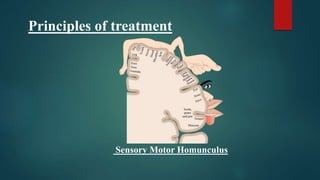
Principles of treatment
Sensory Motor Homunculus
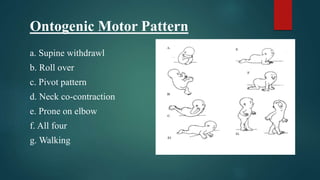
Ontogenic Motor Pattern
a. Supine withdrawl
b. Roll over
c. Pivot pattern
d. Neck co-contraction
e. Prone on elbow
f. All four
g. Walking
Sequence Of Motor Development
1. Reciprocal innervation
2. Co-contraction
3. Mobility superimposed on stability
4. Distal mobility with proximal stability
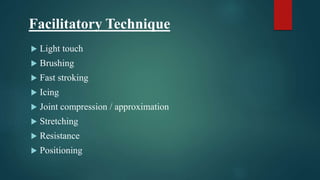
Facilitatory Technique
 Light touch
 Brushing
 Fast stroking
 Icing
 Joint compression / approximation
 Stretching
 Resistance
 Positioning
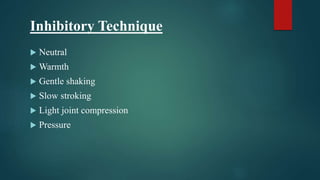
Inhibitory Technique
 Neutral
 Warmth
 Gentle shaking
 Slow stroking
 Light joint compression
 Pressure
Facilitatory Technique
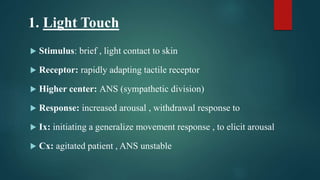
1. Light Touch
 Stimulus: brief , light contact to skin
 Receptor: rapidly adapting tactile receptor
 Higher center: ANS (sympathetic division)
 Response: increased arousal , withdrawal response to
 Ix: initiating a generalize movement response , to elicit arousal
 Cx: agitated patient , ANS unstable
2. Fast Brushing
 Stimulus: battery operated brush , camel hair brush use over skin
overlying the myotomes
 Receptor: hair end organs , free nerve ending
 Response: increased arousal ,activate muscle & improve the
sensory function
 Higher center: reticular activating center
 Ix: sensory integration patient
 Use: for 3sec over same area
3. Icing
 Stimulate: ice cube over skin overlying the muscle
 Receptor: free nerve ending
 Type: 2
1. A icing /quick icing
2. C icing
 Response: - in A icing facilitate the muscle contraction
- In C icing improve the postural tone
 Use: 3- 5 stroke in one time
 Cx: in cardiovascular problem & don't applied over neck which
cause sudden low BP
4. Quick Stretch
 Stimulus: quick stretch or tapping over a muscle belly or tendon
 Receptor: muscle spindle ia
 Response: activates agonist to contract; reciprocally inhibit the
antagonist activation
 CX: in spasticity
5. Resistance
 Stimulus: manually or with body weight or gravity; mechanical
weights
 Receptor: muscle spindle
 Response: enhances muscles contraction through recruitment ;
enhances kinesthetic awareness
6. Approximation/Joint Compression
 Stimulus: compression of joint surface ; manual or mechanical or
mechanical; bouncing applied in weight bearing
 Receptor: joint receptor
 Response: enhances muscular co-contraction , postural stabity &
increase kinesthetic awareness
 Cx: inflamed joint
7. Traction
 Stimulus: joint surface distracted , usually manually and at
beginning of movement
 Receptor: joint receptor
 Response: facilitates muscle activation to improve mobility and
movement initiation
8.Fast Vestibular Stimulation
 Stimulus: fast or irregular movement with an acceleration and
deceleration component , such as spinning , use of a scooter board ,
fast rolling
 Receptor: semicircular canals
 Response: facilitates general muscle tone and promote postural
response to movement
 Ix: hypotonia ( CP , Down syndrome ) ; used to promote sensory
integration(required specialized training and certification)
Inhibitory Techniques
1. Prolonged Stretch
 Stimulus: maintained stretch in a lengthened range
 Receptor: muscle spindle ia and ii endings, Golgi tendon organs
 Response: inhibits muscle contraction
2. Inhibitory Pressure
 Stimulus: firm pressure manually or with body weight over
muscle belly or tendon
 Receptor: GTO , muscle spindles , tactile receptors
 Response: inhibits muscle activity
 Equipment uses: casts , splints , placing cones in hand, position at
use of wheelchair lap tray ; weight bearing positioning (open hand
to inhibit finger flexors
3. Maintained Touch
 Stimulus: maintained contact or pressure
 Receptor: slowly adapting tactile receptors
 Higher center: ANS (para-sympathetic division)
 Responses: calming effect, desensitizes skin , general inhibition
 Ix: patient with higher level of arousal or hypersensitivity
4. Neutral Warmth
 Stimulus: Towel or elastic wrap of body or body parts
 Receptor: Thermo receptors
 Response: Provides general relaxation & inhibition; decreased
muscle tone ; decreased agitation or pain
 Higher center: ANS (parasympathetic division)
 Use: use for 10-15min; avoid overheating; appropriate for highly
agitated patient or individual with increased sympathetic response
5. Slow Vestibular Stimulation
 Stimulus: slow rocking , slow movement on ball , in hammock , in
rocking chair
 Receptor: Tonic vestibular receptors
 Response: Produce calming effect , decreased arousal ,
generalized inhibition
 Ix: patient who are defensive to sensory stimulation ,
hyperreactive to stimulation , hypertonic or agitated
6. Slow Stroking
 Stimulus: slow , firm stroking with flat hand over neck or trunk
extensors
 Receptor: Tactile Receptor
 Response: produce calming effect , general inhibition ; induces
feeling of security
 Higher Center: ANS (parasympathetic division)
 Ix: over arousal patient

Roods Approaches

  • 1.
    Inhibitory & facilitatorytechnique By: Dr.Sagar S. Gajra (F.Y.MPT)
  • 2.
    Objectives  Introduction  Goals Principles of treatment  Ontogenic motor pattern  Sequence of motor development  Ontogenetic motor patterns  Facilitation technique  Inhibition technique
  • 3.
    Facilitatory Technique  Itis process of intervention , which used to the improved postural tone in a goal directed activity.  Facilitation makes movement easier but in the treatment it also means “make it possible” & “making it have to happen”  In this, tactile, vestibular & proprioceptive input also assist in the regulation of the body responses to movement.
  • 4.
    Inhibitory Technique • Thistechnique also used to maintain muscle tone • This technique is opposed to facilitatory technique
  • 5.
    Rood Approach  Thisapproach developed by margaret rood in 1956.  Rood approach deals with the activation or de-activation of sensory receptors, which is concerned with the interaction of somatic, autonomic and psychic factors and their role in the regulation of motor behavior  This approaches was designed for the patient with motor control problem.
  • 6.
    Goals  Normalize muscletone  Treatment begins at developmental level of functioning - Cephalocaudal rule - Proximal to distal  Movement is directed toward functional goals  Repetition is necessary for re-education of muscular response
  • 7.
  • 8.
    Ontogenic Motor Pattern a.Supine withdrawl b. Roll over c. Pivot pattern d. Neck co-contraction e. Prone on elbow f. All four g. Walking
  • 9.
    Sequence Of MotorDevelopment 1. Reciprocal innervation 2. Co-contraction 3. Mobility superimposed on stability 4. Distal mobility with proximal stability
  • 10.
    Facilitatory Technique  Lighttouch  Brushing  Fast stroking  Icing  Joint compression / approximation  Stretching  Resistance  Positioning
  • 11.
    Inhibitory Technique  Neutral Warmth  Gentle shaking  Slow stroking  Light joint compression  Pressure
  • 12.
  • 13.
    1. Light Touch Stimulus: brief , light contact to skin  Receptor: rapidly adapting tactile receptor  Higher center: ANS (sympathetic division)  Response: increased arousal , withdrawal response to  Ix: initiating a generalize movement response , to elicit arousal  Cx: agitated patient , ANS unstable
  • 14.
    2. Fast Brushing Stimulus: battery operated brush , camel hair brush use over skin overlying the myotomes  Receptor: hair end organs , free nerve ending  Response: increased arousal ,activate muscle & improve the sensory function  Higher center: reticular activating center
  • 15.
     Ix: sensoryintegration patient  Use: for 3sec over same area
  • 16.
    3. Icing  Stimulate:ice cube over skin overlying the muscle  Receptor: free nerve ending  Type: 2 1. A icing /quick icing 2. C icing
  • 17.
     Response: -in A icing facilitate the muscle contraction - In C icing improve the postural tone  Use: 3- 5 stroke in one time  Cx: in cardiovascular problem & don't applied over neck which cause sudden low BP
  • 18.
    4. Quick Stretch Stimulus: quick stretch or tapping over a muscle belly or tendon  Receptor: muscle spindle ia  Response: activates agonist to contract; reciprocally inhibit the antagonist activation  CX: in spasticity
  • 19.
    5. Resistance  Stimulus:manually or with body weight or gravity; mechanical weights  Receptor: muscle spindle  Response: enhances muscles contraction through recruitment ; enhances kinesthetic awareness
  • 20.
    6. Approximation/Joint Compression Stimulus: compression of joint surface ; manual or mechanical or mechanical; bouncing applied in weight bearing  Receptor: joint receptor  Response: enhances muscular co-contraction , postural stabity & increase kinesthetic awareness  Cx: inflamed joint
  • 21.
    7. Traction  Stimulus:joint surface distracted , usually manually and at beginning of movement  Receptor: joint receptor  Response: facilitates muscle activation to improve mobility and movement initiation
  • 22.
    8.Fast Vestibular Stimulation Stimulus: fast or irregular movement with an acceleration and deceleration component , such as spinning , use of a scooter board , fast rolling  Receptor: semicircular canals  Response: facilitates general muscle tone and promote postural response to movement
  • 23.
     Ix: hypotonia( CP , Down syndrome ) ; used to promote sensory integration(required specialized training and certification)
  • 24.
  • 25.
    1. Prolonged Stretch Stimulus: maintained stretch in a lengthened range  Receptor: muscle spindle ia and ii endings, Golgi tendon organs  Response: inhibits muscle contraction
  • 26.
    2. Inhibitory Pressure Stimulus: firm pressure manually or with body weight over muscle belly or tendon  Receptor: GTO , muscle spindles , tactile receptors  Response: inhibits muscle activity  Equipment uses: casts , splints , placing cones in hand, position at use of wheelchair lap tray ; weight bearing positioning (open hand to inhibit finger flexors
  • 27.
    3. Maintained Touch Stimulus: maintained contact or pressure  Receptor: slowly adapting tactile receptors  Higher center: ANS (para-sympathetic division)  Responses: calming effect, desensitizes skin , general inhibition  Ix: patient with higher level of arousal or hypersensitivity
  • 28.
    4. Neutral Warmth Stimulus: Towel or elastic wrap of body or body parts  Receptor: Thermo receptors  Response: Provides general relaxation & inhibition; decreased muscle tone ; decreased agitation or pain  Higher center: ANS (parasympathetic division)  Use: use for 10-15min; avoid overheating; appropriate for highly agitated patient or individual with increased sympathetic response
  • 29.
    5. Slow VestibularStimulation  Stimulus: slow rocking , slow movement on ball , in hammock , in rocking chair  Receptor: Tonic vestibular receptors  Response: Produce calming effect , decreased arousal , generalized inhibition  Ix: patient who are defensive to sensory stimulation , hyperreactive to stimulation , hypertonic or agitated
  • 30.
    6. Slow Stroking Stimulus: slow , firm stroking with flat hand over neck or trunk extensors  Receptor: Tactile Receptor  Response: produce calming effect , general inhibition ; induces feeling of security  Higher Center: ANS (parasympathetic division)  Ix: over arousal patient