Bobath
Therapy
[NDT]
Dr. Jasjyot Kaur Sabharwal (PT)
• The Bobath concept is an evolving approach
to the management and treatment of children
and adults with mobility difficulties caused by
neurological conditions such as cerebral
palsy and strokes.
This therapeutic approach was originated
over 50 years ago based upon clinical
experience using models of movement and
neuroscience available at that time.
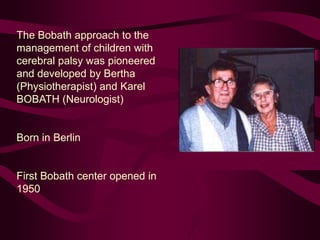
The Bobath approach to the
management of children with
cerebral palsy was pioneered
and developed by Bertha
(Physiotherapist) and Karel
BOBATH (Neurologist)
Born in Berlin
First Bobath center opened in
1950
Bobath – concept [NDT]
Neuro : based on neuro-anatomy and neuro-
physiology
Developmental : the normal development of aging
child guides us through the rehabilitation process
Treatment : a structured and methodic approach
of the rehabilitation issues for stroke patients
Inhibition of abnormal tone & posture of released postural reflex
while facilitating specific automatic motor response (by special
technique of handling) resulting in performance of skilled
voluntary movements.
The Bobath approach to treatment
• The Bobath treatment aims to improve
posture and movement to enable more
realistic functioning in daily life.
• Through specialised ways of handling,
stiffness can be reduced, muscle control
against gravity increased and fluctuating
muscle activity stabilised.
• Depending on the severity of the condition,
the child may be better able to learn how to
sit up, use his/her hands, to stand up, to
stand, and to walk.
• Ideally the treatment will be an integral part of
the daily routine for that child.
• For example, the way the child is picked up,
carried, put down, or positioned when sitting,
will enable parents/carers to enhance the
child's ability and function.
• Treatment is tailored to clients' individual
needs and is based upon an assessment of
their abilities and analysis of their movement
disorder.
• This is achieved through the use of
specialized handling techniques that help to
reduce spasticity and facilitate more normal
movement.
AIM OF TREATMENT
• To improve the quality of movement on
affected side, so that ultimately the 2 sides
work together as harmoniously as possible
within the scope of the cerebral injury.
In general, the results of a treatment depends
on
- measure of spasticity
- sensibility disorders
- perceptive disorders
- incontinence
- duration and deepness of coma
And not on the use of a treatment concept
!!!!!!!!!!!!!!
NOT
Overload of not affected body half to
compensate loss of functionality in
affected body half.
Two major principles:
Plasticity of the central nerval system
The brain is able to learn and from that the
brain is also able te relearn
Initiation of a normal development
The normal development (0y-3y) shows the
same major developments but we can also
notice little individual differences in
development
Structural Bobath thinking
1. Analysis of normal movements
2. Analysis of pathological movements
3. Analysis of rehabilitation technics and methods
Analysis of normal movements
After 3yrs there are recognizable, specific patterns with
little individual differences
Intentional movements
- specific
- intended
- controlled
Automatic reactions
- unconsciously
Intentional movements
Coarse motor skills
Postural
Global movements
Fine motor skills
Hand functions
Mouth n face functions
Automatic reactions
Head raise response
Positive support reflex
Parachute response
Propping
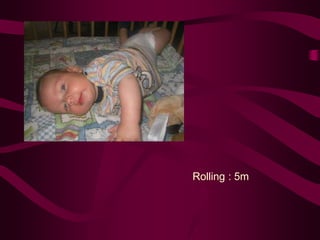
Rolling : 5m
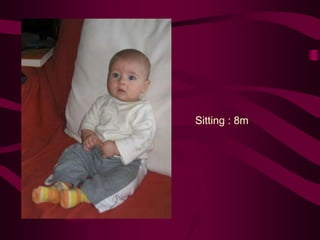
Sitting : 8m
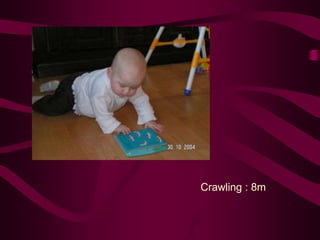
Crawling : 8m
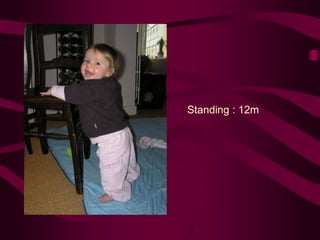
Standing : 12m
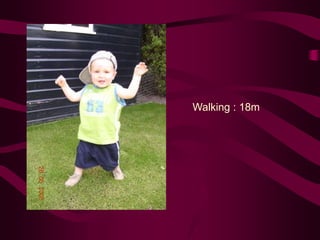
Walking : 18m
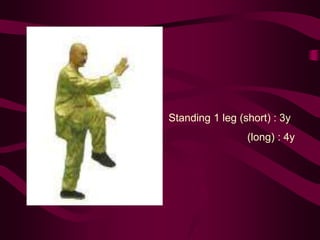
Standing 1 leg (short) : 3y
(long) : 4y
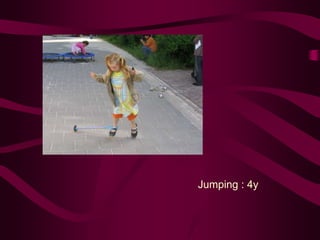
Jumping : 4y
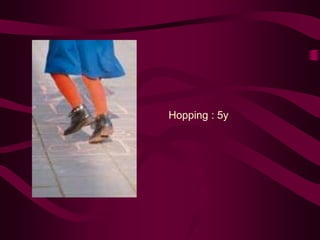
Hopping : 5y
REHABILITATION
BOBATH - CONCEPT
Conditions for a normal development
of the motor skills
Sensory-motor conditions
- muscle tone
- adaptation to postural changes
- mobility, feeling, senses, endurance
Cognition
Psychological and Social conditions
Control of movement
From proximal to distal
From global to selective
From reflex to reaction
From spontanuous to functional
Conclusions
Normal moving includes
Mechanisms of postural reflexes
Mechanisms of postural reactions
Normal muscle tonus
Reciprocal innervation/inhibition
Automatic movement patterns
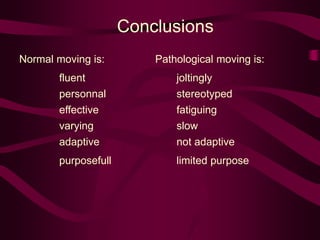
Conclusions
Normal moving is:
fluent
personnal
effective
varying
adaptive
purposefull
Pathological moving is:
joltingly
stereotyped
fatiguing
slow
not adaptive
limited purpose
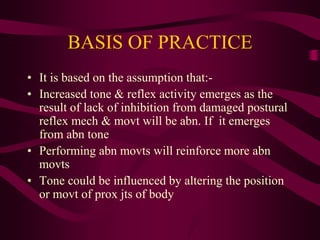
BASIS OF PRACTICE
• It is based on the assumption that:-
• Increased tone & reflex activity emerges as the
result of lack of inhibition from damaged postural
reflex mech & movt will be abn. If it emerges
from abn tone
• Performing abn movts will reinforce more abn
movts
• Tone could be influenced by altering the position
or movt of prox jts of body
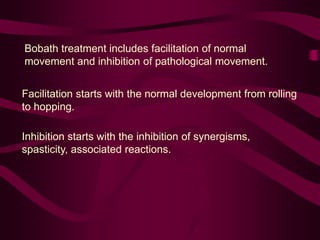
Bobath treatment includes facilitation of normal
movement and inhibition of pathological movement.
Facilitation starts with the normal development from rolling
to hopping.
Inhibition starts with the inhibition of synergisms,
spasticity, associated reactions.
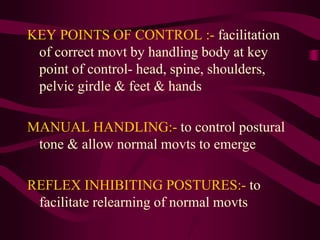
KEY POINTS OF CONTROL :- facilitation
of correct movt by handling body at key
point of control- head, spine, shoulders,
pelvic girdle & feet & hands
MANUAL HANDLING:- to control postural
tone & allow normal movts to emerge
REFLEX INHIBITING POSTURES:- to
facilitate relearning of normal movts
REFLEX INHIBITING POSTURES
Consequences in positioning and transfer
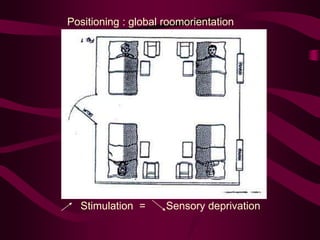
Positioning : global roomorientation
Stimulation = Sensory deprivation
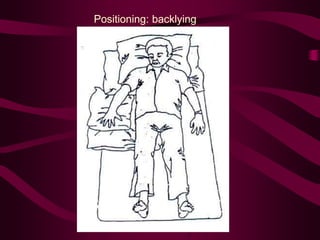
Positioning: backlying
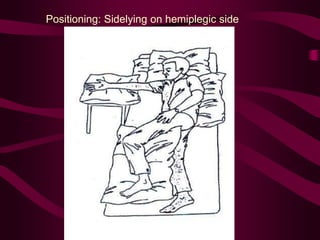
Positioning: Sidelying on hemiplegic side
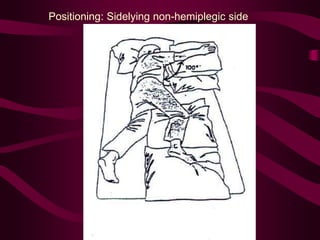
Positioning: Sidelying non-hemiplegic side
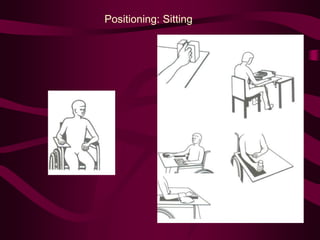
Positioning: Sitting
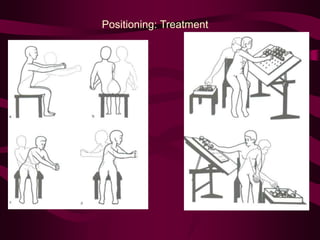
Positioning: Treatment
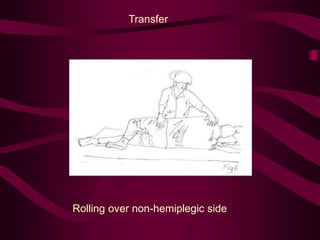
Transfer
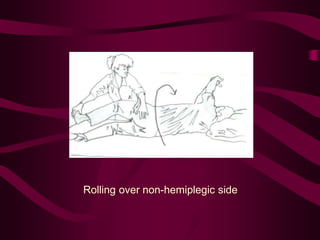
Rolling over non-hemiplegic side
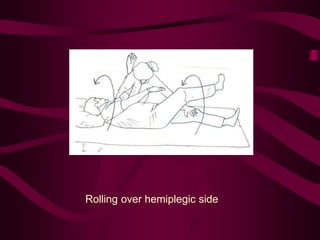
Rolling over hemiplegic side
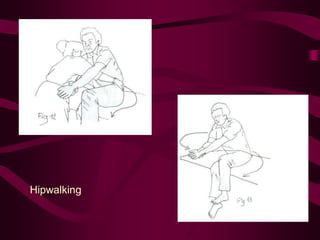
Hipwalking
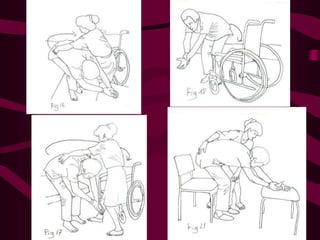
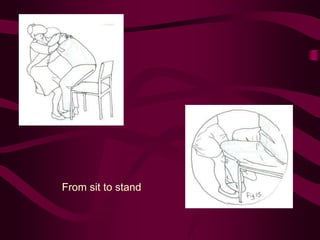
From sit to stand
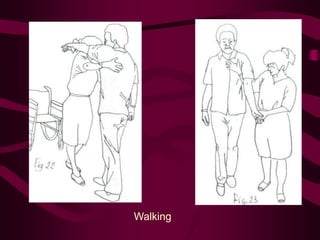
Walking
ASSESSMENT
• The aims of the treatment are goal-
orientated and influenced by several
factors such as the age of the child,
severity of their condition and their
motivation.
• Treatment is planned for each child via
assessment. Some of the areas that will
be assessed are:-.
  The patterns of movement the child
presents with.
  Age-appropriate movements that the
child may not be achieving or may find
difficult.
  The child's present capabilities.
  Examination of the child's posture in
different situations and positions.
• Once the child has been assessed, a
prioritised 'problem-solving' list will be
formulated, and then appropriate
techniques used to address these
areas.
• Positioning is very important in Bobath
treatment. Correct positioning helps
improve movements. Experience of
different positions is necessary to
improve overall body control and reduce
the risk of unnecessary poor posture.
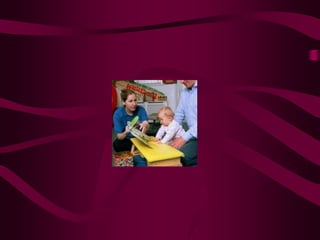
• Handling a child using key points on the
body allows the therapist to manipulate the
child to correct their movements.
• Help may be given with movements like
chewing, handling objects, moving about,
sitting or lying down.
• Even when a child is being carried, using
correct positioning and handling of 'key
points' on the child's body, is considered
very important, as this lets the child
experience, as far possible, normal
movement patterns.
• The main aim of treatment is to encourage
and increase the child's ability to move and
function in as normal a way as possible.
• More normal movements cannot be
obtained if the child stays in a few positions
and moves in a limited or disordered way.
• The aim of management is to help the child
to change his abnormal postures and
movements so that he or she is able to
comfortably adapt to the environment and
develop a better quality of functional skills.
THANKYOU

Bobath therapy.ppt

  • 1.
  • 2.
    • The Bobathconcept is an evolving approach to the management and treatment of children and adults with mobility difficulties caused by neurological conditions such as cerebral palsy and strokes. This therapeutic approach was originated over 50 years ago based upon clinical experience using models of movement and neuroscience available at that time.
  • 3.
    The Bobath approachto the management of children with cerebral palsy was pioneered and developed by Bertha (Physiotherapist) and Karel BOBATH (Neurologist) Born in Berlin First Bobath center opened in 1950
  • 4.
    Bobath – concept[NDT] Neuro : based on neuro-anatomy and neuro- physiology Developmental : the normal development of aging child guides us through the rehabilitation process Treatment : a structured and methodic approach of the rehabilitation issues for stroke patients Inhibition of abnormal tone & posture of released postural reflex while facilitating specific automatic motor response (by special technique of handling) resulting in performance of skilled voluntary movements.
  • 5.
    The Bobath approachto treatment • The Bobath treatment aims to improve posture and movement to enable more realistic functioning in daily life. • Through specialised ways of handling, stiffness can be reduced, muscle control against gravity increased and fluctuating muscle activity stabilised. • Depending on the severity of the condition, the child may be better able to learn how to sit up, use his/her hands, to stand up, to stand, and to walk. • Ideally the treatment will be an integral part of the daily routine for that child.
  • 6.
    • For example,the way the child is picked up, carried, put down, or positioned when sitting, will enable parents/carers to enhance the child's ability and function. • Treatment is tailored to clients' individual needs and is based upon an assessment of their abilities and analysis of their movement disorder. • This is achieved through the use of specialized handling techniques that help to reduce spasticity and facilitate more normal movement.
  • 7.
    AIM OF TREATMENT •To improve the quality of movement on affected side, so that ultimately the 2 sides work together as harmoniously as possible within the scope of the cerebral injury.
  • 8.
    In general, theresults of a treatment depends on - measure of spasticity - sensibility disorders - perceptive disorders - incontinence - duration and deepness of coma And not on the use of a treatment concept !!!!!!!!!!!!!!
  • 9.
    NOT Overload of notaffected body half to compensate loss of functionality in affected body half.
  • 10.
    Two major principles: Plasticityof the central nerval system The brain is able to learn and from that the brain is also able te relearn Initiation of a normal development The normal development (0y-3y) shows the same major developments but we can also notice little individual differences in development
  • 11.
    Structural Bobath thinking 1.Analysis of normal movements 2. Analysis of pathological movements 3. Analysis of rehabilitation technics and methods
  • 12.
    Analysis of normalmovements After 3yrs there are recognizable, specific patterns with little individual differences Intentional movements - specific - intended - controlled Automatic reactions - unconsciously
  • 13.
    Intentional movements Coarse motorskills Postural Global movements Fine motor skills Hand functions Mouth n face functions
  • 14.
    Automatic reactions Head raiseresponse Positive support reflex Parachute response Propping
  • 15.
  • 16.
  • 17.
  • 18.
  • 19.
  • 20.
    Standing 1 leg(short) : 3y (long) : 4y
  • 21.
  • 22.
  • 23.
  • 24.
    Conditions for anormal development of the motor skills Sensory-motor conditions - muscle tone - adaptation to postural changes - mobility, feeling, senses, endurance Cognition Psychological and Social conditions
  • 25.
    Control of movement Fromproximal to distal From global to selective From reflex to reaction From spontanuous to functional
  • 26.
    Conclusions Normal moving includes Mechanismsof postural reflexes Mechanisms of postural reactions Normal muscle tonus Reciprocal innervation/inhibition Automatic movement patterns
  • 27.
    Conclusions Normal moving is: fluent personnal effective varying adaptive purposefull Pathologicalmoving is: joltingly stereotyped fatiguing slow not adaptive limited purpose
  • 28.
    BASIS OF PRACTICE •It is based on the assumption that:- • Increased tone & reflex activity emerges as the result of lack of inhibition from damaged postural reflex mech & movt will be abn. If it emerges from abn tone • Performing abn movts will reinforce more abn movts • Tone could be influenced by altering the position or movt of prox jts of body
  • 29.
    Bobath treatment includesfacilitation of normal movement and inhibition of pathological movement. Facilitation starts with the normal development from rolling to hopping. Inhibition starts with the inhibition of synergisms, spasticity, associated reactions.
  • 30.
    KEY POINTS OFCONTROL :- facilitation of correct movt by handling body at key point of control- head, spine, shoulders, pelvic girdle & feet & hands MANUAL HANDLING:- to control postural tone & allow normal movts to emerge REFLEX INHIBITING POSTURES:- to facilitate relearning of normal movts
  • 31.
    REFLEX INHIBITING POSTURES Consequencesin positioning and transfer
  • 32.
    Positioning : globalroomorientation Stimulation = Sensory deprivation
  • 33.
  • 34.
  • 35.
  • 36.
  • 37.
  • 39.
  • 40.
  • 41.
  • 42.
  • 43.
  • 45.
  • 46.
    ASSESSMENT • The aimsof the treatment are goal- orientated and influenced by several factors such as the age of the child, severity of their condition and their motivation. • Treatment is planned for each child via assessment. Some of the areas that will be assessed are:-.   The patterns of movement the child presents with.
  • 47.
      Age-appropriatemovements that the child may not be achieving or may find difficult.   The child's present capabilities.   Examination of the child's posture in different situations and positions. • Once the child has been assessed, a prioritised 'problem-solving' list will be formulated, and then appropriate techniques used to address these areas.
  • 48.
    • Positioning isvery important in Bobath treatment. Correct positioning helps improve movements. Experience of different positions is necessary to improve overall body control and reduce the risk of unnecessary poor posture.
  • 51.
    • Handling achild using key points on the body allows the therapist to manipulate the child to correct their movements. • Help may be given with movements like chewing, handling objects, moving about, sitting or lying down. • Even when a child is being carried, using correct positioning and handling of 'key points' on the child's body, is considered very important, as this lets the child experience, as far possible, normal movement patterns.
  • 52.
    • The mainaim of treatment is to encourage and increase the child's ability to move and function in as normal a way as possible. • More normal movements cannot be obtained if the child stays in a few positions and moves in a limited or disordered way. • The aim of management is to help the child to change his abnormal postures and movements so that he or she is able to comfortably adapt to the environment and develop a better quality of functional skills.
  • 53.