ROBOTICS

      A Presentation by :-

             SK. Mushtaq Ahmed
            Mechanical Department
               HT no: 11F01A0389
                   SACET
• Robotics

• Why Robotics?

• Types of Robot

• Laws of Robotics

• Components of Robots

• Advantages

• Future prospects
ROBOTICS

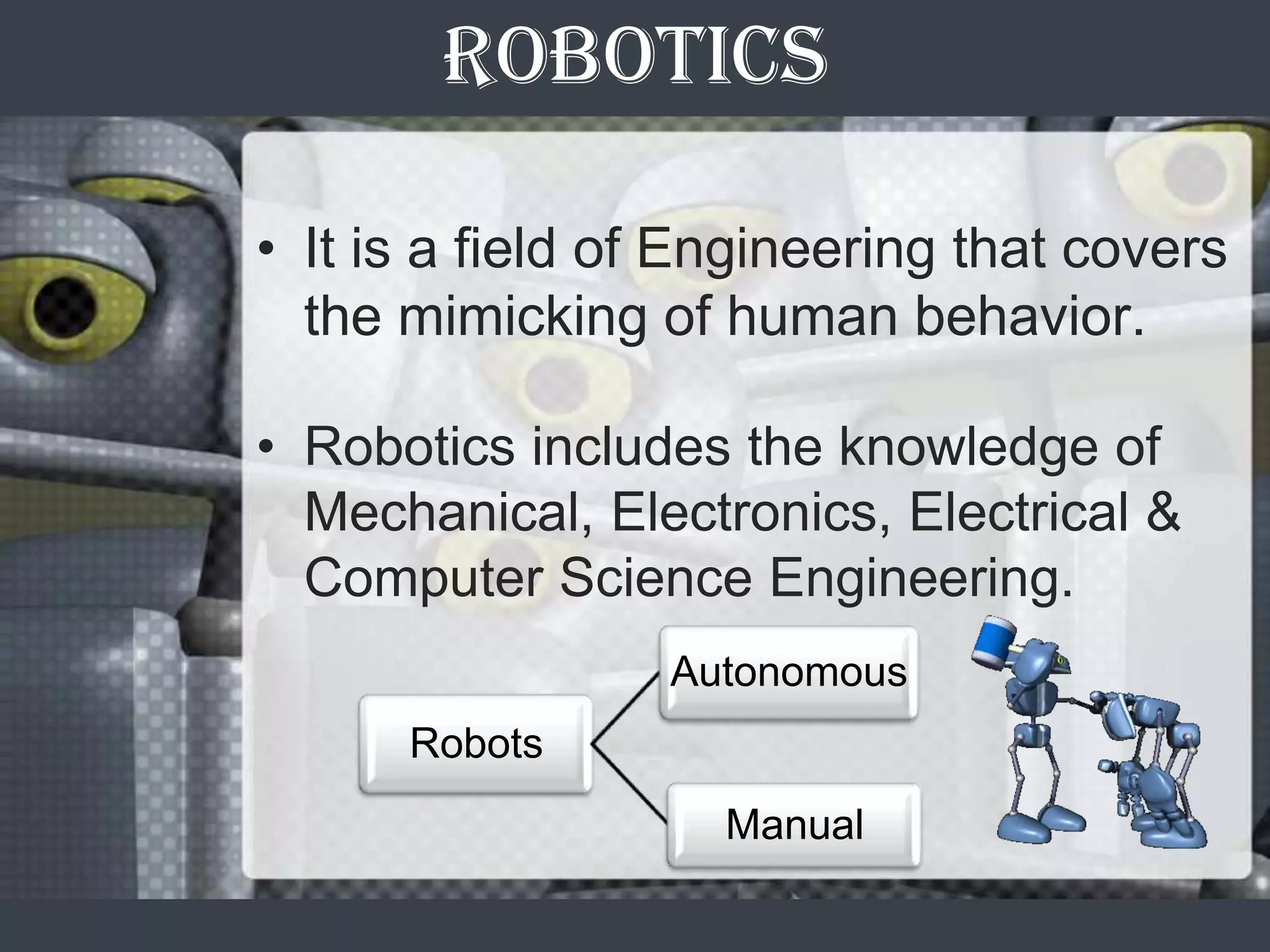
• It is a field of Engineering that covers
  the mimicking of human behavior.

• Robotics includes the knowledge of
  Mechanical, Electronics, Electrical &
  Computer Science Engineering.
                 Autonomous
      Robots
                    Manual
Why Robotics?
 Speed.

 It can work hazardous/dangerous environment.

 To perform repetitive task.

 Efficiency

 Accuracy

 Adaptability
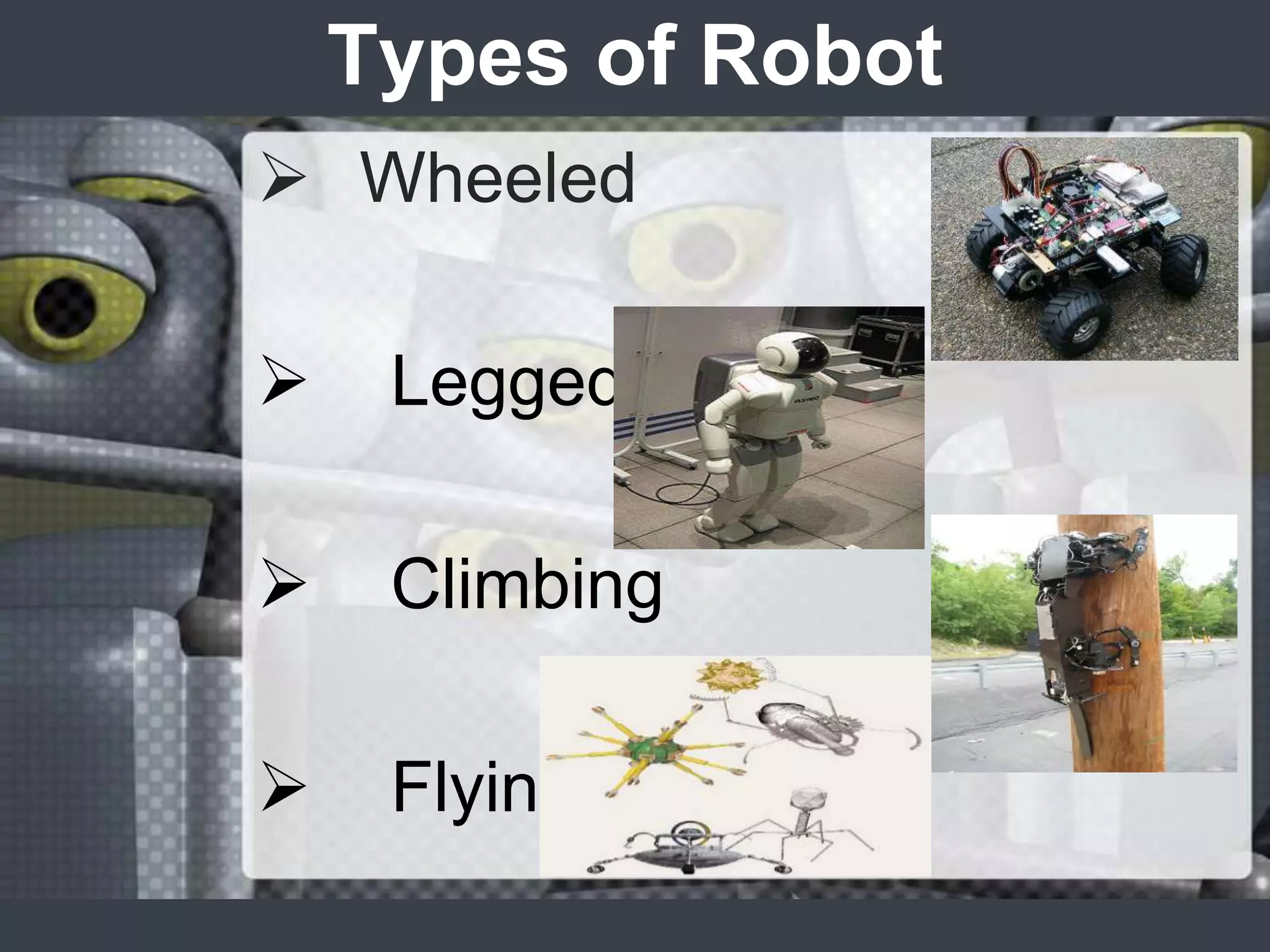
Types of Robot
 Wheeled

    Legged

    Climbing

    Flying
Laws of Robotics
   A robot may not injure a human
    being, or, through inaction, allow a
    human being to come to harm.

   A robot must obey the orders given it
    by human beings except where such
    order would conflict with the First Law.

   A robot must protect its own
    existence as long as such protection
    does not conflict with the First or
    Second Law.
Components of Robots

      Structure
      Power source
      Actuation
      Manipulation
      Locomotion
      Sensing
STRUCTURE:
  The structure of a robot is usually mostly
  mechanical and can be called a kinematic
  chain.
POWER SOURCE:
 Typical power requirement ranges from 3V to
  24V DC
 220V AC supply must be modified to suit the
  needs of our machine
 Batteries can also be used to run robots
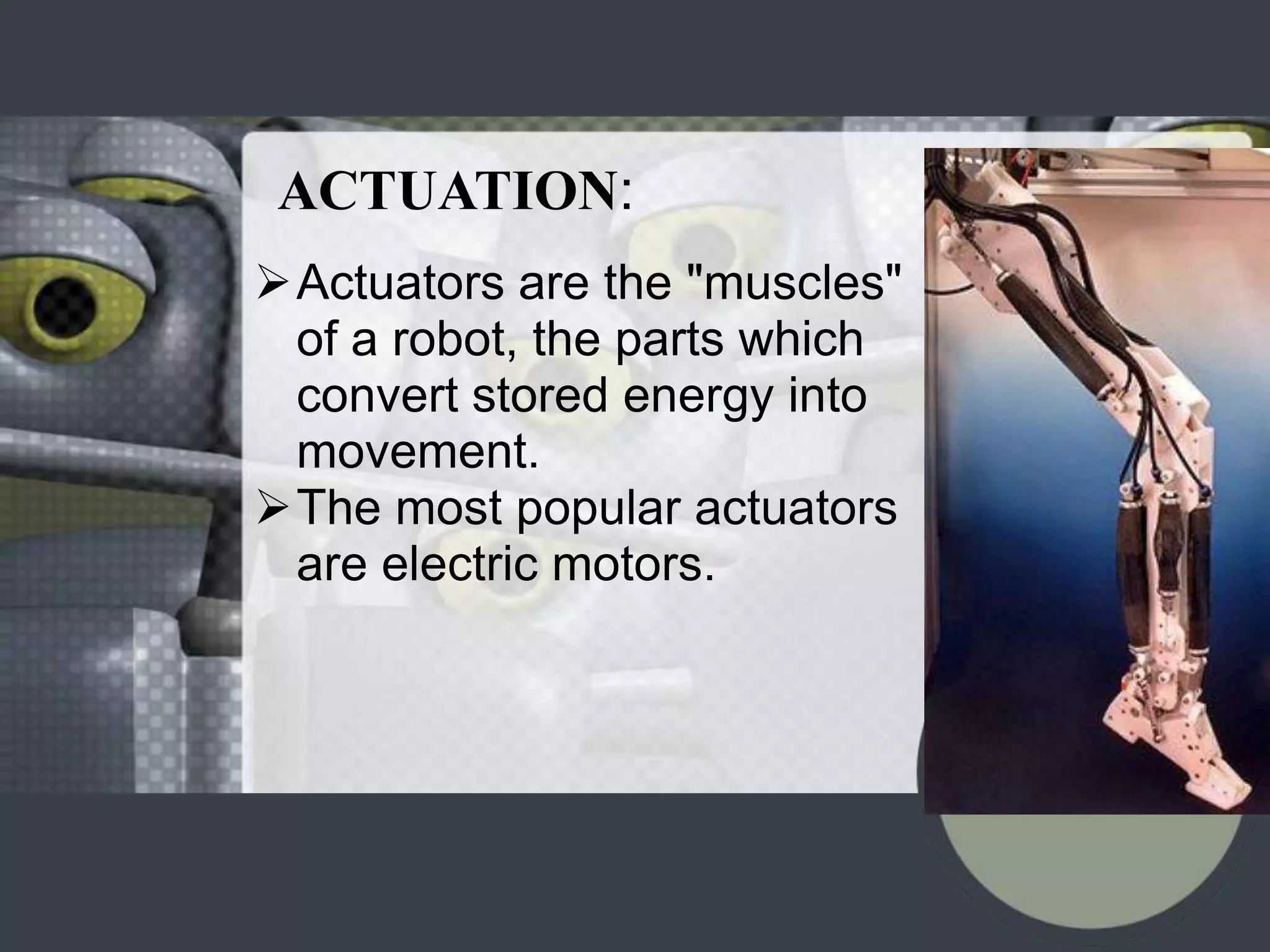
ACTUATION:
Actuators are the "muscles"
 of a robot, the parts which
 convert stored energy into
 movement.
The most popular actuators
 are electric motors.
MANIPULATION:
 The 'hands' of a robot are often referred
 to as end effectors, while the arm is
 referred to as a manipulator.


LOCOMOTION:
 It is concerned with the motion of the
 robot.
Advantages

•   Revolution in Medical science and
    Health care systems.
•   New & wide scope in Education &
    Training.
• A good help in Nuclear industry.
•   Used tremendously in Sports activities

•   Play the role of an efficient assistance in
    Research and Development sciences.
• Can very well handle household
  business.
Future prospects
•   Scientists say that it is possible that a robot brain
    will exist by 2019 .
•  Vernor Vinge has suggested that a
  moment may come when computers and
  robots are smarter than humans.
• In 2009, some robots acquired various
  forms of semi-autonomy, including being
  able to find power sources on their own.
•    The Association for the Advancement
    of Artificial Intelligence has researched
    on this problem.
Conclusion
Ahmed’s

Robotics

  • 1.
    ROBOTICS A Presentation by :- SK. Mushtaq Ahmed Mechanical Department HT no: 11F01A0389 SACET
  • 2.
    • Robotics • WhyRobotics? • Types of Robot • Laws of Robotics • Components of Robots • Advantages • Future prospects
  • 3.
    ROBOTICS • It isa field of Engineering that covers the mimicking of human behavior. • Robotics includes the knowledge of Mechanical, Electronics, Electrical & Computer Science Engineering. Autonomous Robots Manual
  • 4.
    Why Robotics?  Speed. It can work hazardous/dangerous environment.  To perform repetitive task.  Efficiency  Accuracy  Adaptability
  • 5.
    Types of Robot Wheeled  Legged  Climbing  Flying
  • 6.
    Laws of Robotics  A robot may not injure a human being, or, through inaction, allow a human being to come to harm.  A robot must obey the orders given it by human beings except where such order would conflict with the First Law.  A robot must protect its own existence as long as such protection does not conflict with the First or Second Law.
  • 7.
    Components of Robots  Structure  Power source  Actuation  Manipulation  Locomotion  Sensing
  • 8.
    STRUCTURE: Thestructure of a robot is usually mostly mechanical and can be called a kinematic chain. POWER SOURCE:  Typical power requirement ranges from 3V to 24V DC  220V AC supply must be modified to suit the needs of our machine  Batteries can also be used to run robots
  • 9.
    ACTUATION: Actuators are the"muscles" of a robot, the parts which convert stored energy into movement. The most popular actuators are electric motors.
  • 10.
    MANIPULATION: The 'hands'of a robot are often referred to as end effectors, while the arm is referred to as a manipulator. LOCOMOTION: It is concerned with the motion of the robot.
  • 11.
    Advantages • Revolution in Medical science and Health care systems. • New & wide scope in Education & Training. • A good help in Nuclear industry. • Used tremendously in Sports activities • Play the role of an efficient assistance in Research and Development sciences. • Can very well handle household business.
  • 12.
    Future prospects • Scientists say that it is possible that a robot brain will exist by 2019 . • Vernor Vinge has suggested that a moment may come when computers and robots are smarter than humans. • In 2009, some robots acquired various forms of semi-autonomy, including being able to find power sources on their own. • The Association for the Advancement of Artificial Intelligence has researched on this problem.
  • 13.
  • 15.