PULIPATI PRASAD INSTIUTE OF
TECHNOLOGY AND SCIENCES ,
KHAMMAM


            A
         SEMINAR
            ON
         ROBOTICS


                       NARESH.D
                       FINAL YEAR, ECE
                       PRESENTED BY:
CONTENTS

•Robotics
•Why Robotics ?
•Types of robots
•Laws of robotics
•Components of robots
•Advantages
•Conclusion
•Queries
WHAT IS ROBOTICS
• A ROBOT IS A ONE-ARMED, BLIND IDIOT WITH
LIMITED MEMORY AND WHICH CANNOT SPEAK,
SEE, OR HEAR.


• IT FIND ITS USES IN ALL ASPECTS OF OUR LIFE
WHY ROBOTICS ?
•Speed.
•It can work hazardous/dangerous
environment.
•To perform repetitive task.
•Efficiency
•Accuracy
•Adaptability
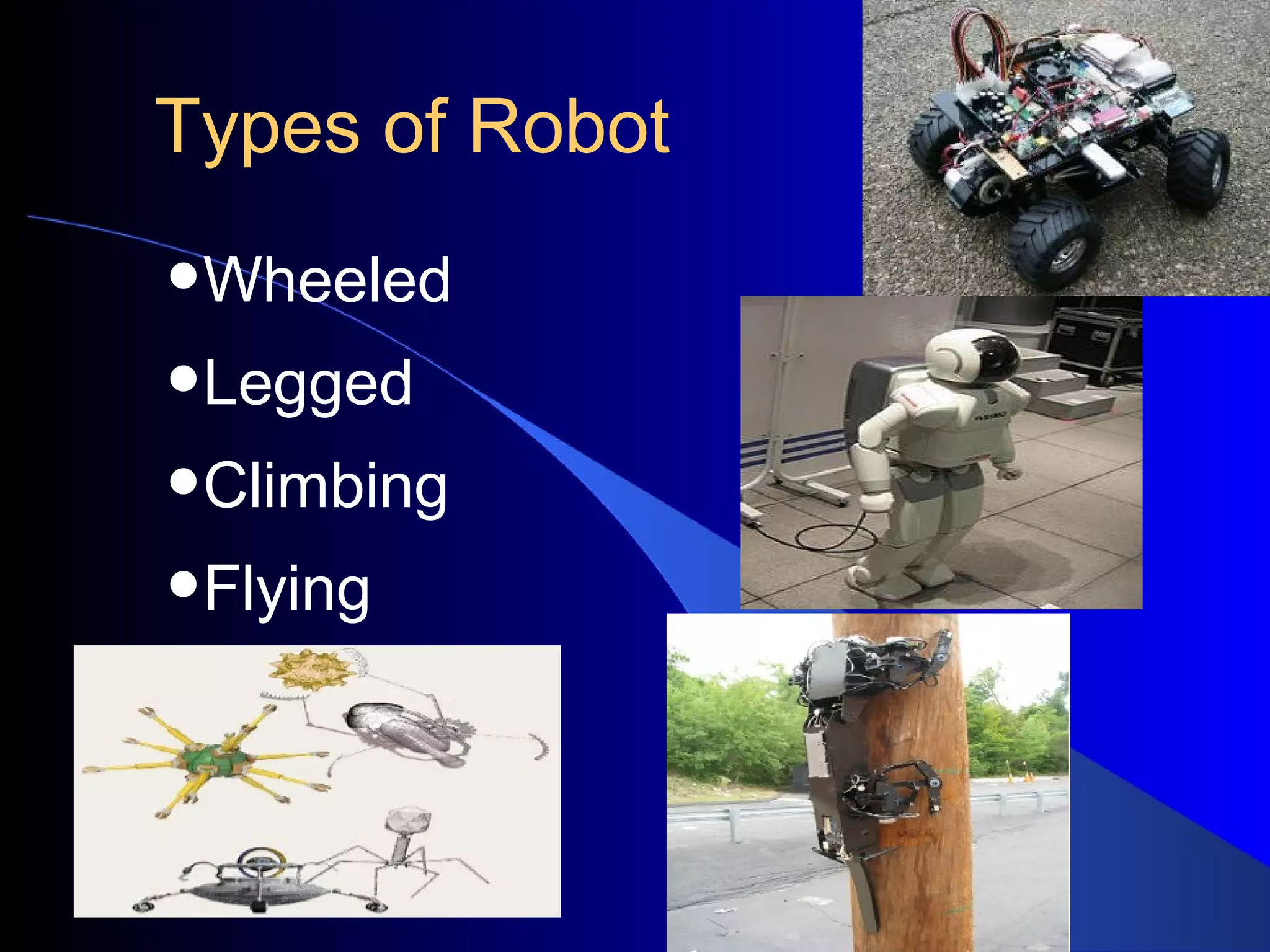
Types of Robot

•Wheeled
•Legged
•Climbing
•Flying
Laws of Robotics

•A robot may not injure a human being, or, through
inaction, allow a human being to come to harm.
•A robot must obey the orders given it by human beings
except where such order would conflict with the First
Law.
•A robot must protect its own existence as long as such
protection does not conflict with the First or Second Law.
Components of ROBOTS

o Structure
o Power source
o Actuation
o Locomotion
Structure
•The structure of a robot is usually
 mostly mechanical and can be
 called a kinematic chain.
•The chain is formed of links (its
 bones), actuators (its muscles), and
 joints which can allow one or more
 degrees of freedom.
Power Supply
• Suitable power supply is needed to run the
 motors and associated circuitry
• Typical power requirement ranges from 3V to 24V
 DC
• 220V AC supply must be modified to suit the
 needs of our machine
• Batteries can also be used to run robots
• Robots are driven by different motors :-
  o DC Motors
  o Stepper Motors
  o Servo Motors
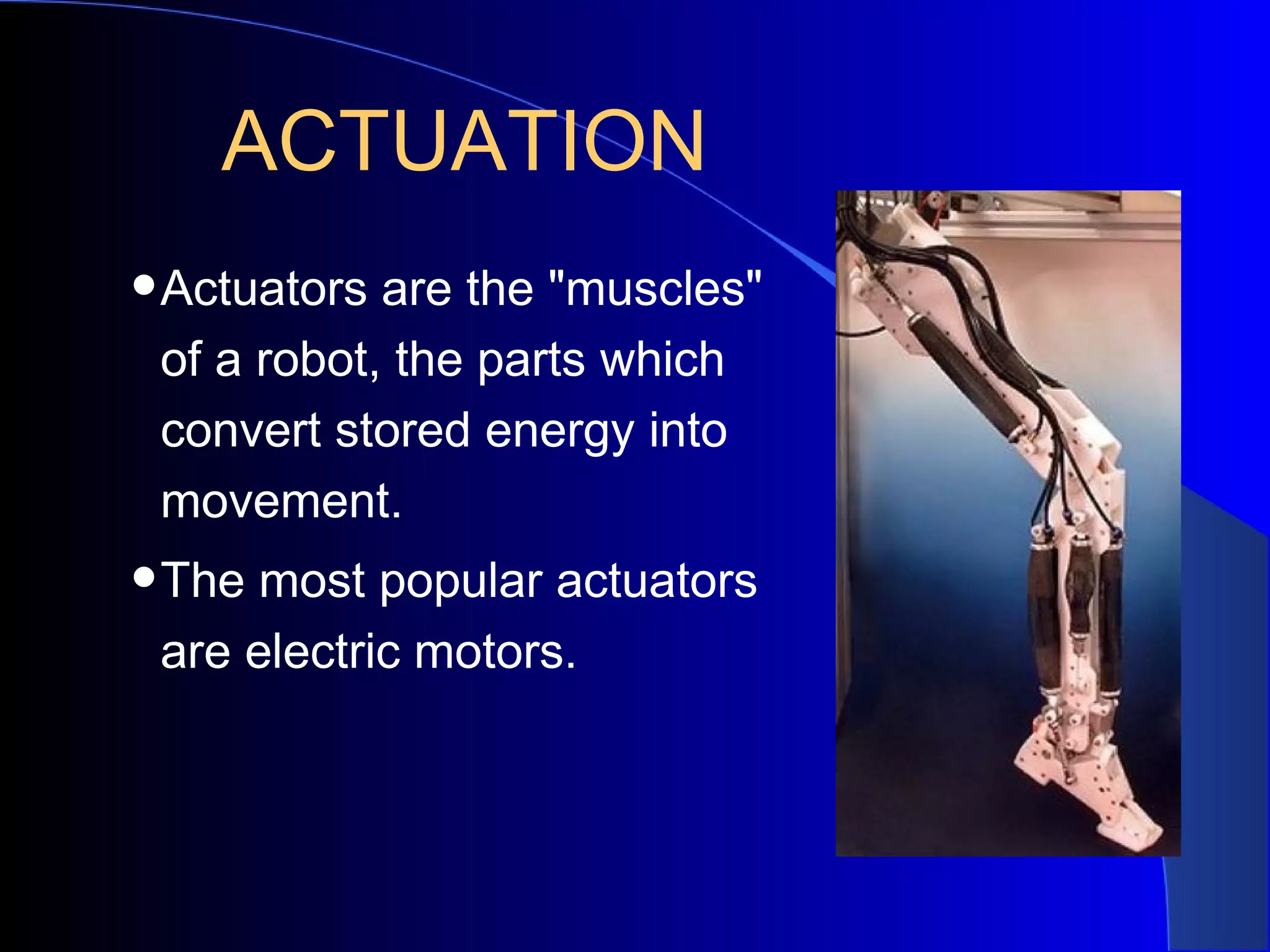
ACTUATION
•Actuators are the "muscles"
 of a robot, the parts which
 convert stored energy into
 movement.
•The most popular actuators
 are electric motors.
LOCOMOTION
• It is concerned with the motion of the robot.
• Robot contains different types of drives:-
  o Differential drive
  o Car type
  o Synchronous drive
ADVANTAGES
•Revolution in Medical science and Health care
 systems.
•New & wide scope in Education & Training.
•A good help in Nuclear industry.
•Used tremendously in Sports activities.
•Play the role of an Research and
 Development sciences.
CONCLUSION
• Scientists say that it is possible that a robot brain will
 exist by 2019 .


• The Association for the Advancement of Artificial
 Intelligence has researched on this problem.
ries
       Que
A   ny  Âż
y ou
   ank
T h

NareshDandu92 Robotics ppt

  • 1.
    PULIPATI PRASAD INSTIUTEOF TECHNOLOGY AND SCIENCES , KHAMMAM A SEMINAR ON ROBOTICS NARESH.D FINAL YEAR, ECE PRESENTED BY:
  • 2.
    CONTENTS •Robotics •Why Robotics ? •Typesof robots •Laws of robotics •Components of robots •Advantages •Conclusion •Queries
  • 3.
    WHAT IS ROBOTICS •A ROBOT IS A ONE-ARMED, BLIND IDIOT WITH LIMITED MEMORY AND WHICH CANNOT SPEAK, SEE, OR HEAR. • IT FIND ITS USES IN ALL ASPECTS OF OUR LIFE
  • 4.
    WHY ROBOTICS ? •Speed. •Itcan work hazardous/dangerous environment. •To perform repetitive task. •Efficiency •Accuracy •Adaptability
  • 5.
  • 6.
    Laws of Robotics •Arobot may not injure a human being, or, through inaction, allow a human being to come to harm. •A robot must obey the orders given it by human beings except where such order would conflict with the First Law. •A robot must protect its own existence as long as such protection does not conflict with the First or Second Law.
  • 8.
    Components of ROBOTS oStructure o Power source o Actuation o Locomotion
  • 9.
    Structure •The structure ofa robot is usually mostly mechanical and can be called a kinematic chain. •The chain is formed of links (its bones), actuators (its muscles), and joints which can allow one or more degrees of freedom.
  • 10.
    Power Supply • Suitablepower supply is needed to run the motors and associated circuitry • Typical power requirement ranges from 3V to 24V DC • 220V AC supply must be modified to suit the needs of our machine • Batteries can also be used to run robots • Robots are driven by different motors :- o DC Motors o Stepper Motors o Servo Motors
  • 11.
    ACTUATION •Actuators are the"muscles" of a robot, the parts which convert stored energy into movement. •The most popular actuators are electric motors.
  • 12.
    LOCOMOTION • It isconcerned with the motion of the robot. • Robot contains different types of drives:- o Differential drive o Car type o Synchronous drive
  • 13.
    ADVANTAGES •Revolution in Medicalscience and Health care systems. •New & wide scope in Education & Training. •A good help in Nuclear industry. •Used tremendously in Sports activities. •Play the role of an Research and Development sciences.
  • 14.
    CONCLUSION • Scientists saythat it is possible that a robot brain will exist by 2019 . • The Association for the Advancement of Artificial Intelligence has researched on this problem.
  • 15.
    ries Que A ny Âż
  • 16.
    y ou ank T h