Neonatal Seizure
Submitted By Ritik
Bsc Nursing III year
Introduction
A neonatal seizure is a seizure that occurs in a
newborn baby, typically within the first 28 days of
life. These seizures can be caused by various
factors, such as infection, brain injury, or congenital
disorders. They can also be a symptom of an
underlying condition such as hypoglycemia.
Definition
Seizures are abnormally excessive neuronal activity in
the brain. Neonatal seizures or neonatal convulsions
are epileptics occurring from birth to the end of neonatal
period.
Incidence rate
the incidence of neonatal seizures is estimated to
be between 1 and 5 per 1,000 live births.
Risk factors
• Prematurity: Infants born prematurely, especially those less
than 32 weeks gestational age, have an increased risk of
developing seizures.
• Birth trauma
• Hypoxic-ischemic encephalopathy (HIE): HIE occurs when
the baby's brain does not receive enough oxygen and blood
during or after delivery, and is a significant risk factor for
neonatal seizures.
• Congenital brain malformations: Structural abnormalities or
malformations of the brain can lead to neonatal seizures.
Etiology
• Hypoxic-ischemic encephalopathy
(HIE)
• Intracranial hemorrhage
• Infections
• Metabolic disorders
• Genetic disorders (tuberous sclerosis)
• Maternal Drug use
Pathophysilogy
Due to etiological factor
Disturbance in brain function
Brain cell become over reactive
Burst electrical activity in the brain
That affect the CNS area
Seizure
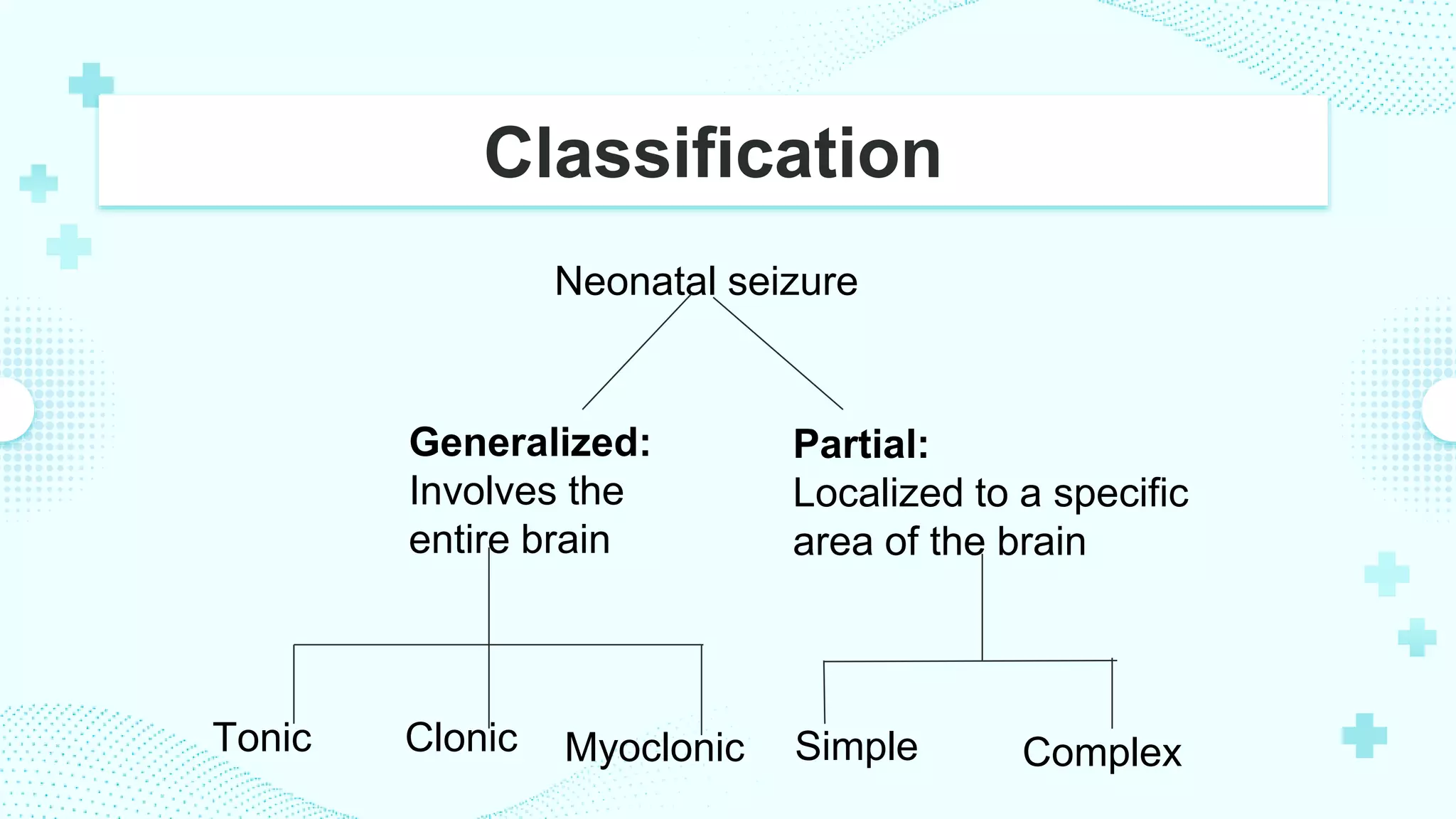
Classification
Neonatal seizure
Generalized:
Involves the
entire brain
Partial:
Localized to a specific
area of the brain
Tonic Clonic Myoclonic Simple Complex
Generalized Seizure: Generalized seizure is a
type of seizure that involves the entire brain( both
side of hemisphere) .
It have 3 sub types
1. Tonic seizure
2. Clonic seizure
3. Myoclonic seizure
Tonic Seizure: Sudden & Sustained muscle stiffness or
rigidity in the body. During a tonic seizure, the muscle of
the arm, legs may become stiff. The baby may become
unconscious. It lasts for few seconds to a minute.
Clonic seizure: Rhythmic, Jerking muscle
movement that may affect The entire body or just
one part of the body, such as arm or leg. The
movements typically alternate between contraction
& relaxation of the muscles, causing a shaking
trembling motion. This is last for seconds to 3
minutes.
Myoclonic seizure: Sudden, brief muscle
contraction that can affect one or more Part
of the body. This is typically last for only a
few seconds.
Partial seizure: A partial seizure, also known as a
focal seizure, is a type of seizure that affects only one
part of the brain or a particular area.
Partial seizures can be further classified into two
subtypes: simple partial seizures and complex
partial seizures.
Simple Partial seizure:
Also known as a focal aware seizure, is characterized by
abnormal electrical activity in a specific part of the brain.
The person experiencing a simple seizure remains
conscious and aware of their surrounding during the
seizure. They may experience abnormal sensations, such
as tingling, feeling or a sense of fear.
Complex Seizure:
Complex Seizure is characterized by abnormal
electrical activity in a specific part of the brain that
cause a loss of consciousness. During a complex
seizure the person may exhibit unusual behaviours,
such as lip smacking and Hand rubbing.
Clinical Manifestation
• Twitching of facial muscles
• Twitching of the hands and feet
• The eye roll or stare
• Hallucination
• Dizziness
• Confusion
• Anxiety and fear
Diagnostic Evaluation
• History taking
• MRI
• EEG(Electroencephalogram)
• XRAY
• CT Scan
• Lumber puncture
Management
Medical management:
• Phenobarbital – 3-5 mg /kg/day
• Diphenylhydantoin – 5-8mg/kg/day in 2 divided doses.
• Diazepam – 0.2mg/kg/dose
• Sodium valproate – 12-20mg/kg/day 3-3 divided doses.
• oxygen therapy
Surgical management:
• Neurosurgery- Removing area of brain where seizure
occurs like tumors.
• Callosotomy - Surgery to treat epilepsy seizure when anti
seizure medication can’t help. Procedure involve cutting
a band of fibres (carpes callosum) in brain afterward, the
nerves can’t send seizure signals between the brains to
halves.
• Focal Resection of parts of cerebral cortex. Such as
temporal lobe.
Nursing Management
• Early Recognition and assessment of seizure activity.
• Monitoring And managing vital signs and oxygenation.
• Administering antiepileptic medications.
• Providing a safe and supportive environment.
• Provide education and support to family.
Nursing Diagnosis
1. Ineffective impaired cerebral tissue perfusion related to
decreased oxygenation during seizure.
2. Delayed development related to underlying neurological
condition.
3. Hyperthermia related to infectious process.
4. Risk for injury related to seizure and cerebral edema.
5. Deficient knowledge related to seizure.
1. Ineffective impaired cerebral tissue perfusion
related to decreased oxygenation during seizure.
• Monitor vital signs: Vital signs, including blood
pressure, pulse, respiratory rate, and oxygen
saturation, should be monitored frequently during and
after the seizure to detect any changes in oxygenation
levels.
• Administer oxygen.
• Administer anticonvulsant.
2. Delayed development related to underlying
neurological condition.
• Monitor the neonate‘s developmental milestones regularly.
• Providing appropriate developmental stimulation and
interventions to promote growth and development.
• Educating parents on the potential long term effects of
neonatal seizures and the importance of follow up care and
monitoring.
3.Hyperthermia related to infectious process.
• Check the temperature and other vital signs after 2 hrs.
• Provide cold sponges.
• Provide antipyretics as per ordered.
• Maintain room and it’s body at low temperature.
4. Risk for injury related to seizure and cerebral edema.
• Continues monitoring
• Maintaining a safe environment
• Apply tag (neon pink) for high risk of falls.
• Stay with patient during and after seizure.
• Administer proper medication.
5. Deficient knowledge related to seizure.
• Assess the patient knowledge.
• Provide education.
• Encourage the members to ask questions.
Prevention
• Prevent Perinatal injury and head injury in children.
• Prevent meningitis in children.
• In neonates hypoglycemia should be managed to
prevent brain injury and seizure.
• Remove the dangerous objects from child’s vicinity.
Complications
• Cerebral Palsy
• Mental Retardation
• Injury from falls
• Difficulty in learning
Bibliography
Sharma R., “Essential of pediatric nursing”. Edition : 3rd
Edition , jaypee brothers publishers , pg no. 131-132.
Thank you

ritikneonatalseizure99-230530033401-88c89f06.pdf

  • 1.
    Neonatal Seizure Submitted ByRitik Bsc Nursing III year
  • 2.
    Introduction A neonatal seizureis a seizure that occurs in a newborn baby, typically within the first 28 days of life. These seizures can be caused by various factors, such as infection, brain injury, or congenital disorders. They can also be a symptom of an underlying condition such as hypoglycemia.
  • 3.
    Definition Seizures are abnormallyexcessive neuronal activity in the brain. Neonatal seizures or neonatal convulsions are epileptics occurring from birth to the end of neonatal period.
  • 4.
    Incidence rate the incidenceof neonatal seizures is estimated to be between 1 and 5 per 1,000 live births.
  • 5.
    Risk factors • Prematurity:Infants born prematurely, especially those less than 32 weeks gestational age, have an increased risk of developing seizures. • Birth trauma • Hypoxic-ischemic encephalopathy (HIE): HIE occurs when the baby's brain does not receive enough oxygen and blood during or after delivery, and is a significant risk factor for neonatal seizures. • Congenital brain malformations: Structural abnormalities or malformations of the brain can lead to neonatal seizures.
  • 6.
    Etiology • Hypoxic-ischemic encephalopathy (HIE) •Intracranial hemorrhage • Infections • Metabolic disorders • Genetic disorders (tuberous sclerosis) • Maternal Drug use
  • 7.
    Pathophysilogy Due to etiologicalfactor Disturbance in brain function Brain cell become over reactive Burst electrical activity in the brain That affect the CNS area Seizure
  • 8.
    Classification Neonatal seizure Generalized: Involves the entirebrain Partial: Localized to a specific area of the brain Tonic Clonic Myoclonic Simple Complex
  • 9.
    Generalized Seizure: Generalizedseizure is a type of seizure that involves the entire brain( both side of hemisphere) . It have 3 sub types 1. Tonic seizure 2. Clonic seizure 3. Myoclonic seizure
  • 10.
    Tonic Seizure: Sudden& Sustained muscle stiffness or rigidity in the body. During a tonic seizure, the muscle of the arm, legs may become stiff. The baby may become unconscious. It lasts for few seconds to a minute. Clonic seizure: Rhythmic, Jerking muscle movement that may affect The entire body or just one part of the body, such as arm or leg. The movements typically alternate between contraction & relaxation of the muscles, causing a shaking trembling motion. This is last for seconds to 3 minutes.
  • 11.
    Myoclonic seizure: Sudden,brief muscle contraction that can affect one or more Part of the body. This is typically last for only a few seconds.
  • 12.
    Partial seizure: Apartial seizure, also known as a focal seizure, is a type of seizure that affects only one part of the brain or a particular area. Partial seizures can be further classified into two subtypes: simple partial seizures and complex partial seizures.
  • 13.
    Simple Partial seizure: Alsoknown as a focal aware seizure, is characterized by abnormal electrical activity in a specific part of the brain. The person experiencing a simple seizure remains conscious and aware of their surrounding during the seizure. They may experience abnormal sensations, such as tingling, feeling or a sense of fear.
  • 14.
    Complex Seizure: Complex Seizureis characterized by abnormal electrical activity in a specific part of the brain that cause a loss of consciousness. During a complex seizure the person may exhibit unusual behaviours, such as lip smacking and Hand rubbing.
  • 15.
    Clinical Manifestation • Twitchingof facial muscles • Twitching of the hands and feet • The eye roll or stare • Hallucination • Dizziness • Confusion • Anxiety and fear
  • 16.
    Diagnostic Evaluation • Historytaking • MRI • EEG(Electroencephalogram) • XRAY • CT Scan • Lumber puncture
  • 17.
    Management Medical management: • Phenobarbital– 3-5 mg /kg/day • Diphenylhydantoin – 5-8mg/kg/day in 2 divided doses. • Diazepam – 0.2mg/kg/dose • Sodium valproate – 12-20mg/kg/day 3-3 divided doses. • oxygen therapy
  • 18.
    Surgical management: • Neurosurgery-Removing area of brain where seizure occurs like tumors. • Callosotomy - Surgery to treat epilepsy seizure when anti seizure medication can’t help. Procedure involve cutting a band of fibres (carpes callosum) in brain afterward, the nerves can’t send seizure signals between the brains to halves. • Focal Resection of parts of cerebral cortex. Such as temporal lobe.
  • 19.
    Nursing Management • EarlyRecognition and assessment of seizure activity. • Monitoring And managing vital signs and oxygenation. • Administering antiepileptic medications. • Providing a safe and supportive environment. • Provide education and support to family.
  • 20.
    Nursing Diagnosis 1. Ineffectiveimpaired cerebral tissue perfusion related to decreased oxygenation during seizure. 2. Delayed development related to underlying neurological condition. 3. Hyperthermia related to infectious process. 4. Risk for injury related to seizure and cerebral edema. 5. Deficient knowledge related to seizure.
  • 21.
    1. Ineffective impairedcerebral tissue perfusion related to decreased oxygenation during seizure. • Monitor vital signs: Vital signs, including blood pressure, pulse, respiratory rate, and oxygen saturation, should be monitored frequently during and after the seizure to detect any changes in oxygenation levels. • Administer oxygen. • Administer anticonvulsant.
  • 22.
    2. Delayed developmentrelated to underlying neurological condition. • Monitor the neonate‘s developmental milestones regularly. • Providing appropriate developmental stimulation and interventions to promote growth and development. • Educating parents on the potential long term effects of neonatal seizures and the importance of follow up care and monitoring.
  • 23.
    3.Hyperthermia related toinfectious process. • Check the temperature and other vital signs after 2 hrs. • Provide cold sponges. • Provide antipyretics as per ordered. • Maintain room and it’s body at low temperature.
  • 24.
    4. Risk forinjury related to seizure and cerebral edema. • Continues monitoring • Maintaining a safe environment • Apply tag (neon pink) for high risk of falls. • Stay with patient during and after seizure. • Administer proper medication.
  • 25.
    5. Deficient knowledgerelated to seizure. • Assess the patient knowledge. • Provide education. • Encourage the members to ask questions.
  • 26.
    Prevention • Prevent Perinatalinjury and head injury in children. • Prevent meningitis in children. • In neonates hypoglycemia should be managed to prevent brain injury and seizure. • Remove the dangerous objects from child’s vicinity.
  • 27.
    Complications • Cerebral Palsy •Mental Retardation • Injury from falls • Difficulty in learning
  • 28.
    Bibliography Sharma R., “Essentialof pediatric nursing”. Edition : 3rd Edition , jaypee brothers publishers , pg no. 131-132.
  • 29.