“RICH DAD POOR DAD”
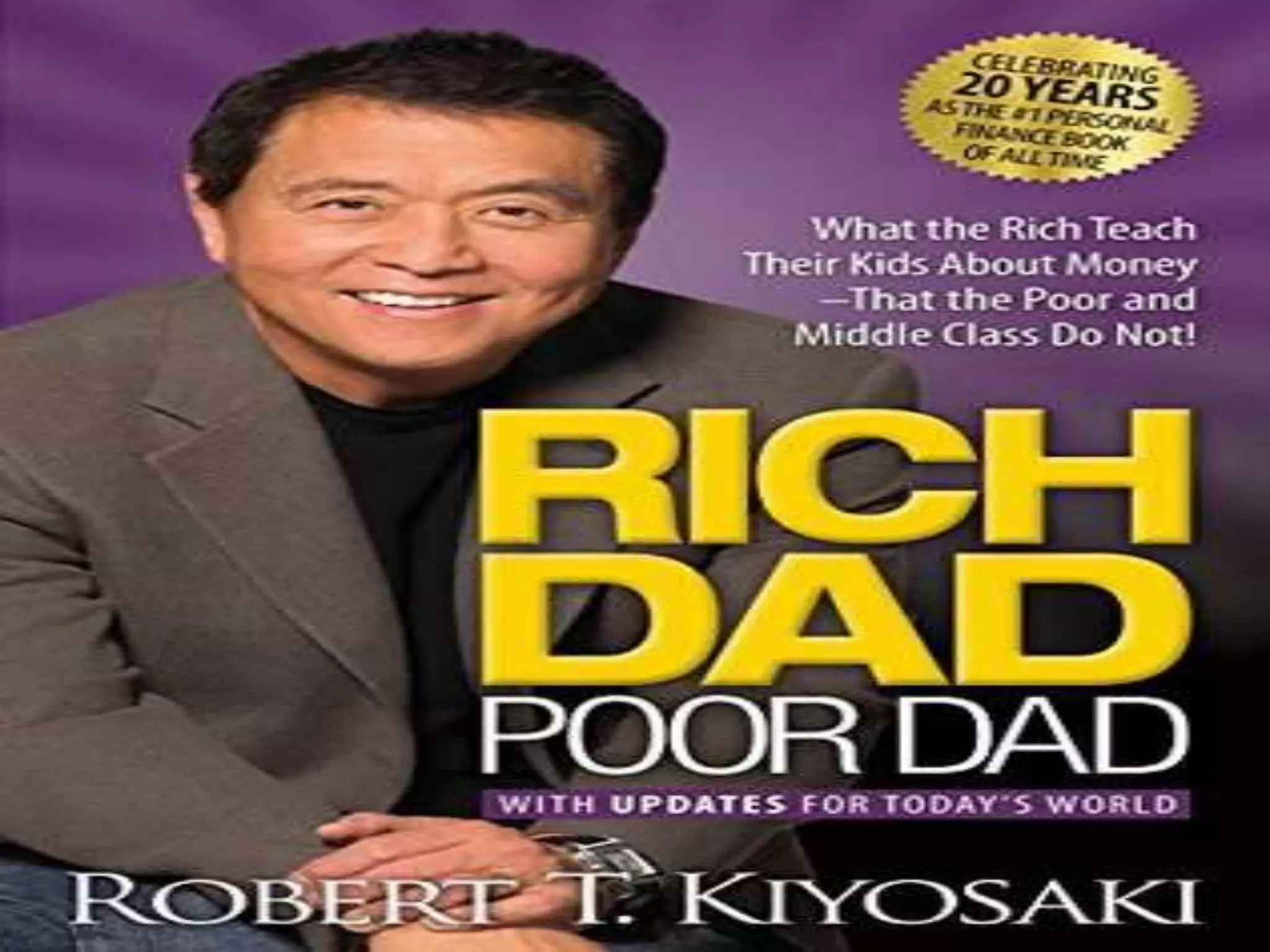
 Rich Dad Poor Dad is a 1997 book written by Robert
Kiyosaki and Sharon Lechter. It advocates the
importance of financial literacy (financial
education), financial independence and building wealth
through investing in assets, real estate investing,
starting and owning businesses, as well as increasing
one's financial intelligence (financial IQ).
 Rich Dad Poor Dad is written in the style of a set
of parables, ostensibly based on Kiyosaki's life. The
titular "rich dad" is his friend's father who accumulated
wealth due to entrepreneurship and savvy investing,
while the "poor dad" is claimed to be Kiyosaki's own
father who he says worked hard all his life but never
obtained financial security.
ABOUT THE BOOK
 Rich Dad Poor Dad has sold over 32 million
copies in more than 51 languages across more
than 109 countries, been on the New York Times
bestsellers list for over six years, launched a series
of books and related products; and received
positive reviews from some critics. American talk
show host and media mogul Oprah
Winfrey endorsed the book on her show. Another
celebrity supporter is actor Will Smith, who said he
taught his son about the financial responsibility by
reading the book.
 PBS Public Television station KOCE, aired a 55-
minute presentation of Kiyosaki titled "A Guide to
Wealth" in 2006 which essentially summarises his
Rich Dad Poor Dad book. PBS also honoured him
with an excellence in education award in 2005.
Donald Trump did a literary collaboration with
Kiyosaki in 2006 called Why We Want You To Be
Rich, Two Men One Message and a second book
called Midas Touch: Why Some Entrepreneurs Get
Rich — And Why Most Don't in 2011.
THE BOOK IN THREE SENTENCES
 Rich Dad Poor Dad is about Robert Kiyosaki and
his two dads—his real father (poor dad) and the
father of his best friend (rich dad)—and the ways in
which both men shaped his thoughts about money
and investing.
 You don’t need to earn a high income to be rich.
 Rich people make money work for them
THE FIVE BIG IDEAS
1. The poor and the middle-class work for money.
The rich have money work for them.
2. It’s not how much money you make that matters.
It’s how much money you keep.
3. Rich people acquire assets. The poor and middle
class acquire liabilities that they think are assets.
4. Financial aptitude is what you do with money once
you make it, how you keep people from taking it
from you, how to keep it longer, and how you
make money work hard for you.
5. The single most powerful asset we all have is our
mind.
BEFORE DIVING INTO THE ARTICLE, HERE IS
MY FAVORITE PASSAGE FROM THE BOOK:
 “Life is much like going gym. The most painful part
is deciding to go. Once you get past that, it’s easy.
There have been many days I have dreaded going
to the gym, but once I am there and in motion, it is
a pleasure. After the workout is over, I am glad I
talked myself into going”
SOME CRITICAL LESSONS FROM “RICH DAD POOR DAD”
 1. Get brave
 School teaches you to work for money. Our
education system is built on the premise of
producing a workforce for companies or institutions.
 People learn it without questioning because they
are afraid. And it’s an easy path.
 If you want to take control, get brave. Why not bash
the walls a bit?
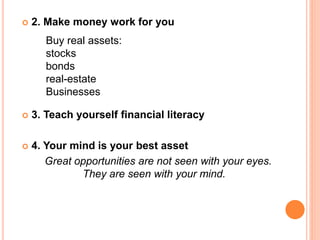
 2. Make money work for you
 3. Teach yourself financial literacy
 4. Your mind is your best asset
Great opportunities are not seen with your eyes.
They are seen with your mind.
Buy real assets:
stocks
bonds
real-estate
Businesses
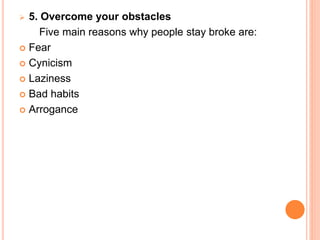
 5. Overcome your obstacles
Five main reasons why people stay broke are:
 Fear
 Cynicism
 Laziness
 Bad habits
 Arrogance
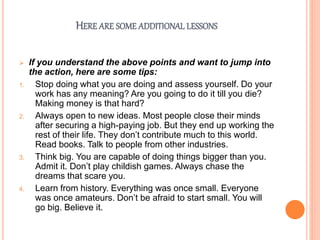
HERE ARE SOME ADDITIONAL LESSONS
 If you understand the above points and want to jump into
the action, here are some tips:
1. Stop doing what you are doing and assess yourself. Do your
work has any meaning? Are you going to do it till you die?
Making money is that hard?
2. Always open to new ideas. Most people close their minds
after securing a high-paying job. But they end up working the
rest of their life. They don’t contribute much to this world.
Read books. Talk to people from other industries.
3. Think big. You are capable of doing things bigger than you.
Admit it. Don’t play childish games. Always chase the
dreams that scare you.
4. Learn from history. Everything was once small. Everyone
was once amateurs. Don’t be afraid to start small. You will
go big. Believe it.
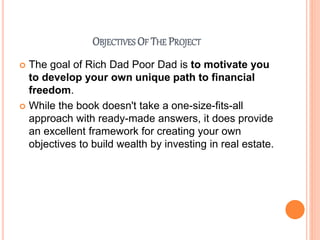
OBJECTIVES OF THE PROJECT
 The goal of Rich Dad Poor Dad is to motivate you
to develop your own unique path to financial
freedom.
 While the book doesn't take a one-size-fits-all
approach with ready-made answers, it does provide
an excellent framework for creating your own
objectives to build wealth by investing in real estate.
BIBLIOGRAPHY
 https://www.elearnmarkets.com/school/units/rich-
dad-poor-dad
 https://en.wikipedia.org/wiki/Rich_Dad_Poor_Dad
Rich dad poor dad.pptx

Rich dad poor dad.pptx

  • 2.
    “RICH DAD POORDAD”  Rich Dad Poor Dad is a 1997 book written by Robert Kiyosaki and Sharon Lechter. It advocates the importance of financial literacy (financial education), financial independence and building wealth through investing in assets, real estate investing, starting and owning businesses, as well as increasing one's financial intelligence (financial IQ).  Rich Dad Poor Dad is written in the style of a set of parables, ostensibly based on Kiyosaki's life. The titular "rich dad" is his friend's father who accumulated wealth due to entrepreneurship and savvy investing, while the "poor dad" is claimed to be Kiyosaki's own father who he says worked hard all his life but never obtained financial security.
  • 3.
    ABOUT THE BOOK Rich Dad Poor Dad has sold over 32 million copies in more than 51 languages across more than 109 countries, been on the New York Times bestsellers list for over six years, launched a series of books and related products; and received positive reviews from some critics. American talk show host and media mogul Oprah Winfrey endorsed the book on her show. Another celebrity supporter is actor Will Smith, who said he taught his son about the financial responsibility by reading the book.
  • 4.
     PBS PublicTelevision station KOCE, aired a 55- minute presentation of Kiyosaki titled "A Guide to Wealth" in 2006 which essentially summarises his Rich Dad Poor Dad book. PBS also honoured him with an excellence in education award in 2005. Donald Trump did a literary collaboration with Kiyosaki in 2006 called Why We Want You To Be Rich, Two Men One Message and a second book called Midas Touch: Why Some Entrepreneurs Get Rich — And Why Most Don't in 2011.
  • 5.
    THE BOOK INTHREE SENTENCES  Rich Dad Poor Dad is about Robert Kiyosaki and his two dads—his real father (poor dad) and the father of his best friend (rich dad)—and the ways in which both men shaped his thoughts about money and investing.  You don’t need to earn a high income to be rich.  Rich people make money work for them
  • 6.
    THE FIVE BIGIDEAS 1. The poor and the middle-class work for money. The rich have money work for them. 2. It’s not how much money you make that matters. It’s how much money you keep. 3. Rich people acquire assets. The poor and middle class acquire liabilities that they think are assets. 4. Financial aptitude is what you do with money once you make it, how you keep people from taking it from you, how to keep it longer, and how you make money work hard for you. 5. The single most powerful asset we all have is our mind.
  • 7.
    BEFORE DIVING INTOTHE ARTICLE, HERE IS MY FAVORITE PASSAGE FROM THE BOOK:  “Life is much like going gym. The most painful part is deciding to go. Once you get past that, it’s easy. There have been many days I have dreaded going to the gym, but once I am there and in motion, it is a pleasure. After the workout is over, I am glad I talked myself into going”
  • 8.
    SOME CRITICAL LESSONSFROM “RICH DAD POOR DAD”  1. Get brave  School teaches you to work for money. Our education system is built on the premise of producing a workforce for companies or institutions.  People learn it without questioning because they are afraid. And it’s an easy path.  If you want to take control, get brave. Why not bash the walls a bit?
  • 9.
     2. Makemoney work for you  3. Teach yourself financial literacy  4. Your mind is your best asset Great opportunities are not seen with your eyes. They are seen with your mind. Buy real assets: stocks bonds real-estate Businesses
  • 10.
     5. Overcomeyour obstacles Five main reasons why people stay broke are:  Fear  Cynicism  Laziness  Bad habits  Arrogance
  • 11.
    HERE ARE SOMEADDITIONAL LESSONS  If you understand the above points and want to jump into the action, here are some tips: 1. Stop doing what you are doing and assess yourself. Do your work has any meaning? Are you going to do it till you die? Making money is that hard? 2. Always open to new ideas. Most people close their minds after securing a high-paying job. But they end up working the rest of their life. They don’t contribute much to this world. Read books. Talk to people from other industries. 3. Think big. You are capable of doing things bigger than you. Admit it. Don’t play childish games. Always chase the dreams that scare you. 4. Learn from history. Everything was once small. Everyone was once amateurs. Don’t be afraid to start small. You will go big. Believe it.
  • 12.
    OBJECTIVES OF THEPROJECT  The goal of Rich Dad Poor Dad is to motivate you to develop your own unique path to financial freedom.  While the book doesn't take a one-size-fits-all approach with ready-made answers, it does provide an excellent framework for creating your own objectives to build wealth by investing in real estate.
  • 13.