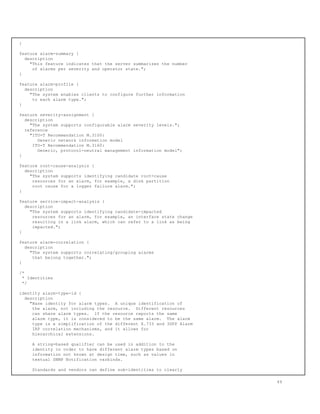
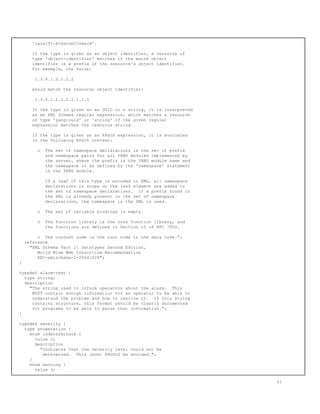
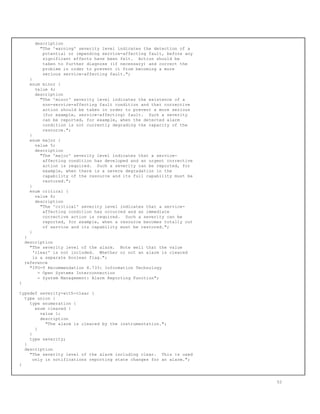
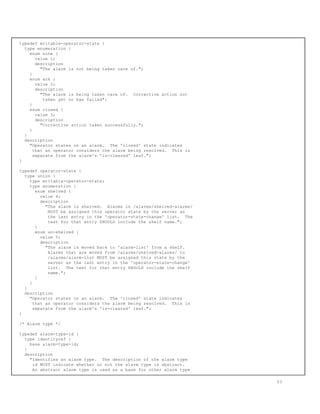
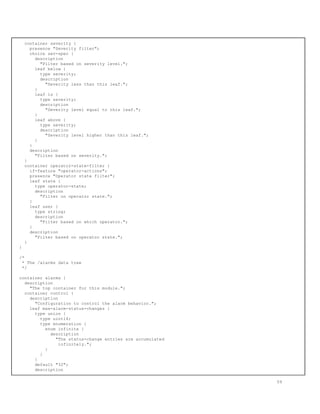
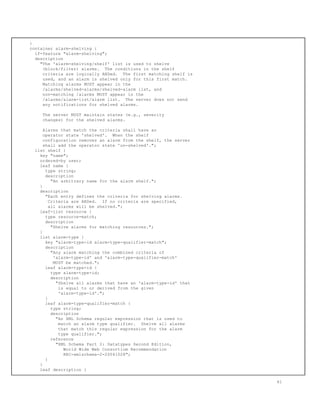
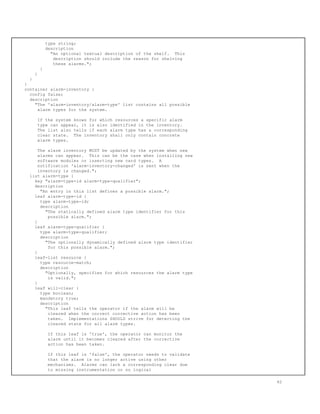
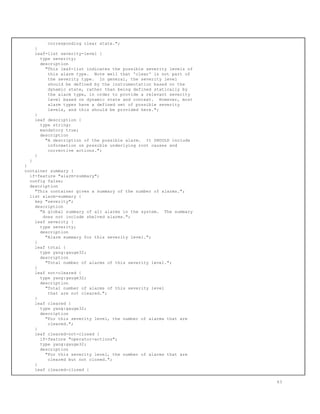
RFC8632(A YANG Data Model for Alarm Management)ベースの勉強資料です。
下線、ハイライトは個人的に重要そうなところ。斜体、#はメモ。
原文のMUST/REQUIRED/SHALL/SHOULD/MAY/OPTIONAL等の​RFC2119​用語は原文のまま残しています。
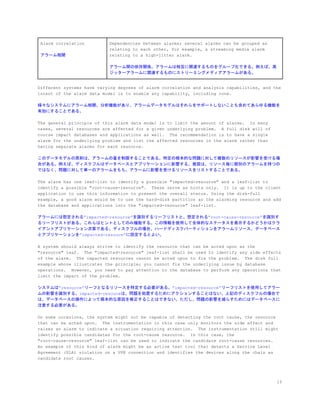
 MUST、REQUIRED、SHALL:絶対的な要求事項
 MUST NOT:絶対的な禁止事項
 SHOULD、RECOMMENDED:慎重に重要性を判断するべき要求事項
 SHOULD NOT、NOT RECOMMENDED:慎重に重要性を判断するべき禁止事項
 MAY、OPTIONAL:オプション。
間違っていたらコメントをお願いします。
元ネタ(RFC8632)
https://tools.ietf.org/html/rfc8632
Errata
https://www.rfc-editor.org/errata_search.php?rfc=8632
A YANG Data Model for Alarm Management
Abstract
This document defines a YANG module for alarm management. It includes functions for
alarm-list management, alarm shelving, and notifications to inform management systems. There
are also operations to manage the operator state of an alarm and administrative alarm
procedures. The module carefully maps to relevant alarm standards.
アラーム管理のためのYANG moduleを定義する。​アラームリスト管理、アラームシェルブ、管理システムに通知する
notificationが含まれる。アラームのオペレーター状態とアラーム管理のプロシージャーを管理するオペレーションも含まれ
る。関連するアラームの標準にマッピングする。
#シェルフ : 棚上げ
#アラームシェルビング(Alarm shelving):アラームをブロック/フィルターすること。
#オペレーター状態(Operator state):オペレーターがアラームをシェルフしたり、クローズしたりすること。
#関連するラーム標準にマッピング
3PGG、ITU-Tとかのアラームへのマッピング方法。
X.733へのマッピングは専用のYANGモジュールが本ドキュメントで規定されている。
Table of Contents
Abstract 1
Table of Contents 1
1. Introduction 4
1.1. Terminology and Notation 4
2. Objectives 7
3. Alarm Data Model Concepts 8
3.1. Alarm Definition 8
3.2. Alarm Type 8
3.3. Identifying the Alarming Resource 10
3.4. Identifying Alarm Instances 11
3.5. Alarm Lifecycle 11
3.5.1. Resource Alarm Lifecycle 12
1
3.5.2. Operator Alarm Lifecycle 13
3.5.3. Administrative Alarm Lifecycle 14
3.6. Root Cause, Impacted Resources, and Related Alarms 14
3.7. Alarm Shelving 16
3.8. Alarm Profiles 16
4. Alarm Data Model 17
4.1. Alarm Control 18
4.1.1. Alarm Shelving 18
4.2. Alarm Inventory 19
4.3. Alarm Summary 20
4.4. The Alarm List 20
4.5. The Shelved-Alarm List 22
4.6. Alarm Profiles 22
4.7. Operations 22
4.8. Notifications 23
5. Relationship to the ietf-hardware YANG Module 24
8. IANA Considerations 25
9. Security Considerations 26
Appendix A. Vendor-Specific Alarm Types Example 28
Appendix B. Alarm Inventory Example 29
Appendix C. Alarm List Example 30
Appendix D. Alarm Shelving Example 31
Appendix E. X.733 Mapping Example 32
7. The X.733 Mapping Module 33
6. Alarm YANG Module 42
主な機能 42
Feature 42
Tree Diagram 42
ietf-alarms.yang 46
2
3
1. Introduction
This document defines a YANG module [RFC7950] for alarm management. The purpose is to define a
standardized alarm interface for network devices that can be easily integrated into management
applications. The model is also applicable as a northbound alarm interface in the management
applications.
アラーム管理のYANG moduleを定義する。目的は、管理アプリケーションへのインテグレーションを容易にするネットワークデ
バイス用の標準化されたアラームインターフェースを定義することである。このモデルは管理アプリケーションのノースバウンド
アラームインターフェースとしても適用できる。
Alarm monitoring is a fundamental part of monitoring the network. Raw alarms from devices do
not always tell the status of the network services or necessarily point to the root cause.
However, being able to feed alarms to the alarm-management application in a standardized
format is a starting point for performing higher-level network assurance tasks.
アラーム監視はネットワーク監視の基本機能である。デバイスからの生のアラームは必ずしもネットワークサービスのステータス
を通知したり、根本原因を示すものではない。ただし、アラームを標準化された形式で管理アプリケーションに送信できるという
ことは、ハイレベルでのネットワーク保守を実行するための出発点である。
The design of the module is based on experience from using and implementing available alarm
standards from ITU [X.733], 3GPP [ALARMIRP], and ANSI [ISA182].
モジュールの設計はITU-X.733、3GPP、ANSI-ISA182といった標準のアラームを使用、実装した経験に基づいている。
1.1. Terminology and Notation
Alarm (the general concept)
アラーム
An alarm signifies an undesirable state in a resource that
requires corrective action.
是正処置が必要となるリソースの望ましくない状態を示す。
Fault
フォルト
A fault is the underlying cause of an undesired behavior.
There is no trivial one-to-one mapping between faults and
alarms. One fault may result in several alarms in case the
system lacks root-cause and correlation capabilities. An
alarm might not have an underlying fault as a cause. For
example, imagine a bad Mean Opinion Score (MOS) alarm from a
Voice over IP (VOIP) probe and the cause being non-optimal
QoS configuration.
望ましくない状態の根本原因。フォルトとアラームのマッピングは単純な一対一の
関係ではない。一つのフォルトによって複数のアラームが発生する場合がある。ま
た、アラームには根本原因となるフォルトが無い場合もある。
Alarm Type
アラームタイプ
An alarm type identifies a possible unique alarm state for a
resource. Alarm types are names to identify the state like
"link-alarm", "jitter-violation", and
"high-disk-utilization".
リソースのアラーム状態を識別するための情報。アラームタイプは”
link-alarm”、”jitter-violation”、”high-disk-utilization”といっ
た状態を識別する名前である。
Resource
リソース
A fine-grained identification of the alarming resource, for
example, an interface and a process.
4
インターフェースやプロセス等のアラームしているリソースを識別する情報。
Alarm Instance
アラームインスタンス
The alarm state for a specific resource and alarm type, for
example, ("GigabitEthernet0/15", "link-alarm"). An entry in
the alarm list.
特定のリソースおよびアラームタイプのアラーム状態。例えば、
("GigabitEthernet0/15", "link-alarm")。​アラームリストの一つのエン
トリ。
Cleared Alarm
クリアードアラーム
A cleared alarm is an alarm where the system considers the
undesired state to be cleared. Operators cannot clear
alarms; clearance is managed by the system. For example, a
"linkUp" notification can be considered a clear condition
for a "linkDown" state.
システムが望ましくない状態から回復したとみなすアラーム。オペレーターはア
ラームをクリアできない。システムによってクリアされる。クリアはシステムに
よって管理される。例えば、”linkup” notificationは”linkDown”状態のク
リア条件とみなすことができる。
Closed Alarm
クローズドアラーム
Operators can close alarms irrespective of the alarm being
cleared or not. A closed alarm indicates that the alarm
does not need attention because either the corrective action
has been taken or it can be ignored for other reasons.
オペレーターはアラームがクリアされているかによらず、アラームをクローズする
ことができる。クローズアラームは、是正処置によってまたは無視できるため、ア
ラームに注意する必要がないことを示す。
Alarm Inventory
アラームインベントリ
A list of all possible alarm types on a system.
システムの全てのアラームタイプのリスト。
Alarm Shelving
アラームシェルビング
Blocking alarms according to specific criteria.
特定の基準に従ってアラームをブロックする。
Corrective Action
是正処置
An action taken by an operator or automation routine in
order to minimize the impact of the alarm or resolve the
root cause.
アラームの影響を最小限に抑えるため、または根本原因の解決のために、オペレー
ターまたは自動化ルーチンによって実行されるアクション。
Management System
管理システム
The alarm-management application that consumes the alarms,
i.e., acts as a client.
アラームを処理するアラーム管理アプリケーション。クライアントとして機能す
る。
System
システム
The system that implements this YANG module, i.e., acts as a
server. This corresponds to a network device or a
management application that provides a northbound alarm
interface.
YANG moduleを実装するシステム。サーバーとして機能する。ノースバウンドア
ラームインターフェースを提供するネットワークデバイスまたは管理アプリケー
ションに対応する。
Tree diagrams used in this document follow the notation defined in [RFC8340].
ツリーダイアグラムはRFC8340で定義された表記法に従う。
5
6
2. Objectives
The objectives for the design of the alarm data model are:
アラームデータモデルのデザインの目的は以下である:
Users find it simple to use. If a system supports this module, it shall be straightforward
to integrate it into a YANG-based alarm manager.
ユーザーはシンプルな使い方ができる。システムがこのモジュールをサポートする場合、YANGベースのアラームマネージャー
に統合するのは容易である。
Alarms are viewed as states on resources and not as discrete notifications.
アラームは個別の通知ではなく、リソースの状態として確認できる。
#リソースに括りつくということ
A precise definition of "alarm" is provided in order to exclude general events that should
not be forwarded as alarm notifications.
“alarm”の正確な定義は、アラームnotificationとして通知されるべきではない一般的なイベントを除外するために提供さ
れる。
Precise identification of alarm types and alarm instances is provided.
アラームタイプとアラームインスタンスの区別。
A management system should be able to pull all available alarm types from a system, i.e.,
read the alarm inventory from a system. This makes it possible to prepare alarm operators
with corresponding alarm instructions.
管理システムはシステムからアラームタイプを取得できる、つまりシステムからアラームイベントを取得できる。
Alarm-usability requirements are addressed; see Appendix G. While IETF and telecom
standards have addressed alarms mostly from a protocol perspective, the process industry has
published several relevant standards addressing requirements for a useful alarm interface;
see [EEMUA] and [ISA182]. This document defines usability requirements as well as a YANG
data model.
アラームのユーザビリティ要件に対応する。Appendix G参照。IETFおよびTelecom standardはプロトコル観点でアラー
ムを扱っているが、プロセス業界はアラームインターフェースに関する要件を公開している。EEMUA、ISA182を参照。​ユーザ
ビリティ要件とYANGデータモデルを定義する。
Mapping to [X.733], which is a requirement for some alarm systems, is achievable. Still,
keep some of the X.733 concepts out of the core model in order to make the model small and
easy to understand.
一部のアラームはシステム要件であるX.733へのマッピングが可能。ただし、モデルを小さく、理解しやすくするためにX.733
のコンセプトの一部を除外する。
7
3. Alarm Data Model Concepts
This section defines the fundamental concepts behind the data model. This section is rooted in
the works of Vallin et. al [ALARMSEM].
データモデルの背景にある概念について定義する。
3.1. Alarm Definition
An alarm signifies an undesirable state in a resource that requires corrective action.
There are two main things to remember from this definition:
アラームは是正処置が必要なリソースの望ましくない状態を示す。この定義は以下のためである。
1. It focuses on leaving out events and logging information in general. Alarms should
only be used for undesired states that require action.
イベントとログ情報は除外する。アラームはアクションが必要な望ましくない状態にのみ使用する。
2. It also focuses on alarms as a state on a resource, not the notifications that report
the state changes.
状態の変化を報告するのではなく、リソースの状態としてのアラームにフォーカスする。
See Appendix F for information on how this definition relates to other alarm standards.
この定義が他の標準のアラームとどのように関係するかはAppendix F参照。
3.2. Alarm Type
This document defines an alarm type with an alarm-type id and an alarm-type qualifier.
alarm-type idとalarm-type qualifierでアラームタイプを定義する。
The alarm-type id is modeled as a YANG identity. With YANG identities, new alarm types can be
defined in a distributed fashion. YANG identities are hierarchical, which means that a
hierarchy of alarm types can be defined.
alarm-type idはYANG identityとしてモデル化される。YANG identityを使用すると新しいアラームタイプを分散方式で
定義できる。YANG identityは階層的のため階層でアラームタイプを定義できる。
Standards and vendors should define their own alarm-type identities based on this definition.
標準とベンダーはこの定義に基づいて独自のalarm-type identityを定義する必要がある。
The use of YANG identities means that all possible alarms are identified at design time. This
explicit declaration of alarm types makes it easier to allow for alarm qualification reviews
and preparation of alarm actions and documentation.
YANG identityを使用すると全てのアラームを設計時に区別できる。アラームタイプの明示的な宣言により、アラームのレ
ビュー、アクション、ドキュメントの準備が容易になる。
There are occasions where the alarm types are not known at design time. An example is a
system with digital inputs that allows users to connect detectors, such as smoke detectors, to
the inputs. In this case, it is a configuration action that says certain connectors are fire
alarms, for example.
8
設計時にアラームタイプが不明な場合がある。例えば、ユーザーが煙検知器のような検知器の入力を備えたシステムがあるとす
る。この場合、特定のコネクタは火災警報をするといったアクションを設定する。
In order to allow for dynamic addition of alarm types, the alarm data model permits further
qualification of the identity-based alarm type using a string. A potential drawback of this
is that there is a significant risk that alarm operators will receive alarm types as a
surprise. They do not know how to resolve the problem since a defined alarm procedure does
not necessarily exist. To avoid this risk, the system MUST publish all possible alarm types
in the alarm inventory; see Section 4.2.
アラームの動的な追加を可能にするために、アラームデータモデルでは文字列を使用してIDベースのアラームタイプを定義でき
る。これの決定ンは、アラームオペレーターが予期しないアラームタイプを受信することである。定義されたアラームプロシー
ジャーは必ずしも存在しないため、オペレーターは解決方法を知らない可能性がある。このリスクを回避するために、​システムは
対応する全てのアラームタイプをインベントリに公開すること(MUST)。
A vendor or standards organization can define their own alarm-type hierarchy. The example
below shows a hierarchy based on X.733 event types:
ベンダーまたは標準組織は独自のアラームタイプ階層を定義できる。以下の例はX.733イベントタイプの階層である。
import ietf-alarms {
prefix al;
}
identity vendor-alarms {
base al:alarm-type;
}
identity communications-alarm {
base vendor-alarms;
}
identity link-alarm {
base communications-alarm;
}
#vendor-alarms - communications-alarm - link-alarm という階層構造
Alarm types can be abstract. An abstract alarm type is used as a base for defining
hierarchical alarm types. Concrete alarm types are used for alarm states and appear in the
alarm inventory. There are two kinds of concrete alarm types:
アラームタイプは抽象化されてもよい。抽象化アラームタイプは、階層アラームタイプを定義するためのベースとして使用され
る。具体化アラームタイプはアラーム状態に使用され、アラームインベントリに表示される。​具体化アラームタイプには二種類あ
る。
1. The last subordinate identity in the "alarm-type-id" hierarchy is concrete, for
example, "alarm-identity.environmental-alarm.smoke". In this example, "alarm-identity"
and "environmental-alarm" are abstract YANG identities, whereas "smoke" is a concrete
YANG identity.
“alarm-type-id”階層の下位のidentityは、”alarm-identity.environmental-alarm.smoke”である。こ
の例では、”alarm-identity”と”environmental-alarm”は抽象的なYANG identityであるが、”smoke”は具
体的なYANG identityである。
#静的
2. The YANG identity hierarchy is abstract, and the concrete alarm type is defined by the
dynamic alarm-qualifier string, for example,
"alarm-identity.environmental-alarm.external-detector" with alarm-type-qualifier
"smoke".
YANG identity階層は抽象的であり、具体的なアラームタイプは動的なalarm-qualifier stringによって定義さ
れる。例えば、alarm-qualifier “smoke”を含む
9
"alarm-identity.environmental-alarm.external-detector”である。
#動的
For example:
// Alternative 1: concrete alarm type identity
import ietf-alarms {
prefix al;
}
identity environmental-alarm {
base al:alarm-type;
description "Abstract alarm type"; ​#抽象化アラームタイプ
}
identity smoke {
base environmental-alarm;
description "Concrete alarm type"; ​#具体化アラームタイプ
}
// Alternative 2: concrete alarm type qualifier
import ietf-alarms {
prefix al;
}
identity environmental-alarm {
base al:alarm-type;
description "Abstract alarm type"; ​#抽象化アラームタイプ
}
identity external-detector {
base environmental-alarm;
description
"Abstract alarm type; a runtime configuration ​#抽象化アラームタイプ
procedure sets the type of alarm detected. This will
be reported in the alarm-type-qualifier.";
​#検出されたアラームタイプがalarm-type-qualifieで報告される
}
A server SHOULD strive to minimize the number of dynamically defined alarm types.
サーバーは動的に定義されたアラームタイプの数を最小限にすることが推奨される(SHOULD)。
3.3. Identifying the Alarming Resource
It is of vital importance to be able to refer to the alarming resource. This reference must
be as fine-grained as possible. If the alarming resource exists in the data tree, an
instance-identifier MUST be used with the full path to the object.
アラームリソースを参照できることは重要である。できる限り詳細に参照できる必要がある。アラームリソースがデータツリーに
存在する場合、オブジェクトへのフルパスでinstance-identifierを使用すること(MUST)。
When the module is used in a controller/orchestrator/manager, the original device resource
identification can be modified to include the device in the path. The details depend on how
devices are identified and are out of scope for this specification.
モジュールがコントローラー/オーケストレーター/マネージャーで使用されている場合、オリジナルのデバイスリソースIDを使用
して、デバイスをパスに含めることができる。デバイスの識別方法は仕様のスコープ外である。
Example:
The original device alarm might identify the resource as
"/dev:interfaces/dev:interface[dev:name='FastEthernet1/0']".
10
オリジナルのデバイスアラームはリソースを"/dev:interfaces/dev:interface[dev:name='FastEthernet1/0']"と識
別する。
The resource identification in the manager could look something like:
"/mgr:devices/mgr:device[mgr:name='xyz123']/dev:interfaces/
dev:interface[dev:name='FastEthernet1/0']"
マネージャーのリソースIDは次のようになる"​/mgr:devices/mgr:device[mgr:name='xyz123']​/dev:interfaces/
dev:interface[dev:name='FastEthernet1/0']"
This module also allows for alternate naming of the alarming resource if it is not available
in the data tree.
このモジュールはデータツリーを使用できないアラームリソースに別名をつけることもできる。
3.4. Identifying Alarm Instances
A primary goal of the alarm data model is to remove any ambiguity in how alarm notifications
are mapped to an update of an alarm instance. The X.733 [X.733] and 3GPP [ALARMIRP] documents
were not clear on this point. This alarm data model states that the tuple (resource,
alarm-type identifier, and alarm-type qualifier) corresponds to a single alarm instance. This
means that alarm notifications for the same resource and same alarm type are matched to update
the same alarm instance. These three leafs are therefore used as the key in the alarm list:
アラームデータモデルの主なゴールはアラームnotificationをアラームインスタンスの更新にマッピングする方法のあいまいさ
を排除することである。X.733および3GPPではこの点は明確ではなかった。このアラームデータモデルは、(リソース、
alarm-type identifier、alarm-type qualifier)のタプルが一つのアラームインスタンスに対応する。これは、同じリ
ソースで同じアラームタイプのアラームnotificationによってそのアラームインスタンスが更新されることを意味する。した
がって、以下の3つのリーフはアラームリストのキーとして使用される。
list alarm {
key "resource alarm-type-id alarm-type-qualifier";
...
}
3.5. Alarm Lifecycle
The alarm model clearly separates the resource alarm lifecycle from the operator and
administrative lifecycles of an alarm.
アラームモデルはリソースアラームのライフサイクルをオペレーター、管理のライフサイクルから分離する。
resource alarm lifecycle the alarm instrumentation that controls alarm raise,
clearance, and severity changes.
アラームの発生、クリア、重要度の変更を制御するアラームの動作。
operator alarm lifecycle operators acting upon alarms with actions like
acknowledging and closing. Closing an alarm implies that
the operator considers the corrective action performed.
Operators can also shelve (block/filter) alarms in order
to avoid nuisance alarms.
11
アラームを対処するオペレーターのアクション。オペレーターが是正処置を確認
してアラームをクローズしたり、不要なアラームをシェルブ(ブロック/フィル
タ)したりすること。
administrative alarm lifecycle purging (deleting) unwanted alarms and compressing the
alarm status-change list. This module exposes operations
to manage the administrative lifecycle. The server may
also perform these operations based on other policies, but
how that is done is out of scope for this document.
不要なアラームを削除し、アラームステータス変更リストを圧縮する。このモ
ジュールは管理ライフサイクルのオペレーションを公開する。サーバーはポリ
シーに基づきこのオペレーションを実行できるが、その方法はドキュメントのス
コープ外。
A server SHOULD describe how long it retains cleared/closed alarms until they are manually
purged or if it has an automatic removal policy. How this is done is outside the scope of
this document.
サーバーは手動で削除されるか自動削除ポリシーが設定されるまで、クリアード/クローズド アラームを保持する期間を示すこと
が推奨される(SHOULD)。その方法はドキュメントのスコープ外。
#勝手に消える場合は一ヶ月は保持するした後、ファイルに出しておく とか仕様書とかに書いておく。
3.5.1. Resource Alarm Lifecycle
From a resource perspective, an alarm can, for example, have the following lifecycle: raise,
change severity, change severity, clear, being raised again, etc. All of these status changes
can have different alarm texts generated by the instrumentation. Two important things to
note:
リソースの観点では、アラームには発生、重要度の変更、クリア、再発生などのライフサイクルがある。これらのステータス変更
は全て異なるアラームテキストする。注意すべき点が2つある。
1. Alarms are not deleted when they are cleared. Deleting alarms is an administrative
process. The "ietf-alarms" YANG module defines an action "purge-alarms" that deletes
alarms.
アラームはクリアされても削除されない。アラームの削除は管理プロセス(Administrative process)である。”
ietf-alarms” YANG moduleはアラームを削除するアクション”purge-alarms”を定義する。
2. Alarms are not cleared by operators; only the underlying instrumentation can clear an
alarm. Operators can close alarms.
オペレーターはアラームをクリアしない。発生源の装置のみがアラームをクリアできる。オペレーターはアラームをク
ローズすることはできる。
The YANG tree representation below illustrates the resource-oriented lifecycle:
以下のYANGツリーはリソース指向のライフサイクルを示している。
+--ro alarm* [resource alarm-type-id alarm-type-qualifier]
...
+--ro is-cleared boolean
+--ro last-raised yang:date-and-time
+--ro last-changed yang:date-and-time
+--ro perceived-severity severity
12
+--ro alarm-text alarm-text
+--ro status-change* [time] {alarm-history}?
+--ro time yang:date-and-time
+--ro perceived-severity severity-with-clear
+--ro alarm-text alarm-text
For every status change from the resource perspective, a row is added to the "status-change"
list, if the server implements the feature "alarm-history". The feature "alarm-history" is
optional to implement, since keeping the alarm history may have an impact on the server's
memory resources.
サーバーが”alarm-history”を実装している場合、ステータスが変更されるたびに”status-change”リストに行が追加され
る。アラーム履歴を保持するとサーバーのメモリリソースに影響を与える可能性があるため、​”alarm-history”の実装はオプ
ションである。
The last status values are also represented as leafs for the alarm. Note well that the alarm
severity does not include "cleared"; alarm clearance is a boolean flag.
最新のステータスはalarmのリーフとしても表される。アラームの重要度には”cleared”が含まれないことに注意せよ。アラー
ムのクリアはboolean flagである。
Therefore, an alarm can look like this: (("GigabitEthernet0/25", "link-alarm",""), false,
2018-04-08T08:20:10.00Z, 2018-04-08T08:20:10.00Z, major, "Interface GigabitEthernet0/25
down").
したがって、アラームは次のようにみえる。
(("GigabitEthernet0/25", #resource
"link-alarm", #alarm-type-id
""), #alarm-type-qualifier
false, #is-cleared
2018-04-08T08:20:10.00Z,#last-raised
2018-04-08T08:20:10.00Z,#last-changed
major, #perceived-severity
"Interface GigabitEthernet0/25 down"). #alarm-text
3.5.2. Operator Alarm Lifecycle
Operators can act upon alarms using the set-operator-state action:
オペレーターは”set-operator-state”アクションでアラームを処理できる。
+--ro alarm* [resource alarm-type-id alarm-type-qualifier]
...
+--ro operator-state-change* [time] {operator-actions}?
| +--ro time yang:date-and-time
| +--ro operator string
| +--ro state operator-state
| +--ro text? string
+---x set-operator-state {operator-actions}?
+---w input
+---w state writable-operator-state
+---w text? string
The operator state for an alarm can be "none", "ack", "shelved", and "closed". Alarm deletion
(using the action "purge-alarms") can use this state as a criterion. For example, a closed
alarm is an alarm where the operator has performed any required corrective actions. Closed
alarms are good candidates for being purged.
13
アラームのオペレーター状態は”none”、”ack”、”shelved”、”closed”である。これらの状態を基準にアラームの削除”
purge-alarms”アクションを使用できる。例えば、クローズドアラームは、オペレーターが必要な是正処置を実行したアラーム
である。クローズドアラームはパージする候補である。
3.5.3. Administrative Alarm Lifecycle
Deleting alarms from the alarm list is considered an administrative action. This is supported
by the "purge-alarms" action. The "purge-alarms" action takes a filter as input. The filter
selects alarms based on the operator and resource alarm lifecycle such as "all closed cleared
alarms older than a time specification". The server may also perform these operations based
on other policies, but how that is done is out of scope for this document.
アラームリストからアラームを削除することは管理アクションとみなされる。これは”purge-alarms”アクションによってサ
ポートされる。”purge-alarms”アクションはフィルターを入力として使用する。フィルターは”指定時間より古い全てのクロー
ズドアラームでクリアされたもの”のようにオペレーターおよびリソースアラームのライフサイクルに基づいてアラームを選択す
る。サーバーは他のポリシーに基づいてこれらのオペレーションを実行してもよいが、その方法はスコープ外。
Purged alarms are removed from the alarm list. Note well that if the alarm resource state
changes after a purge, the alarm will reappear in the alarm list.
パージされたアラームは、アラームリストから削除される。パージ後にアラームリソースの状態が変化すると、アラームはアラー
ムリストに再表示される。
Alarms can be compressed. Compressing an alarm deletes all entries in the alarm's
"status-change" list except for the last status change. A client can perform this using the
"compress-alarms" action. The server may also perform these operations based on other
policies, but how that is done is out of scope for this document.
アラームは圧縮できる。アラームを圧縮すると最新のステータス変更を除く、アラームの”status-change”リストの全てのエン
トリが削除される。クライアントは”compress-alarms”アクションでこれを実行できる。​サーバーは他のポリシーに基づいてこ
れらのオペレーションを実行してもよいが、その方法はスコープ外。
3.6. Root Cause, Impacted Resources, and Related Alarms
The alarm data model does not mandate any requirements for the system to support alarm
correlation or root-cause and service-impact analysis. However, if such features are
supported, this section describes how the results of such analysis are represented in the data
model. These parts of the model are optional. The module supports three scenarios:
アラームデータモデルは、システムがアラーム相関または根本原因分析、サービス影響分析をサポートするための要件を強制する
ものではない。ただし、そのような機能がサポートされている場合、分析の結果がデータモデルでどのように表されるかについて
説明する。モジュールは3つのシナリオをサポートする。
Root-cause analysis
根本原因分析
An alarm can indicate candidate root-cause resources, for
example, a database issue alarm referring to a full-disk
partition.
アラームは候補の根本原因リソースを示すことができる。例えば、ディスクフルを示す
データベースアラームがある。
Service-impact analysis
サービス影響分析
An alarm can refer to potential impacted resources, for example,
an interface alarm referring to impacted network services.
アラームは影響を受ける可能性のあるリソースを参照できる。例えば、影響を受けるネッ
トワークサービスを参照するインターフェースアラームがある。
14
Alarm correlation
アラーム相関
Dependencies between alarms; several alarms can be grouped as
relating to each other, for example, a streaming media alarm
relating to a high-jitter alarm.
アラーム間の依存関係。アラームは相互に関連するものをグループ化できる。例えば、高
ジッターアラームに関連するものにストリーミングメディアアラームがある。
Different systems have varying degrees of alarm correlation and analysis capabilities, and the
intent of the alarm data model is to enable any capability, including none.
様々なシステムにアラーム相関、分析機能があり、アラームデータモデルはそれらをサポートしないことも含めてあらゆる機能を
有効にすることである。
The general principle of this alarm data model is to limit the amount of alarms. In many
cases, several resources are affected for a given underlying problem. A full disk will of
course impact databases and applications as well. The recommendation is to have a single
alarm for the underlying problem and list the affected resources in the alarm rather than
having separate alarms for each resource.
このデータモデルの原則は、アラームの量を制限することである。特定の根本的な問題に対して複数のリソースが影響を受ける場
合がある。例えば、ディスクフルはデータベースとアプリケーションに影響する。推奨は、リソース毎に個別のアラームを持つの
ではなく、問題に対して単一のアラームをもち、アラームに影響を受けるリソースをリストすることである。
The alarm has one leaf-list to identify a possible "impacted-resource" and a leaf-list to
identify a possible "root-cause-resource". These serve as hints only. It is up to the client
application to use this information to present the overall status. Using the disk-full
example, a good alarm would be to use the hard-disk partition as the alarming resource and add
the database and applications into the "impacted-resource" leaf-list.
アラームには想定される”impacted-resource”を識別するリーフリストと、想定される”root-cause-resource”を識別す
るリーフリストがある。これらはヒントとしてのみ機能する。この情報を使用して全体的なステータスを表示するかどうかはクラ
イアントアプリケーション次第である。ディスクフルの場合、ハードディスクパーティションをアラームリソース、データベース
とアプリケーションを”impacted-resouce”に設定するとよい。
A system should always strive to identify the resource that can be acted upon as the
"resource" leaf. The "impacted-resource" leaf-list shall be used to identify any side effects
of the alarm. The impacted resources cannot be acted upon to fix the problem. The disk full
example above illustrates the principle; you cannot fix the underlying issue by database
operations. However, you need to pay attention to the database to perform any operations that
limit the impact of the problem.
システムは”resource”リーフとなるリソースを特定する必要がある。”impacted-resource”リーフリストを使用してアラー
ムの影響を識別する。impacted-resouceは、問題を処置するためにアクションすることはない。上記のディスクフルの場合で
は、データベースの操作によって根本的な原因を修正することはできない。ただし、問題の影響を減らすためにはデータベースに
注意する必要がある。
On some occasions, the system might not be capable of detecting the root cause, the resource
that can be acted upon. The instrumentation in this case only monitors the side effect and
raises an alarm to indicate a situation requiring attention. The instrumentation still might
identify possible candidates for the root-cause resource. In this case, the
"root-cause-resource" leaf-list can be used to indicate the candidate root-cause resources.
An example of this kind of alarm might be an active test tool that detects a Service Level
Agreement (SLA) violation on a VPN connection and identifies the devices along the chain as
candidate root causes.
15
場合によってはシステムが根本原因、対処対象のリソースを特定できない場合がある。その場合、実装は影響箇所を監視し、注意
を必要とする状況を示すアラームを発生させる。実装は、根本原因リソースの候補を特定する可能性がある。その場合、”
route-cause-resource”リーフリストを使用して根本原因リソースの候補を示してよい。例えば、VPN接続でSLA違反を検出
し、関連するデバイスを根本原因の候補として識別するアクティブなツールがある。
The alarm data model also supports a way to associate different alarms with each other using
the "related-alarm" list. This list enables the server to inform the client that certain
alarms are related to other alarms.
アラームデータモデルは”related-alarm”リストを使用して異なるアラームの関連付けをサポートする。このリストによりサー
バーは特定のアラームが他のアラームに関連していることをクライアントに通知できる。
Note well that this module does not prescribe any dependencies or preference between the above
alarm correlation mechanisms. Different systems have different capabilities, and the above
described mechanisms are available to support the instrumentation features.
このモジュールは上記のアラーム相関メカニズムの依存関係や設定していないことに注意せよ。様々なメカニズム、機能が上記の
メカニズムを使用して機能を実現できる。
3.7. Alarm Shelving
Alarm shelving is an important function in order for alarm-management applications and
operators to stop superfluous alarms. A shelved alarm implies that any alarms fulfilling
these criteria are ignored (blocked/filtered). Shelved alarms appear in a dedicated
shelved-alarm list; thus, they can be filtered out so that the main alarm list only contains
entries of interest. Shelved alarms do not generate notifications, but the shelved-alarm list
is updated with any alarm-state changes.
アラームシェルビングは、アラーム管理アプリケーションおよびオペレーターが不要なアラームを停止するための重要な機能であ
る。シェルフされたアラームは、シェルフ基準を満たすアラームがブロック、フィルターされることを意味する。シェルフされた
アラームは、shelved-alarm listに表示され、メインアラームリストからは除外される。シェルブドアラームは
notificationを生成しないが、アラーム状態の変化時にshelved-alarm listが更新される。
Alarm shelving is optional to implement, since matching alarms against shelf criteria may have
an impact on the server's processing resources.
シェルフ条件に対するアラームのマッチングは処理リソースに影響を与える可能性があるため、アラームシェルビングの実装はオ
プションである。
3.8. Alarm Profiles
Alarm profiles are used to configure further information to an alarm type. This module
supports configuring severity levels overriding the system-default levels. This corresponds
to the Alarm Severity Assignment Profile (ASAP) functionality in M.3100 [M.3100] and M.3160
[M.3160]. Other standard or enterprise modules can augment this list with further alarm-type
information.
アラームプロファイルは、アラームタイプの詳細情報を設定するために使用される。このモジュールは、システムがデフォルトで
もつ重要度の変更をサポートする。これはM.3100およびM.3160のアラーム重要度割当プロファイル(Alarm Severity
Assignment Profile (ASAP))に対応している。
16
4. Alarm Data Model
The fundamental parts of the data model are the "alarm-list" with associated notifications and
the "alarm-inventory" list of all possible alarm types. These MUST be implemented by a
system. The rest of the data model is made conditional with these YANG features:
"operator-actions", "alarm-shelving", "alarm-history", "alarm-summary", "alarm-profile", and
"severity-assignment".
データモデルの基本的な部分は、Notificationが関連付けられた”alarm-list”と、設定される全てのアラームタイプである”
alarm-inventory”である。こえっらはシステムによって実装されること(MUST)。データモデルの残りの部分は、
"operator-actions", "alarm-shelving", "alarm-history", "alarm-summary", "alarm-profile", and
"severity-assignment"である。
The data model has the following overall structure:
データモデルの概要は以下の通り:
+--rw control
| +--rw max-alarm-status-changes? union
| +--rw notify-status-changes? enumeration
| +--rw notify-severity-level? severity
| +--rw alarm-shelving {alarm-shelving}?
| ...
+--ro alarm-inventory
| +--ro alarm-type* [alarm-type-id alarm-type-qualifier]
| ...
+--ro summary {alarm-summary}?
| +--ro alarm-summary* [severity]
| | ...
| +--ro shelves-active? empty {alarm-shelving}?
+--ro alarm-list
| +--ro number-of-alarms? yang:gauge32
| +--ro last-changed? yang:date-and-time
| +--ro alarm* [resource alarm-type-id alarm-type-qualifier]
| | ...
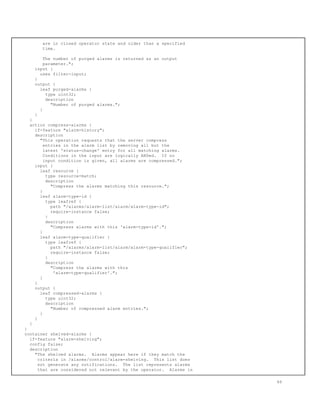
| +---x purge-alarms
| | ...
| +---x compress-alarms {alarm-history}?
| ...
+--ro shelved-alarms {alarm-shelving}?
| +--ro number-of-shelved-alarms? yang:gauge32
| +--ro shelved-alarms-last-changed? yang:date-and-time
| +--ro shelved-alarm*
| | [resource alarm-type-id alarm-type-qualifier]
| | ...
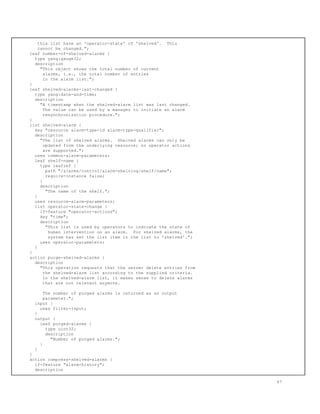
| +---x purge-shelved-alarms
| | ...
| +---x compress-shelved-alarms {alarm-history}?
| ...
+--rw alarm-profile*
[alarm-type-id alarm-type-qualifier-match resource]
{alarm-profile}?
+--rw alarm-type-id alarm-type-id
+--rw alarm-type-qualifier-match string
+--rw resource resource-match
+--rw description string
+--rw alarm-severity-assignment-profile
{severity-assignment}?
...
17
4.1. Alarm Control
The "/alarms/control/notify-status-changes" leaf controls whether notifications are sent for
all state changes, only raise and clear, or only notifications more severe than a configured
level. This feature, in combination with alarm shelving, corresponds to the ITU Alarm Report
Control functionality; see Appendix F.2.4.
"/alarms/control/notify-status-changes"リーフは、全ての状態変化に対してnotificationを送信するか、発生と
クリアのみ送信するか、設定した重要度より高いものを送信するかを制御する。この機能はアラームシェルビングと組み合わせて
ITUアラームレポート制御機能に対応している。Appendix F.2.4参照。
Every alarm has a list of status changes. The length of this list is controlled by
"/alarms/control/max-alarm-status-changes". When the list is full and a new entry created,
the oldest entry is removed.
全てのアラームにはステータス変更のリストがある。このリストのリスト長は
"/alarms/control/max-alarm-status-changes"で制御される。リストフルになり、新しいエントリが生成された場合、
最も古いエントリが削除される。
4.1.1. Alarm Shelving
The shelving control tree is shown below:
シェルビング制御のツリーを以下に示す:
+--rw control
+--rw alarm-shelving {alarm-shelving}?
+--rw shelf* [name]
+--rw name string
+--rw resource* resource-match
+--rw alarm-type*
| [alarm-type-id alarm-type-qualifier-match]
| +--rw alarm-type-id alarm-type-id
| +--rw alarm-type-qualifier-match string
+--rw description? string
Shelved alarms are shown in a dedicated shelved-alarm list. Matching alarms MUST appear in
the "/alarms/shelved-alarms/shelved-alarm" list, and non-matching alarms MUST appear in the
"/alarms/alarm-list/ alarm" list. The server does not send any notifications for shelved
alarms.
シェルブドアラームはshelved-alarm listに示される。一致するアラームは
"/alarms/shelved-alarms/shelved-alarm" list、マッチしないアラームは"/alarms/alarm-list/ alarm" list
に存在すること(MUST)。サーバーはシェルブドアラームのnotificationを送信しない。
Shelving and unshelving can only be performed by editing the shelf configuration. It cannot
be performed on individual alarms. The server will add an operator state indicating that the
alarm was shelved/unshelved.
シェルフの設定の解除は、シェルフを編集することによってのみ実行できる。個々のアラームに対しては実行できない。サーバー
はアラームがシェルブド/アンシェルブドされたことを示すオペレーター状態を示す。
A leaf, "/alarms/summary/shelves-active", in the alarm summary indicates if there are shelved
alarms.
アラームサマリー内の"/alarms/summary/shelves-active"は、シェルフされたアラームがあるかどうかを示す。
18
A system can select not to support the shelving feature.
システムはシェルブ機能をサポートしないことを選択してよい。
4.2. Alarm Inventory
The alarm inventory represents all possible alarm types that may occur in the system. A
management system may use this to build alarm procedures. The alarm inventory is relevant for
the following reasons:
アラームインベントリは、システムで発生する可能性のある全てのアラームタイプを表す。管理システムはこれを使用して、ア
ラームプロシージャーを作成できる。アラームインベントリは以下の理由で関連している:
● The system might not implement all defined alarm type identities, and some alarm
identities are abstract.
システムは定義された全てのアラームタイプidentityを実装するのではなく、一部のアラームidentityは抽象的であ
る。
● The system has configured dynamic alarm types using the alarm qualifier. The inventory
makes it possible for the management system to discover these.
システムはアラームタイプqualifierを使用して動的なアラームタイプを設定する。インベントリにより管理システム
はこれを確認できる。
Note that the mechanism whereby dynamic alarm types are added using the alarm-type qualifier
MUST populate this list.
Alarm-type qualifierを使用して動的なアラームタイプを追加するメカニズムは、このリストに入力すること(MUST)に注意
せよ。
The optional leaf-list "resource" in the alarm inventory enables the system to publish for
which resources a given alarm type may appear.
アラームインベントリのオプションのリーフリスト”resource”により、システムは特定のアラームタイプが発生する可能性のあ
るリソースを開示できる。
A server MUST implement the alarm inventory in order to enable controlled alarm procedures in
the client.
サーバーはクライアントで制御されたアラームプロシージャーを有効にするために、アラームインベントリを実装すること
(MUST)。
A server implementer may want to document the alarm inventory for offline processing by
clients. The file format defined in [YANG-INSTANCE] can be used for this purpose.
The alarm inventory tree is shown below:
サーバーの実装者は、クライアントの処理のためにインベントリを文書化してもよい。​[YANG-INSTANCE]​で定義されたファイル
フォーマットはこの目的のために使用できる。アラームインベントリのツリーは以下の通り:
+--ro alarm-inventory
+--ro alarm-type* [alarm-type-id alarm-type-qualifier]
+--ro alarm-type-id alarm-type-id
+--ro alarm-type-qualifier alarm-type-qualifier
+--ro resource* resource-match
+--ro will-clear boolean
+--ro severity-level* severity
+--ro description string
19
4.3. Alarm Summary
The alarm summary list summarizes alarms per severity: how many cleared, cleared and closed,
and closed. It also gives an indication if there are shelved alarms.
アラームサマリーリストは、重要度毎にアラームをサマライズする。クリア、クリアかつクローズ、クローズの数、シェルフの有
無を示す。
The alarm summary tree is shown below:
アラームサマリーのツリーは以下の通り:
+--ro summary {alarm-summary}?
+--ro alarm-summary* [severity]
| +--ro severity severity
| +--ro total? yang:gauge32
| +--ro not-cleared? yang:gauge32
| +--ro cleared? yang:gauge32
| +--ro cleared-not-closed? yang:gauge32
| | {operator-actions}?
| +--ro cleared-closed? yang:gauge32
| | {operator-actions}?
| +--ro not-cleared-closed? yang:gauge32
| | {operator-actions}?
| +--ro not-cleared-not-closed? yang:gauge32
| {operator-actions}?
+--ro shelves-active? empty {alarm-shelving}?
4.4. The Alarm List
The alarm list, "/alarms/alarm-list", is a function from the tuple (resource, alarm type,
alarm-type qualifier) to the current composite alarm state. The composite state includes
states for the resource alarm lifecycle such as severity, clearance flag, and operator states
such as acknowledged. This means that for a given resource and alarm type, the alarm list
shows the current states of the alarm such as acknowledged and cleared.
アラームリスト"/alarms/alarm-list"は、タプル(resource, alarm type, alarm-type qualifier)から現在の複
合的なアラーム状態を確認する機能である。複合状態には、重要度、リソースアラームライフサイクルの状態、オペレーター状態
などが含まれる。
#ro operator-state-change* [time] {operator-actions}? <- これはif-feature
# list status-change {
# if-feature "alarm-history";
# key "time";
+--ro alarm-list
+--ro number-of-alarms? yang:gauge32
+--ro last-changed? yang:date-and-time
+--ro alarm* [resource alarm-type-id alarm-type-qualifier]
| +--ro resource resource
| +--ro alarm-type-id alarm-type-id
| +--ro alarm-type-qualifier alarm-type-qualifier
| +--ro alt-resource* resource
| +--ro related-alarm*
| | [resource alarm-type-id alarm-type-qualifier]
| | {alarm-correlation}?
| | +--ro resource
| | | -> /alarms/alarm-list/alarm/resource
| | +--ro alarm-type-id leafref
| | +--ro alarm-type-qualifier leafref
| +--ro impacted-resource* resource
20
| | {service-impact-analysis}?
| +--ro root-cause-resource* resource
| | {root-cause-analysis}?
| +--ro time-created yang:date-and-time
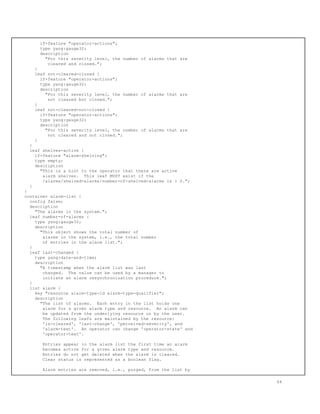
| +--ro ​is-cleared boolean​ #重要な状態①
| +--ro last-raised yang:date-and-time
| +--ro last-changed yang:date-and-time
| +--ro ​perceived-severity severity​ #重要な状態②
| +--ro alarm-text alarm-text
| +--ro status-change* [time] {alarm-history}?
| | +--ro time yang:date-and-time
| | +--ro perceived-severity severity-with-clear
| | +--ro alarm-text alarm-text
| +--ro ​operator-state-change* [time] {operator-actions}?​ #重要な状態③
| | +--ro time yang:date-and-time
| | +--ro operator string
| | +--ro state operator-state
| | +--ro text? string
| +---x set-operator-state {operator-actions}?
| | +---w input
| | +---w state writable-operator-state
| | +---w text? string
| +---n operator-action {operator-actions}?
| +-- time yang:date-and-time
| +-- operator string
| +-- state operator-state
| +-- text? string
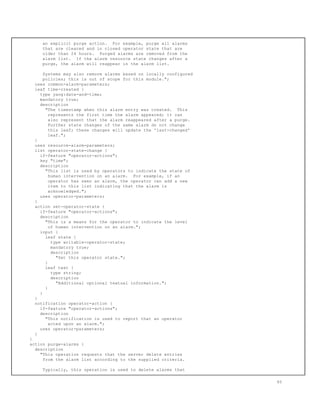
+---x purge-alarms
| +---w input
| | +---w alarm-clearance-status enumeration
| | +---w older-than!
| | | +---w (age-spec)?
| | | +--:(seconds)
| | | | +---w seconds? uint16
| | | +--:(minutes)
| | | | +---w minutes? uint16
| | | +--:(hours)
| | | | +---w hours? uint16
| | | +--:(days)
| | | | +---w days? uint16
| | | +--:(weeks)
| | | +---w weeks? uint16
| | +---w severity!
| | | +---w (sev-spec)?
| | | +--:(below)
| | | | +---w below? severity
| | | +--:(is)
| | | | +---w is? severity
| | | +--:(above)
| | | +---w above? severity
| | +---w operator-state-filter! {operator-actions}?
| | +---w state? operator-state
| | +---w user? string
| +--ro output
| +--ro purged-alarms? uint32
+---x compress-alarms {alarm-history}?
+---w input
| +---w resource? resource-match
| +---w alarm-type-id?
| | -> /alarms/alarm-list/alarm/alarm-type-id
| +---w alarm-type-qualifier? leafref
+--ro output
+--ro compressed-alarms? uint32
21
Every alarm has three important states: the resource clearance state "is-cleared", the
severity "perceived-severity", and the operator state available in the operator-state change
list.
全てのアラームには3つの重要な状態がある: リソースのクリア状態"is-cleared"、重要度"perceived-severity"、
operator-state-changeリストで利用可能なオペレーター状態である。
In order to see the alarm history, the resource state changes are available in the
"status-change" list, and the operator history is available in the "operator-state-change"
list.
アラーム履歴を確認するために、リソース状態の変化は"status-change"リストを利用でき、オペレーター履歴は
"operator-state-change"リストを利用できる。
4.5. The Shelved-Alarm List
The shelved-alarm list has the same structure as the alarm list above. It shows all the
alarms that match the shelving criteria "/alarms/control/alarm-shelving".
シェルブドアラームリストの構造は上記と同様である。シェルフ基準"/alarms/control/alarm-shelving"に一致するア
ラームが表示される。
4.6. Alarm Profiles
Alarm profiles, "/alarms/alarm-profile", is a list of configurable alarm types. The list
supports configurable alarm severity levels in the container
"alarm-severity-assignment-profile". If an alarm matches the configured alarm type, it MUST
use the configured severity level(s) instead of the system default. This configuration MUST
also be represented in the alarm inventory.
アラームプロファイル"/alarms/alarm-profile"は変更可能なアラームタイプのリストである。このリストはコンテナ
"alarm-severity-assignment-profile"で重要度の変更をサポートしている。アラームが設定されたアラームタイプと一
致する場合、システムデフォルトの代わりにここで設定された重要度を使用すること(MUST)。​この設定はアラームインベントリ
でも示すこと(MUST)。
+--rw alarm-profile*
[alarm-type-id alarm-type-qualifier-match resource]
{alarm-profile}?
+--rw alarm-type-id alarm-type-id
+--rw alarm-type-qualifier-match string
+--rw resource resource-match
+--rw description string
+--rw alarm-severity-assignment-profile
{severity-assignment}?
+--rw severity-level* severity
4.7. Operations
The alarm data model supports the following actions to manage the alarms:
アラームデータモデルはアラームを管理するために以下のアクションをサポートする。
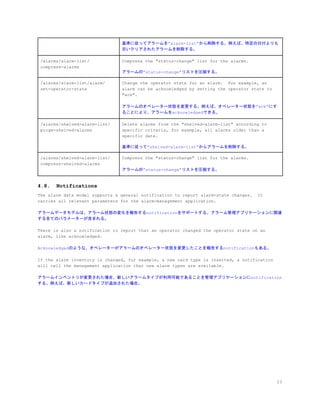
/alarms/alarm-list/
purge-alarms
Delete alarms from the "alarm-list" according to specific
criteria, for example, all cleared alarms older than a
specific date.
22
基準に従ってアラームを”alarm-list”から削除する。例えば、特定の日付よりも
古いクリアされたアラームを削除する。
/alarms/alarm-list/
compress-alarms
Compress the "status-change" list for the alarms.
アラームの”status-change”リストを圧縮する。
/alarms/alarm-list/alarm/
set-operator-state
Change the operator state for an alarm. For example, an
alarm can be acknowledged by setting the operator state to
"ack".
アラームのオペレーター状態を変更する。例えば、オペレーター状態を”ack”にす
ることにより、アラームをacknowledgedできる。
/alarms/shelved-alarm-list/
purge-shelved-alarms
Delete alarms from the "shelved-alarm-list" according to
specific criteria, for example, all alarms older than a
specific date.
基準に従って”shelved-alarm-list”からアラームを削除する。
/alarms/shelved-alarm-list/
compress-shelved-alarms
Compress the "status-change" list for the alarms.
アラームの”status-change”リストを圧縮する。
4.8. Notifications
The alarm data model supports a general notification to report alarm-state changes. It
carries all relevant parameters for the alarm-management application.
アラームデータモデルは、アラーム状態の変化を報告するnotificationをサポートする。アラーム管理アプリケーションに関連
する全てのパラメーターが含まれる。
There is also a notification to report that an operator changed the operator state on an
alarm, like acknowledged.
Acknowledgedのような、オペレーターがアラームのオペレーター状態を変更したことを報告するnotificationもある。
If the alarm inventory is changed, for example, a new card type is inserted, a notification
will tell the management application that new alarm types are available.
アラームインベントリが変更された場合、新しいアラームタイプが利用可能であることを管理アプリケーションにnotification
する。例えば、新しいカードタイプが追加された場合。
23
5. Relationship to the ietf-hardware YANG Module
RFC 8348 [RFC8348] defines the "ietf-hardware" YANG data model for the management of hardware.
The "alarm-state" in RFC 8348 is a summary of the alarm severity levels that may be active on
the specific hardware component. It does not say anything about how alarms are reported, and
it doesn't provide any details of the alarms.
RFC8348はハードウェア管理のための"ietf-hardware" YANGデータモデルを定義している。RFC8348の”alarm-state”
は、特定のハードウェアコンポーネントでアクティブになる場合があるアラームのサマリーである。アラームの報告方法、アラー
ムの詳細については提供しない。
The mapping between the alarm YANG data model, prefix "al", and the "alarm-state" in RFC 8348,
prefix "hw", is as follows:
アラームYANGデータモデル(prefix ”al”)とRFC8348の”alarm-state”(prefix “hw”)は以下のようにマッピングされ
る。
"al:resource" "/hw:hardware/hw:component/"リストのエントリに対応する。
"al:is-cleared" "/hw:hardware/hw:component/hw:state/hw:alarm-state"。
"al:perceived-severity" "/hw:hardware/hw:component/hw:state/hw:alarm-state"。
"al:operator-state-change/al:state" オペレーターがアラームを確認すると、
"/hw:hardware/hw:component/hw:state/hw:alarm-state"の
"hw:under-repair"がtrueに設定される。
24
8. IANA Considerations
This document registers two URIs in the "IETF XML Registry" [RFC3688]. Following the format
in RFC 3688, the following registrations have been made.
本ドキュメントはIETF XML Registryに2つURIを登録する。
URI: urn:ietf:params:xml:ns:yang:ietf-alarms
Registrant Contact: The IESG.
XML: N/A; the requested URI is an XML namespace.
URI: urn:ietf:params:xml:ns:yang:ietf-alarms-x733
Registrant Contact: The IESG.
XML: N/A; the requested URI is an XML namespace.
This document registers two YANG modules in the "YANG Module Names" registry [RFC6020].
本ドキュメントは2つのYANGモジュールをYANG Module Namesレジストリに登録する。
name: ietf-alarms
namespace: urn:ietf:params:xml:ns:yang:ietf-alarms
prefix: al
reference: RFC 8632
name: ietf-alarms-x733
namespace: urn:ietf:params:xml:ns:yang:ietf-alarms-x733
prefix: x733
reference: RFC 8632
25
9. Security Considerations
The YANG modules specified in this document define a schema for data that is designed to be
accessed via network management protocols such as NETCONF [RFC6241] or RESTCONF [RFC8040].
The lowest NETCONF layer is the secure transport layer, and the mandatory-to-implement secure
transport is Secure Shell (SSH) [RFC6242]. The lowest RESTCONF layer is HTTPS, and the
mandatory-to-implement secure transport is TLS [RFC8446].
本ドキュメントで規定されたYANGモジュールはNETCONF、RESTCONFなどのネットワーク管理プロトコルを介してアクセスする
ように設計されたデータのスキーマを定義する。最下位のNETCONFレイヤはセキュアなトランスポートはSSH、最下位の
RESTCONFはHTTPS、TLSである。
The Network Configuration Access Control Model (NACM) [RFC8341] provides the means to restrict
access for particular NETCONF or RESTCONF users to a preconfigured subset of all available
NETCONF or RESTCONF protocol operations and content.
NACMは特定のNETCONF、RESTCONFのユーザアクセスを制限する手段を提供する。
The list of alarms itself may be potentially sensitive from a security perspective, in that it
potentially gives an attacker an authoritative picture of the (broken) state of the network.
アラームリスト自体はネットワークの状態を攻撃者に提供するという点でセキュリティ観点でセキュアである必要がある。
There are a number of data nodes defined in the YANG modules that are
writable/creatable/deletable (i.e., config true, which is the default). These data nodes may
be considered sensitive or vulnerable in some network environments. Write operations (e.g.,
edit-config) to these data nodes without proper protection can have a negative effect on
network operations. These are the subtrees and data nodes in the "ietf-alarms" module and
their sensitivity/vulnerability:
YANGモジュールには、config trueである書き込み可能/作成可能/削除可能な多数のデータノードが定義されている。これらの
データノードはネットワーク環境によってはセキュアであったり、脆弱である場合がある。適切な保護なしにこれらのデータノー
ドに編集(例:edit-config)すると、ネットワーク運用に悪影響を与える可能性がある。これらは”ietf-alarms”モジュール
のサブツリーとデータノードに関する機密性、脆弱性である。
/alarms/control/
notify-status-changes
This leaf controls whether an alarm should notify based
on various state changes. Unauthorized access to this
leaf could have a negative impact on operational
procedures relying on fine-grained alarm-state change
reporting.
状態変化に基づくnotificationの有無を制御する。このリーフへの不正
アクセスは、アラーム状態変化報告に依存する運用に悪影響を及ぼす可能性
がある。
/alarms/control/alarm-shelving/
shelf
This list controls the shelving (blocking) of alarms.
Unauthorized access to this list could jeopardize the
alarm-management procedures, since these alarms will
not be notified or be part of the alarm list.
アラームシェルビングを制御する。このリストへの不正アクセスは、アラー
ムが通知されなくなるため、アラーム管理プロシージャーに悪影響を及ぼす
可能性がある。
/alarms/control/alarm-profile/
alarm-severity-assignment-profile
This list controls the severity levels of an alarm.
Unauthorized access to this could, for example,
26
downgrade the severity of an alarm and thereby have a
negative impact on the alarm-monitoring process.
アラームの重要度を制御する。例えば、アラームの重要度を下げることでア
ラーム監視プロセスに悪影響を及ぼす可能性がある。
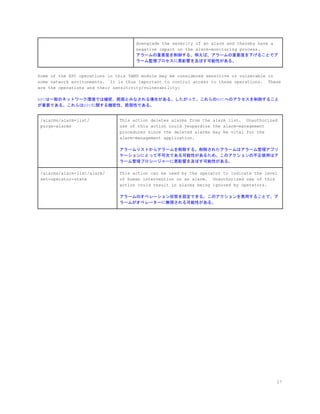
Some of the RPC operations in this YANG module may be considered sensitive or vulnerable in
some network environments. It is thus important to control access to these operations. These
are the operations and their sensitivity/vulnerability:
RPCは一部のネットワーク環境では機密、脆弱とみなされる場合がある。したがって、これらのRPCへのアクセスを制御すること
が重要である。これらはRPCに関する機密性、脆弱性である。
/alarms/alarm-list/
purge-alarms
This action deletes alarms from the alarm list. Unauthorized
use of this action could jeopardize the alarm-management
procedures since the deleted alarms may be vital for the
alarm-management application.
アラームリストからアラームを削除する。削除されたアラームはアラーム管理アプリ
ケーションにとって不可欠である可能性があるため、このアクションの不正使用はア
ラーム管理プロシージャーに悪影響を及ぼす可能性がある。
/alarms/alarm-list/alarm/
set-operator-state
This action can be used by the operator to indicate the level
of human intervention on an alarm. Unauthorized use of this
action could result in alarms being ignored by operators.
アラームのオペレーション状態を設定できる。このアクションを悪用することで、ア
ラームがオペレーターに無視される可能性がある。
27
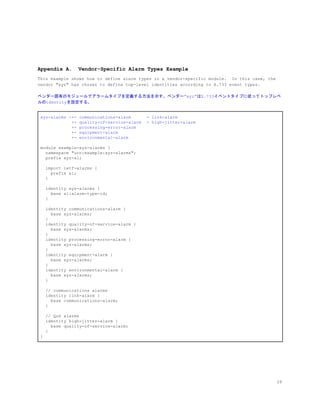
Appendix A. Vendor-Specific Alarm Types Example
This example shows how to define alarm types in a vendor-specific module. In this case, the
vendor "xyz" has chosen to define top-level identities according to X.733 event types.
ベンダー固有のモジュールでアラームタイプを定義する方法を示す。ベンダー”xyz”はX.733イベントタイプに従ってトップレベ
ルのidentityを設定する。
xyz-alarms -+- communications-alarm - link-alarm
+- quality-of-service-alarm - high-jitter-alarm
+- processing-error-alarm
+- equipment-alarm
+- environmental-alarm
module example-xyz-alarms {
namespace "urn:example:xyz-alarms";
prefix xyz-al;
import ietf-alarms {
prefix al;
}
identity xyz-alarms {
base al:alarm-type-id;
}
identity communications-alarm {
base xyz-alarms;
}
identity quality-of-service-alarm {
base xyz-alarms;
}
identity processing-error-alarm {
base xyz-alarms;
}
identity equipment-alarm {
base xyz-alarms;
}
identity environmental-alarm {
base xyz-alarms;
}
// communications alarms
identity link-alarm {
base communications-alarm;
}
// QoS alarms
identity high-jitter-alarm {
base quality-of-service-alarm;
}
}
28
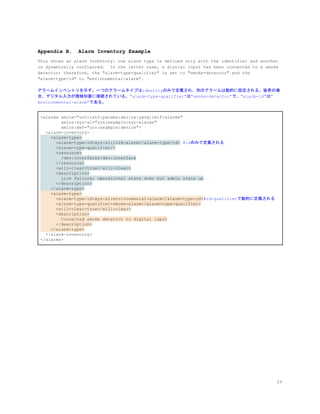
Appendix B. Alarm Inventory Example
This shows an alarm inventory: one alarm type is defined only with the identifier and another
is dynamically configured. In the latter case, a digital input has been connected to a smoke
detector; therefore, the "alarm-type-qualifier" is set to "smoke-detector" and the
"alarm-type-id" to "environmental-alarm".
アラームインベントリを示す。一つのアラームタイプはidentityのみで定義され、別のアラームは動的に設定される。後者の場
合、デジタル入力が煙検知器に接続されている。”alarm-type-qualifier”は”smoke-detector”で、”alarm-id”は”
environmental-alarm”である。
<alarms xmlns="urn:ietf:params:xml:ns:yang:ietf-alarms"
xmlns:xyz-al="urn:example:xyz-alarms"
xmlns:dev="urn:example:device">
<alarm-inventory>
<alarm-type>
<alarm-type-id>xyz-al:link-alarm</alarm-type-id>​ ​#idのみで定義される
<alarm-type-qualifier/>
<resource>
/dev:interfaces/dev:interface
</resource>
<will-clear>true</will-clear>
<description>
Link failure; operational state down but admin state up
</description>
</alarm-type>
<alarm-type>
<alarm-type-id>xyz-al:environmental-alarm</alarm-type-id>​#id+qualifierで動的に定義される
<alarm-type-qualifier>smoke-alarm</alarm-type-qualifier>
<will-clear>true</will-clear>
<description>
Connected smoke detector to digital input
</description>
</alarm-type>
</alarm-inventory>
</alarms>
29
Appendix C. Alarm List Example
In this example, we show an alarm that has toggled [major, clear, major]. An operator has
acknowledged the alarm.
major, clear, majorと切り替わったアラームを示す。オペレーターがアラームを確認した。
<alarms xmlns="urn:ietf:params:xml:ns:yang:ietf-alarms"
xmlns:xyz-al="urn:example:xyz-alarms"
xmlns:dev="urn:example:device">
<alarm-list>
<number-of-alarms>1</number-of-alarms>
<last-changed>2018-04-08T08:39:50.00Z</last-changed>
<alarm>
<resource>
/dev:interfaces/dev:interface[name='FastEthernet1/0']
</resource>
<alarm-type-id>xyz-al:link-alarm</alarm-type-id>
<alarm-type-qualifier></alarm-type-qualifier>
<time-created>2018-04-08T08:20:10.00Z</time-created>
<is-cleared>false</is-cleared>
<alt-resource>1.3.6.1.2.1.2.2.1.1.17</alt-resource>
<last-raised>2018-04-08T08:39:40.00Z</last-raised>
<last-changed>2018-04-08T08:39:50.00Z</last-changed>
<perceived-severity>major</perceived-severity>
<alarm-text>
Link operationally down but administratively up
</alarm-text>
<status-change>
<time>2018-04-08T08:39:40.00Z</time>​ #major
<perceived-severity>major</perceived-severity>
<alarm-text>
Link operationally down but administratively up
</alarm-text>
</status-change>
<status-change>
<time>2018-04-08T08:30:00.00Z</time>​ #clear
<perceived-severity>cleared</perceived-severity>
<alarm-text>
Link operationally up and administratively up
</alarm-text>
</status-change>
<status-change>
<time>2018-04-08T08:20:10.00Z</time>​ #major
<perceived-severity>major</perceived-severity>
<alarm-text>
Link operationally down but administratively up
</alarm-text>
</status-change>
<operator-state-change>
<time>2018-04-08T08:39:50.00Z</time>
​<state>ack</state>​ #ack
<operator>joe</operator>
<text>Will investigate, ticket TR764999</text>
</operator-state-change>
</alarm>
</alarm-list>
</alarms>
30
Appendix D. Alarm Shelving Example
This example shows how to shelve alarms. We shelve alarms related to the smoke detectors,
since they are being installed and tested. We also shelve all alarms from FastEthernet1/0.
アラームをシェルフする。煙検知器は設置後のテスト中のためシェルフする。FastEthernet1/0のアラームも全てシェルフす
る。
<alarms xmlns="urn:ietf:params:xml:ns:yang:ietf-alarms"
xmlns:xyz-al="urn:example:xyz-alarms"
xmlns:dev="urn:example:device">
<control>
<alarm-shelving>
<shelf>​ ​#FastEthernet1/0のシェルフ。リソース名指定。
<name>FE10</name>
<resource>
/dev:interfaces/dev:interface[name='FastEthernet1/0']
</resource>
</shelf>
<shelf>​ ​#煙検知器のシェルフ。アラームタイプ指定。
<name>detectortest</name>
<alarm-type>
<alarm-type-id>
xyz-al:environmental-alarm
</alarm-type-id>
<alarm-type-qualifier-match>
smoke-alarm
</alarm-type-qualifier-match>
</alarm-type>
</shelf>
</alarm-shelving>
</control>
</alarms>
31
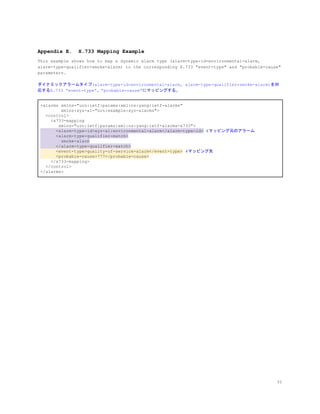
Appendix E. X.733 Mapping Example
This example shows how to map a dynamic alarm type (alarm-type-id=environmental-alarm,
alarm-type-qualifier=smoke-alarm) to the corresponding X.733 "event-type" and "probable-cause"
parameters.
ダイナミックアラームタイプ(alarm-type-id=environmental-alarm, alarm-type-qualifier=smoke-alarm)を対
応するX.733 “event-type”、”probable-cause”にマッピングする。
<alarms xmlns="urn:ietf:params:xml:ns:yang:ietf-alarms"
xmlns:xyz-al="urn:example:xyz-alarms">
<control>
<x733-mapping
xmlns="urn:ietf:params:xml:ns:yang:ietf-alarms-x733">
<alarm-type-id>xyz-al:environmental-alarm</alarm-type-id>​ ​#マッピング元のアラーム
<alarm-type-qualifier-match>
smoke-alarm
</alarm-type-qualifier-match>
<event-type>quality-of-service-alarm</event-type>​ ​#マッピング先
<probable-cause>777</probable-cause>
</x733-mapping>
</control>
</alarms>
32
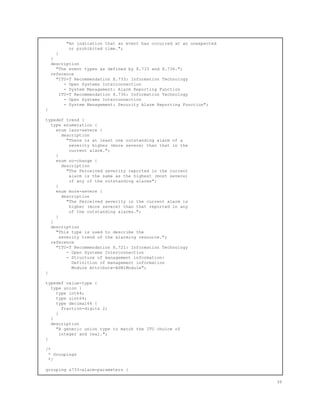
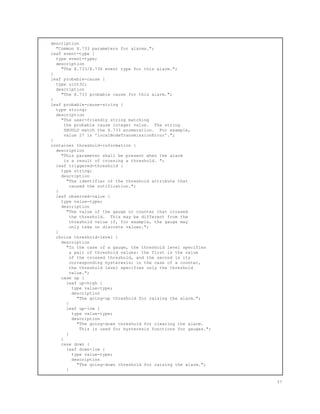
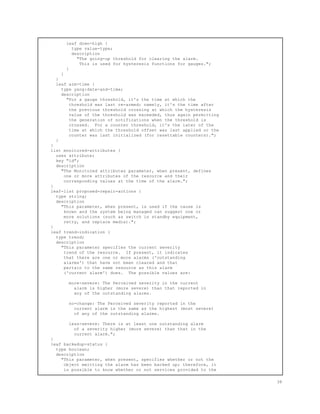
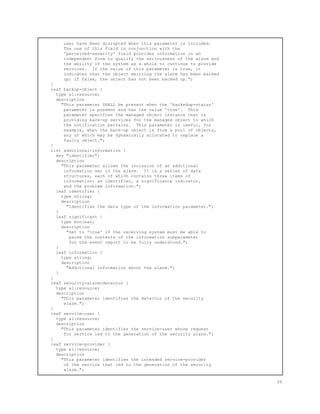
7. The X.733 Mapping Module
Many alarm systems are based on the X.733 [X.733] and X.736 [X.736] alarm standards. This
module "ietf-alarms-x733" augments the alarm inventory, the alarm lists, and the alarm
notification with X.733 and X.736 parameters.
多くのアラームシステムはX.733、X.736に基づいている。ietf-alarms-x733モジュールは、アラームインベントリ、アラー
ムリスト、notificationをX.733、X.736のパラメーターでaugmentする。
The module also supports a feature whereby the alarm manager can configure the mapping from
alarm types to X.733 "event-type" and "probable-cause" parameters. This might be needed when
the default mapping provided by the system is in conflict with other management systems or not
considered correct.
このモジュールは、アラームマネージャーがアラームタイプからX.733 ”event-type”および”probable-cause”へのマッピ
ングを設定できる機能もサポートする。​これは、システムが提供するデフォルトのマッピングが他の管理システムと競合する場合
等に必要になる。
Note that the term "resource" in this document is synonymous to the ITU term "managed object".
このドキュメントの”resource”はITUの”managed object”と同じ意味である。
module ietf-alarms-x733 {
yang-version 1.1;
namespace "urn:ietf:params:xml:ns:yang:ietf-alarms-x733";
prefix x733;
import ietf-alarms {
prefix al;
}
import ietf-yang-types {
prefix yang;
reference
"RFC 6991: Common YANG Data Types";
}
organization
"IETF CCAMP Working Group";
contact
"WG Web: <https://trac.ietf.org/trac/ccamp>
WG List: <mailto:ccamp@ietf.org>
Editor: Stefan Vallin
<mailto:stefan@wallan.se>
Editor: Martin Bjorklund
<mailto:mbj@tail-f.com>";
description
"This module augments the ietf-alarms module with X.733 alarm
parameters.
The following structures are augmented with the X.733 event type
and probable cause:
1) alarms/alarm-inventory: all possible alarm types
2) alarms/alarm-list: every alarm in the system
3) alarm-notification: notifications indicating alarm-state
changes
33
4) alarms/shelved-alarms
The module also optionally allows the alarm-management system
to configure the mapping from the ietf-alarms' alarm keys
to the ITU tuple (event-type, probable-cause).
​ #ietf-alarmのkeyからITUタプル(event-type, probable-cause)へのマッピングを設定できる。
The mapping does not include a corresponding problem value
specific to X.733. The recommendation is to use the
'alarm-type-qualifier' leaf, which serves the same purpose.
#マッピングにX.733のproblem valueは含まない。alarm-type-qualifierを代わりに使うことが推奨される。
The module uses an integer and a corresponding string for
probable cause instead of a globally defined enumeration, in
order to be able to manage conflicting enumeration definitions.
A single globally defined enumeration is challenging to
maintain.
The key words 'MUST', 'MUST NOT', 'REQUIRED', 'SHALL', 'SHALL
NOT', 'SHOULD', 'SHOULD NOT', 'RECOMMENDED', 'NOT RECOMMENDED',
'MAY', and 'OPTIONAL' in this document are to be interpreted as
described in BCP 14 (RFC 2119) (RFC 8174) when, and only when,
they appear in all capitals, as shown here.
Copyright (c) 2019 IETF Trust and the persons identified as
authors of the code. All rights reserved.
Redistribution and use in source and binary forms, with or
without modification, is permitted pursuant to, and subject to
the license terms contained in, the Simplified BSD License set
forth in Section 4.c of the IETF Trust's Legal Provisions
Relating to IETF Documents
(https://trustee.ietf.org/license-info).
This version of this YANG module is part of RFC 8632; see
the RFC itself for full legal notices.";
reference
"ITU-T Recommendation X.733: Information Technology
- Open Systems Interconnection
- System Management: Alarm Reporting Function";
revision 2019-09-11 {
description
"Initial revision.";
reference
"RFC 8632: A YANG Data Model for Alarm Management";
}
/*
* Features
*/
feature configure-x733-mapping {
description
"The system supports configurable X733 mapping from
the ietf-alarms' alarm-type to X733 event-type
and probable-cause.";
}
/*
* Typedefs
*/
typedef event-type {
type enumeration {
34
enum other {
value 1;
description
"None of the below.";
}
enum communications-alarm {
value 2;
description
"An alarm of this type is principally associated with the
procedures and/or processes required to convey
information from one point to another.";
}
enum quality-of-service-alarm {
value 3;
description
"An alarm of this type is principally associated with a
degradation in the quality of a service.";
}
enum processing-error-alarm {
value 4;
description
"An alarm of this type is principally associated with a
software or processing fault.";
}
enum equipment-alarm {
value 5;
description
"An alarm of this type is principally associated with an
equipment fault.";
}
enum environmental-alarm {
value 6;
description
"An alarm of this type is principally associated with a
condition relating to an enclosure in which the equipment
resides.";
}
enum integrity-violation {
value 7;
description
"An indication that information may have been illegally
modified, inserted, or deleted.";
}
enum operational-violation {
value 8;
description
"An indication that the provision of the requested service
was not possible due to the unavailability, malfunction,
or incorrect invocation of the service.";
}
enum physical-violation {
value 9;
description
"An indication that a physical resource has been violated
in a way that suggests a security attack.";
}
enum security-service-or-mechanism-violation {
value 10;
description
"An indication that a security attack has been detected by
a security service or mechanism.";
}
enum time-domain-violation {
value 11;
description
35
"An indication that an event has occurred at an unexpected
or prohibited time.";
}
}
description
"The event types as defined by X.733 and X.736.";
reference
"ITU-T Recommendation X.733: Information Technology
- Open Systems Interconnection
- System Management: Alarm Reporting Function
ITU-T Recommendation X.736: Information Technology
- Open Systems Interconnection
- System Management: Security Alarm Reporting Function";
}
typedef trend {
type enumeration {
enum less-severe {
description
"There is at least one outstanding alarm of a
severity higher (more severe) than that in the
current alarm.";
}
enum no-change {
description
"The Perceived severity reported in the current
alarm is the same as the highest (most severe)
of any of the outstanding alarms";
}
enum more-severe {
description
"The Perceived severity in the current alarm is
higher (more severe) than that reported in any
of the outstanding alarms.";
}
}
description
"This type is used to describe the
severity trend of the alarming resource.";
reference
"ITU-T Recommendation X.721: Information Technology
- Open Systems Interconnection
- Structure of management information:
Definition of management information
Module Attribute-ASN1Module";
}
typedef value-type {
type union {
type int64;
type uint64;
type decimal64 {
fraction-digits 2;
}
}
description
"A generic union type to match the ITU choice of
integer and real.";
}
/*
* Groupings
*/
grouping x733-alarm-parameters {
36
description
"Common X.733 parameters for alarms.";
leaf event-type {
type event-type;
description
"The X.733/X.736 event type for this alarm.";
}
leaf probable-cause {
type uint32;
description
"The X.733 probable cause for this alarm.";
}
leaf probable-cause-string {
type string;
description
"The user-friendly string matching
the probable cause integer value. The string
SHOULD match the X.733 enumeration. For example,
value 27 is 'localNodeTransmissionError'.";
}
container threshold-information {
description
"This parameter shall be present when the alarm
is a result of crossing a threshold. ";
leaf triggered-threshold {
type string;
description
"The identifier of the threshold attribute that
caused the notification.";
}
leaf observed-value {
type value-type;
description
"The value of the gauge or counter that crossed
the threshold. This may be different from the
threshold value if, for example, the gauge may
only take on discrete values.";
}
choice threshold-level {
description
"In the case of a gauge, the threshold level specifies
a pair of threshold values: the first is the value
of the crossed threshold, and the second is its
corresponding hysteresis; in the case of a counter,
the threshold level specifies only the threshold
value.";
case up {
leaf up-high {
type value-type;
description
"The going-up threshold for raising the alarm.";
}
leaf up-low {
type value-type;
description
"The going-down threshold for clearing the alarm.
This is used for hysteresis functions for gauges.";
}
}
case down {
leaf down-low {
type value-type;
description
"The going-down threshold for raising the alarm.";
}
37
leaf down-high {
type value-type;
description
"The going-up threshold for clearing the alarm.
This is used for hysteresis functions for gauges.";
}
}
}
leaf arm-time {
type yang:date-and-time;
description
"For a gauge threshold, it's the time at which the
threshold was last re-armed; namely, it's the time after
the previous threshold crossing at which the hysteresis
value of the threshold was exceeded, thus again permitting
the generation of notifications when the threshold is
crossed. For a counter threshold, it's the later of the
time at which the threshold offset was last applied or the
counter was last initialized (for resettable counters).";
}
}
list monitored-attributes {
uses attribute;
key "id";
description
"The Monitored attributes parameter, when present, defines
one or more attributes of the resource and their
corresponding values at the time of the alarm.";
}
leaf-list proposed-repair-actions {
type string;
description
"This parameter, when present, is used if the cause is
known and the system being managed can suggest one or
more solutions (such as switch in standby equipment,
retry, and replace media).";
}
leaf trend-indication {
type trend;
description
"This parameter specifies the current severity
trend of the resource. If present, it indicates
that there are one or more alarms ('outstanding
alarms') that have not been cleared and that
pertain to the same resource as this alarm
('current alarm') does. The possible values are:
more-severe: The Perceived severity in the current
alarm is higher (more severe) than that reported in
any of the outstanding alarms.
no-change: The Perceived severity reported in the
current alarm is the same as the highest (most severe)
of any of the outstanding alarms.
less-severe: There is at least one outstanding alarm
of a severity higher (more severe) than that in the
current alarm.";
}
leaf backedup-status {
type boolean;
description
"This parameter, when present, specifies whether or not the
object emitting the alarm has been backed up; therefore, it
is possible to know whether or not services provided to the
38
user have been disrupted when this parameter is included.
The use of this field in conjunction with the
'perceived-severity' field provides information in an
independent form to qualify the seriousness of the alarm and
the ability of the system as a whole to continue to provide
services. If the value of this parameter is true, it
indicates that the object emitting the alarm has been backed
up; if false, the object has not been backed up.";
}
leaf backup-object {
type al:resource;
description
"This parameter SHALL be present when the 'backedup-status'
parameter is present and has the value 'true'. This
parameter specifies the managed object instance that is
providing back-up services for the managed object to which
the notification pertains. This parameter is useful, for
example, when the back-up object is from a pool of objects,
any of which may be dynamically allocated to replace a
faulty object.";
}
list additional-information {
key "identifier";
description
"This parameter allows the inclusion of an additional
information set in the alarm. It is a series of data
structures, each of which contains three items of
information: an identifier, a significance indicator,
and the problem information.";
leaf identifier {
type string;
description
"Identifies the data type of the information parameter.";
}
leaf significant {
type boolean;
description
"Set to 'true' if the receiving system must be able to
parse the contents of the information subparameter
for the event report to be fully understood.";
}
leaf information {
type string;
description
"Additional information about the alarm.";
}
}
leaf security-alarm-detector {
type al:resource;
description
"This parameter identifies the detector of the security
alarm.";
}
leaf service-user {
type al:resource;
description
"This parameter identifies the service-user whose request
for service led to the generation of the security alarm.";
}
leaf service-provider {
type al:resource;
description
"This parameter identifies the intended service-provider
of the service that led to the generation of the security
alarm.";
39
}
reference
"ITU-T Recommendation X.733: Information Technology
- Open Systems Interconnection
- System Management: Alarm Reporting Function
ITU-T Recommendation X.736: Information Technology
- Open Systems Interconnection
- System Management: Security Alarm Reporting Function";
}
grouping x733-alarm-definition-parameters {
description
"Common X.733 parameters for alarm definitions.
This grouping is used to define those alarm
attributes that can be mapped from the alarm-type
mechanism in the ietf-alarms module.";
leaf event-type {
type event-type;
description
"The alarm type has this X.733/X.736 event type.";
}
leaf probable-cause {
type uint32;
description
"The alarm type has this X.733 probable cause value.
This module defines probable cause as an integer
and not as an enumeration. The reason being that the
primary use of probable cause is in the management
application if it is based on the X.733 standard.
However, most management applications have their own
defined enum definitions and merging enums from
different systems might create conflicts. By using
a configurable uint32, the system can be configured
to match the enum values in the management application.";
}
leaf probable-cause-string {
type string;
description
"This string can be used to give a user-friendly string
to the probable cause value.";
}
}
grouping attribute {
description
"A grouping to match the ITU generic reference to
an attribute.";
leaf id {
type al:resource;
description
"The resource representing the attribute.";
}
leaf value {
type string;
description
"The value represented as a string since it could
be of any type.";
}
reference
"ITU-T Recommendation X.721: Information Technology
- Open Systems Interconnection
- Structure of management information:
Definition of management information
Module Attribute-ASN1Module";
}
40
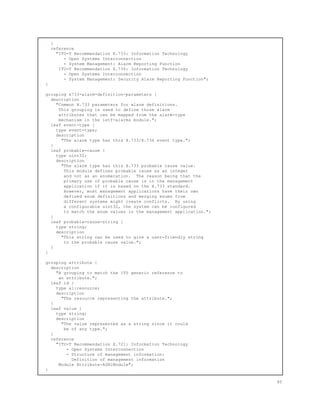
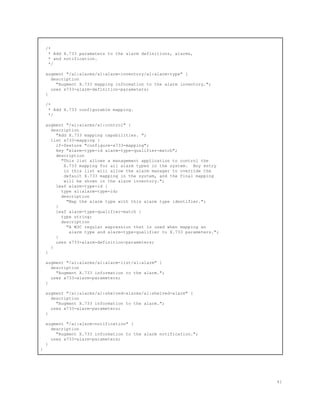
/*
* Add X.733 parameters to the alarm definitions, alarms,
* and notification.
*/
augment "/al:alarms/al:alarm-inventory/al:alarm-type" {
description
"Augment X.733 mapping information to the alarm inventory.";
uses x733-alarm-definition-parameters;
}
/*
* Add X.733 configurable mapping.
*/
augment "/al:alarms/al:control" {
description
"Add X.733 mapping capabilities. ";
list x733-mapping {
if-feature "configure-x733-mapping";
key "alarm-type-id alarm-type-qualifier-match";
description
"This list allows a management application to control the
X.733 mapping for all alarm types in the system. Any entry
in this list will allow the alarm manager to override the
default X.733 mapping in the system, and the final mapping
will be shown in the alarm inventory.";
leaf alarm-type-id {
type al:alarm-type-id;
description
"Map the alarm type with this alarm type identifier.";
}
leaf alarm-type-qualifier-match {
type string;
description
"A W3C regular expression that is used when mapping an
alarm type and alarm-type-qualifier to X.733 parameters.";
}
uses x733-alarm-definition-parameters;
}
}
augment "/al:alarms/al:alarm-list/al:alarm" {
description
"Augment X.733 information to the alarm.";
uses x733-alarm-parameters;
}
augment "/al:alarms/al:shelved-alarms/al:shelved-alarm" {
description
"Augment X.733 information to the alarm.";
uses x733-alarm-parameters;
}
augment "/al:alarm-notification" {
description
"Augment X.733 information to the alarm notification.";
uses x733-alarm-parameters;
}
}
41
6. Alarm YANG Module
This YANG module references [RFC6991] and [XSD-TYPES].
YANG moduleは​[RFC6991]​ and ​[XSD-TYPES]​を参照する。
主な機能
Alarm list 全てのアラームのリスト。クリアされたアラームも明示的にパージされるまで
リストに残る。
Operator actions on alarms アラームのackとclose。
Administrative actions on alarms アラームのパージ。
Alarm inventory システムに実装されている全てのアラームタイプ。
Alarm shelving アラームのブロック。
Alarm profiles アラームの重要度等の変更。
Feature
operator-actions Operator actions on alarms。
alarm-shelving Alarm shelving。
alarm-history アラームの状態変化の履歴を保持する。
alarm-summary アラームの統計情報として重要度毎のアラーム数等を示す。
alarm-profile Alarm profiles。
severity-assignment 重要度の変更が可能。
root-cause-analysis アラームの根本原因のリソースの候補を示す。
service-impact-analysis アラームの影響を受ける候補のリソースを示す。
alarm-correlation アラーム間の相関を示す。
Tree Diagram
module: ietf-alarms
+--rw alarms
+--rw control
| +--rw max-alarm-status-changes? union
#循環リストstatus-changeの最大エントリ数。enum(infinite) or uint16。デフォルト32。
| +--rw notify-status-changes? enumeration
#Notificationする条件:enum(all-state-changes(デフォルト)、raise-and-clear、severity-level)
| +--rw notify-severity-level? severity
42
​#notify-status-changes=”severity-level”でnotify-severity-level=”major”で
# 下記のアラーム変化があった場合、T1、T2、T5-8が通知される。T2はminorだがmajorからminorへの変化のため通知される。
[(Time, severity, clear)]:
[(T1, major, -), (T2, minor, -), (T3, warning, -),
(T4, minor, -), (T5, major, -), (T6, critical, -),
(T7, major. -), (T8, major, clear)]
| +--rw alarm-shelving {alarm-shelving}?
| +--rw shelf* [name]
| +--rw name string
| +--rw resource* resource-match
| +--rw alarm-type* [alarm-type-id alarm-type-qualifier-match]
| | +--rw alarm-type-id alarm-type-id
| | +--rw alarm-type-qualifier-match string
| +--rw description? string
+--ro alarm-inventory
| +--ro alarm-type* [alarm-type-id alarm-type-qualifier]
| +--ro alarm-type-id alarm-type-id
| +--ro alarm-type-qualifier alarm-type-qualifier
| +--ro resource* resource-match
| +--ro will-clear boolean
#アラームが是正処置後にクリアされるかどうか。クリアされることが推奨される(SHOULD)。
#falseの場合はオペレーターがクリアを確認する必要がある。
| +--ro severity-level* severity
| +--ro description string
+--ro summary {alarm-summary}?
| +--ro alarm-summary* [severity]
| | +--ro severity severity
| | +--ro total? yang:gauge32
| | +--ro not-cleared? yang:gauge32
| | +--ro cleared? yang:gauge32
| | +--ro cleared-not-closed? yang:gauge32 {operator-actions}?
| | +--ro cleared-closed? yang:gauge32 {operator-actions}?
| | +--ro not-cleared-closed? yang:gauge32 {operator-actions}?
| | +--ro not-cleared-not-closed? yang:gauge32 {operator-actions}?
| +--ro shelves-active? empty {alarm-shelving}?
#アラームがシェルフの有無を示す。
#/alarms/shelved-alarms/number-of-shelved-alarms>0の場合、このリーフが存在すること(MUST)。
+--ro alarm-list
| +--ro number-of-alarms? yang:gauge32
​#alarm-listのエントリ数。
| +--ro last-changed? yang:date-and-time
​#alarm-listが最後に変更されたときのタイムスタンプ。
| +--ro alarm* [resource alarm-type-id alarm-type-qualifier]
| | +--ro resource resource
​#リソースが
YANGでモデル化されている場合:instance-identifier Built-In Type
​ SNMPの場合:yang:object-identifier
​ UUIDの場合:yang:yang:uuid
​ それ以外の場合:yang:uuid
| | +--ro alarm-type-id alarm-type-id
| | +--ro alarm-type-qualifier alarm-type-qualifier
| | +--ro alt-resource* resource
​#代替リソース。
| | +--ro related-alarm* [resource alarm-type-id alarm-type-qualifier] {alarm-correlation}?
| | | +--ro resource -> /alarms/alarm-list/alarm/resource
| | | +--ro alarm-type-id ->
/alarms/alarm-list/alarm[resource=current()/../resource]/alarm-type-id
| | | +--ro alarm-type-qualifier ->
/alarms/alarm-list/alarm[resource=current()/../resource][alarm-type-id=current()/../alarm-type-id]/alarm-type-qual
ifier
| | +--ro impacted-resource* resource {service-impact-analysis}?
| | +--ro root-cause-resource* resource {root-cause-analysis}?
| | +--ro time-created yang:date-and-time
| | +--ro is-cleared boolean
| | +--ro last-raised yang:date-and-time
43
| | +--ro last-changed yang:date-and-time
| | +--ro perceived-severity severity
| | +--ro alarm-text alarm-text
| | +--ro status-change* [time] {alarm-history}?
| | | +--ro time yang:date-and-time
| | | +--ro perceived-severity severity-with-clear
| | | +--ro alarm-text alarm-text
| | +--ro operator-state-change* [time] {operator-actions}?
| | | +--ro time yang:date-and-time
| | | +--ro operator string
​#このアラームに対応したオペレーター名
| | | +--ro state operator-state
​#none :何もしてない (writable-operator-state)
#ack :対処中。 (writable-operator-state)
#closed:対処済み。 (writable-operator-state)
​#shelved:シェルフされる。シェルフ名を含めることが推奨される(SHOULD)。
​#un-shelved:シェルフからアラームリストから移動。シェルフ名を含めることが推奨される(SHOULD)。
| | | +--ro text? string
| | +---x set-operator-state {operator-actions}?
| | | +---w input
| | | +---w state writable-operator-state
| | | +---w text? string
| | +---n operator-action {operator-actions}?
| | +-- time yang:date-and-time
| | +-- operator string
| | +-- state operator-state
| | +-- text? string
| +---x purge-alarms
| | +---w input
| | | +---w alarm-clearance-status enumeration
​#any、cleared、not-cleared
| | | +---w older-than!
| | | | +---w (age-spec)?
| | | | +--:(seconds)
| | | | | +---w seconds? uint16
| | | | +--:(minutes)
| | | | | +---w minutes? uint16
| | | | +--:(hours)
| | | | | +---w hours? uint16
| | | | +--:(days)
| | | | | +---w days? uint16
| | | | +--:(weeks)
| | | | +---w weeks? uint16
| | | +---w severity!
| | | | +---w (sev-spec)?
| | | | +--:(below)
| | | | | +---w below? severity
| | | | +--:(is)
| | | | | +---w is? severity
| | | | +--:(above)
| | | | +---w above? severity
| | | +---w operator-state-filter! {operator-actions}?
| | | +---w state? operator-state
| | | +---w user? string
| | +--ro output
| | +--ro purged-alarms? uint32
​#パージされたアラーム数
| +---x compress-alarms {alarm-history}?
| +---w input
| | +---w resource? resource-match
| | +---w alarm-type-id? -> /alarms/alarm-list/alarm/alarm-type-id
| | +---w alarm-type-qualifier? -> /alarms/alarm-list/alarm/alarm-type-qualifier
| +--ro output
| +--ro compressed-alarms? uint32
​#圧縮されたアラーム数
44
+--ro shelved-alarms {alarm-shelving}?
| +--ro number-of-shelved-alarms? yang:gauge32
| +--ro shelved-alarms-last-changed? yang:date-and-time
| +--ro shelved-alarm* [resource alarm-type-id alarm-type-qualifier]
| | +--ro resource resource
| | +--ro alarm-type-id alarm-type-id
| | +--ro alarm-type-qualifier alarm-type-qualifier
| | +--ro alt-resource* resource
| | +--ro related-alarm* [resource alarm-type-id alarm-type-qualifier] {alarm-correlation}?
| | | +--ro resource -> /alarms/alarm-list/alarm/resource
| | | +--ro alarm-type-id ->
/alarms/alarm-list/alarm[resource=current()/../resource]/alarm-type-id
| | | +--ro alarm-type-qualifier ->
/alarms/alarm-list/alarm[resource=current()/../resource][alarm-type-id=current()/../alarm-type-id]/alarm-type-qual
ifier
| | +--ro impacted-resource* resource {service-impact-analysis}?
| | +--ro root-cause-resource* resource {root-cause-analysis}?
| | +--ro shelf-name? -> /alarms/control/alarm-shelving/shelf/name
| | +--ro is-cleared boolean
| | +--ro last-raised yang:date-and-time
| | +--ro last-changed yang:date-and-time
| | +--ro perceived-severity severity
| | +--ro alarm-text alarm-text
| | +--ro status-change* [time] {alarm-history}?
| | | +--ro time yang:date-and-time
| | | +--ro perceived-severity severity-with-clear
| | | +--ro alarm-text alarm-text
| | +--ro operator-state-change* [time] {operator-actions}?
| | +--ro time yang:date-and-time
| | +--ro operator string
| | +--ro state operator-state
| | +--ro text? string
| +---x purge-shelved-alarms
| | +---w input
| | | +---w alarm-clearance-status enumeration
| | | +---w older-than!
| | | | +---w (age-spec)?
| | | | +--:(seconds)
| | | | | +---w seconds? uint16
| | | | +--:(minutes)
| | | | | +---w minutes? uint16
| | | | +--:(hours)
| | | | | +---w hours? uint16
| | | | +--:(days)
| | | | | +---w days? uint16
| | | | +--:(weeks)
| | | | +---w weeks? uint16
| | | +---w severity!
| | | | +---w (sev-spec)?
| | | | +--:(below)
| | | | | +---w below? severity
| | | | +--:(is)
| | | | | +---w is? severity
| | | | +--:(above)
| | | | +---w above? severity
| | | +---w operator-state-filter! {operator-actions}?
| | | +---w state? operator-state
| | | +---w user? string
| | +--ro output
| | +--ro purged-alarms? uint32
| +---x compress-shelved-alarms {alarm-history}?
| +---w input
| | +---w resource? -> /alarms/shelved-alarms/shelved-alarm/resource
| | +---w alarm-type-id? -> /alarms/shelved-alarms/shelved-alarm/alarm-type-id
| | +---w alarm-type-qualifier? -> /alarms/shelved-alarms/shelved-alarm/alarm-type-qualifier
45
| +--ro output
| +--ro compressed-alarms? uint32
+--rw alarm-profile* [alarm-type-id alarm-type-qualifier-match resource] {alarm-profile}?
+--rw alarm-type-id alarm-type-id
+--rw alarm-type-qualifier-match string
+--rw resource resource-match
+--rw description string
+--rw alarm-severity-assignment-profile {severity-assignment}?
+--rw severity-level* severity
notifications:
+---n alarm-notification
| +--ro resource resource
| +--ro alarm-type-id alarm-type-id
| +--ro alarm-type-qualifier? alarm-type-qualifier
| +--ro alt-resource* resource
| +--ro related-alarm* [resource alarm-type-id alarm-type-qualifier] {alarm-correlation}?
| | +--ro resource -> /alarms/alarm-list/alarm/resource
| | +--ro alarm-type-id -> /alarms/alarm-list/alarm[resource=current()/../resource]/alarm-type-id
| | +--ro alarm-type-qualifier ->
/alarms/alarm-list/alarm[resource=current()/../resource][alarm-type-id=current()/../alarm-type-id]/alarm-type-qual
ifier
| +--ro impacted-resource* resource {service-impact-analysis}?
| +--ro root-cause-resource* resource {root-cause-analysis}?
| +--ro time yang:date-and-time
| +--ro perceived-severity severity-with-clear
| +--ro alarm-text alarm-text
+---n alarm-inventory-changed
ietf-alarms.yang
module ietf-alarms {
yang-version 1.1;
namespace "urn:ietf:params:xml:ns:yang:ietf-alarms";
prefix al;
import ietf-yang-types {
prefix yang;
reference
"RFC 6991: Common YANG Data Types.";
}
organization
"IETF CCAMP Working Group";
contact
"WG Web: <https://trac.ietf.org/trac/ccamp>
WG List: <mailto:ccamp@ietf.org>
Editor: Stefan Vallin
<mailto:stefan@wallan.se>
Editor: Martin Bjorklund
<mailto:mbj@tail-f.com>";
description
"This module defines an interface for managing alarms. Main
inputs to the module design are the 3GPP Alarm Integration
Reference Point (IRP), ITU-T X.733, and ANSI/ISA-18.2 alarm
standards.
46
Main features of this module include:
* Alarm list:
A list of all alarms. Cleared alarms stay in
the list until explicitly purged.
* Operator actions on alarms:
Acknowledging and closing alarms.
* Administrative actions on alarms:
Purging alarms from the list according to specific
criteria.
* Alarm inventory:
A management application can read all
alarm types implemented by the system.
* Alarm shelving:
Shelving (blocking) alarms according
to specific criteria.
* Alarm profiles:
A management system can attach further
information to alarm types, for example,
overriding system-default severity
levels.
This module uses a stateful view on alarms. An alarm is a state
for a specific resource (note that an alarm is not a
notification). An alarm type is a possible alarm state for a
resource. For example, the tuple:
('link-alarm', 'GigabitEthernet0/25')
is an alarm of type 'link-alarm' on the resource
'GigabitEthernet0/25'.
Alarm types are identified using YANG identities and an optional
string-based qualifier. The string-based qualifier allows for
dynamic extension of the statically defined alarm types. Alarm
types identify a possible alarm state and not the individual
notifications. For example, the traditional 'link-down' and
'link-up' notifications are two notifications referring to the
same alarm type 'link-alarm'.
With this design, there is no ambiguity about how alarm and
alarm clear correlation should be performed; notifications that
report the same resource and alarm type are considered updates
of the same alarm, e.g., clearing an active alarm or changing
the severity of an alarm. The instrumentation can update the
severity and alarm text on an existing alarm. The above alarm
example can therefore look like the following:
(('link-alarm', 'GigabitEthernet0/25'),
warning,
'interface down while interface admin state is up')
There is a clear separation between updates on the alarm from
the underlying resource, like clear, and updates from an
operator, like acknowledging or closing an alarm:
(('link-alarm', 'GigabitEthernet0/25'),
warning,
'interface down while interface admin state is up',
cleared,
47
closed)
Administrative actions like removing closed alarms older than a
given time is supported.
This YANG module does not define how the underlying
instrumentation detects and clears the specific alarms. That
belongs to the Standards Development Organization (SDO) or
enterprise that owns that specific technology.
The key words 'MUST', 'MUST NOT', 'REQUIRED', 'SHALL', 'SHALL
NOT', 'SHOULD', 'SHOULD NOT', 'RECOMMENDED', 'NOT RECOMMENDED',
'MAY', and 'OPTIONAL' in this document are to be interpreted as
described in BCP 14 (RFC 2119) (RFC 8174) when, and only when,
they appear in all capitals, as shown here.
Copyright (c) 2019 IETF Trust and the persons identified as
authors of the code. All rights reserved.
Redistribution and use in source and binary forms, with or
without modification, is permitted pursuant to, and subject to
the license terms contained in, the Simplified BSD License set
forth in Section 4.c of the IETF Trust's Legal Provisions
Relating to IETF Documents
(https://trustee.ietf.org/license-info).
This version of this YANG module is part of RFC 8632; see
the RFC itself for full legal notices.";
revision 2019-09-11 {
description
"Initial revision.";
reference
"RFC 8632: A YANG Data Model for Alarm Management";
}
/*
* Features
*/
feature operator-actions {
description
"This feature indicates that the system supports operator
states on alarms.";
}
feature alarm-shelving {
description
"This feature indicates that the system supports shelving
(blocking) alarms.
Alarm shelving may have an impact on server processing
resources in order to match alarms against shelf
criteria.";
}
feature alarm-history {
description
"This feature indicates that the server maintains a history
of state changes for each alarm. For example, if an alarm
toggles between cleared and active 10 times, these state
changes are present in a separate list in the alarm.
Keeping the alarm history may have an impact on server
memory resources.";
48
}
feature alarm-summary {
description
"This feature indicates that the server summarizes the number
of alarms per severity and operator state.";
}
feature alarm-profile {
description
"The system enables clients to configure further information
to each alarm type.";
}
feature severity-assignment {
description
"The system supports configurable alarm severity levels.";
reference
"ITU-T Recommendation M.3100:
Generic network information model
ITU-T Recommendation M.3160:
Generic, protocol-neutral management information model";
}
feature root-cause-analysis {
description
"The system supports identifying candidate root-cause
resources for an alarm, for example, a disk partition
root cause for a logger failure alarm.";
}
feature service-impact-analysis {
description
"The system supports identifying candidate-impacted
resources for an alarm, for example, an interface state change
resulting in a link alarm, which can refer to a link as being
impacted.";
}
feature alarm-correlation {
description
"The system supports correlating/grouping alarms
that belong together.";
}
/*
* Identities
*/
identity alarm-type-id {
description
"Base identity for alarm types. A unique identification of
the alarm, not including the resource. Different resources
can share alarm types. If the resource reports the same
alarm type, it is considered to be the same alarm. The alarm
type is a simplification of the different X.733 and 3GPP Alarm
IRP correlation mechanisms, and it allows for
hierarchical extensions.
A string-based qualifier can be used in addition to the
identity in order to have different alarm types based on
information not known at design time, such as values in
textual SNMP Notification varbinds.
Standards and vendors can define sub-identities to clearly
49
identify specific alarm types.
This identity is abstract and MUST NOT be used for alarms.";
}
/*
* Common types
*/
typedef resource {
type union {
type instance-identifier {
require-instance false;
}
type yang:object-identifier;
type string;
type yang:uuid;
}
description
"This is an identification of the alarming resource, such as an
interface. It should be as fine-grained as possible to both
guide the operator and guarantee uniqueness of the alarms.
If the alarming resource is modeled in YANG, this type will
be an instance-identifier.
If the resource is an SNMP object, the type will be an
'object-identifier'.
If the resource is anything else, for example, a distinguished
name or a Common Information Model (CIM) path, this type will
be a string.
If the alarming object is identified by a Universally Unique
Identifier (UUID), use the uuid type. Be cautious when using
this type, since a UUID is hard to use for an operator.
If the server supports several models, the precedence should
be in the order as given in the union definition.";
}
typedef resource-match {
type union {
type yang:xpath1.0;
type yang:object-identifier;
type string;
}
description
"This type is used to match resources of type 'resource'.
Since the type 'resource' is a union of different types, the
'resource-match' type is also a union of corresponding types.
If the type is given as an XPath 1.0 expression, a resource
of type 'instance-identifier' matches if the instance is part
of the node set that is the result of evaluating the XPath 1.0
expression. For example, the XPath 1.0 expression:
/ietf-interfaces:interfaces/ietf-interfaces:interface
[ietf-interfaces:type='ianaift:ethernetCsmacd']
would match the resource instance-identifier:
/if:interfaces/if:interface[if:name='eth1'],
assuming that the interface 'eth1' is of type
50
'ianaift:ethernetCsmacd'.
If the type is given as an object identifier, a resource of
type 'object-identifier' matches if the match object
identifier is a prefix of the resource's object identifier.
For example, the value:
1.3.6.1.2.1.2.2
would match the resource object identifier:
1.3.6.1.2.1.2.2.1.1.5
If the type is given as an UUID or a string, it is interpreted
as an XML Schema regular expression, which matches a resource
of type 'yang:uuid' or 'string' if the given regular
expression matches the resource string.
If the type is given as an XPath expression, it is evaluated
in the following XPath context:
o The set of namespace declarations is the set of prefix
and namespace pairs for all YANG modules implemented by
the server, where the prefix is the YANG module name and
the namespace is as defined by the 'namespace' statement
in the YANG module.
If a leaf of this type is encoded in XML, all namespace
declarations in scope on the leaf element are added to
the set of namespace declarations. If a prefix found in
the XML is already present in the set of namespace
declarations, the namespace in the XML is used.
o The set of variable bindings is empty.
o The function library is the core function library, and
the functions are defined in Section 10 of RFC 7950.
o The context node is the root node in the data tree.";
reference
"XML Schema Part 2: Datatypes Second Edition,
World Wide Web Consortium Recommendation
REC-xmlschema-2-20041028";
}
typedef alarm-text {
type string;
description
"The string used to inform operators about the alarm. This
MUST contain enough information for an operator to be able to
understand the problem and how to resolve it. If this string
contains structure, this format should be clearly documented
for programs to be able to parse that information.";
}
typedef severity {
type enumeration {
enum indeterminate {
value 2;
description
"Indicates that the severity level could not be
determined. This level SHOULD be avoided.";
}
enum warning {
value 3;
51
description
"The 'warning' severity level indicates the detection of a
potential or impending service-affecting fault, before any
significant effects have been felt. Action should be
taken to further diagnose (if necessary) and correct the
problem in order to prevent it from becoming a more
serious service-affecting fault.";
}
enum minor {
value 4;
description
"The 'minor' severity level indicates the existence of a
non-service-affecting fault condition and that corrective
action should be taken in order to prevent a more serious
(for example, service-affecting) fault. Such a severity
can be reported, for example, when the detected alarm
condition is not currently degrading the capacity of the
resource.";
}
enum major {
value 5;
description
"The 'major' severity level indicates that a service-
affecting condition has developed and an urgent corrective
action is required. Such a severity can be reported, for
example, when there is a severe degradation in the
capability of the resource and its full capability must be
restored.";
}
enum critical {
value 6;
description
"The 'critical' severity level indicates that a service-
affecting condition has occurred and an immediate
corrective action is required. Such a severity can be
reported, for example, when a resource becomes totally out
of service and its capability must be restored.";
}
}
description
"The severity level of the alarm. Note well that the value
'clear' is not included. Whether or not an alarm is cleared
is a separate boolean flag.";
reference
"ITU-T Recommendation X.733: Information Technology
- Open Systems Interconnection
- System Management: Alarm Reporting Function";
}
typedef severity-with-clear {
type union {
type enumeration {
enum cleared {
value 1;
description
"The alarm is cleared by the instrumentation.";
}
}
type severity;
}
description
"The severity level of the alarm including clear. This is used
only in notifications reporting state changes for an alarm.";
}
52
typedef writable-operator-state {
type enumeration {
enum none {
value 1;
description
"The alarm is not being taken care of.";
}
enum ack {
value 2;
description
"The alarm is being taken care of. Corrective action not
taken yet or has failed";
}
enum closed {
value 3;
description
"Corrective action taken successfully.";
}
}
description
"Operator states on an alarm. The 'closed' state indicates
that an operator considers the alarm being resolved. This is
separate from the alarm's 'is-cleared' leaf.";
}
typedef operator-state {
type union {
type writable-operator-state;
type enumeration {
enum shelved {
value 4;
description
"The alarm is shelved. Alarms in /alarms/shelved-alarms/
MUST be assigned this operator state by the server as
the last entry in the 'operator-state-change' list. The
text for that entry SHOULD include the shelf name.";
}
enum un-shelved {
value 5;
description
"The alarm is moved back to 'alarm-list' from a shelf.
Alarms that are moved from /alarms/shelved-alarms/ to
/alarms/alarm-list MUST be assigned this state by the
server as the last entry in the 'operator-state-change'
list. The text for that entry SHOULD include the shelf
name.";
}
}
}
description
"Operator states on an alarm. The 'closed' state indicates
that an operator considers the alarm being resolved. This is
separate from the alarm's 'is-cleared' leaf.";
}
/* Alarm type */
typedef alarm-type-id {
type identityref {
base alarm-type-id;
}
description
"Identifies an alarm type. The description of the alarm type
id MUST indicate whether or not the alarm type is abstract.
An abstract alarm type is used as a base for other alarm type
53
ids and will not be used as a value for an alarm or be present
in the alarm inventory.";
}
typedef alarm-type-qualifier {
type string;
description
"If an alarm type cannot be fully specified at design time by
'alarm-type-id', this string qualifier is used in addition to
fully define a unique alarm type.
The definition of alarm qualifiers is considered to be part of
the instrumentation and is out of scope for this module. An
empty string is used when this is part of a key.";
}
/*
* Groupings
*/
grouping common-alarm-parameters {
description
"Common parameters for an alarm.
This grouping is used both in the alarm list and in the
notification representing an alarm-state change.";
leaf resource {
type resource;
mandatory true;
description
"The alarming resource. See also 'alt-resource'. This could
be, for example, a reference to the alarming interface";
}
leaf alarm-type-id {
type alarm-type-id;
mandatory true;
description
"This leaf and the leaf 'alarm-type-qualifier' together
provide a unique identification of the alarm type.";
}
leaf alarm-type-qualifier {
type alarm-type-qualifier;
description
"This leaf is used when the 'alarm-type-id' leaf cannot
uniquely identify the alarm type. Normally, this is not the
case, and this leaf is the empty string.";
}
leaf-list alt-resource {
type resource;
description
"Used if the alarming resource is available over other
interfaces. This field can contain SNMP OIDs, CIM paths, or
3GPP distinguished names, for example.";
}
list related-alarm {
if-feature "alarm-correlation";
key "resource alarm-type-id alarm-type-qualifier";
description
"References to related alarms. Note that the related alarm
might have been purged from the alarm list.";
leaf resource {
type leafref {
path "/alarms/alarm-list/alarm/resource";
require-instance false;
}
54
description
"The alarming resource for the related alarm.";
}
leaf alarm-type-id {
type leafref {
path "/alarms/alarm-list/alarm"
+ "[resource=current()/../resource]"
+ "/alarm-type-id";
require-instance false;
}
description
"The alarm type identifier for the related alarm.";
}
leaf alarm-type-qualifier {
type leafref {
path "/alarms/alarm-list/alarm"
+ "[resource=current()/../resource]"
+ "[alarm-type-id=current()/../alarm-type-id]"
+ "/alarm-type-qualifier";
require-instance false;
}
description
"The alarm qualifier for the related alarm.";
}
}
leaf-list impacted-resource {
if-feature "service-impact-analysis";
type resource;
description
"Resources that might be affected by this alarm. If the
system creates an alarm on a resource and also has a mapping
to other resources that might be impacted, these resources
can be listed in this leaf-list. In this way, the system
can create one alarm instead of several. For example, if an
interface has an alarm, the 'impacted-resource' can
reference the aggregated port channels.";
}
leaf-list root-cause-resource {
if-feature "root-cause-analysis";
type resource;
description
"Resources that are candidates for causing the alarm. If the
system has a mechanism to understand the candidate root
causes of an alarm, this leaf-list can be used to list the
root-cause candidate resources. In this way, the system can
create one alarm instead of several. An example might be a
logging system (alarm resource) that fails; the alarm can
reference the file system in the 'root-cause-resource'
leaf-list. Note that the intended use is not to also send
an alarm with the 'root-cause-resource' as an alarming
resource. The 'root-cause-resource' leaf-list is a hint and
should not also generate an alarm for the same problem.";
}
}
grouping alarm-state-change-parameters {
description
"Parameters for an alarm-state change.
This grouping is used both in the alarm list's status-change
list and in the notification representing an alarm-state
change.";
leaf time {
type yang:date-and-time;
mandatory true;
55
description
"The time the status of the alarm changed. The value
represents the time the real alarm-state change appeared in
the resource and not when it was added to the alarm
list. The /alarm-list/alarm/last-changed MUST be set to the
same value.";
}
leaf perceived-severity {
type severity-with-clear;
mandatory true;
description
"The severity of the alarm as defined by X.733. Note that
this may not be the original severity since the alarm may
have changed severity.";
reference
"ITU-T Recommendation X.733: Information Technology
- Open Systems Interconnection
- System Management: Alarm Reporting Function";
}
leaf alarm-text {
type alarm-text;
mandatory true;
description
"A user-friendly text describing the alarm-state change.";
reference
"ITU-T Recommendation X.733: Information Technology
- Open Systems Interconnection
- System Management: Alarm Reporting Function";
}
}
grouping operator-parameters {
description
"This grouping defines parameters that can be changed by an
operator.";
leaf time {
type yang:date-and-time;
mandatory true;
description
"Timestamp for operator action on the alarm.";
}
leaf operator {
type string;
mandatory true;
description
"The name of the operator that has acted on this alarm.";
}
leaf state {
type operator-state;
mandatory true;
description
"The operator's view of the alarm state.";
}
leaf text {
type string;
description
"Additional optional textual information provided by the
operator.";
}
}
grouping resource-alarm-parameters {
description
"Alarm parameters that originate from the resource view.";
leaf is-cleared {
56
type boolean;
mandatory true;
description
"Indicates the current clearance state of the alarm. An
alarm might toggle from active alarm to cleared alarm and
back to active again.";
}
leaf last-raised {
type yang:date-and-time;
mandatory true;
description
"An alarm may change severity level and toggle between
active and cleared during its lifetime. This leaf indicates
the last time it was raised ('is-cleared' = 'false').";
}
leaf last-changed {
type yang:date-and-time;
mandatory true;
description
"A timestamp when the 'status-change' or
'operator-state-change' list was last changed.";
}
leaf perceived-severity {
type severity;
mandatory true;
description
"The last severity of the alarm.
If an alarm was raised with severity 'warning' but later
changed to 'major', this leaf will show 'major'.";
}
leaf alarm-text {
type alarm-text;
mandatory true;
description
"The last reported alarm text. This text should contain
information for an operator to be able to understand the
problem and how to resolve it.";
}
list status-change {
if-feature "alarm-history";
key "time";
min-elements 1;
description
"A list of status-change events for this alarm.
The entry with latest timestamp in this list MUST
correspond to the leafs 'is-cleared', 'perceived-severity',
and 'alarm-text' for the alarm.
This list is ordered according to the timestamps of alarm
state changes. The first item corresponds to the latest
state change.
The following state changes create an entry in this
list:
- changed severity (warning, minor, major, critical)
- clearance status; this also updates the 'is-cleared'
leaf
- alarm-text update";
uses alarm-state-change-parameters;
}
}
grouping filter-input {
57
description
"Grouping to specify a filter construct on alarm information.";
leaf alarm-clearance-status {
type enumeration {
enum any {
description
"Ignore alarm-clearance status.";
}
enum cleared {
description
"Filter cleared alarms.";
}
enum not-cleared {
description
"Filter not-cleared alarms.";
}
}
mandatory true;
description
"The clearance status of the alarm.";
}
container older-than {
presence "Age specification";
description
"Matches the 'last-status-change' leaf in the alarm.";
choice age-spec {
description
"Filter using date and time age.";
case seconds {
leaf seconds {
type uint16;
description
"Age expressed in seconds.";
}
}
case minutes {
leaf minutes {
type uint16;
description
"Age expressed in minutes.";
}
}
case hours {
leaf hours {
type uint16;
description
"Age expressed in hours.";
}
}
case days {
leaf days {
type uint16;
description
"Age expressed in days.";
}
}
case weeks {
leaf weeks {
type uint16;
description
"Age expressed in weeks.";
}
}
}
}
58
container severity {
presence "Severity filter";
choice sev-spec {
description
"Filter based on severity level.";
leaf below {
type severity;
description
"Severity less than this leaf.";
}
leaf is {
type severity;
description
"Severity level equal to this leaf.";
}
leaf above {
type severity;
description
"Severity level higher than this leaf.";
}
}
description
"Filter based on severity.";
}
container operator-state-filter {
if-feature "operator-actions";
presence "Operator state filter";
leaf state {
type operator-state;
description
"Filter on operator state.";
}
leaf user {
type string;
description
"Filter based on which operator.";
}
description
"Filter based on operator state.";
}
}
/*
* The /alarms data tree
*/
container alarms {
description
"The top container for this module.";
container control {
description
"Configuration to control the alarm behavior.";
leaf max-alarm-status-changes {
type union {
type uint16;
type enumeration {
enum infinite {
description
"The status-change entries are accumulated
infinitely.";
}
}
}
default "32";
description
59
"The 'status-change' entries are kept in a circular list
per alarm. When this number is exceeded, the oldest
status change entry is automatically removed. If the
value is 'infinite', the status-change entries are
accumulated infinitely.";
}
leaf notify-status-changes {
type enumeration {
enum all-state-changes {
description
"Send notifications for all status changes.";
}
enum raise-and-clear {
description
"Send notifications only for raise, clear, and
re-raise. Notifications for severity-level changes or
alarm-text changes are not sent.";
}
enum severity-level {
description
"Only send notifications for alarm-state changes
crossing the level specified in
'notify-severity-level'. Always send clear
notifications.";
}
}
must '. != "severity-level" or ../notify-severity-level' {
description
"When notify-status-changes is 'severity-level', a value
must be given for 'notify-severity-level'.";
}
default "all-state-changes";
description
"This leaf controls the notifications sent for alarm status
updates. There are three options:
1. Notifications are sent for all updates, severity-level
changes, and alarm-text changes.
2. Notifications are only sent for alarm raise and clear.
3. Notifications are sent for status changes equal to or
above the specified severity level. Clear
notifications shall always be sent. Notifications
shall also be sent for state changes that make an
alarm less severe than the specified level.
For example, in option 3, assume that the severity level
is set to major and that the alarm has the following state
changes:
[(Time, severity, clear)]:
[(T1, major, -), (T2, minor, -), (T3, warning, -),
(T4, minor, -), (T5, major, -), (T6, critical, -),
(T7, major. -), (T8, major, clear)]
In that case, notifications will be sent at times
T1, T2, T5, T6, T7, and T8.";
}
leaf notify-severity-level {
when '../notify-status-changes = "severity-level"';
type severity;
description
"Only send notifications for alarm-state changes crossing
the specified level. Always send clear notifications.";
60
}
container alarm-shelving {
if-feature "alarm-shelving";
description
"The 'alarm-shelving/shelf' list is used to shelve
(block/filter) alarms. The conditions in the shelf
criteria are logically ANDed. The first matching shelf is
used, and an alarm is shelved only for this first match.
Matching alarms MUST appear in the
/alarms/shelved-alarms/shelved-alarm list, and
non-matching /alarms MUST appear in the
/alarms/alarm-list/alarm list. The server does not send
any notifications for shelved alarms.
The server MUST maintain states (e.g., severity
changes) for the shelved alarms.
Alarms that match the criteria shall have an
operator state 'shelved'. When the shelf
configuration removes an alarm from the shelf, the server
shall add the operator state 'un-shelved'.";
list shelf {
key "name";
ordered-by user;
leaf name {
type string;
description
"An arbitrary name for the alarm shelf.";
}
description
"Each entry defines the criteria for shelving alarms.
Criteria are ANDed. If no criteria are specified,
all alarms will be shelved.";
leaf-list resource {
type resource-match;
description
"Shelve alarms for matching resources.";
}
list alarm-type {
key "alarm-type-id alarm-type-qualifier-match";
description
"Any alarm matching the combined criteria of
'alarm-type-id' and 'alarm-type-qualifier-match'
MUST be matched.";
leaf alarm-type-id {
type alarm-type-id;
description
"Shelve all alarms that have an 'alarm-type-id' that
is equal to or derived from the given
'alarm-type-id'.";
}
leaf alarm-type-qualifier-match {
type string;
description
"An XML Schema regular expression that is used to
match an alarm type qualifier. Shelve all alarms
that match this regular expression for the alarm
type qualifier.";
reference
"XML Schema Part 2: Datatypes Second Edition,
World Wide Web Consortium Recommendation
REC-xmlschema-2-20041028";
}
}
leaf description {
61
type string;
description
"An optional textual description of the shelf. This
description should include the reason for shelving
these alarms.";
}
}
}
}
container alarm-inventory {
config false;
description
"The 'alarm-inventory/alarm-type' list contains all possible
alarm types for the system.
If the system knows for which resources a specific alarm
type can appear, it is also identified in the inventory.
The list also tells if each alarm type has a corresponding
clear state. The inventory shall only contain concrete
alarm types.
The alarm inventory MUST be updated by the system when new
alarms can appear. This can be the case when installing new
software modules or inserting new card types. A
notification 'alarm-inventory-changed' is sent when the
inventory is changed.";
list alarm-type {
key "alarm-type-id alarm-type-qualifier";
description
"An entry in this list defines a possible alarm.";
leaf alarm-type-id {
type alarm-type-id;
description
"The statically defined alarm type identifier for this
possible alarm.";
}
leaf alarm-type-qualifier {
type alarm-type-qualifier;
description
"The optionally dynamically defined alarm type identifier
for this possible alarm.";
}
leaf-list resource {
type resource-match;
description
"Optionally, specifies for which resources the alarm type
is valid.";
}
leaf will-clear {
type boolean;
mandatory true;
description
"This leaf tells the operator if the alarm will be
cleared when the correct corrective action has been
taken. Implementations SHOULD strive for detecting the
cleared state for all alarm types.
If this leaf is 'true', the operator can monitor the
alarm until it becomes cleared after the corrective
action has been taken.
If this leaf is 'false', the operator needs to validate
that the alarm is no longer active using other
mechanisms. Alarms can lack a corresponding clear due
to missing instrumentation or no logical
62
corresponding clear state.";
}
leaf-list severity-level {
type severity;
description
"This leaf-list indicates the possible severity levels of
this alarm type. Note well that 'clear' is not part of
the severity type. In general, the severity level
should be defined by the instrumentation based on the
dynamic state, rather than being defined statically by
the alarm type, in order to provide a relevant severity
level based on dynamic state and context. However, most
alarm types have a defined set of possible severity
levels, and this should be provided here.";
}
leaf description {
type string;
mandatory true;
description
"A description of the possible alarm. It SHOULD include
information on possible underlying root causes and
corrective actions.";
}
}
}
container summary {
if-feature "alarm-summary";
config false;
description
"This container gives a summary of the number of alarms.";
list alarm-summary {
key "severity";
description
"A global summary of all alarms in the system. The summary
does not include shelved alarms.";
leaf severity {
type severity;
description
"Alarm summary for this severity level.";
}
leaf total {
type yang:gauge32;
description
"Total number of alarms of this severity level.";
}
leaf not-cleared {
type yang:gauge32;
description
"Total number of alarms of this severity level
that are not cleared.";
}
leaf cleared {
type yang:gauge32;
description
"For this severity level, the number of alarms that are
cleared.";
}
leaf cleared-not-closed {
if-feature "operator-actions";
type yang:gauge32;
description
"For this severity level, the number of alarms that are
cleared but not closed.";
}
leaf cleared-closed {
63
if-feature "operator-actions";
type yang:gauge32;
description
"For this severity level, the number of alarms that are
cleared and closed.";
}
leaf not-cleared-closed {
if-feature "operator-actions";
type yang:gauge32;
description
"For this severity level, the number of alarms that are
not cleared but closed.";
}
leaf not-cleared-not-closed {
if-feature "operator-actions";
type yang:gauge32;
description
"For this severity level, the number of alarms that are
not cleared and not closed.";
}
}
leaf shelves-active {
if-feature "alarm-shelving";
type empty;
description
"This is a hint to the operator that there are active
alarm shelves. This leaf MUST exist if the
/alarms/shelved-alarms/number-of-shelved-alarms is > 0.";
}
}
container alarm-list {
config false;
description
"The alarms in the system.";
leaf number-of-alarms {
type yang:gauge32;
description
"This object shows the total number of
alarms in the system, i.e., the total number
of entries in the alarm list.";
}
leaf last-changed {
type yang:date-and-time;
description
"A timestamp when the alarm list was last
changed. The value can be used by a manager to
initiate an alarm resynchronization procedure.";
}
list alarm {
key "resource alarm-type-id alarm-type-qualifier";
description
"The list of alarms. Each entry in the list holds one
alarm for a given alarm type and resource. An alarm can
be updated from the underlying resource or by the user.
The following leafs are maintained by the resource:
'is-cleared', 'last-change', 'perceived-severity', and
'alarm-text'. An operator can change 'operator-state' and
'operator-text'.
Entries appear in the alarm list the first time an alarm
becomes active for a given alarm type and resource.
Entries do not get deleted when the alarm is cleared.
Clear status is represented as a boolean flag.
Alarm entries are removed, i.e., purged, from the list by
64
an explicit purge action. For example, purge all alarms
that are cleared and in closed operator state that are
older than 24 hours. Purged alarms are removed from the
alarm list. If the alarm resource state changes after a
purge, the alarm will reappear in the alarm list.
Systems may also remove alarms based on locally configured
policies; this is out of scope for this module.";
uses common-alarm-parameters;
leaf time-created {
type yang:date-and-time;
mandatory true;
description
"The timestamp when this alarm entry was created. This
represents the first time the alarm appeared; it can
also represent that the alarm reappeared after a purge.
Further state changes of the same alarm do not change
this leaf; these changes will update the 'last-changed'
leaf.";
}
uses resource-alarm-parameters;
list operator-state-change {
if-feature "operator-actions";
key "time";
description
"This list is used by operators to indicate the state of
human intervention on an alarm. For example, if an
operator has seen an alarm, the operator can add a new
item to this list indicating that the alarm is
acknowledged.";
uses operator-parameters;
}
action set-operator-state {
if-feature "operator-actions";
description
"This is a means for the operator to indicate the level
of human intervention on an alarm.";
input {
leaf state {
type writable-operator-state;
mandatory true;
description
"Set this operator state.";
}
leaf text {
type string;
description
"Additional optional textual information.";
}
}
}
notification operator-action {
if-feature "operator-actions";
description
"This notification is used to report that an operator
acted upon an alarm.";
uses operator-parameters;
}
}
action purge-alarms {
description
"This operation requests that the server delete entries
from the alarm list according to the supplied criteria.
Typically, this operation is used to delete alarms that
65
are in closed operator state and older than a specified
time.
The number of purged alarms is returned as an output
parameter.";
input {
uses filter-input;
}
output {
leaf purged-alarms {
type uint32;
description
"Number of purged alarms.";
}
}
}
action compress-alarms {
if-feature "alarm-history";
description
"This operation requests that the server compress
entries in the alarm list by removing all but the
latest 'status-change' entry for all matching alarms.
Conditions in the input are logically ANDed. If no
input condition is given, all alarms are compressed.";
input {
leaf resource {
type resource-match;
description
"Compress the alarms matching this resource.";
}
leaf alarm-type-id {
type leafref {
path "/alarms/alarm-list/alarm/alarm-type-id";
require-instance false;
}
description
"Compress alarms with this 'alarm-type-id'.";
}
leaf alarm-type-qualifier {
type leafref {
path "/alarms/alarm-list/alarm/alarm-type-qualifier";
require-instance false;
}
description
"Compress the alarms with this
'alarm-type-qualifier'.";
}
}
output {
leaf compressed-alarms {
type uint32;
description
"Number of compressed alarm entries.";
}
}
}
}
container shelved-alarms {
if-feature "alarm-shelving";
config false;
description
"The shelved alarms. Alarms appear here if they match the
criteria in /alarms/control/alarm-shelving. This list does
not generate any notifications. The list represents alarms
that are considered not relevant by the operator. Alarms in
66
this list have an 'operator-state' of 'shelved'. This
cannot be changed.";
leaf number-of-shelved-alarms {
type yang:gauge32;
description
"This object shows the total number of current
alarms, i.e., the total number of entries
in the alarm list.";
}
leaf shelved-alarms-last-changed {
type yang:date-and-time;
description
"A timestamp when the shelved-alarm list was last changed.
The value can be used by a manager to initiate an alarm
resynchronization procedure.";
}
list shelved-alarm {
key "resource alarm-type-id alarm-type-qualifier";
description
"The list of shelved alarms. Shelved alarms can only be
updated from the underlying resource; no operator actions
are supported.";
uses common-alarm-parameters;
leaf shelf-name {
type leafref {
path "/alarms/control/alarm-shelving/shelf/name";
require-instance false;
}
description
"The name of the shelf.";
}
uses resource-alarm-parameters;
list operator-state-change {
if-feature "operator-actions";
key "time";
description
"This list is used by operators to indicate the state of
human intervention on an alarm. For shelved alarms, the
system has set the list item in the list to 'shelved'.";
uses operator-parameters;
}
}
action purge-shelved-alarms {
description
"This operation requests that the server delete entries from
the shelved-alarm list according to the supplied criteria.
In the shelved-alarm list, it makes sense to delete alarms
that are not relevant anymore.
The number of purged alarms is returned as an output
parameter.";
input {
uses filter-input;
}
output {
leaf purged-alarms {
type uint32;
description
"Number of purged alarms.";
}
}
}
action compress-shelved-alarms {
if-feature "alarm-history";
description
67
"This operation requests that the server compress entries
in the shelved-alarm list by removing all but the latest
'status-change' entry for all matching shelved alarms.
Conditions in the input are logically ANDed. If no input
condition is given, all alarms are compressed.";
input {
leaf resource {
type leafref {
path "/alarms/shelved-alarms/shelved-alarm/resource";
require-instance false;
}
description
"Compress the alarms with this resource.";
}
leaf alarm-type-id {
type leafref {
path "/alarms/shelved-alarms/shelved-alarm"
+ "/alarm-type-id";
require-instance false;
}
description
"Compress alarms with this 'alarm-type-id'.";
}
leaf alarm-type-qualifier {
type leafref {
path "/alarms/shelved-alarms/shelved-alarm"
+ "/alarm-type-qualifier";
require-instance false;
}
description
"Compress the alarms with this
'alarm-type-qualifier'.";
}
}
output {
leaf compressed-alarms {
type uint32;
description
"Number of compressed alarm entries.";
}
}
}
}
list alarm-profile {
if-feature "alarm-profile";
key "alarm-type-id alarm-type-qualifier-match resource";
ordered-by user;
description
"This list is used to assign further information or
configuration for each alarm type. This module supports a
mechanism where the client can override the system-default
alarm severity levels. The 'alarm-profile' is also a useful
augmentation point for specific additions to alarm types.";
leaf alarm-type-id {
type alarm-type-id;
description
"The alarm type identifier to match.";
}
leaf alarm-type-qualifier-match {
type string;
description
"An XML Schema regular expression that is used to match the
alarm type qualifier.";
reference
"XML Schema Part 2: Datatypes Second Edition,
68
World Wide Web Consortium Recommendation
REC-xmlschema-2-20041028";
}
leaf resource {
type resource-match;
description
"Specifies which resources to match.";
}
leaf description {
type string;
mandatory true;
description
"A description of the alarm profile.";
}
container alarm-severity-assignment-profile {
if-feature "severity-assignment";
description
"The client can override the system-default severity
level.";
reference
"ITU-T Recommendation M.3100:
Generic network information model
ITU-T Recommendation M.3160:
Generic, protocol-neutral management information model";
leaf-list severity-level {
type severity;
ordered-by user;
description
"Specifies the configured severity level(s) for the
matching alarm. If the alarm has several severity
levels, the leaf-list shall be given in rising severity
order. The original M3100/M3160 ASAP function only
allows for a one-to-one mapping between alarm type and
severity, but since YANG module supports stateful
alarms, the mapping must allow for several severity
levels.
Assume a high-utilization alarm type with two thresholds
with the system-default severity levels of threshold1 =
warning and threshold2 = minor. Setting this leaf-list
to (minor, major) will assign the severity levels as
threshold1 = minor and threshold2 = major";
}
}
}
}
/*
* Notifications
*/
notification alarm-notification {
description
"This notification is used to report a state change for an
alarm. The same notification is used for reporting a newly
raised alarm, a cleared alarm, or changing the text and/or
severity of an existing alarm.";
uses common-alarm-parameters;
uses alarm-state-change-parameters;
}
notification alarm-inventory-changed {
description
"This notification is used to report that the list of possible
alarms has changed. This can happen when, for example, a new
69
software module is installed or a new physical card is
inserted.";
}
}
70

RFC8632(A YANG Data Model for Alarm Management)の勉強資料

  • 1.
    RFC8632(A YANG DataModel for Alarm Management)ベースの勉強資料です。 下線、ハイライトは個人的に重要そうなところ。斜体、#はメモ。 原文のMUST/REQUIRED/SHALL/SHOULD/MAY/OPTIONAL等の​RFC2119​用語は原文のまま残しています。  MUST、REQUIRED、SHALL:絶対的な要求事項  MUST NOT:絶対的な禁止事項  SHOULD、RECOMMENDED:慎重に重要性を判断するべき要求事項  SHOULD NOT、NOT RECOMMENDED:慎重に重要性を判断するべき禁止事項  MAY、OPTIONAL:オプション。 間違っていたらコメントをお願いします。 元ネタ(RFC8632) https://tools.ietf.org/html/rfc8632 Errata https://www.rfc-editor.org/errata_search.php?rfc=8632 A YANG Data Model for Alarm Management Abstract This document defines a YANG module for alarm management. It includes functions for alarm-list management, alarm shelving, and notifications to inform management systems. There are also operations to manage the operator state of an alarm and administrative alarm procedures. The module carefully maps to relevant alarm standards. アラーム管理のためのYANG moduleを定義する。​アラームリスト管理、アラームシェルブ、管理システムに通知する notificationが含まれる。アラームのオペレーター状態とアラーム管理のプロシージャーを管理するオペレーションも含まれ る。関連するアラームの標準にマッピングする。 #シェルフ : 棚上げ #アラームシェルビング(Alarm shelving):アラームをブロック/フィルターすること。 #オペレーター状態(Operator state):オペレーターがアラームをシェルフしたり、クローズしたりすること。 #関連するラーム標準にマッピング 3PGG、ITU-Tとかのアラームへのマッピング方法。 X.733へのマッピングは専用のYANGモジュールが本ドキュメントで規定されている。 Table of Contents Abstract 1 Table of Contents 1 1. Introduction 4 1.1. Terminology and Notation 4 2. Objectives 7 3. Alarm Data Model Concepts 8 3.1. Alarm Definition 8 3.2. Alarm Type 8 3.3. Identifying the Alarming Resource 10 3.4. Identifying Alarm Instances 11 3.5. Alarm Lifecycle 11 3.5.1. Resource Alarm Lifecycle 12 1
  • 2.
    3.5.2. Operator AlarmLifecycle 13 3.5.3. Administrative Alarm Lifecycle 14 3.6. Root Cause, Impacted Resources, and Related Alarms 14 3.7. Alarm Shelving 16 3.8. Alarm Profiles 16 4. Alarm Data Model 17 4.1. Alarm Control 18 4.1.1. Alarm Shelving 18 4.2. Alarm Inventory 19 4.3. Alarm Summary 20 4.4. The Alarm List 20 4.5. The Shelved-Alarm List 22 4.6. Alarm Profiles 22 4.7. Operations 22 4.8. Notifications 23 5. Relationship to the ietf-hardware YANG Module 24 8. IANA Considerations 25 9. Security Considerations 26 Appendix A. Vendor-Specific Alarm Types Example 28 Appendix B. Alarm Inventory Example 29 Appendix C. Alarm List Example 30 Appendix D. Alarm Shelving Example 31 Appendix E. X.733 Mapping Example 32 7. The X.733 Mapping Module 33 6. Alarm YANG Module 42 主な機能 42 Feature 42 Tree Diagram 42 ietf-alarms.yang 46 2
  • 3.
  • 4.
    1. Introduction This documentdefines a YANG module [RFC7950] for alarm management. The purpose is to define a standardized alarm interface for network devices that can be easily integrated into management applications. The model is also applicable as a northbound alarm interface in the management applications. アラーム管理のYANG moduleを定義する。目的は、管理アプリケーションへのインテグレーションを容易にするネットワークデ バイス用の標準化されたアラームインターフェースを定義することである。このモデルは管理アプリケーションのノースバウンド アラームインターフェースとしても適用できる。 Alarm monitoring is a fundamental part of monitoring the network. Raw alarms from devices do not always tell the status of the network services or necessarily point to the root cause. However, being able to feed alarms to the alarm-management application in a standardized format is a starting point for performing higher-level network assurance tasks. アラーム監視はネットワーク監視の基本機能である。デバイスからの生のアラームは必ずしもネットワークサービスのステータス を通知したり、根本原因を示すものではない。ただし、アラームを標準化された形式で管理アプリケーションに送信できるという ことは、ハイレベルでのネットワーク保守を実行するための出発点である。 The design of the module is based on experience from using and implementing available alarm standards from ITU [X.733], 3GPP [ALARMIRP], and ANSI [ISA182]. モジュールの設計はITU-X.733、3GPP、ANSI-ISA182といった標準のアラームを使用、実装した経験に基づいている。 1.1. Terminology and Notation Alarm (the general concept) アラーム An alarm signifies an undesirable state in a resource that requires corrective action. 是正処置が必要となるリソースの望ましくない状態を示す。 Fault フォルト A fault is the underlying cause of an undesired behavior. There is no trivial one-to-one mapping between faults and alarms. One fault may result in several alarms in case the system lacks root-cause and correlation capabilities. An alarm might not have an underlying fault as a cause. For example, imagine a bad Mean Opinion Score (MOS) alarm from a Voice over IP (VOIP) probe and the cause being non-optimal QoS configuration. 望ましくない状態の根本原因。フォルトとアラームのマッピングは単純な一対一の 関係ではない。一つのフォルトによって複数のアラームが発生する場合がある。ま た、アラームには根本原因となるフォルトが無い場合もある。 Alarm Type アラームタイプ An alarm type identifies a possible unique alarm state for a resource. Alarm types are names to identify the state like "link-alarm", "jitter-violation", and "high-disk-utilization". リソースのアラーム状態を識別するための情報。アラームタイプは” link-alarm”、”jitter-violation”、”high-disk-utilization”といっ た状態を識別する名前である。 Resource リソース A fine-grained identification of the alarming resource, for example, an interface and a process. 4
  • 5.
    インターフェースやプロセス等のアラームしているリソースを識別する情報。 Alarm Instance アラームインスタンス The alarmstate for a specific resource and alarm type, for example, ("GigabitEthernet0/15", "link-alarm"). An entry in the alarm list. 特定のリソースおよびアラームタイプのアラーム状態。例えば、 ("GigabitEthernet0/15", "link-alarm")。​アラームリストの一つのエン トリ。 Cleared Alarm クリアードアラーム A cleared alarm is an alarm where the system considers the undesired state to be cleared. Operators cannot clear alarms; clearance is managed by the system. For example, a "linkUp" notification can be considered a clear condition for a "linkDown" state. システムが望ましくない状態から回復したとみなすアラーム。オペレーターはア ラームをクリアできない。システムによってクリアされる。クリアはシステムに よって管理される。例えば、”linkup” notificationは”linkDown”状態のク リア条件とみなすことができる。 Closed Alarm クローズドアラーム Operators can close alarms irrespective of the alarm being cleared or not. A closed alarm indicates that the alarm does not need attention because either the corrective action has been taken or it can be ignored for other reasons. オペレーターはアラームがクリアされているかによらず、アラームをクローズする ことができる。クローズアラームは、是正処置によってまたは無視できるため、ア ラームに注意する必要がないことを示す。 Alarm Inventory アラームインベントリ A list of all possible alarm types on a system. システムの全てのアラームタイプのリスト。 Alarm Shelving アラームシェルビング Blocking alarms according to specific criteria. 特定の基準に従ってアラームをブロックする。 Corrective Action 是正処置 An action taken by an operator or automation routine in order to minimize the impact of the alarm or resolve the root cause. アラームの影響を最小限に抑えるため、または根本原因の解決のために、オペレー ターまたは自動化ルーチンによって実行されるアクション。 Management System 管理システム The alarm-management application that consumes the alarms, i.e., acts as a client. アラームを処理するアラーム管理アプリケーション。クライアントとして機能す る。 System システム The system that implements this YANG module, i.e., acts as a server. This corresponds to a network device or a management application that provides a northbound alarm interface. YANG moduleを実装するシステム。サーバーとして機能する。ノースバウンドア ラームインターフェースを提供するネットワークデバイスまたは管理アプリケー ションに対応する。 Tree diagrams used in this document follow the notation defined in [RFC8340]. ツリーダイアグラムはRFC8340で定義された表記法に従う。 5
  • 6.
  • 7.
    2. Objectives The objectivesfor the design of the alarm data model are: アラームデータモデルのデザインの目的は以下である: Users find it simple to use. If a system supports this module, it shall be straightforward to integrate it into a YANG-based alarm manager. ユーザーはシンプルな使い方ができる。システムがこのモジュールをサポートする場合、YANGベースのアラームマネージャー に統合するのは容易である。 Alarms are viewed as states on resources and not as discrete notifications. アラームは個別の通知ではなく、リソースの状態として確認できる。 #リソースに括りつくということ A precise definition of "alarm" is provided in order to exclude general events that should not be forwarded as alarm notifications. “alarm”の正確な定義は、アラームnotificationとして通知されるべきではない一般的なイベントを除外するために提供さ れる。 Precise identification of alarm types and alarm instances is provided. アラームタイプとアラームインスタンスの区別。 A management system should be able to pull all available alarm types from a system, i.e., read the alarm inventory from a system. This makes it possible to prepare alarm operators with corresponding alarm instructions. 管理システムはシステムからアラームタイプを取得できる、つまりシステムからアラームイベントを取得できる。 Alarm-usability requirements are addressed; see Appendix G. While IETF and telecom standards have addressed alarms mostly from a protocol perspective, the process industry has published several relevant standards addressing requirements for a useful alarm interface; see [EEMUA] and [ISA182]. This document defines usability requirements as well as a YANG data model. アラームのユーザビリティ要件に対応する。Appendix G参照。IETFおよびTelecom standardはプロトコル観点でアラー ムを扱っているが、プロセス業界はアラームインターフェースに関する要件を公開している。EEMUA、ISA182を参照。​ユーザ ビリティ要件とYANGデータモデルを定義する。 Mapping to [X.733], which is a requirement for some alarm systems, is achievable. Still, keep some of the X.733 concepts out of the core model in order to make the model small and easy to understand. 一部のアラームはシステム要件であるX.733へのマッピングが可能。ただし、モデルを小さく、理解しやすくするためにX.733 のコンセプトの一部を除外する。 7
  • 8.
    3. Alarm DataModel Concepts This section defines the fundamental concepts behind the data model. This section is rooted in the works of Vallin et. al [ALARMSEM]. データモデルの背景にある概念について定義する。 3.1. Alarm Definition An alarm signifies an undesirable state in a resource that requires corrective action. There are two main things to remember from this definition: アラームは是正処置が必要なリソースの望ましくない状態を示す。この定義は以下のためである。 1. It focuses on leaving out events and logging information in general. Alarms should only be used for undesired states that require action. イベントとログ情報は除外する。アラームはアクションが必要な望ましくない状態にのみ使用する。 2. It also focuses on alarms as a state on a resource, not the notifications that report the state changes. 状態の変化を報告するのではなく、リソースの状態としてのアラームにフォーカスする。 See Appendix F for information on how this definition relates to other alarm standards. この定義が他の標準のアラームとどのように関係するかはAppendix F参照。 3.2. Alarm Type This document defines an alarm type with an alarm-type id and an alarm-type qualifier. alarm-type idとalarm-type qualifierでアラームタイプを定義する。 The alarm-type id is modeled as a YANG identity. With YANG identities, new alarm types can be defined in a distributed fashion. YANG identities are hierarchical, which means that a hierarchy of alarm types can be defined. alarm-type idはYANG identityとしてモデル化される。YANG identityを使用すると新しいアラームタイプを分散方式で 定義できる。YANG identityは階層的のため階層でアラームタイプを定義できる。 Standards and vendors should define their own alarm-type identities based on this definition. 標準とベンダーはこの定義に基づいて独自のalarm-type identityを定義する必要がある。 The use of YANG identities means that all possible alarms are identified at design time. This explicit declaration of alarm types makes it easier to allow for alarm qualification reviews and preparation of alarm actions and documentation. YANG identityを使用すると全てのアラームを設計時に区別できる。アラームタイプの明示的な宣言により、アラームのレ ビュー、アクション、ドキュメントの準備が容易になる。 There are occasions where the alarm types are not known at design time. An example is a system with digital inputs that allows users to connect detectors, such as smoke detectors, to the inputs. In this case, it is a configuration action that says certain connectors are fire alarms, for example. 8
  • 9.
    設計時にアラームタイプが不明な場合がある。例えば、ユーザーが煙検知器のような検知器の入力を備えたシステムがあるとす る。この場合、特定のコネクタは火災警報をするといったアクションを設定する。 In order toallow for dynamic addition of alarm types, the alarm data model permits further qualification of the identity-based alarm type using a string. A potential drawback of this is that there is a significant risk that alarm operators will receive alarm types as a surprise. They do not know how to resolve the problem since a defined alarm procedure does not necessarily exist. To avoid this risk, the system MUST publish all possible alarm types in the alarm inventory; see Section 4.2. アラームの動的な追加を可能にするために、アラームデータモデルでは文字列を使用してIDベースのアラームタイプを定義でき る。これの決定ンは、アラームオペレーターが予期しないアラームタイプを受信することである。定義されたアラームプロシー ジャーは必ずしも存在しないため、オペレーターは解決方法を知らない可能性がある。このリスクを回避するために、​システムは 対応する全てのアラームタイプをインベントリに公開すること(MUST)。 A vendor or standards organization can define their own alarm-type hierarchy. The example below shows a hierarchy based on X.733 event types: ベンダーまたは標準組織は独自のアラームタイプ階層を定義できる。以下の例はX.733イベントタイプの階層である。 import ietf-alarms { prefix al; } identity vendor-alarms { base al:alarm-type; } identity communications-alarm { base vendor-alarms; } identity link-alarm { base communications-alarm; } #vendor-alarms - communications-alarm - link-alarm という階層構造 Alarm types can be abstract. An abstract alarm type is used as a base for defining hierarchical alarm types. Concrete alarm types are used for alarm states and appear in the alarm inventory. There are two kinds of concrete alarm types: アラームタイプは抽象化されてもよい。抽象化アラームタイプは、階層アラームタイプを定義するためのベースとして使用され る。具体化アラームタイプはアラーム状態に使用され、アラームインベントリに表示される。​具体化アラームタイプには二種類あ る。 1. The last subordinate identity in the "alarm-type-id" hierarchy is concrete, for example, "alarm-identity.environmental-alarm.smoke". In this example, "alarm-identity" and "environmental-alarm" are abstract YANG identities, whereas "smoke" is a concrete YANG identity. “alarm-type-id”階層の下位のidentityは、”alarm-identity.environmental-alarm.smoke”である。こ の例では、”alarm-identity”と”environmental-alarm”は抽象的なYANG identityであるが、”smoke”は具 体的なYANG identityである。 #静的 2. The YANG identity hierarchy is abstract, and the concrete alarm type is defined by the dynamic alarm-qualifier string, for example, "alarm-identity.environmental-alarm.external-detector" with alarm-type-qualifier "smoke". YANG identity階層は抽象的であり、具体的なアラームタイプは動的なalarm-qualifier stringによって定義さ れる。例えば、alarm-qualifier “smoke”を含む 9
  • 10.
    "alarm-identity.environmental-alarm.external-detector”である。 #動的 For example: // Alternative1: concrete alarm type identity import ietf-alarms { prefix al; } identity environmental-alarm { base al:alarm-type; description "Abstract alarm type"; ​#抽象化アラームタイプ } identity smoke { base environmental-alarm; description "Concrete alarm type"; ​#具体化アラームタイプ } // Alternative 2: concrete alarm type qualifier import ietf-alarms { prefix al; } identity environmental-alarm { base al:alarm-type; description "Abstract alarm type"; ​#抽象化アラームタイプ } identity external-detector { base environmental-alarm; description "Abstract alarm type; a runtime configuration ​#抽象化アラームタイプ procedure sets the type of alarm detected. This will be reported in the alarm-type-qualifier."; ​#検出されたアラームタイプがalarm-type-qualifieで報告される } A server SHOULD strive to minimize the number of dynamically defined alarm types. サーバーは動的に定義されたアラームタイプの数を最小限にすることが推奨される(SHOULD)。 3.3. Identifying the Alarming Resource It is of vital importance to be able to refer to the alarming resource. This reference must be as fine-grained as possible. If the alarming resource exists in the data tree, an instance-identifier MUST be used with the full path to the object. アラームリソースを参照できることは重要である。できる限り詳細に参照できる必要がある。アラームリソースがデータツリーに 存在する場合、オブジェクトへのフルパスでinstance-identifierを使用すること(MUST)。 When the module is used in a controller/orchestrator/manager, the original device resource identification can be modified to include the device in the path. The details depend on how devices are identified and are out of scope for this specification. モジュールがコントローラー/オーケストレーター/マネージャーで使用されている場合、オリジナルのデバイスリソースIDを使用 して、デバイスをパスに含めることができる。デバイスの識別方法は仕様のスコープ外である。 Example: The original device alarm might identify the resource as "/dev:interfaces/dev:interface[dev:name='FastEthernet1/0']". 10
  • 11.
    オリジナルのデバイスアラームはリソースを"/dev:interfaces/dev:interface[dev:name='FastEthernet1/0']"と識 別する。 The resource identificationin the manager could look something like: "/mgr:devices/mgr:device[mgr:name='xyz123']/dev:interfaces/ dev:interface[dev:name='FastEthernet1/0']" マネージャーのリソースIDは次のようになる"​/mgr:devices/mgr:device[mgr:name='xyz123']​/dev:interfaces/ dev:interface[dev:name='FastEthernet1/0']" This module also allows for alternate naming of the alarming resource if it is not available in the data tree. このモジュールはデータツリーを使用できないアラームリソースに別名をつけることもできる。 3.4. Identifying Alarm Instances A primary goal of the alarm data model is to remove any ambiguity in how alarm notifications are mapped to an update of an alarm instance. The X.733 [X.733] and 3GPP [ALARMIRP] documents were not clear on this point. This alarm data model states that the tuple (resource, alarm-type identifier, and alarm-type qualifier) corresponds to a single alarm instance. This means that alarm notifications for the same resource and same alarm type are matched to update the same alarm instance. These three leafs are therefore used as the key in the alarm list: アラームデータモデルの主なゴールはアラームnotificationをアラームインスタンスの更新にマッピングする方法のあいまいさ を排除することである。X.733および3GPPではこの点は明確ではなかった。このアラームデータモデルは、(リソース、 alarm-type identifier、alarm-type qualifier)のタプルが一つのアラームインスタンスに対応する。これは、同じリ ソースで同じアラームタイプのアラームnotificationによってそのアラームインスタンスが更新されることを意味する。した がって、以下の3つのリーフはアラームリストのキーとして使用される。 list alarm { key "resource alarm-type-id alarm-type-qualifier"; ... } 3.5. Alarm Lifecycle The alarm model clearly separates the resource alarm lifecycle from the operator and administrative lifecycles of an alarm. アラームモデルはリソースアラームのライフサイクルをオペレーター、管理のライフサイクルから分離する。 resource alarm lifecycle the alarm instrumentation that controls alarm raise, clearance, and severity changes. アラームの発生、クリア、重要度の変更を制御するアラームの動作。 operator alarm lifecycle operators acting upon alarms with actions like acknowledging and closing. Closing an alarm implies that the operator considers the corrective action performed. Operators can also shelve (block/filter) alarms in order to avoid nuisance alarms. 11
  • 12.
    アラームを対処するオペレーターのアクション。オペレーターが是正処置を確認 してアラームをクローズしたり、不要なアラームをシェルブ(ブロック/フィル タ)したりすること。 administrative alarm lifecyclepurging (deleting) unwanted alarms and compressing the alarm status-change list. This module exposes operations to manage the administrative lifecycle. The server may also perform these operations based on other policies, but how that is done is out of scope for this document. 不要なアラームを削除し、アラームステータス変更リストを圧縮する。このモ ジュールは管理ライフサイクルのオペレーションを公開する。サーバーはポリ シーに基づきこのオペレーションを実行できるが、その方法はドキュメントのス コープ外。 A server SHOULD describe how long it retains cleared/closed alarms until they are manually purged or if it has an automatic removal policy. How this is done is outside the scope of this document. サーバーは手動で削除されるか自動削除ポリシーが設定されるまで、クリアード/クローズド アラームを保持する期間を示すこと が推奨される(SHOULD)。その方法はドキュメントのスコープ外。 #勝手に消える場合は一ヶ月は保持するした後、ファイルに出しておく とか仕様書とかに書いておく。 3.5.1. Resource Alarm Lifecycle From a resource perspective, an alarm can, for example, have the following lifecycle: raise, change severity, change severity, clear, being raised again, etc. All of these status changes can have different alarm texts generated by the instrumentation. Two important things to note: リソースの観点では、アラームには発生、重要度の変更、クリア、再発生などのライフサイクルがある。これらのステータス変更 は全て異なるアラームテキストする。注意すべき点が2つある。 1. Alarms are not deleted when they are cleared. Deleting alarms is an administrative process. The "ietf-alarms" YANG module defines an action "purge-alarms" that deletes alarms. アラームはクリアされても削除されない。アラームの削除は管理プロセス(Administrative process)である。” ietf-alarms” YANG moduleはアラームを削除するアクション”purge-alarms”を定義する。 2. Alarms are not cleared by operators; only the underlying instrumentation can clear an alarm. Operators can close alarms. オペレーターはアラームをクリアしない。発生源の装置のみがアラームをクリアできる。オペレーターはアラームをク ローズすることはできる。 The YANG tree representation below illustrates the resource-oriented lifecycle: 以下のYANGツリーはリソース指向のライフサイクルを示している。 +--ro alarm* [resource alarm-type-id alarm-type-qualifier] ... +--ro is-cleared boolean +--ro last-raised yang:date-and-time +--ro last-changed yang:date-and-time +--ro perceived-severity severity 12
  • 13.
    +--ro alarm-text alarm-text +--rostatus-change* [time] {alarm-history}? +--ro time yang:date-and-time +--ro perceived-severity severity-with-clear +--ro alarm-text alarm-text For every status change from the resource perspective, a row is added to the "status-change" list, if the server implements the feature "alarm-history". The feature "alarm-history" is optional to implement, since keeping the alarm history may have an impact on the server's memory resources. サーバーが”alarm-history”を実装している場合、ステータスが変更されるたびに”status-change”リストに行が追加され る。アラーム履歴を保持するとサーバーのメモリリソースに影響を与える可能性があるため、​”alarm-history”の実装はオプ ションである。 The last status values are also represented as leafs for the alarm. Note well that the alarm severity does not include "cleared"; alarm clearance is a boolean flag. 最新のステータスはalarmのリーフとしても表される。アラームの重要度には”cleared”が含まれないことに注意せよ。アラー ムのクリアはboolean flagである。 Therefore, an alarm can look like this: (("GigabitEthernet0/25", "link-alarm",""), false, 2018-04-08T08:20:10.00Z, 2018-04-08T08:20:10.00Z, major, "Interface GigabitEthernet0/25 down"). したがって、アラームは次のようにみえる。 (("GigabitEthernet0/25", #resource "link-alarm", #alarm-type-id ""), #alarm-type-qualifier false, #is-cleared 2018-04-08T08:20:10.00Z,#last-raised 2018-04-08T08:20:10.00Z,#last-changed major, #perceived-severity "Interface GigabitEthernet0/25 down"). #alarm-text 3.5.2. Operator Alarm Lifecycle Operators can act upon alarms using the set-operator-state action: オペレーターは”set-operator-state”アクションでアラームを処理できる。 +--ro alarm* [resource alarm-type-id alarm-type-qualifier] ... +--ro operator-state-change* [time] {operator-actions}? | +--ro time yang:date-and-time | +--ro operator string | +--ro state operator-state | +--ro text? string +---x set-operator-state {operator-actions}? +---w input +---w state writable-operator-state +---w text? string The operator state for an alarm can be "none", "ack", "shelved", and "closed". Alarm deletion (using the action "purge-alarms") can use this state as a criterion. For example, a closed alarm is an alarm where the operator has performed any required corrective actions. Closed alarms are good candidates for being purged. 13
  • 14.
    アラームのオペレーター状態は”none”、”ack”、”shelved”、”closed”である。これらの状態を基準にアラームの削除” purge-alarms”アクションを使用できる。例えば、クローズドアラームは、オペレーターが必要な是正処置を実行したアラーム である。クローズドアラームはパージする候補である。 3.5.3. Administrative AlarmLifecycle Deleting alarms from the alarm list is considered an administrative action. This is supported by the "purge-alarms" action. The "purge-alarms" action takes a filter as input. The filter selects alarms based on the operator and resource alarm lifecycle such as "all closed cleared alarms older than a time specification". The server may also perform these operations based on other policies, but how that is done is out of scope for this document. アラームリストからアラームを削除することは管理アクションとみなされる。これは”purge-alarms”アクションによってサ ポートされる。”purge-alarms”アクションはフィルターを入力として使用する。フィルターは”指定時間より古い全てのクロー ズドアラームでクリアされたもの”のようにオペレーターおよびリソースアラームのライフサイクルに基づいてアラームを選択す る。サーバーは他のポリシーに基づいてこれらのオペレーションを実行してもよいが、その方法はスコープ外。 Purged alarms are removed from the alarm list. Note well that if the alarm resource state changes after a purge, the alarm will reappear in the alarm list. パージされたアラームは、アラームリストから削除される。パージ後にアラームリソースの状態が変化すると、アラームはアラー ムリストに再表示される。 Alarms can be compressed. Compressing an alarm deletes all entries in the alarm's "status-change" list except for the last status change. A client can perform this using the "compress-alarms" action. The server may also perform these operations based on other policies, but how that is done is out of scope for this document. アラームは圧縮できる。アラームを圧縮すると最新のステータス変更を除く、アラームの”status-change”リストの全てのエン トリが削除される。クライアントは”compress-alarms”アクションでこれを実行できる。​サーバーは他のポリシーに基づいてこ れらのオペレーションを実行してもよいが、その方法はスコープ外。 3.6. Root Cause, Impacted Resources, and Related Alarms The alarm data model does not mandate any requirements for the system to support alarm correlation or root-cause and service-impact analysis. However, if such features are supported, this section describes how the results of such analysis are represented in the data model. These parts of the model are optional. The module supports three scenarios: アラームデータモデルは、システムがアラーム相関または根本原因分析、サービス影響分析をサポートするための要件を強制する ものではない。ただし、そのような機能がサポートされている場合、分析の結果がデータモデルでどのように表されるかについて 説明する。モジュールは3つのシナリオをサポートする。 Root-cause analysis 根本原因分析 An alarm can indicate candidate root-cause resources, for example, a database issue alarm referring to a full-disk partition. アラームは候補の根本原因リソースを示すことができる。例えば、ディスクフルを示す データベースアラームがある。 Service-impact analysis サービス影響分析 An alarm can refer to potential impacted resources, for example, an interface alarm referring to impacted network services. アラームは影響を受ける可能性のあるリソースを参照できる。例えば、影響を受けるネッ トワークサービスを参照するインターフェースアラームがある。 14
  • 15.
    Alarm correlation アラーム相関 Dependencies betweenalarms; several alarms can be grouped as relating to each other, for example, a streaming media alarm relating to a high-jitter alarm. アラーム間の依存関係。アラームは相互に関連するものをグループ化できる。例えば、高 ジッターアラームに関連するものにストリーミングメディアアラームがある。 Different systems have varying degrees of alarm correlation and analysis capabilities, and the intent of the alarm data model is to enable any capability, including none. 様々なシステムにアラーム相関、分析機能があり、アラームデータモデルはそれらをサポートしないことも含めてあらゆる機能を 有効にすることである。 The general principle of this alarm data model is to limit the amount of alarms. In many cases, several resources are affected for a given underlying problem. A full disk will of course impact databases and applications as well. The recommendation is to have a single alarm for the underlying problem and list the affected resources in the alarm rather than having separate alarms for each resource. このデータモデルの原則は、アラームの量を制限することである。特定の根本的な問題に対して複数のリソースが影響を受ける場 合がある。例えば、ディスクフルはデータベースとアプリケーションに影響する。推奨は、リソース毎に個別のアラームを持つの ではなく、問題に対して単一のアラームをもち、アラームに影響を受けるリソースをリストすることである。 The alarm has one leaf-list to identify a possible "impacted-resource" and a leaf-list to identify a possible "root-cause-resource". These serve as hints only. It is up to the client application to use this information to present the overall status. Using the disk-full example, a good alarm would be to use the hard-disk partition as the alarming resource and add the database and applications into the "impacted-resource" leaf-list. アラームには想定される”impacted-resource”を識別するリーフリストと、想定される”root-cause-resource”を識別す るリーフリストがある。これらはヒントとしてのみ機能する。この情報を使用して全体的なステータスを表示するかどうかはクラ イアントアプリケーション次第である。ディスクフルの場合、ハードディスクパーティションをアラームリソース、データベース とアプリケーションを”impacted-resouce”に設定するとよい。 A system should always strive to identify the resource that can be acted upon as the "resource" leaf. The "impacted-resource" leaf-list shall be used to identify any side effects of the alarm. The impacted resources cannot be acted upon to fix the problem. The disk full example above illustrates the principle; you cannot fix the underlying issue by database operations. However, you need to pay attention to the database to perform any operations that limit the impact of the problem. システムは”resource”リーフとなるリソースを特定する必要がある。”impacted-resource”リーフリストを使用してアラー ムの影響を識別する。impacted-resouceは、問題を処置するためにアクションすることはない。上記のディスクフルの場合で は、データベースの操作によって根本的な原因を修正することはできない。ただし、問題の影響を減らすためにはデータベースに 注意する必要がある。 On some occasions, the system might not be capable of detecting the root cause, the resource that can be acted upon. The instrumentation in this case only monitors the side effect and raises an alarm to indicate a situation requiring attention. The instrumentation still might identify possible candidates for the root-cause resource. In this case, the "root-cause-resource" leaf-list can be used to indicate the candidate root-cause resources. An example of this kind of alarm might be an active test tool that detects a Service Level Agreement (SLA) violation on a VPN connection and identifies the devices along the chain as candidate root causes. 15
  • 16.
    場合によってはシステムが根本原因、対処対象のリソースを特定できない場合がある。その場合、実装は影響箇所を監視し、注意 を必要とする状況を示すアラームを発生させる。実装は、根本原因リソースの候補を特定する可能性がある。その場合、” route-cause-resource”リーフリストを使用して根本原因リソースの候補を示してよい。例えば、VPN接続でSLA違反を検出 し、関連するデバイスを根本原因の候補として識別するアクティブなツールがある。 The alarm datamodel also supports a way to associate different alarms with each other using the "related-alarm" list. This list enables the server to inform the client that certain alarms are related to other alarms. アラームデータモデルは”related-alarm”リストを使用して異なるアラームの関連付けをサポートする。このリストによりサー バーは特定のアラームが他のアラームに関連していることをクライアントに通知できる。 Note well that this module does not prescribe any dependencies or preference between the above alarm correlation mechanisms. Different systems have different capabilities, and the above described mechanisms are available to support the instrumentation features. このモジュールは上記のアラーム相関メカニズムの依存関係や設定していないことに注意せよ。様々なメカニズム、機能が上記の メカニズムを使用して機能を実現できる。 3.7. Alarm Shelving Alarm shelving is an important function in order for alarm-management applications and operators to stop superfluous alarms. A shelved alarm implies that any alarms fulfilling these criteria are ignored (blocked/filtered). Shelved alarms appear in a dedicated shelved-alarm list; thus, they can be filtered out so that the main alarm list only contains entries of interest. Shelved alarms do not generate notifications, but the shelved-alarm list is updated with any alarm-state changes. アラームシェルビングは、アラーム管理アプリケーションおよびオペレーターが不要なアラームを停止するための重要な機能であ る。シェルフされたアラームは、シェルフ基準を満たすアラームがブロック、フィルターされることを意味する。シェルフされた アラームは、shelved-alarm listに表示され、メインアラームリストからは除外される。シェルブドアラームは notificationを生成しないが、アラーム状態の変化時にshelved-alarm listが更新される。 Alarm shelving is optional to implement, since matching alarms against shelf criteria may have an impact on the server's processing resources. シェルフ条件に対するアラームのマッチングは処理リソースに影響を与える可能性があるため、アラームシェルビングの実装はオ プションである。 3.8. Alarm Profiles Alarm profiles are used to configure further information to an alarm type. This module supports configuring severity levels overriding the system-default levels. This corresponds to the Alarm Severity Assignment Profile (ASAP) functionality in M.3100 [M.3100] and M.3160 [M.3160]. Other standard or enterprise modules can augment this list with further alarm-type information. アラームプロファイルは、アラームタイプの詳細情報を設定するために使用される。このモジュールは、システムがデフォルトで もつ重要度の変更をサポートする。これはM.3100およびM.3160のアラーム重要度割当プロファイル(Alarm Severity Assignment Profile (ASAP))に対応している。 16
  • 17.
    4. Alarm DataModel The fundamental parts of the data model are the "alarm-list" with associated notifications and the "alarm-inventory" list of all possible alarm types. These MUST be implemented by a system. The rest of the data model is made conditional with these YANG features: "operator-actions", "alarm-shelving", "alarm-history", "alarm-summary", "alarm-profile", and "severity-assignment". データモデルの基本的な部分は、Notificationが関連付けられた”alarm-list”と、設定される全てのアラームタイプである” alarm-inventory”である。こえっらはシステムによって実装されること(MUST)。データモデルの残りの部分は、 "operator-actions", "alarm-shelving", "alarm-history", "alarm-summary", "alarm-profile", and "severity-assignment"である。 The data model has the following overall structure: データモデルの概要は以下の通り: +--rw control | +--rw max-alarm-status-changes? union | +--rw notify-status-changes? enumeration | +--rw notify-severity-level? severity | +--rw alarm-shelving {alarm-shelving}? | ... +--ro alarm-inventory | +--ro alarm-type* [alarm-type-id alarm-type-qualifier] | ... +--ro summary {alarm-summary}? | +--ro alarm-summary* [severity] | | ... | +--ro shelves-active? empty {alarm-shelving}? +--ro alarm-list | +--ro number-of-alarms? yang:gauge32 | +--ro last-changed? yang:date-and-time | +--ro alarm* [resource alarm-type-id alarm-type-qualifier] | | ... | +---x purge-alarms | | ... | +---x compress-alarms {alarm-history}? | ... +--ro shelved-alarms {alarm-shelving}? | +--ro number-of-shelved-alarms? yang:gauge32 | +--ro shelved-alarms-last-changed? yang:date-and-time | +--ro shelved-alarm* | | [resource alarm-type-id alarm-type-qualifier] | | ... | +---x purge-shelved-alarms | | ... | +---x compress-shelved-alarms {alarm-history}? | ... +--rw alarm-profile* [alarm-type-id alarm-type-qualifier-match resource] {alarm-profile}? +--rw alarm-type-id alarm-type-id +--rw alarm-type-qualifier-match string +--rw resource resource-match +--rw description string +--rw alarm-severity-assignment-profile {severity-assignment}? ... 17
  • 18.
    4.1. Alarm Control The"/alarms/control/notify-status-changes" leaf controls whether notifications are sent for all state changes, only raise and clear, or only notifications more severe than a configured level. This feature, in combination with alarm shelving, corresponds to the ITU Alarm Report Control functionality; see Appendix F.2.4. "/alarms/control/notify-status-changes"リーフは、全ての状態変化に対してnotificationを送信するか、発生と クリアのみ送信するか、設定した重要度より高いものを送信するかを制御する。この機能はアラームシェルビングと組み合わせて ITUアラームレポート制御機能に対応している。Appendix F.2.4参照。 Every alarm has a list of status changes. The length of this list is controlled by "/alarms/control/max-alarm-status-changes". When the list is full and a new entry created, the oldest entry is removed. 全てのアラームにはステータス変更のリストがある。このリストのリスト長は "/alarms/control/max-alarm-status-changes"で制御される。リストフルになり、新しいエントリが生成された場合、 最も古いエントリが削除される。 4.1.1. Alarm Shelving The shelving control tree is shown below: シェルビング制御のツリーを以下に示す: +--rw control +--rw alarm-shelving {alarm-shelving}? +--rw shelf* [name] +--rw name string +--rw resource* resource-match +--rw alarm-type* | [alarm-type-id alarm-type-qualifier-match] | +--rw alarm-type-id alarm-type-id | +--rw alarm-type-qualifier-match string +--rw description? string Shelved alarms are shown in a dedicated shelved-alarm list. Matching alarms MUST appear in the "/alarms/shelved-alarms/shelved-alarm" list, and non-matching alarms MUST appear in the "/alarms/alarm-list/ alarm" list. The server does not send any notifications for shelved alarms. シェルブドアラームはshelved-alarm listに示される。一致するアラームは "/alarms/shelved-alarms/shelved-alarm" list、マッチしないアラームは"/alarms/alarm-list/ alarm" list に存在すること(MUST)。サーバーはシェルブドアラームのnotificationを送信しない。 Shelving and unshelving can only be performed by editing the shelf configuration. It cannot be performed on individual alarms. The server will add an operator state indicating that the alarm was shelved/unshelved. シェルフの設定の解除は、シェルフを編集することによってのみ実行できる。個々のアラームに対しては実行できない。サーバー はアラームがシェルブド/アンシェルブドされたことを示すオペレーター状態を示す。 A leaf, "/alarms/summary/shelves-active", in the alarm summary indicates if there are shelved alarms. アラームサマリー内の"/alarms/summary/shelves-active"は、シェルフされたアラームがあるかどうかを示す。 18
  • 19.
    A system canselect not to support the shelving feature. システムはシェルブ機能をサポートしないことを選択してよい。 4.2. Alarm Inventory The alarm inventory represents all possible alarm types that may occur in the system. A management system may use this to build alarm procedures. The alarm inventory is relevant for the following reasons: アラームインベントリは、システムで発生する可能性のある全てのアラームタイプを表す。管理システムはこれを使用して、ア ラームプロシージャーを作成できる。アラームインベントリは以下の理由で関連している: ● The system might not implement all defined alarm type identities, and some alarm identities are abstract. システムは定義された全てのアラームタイプidentityを実装するのではなく、一部のアラームidentityは抽象的であ る。 ● The system has configured dynamic alarm types using the alarm qualifier. The inventory makes it possible for the management system to discover these. システムはアラームタイプqualifierを使用して動的なアラームタイプを設定する。インベントリにより管理システム はこれを確認できる。 Note that the mechanism whereby dynamic alarm types are added using the alarm-type qualifier MUST populate this list. Alarm-type qualifierを使用して動的なアラームタイプを追加するメカニズムは、このリストに入力すること(MUST)に注意 せよ。 The optional leaf-list "resource" in the alarm inventory enables the system to publish for which resources a given alarm type may appear. アラームインベントリのオプションのリーフリスト”resource”により、システムは特定のアラームタイプが発生する可能性のあ るリソースを開示できる。 A server MUST implement the alarm inventory in order to enable controlled alarm procedures in the client. サーバーはクライアントで制御されたアラームプロシージャーを有効にするために、アラームインベントリを実装すること (MUST)。 A server implementer may want to document the alarm inventory for offline processing by clients. The file format defined in [YANG-INSTANCE] can be used for this purpose. The alarm inventory tree is shown below: サーバーの実装者は、クライアントの処理のためにインベントリを文書化してもよい。​[YANG-INSTANCE]​で定義されたファイル フォーマットはこの目的のために使用できる。アラームインベントリのツリーは以下の通り: +--ro alarm-inventory +--ro alarm-type* [alarm-type-id alarm-type-qualifier] +--ro alarm-type-id alarm-type-id +--ro alarm-type-qualifier alarm-type-qualifier +--ro resource* resource-match +--ro will-clear boolean +--ro severity-level* severity +--ro description string 19
  • 20.
    4.3. Alarm Summary Thealarm summary list summarizes alarms per severity: how many cleared, cleared and closed, and closed. It also gives an indication if there are shelved alarms. アラームサマリーリストは、重要度毎にアラームをサマライズする。クリア、クリアかつクローズ、クローズの数、シェルフの有 無を示す。 The alarm summary tree is shown below: アラームサマリーのツリーは以下の通り: +--ro summary {alarm-summary}? +--ro alarm-summary* [severity] | +--ro severity severity | +--ro total? yang:gauge32 | +--ro not-cleared? yang:gauge32 | +--ro cleared? yang:gauge32 | +--ro cleared-not-closed? yang:gauge32 | | {operator-actions}? | +--ro cleared-closed? yang:gauge32 | | {operator-actions}? | +--ro not-cleared-closed? yang:gauge32 | | {operator-actions}? | +--ro not-cleared-not-closed? yang:gauge32 | {operator-actions}? +--ro shelves-active? empty {alarm-shelving}? 4.4. The Alarm List The alarm list, "/alarms/alarm-list", is a function from the tuple (resource, alarm type, alarm-type qualifier) to the current composite alarm state. The composite state includes states for the resource alarm lifecycle such as severity, clearance flag, and operator states such as acknowledged. This means that for a given resource and alarm type, the alarm list shows the current states of the alarm such as acknowledged and cleared. アラームリスト"/alarms/alarm-list"は、タプル(resource, alarm type, alarm-type qualifier)から現在の複 合的なアラーム状態を確認する機能である。複合状態には、重要度、リソースアラームライフサイクルの状態、オペレーター状態 などが含まれる。 #ro operator-state-change* [time] {operator-actions}? <- これはif-feature # list status-change { # if-feature "alarm-history"; # key "time"; +--ro alarm-list +--ro number-of-alarms? yang:gauge32 +--ro last-changed? yang:date-and-time +--ro alarm* [resource alarm-type-id alarm-type-qualifier] | +--ro resource resource | +--ro alarm-type-id alarm-type-id | +--ro alarm-type-qualifier alarm-type-qualifier | +--ro alt-resource* resource | +--ro related-alarm* | | [resource alarm-type-id alarm-type-qualifier] | | {alarm-correlation}? | | +--ro resource | | | -> /alarms/alarm-list/alarm/resource | | +--ro alarm-type-id leafref | | +--ro alarm-type-qualifier leafref | +--ro impacted-resource* resource 20
  • 21.
    | | {service-impact-analysis}? |+--ro root-cause-resource* resource | | {root-cause-analysis}? | +--ro time-created yang:date-and-time | +--ro ​is-cleared boolean​ #重要な状態① | +--ro last-raised yang:date-and-time | +--ro last-changed yang:date-and-time | +--ro ​perceived-severity severity​ #重要な状態② | +--ro alarm-text alarm-text | +--ro status-change* [time] {alarm-history}? | | +--ro time yang:date-and-time | | +--ro perceived-severity severity-with-clear | | +--ro alarm-text alarm-text | +--ro ​operator-state-change* [time] {operator-actions}?​ #重要な状態③ | | +--ro time yang:date-and-time | | +--ro operator string | | +--ro state operator-state | | +--ro text? string | +---x set-operator-state {operator-actions}? | | +---w input | | +---w state writable-operator-state | | +---w text? string | +---n operator-action {operator-actions}? | +-- time yang:date-and-time | +-- operator string | +-- state operator-state | +-- text? string +---x purge-alarms | +---w input | | +---w alarm-clearance-status enumeration | | +---w older-than! | | | +---w (age-spec)? | | | +--:(seconds) | | | | +---w seconds? uint16 | | | +--:(minutes) | | | | +---w minutes? uint16 | | | +--:(hours) | | | | +---w hours? uint16 | | | +--:(days) | | | | +---w days? uint16 | | | +--:(weeks) | | | +---w weeks? uint16 | | +---w severity! | | | +---w (sev-spec)? | | | +--:(below) | | | | +---w below? severity | | | +--:(is) | | | | +---w is? severity | | | +--:(above) | | | +---w above? severity | | +---w operator-state-filter! {operator-actions}? | | +---w state? operator-state | | +---w user? string | +--ro output | +--ro purged-alarms? uint32 +---x compress-alarms {alarm-history}? +---w input | +---w resource? resource-match | +---w alarm-type-id? | | -> /alarms/alarm-list/alarm/alarm-type-id | +---w alarm-type-qualifier? leafref +--ro output +--ro compressed-alarms? uint32 21
  • 22.
    Every alarm hasthree important states: the resource clearance state "is-cleared", the severity "perceived-severity", and the operator state available in the operator-state change list. 全てのアラームには3つの重要な状態がある: リソースのクリア状態"is-cleared"、重要度"perceived-severity"、 operator-state-changeリストで利用可能なオペレーター状態である。 In order to see the alarm history, the resource state changes are available in the "status-change" list, and the operator history is available in the "operator-state-change" list. アラーム履歴を確認するために、リソース状態の変化は"status-change"リストを利用でき、オペレーター履歴は "operator-state-change"リストを利用できる。 4.5. The Shelved-Alarm List The shelved-alarm list has the same structure as the alarm list above. It shows all the alarms that match the shelving criteria "/alarms/control/alarm-shelving". シェルブドアラームリストの構造は上記と同様である。シェルフ基準"/alarms/control/alarm-shelving"に一致するア ラームが表示される。 4.6. Alarm Profiles Alarm profiles, "/alarms/alarm-profile", is a list of configurable alarm types. The list supports configurable alarm severity levels in the container "alarm-severity-assignment-profile". If an alarm matches the configured alarm type, it MUST use the configured severity level(s) instead of the system default. This configuration MUST also be represented in the alarm inventory. アラームプロファイル"/alarms/alarm-profile"は変更可能なアラームタイプのリストである。このリストはコンテナ "alarm-severity-assignment-profile"で重要度の変更をサポートしている。アラームが設定されたアラームタイプと一 致する場合、システムデフォルトの代わりにここで設定された重要度を使用すること(MUST)。​この設定はアラームインベントリ でも示すこと(MUST)。 +--rw alarm-profile* [alarm-type-id alarm-type-qualifier-match resource] {alarm-profile}? +--rw alarm-type-id alarm-type-id +--rw alarm-type-qualifier-match string +--rw resource resource-match +--rw description string +--rw alarm-severity-assignment-profile {severity-assignment}? +--rw severity-level* severity 4.7. Operations The alarm data model supports the following actions to manage the alarms: アラームデータモデルはアラームを管理するために以下のアクションをサポートする。 /alarms/alarm-list/ purge-alarms Delete alarms from the "alarm-list" according to specific criteria, for example, all cleared alarms older than a specific date. 22
  • 23.
    基準に従ってアラームを”alarm-list”から削除する。例えば、特定の日付よりも 古いクリアされたアラームを削除する。 /alarms/alarm-list/ compress-alarms Compress the "status-change"list for the alarms. アラームの”status-change”リストを圧縮する。 /alarms/alarm-list/alarm/ set-operator-state Change the operator state for an alarm. For example, an alarm can be acknowledged by setting the operator state to "ack". アラームのオペレーター状態を変更する。例えば、オペレーター状態を”ack”にす ることにより、アラームをacknowledgedできる。 /alarms/shelved-alarm-list/ purge-shelved-alarms Delete alarms from the "shelved-alarm-list" according to specific criteria, for example, all alarms older than a specific date. 基準に従って”shelved-alarm-list”からアラームを削除する。 /alarms/shelved-alarm-list/ compress-shelved-alarms Compress the "status-change" list for the alarms. アラームの”status-change”リストを圧縮する。 4.8. Notifications The alarm data model supports a general notification to report alarm-state changes. It carries all relevant parameters for the alarm-management application. アラームデータモデルは、アラーム状態の変化を報告するnotificationをサポートする。アラーム管理アプリケーションに関連 する全てのパラメーターが含まれる。 There is also a notification to report that an operator changed the operator state on an alarm, like acknowledged. Acknowledgedのような、オペレーターがアラームのオペレーター状態を変更したことを報告するnotificationもある。 If the alarm inventory is changed, for example, a new card type is inserted, a notification will tell the management application that new alarm types are available. アラームインベントリが変更された場合、新しいアラームタイプが利用可能であることを管理アプリケーションにnotification する。例えば、新しいカードタイプが追加された場合。 23
  • 24.
    5. Relationship tothe ietf-hardware YANG Module RFC 8348 [RFC8348] defines the "ietf-hardware" YANG data model for the management of hardware. The "alarm-state" in RFC 8348 is a summary of the alarm severity levels that may be active on the specific hardware component. It does not say anything about how alarms are reported, and it doesn't provide any details of the alarms. RFC8348はハードウェア管理のための"ietf-hardware" YANGデータモデルを定義している。RFC8348の”alarm-state” は、特定のハードウェアコンポーネントでアクティブになる場合があるアラームのサマリーである。アラームの報告方法、アラー ムの詳細については提供しない。 The mapping between the alarm YANG data model, prefix "al", and the "alarm-state" in RFC 8348, prefix "hw", is as follows: アラームYANGデータモデル(prefix ”al”)とRFC8348の”alarm-state”(prefix “hw”)は以下のようにマッピングされ る。 "al:resource" "/hw:hardware/hw:component/"リストのエントリに対応する。 "al:is-cleared" "/hw:hardware/hw:component/hw:state/hw:alarm-state"。 "al:perceived-severity" "/hw:hardware/hw:component/hw:state/hw:alarm-state"。 "al:operator-state-change/al:state" オペレーターがアラームを確認すると、 "/hw:hardware/hw:component/hw:state/hw:alarm-state"の "hw:under-repair"がtrueに設定される。 24
  • 25.
    8. IANA Considerations Thisdocument registers two URIs in the "IETF XML Registry" [RFC3688]. Following the format in RFC 3688, the following registrations have been made. 本ドキュメントはIETF XML Registryに2つURIを登録する。 URI: urn:ietf:params:xml:ns:yang:ietf-alarms Registrant Contact: The IESG. XML: N/A; the requested URI is an XML namespace. URI: urn:ietf:params:xml:ns:yang:ietf-alarms-x733 Registrant Contact: The IESG. XML: N/A; the requested URI is an XML namespace. This document registers two YANG modules in the "YANG Module Names" registry [RFC6020]. 本ドキュメントは2つのYANGモジュールをYANG Module Namesレジストリに登録する。 name: ietf-alarms namespace: urn:ietf:params:xml:ns:yang:ietf-alarms prefix: al reference: RFC 8632 name: ietf-alarms-x733 namespace: urn:ietf:params:xml:ns:yang:ietf-alarms-x733 prefix: x733 reference: RFC 8632 25
  • 26.
    9. Security Considerations TheYANG modules specified in this document define a schema for data that is designed to be accessed via network management protocols such as NETCONF [RFC6241] or RESTCONF [RFC8040]. The lowest NETCONF layer is the secure transport layer, and the mandatory-to-implement secure transport is Secure Shell (SSH) [RFC6242]. The lowest RESTCONF layer is HTTPS, and the mandatory-to-implement secure transport is TLS [RFC8446]. 本ドキュメントで規定されたYANGモジュールはNETCONF、RESTCONFなどのネットワーク管理プロトコルを介してアクセスする ように設計されたデータのスキーマを定義する。最下位のNETCONFレイヤはセキュアなトランスポートはSSH、最下位の RESTCONFはHTTPS、TLSである。 The Network Configuration Access Control Model (NACM) [RFC8341] provides the means to restrict access for particular NETCONF or RESTCONF users to a preconfigured subset of all available NETCONF or RESTCONF protocol operations and content. NACMは特定のNETCONF、RESTCONFのユーザアクセスを制限する手段を提供する。 The list of alarms itself may be potentially sensitive from a security perspective, in that it potentially gives an attacker an authoritative picture of the (broken) state of the network. アラームリスト自体はネットワークの状態を攻撃者に提供するという点でセキュリティ観点でセキュアである必要がある。 There are a number of data nodes defined in the YANG modules that are writable/creatable/deletable (i.e., config true, which is the default). These data nodes may be considered sensitive or vulnerable in some network environments. Write operations (e.g., edit-config) to these data nodes without proper protection can have a negative effect on network operations. These are the subtrees and data nodes in the "ietf-alarms" module and their sensitivity/vulnerability: YANGモジュールには、config trueである書き込み可能/作成可能/削除可能な多数のデータノードが定義されている。これらの データノードはネットワーク環境によってはセキュアであったり、脆弱である場合がある。適切な保護なしにこれらのデータノー ドに編集(例:edit-config)すると、ネットワーク運用に悪影響を与える可能性がある。これらは”ietf-alarms”モジュール のサブツリーとデータノードに関する機密性、脆弱性である。 /alarms/control/ notify-status-changes This leaf controls whether an alarm should notify based on various state changes. Unauthorized access to this leaf could have a negative impact on operational procedures relying on fine-grained alarm-state change reporting. 状態変化に基づくnotificationの有無を制御する。このリーフへの不正 アクセスは、アラーム状態変化報告に依存する運用に悪影響を及ぼす可能性 がある。 /alarms/control/alarm-shelving/ shelf This list controls the shelving (blocking) of alarms. Unauthorized access to this list could jeopardize the alarm-management procedures, since these alarms will not be notified or be part of the alarm list. アラームシェルビングを制御する。このリストへの不正アクセスは、アラー ムが通知されなくなるため、アラーム管理プロシージャーに悪影響を及ぼす 可能性がある。 /alarms/control/alarm-profile/ alarm-severity-assignment-profile This list controls the severity levels of an alarm. Unauthorized access to this could, for example, 26
  • 27.
    downgrade the severityof an alarm and thereby have a negative impact on the alarm-monitoring process. アラームの重要度を制御する。例えば、アラームの重要度を下げることでア ラーム監視プロセスに悪影響を及ぼす可能性がある。 Some of the RPC operations in this YANG module may be considered sensitive or vulnerable in some network environments. It is thus important to control access to these operations. These are the operations and their sensitivity/vulnerability: RPCは一部のネットワーク環境では機密、脆弱とみなされる場合がある。したがって、これらのRPCへのアクセスを制御すること が重要である。これらはRPCに関する機密性、脆弱性である。 /alarms/alarm-list/ purge-alarms This action deletes alarms from the alarm list. Unauthorized use of this action could jeopardize the alarm-management procedures since the deleted alarms may be vital for the alarm-management application. アラームリストからアラームを削除する。削除されたアラームはアラーム管理アプリ ケーションにとって不可欠である可能性があるため、このアクションの不正使用はア ラーム管理プロシージャーに悪影響を及ぼす可能性がある。 /alarms/alarm-list/alarm/ set-operator-state This action can be used by the operator to indicate the level of human intervention on an alarm. Unauthorized use of this action could result in alarms being ignored by operators. アラームのオペレーション状態を設定できる。このアクションを悪用することで、ア ラームがオペレーターに無視される可能性がある。 27
  • 28.
    Appendix A. Vendor-SpecificAlarm Types Example This example shows how to define alarm types in a vendor-specific module. In this case, the vendor "xyz" has chosen to define top-level identities according to X.733 event types. ベンダー固有のモジュールでアラームタイプを定義する方法を示す。ベンダー”xyz”はX.733イベントタイプに従ってトップレベ ルのidentityを設定する。 xyz-alarms -+- communications-alarm - link-alarm +- quality-of-service-alarm - high-jitter-alarm +- processing-error-alarm +- equipment-alarm +- environmental-alarm module example-xyz-alarms { namespace "urn:example:xyz-alarms"; prefix xyz-al; import ietf-alarms { prefix al; } identity xyz-alarms { base al:alarm-type-id; } identity communications-alarm { base xyz-alarms; } identity quality-of-service-alarm { base xyz-alarms; } identity processing-error-alarm { base xyz-alarms; } identity equipment-alarm { base xyz-alarms; } identity environmental-alarm { base xyz-alarms; } // communications alarms identity link-alarm { base communications-alarm; } // QoS alarms identity high-jitter-alarm { base quality-of-service-alarm; } } 28
  • 29.
    Appendix B. AlarmInventory Example This shows an alarm inventory: one alarm type is defined only with the identifier and another is dynamically configured. In the latter case, a digital input has been connected to a smoke detector; therefore, the "alarm-type-qualifier" is set to "smoke-detector" and the "alarm-type-id" to "environmental-alarm". アラームインベントリを示す。一つのアラームタイプはidentityのみで定義され、別のアラームは動的に設定される。後者の場 合、デジタル入力が煙検知器に接続されている。”alarm-type-qualifier”は”smoke-detector”で、”alarm-id”は” environmental-alarm”である。 <alarms xmlns="urn:ietf:params:xml:ns:yang:ietf-alarms" xmlns:xyz-al="urn:example:xyz-alarms" xmlns:dev="urn:example:device"> <alarm-inventory> <alarm-type> <alarm-type-id>xyz-al:link-alarm</alarm-type-id>​ ​#idのみで定義される <alarm-type-qualifier/> <resource> /dev:interfaces/dev:interface </resource> <will-clear>true</will-clear> <description> Link failure; operational state down but admin state up </description> </alarm-type> <alarm-type> <alarm-type-id>xyz-al:environmental-alarm</alarm-type-id>​#id+qualifierで動的に定義される <alarm-type-qualifier>smoke-alarm</alarm-type-qualifier> <will-clear>true</will-clear> <description> Connected smoke detector to digital input </description> </alarm-type> </alarm-inventory> </alarms> 29
  • 30.
    Appendix C. AlarmList Example In this example, we show an alarm that has toggled [major, clear, major]. An operator has acknowledged the alarm. major, clear, majorと切り替わったアラームを示す。オペレーターがアラームを確認した。 <alarms xmlns="urn:ietf:params:xml:ns:yang:ietf-alarms" xmlns:xyz-al="urn:example:xyz-alarms" xmlns:dev="urn:example:device"> <alarm-list> <number-of-alarms>1</number-of-alarms> <last-changed>2018-04-08T08:39:50.00Z</last-changed> <alarm> <resource> /dev:interfaces/dev:interface[name='FastEthernet1/0'] </resource> <alarm-type-id>xyz-al:link-alarm</alarm-type-id> <alarm-type-qualifier></alarm-type-qualifier> <time-created>2018-04-08T08:20:10.00Z</time-created> <is-cleared>false</is-cleared> <alt-resource>1.3.6.1.2.1.2.2.1.1.17</alt-resource> <last-raised>2018-04-08T08:39:40.00Z</last-raised> <last-changed>2018-04-08T08:39:50.00Z</last-changed> <perceived-severity>major</perceived-severity> <alarm-text> Link operationally down but administratively up </alarm-text> <status-change> <time>2018-04-08T08:39:40.00Z</time>​ #major <perceived-severity>major</perceived-severity> <alarm-text> Link operationally down but administratively up </alarm-text> </status-change> <status-change> <time>2018-04-08T08:30:00.00Z</time>​ #clear <perceived-severity>cleared</perceived-severity> <alarm-text> Link operationally up and administratively up </alarm-text> </status-change> <status-change> <time>2018-04-08T08:20:10.00Z</time>​ #major <perceived-severity>major</perceived-severity> <alarm-text> Link operationally down but administratively up </alarm-text> </status-change> <operator-state-change> <time>2018-04-08T08:39:50.00Z</time> ​<state>ack</state>​ #ack <operator>joe</operator> <text>Will investigate, ticket TR764999</text> </operator-state-change> </alarm> </alarm-list> </alarms> 30
  • 31.
    Appendix D. AlarmShelving Example This example shows how to shelve alarms. We shelve alarms related to the smoke detectors, since they are being installed and tested. We also shelve all alarms from FastEthernet1/0. アラームをシェルフする。煙検知器は設置後のテスト中のためシェルフする。FastEthernet1/0のアラームも全てシェルフす る。 <alarms xmlns="urn:ietf:params:xml:ns:yang:ietf-alarms" xmlns:xyz-al="urn:example:xyz-alarms" xmlns:dev="urn:example:device"> <control> <alarm-shelving> <shelf>​ ​#FastEthernet1/0のシェルフ。リソース名指定。 <name>FE10</name> <resource> /dev:interfaces/dev:interface[name='FastEthernet1/0'] </resource> </shelf> <shelf>​ ​#煙検知器のシェルフ。アラームタイプ指定。 <name>detectortest</name> <alarm-type> <alarm-type-id> xyz-al:environmental-alarm </alarm-type-id> <alarm-type-qualifier-match> smoke-alarm </alarm-type-qualifier-match> </alarm-type> </shelf> </alarm-shelving> </control> </alarms> 31
  • 32.
    Appendix E. X.733Mapping Example This example shows how to map a dynamic alarm type (alarm-type-id=environmental-alarm, alarm-type-qualifier=smoke-alarm) to the corresponding X.733 "event-type" and "probable-cause" parameters. ダイナミックアラームタイプ(alarm-type-id=environmental-alarm, alarm-type-qualifier=smoke-alarm)を対 応するX.733 “event-type”、”probable-cause”にマッピングする。 <alarms xmlns="urn:ietf:params:xml:ns:yang:ietf-alarms" xmlns:xyz-al="urn:example:xyz-alarms"> <control> <x733-mapping xmlns="urn:ietf:params:xml:ns:yang:ietf-alarms-x733"> <alarm-type-id>xyz-al:environmental-alarm</alarm-type-id>​ ​#マッピング元のアラーム <alarm-type-qualifier-match> smoke-alarm </alarm-type-qualifier-match> <event-type>quality-of-service-alarm</event-type>​ ​#マッピング先 <probable-cause>777</probable-cause> </x733-mapping> </control> </alarms> 32
  • 33.
    7. The X.733Mapping Module Many alarm systems are based on the X.733 [X.733] and X.736 [X.736] alarm standards. This module "ietf-alarms-x733" augments the alarm inventory, the alarm lists, and the alarm notification with X.733 and X.736 parameters. 多くのアラームシステムはX.733、X.736に基づいている。ietf-alarms-x733モジュールは、アラームインベントリ、アラー ムリスト、notificationをX.733、X.736のパラメーターでaugmentする。 The module also supports a feature whereby the alarm manager can configure the mapping from alarm types to X.733 "event-type" and "probable-cause" parameters. This might be needed when the default mapping provided by the system is in conflict with other management systems or not considered correct. このモジュールは、アラームマネージャーがアラームタイプからX.733 ”event-type”および”probable-cause”へのマッピ ングを設定できる機能もサポートする。​これは、システムが提供するデフォルトのマッピングが他の管理システムと競合する場合 等に必要になる。 Note that the term "resource" in this document is synonymous to the ITU term "managed object". このドキュメントの”resource”はITUの”managed object”と同じ意味である。 module ietf-alarms-x733 { yang-version 1.1; namespace "urn:ietf:params:xml:ns:yang:ietf-alarms-x733"; prefix x733; import ietf-alarms { prefix al; } import ietf-yang-types { prefix yang; reference "RFC 6991: Common YANG Data Types"; } organization "IETF CCAMP Working Group"; contact "WG Web: <https://trac.ietf.org/trac/ccamp> WG List: <mailto:ccamp@ietf.org> Editor: Stefan Vallin <mailto:stefan@wallan.se> Editor: Martin Bjorklund <mailto:mbj@tail-f.com>"; description "This module augments the ietf-alarms module with X.733 alarm parameters. The following structures are augmented with the X.733 event type and probable cause: 1) alarms/alarm-inventory: all possible alarm types 2) alarms/alarm-list: every alarm in the system 3) alarm-notification: notifications indicating alarm-state changes 33
  • 34.
    4) alarms/shelved-alarms The modulealso optionally allows the alarm-management system to configure the mapping from the ietf-alarms' alarm keys to the ITU tuple (event-type, probable-cause). ​ #ietf-alarmのkeyからITUタプル(event-type, probable-cause)へのマッピングを設定できる。 The mapping does not include a corresponding problem value specific to X.733. The recommendation is to use the 'alarm-type-qualifier' leaf, which serves the same purpose. #マッピングにX.733のproblem valueは含まない。alarm-type-qualifierを代わりに使うことが推奨される。 The module uses an integer and a corresponding string for probable cause instead of a globally defined enumeration, in order to be able to manage conflicting enumeration definitions. A single globally defined enumeration is challenging to maintain. The key words 'MUST', 'MUST NOT', 'REQUIRED', 'SHALL', 'SHALL NOT', 'SHOULD', 'SHOULD NOT', 'RECOMMENDED', 'NOT RECOMMENDED', 'MAY', and 'OPTIONAL' in this document are to be interpreted as described in BCP 14 (RFC 2119) (RFC 8174) when, and only when, they appear in all capitals, as shown here. Copyright (c) 2019 IETF Trust and the persons identified as authors of the code. All rights reserved. Redistribution and use in source and binary forms, with or without modification, is permitted pursuant to, and subject to the license terms contained in, the Simplified BSD License set forth in Section 4.c of the IETF Trust's Legal Provisions Relating to IETF Documents (https://trustee.ietf.org/license-info). This version of this YANG module is part of RFC 8632; see the RFC itself for full legal notices."; reference "ITU-T Recommendation X.733: Information Technology - Open Systems Interconnection - System Management: Alarm Reporting Function"; revision 2019-09-11 { description "Initial revision."; reference "RFC 8632: A YANG Data Model for Alarm Management"; } /* * Features */ feature configure-x733-mapping { description "The system supports configurable X733 mapping from the ietf-alarms' alarm-type to X733 event-type and probable-cause."; } /* * Typedefs */ typedef event-type { type enumeration { 34
  • 35.
    enum other { value1; description "None of the below."; } enum communications-alarm { value 2; description "An alarm of this type is principally associated with the procedures and/or processes required to convey information from one point to another."; } enum quality-of-service-alarm { value 3; description "An alarm of this type is principally associated with a degradation in the quality of a service."; } enum processing-error-alarm { value 4; description "An alarm of this type is principally associated with a software or processing fault."; } enum equipment-alarm { value 5; description "An alarm of this type is principally associated with an equipment fault."; } enum environmental-alarm { value 6; description "An alarm of this type is principally associated with a condition relating to an enclosure in which the equipment resides."; } enum integrity-violation { value 7; description "An indication that information may have been illegally modified, inserted, or deleted."; } enum operational-violation { value 8; description "An indication that the provision of the requested service was not possible due to the unavailability, malfunction, or incorrect invocation of the service."; } enum physical-violation { value 9; description "An indication that a physical resource has been violated in a way that suggests a security attack."; } enum security-service-or-mechanism-violation { value 10; description "An indication that a security attack has been detected by a security service or mechanism."; } enum time-domain-violation { value 11; description 35
  • 36.
    "An indication thatan event has occurred at an unexpected or prohibited time."; } } description "The event types as defined by X.733 and X.736."; reference "ITU-T Recommendation X.733: Information Technology - Open Systems Interconnection - System Management: Alarm Reporting Function ITU-T Recommendation X.736: Information Technology - Open Systems Interconnection - System Management: Security Alarm Reporting Function"; } typedef trend { type enumeration { enum less-severe { description "There is at least one outstanding alarm of a severity higher (more severe) than that in the current alarm."; } enum no-change { description "The Perceived severity reported in the current alarm is the same as the highest (most severe) of any of the outstanding alarms"; } enum more-severe { description "The Perceived severity in the current alarm is higher (more severe) than that reported in any of the outstanding alarms."; } } description "This type is used to describe the severity trend of the alarming resource."; reference "ITU-T Recommendation X.721: Information Technology - Open Systems Interconnection - Structure of management information: Definition of management information Module Attribute-ASN1Module"; } typedef value-type { type union { type int64; type uint64; type decimal64 { fraction-digits 2; } } description "A generic union type to match the ITU choice of integer and real."; } /* * Groupings */ grouping x733-alarm-parameters { 36
  • 37.
    description "Common X.733 parametersfor alarms."; leaf event-type { type event-type; description "The X.733/X.736 event type for this alarm."; } leaf probable-cause { type uint32; description "The X.733 probable cause for this alarm."; } leaf probable-cause-string { type string; description "The user-friendly string matching the probable cause integer value. The string SHOULD match the X.733 enumeration. For example, value 27 is 'localNodeTransmissionError'."; } container threshold-information { description "This parameter shall be present when the alarm is a result of crossing a threshold. "; leaf triggered-threshold { type string; description "The identifier of the threshold attribute that caused the notification."; } leaf observed-value { type value-type; description "The value of the gauge or counter that crossed the threshold. This may be different from the threshold value if, for example, the gauge may only take on discrete values."; } choice threshold-level { description "In the case of a gauge, the threshold level specifies a pair of threshold values: the first is the value of the crossed threshold, and the second is its corresponding hysteresis; in the case of a counter, the threshold level specifies only the threshold value."; case up { leaf up-high { type value-type; description "The going-up threshold for raising the alarm."; } leaf up-low { type value-type; description "The going-down threshold for clearing the alarm. This is used for hysteresis functions for gauges."; } } case down { leaf down-low { type value-type; description "The going-down threshold for raising the alarm."; } 37
  • 38.
    leaf down-high { typevalue-type; description "The going-up threshold for clearing the alarm. This is used for hysteresis functions for gauges."; } } } leaf arm-time { type yang:date-and-time; description "For a gauge threshold, it's the time at which the threshold was last re-armed; namely, it's the time after the previous threshold crossing at which the hysteresis value of the threshold was exceeded, thus again permitting the generation of notifications when the threshold is crossed. For a counter threshold, it's the later of the time at which the threshold offset was last applied or the counter was last initialized (for resettable counters)."; } } list monitored-attributes { uses attribute; key "id"; description "The Monitored attributes parameter, when present, defines one or more attributes of the resource and their corresponding values at the time of the alarm."; } leaf-list proposed-repair-actions { type string; description "This parameter, when present, is used if the cause is known and the system being managed can suggest one or more solutions (such as switch in standby equipment, retry, and replace media)."; } leaf trend-indication { type trend; description "This parameter specifies the current severity trend of the resource. If present, it indicates that there are one or more alarms ('outstanding alarms') that have not been cleared and that pertain to the same resource as this alarm ('current alarm') does. The possible values are: more-severe: The Perceived severity in the current alarm is higher (more severe) than that reported in any of the outstanding alarms. no-change: The Perceived severity reported in the current alarm is the same as the highest (most severe) of any of the outstanding alarms. less-severe: There is at least one outstanding alarm of a severity higher (more severe) than that in the current alarm."; } leaf backedup-status { type boolean; description "This parameter, when present, specifies whether or not the object emitting the alarm has been backed up; therefore, it is possible to know whether or not services provided to the 38
  • 39.
    user have beendisrupted when this parameter is included. The use of this field in conjunction with the 'perceived-severity' field provides information in an independent form to qualify the seriousness of the alarm and the ability of the system as a whole to continue to provide services. If the value of this parameter is true, it indicates that the object emitting the alarm has been backed up; if false, the object has not been backed up."; } leaf backup-object { type al:resource; description "This parameter SHALL be present when the 'backedup-status' parameter is present and has the value 'true'. This parameter specifies the managed object instance that is providing back-up services for the managed object to which the notification pertains. This parameter is useful, for example, when the back-up object is from a pool of objects, any of which may be dynamically allocated to replace a faulty object."; } list additional-information { key "identifier"; description "This parameter allows the inclusion of an additional information set in the alarm. It is a series of data structures, each of which contains three items of information: an identifier, a significance indicator, and the problem information."; leaf identifier { type string; description "Identifies the data type of the information parameter."; } leaf significant { type boolean; description "Set to 'true' if the receiving system must be able to parse the contents of the information subparameter for the event report to be fully understood."; } leaf information { type string; description "Additional information about the alarm."; } } leaf security-alarm-detector { type al:resource; description "This parameter identifies the detector of the security alarm."; } leaf service-user { type al:resource; description "This parameter identifies the service-user whose request for service led to the generation of the security alarm."; } leaf service-provider { type al:resource; description "This parameter identifies the intended service-provider of the service that led to the generation of the security alarm."; 39
  • 40.
    } reference "ITU-T Recommendation X.733:Information Technology - Open Systems Interconnection - System Management: Alarm Reporting Function ITU-T Recommendation X.736: Information Technology - Open Systems Interconnection - System Management: Security Alarm Reporting Function"; } grouping x733-alarm-definition-parameters { description "Common X.733 parameters for alarm definitions. This grouping is used to define those alarm attributes that can be mapped from the alarm-type mechanism in the ietf-alarms module."; leaf event-type { type event-type; description "The alarm type has this X.733/X.736 event type."; } leaf probable-cause { type uint32; description "The alarm type has this X.733 probable cause value. This module defines probable cause as an integer and not as an enumeration. The reason being that the primary use of probable cause is in the management application if it is based on the X.733 standard. However, most management applications have their own defined enum definitions and merging enums from different systems might create conflicts. By using a configurable uint32, the system can be configured to match the enum values in the management application."; } leaf probable-cause-string { type string; description "This string can be used to give a user-friendly string to the probable cause value."; } } grouping attribute { description "A grouping to match the ITU generic reference to an attribute."; leaf id { type al:resource; description "The resource representing the attribute."; } leaf value { type string; description "The value represented as a string since it could be of any type."; } reference "ITU-T Recommendation X.721: Information Technology - Open Systems Interconnection - Structure of management information: Definition of management information Module Attribute-ASN1Module"; } 40
  • 41.
    /* * Add X.733parameters to the alarm definitions, alarms, * and notification. */ augment "/al:alarms/al:alarm-inventory/al:alarm-type" { description "Augment X.733 mapping information to the alarm inventory."; uses x733-alarm-definition-parameters; } /* * Add X.733 configurable mapping. */ augment "/al:alarms/al:control" { description "Add X.733 mapping capabilities. "; list x733-mapping { if-feature "configure-x733-mapping"; key "alarm-type-id alarm-type-qualifier-match"; description "This list allows a management application to control the X.733 mapping for all alarm types in the system. Any entry in this list will allow the alarm manager to override the default X.733 mapping in the system, and the final mapping will be shown in the alarm inventory."; leaf alarm-type-id { type al:alarm-type-id; description "Map the alarm type with this alarm type identifier."; } leaf alarm-type-qualifier-match { type string; description "A W3C regular expression that is used when mapping an alarm type and alarm-type-qualifier to X.733 parameters."; } uses x733-alarm-definition-parameters; } } augment "/al:alarms/al:alarm-list/al:alarm" { description "Augment X.733 information to the alarm."; uses x733-alarm-parameters; } augment "/al:alarms/al:shelved-alarms/al:shelved-alarm" { description "Augment X.733 information to the alarm."; uses x733-alarm-parameters; } augment "/al:alarm-notification" { description "Augment X.733 information to the alarm notification."; uses x733-alarm-parameters; } } 41
  • 42.
    6. Alarm YANGModule This YANG module references [RFC6991] and [XSD-TYPES]. YANG moduleは​[RFC6991]​ and ​[XSD-TYPES]​を参照する。 主な機能 Alarm list 全てのアラームのリスト。クリアされたアラームも明示的にパージされるまで リストに残る。 Operator actions on alarms アラームのackとclose。 Administrative actions on alarms アラームのパージ。 Alarm inventory システムに実装されている全てのアラームタイプ。 Alarm shelving アラームのブロック。 Alarm profiles アラームの重要度等の変更。 Feature operator-actions Operator actions on alarms。 alarm-shelving Alarm shelving。 alarm-history アラームの状態変化の履歴を保持する。 alarm-summary アラームの統計情報として重要度毎のアラーム数等を示す。 alarm-profile Alarm profiles。 severity-assignment 重要度の変更が可能。 root-cause-analysis アラームの根本原因のリソースの候補を示す。 service-impact-analysis アラームの影響を受ける候補のリソースを示す。 alarm-correlation アラーム間の相関を示す。 Tree Diagram module: ietf-alarms +--rw alarms +--rw control | +--rw max-alarm-status-changes? union #循環リストstatus-changeの最大エントリ数。enum(infinite) or uint16。デフォルト32。 | +--rw notify-status-changes? enumeration #Notificationする条件:enum(all-state-changes(デフォルト)、raise-and-clear、severity-level) | +--rw notify-severity-level? severity 42
  • 43.
    ​#notify-status-changes=”severity-level”でnotify-severity-level=”major”で # 下記のアラーム変化があった場合、T1、T2、T5-8が通知される。T2はminorだがmajorからminorへの変化のため通知される。 [(Time, severity,clear)]: [(T1, major, -), (T2, minor, -), (T3, warning, -), (T4, minor, -), (T5, major, -), (T6, critical, -), (T7, major. -), (T8, major, clear)] | +--rw alarm-shelving {alarm-shelving}? | +--rw shelf* [name] | +--rw name string | +--rw resource* resource-match | +--rw alarm-type* [alarm-type-id alarm-type-qualifier-match] | | +--rw alarm-type-id alarm-type-id | | +--rw alarm-type-qualifier-match string | +--rw description? string +--ro alarm-inventory | +--ro alarm-type* [alarm-type-id alarm-type-qualifier] | +--ro alarm-type-id alarm-type-id | +--ro alarm-type-qualifier alarm-type-qualifier | +--ro resource* resource-match | +--ro will-clear boolean #アラームが是正処置後にクリアされるかどうか。クリアされることが推奨される(SHOULD)。 #falseの場合はオペレーターがクリアを確認する必要がある。 | +--ro severity-level* severity | +--ro description string +--ro summary {alarm-summary}? | +--ro alarm-summary* [severity] | | +--ro severity severity | | +--ro total? yang:gauge32 | | +--ro not-cleared? yang:gauge32 | | +--ro cleared? yang:gauge32 | | +--ro cleared-not-closed? yang:gauge32 {operator-actions}? | | +--ro cleared-closed? yang:gauge32 {operator-actions}? | | +--ro not-cleared-closed? yang:gauge32 {operator-actions}? | | +--ro not-cleared-not-closed? yang:gauge32 {operator-actions}? | +--ro shelves-active? empty {alarm-shelving}? #アラームがシェルフの有無を示す。 #/alarms/shelved-alarms/number-of-shelved-alarms>0の場合、このリーフが存在すること(MUST)。 +--ro alarm-list | +--ro number-of-alarms? yang:gauge32 ​#alarm-listのエントリ数。 | +--ro last-changed? yang:date-and-time ​#alarm-listが最後に変更されたときのタイムスタンプ。 | +--ro alarm* [resource alarm-type-id alarm-type-qualifier] | | +--ro resource resource ​#リソースが YANGでモデル化されている場合:instance-identifier Built-In Type ​ SNMPの場合:yang:object-identifier ​ UUIDの場合:yang:yang:uuid ​ それ以外の場合:yang:uuid | | +--ro alarm-type-id alarm-type-id | | +--ro alarm-type-qualifier alarm-type-qualifier | | +--ro alt-resource* resource ​#代替リソース。 | | +--ro related-alarm* [resource alarm-type-id alarm-type-qualifier] {alarm-correlation}? | | | +--ro resource -> /alarms/alarm-list/alarm/resource | | | +--ro alarm-type-id -> /alarms/alarm-list/alarm[resource=current()/../resource]/alarm-type-id | | | +--ro alarm-type-qualifier -> /alarms/alarm-list/alarm[resource=current()/../resource][alarm-type-id=current()/../alarm-type-id]/alarm-type-qual ifier | | +--ro impacted-resource* resource {service-impact-analysis}? | | +--ro root-cause-resource* resource {root-cause-analysis}? | | +--ro time-created yang:date-and-time | | +--ro is-cleared boolean | | +--ro last-raised yang:date-and-time 43
  • 44.
    | | +--rolast-changed yang:date-and-time | | +--ro perceived-severity severity | | +--ro alarm-text alarm-text | | +--ro status-change* [time] {alarm-history}? | | | +--ro time yang:date-and-time | | | +--ro perceived-severity severity-with-clear | | | +--ro alarm-text alarm-text | | +--ro operator-state-change* [time] {operator-actions}? | | | +--ro time yang:date-and-time | | | +--ro operator string ​#このアラームに対応したオペレーター名 | | | +--ro state operator-state ​#none :何もしてない (writable-operator-state) #ack :対処中。 (writable-operator-state) #closed:対処済み。 (writable-operator-state) ​#shelved:シェルフされる。シェルフ名を含めることが推奨される(SHOULD)。 ​#un-shelved:シェルフからアラームリストから移動。シェルフ名を含めることが推奨される(SHOULD)。 | | | +--ro text? string | | +---x set-operator-state {operator-actions}? | | | +---w input | | | +---w state writable-operator-state | | | +---w text? string | | +---n operator-action {operator-actions}? | | +-- time yang:date-and-time | | +-- operator string | | +-- state operator-state | | +-- text? string | +---x purge-alarms | | +---w input | | | +---w alarm-clearance-status enumeration ​#any、cleared、not-cleared | | | +---w older-than! | | | | +---w (age-spec)? | | | | +--:(seconds) | | | | | +---w seconds? uint16 | | | | +--:(minutes) | | | | | +---w minutes? uint16 | | | | +--:(hours) | | | | | +---w hours? uint16 | | | | +--:(days) | | | | | +---w days? uint16 | | | | +--:(weeks) | | | | +---w weeks? uint16 | | | +---w severity! | | | | +---w (sev-spec)? | | | | +--:(below) | | | | | +---w below? severity | | | | +--:(is) | | | | | +---w is? severity | | | | +--:(above) | | | | +---w above? severity | | | +---w operator-state-filter! {operator-actions}? | | | +---w state? operator-state | | | +---w user? string | | +--ro output | | +--ro purged-alarms? uint32 ​#パージされたアラーム数 | +---x compress-alarms {alarm-history}? | +---w input | | +---w resource? resource-match | | +---w alarm-type-id? -> /alarms/alarm-list/alarm/alarm-type-id | | +---w alarm-type-qualifier? -> /alarms/alarm-list/alarm/alarm-type-qualifier | +--ro output | +--ro compressed-alarms? uint32 ​#圧縮されたアラーム数 44
  • 45.
    +--ro shelved-alarms {alarm-shelving}? |+--ro number-of-shelved-alarms? yang:gauge32 | +--ro shelved-alarms-last-changed? yang:date-and-time | +--ro shelved-alarm* [resource alarm-type-id alarm-type-qualifier] | | +--ro resource resource | | +--ro alarm-type-id alarm-type-id | | +--ro alarm-type-qualifier alarm-type-qualifier | | +--ro alt-resource* resource | | +--ro related-alarm* [resource alarm-type-id alarm-type-qualifier] {alarm-correlation}? | | | +--ro resource -> /alarms/alarm-list/alarm/resource | | | +--ro alarm-type-id -> /alarms/alarm-list/alarm[resource=current()/../resource]/alarm-type-id | | | +--ro alarm-type-qualifier -> /alarms/alarm-list/alarm[resource=current()/../resource][alarm-type-id=current()/../alarm-type-id]/alarm-type-qual ifier | | +--ro impacted-resource* resource {service-impact-analysis}? | | +--ro root-cause-resource* resource {root-cause-analysis}? | | +--ro shelf-name? -> /alarms/control/alarm-shelving/shelf/name | | +--ro is-cleared boolean | | +--ro last-raised yang:date-and-time | | +--ro last-changed yang:date-and-time | | +--ro perceived-severity severity | | +--ro alarm-text alarm-text | | +--ro status-change* [time] {alarm-history}? | | | +--ro time yang:date-and-time | | | +--ro perceived-severity severity-with-clear | | | +--ro alarm-text alarm-text | | +--ro operator-state-change* [time] {operator-actions}? | | +--ro time yang:date-and-time | | +--ro operator string | | +--ro state operator-state | | +--ro text? string | +---x purge-shelved-alarms | | +---w input | | | +---w alarm-clearance-status enumeration | | | +---w older-than! | | | | +---w (age-spec)? | | | | +--:(seconds) | | | | | +---w seconds? uint16 | | | | +--:(minutes) | | | | | +---w minutes? uint16 | | | | +--:(hours) | | | | | +---w hours? uint16 | | | | +--:(days) | | | | | +---w days? uint16 | | | | +--:(weeks) | | | | +---w weeks? uint16 | | | +---w severity! | | | | +---w (sev-spec)? | | | | +--:(below) | | | | | +---w below? severity | | | | +--:(is) | | | | | +---w is? severity | | | | +--:(above) | | | | +---w above? severity | | | +---w operator-state-filter! {operator-actions}? | | | +---w state? operator-state | | | +---w user? string | | +--ro output | | +--ro purged-alarms? uint32 | +---x compress-shelved-alarms {alarm-history}? | +---w input | | +---w resource? -> /alarms/shelved-alarms/shelved-alarm/resource | | +---w alarm-type-id? -> /alarms/shelved-alarms/shelved-alarm/alarm-type-id | | +---w alarm-type-qualifier? -> /alarms/shelved-alarms/shelved-alarm/alarm-type-qualifier 45
  • 46.
    | +--ro output |+--ro compressed-alarms? uint32 +--rw alarm-profile* [alarm-type-id alarm-type-qualifier-match resource] {alarm-profile}? +--rw alarm-type-id alarm-type-id +--rw alarm-type-qualifier-match string +--rw resource resource-match +--rw description string +--rw alarm-severity-assignment-profile {severity-assignment}? +--rw severity-level* severity notifications: +---n alarm-notification | +--ro resource resource | +--ro alarm-type-id alarm-type-id | +--ro alarm-type-qualifier? alarm-type-qualifier | +--ro alt-resource* resource | +--ro related-alarm* [resource alarm-type-id alarm-type-qualifier] {alarm-correlation}? | | +--ro resource -> /alarms/alarm-list/alarm/resource | | +--ro alarm-type-id -> /alarms/alarm-list/alarm[resource=current()/../resource]/alarm-type-id | | +--ro alarm-type-qualifier -> /alarms/alarm-list/alarm[resource=current()/../resource][alarm-type-id=current()/../alarm-type-id]/alarm-type-qual ifier | +--ro impacted-resource* resource {service-impact-analysis}? | +--ro root-cause-resource* resource {root-cause-analysis}? | +--ro time yang:date-and-time | +--ro perceived-severity severity-with-clear | +--ro alarm-text alarm-text +---n alarm-inventory-changed ietf-alarms.yang module ietf-alarms { yang-version 1.1; namespace "urn:ietf:params:xml:ns:yang:ietf-alarms"; prefix al; import ietf-yang-types { prefix yang; reference "RFC 6991: Common YANG Data Types."; } organization "IETF CCAMP Working Group"; contact "WG Web: <https://trac.ietf.org/trac/ccamp> WG List: <mailto:ccamp@ietf.org> Editor: Stefan Vallin <mailto:stefan@wallan.se> Editor: Martin Bjorklund <mailto:mbj@tail-f.com>"; description "This module defines an interface for managing alarms. Main inputs to the module design are the 3GPP Alarm Integration Reference Point (IRP), ITU-T X.733, and ANSI/ISA-18.2 alarm standards. 46
  • 47.
    Main features ofthis module include: * Alarm list: A list of all alarms. Cleared alarms stay in the list until explicitly purged. * Operator actions on alarms: Acknowledging and closing alarms. * Administrative actions on alarms: Purging alarms from the list according to specific criteria. * Alarm inventory: A management application can read all alarm types implemented by the system. * Alarm shelving: Shelving (blocking) alarms according to specific criteria. * Alarm profiles: A management system can attach further information to alarm types, for example, overriding system-default severity levels. This module uses a stateful view on alarms. An alarm is a state for a specific resource (note that an alarm is not a notification). An alarm type is a possible alarm state for a resource. For example, the tuple: ('link-alarm', 'GigabitEthernet0/25') is an alarm of type 'link-alarm' on the resource 'GigabitEthernet0/25'. Alarm types are identified using YANG identities and an optional string-based qualifier. The string-based qualifier allows for dynamic extension of the statically defined alarm types. Alarm types identify a possible alarm state and not the individual notifications. For example, the traditional 'link-down' and 'link-up' notifications are two notifications referring to the same alarm type 'link-alarm'. With this design, there is no ambiguity about how alarm and alarm clear correlation should be performed; notifications that report the same resource and alarm type are considered updates of the same alarm, e.g., clearing an active alarm or changing the severity of an alarm. The instrumentation can update the severity and alarm text on an existing alarm. The above alarm example can therefore look like the following: (('link-alarm', 'GigabitEthernet0/25'), warning, 'interface down while interface admin state is up') There is a clear separation between updates on the alarm from the underlying resource, like clear, and updates from an operator, like acknowledging or closing an alarm: (('link-alarm', 'GigabitEthernet0/25'), warning, 'interface down while interface admin state is up', cleared, 47
  • 48.
    closed) Administrative actions likeremoving closed alarms older than a given time is supported. This YANG module does not define how the underlying instrumentation detects and clears the specific alarms. That belongs to the Standards Development Organization (SDO) or enterprise that owns that specific technology. The key words 'MUST', 'MUST NOT', 'REQUIRED', 'SHALL', 'SHALL NOT', 'SHOULD', 'SHOULD NOT', 'RECOMMENDED', 'NOT RECOMMENDED', 'MAY', and 'OPTIONAL' in this document are to be interpreted as described in BCP 14 (RFC 2119) (RFC 8174) when, and only when, they appear in all capitals, as shown here. Copyright (c) 2019 IETF Trust and the persons identified as authors of the code. All rights reserved. Redistribution and use in source and binary forms, with or without modification, is permitted pursuant to, and subject to the license terms contained in, the Simplified BSD License set forth in Section 4.c of the IETF Trust's Legal Provisions Relating to IETF Documents (https://trustee.ietf.org/license-info). This version of this YANG module is part of RFC 8632; see the RFC itself for full legal notices."; revision 2019-09-11 { description "Initial revision."; reference "RFC 8632: A YANG Data Model for Alarm Management"; } /* * Features */ feature operator-actions { description "This feature indicates that the system supports operator states on alarms."; } feature alarm-shelving { description "This feature indicates that the system supports shelving (blocking) alarms. Alarm shelving may have an impact on server processing resources in order to match alarms against shelf criteria."; } feature alarm-history { description "This feature indicates that the server maintains a history of state changes for each alarm. For example, if an alarm toggles between cleared and active 10 times, these state changes are present in a separate list in the alarm. Keeping the alarm history may have an impact on server memory resources."; 48
  • 49.
    } feature alarm-summary { description "Thisfeature indicates that the server summarizes the number of alarms per severity and operator state."; } feature alarm-profile { description "The system enables clients to configure further information to each alarm type."; } feature severity-assignment { description "The system supports configurable alarm severity levels."; reference "ITU-T Recommendation M.3100: Generic network information model ITU-T Recommendation M.3160: Generic, protocol-neutral management information model"; } feature root-cause-analysis { description "The system supports identifying candidate root-cause resources for an alarm, for example, a disk partition root cause for a logger failure alarm."; } feature service-impact-analysis { description "The system supports identifying candidate-impacted resources for an alarm, for example, an interface state change resulting in a link alarm, which can refer to a link as being impacted."; } feature alarm-correlation { description "The system supports correlating/grouping alarms that belong together."; } /* * Identities */ identity alarm-type-id { description "Base identity for alarm types. A unique identification of the alarm, not including the resource. Different resources can share alarm types. If the resource reports the same alarm type, it is considered to be the same alarm. The alarm type is a simplification of the different X.733 and 3GPP Alarm IRP correlation mechanisms, and it allows for hierarchical extensions. A string-based qualifier can be used in addition to the identity in order to have different alarm types based on information not known at design time, such as values in textual SNMP Notification varbinds. Standards and vendors can define sub-identities to clearly 49
  • 50.
    identify specific alarmtypes. This identity is abstract and MUST NOT be used for alarms."; } /* * Common types */ typedef resource { type union { type instance-identifier { require-instance false; } type yang:object-identifier; type string; type yang:uuid; } description "This is an identification of the alarming resource, such as an interface. It should be as fine-grained as possible to both guide the operator and guarantee uniqueness of the alarms. If the alarming resource is modeled in YANG, this type will be an instance-identifier. If the resource is an SNMP object, the type will be an 'object-identifier'. If the resource is anything else, for example, a distinguished name or a Common Information Model (CIM) path, this type will be a string. If the alarming object is identified by a Universally Unique Identifier (UUID), use the uuid type. Be cautious when using this type, since a UUID is hard to use for an operator. If the server supports several models, the precedence should be in the order as given in the union definition."; } typedef resource-match { type union { type yang:xpath1.0; type yang:object-identifier; type string; } description "This type is used to match resources of type 'resource'. Since the type 'resource' is a union of different types, the 'resource-match' type is also a union of corresponding types. If the type is given as an XPath 1.0 expression, a resource of type 'instance-identifier' matches if the instance is part of the node set that is the result of evaluating the XPath 1.0 expression. For example, the XPath 1.0 expression: /ietf-interfaces:interfaces/ietf-interfaces:interface [ietf-interfaces:type='ianaift:ethernetCsmacd'] would match the resource instance-identifier: /if:interfaces/if:interface[if:name='eth1'], assuming that the interface 'eth1' is of type 50
  • 51.
    'ianaift:ethernetCsmacd'. If the typeis given as an object identifier, a resource of type 'object-identifier' matches if the match object identifier is a prefix of the resource's object identifier. For example, the value: 1.3.6.1.2.1.2.2 would match the resource object identifier: 1.3.6.1.2.1.2.2.1.1.5 If the type is given as an UUID or a string, it is interpreted as an XML Schema regular expression, which matches a resource of type 'yang:uuid' or 'string' if the given regular expression matches the resource string. If the type is given as an XPath expression, it is evaluated in the following XPath context: o The set of namespace declarations is the set of prefix and namespace pairs for all YANG modules implemented by the server, where the prefix is the YANG module name and the namespace is as defined by the 'namespace' statement in the YANG module. If a leaf of this type is encoded in XML, all namespace declarations in scope on the leaf element are added to the set of namespace declarations. If a prefix found in the XML is already present in the set of namespace declarations, the namespace in the XML is used. o The set of variable bindings is empty. o The function library is the core function library, and the functions are defined in Section 10 of RFC 7950. o The context node is the root node in the data tree."; reference "XML Schema Part 2: Datatypes Second Edition, World Wide Web Consortium Recommendation REC-xmlschema-2-20041028"; } typedef alarm-text { type string; description "The string used to inform operators about the alarm. This MUST contain enough information for an operator to be able to understand the problem and how to resolve it. If this string contains structure, this format should be clearly documented for programs to be able to parse that information."; } typedef severity { type enumeration { enum indeterminate { value 2; description "Indicates that the severity level could not be determined. This level SHOULD be avoided."; } enum warning { value 3; 51
  • 52.
    description "The 'warning' severitylevel indicates the detection of a potential or impending service-affecting fault, before any significant effects have been felt. Action should be taken to further diagnose (if necessary) and correct the problem in order to prevent it from becoming a more serious service-affecting fault."; } enum minor { value 4; description "The 'minor' severity level indicates the existence of a non-service-affecting fault condition and that corrective action should be taken in order to prevent a more serious (for example, service-affecting) fault. Such a severity can be reported, for example, when the detected alarm condition is not currently degrading the capacity of the resource."; } enum major { value 5; description "The 'major' severity level indicates that a service- affecting condition has developed and an urgent corrective action is required. Such a severity can be reported, for example, when there is a severe degradation in the capability of the resource and its full capability must be restored."; } enum critical { value 6; description "The 'critical' severity level indicates that a service- affecting condition has occurred and an immediate corrective action is required. Such a severity can be reported, for example, when a resource becomes totally out of service and its capability must be restored."; } } description "The severity level of the alarm. Note well that the value 'clear' is not included. Whether or not an alarm is cleared is a separate boolean flag."; reference "ITU-T Recommendation X.733: Information Technology - Open Systems Interconnection - System Management: Alarm Reporting Function"; } typedef severity-with-clear { type union { type enumeration { enum cleared { value 1; description "The alarm is cleared by the instrumentation."; } } type severity; } description "The severity level of the alarm including clear. This is used only in notifications reporting state changes for an alarm."; } 52
  • 53.
    typedef writable-operator-state { typeenumeration { enum none { value 1; description "The alarm is not being taken care of."; } enum ack { value 2; description "The alarm is being taken care of. Corrective action not taken yet or has failed"; } enum closed { value 3; description "Corrective action taken successfully."; } } description "Operator states on an alarm. The 'closed' state indicates that an operator considers the alarm being resolved. This is separate from the alarm's 'is-cleared' leaf."; } typedef operator-state { type union { type writable-operator-state; type enumeration { enum shelved { value 4; description "The alarm is shelved. Alarms in /alarms/shelved-alarms/ MUST be assigned this operator state by the server as the last entry in the 'operator-state-change' list. The text for that entry SHOULD include the shelf name."; } enum un-shelved { value 5; description "The alarm is moved back to 'alarm-list' from a shelf. Alarms that are moved from /alarms/shelved-alarms/ to /alarms/alarm-list MUST be assigned this state by the server as the last entry in the 'operator-state-change' list. The text for that entry SHOULD include the shelf name."; } } } description "Operator states on an alarm. The 'closed' state indicates that an operator considers the alarm being resolved. This is separate from the alarm's 'is-cleared' leaf."; } /* Alarm type */ typedef alarm-type-id { type identityref { base alarm-type-id; } description "Identifies an alarm type. The description of the alarm type id MUST indicate whether or not the alarm type is abstract. An abstract alarm type is used as a base for other alarm type 53
  • 54.
    ids and willnot be used as a value for an alarm or be present in the alarm inventory."; } typedef alarm-type-qualifier { type string; description "If an alarm type cannot be fully specified at design time by 'alarm-type-id', this string qualifier is used in addition to fully define a unique alarm type. The definition of alarm qualifiers is considered to be part of the instrumentation and is out of scope for this module. An empty string is used when this is part of a key."; } /* * Groupings */ grouping common-alarm-parameters { description "Common parameters for an alarm. This grouping is used both in the alarm list and in the notification representing an alarm-state change."; leaf resource { type resource; mandatory true; description "The alarming resource. See also 'alt-resource'. This could be, for example, a reference to the alarming interface"; } leaf alarm-type-id { type alarm-type-id; mandatory true; description "This leaf and the leaf 'alarm-type-qualifier' together provide a unique identification of the alarm type."; } leaf alarm-type-qualifier { type alarm-type-qualifier; description "This leaf is used when the 'alarm-type-id' leaf cannot uniquely identify the alarm type. Normally, this is not the case, and this leaf is the empty string."; } leaf-list alt-resource { type resource; description "Used if the alarming resource is available over other interfaces. This field can contain SNMP OIDs, CIM paths, or 3GPP distinguished names, for example."; } list related-alarm { if-feature "alarm-correlation"; key "resource alarm-type-id alarm-type-qualifier"; description "References to related alarms. Note that the related alarm might have been purged from the alarm list."; leaf resource { type leafref { path "/alarms/alarm-list/alarm/resource"; require-instance false; } 54
  • 55.
    description "The alarming resourcefor the related alarm."; } leaf alarm-type-id { type leafref { path "/alarms/alarm-list/alarm" + "[resource=current()/../resource]" + "/alarm-type-id"; require-instance false; } description "The alarm type identifier for the related alarm."; } leaf alarm-type-qualifier { type leafref { path "/alarms/alarm-list/alarm" + "[resource=current()/../resource]" + "[alarm-type-id=current()/../alarm-type-id]" + "/alarm-type-qualifier"; require-instance false; } description "The alarm qualifier for the related alarm."; } } leaf-list impacted-resource { if-feature "service-impact-analysis"; type resource; description "Resources that might be affected by this alarm. If the system creates an alarm on a resource and also has a mapping to other resources that might be impacted, these resources can be listed in this leaf-list. In this way, the system can create one alarm instead of several. For example, if an interface has an alarm, the 'impacted-resource' can reference the aggregated port channels."; } leaf-list root-cause-resource { if-feature "root-cause-analysis"; type resource; description "Resources that are candidates for causing the alarm. If the system has a mechanism to understand the candidate root causes of an alarm, this leaf-list can be used to list the root-cause candidate resources. In this way, the system can create one alarm instead of several. An example might be a logging system (alarm resource) that fails; the alarm can reference the file system in the 'root-cause-resource' leaf-list. Note that the intended use is not to also send an alarm with the 'root-cause-resource' as an alarming resource. The 'root-cause-resource' leaf-list is a hint and should not also generate an alarm for the same problem."; } } grouping alarm-state-change-parameters { description "Parameters for an alarm-state change. This grouping is used both in the alarm list's status-change list and in the notification representing an alarm-state change."; leaf time { type yang:date-and-time; mandatory true; 55
  • 56.
    description "The time thestatus of the alarm changed. The value represents the time the real alarm-state change appeared in the resource and not when it was added to the alarm list. The /alarm-list/alarm/last-changed MUST be set to the same value."; } leaf perceived-severity { type severity-with-clear; mandatory true; description "The severity of the alarm as defined by X.733. Note that this may not be the original severity since the alarm may have changed severity."; reference "ITU-T Recommendation X.733: Information Technology - Open Systems Interconnection - System Management: Alarm Reporting Function"; } leaf alarm-text { type alarm-text; mandatory true; description "A user-friendly text describing the alarm-state change."; reference "ITU-T Recommendation X.733: Information Technology - Open Systems Interconnection - System Management: Alarm Reporting Function"; } } grouping operator-parameters { description "This grouping defines parameters that can be changed by an operator."; leaf time { type yang:date-and-time; mandatory true; description "Timestamp for operator action on the alarm."; } leaf operator { type string; mandatory true; description "The name of the operator that has acted on this alarm."; } leaf state { type operator-state; mandatory true; description "The operator's view of the alarm state."; } leaf text { type string; description "Additional optional textual information provided by the operator."; } } grouping resource-alarm-parameters { description "Alarm parameters that originate from the resource view."; leaf is-cleared { 56
  • 57.
    type boolean; mandatory true; description "Indicatesthe current clearance state of the alarm. An alarm might toggle from active alarm to cleared alarm and back to active again."; } leaf last-raised { type yang:date-and-time; mandatory true; description "An alarm may change severity level and toggle between active and cleared during its lifetime. This leaf indicates the last time it was raised ('is-cleared' = 'false')."; } leaf last-changed { type yang:date-and-time; mandatory true; description "A timestamp when the 'status-change' or 'operator-state-change' list was last changed."; } leaf perceived-severity { type severity; mandatory true; description "The last severity of the alarm. If an alarm was raised with severity 'warning' but later changed to 'major', this leaf will show 'major'."; } leaf alarm-text { type alarm-text; mandatory true; description "The last reported alarm text. This text should contain information for an operator to be able to understand the problem and how to resolve it."; } list status-change { if-feature "alarm-history"; key "time"; min-elements 1; description "A list of status-change events for this alarm. The entry with latest timestamp in this list MUST correspond to the leafs 'is-cleared', 'perceived-severity', and 'alarm-text' for the alarm. This list is ordered according to the timestamps of alarm state changes. The first item corresponds to the latest state change. The following state changes create an entry in this list: - changed severity (warning, minor, major, critical) - clearance status; this also updates the 'is-cleared' leaf - alarm-text update"; uses alarm-state-change-parameters; } } grouping filter-input { 57
  • 58.
    description "Grouping to specifya filter construct on alarm information."; leaf alarm-clearance-status { type enumeration { enum any { description "Ignore alarm-clearance status."; } enum cleared { description "Filter cleared alarms."; } enum not-cleared { description "Filter not-cleared alarms."; } } mandatory true; description "The clearance status of the alarm."; } container older-than { presence "Age specification"; description "Matches the 'last-status-change' leaf in the alarm."; choice age-spec { description "Filter using date and time age."; case seconds { leaf seconds { type uint16; description "Age expressed in seconds."; } } case minutes { leaf minutes { type uint16; description "Age expressed in minutes."; } } case hours { leaf hours { type uint16; description "Age expressed in hours."; } } case days { leaf days { type uint16; description "Age expressed in days."; } } case weeks { leaf weeks { type uint16; description "Age expressed in weeks."; } } } } 58
  • 59.
    container severity { presence"Severity filter"; choice sev-spec { description "Filter based on severity level."; leaf below { type severity; description "Severity less than this leaf."; } leaf is { type severity; description "Severity level equal to this leaf."; } leaf above { type severity; description "Severity level higher than this leaf."; } } description "Filter based on severity."; } container operator-state-filter { if-feature "operator-actions"; presence "Operator state filter"; leaf state { type operator-state; description "Filter on operator state."; } leaf user { type string; description "Filter based on which operator."; } description "Filter based on operator state."; } } /* * The /alarms data tree */ container alarms { description "The top container for this module."; container control { description "Configuration to control the alarm behavior."; leaf max-alarm-status-changes { type union { type uint16; type enumeration { enum infinite { description "The status-change entries are accumulated infinitely."; } } } default "32"; description 59
  • 60.
    "The 'status-change' entriesare kept in a circular list per alarm. When this number is exceeded, the oldest status change entry is automatically removed. If the value is 'infinite', the status-change entries are accumulated infinitely."; } leaf notify-status-changes { type enumeration { enum all-state-changes { description "Send notifications for all status changes."; } enum raise-and-clear { description "Send notifications only for raise, clear, and re-raise. Notifications for severity-level changes or alarm-text changes are not sent."; } enum severity-level { description "Only send notifications for alarm-state changes crossing the level specified in 'notify-severity-level'. Always send clear notifications."; } } must '. != "severity-level" or ../notify-severity-level' { description "When notify-status-changes is 'severity-level', a value must be given for 'notify-severity-level'."; } default "all-state-changes"; description "This leaf controls the notifications sent for alarm status updates. There are three options: 1. Notifications are sent for all updates, severity-level changes, and alarm-text changes. 2. Notifications are only sent for alarm raise and clear. 3. Notifications are sent for status changes equal to or above the specified severity level. Clear notifications shall always be sent. Notifications shall also be sent for state changes that make an alarm less severe than the specified level. For example, in option 3, assume that the severity level is set to major and that the alarm has the following state changes: [(Time, severity, clear)]: [(T1, major, -), (T2, minor, -), (T3, warning, -), (T4, minor, -), (T5, major, -), (T6, critical, -), (T7, major. -), (T8, major, clear)] In that case, notifications will be sent at times T1, T2, T5, T6, T7, and T8."; } leaf notify-severity-level { when '../notify-status-changes = "severity-level"'; type severity; description "Only send notifications for alarm-state changes crossing the specified level. Always send clear notifications."; 60
  • 61.
    } container alarm-shelving { if-feature"alarm-shelving"; description "The 'alarm-shelving/shelf' list is used to shelve (block/filter) alarms. The conditions in the shelf criteria are logically ANDed. The first matching shelf is used, and an alarm is shelved only for this first match. Matching alarms MUST appear in the /alarms/shelved-alarms/shelved-alarm list, and non-matching /alarms MUST appear in the /alarms/alarm-list/alarm list. The server does not send any notifications for shelved alarms. The server MUST maintain states (e.g., severity changes) for the shelved alarms. Alarms that match the criteria shall have an operator state 'shelved'. When the shelf configuration removes an alarm from the shelf, the server shall add the operator state 'un-shelved'."; list shelf { key "name"; ordered-by user; leaf name { type string; description "An arbitrary name for the alarm shelf."; } description "Each entry defines the criteria for shelving alarms. Criteria are ANDed. If no criteria are specified, all alarms will be shelved."; leaf-list resource { type resource-match; description "Shelve alarms for matching resources."; } list alarm-type { key "alarm-type-id alarm-type-qualifier-match"; description "Any alarm matching the combined criteria of 'alarm-type-id' and 'alarm-type-qualifier-match' MUST be matched."; leaf alarm-type-id { type alarm-type-id; description "Shelve all alarms that have an 'alarm-type-id' that is equal to or derived from the given 'alarm-type-id'."; } leaf alarm-type-qualifier-match { type string; description "An XML Schema regular expression that is used to match an alarm type qualifier. Shelve all alarms that match this regular expression for the alarm type qualifier."; reference "XML Schema Part 2: Datatypes Second Edition, World Wide Web Consortium Recommendation REC-xmlschema-2-20041028"; } } leaf description { 61
  • 62.
    type string; description "An optionaltextual description of the shelf. This description should include the reason for shelving these alarms."; } } } } container alarm-inventory { config false; description "The 'alarm-inventory/alarm-type' list contains all possible alarm types for the system. If the system knows for which resources a specific alarm type can appear, it is also identified in the inventory. The list also tells if each alarm type has a corresponding clear state. The inventory shall only contain concrete alarm types. The alarm inventory MUST be updated by the system when new alarms can appear. This can be the case when installing new software modules or inserting new card types. A notification 'alarm-inventory-changed' is sent when the inventory is changed."; list alarm-type { key "alarm-type-id alarm-type-qualifier"; description "An entry in this list defines a possible alarm."; leaf alarm-type-id { type alarm-type-id; description "The statically defined alarm type identifier for this possible alarm."; } leaf alarm-type-qualifier { type alarm-type-qualifier; description "The optionally dynamically defined alarm type identifier for this possible alarm."; } leaf-list resource { type resource-match; description "Optionally, specifies for which resources the alarm type is valid."; } leaf will-clear { type boolean; mandatory true; description "This leaf tells the operator if the alarm will be cleared when the correct corrective action has been taken. Implementations SHOULD strive for detecting the cleared state for all alarm types. If this leaf is 'true', the operator can monitor the alarm until it becomes cleared after the corrective action has been taken. If this leaf is 'false', the operator needs to validate that the alarm is no longer active using other mechanisms. Alarms can lack a corresponding clear due to missing instrumentation or no logical 62
  • 63.
    corresponding clear state."; } leaf-listseverity-level { type severity; description "This leaf-list indicates the possible severity levels of this alarm type. Note well that 'clear' is not part of the severity type. In general, the severity level should be defined by the instrumentation based on the dynamic state, rather than being defined statically by the alarm type, in order to provide a relevant severity level based on dynamic state and context. However, most alarm types have a defined set of possible severity levels, and this should be provided here."; } leaf description { type string; mandatory true; description "A description of the possible alarm. It SHOULD include information on possible underlying root causes and corrective actions."; } } } container summary { if-feature "alarm-summary"; config false; description "This container gives a summary of the number of alarms."; list alarm-summary { key "severity"; description "A global summary of all alarms in the system. The summary does not include shelved alarms."; leaf severity { type severity; description "Alarm summary for this severity level."; } leaf total { type yang:gauge32; description "Total number of alarms of this severity level."; } leaf not-cleared { type yang:gauge32; description "Total number of alarms of this severity level that are not cleared."; } leaf cleared { type yang:gauge32; description "For this severity level, the number of alarms that are cleared."; } leaf cleared-not-closed { if-feature "operator-actions"; type yang:gauge32; description "For this severity level, the number of alarms that are cleared but not closed."; } leaf cleared-closed { 63
  • 64.
    if-feature "operator-actions"; type yang:gauge32; description "Forthis severity level, the number of alarms that are cleared and closed."; } leaf not-cleared-closed { if-feature "operator-actions"; type yang:gauge32; description "For this severity level, the number of alarms that are not cleared but closed."; } leaf not-cleared-not-closed { if-feature "operator-actions"; type yang:gauge32; description "For this severity level, the number of alarms that are not cleared and not closed."; } } leaf shelves-active { if-feature "alarm-shelving"; type empty; description "This is a hint to the operator that there are active alarm shelves. This leaf MUST exist if the /alarms/shelved-alarms/number-of-shelved-alarms is > 0."; } } container alarm-list { config false; description "The alarms in the system."; leaf number-of-alarms { type yang:gauge32; description "This object shows the total number of alarms in the system, i.e., the total number of entries in the alarm list."; } leaf last-changed { type yang:date-and-time; description "A timestamp when the alarm list was last changed. The value can be used by a manager to initiate an alarm resynchronization procedure."; } list alarm { key "resource alarm-type-id alarm-type-qualifier"; description "The list of alarms. Each entry in the list holds one alarm for a given alarm type and resource. An alarm can be updated from the underlying resource or by the user. The following leafs are maintained by the resource: 'is-cleared', 'last-change', 'perceived-severity', and 'alarm-text'. An operator can change 'operator-state' and 'operator-text'. Entries appear in the alarm list the first time an alarm becomes active for a given alarm type and resource. Entries do not get deleted when the alarm is cleared. Clear status is represented as a boolean flag. Alarm entries are removed, i.e., purged, from the list by 64
  • 65.
    an explicit purgeaction. For example, purge all alarms that are cleared and in closed operator state that are older than 24 hours. Purged alarms are removed from the alarm list. If the alarm resource state changes after a purge, the alarm will reappear in the alarm list. Systems may also remove alarms based on locally configured policies; this is out of scope for this module."; uses common-alarm-parameters; leaf time-created { type yang:date-and-time; mandatory true; description "The timestamp when this alarm entry was created. This represents the first time the alarm appeared; it can also represent that the alarm reappeared after a purge. Further state changes of the same alarm do not change this leaf; these changes will update the 'last-changed' leaf."; } uses resource-alarm-parameters; list operator-state-change { if-feature "operator-actions"; key "time"; description "This list is used by operators to indicate the state of human intervention on an alarm. For example, if an operator has seen an alarm, the operator can add a new item to this list indicating that the alarm is acknowledged."; uses operator-parameters; } action set-operator-state { if-feature "operator-actions"; description "This is a means for the operator to indicate the level of human intervention on an alarm."; input { leaf state { type writable-operator-state; mandatory true; description "Set this operator state."; } leaf text { type string; description "Additional optional textual information."; } } } notification operator-action { if-feature "operator-actions"; description "This notification is used to report that an operator acted upon an alarm."; uses operator-parameters; } } action purge-alarms { description "This operation requests that the server delete entries from the alarm list according to the supplied criteria. Typically, this operation is used to delete alarms that 65
  • 66.
    are in closedoperator state and older than a specified time. The number of purged alarms is returned as an output parameter."; input { uses filter-input; } output { leaf purged-alarms { type uint32; description "Number of purged alarms."; } } } action compress-alarms { if-feature "alarm-history"; description "This operation requests that the server compress entries in the alarm list by removing all but the latest 'status-change' entry for all matching alarms. Conditions in the input are logically ANDed. If no input condition is given, all alarms are compressed."; input { leaf resource { type resource-match; description "Compress the alarms matching this resource."; } leaf alarm-type-id { type leafref { path "/alarms/alarm-list/alarm/alarm-type-id"; require-instance false; } description "Compress alarms with this 'alarm-type-id'."; } leaf alarm-type-qualifier { type leafref { path "/alarms/alarm-list/alarm/alarm-type-qualifier"; require-instance false; } description "Compress the alarms with this 'alarm-type-qualifier'."; } } output { leaf compressed-alarms { type uint32; description "Number of compressed alarm entries."; } } } } container shelved-alarms { if-feature "alarm-shelving"; config false; description "The shelved alarms. Alarms appear here if they match the criteria in /alarms/control/alarm-shelving. This list does not generate any notifications. The list represents alarms that are considered not relevant by the operator. Alarms in 66
  • 67.
    this list havean 'operator-state' of 'shelved'. This cannot be changed."; leaf number-of-shelved-alarms { type yang:gauge32; description "This object shows the total number of current alarms, i.e., the total number of entries in the alarm list."; } leaf shelved-alarms-last-changed { type yang:date-and-time; description "A timestamp when the shelved-alarm list was last changed. The value can be used by a manager to initiate an alarm resynchronization procedure."; } list shelved-alarm { key "resource alarm-type-id alarm-type-qualifier"; description "The list of shelved alarms. Shelved alarms can only be updated from the underlying resource; no operator actions are supported."; uses common-alarm-parameters; leaf shelf-name { type leafref { path "/alarms/control/alarm-shelving/shelf/name"; require-instance false; } description "The name of the shelf."; } uses resource-alarm-parameters; list operator-state-change { if-feature "operator-actions"; key "time"; description "This list is used by operators to indicate the state of human intervention on an alarm. For shelved alarms, the system has set the list item in the list to 'shelved'."; uses operator-parameters; } } action purge-shelved-alarms { description "This operation requests that the server delete entries from the shelved-alarm list according to the supplied criteria. In the shelved-alarm list, it makes sense to delete alarms that are not relevant anymore. The number of purged alarms is returned as an output parameter."; input { uses filter-input; } output { leaf purged-alarms { type uint32; description "Number of purged alarms."; } } } action compress-shelved-alarms { if-feature "alarm-history"; description 67
  • 68.
    "This operation requeststhat the server compress entries in the shelved-alarm list by removing all but the latest 'status-change' entry for all matching shelved alarms. Conditions in the input are logically ANDed. If no input condition is given, all alarms are compressed."; input { leaf resource { type leafref { path "/alarms/shelved-alarms/shelved-alarm/resource"; require-instance false; } description "Compress the alarms with this resource."; } leaf alarm-type-id { type leafref { path "/alarms/shelved-alarms/shelved-alarm" + "/alarm-type-id"; require-instance false; } description "Compress alarms with this 'alarm-type-id'."; } leaf alarm-type-qualifier { type leafref { path "/alarms/shelved-alarms/shelved-alarm" + "/alarm-type-qualifier"; require-instance false; } description "Compress the alarms with this 'alarm-type-qualifier'."; } } output { leaf compressed-alarms { type uint32; description "Number of compressed alarm entries."; } } } } list alarm-profile { if-feature "alarm-profile"; key "alarm-type-id alarm-type-qualifier-match resource"; ordered-by user; description "This list is used to assign further information or configuration for each alarm type. This module supports a mechanism where the client can override the system-default alarm severity levels. The 'alarm-profile' is also a useful augmentation point for specific additions to alarm types."; leaf alarm-type-id { type alarm-type-id; description "The alarm type identifier to match."; } leaf alarm-type-qualifier-match { type string; description "An XML Schema regular expression that is used to match the alarm type qualifier."; reference "XML Schema Part 2: Datatypes Second Edition, 68
  • 69.
    World Wide WebConsortium Recommendation REC-xmlschema-2-20041028"; } leaf resource { type resource-match; description "Specifies which resources to match."; } leaf description { type string; mandatory true; description "A description of the alarm profile."; } container alarm-severity-assignment-profile { if-feature "severity-assignment"; description "The client can override the system-default severity level."; reference "ITU-T Recommendation M.3100: Generic network information model ITU-T Recommendation M.3160: Generic, protocol-neutral management information model"; leaf-list severity-level { type severity; ordered-by user; description "Specifies the configured severity level(s) for the matching alarm. If the alarm has several severity levels, the leaf-list shall be given in rising severity order. The original M3100/M3160 ASAP function only allows for a one-to-one mapping between alarm type and severity, but since YANG module supports stateful alarms, the mapping must allow for several severity levels. Assume a high-utilization alarm type with two thresholds with the system-default severity levels of threshold1 = warning and threshold2 = minor. Setting this leaf-list to (minor, major) will assign the severity levels as threshold1 = minor and threshold2 = major"; } } } } /* * Notifications */ notification alarm-notification { description "This notification is used to report a state change for an alarm. The same notification is used for reporting a newly raised alarm, a cleared alarm, or changing the text and/or severity of an existing alarm."; uses common-alarm-parameters; uses alarm-state-change-parameters; } notification alarm-inventory-changed { description "This notification is used to report that the list of possible alarms has changed. This can happen when, for example, a new 69
  • 70.
    software module isinstalled or a new physical card is inserted."; } } 70