CIMP Newsletter 79


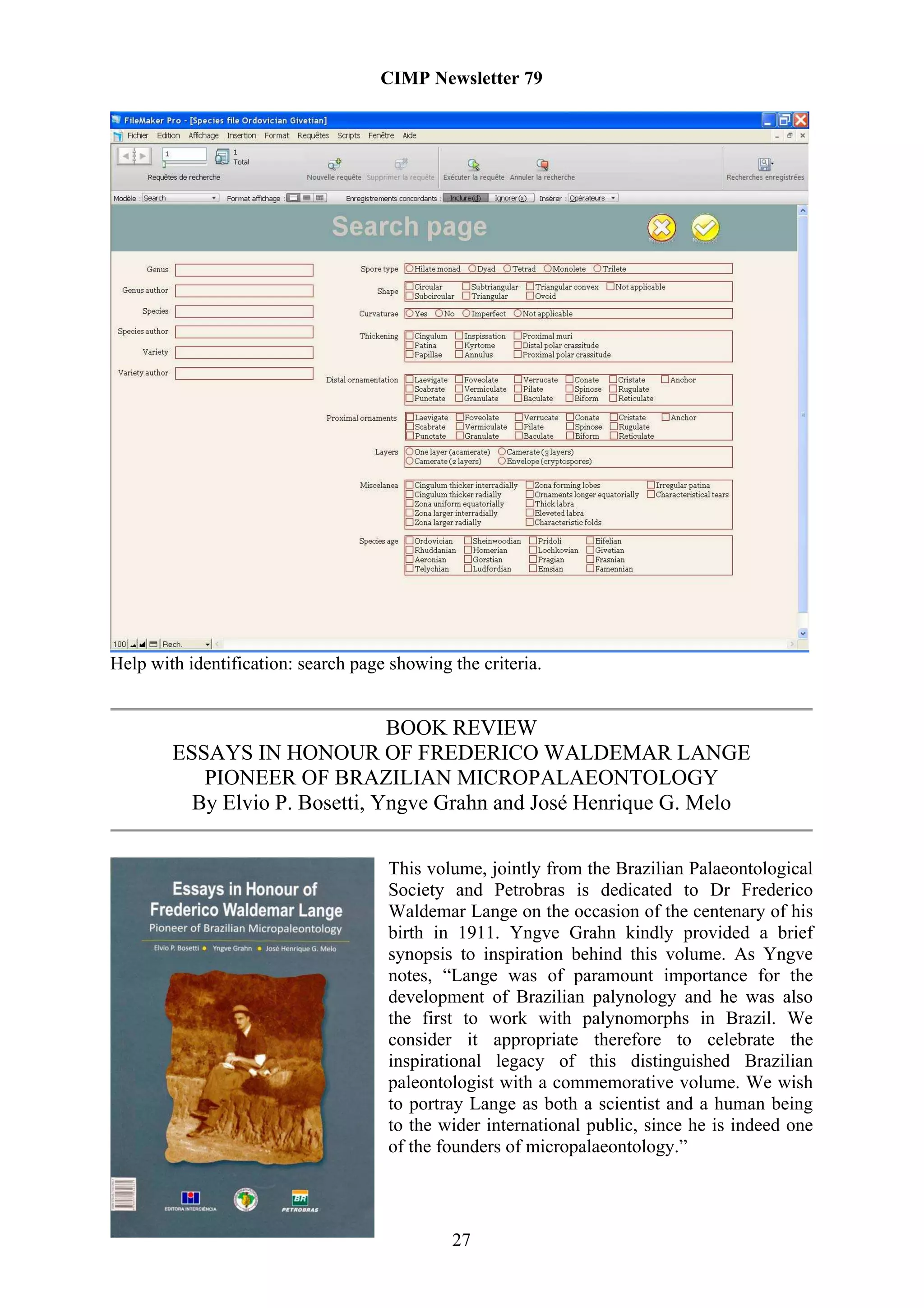
Help with identification: search page showing the criteria.


                                BOOK REVIEW
        ESSAYS IN HONOUR OF FREDERICO WALDEMAR LANGE
           PIONEER OF BRAZILIAN MICROPALAEONTOLOGY
          By Elvio P. Bosetti, Yngve Grahn and José Henrique G. Melo

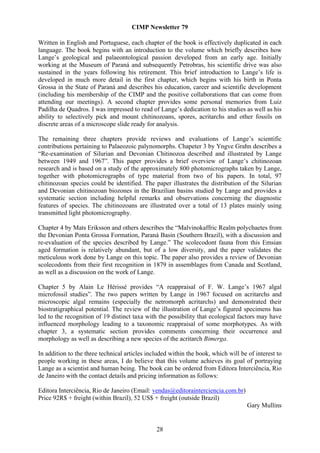
                                      This volume, jointly from the Brazilian Palaeontological
                                      Society and Petrobras is dedicated to Dr Frederico
                                      Waldemar Lange on the occasion of the centenary of his
                                      birth in 1911. Yngve Grahn kindly provided a brief
                                      synopsis to inspiration behind this volume. As Yngve
                                      notes, “Lange was of paramount importance for the
                                      development of Brazilian palynology and he was also
                                      the first to work with palynomorphs in Brazil. We
                                      consider it appropriate therefore to celebrate the
                                      inspirational legacy of this distinguished Brazilian
                                      paleontologist with a commemorative volume. We wish
                                      to portray Lange as both a scientist and a human being
                                      to the wider international public, since he is indeed one
                                      of the founders of micropalaeontology.”


                                              27
CIMP Newsletter 79

Written in English and Portuguese, each chapter of the book is effectively duplicated in each
language. The book begins with an introduction to the volume which briefly describes how
Lange’s geological and palaeontological passion developed from an early age. Initially
working at the Museum of Paraná and subsequently Petrobras, his scientific drive was also
sustained in the years following his retirement. This brief introduction to Lange’s life is
developed in much more detail in the first chapter, which begins with his birth in Ponta
Grossa in the State of Paraná and describes his education, career and scientific development
(including his membership of the CIMP and the positive collaborations that can come from
attending our meetings). A second chapter provides some personal memories from Luiz
Padilha de Quadros. I was impressed to read of Lange’s dedication to his studies as well as his
ability to selectively pick and mount chitinozoans, spores, acritarchs and other fossils on
discrete areas of a microscope slide ready for analysis.

The remaining three chapters provide reviews and evaluations of Lange’s scientific
contributions pertaining to Palaeozoic palynomorphs. Chapeter 3 by Yngve Grahn describes a
“Re-examination of Silurian and Devonian Chitinozoa described and illustrated by Lange
between 1949 and 1967”. This paper provides a brief overview of Lange’s chitinozoan
research and is based on a study of the approximately 800 photomicrographs taken by Lange,
together with photomicrographs of type material from two of his papers. In total, 97
chitinozoan species could be identified. The paper illustrates the distribution of the Silurian
and Devonian chitinozoan biozones in the Brazilian basins studied by Lange and provides a
systematic section including helpful remarks and observations concerning the diagnostic
features of species. The chitinozoans are illustrated over a total of 13 plates mainly using
transmitted light photomicrography.

Chapter 4 by Mats Eriksson and others describes the “Malvinokaffric Realm polychaetes from
the Devonian Ponta Grossa Formation, Paraná Basin (Southern Brazil), with a discussion and
re-evaluation of the species described by Lange.” The scolecodont fauna from this Emsian
aged formation is relatively abundant, but of a low diversity, and the paper validates the
meticulous work done by Lange on this topic. The paper also provides a review of Devonian
scolecodonts from their first recognition in 1879 in assemblages from Canada and Scotland,
as well as a discussion on the work of Lange.

Chapter 5 by Alain Le Hérissé provides “A reappraisal of F. W. Lange’s 1967 algal
microfossil studies”. The two papers written by Lange in 1967 focused on acritarchs and
microscopic algal remains (especially the netromorph acritarchs) and demonstrated their
biostratigraphical potential. The review of the illustration of Lange’s figured specimens has
led to the recognition of 19 distinct taxa with the possibility that ecological factors may have
influenced morphology leading to a taxonomic reappraisal of some morphotypes. As with
chapter 3, a systematic section provides comments concerning their occurrence and
morphology as well as describing a new species of the acritarch Bimerga.

In addition to the three technical articles included within the book, which will be of interest to
people working in these areas, I do believe that this volume achieves its goal of portraying
Lange as a scientist and human being. The book can be ordered from Editora Interciência, Rio
de Janeiro with the contact details and pricing information as follows:

Editora Interciência, Rio de Janeiro (Email: vendas@editorainterciencia.com.br)
Price 92R$ + freight (within Brazil), 52 US$ + freight (outside Brazil)
                                                                                    Gary Mullins


                                               28

Rewiew lange book

  • 1.
    CIMP Newsletter 79 Helpwith identification: search page showing the criteria. BOOK REVIEW ESSAYS IN HONOUR OF FREDERICO WALDEMAR LANGE PIONEER OF BRAZILIAN MICROPALAEONTOLOGY By Elvio P. Bosetti, Yngve Grahn and José Henrique G. Melo This volume, jointly from the Brazilian Palaeontological Society and Petrobras is dedicated to Dr Frederico Waldemar Lange on the occasion of the centenary of his birth in 1911. Yngve Grahn kindly provided a brief synopsis to inspiration behind this volume. As Yngve notes, “Lange was of paramount importance for the development of Brazilian palynology and he was also the first to work with palynomorphs in Brazil. We consider it appropriate therefore to celebrate the inspirational legacy of this distinguished Brazilian paleontologist with a commemorative volume. We wish to portray Lange as both a scientist and a human being to the wider international public, since he is indeed one of the founders of micropalaeontology.” 27
  • 2.
    CIMP Newsletter 79 Writtenin English and Portuguese, each chapter of the book is effectively duplicated in each language. The book begins with an introduction to the volume which briefly describes how Lange’s geological and palaeontological passion developed from an early age. Initially working at the Museum of Paraná and subsequently Petrobras, his scientific drive was also sustained in the years following his retirement. This brief introduction to Lange’s life is developed in much more detail in the first chapter, which begins with his birth in Ponta Grossa in the State of Paraná and describes his education, career and scientific development (including his membership of the CIMP and the positive collaborations that can come from attending our meetings). A second chapter provides some personal memories from Luiz Padilha de Quadros. I was impressed to read of Lange’s dedication to his studies as well as his ability to selectively pick and mount chitinozoans, spores, acritarchs and other fossils on discrete areas of a microscope slide ready for analysis. The remaining three chapters provide reviews and evaluations of Lange’s scientific contributions pertaining to Palaeozoic palynomorphs. Chapeter 3 by Yngve Grahn describes a “Re-examination of Silurian and Devonian Chitinozoa described and illustrated by Lange between 1949 and 1967”. This paper provides a brief overview of Lange’s chitinozoan research and is based on a study of the approximately 800 photomicrographs taken by Lange, together with photomicrographs of type material from two of his papers. In total, 97 chitinozoan species could be identified. The paper illustrates the distribution of the Silurian and Devonian chitinozoan biozones in the Brazilian basins studied by Lange and provides a systematic section including helpful remarks and observations concerning the diagnostic features of species. The chitinozoans are illustrated over a total of 13 plates mainly using transmitted light photomicrography. Chapter 4 by Mats Eriksson and others describes the “Malvinokaffric Realm polychaetes from the Devonian Ponta Grossa Formation, Paraná Basin (Southern Brazil), with a discussion and re-evaluation of the species described by Lange.” The scolecodont fauna from this Emsian aged formation is relatively abundant, but of a low diversity, and the paper validates the meticulous work done by Lange on this topic. The paper also provides a review of Devonian scolecodonts from their first recognition in 1879 in assemblages from Canada and Scotland, as well as a discussion on the work of Lange. Chapter 5 by Alain Le Hérissé provides “A reappraisal of F. W. Lange’s 1967 algal microfossil studies”. The two papers written by Lange in 1967 focused on acritarchs and microscopic algal remains (especially the netromorph acritarchs) and demonstrated their biostratigraphical potential. The review of the illustration of Lange’s figured specimens has led to the recognition of 19 distinct taxa with the possibility that ecological factors may have influenced morphology leading to a taxonomic reappraisal of some morphotypes. As with chapter 3, a systematic section provides comments concerning their occurrence and morphology as well as describing a new species of the acritarch Bimerga. In addition to the three technical articles included within the book, which will be of interest to people working in these areas, I do believe that this volume achieves its goal of portraying Lange as a scientist and human being. The book can be ordered from Editora Interciência, Rio de Janeiro with the contact details and pricing information as follows: Editora Interciência, Rio de Janeiro (Email: vendas@editorainterciencia.com.br) Price 92R$ + freight (within Brazil), 52 US$ + freight (outside Brazil) Gary Mullins 28