CHAPTER 4. SEC.3
ART. 73-77
Art. 73. Presumption in regard to the
imposition of accessory penalties.
 Whenever the courts shall impose a penalty which by provision of law, carries
with it other penalties, according to the provisions of Articles 40- 45 (penalties in
which other accessory penalties are inherent) of this Code, it must be understood
that the accessory penalties are also imposed upon the convict.
Art. 40 Death (Its accessory penalties)
When it is not executed by reason of commutation or pardon shall carry with it that of
perpetual absolute disqualification and that of civil interdiction during 30 years following the
date of service, unless expressly remitted in the pardon.
Death Penalty as abolished by RA 9346 is automatically
commuted to reclusion perpetual.
 Reason: Barbarous, cruel, and unusual punishment which
belongs to the by gone era and it not applicable in this
enlightened age.
Example:
A as Principal is sentenced to serve 30-40 years
imprisonment.
B as Accessory is penalized by perpetual absolute
disqualification and civil interdiction.
Art. 41. Reclusion Perpetua and Reclusion
Temporal
 Loses his parental and marital authority, guardianship over the person and properties of
his ward and the right to manage his properties or to dispose of his properties by any act
or conveyance inter vivos. (civil interdiction)
 Loses his office even if the same is conferred by popular election, the right to exercise his
profession or calling, the right to exercise his right of suffrage and even his retirement
and other benefits.
(perpetual absolute disqualification)
Note: Even if being rendered of pardon unless EXPRESSED that accessory must not be
included.
Art. 42. Prision Mayor
 Temporary absolute disqualification
( its duration is co- terminus with the principal penalty)
 Perpetual special disqualification from the right to suffrage
(unless disqualification is expressly remitted in the pardon, he
is perpetually barred from running for public office and to
vote).
Art. 43. Prision Correctional
 Suspension from public office, from the right to follow a profession
or calling
 Perpetual special disqualification from the right of suffrage, if the
duration of imprisonment shall exceed 18 mos.
Unless pardoned as to the principal penalty, the same is remitted in
the pardon.
Art. 44.Arresto.
 Suspension of the right to hold office.
 The right of suffrage during the term of
the sentence
Note: Only for the term of the snetence
Art. 45. Confiscation and forfeiture of
the proceeds or instruments of the crime.
 Proceeds and instruments or tools shall be
confiscated and forfeited in favor of the
Government, unless they be property of a third
person not liable for the offense, but those
articles which are not subject of lawful
commerce shall be destroyed.
UNLESS
 a Solicitor General suggested that the decision be
modified to show expressly that appellants were also
sentenced to the accessory penalties provided by
law.
Subsidiary imprisonment, not an accessory
penalty
Judgement of the conviction must EXPRESSLY state that the
offender shall suffer the subsidiary imprisonment in case of
insolvency.
(People vs. Fajardo, 65 Phil 539, 542)
Art. 74. Penalty higher than reclusion
perpetua in certain cases.
 In cases in which the law prescribes a penalty higher than
another given penalty, without specifically designating the name
of the former, if such higher penalty should be that of death,
the same penalty and the accesoory penalties of Art. 40 shall
be considered as the next higher penalty.
Example:
 A, an employee of Bureau of Posts, Registry Section, stole a
registered package of diamond worth Php 250,000.00.
 Penalty of simple theft is reclusion temporal. (Art. 309)
 The property stolen being mail matter, the crime is qualified theft
 And shall be punished by the penalties next higher by two
degrees. (Art. 310)
Art. 71. In cases in which the law prescribes a penalty higher by one
or more degrees than another given penalty, two degrees higher
than reclusion temporal would be death, as per scale no.1.
In application of Art.74
 When a given penalty is to be raised by one or two
degrees and the resulting penalty is death according to the
scale, but is not specifically provided by law as a penalty, the
latter cannot be imposed.
 Art. 40 applies for the accessory penalties of death.
Art. 75. Increasing or reducing the penalty
of fine by one or more degrees.
 Whenever it may be necessary to increase or reduce the
penalty of fine by one or more degrees, it shall be
increased or reduced , respectively for each degree, by
one-fourth of the maximum amount prescribed by law,
without however changing the minimum.
 The same rules shall be observed with regards to fines
that do not consist of a fixed amount, but are made
proportional.
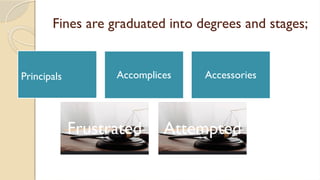
Fines are graduated into degrees and stages;
Principals Accomplices Accessories
Frustrated Attempted
Example:
In reducing the penalty of fine by one or more degrees, the
basis for the reduction of the 1st
and the 2nd
degree must
necessarily be the penalty prescribed by law for the
consummated felony.Thus, where the maximum fine fixed
for the consummated offense is not more than Php
2,000.00- ¼= Php1,500.00
Reducing it further by one degree, the basis is still the 2k
not 1,500.
So that, the maximum fine as reduced is Php 1,000.00
Without changing the minimum
 If the fine is from is Php 20,000.00 to Php 200,000.00,
each degree is ¼ of Php 200,000.00.The minimum is Php
20,000.00.
Thus, it is not changed.
Example:
 A, a 15- year old minor committed acts with a penalty of prision
correctional or a fine of Php 200.00 to Php 2,000.00 or both.
 In application of Art. 68 as a minor given one degree lower of a
penalty.
 Arresto Mayor or a fine of 200.00 to 1,500.00.
Art. 75 provides that it cannot change the minimum of Php 200.00
even if the offender is a poor man.
Note:
 In determination of amount of reduced fine, a distinction
should be made between cases where the minimum of
the fine is fixed by law and those where the minimum is
not fixed by law.
Fixed Minimum and Maximum of Fines (Arts.143, 144, 150)
Not fixed (Arts. 114, 115 and 129)
When the minimum is not fixed by law
◦ The determination is by the sound discretion of
the courts without exceeding the minimum
authorized by law.
Distinction between;
FINE WITH A MINIMUM FINE WITHOUT A MINIMUM
 Fixes the maximum of the fine.
 When the law fixes the minimum, it
cannot be changed.
 Fixes the maximum of the fine.
 Unstated minimum, only maximum is
determined, the court can impose any
amount not exceeding the maximum.
Distinction between;
LAW FIXES BOTH THE MINIMUM AND MAXIMUM ONLYTHE MAXIMUM IS FIXED
The court can impose an amount
higher than the maximum.
The court cannot impose an
amount higher than the maximum.
As to fines that do not consist of a fixed
amount, but are made proportional.
(Art. 36 par. 3) Figure:
 When in negligence, an act resulted in
damage to property of another, the
fine shall be from an amount equal to
the value of the damage to three
times, but shall in no case be less than
25 pesos.
 In the crime of bribery (Art. 210)
A bribe of 2,300.00
Maximum fine = 6,900.00
Take ¼= 1,725.00 = 5,175.00
¼ of the maximum= 3,450.00
The court may fix any amount of the fine
from 2,300 to 3,450
Art. 76. Legal period of duration
of divisible penalties.
 The legal period of duration of divisible penalties shall be
considered as divided into three parts, forming 3 periods;
 Minimum
 Medium
 Maximum
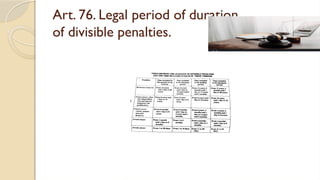
Art. 76. Legal period of duration
of divisible penalties.
Art. 76. Legal period of duration
of divisible penalties.
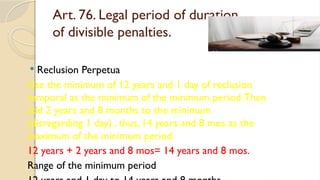
 Reclusion Perpetua
Duration:
 Minimum: 12 years and 1 day
 Maximum: 20 years
Subtract the minimum (disregarding the 1 day from te
maximum)
20 years- 12 years= 8 years
Art. 76. Legal period of duration
of divisible penalties.
 Reclusion Perpetua
Divide the difference by 3:
8 years/3= 2 years and 8 months
Subtract the minimum (disregarding the 1 day
from te maximum)
20 years- 12 years= 8 years
Use the minimum of 12 years and 1 day of reclusion temporal as the minimum of the minimum period.Then add 2
Art. 76. Legal period of duration
of divisible penalties.
 Reclusion Perpetua
Use the minimum of 12 years and 1 day of reclusion
temporal as the minimum of the minimum period.Then
add 2 years and 8 months to the minimum
(disregarding 1 day) , thus, 14 years and 8 mos as the
maximum of the minimum period.
12 years + 2 years and 8 mos= 14 years and 8 mos.
Range of the minimum period
Art. 76. Legal period of duration
of divisible penalties.
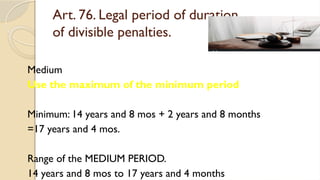
Medium
Use the maximum of the minimum period
Minimum: 14 years and 8 mos + 2 years and 8 months
=17 years and 4 mos.
Range of the MEDIUM PERIOD.
14 years and 8 mos to 17 years and 4 months
Art. 76. Legal period of duration
of divisible penalties.
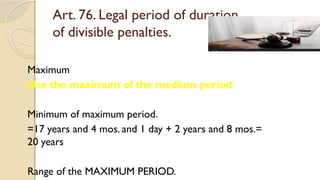
Maximum
Use the maximum of the medium period
Minimum of maximum period.
=17 years and 4 mos. and 1 day + 2 years and 8 mos.=
20 years
Range of the MAXIMUM PERIOD.
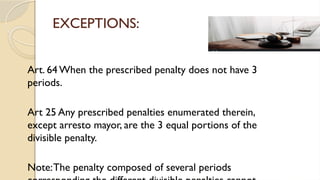
EXCEPTIONS:
Art. 64 When the prescribed penalty does not have 3
periods.
Art 25 Any prescribed penalties enumerated therein,
except arresto mayor, are the 3 equal portions of the
divisible penalty.
Note:The penalty composed of several periods
EXCEPTIONS:
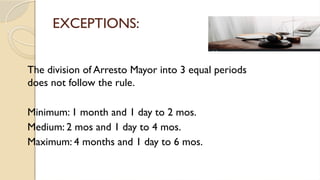
The division of Arresto Mayor into 3 equal periods
does not follow the rule.
Minimum: 1 month and 1 day to 2 mos.
Medium: 2 mos and 1 day to 4 mos.
Maximum: 4 months and 1 day to 6 mos.
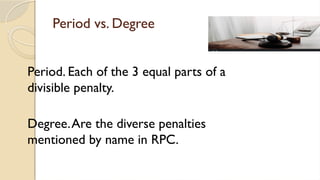
Period vs. Degree
Period. Each of the 3 equal parts of a
divisible penalty.
Degree.Are the diverse penalties
mentioned by name in RPC.
Art.77.When the penalty is a complex
one composed of three distinct penalties.
Each one shall form a period; the lightest of them shall
be the minimum, the next the medium, and the severe
the maximum period.
Whenever the penalty prescribes does not have one of
the forms specially provided for in this Code, the
periods shall be distributed, applying by analogy the
prescribed rules.

REVISED PENAL CODE BOOK 1 ART. 73-77.pptx

  • 1.
  • 2.
    Art. 73. Presumptionin regard to the imposition of accessory penalties.  Whenever the courts shall impose a penalty which by provision of law, carries with it other penalties, according to the provisions of Articles 40- 45 (penalties in which other accessory penalties are inherent) of this Code, it must be understood that the accessory penalties are also imposed upon the convict. Art. 40 Death (Its accessory penalties) When it is not executed by reason of commutation or pardon shall carry with it that of perpetual absolute disqualification and that of civil interdiction during 30 years following the date of service, unless expressly remitted in the pardon.
  • 3.
    Death Penalty asabolished by RA 9346 is automatically commuted to reclusion perpetual.  Reason: Barbarous, cruel, and unusual punishment which belongs to the by gone era and it not applicable in this enlightened age. Example: A as Principal is sentenced to serve 30-40 years imprisonment. B as Accessory is penalized by perpetual absolute disqualification and civil interdiction.
  • 4.
    Art. 41. ReclusionPerpetua and Reclusion Temporal  Loses his parental and marital authority, guardianship over the person and properties of his ward and the right to manage his properties or to dispose of his properties by any act or conveyance inter vivos. (civil interdiction)  Loses his office even if the same is conferred by popular election, the right to exercise his profession or calling, the right to exercise his right of suffrage and even his retirement and other benefits. (perpetual absolute disqualification) Note: Even if being rendered of pardon unless EXPRESSED that accessory must not be included.
  • 5.
    Art. 42. PrisionMayor  Temporary absolute disqualification ( its duration is co- terminus with the principal penalty)  Perpetual special disqualification from the right to suffrage (unless disqualification is expressly remitted in the pardon, he is perpetually barred from running for public office and to vote).
  • 6.
    Art. 43. PrisionCorrectional  Suspension from public office, from the right to follow a profession or calling  Perpetual special disqualification from the right of suffrage, if the duration of imprisonment shall exceed 18 mos. Unless pardoned as to the principal penalty, the same is remitted in the pardon.
  • 7.
    Art. 44.Arresto.  Suspensionof the right to hold office.  The right of suffrage during the term of the sentence Note: Only for the term of the snetence
  • 8.
    Art. 45. Confiscationand forfeiture of the proceeds or instruments of the crime.  Proceeds and instruments or tools shall be confiscated and forfeited in favor of the Government, unless they be property of a third person not liable for the offense, but those articles which are not subject of lawful commerce shall be destroyed.
  • 9.
    UNLESS  a SolicitorGeneral suggested that the decision be modified to show expressly that appellants were also sentenced to the accessory penalties provided by law.
  • 10.
    Subsidiary imprisonment, notan accessory penalty Judgement of the conviction must EXPRESSLY state that the offender shall suffer the subsidiary imprisonment in case of insolvency. (People vs. Fajardo, 65 Phil 539, 542)
  • 11.
    Art. 74. Penaltyhigher than reclusion perpetua in certain cases.  In cases in which the law prescribes a penalty higher than another given penalty, without specifically designating the name of the former, if such higher penalty should be that of death, the same penalty and the accesoory penalties of Art. 40 shall be considered as the next higher penalty.
  • 12.
    Example:  A, anemployee of Bureau of Posts, Registry Section, stole a registered package of diamond worth Php 250,000.00.  Penalty of simple theft is reclusion temporal. (Art. 309)  The property stolen being mail matter, the crime is qualified theft  And shall be punished by the penalties next higher by two degrees. (Art. 310) Art. 71. In cases in which the law prescribes a penalty higher by one or more degrees than another given penalty, two degrees higher than reclusion temporal would be death, as per scale no.1.
  • 13.
    In application ofArt.74  When a given penalty is to be raised by one or two degrees and the resulting penalty is death according to the scale, but is not specifically provided by law as a penalty, the latter cannot be imposed.  Art. 40 applies for the accessory penalties of death.
  • 14.
    Art. 75. Increasingor reducing the penalty of fine by one or more degrees.  Whenever it may be necessary to increase or reduce the penalty of fine by one or more degrees, it shall be increased or reduced , respectively for each degree, by one-fourth of the maximum amount prescribed by law, without however changing the minimum.  The same rules shall be observed with regards to fines that do not consist of a fixed amount, but are made proportional.
  • 15.
    Fines are graduatedinto degrees and stages; Principals Accomplices Accessories Frustrated Attempted
  • 16.
    Example: In reducing thepenalty of fine by one or more degrees, the basis for the reduction of the 1st and the 2nd degree must necessarily be the penalty prescribed by law for the consummated felony.Thus, where the maximum fine fixed for the consummated offense is not more than Php 2,000.00- ¼= Php1,500.00 Reducing it further by one degree, the basis is still the 2k not 1,500. So that, the maximum fine as reduced is Php 1,000.00
  • 17.
    Without changing theminimum  If the fine is from is Php 20,000.00 to Php 200,000.00, each degree is ¼ of Php 200,000.00.The minimum is Php 20,000.00. Thus, it is not changed.
  • 18.
    Example:  A, a15- year old minor committed acts with a penalty of prision correctional or a fine of Php 200.00 to Php 2,000.00 or both.  In application of Art. 68 as a minor given one degree lower of a penalty.  Arresto Mayor or a fine of 200.00 to 1,500.00. Art. 75 provides that it cannot change the minimum of Php 200.00 even if the offender is a poor man.
  • 19.
    Note:  In determinationof amount of reduced fine, a distinction should be made between cases where the minimum of the fine is fixed by law and those where the minimum is not fixed by law. Fixed Minimum and Maximum of Fines (Arts.143, 144, 150) Not fixed (Arts. 114, 115 and 129)
  • 20.
    When the minimumis not fixed by law ◦ The determination is by the sound discretion of the courts without exceeding the minimum authorized by law.
  • 21.
    Distinction between; FINE WITHA MINIMUM FINE WITHOUT A MINIMUM  Fixes the maximum of the fine.  When the law fixes the minimum, it cannot be changed.  Fixes the maximum of the fine.  Unstated minimum, only maximum is determined, the court can impose any amount not exceeding the maximum.
  • 22.
    Distinction between; LAW FIXESBOTH THE MINIMUM AND MAXIMUM ONLYTHE MAXIMUM IS FIXED The court can impose an amount higher than the maximum. The court cannot impose an amount higher than the maximum.
  • 23.
    As to finesthat do not consist of a fixed amount, but are made proportional. (Art. 36 par. 3) Figure:  When in negligence, an act resulted in damage to property of another, the fine shall be from an amount equal to the value of the damage to three times, but shall in no case be less than 25 pesos.  In the crime of bribery (Art. 210) A bribe of 2,300.00 Maximum fine = 6,900.00 Take ¼= 1,725.00 = 5,175.00 ¼ of the maximum= 3,450.00 The court may fix any amount of the fine from 2,300 to 3,450
  • 24.
    Art. 76. Legalperiod of duration of divisible penalties.  The legal period of duration of divisible penalties shall be considered as divided into three parts, forming 3 periods;  Minimum  Medium  Maximum
  • 25.
    Art. 76. Legalperiod of duration of divisible penalties.
  • 26.
    Art. 76. Legalperiod of duration of divisible penalties.  Reclusion Perpetua Duration:  Minimum: 12 years and 1 day  Maximum: 20 years Subtract the minimum (disregarding the 1 day from te maximum) 20 years- 12 years= 8 years
  • 27.
    Art. 76. Legalperiod of duration of divisible penalties.  Reclusion Perpetua Divide the difference by 3: 8 years/3= 2 years and 8 months Subtract the minimum (disregarding the 1 day from te maximum) 20 years- 12 years= 8 years Use the minimum of 12 years and 1 day of reclusion temporal as the minimum of the minimum period.Then add 2
  • 28.
    Art. 76. Legalperiod of duration of divisible penalties.  Reclusion Perpetua Use the minimum of 12 years and 1 day of reclusion temporal as the minimum of the minimum period.Then add 2 years and 8 months to the minimum (disregarding 1 day) , thus, 14 years and 8 mos as the maximum of the minimum period. 12 years + 2 years and 8 mos= 14 years and 8 mos. Range of the minimum period
  • 29.
    Art. 76. Legalperiod of duration of divisible penalties. Medium Use the maximum of the minimum period Minimum: 14 years and 8 mos + 2 years and 8 months =17 years and 4 mos. Range of the MEDIUM PERIOD. 14 years and 8 mos to 17 years and 4 months
  • 30.
    Art. 76. Legalperiod of duration of divisible penalties. Maximum Use the maximum of the medium period Minimum of maximum period. =17 years and 4 mos. and 1 day + 2 years and 8 mos.= 20 years Range of the MAXIMUM PERIOD.
  • 31.
    EXCEPTIONS: Art. 64 Whenthe prescribed penalty does not have 3 periods. Art 25 Any prescribed penalties enumerated therein, except arresto mayor, are the 3 equal portions of the divisible penalty. Note:The penalty composed of several periods
  • 32.
    EXCEPTIONS: The division ofArresto Mayor into 3 equal periods does not follow the rule. Minimum: 1 month and 1 day to 2 mos. Medium: 2 mos and 1 day to 4 mos. Maximum: 4 months and 1 day to 6 mos.
  • 33.
    Period vs. Degree Period.Each of the 3 equal parts of a divisible penalty. Degree.Are the diverse penalties mentioned by name in RPC.
  • 34.
    Art.77.When the penaltyis a complex one composed of three distinct penalties. Each one shall form a period; the lightest of them shall be the minimum, the next the medium, and the severe the maximum period. Whenever the penalty prescribes does not have one of the forms specially provided for in this Code, the periods shall be distributed, applying by analogy the prescribed rules.

Editor's Notes

  • #6 Kahit na pardon na ng President ang offender ay patuloy pa rin mag sa suffer sa penalty na ito unless EXPRESSED. Mag ma matter lang ang perpetual disqualification kapag nag exceed ng 18 months ang imprisonment.
  • #7 If the principal had finished serving sentence, mawawala na rin ang accessory penalties na ito. Considering that the penalty of arresto consist of actual deprivation of liberty, it is only logical that suspension as an accessory penalty should accompany the same.
  • #8 Example. Weapons used for a crime will be confiscated/ forfeited in favor of the government, unless such tool or instruments are owned by the third person, it cannot be confiscated or forfeited. Basta ang third person ay hindi kasali sa pag commit ng crime… Articles like drugs is violative of a lawful commerce so it must be destroyed.
  • #11 Death cannot be the penalty next higher in degree when not provided by law.
  • #12  Application of this article provides the judgement for the convict should not be given the benefit of Art. 27..that he should be pardoned after undergoing the penalty for 30 years after 40 years have elapsed. Otherwise thers should be no difference at all between reclusion perpetua when imposed as the penalty next higher in degree and when it is imposed as the penalty fixed by law.
  • #13 When not executed by reason of commutation or pardon, then such shall be imposed. The penalty higher than reclusion perpetua cannot be death, because the penalty of death must be specifically imposed by law as a penalty for a given crime.
  • #15 Art. 50-57
  • #17 So, this Art. Specifically mentions the word “minimum” of the fine. Under such, the fine must have a minimum and maximum fixed by law.
  • #18 Therefore, this art. Does not apply when the law does not fix the minimum of the fine.
  • #24 In a manner shown in the following table.
  • #26 In a manner shown in the following table.
  • #27 In a manner shown in the following table.
  • #28 In a manner shown in the following table.
  • #29 In a manner shown in the following table.
  • #30 Art. 76 has expressed a phrase, “ In a manner shown in the following table. This indicates merely the way or method of dividing into three periods the divisible penalties as those mentioned in the table. Those which are fixed in the table are respectively the periods of the divisible penalties. It can be noted that the duration of one of its three periods is not equal to that of the others.
  • #31 Art. 76 has expressed a phrase, “ In a manner shown in the following table. This indicates merely the way or method of dividing into three periods the divisible penalties as those mentioned in the table. Those which are fixed in the table are respectively the periods of the divisible penalties. It can be noted that the duration of one of its three periods is not equal to that of the others.
  • #32 Art. 76 has expressed a phrase, “ In a manner shown in the following table. This indicates merely the way or method of dividing into three periods the divisible penalties as those mentioned in the table. Those which are fixed in the table are respectively the periods of the divisible penalties. It can be noted that the duration of one of its three periods is not equal to that of the others.
  • #33 Art. 76 has expressed a phrase, “ In a manner shown in the following table. This indicates merely the way or method of dividing into three periods the divisible penalties as those mentioned in the table. Those which are fixed in the table are respectively the periods of the divisible penalties. It can be noted that the duration of one of its three periods is not equal to that of the others.
  • #34 Art. 76 has expressed a phrase, “ In a manner shown in the following table. This indicates merely the way or method of dividing into three periods the divisible penalties as those mentioned in the table. Those which are fixed in the table are respectively the periods of the divisible penalties. It can be noted that the duration of one of its three periods is not equal to that of the others.