Name: _____________________________________ Class: _________ Date: ____________ Grade 7
REVIEW FOR END-OF-SEMESTER 1 EXAM
REVIEW OF UNIT 8 - SHAPES AND SYMMETRY
~ ✩ ~ ✩ ~ ✩ ~ ✩ ~ ✩ ~
1. Draw and write down the number of lines of symmetry for each of these shapes.
2. For each of these shapes in question 1, write down the order of rotational symmetry.
3. Complete the table below.
Name of Regular Polygon
Number of Sides
Number of Lines of Symmetry
Order of Rotational Symmetry
4. Label the parts of the circle.
1
5. Here are the names of 5 shapes.
A - Rhombus
B - Trapezium
C - Kite
D - Rectangle
E - Square
F - Isosceles Trapezium
G - Parallelogram
The diagram can be used to sort these shapes.
Complete the diagram by writing one of A, B, C, D, E, F, G in each gap. (E has been done for you.)
6. Write true (T) or false (F) for each statement about regular polygons.
a. A regular hexagon has five lines of symmetry.
b. A regular octagon has order of rotation 8.
c. A regular pentagon has order of rotation 10.
d. A regular decagon has 10 lines of symmetry.
e. A regular polygon with 15 lines of symmetry has 15 sides.
f. A regular polygon with order of rotation 20 has 19 sides.
2
7. Work out the circumference of these circles. Use the π = 3.14. Give your answers correct to 2 d.p.
a. diameter = 12.5cm b. radius = 3.4m
8. Work out the diameter of a circle when given the circumference. Round each answer correct to 1 d.p.
a. Circumference = 35cm b. circumference = 8.95cm
9. Work out the perimeter of each compound shape. (Use the π = 3.14.)
a. b. c.
10. Draw the plan view, front elevation and side elevation of these 3D shapes.
Use a scale of 1:4.
a. b.
3
REVIEW OF UNIT 15 - SHAPES, AREA AND VOLUME
~ ✩ ~ ✩ ~ ✩ ~ ✩ ~ ✩ ~
11. Complete these area conversions. When possible, give your answer as a mixed number in its simplest form.
a. 88 km = ____________ miles i. 72 km = ____________ miles
b. 120 km = ____________ miles j. 200 km = ____________ miles
c. 34 km = ____________ miles k. 63 km = ____________ miles
d. 30 miles = ____________ km l. 45 miles = ____________ km
e. 95 miles = ____________ km m. 55 miles = ____________ km
f. 7 miles = ____________ km n. 21 miles = ____________ km
12. Work out the area of each shape. When possible, give each answer as a fraction in its simplest form.
a. c. e.
b. d. f.
13. This parallelogram has an area of 43.4cm2
. It has a height of 28mm.
What is the length of the base of the parallelogram?
14. The diagram shows a trapezium with an area of 7182mm2
.
What is the perpendicular height of the trapezium?
15. Find the shaded area in each diagram.
4
a. b.
16. Windscreen glass for a van costs $250 per square metre.
The diagram shows a van windscreen in the shape of a trapezium.
Work out the cost of the glass for the windscreen.
17. Work out the volume and surface area of each 3D shape.
a. b. c.
18. Work out the volume of each compound shape.
5
REVIEW OF UNIT 7 - FRACTIONS
~ ✩ ~ ✩ ~ ✩ ~ ✩ ~ ✩ ~
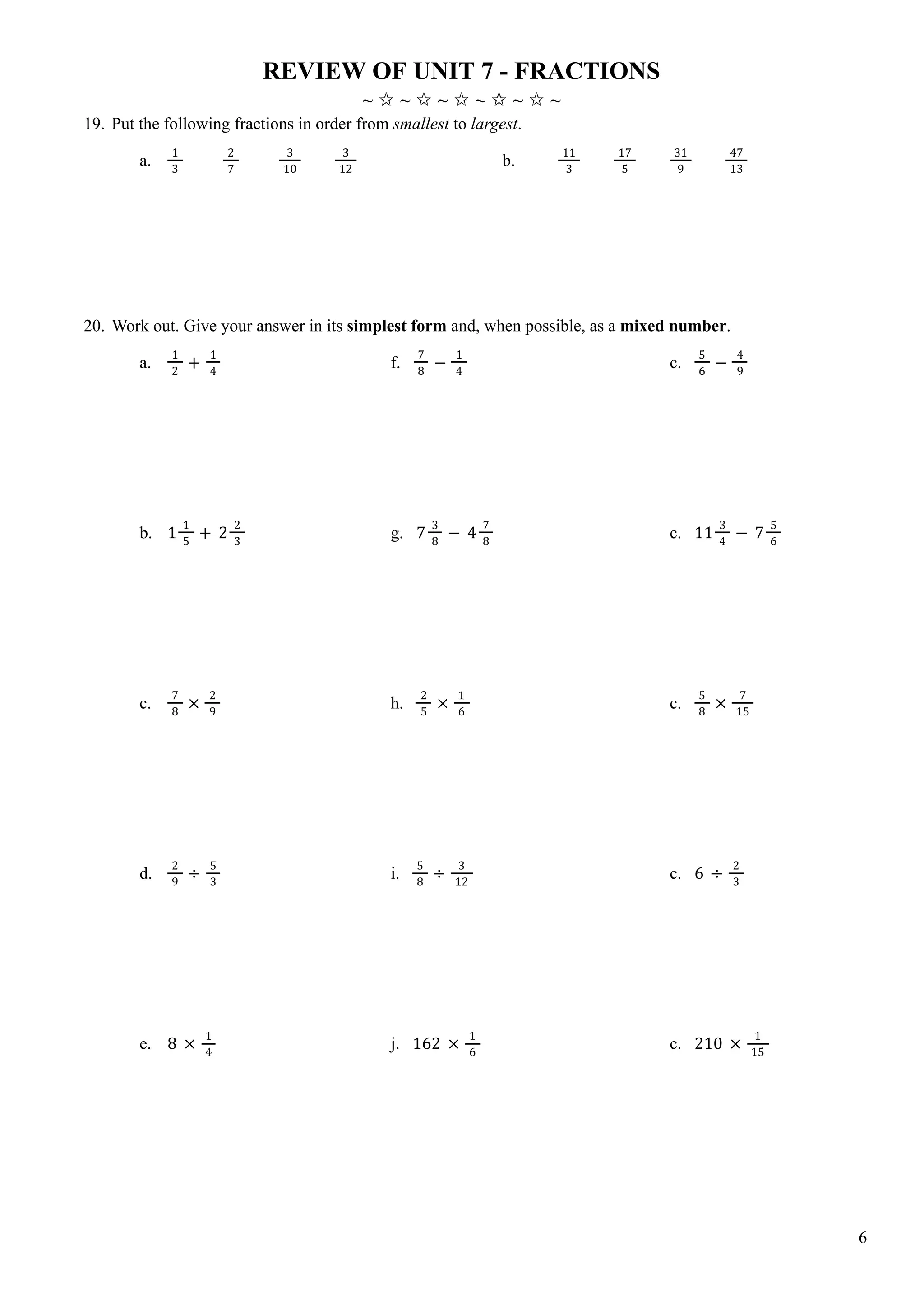
19. Put the following fractions in order from smallest to largest.
a. b.
1
3
2
7
3
10
3
12
11
3
17
5
31
9
47
13
20. Work out. Give your answer in its simplest form and, when possible, as a mixed number.
a. f. c.
1
2
+
1
4
7
8
−
1
4
5
6
−
4
9
b. g. c.
1
1
5
+ 2
2
3
7
3
8
− 4
7
8
11
3
4
− 7
5
6
c. h. c.
7
8
×
2
9
2
5
×
1
6
5
8
×
7
15
d. i. c.
2
9
÷
5
3
5
8
÷
3
12
6 ÷
2
3
e. j. c.
8 ×
1
4
162 ×
1
6
210 ×
1
15
6
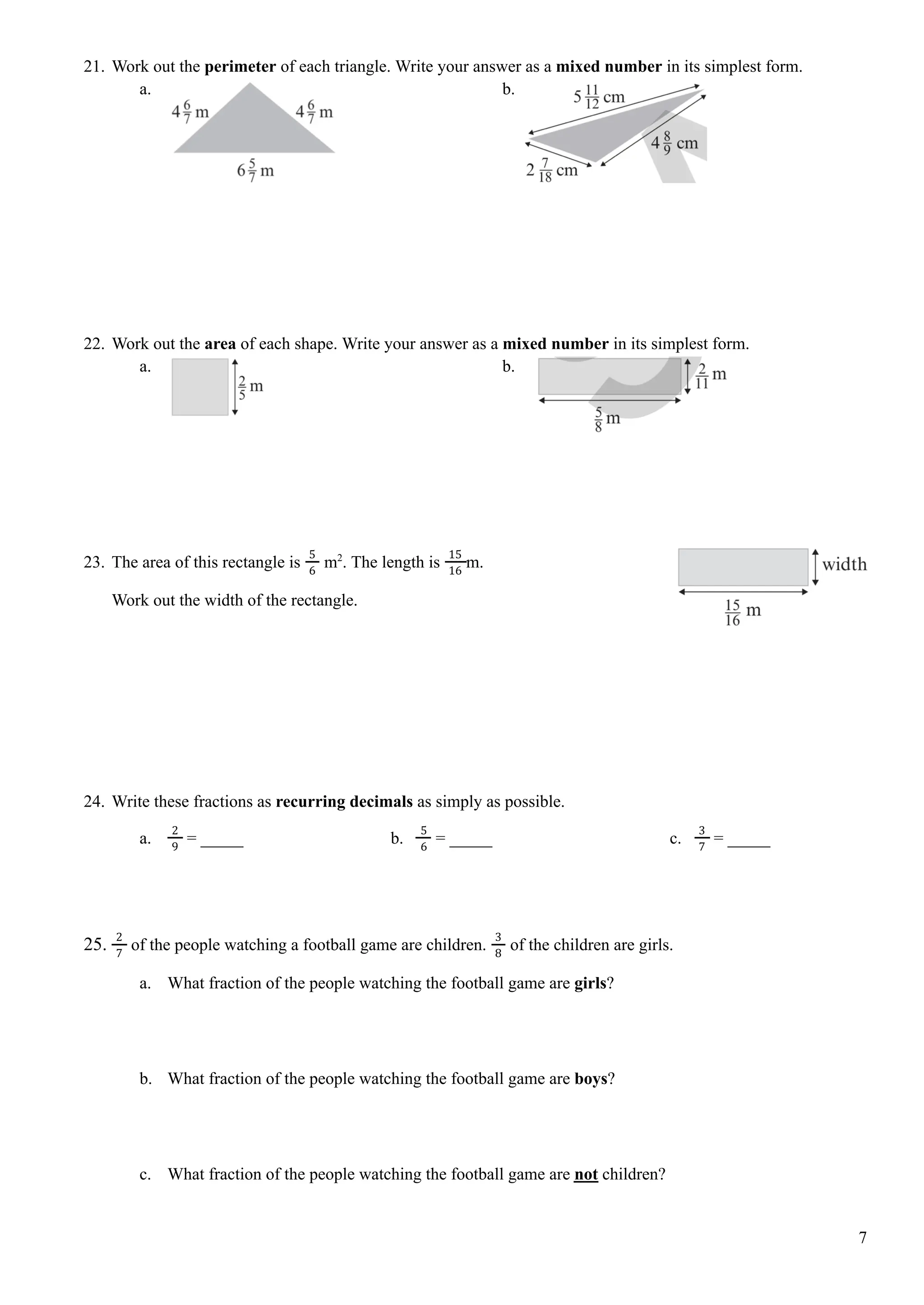
21. Work out the perimeter of each triangle. Write your answer as a mixed number in its simplest form.
a. b.
22. Work out the area of each shape. Write your answer as a mixed number in its simplest form.
a. b.
23. The area of this rectangle is m2
. The length is m.
5
6
15
16
Work out the width of the rectangle.
24. Write these fractions as recurring decimals as simply as possible.
a. = _____ b. = _____ c. = _____
2
9
5
6
3
7
25. of the people watching a football game are children. of the children are girls.
2
7
3
8
a. What fraction of the people watching the football game are girls?
b. What fraction of the people watching the football game are boys?
c. What fraction of the people watching the football game are not children?
7
REVIEW OF UNIT 13 - PROBABILITY
~ ✩ ~ ✩ ~ ✩ ~ ✩ ~ ✩ ~
26. This fair dice has 20 faces, which are numbered from 1 to 20. The dice is thrown once.
Find the probability that the outcome is:
a. a multiple of 3 f. a multiple of 8
b. a prime number g. a square number
c. a two-digit number h. a cube number
d. an even number i. an odd number less than 10
27. A spinner has 7 equally likely sectors numbered 1, 2, 3, 4, 5, 6 and 7.
The spinner is spun and a coin is thrown. Work out the probability of
a. a head and a 5 b. a tail and an even number c. a head but not a 5
28. A train can arrive early, on time or late. The probability the train arrives early is 5% and the probability it
arrives late is 15%. Work out the probability that it is
a. not early b. not late c. not on time
29. Two fair six-sided dice are thrown and the numbers are multiplied together.
a. Find the probability of getting more than 15.
b. Find the probability of getting an odd number.
8
30. A spinner has five equal sectors numbered 1, 2, 3, 4, 5. Here are the results of 400 spins.
Score 1 2 3 4 5
Frequency 90 83 86 66 75
a. Find the experimental probabilities of
i. 2 ii. an odd number iii. 4 or 5
b. Find the theoretical probabilities of
i. 2 ii. an odd number iii. 4 or 5
c. Do you think the spinner is fair? Give a reason for your answer.
31. When you throw three coins you can get 0, 1, 2 or 3 heads. Here are the results of a computer simulation of
500 throws of three coins.
Number of heads 0 1 2 3
Frequency 59 180 192 69
a. Find the experimental probabilities of 0, 1, 2 and 3 heads.
b. Work out the theoretical probabilities of 0, 1, 2 and 3 heads.
c. Is computer simulation working properly? Explain your reasoning.
9
REVIEW OF UNITS 1-4
~ ✩ ~ ✩ ~ ✩ ~ ✩ ~ ✩ ~
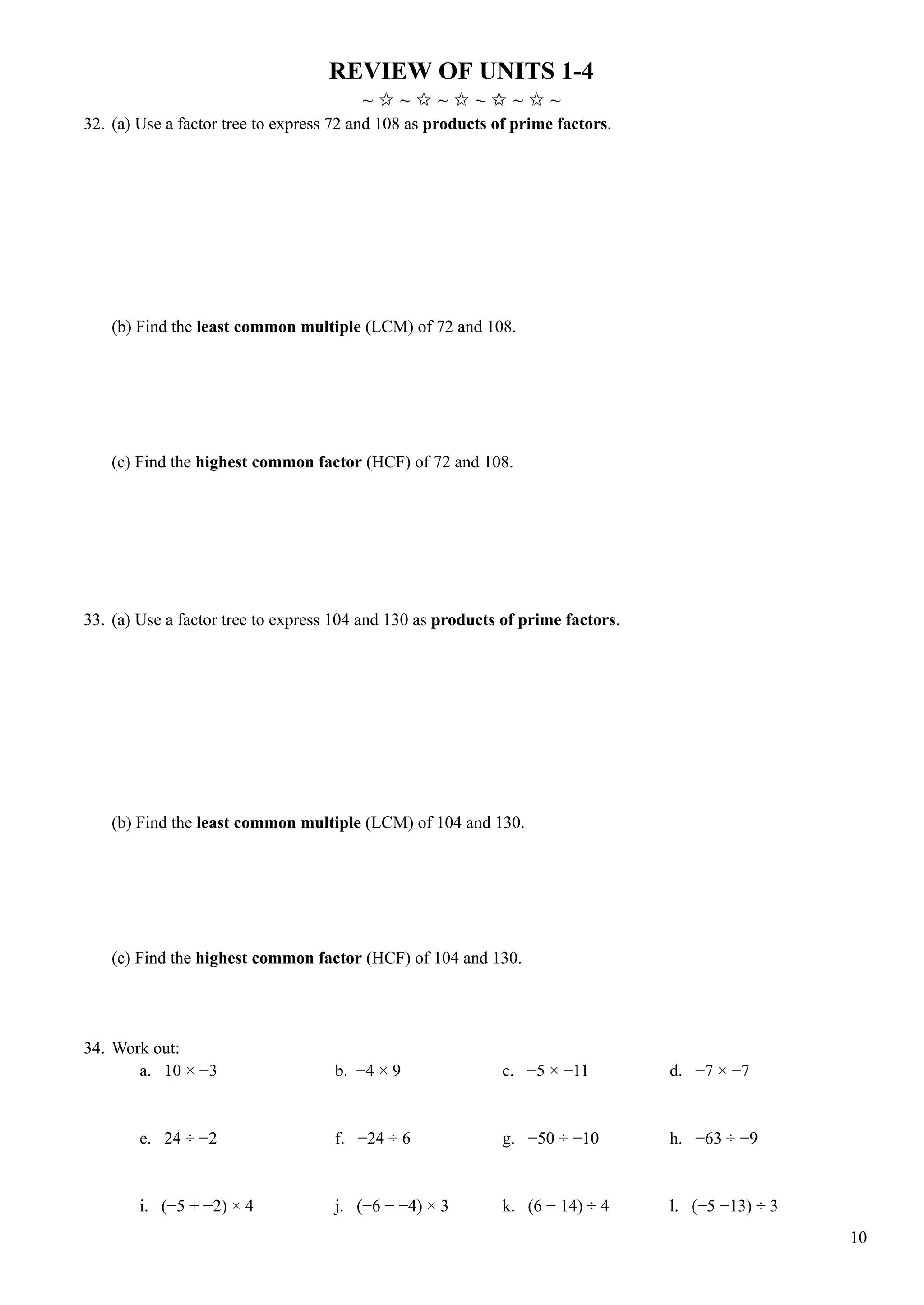
32. (a) Use a factor tree to express 72 and 108 as products of prime factors.
(b) Find the least common multiple (LCM) of 72 and 108.
(c) Find the highest common factor (HCF) of 72 and 108.
33. (a) Use a factor tree to express 104 and 130 as products of prime factors.
(b) Find the least common multiple (LCM) of 104 and 130.
(c) Find the highest common factor (HCF) of 104 and 130.
34. Work out:
a. 10 × −3 b. −4 × 9 c. −5 × −11 d. −7 × −7
e. 24 ÷ −2 f. −24 ÷ 6 g. −50 ÷ −10 h. −63 ÷ −9
i. (−5 + −2) × 4 j. (−6 − −4) × 3 k. (6 − 14) ÷ 4 l. (−5 −13) ÷ 3
10
35. Work out.
a. 32
+ 42
b. (−6)2
+ (−7)2
c. 33
+ 53
d. 43
− (−2)3
e. f. g. h.
16 100 225 169
i. j. k. l.
3
− 8 64 −
3
64 25 −
3
125
3
27 − 16
36. (a) Show that 9 is the closest integer to .
79
(b) Show that is between 14 and 15.
215
37. Write whether each statement is true or false.
a. 9 is a rational number.
b. −9 is a natural number.
c. 99 is an integer.
d. −999 is both an integer and a rational number.
e. 9999 is both a natural number and a rational number.
38. Work out and write the answer in index form.
a. 62
× 63
b. 54
× 5 c. 22
× 23
× 2 d. 30
× 3 × 34
e. 56
÷ 52
f. 83
÷ 8 g. (45
)3
h. (154
)5
39. Shen thinks of a number, n. Write an expression for the number Shen gets when he
a. multiplies the number by 7 then adds 4.
b. divides the number by 6 then subtracts 8.
c. adds 4 to the number then divides by 5.
d. subtracts 4 from the number then divides by 5.
11
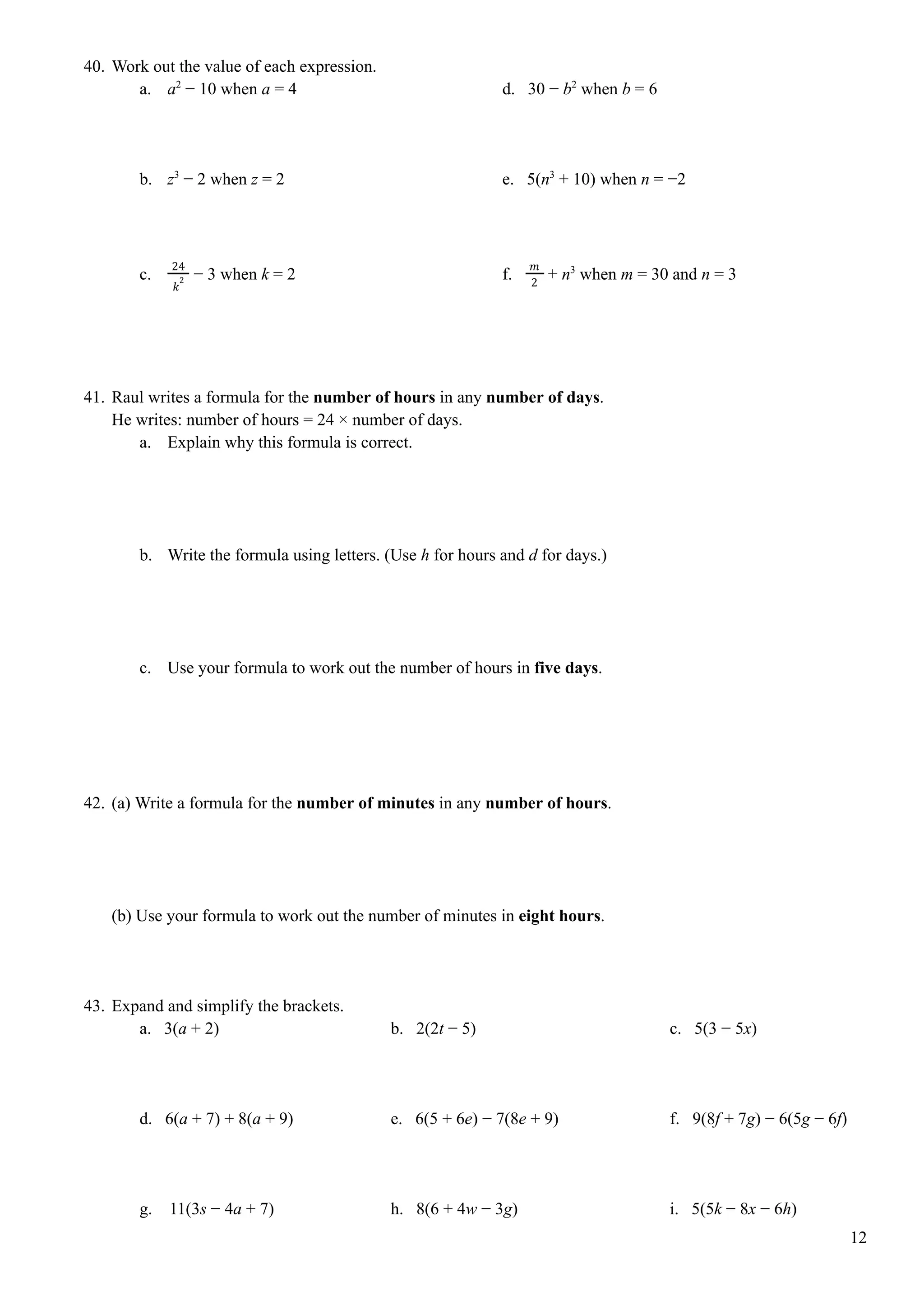
40. Work out the value of each expression.
a. a2
− 10 when a = 4 d. 30 − b2
when b = 6
b. z3
− 2 when z = 2 e. 5(n3
+ 10) when n = −2
c. − 3 when k = 2 f. + n3
when m = 30 and n = 3
24
𝑘
2
𝑚
2
41. Raul writes a formula for the number of hours in any number of days.
He writes: number of hours = 24 × number of days.
a. Explain why this formula is correct.
b. Write the formula using letters. (Use h for hours and d for days.)
c. Use your formula to work out the number of hours in five days.
42. (a) Write a formula for the number of minutes in any number of hours.
(b) Use your formula to work out the number of minutes in eight hours.
43. Expand and simplify the brackets.
a. 3(a + 2) b. 2(2t − 5) c. 5(3 − 5x)
d. 6(a + 7) + 8(a + 9) e. 6(5 + 6e) − 7(8e + 9) f. 9(8f + 7g) − 6(5g − 6f)
g. 11(3s − 4a + 7) h. 8(6 + 4w − 3g) i. 5(5k − 8x − 6h)
12
44. (a) Write an expression for the perimeter of the rectangle at right.
(b) Write an expression for the area of the rectangle at right.
Be sure to write your answer in its simplest form, and expand brackets where necessary.
45. Fully factorise each expression.
a. 5z + 15 b. 2y − 14 c. 6v + 8 d. 14a − 21
e. 7m2
+ m f. 8h − 4h2
g. 12y − 16y2
h. 12a + 8ab
46. The diagram shows a rectangle. The area of the rectangle is 12b2
− 30b.
Write an expression for
a. the length of the rectangle
b. the perimeter of the rectangle
47. Alex says:
My brother is 9 years old.
My Mum is x years old.
One third of my Mum’s age minus 2 is the same as my brother’s age.
How old is my Mum?
a. Write an equation to represent what Alex says.
b. Solve your equation to find how old Alex’s mom is.
13
48. Solve these equations.
a. 4x + 5 = x + 17 b. 10x − 4 = 8x + 12 c. 4(x − 3) = 24
49. Work out the value of the letters in each diagram.
a. b.
c. d.
50. Show each inequality on the number line.
a. 5 < x < 8 b. 2 < x ≤ 6
c. −5 < x ≤ −2 d. −1 ≤ x ≤ 4
​
​
14
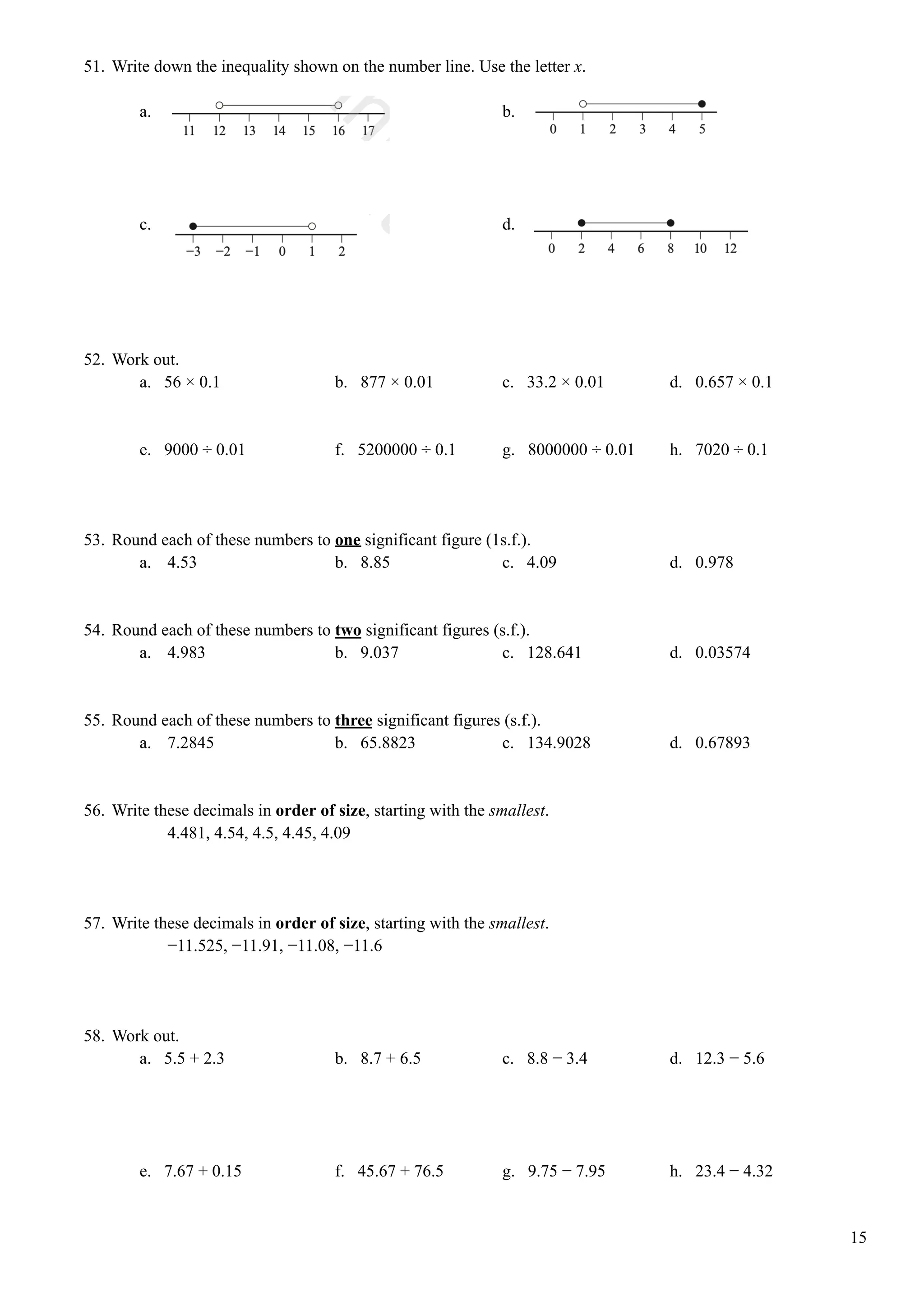
51. Write down the inequality shown on the number line. Use the letter x.
a. b.
c. d.
52. Work out.
a. 56 × 0.1 b. 877 × 0.01 c. 33.2 × 0.01 d. 0.657 × 0.1
e. 9000 ÷ 0.01 f. 5200000 ÷ 0.1 g. 8000000 ÷ 0.01 h. 7020 ÷ 0.1
53. Round each of these numbers to one significant figure (1s.f.).
a. 4.53 b. 8.85 c. 4.09 d. 0.978
54. Round each of these numbers to two significant figures (s.f.).
a. 4.983 b. 9.037 c. 128.641 d. 0.03574
55. Round each of these numbers to three significant figures (s.f.).
a. 7.2845 b. 65.8823 c. 134.9028 d. 0.67893
56. Write these decimals in order of size, starting with the smallest.
4.481, 4.54, 4.5, 4.45, 4.09
57. Write these decimals in order of size, starting with the smallest.
−11.525, −11.91, −11.08, −11.6
58. Work out.
a. 5.5 + 2.3 b. 8.7 + 6.5 c. 8.8 − 3.4 d. 12.3 − 5.6
e. 7.67 + 0.15 f. 45.67 + 76.5 g. 9.75 − 7.95 h. 23.4 − 4.32
15
59. Work out.
a. 0.3 × 2 b. 0.4 × 0.8 c. 0.5 × 0.6 d. 0.7 × 0.7
e. 4.8 × 3.4 f. 2.1 × 4.76 g. 0.32 × 7.1 h. 0.57 × 0.635
60. Work out.
a. 6.3 ÷ 3 b. 4.6 ÷ 0.2 c. 9.1 ÷ 0.7 d. 8.4 ÷ 0.03
e. 4.628 ÷ 0.2 f. 7.926 ÷ 0.06 g. 27.845 ÷ 0.5h. 0.976 ÷ 0.008
61. Complete these addition pyramids.
16

Review math grade 7(abcxyzehfoendheiemci)

  • 1.
    Name: _____________________________________ Class:_________ Date: ____________ Grade 7 REVIEW FOR END-OF-SEMESTER 1 EXAM REVIEW OF UNIT 8 - SHAPES AND SYMMETRY ~ ✩ ~ ✩ ~ ✩ ~ ✩ ~ ✩ ~ 1. Draw and write down the number of lines of symmetry for each of these shapes. 2. For each of these shapes in question 1, write down the order of rotational symmetry. 3. Complete the table below. Name of Regular Polygon Number of Sides Number of Lines of Symmetry Order of Rotational Symmetry 4. Label the parts of the circle. 1
  • 2.
    5. Here arethe names of 5 shapes. A - Rhombus B - Trapezium C - Kite D - Rectangle E - Square F - Isosceles Trapezium G - Parallelogram The diagram can be used to sort these shapes. Complete the diagram by writing one of A, B, C, D, E, F, G in each gap. (E has been done for you.) 6. Write true (T) or false (F) for each statement about regular polygons. a. A regular hexagon has five lines of symmetry. b. A regular octagon has order of rotation 8. c. A regular pentagon has order of rotation 10. d. A regular decagon has 10 lines of symmetry. e. A regular polygon with 15 lines of symmetry has 15 sides. f. A regular polygon with order of rotation 20 has 19 sides. 2
  • 3.
    7. Work outthe circumference of these circles. Use the π = 3.14. Give your answers correct to 2 d.p. a. diameter = 12.5cm b. radius = 3.4m 8. Work out the diameter of a circle when given the circumference. Round each answer correct to 1 d.p. a. Circumference = 35cm b. circumference = 8.95cm 9. Work out the perimeter of each compound shape. (Use the π = 3.14.) a. b. c. 10. Draw the plan view, front elevation and side elevation of these 3D shapes. Use a scale of 1:4. a. b. 3
  • 4.
    REVIEW OF UNIT15 - SHAPES, AREA AND VOLUME ~ ✩ ~ ✩ ~ ✩ ~ ✩ ~ ✩ ~ 11. Complete these area conversions. When possible, give your answer as a mixed number in its simplest form. a. 88 km = ____________ miles i. 72 km = ____________ miles b. 120 km = ____________ miles j. 200 km = ____________ miles c. 34 km = ____________ miles k. 63 km = ____________ miles d. 30 miles = ____________ km l. 45 miles = ____________ km e. 95 miles = ____________ km m. 55 miles = ____________ km f. 7 miles = ____________ km n. 21 miles = ____________ km 12. Work out the area of each shape. When possible, give each answer as a fraction in its simplest form. a. c. e. b. d. f. 13. This parallelogram has an area of 43.4cm2 . It has a height of 28mm. What is the length of the base of the parallelogram? 14. The diagram shows a trapezium with an area of 7182mm2 . What is the perpendicular height of the trapezium? 15. Find the shaded area in each diagram. 4
  • 5.
    a. b. 16. Windscreenglass for a van costs $250 per square metre. The diagram shows a van windscreen in the shape of a trapezium. Work out the cost of the glass for the windscreen. 17. Work out the volume and surface area of each 3D shape. a. b. c. 18. Work out the volume of each compound shape. 5
  • 6.
    REVIEW OF UNIT7 - FRACTIONS ~ ✩ ~ ✩ ~ ✩ ~ ✩ ~ ✩ ~ 19. Put the following fractions in order from smallest to largest. a. b. 1 3 2 7 3 10 3 12 11 3 17 5 31 9 47 13 20. Work out. Give your answer in its simplest form and, when possible, as a mixed number. a. f. c. 1 2 + 1 4 7 8 − 1 4 5 6 − 4 9 b. g. c. 1 1 5 + 2 2 3 7 3 8 − 4 7 8 11 3 4 − 7 5 6 c. h. c. 7 8 × 2 9 2 5 × 1 6 5 8 × 7 15 d. i. c. 2 9 ÷ 5 3 5 8 ÷ 3 12 6 ÷ 2 3 e. j. c. 8 × 1 4 162 × 1 6 210 × 1 15 6
  • 7.
    21. Work outthe perimeter of each triangle. Write your answer as a mixed number in its simplest form. a. b. 22. Work out the area of each shape. Write your answer as a mixed number in its simplest form. a. b. 23. The area of this rectangle is m2 . The length is m. 5 6 15 16 Work out the width of the rectangle. 24. Write these fractions as recurring decimals as simply as possible. a. = _____ b. = _____ c. = _____ 2 9 5 6 3 7 25. of the people watching a football game are children. of the children are girls. 2 7 3 8 a. What fraction of the people watching the football game are girls? b. What fraction of the people watching the football game are boys? c. What fraction of the people watching the football game are not children? 7
  • 8.
    REVIEW OF UNIT13 - PROBABILITY ~ ✩ ~ ✩ ~ ✩ ~ ✩ ~ ✩ ~ 26. This fair dice has 20 faces, which are numbered from 1 to 20. The dice is thrown once. Find the probability that the outcome is: a. a multiple of 3 f. a multiple of 8 b. a prime number g. a square number c. a two-digit number h. a cube number d. an even number i. an odd number less than 10 27. A spinner has 7 equally likely sectors numbered 1, 2, 3, 4, 5, 6 and 7. The spinner is spun and a coin is thrown. Work out the probability of a. a head and a 5 b. a tail and an even number c. a head but not a 5 28. A train can arrive early, on time or late. The probability the train arrives early is 5% and the probability it arrives late is 15%. Work out the probability that it is a. not early b. not late c. not on time 29. Two fair six-sided dice are thrown and the numbers are multiplied together. a. Find the probability of getting more than 15. b. Find the probability of getting an odd number. 8
  • 9.
    30. A spinnerhas five equal sectors numbered 1, 2, 3, 4, 5. Here are the results of 400 spins. Score 1 2 3 4 5 Frequency 90 83 86 66 75 a. Find the experimental probabilities of i. 2 ii. an odd number iii. 4 or 5 b. Find the theoretical probabilities of i. 2 ii. an odd number iii. 4 or 5 c. Do you think the spinner is fair? Give a reason for your answer. 31. When you throw three coins you can get 0, 1, 2 or 3 heads. Here are the results of a computer simulation of 500 throws of three coins. Number of heads 0 1 2 3 Frequency 59 180 192 69 a. Find the experimental probabilities of 0, 1, 2 and 3 heads. b. Work out the theoretical probabilities of 0, 1, 2 and 3 heads. c. Is computer simulation working properly? Explain your reasoning. 9
  • 10.
    REVIEW OF UNITS1-4 ~ ✩ ~ ✩ ~ ✩ ~ ✩ ~ ✩ ~ 32. (a) Use a factor tree to express 72 and 108 as products of prime factors. (b) Find the least common multiple (LCM) of 72 and 108. (c) Find the highest common factor (HCF) of 72 and 108. 33. (a) Use a factor tree to express 104 and 130 as products of prime factors. (b) Find the least common multiple (LCM) of 104 and 130. (c) Find the highest common factor (HCF) of 104 and 130. 34. Work out: a. 10 × −3 b. −4 × 9 c. −5 × −11 d. −7 × −7 e. 24 ÷ −2 f. −24 ÷ 6 g. −50 ÷ −10 h. −63 ÷ −9 i. (−5 + −2) × 4 j. (−6 − −4) × 3 k. (6 − 14) ÷ 4 l. (−5 −13) ÷ 3 10
  • 11.
    35. Work out. a.32 + 42 b. (−6)2 + (−7)2 c. 33 + 53 d. 43 − (−2)3 e. f. g. h. 16 100 225 169 i. j. k. l. 3 − 8 64 − 3 64 25 − 3 125 3 27 − 16 36. (a) Show that 9 is the closest integer to . 79 (b) Show that is between 14 and 15. 215 37. Write whether each statement is true or false. a. 9 is a rational number. b. −9 is a natural number. c. 99 is an integer. d. −999 is both an integer and a rational number. e. 9999 is both a natural number and a rational number. 38. Work out and write the answer in index form. a. 62 × 63 b. 54 × 5 c. 22 × 23 × 2 d. 30 × 3 × 34 e. 56 ÷ 52 f. 83 ÷ 8 g. (45 )3 h. (154 )5 39. Shen thinks of a number, n. Write an expression for the number Shen gets when he a. multiplies the number by 7 then adds 4. b. divides the number by 6 then subtracts 8. c. adds 4 to the number then divides by 5. d. subtracts 4 from the number then divides by 5. 11
  • 12.
    40. Work outthe value of each expression. a. a2 − 10 when a = 4 d. 30 − b2 when b = 6 b. z3 − 2 when z = 2 e. 5(n3 + 10) when n = −2 c. − 3 when k = 2 f. + n3 when m = 30 and n = 3 24 𝑘 2 𝑚 2 41. Raul writes a formula for the number of hours in any number of days. He writes: number of hours = 24 × number of days. a. Explain why this formula is correct. b. Write the formula using letters. (Use h for hours and d for days.) c. Use your formula to work out the number of hours in five days. 42. (a) Write a formula for the number of minutes in any number of hours. (b) Use your formula to work out the number of minutes in eight hours. 43. Expand and simplify the brackets. a. 3(a + 2) b. 2(2t − 5) c. 5(3 − 5x) d. 6(a + 7) + 8(a + 9) e. 6(5 + 6e) − 7(8e + 9) f. 9(8f + 7g) − 6(5g − 6f) g. 11(3s − 4a + 7) h. 8(6 + 4w − 3g) i. 5(5k − 8x − 6h) 12
  • 13.
    44. (a) Writean expression for the perimeter of the rectangle at right. (b) Write an expression for the area of the rectangle at right. Be sure to write your answer in its simplest form, and expand brackets where necessary. 45. Fully factorise each expression. a. 5z + 15 b. 2y − 14 c. 6v + 8 d. 14a − 21 e. 7m2 + m f. 8h − 4h2 g. 12y − 16y2 h. 12a + 8ab 46. The diagram shows a rectangle. The area of the rectangle is 12b2 − 30b. Write an expression for a. the length of the rectangle b. the perimeter of the rectangle 47. Alex says: My brother is 9 years old. My Mum is x years old. One third of my Mum’s age minus 2 is the same as my brother’s age. How old is my Mum? a. Write an equation to represent what Alex says. b. Solve your equation to find how old Alex’s mom is. 13
  • 14.
    48. Solve theseequations. a. 4x + 5 = x + 17 b. 10x − 4 = 8x + 12 c. 4(x − 3) = 24 49. Work out the value of the letters in each diagram. a. b. c. d. 50. Show each inequality on the number line. a. 5 < x < 8 b. 2 < x ≤ 6 c. −5 < x ≤ −2 d. −1 ≤ x ≤ 4 ​ ​ 14
  • 15.
    51. Write downthe inequality shown on the number line. Use the letter x. a. b. c. d. 52. Work out. a. 56 × 0.1 b. 877 × 0.01 c. 33.2 × 0.01 d. 0.657 × 0.1 e. 9000 ÷ 0.01 f. 5200000 ÷ 0.1 g. 8000000 ÷ 0.01 h. 7020 ÷ 0.1 53. Round each of these numbers to one significant figure (1s.f.). a. 4.53 b. 8.85 c. 4.09 d. 0.978 54. Round each of these numbers to two significant figures (s.f.). a. 4.983 b. 9.037 c. 128.641 d. 0.03574 55. Round each of these numbers to three significant figures (s.f.). a. 7.2845 b. 65.8823 c. 134.9028 d. 0.67893 56. Write these decimals in order of size, starting with the smallest. 4.481, 4.54, 4.5, 4.45, 4.09 57. Write these decimals in order of size, starting with the smallest. −11.525, −11.91, −11.08, −11.6 58. Work out. a. 5.5 + 2.3 b. 8.7 + 6.5 c. 8.8 − 3.4 d. 12.3 − 5.6 e. 7.67 + 0.15 f. 45.67 + 76.5 g. 9.75 − 7.95 h. 23.4 − 4.32 15
  • 16.
    59. Work out. a.0.3 × 2 b. 0.4 × 0.8 c. 0.5 × 0.6 d. 0.7 × 0.7 e. 4.8 × 3.4 f. 2.1 × 4.76 g. 0.32 × 7.1 h. 0.57 × 0.635 60. Work out. a. 6.3 ÷ 3 b. 4.6 ÷ 0.2 c. 9.1 ÷ 0.7 d. 8.4 ÷ 0.03 e. 4.628 ÷ 0.2 f. 7.926 ÷ 0.06 g. 27.845 ÷ 0.5h. 0.976 ÷ 0.008 61. Complete these addition pyramids. 16