Jason Schafer, ATS
Director, Technology & Operations Management
Retrofit, Build, or Go Colo/Cloud:
Choosing Your Best Direction
Schneider Electric 2
Objectives
1. Review the evaluation criteria that goes into determining
whether to upgrade, build new, or outsource a data center.
2. Understand the financial metrics and scenarios that go
into determining the direction of the data center.
3. Identify the 10 strategic, non-financial factors that go into
the decision.
4. Overview of tools available to help in the decision making
process.
Schneider Electric 3
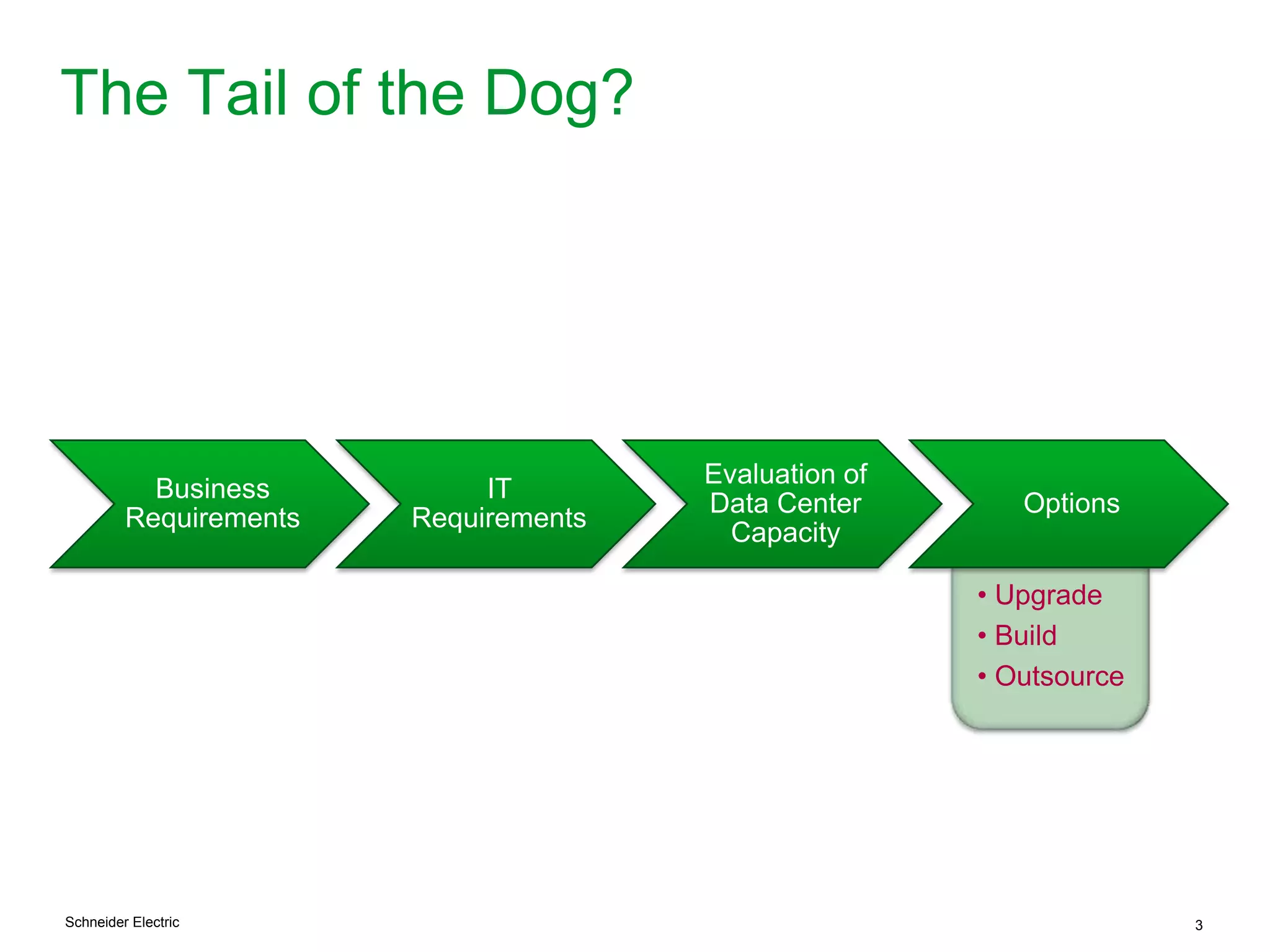
• Upgrade
• Build
• Outsource
Business
Requirements
IT
Requirements
Evaluation of
Data Center
Capacity
Options
The Tail of the Dog?
Schneider Electric 4
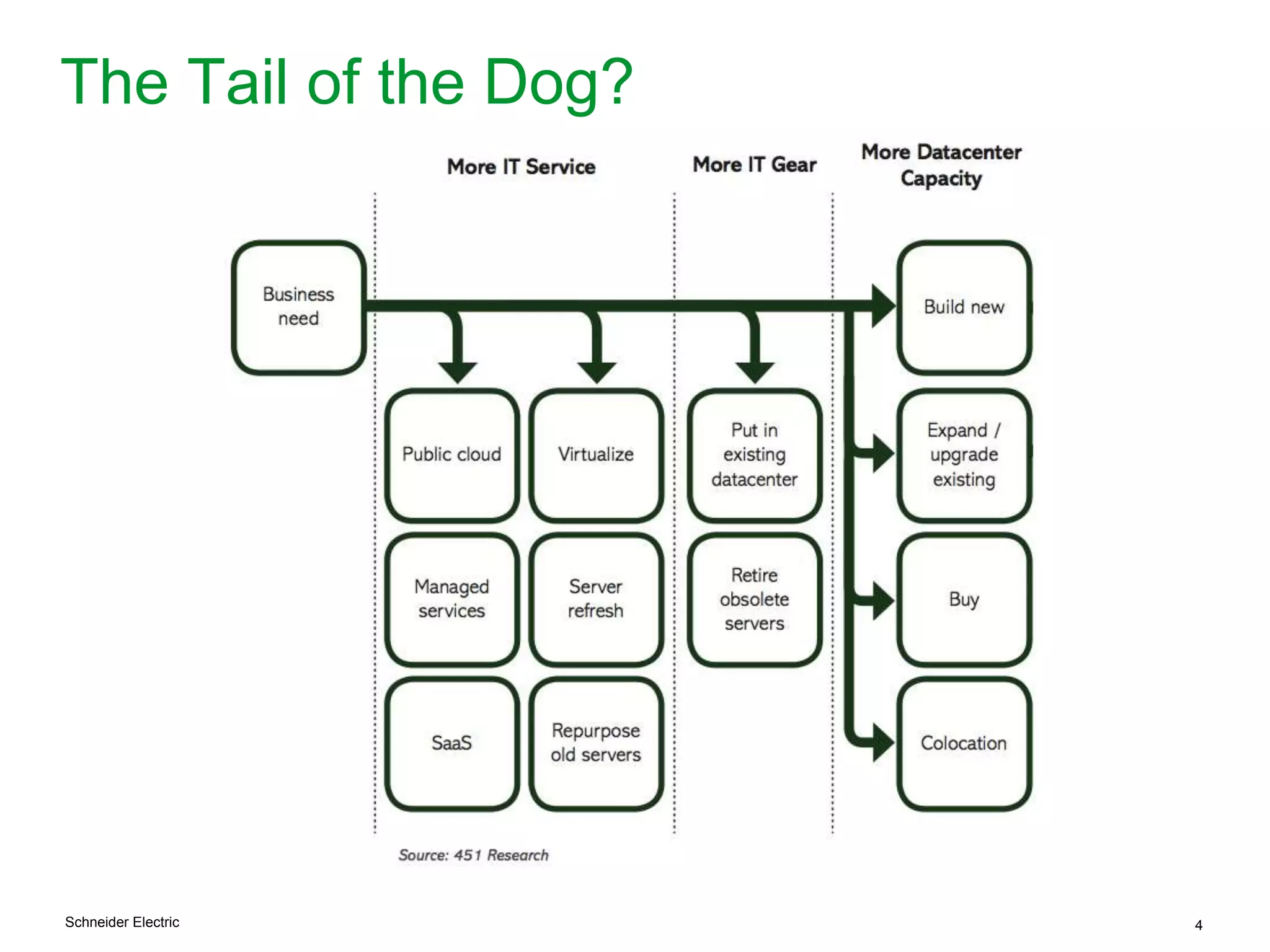
The Tail of the Dog?
Schneider Electric 5
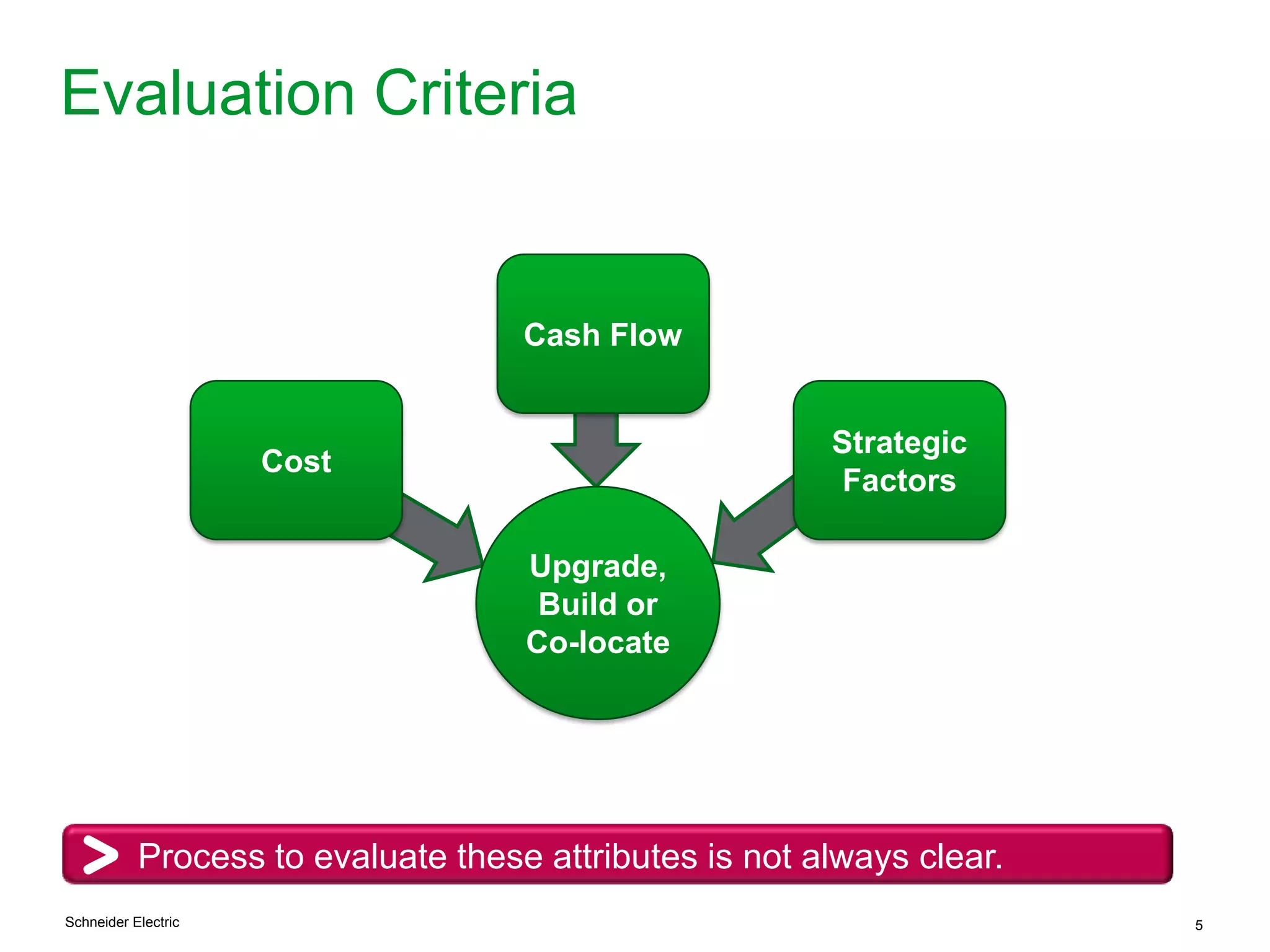
Evaluation Criteria
Upgrade,
Build or
Co-locate
Cost
Cash Flow
Strategic
Factors
Process to evaluate these attributes is not always clear.
Schneider Electric 6
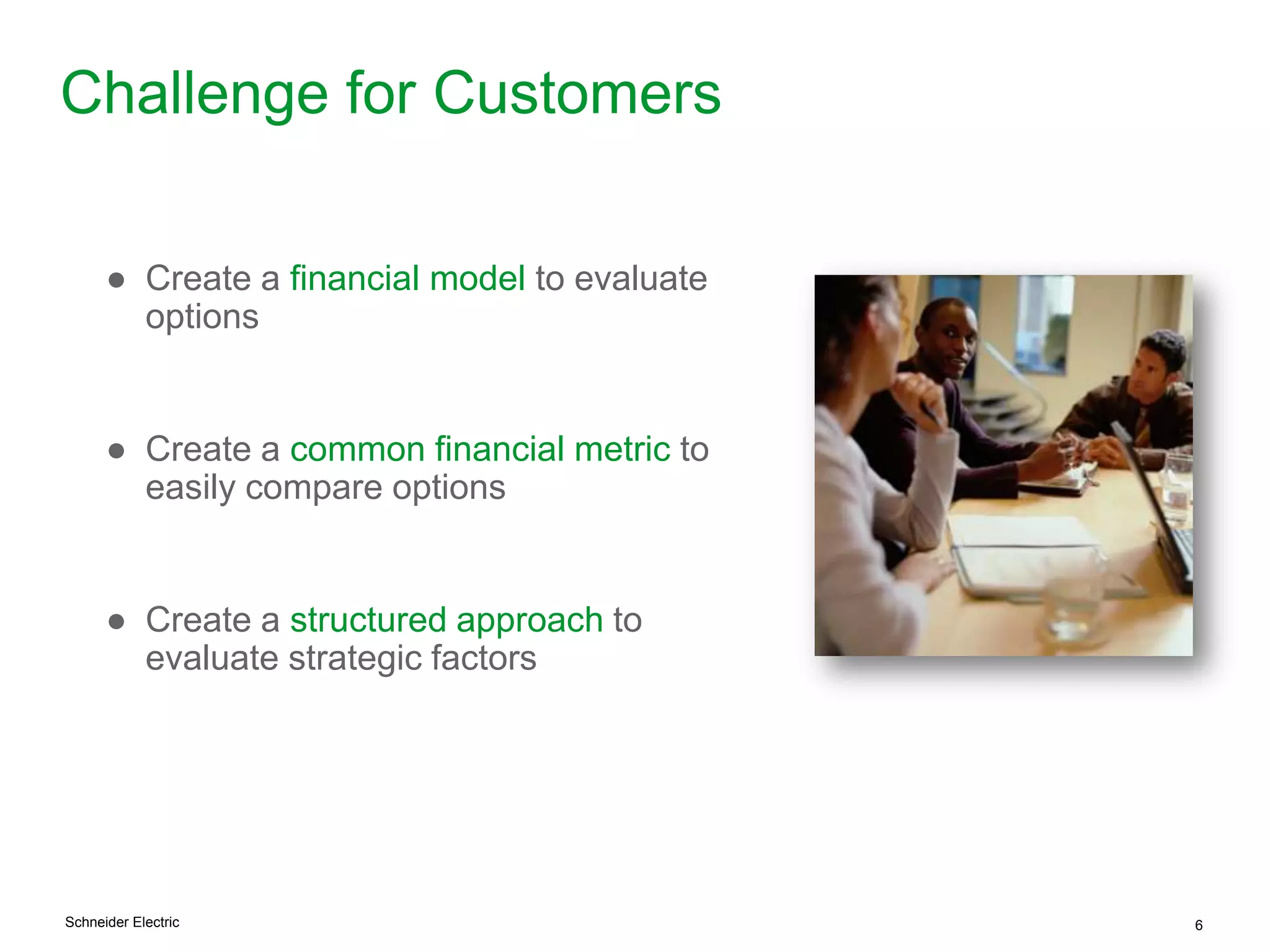
Challenge for Customers
● Create a financial model to evaluate
options
● Create a common financial metric to
easily compare options
● Create a structured approach to
evaluate strategic factors
Schneider Electric 7
Financial Metrics
● Normalize costs to 10 year TCO per watt
● Utilize cumulative cash outlay to
determine a break even point
● Provide insight into opex versus capex
Schneider Electric 8
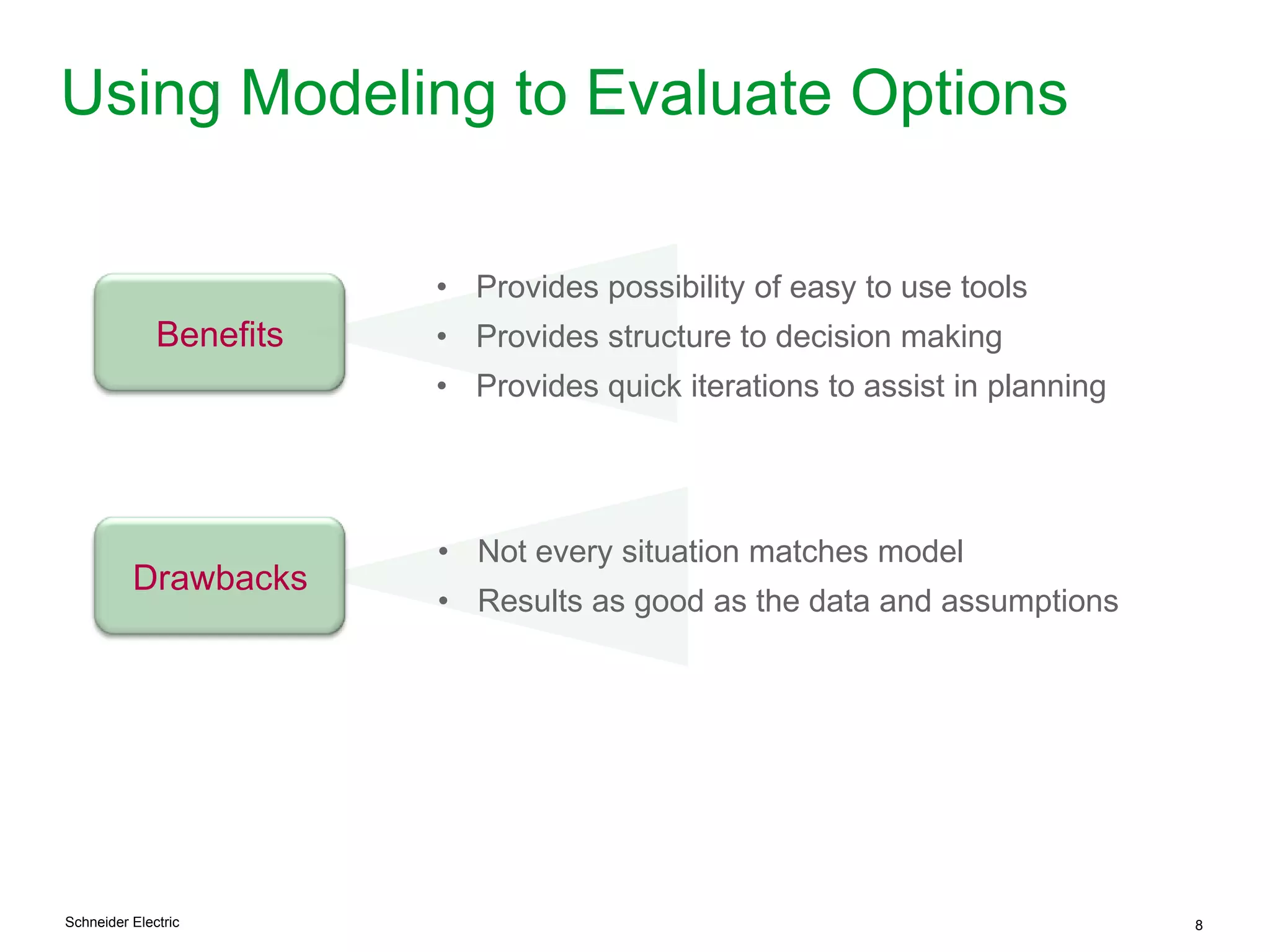
Using Modeling to Evaluate Options
Benefits
Drawbacks
• Provides possibility of easy to use tools
• Provides structure to decision making
• Provides quick iterations to assist in planning
• Not every situation matches model
• Results as good as the data and assumptions
Schneider Electric 9
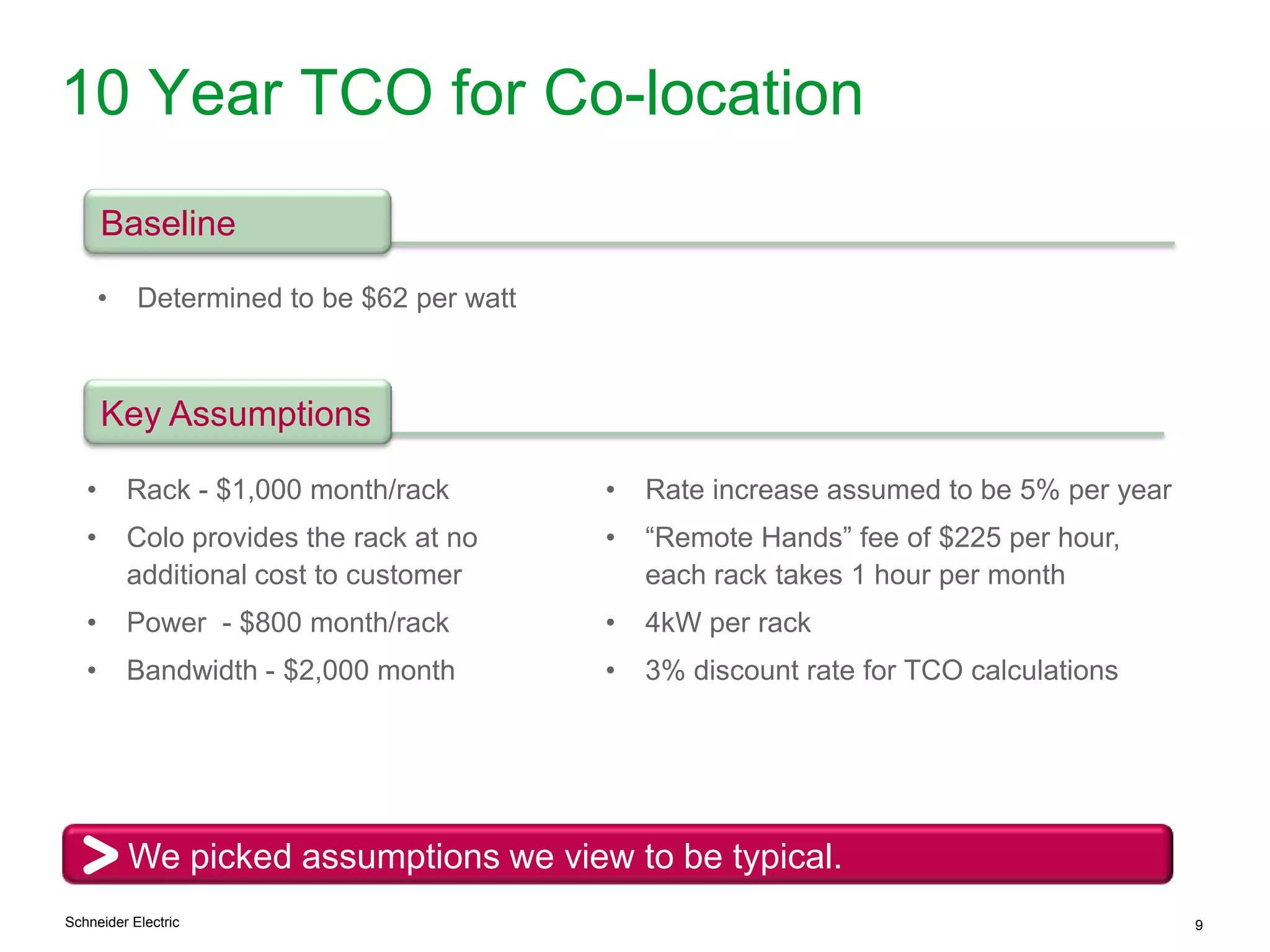
10 Year TCO for Co-location
We picked assumptions we view to be typical.
Baseline
• Determined to be $62 per watt
• Rate increase assumed to be 5% per year
• “Remote Hands” fee of $225 per hour,
each rack takes 1 hour per month
• 4kW per rack
• 3% discount rate for TCO calculations
Key Assumptions
• Rack - $1,000 month/rack
• Colo provides the rack at no
additional cost to customer
• Power - $800 month/rack
• Bandwidth - $2,000 month
Schneider Electric 10
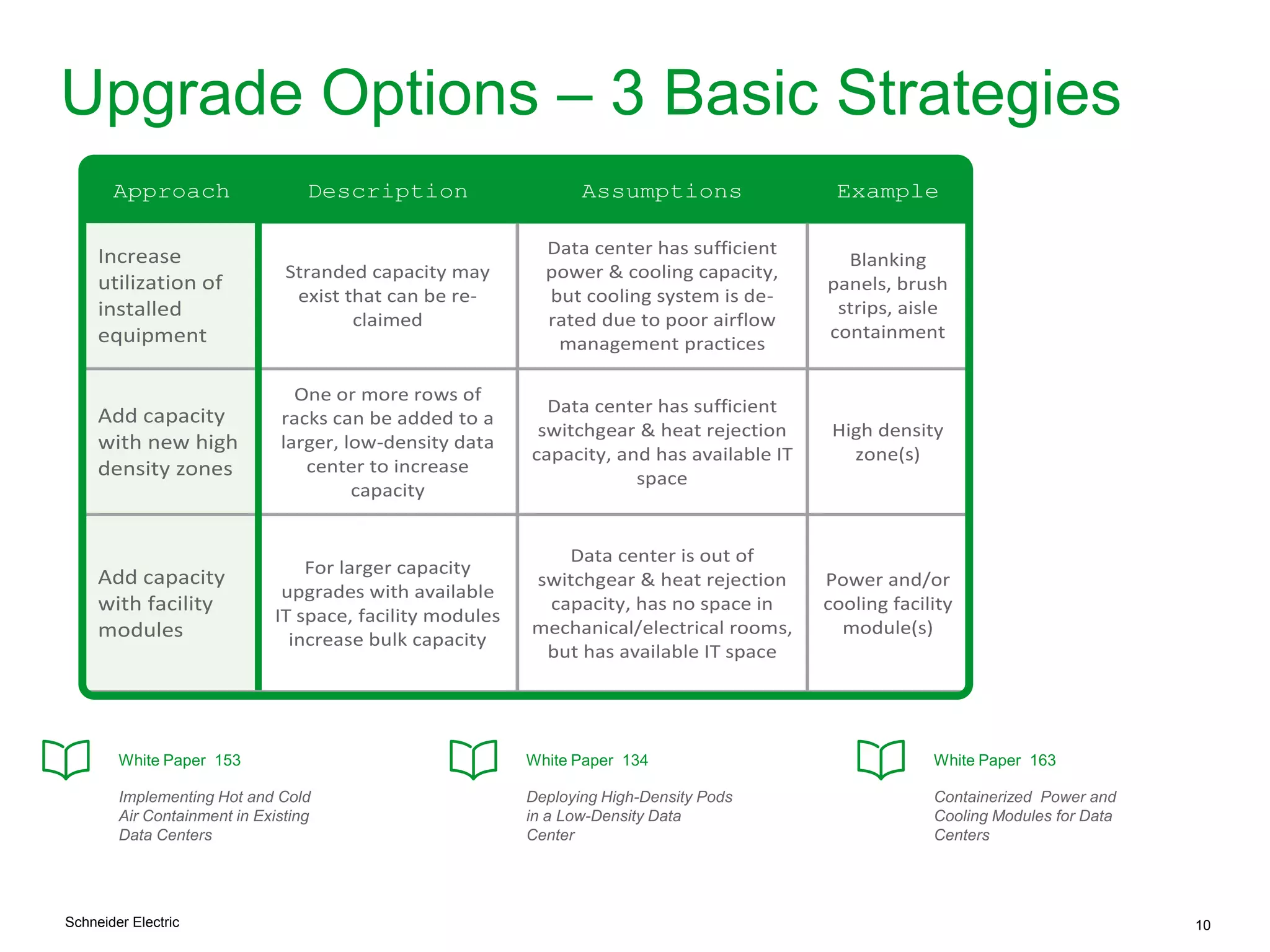
Upgrade Options – 3 Basic Strategies
Approach Description Assumptions Example
Increase
utilization of
installed
equipment
Stranded capacity may
exist that can be re-
claimed
Data center has sufficient
power & cooling capacity,
but cooling system is de-
rated due to poor airflow
management practices
Blanking
panels, brush
strips, aisle
containment
Add capacity
with new high
density zones
One or more rows of
racks can be added to a
larger, low-density data
center to increase
capacity
Data center has sufficient
switchgear & heat rejection
capacity, and has available IT
space
High density
zone(s)
Add capacity
with facility
modules
For larger capacity
upgrades with available
IT space, facility modules
increase bulk capacity
Data center is out of
switchgear & heat rejection
capacity, has no space in
mechanical/electrical rooms,
but has available IT space
Power and/or
cooling facility
module(s)
White Paper 153
Implementing Hot and Cold
Air Containment in Existing
Data Centers
White Paper 134
Deploying High-Density Pods
in a Low-Density Data
Center
White Paper 163
Containerized Power and
Cooling Modules for Data
Centers
Schneider Electric 11
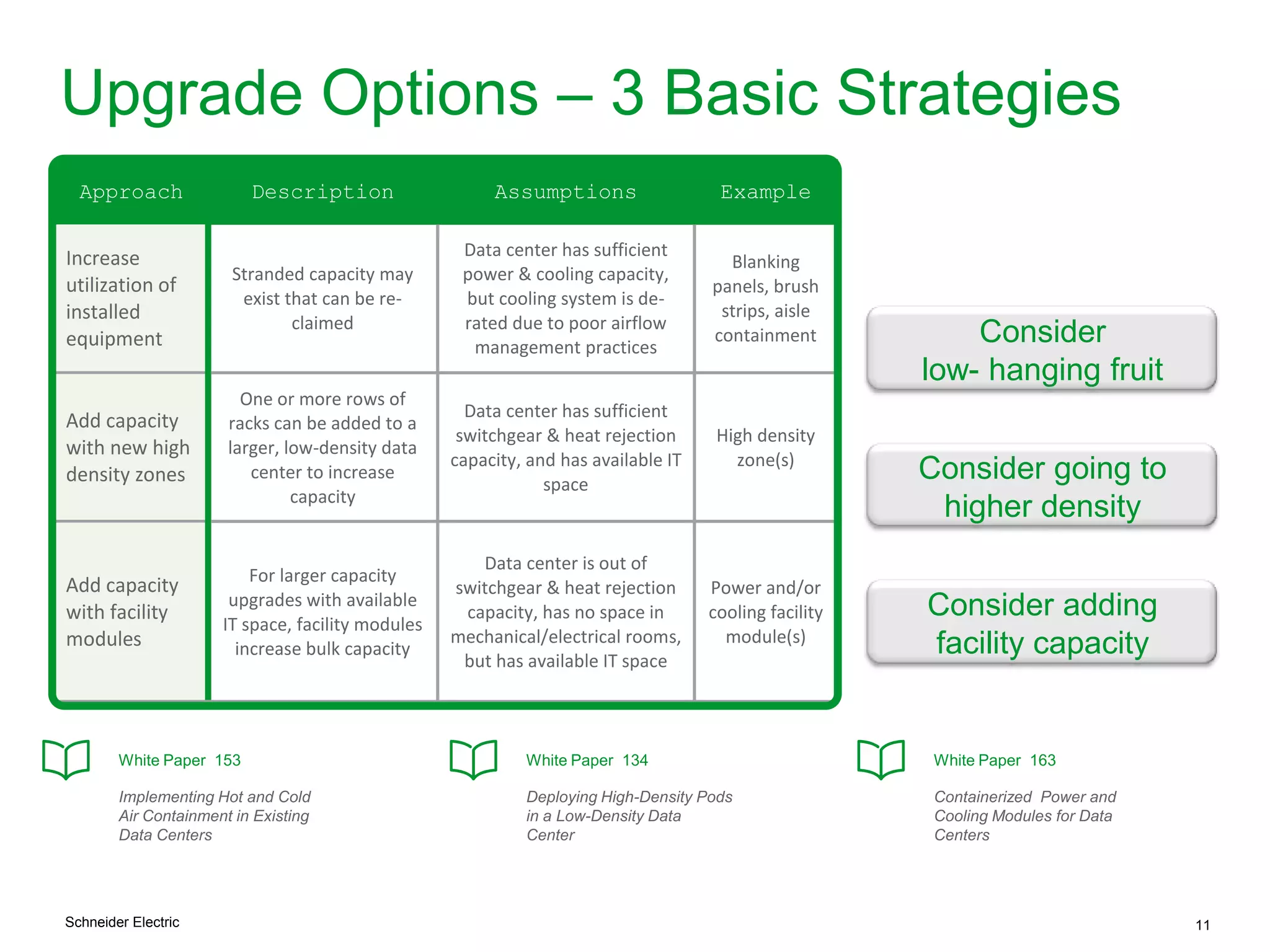
Upgrade Options – 3 Basic Strategies
Approach Description Assumptions Example
Increase
utilization of
installed
equipment
Stranded capacity may
exist that can be re-
claimed
Data center has sufficient
power & cooling capacity,
but cooling system is de-
rated due to poor airflow
management practices
Blanking
panels, brush
strips, aisle
containment
Add capacity
with new high
density zones
One or more rows of
racks can be added to a
larger, low-density data
center to increase
capacity
Data center has sufficient
switchgear & heat rejection
capacity, and has available IT
space
High density
zone(s)
Add capacity
with facility
modules
For larger capacity
upgrades with available
IT space, facility modules
increase bulk capacity
Data center is out of
switchgear & heat rejection
capacity, has no space in
mechanical/electrical rooms,
but has available IT space
Power and/or
cooling facility
module(s)
Consider
low- hanging fruit
Consider going to
higher density
Consider adding
facility capacity
White Paper 153
Implementing Hot and Cold
Air Containment in Existing
Data Centers
White Paper 134
Deploying High-Density Pods
in a Low-Density Data
Center
White Paper 163
Containerized Power and
Cooling Modules for Data
Centers
Schneider Electric 12
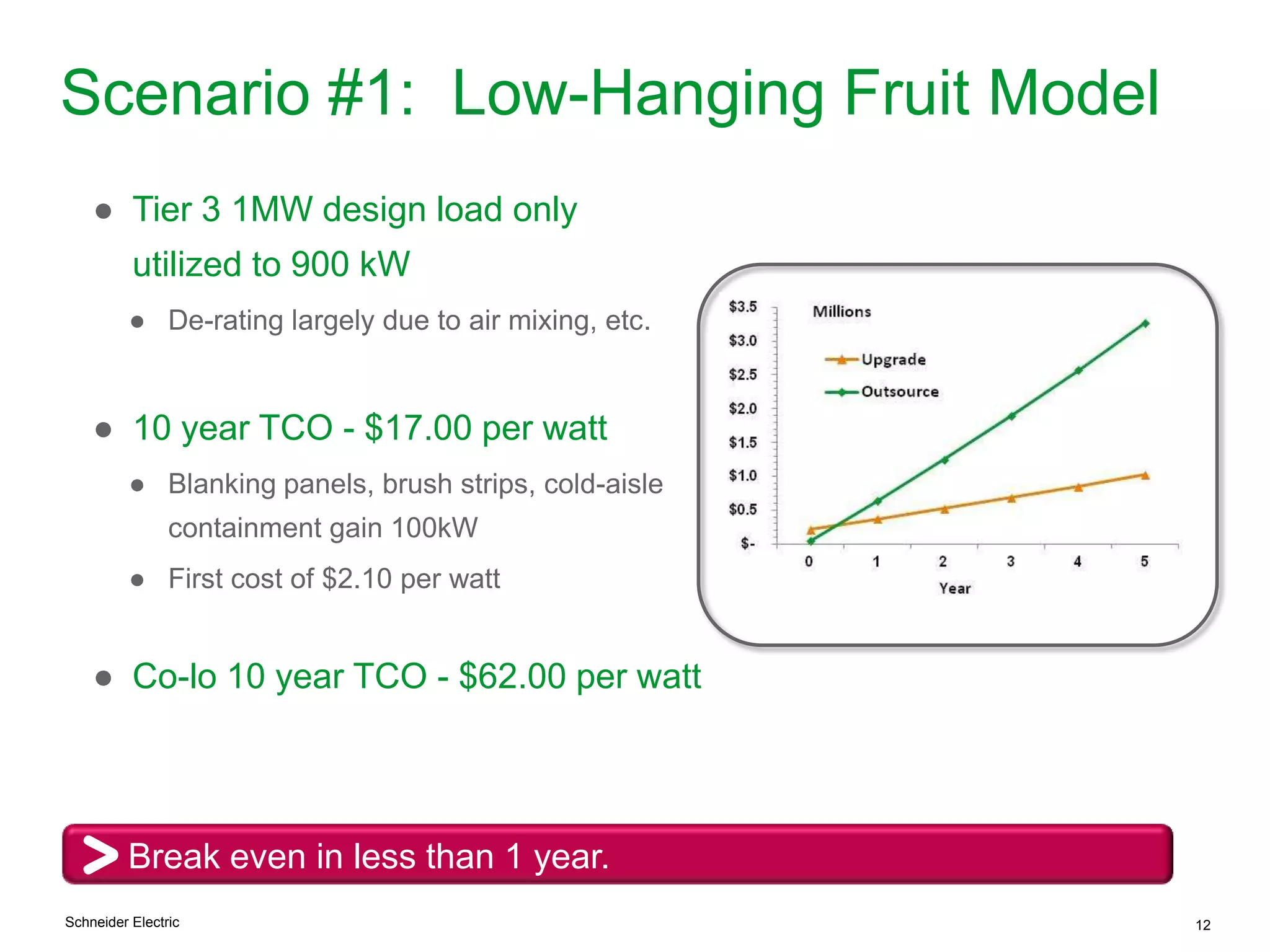
Scenario #1: Low-Hanging Fruit Model
Break even in less than 1 year.
● Tier 3 1MW design load only
utilized to 900 kW
● De-rating largely due to air mixing, etc.
● 10 year TCO - $17.00 per watt
● Blanking panels, brush strips, cold-aisle
containment gain 100kW
● First cost of $2.10 per watt
● Co-lo 10 year TCO - $62.00 per watt
Schneider Electric 13
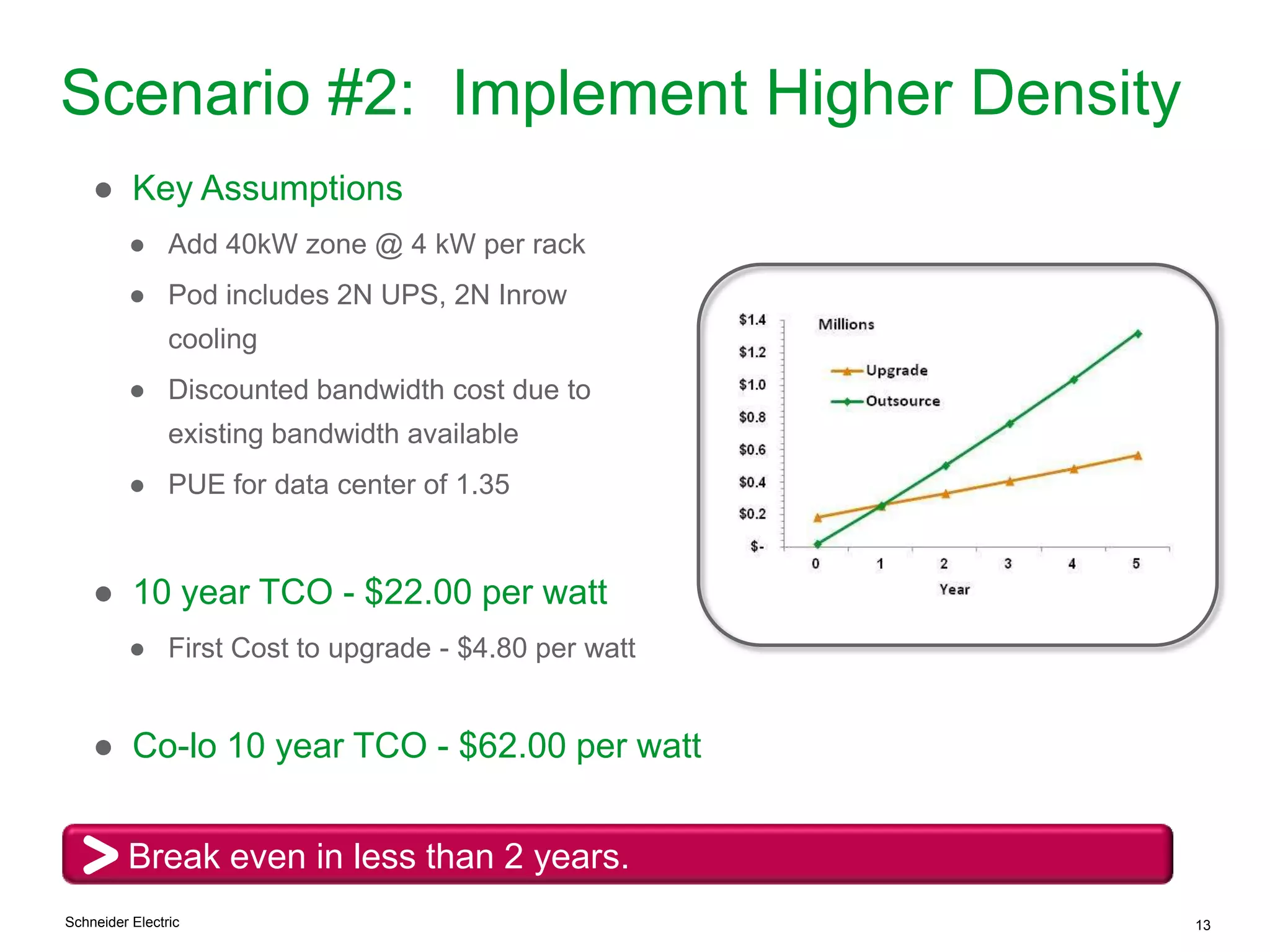
Scenario #2: Implement Higher Density
Break even in less than 2 years.
● Key Assumptions
● Add 40kW zone @ 4 kW per rack
● Pod includes 2N UPS, 2N Inrow
cooling
● Discounted bandwidth cost due to
existing bandwidth available
● PUE for data center of 1.35
● 10 year TCO - $22.00 per watt
● First Cost to upgrade - $4.80 per watt
● Co-lo 10 year TCO - $62.00 per watt
Schneider Electric 14
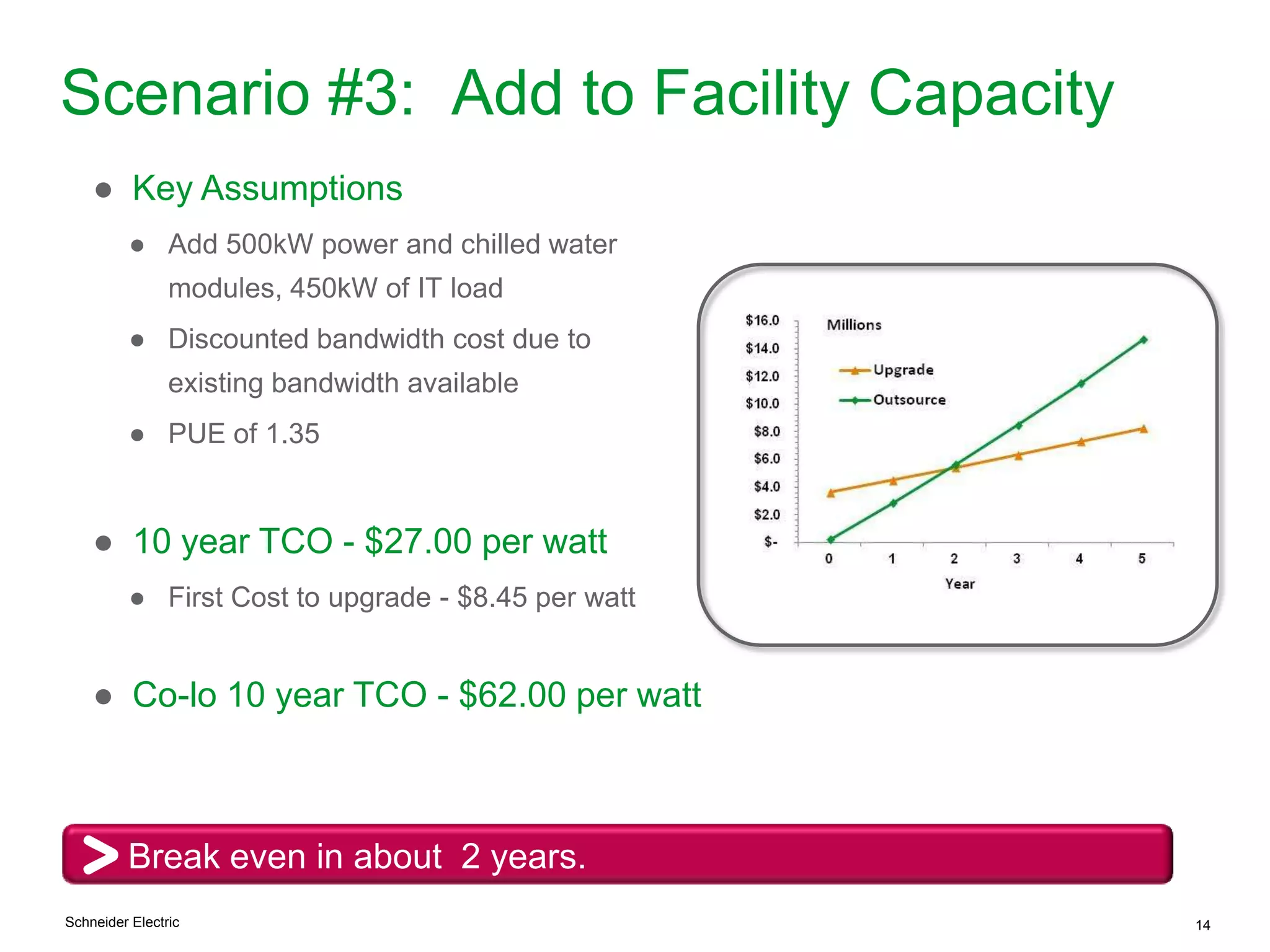
Scenario #3: Add to Facility Capacity
Break even in about 2 years.
● Key Assumptions
● Add 500kW power and chilled water
modules, 450kW of IT load
● Discounted bandwidth cost due to
existing bandwidth available
● PUE of 1.35
● 10 year TCO - $27.00 per watt
● First Cost to upgrade - $8.45 per watt
● Co-lo 10 year TCO - $62.00 per watt
Schneider Electric 15
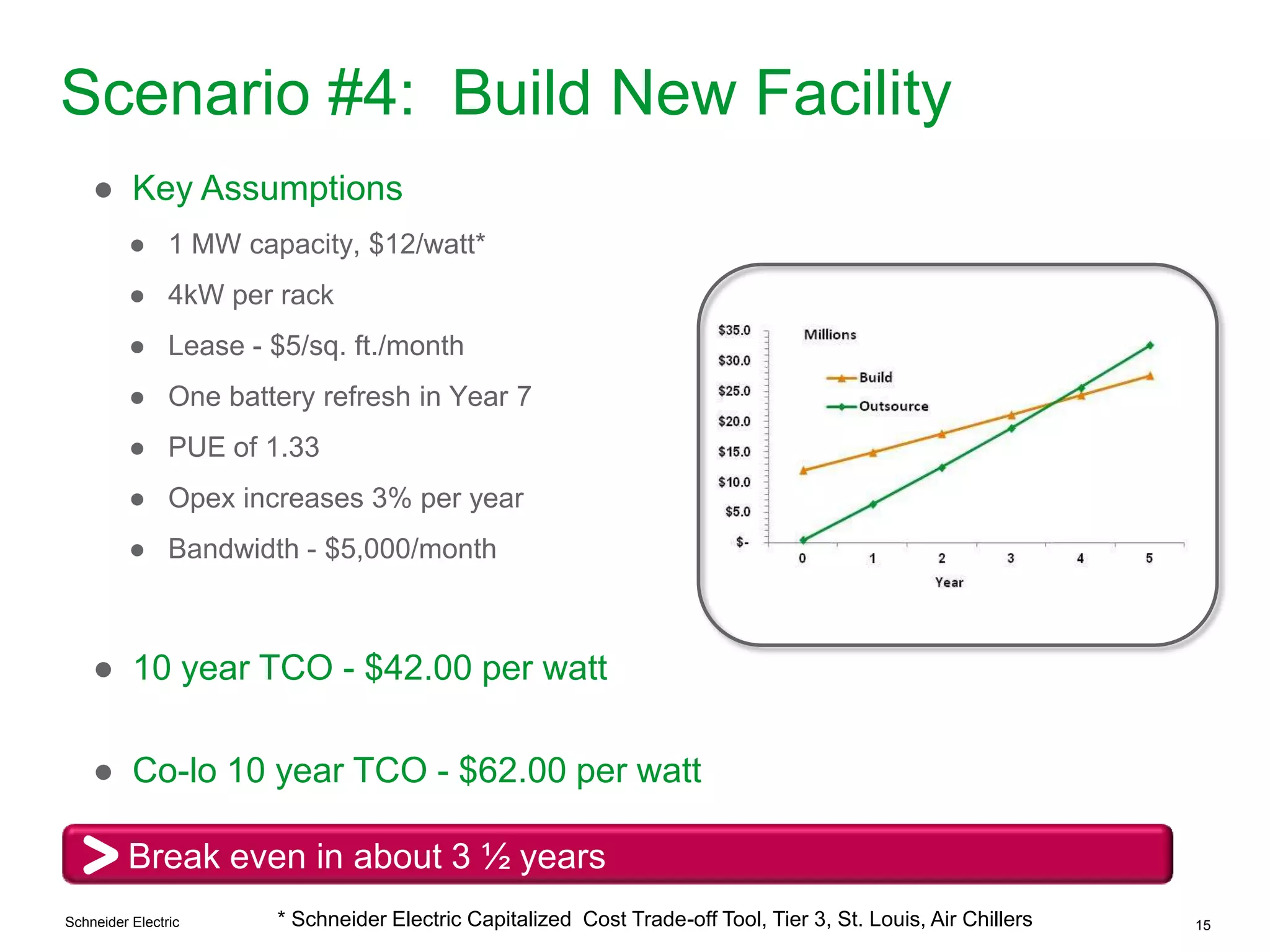
Scenario #4: Build New Facility
Break even in about 3 ½ years
● Key Assumptions
● 1 MW capacity, $12/watt*
● 4kW per rack
● Lease - $5/sq. ft./month
● One battery refresh in Year 7
● PUE of 1.33
● Opex increases 3% per year
● Bandwidth - $5,000/month
● 10 year TCO - $42.00 per watt
● Co-lo 10 year TCO - $62.00 per watt
* Schneider Electric Capitalized Cost Trade-off Tool, Tier 3, St. Louis, Air Chillers
Schneider Electric 16
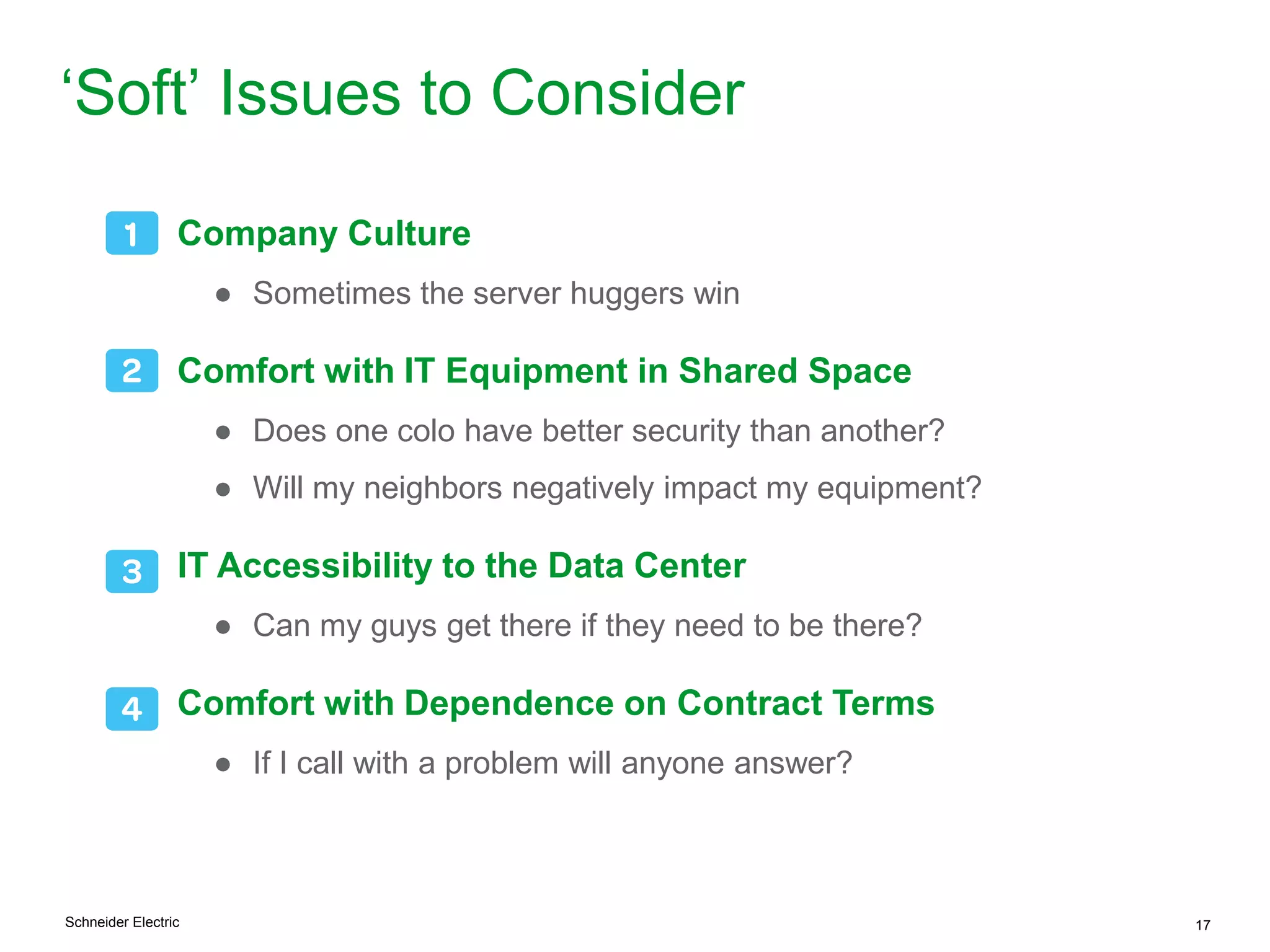
But is it really about the money?
The 10 factors that may trump any financial discussion.
Schneider Electric 17
„Soft‟ Issues to Consider
Company Culture
● Sometimes the server huggers win
Comfort with IT Equipment in Shared Space
● Does one colo have better security than another?
● Will my neighbors negatively impact my equipment?
IT Accessibility to the Data Center
● Can my guys get there if they need to be there?
Comfort with Dependence on Contract Terms
● If I call with a problem will anyone answer?
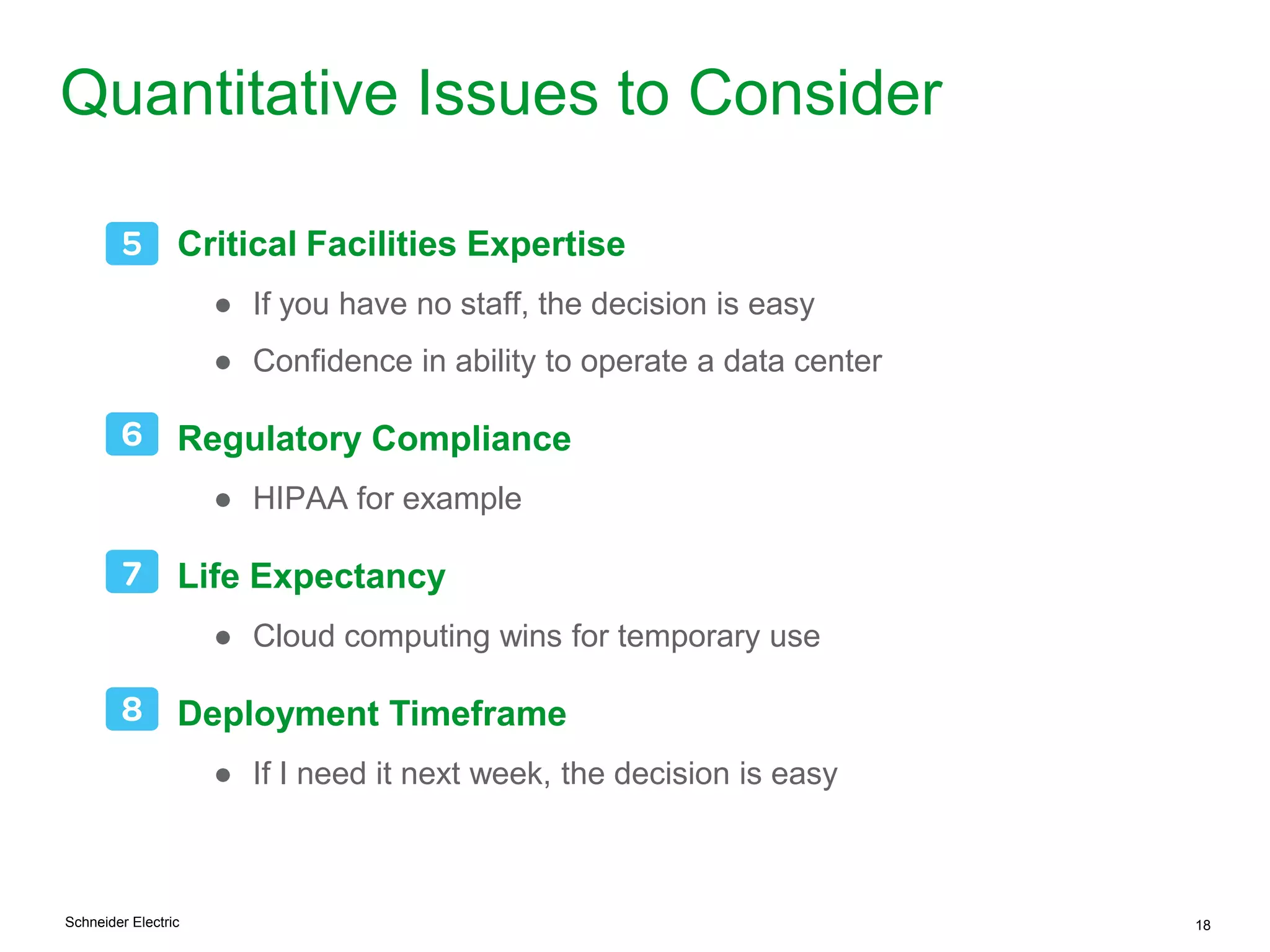
Schneider Electric 18
Quantitative Issues to Consider
Critical Facilities Expertise
● If you have no staff, the decision is easy
● Confidence in ability to operate a data center
Regulatory Compliance
● HIPAA for example
Life Expectancy
● Cloud computing wins for temporary use
Deployment Timeframe
● If I need it next week, the decision is easy
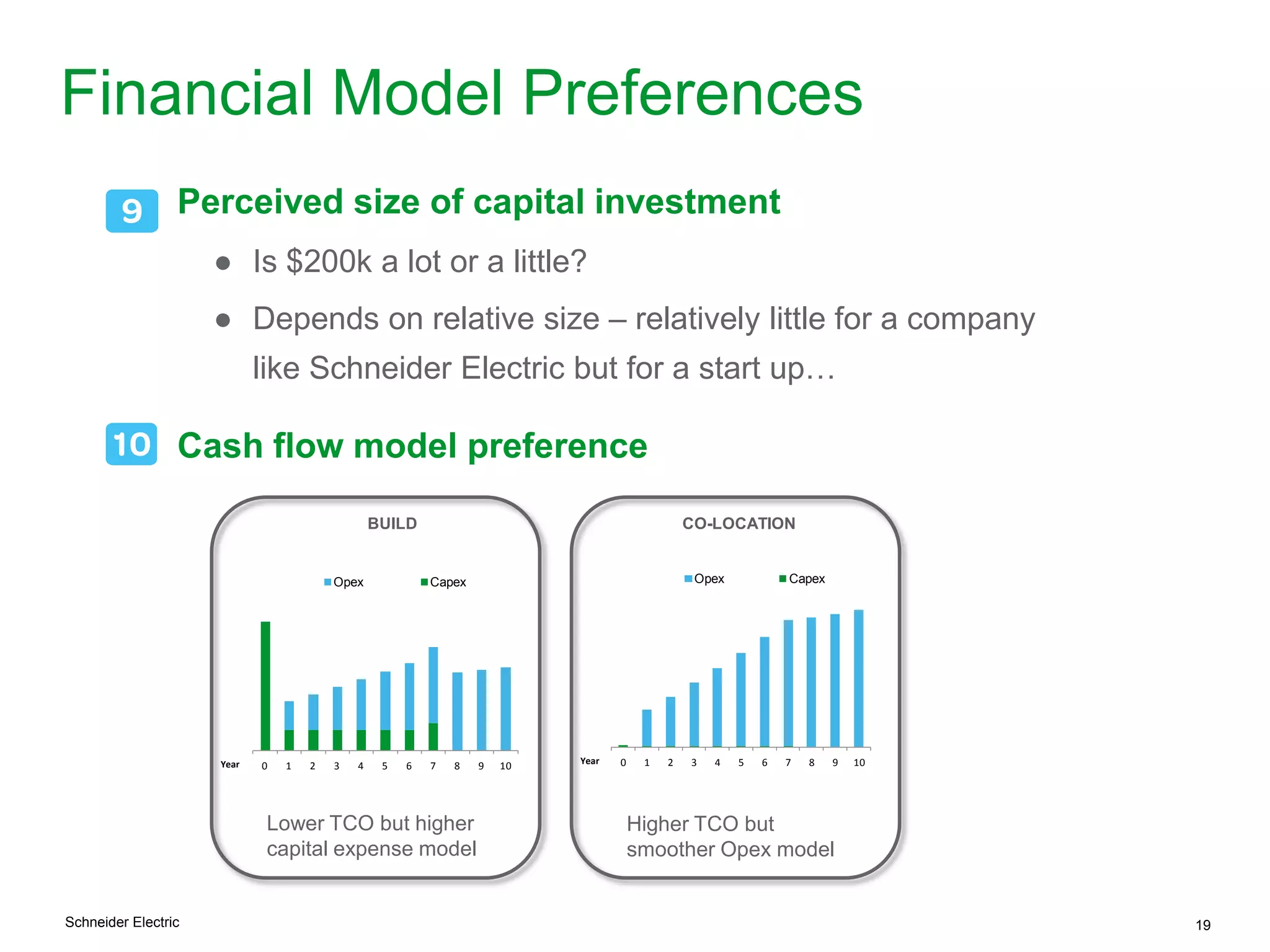
Schneider Electric 19
Financial Model Preferences
Perceived size of capital investment
● Is $200k a lot or a little?
● Depends on relative size – relatively little for a company
like Schneider Electric but for a start up…
Cash flow model preference
0 1 2 3 4 5 6 7 8 9 10
Opex Capex
Year 0 1 2 3 4 5 6 7 8 9 10
Opex Capex
Year
BUILD CO-LOCATION
Lower TCO but higher
capital expense model
Higher TCO but
smoother Opex model
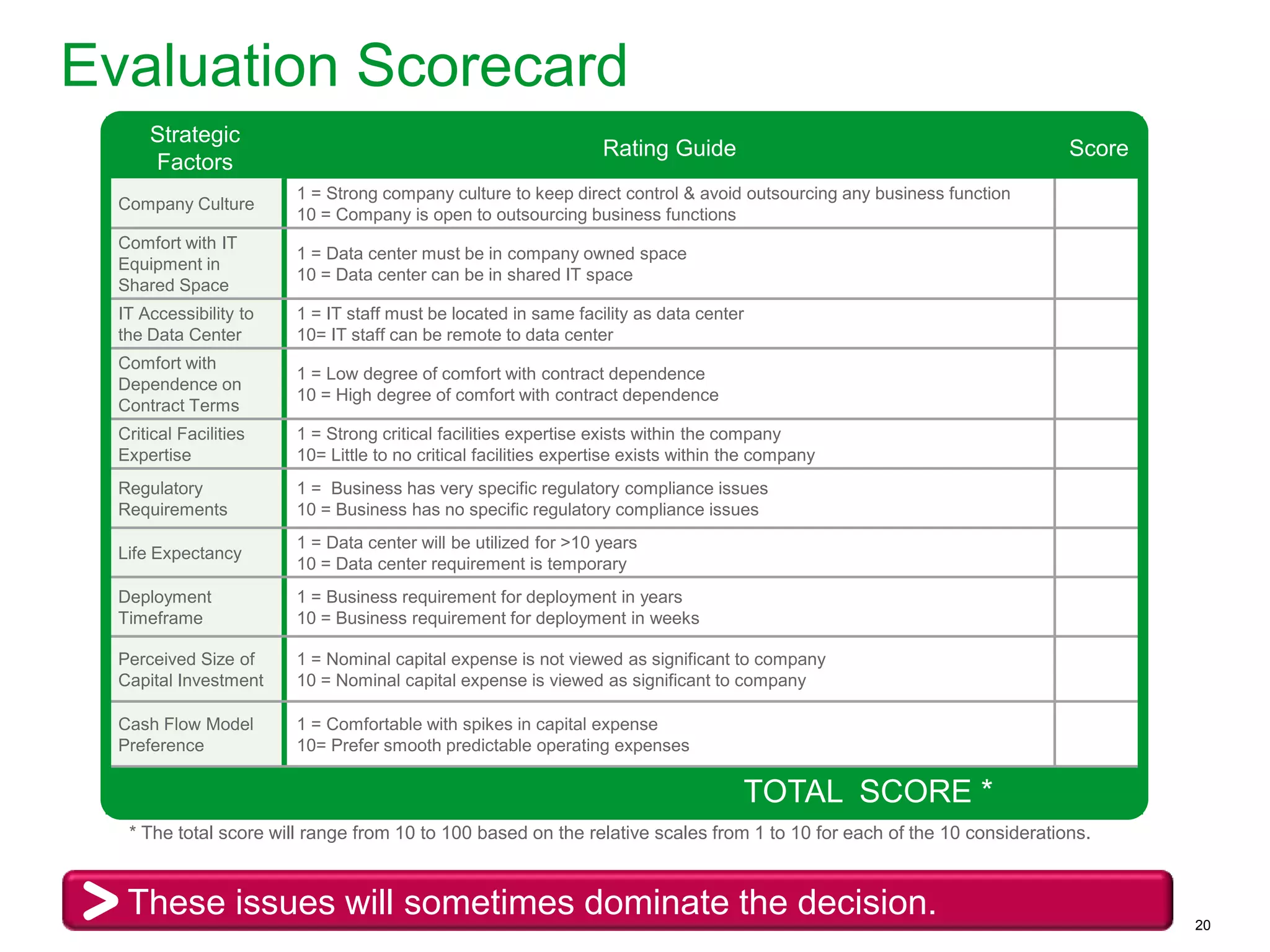
Schneider Electric 20
Strategic
Factors
Rating Guide Score
Company Culture
1 = Strong company culture to keep direct control & avoid outsourcing any business function
10 = Company is open to outsourcing business functions
Comfort with IT
Equipment in
Shared Space
1 = Data center must be in company owned space
10 = Data center can be in shared IT space
IT Accessibility to
the Data Center
1 = IT staff must be located in same facility as data center
10= IT staff can be remote to data center
Comfort with
Dependence on
Contract Terms
1 = Low degree of comfort with contract dependence
10 = High degree of comfort with contract dependence
Critical Facilities
Expertise
1 = Strong critical facilities expertise exists within the company
10= Little to no critical facilities expertise exists within the company
Regulatory
Requirements
1 = Business has very specific regulatory compliance issues
10 = Business has no specific regulatory compliance issues
Life Expectancy
1 = Data center will be utilized for >10 years
10 = Data center requirement is temporary
Deployment
Timeframe
1 = Business requirement for deployment in years
10 = Business requirement for deployment in weeks
Perceived Size of
Capital Investment
1 = Nominal capital expense is not viewed as significant to company
10 = Nominal capital expense is viewed as significant to company
Cash Flow Model
Preference
1 = Comfortable with spikes in capital expense
10= Prefer smooth predictable operating expenses
TOTAL SCORE *
* The total score will range from 10 to 100 based on the relative scales from 1 to 10 for each of the 10 considerations.
Evaluation Scorecard
These issues will sometimes dominate the decision.
Schneider Electric 21
Summary
Use model to evaluate financial options with a common language
● 10 year TCO is less for doing it yourself and is almost always
cheaper than co-location
● Break even time and capital preservation may be more important
than TCO
● Using the right financial metric is critical
Cultural issues sometimes can dominate the conversation – create
an objective way to discuss these
● Scorecard or weighted scorecard
● Are there Filtering Criteria?
Use tools to help facilitate the conversation and allow for rapid
evaluation of options
*
*
*
Schneider Electric 22
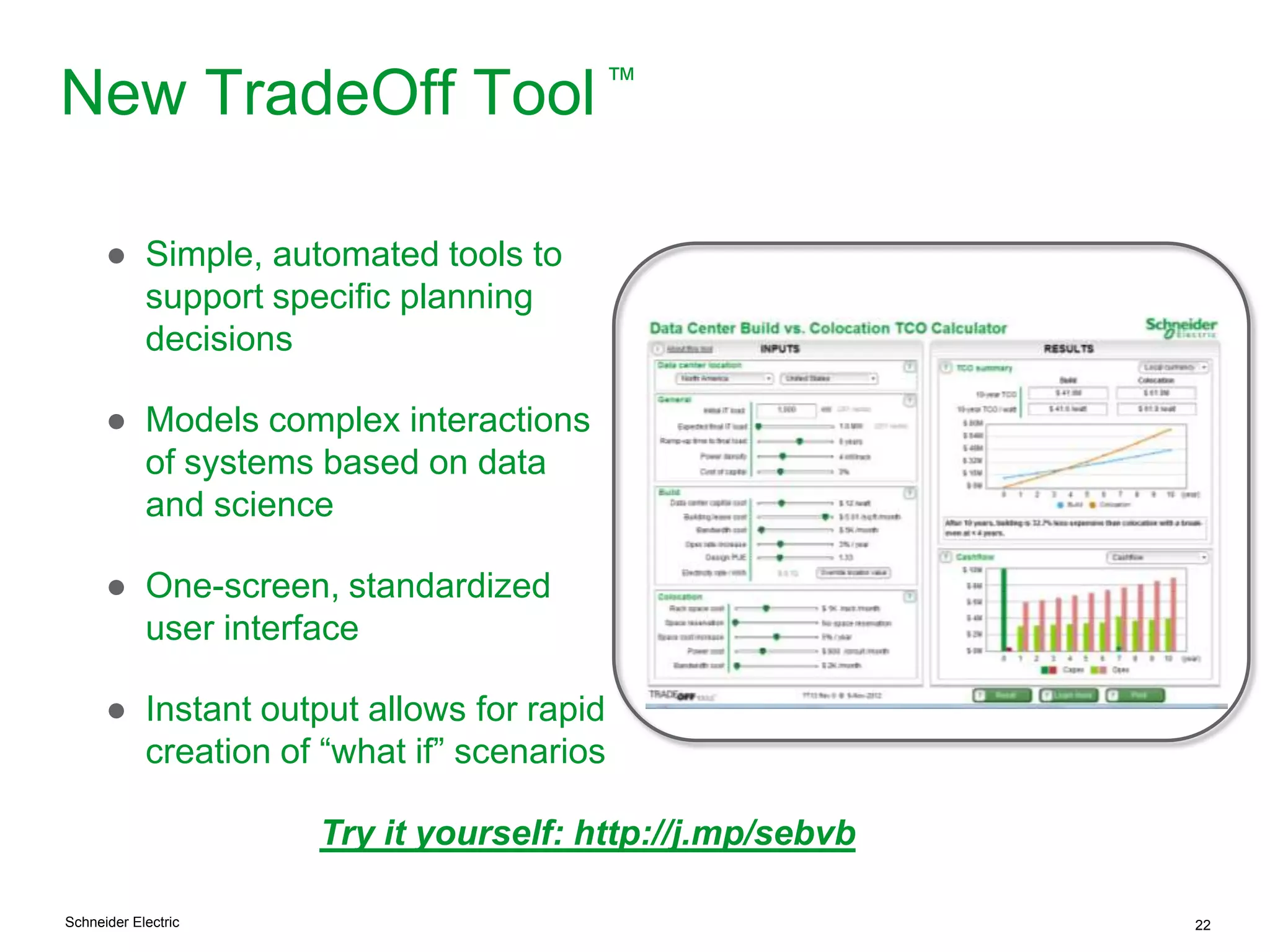
New TradeOff Tool™
● Simple, automated tools to
support specific planning
decisions
● Models complex interactions
of systems based on data
and science
● One-screen, standardized
user interface
● Instant output allows for rapid
creation of “what if” scenarios
Try it yourself: http://j.mp/sebvb
Schneider Electric 23
Questions?
Links for:
Considerations for Owning versus Outsourcing Data Center Physical Infrastructure
http://www.apc.com/whitepaper/?wp=171
Data Center Build vs. Colocation TCO Calculator
http://www.apc.com/tool/?tt=13 -or- http://j.mp/sebvb

Retrofit, build, or go cloud/colo? Choosing your best direction

  • 1.
    Jason Schafer, ATS Director,Technology & Operations Management Retrofit, Build, or Go Colo/Cloud: Choosing Your Best Direction
  • 2.
    Schneider Electric 2 Objectives 1.Review the evaluation criteria that goes into determining whether to upgrade, build new, or outsource a data center. 2. Understand the financial metrics and scenarios that go into determining the direction of the data center. 3. Identify the 10 strategic, non-financial factors that go into the decision. 4. Overview of tools available to help in the decision making process.
  • 3.
    Schneider Electric 3 •Upgrade • Build • Outsource Business Requirements IT Requirements Evaluation of Data Center Capacity Options The Tail of the Dog?
  • 4.
    Schneider Electric 4 TheTail of the Dog?
  • 5.
    Schneider Electric 5 EvaluationCriteria Upgrade, Build or Co-locate Cost Cash Flow Strategic Factors Process to evaluate these attributes is not always clear.
  • 6.
    Schneider Electric 6 Challengefor Customers ● Create a financial model to evaluate options ● Create a common financial metric to easily compare options ● Create a structured approach to evaluate strategic factors
  • 7.
    Schneider Electric 7 FinancialMetrics ● Normalize costs to 10 year TCO per watt ● Utilize cumulative cash outlay to determine a break even point ● Provide insight into opex versus capex
  • 8.
    Schneider Electric 8 UsingModeling to Evaluate Options Benefits Drawbacks • Provides possibility of easy to use tools • Provides structure to decision making • Provides quick iterations to assist in planning • Not every situation matches model • Results as good as the data and assumptions
  • 9.
    Schneider Electric 9 10Year TCO for Co-location We picked assumptions we view to be typical. Baseline • Determined to be $62 per watt • Rate increase assumed to be 5% per year • “Remote Hands” fee of $225 per hour, each rack takes 1 hour per month • 4kW per rack • 3% discount rate for TCO calculations Key Assumptions • Rack - $1,000 month/rack • Colo provides the rack at no additional cost to customer • Power - $800 month/rack • Bandwidth - $2,000 month
  • 10.
    Schneider Electric 10 UpgradeOptions – 3 Basic Strategies Approach Description Assumptions Example Increase utilization of installed equipment Stranded capacity may exist that can be re- claimed Data center has sufficient power & cooling capacity, but cooling system is de- rated due to poor airflow management practices Blanking panels, brush strips, aisle containment Add capacity with new high density zones One or more rows of racks can be added to a larger, low-density data center to increase capacity Data center has sufficient switchgear & heat rejection capacity, and has available IT space High density zone(s) Add capacity with facility modules For larger capacity upgrades with available IT space, facility modules increase bulk capacity Data center is out of switchgear & heat rejection capacity, has no space in mechanical/electrical rooms, but has available IT space Power and/or cooling facility module(s) White Paper 153 Implementing Hot and Cold Air Containment in Existing Data Centers White Paper 134 Deploying High-Density Pods in a Low-Density Data Center White Paper 163 Containerized Power and Cooling Modules for Data Centers
  • 11.
    Schneider Electric 11 UpgradeOptions – 3 Basic Strategies Approach Description Assumptions Example Increase utilization of installed equipment Stranded capacity may exist that can be re- claimed Data center has sufficient power & cooling capacity, but cooling system is de- rated due to poor airflow management practices Blanking panels, brush strips, aisle containment Add capacity with new high density zones One or more rows of racks can be added to a larger, low-density data center to increase capacity Data center has sufficient switchgear & heat rejection capacity, and has available IT space High density zone(s) Add capacity with facility modules For larger capacity upgrades with available IT space, facility modules increase bulk capacity Data center is out of switchgear & heat rejection capacity, has no space in mechanical/electrical rooms, but has available IT space Power and/or cooling facility module(s) Consider low- hanging fruit Consider going to higher density Consider adding facility capacity White Paper 153 Implementing Hot and Cold Air Containment in Existing Data Centers White Paper 134 Deploying High-Density Pods in a Low-Density Data Center White Paper 163 Containerized Power and Cooling Modules for Data Centers
  • 12.
    Schneider Electric 12 Scenario#1: Low-Hanging Fruit Model Break even in less than 1 year. ● Tier 3 1MW design load only utilized to 900 kW ● De-rating largely due to air mixing, etc. ● 10 year TCO - $17.00 per watt ● Blanking panels, brush strips, cold-aisle containment gain 100kW ● First cost of $2.10 per watt ● Co-lo 10 year TCO - $62.00 per watt
  • 13.
    Schneider Electric 13 Scenario#2: Implement Higher Density Break even in less than 2 years. ● Key Assumptions ● Add 40kW zone @ 4 kW per rack ● Pod includes 2N UPS, 2N Inrow cooling ● Discounted bandwidth cost due to existing bandwidth available ● PUE for data center of 1.35 ● 10 year TCO - $22.00 per watt ● First Cost to upgrade - $4.80 per watt ● Co-lo 10 year TCO - $62.00 per watt
  • 14.
    Schneider Electric 14 Scenario#3: Add to Facility Capacity Break even in about 2 years. ● Key Assumptions ● Add 500kW power and chilled water modules, 450kW of IT load ● Discounted bandwidth cost due to existing bandwidth available ● PUE of 1.35 ● 10 year TCO - $27.00 per watt ● First Cost to upgrade - $8.45 per watt ● Co-lo 10 year TCO - $62.00 per watt
  • 15.
    Schneider Electric 15 Scenario#4: Build New Facility Break even in about 3 ½ years ● Key Assumptions ● 1 MW capacity, $12/watt* ● 4kW per rack ● Lease - $5/sq. ft./month ● One battery refresh in Year 7 ● PUE of 1.33 ● Opex increases 3% per year ● Bandwidth - $5,000/month ● 10 year TCO - $42.00 per watt ● Co-lo 10 year TCO - $62.00 per watt * Schneider Electric Capitalized Cost Trade-off Tool, Tier 3, St. Louis, Air Chillers
  • 16.
    Schneider Electric 16 Butis it really about the money? The 10 factors that may trump any financial discussion.
  • 17.
    Schneider Electric 17 „Soft‟Issues to Consider Company Culture ● Sometimes the server huggers win Comfort with IT Equipment in Shared Space ● Does one colo have better security than another? ● Will my neighbors negatively impact my equipment? IT Accessibility to the Data Center ● Can my guys get there if they need to be there? Comfort with Dependence on Contract Terms ● If I call with a problem will anyone answer?
  • 18.
    Schneider Electric 18 QuantitativeIssues to Consider Critical Facilities Expertise ● If you have no staff, the decision is easy ● Confidence in ability to operate a data center Regulatory Compliance ● HIPAA for example Life Expectancy ● Cloud computing wins for temporary use Deployment Timeframe ● If I need it next week, the decision is easy
  • 19.
    Schneider Electric 19 FinancialModel Preferences Perceived size of capital investment ● Is $200k a lot or a little? ● Depends on relative size – relatively little for a company like Schneider Electric but for a start up… Cash flow model preference 0 1 2 3 4 5 6 7 8 9 10 Opex Capex Year 0 1 2 3 4 5 6 7 8 9 10 Opex Capex Year BUILD CO-LOCATION Lower TCO but higher capital expense model Higher TCO but smoother Opex model
  • 20.
    Schneider Electric 20 Strategic Factors RatingGuide Score Company Culture 1 = Strong company culture to keep direct control & avoid outsourcing any business function 10 = Company is open to outsourcing business functions Comfort with IT Equipment in Shared Space 1 = Data center must be in company owned space 10 = Data center can be in shared IT space IT Accessibility to the Data Center 1 = IT staff must be located in same facility as data center 10= IT staff can be remote to data center Comfort with Dependence on Contract Terms 1 = Low degree of comfort with contract dependence 10 = High degree of comfort with contract dependence Critical Facilities Expertise 1 = Strong critical facilities expertise exists within the company 10= Little to no critical facilities expertise exists within the company Regulatory Requirements 1 = Business has very specific regulatory compliance issues 10 = Business has no specific regulatory compliance issues Life Expectancy 1 = Data center will be utilized for >10 years 10 = Data center requirement is temporary Deployment Timeframe 1 = Business requirement for deployment in years 10 = Business requirement for deployment in weeks Perceived Size of Capital Investment 1 = Nominal capital expense is not viewed as significant to company 10 = Nominal capital expense is viewed as significant to company Cash Flow Model Preference 1 = Comfortable with spikes in capital expense 10= Prefer smooth predictable operating expenses TOTAL SCORE * * The total score will range from 10 to 100 based on the relative scales from 1 to 10 for each of the 10 considerations. Evaluation Scorecard These issues will sometimes dominate the decision.
  • 21.
    Schneider Electric 21 Summary Usemodel to evaluate financial options with a common language ● 10 year TCO is less for doing it yourself and is almost always cheaper than co-location ● Break even time and capital preservation may be more important than TCO ● Using the right financial metric is critical Cultural issues sometimes can dominate the conversation – create an objective way to discuss these ● Scorecard or weighted scorecard ● Are there Filtering Criteria? Use tools to help facilitate the conversation and allow for rapid evaluation of options * * *
  • 22.
    Schneider Electric 22 NewTradeOff Tool™ ● Simple, automated tools to support specific planning decisions ● Models complex interactions of systems based on data and science ● One-screen, standardized user interface ● Instant output allows for rapid creation of “what if” scenarios Try it yourself: http://j.mp/sebvb
  • 23.
    Schneider Electric 23 Questions? Linksfor: Considerations for Owning versus Outsourcing Data Center Physical Infrastructure http://www.apc.com/whitepaper/?wp=171 Data Center Build vs. Colocation TCO Calculator http://www.apc.com/tool/?tt=13 -or- http://j.mp/sebvb