Web Services (NSWI145)
Lecture 07: RESTful Web Services

  Martin Nečaský, Ph.D.
  Faculty of Mathematics and Physics
  Charles University in Prague, Czech Republic
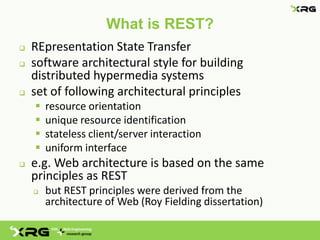
What is REST?
   REpresentation State Transfer
   software architectural style for building
    distributed hypermedia systems
   set of following architectural principles
       resource orientation
       unique resource identification
       stateless client/server interaction
       uniform interface
   e.g. Web architecture is based on the same
    principles as REST
       but REST principles were derived from the
        architecture of Web (Roy Fielding dissertation)
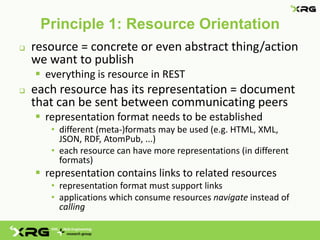
Principle 1: Resource Orientation
   resource = concrete or even abstract thing/action
    we want to publish
     everything is resource in REST
   each resource has its representation = document
    that can be sent between communicating peers
     representation format needs to be established
       • different (meta-)formats may be used (e.g. HTML, XML,
         JSON, RDF, AtomPub, ...)
       • each resource can have more representations (in different
         formats)
     representation contains links to related resources
       • representation format must support links
       • applications which consume resources navigate instead of
         calling
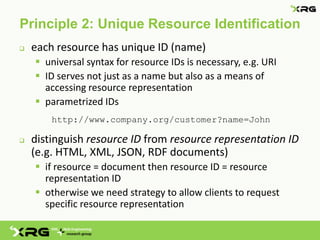
Principle 2: Unique Resource Identification
   each resource has unique ID (name)
     universal syntax for resource IDs is necessary, e.g. URI
     ID serves not just as a name but also as a means of
      accessing resource representation
     parametrized IDs
        http://www.company.org/customer?name=John

   distinguish resource ID from resource representation ID
    (e.g. HTML, XML, JSON, RDF documents)
     if resource = document then resource ID = resource
      representation ID
     otherwise we need strategy to allow clients to request
      specific resource representation
Principle 2: Unique Resource Identification
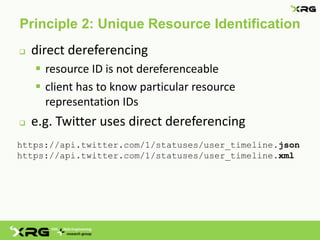
   direct dereferencing
     resource ID is not dereferenceable
     client has to know particular resource
      representation IDs
   e.g. Twitter uses direct dereferencing
https://api.twitter.com/1/statuses/user_timeline.json
https://api.twitter.com/1/statuses/user_timeline.xml
Principle 2: Unique Resource Identification
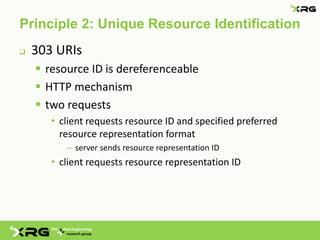
   303 URIs
     resource ID is dereferenceable
     HTTP mechanism
     two requests
       • client requests resource ID and specified preferred
         resource representation format
          – server sends resource representation ID
       • client requests resource representation ID
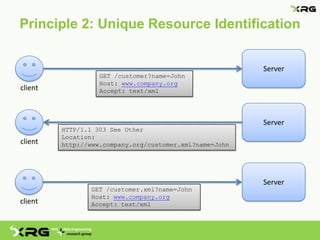
Principle 2: Unique Resource Identification


                                                         Server
                   GET /customer?name=John
                   Host: www.company.org
client             Accept: text/xml


                                                         Server
         HTTP/1.1 303 See Other
         Location:
client   http://www.company.org/customer.xml?name=John


                                                         Server
                 GET /customer.xml?name=John
                 Host: www.company.org
client           Accept: text/xml
Principle 2: Unique Resource Identification
   how to set-up 303 URIs?
   e.g. Apache HTTPD (.htaccess file)
RewriteCond %{HTTP_ACCEPT} application/rdf+xml
RewriteRule ^customer customer.rdf [R=303]


http://www.company.org/            http://www.company.org/
   customer?name=John               customer.xml?name=John
Principle 2: Unique Resource Identification
   avoid parametrized resource ID
     e.g.
             http://www.company.org/customer/John
     instead of
        http://www.company.org/customer?name=John


RewriteCond %{HTTP_ACCEPT} application/rdf+xml
RewriteRule ^customer/([a-zA-Z]+)$ customer.rdf?name=John
Principle 3: Stateless Client/Server
                 Communication
   request/response message exchange
   separation of concerns principle
     clients separated from servers by interface
     clients are not concerned with data storage and
      (most) application logic
     servers are not concerned with user interface or
      state (server simplicity and scalability)
     independent evolution of clients and server
     e.g. HTTP request/response, SOAP
      request/response message exchange pattern, etc.
Principle 3: Stateless Client/Server
                  Communication
   stateless communication
     no state in server-side applications
     move state to clients and/or resources
   resource state is the same for every client
     client changes to resource state affect all other
      clients
   client state is specific for each particular client
     communication state
Principle 4: Resource Manipulation
   uniform interface for resource manipulation
     small set of operations which apply for everything
       • e.g. CRUD operations (Create, Retrieve, Update, Delete)
     small set of verbs which apply to large set of
      nouns
       • if many applications need new verb, uniform interface
         can be extended
   do not encode verbs into resource identifiers
        http://www.company.org/addCustomer?name=John
Principle 4: Resource Manipulation
   when HTTP protocol is used, following four operations are
    usually considered
     GET = requests representation of the specified resource
        • read-only operation, should be safe = should not cause any side-
          effects
     PUT = uploads representation of the specified resource
        • write operation, should be idempotent
            – idempotent = may cause side effects but its multiple calls cause the same
              effect
            – being idempotent means being simple = identical request causes the same
              state change independently of how many times it has been called
     DELETE = deletes the specified resource
        • write operation, should be idempotent
     POST = submits data to be processed to the specified resource
        • it can update the resource
        • generally not safe and not idempotent
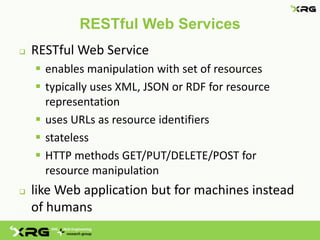
RESTful Web Services
   RESTful Web Service
     enables manipulation with set of resources
     typically uses XML, JSON or RDF for resource
      representation
     uses URLs as resource identifiers
     stateless
     HTTP methods GET/PUT/DELETE/POST for
      resource manipulation
   like Web application but for machines instead
    of humans
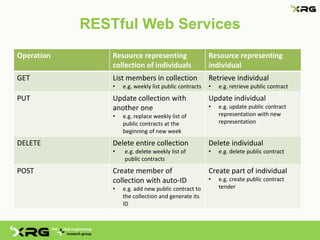
RESTful Web Services
Operation       Resource representing                   Resource representing
                collection of individuals               individual
GET             List members in collection              Retrieve individual
                •   e.g. weekly list public contracts   •   e.g. retrieve public contract
PUT             Update collection with                  Update individual
                another one                             •   e.g. update public contract
                •   e.g. replace weekly list of             representation with new
                    public contracts at the                 representation
                    beginning of new week
DELETE          Delete entire collection                Delete individual
                •   e.g. delete weekly list of          •   e.g. delete public contract
                    public contracts
POST            Create member of                        Create part of individual
                collection with auto-ID                 •   e.g. create public contract
                •   e.g. add new public contract to         tender
                    the collection and generate its
                    ID
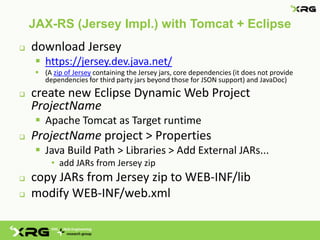
JAX-RS (Jersey Impl.) with Tomcat + Eclipse
   download Jersey
      https://jersey.dev.java.net/
      (A zip of Jersey containing the Jersey jars, core dependencies (it does not provide
       dependencies for third party jars beyond those for JSON support) and JavaDoc)
   create new Eclipse Dynamic Web Project
    ProjectName
      Apache Tomcat as Target runtime
   ProjectName project > Properties
      Java Build Path > Libraries > Add External JARs...
          • add JARs from Jersey zip
   copy JARs from Jersey zip to WEB-INF/lib
   modify WEB-INF/web.xml
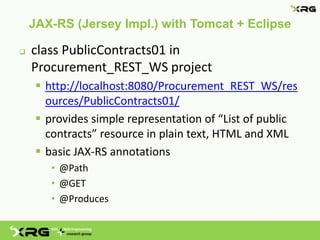
JAX-RS (Jersey Impl.) with Tomcat + Eclipse

   class PublicContracts01 in
    Procurement_REST_WS project
      http://localhost:8080/Procurement_REST_WS/res
       ources/PublicContracts01/
      provides simple representation of “List of public
       contracts” resource in plain text, HTML and XML
      basic JAX-RS annotations
        • @Path
        • @GET
        • @Produces
JAX-RS (Jersey Impl.) with Tomcat + Eclipse

   test with cURL (curl_PublicContracts01.bat)
      http://curl.haxx.se/download.html
JAX-RS (Jersey Impl.) with Tomcat + Eclipse
   class PublicContracts02 in Procurement_REST_WS project
      http://localhost:8080/Procurement_REST_WS/resources/Public
       Contracts02/
      getPublicContract method which returns XML or JSON
       representation of public contract to GET request
        • class PublicContract
        • JAXB annotation (provides XML and JSON binding)
            – @XmlRootElement
      listContracts method returns XML or JSON representation of all
       public contracts in collection to GET request
      listContractsHTML method returns HTML representation of all
       public contracts in collection to GET request
      JAX-RS annotations
        • @Path – path with path parameter
        • @PathParam – association of path parameter with method parameter
JAX-RS (Jersey Impl.) with Tomcat + Eclipse

   test
      http://localhost:8080/Procurement_REST_WS/res
       ources/PublicContracts02/
      http://localhost:8080/Procurement_REST_WS/res
       ources/PublicContracts02/4
JAX-RS (Jersey Impl.) with Tomcat + Eclipse
   class PublicContracts03 in
    Procurement_REST_WS project
      http://localhost:8080/Procurement_REST_WS/res
       ources/PublicContracts03/
      putPublicContract updates existing or creates new
       public contract
      deletePublicContract deletes existing public
       contract
      JAX-RS annotations
        • @PUT
        • @DELETE
JAX-RS (Jersey Impl.) with Tomcat + Eclipse

   test with cURL (curl_PublicContracts03.bat)
JAX-RS (Jersey Impl.) with Tomcat + Eclipse

   class PublicContracts04 in
    Procurement_REST_WS project
      http://localhost:8080/Procurement_REST_WS/res
       ources/PublicContracts04/
      createPublicContract creates new contract on
       POST request
      JAX-RS annotations
       • @POST
JAX-RS (Jersey Impl.) with Tomcat + Eclipse

   test with form_PublicContracts04.html

RESTful Web Services

  • 1.
    Web Services (NSWI145) Lecture07: RESTful Web Services Martin Nečaský, Ph.D. Faculty of Mathematics and Physics Charles University in Prague, Czech Republic
  • 2.
    What is REST?  REpresentation State Transfer  software architectural style for building distributed hypermedia systems  set of following architectural principles  resource orientation  unique resource identification  stateless client/server interaction  uniform interface  e.g. Web architecture is based on the same principles as REST  but REST principles were derived from the architecture of Web (Roy Fielding dissertation)
  • 3.
    Principle 1: ResourceOrientation  resource = concrete or even abstract thing/action we want to publish  everything is resource in REST  each resource has its representation = document that can be sent between communicating peers  representation format needs to be established • different (meta-)formats may be used (e.g. HTML, XML, JSON, RDF, AtomPub, ...) • each resource can have more representations (in different formats)  representation contains links to related resources • representation format must support links • applications which consume resources navigate instead of calling
  • 4.
    Principle 2: UniqueResource Identification  each resource has unique ID (name)  universal syntax for resource IDs is necessary, e.g. URI  ID serves not just as a name but also as a means of accessing resource representation  parametrized IDs http://www.company.org/customer?name=John  distinguish resource ID from resource representation ID (e.g. HTML, XML, JSON, RDF documents)  if resource = document then resource ID = resource representation ID  otherwise we need strategy to allow clients to request specific resource representation
  • 5.
    Principle 2: UniqueResource Identification  direct dereferencing  resource ID is not dereferenceable  client has to know particular resource representation IDs  e.g. Twitter uses direct dereferencing https://api.twitter.com/1/statuses/user_timeline.json https://api.twitter.com/1/statuses/user_timeline.xml
  • 6.
    Principle 2: UniqueResource Identification  303 URIs  resource ID is dereferenceable  HTTP mechanism  two requests • client requests resource ID and specified preferred resource representation format – server sends resource representation ID • client requests resource representation ID
  • 7.
    Principle 2: UniqueResource Identification Server GET /customer?name=John Host: www.company.org client Accept: text/xml Server HTTP/1.1 303 See Other Location: client http://www.company.org/customer.xml?name=John Server GET /customer.xml?name=John Host: www.company.org client Accept: text/xml
  • 8.
    Principle 2: UniqueResource Identification  how to set-up 303 URIs?  e.g. Apache HTTPD (.htaccess file) RewriteCond %{HTTP_ACCEPT} application/rdf+xml RewriteRule ^customer customer.rdf [R=303] http://www.company.org/ http://www.company.org/ customer?name=John customer.xml?name=John
  • 9.
    Principle 2: UniqueResource Identification  avoid parametrized resource ID  e.g. http://www.company.org/customer/John  instead of http://www.company.org/customer?name=John RewriteCond %{HTTP_ACCEPT} application/rdf+xml RewriteRule ^customer/([a-zA-Z]+)$ customer.rdf?name=John
  • 10.
    Principle 3: StatelessClient/Server Communication  request/response message exchange  separation of concerns principle  clients separated from servers by interface  clients are not concerned with data storage and (most) application logic  servers are not concerned with user interface or state (server simplicity and scalability)  independent evolution of clients and server  e.g. HTTP request/response, SOAP request/response message exchange pattern, etc.
  • 11.
    Principle 3: StatelessClient/Server Communication  stateless communication  no state in server-side applications  move state to clients and/or resources  resource state is the same for every client  client changes to resource state affect all other clients  client state is specific for each particular client  communication state
  • 12.
    Principle 4: ResourceManipulation  uniform interface for resource manipulation  small set of operations which apply for everything • e.g. CRUD operations (Create, Retrieve, Update, Delete)  small set of verbs which apply to large set of nouns • if many applications need new verb, uniform interface can be extended  do not encode verbs into resource identifiers http://www.company.org/addCustomer?name=John
  • 13.
    Principle 4: ResourceManipulation  when HTTP protocol is used, following four operations are usually considered  GET = requests representation of the specified resource • read-only operation, should be safe = should not cause any side- effects  PUT = uploads representation of the specified resource • write operation, should be idempotent – idempotent = may cause side effects but its multiple calls cause the same effect – being idempotent means being simple = identical request causes the same state change independently of how many times it has been called  DELETE = deletes the specified resource • write operation, should be idempotent  POST = submits data to be processed to the specified resource • it can update the resource • generally not safe and not idempotent
  • 14.
    RESTful Web Services  RESTful Web Service  enables manipulation with set of resources  typically uses XML, JSON or RDF for resource representation  uses URLs as resource identifiers  stateless  HTTP methods GET/PUT/DELETE/POST for resource manipulation  like Web application but for machines instead of humans
  • 15.
    RESTful Web Services Operation Resource representing Resource representing collection of individuals individual GET List members in collection Retrieve individual • e.g. weekly list public contracts • e.g. retrieve public contract PUT Update collection with Update individual another one • e.g. update public contract • e.g. replace weekly list of representation with new public contracts at the representation beginning of new week DELETE Delete entire collection Delete individual • e.g. delete weekly list of • e.g. delete public contract public contracts POST Create member of Create part of individual collection with auto-ID • e.g. create public contract • e.g. add new public contract to tender the collection and generate its ID
  • 16.
    JAX-RS (Jersey Impl.)with Tomcat + Eclipse  download Jersey  https://jersey.dev.java.net/  (A zip of Jersey containing the Jersey jars, core dependencies (it does not provide dependencies for third party jars beyond those for JSON support) and JavaDoc)  create new Eclipse Dynamic Web Project ProjectName  Apache Tomcat as Target runtime  ProjectName project > Properties  Java Build Path > Libraries > Add External JARs... • add JARs from Jersey zip  copy JARs from Jersey zip to WEB-INF/lib  modify WEB-INF/web.xml
  • 17.
    JAX-RS (Jersey Impl.)with Tomcat + Eclipse  class PublicContracts01 in Procurement_REST_WS project  http://localhost:8080/Procurement_REST_WS/res ources/PublicContracts01/  provides simple representation of “List of public contracts” resource in plain text, HTML and XML  basic JAX-RS annotations • @Path • @GET • @Produces
  • 18.
    JAX-RS (Jersey Impl.)with Tomcat + Eclipse  test with cURL (curl_PublicContracts01.bat)  http://curl.haxx.se/download.html
  • 19.
    JAX-RS (Jersey Impl.)with Tomcat + Eclipse  class PublicContracts02 in Procurement_REST_WS project  http://localhost:8080/Procurement_REST_WS/resources/Public Contracts02/  getPublicContract method which returns XML or JSON representation of public contract to GET request • class PublicContract • JAXB annotation (provides XML and JSON binding) – @XmlRootElement  listContracts method returns XML or JSON representation of all public contracts in collection to GET request  listContractsHTML method returns HTML representation of all public contracts in collection to GET request  JAX-RS annotations • @Path – path with path parameter • @PathParam – association of path parameter with method parameter
  • 20.
    JAX-RS (Jersey Impl.)with Tomcat + Eclipse  test  http://localhost:8080/Procurement_REST_WS/res ources/PublicContracts02/  http://localhost:8080/Procurement_REST_WS/res ources/PublicContracts02/4
  • 21.
    JAX-RS (Jersey Impl.)with Tomcat + Eclipse  class PublicContracts03 in Procurement_REST_WS project  http://localhost:8080/Procurement_REST_WS/res ources/PublicContracts03/  putPublicContract updates existing or creates new public contract  deletePublicContract deletes existing public contract  JAX-RS annotations • @PUT • @DELETE
  • 22.
    JAX-RS (Jersey Impl.)with Tomcat + Eclipse  test with cURL (curl_PublicContracts03.bat)
  • 23.
    JAX-RS (Jersey Impl.)with Tomcat + Eclipse  class PublicContracts04 in Procurement_REST_WS project  http://localhost:8080/Procurement_REST_WS/res ources/PublicContracts04/  createPublicContract creates new contract on POST request  JAX-RS annotations • @POST
  • 24.
    JAX-RS (Jersey Impl.)with Tomcat + Eclipse  test with form_PublicContracts04.html