Literature Review on
“A Responsive Distributed
Routing Algorithm for
Computer Networks”
JEFFREY M. JAFFE AND FRANKLIN H. MOSS
• Nafiz Ishtiaque Ahmed
•Rafi Al Razi
•Mohammed Rokon Uddin
•
Introduction
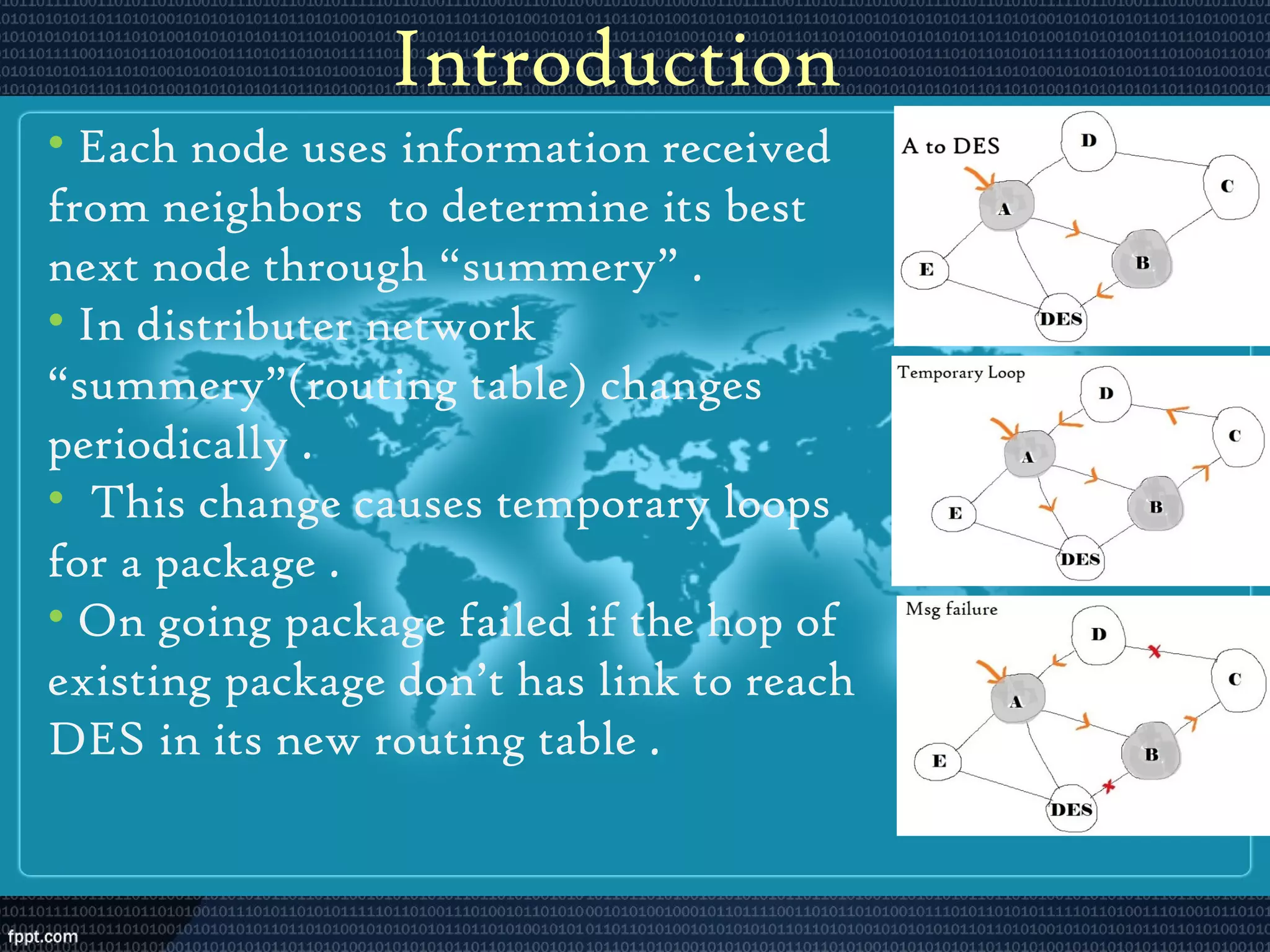
• Each node uses information received
from neighbors to determine its best
next node through “summery” .
• In distributer network
“summery”(routing table) changes
periodically .
• This change causes temporary loops
for a package .
• On going package failed if the hop of
existing package don’t has link to reach
DES in its new routing table .
Motivation
Analysis a new dynamic distributed
algorithm for
• Temporary Loops free routing .
• Take Less Recovery Time(h)
than previous algorithm (h^2)
when Network Links fails .
Research Proposal
• Maintains “summary” information rather
than global topology by IUP .
• A hop count field is included in the
messages and tables for IUP to reasonably
fast detection of loops .
• Uptree nodes can update link cost but can’t
change on going package route that means
Uptree nodes are “Frozen” till it receives
DES ack for “Unfrozen” .
Research Proposal
• Multiple freeze ack are processed in FIFO
order .
• If a uptree node frozen then new link cost
have to wait to entry to the table till it
receives unfrozen ACK .
• That means it takes O(x)time in worst case
for unfrozen all nodes and O(h)time for sub-
tree nodes to recovery .
Finding
• Take more steps to recovery and still
O(x) and O(h) is a hues time for a hues
network .
• Each Hop has to remember hues
“summery table” and run through
algorithm so it need memory and it
takes more time to delivery .
• Multiple frozen route in a hop can case
noisy jam in a router thus no package can
pass through the hop .
Solution
• Global routing topology may use to
solve this problem .
• Package may used to memorize path in
Global routing rather being “frozen” a
hop .
Conclusion
• This algorithm was developed for loop-
free paths in the circumstance of
changing link weights and minimize
recovery time .
• Modern Dynamic distributed algorithm
was rooted on this algorithm .
Responsive Distributed Routing Algorithm

Responsive Distributed Routing Algorithm

  • 1.
    Literature Review on “AResponsive Distributed Routing Algorithm for Computer Networks” JEFFREY M. JAFFE AND FRANKLIN H. MOSS • Nafiz Ishtiaque Ahmed •Rafi Al Razi •Mohammed Rokon Uddin •
  • 2.
    Introduction • Each nodeuses information received from neighbors to determine its best next node through “summery” . • In distributer network “summery”(routing table) changes periodically . • This change causes temporary loops for a package . • On going package failed if the hop of existing package don’t has link to reach DES in its new routing table .
  • 3.
    Motivation Analysis a newdynamic distributed algorithm for • Temporary Loops free routing . • Take Less Recovery Time(h) than previous algorithm (h^2) when Network Links fails .
  • 4.
    Research Proposal • Maintains“summary” information rather than global topology by IUP . • A hop count field is included in the messages and tables for IUP to reasonably fast detection of loops . • Uptree nodes can update link cost but can’t change on going package route that means Uptree nodes are “Frozen” till it receives DES ack for “Unfrozen” .
  • 5.
    Research Proposal • Multiplefreeze ack are processed in FIFO order . • If a uptree node frozen then new link cost have to wait to entry to the table till it receives unfrozen ACK . • That means it takes O(x)time in worst case for unfrozen all nodes and O(h)time for sub- tree nodes to recovery .
  • 6.
    Finding • Take moresteps to recovery and still O(x) and O(h) is a hues time for a hues network . • Each Hop has to remember hues “summery table” and run through algorithm so it need memory and it takes more time to delivery . • Multiple frozen route in a hop can case noisy jam in a router thus no package can pass through the hop .
  • 7.
    Solution • Global routingtopology may use to solve this problem . • Package may used to memorize path in Global routing rather being “frozen” a hop .
  • 8.
    Conclusion • This algorithmwas developed for loop- free paths in the circumstance of changing link weights and minimize recovery time . • Modern Dynamic distributed algorithm was rooted on this algorithm .

Editor's Notes

  • #3 1. each node periodically sends “summary” information to its neighbors regarding its current best cost to one or more destinations. Each node uses information received from neighbors to determine its best next nodes.One basic attribute of these algorithms is that there is no notion of exercising control over the ordering in which the nodes perform their updates.