IJRET: International Journal of Research in Engineering and Technology eISSN: 2319-1163 | pISSN: 2321-7308
__________________________________________________________________________________________
Volume: 02 Issue: 10 | Oct-2013, Available @ http://www.ijret.org 78
RESOURCE POTENTIAL APPRAISAL / ASSESSMENT AND TO
DELINEATE GROUNDWATER POTENTIAL ZONES IN PARTS OF
ANAIMALAI, POLLACHI AND UDUMALPETBLOCK USING REMOTE
SENSING AND GIS
M.Pandian1
, M.Julie2
, Y. Allwyn Fernandes3
, SK Mahammad Sartaj Basha4
1
M.Tech, Student, 4
Res.Associate, Centre for Remote Sensing, Bharathidasan University, Khajamalai Campus, Trichy-23
2
ME, Student, Institute of Remote Sensing, College of Engineering, Anna University, Guindy, Chennai-25
3
M.Tech, Student, Remote Sensing, Dept. of Civil Engg, PSNA College of Engg, & Tech, Dindigul -22
mahapandian@hotmail.com
Abstract
Remote sensing has its application in various fields like geology and mineral exploration, geomorphology and modern geomorphic
process modeling, nature mitigation studies, hazard zone mapping, eco system study in hills, plains, riverine, coastal, marine and
volcanic landforms, forest and biomass inventory, fishery. Remote sensing plays a vital in various fields. This technique along with the
GIS has been to study the geomorphological, hydro geological, land use/land cover, lithological, structural aspects/ features in the
parts of Anaimalai, Pollachi and Udumalpet block of TamilNadu. Integrated approach using geographic information system provides
cost effective support in resources inventory including land use mapping, comprehensive data base for resources, analytical tools for
decision making and impact analysis for plan evaluation. GIS accept large volumes of spatial data derived from a variety of sources
and effectively store, retrieve, manipulate, analyze and display all forms of geographically referenced information. Maps and
statistical data can be obtained from the spatial integration and analysis of an area using GIS software. In order to assess the natural
resource availability and its potentiality in parts of Anaimalai, Pollachi and Udumalpet block, Tamil Nadu, an integrated remote
sensing and GIS based study has been conducted by adopting the standard procedures. The groundwater potential zone of any area is
depends on geological formations; geomorphologic unit’s recharges characters, topography, and thickness of weathered and
fractured zones. In the present study, area was taken to locate groundwater potential zones by integrated different thematic maps,
remote sensing and geographic information system techniques. To find out the ground water potential zones, different thematic maps
have been prepared and integrated each of them. They are mainly geology, geomorphology, land use / land cover, lineament etc.
Groundwater potential zones have been prepared with help of integrating different thematic maps. This study area is finally to get the
groundwater potential zones we have to classified few area such as high, moderate and low potential zones.
Index Terms: Remote sensing, GIS, lithology, Geomorphology, Hydrology, landforms etc.
---------------------------------------------------------------------***----------------------------------------------------------------------
1. INTRODUCTION
Remote sensing techniques are efficient, accurate and cost
effective. Remote sensing data along with ground truth
information and other collateral data have been extensively used
to survey various natural resources. Remote sensing techniques
along with GIS technology also processes the unique
capabilities to model, animate and retrieves various spatial and
non-spatial information’s including the modern dynamic
processes. To achieve the utilizes of remote sensing and GIS
techniques on up graduation of terrain information. The
enormous infrastructure of what are collectively known as
utilizes, i.e., water, gas, telephone lines, sewage system all need
to be recorded and manipulated in map form. GIS can play a
vital role in managing these utilizes.
2. AIM AND OBJECTIVES
The main aim and objective of the present investigations are, to
prepare the thematic maps such as, geology, Landuse and
Landcover, geomorphology, lineament, drainage and soil of the
study area. To demarcate the suitable zones for drilling bore
wells and dug wells. To prove the usage of the remote sensing
and geographic information system techniques to delineate the
potential zones of groundwater
IJRET: International Journal of Research in Engineering and Technology eISSN: 2319-1163 | pISSN: 2321-7308
__________________________________________________________________________________________
Volume: 02 Issue: 10 | Oct-2013, Available @ http://www.ijret.org 79
3. STUDY AREA
The area chosen for the present study lie between the latitude
100 20” 00’ and 100 40’ 00’ N and longitude 760 50” 00’ and
770 10” 00’ E in the survey of India Toposheet no 58 B/14,
58B/15, 58 F/2, and 58F/3and the total study area is 813.86
Sq.km. In general study area is a plain terrain with slight
undulation and with structuralhill. The ground surfaces on the
Southern side of Aliyar River generally slope towards North
East and ground surface on the Northern side of Noyyal River.
Figure.1 Location of the Study area
4. MATERIALS AND METHODOLOGY
In the present study geocoded the IRS – P6 LISS III satellite
imagery data in the scale on 1:50,000. Both satellite data and
topographic sheet were used for the generation of various
thematic maps. The following maps (base map, drainage) were
prepared by making use of survey of India Toposheet. The
methodology includes the generation of thematic layers on
lithology, structure (lineament, trend line), geomorphology
(landforms), Landuse/Landcover, hydrology (water bodies,
streams, etc.,) based on their image characteristics
(interpretation key and elements like tone, texture, pattern
shape, size, and drainage characteristics). A lineament map was
generated using the satellite data. This can be used to see the
possible relationship between lineament distribution and their
control on the ground water. Geographic information system
(Arc GIS software 9.3.1 and surfer 10) was used for the
mapping of individual layers and final integration of map. Based
on the character, the features in different thematiclayers were
assigned with different weightages values according to the
potential for groundwater.After the layerswere integrated using
GIS and then the area can be classified as high, moderate and
low groundwater potentialzones.
Figure.2 Flowchart showing methodology
5. DRAINAGE AND DRAINAGE DENSITY
Drainage map has been prepared in the scale of 1:50,000 from
the topographic sheet no 58 B/14, 58 B/15, 58 F/2, and 58 F/3.
And from this map it is inferred that a major river Aliyar river is
flowing from west to east of the study area. Except these other
small drainages are flowing in the study area from south west to
north east to the south of Aliyar River. The drainage density
map is total length of the drainage in a grid of unit area.
Drainage map is prepared.
Figure.3 drainage density map
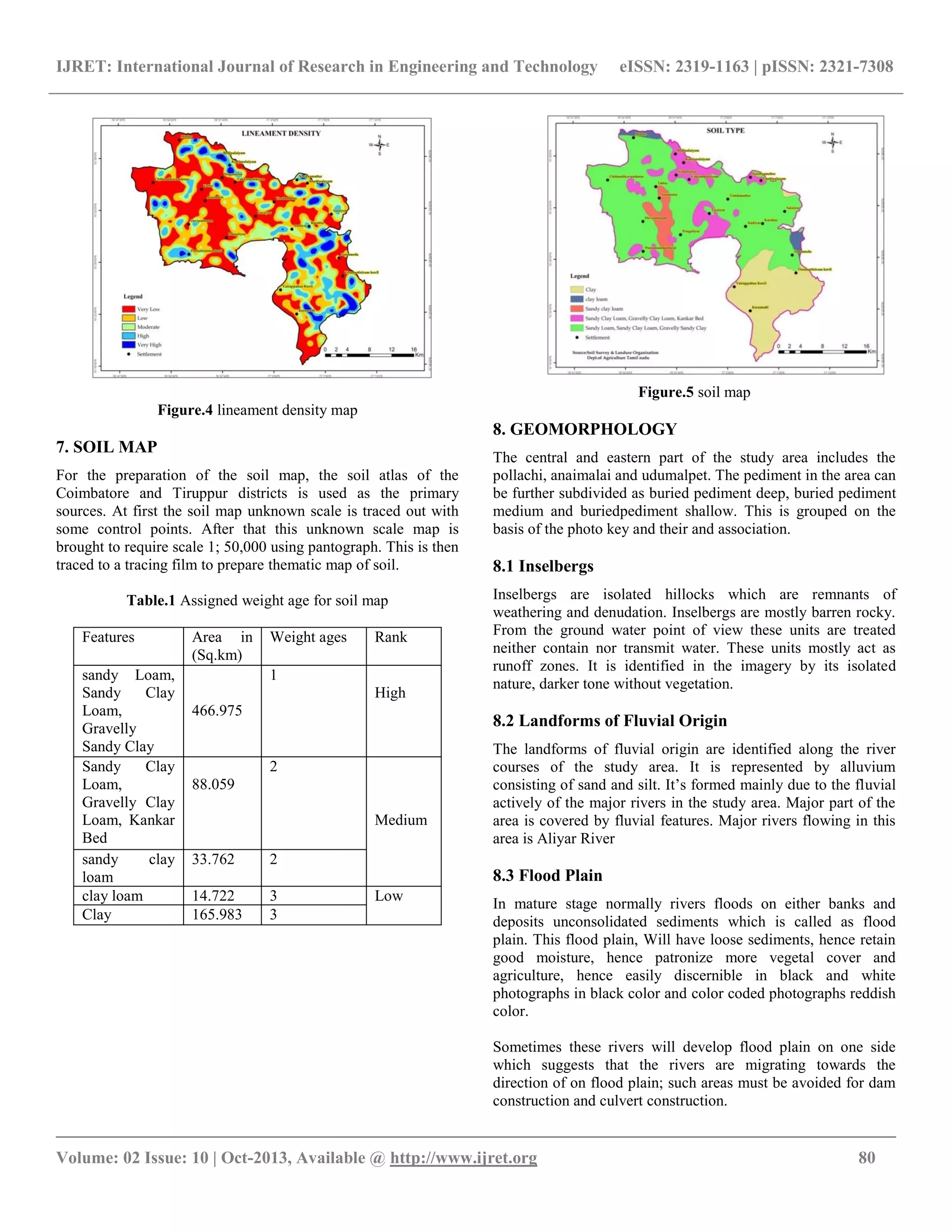
6. LINEAMENT AND LINEAMENT DENSITY
Lineaments is defined as map able simple or composite feature
of a surface, whose parts are aligned in a straight or slightly
curving relationship and which differs distinctly from the
patterns of adjacent features an presently reflect a subsurface
phenomenon. The surface feature making up a lineament may
be geomorphic or tonal. The intersection, frequency of
lineaments and their densities can also be plotted and density
contour drawn.
IJRET: International Journal of Research in Engineering and Technology eISSN: 2319-1163 | pISSN: 2321-7308
__________________________________________________________________________________________
Volume: 02 Issue: 10 | Oct-2013, Available @ http://www.ijret.org 80
Figure.4 lineament density map
7. SOIL MAP
For the preparation of the soil map, the soil atlas of the
Coimbatore and Tiruppur districts is used as the primary
sources. At first the soil map unknown scale is traced out with
some control points. After that this unknown scale map is
brought to require scale 1; 50,000 using pantograph. This is then
traced to a tracing film to prepare thematic map of soil.
Table.1 Assigned weight age for soil map
Features Area in
(Sq.km)
Weight ages Rank
sandy Loam,
Sandy Clay
Loam,
Gravelly
Sandy Clay
466.975
1
High
Sandy Clay
Loam,
Gravelly Clay
Loam, Kankar
Bed
88.059
2
Medium
sandy clay
loam
33.762 2
clay loam 14.722 3 Low
Clay 165.983 3
Figure.5 soil map
8. GEOMORPHOLOGY
The central and eastern part of the study area includes the
pollachi, anaimalai and udumalpet. The pediment in the area can
be further subdivided as buried pediment deep, buried pediment
medium and buriedpediment shallow. This is grouped on the
basis of the photo key and their and association.
8.1 Inselbergs
Inselbergs are isolated hillocks which are remnants of
weathering and denudation. Inselbergs are mostly barren rocky.
From the ground water point of view these units are treated
neither contain nor transmit water. These units mostly act as
runoff zones. It is identified in the imagery by its isolated
nature, darker tone without vegetation.
8.2 Landforms of Fluvial Origin
The landforms of fluvial origin are identified along the river
courses of the study area. It is represented by alluvium
consisting of sand and silt. It’s formed mainly due to the fluvial
actively of the major rivers in the study area. Major part of the
area is covered by fluvial features. Major rivers flowing in this
area is Aliyar River
8.3 Flood Plain
In mature stage normally rivers floods on either banks and
deposits unconsolidated sediments which is called as flood
plain. This flood plain, Will have loose sediments, hence retain
good moisture, hence patronize more vegetal cover and
agriculture, hence easily discernible in black and white
photographs in black color and color coded photographs reddish
color.
Sometimes these rivers will develop flood plain on one side
which suggests that the rivers are migrating towards the
direction of on flood plain; such areas must be avoided for dam
construction and culvert construction.
IJRET: International Journal of Research in Engineering and Technology eISSN: 2319-1163 | pISSN: 2321-7308
__________________________________________________________________________________________
Volume: 02 Issue: 10 | Oct-2013, Available @ http://www.ijret.org 81
8.4 Pediment
These are gently sloping bed rock surface terminating against
the mountain front, usually by a sharp in slope. Pediments are
identified as gently undulating rock floored surface without
weathered mantle, but often partly mantled with thin veneer of
soil obtained from the upland masses bordering the hills. These
are for by combination of processes, such as back weathering,
sheet wash and lateral erosion. These zones are generally low
permeable with poor infiltration and are considered to be the
runoff zones. In the satellite IRS 1C imagery pediment is
identified by their gray to yellow tone, medium texture, highly
irregular pattern and close association with the foot hills
indicates the pediments where the slope is low to moderate,
gently the left out rocky materials preen over here.
Table.2 assigned weightage for Geomorphology map
Figure.6 geomorphology map
9. LAND USE AND LAND COVER
Information on the rate of changes in land resources is essential
for proper planning, management and regulating the use of such
resources. Under a given climate condition the growth and yield
of the crop is determinate by available nutrients and water
supplies, which are taken up from the soil and hence it should be
carefully managed. Good cultivable soils are not only limited
but also unevenly distributed. Often the improper land use is
causing various forms of environmental degradations for
sustainable utilization of the land ecosystem, it essential to
know the nature, characteristics, extent, and location of soil
resources, its quality, productivity, sustainability and limitations
for various land uses.The IMSD guide lines NRSA have been
followed and prepared the land use / land cover classifications.
Land use refers to mean’s activities and various use which are
carried up land. Landcover refer to natural vegetation, water
bodies’ rock / soil, artificial cover and other resulting due to
land transformations. The study classified into several of Land
use / Landcover classes by visual interpretation. Classes such as
built up land, crop land, fallow land, barren rocky, landwith
scrup, plantation, wet logged area and water bodies
Table.3 assigned weightage for Landuse / Landcover map
Figures.7 land use / land cover map
Features Area in
(Sq.km)
Weightages Rank
Flood plain 119.857 1
HighBuried
pediment 466.866
1
water body 2.730 1
Shallow
pediment
10.899 2 Medium
Inselberg 4.180 3
Low
Valley fill 11.924 3
Ridges 7.9030 3
Structural
hill
146.052 3
Features Area in
(sq.km)
Weightages Rank
Crop land 339.55 1
High
Waterbodies 5.98 1
Plantation 117.347 1
Wet logged 5.115 1
Landwith scrub 0.060 1
Builtup land 0.909 2 Medium
Barren Rocky 63.379 3
LowFallow land 237.150 3
IJRET: International Journal of Research in Engineering and Technology eISSN: 2319-1163 | pISSN: 2321-7308
__________________________________________________________________________________________
Volume: 02 Issue: 10 | Oct-2013, Available @ http://www.ijret.org 82
10. GEOLOGY
Geologically the study area is predominantly comprised of the
peninsular gneiss of Archean age and intrusive body of
quartzite’s veins. There are three major types are observed in the
study area, such as granite gneiss, hornblende Biotite gneiss and
a linear pockets of quartzite intrusions.
The geology of the investigated area has been delineated in the
satellite imageries. Visual interpretation techniques carried out
based on the photo recognition elements like tone, texture, and
color, bordered information of the object, drainage pattern, and
differential erosional characteristics and associated of the
structural features of the exposed litho-stratigraphic units. The
lithological map of the area prepared, and supported by
collateral data and fields verifications. The lithology of the
study area has been delineated light to dark tonal variations,
medium to coarse texture in slightly undulating terrain. Brown
to reddish brown tone with medium to very coarse texture
observed in undulating terrain uneven shapes indicates granitic
gneiss. This specifically shows alternate bands light dark color
distinctions.
Table.4 Assigned weightages for lithology map
Figure.7 lithology map
11. INTEGRATION OF THEMATIC MAPS
All the thematic maps were integrated with suitable ranks and
weightages factor using ARC/ INFO geographic information
system (GIS) software packages in order to delineate the ground
water potential zones.
The different thematic layers were integrated with one to each
through GIS using operations like union and functions. First the
all thematic layers have been arranged for union for one another
according to their relationship with weathering characteristics,
chemical compositions, and infiltration capacities. The
following methods are follows for the integration purposes.in
the first geomorphology assigned as, land use / land cover map
assigned as. Both were integrated one another and the resulting
product assigned as. In the second step combined with geology
map and the resulting product assigned as. In the third step
integrated with subsurface lithology map the resulting product
assigned as. Finally integrated with lineament density map the
resulting product assigned as. So the final product maps the all
combinations.
12. GROUNDWATER POTENTIAL ZONE
Demarcation of ground water potential zones has been
developed by grouped the polygons of integrated various
thematic maps of different categories. These categories are
good, moderate and poor which are derived adding the entire
thematic layer.
Lithology Age Area
in
(Sq.km
)
Weig
htage
s
Rank
Fluvial
(Block
Cotton soil
with
Gypsum)
Recent to
late
Pleistocen
e –
cainozoic
15.322 2
Medium
Granite Migmatite
complex –
archean
23.782 3
Low
Hornblende
Biotite
gneiss
Migmatite
Complex -
Archean
536.69
9
3
Charnockite Migmatite
Complex -
Archean
186.55
2
1
High
Water body - 6.947 1
IJRET: International Journal of Research in Engineering and Technology eISSN: 2319-1163 | pISSN: 2321-7308
__________________________________________________________________________________________
Volume: 02 Issue: 10 | Oct-2013, Available @ http://www.ijret.org 83
Figure.8 groundwater potential zone
13. RESULTS AND DISCUSSION
The present study is concluding like this for terrain analysis the
remote sensing is best suitable technology. Remote sensing
provides information of an area which in a short time at low
cost. The information which is obtained from the satellites
involves all sort of information of the area. Remote sensing also
provides continuous monitoring of the area, environmental
monitoring, climatic condition, changes and also provides
information on seasonal variation etc.For geographical,
geomorphologic mapping, hazards management, resource
estimation, urban planning and to study the agriculture practices
remote sensing techniques is suitable technique. By this
technology information on a terrain can get for a micro level of
all aspect. The data obtained from this technology is user
friendly and multidisciplinary.
CONCLUSIONS
The groundwater potential zone of any area is depends on
geological formations; geomorphologic unit’s recharges
characters, topography, and thickness of weathered and
fractured zones.In the present study, area was taken to locate
groundwater potential zones by integrated different thematic
maps, remote sensing and geographic information system
techniques. To find out the ground water potential zones,
different thematic maps have been prepared and integrated each
of them. They are mainly geology, geomorphology, land use/
land cover, lineament etc.
Geologically the investigated area comprised by hornblende
Biotite gneiss, granitic rocks and isolated pockets of quartzite’s
veins. Geomorphologically the area classified into 3 categories.
They are buried pediment deep buried pediment shallow, buried
pediment moderate. Lineament map, drainage map has been
prepared from the Toposheet /imageries. Groundwater potential
zones have been prepared with help of integrating different
thematic maps.
REFERENCES
[1]. MurugasenVasanthavigar, rishnarajSrinivasamoorthy,
KannusamyVijayaragavan, SelvarajGopinath and
SubramanyaSarma (2011). Groundwater potential
zoning in Thirumani-muttar sub-basin Tamilnadu,
India-A GIS and remote sensing approach Geo-spatial
Information Science, 14(1):17-26.
[2]. Ganesh Babu O, MC Sashikkumar (2010).
Demarcation of groundwater recharges potential zones
for Tiruppur block using GIS. Journal of soil and water
conservation, 9, pp 154-158.
[3]. Sukumar S, Sankar K (2010). Delineation of potential
zones for artificial recharge using GIS in Thenidistrict,
Tamilnadu, India” International journal of geomatics
and geosciences Volume 1, ISSN 0976-4380.
[4]. Krishnamurthy, J., Mani, A.N., Jayaram, V. and
Manivel, M (2000), groundwaterresources
development in hard rock terrain: An approach using
remote sensingand GIS techniques. International
Journal of Applied Earth Observation
andGeoinformatics, 2, pp 204–215.
[5]. Anbazhagan S, Ramasamy SM, Gupta DS (2005)
Remote sensing andGIS for artificial recharge study,
runoff estimation and planningin Ayyar basin, Tamil
Nadu, India. Environ Geol 48:158–170
[7]. Chenini I, Benmammou A, Elmay M (2010)
Groundwater recharge zone mapping using GIS-based
multi-criteria analysis: a casestudy in central Tunisia
(Maknassy Basin). Int J Water ResourManag 24:921–
939
[8]. Choudhury PR (1999) Integrated Remote Sensing and
GIS Techniques for Groundwater Studies in Part of
Betwa Basin Ph.D.Thesis (unpublished), Department
of Earth Sciences, University of Roorkee, India
[9]. Krishnamurthy. J, Manavalan.P &Saivasan. V (1992).
Application of digital enhancement techniques for
groundwater exploration in a hard rock terrain.
International Journal of Remote Sensing, 13(15),
2925–2942.
[10]. Krishnamurthy. J, Kumar. N. V, Jayaraman, V
&Manivel, M. (1996). An approach to demarcate
groundwater potential zones through remote sensing
and geographic information systems. International
Journal of Remote Sensing, 17(10), 1867–1884.
[11]. Krishnamurthy, J., Kumar, N. V., Jayaraman, V.,
&Manivel, M. (1996). An approach to demarcate
groundwater potential zones through remote sensing
and a geographic information system. International
Journal of Remote Sensing, 17, 1867–1885.
IJRET: International Journal of Research in Engineering and Technology eISSN: 2319-1163 | pISSN: 2321-7308
__________________________________________________________________________________________
Volume: 02 Issue: 10 | Oct-2013, Available @ http://www.ijret.org 84
BIOGRAPHIES
M. Pandian has completed B.Sc.
(chemistry) from Urumu Dhanalaksmi
College, Bharathidasan University,
Tiruchirappalli-23, Tamil Nadu, India and
Pursuing M.Tech (Geo-Technology &
Geo-Informatics) in Centre for Remote
Sensing, Bharathidasan University,
Tiruchirappalli-23, Tamil Nadu, India. He
has presented paper national conference, cash awarded held on
IRS Anna University, Chennai. His Research interest includes
Remote Sensing and GIS and Hydrology.

Resource potential appraisal

  • 1.
    IJRET: International Journalof Research in Engineering and Technology eISSN: 2319-1163 | pISSN: 2321-7308 __________________________________________________________________________________________ Volume: 02 Issue: 10 | Oct-2013, Available @ http://www.ijret.org 78 RESOURCE POTENTIAL APPRAISAL / ASSESSMENT AND TO DELINEATE GROUNDWATER POTENTIAL ZONES IN PARTS OF ANAIMALAI, POLLACHI AND UDUMALPETBLOCK USING REMOTE SENSING AND GIS M.Pandian1 , M.Julie2 , Y. Allwyn Fernandes3 , SK Mahammad Sartaj Basha4 1 M.Tech, Student, 4 Res.Associate, Centre for Remote Sensing, Bharathidasan University, Khajamalai Campus, Trichy-23 2 ME, Student, Institute of Remote Sensing, College of Engineering, Anna University, Guindy, Chennai-25 3 M.Tech, Student, Remote Sensing, Dept. of Civil Engg, PSNA College of Engg, & Tech, Dindigul -22 mahapandian@hotmail.com Abstract Remote sensing has its application in various fields like geology and mineral exploration, geomorphology and modern geomorphic process modeling, nature mitigation studies, hazard zone mapping, eco system study in hills, plains, riverine, coastal, marine and volcanic landforms, forest and biomass inventory, fishery. Remote sensing plays a vital in various fields. This technique along with the GIS has been to study the geomorphological, hydro geological, land use/land cover, lithological, structural aspects/ features in the parts of Anaimalai, Pollachi and Udumalpet block of TamilNadu. Integrated approach using geographic information system provides cost effective support in resources inventory including land use mapping, comprehensive data base for resources, analytical tools for decision making and impact analysis for plan evaluation. GIS accept large volumes of spatial data derived from a variety of sources and effectively store, retrieve, manipulate, analyze and display all forms of geographically referenced information. Maps and statistical data can be obtained from the spatial integration and analysis of an area using GIS software. In order to assess the natural resource availability and its potentiality in parts of Anaimalai, Pollachi and Udumalpet block, Tamil Nadu, an integrated remote sensing and GIS based study has been conducted by adopting the standard procedures. The groundwater potential zone of any area is depends on geological formations; geomorphologic unit’s recharges characters, topography, and thickness of weathered and fractured zones. In the present study, area was taken to locate groundwater potential zones by integrated different thematic maps, remote sensing and geographic information system techniques. To find out the ground water potential zones, different thematic maps have been prepared and integrated each of them. They are mainly geology, geomorphology, land use / land cover, lineament etc. Groundwater potential zones have been prepared with help of integrating different thematic maps. This study area is finally to get the groundwater potential zones we have to classified few area such as high, moderate and low potential zones. Index Terms: Remote sensing, GIS, lithology, Geomorphology, Hydrology, landforms etc. ---------------------------------------------------------------------***---------------------------------------------------------------------- 1. INTRODUCTION Remote sensing techniques are efficient, accurate and cost effective. Remote sensing data along with ground truth information and other collateral data have been extensively used to survey various natural resources. Remote sensing techniques along with GIS technology also processes the unique capabilities to model, animate and retrieves various spatial and non-spatial information’s including the modern dynamic processes. To achieve the utilizes of remote sensing and GIS techniques on up graduation of terrain information. The enormous infrastructure of what are collectively known as utilizes, i.e., water, gas, telephone lines, sewage system all need to be recorded and manipulated in map form. GIS can play a vital role in managing these utilizes. 2. AIM AND OBJECTIVES The main aim and objective of the present investigations are, to prepare the thematic maps such as, geology, Landuse and Landcover, geomorphology, lineament, drainage and soil of the study area. To demarcate the suitable zones for drilling bore wells and dug wells. To prove the usage of the remote sensing and geographic information system techniques to delineate the potential zones of groundwater
  • 2.
    IJRET: International Journalof Research in Engineering and Technology eISSN: 2319-1163 | pISSN: 2321-7308 __________________________________________________________________________________________ Volume: 02 Issue: 10 | Oct-2013, Available @ http://www.ijret.org 79 3. STUDY AREA The area chosen for the present study lie between the latitude 100 20” 00’ and 100 40’ 00’ N and longitude 760 50” 00’ and 770 10” 00’ E in the survey of India Toposheet no 58 B/14, 58B/15, 58 F/2, and 58F/3and the total study area is 813.86 Sq.km. In general study area is a plain terrain with slight undulation and with structuralhill. The ground surfaces on the Southern side of Aliyar River generally slope towards North East and ground surface on the Northern side of Noyyal River. Figure.1 Location of the Study area 4. MATERIALS AND METHODOLOGY In the present study geocoded the IRS – P6 LISS III satellite imagery data in the scale on 1:50,000. Both satellite data and topographic sheet were used for the generation of various thematic maps. The following maps (base map, drainage) were prepared by making use of survey of India Toposheet. The methodology includes the generation of thematic layers on lithology, structure (lineament, trend line), geomorphology (landforms), Landuse/Landcover, hydrology (water bodies, streams, etc.,) based on their image characteristics (interpretation key and elements like tone, texture, pattern shape, size, and drainage characteristics). A lineament map was generated using the satellite data. This can be used to see the possible relationship between lineament distribution and their control on the ground water. Geographic information system (Arc GIS software 9.3.1 and surfer 10) was used for the mapping of individual layers and final integration of map. Based on the character, the features in different thematiclayers were assigned with different weightages values according to the potential for groundwater.After the layerswere integrated using GIS and then the area can be classified as high, moderate and low groundwater potentialzones. Figure.2 Flowchart showing methodology 5. DRAINAGE AND DRAINAGE DENSITY Drainage map has been prepared in the scale of 1:50,000 from the topographic sheet no 58 B/14, 58 B/15, 58 F/2, and 58 F/3. And from this map it is inferred that a major river Aliyar river is flowing from west to east of the study area. Except these other small drainages are flowing in the study area from south west to north east to the south of Aliyar River. The drainage density map is total length of the drainage in a grid of unit area. Drainage map is prepared. Figure.3 drainage density map 6. LINEAMENT AND LINEAMENT DENSITY Lineaments is defined as map able simple or composite feature of a surface, whose parts are aligned in a straight or slightly curving relationship and which differs distinctly from the patterns of adjacent features an presently reflect a subsurface phenomenon. The surface feature making up a lineament may be geomorphic or tonal. The intersection, frequency of lineaments and their densities can also be plotted and density contour drawn.
  • 3.
    IJRET: International Journalof Research in Engineering and Technology eISSN: 2319-1163 | pISSN: 2321-7308 __________________________________________________________________________________________ Volume: 02 Issue: 10 | Oct-2013, Available @ http://www.ijret.org 80 Figure.4 lineament density map 7. SOIL MAP For the preparation of the soil map, the soil atlas of the Coimbatore and Tiruppur districts is used as the primary sources. At first the soil map unknown scale is traced out with some control points. After that this unknown scale map is brought to require scale 1; 50,000 using pantograph. This is then traced to a tracing film to prepare thematic map of soil. Table.1 Assigned weight age for soil map Features Area in (Sq.km) Weight ages Rank sandy Loam, Sandy Clay Loam, Gravelly Sandy Clay 466.975 1 High Sandy Clay Loam, Gravelly Clay Loam, Kankar Bed 88.059 2 Medium sandy clay loam 33.762 2 clay loam 14.722 3 Low Clay 165.983 3 Figure.5 soil map 8. GEOMORPHOLOGY The central and eastern part of the study area includes the pollachi, anaimalai and udumalpet. The pediment in the area can be further subdivided as buried pediment deep, buried pediment medium and buriedpediment shallow. This is grouped on the basis of the photo key and their and association. 8.1 Inselbergs Inselbergs are isolated hillocks which are remnants of weathering and denudation. Inselbergs are mostly barren rocky. From the ground water point of view these units are treated neither contain nor transmit water. These units mostly act as runoff zones. It is identified in the imagery by its isolated nature, darker tone without vegetation. 8.2 Landforms of Fluvial Origin The landforms of fluvial origin are identified along the river courses of the study area. It is represented by alluvium consisting of sand and silt. It’s formed mainly due to the fluvial actively of the major rivers in the study area. Major part of the area is covered by fluvial features. Major rivers flowing in this area is Aliyar River 8.3 Flood Plain In mature stage normally rivers floods on either banks and deposits unconsolidated sediments which is called as flood plain. This flood plain, Will have loose sediments, hence retain good moisture, hence patronize more vegetal cover and agriculture, hence easily discernible in black and white photographs in black color and color coded photographs reddish color. Sometimes these rivers will develop flood plain on one side which suggests that the rivers are migrating towards the direction of on flood plain; such areas must be avoided for dam construction and culvert construction.
  • 4.
    IJRET: International Journalof Research in Engineering and Technology eISSN: 2319-1163 | pISSN: 2321-7308 __________________________________________________________________________________________ Volume: 02 Issue: 10 | Oct-2013, Available @ http://www.ijret.org 81 8.4 Pediment These are gently sloping bed rock surface terminating against the mountain front, usually by a sharp in slope. Pediments are identified as gently undulating rock floored surface without weathered mantle, but often partly mantled with thin veneer of soil obtained from the upland masses bordering the hills. These are for by combination of processes, such as back weathering, sheet wash and lateral erosion. These zones are generally low permeable with poor infiltration and are considered to be the runoff zones. In the satellite IRS 1C imagery pediment is identified by their gray to yellow tone, medium texture, highly irregular pattern and close association with the foot hills indicates the pediments where the slope is low to moderate, gently the left out rocky materials preen over here. Table.2 assigned weightage for Geomorphology map Figure.6 geomorphology map 9. LAND USE AND LAND COVER Information on the rate of changes in land resources is essential for proper planning, management and regulating the use of such resources. Under a given climate condition the growth and yield of the crop is determinate by available nutrients and water supplies, which are taken up from the soil and hence it should be carefully managed. Good cultivable soils are not only limited but also unevenly distributed. Often the improper land use is causing various forms of environmental degradations for sustainable utilization of the land ecosystem, it essential to know the nature, characteristics, extent, and location of soil resources, its quality, productivity, sustainability and limitations for various land uses.The IMSD guide lines NRSA have been followed and prepared the land use / land cover classifications. Land use refers to mean’s activities and various use which are carried up land. Landcover refer to natural vegetation, water bodies’ rock / soil, artificial cover and other resulting due to land transformations. The study classified into several of Land use / Landcover classes by visual interpretation. Classes such as built up land, crop land, fallow land, barren rocky, landwith scrup, plantation, wet logged area and water bodies Table.3 assigned weightage for Landuse / Landcover map Figures.7 land use / land cover map Features Area in (Sq.km) Weightages Rank Flood plain 119.857 1 HighBuried pediment 466.866 1 water body 2.730 1 Shallow pediment 10.899 2 Medium Inselberg 4.180 3 Low Valley fill 11.924 3 Ridges 7.9030 3 Structural hill 146.052 3 Features Area in (sq.km) Weightages Rank Crop land 339.55 1 High Waterbodies 5.98 1 Plantation 117.347 1 Wet logged 5.115 1 Landwith scrub 0.060 1 Builtup land 0.909 2 Medium Barren Rocky 63.379 3 LowFallow land 237.150 3
  • 5.
    IJRET: International Journalof Research in Engineering and Technology eISSN: 2319-1163 | pISSN: 2321-7308 __________________________________________________________________________________________ Volume: 02 Issue: 10 | Oct-2013, Available @ http://www.ijret.org 82 10. GEOLOGY Geologically the study area is predominantly comprised of the peninsular gneiss of Archean age and intrusive body of quartzite’s veins. There are three major types are observed in the study area, such as granite gneiss, hornblende Biotite gneiss and a linear pockets of quartzite intrusions. The geology of the investigated area has been delineated in the satellite imageries. Visual interpretation techniques carried out based on the photo recognition elements like tone, texture, and color, bordered information of the object, drainage pattern, and differential erosional characteristics and associated of the structural features of the exposed litho-stratigraphic units. The lithological map of the area prepared, and supported by collateral data and fields verifications. The lithology of the study area has been delineated light to dark tonal variations, medium to coarse texture in slightly undulating terrain. Brown to reddish brown tone with medium to very coarse texture observed in undulating terrain uneven shapes indicates granitic gneiss. This specifically shows alternate bands light dark color distinctions. Table.4 Assigned weightages for lithology map Figure.7 lithology map 11. INTEGRATION OF THEMATIC MAPS All the thematic maps were integrated with suitable ranks and weightages factor using ARC/ INFO geographic information system (GIS) software packages in order to delineate the ground water potential zones. The different thematic layers were integrated with one to each through GIS using operations like union and functions. First the all thematic layers have been arranged for union for one another according to their relationship with weathering characteristics, chemical compositions, and infiltration capacities. The following methods are follows for the integration purposes.in the first geomorphology assigned as, land use / land cover map assigned as. Both were integrated one another and the resulting product assigned as. In the second step combined with geology map and the resulting product assigned as. In the third step integrated with subsurface lithology map the resulting product assigned as. Finally integrated with lineament density map the resulting product assigned as. So the final product maps the all combinations. 12. GROUNDWATER POTENTIAL ZONE Demarcation of ground water potential zones has been developed by grouped the polygons of integrated various thematic maps of different categories. These categories are good, moderate and poor which are derived adding the entire thematic layer. Lithology Age Area in (Sq.km ) Weig htage s Rank Fluvial (Block Cotton soil with Gypsum) Recent to late Pleistocen e – cainozoic 15.322 2 Medium Granite Migmatite complex – archean 23.782 3 Low Hornblende Biotite gneiss Migmatite Complex - Archean 536.69 9 3 Charnockite Migmatite Complex - Archean 186.55 2 1 High Water body - 6.947 1
  • 6.
    IJRET: International Journalof Research in Engineering and Technology eISSN: 2319-1163 | pISSN: 2321-7308 __________________________________________________________________________________________ Volume: 02 Issue: 10 | Oct-2013, Available @ http://www.ijret.org 83 Figure.8 groundwater potential zone 13. RESULTS AND DISCUSSION The present study is concluding like this for terrain analysis the remote sensing is best suitable technology. Remote sensing provides information of an area which in a short time at low cost. The information which is obtained from the satellites involves all sort of information of the area. Remote sensing also provides continuous monitoring of the area, environmental monitoring, climatic condition, changes and also provides information on seasonal variation etc.For geographical, geomorphologic mapping, hazards management, resource estimation, urban planning and to study the agriculture practices remote sensing techniques is suitable technique. By this technology information on a terrain can get for a micro level of all aspect. The data obtained from this technology is user friendly and multidisciplinary. CONCLUSIONS The groundwater potential zone of any area is depends on geological formations; geomorphologic unit’s recharges characters, topography, and thickness of weathered and fractured zones.In the present study, area was taken to locate groundwater potential zones by integrated different thematic maps, remote sensing and geographic information system techniques. To find out the ground water potential zones, different thematic maps have been prepared and integrated each of them. They are mainly geology, geomorphology, land use/ land cover, lineament etc. Geologically the investigated area comprised by hornblende Biotite gneiss, granitic rocks and isolated pockets of quartzite’s veins. Geomorphologically the area classified into 3 categories. They are buried pediment deep buried pediment shallow, buried pediment moderate. Lineament map, drainage map has been prepared from the Toposheet /imageries. Groundwater potential zones have been prepared with help of integrating different thematic maps. REFERENCES [1]. MurugasenVasanthavigar, rishnarajSrinivasamoorthy, KannusamyVijayaragavan, SelvarajGopinath and SubramanyaSarma (2011). Groundwater potential zoning in Thirumani-muttar sub-basin Tamilnadu, India-A GIS and remote sensing approach Geo-spatial Information Science, 14(1):17-26. [2]. Ganesh Babu O, MC Sashikkumar (2010). Demarcation of groundwater recharges potential zones for Tiruppur block using GIS. Journal of soil and water conservation, 9, pp 154-158. [3]. Sukumar S, Sankar K (2010). Delineation of potential zones for artificial recharge using GIS in Thenidistrict, Tamilnadu, India” International journal of geomatics and geosciences Volume 1, ISSN 0976-4380. [4]. Krishnamurthy, J., Mani, A.N., Jayaram, V. and Manivel, M (2000), groundwaterresources development in hard rock terrain: An approach using remote sensingand GIS techniques. International Journal of Applied Earth Observation andGeoinformatics, 2, pp 204–215. [5]. Anbazhagan S, Ramasamy SM, Gupta DS (2005) Remote sensing andGIS for artificial recharge study, runoff estimation and planningin Ayyar basin, Tamil Nadu, India. Environ Geol 48:158–170 [7]. Chenini I, Benmammou A, Elmay M (2010) Groundwater recharge zone mapping using GIS-based multi-criteria analysis: a casestudy in central Tunisia (Maknassy Basin). Int J Water ResourManag 24:921– 939 [8]. Choudhury PR (1999) Integrated Remote Sensing and GIS Techniques for Groundwater Studies in Part of Betwa Basin Ph.D.Thesis (unpublished), Department of Earth Sciences, University of Roorkee, India [9]. Krishnamurthy. J, Manavalan.P &Saivasan. V (1992). Application of digital enhancement techniques for groundwater exploration in a hard rock terrain. International Journal of Remote Sensing, 13(15), 2925–2942. [10]. Krishnamurthy. J, Kumar. N. V, Jayaraman, V &Manivel, M. (1996). An approach to demarcate groundwater potential zones through remote sensing and geographic information systems. International Journal of Remote Sensing, 17(10), 1867–1884. [11]. Krishnamurthy, J., Kumar, N. V., Jayaraman, V., &Manivel, M. (1996). An approach to demarcate groundwater potential zones through remote sensing and a geographic information system. International Journal of Remote Sensing, 17, 1867–1885.
  • 7.
    IJRET: International Journalof Research in Engineering and Technology eISSN: 2319-1163 | pISSN: 2321-7308 __________________________________________________________________________________________ Volume: 02 Issue: 10 | Oct-2013, Available @ http://www.ijret.org 84 BIOGRAPHIES M. Pandian has completed B.Sc. (chemistry) from Urumu Dhanalaksmi College, Bharathidasan University, Tiruchirappalli-23, Tamil Nadu, India and Pursuing M.Tech (Geo-Technology & Geo-Informatics) in Centre for Remote Sensing, Bharathidasan University, Tiruchirappalli-23, Tamil Nadu, India. He has presented paper national conference, cash awarded held on IRS Anna University, Chennai. His Research interest includes Remote Sensing and GIS and Hydrology.