Contents
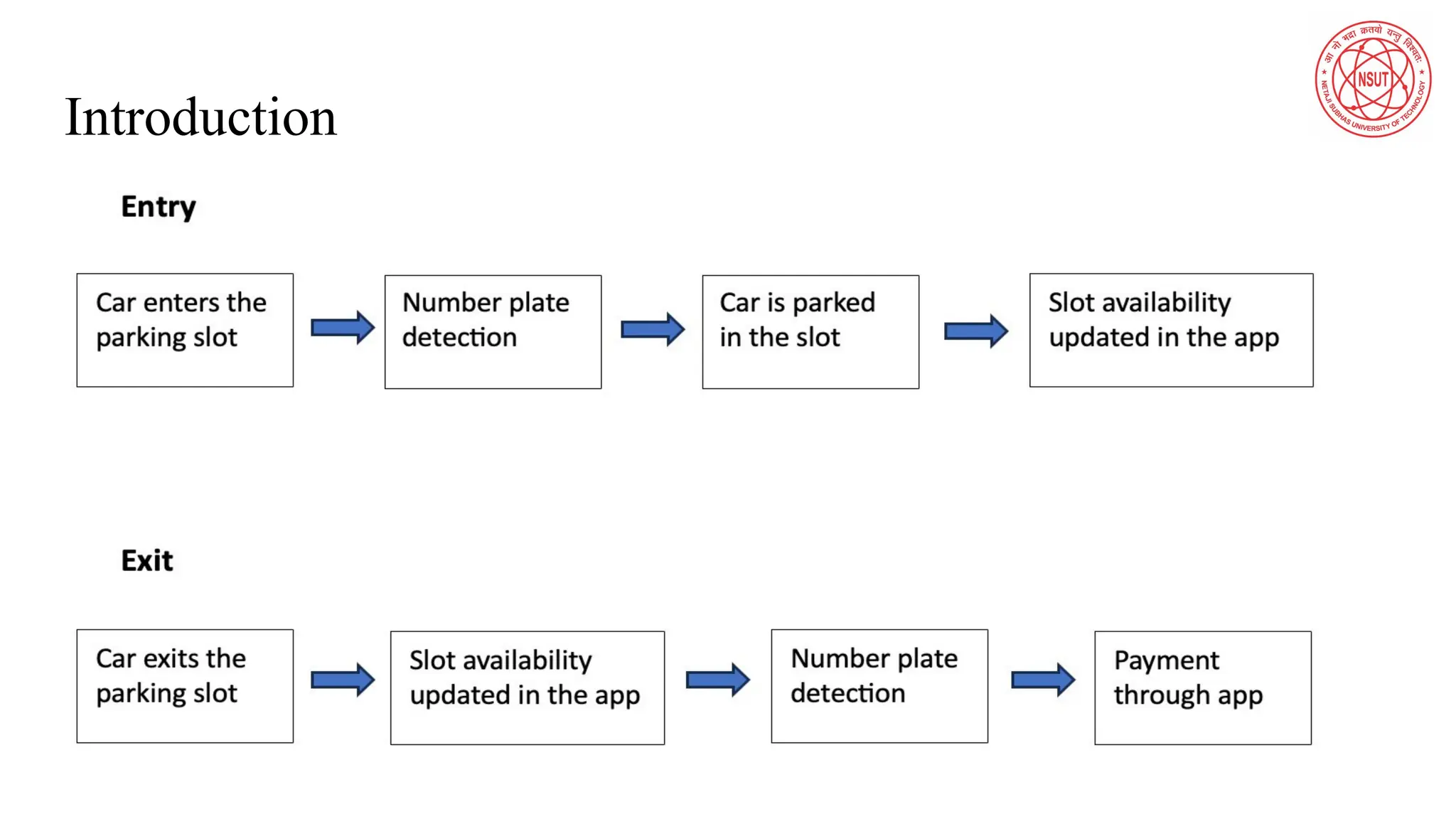
1. Introduction
2. LiteratureSurvey
3. Gaps Identified
4. Problem Statement and objectives
5. Experimental Methods and Implementation
6. Results
7. Future Work to be done
8. References
Literature survey
1. (MahdiJemmali, 2022) This research proposes a new framework for solving the problem of parking lot allocation,
which emphasizes the equitable allocation of people based on the overall count of people in each parking space. The allocation
process is performed while considering the available parking lots in each parking space.
2. (Violeta Todorović, 2017) Payment systems organized on the current basis would not help in achieving the full potential of
IoT. Cash payments are completely inappropriate for the desired level of automation, while classic non-cash payments are
very slow and expensive. Payment cards and checks are intended for transactions of significantly higher amounts than the
amounts of transactions in the ecosystem of IoT would be.
3. (Mohd Mustari Syafiq Ismail ET AL, 2019) The old technique to find parking space is manual by finds free space area by
self. This makes the users take more time and energy that end up lead to traffic jam. Due to these problems, based smart
parking system is developed to ease user to find parking space. This method is developed to approach the user to using
application to review available parking space and pay parking through mobile phone application.
4. (Vijay Paidi ET AL, 2018) His study reviews the literature on the usage of smart parking sensors, technologies, applications
and evaluates their applicability to open parking lots. Magnetometers, ultrasonic sensors and machine vision were few of the
widely used sensors and technologies on closed parking lots. However, this study suggests a combination of machine vision,
convolutional neural network or multi-agent systems suitable for open parking lots due to less expenditure and resistance to
varied environmental conditions.
4.
Gaps Identified
1. Wastageof manpower at entry
2. Cumbersome process of entry and exit (removing parking slip- app/text based
solutions)
3. Saving wait time at parking lot (showing slots availability)
4. Issue of paying change at parking exit gate
5. Inaccessibility of parking slots due to lack of signage/directions
6. Increased greenhouse gas emissions due to long queues at entry and exit of parking
lot [1]
5.
Problem Statement
To developan IoT-enabled parking system with AI integration and
hardware design, aligned with a dedicated payment gateway
2. Reducing wait time- It is a struggle for
anyone to wait in queue for a long time
only to find no slots in the lot, with a
dynamic display of slots this problem is
solved.
1. Parking Experience-
We often see and have even encountered
ourselves where cars circle around the same
lot for almost 30 minutes but are not able to
find a parking slot. An app-based parking
solution can help us overcome this issue.
Objectives
6.
3. Robust andunmanned parking lot-
Often we see a lot of people trying to guide
drivers to parking lots but it more often than not
creates a ruckus. By using sensors and IoT
technology we can automate the entire parking
experience.
4. Integrating digital payments-
Getting in the lot is one struggle and it is even
more inefficient if paying and getting out is also
one. Queuing up at exit points because the cashier
doesn't have change or because the billing
machine malfunctions to produce the bill often
causes inconvenience for the driver. By
integrating fast tag technologies and payment
gateways into the app the user doesn't have to
worry about carrying change but simply pay and
go by approving the payments at the touch of a
button.
7.
Experimental Methods andImplementation
Hardware Implementation
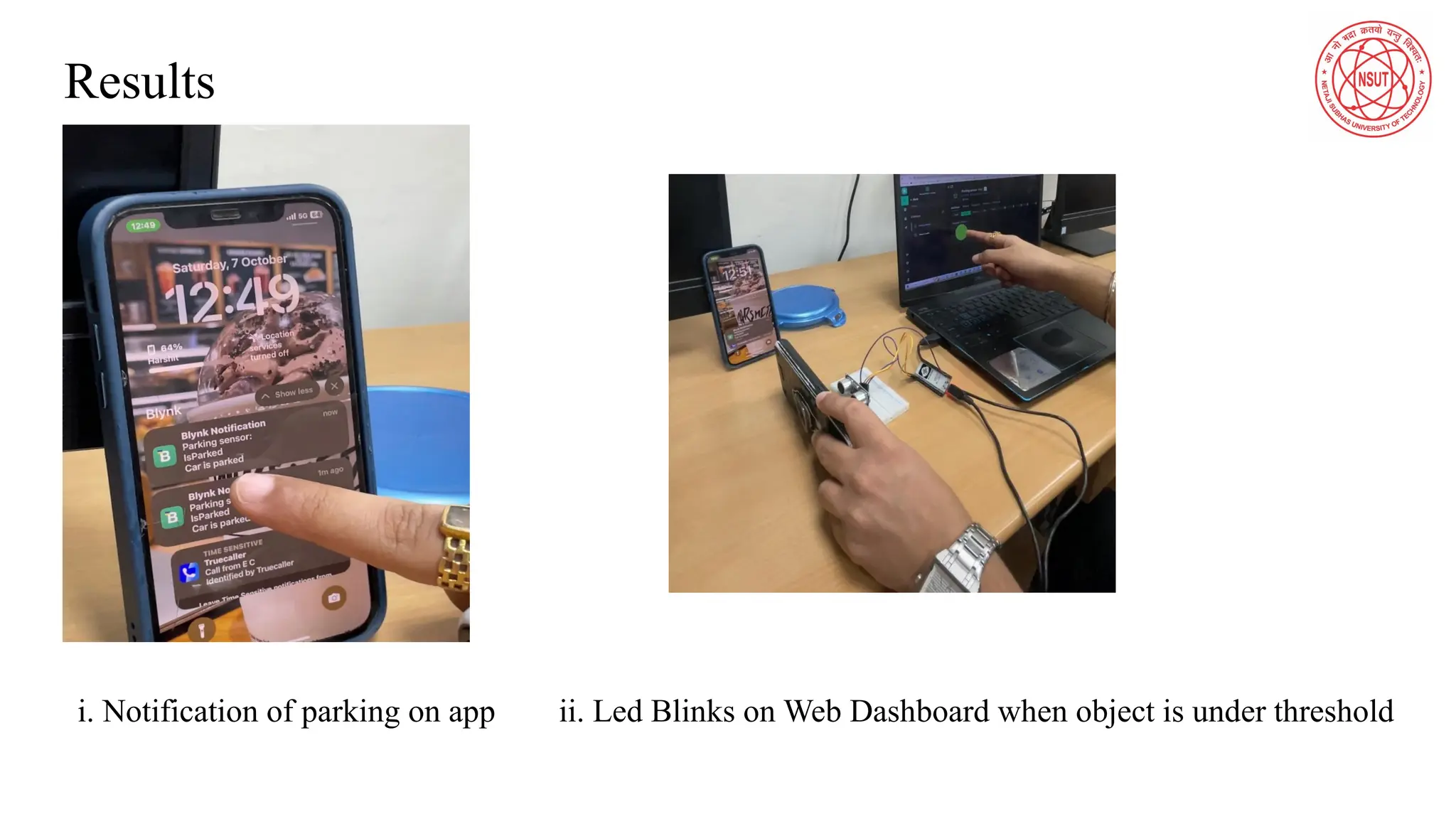
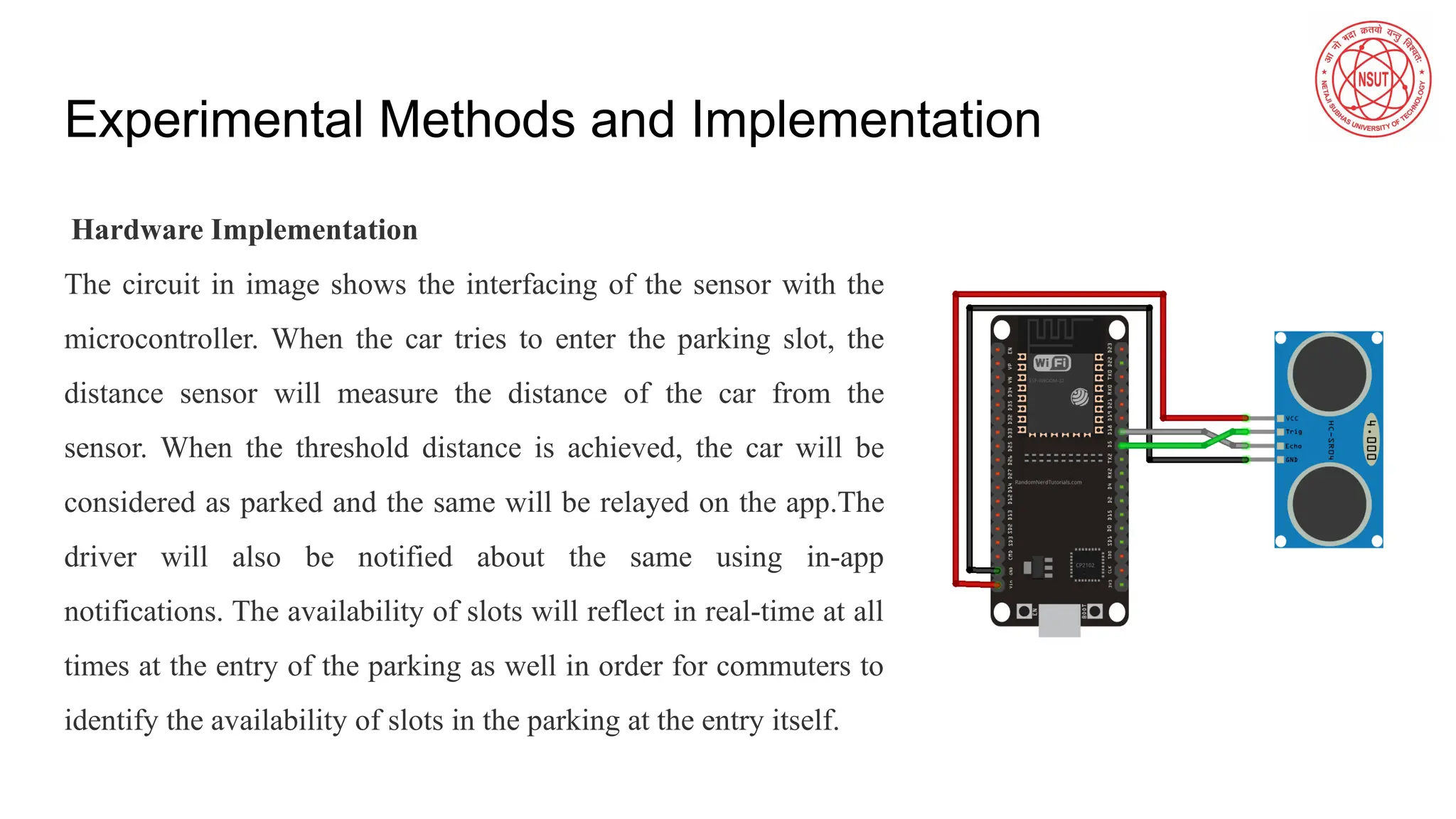
The circuit in image shows the interfacing of the sensor with the
microcontroller. When the car tries to enter the parking slot, the
distance sensor will measure the distance of the car from the
sensor. When the threshold distance is achieved, the car will be
considered as parked and the same will be relayed on the app.The
driver will also be notified about the same using in-app
notifications. The availability of slots will reflect in real-time at all
times at the entry of the parking as well in order for commuters to
identify the availability of slots in the parking at the entry itself.
8.
Sensor Microcontroller
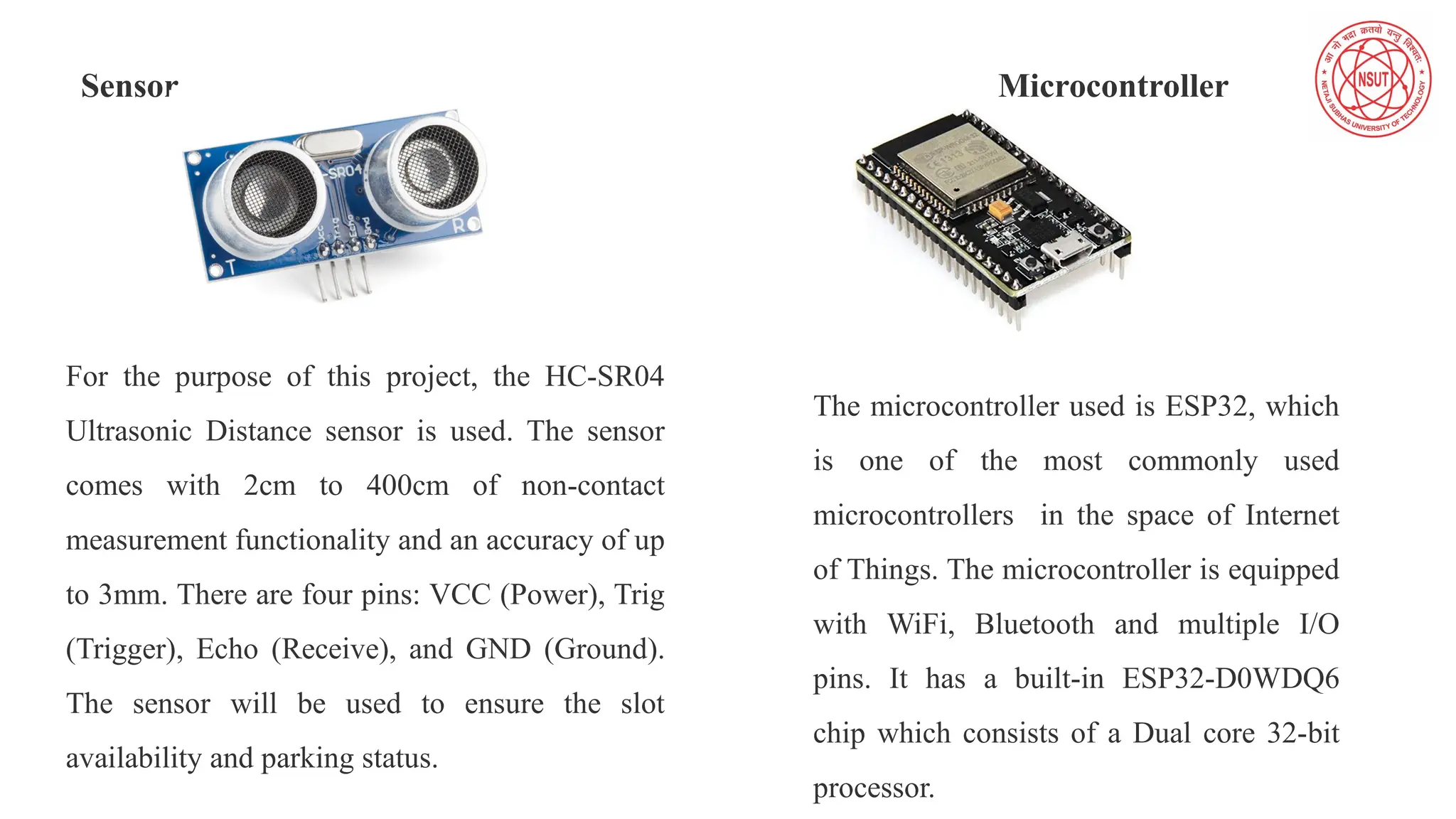
For thepurpose of this project, the HC-SR04
Ultrasonic Distance sensor is used. The sensor
comes with 2cm to 400cm of non-contact
measurement functionality and an accuracy of up
to 3mm. There are four pins: VCC (Power), Trig
(Trigger), Echo (Receive), and GND (Ground).
The sensor will be used to ensure the slot
availability and parking status.
The microcontroller used is ESP32, which
is one of the most commonly used
microcontrollers in the space of Internet
of Things. The microcontroller is equipped
with WiFi, Bluetooth and multiple I/O
pins. It has a built-in ESP32-D0WDQ6
chip which consists of a Dual core 32-bit
processor.
9.
Software Implementation
Automatic NumberPlate Recognition (ANPR)
Automatic Number Plate Recognition (ANPR) is a system that
reads the vehicle's registration number by using optical character
recognition on photographs of vehicle registration plates. An
automatic licence plate recognition system uses several image
processing algorithms to detect cars in pictures or real-time video
captured by one or more cameras. Automatic number-plate
recognition may be used to save the photos acquired by the
cameras as well as the text from the licence plate, with some
models storing a snapshot of the driver as well.[2]
10.
Process:
1. Real-time objectDetection- Object detection uses deep learning to recognize vehicles and different
vehicle classes (bus, truck, car, van, motorcycle, etc.) in images of video streams. State-of-the-art object
detection algorithms such as YOLOv3 or YOLOv7 use neural networks trained on a dataset of images.
2. Image Processing- Image Processing includes traditional computer vision methods used to normalize
and prepare images for being processed by the OCR algorithm.Image processing functions are used to
sharpen, color-correct or crop images to improve the results and output of subsequent algorithms.
3. Optical Character Recognition (OCR)- Optical Character Recognition (OCR) allows the ANPR
system to identify license plates. Image processing techniques such as Tesseract OCR algorithms are
used to detect individual characters, verify the sequence of those characters, and convert the number
plate image to text.
4. Template Matching Template matching is used to compare an image of a license plate against a
library of images of license plates to find a match.[3]
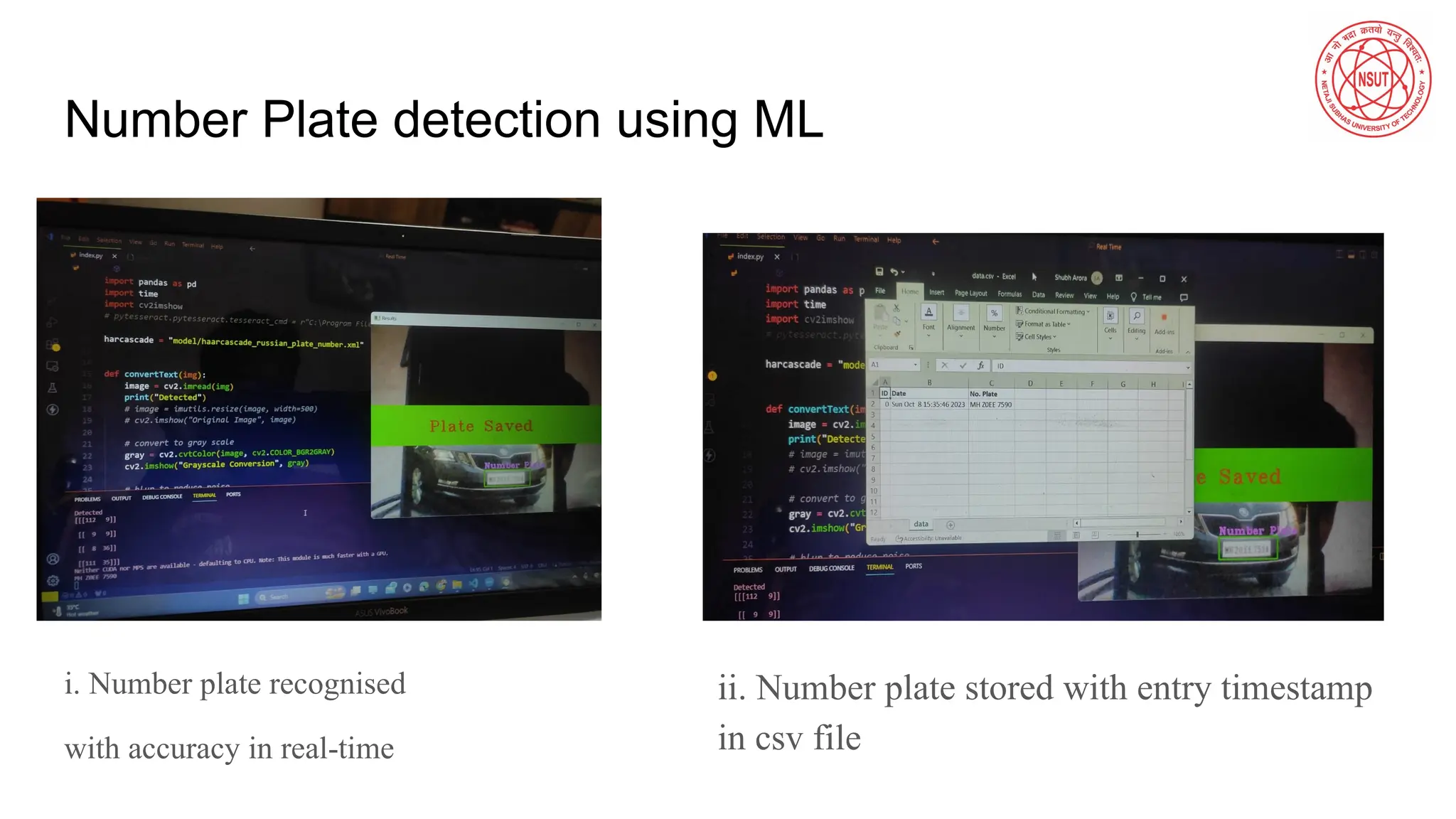
Number Plate detectionusing ML
i. Number plate recognised
with accuracy in real-time
ii. Number plate stored with entry timestamp
in csv file
13.
Future Work tobe done
1. Enhancing ease of navigation- Moving forward, the parking system will
be enhanced by creating a virtual map of the slots and the parking lot to
make navigation across the lot easier. The development of a dynamic visual
feed at the entry of the lot will make the parking experience less
cumbersome and make the entire parking lot more robust.
2. Cashless Transactions- Moreover, after researching and identifying
payment interfacing techniques, approaches will be created and added to
the system to facilitate an automatic payment gateway. The proposed
method involves studying and utilization of fast tag payment APIs to
facilitate payment using (Unified Payment Interface) UPI, the same will be
tested by utilizing free payment gateways facilitated by RazorPay.
3. Creating a scalable model of the smart car parking system which will
incorporate a robust network of multiple sensors and microcontrollers to
emulate the workings of a real life smart parking system
14.
References
1. Institute forTransport and Development Policy, To Tackle Climate Change, Cities Need to Rethink
Parking, September 20, 2022
https://www.itdp.org/2022/09/20/to-tackle-climate-change-cities-need-to-rethink-parking/
https://diyi0t.com/ultrasonic-sensor-tutorial-for-arduino-and-esp8266/
2. Chirag Patel, “Automatic Number Plate Recognition System (ANPR): A Survey”, May
2013
https://www.researchgate.net/publication/236888959_Automatic_Number_Plate_Recog
nition_System_ANPR_A_Survey
3. Nico Kingler, “Automatic Number Plate Recognition (ANPR) – 2023 Guide,
https://viso.ai/computer-vision/automatic-number-plate-recognition-anpr/
![Gaps Identified
1. Wastage of manpower at entry
2. Cumbersome process of entry and exit (removing parking slip- app/text based
solutions)
3. Saving wait time at parking lot (showing slots availability)
4. Issue of paying change at parking exit gate
5. Inaccessibility of parking slots due to lack of signage/directions
6. Increased greenhouse gas emissions due to long queues at entry and exit of parking
lot [1]](https://image.slidesharecdn.com/reserachmlautomation-250331155615-1b05c4c9/75/RESERACH-ML-AUTOMATION-FOR-NUMBER-PLATE-SYSTEM-4-2048.jpg)
![Software Implementation
Automatic Number Plate Recognition (ANPR)
Automatic Number Plate Recognition (ANPR) is a system that
reads the vehicle's registration number by using optical character
recognition on photographs of vehicle registration plates. An
automatic licence plate recognition system uses several image
processing algorithms to detect cars in pictures or real-time video
captured by one or more cameras. Automatic number-plate
recognition may be used to save the photos acquired by the
cameras as well as the text from the licence plate, with some
models storing a snapshot of the driver as well.[2]](https://image.slidesharecdn.com/reserachmlautomation-250331155615-1b05c4c9/75/RESERACH-ML-AUTOMATION-FOR-NUMBER-PLATE-SYSTEM-9-2048.jpg)
![Process:
1. Real-time object Detection- Object detection uses deep learning to recognize vehicles and different
vehicle classes (bus, truck, car, van, motorcycle, etc.) in images of video streams. State-of-the-art object
detection algorithms such as YOLOv3 or YOLOv7 use neural networks trained on a dataset of images.
2. Image Processing- Image Processing includes traditional computer vision methods used to normalize
and prepare images for being processed by the OCR algorithm.Image processing functions are used to
sharpen, color-correct or crop images to improve the results and output of subsequent algorithms.
3. Optical Character Recognition (OCR)- Optical Character Recognition (OCR) allows the ANPR
system to identify license plates. Image processing techniques such as Tesseract OCR algorithms are
used to detect individual characters, verify the sequence of those characters, and convert the number
plate image to text.
4. Template Matching Template matching is used to compare an image of a license plate against a
library of images of license plates to find a match.[3]](https://image.slidesharecdn.com/reserachmlautomation-250331155615-1b05c4c9/75/RESERACH-ML-AUTOMATION-FOR-NUMBER-PLATE-SYSTEM-10-2048.jpg)