Presented By
Saba Nazir (4025)
BS MLT 8th
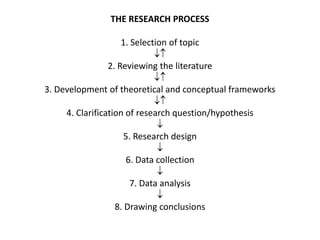
THE RESEARCH PROCESS
1. Selection of topic

2. Reviewing the literature

3. Development of theoretical and conceptual frameworks

4. Clarification of research question/hypothesis

5. Research design

6. Data collection

7. Data analysis

8. Drawing conclusions
STAGE 1. SELECTION OF TOPIC
• A crucial stage, as an inappropriate topic or
question will often lead to irretrievable
difficulties later in the research.
• Where do you get a topic?
• Read newspapers
• Read magazines
• Write down your interests and hobbies
• Talk to friends
• Watch public television, movies, ads.
• As a research object can serve genes, chromosomes,
individual cells, tissue cultures, animals, persons,
populations, and technologic devices (computers,
different kinds of models, computer networks and
others).
• If human being is to be the research object the
inclusion and exclusion criteria should be defined first,
e.g. health state, type of disease, age - children, adults
(age span) size of group(s), different age groups,
control group, gender, selected group, patients with
special kind of disease, and others
STAGE 2. REVIEWING THE LITERATURE
•A literature review essentially consists of critically
reading, evaluating and organising existing
literature on the topic to assess the state of
knowledge in the area.
•When conducting the literature review it’s
important to concentrate on the scientific
literature, start with the most valuable research
journals in your topical area.
•During this stage you should aim to become an
‘expert’ in your field of research.
STAGE 3. DEVELOPMENT OF THEORETICAL
AND CONCEPTUAL FRAMEWORKS
• As you read the literature, you should be
continually developing and refining your
theoretical and conceptual frameworks.
• Your theoretical framework refers to the
underlying theoretical approach that you adopt
to underpin your study.
• The conceptual framework defines and organises
the concepts important within your study.
STAGE 4. CLARIFICATION OF THE
RESEARCH QUESTION
• Initial research questions are chosen, investigated and
often rejected for a number of reasons, for example:
• The question lacks sufficient focus.
• The conceptual framework has identified problems in
either defining and/or measuring the appropriate concepts.
• There are too many moderating or intervening variables.
• The project is unfeasible in terms of complexity, access,
facilities or resources.
STAGE 5. RESEARCH DESIGN
• What data do I need to collect to answer this question?
• What is the best way to collect this data?
• What overall research design should I use? For example, a
cross-sectional, experimental or longitudinal design?
• Will I need to collect primary or secondary data?
• What methods, for example interviews, questionnaire
surveys and so on, will be best to collect the primary data?
• What are the exact procedures that I should adopt in my
data collection to ensure reliability and validity?
• Are there any ethical issues associated with the research?
STAGE 6. DATA COLLECTION
• You have to consider
• which methodology to choose, and
• which methods to utilise
STAGE 7. DATA ANALYSIS AND
DISCUSSION OF THE FINDINGS
• . The data you collect in stage 6 needs to be analysed
to provide answers to your research question.
• 2. In your discussion of the results, reference should
also be made back to the literature reviewed in stage 2,
for example
• How do the findings add to this literature?
• Do they support the literature?
• If not, what are the possible reasons why?
STAGE 8. DRAWING CONCLUSIONS
• Conclusions should relate back to the focused
research question.
• You can evaluate how successful you have been
in achieving your research objectives, and
highlight the strengths and weaknesses of the
research.
• You may also want to make recommendations
for further research.
SUMMARY
• Research is not just about the collection of data. Data
collection is important, but it is simply part of a wider
process – the research process.
• 2. The research process follows 8 steps: selection of topic,
reviewing the literature, developing your theoretical and
conceptual frameworks, clarifying your research question,
developing a research design, collecting data, analysing
data, and drawing conclusions.
• 3. Relating your project to the research process will allow
you to develop and answer your research question in a
logical and systematic manner.
research process

  • 1.
    Presented By Saba Nazir(4025) BS MLT 8th
  • 2.
    THE RESEARCH PROCESS 1.Selection of topic  2. Reviewing the literature  3. Development of theoretical and conceptual frameworks  4. Clarification of research question/hypothesis  5. Research design  6. Data collection  7. Data analysis  8. Drawing conclusions
  • 3.
    STAGE 1. SELECTIONOF TOPIC • A crucial stage, as an inappropriate topic or question will often lead to irretrievable difficulties later in the research. • Where do you get a topic? • Read newspapers • Read magazines • Write down your interests and hobbies • Talk to friends • Watch public television, movies, ads.
  • 4.
    • As aresearch object can serve genes, chromosomes, individual cells, tissue cultures, animals, persons, populations, and technologic devices (computers, different kinds of models, computer networks and others). • If human being is to be the research object the inclusion and exclusion criteria should be defined first, e.g. health state, type of disease, age - children, adults (age span) size of group(s), different age groups, control group, gender, selected group, patients with special kind of disease, and others
  • 5.
    STAGE 2. REVIEWINGTHE LITERATURE •A literature review essentially consists of critically reading, evaluating and organising existing literature on the topic to assess the state of knowledge in the area. •When conducting the literature review it’s important to concentrate on the scientific literature, start with the most valuable research journals in your topical area. •During this stage you should aim to become an ‘expert’ in your field of research.
  • 6.
    STAGE 3. DEVELOPMENTOF THEORETICAL AND CONCEPTUAL FRAMEWORKS • As you read the literature, you should be continually developing and refining your theoretical and conceptual frameworks. • Your theoretical framework refers to the underlying theoretical approach that you adopt to underpin your study. • The conceptual framework defines and organises the concepts important within your study.
  • 7.
    STAGE 4. CLARIFICATIONOF THE RESEARCH QUESTION • Initial research questions are chosen, investigated and often rejected for a number of reasons, for example: • The question lacks sufficient focus. • The conceptual framework has identified problems in either defining and/or measuring the appropriate concepts. • There are too many moderating or intervening variables. • The project is unfeasible in terms of complexity, access, facilities or resources.
  • 8.
    STAGE 5. RESEARCHDESIGN • What data do I need to collect to answer this question? • What is the best way to collect this data? • What overall research design should I use? For example, a cross-sectional, experimental or longitudinal design? • Will I need to collect primary or secondary data? • What methods, for example interviews, questionnaire surveys and so on, will be best to collect the primary data? • What are the exact procedures that I should adopt in my data collection to ensure reliability and validity? • Are there any ethical issues associated with the research?
  • 9.
    STAGE 6. DATACOLLECTION • You have to consider • which methodology to choose, and • which methods to utilise
  • 10.
    STAGE 7. DATAANALYSIS AND DISCUSSION OF THE FINDINGS • . The data you collect in stage 6 needs to be analysed to provide answers to your research question. • 2. In your discussion of the results, reference should also be made back to the literature reviewed in stage 2, for example • How do the findings add to this literature? • Do they support the literature? • If not, what are the possible reasons why?
  • 11.
    STAGE 8. DRAWINGCONCLUSIONS • Conclusions should relate back to the focused research question. • You can evaluate how successful you have been in achieving your research objectives, and highlight the strengths and weaknesses of the research. • You may also want to make recommendations for further research.
  • 12.
    SUMMARY • Research isnot just about the collection of data. Data collection is important, but it is simply part of a wider process – the research process. • 2. The research process follows 8 steps: selection of topic, reviewing the literature, developing your theoretical and conceptual frameworks, clarifying your research question, developing a research design, collecting data, analysing data, and drawing conclusions. • 3. Relating your project to the research process will allow you to develop and answer your research question in a logical and systematic manner.