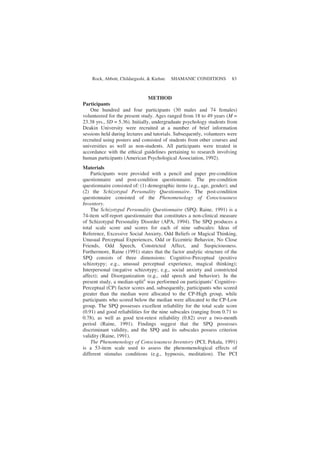
Author info: Correspondence should be sent to: Adam J. Rock, Ph.D. School of
Psychology, Deakin University, Burwood, VIC, 3125, Australia. email:
rock@deakin.edu.au
North American Journal of Psychology, 2008, Vol. 10, No. 1, 79-98.
© NAJP
The Effect of Shamanic-like Stimulus Conditions
and the Cognitive-perceptual Factor of
Schizotypy on Phenomenology
Adam J. Rock, Gavin R. Abbott
Hatun Childargushi, & Melanie L. Kiehne
Deakin University, Melbourne, Victoria, Australia
Shamanism has remained an integral part of indigenous healing rituals
since ancient times and is currently attracting interest as a complementary
therapeutic technique in psychology. Recently, shamanic-like techniques
have been used to facilitate changes in the phenomenology of non-
shamans. However, such research has largely been delimited to a single
shamanic-like technique (i.e., drumming), and the role of personality
traits with regards to receptivity to this technique has been neglected. The
purpose of the present study was to investigate experimentally the effect
of different shamanic-like techniques and the cognitive-perceptual factor
of the schizotypy construct on phenomenology. One hundred and four
non-shamans were randomly assigned to one of three conditions:
Drumming, Ganzfeld, or Sitting Quietly with Eyes Open. Participants’
phenomenology was assessed using the Phenomenology of
Consciousness Inventory. Phenomenology associated with shamanic-like
techniques appeared to be statistically significantly different from
phenomenology associated with sitting quietly with eyes open.
Furthermore, high cognitive-perceptual participants reported significant
alterations in phenomenology compared to their low cognitive-perceptual
counterparts. Methodological shortcomings of the present study are
discussed and suggestions for future research are advanced.
Shamanism may be defined as “a family of traditions whose
practitioners focus on voluntarily entering altered states of consciousness
in which they experience themselves, or their spirit(s), traveling to other
realms at will and interacting with other entities in order to serve their
community” (Walsh, 1989, p. 5). While no single definition will appeal
to all scholars (Walsh, 1995), this one emphasizes several integral
features of shamanism. First, it describes shamanism as a set of
techniques (e.g., listening to monotonous drumming) designed to
facilitate purported alterations in consciousness (see Krippner, 2002),
rather than a religious tradition (e.g., Eliade, 1964). Second, the
definition highlights the volitional control of the practitioner; that is, the
shaman’s ability to enter and exit altered states of consciousness (ASCs)
80 NORTH AMERICAN JOURNAL OF PSYCHOLOGY
at will and limited mastery with regards to the phenomenological content
of the ASCs. Third, the definition’s reference to the practitioner’s spirit
“traveling to other realms” (Walsh, 1989, p. 5) underscores the
commonly accepted view (e.g., Heinze, 1991; Ripinsky-Naxon, 1993)
that an ASC referred to as “ecstatic journeying” or simply “shamanic
journeying” (i.e., out-of-body experiences or soul flight) constitutes a
core aspect of shamanism (Krippner, 2002). Finally, the practitioner’s
commitment to serve the interests of the community highlights the social-
role function of shamanism (see, for example, Noll, 1983; Wright, 1989).
It is noteworthy that shamanism has remained an integral part of
indigenous healing rituals since ancient times and is currently attracting
increasing interest as a complementary therapeutic technique in the
disciplines of psychology and medicine (Bittman et al., 2001). For
example, Harner and Tryon (1995) found that shamanic practitioners
reported statistically significantly lower mood disturbance (e.g.,
depression, tension-anxiety) scores after journeying with monotonous
drumming relative to baseline. Consequently, given that the principles of
shamanism may prove pertinent to clinical psychologists (Krippner,
2002) it may be prudent to investigate the phenomenological effects of
such techniques on non-shamans.
Indeed, there has been a recent trend towards investigating
experimentally the effect of “shamanic-like” stimulus conditions on non-
shamans (e.g., university students; Rock, 2006; Rock, Baynes, & Casey,
2005; Rock, Casey, & Baynes, 2006; Woodside, Kumar, & Pekala,
1997). Techniques may be conceptualized as “shamanic-like” insofar as
they bear some relation to shamanic techniques and yet depart from what
may properly be called shamanism. For example, listening to
monotonous drumming to facilitate soul flight on behalf of one’s
community may be considered a shamanic technique, while
recreationally listening to monotonous drumming to facilitate purported
shifts in consciousness is merely “shamanic-like.”
It is perhaps salient that the majority of experimental studies using
shamanic-like stimulus conditions have focused on the
phenomenological effects of monotonous drumming (e.g., Rock et al.,
2005; Rock et al., 2006; Woodside et al., 1997). For example, Rock et al.
(2006) found that non-shamans administered monotonous drumming
while “journeying” reported statistically significant alterations in
phenomenology (i.e., fear, altered state of awareness, arousal) compared
to a control condition (i.e., sitting quietly with eyes open). Historically,
however, shamanic practitioners have used various technologies (e.g.,
plant hallucinogens, perceptual deprivation, ritualistic dancing) to elicit
shamanic journeying experiences (Achterberg, 1987). Consequently, it
may prove edifying to assess which phenomenological effects of
Rock, Abbott, Childargushi, & Kiehne SHAMANIC CONDITIONS 81
monotonous drumming may be replicated by other shamanic-like
stimulus conditions.
One potentially useful technique is the Ganzfeld (“total field”) which
may be defined, in broad terms, as a “homogeneous perceptual
environment” (Bem, 1993, p. 102). Specifically, the Ganzfeld consists of
an undifferentiated visual field created by viewing a red light through
halved translucent ping-pong balls taped over one’s eyes. Additionally,
an analogous auditory field is produced by listening to stereophonic
white noise (i.e., a monotonous hissing sound; Bem, 1993). In a recent
experimental study, Rock (2006) found that non-shamans administered
journeying instructions during exposure to the Ganzfeld reported
shamanic-like motifs (e.g., battles with predatory creatures).
Furthermore, little is known about individual susceptibility to
shamanic-like techniques (Harner & Tryon, 1995). Various personality
traits may be associated with receptivity to shamanic-like experiences
and, thus, alterations in phenomenology (e.g., mood). One potentially
relevant personality trait is schizotypy or the schizotypal personality trait.
Schizotypal Personality Disorder (SPD), which represents an excess of
schizotypal personality features, is characterized by a “pervasive pattern
of social and interpersonal deficits marked by acute discomfort with, and
reduced capacity for, close relationships as well as by cognitive or
perceptual distortions and eccentricities of behavior” (APA, 1994, p.
645). Through factor analysis, Raine (1991) proposed three dimensions
of schizotypal personality: (1) cognitive-perceptual (positive schizotypy;
e.g., unusual perceptual experience, magical thinking); (2) interpersonal
(negative schizotypy; e.g., social anxiety and constricted affect); and (3)
disorganization (e.g., odd speech and behavior). As previously stated,
shamanic-like journeying experiences consist of alterations in
phenomenology relative to normal waking consciousness (Rock et al.,
2005; Rock et al., 2006). Consequently, it is arguable that those who
score high on the cognitive perceptual factor – and are, thus, predisposed
to having unusual perceptual experiences – may be susceptible to
shamanic-like stimulus conditions and, thus, shamanic-like journeying
experiences.
Shamanic-like experiences may be quantified using a methodology
that was developed by Pekala (1985) to “operationally define, map and
diagram states and altered states of consciousness” (p. 207). The
methodology consists, in part, of a novel retrospective phenomenological
assessment instrument referred to as the Phenomenology of
Consciousness Inventory (PCI; Pekala, 1991). The PCI is a 53-item
questionnaire consisting of 12 major dimensions or phenomenological
(i.e., subjective) elements (e.g., positive affect, altered experience, visual
imagery, rationality), and 14 minor dimensions (e.g., fear, joy, altered
82 NORTH AMERICAN JOURNAL OF PSYCHOLOGY
body image, absorption). One may operationally define or “map” states
of consciousness and ASCs by quantifying: (1) the intensity of each
phenomenological element; and (2) the strength of relationships between
pairs of phenomenological elements. Furthermore, one may use PCI data
to construct graphs referred to as “psygrams” that pictorially represent
the intensity and pattern of relationships between pairs of
phenomenological elements derived from a squared correlation matrix
(Pekala, 1991). The PCI has been used to map and diagram
phenomenology facilitated by, for example, progressive relaxation (e.g.,
Pekala, Forbes, & Contrisciani, 1989), hypnosis (e.g., Kumar & Pekala,
1989; Pekala & Kumar, 1984, 1986, 1989), and sitting quietly with eyes
closed (e.g., Pekala & Kumar, 1989). Recent experimental research (e.g.,
Rock et al., 2005; Rock et al., 2006; Woodside et al., 1997) has applied
this methodology to shamanic-like journeying experiences. However, to
date, no published studies have applied Pekala’s (1985) methodology to
map the phenomenological effects of: (1) a Ganzfeld stimulus condition;
and (2) the cognitive-perceptual factor of the schizotypy construct.
In light of the literature reviewed, the present study was conducted
with three aims: (1) to determine if there were differences between a
control condition and two shamanic-like stimulus conditions with regards
to phenomenology; (2) to determine if there were differences between
persons high and low on the cognitive-perceptual factor of schizotypy
with regards to phenomenology; and (3) to determine if there was an
interaction between condition and the cognitive-perceptual factor with
regards to phenomenology.
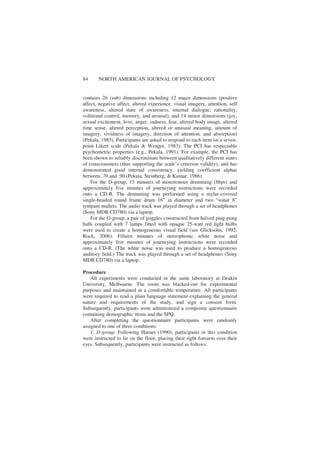
The present study consisted of a between-subjects design with three
conditions: (1) a control condition consisting of sitting quietly with eyes
open for 15 minutes (S-group); (2) listening to shamanic-like journeying
instructions followed by 15 minutes of white noise, while viewing
diffuse red light (G-group); and (3) listening to shamanic-like journeying
instructions followed by 15 minutes of listening to monotonous
drumming at 8-beats-per-second (D-group).i
This study’s design allowed investigation of three related hypotheses:
There should be a difference between treatment and control conditions
with regards to: (a) the combined PCI major dimensions scores; and (b)
the combined PCI minor dimension scores. There should be a difference
between high cognitive-perceptual factor participants versus low
cognitive-perceptual factor participants with regards to: (a) the combined
PCI major dimension scores; and (b) the combined PCI minor dimension
scores. Condition should interact with the cognitive-perceptual factor
with regards to: (a) the combined PCI major dimensions scores; and (b)
the combined PCI minor dimension scores.
Rock, Abbott, Childargushi, & Kiehne SHAMANIC CONDITIONS 83
METHOD
Participants
One hundred and four participants (30 males and 74 females)
volunteered for the present study. Ages ranged from 18 to 49 years (M =
23.38 yrs., SD = 5.36). Initially, undergraduate psychology students from
Deakin University were recruited at a number of brief information
sessions held during lectures and tutorials. Subsequently, volunteers were
recruited using posters and consisted of students from other courses and
universities as well as non-students. All participants were treated in
accordance with the ethical guidelines pertaining to research involving
human participants (American Psychological Association, 1992).
Materials
Participants were provided with a pencil and paper pre-condition
questionnaire and post-condition questionnaire. The pre-condition
questionnaire consisted of: (1) demographic items (e.g., age, gender); and
(2) the Schizotypal Personality Questionnaire. The post-condition
questionnaire consisted of the Phenomenology of Consciousness
Inventory.
The Schizotypal Personality Questionnaire (SPQ; Raine, 1991) is a
74-item self-report questionnaire that constitutes a non-clinical measure
of Schizotypal Personality Disorder (APA, 1994). The SPQ produces a
total scale score and scores for each of nine subscales: Ideas of
Reference, Excessive Social Anxiety, Odd Beliefs or Magical Thinking,
Unusual Perceptual Experiences, Odd or Eccentric Behavior, No Close
Friends, Odd Speech, Constricted Affect, and Suspiciousness.
Furthermore, Raine (1991) states that the factor analytic structure of the
SPQ consists of three dimensions: Cognitive-Perceptual (positive
schizotypy; e.g., unusual perceptual experience, magical thinking);
Interpersonal (negative schizotypy; e.g., social anxiety and constricted
affect); and Disorganization (e.g., odd speech and behavior). In the
present study, a median-splitii
was performed on participants’ Cognitive-
Perceptual (CP) factor scores and, subsequently, participants who scored
greater than the median were allocated to the CP-High group, while
participants who scored below the median were allocated to the CP-Low
group. The SPQ possesses excellent reliability for the total scale score
(0.91) and good reliabilities for the nine subscales (ranging from 0.71 to
0.78), as well as good test-retest reliability (0.82) over a two-month
period (Raine, 1991). Findings suggest that the SPQ possesses
discriminant validity, and the SPQ and its subscales possess criterion
validity (Raine, 1991).
The Phenomenology of Consciousness Inventory (PCI; Pekala, 1991)
is a 53-item scale used to assess the phenomenological effects of
different stimulus conditions (e.g., hypnosis, meditation). The PCI
84 NORTH AMERICAN JOURNAL OF PSYCHOLOGY
contains 26 (sub) dimensions including 12 major dimensions (positive
affect, negative affect, altered experience, visual imagery, attention, self
awareness, altered state of awareness, internal dialogue, rationality,
volitional control, memory, and arousal), and 14 minor dimensions (joy,
sexual excitement, love, anger, sadness, fear, altered body image, altered
time sense, altered perception, altered or unusual meaning, amount of
imagery, vividness of imagery, direction of attention, and absorption)
(Pekala, 1985). Participants are asked to respond to each item on a seven-
point Likert scale (Pekala & Wenger, 1983). The PCI has respectable
psychometric properties (e.g., Pekala, 1991). For example, the PCI has
been shown to reliably discriminate between qualitatively different states
of consciousness (thus supporting the scale’s criterion validity), and has
demonstrated good internal consistency, yielding coefficient alphas
between .70 and .90 (Pekala, Steinberg, & Kumar, 1986).
For the D-group, 15 minutes of monotonous drumming (8bps) and
approximately five minutes of journeying instructions were recorded
onto a CD-R. The drumming was performed using a mylar-covered
single-headed round frame drum 16” in diameter and two “sonar 8”
tympani mallets. The audio track was played through a set of headphones
(Sony MDR CD780) via a laptop.
For the G-group, a pair of goggles constructed from halved ping-pong
balls coupled with 7 lamps fitted with opaque 25-watt red light bulbs
were used to create a homogeneous visual field (see Glicksohn, 1992;
Rock, 2006). Fifteen minutes of stereophonic white noise and
approximately five minutes of journeying instructions were recorded
onto a CD-R. (The white noise was used to produce a homogeneous
auditory field.) The track was played through a set of headphones (Sony
MDR CD780) via a laptop.
Procedure
All experiments were conducted in the same laboratory at Deakin
University, Melbourne. The room was blacked-out for experimental
purposes and maintained at a comfortable temperature. All participants
were required to read a plain language statement explaining the general
nature and requirements of the study, and sign a consent form.
Subsequently, participants were administered a composite questionnaire
containing demographic items and the SPQ.
After completing the questionnaire participants were randomly
assigned to one of three conditions:
1. D-group. Following Harner (1990), participants in this condition
were instructed to lie on the floor, placing their right forearm over their
eyes. Subsequently, participants were instructed as follows:
Rock, Abbott, Childargushi, & Kiehne SHAMANIC CONDITIONS 85
Shortly, we are going to attempt to visualize certain images while
listening to drumming. But, for now, I’d like you to visualize a particular
location or object in nature that will help you travel upward… that you
remember from some time in your life. It can be a location you remember
from your childhood, or one you saw last week, or even today. Any kind
of location will do. For example, you can see yourself climbing up a tree,
rope, or ladder; jumping from the top of a mountain; rising up on a
tornado or a whirlwind; climbing over a rainbow; going up with the
smoke of a fire or through a chimney; or finding a bird to take you up.
The right location or object is one that really feels comfortable to you,
and one which you can visualize. Spend a couple of minutes seeing the
location or object without using it. Note its details clearly (Adapted from
Ingerman, 2004).
Participants were, subsequently, allocated two minutes to visualize
their chosen “object or location in nature.” At the conclusion of the 2-
minute period participants were instructed as follows:
When the drumming begins, visualize your familiar location or object
and begin the journey upwards. You will pass through a transition, such
as a cloud or a layer of fog, that will indicate that you have arrived at
your destination. If you are still seeing planets and stars as you journey
upward, you have not yet reached your destination. Again, you will know
that you have reached your destination because of the sensation of having
passed through a threshold of some kind, after which the landscape will
change. Examine the landscape in detail, travel through it, and remember
its features. Explore until you are signaled to come back, and then return
by traveling down using your particular location or object. Do not bring
anything back with you; this is only an exploratory journey. Towards the
end of the journey, the drum will be struck sharply four times to signal to
you that it is time to return. The drum tempo will then become very rapid
for the next half a minute to accompany you on your return journey. The
session will conclude with four more sharp strikes of the drum to signal
that the journey is over. Are you ready to begin the journey? Okay, here
we go (Adapted from Ingerman, 2004).
After being administered the instructions, participants listened to 15
minutes of monotonous drumming at 8-beats-per-second. At the
conclusion of the 15-minute period the drum was struck “sharply four
times to signal” to all participants that it was time to return.
Subsequently, the drum beat became “very rapid for about half a minute
to accompany...” participants “...on their return journey” (Harner, 1990,
p. 32).
2. G-group. Participants were instructed the same as the D-group with
the exception that all references to “drumming” were replaced with “a
hissing sound.” Participants were equipped with a pair of opaque goggles
and exposed to a Ganzfeld for 15 minutes.
86 NORTH AMERICAN JOURNAL OF PSYCHOLOGY
3. S-group. Participants in the control condition were requested to sit
quietly with their eyes open for 15 minutes.
After the completion of the treatment and control procedures, all
participants were administered the post-condition questionnaire
consisting of the PCI.
RESULTS
To address hypotheses 1 to 3, and to avoid violating the assumption
of multi-collinearity, separate multivariate analyses were performed on
the PCI major and minor dimension scores (Woodside et al., 1997).
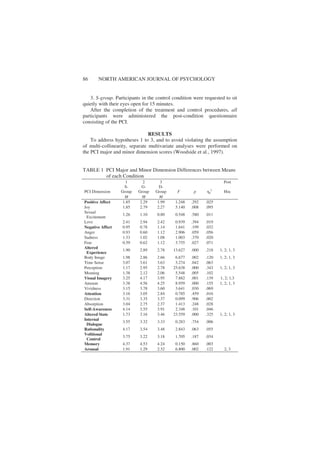
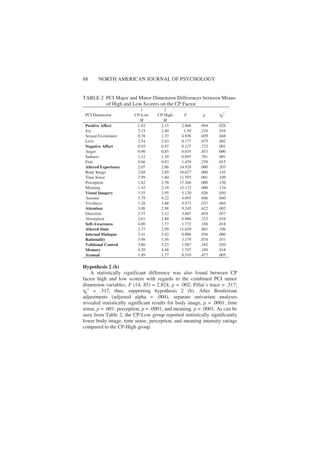
TABLE 1 PCI Major and Minor Dimension Differences between Means
of each Condition
1 2 3 Post
PCI Dimension
S-
Group
G-
Group
D-
Group F p p
2
Hoc
M M M
Positive Affect 1.85 2.29 1.99 1.248 .292 .025
Joy 1.85 2.79 2.27 5.140 .008 .095
Sexual
Excitement
1.26 1.10 0.80 0.548 .580 .011
Love 2.41 2.94 2.42 0.939 .394 .019
Negative Affect 0.95 0.78 1.14 1.641 .199 .032
Anger 0.93 0.60 1.12 2.906 .059 .056
Sadness 1.33 1.02 1.08 1.003 .370 .020
Fear 0.59 0.62 1.12 3.755 .027 .071
Altered
Experience
1.90 2.89 2.78 13.627 .000 .218 1, 2; 1, 3
Body Image 1.98 2.86 2.66 6.677 .002 .120 1, 2; 1, 3
Time Sense 3.07 3.61 3.63 3.274 .042 .063
Perception 1.17 2.95 2.78 25.638 .000 .343 1, 2; 1, 3
Meaning 1.38 2.12 2.06 5.548 .005 .102
Visual Imagery 3.25 4.17 3.95 7.882 .001 .139 1, 2; 1,3
Amount 3.38 4.56 4.25 8.959 .000 .155 1, 2; 1, 3
Vividness 3.15 3.78 3.60 3.641 .030 .069
Attention 3.16 3.05 2.84 0.785 .459 .016
Direction 3.31 3.35 3.37 0.099 .906 .002
Absorption 3.04 2.75 2.37 1.413 .248 .028
Self-Awareness 4.14 3.55 3.91 2.348 .101 .046
Altered State 1.73 3.16 3.46 23.559 .000 .325 1, 2; 1, 3
Internal
Dialogue
3.55 3.32 3.33 0.283 .754 .006
Rationality 4.17 3.54 3.48 2.843 .063 .055
Volitional
Control
3.75 3.22 3.18 1.705 .187 .034
Memory 4.37 4.53 4.24 0.150 .860 .003
Arousal 1.91 1.29 2.32 6.800 .002 .122 2, 3
Rock, Abbott, Childargushi, & Kiehne SHAMANIC CONDITIONS 87
Hypothesis 1 (a)
A two-way between-subjects multivariate analysis of variance
(MANOVA) was conducted with condition and CP factor (high/low) as
independent variables (IVs) and the 12 PCI major dimensions as
dependent variables (DVs). A statistically significant difference was
found between conditions with regards to the combined PCI major
dimension variables, F (24, 176) = 3.465, p = .0001; Pillai’s trace = .642;
partial eta squared ( p
2
) = .321, thus, supporting hypothesis 1 (a). After
Bonferroni adjustments (adjusted alpha = .004), separate univariate
analyses revealed statistically significant results for altered experience, p
= .0001; visual imagery, p = .001; altered state, p = .0001; and arousal, p
= .002. As can be seen from Table 1, the S-group reported statistically
significantly lower altered experience, visual imagery, and altered state
intensity ratings compared to both the G-group and the D-group; and the
G-group reported statistically significantly lower arousal intensity ratings
than the D-group.
Hypothesis 1 (b)
A separate two-way between-subjects MANOVA was conducted with
condition and CP factor as IVs and the 14 PCI minor dimensions as DVs.
A statistically significant difference was found between conditions with
regards to the combined PCI minor dimension variables, F (28, 172) =
3.304, p = .0001; Pillai’s trace = .700; p
2
= .350, thus, supporting
hypothesis 1 (b). After Bonferroni adjustments (adjusted alpha = .004),
separate univariate analyses revealed statistically significant results for
body image, p = .002; perception, p = .0001; and amount, p = .0001. As
can be seen from Table 1, the S-group reported statistically significantly
lower body image, perception, and amount intensity ratings compared to
both the G-group and the D-group.
Hypothesis 2 (a)
A statistically significant difference was also found between the CP
factor high and low scorers with regards to the combined PCI major
dimension variables, F (12, 87) = 2.734, p = .003; Pillai’s trace = .274;
p
2
= .274, thus, supporting hypothesis 2 (a). After Bonferroni
adjustments (adjusted alpha = .004), separate univariate analyses
revealed statistically significant results for altered experience, p = .0001,
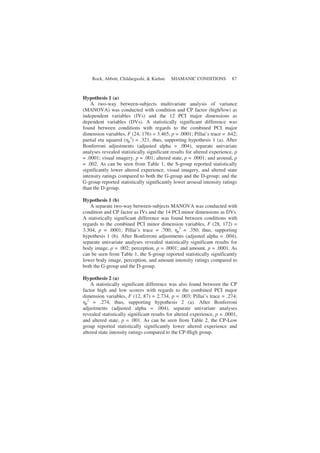
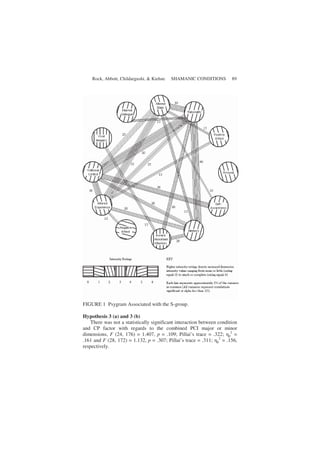
and altered state, p = .001. As can be seen from Table 2, the CP-Low
group reported statistically significantly lower altered experience and
altered state intensity ratings compared to the CP-High group.
88 NORTH AMERICAN JOURNAL OF PSYCHOLOGY
TABLE 2 PCI Major and Minor Dimension Differences between Means
of High and Low Scorers on the CP Factor
1 2
PCI Dimension CP-Low CP-High F p p
2
M M
Positive Affect 1.82 2.15 2.866 .094 .028
Joy 2.15 2.40 1.59 .210 .016
Sexual Excitement 0.76 1.37 4.936 .029 .048
Love 2.54 2.63 0.177 .675 .002
Negative Affect 0.93 0.97 0.127 .722 .001
Anger 0.90 0.85 0.035 .853 .000
Sadness 1.12 1.19 0.093 .761 .001
Fear 0.66 0.83 1.459 .230 .015
Altered Experience 2.07 2.86 24.928 .000 .203
Body Image 2.04 2.85 16.677 .000 .145
Time Sense 2.99 3.80 11.955 .001 .109
Perception 1.82 2.58 17.266 .000 .150
Meaning 1.42 2.19 15.132 .000 .134
Visual Imagery 3.55 3.95 5.120 .026 .050
Amount 3.79 4.22 4.093 .046 .040
Vividness 3.28 3.68 4.473 .037 .044
Attention 3.08 2.98 0.245 .622 .002
Direction 3.57 3.12 3.807 .054 .037
Absorption 2.61 2.88 0.986 .323 .010
Self-Awareness 4.00 3.77 1.772 .186 .018
Altered State 2.37 2.99 11.659 .001 .106
Internal Dialogue 3.41 3.42 0.006 .936 .000
Rationality 3.98 3.56 3.179 .078 .031
Volitional Control 3.60 3.23 1.987 .162 .020
Memory 4.29 4.48 1.747 .189 .018
Arousal 1.89 1.77 0.510 .477 .005
Hypothesis 2 (b)
A statistically significant difference was also found between CP
factor high and low scorers with regards to the combined PCI minor
dimension variables, F (14, 85) = 2.824, p = .002; Pillai’s trace = .317;
p
2
= .317, thus, supporting hypothesis 2 (b). After Bonferroni
adjustments (adjusted alpha = .004), separate univariate analyses
revealed statistically significant results for body image, p = .0001; time
sense, p = .001; perception, p = .0001; and meaning, p = .0001. As can be
seen from Table 2, the CP-Low group reported statistically significantly
lower body image, time sense, perception, and meaning intensity ratings
compared to the CP-High group.
Rock, Abbott, Childargushi, & Kiehne SHAMANIC CONDITIONS 89
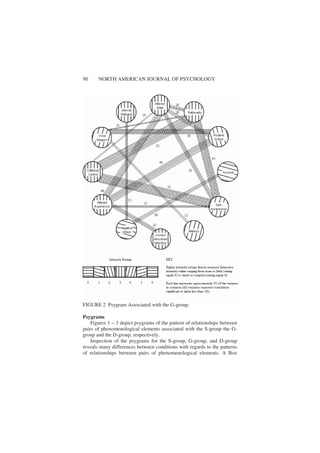
FIGURE 1 Psygram Associated with the S-group.
Hypothesis 3 (a) and 3 (b)
There was not a statistically significant interaction between condition
and CP factor with regards to the combined PCI major or minor
dimensions, F (24, 176) = 1.407, p = .109; Pillai’s trace = .322; p
2
=
.161 and F (28, 172) = 1.132, p = .307; Pillai’s trace = .311; p
2
= .156,
respectively.
90 NORTH AMERICAN JOURNAL OF PSYCHOLOGY
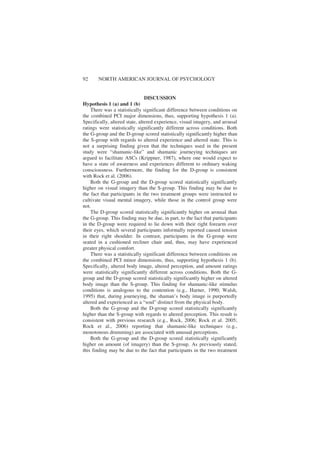
FIGURE 2 Psygram Associated with the G-group.
Psygrams
Figures 1 – 3 depict psygrams of the pattern of relationships between
pairs of phenomenological elements associated with the S-group the G-
group and the D-group, respectively.
Inspection of the psygrams for the S-group, G-group, and D-group
reveals many differences between conditions with regards to the patterns
of relationships between pairs of phenomenological elements. A Box
Rock, Abbott, Childargushi, & Kiehne SHAMANIC CONDITIONS 91
test, however, revealed that there was not a statistically significant
difference between psygrams. Nevertheless, the difference approached
statistical significance, F (156, 24592.60) = 1.359, p = .002; Box M =
256.430.iii
FIGURE 3 Psygram Associated with the D-group.
92 NORTH AMERICAN JOURNAL OF PSYCHOLOGY
DISCUSSION
Hypothesis 1 (a) and 1 (b)
There was a statistically significant difference between conditions on
the combined PCI major dimensions, thus, supporting hypothesis 1 (a).
Specifically, altered state, altered experience, visual imagery, and arousal
ratings were statistically significantly different across conditions. Both
the G-group and the D-group scored statistically significantly higher than
the S-group with regards to altered experience and altered state. This is
not a surprising finding given that the techniques used in the present
study were “shamanic-like” and shamanic journeying techniques are
argued to facilitate ASCs (Krippner, 1987), where one would expect to
have a state of awareness and experiences different to ordinary waking
consciousness. Furthermore, the finding for the D-group is consistent
with Rock et al. (2006).
Both the G-group and the D-group scored statistically significantly
higher on visual imagery than the S-group. This finding may be due to
the fact that participants in the two treatment groups were instructed to
cultivate visual mental imagery, while those in the control group were
not.
The D-group scored statistically significantly higher on arousal than
the G-group. This finding may be due, in part, to the fact that participants
in the D-group were required to lie down with their right forearm over
their eyes, which several participants informally reported caused tension
in their right shoulder. In contrast, participants in the G-group were
seated in a cushioned recliner chair and, thus, may have experienced
greater physical comfort.
There was a statistically significant difference between conditions on
the combined PCI minor dimensions, thus, supporting hypothesis 1 (b).
Specifically, altered body image, altered perception, and amount ratings
were statistically significantly different across conditions. Both the G-
group and the D-group scored statistically significantly higher on altered
body image than the S-group. This finding for shamanic-like stimulus
conditions is analogous to the contention (e.g., Harner, 1990; Walsh,
1995) that, during journeying, the shaman’s body image is purportedly
altered and experienced as a “soul” distinct from the physical body.
Both the G-group and the D-group scored statistically significantly
higher than the S-group with regards to altered perception. This result is
consistent with previous research (e.g., Rock, 2006; Rock et al. 2005;
Rock et al., 2006) reporting that shamanic-like techniques (e.g.,
monotonous drumming) are associated with unusual perceptions.
Both the G-group and the D-group scored statistically significantly
higher on amount (of imagery) than the S-group. As previously stated,
this finding may be due to the fact that participants in the two treatment
Rock, Abbott, Childargushi, & Kiehne SHAMANIC CONDITIONS 93
groups were instructed to cultivate visual mental imagery, while those in
the control group were not.
Hypothesis 2 (a) and 2 (b)
There was a statistically significant difference between high CP factor
participants versus low CP factor participants with regards to the
combined PCI major scores, thus supporting hypothesis 2 (a).
Specifically, altered experience and altered state ratings differed
significantly between the high and low CP factor groups. Furthermore,
there was a statistically significant difference between high CP factor
participants versus low CP factor participants with regards to the
combined PCI minor scores, thus supporting hypothesis 2 (b).
Specifically, altered body image, altered time sense, altered perception,
and altered meaning ratings differed significantly between the high and
low CP factor groups. These findings are not surprising given that
participants who scored high on the CP factor are predisposed to having
unusual perceptual experiences. These findings also suggest that high CP
factor individuals may be ideal candidates for shamanic training insofar
as shamanism is associated with the production of what have typically
been referred to as ASCs.
Hypotheses 3 (a) and 3 (b)
There was not a statistically significant interaction between condition
and the CP factor with regards to the combined PCI major or minor
scores, thus failing to support hypotheses 3 (a) and 3 (b). These findings
suggest that the effect of the CP factor on phenomenology was, broadly
speaking, the same across all stimulus conditions.
Analysis of Psygrams
There was not a statistically significant difference between psygrams
for each condition. This result suggests that, compared to the S-group,
the G-group and D-Group were not associated with a “major
reorganization in pattern structure that is hypothesized by Tart (1975) to
be associated with an altered state of consciousness” (Woodside et al.,
1997, p. 84). This finding supports Hubbard’s (2003) hypothesis that
“shamanic cognition is not fundamentally different from nonshamanic
cognition” (p. 42). This result is also consistent with Rock et al. (2006).
However, it is noteworthy that the Box test result approached statistical
significance. Consequently, a larger sample size and, thus, greater
statistical power may have led to the detection of a statistically
significant result.
94 NORTH AMERICAN JOURNAL OF PSYCHOLOGY
Possible Methodological Limitations and Suggestions for Future
Research
As previously stated, participants in the D-group were instructed to
place their right forearm over their eyes and many complained that this
was uncomfortable (e.g., “numbness,” “tingling”). Consequently, this
may have compromised participants’ total engagement with the stimulus
condition and, thus, may have influenced, for example, PCI absorption
and arousal dimension scores.
The present study’s sample size (N = 104) was too small to allow
comparisons of very high versus very low CP factor participants within
each condition with regards to phenomenology. It is arguable that by
removing the second and third quartile of the CP factor scores and, thus,
retaining only the extreme CP factor participants, the magnitude of the
treatment effect with regards to phenomenology quantified by the PCI
may have been larger.
Rather than merely consider the effect of the CP factor of the
schizotypy construct on phenomenology, future research may wish to
investigate the impact of the three dimensions of schizotypy (i.e.,
positive, negative, and disorganized) or the individual subscales of the
SPQ (e.g., odd beliefs, suspiciousness). By considering other aspects of
the schizotypy construct, one may be able to account for a greater amount
of variability in phenomenology. Additionally, given the findings of
Harner and Tryon (1995) and the fact that shamanism is traditionally
associated with self-healing (Harner, 1990), it may be useful to examine
the effect of shamanic-like stimulus conditions and schizotypy on
negative mood states (e.g., anxiety, anger, depression, fatigue,
confusion).
Conclusions
Overall, phenomenology associated with shamanic-like techniques
appeared to be statistically significantly different from phenomenology
associated with sitting quietly with eyes open. In contrast, with the
exception of the phenomenological element of arousal, different
shamanic-like techniques (journeying while listening to monotonous
drumming versus journeying while exposed to the Ganzfeld) were
associated with similar phenomenological effects. These results suggest
that Pekala’s (1991) phenomenological methodology is a valuable means
of investigating phenomenology associated with shamanic-like stimulus
conditions. Finally, one’s score on the CP factor of schizotypy appeared
to influence one’s ability to experience alterations in phenomenology.
Consequently, high CP factor individuals may be strong candidates for
shamanic training insofar as shamanism is considered a set of techniques
designed to produce ASCs.
Rock, Abbott, Childargushi, & Kiehne SHAMANIC CONDITIONS 95
REFERENCES
Achterberg, J. (1987). The shaman: Master healer in the imaginary realm. In S.
Nicholson (Ed.), Shamanism: An expanded view of reality (pp. 103-124).
Wheaton, IL: The Theosophical Publishing House.
American Psychiatric Association. (1994). Diagnostic and statistical manual of
mental disorders (4th
ed.). Washington, DC: American Psychiatric
Association.
American Psychological Association. (1992). Ethical principles of psychologists
and code of conduct. American Psychologist, 47, 1597-1611.
Bem, D. J. (1993). The ganzfeld experiment. Journal of Parapsychology, 57,
1001-110.
Bittman, B. B., Berk, L. S., Felten, D. L., Westengard, J., Simonton, C., &
Pappas, J. (2001). Composite effects of group drumming music therapy on
modulation of neuroendocrine-immune parameters in normal subjects.
Alternative Therapies in Health and Medicine, 7, 38-47.
Eliade, M. (1964). Shamanism: Archaic techniques of ecstasy. Princeton:
Bollingen Foundation.
Glicksohn, J. (1992). Subjective time estimation in altered sensory environments.
Environment and Behavior, 24, 634-652.
Harner, M. (1990). The way of the shaman (3rd ed.). San Francisco: Harper &
Row.
Harner, S. D., & Tryon, W. W. (1995). Psychological and immunological
responses to shamanic journeying with drumming. Shaman, 1-2, 89-97.
Heinze, R. I. (1991). Shamans of the 20th century. New York: Irvington.
Hubbard, T. L. (2003). Further correspondences and similarities of shamanism
and cognitive science: Mental representation, implicit processing, and
cognitive structures. Anthropology of Consciousness, 14, 40-74.
Ingerman, S. (2004). Shamanic journeying: A beginner’s guide. Boulder: Sounds
True.
Krippner, S. (1987). Dreams and shamanism. In S. Nicholson (Ed.), Shamanism:
An expanded view of reality (pp. 125-132). Wheaton, IL: The Theosophical
Publishing House.
Krippner, S. (2002). Conflicting perspectives on shamans and shamanism: Points
and counterpoints. American Psychologist, 57 (11), 962-977.
Kumar, V. K., & Pekala, R. J. (1989). Variations in phenomenological experience
as a function of hypnosis and hypnotic susceptibility: A replication. British
Journal of Experimental and Clinical Hypnosis, 36, 80-88.
Noll, R. (1983). Shamanism and schizophrenia: A state specific approach to the
“schizophrenia metaphor” of shamanic states. American Ethnologist, 10,
443-459.
Pekala, R. J. (1985). A psychophenomenological approach to mapping and
diagramming states of consciousness. Journal of Religion and Psychical
Research, 8, 199-214.
Pekala, R. J. (1991). Quantifying consciousness: An empirical approach. New
York: Plenum Press.
Pekala, R. J., Forbes, E., & Contrisciani, P. A. (1989). Assessing the
phenomenological effects of several stress management strategies.
Imagination, Cognition, and Personality, 88, 265-281.
96 NORTH AMERICAN JOURNAL OF PSYCHOLOGY
Pekala, R. J., & Kumar, V. K. (1984). Predicting hypnotic susceptibility by a
self-report phenomenological state instrument. American Journal of Clinical
Hypnosis, 27, 114-121.
Pekala, R. J., & Kumar, V. K. (1986). The differential organization of the
structures of consciousness during hypnosis and a baseline condition.
Journal of Mind and Behavior, 7, 515-540.
Pekala, R. J., & Kumar, V. K. (1989). Phenomenological patterns of
consciousness during hypnosis: Relevance to cognition and individual
differences. Australian Journal of Clinical and Experimental Hypnosis, 17,
1-20.
Pekala, R. J., Steinberg, J., & Kumar, C. K. (1986). Measurement of
phenomenological experience: Phenomenology of consciousness inventory.
Perceptual and Motor Skills, 63, 983-989.
Pekala, R. J., & Wenger, C. F. (1983). Retrospective phenomenological
assessment: Mapping consciousness in reference to specific stimulus
conditions. Journal of Mind and Behavior, 4, 247-274.
Raine, A. (1991). The SPQ: A scale for the assessment of Schizotypal Personality
based on DSM-III-R criteria. Schizophrenia Bulletin, 17, 555-564.
Ripinsky-Naxon, M. (1993). The nature of shamanism. Albany: State University
of New York Press.
Rock, A. J. (2006). Phenomenological analysis of experimentally induced visual
mental imagery associated with shamanic journeying to the lower world.
International Journal of Transpersonal Studies, 25, 45-55.
Rock, A. J., Baynes, P. B., & Casey, P. J. (2005). Experimental study of
ostensibly shamanic journeying imagery in naive participants I:
Antecedents. Anthropology of Consciousness, 16 (2), 72-92.
Rock, A. J., Casey, P. J., & Baynes, P. B. (2006). Experimental study of
ostensibly shamanic journeying imagery in naive participants II:
Phenomenological mapping and modified affect bridge. Anthropology of
Consciousness, 17 (1), 65-83
Tabachnick, B. G., & Fidell, L. S. (2007). Using multivariate statistics (5th ed.).
Boston: Pearson.
Walsh, R. (1989). What is a shaman? Definition, origin and distribution. The
Journal of Transpersonal Psychology, 21, 1-11.
Walsh, R. (1995). Phenomenological mapping: A method for describing and
comparing states of consciousness. The Journal of Transpersonal
Psychology, 27, 25-56.
Woodside, L., Kumar, V. K., & Pekala, R. (1997). Monotonous percussion
drumming and trance postures: A controlled evaluation of
phenomenological effects. Anthropology of Consciousness, 8, 69-87.
Wright, P. A. (1989). The nature of the shamanic state of consciousness: A
review. Journal of Psychoactive Drugs, 21 (1), 25-33.
Endnotes
i
Monotonous drumming at 8 beats-per-second for 15 minutes was used
in the present study because Rock et al. (2005) found that that it was
Rock, Abbott, Childargushi, & Kiehne SHAMANIC CONDITIONS 97
associated with a statistically significantly higher number of ostensibly
shamanic journeying images reported by non-shamans compared to a
control condition, whereas, for example, 4 beats-per-second for 10 or 15
minutes and 8 beats-per-second for 10 minutes were not.
ii
A median split was preferred to a mean split for distinguishing between
SPQ Cognitive-Perceptual Factor high and low scorers primarily
because, with 6 cells in the MANOVAs and a relatively small sample
size, it was important that the cell sizes were as equal as possible.
iii
The Box Test is typically held to be overly sensitive with regards to the
detection of differences between independent correlation matrices.
Consequently, convention dictates that the alpha level associated with the
Box Test should be set at p < .001 (Tabachnick & Fidell, 2007).
Research Paper

Research Paper

  • 1.
    Author info: Correspondenceshould be sent to: Adam J. Rock, Ph.D. School of Psychology, Deakin University, Burwood, VIC, 3125, Australia. email: rock@deakin.edu.au North American Journal of Psychology, 2008, Vol. 10, No. 1, 79-98. © NAJP The Effect of Shamanic-like Stimulus Conditions and the Cognitive-perceptual Factor of Schizotypy on Phenomenology Adam J. Rock, Gavin R. Abbott Hatun Childargushi, & Melanie L. Kiehne Deakin University, Melbourne, Victoria, Australia Shamanism has remained an integral part of indigenous healing rituals since ancient times and is currently attracting interest as a complementary therapeutic technique in psychology. Recently, shamanic-like techniques have been used to facilitate changes in the phenomenology of non- shamans. However, such research has largely been delimited to a single shamanic-like technique (i.e., drumming), and the role of personality traits with regards to receptivity to this technique has been neglected. The purpose of the present study was to investigate experimentally the effect of different shamanic-like techniques and the cognitive-perceptual factor of the schizotypy construct on phenomenology. One hundred and four non-shamans were randomly assigned to one of three conditions: Drumming, Ganzfeld, or Sitting Quietly with Eyes Open. Participants’ phenomenology was assessed using the Phenomenology of Consciousness Inventory. Phenomenology associated with shamanic-like techniques appeared to be statistically significantly different from phenomenology associated with sitting quietly with eyes open. Furthermore, high cognitive-perceptual participants reported significant alterations in phenomenology compared to their low cognitive-perceptual counterparts. Methodological shortcomings of the present study are discussed and suggestions for future research are advanced. Shamanism may be defined as “a family of traditions whose practitioners focus on voluntarily entering altered states of consciousness in which they experience themselves, or their spirit(s), traveling to other realms at will and interacting with other entities in order to serve their community” (Walsh, 1989, p. 5). While no single definition will appeal to all scholars (Walsh, 1995), this one emphasizes several integral features of shamanism. First, it describes shamanism as a set of techniques (e.g., listening to monotonous drumming) designed to facilitate purported alterations in consciousness (see Krippner, 2002), rather than a religious tradition (e.g., Eliade, 1964). Second, the definition highlights the volitional control of the practitioner; that is, the shaman’s ability to enter and exit altered states of consciousness (ASCs)
  • 2.
    80 NORTH AMERICANJOURNAL OF PSYCHOLOGY at will and limited mastery with regards to the phenomenological content of the ASCs. Third, the definition’s reference to the practitioner’s spirit “traveling to other realms” (Walsh, 1989, p. 5) underscores the commonly accepted view (e.g., Heinze, 1991; Ripinsky-Naxon, 1993) that an ASC referred to as “ecstatic journeying” or simply “shamanic journeying” (i.e., out-of-body experiences or soul flight) constitutes a core aspect of shamanism (Krippner, 2002). Finally, the practitioner’s commitment to serve the interests of the community highlights the social- role function of shamanism (see, for example, Noll, 1983; Wright, 1989). It is noteworthy that shamanism has remained an integral part of indigenous healing rituals since ancient times and is currently attracting increasing interest as a complementary therapeutic technique in the disciplines of psychology and medicine (Bittman et al., 2001). For example, Harner and Tryon (1995) found that shamanic practitioners reported statistically significantly lower mood disturbance (e.g., depression, tension-anxiety) scores after journeying with monotonous drumming relative to baseline. Consequently, given that the principles of shamanism may prove pertinent to clinical psychologists (Krippner, 2002) it may be prudent to investigate the phenomenological effects of such techniques on non-shamans. Indeed, there has been a recent trend towards investigating experimentally the effect of “shamanic-like” stimulus conditions on non- shamans (e.g., university students; Rock, 2006; Rock, Baynes, & Casey, 2005; Rock, Casey, & Baynes, 2006; Woodside, Kumar, & Pekala, 1997). Techniques may be conceptualized as “shamanic-like” insofar as they bear some relation to shamanic techniques and yet depart from what may properly be called shamanism. For example, listening to monotonous drumming to facilitate soul flight on behalf of one’s community may be considered a shamanic technique, while recreationally listening to monotonous drumming to facilitate purported shifts in consciousness is merely “shamanic-like.” It is perhaps salient that the majority of experimental studies using shamanic-like stimulus conditions have focused on the phenomenological effects of monotonous drumming (e.g., Rock et al., 2005; Rock et al., 2006; Woodside et al., 1997). For example, Rock et al. (2006) found that non-shamans administered monotonous drumming while “journeying” reported statistically significant alterations in phenomenology (i.e., fear, altered state of awareness, arousal) compared to a control condition (i.e., sitting quietly with eyes open). Historically, however, shamanic practitioners have used various technologies (e.g., plant hallucinogens, perceptual deprivation, ritualistic dancing) to elicit shamanic journeying experiences (Achterberg, 1987). Consequently, it may prove edifying to assess which phenomenological effects of
  • 3.
    Rock, Abbott, Childargushi,& Kiehne SHAMANIC CONDITIONS 81 monotonous drumming may be replicated by other shamanic-like stimulus conditions. One potentially useful technique is the Ganzfeld (“total field”) which may be defined, in broad terms, as a “homogeneous perceptual environment” (Bem, 1993, p. 102). Specifically, the Ganzfeld consists of an undifferentiated visual field created by viewing a red light through halved translucent ping-pong balls taped over one’s eyes. Additionally, an analogous auditory field is produced by listening to stereophonic white noise (i.e., a monotonous hissing sound; Bem, 1993). In a recent experimental study, Rock (2006) found that non-shamans administered journeying instructions during exposure to the Ganzfeld reported shamanic-like motifs (e.g., battles with predatory creatures). Furthermore, little is known about individual susceptibility to shamanic-like techniques (Harner & Tryon, 1995). Various personality traits may be associated with receptivity to shamanic-like experiences and, thus, alterations in phenomenology (e.g., mood). One potentially relevant personality trait is schizotypy or the schizotypal personality trait. Schizotypal Personality Disorder (SPD), which represents an excess of schizotypal personality features, is characterized by a “pervasive pattern of social and interpersonal deficits marked by acute discomfort with, and reduced capacity for, close relationships as well as by cognitive or perceptual distortions and eccentricities of behavior” (APA, 1994, p. 645). Through factor analysis, Raine (1991) proposed three dimensions of schizotypal personality: (1) cognitive-perceptual (positive schizotypy; e.g., unusual perceptual experience, magical thinking); (2) interpersonal (negative schizotypy; e.g., social anxiety and constricted affect); and (3) disorganization (e.g., odd speech and behavior). As previously stated, shamanic-like journeying experiences consist of alterations in phenomenology relative to normal waking consciousness (Rock et al., 2005; Rock et al., 2006). Consequently, it is arguable that those who score high on the cognitive perceptual factor – and are, thus, predisposed to having unusual perceptual experiences – may be susceptible to shamanic-like stimulus conditions and, thus, shamanic-like journeying experiences. Shamanic-like experiences may be quantified using a methodology that was developed by Pekala (1985) to “operationally define, map and diagram states and altered states of consciousness” (p. 207). The methodology consists, in part, of a novel retrospective phenomenological assessment instrument referred to as the Phenomenology of Consciousness Inventory (PCI; Pekala, 1991). The PCI is a 53-item questionnaire consisting of 12 major dimensions or phenomenological (i.e., subjective) elements (e.g., positive affect, altered experience, visual imagery, rationality), and 14 minor dimensions (e.g., fear, joy, altered
  • 4.
    82 NORTH AMERICANJOURNAL OF PSYCHOLOGY body image, absorption). One may operationally define or “map” states of consciousness and ASCs by quantifying: (1) the intensity of each phenomenological element; and (2) the strength of relationships between pairs of phenomenological elements. Furthermore, one may use PCI data to construct graphs referred to as “psygrams” that pictorially represent the intensity and pattern of relationships between pairs of phenomenological elements derived from a squared correlation matrix (Pekala, 1991). The PCI has been used to map and diagram phenomenology facilitated by, for example, progressive relaxation (e.g., Pekala, Forbes, & Contrisciani, 1989), hypnosis (e.g., Kumar & Pekala, 1989; Pekala & Kumar, 1984, 1986, 1989), and sitting quietly with eyes closed (e.g., Pekala & Kumar, 1989). Recent experimental research (e.g., Rock et al., 2005; Rock et al., 2006; Woodside et al., 1997) has applied this methodology to shamanic-like journeying experiences. However, to date, no published studies have applied Pekala’s (1985) methodology to map the phenomenological effects of: (1) a Ganzfeld stimulus condition; and (2) the cognitive-perceptual factor of the schizotypy construct. In light of the literature reviewed, the present study was conducted with three aims: (1) to determine if there were differences between a control condition and two shamanic-like stimulus conditions with regards to phenomenology; (2) to determine if there were differences between persons high and low on the cognitive-perceptual factor of schizotypy with regards to phenomenology; and (3) to determine if there was an interaction between condition and the cognitive-perceptual factor with regards to phenomenology. The present study consisted of a between-subjects design with three conditions: (1) a control condition consisting of sitting quietly with eyes open for 15 minutes (S-group); (2) listening to shamanic-like journeying instructions followed by 15 minutes of white noise, while viewing diffuse red light (G-group); and (3) listening to shamanic-like journeying instructions followed by 15 minutes of listening to monotonous drumming at 8-beats-per-second (D-group).i This study’s design allowed investigation of three related hypotheses: There should be a difference between treatment and control conditions with regards to: (a) the combined PCI major dimensions scores; and (b) the combined PCI minor dimension scores. There should be a difference between high cognitive-perceptual factor participants versus low cognitive-perceptual factor participants with regards to: (a) the combined PCI major dimension scores; and (b) the combined PCI minor dimension scores. Condition should interact with the cognitive-perceptual factor with regards to: (a) the combined PCI major dimensions scores; and (b) the combined PCI minor dimension scores.
  • 5.
    Rock, Abbott, Childargushi,& Kiehne SHAMANIC CONDITIONS 83 METHOD Participants One hundred and four participants (30 males and 74 females) volunteered for the present study. Ages ranged from 18 to 49 years (M = 23.38 yrs., SD = 5.36). Initially, undergraduate psychology students from Deakin University were recruited at a number of brief information sessions held during lectures and tutorials. Subsequently, volunteers were recruited using posters and consisted of students from other courses and universities as well as non-students. All participants were treated in accordance with the ethical guidelines pertaining to research involving human participants (American Psychological Association, 1992). Materials Participants were provided with a pencil and paper pre-condition questionnaire and post-condition questionnaire. The pre-condition questionnaire consisted of: (1) demographic items (e.g., age, gender); and (2) the Schizotypal Personality Questionnaire. The post-condition questionnaire consisted of the Phenomenology of Consciousness Inventory. The Schizotypal Personality Questionnaire (SPQ; Raine, 1991) is a 74-item self-report questionnaire that constitutes a non-clinical measure of Schizotypal Personality Disorder (APA, 1994). The SPQ produces a total scale score and scores for each of nine subscales: Ideas of Reference, Excessive Social Anxiety, Odd Beliefs or Magical Thinking, Unusual Perceptual Experiences, Odd or Eccentric Behavior, No Close Friends, Odd Speech, Constricted Affect, and Suspiciousness. Furthermore, Raine (1991) states that the factor analytic structure of the SPQ consists of three dimensions: Cognitive-Perceptual (positive schizotypy; e.g., unusual perceptual experience, magical thinking); Interpersonal (negative schizotypy; e.g., social anxiety and constricted affect); and Disorganization (e.g., odd speech and behavior). In the present study, a median-splitii was performed on participants’ Cognitive- Perceptual (CP) factor scores and, subsequently, participants who scored greater than the median were allocated to the CP-High group, while participants who scored below the median were allocated to the CP-Low group. The SPQ possesses excellent reliability for the total scale score (0.91) and good reliabilities for the nine subscales (ranging from 0.71 to 0.78), as well as good test-retest reliability (0.82) over a two-month period (Raine, 1991). Findings suggest that the SPQ possesses discriminant validity, and the SPQ and its subscales possess criterion validity (Raine, 1991). The Phenomenology of Consciousness Inventory (PCI; Pekala, 1991) is a 53-item scale used to assess the phenomenological effects of different stimulus conditions (e.g., hypnosis, meditation). The PCI
  • 6.
    84 NORTH AMERICANJOURNAL OF PSYCHOLOGY contains 26 (sub) dimensions including 12 major dimensions (positive affect, negative affect, altered experience, visual imagery, attention, self awareness, altered state of awareness, internal dialogue, rationality, volitional control, memory, and arousal), and 14 minor dimensions (joy, sexual excitement, love, anger, sadness, fear, altered body image, altered time sense, altered perception, altered or unusual meaning, amount of imagery, vividness of imagery, direction of attention, and absorption) (Pekala, 1985). Participants are asked to respond to each item on a seven- point Likert scale (Pekala & Wenger, 1983). The PCI has respectable psychometric properties (e.g., Pekala, 1991). For example, the PCI has been shown to reliably discriminate between qualitatively different states of consciousness (thus supporting the scale’s criterion validity), and has demonstrated good internal consistency, yielding coefficient alphas between .70 and .90 (Pekala, Steinberg, & Kumar, 1986). For the D-group, 15 minutes of monotonous drumming (8bps) and approximately five minutes of journeying instructions were recorded onto a CD-R. The drumming was performed using a mylar-covered single-headed round frame drum 16” in diameter and two “sonar 8” tympani mallets. The audio track was played through a set of headphones (Sony MDR CD780) via a laptop. For the G-group, a pair of goggles constructed from halved ping-pong balls coupled with 7 lamps fitted with opaque 25-watt red light bulbs were used to create a homogeneous visual field (see Glicksohn, 1992; Rock, 2006). Fifteen minutes of stereophonic white noise and approximately five minutes of journeying instructions were recorded onto a CD-R. (The white noise was used to produce a homogeneous auditory field.) The track was played through a set of headphones (Sony MDR CD780) via a laptop. Procedure All experiments were conducted in the same laboratory at Deakin University, Melbourne. The room was blacked-out for experimental purposes and maintained at a comfortable temperature. All participants were required to read a plain language statement explaining the general nature and requirements of the study, and sign a consent form. Subsequently, participants were administered a composite questionnaire containing demographic items and the SPQ. After completing the questionnaire participants were randomly assigned to one of three conditions: 1. D-group. Following Harner (1990), participants in this condition were instructed to lie on the floor, placing their right forearm over their eyes. Subsequently, participants were instructed as follows:
  • 7.
    Rock, Abbott, Childargushi,& Kiehne SHAMANIC CONDITIONS 85 Shortly, we are going to attempt to visualize certain images while listening to drumming. But, for now, I’d like you to visualize a particular location or object in nature that will help you travel upward… that you remember from some time in your life. It can be a location you remember from your childhood, or one you saw last week, or even today. Any kind of location will do. For example, you can see yourself climbing up a tree, rope, or ladder; jumping from the top of a mountain; rising up on a tornado or a whirlwind; climbing over a rainbow; going up with the smoke of a fire or through a chimney; or finding a bird to take you up. The right location or object is one that really feels comfortable to you, and one which you can visualize. Spend a couple of minutes seeing the location or object without using it. Note its details clearly (Adapted from Ingerman, 2004). Participants were, subsequently, allocated two minutes to visualize their chosen “object or location in nature.” At the conclusion of the 2- minute period participants were instructed as follows: When the drumming begins, visualize your familiar location or object and begin the journey upwards. You will pass through a transition, such as a cloud or a layer of fog, that will indicate that you have arrived at your destination. If you are still seeing planets and stars as you journey upward, you have not yet reached your destination. Again, you will know that you have reached your destination because of the sensation of having passed through a threshold of some kind, after which the landscape will change. Examine the landscape in detail, travel through it, and remember its features. Explore until you are signaled to come back, and then return by traveling down using your particular location or object. Do not bring anything back with you; this is only an exploratory journey. Towards the end of the journey, the drum will be struck sharply four times to signal to you that it is time to return. The drum tempo will then become very rapid for the next half a minute to accompany you on your return journey. The session will conclude with four more sharp strikes of the drum to signal that the journey is over. Are you ready to begin the journey? Okay, here we go (Adapted from Ingerman, 2004). After being administered the instructions, participants listened to 15 minutes of monotonous drumming at 8-beats-per-second. At the conclusion of the 15-minute period the drum was struck “sharply four times to signal” to all participants that it was time to return. Subsequently, the drum beat became “very rapid for about half a minute to accompany...” participants “...on their return journey” (Harner, 1990, p. 32). 2. G-group. Participants were instructed the same as the D-group with the exception that all references to “drumming” were replaced with “a hissing sound.” Participants were equipped with a pair of opaque goggles and exposed to a Ganzfeld for 15 minutes.
  • 8.
    86 NORTH AMERICANJOURNAL OF PSYCHOLOGY 3. S-group. Participants in the control condition were requested to sit quietly with their eyes open for 15 minutes. After the completion of the treatment and control procedures, all participants were administered the post-condition questionnaire consisting of the PCI. RESULTS To address hypotheses 1 to 3, and to avoid violating the assumption of multi-collinearity, separate multivariate analyses were performed on the PCI major and minor dimension scores (Woodside et al., 1997). TABLE 1 PCI Major and Minor Dimension Differences between Means of each Condition 1 2 3 Post PCI Dimension S- Group G- Group D- Group F p p 2 Hoc M M M Positive Affect 1.85 2.29 1.99 1.248 .292 .025 Joy 1.85 2.79 2.27 5.140 .008 .095 Sexual Excitement 1.26 1.10 0.80 0.548 .580 .011 Love 2.41 2.94 2.42 0.939 .394 .019 Negative Affect 0.95 0.78 1.14 1.641 .199 .032 Anger 0.93 0.60 1.12 2.906 .059 .056 Sadness 1.33 1.02 1.08 1.003 .370 .020 Fear 0.59 0.62 1.12 3.755 .027 .071 Altered Experience 1.90 2.89 2.78 13.627 .000 .218 1, 2; 1, 3 Body Image 1.98 2.86 2.66 6.677 .002 .120 1, 2; 1, 3 Time Sense 3.07 3.61 3.63 3.274 .042 .063 Perception 1.17 2.95 2.78 25.638 .000 .343 1, 2; 1, 3 Meaning 1.38 2.12 2.06 5.548 .005 .102 Visual Imagery 3.25 4.17 3.95 7.882 .001 .139 1, 2; 1,3 Amount 3.38 4.56 4.25 8.959 .000 .155 1, 2; 1, 3 Vividness 3.15 3.78 3.60 3.641 .030 .069 Attention 3.16 3.05 2.84 0.785 .459 .016 Direction 3.31 3.35 3.37 0.099 .906 .002 Absorption 3.04 2.75 2.37 1.413 .248 .028 Self-Awareness 4.14 3.55 3.91 2.348 .101 .046 Altered State 1.73 3.16 3.46 23.559 .000 .325 1, 2; 1, 3 Internal Dialogue 3.55 3.32 3.33 0.283 .754 .006 Rationality 4.17 3.54 3.48 2.843 .063 .055 Volitional Control 3.75 3.22 3.18 1.705 .187 .034 Memory 4.37 4.53 4.24 0.150 .860 .003 Arousal 1.91 1.29 2.32 6.800 .002 .122 2, 3
  • 9.
    Rock, Abbott, Childargushi,& Kiehne SHAMANIC CONDITIONS 87 Hypothesis 1 (a) A two-way between-subjects multivariate analysis of variance (MANOVA) was conducted with condition and CP factor (high/low) as independent variables (IVs) and the 12 PCI major dimensions as dependent variables (DVs). A statistically significant difference was found between conditions with regards to the combined PCI major dimension variables, F (24, 176) = 3.465, p = .0001; Pillai’s trace = .642; partial eta squared ( p 2 ) = .321, thus, supporting hypothesis 1 (a). After Bonferroni adjustments (adjusted alpha = .004), separate univariate analyses revealed statistically significant results for altered experience, p = .0001; visual imagery, p = .001; altered state, p = .0001; and arousal, p = .002. As can be seen from Table 1, the S-group reported statistically significantly lower altered experience, visual imagery, and altered state intensity ratings compared to both the G-group and the D-group; and the G-group reported statistically significantly lower arousal intensity ratings than the D-group. Hypothesis 1 (b) A separate two-way between-subjects MANOVA was conducted with condition and CP factor as IVs and the 14 PCI minor dimensions as DVs. A statistically significant difference was found between conditions with regards to the combined PCI minor dimension variables, F (28, 172) = 3.304, p = .0001; Pillai’s trace = .700; p 2 = .350, thus, supporting hypothesis 1 (b). After Bonferroni adjustments (adjusted alpha = .004), separate univariate analyses revealed statistically significant results for body image, p = .002; perception, p = .0001; and amount, p = .0001. As can be seen from Table 1, the S-group reported statistically significantly lower body image, perception, and amount intensity ratings compared to both the G-group and the D-group. Hypothesis 2 (a) A statistically significant difference was also found between the CP factor high and low scorers with regards to the combined PCI major dimension variables, F (12, 87) = 2.734, p = .003; Pillai’s trace = .274; p 2 = .274, thus, supporting hypothesis 2 (a). After Bonferroni adjustments (adjusted alpha = .004), separate univariate analyses revealed statistically significant results for altered experience, p = .0001, and altered state, p = .001. As can be seen from Table 2, the CP-Low group reported statistically significantly lower altered experience and altered state intensity ratings compared to the CP-High group.
  • 10.
    88 NORTH AMERICANJOURNAL OF PSYCHOLOGY TABLE 2 PCI Major and Minor Dimension Differences between Means of High and Low Scorers on the CP Factor 1 2 PCI Dimension CP-Low CP-High F p p 2 M M Positive Affect 1.82 2.15 2.866 .094 .028 Joy 2.15 2.40 1.59 .210 .016 Sexual Excitement 0.76 1.37 4.936 .029 .048 Love 2.54 2.63 0.177 .675 .002 Negative Affect 0.93 0.97 0.127 .722 .001 Anger 0.90 0.85 0.035 .853 .000 Sadness 1.12 1.19 0.093 .761 .001 Fear 0.66 0.83 1.459 .230 .015 Altered Experience 2.07 2.86 24.928 .000 .203 Body Image 2.04 2.85 16.677 .000 .145 Time Sense 2.99 3.80 11.955 .001 .109 Perception 1.82 2.58 17.266 .000 .150 Meaning 1.42 2.19 15.132 .000 .134 Visual Imagery 3.55 3.95 5.120 .026 .050 Amount 3.79 4.22 4.093 .046 .040 Vividness 3.28 3.68 4.473 .037 .044 Attention 3.08 2.98 0.245 .622 .002 Direction 3.57 3.12 3.807 .054 .037 Absorption 2.61 2.88 0.986 .323 .010 Self-Awareness 4.00 3.77 1.772 .186 .018 Altered State 2.37 2.99 11.659 .001 .106 Internal Dialogue 3.41 3.42 0.006 .936 .000 Rationality 3.98 3.56 3.179 .078 .031 Volitional Control 3.60 3.23 1.987 .162 .020 Memory 4.29 4.48 1.747 .189 .018 Arousal 1.89 1.77 0.510 .477 .005 Hypothesis 2 (b) A statistically significant difference was also found between CP factor high and low scorers with regards to the combined PCI minor dimension variables, F (14, 85) = 2.824, p = .002; Pillai’s trace = .317; p 2 = .317, thus, supporting hypothesis 2 (b). After Bonferroni adjustments (adjusted alpha = .004), separate univariate analyses revealed statistically significant results for body image, p = .0001; time sense, p = .001; perception, p = .0001; and meaning, p = .0001. As can be seen from Table 2, the CP-Low group reported statistically significantly lower body image, time sense, perception, and meaning intensity ratings compared to the CP-High group.
  • 11.
    Rock, Abbott, Childargushi,& Kiehne SHAMANIC CONDITIONS 89 FIGURE 1 Psygram Associated with the S-group. Hypothesis 3 (a) and 3 (b) There was not a statistically significant interaction between condition and CP factor with regards to the combined PCI major or minor dimensions, F (24, 176) = 1.407, p = .109; Pillai’s trace = .322; p 2 = .161 and F (28, 172) = 1.132, p = .307; Pillai’s trace = .311; p 2 = .156, respectively.
  • 12.
    90 NORTH AMERICANJOURNAL OF PSYCHOLOGY FIGURE 2 Psygram Associated with the G-group. Psygrams Figures 1 – 3 depict psygrams of the pattern of relationships between pairs of phenomenological elements associated with the S-group the G- group and the D-group, respectively. Inspection of the psygrams for the S-group, G-group, and D-group reveals many differences between conditions with regards to the patterns of relationships between pairs of phenomenological elements. A Box
  • 13.
    Rock, Abbott, Childargushi,& Kiehne SHAMANIC CONDITIONS 91 test, however, revealed that there was not a statistically significant difference between psygrams. Nevertheless, the difference approached statistical significance, F (156, 24592.60) = 1.359, p = .002; Box M = 256.430.iii FIGURE 3 Psygram Associated with the D-group.
  • 14.
    92 NORTH AMERICANJOURNAL OF PSYCHOLOGY DISCUSSION Hypothesis 1 (a) and 1 (b) There was a statistically significant difference between conditions on the combined PCI major dimensions, thus, supporting hypothesis 1 (a). Specifically, altered state, altered experience, visual imagery, and arousal ratings were statistically significantly different across conditions. Both the G-group and the D-group scored statistically significantly higher than the S-group with regards to altered experience and altered state. This is not a surprising finding given that the techniques used in the present study were “shamanic-like” and shamanic journeying techniques are argued to facilitate ASCs (Krippner, 1987), where one would expect to have a state of awareness and experiences different to ordinary waking consciousness. Furthermore, the finding for the D-group is consistent with Rock et al. (2006). Both the G-group and the D-group scored statistically significantly higher on visual imagery than the S-group. This finding may be due to the fact that participants in the two treatment groups were instructed to cultivate visual mental imagery, while those in the control group were not. The D-group scored statistically significantly higher on arousal than the G-group. This finding may be due, in part, to the fact that participants in the D-group were required to lie down with their right forearm over their eyes, which several participants informally reported caused tension in their right shoulder. In contrast, participants in the G-group were seated in a cushioned recliner chair and, thus, may have experienced greater physical comfort. There was a statistically significant difference between conditions on the combined PCI minor dimensions, thus, supporting hypothesis 1 (b). Specifically, altered body image, altered perception, and amount ratings were statistically significantly different across conditions. Both the G- group and the D-group scored statistically significantly higher on altered body image than the S-group. This finding for shamanic-like stimulus conditions is analogous to the contention (e.g., Harner, 1990; Walsh, 1995) that, during journeying, the shaman’s body image is purportedly altered and experienced as a “soul” distinct from the physical body. Both the G-group and the D-group scored statistically significantly higher than the S-group with regards to altered perception. This result is consistent with previous research (e.g., Rock, 2006; Rock et al. 2005; Rock et al., 2006) reporting that shamanic-like techniques (e.g., monotonous drumming) are associated with unusual perceptions. Both the G-group and the D-group scored statistically significantly higher on amount (of imagery) than the S-group. As previously stated, this finding may be due to the fact that participants in the two treatment
  • 15.
    Rock, Abbott, Childargushi,& Kiehne SHAMANIC CONDITIONS 93 groups were instructed to cultivate visual mental imagery, while those in the control group were not. Hypothesis 2 (a) and 2 (b) There was a statistically significant difference between high CP factor participants versus low CP factor participants with regards to the combined PCI major scores, thus supporting hypothesis 2 (a). Specifically, altered experience and altered state ratings differed significantly between the high and low CP factor groups. Furthermore, there was a statistically significant difference between high CP factor participants versus low CP factor participants with regards to the combined PCI minor scores, thus supporting hypothesis 2 (b). Specifically, altered body image, altered time sense, altered perception, and altered meaning ratings differed significantly between the high and low CP factor groups. These findings are not surprising given that participants who scored high on the CP factor are predisposed to having unusual perceptual experiences. These findings also suggest that high CP factor individuals may be ideal candidates for shamanic training insofar as shamanism is associated with the production of what have typically been referred to as ASCs. Hypotheses 3 (a) and 3 (b) There was not a statistically significant interaction between condition and the CP factor with regards to the combined PCI major or minor scores, thus failing to support hypotheses 3 (a) and 3 (b). These findings suggest that the effect of the CP factor on phenomenology was, broadly speaking, the same across all stimulus conditions. Analysis of Psygrams There was not a statistically significant difference between psygrams for each condition. This result suggests that, compared to the S-group, the G-group and D-Group were not associated with a “major reorganization in pattern structure that is hypothesized by Tart (1975) to be associated with an altered state of consciousness” (Woodside et al., 1997, p. 84). This finding supports Hubbard’s (2003) hypothesis that “shamanic cognition is not fundamentally different from nonshamanic cognition” (p. 42). This result is also consistent with Rock et al. (2006). However, it is noteworthy that the Box test result approached statistical significance. Consequently, a larger sample size and, thus, greater statistical power may have led to the detection of a statistically significant result.
  • 16.
    94 NORTH AMERICANJOURNAL OF PSYCHOLOGY Possible Methodological Limitations and Suggestions for Future Research As previously stated, participants in the D-group were instructed to place their right forearm over their eyes and many complained that this was uncomfortable (e.g., “numbness,” “tingling”). Consequently, this may have compromised participants’ total engagement with the stimulus condition and, thus, may have influenced, for example, PCI absorption and arousal dimension scores. The present study’s sample size (N = 104) was too small to allow comparisons of very high versus very low CP factor participants within each condition with regards to phenomenology. It is arguable that by removing the second and third quartile of the CP factor scores and, thus, retaining only the extreme CP factor participants, the magnitude of the treatment effect with regards to phenomenology quantified by the PCI may have been larger. Rather than merely consider the effect of the CP factor of the schizotypy construct on phenomenology, future research may wish to investigate the impact of the three dimensions of schizotypy (i.e., positive, negative, and disorganized) or the individual subscales of the SPQ (e.g., odd beliefs, suspiciousness). By considering other aspects of the schizotypy construct, one may be able to account for a greater amount of variability in phenomenology. Additionally, given the findings of Harner and Tryon (1995) and the fact that shamanism is traditionally associated with self-healing (Harner, 1990), it may be useful to examine the effect of shamanic-like stimulus conditions and schizotypy on negative mood states (e.g., anxiety, anger, depression, fatigue, confusion). Conclusions Overall, phenomenology associated with shamanic-like techniques appeared to be statistically significantly different from phenomenology associated with sitting quietly with eyes open. In contrast, with the exception of the phenomenological element of arousal, different shamanic-like techniques (journeying while listening to monotonous drumming versus journeying while exposed to the Ganzfeld) were associated with similar phenomenological effects. These results suggest that Pekala’s (1991) phenomenological methodology is a valuable means of investigating phenomenology associated with shamanic-like stimulus conditions. Finally, one’s score on the CP factor of schizotypy appeared to influence one’s ability to experience alterations in phenomenology. Consequently, high CP factor individuals may be strong candidates for shamanic training insofar as shamanism is considered a set of techniques designed to produce ASCs.
  • 17.
    Rock, Abbott, Childargushi,& Kiehne SHAMANIC CONDITIONS 95 REFERENCES Achterberg, J. (1987). The shaman: Master healer in the imaginary realm. In S. Nicholson (Ed.), Shamanism: An expanded view of reality (pp. 103-124). Wheaton, IL: The Theosophical Publishing House. American Psychiatric Association. (1994). Diagnostic and statistical manual of mental disorders (4th ed.). Washington, DC: American Psychiatric Association. American Psychological Association. (1992). Ethical principles of psychologists and code of conduct. American Psychologist, 47, 1597-1611. Bem, D. J. (1993). The ganzfeld experiment. Journal of Parapsychology, 57, 1001-110. Bittman, B. B., Berk, L. S., Felten, D. L., Westengard, J., Simonton, C., & Pappas, J. (2001). Composite effects of group drumming music therapy on modulation of neuroendocrine-immune parameters in normal subjects. Alternative Therapies in Health and Medicine, 7, 38-47. Eliade, M. (1964). Shamanism: Archaic techniques of ecstasy. Princeton: Bollingen Foundation. Glicksohn, J. (1992). Subjective time estimation in altered sensory environments. Environment and Behavior, 24, 634-652. Harner, M. (1990). The way of the shaman (3rd ed.). San Francisco: Harper & Row. Harner, S. D., & Tryon, W. W. (1995). Psychological and immunological responses to shamanic journeying with drumming. Shaman, 1-2, 89-97. Heinze, R. I. (1991). Shamans of the 20th century. New York: Irvington. Hubbard, T. L. (2003). Further correspondences and similarities of shamanism and cognitive science: Mental representation, implicit processing, and cognitive structures. Anthropology of Consciousness, 14, 40-74. Ingerman, S. (2004). Shamanic journeying: A beginner’s guide. Boulder: Sounds True. Krippner, S. (1987). Dreams and shamanism. In S. Nicholson (Ed.), Shamanism: An expanded view of reality (pp. 125-132). Wheaton, IL: The Theosophical Publishing House. Krippner, S. (2002). Conflicting perspectives on shamans and shamanism: Points and counterpoints. American Psychologist, 57 (11), 962-977. Kumar, V. K., & Pekala, R. J. (1989). Variations in phenomenological experience as a function of hypnosis and hypnotic susceptibility: A replication. British Journal of Experimental and Clinical Hypnosis, 36, 80-88. Noll, R. (1983). Shamanism and schizophrenia: A state specific approach to the “schizophrenia metaphor” of shamanic states. American Ethnologist, 10, 443-459. Pekala, R. J. (1985). A psychophenomenological approach to mapping and diagramming states of consciousness. Journal of Religion and Psychical Research, 8, 199-214. Pekala, R. J. (1991). Quantifying consciousness: An empirical approach. New York: Plenum Press. Pekala, R. J., Forbes, E., & Contrisciani, P. A. (1989). Assessing the phenomenological effects of several stress management strategies. Imagination, Cognition, and Personality, 88, 265-281.
  • 18.
    96 NORTH AMERICANJOURNAL OF PSYCHOLOGY Pekala, R. J., & Kumar, V. K. (1984). Predicting hypnotic susceptibility by a self-report phenomenological state instrument. American Journal of Clinical Hypnosis, 27, 114-121. Pekala, R. J., & Kumar, V. K. (1986). The differential organization of the structures of consciousness during hypnosis and a baseline condition. Journal of Mind and Behavior, 7, 515-540. Pekala, R. J., & Kumar, V. K. (1989). Phenomenological patterns of consciousness during hypnosis: Relevance to cognition and individual differences. Australian Journal of Clinical and Experimental Hypnosis, 17, 1-20. Pekala, R. J., Steinberg, J., & Kumar, C. K. (1986). Measurement of phenomenological experience: Phenomenology of consciousness inventory. Perceptual and Motor Skills, 63, 983-989. Pekala, R. J., & Wenger, C. F. (1983). Retrospective phenomenological assessment: Mapping consciousness in reference to specific stimulus conditions. Journal of Mind and Behavior, 4, 247-274. Raine, A. (1991). The SPQ: A scale for the assessment of Schizotypal Personality based on DSM-III-R criteria. Schizophrenia Bulletin, 17, 555-564. Ripinsky-Naxon, M. (1993). The nature of shamanism. Albany: State University of New York Press. Rock, A. J. (2006). Phenomenological analysis of experimentally induced visual mental imagery associated with shamanic journeying to the lower world. International Journal of Transpersonal Studies, 25, 45-55. Rock, A. J., Baynes, P. B., & Casey, P. J. (2005). Experimental study of ostensibly shamanic journeying imagery in naive participants I: Antecedents. Anthropology of Consciousness, 16 (2), 72-92. Rock, A. J., Casey, P. J., & Baynes, P. B. (2006). Experimental study of ostensibly shamanic journeying imagery in naive participants II: Phenomenological mapping and modified affect bridge. Anthropology of Consciousness, 17 (1), 65-83 Tabachnick, B. G., & Fidell, L. S. (2007). Using multivariate statistics (5th ed.). Boston: Pearson. Walsh, R. (1989). What is a shaman? Definition, origin and distribution. The Journal of Transpersonal Psychology, 21, 1-11. Walsh, R. (1995). Phenomenological mapping: A method for describing and comparing states of consciousness. The Journal of Transpersonal Psychology, 27, 25-56. Woodside, L., Kumar, V. K., & Pekala, R. (1997). Monotonous percussion drumming and trance postures: A controlled evaluation of phenomenological effects. Anthropology of Consciousness, 8, 69-87. Wright, P. A. (1989). The nature of the shamanic state of consciousness: A review. Journal of Psychoactive Drugs, 21 (1), 25-33. Endnotes i Monotonous drumming at 8 beats-per-second for 15 minutes was used in the present study because Rock et al. (2005) found that that it was
  • 19.
    Rock, Abbott, Childargushi,& Kiehne SHAMANIC CONDITIONS 97 associated with a statistically significantly higher number of ostensibly shamanic journeying images reported by non-shamans compared to a control condition, whereas, for example, 4 beats-per-second for 10 or 15 minutes and 8 beats-per-second for 10 minutes were not. ii A median split was preferred to a mean split for distinguishing between SPQ Cognitive-Perceptual Factor high and low scorers primarily because, with 6 cells in the MANOVAs and a relatively small sample size, it was important that the cell sizes were as equal as possible. iii The Box Test is typically held to be overly sensitive with regards to the detection of differences between independent correlation matrices. Consequently, convention dictates that the alpha level associated with the Box Test should be set at p < .001 (Tabachnick & Fidell, 2007).