RES JUDICATA (SECTION11)
Section 11 of the Code incorporates the doctrine of res judicata.
It is also called rule of conclusiveness.
‘Res’ means dispute or subject matter and ‘judicata’ means
decided. Thus, res judicata means matter adjudicated.
It means that once the matter is finally decided by the court no
one can reopen it in a subsequent litigation.
The doctrine operates as a ‘bar to the trial of a subsequent suit on
the same cause of action between the same parties.
In other words ‘things once decided by competent courts should
be taken as conclusive truths until they are reversed by any
higher court.
2.
HISTORY
Rule of resjudicata has a very ancient history.
It was known in ancient Hindu Law as Purva Nyaya
(former judgment).
It was well understood by Hindu lawyers and
Mohammedan jurists.
3.
OBJECT OF THEDOCTRINE
The doctrine of res-judicata is based on the following
maxims:
1. Interest Republicac est sit finis litium- It is in the
interest of State that litigation should not be protracted
but finished.
2. Nemo debet bis vexari pro una et eadem causa- No
man ought to be vexed twice for one and the same cause.
3. Res-judicata pro Veritate occipitur- A judicial decision
must be accepted as correct.
4.
CONDITIONS REQUIRED
The followingconditions must be satisfied to constitute a bar of res
judicata:
1. The matter must be directly and substantially in issue in the two
suits.
2. The prior suits must have between the same parties or persons
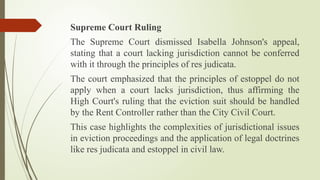
claiming under them.
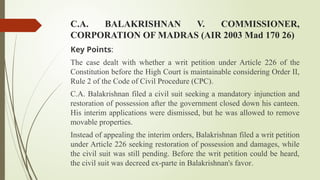
3. Such parties must have litigated under the same title in the former
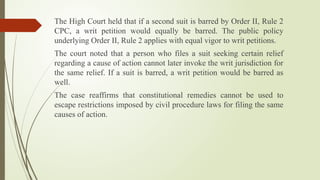
suit.
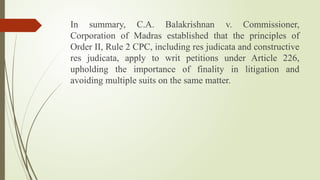
4. The court which determined the earlier suit must be competent to
try the later suit.
5. The questions directly and substantially in issue in the subsequent
suit should have been heard and finally decided in the earlier suit.
5.
1. Matter directlyand substantially in issue
To constitute res-judicata, it is essential that it must have been
directly and substantially in issue as distinguished from
collaterally or incidentally in issue in the former suit.
Directly means directly, at once, immediately without
intervention. Substantially means essentially, materially or
in a substantial manner.
A matter can be said to be substantially in issue if it is of
importance for the decision of a case.
A matter can’t be said to have been directly and substantially in
issue in a suit, unless it was alleged by one party and denied
or admitted, either expressly or by necessary implication, by
the other.
6.
Every suit involvesmatter in respect of which relief is claimed by
the plaintiff.
Such matters are necessarily matters which are directly and
substantially in issue.
However, the suit may also involve matters in respect of which
relief is not claimed but which are brought in issue for the
purpose of deciding matters for which relief is claimed. The latter
class of matters would be collaterally or incidentally in issue.
Example 1: A sues B for the rent of certain land for the year
2001. B’s defence is that no rent is due. Here the claim for rent in
the matter in respect of which the relief is claimed. The claim of
rent is, therefore, a matter directly and substantially in issue.
7.
Example 2: Asues B for possession of certain properties on
the basis of a sale deed in his favour. B impugns the deed as
fictious. The plea is upheld and the suit is dismissed. A
subsequent suit for some other properties on the basis of the
same sale deed is barred as the issue about the fictitious
nature of the sale deed was actually in issue in the former
suit directly and substantially.
Example 3: A sues B for rent. B pleads that lesser rent is
payable because the actual area of the land is lesser than what
is mentioned in their lease-deed. The court, however, finds
that the actual area is greater than the one shown in the lease.
The finding as to excess area is not res-judicata because this
issue was only collaterally or incidentally in issue.
8.
Issue Meaning
Issues meana single material point of fact or law in litigation
that is affirmed by one party and denied by the other party to
the suit and that subject of the final determination of the
proceedings.
Issues are of three kinds:
1. Issue in Fact
2. Issue in Law
3. Issue of Fact and Law
9.
AVTAR SINGH v.JAGJIT SINGH (AIR 1979 SC 1911)
In a suit filed by A in a civil court, a preliminary contention
regarding jurisdiction of the court was taken by B. The
objection was upheld and the plaint was returned to the
plaintiff for presentation to the Revenue Court. When A
approached the Revenue court, it returned the petition holding
that the Revenue court had no jurisdiction.
Once Again, A filed a civil suit in a Civil Court. It was
contended by B that the suit was barred by res-judicata. The
court, though it sympathised with the dilemma wherein the
plaintiff was placed and was driven from pillar to post,
dismissed the suit upholding the contention of the defendant.
10.
The court statedif the defendant does not appear and the
court on its own returns the plaint on the ground of lack of
jurisdiction, the order in a subsequent suit may not operate as
res-judicata but if the defendant appears and an issue is
raised and decided then the decision on the question of
jurisdiction will operate as res-judicata in a subsequent suit
although the reasons for its decision may not be so.
11.
MATHURA PRASAD v.DOSSIBAI (AIR 1971
SC 2355)
A decision on an issue of fact, however erroneous it may be,
constitute res-judicata b/w the parties to the previous suit,
and can’t be reagitated in collateral proceedings.
A mixed issue of law and fact also operate as res judicata.
In this case, question was set regarding how far a decision on
a question of law would operate as res-judicata. Wherein
after considering the case law on the point, the court held
generally a decision of a competent court even on a point of
law operates as res-judicata.
12.
However, a purequestion of law unrelated to facts which
gives rise to a right doesn’t operate as res-judicata. Thus,
where cause of action is different, or when decision relates to
the jurisdiction of a court to try the earlier proceeding, the
decision doesn’t operate as res-judicata.
The view taken by the SC in Mathura Prasad v. Dossibai is
correct. The following observation of Shah, J.C. laid down
the correct principles of law and are therefore, worth
quoting.
13.
The matter inissue, if it is one purely of fact, decided in the
earlier proceeding by a competent court must in a subsequent
litigation b/w the same parties be regarded as finally decided
and cannot be reopened.
A mixed question of law and fact determined in the earlier
proceeding b/w the same parties may not, for the same
reason, be questioned in a subsequent proceeding b/w the
same parties.
But, where the decision is on a question of law i.e. the
interpretation of a statute, it will be res-judicata in a
subsequent proceeding b/w the same-parties where the cause
of action is the same.
14.
Where, however, thequestion is one purely of law and it
relates to the jurisdiction of the court or a decision of a court
sanctioning something which is illegal, by resort to the rule
of res-judicata a party affected by the decision will not be
precluded from challenging the validity of that order under
the rule of res-judicata for a rule of procedure cannot
supersede the law of the land.
15.
GANGABAI v. CHHABUBAI(AIR 1982 SC 20)
A regular suit was filed by A against B for a declaration that
she was the owner of the property and the so-called Sale
Deed said to have been executed by her in favour of B was
not real and genuine, and also for possession of property on
the ground of title.
B contended that he had become the owner of the property
and the decree for arrears of rent had been previously passed
by the court of small causes in his favour, negativating
the contention of A that she was the owner. She had been
held to be the tenant. The subsequent suit, it was contended,
was therefore, barred by doctrine of res judicata.
16.
RES JUDICATA ANDRULE OF LAW
This doctrine is of universal application.
In the historical judgment of Daryao v. State of UP AIR
1967 SC 1457, the SC has placed the doctrine of res-
judicata on a still broader basis.
In that case, the petitioners had filed writ petitions in the
HC of Allahabad U/A 226 of the Constitution and they were
dismissed.
Thereafter, they filed substantive petitions in the SC U/A 32
of the Constitution for the same relief and on the same
ground.
17.
The defendant raiseda preliminary objection regarding
maintainability of the petition by contending that the prior
decision of the HC would operate on res-judicata to a
petition U/A 32.
The SC upheld the contention and dismissed the petitions.
The court observed:
The binding character of judgments pronounced by
courts of competent jurisdiction is itself an essential part
of the Rule of Law, and the Rule of Law obviously is the
basis of the administration of justice.
18.
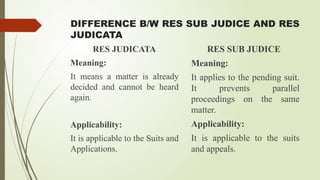
DIFFERENCE B/W RESSUB JUDICE AND RES
JUDICATA
RES JUDICATA
Meaning:
It means a matter is already
decided and cannot be heard
again.
Applicability:
It is applicable to the Suits and
Applications.
RES SUB JUDICE
Meaning:
It applies to the pending suit.
It prevents parallel
proceedings on the same
matter.
Applicability:
It is applicable to the suits
and appeals.
19.
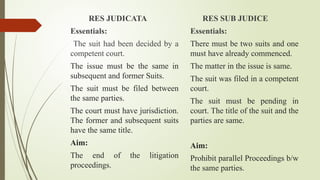
RES JUDICATA
Essentials:
The suithad been decided by a
competent court.
The issue must be the same in
subsequent and former Suits.
The suit must be filed between
the same parties.
The court must have jurisdiction.
The former and subsequent suits
have the same title.
Aim:
The end of the litigation
proceedings.
RES SUB JUDICE
Essentials:
There must be two suits and one
must have already commenced.
The matter in the issue is same.
The suit was filed in a competent
court.
The suit must be pending in
court. The title of the suit and the
parties are same.
Aim:
Prohibit parallel Proceedings b/w
the same parties.
20.
RES JUDICATA ANDESTOPPEL
Doctrine of Res Judicata is often treated as a branch of law
of estoppel.
Res Judicata is really estoppel by verdict or estoppel by
judgment.
21.
DIFFERENCE B/W RESJUDICATA AND
ESTOPPEL
Res Judicata results from decision of the court whereas
estoppel flows from the acts of parties.
Rule of Res Judicata is based on public policy viz. that
there should be an end to litigation. Estoppel, on the other
hand, proceeds upon the doctrine of equity, that he who,
by his conduct, has induced another to alter his position to
his disadvantage, can’t turn round and take advantage of
such alteration of the other’s position.
In other words, while res-judicata bars multiplicity of
suits, estoppel prevents multiplicity of representations.
22.
Res-Judicata ousts thejurisdiction of the court to try the
case; Estoppel is only a Rule of Evidence and shuts the
mouth of a party.
Res-Judicata prohibits a man averring the same thing
twice in successive litigations, while estoppel prevents
him from saying one thing at one time and the opposite at
another.
NOTE: Section 11 is Mandatory.
The plea of res-judicata is a plea of law.
23.
COMPROMISE DECREE
Doctrine ofres-judicata does not apply to consent decree as
in consent decree, a matter cannot be said to be heard and
finally decided.
WITHDRAWAL OF SUIT
Does not operate as res-judicata. It lacks basic principle of
res judicata- final adjudication on merits.
But there is a bar to file a fresh suit on the same ground
under Order 23 Rule 1(4).
24.
CONSTRUCTIVE RES JUDICATA
Asues B for possession of property on the basis of
ownership. The suit is dismissed. A cannot thereafter claim
possession of property as mortgage as that ground ought to
have been taken in the previous suit as a ground of attack.
Daryao v. State of U.P.- Petitioner had filed writ petitions in
H.C. of Allahabad U/A 226 of the Constitution and they were
dismissed. Thereafter, they filed substantive petitions in the
S.C. U/A 32 for the same relief and on the same grounds.
The respondent raised a preliminary objection regarding
maintainability of the petition on res-judicata. The S.C.
upheld the contention and dismissed the petitions.
25.
DARYAO & OTHERSV. STATE OF UP (AIR
1961 SC 1457)
Case Background
The petitioners, Daryao and others, were land tenants who
had left their village in Western Uttar Pradesh due to
communal disturbances in July 1947. Upon their return in
November 1947, they found that the respondents had taken
possession of their land without authorization. The
petitioners initially succeeded in their claims in lower courts,
but the decisions were later overturned by the Board of
Revenue, leading them to file a writ petition in the Allahabad
High Court, which was dismissed.
26.
Legal Issues
The primarylegal question was whether the dismissal of a
writ petition by the High Court, which had been heard on its
merits, would bar a subsequent petition to the Supreme Court
under Article 32 on the same facts. The Supreme Court
examined the implications of res judicata, which prevents the
same issue from being litigated again once it has been judged
on its merits.
27.
Supreme Court Judgment
TheSupreme Court ruled that if a writ petition is dismissed by the High
Court after a substantive hearing, that decision constitutes res judicata for
any subsequent petition to the Supreme Court on the same grounds and for
similar relief.
This principle reinforces the finality of judicial decisions and aims to
prevent unnecessary litigation, ensuring that parties cannot bypass a High
Court's ruling by seeking relief from the Supreme Court under Article 32 for
the same issue
The judgment underscored the importance of the binding nature of judicial
decisions and established that the doctrine of res judicata applies even when
fundamental rights are involved, thereby setting a significant precedent in
Indian constitutional law.
28.
STATE OF U.P.v. NAWAB HUSSAIN (AIR 1977
SC 1681)
A sub-Inspector of police, was dismissed from service by the D.I.G.
He challenged the order of dismissal by filing a writ petition in
H.C. on the ground that he was not afforded reasonable opportunity
of being heard before passing the order.
The contention was negative and the petition was dismissed. He
then filed a suit and raised an additional ground that since he was
appointed by the I.G.P., DIG had no power to dismiss him. State
contended res-judicata. Trial court, appellate court and HC held not
barred by res-judicata.
SC held that the suit was barred by constructive res-judicata as the
plea was within the knowledge of the plaintiff and could well have
been taken in earlier writ petition.
29.
RES JUDICATA B/WCO-DEFENDANTS
As a matter may be res-judicata b/w a plaintiff and a defendant,
similarly it may be res-judicata b/w co-defendants and co-
plaintiffs also. An adjudication will operate as res-judicata b/w
co-defendants if the following conditions are satisfied-
1. There must be a conflict of interest b/w the co-defendants.
2. It must be necessary to decide that conflict in order to give
relief to the plaintiff.
3. The question b/w the co-defendants must have been finally
decided; &
4. The co-defendants were necessary or proper parties in the
former suit.
30.
Pro Forma Defendant
Adefendant to a suit against whom no relief is claimed is
called a pro forma defendant. A person may be added as a
proforma defendant in a suit merely because his presence is
necessary for a complete and final decision of the
question involved in the suit.
In such a case, since no relief is sought against him, a finding
does not operate as res judicata in a subsequent suit against
him. On the other hand, the fact that the party is described as
a pro forma defendant or that no relief is claimed against him
is by itself not sufficient to avoid the bar of res-judicata, if
other conditions laid down in the section are satisfied.
31.
Example: A suesB for possession of property contending
that he is tenant of C. C is joined as proforma defendant and
no relief is claimed against him.
The suit is dismissed as the court finds B to be the owner. C
then sues B for possession on the basis of title. B’s
contention that the issue regarding ownership of property is
res-judicata must fail as the issue was decided in the former
suit b/w A and B and not b/w C and B as C was only
proforma defendant.
32.
LANDMARK CASES
WORKMEN OFCOCHIN PORT TRUST V. BOARD OF
TRUSTEES OF THE COCHIN 1978 (3) SCC 119
Case Background: The dispute arose concerning the working
conditions of two specific categories of workers within the
Cochin Port Trust's Traffic Department: Labour Supervisors
Grade II and Markers/Sorters/Checkers. The workers from
these categories were placed on a roster system, which
required them to work on Sundays in rotation, receiving a day
off during the week but without additional compensation. In
contrast, other categories of workers were compensated with
extra wages and a day off if they worked on a Sunday.
33.
Legal Proceedings
The workersraised an industrial dispute, questioning the
fairness of the roster system compared to the non-roster
workers who received more favorable conditions. The
Industrial Tribunal ruled in favor of the workers, leading to
an appeal by the Port Trust to the Supreme Court after the
High Court set aside the Tribunal's award.
34.
Supreme Court Judgment
TheSupreme Court upheld the Tribunal's decision,
emphasizing the need for equitable treatment among workers
regardless of their category. The Court ruled that the roster
system imposed on certain categories of workers was unjust
and that the demands for changing this system were justified.
The Court also discussed the applicability of res judicata,
noting that the dismissal of a previous special leave petition
did not bar the workers from pursuing their claims in this
case.
35.
ISABELLA JOHNSON (Smt)V.M.A SUSAI (Dead) BY
Lrs., (AIR 1991 SC 993)
Case Background
The dispute arose when the respondent, M.A. Susai, a
landlord, filed a suit for recovery of possession and mesne
profits against the appellant, Isabella Johnson. The appellant
raised a preliminary objection regarding the jurisdiction of
the City Civil Court, arguing that the matter should be heard
by the Rent Controller, as the tenancy was purportedly
affected by Section 3 of the Andhra Pradesh Rent Control
Act.
36.
Court Proceedings
1. TrialCourt Decision: The trial court initially ruled in favor
of Isabella Johnson, stating that the respondent could not
change his stance regarding jurisdiction after previously
asserting that the City Civil Court had jurisdiction. The
court held that the respondent was estopped from taking
an inconsistent position.
2. High Court Appeal: Upon appeal, the High Court reversed
the trial court's decision, leading Isabella Johnson to seek
redress from the Supreme Court.
37.
Supreme Court Ruling
TheSupreme Court dismissed Isabella Johnson's appeal,
stating that a court lacking jurisdiction cannot be conferred
with it through the principles of res judicata.
The court emphasized that the principles of estoppel do not
apply when a court lacks jurisdiction, thus affirming the
High Court's ruling that the eviction suit should be handled
by the Rent Controller rather than the City Civil Court.
This case highlights the complexities of jurisdictional issues
in eviction proceedings and the application of legal doctrines
like res judicata and estoppel in civil law.
38.
C.A. BALAKRISHNAN V.COMMISSIONER,
CORPORATION OF MADRAS (AIR 2003 Mad 170 26)
Key Points:
The case dealt with whether a writ petition under Article 226 of the
Constitution before the High Court is maintainable considering Order II,
Rule 2 of the Code of Civil Procedure (CPC).
C.A. Balakrishnan filed a civil suit seeking a mandatory injunction and
restoration of possession after the government closed down his canteen.
His interim applications were dismissed, but he was allowed to remove
movable properties.
Instead of appealing the interim orders, Balakrishnan filed a writ petition
under Article 226 seeking restoration of possession and damages, while
the civil suit was still pending. Before the writ petition could be heard,
the civil suit was decreed ex-parte in Balakrishnan's favor.
39.
The High Courtheld that if a second suit is barred by Order II, Rule 2
CPC, a writ petition would equally be barred. The public policy
underlying Order II, Rule 2 applies with equal vigor to writ petitions.
The court noted that a person who files a suit seeking certain relief
regarding a cause of action cannot later invoke the writ jurisdiction for
the same relief. If a suit is barred, a writ petition would be barred as
well.
The case reaffirms that constitutional remedies cannot be used to
escape restrictions imposed by civil procedure laws for filing the same
causes of action.
40.
In summary, C.A.Balakrishnan v. Commissioner,
Corporation of Madras established that the principles of
Order II, Rule 2 CPC, including res judicata and constructive
res judicata, apply to writ petitions under Article 226,
upholding the importance of finality in litigation and
avoiding multiple suits on the same matter.