1
CITIZEN SECURITY INITIATIVE
HOW TO IMPROVE THE EFFECTIVENESS OF PUBLIC POLICIES IN THE AREA OF
CITIZEN SECURITY AND JUSTICE
Institutional Capacity of the State Division
Department of Institutions for Development
Inter-American Development Bank
January 2014
2
TABLE OF CONTENTS
I. ABOUT THE CITIZEN SECURITY INITIATIVE .........................................................................4
II. BUILDING DATA AND FOSTERING ANALYSIS ON CRIME AND VIOLENCE......................................8
III. IMPROVING THE MANAGEMENT AND EVALUATION OF CITIZEN SECURITY PUBLIC POLICIES............ 14
IV. FOSTERING DIALOGUE AND COOPERATION BETWEEN COUNTRIES.......................................... 23
IV. CONTACT .................................................................................................................
3
“SUCCESSFUL POLICIES HAVE TO BE TAILORED-MADE”
LUIS ALBERTO MORENO, PRESIDENT OF THE INTER-AMERICAN DEVELOPMENT BANK
4
ABOUT THE CITIZEN
SECURITY INITIATIVE
In 2012, the Inter-American Development
Bank launched the Citizen Security Initiative,
which remains the unique grant-making
mechanism specifically dedicated to improving
the effectiveness of public policies on citizen
security and justice and reducing the levels of
crime and violence in Latin America and the
Caribbean. It supports programs led by
governments, regional and sub-regional
governmental organizations, non-profit
institutions and community-based
organizations, aimed at improving the design,
management and evaluation of public policies
aimed at reducing the levels of crime, violence
and insecurity in the region.
THE CITIZEN SECURITY INITIATIVE IS:
 A critical source of financial support to the Bank’s clients, which complements other available lending
instruments offered by the Bank in the citizen security and justice sector.
 A mechanism to build and share evidence-based knowledge on how to prevent crime and violence in an
effective and sustained manner.
 A driver of change, by identifying and supporting innovative interventions to preventing crime and violence
that will contribute to larger-scale institutional reforms.
 A platform for bringing together key stakeholders, in particular governments, civil society, the private sector
and the academic world, to advance citizen security and justice in the region.
5
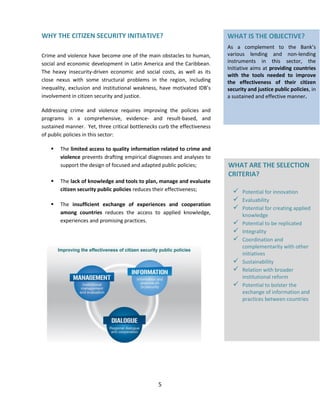
WHY THE CITIZEN SECURITY INITIATIVE?
Crime and violence have become one of the main obstacles to human,
social and economic development in Latin America and the Caribbean.
The heavy insecurity-driven economic and social costs, as well as its
close nexus with some structural problems in the region, including
inequality, exclusion and institutional weakness, have motivated IDB’s
involvement in citizen security and justice.
Addressing crime and violence requires improving the policies and
programs in a comprehensive, evidence- and result-based, and
sustained manner. Yet, three critical bottlenecks curb the effectiveness
of public policies in this sector:
 The limited access to quality information related to crime and
violence prevents drafting empirical diagnoses and analyses to
support the design of focused and adapted public policies;
 The lack of knowledge and tools to plan, manage and evaluate
citizen security public policies reduces their effectiveness;
 The insufficient exchange of experiences and cooperation
among countries reduces the access to applied knowledge,
experiences and promising practices.
WHAT IS THE OBJECTIVE?
As a complement to the Bank’s
various lending and non-lending
instruments in this sector, the
Initiative aims at providing countries
with the tools needed to improve
the effectiveness of their citizen
security and justice public policies, in
a sustained and effective manner.
WHAT ARE THE SELECTION
CRITERIA?
 Potential for innovation
 Evaluability
 Potential for creating applied
knowledge
 Potential to be replicated
 Integrality
 Coordination and
complementarity with other
initiatives
 Sustainability
 Relation with broader
institutional reform
 Potential to bolster the
exchange of information and
practices between countries
6
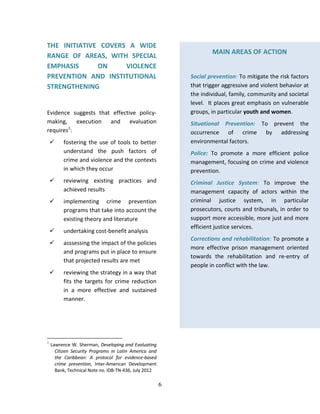
THE INITIATIVE COVERS A WIDE
RANGE OF AREAS, WITH SPECIAL
EMPHASIS ON VIOLENCE
PREVENTION AND INSTITUTIONAL
STRENGTHENING
Evidence suggests that effective policy-
making, execution and evaluation
requires1
:
 fostering the use of tools to better
understand the push factors of
crime and violence and the contexts
in which they occur
 reviewing existing practices and
achieved results
 implementing crime prevention
programs that take into account the
existing theory and literature
 undertaking cost-benefit analysis
 asssessing the impact of the policies
and programs put in place to ensure
that projected results are met
 reviewing the strategy in a way that
fits the targets for crime reduction
in a more effective and sustained
manner.
1
Lawrence W. Sherman, Developing and Evaluating
Citizen Security Programs in Latin America and
the Caribbean: A protocol for evidence-based
crime prevention, Inter-American Development
Bank, Technical Note no. IDB-TN-436, July 2012
MAIN AREAS OF ACTION
Social prevention: To mitigate the risk factors
that trigger aggressive and violent behavior at
the individual, family, community and societal
level. It places great emphasis on vulnerable
groups, in particular youth and women.
Situational Prevention: To prevent the
occurrence of crime by addressing
environmental factors.
Police: To promote a more efficient police
management, focusing on crime and violence
prevention.
Criminal Justice System: To improve the
management capacity of actors within the
criminal justice system, in particular
prosecutors, courts and tribunals, in order to
support more accessible, more just and more
efficient justice services.
Corrections and rehabilitation: To promote a
more effective prison management oriented
towards the rehabilitation and re-entry of
people in conflict with the law.
7
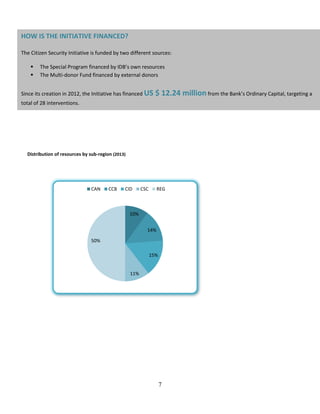
10%
14%
15%
11%
50%
CAN CCB CID CSC REG
HOW IS THE INITIATIVE FINANCED?
The Citizen Security Initiative is funded by two different sources:
 The Special Program financed by IDB’s own resources
 The Multi-donor Fund financed by external donors
Since its creation in 2012, the Initiative has financed US $ 12.24 million from the Bank’s Ordinary Capital, targeting a
total of 28 interventions.
Distribution of resources by sub-region (2013)
8
Investing US$4.5 MILLION in the collection and analysis
of data on crime and violence to decision-making based on high-
quality data in the field of citizen security and justice
What is the challenge?
The Caribbean’s attractive image is threatened by the recent increase in criminal activity. Faced with a
growing fear of crime and violence and the uncertainty it poses to their daily lives, citizens are increasingly
demanding more focused and effective governmental action.
In recent years, violence has been compared to an epidemic—something that is impossible to prevent
without understanding its transmission throughout the population; who the victims and offenders are and
why; and when and where the crime occurs. However, the scant availability of regularly produced, high-
quality data on crime and violence in the Caribbean hinders understanding of these phenomena,
documenting their risk factors, and measuring the impact of interventions.
There have, moreover, been few rigorous, evidence-based studies in the region, and there is little
documentation of the influence such studies have had on public policies.
In this sense, victimization surveys and other data collection methods used to obtain information from
citizens about crimes they have experienced are essential tools: they complement administrative data to
give a more comprehensive vision and understanding of the nature of crime.
What is the response?
The Initiative supports the governments of the Bahamas, Barbados, Guyana, Jamaica, Trinidad and
Tobago, and Suriname in carrying out a baseline mapping exercise that looks at existing data, information,
policies, programs, institutions, and their budgets in the area of crime. Similarly, the design of new
statistical instruments and the collection of data on youth violence and violence against women is
planned. This variety of information are providing countries with comparable statistics regarding levels of
To prevent violence in the Caribbean, let’s start
with statistics
Title: Crime and Violence in the Caribbean
Amount: US$1,100,000
Beneficiaries: Bahamas, Barbados, Guyana, Jamaica,
Trinidad y Tobago, Suriname
9
violence, risk factors, and institutional frameworks, as well as links to the prevention policies that have
been implemented. Above all, it will allow them to carry out impact evaluations.
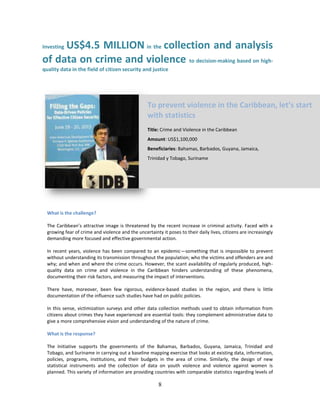
As part of the operation’s launch, an event was held in early 2013 entitled “Filling the Gaps: Data-Driven
Policies for Effective Citizen Security.”2 The event was attended by authorities in the areas of public safety
and social policy from the Caribbean countries, with the aim of sharing knowledge and experience from
within the region and outside it regarding the use of high-quality information for the design and
evaluation of public policies.
The event generated broad discussion of the availability and territorial nature of the data, and stimulated
interest in the need to share collection criteria and data analyses.
What is the challenge? Public policies for citizen security cannot be designed blindly. However, the lack of
reliable, timely, and comparable crime and violence data in Latin America and the Caribbean hinders the
design, execution, monitoring, and evaluation of public policies in the sector.
What is the response? The Initiative is providing support for the expansion of the Regional System of
Standardized Citizen Security and Coexistence Indicators3 with a view to consolidating a regional project
in which the countries collected, reviewed, and approved (by consensus) a series of comparable indicators
on crime and violence, as well as a common methodology that standardizes the capture, processing,
analysis, and flow of high-quality information.
The System is a unique example of cooperation in the management of citizen security and justice
information, encompassing 19 countries and 2 cities. This intervention facilitates the incorporation of five
additional countries, including Bolivia, Brazil, Guatemala, and Panama.
To facilitate the availability of high-quality, comparable data on crime and violence, this operation is
financing analytical studies to develop a profile of crime at the regional and sub-regional levels,
highlighting the specific characteristics of the offenses involved. The development of disaggregated data
2
http://www.iadb.org/en/topics/citizen-security/filling-the-gaps-data-driven-policies-for-effective-citizen
security,8510.html#.Uk8o3xukrIs.
3
http://www.seguridadyregion.com/.
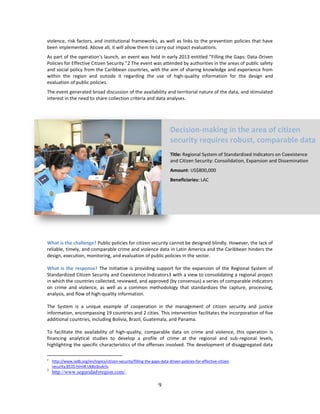
Decision-making in the area of citizen
security requires robust, comparable data
Title: Regional System of Standardized Indicators on Coexistence
and Citizen Security: Consolidation, Expansion and Dissemination
Amount: US$800,000
Beneficiaries: LAC
10
on homicides (gender, age, context, type of weapon, etc.) aims to support the development of policies
that are more specific to the nature of the offense.
In partnership with the UNODC, the operation will also help to develop a methodology for the
standardization of victimization surveys based on existing international best practices. In response to the
limited availability and shortcomings of high-quality primary sources of information, victimization surveys
have become essential, complementary instruments for collecting information on crime and violence.
Another important output is the development and launch of an interactive map on crime and violence.
This map allows users to follow trends in crime on a regular basis, as well as to link those trends with
other databases at the national and sub-regional levels (Sociométro, Datagov, RES).
What is the challenge? Central America is particularly vulnerable to gang violence. These gangs, or
“maras” are estimated to have approximately 70,000 members. The escalation of this type of violence has
a negative impact on the well-being and safety of the population, making it a particular political priority
for a number of Central American governments, such as El Salvador, Guatemala, and Honduras. In
addition to gang violence, these countries are among the most violent in the world for women, with rates
of femicide that are of almost epidemic proportions.
Nonetheless, there is scant information regarding the links and roles of women with respect to the gangs
(as victims and offenders in the violence), and this makes it impossible to develop specific, gender-
focused strategies for preventing gang violence in this subregion.
What is the response? The Initiative finances a quantitative and qualitative study to analyze the factors
that determine or prevent women’s involvement with or membership in gangs, as well as the impact of
women (in their roles as members, girlfriends, or family members) on gang dynamics. This new
information will be an important contribution to enhancing knowledge and guiding gang-focused public
policies with a gender equality approach.
What do we know about the involvement of women in gangs?
Title: Women and Gangs in Central America
Amount: US$170,000
Beneficiaries: El Salvador, Guatemala, Honduras
11
What is the challenge? A lack of public safety reduces productive potential and slows economic growth.
In Guyana and Jamaica, crime and theft have become the main obstacle to an improvement in the
business climate, with a similar situation prevailing in Trinidad and Tobago. Although tools and
methodologies exist to measure the impact of crime and violence on competitiveness, these instruments
need to be supplemented by more precise indicators that facilitate a deeper analysis of the ways in which
crime affects firms in the Caribbean.
What is the response? The Initiative supports the design, collection, and analysis of new indicators to
determine the impact of crime on firms, as well as preparation of the first regional study of the impact of
insecurity on the business climate in the Caribbean. Dissemination and dialogue activities will also be
organized with the public and private sectors to identify possible responses to the violence affecting
them, as well as areas of common interest and possible contributions that they can make.
What is the challenge? Bolivia has created a National Citizen Security Observatory that allows information
on crime from various sources (such as the Public Prosecutor’s Office, the Ombudsman’s Office, the
judiciary, municipal governments, and the police) to be compiled, analyzed, and geo-referenced in a
standardized manner. However, the agencies providing this information face technical challenges in
ensuring the quality and analysis of the information that is required for them to build a profile of the
violence and to develop specific interventions to tackle it.
What is the response? The Initiative is helping the national police improve their systems for collecting and
processing data on police reports received, as well as for recording data generated during investigations.
It also provides assistance for disaggregating data by type of offense, gender, ages of victims and
offenders, place and time, use of weapons, and institutional source.
A Safer Caribbean is a more competitive Caribbean
Title: Improving Caribbean Competitiveness by Addressing Crime and Violence Issues
Amount: US$340,000
Beneficiaries: Bahamas, Barbados, Jamaica, Guyana, Trinidad and Tobago and Suriname
Another step in improving the quality, availability and analysis of crime and
violence data in Bolivia
Title: Support for the strengthening of Bolivia’s National Citizen Security Observatory
Amount: US$550,000
Beneficiaries: Bolivia
12
What is the challenge? Police information in Nicaragua suffers from a number of weaknesses related to
the management of crime and violence data. These weaknesses hinder the effectiveness of public policies
in the areas of citizen security and civic coexistence.
What is the response? The Initiative supports the development of the National Police’s capacity to collect,
manage, and analyze crime and violence data, including the development of indicators and instruments to
measure public safety and civic coexistence. The standards and procedures used are be those promoted
by the System of Standardized Citizen Security and Coexistence Indicators4.
What is the challenge? Knowledge of the analysis of crime and violence, as well as actions to prevent
these, has been developed only recently in Latin America and the Caribbean. Moreover, there have been
few rigorous, evidence-based studies that would allow an understanding of what works and what doesn’t,
and in what context, for the prevention of violence.
What is the response? The Initiative supports an expansion of the Visiting Scholars program initiated by
the Bank’s Research Department, with a view to attracting researchers with prominent profiles in the
region. In partnership with sector specialists, these researchers can provide governments with applied
research, methodologies, and instruments to improve capacities for the design of public policies based on
empirical evidence. The program also establishes a high-level network of scientific advisors (researchers
and universities) that will support the Bank and its member countries in the development and
implementation of a research agenda, thus creating a bridge between academic research and public
policy.
4
http://www.seguridadyregion.com/.
More, improved information from Nicaragua’s National Police
Title: Modernization of the National Police Information System
Amount: US$440,000
Beneficiaries: Nicaragua
Evidence-based public policies: Building bridges between academic research and
public policy
Title: Strengthening Citizen Security: Visiting Scholars Program
Amount: US$500,000
Beneficiaries: LAC
13
What is the challenge? New information
technologies entail a series of security threats linked to greater connectivity and the growing exchange of
sensitive information by both governments and citizens. Although progress has been made at the
international level, the ability of Latin American and Caribbean countries to tackle these new threats is
not known. Greater knowledge is required in order to develop innovative strategies for protecting critical
infrastructure and sensitive information.
What is the response? In partnership with the Bank’s Broadband Initiative, the Citizen Security Initiative
supports a mapping exercise aimed at determining the advances achieved in this field worldwide. A
regional study of progress in the countries will also be carried out to determine possible areas for support.
These activities will be supported by an event for the exchange of experiences and practices among
regional and international bodies, with the objective of forming a work group to guide future
cybersecurity strategies and interventions in the region.
Laying the groundwork for a more secure
cyber-environment
Title: Cybersecurity: Laying the Groundwork for a More Secure Cyber-
environment
Amount: US$500,000
Beneficiaries: LAC
14
Investing US$6.34 MILLION in the development of institutional capacities for
the management and evaluation of public policies in the field of
citizen security and justice
What is the challenge? Violence against women has serious social and economic consequences that
affect their health and well-being. Beyond this, the issue is also a priority for improving public safety and
justice for women, families, and communities.
Indeed, child abuse or exposure to violence at an early age increases the likelihood that an individual will
become an offender and engage in violent acts as an adult, or become more tolerant to violence.
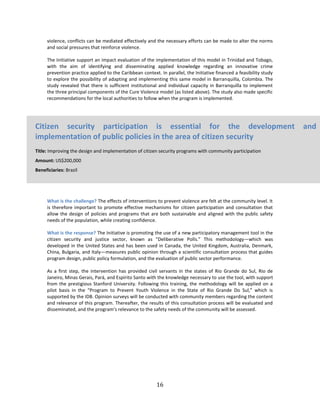
Latin America and the Caribbean is the second most violent region in the world for women. Domestic
violence affects between 20% and 50% of women in the region. Despite the magnitude and complexity of
the phenomenon, there is little scientific evidence regarding the efficacy of programs to prevent violence
against women.
What is the response? In Peru, the Initiative is supporting the development and implementation of a
recognized model for the prevention of violence against women: “Intervención con Microfinanzas para el
SIDA y la Equidad de Género” [Intervention with Microfinance for AIDS and Gender Equality] (IMAGE).5
This model, from South Africa, is one of the few interventions for which there is solid evidence of a
reduction in physical and sexual domestic violence against women. Under the program, educational and
participatory workshops were added to a traditional micro-lending program with a view to altering gender
norms, developing communication skills, expanding the influence of women over household decisions,
and creating mechanisms for mutual support and collective action to change attitudes.
5
http://www.who.int/violence_injury_prevention/violence/4th_milestones_meeting/evidence_briefings_all.pdf.
To empower women is to prevent violence
Title: Preventing violence against women through the use of microfinance
Amount: US$677,000
Beneficiaries: LAC/Peru
15
This pilot program—which is being conducted in collaboration with FINCA-Peru, the Flora Tristan Center
for Peruvian Women, and the Ministry for Women and Vulnerable Groups—will be scientifically evaluated
to measure its effectiveness in reducing violence against women in the region, and its applicability to the
situation in Latin America and the Caribbean.
What is the challenge? Youth violence, particularly that perpetrated by gangs, is reaching epidemic levels
in a number of countries in Latin America and the Caribbean, and the cure is not always clear. There are a
number of models addressing this type of violence, but few of them offer any empirical evidence
regarding their effectiveness and real impact on reducing crime rates.
What is the response? The Initiative is supporting the adaptation and evaluation of an innovative model
to prevent youth violence (known as “Cure Violence”),6 and the creation of applied knowledge regarding
its impact on the reduction of insecurity in Trinidad and Tobago and the city of Barranquilla in Colombia.
This is an international public health strategy that has been scientifically proven7 to reduce violence, and
high murder rates in particular. The model treats violence as a learned behavior that is similar to an
infectious disease, in that it can be prevented and modified using methods applied to the control of
epidemics: (i) detect and interrupt all transmission, (ii) determine who might be the next person in the
chain of transmission and reverse the potential for transmission, and (iii) alter community norms. Cure
Violence thus proposes that the use of violence as a response to a real or perceived situation can always
be prevented if an intervention is made to interrupt it, regardless of the cultural context. With an
awareness of the people or groups that are at highest risk of perpetrating or being victims of an act of
6
http://cureviolence.org.
7
An extensive, rigorous, and independent three-year evaluation confirmed the success of the Ceasefire program in Chicago,
particularly in terms of a reduction in shootings and homicides (by 41% and 73%, respectively). It also highlighted a 100% success
rate in reducing revenge homicides in five of the eight communities examined. The evaluations of the Ceasefire program for the
cases of Chicago and Baltimore may be found at http://skogan.org/WorkInProgress.html (Chicago);
http://www.rwjf.org/content/rwjf/en/research-publications/
find-rwjf-research/2012/01/evaluation-of-baltimore-s-safe-streets-program.html (Baltimore).
A cure for criminal behavior in Latin America
and the Caribbean
Title: Feasibility Study, Adaptation and Evaluation of the Ceasefire Model
Amount: US$550,000
Beneficiaries: Colombia/Trinidad and Tobago
16
violence, conflicts can be mediated effectively and the necessary efforts can be made to alter the norms
and social pressures that reinforce violence.
The Initiative support an impact evaluation of the implementation of this model in Trinidad and Tobago,
with the aim of identifying and disseminating applied knowledge regarding an innovative crime
prevention practice applied to the Caribbean context. In parallel, the Initiative financed a feasibility study
to explore the possibility of adapting and implementing this same model in Barranquilla, Colombia. The
study revealed that there is sufficient institutional and individual capacity in Barranquilla to implement
the three principal components of the Cure Violence model (as listed above). The study also made specific
recommendations for the local authorities to follow when the program is implemented.
What is the challenge? The effects of interventions to prevent violence are felt at the community level. It
is therefore important to promote effective mechanisms for citizen participation and consultation that
allow the design of policies and programs that are both sustainable and aligned with the public safety
needs of the population, while creating confidence.
What is the response? The Initiative is promoting the use of a new participatory management tool in the
citizen security and justice sector, known as “Deliberative Polls.” This methodology—which was
developed in the United States and has been used in Canada, the United Kingdom, Australia, Denmark,
China, Bulgaria, and Italy—measures public opinion through a scientific consultation process that guides
program design, public policy formulation, and the evaluation of public sector performance.
As a first step, the intervention has provided civil servants in the states of Rio Grande do Sul, Rio de
Janeiro, Minas Gerais, Pará, and Espírito Santo with the knowledge necessary to use the tool, with support
from the prestigious Stanford University. Following this training, the methodology will be applied on a
pilot basis in the “Program to Prevent Youth Violence in the State of Rio Grande Do Sul,” which is
supported by the IDB. Opinion surveys will be conducted with community members regarding the content
and relevance of this program. Thereafter, the results of this consultation process will be evaluated and
disseminated, and the program’s relevance to the safety needs of the community will be assessed.
Citizen security participation is essential for the development and
implementation of public policies in the area of citizen security
Title: Improving the design and implementation of citizen security programs with community participation
Amount: US$200,000
Beneficiaries: Brazil
17
What is the challenge? From 2009 to 2012, the Bank approved citizen security and justice operations
worth a total of US$350 million—almost the same amount approved over the last 12 years. These new
approvals represent a challenge in terms of providing a rapid and effective response to the growing
demands of citizens. However, it is still of critical importance to identify a number of factors that are
hindering the execution of civic coexistence, citizen security, and justice projects. This will facilitate
improved levels of information, evidence, effectiveness, and responsiveness regarding what works and
what doesn’t for preventing crime and violence.
What is the response? In addition to supporting contact between the countries and high-level experts in
citizen security and justice, the Initiative facilitates the systematization and evaluation of sector
interventions, thus enabling the future formulation of public policies and programs based on empirical
evidence. Lastly, it seeks to strengthen links between decision-makers and academia in order to leverage
existing expertise and experience in the field.
As well as connecting governments with renowned experts in various areas of the citizen security and
justice sector, the project offers analyses of interventions based on projects that already exist and are in
execution. These case studies and/or impact evaluations will serve as inputs into recommendations for
the implementation of interventions in accordance with the Bank’s operational framework, and for
strengthening future interventions in the sector.
What is the challenge? Chile was one of the first Latin American countries to establish and implement
National Public Safety Strategies, with specific and measurable strategic objectives. For Chile, these
advances represent an ideal basis for establishing participatory long-term strategic planning as a crucial
element in state citizen security policy.
What works in the citizen security and justice programs currently implemented?
Title: Applied knowledge generation based on citizen security programs
Amount: US$500,000
Beneficiaries: LAC
Public policies in the area of citizen security should be focused on the long term
Title: Design of a long-term public safety strategy
Amount: US$310,000
Beneficiaries: Chile
18
What is the response? The Initiative is providing support to the Government of Chile for the development
of an innovative management tool in the area of citizen security and justice. The tool will facilitate
strategic planning on the basis of long-term targets agreed by various government and political actors and
by society in general.
This intervention is a response to a request by the Government of Chile, submitted through the Ministry
of Justice and the Department of Crime Prevention in the Ministry of the Interior and Citizen Security. The
Bank will provide support and advice throughout the process.
The project will have positive externalities, as the systematization and documentation activities planned
for the process will serve as a point of reference for other countries in the region.
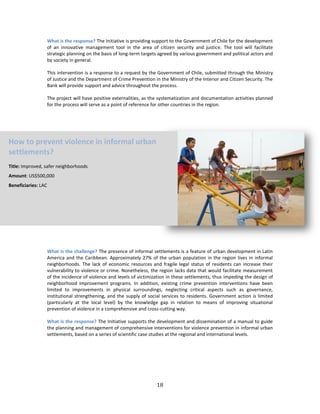
What is the challenge? The presence of informal settlements is a feature of urban development in Latin
America and the Caribbean. Approximately 27% of the urban population in the region lives in informal
neighborhoods. The lack of economic resources and fragile legal status of residents can increase their
vulnerability to violence or crime. Nonetheless, the region lacks data that would facilitate measurement
of the incidence of violence and levels of victimization in these settlements, thus impeding the design of
neighborhood improvement programs. In addition, existing crime prevention interventions have been
limited to improvements in physical surroundings, neglecting critical aspects such as governance,
institutional strengthening, and the supply of social services to residents. Government action is limited
(particularly at the local level) by the knowledge gap in relation to means of improving situational
prevention of violence in a comprehensive and cross-cutting way.
What is the response? The Initiative supports the development and dissemination of a manual to guide
the planning and management of comprehensive interventions for violence prevention in informal urban
settlements, based on a series of scientific case studies at the regional and international levels.
How to prevent violence in informal urban
settlements?
Title: Improved, safer neighborhoods
Amount: US$500,000
Beneficiaries: LAC
19
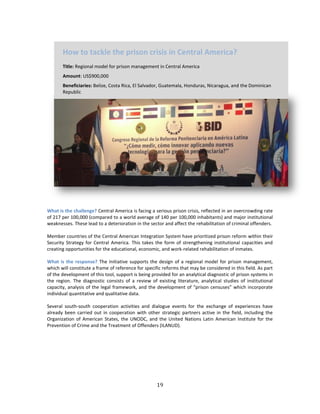
What is the challenge? Central America is facing a serious prison crisis, reflected in an overcrowding rate
of 217 per 100,000 (compared to a world average of 140 per 100,000 inhabitants) and major institutional
weaknesses. These lead to a deterioration in the sector and affect the rehabilitation of criminal offenders.
Member countries of the Central American Integration System have prioritized prison reform within their
Security Strategy for Central America. This takes the form of strengthening institutional capacities and
creating opportunities for the educational, economic, and work-related rehabilitation of inmates.
What is the response? The Initiative supports the design of a regional model for prison management,
which will constitute a frame of reference for specific reforms that may be considered in this field. As part
of the development of this tool, support is being provided for an analytical diagnostic of prison systems in
the region. The diagnostic consists of a review of existing literature, analytical studies of institutional
capacity, analysis of the legal framework, and the development of “prison censuses” which incorporate
individual quantitative and qualitative data.
Several south-south cooperation activities and dialogue events for the exchange of experiences have
already been carried out in cooperation with other strategic partners active in the field, including the
Organization of American States, the UNODC, and the United Nations Latin American Institute for the
Prevention of Crime and the Treatment of Offenders (ILANUD).
How to tackle the prison crisis in Central America?
Title: Regional model for prison management in Central America
Amount: US$900,000
Beneficiaries: Belize, Costa Rica, El Salvador, Guatemala, Honduras, Nicaragua, and the Dominican
Republic
20
What is the challenge? Although empirical evidence from the United States points to the advantages of
using psychosocial support programs as a central feature in comprehensive programs for youth at risk,
there is a lack of applied knowledge regarding the impact of such interventions in the region. Youth
violence is particularly acute in the city of Rio de Janeiro, where the rate of homicide for men aged 15 to
29 years is four or five times higher than the average for the state and for the country as a whole. Any
intervention that proves effective in preventing youth violence would be a major contribution not only for
Brazil, but for the entire region.
What is the response? The Initiative is helping to fill a knowledge gap by supporting an impact evaluation
of the “Social Inclusion and Opportunities Program for Youth in Rio de Janeiro” (BR-L1287), which is aimed
at providing opportunities for young people to develop their human capital, as well as encouraging them
to enter the labor market. The evaluation will look at the impact of the program on youth violence and
aggression, with a special focus on young offenders who have completed prison sentences.
What is the challenge? The effectiveness of public policies in the area of citizen security and justice is
hindered by a number of institutional factors—in particular, weaknesses in technical skills and knowledge
on the part of civil servants responsible for citizen security policy. These staff lack capacities for the
design, implementation, evaluation, and management of interagency coordination. Few countries have
specific programs to build these kinds of skills, and in those that do, the programs lack structure and, in
some cases, permanence.
What is the response? The Initiative is supporting the development of the first theoretical and practical
postgraduate program aimed at strengthening the technical capacities of managers in the citizen security
and justice sector in Latin America and the Caribbean.
In Brazil, youth aggression and violence is being reduced
Title: Reducing youth aggression and violence through an integrated program
Amount: US$350,000
Beneficiaries: Brazil
The effective management of citizen security depends on the creation of
specific skills
Title: Certified citizen security leadership and management program
Amount: US$820,000
Beneficiaries: LAC
30
The Certified Citizen Security Leadership and Management Program will help to strengthen strategic
alliances with renowned universities in the region. The latter will be responsible for developing and
delivering courses that cover the various elements that are essential for effective governance in the
sector. In addition to providing the various participants with theoretical and practical knowledge, the
program will facilitate the creation of a network of excellence that will incorporate former students and
high-level experts. The aim of the network will be to provide continuity to the process and to take
advantage of the support of these mentors for the design, execution, and evaluation of policies and
programs in the area of citizen security and justice in the region.
To ensure the sustainability of this intervention, the courses organized by the Bank will be accompanied
by national or local versions of the program, transforming the governments themselves into catalysts for
the program.
What is the challenge? Public safety has deteriorated in Latin America and the Caribbean, as reflected in
high rates of homicide and victimization. The situation is particularly acute in the region’s cities, which
account for more than 84% of Latin America’s population. In addition to exhibiting high and rapid rates of
urbanization, the cities face challenges such as the prevalence of exclusion and inequality, informality,
and unemployment, which affect the quality of life and well-being of their inhabitants, as well as factors
that are generally associated with crime. Today, cities in Latin America and the Caribbean are among the
most violent in the world, and their murder rates remain high even when compared to national averages.
What is the response? This operation is part of a larger research project entitled Public Policies for the
Reduction and Prevention of Urban Crime in Latin America and the Caribbean. The main objective of the
project, which will be led by the IDB’s Citizen Security Cluster over the next two years, is to create cutting-
edge knowledge that contributes to the more efficient management of citizen security at the municipal
level. The project also seeks to expand the availability of empirical evidence and analysis in the field of
crime and violence for a number of the region’s cities, as well as creating practical instruments to support
local governments in the design and implementation of public policies and programs with improved
potential for sustainable results in the prevention and reduction of insecurity.
The first phase of the project (2013-2014) has a dual purpose: (i) to deepen quantitative analysis of trends
and dynamics in the main violence indicators for a number of cities in Latin America and the Caribbean;
and (ii) to produce empirical evidence by financing research based on rigorous methodologies, and by
systematizing public policy experiences.
Understanding and preventing crime in cities in Latin America and the
Caribbean
Title: Governance and public policy for the prevention of urban crime and violence
Amount: US$365,000
Beneficiaries: LAC
22
What is the challenge? The last decade has
seen a deterioration of the prison situation in Latin America and the Caribbean, manifest in both
increased overcrowding and poor prison conditions (not only physical conditions but also a lack of
services, high levels of violence, the absence of effective measures to protect vulnerable groups, a lack of
work-related and education programs, and a lack of transparency in access to these programs). The
existing literature from outside the region has highlighted a number of basic criteria for improving
programs to rehabilitate offenders. One critical element is the link to work opportunities. As part of a
program of training and psychosocial skill development, such opportunities can help to ensure effective,
sustainable social rehabilitation.
What is the response? The Initiative supports the strengthening of public-private partnerships to facilitate
the design, execution, and evaluation of pilot programs to assist the economic and work-related
rehabilitation of women and young offenders in Latin America and the Caribbean, thus creating a
favorable space for dialogue. This intervention will support the development of a manual to guide private
sector involvement in tertiary violence prevention, as well as a series of impact evaluations to measure
the effectiveness of these programs with respect to recidivism and tertiary violence prevention.
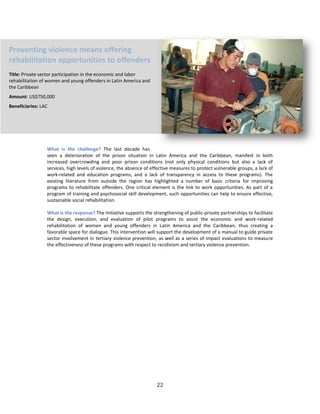
Preventing violence means offering
rehabilitation opportunities to offenders
Title: Private sector participation in the economic and labor
rehabilitation of women and young offenders in Latin America and
the Caribbean
Amount: US$750,000
Beneficiaries: LAC
23
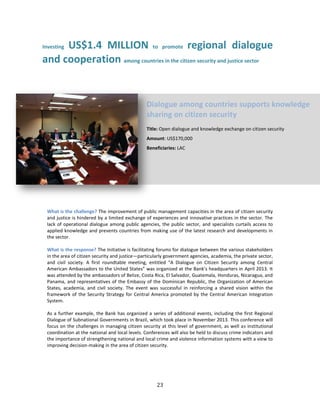
Investing US$1.4 MILLION to promote regional dialogue
and cooperation among countries in the citizen security and justice sector
What is the challenge? The improvement of public management capacities in the area of citizen security
and justice is hindered by a limited exchange of experiences and innovative practices in the sector. The
lack of operational dialogue among public agencies, the public sector, and specialists curtails access to
applied knowledge and prevents countries from making use of the latest research and developments in
the sector.
What is the response? The Initiative is facilitating forums for dialogue between the various stakeholders
in the area of citizen security and justice—particularly government agencies, academia, the private sector,
and civil society. A first roundtable meeting, entitled “A Dialogue on Citizen Security among Central
American Ambassadors to the United States” was organized at the Bank’s headquarters in April 2013. It
was attended by the ambassadors of Belize, Costa Rica, El Salvador, Guatemala, Honduras, Nicaragua, and
Panama, and representatives of the Embassy of the Dominican Republic, the Organization of American
States, academia, and civil society. The event was successful in reinforcing a shared vision within the
framework of the Security Strategy for Central America promoted by the Central American Integration
System.
As a further example, the Bank has organized a series of additional events, including the first Regional
Dialogue of Subnational Governments in Brazil, which took place in November 2013. This conference will
focus on the challenges in managing citizen security at this level of government, as well as institutional
coordination at the national and local levels. Conferences will also be held to discuss crime indicators and
the importance of strengthening national and local crime and violence information systems with a view to
improving decision-making in the area of citizen security.
Dialogue among countries supports knowledge
sharing on citizen security
Title: Open dialogue and knowledge exchange on citizen security
Amount: US$170,000
Beneficiaries: LAC
24
What is the challenge? Subnational governments have a number of advantages in managing security
issues, including proximity to the problem, knowledge of the area and the communities, and an ability to
identify priority areas to be targeted under programs. Nonetheless, there is a lack of information
regarding the crime prevention models that have been used by state governments in the citizen security
and justice sector. Where such models exist, the channels for sharing this information and for
consolidating cooperation between state governments have been inadequate.
What is the response? Given the need to improve subnational governments’ capacities in the area of
crime and violence prevention, the Initiative is supporting the first “Gobernarte: The Art of Good
Government”8 competition, which was launched in June 2013. The contest has facilitated the
identification of successful crime prevention models at the state level in Latin America and the Caribbean.
Proposals in the “Secure Government” category were evaluated, and three state governments were
awarded a seal of quality for their performance in reducing crime in January 2014. Information will also
be disseminated regarding the approaches adopted. This process, in turn, has reinforced collaboration
with the University of Chile, which began as part of the Crime Prevention Best Practices in Latin America
and the Caribbean competition.
8
Visit the webpage for the competition at:
http://www.iadb.org/es/temas/gobierno/gobernarte/inicio,8344.html.
Public policies for citizen security operate
at different levels of government: how
can cooperation between states be
improved?
Title: Identification of best practices in governance for citizen
security in Latin America
Amount: US$153,000
Beneficiaries: LAC
25
What is the challenge? Crime and violence affect Central America disproportionately. The public safety crisis is a
growing threat to well-being and civic coexistence, and it endangers democratic stability. Murder rates in the
region are the highest in the world at 43.3 per 100,000 inhabitants—seven times higher than the world average.
Alarmed by this public safety crisis, the Central American countries have adopted a Comprehensive Security
Strategy for Central America (ESCA) within the framework of the Central American Integration System (SICA). SICA
has four strategic pillars that help the countries align efforts and work together to meet shared challenges:
(i) combating crime; (ii) violence prevention; (iii) institutional strengthening; and (iv) rehabilitation and the prison
system. However, SICA member countries lack sufficient technical knowledge to implement the interventions
planned under the Strategy, and have requested additional support from the Bank to carry out these projects
successfully and sustainably.
What is the response? The Initiative is facilitating access to a network of technical experts who will provide
advisory services on an ad hoc basis to SICA member countries, as well as for the development of planning and
evaluation tools to support effective implementation of the Security Strategy for Central America. A series of
meetings have been held between technical teams and national authorities to facilitate the exchange of
experiences and transfer of knowledge relevant to management of the Strategy, and prison-related issues in
particular.
The countries of Central America are cooperating in search for common
solutions to the phenomena of crime and violence
Title: Advisory group to support implementation of the security strategy for Central America
Amount: US$300,000
Beneficiaries: Belize, Costa Rica, El Salvador, Guatemala, Honduras, Nicaragua, the Dominican Republic
26
CONTACT
Technical Secretariat of the Citizen Security Initiative
Institutional Capacity of the State Division
Department of Institutions for Development
Inter-American Development Bank
ADDRESS:
1300 NEW YORK AVENUE, N.W.
WASHINGTON, D.C. 20057
USA
EMAIL: ICS-CSISECRETARIATECNICA2@IADB.ORG
VISIT OUR WEBSITE: WWW.IADB.ORG/CITIZENSECURITY
VISIT OUR BLOG: HTTP://BLOGS.IADB.ORG/SINMIEDOS
@BID_SEGURIDAD

Report_-_What_is_the_Citizen_Security_Initiative_-_EC

  • 1.
    1 CITIZEN SECURITY INITIATIVE HOWTO IMPROVE THE EFFECTIVENESS OF PUBLIC POLICIES IN THE AREA OF CITIZEN SECURITY AND JUSTICE Institutional Capacity of the State Division Department of Institutions for Development Inter-American Development Bank January 2014
  • 2.
    2 TABLE OF CONTENTS I.ABOUT THE CITIZEN SECURITY INITIATIVE .........................................................................4 II. BUILDING DATA AND FOSTERING ANALYSIS ON CRIME AND VIOLENCE......................................8 III. IMPROVING THE MANAGEMENT AND EVALUATION OF CITIZEN SECURITY PUBLIC POLICIES............ 14 IV. FOSTERING DIALOGUE AND COOPERATION BETWEEN COUNTRIES.......................................... 23 IV. CONTACT .................................................................................................................
  • 3.
    3 “SUCCESSFUL POLICIES HAVETO BE TAILORED-MADE” LUIS ALBERTO MORENO, PRESIDENT OF THE INTER-AMERICAN DEVELOPMENT BANK
  • 4.
    4 ABOUT THE CITIZEN SECURITYINITIATIVE In 2012, the Inter-American Development Bank launched the Citizen Security Initiative, which remains the unique grant-making mechanism specifically dedicated to improving the effectiveness of public policies on citizen security and justice and reducing the levels of crime and violence in Latin America and the Caribbean. It supports programs led by governments, regional and sub-regional governmental organizations, non-profit institutions and community-based organizations, aimed at improving the design, management and evaluation of public policies aimed at reducing the levels of crime, violence and insecurity in the region. THE CITIZEN SECURITY INITIATIVE IS:  A critical source of financial support to the Bank’s clients, which complements other available lending instruments offered by the Bank in the citizen security and justice sector.  A mechanism to build and share evidence-based knowledge on how to prevent crime and violence in an effective and sustained manner.  A driver of change, by identifying and supporting innovative interventions to preventing crime and violence that will contribute to larger-scale institutional reforms.  A platform for bringing together key stakeholders, in particular governments, civil society, the private sector and the academic world, to advance citizen security and justice in the region.
  • 5.
    5 WHY THE CITIZENSECURITY INITIATIVE? Crime and violence have become one of the main obstacles to human, social and economic development in Latin America and the Caribbean. The heavy insecurity-driven economic and social costs, as well as its close nexus with some structural problems in the region, including inequality, exclusion and institutional weakness, have motivated IDB’s involvement in citizen security and justice. Addressing crime and violence requires improving the policies and programs in a comprehensive, evidence- and result-based, and sustained manner. Yet, three critical bottlenecks curb the effectiveness of public policies in this sector:  The limited access to quality information related to crime and violence prevents drafting empirical diagnoses and analyses to support the design of focused and adapted public policies;  The lack of knowledge and tools to plan, manage and evaluate citizen security public policies reduces their effectiveness;  The insufficient exchange of experiences and cooperation among countries reduces the access to applied knowledge, experiences and promising practices. WHAT IS THE OBJECTIVE? As a complement to the Bank’s various lending and non-lending instruments in this sector, the Initiative aims at providing countries with the tools needed to improve the effectiveness of their citizen security and justice public policies, in a sustained and effective manner. WHAT ARE THE SELECTION CRITERIA?  Potential for innovation  Evaluability  Potential for creating applied knowledge  Potential to be replicated  Integrality  Coordination and complementarity with other initiatives  Sustainability  Relation with broader institutional reform  Potential to bolster the exchange of information and practices between countries
  • 6.
    6 THE INITIATIVE COVERSA WIDE RANGE OF AREAS, WITH SPECIAL EMPHASIS ON VIOLENCE PREVENTION AND INSTITUTIONAL STRENGTHENING Evidence suggests that effective policy- making, execution and evaluation requires1 :  fostering the use of tools to better understand the push factors of crime and violence and the contexts in which they occur  reviewing existing practices and achieved results  implementing crime prevention programs that take into account the existing theory and literature  undertaking cost-benefit analysis  asssessing the impact of the policies and programs put in place to ensure that projected results are met  reviewing the strategy in a way that fits the targets for crime reduction in a more effective and sustained manner. 1 Lawrence W. Sherman, Developing and Evaluating Citizen Security Programs in Latin America and the Caribbean: A protocol for evidence-based crime prevention, Inter-American Development Bank, Technical Note no. IDB-TN-436, July 2012 MAIN AREAS OF ACTION Social prevention: To mitigate the risk factors that trigger aggressive and violent behavior at the individual, family, community and societal level. It places great emphasis on vulnerable groups, in particular youth and women. Situational Prevention: To prevent the occurrence of crime by addressing environmental factors. Police: To promote a more efficient police management, focusing on crime and violence prevention. Criminal Justice System: To improve the management capacity of actors within the criminal justice system, in particular prosecutors, courts and tribunals, in order to support more accessible, more just and more efficient justice services. Corrections and rehabilitation: To promote a more effective prison management oriented towards the rehabilitation and re-entry of people in conflict with the law.
  • 7.
    7 10% 14% 15% 11% 50% CAN CCB CIDCSC REG HOW IS THE INITIATIVE FINANCED? The Citizen Security Initiative is funded by two different sources:  The Special Program financed by IDB’s own resources  The Multi-donor Fund financed by external donors Since its creation in 2012, the Initiative has financed US $ 12.24 million from the Bank’s Ordinary Capital, targeting a total of 28 interventions. Distribution of resources by sub-region (2013)
  • 8.
    8 Investing US$4.5 MILLIONin the collection and analysis of data on crime and violence to decision-making based on high- quality data in the field of citizen security and justice What is the challenge? The Caribbean’s attractive image is threatened by the recent increase in criminal activity. Faced with a growing fear of crime and violence and the uncertainty it poses to their daily lives, citizens are increasingly demanding more focused and effective governmental action. In recent years, violence has been compared to an epidemic—something that is impossible to prevent without understanding its transmission throughout the population; who the victims and offenders are and why; and when and where the crime occurs. However, the scant availability of regularly produced, high- quality data on crime and violence in the Caribbean hinders understanding of these phenomena, documenting their risk factors, and measuring the impact of interventions. There have, moreover, been few rigorous, evidence-based studies in the region, and there is little documentation of the influence such studies have had on public policies. In this sense, victimization surveys and other data collection methods used to obtain information from citizens about crimes they have experienced are essential tools: they complement administrative data to give a more comprehensive vision and understanding of the nature of crime. What is the response? The Initiative supports the governments of the Bahamas, Barbados, Guyana, Jamaica, Trinidad and Tobago, and Suriname in carrying out a baseline mapping exercise that looks at existing data, information, policies, programs, institutions, and their budgets in the area of crime. Similarly, the design of new statistical instruments and the collection of data on youth violence and violence against women is planned. This variety of information are providing countries with comparable statistics regarding levels of To prevent violence in the Caribbean, let’s start with statistics Title: Crime and Violence in the Caribbean Amount: US$1,100,000 Beneficiaries: Bahamas, Barbados, Guyana, Jamaica, Trinidad y Tobago, Suriname
  • 9.
    9 violence, risk factors,and institutional frameworks, as well as links to the prevention policies that have been implemented. Above all, it will allow them to carry out impact evaluations. As part of the operation’s launch, an event was held in early 2013 entitled “Filling the Gaps: Data-Driven Policies for Effective Citizen Security.”2 The event was attended by authorities in the areas of public safety and social policy from the Caribbean countries, with the aim of sharing knowledge and experience from within the region and outside it regarding the use of high-quality information for the design and evaluation of public policies. The event generated broad discussion of the availability and territorial nature of the data, and stimulated interest in the need to share collection criteria and data analyses. What is the challenge? Public policies for citizen security cannot be designed blindly. However, the lack of reliable, timely, and comparable crime and violence data in Latin America and the Caribbean hinders the design, execution, monitoring, and evaluation of public policies in the sector. What is the response? The Initiative is providing support for the expansion of the Regional System of Standardized Citizen Security and Coexistence Indicators3 with a view to consolidating a regional project in which the countries collected, reviewed, and approved (by consensus) a series of comparable indicators on crime and violence, as well as a common methodology that standardizes the capture, processing, analysis, and flow of high-quality information. The System is a unique example of cooperation in the management of citizen security and justice information, encompassing 19 countries and 2 cities. This intervention facilitates the incorporation of five additional countries, including Bolivia, Brazil, Guatemala, and Panama. To facilitate the availability of high-quality, comparable data on crime and violence, this operation is financing analytical studies to develop a profile of crime at the regional and sub-regional levels, highlighting the specific characteristics of the offenses involved. The development of disaggregated data 2 http://www.iadb.org/en/topics/citizen-security/filling-the-gaps-data-driven-policies-for-effective-citizen security,8510.html#.Uk8o3xukrIs. 3 http://www.seguridadyregion.com/. Decision-making in the area of citizen security requires robust, comparable data Title: Regional System of Standardized Indicators on Coexistence and Citizen Security: Consolidation, Expansion and Dissemination Amount: US$800,000 Beneficiaries: LAC
  • 10.
    10 on homicides (gender,age, context, type of weapon, etc.) aims to support the development of policies that are more specific to the nature of the offense. In partnership with the UNODC, the operation will also help to develop a methodology for the standardization of victimization surveys based on existing international best practices. In response to the limited availability and shortcomings of high-quality primary sources of information, victimization surveys have become essential, complementary instruments for collecting information on crime and violence. Another important output is the development and launch of an interactive map on crime and violence. This map allows users to follow trends in crime on a regular basis, as well as to link those trends with other databases at the national and sub-regional levels (Sociométro, Datagov, RES). What is the challenge? Central America is particularly vulnerable to gang violence. These gangs, or “maras” are estimated to have approximately 70,000 members. The escalation of this type of violence has a negative impact on the well-being and safety of the population, making it a particular political priority for a number of Central American governments, such as El Salvador, Guatemala, and Honduras. In addition to gang violence, these countries are among the most violent in the world for women, with rates of femicide that are of almost epidemic proportions. Nonetheless, there is scant information regarding the links and roles of women with respect to the gangs (as victims and offenders in the violence), and this makes it impossible to develop specific, gender- focused strategies for preventing gang violence in this subregion. What is the response? The Initiative finances a quantitative and qualitative study to analyze the factors that determine or prevent women’s involvement with or membership in gangs, as well as the impact of women (in their roles as members, girlfriends, or family members) on gang dynamics. This new information will be an important contribution to enhancing knowledge and guiding gang-focused public policies with a gender equality approach. What do we know about the involvement of women in gangs? Title: Women and Gangs in Central America Amount: US$170,000 Beneficiaries: El Salvador, Guatemala, Honduras
  • 11.
    11 What is thechallenge? A lack of public safety reduces productive potential and slows economic growth. In Guyana and Jamaica, crime and theft have become the main obstacle to an improvement in the business climate, with a similar situation prevailing in Trinidad and Tobago. Although tools and methodologies exist to measure the impact of crime and violence on competitiveness, these instruments need to be supplemented by more precise indicators that facilitate a deeper analysis of the ways in which crime affects firms in the Caribbean. What is the response? The Initiative supports the design, collection, and analysis of new indicators to determine the impact of crime on firms, as well as preparation of the first regional study of the impact of insecurity on the business climate in the Caribbean. Dissemination and dialogue activities will also be organized with the public and private sectors to identify possible responses to the violence affecting them, as well as areas of common interest and possible contributions that they can make. What is the challenge? Bolivia has created a National Citizen Security Observatory that allows information on crime from various sources (such as the Public Prosecutor’s Office, the Ombudsman’s Office, the judiciary, municipal governments, and the police) to be compiled, analyzed, and geo-referenced in a standardized manner. However, the agencies providing this information face technical challenges in ensuring the quality and analysis of the information that is required for them to build a profile of the violence and to develop specific interventions to tackle it. What is the response? The Initiative is helping the national police improve their systems for collecting and processing data on police reports received, as well as for recording data generated during investigations. It also provides assistance for disaggregating data by type of offense, gender, ages of victims and offenders, place and time, use of weapons, and institutional source. A Safer Caribbean is a more competitive Caribbean Title: Improving Caribbean Competitiveness by Addressing Crime and Violence Issues Amount: US$340,000 Beneficiaries: Bahamas, Barbados, Jamaica, Guyana, Trinidad and Tobago and Suriname Another step in improving the quality, availability and analysis of crime and violence data in Bolivia Title: Support for the strengthening of Bolivia’s National Citizen Security Observatory Amount: US$550,000 Beneficiaries: Bolivia
  • 12.
    12 What is thechallenge? Police information in Nicaragua suffers from a number of weaknesses related to the management of crime and violence data. These weaknesses hinder the effectiveness of public policies in the areas of citizen security and civic coexistence. What is the response? The Initiative supports the development of the National Police’s capacity to collect, manage, and analyze crime and violence data, including the development of indicators and instruments to measure public safety and civic coexistence. The standards and procedures used are be those promoted by the System of Standardized Citizen Security and Coexistence Indicators4. What is the challenge? Knowledge of the analysis of crime and violence, as well as actions to prevent these, has been developed only recently in Latin America and the Caribbean. Moreover, there have been few rigorous, evidence-based studies that would allow an understanding of what works and what doesn’t, and in what context, for the prevention of violence. What is the response? The Initiative supports an expansion of the Visiting Scholars program initiated by the Bank’s Research Department, with a view to attracting researchers with prominent profiles in the region. In partnership with sector specialists, these researchers can provide governments with applied research, methodologies, and instruments to improve capacities for the design of public policies based on empirical evidence. The program also establishes a high-level network of scientific advisors (researchers and universities) that will support the Bank and its member countries in the development and implementation of a research agenda, thus creating a bridge between academic research and public policy. 4 http://www.seguridadyregion.com/. More, improved information from Nicaragua’s National Police Title: Modernization of the National Police Information System Amount: US$440,000 Beneficiaries: Nicaragua Evidence-based public policies: Building bridges between academic research and public policy Title: Strengthening Citizen Security: Visiting Scholars Program Amount: US$500,000 Beneficiaries: LAC
  • 13.
    13 What is thechallenge? New information technologies entail a series of security threats linked to greater connectivity and the growing exchange of sensitive information by both governments and citizens. Although progress has been made at the international level, the ability of Latin American and Caribbean countries to tackle these new threats is not known. Greater knowledge is required in order to develop innovative strategies for protecting critical infrastructure and sensitive information. What is the response? In partnership with the Bank’s Broadband Initiative, the Citizen Security Initiative supports a mapping exercise aimed at determining the advances achieved in this field worldwide. A regional study of progress in the countries will also be carried out to determine possible areas for support. These activities will be supported by an event for the exchange of experiences and practices among regional and international bodies, with the objective of forming a work group to guide future cybersecurity strategies and interventions in the region. Laying the groundwork for a more secure cyber-environment Title: Cybersecurity: Laying the Groundwork for a More Secure Cyber- environment Amount: US$500,000 Beneficiaries: LAC
  • 14.
    14 Investing US$6.34 MILLIONin the development of institutional capacities for the management and evaluation of public policies in the field of citizen security and justice What is the challenge? Violence against women has serious social and economic consequences that affect their health and well-being. Beyond this, the issue is also a priority for improving public safety and justice for women, families, and communities. Indeed, child abuse or exposure to violence at an early age increases the likelihood that an individual will become an offender and engage in violent acts as an adult, or become more tolerant to violence. Latin America and the Caribbean is the second most violent region in the world for women. Domestic violence affects between 20% and 50% of women in the region. Despite the magnitude and complexity of the phenomenon, there is little scientific evidence regarding the efficacy of programs to prevent violence against women. What is the response? In Peru, the Initiative is supporting the development and implementation of a recognized model for the prevention of violence against women: “Intervención con Microfinanzas para el SIDA y la Equidad de Género” [Intervention with Microfinance for AIDS and Gender Equality] (IMAGE).5 This model, from South Africa, is one of the few interventions for which there is solid evidence of a reduction in physical and sexual domestic violence against women. Under the program, educational and participatory workshops were added to a traditional micro-lending program with a view to altering gender norms, developing communication skills, expanding the influence of women over household decisions, and creating mechanisms for mutual support and collective action to change attitudes. 5 http://www.who.int/violence_injury_prevention/violence/4th_milestones_meeting/evidence_briefings_all.pdf. To empower women is to prevent violence Title: Preventing violence against women through the use of microfinance Amount: US$677,000 Beneficiaries: LAC/Peru
  • 15.
    15 This pilot program—whichis being conducted in collaboration with FINCA-Peru, the Flora Tristan Center for Peruvian Women, and the Ministry for Women and Vulnerable Groups—will be scientifically evaluated to measure its effectiveness in reducing violence against women in the region, and its applicability to the situation in Latin America and the Caribbean. What is the challenge? Youth violence, particularly that perpetrated by gangs, is reaching epidemic levels in a number of countries in Latin America and the Caribbean, and the cure is not always clear. There are a number of models addressing this type of violence, but few of them offer any empirical evidence regarding their effectiveness and real impact on reducing crime rates. What is the response? The Initiative is supporting the adaptation and evaluation of an innovative model to prevent youth violence (known as “Cure Violence”),6 and the creation of applied knowledge regarding its impact on the reduction of insecurity in Trinidad and Tobago and the city of Barranquilla in Colombia. This is an international public health strategy that has been scientifically proven7 to reduce violence, and high murder rates in particular. The model treats violence as a learned behavior that is similar to an infectious disease, in that it can be prevented and modified using methods applied to the control of epidemics: (i) detect and interrupt all transmission, (ii) determine who might be the next person in the chain of transmission and reverse the potential for transmission, and (iii) alter community norms. Cure Violence thus proposes that the use of violence as a response to a real or perceived situation can always be prevented if an intervention is made to interrupt it, regardless of the cultural context. With an awareness of the people or groups that are at highest risk of perpetrating or being victims of an act of 6 http://cureviolence.org. 7 An extensive, rigorous, and independent three-year evaluation confirmed the success of the Ceasefire program in Chicago, particularly in terms of a reduction in shootings and homicides (by 41% and 73%, respectively). It also highlighted a 100% success rate in reducing revenge homicides in five of the eight communities examined. The evaluations of the Ceasefire program for the cases of Chicago and Baltimore may be found at http://skogan.org/WorkInProgress.html (Chicago); http://www.rwjf.org/content/rwjf/en/research-publications/ find-rwjf-research/2012/01/evaluation-of-baltimore-s-safe-streets-program.html (Baltimore). A cure for criminal behavior in Latin America and the Caribbean Title: Feasibility Study, Adaptation and Evaluation of the Ceasefire Model Amount: US$550,000 Beneficiaries: Colombia/Trinidad and Tobago
  • 16.
    16 violence, conflicts canbe mediated effectively and the necessary efforts can be made to alter the norms and social pressures that reinforce violence. The Initiative support an impact evaluation of the implementation of this model in Trinidad and Tobago, with the aim of identifying and disseminating applied knowledge regarding an innovative crime prevention practice applied to the Caribbean context. In parallel, the Initiative financed a feasibility study to explore the possibility of adapting and implementing this same model in Barranquilla, Colombia. The study revealed that there is sufficient institutional and individual capacity in Barranquilla to implement the three principal components of the Cure Violence model (as listed above). The study also made specific recommendations for the local authorities to follow when the program is implemented. What is the challenge? The effects of interventions to prevent violence are felt at the community level. It is therefore important to promote effective mechanisms for citizen participation and consultation that allow the design of policies and programs that are both sustainable and aligned with the public safety needs of the population, while creating confidence. What is the response? The Initiative is promoting the use of a new participatory management tool in the citizen security and justice sector, known as “Deliberative Polls.” This methodology—which was developed in the United States and has been used in Canada, the United Kingdom, Australia, Denmark, China, Bulgaria, and Italy—measures public opinion through a scientific consultation process that guides program design, public policy formulation, and the evaluation of public sector performance. As a first step, the intervention has provided civil servants in the states of Rio Grande do Sul, Rio de Janeiro, Minas Gerais, Pará, and Espírito Santo with the knowledge necessary to use the tool, with support from the prestigious Stanford University. Following this training, the methodology will be applied on a pilot basis in the “Program to Prevent Youth Violence in the State of Rio Grande Do Sul,” which is supported by the IDB. Opinion surveys will be conducted with community members regarding the content and relevance of this program. Thereafter, the results of this consultation process will be evaluated and disseminated, and the program’s relevance to the safety needs of the community will be assessed. Citizen security participation is essential for the development and implementation of public policies in the area of citizen security Title: Improving the design and implementation of citizen security programs with community participation Amount: US$200,000 Beneficiaries: Brazil
  • 17.
    17 What is thechallenge? From 2009 to 2012, the Bank approved citizen security and justice operations worth a total of US$350 million—almost the same amount approved over the last 12 years. These new approvals represent a challenge in terms of providing a rapid and effective response to the growing demands of citizens. However, it is still of critical importance to identify a number of factors that are hindering the execution of civic coexistence, citizen security, and justice projects. This will facilitate improved levels of information, evidence, effectiveness, and responsiveness regarding what works and what doesn’t for preventing crime and violence. What is the response? In addition to supporting contact between the countries and high-level experts in citizen security and justice, the Initiative facilitates the systematization and evaluation of sector interventions, thus enabling the future formulation of public policies and programs based on empirical evidence. Lastly, it seeks to strengthen links between decision-makers and academia in order to leverage existing expertise and experience in the field. As well as connecting governments with renowned experts in various areas of the citizen security and justice sector, the project offers analyses of interventions based on projects that already exist and are in execution. These case studies and/or impact evaluations will serve as inputs into recommendations for the implementation of interventions in accordance with the Bank’s operational framework, and for strengthening future interventions in the sector. What is the challenge? Chile was one of the first Latin American countries to establish and implement National Public Safety Strategies, with specific and measurable strategic objectives. For Chile, these advances represent an ideal basis for establishing participatory long-term strategic planning as a crucial element in state citizen security policy. What works in the citizen security and justice programs currently implemented? Title: Applied knowledge generation based on citizen security programs Amount: US$500,000 Beneficiaries: LAC Public policies in the area of citizen security should be focused on the long term Title: Design of a long-term public safety strategy Amount: US$310,000 Beneficiaries: Chile
  • 18.
    18 What is theresponse? The Initiative is providing support to the Government of Chile for the development of an innovative management tool in the area of citizen security and justice. The tool will facilitate strategic planning on the basis of long-term targets agreed by various government and political actors and by society in general. This intervention is a response to a request by the Government of Chile, submitted through the Ministry of Justice and the Department of Crime Prevention in the Ministry of the Interior and Citizen Security. The Bank will provide support and advice throughout the process. The project will have positive externalities, as the systematization and documentation activities planned for the process will serve as a point of reference for other countries in the region. What is the challenge? The presence of informal settlements is a feature of urban development in Latin America and the Caribbean. Approximately 27% of the urban population in the region lives in informal neighborhoods. The lack of economic resources and fragile legal status of residents can increase their vulnerability to violence or crime. Nonetheless, the region lacks data that would facilitate measurement of the incidence of violence and levels of victimization in these settlements, thus impeding the design of neighborhood improvement programs. In addition, existing crime prevention interventions have been limited to improvements in physical surroundings, neglecting critical aspects such as governance, institutional strengthening, and the supply of social services to residents. Government action is limited (particularly at the local level) by the knowledge gap in relation to means of improving situational prevention of violence in a comprehensive and cross-cutting way. What is the response? The Initiative supports the development and dissemination of a manual to guide the planning and management of comprehensive interventions for violence prevention in informal urban settlements, based on a series of scientific case studies at the regional and international levels. How to prevent violence in informal urban settlements? Title: Improved, safer neighborhoods Amount: US$500,000 Beneficiaries: LAC
  • 19.
    19 What is thechallenge? Central America is facing a serious prison crisis, reflected in an overcrowding rate of 217 per 100,000 (compared to a world average of 140 per 100,000 inhabitants) and major institutional weaknesses. These lead to a deterioration in the sector and affect the rehabilitation of criminal offenders. Member countries of the Central American Integration System have prioritized prison reform within their Security Strategy for Central America. This takes the form of strengthening institutional capacities and creating opportunities for the educational, economic, and work-related rehabilitation of inmates. What is the response? The Initiative supports the design of a regional model for prison management, which will constitute a frame of reference for specific reforms that may be considered in this field. As part of the development of this tool, support is being provided for an analytical diagnostic of prison systems in the region. The diagnostic consists of a review of existing literature, analytical studies of institutional capacity, analysis of the legal framework, and the development of “prison censuses” which incorporate individual quantitative and qualitative data. Several south-south cooperation activities and dialogue events for the exchange of experiences have already been carried out in cooperation with other strategic partners active in the field, including the Organization of American States, the UNODC, and the United Nations Latin American Institute for the Prevention of Crime and the Treatment of Offenders (ILANUD). How to tackle the prison crisis in Central America? Title: Regional model for prison management in Central America Amount: US$900,000 Beneficiaries: Belize, Costa Rica, El Salvador, Guatemala, Honduras, Nicaragua, and the Dominican Republic
  • 20.
    20 What is thechallenge? Although empirical evidence from the United States points to the advantages of using psychosocial support programs as a central feature in comprehensive programs for youth at risk, there is a lack of applied knowledge regarding the impact of such interventions in the region. Youth violence is particularly acute in the city of Rio de Janeiro, where the rate of homicide for men aged 15 to 29 years is four or five times higher than the average for the state and for the country as a whole. Any intervention that proves effective in preventing youth violence would be a major contribution not only for Brazil, but for the entire region. What is the response? The Initiative is helping to fill a knowledge gap by supporting an impact evaluation of the “Social Inclusion and Opportunities Program for Youth in Rio de Janeiro” (BR-L1287), which is aimed at providing opportunities for young people to develop their human capital, as well as encouraging them to enter the labor market. The evaluation will look at the impact of the program on youth violence and aggression, with a special focus on young offenders who have completed prison sentences. What is the challenge? The effectiveness of public policies in the area of citizen security and justice is hindered by a number of institutional factors—in particular, weaknesses in technical skills and knowledge on the part of civil servants responsible for citizen security policy. These staff lack capacities for the design, implementation, evaluation, and management of interagency coordination. Few countries have specific programs to build these kinds of skills, and in those that do, the programs lack structure and, in some cases, permanence. What is the response? The Initiative is supporting the development of the first theoretical and practical postgraduate program aimed at strengthening the technical capacities of managers in the citizen security and justice sector in Latin America and the Caribbean. In Brazil, youth aggression and violence is being reduced Title: Reducing youth aggression and violence through an integrated program Amount: US$350,000 Beneficiaries: Brazil The effective management of citizen security depends on the creation of specific skills Title: Certified citizen security leadership and management program Amount: US$820,000 Beneficiaries: LAC
  • 21.
    30 The Certified CitizenSecurity Leadership and Management Program will help to strengthen strategic alliances with renowned universities in the region. The latter will be responsible for developing and delivering courses that cover the various elements that are essential for effective governance in the sector. In addition to providing the various participants with theoretical and practical knowledge, the program will facilitate the creation of a network of excellence that will incorporate former students and high-level experts. The aim of the network will be to provide continuity to the process and to take advantage of the support of these mentors for the design, execution, and evaluation of policies and programs in the area of citizen security and justice in the region. To ensure the sustainability of this intervention, the courses organized by the Bank will be accompanied by national or local versions of the program, transforming the governments themselves into catalysts for the program. What is the challenge? Public safety has deteriorated in Latin America and the Caribbean, as reflected in high rates of homicide and victimization. The situation is particularly acute in the region’s cities, which account for more than 84% of Latin America’s population. In addition to exhibiting high and rapid rates of urbanization, the cities face challenges such as the prevalence of exclusion and inequality, informality, and unemployment, which affect the quality of life and well-being of their inhabitants, as well as factors that are generally associated with crime. Today, cities in Latin America and the Caribbean are among the most violent in the world, and their murder rates remain high even when compared to national averages. What is the response? This operation is part of a larger research project entitled Public Policies for the Reduction and Prevention of Urban Crime in Latin America and the Caribbean. The main objective of the project, which will be led by the IDB’s Citizen Security Cluster over the next two years, is to create cutting- edge knowledge that contributes to the more efficient management of citizen security at the municipal level. The project also seeks to expand the availability of empirical evidence and analysis in the field of crime and violence for a number of the region’s cities, as well as creating practical instruments to support local governments in the design and implementation of public policies and programs with improved potential for sustainable results in the prevention and reduction of insecurity. The first phase of the project (2013-2014) has a dual purpose: (i) to deepen quantitative analysis of trends and dynamics in the main violence indicators for a number of cities in Latin America and the Caribbean; and (ii) to produce empirical evidence by financing research based on rigorous methodologies, and by systematizing public policy experiences. Understanding and preventing crime in cities in Latin America and the Caribbean Title: Governance and public policy for the prevention of urban crime and violence Amount: US$365,000 Beneficiaries: LAC
  • 22.
    22 What is thechallenge? The last decade has seen a deterioration of the prison situation in Latin America and the Caribbean, manifest in both increased overcrowding and poor prison conditions (not only physical conditions but also a lack of services, high levels of violence, the absence of effective measures to protect vulnerable groups, a lack of work-related and education programs, and a lack of transparency in access to these programs). The existing literature from outside the region has highlighted a number of basic criteria for improving programs to rehabilitate offenders. One critical element is the link to work opportunities. As part of a program of training and psychosocial skill development, such opportunities can help to ensure effective, sustainable social rehabilitation. What is the response? The Initiative supports the strengthening of public-private partnerships to facilitate the design, execution, and evaluation of pilot programs to assist the economic and work-related rehabilitation of women and young offenders in Latin America and the Caribbean, thus creating a favorable space for dialogue. This intervention will support the development of a manual to guide private sector involvement in tertiary violence prevention, as well as a series of impact evaluations to measure the effectiveness of these programs with respect to recidivism and tertiary violence prevention. Preventing violence means offering rehabilitation opportunities to offenders Title: Private sector participation in the economic and labor rehabilitation of women and young offenders in Latin America and the Caribbean Amount: US$750,000 Beneficiaries: LAC
  • 23.
    23 Investing US$1.4 MILLIONto promote regional dialogue and cooperation among countries in the citizen security and justice sector What is the challenge? The improvement of public management capacities in the area of citizen security and justice is hindered by a limited exchange of experiences and innovative practices in the sector. The lack of operational dialogue among public agencies, the public sector, and specialists curtails access to applied knowledge and prevents countries from making use of the latest research and developments in the sector. What is the response? The Initiative is facilitating forums for dialogue between the various stakeholders in the area of citizen security and justice—particularly government agencies, academia, the private sector, and civil society. A first roundtable meeting, entitled “A Dialogue on Citizen Security among Central American Ambassadors to the United States” was organized at the Bank’s headquarters in April 2013. It was attended by the ambassadors of Belize, Costa Rica, El Salvador, Guatemala, Honduras, Nicaragua, and Panama, and representatives of the Embassy of the Dominican Republic, the Organization of American States, academia, and civil society. The event was successful in reinforcing a shared vision within the framework of the Security Strategy for Central America promoted by the Central American Integration System. As a further example, the Bank has organized a series of additional events, including the first Regional Dialogue of Subnational Governments in Brazil, which took place in November 2013. This conference will focus on the challenges in managing citizen security at this level of government, as well as institutional coordination at the national and local levels. Conferences will also be held to discuss crime indicators and the importance of strengthening national and local crime and violence information systems with a view to improving decision-making in the area of citizen security. Dialogue among countries supports knowledge sharing on citizen security Title: Open dialogue and knowledge exchange on citizen security Amount: US$170,000 Beneficiaries: LAC
  • 24.
    24 What is thechallenge? Subnational governments have a number of advantages in managing security issues, including proximity to the problem, knowledge of the area and the communities, and an ability to identify priority areas to be targeted under programs. Nonetheless, there is a lack of information regarding the crime prevention models that have been used by state governments in the citizen security and justice sector. Where such models exist, the channels for sharing this information and for consolidating cooperation between state governments have been inadequate. What is the response? Given the need to improve subnational governments’ capacities in the area of crime and violence prevention, the Initiative is supporting the first “Gobernarte: The Art of Good Government”8 competition, which was launched in June 2013. The contest has facilitated the identification of successful crime prevention models at the state level in Latin America and the Caribbean. Proposals in the “Secure Government” category were evaluated, and three state governments were awarded a seal of quality for their performance in reducing crime in January 2014. Information will also be disseminated regarding the approaches adopted. This process, in turn, has reinforced collaboration with the University of Chile, which began as part of the Crime Prevention Best Practices in Latin America and the Caribbean competition. 8 Visit the webpage for the competition at: http://www.iadb.org/es/temas/gobierno/gobernarte/inicio,8344.html. Public policies for citizen security operate at different levels of government: how can cooperation between states be improved? Title: Identification of best practices in governance for citizen security in Latin America Amount: US$153,000 Beneficiaries: LAC
  • 25.
    25 What is thechallenge? Crime and violence affect Central America disproportionately. The public safety crisis is a growing threat to well-being and civic coexistence, and it endangers democratic stability. Murder rates in the region are the highest in the world at 43.3 per 100,000 inhabitants—seven times higher than the world average. Alarmed by this public safety crisis, the Central American countries have adopted a Comprehensive Security Strategy for Central America (ESCA) within the framework of the Central American Integration System (SICA). SICA has four strategic pillars that help the countries align efforts and work together to meet shared challenges: (i) combating crime; (ii) violence prevention; (iii) institutional strengthening; and (iv) rehabilitation and the prison system. However, SICA member countries lack sufficient technical knowledge to implement the interventions planned under the Strategy, and have requested additional support from the Bank to carry out these projects successfully and sustainably. What is the response? The Initiative is facilitating access to a network of technical experts who will provide advisory services on an ad hoc basis to SICA member countries, as well as for the development of planning and evaluation tools to support effective implementation of the Security Strategy for Central America. A series of meetings have been held between technical teams and national authorities to facilitate the exchange of experiences and transfer of knowledge relevant to management of the Strategy, and prison-related issues in particular. The countries of Central America are cooperating in search for common solutions to the phenomena of crime and violence Title: Advisory group to support implementation of the security strategy for Central America Amount: US$300,000 Beneficiaries: Belize, Costa Rica, El Salvador, Guatemala, Honduras, Nicaragua, the Dominican Republic
  • 26.
    26 CONTACT Technical Secretariat ofthe Citizen Security Initiative Institutional Capacity of the State Division Department of Institutions for Development Inter-American Development Bank ADDRESS: 1300 NEW YORK AVENUE, N.W. WASHINGTON, D.C. 20057 USA EMAIL: ICS-CSISECRETARIATECNICA2@IADB.ORG VISIT OUR WEBSITE: WWW.IADB.ORG/CITIZENSECURITY VISIT OUR BLOG: HTTP://BLOGS.IADB.ORG/SINMIEDOS @BID_SEGURIDAD