The impact of horizontal
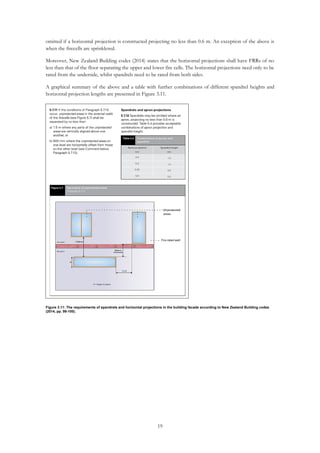
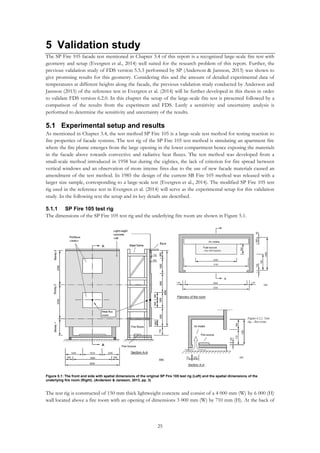
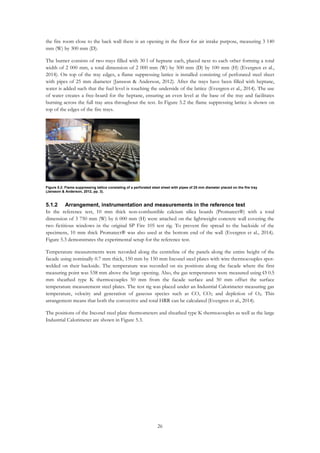
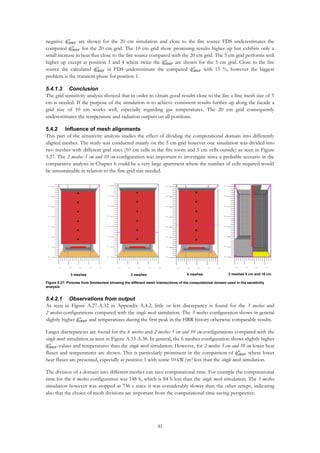
projections on external
fire spread
- A numerical comparative study
Markus Nilsson
Division of Fire Safety Engineering
Lund University, Sweden
Brandteknik
Lunds tekniska högskola
Lunds universitet
Rapport 5510, Lund 2016
Examensarbete på civilingenjörsutbildningen i riskhantering
The impact of horizontal projections on external fire spread
- A numerical comparative study
Markus Nilsson
Lund 2016
Titel
Balkongplattors påverkan på extern brandspridning - En numerisk jämförande studie
Title
The impact of horizontal projections on external fire spread - A numerical comparative study
Author
Markus Nilsson
Report 5510
ISRN: LUTVDG/TVBB--5510--SE
Number of pages: 135
Illustrations: Markus Nilsson unless otherwise stated
Keywords
Horizontal projection, spandrel, balcony, FDS, FDS 6.2.0, external fire spread, vertical fire spread, adiabatic surface
temperature, validation study, comparative analysis, numerical study, SP Fire 105
Sökord
Horisontell projektion, balkong, balkongplatta, bröstning, fönsterbröstning, FDS, FDS 6.2.0, extern brandspridning,
vertikal brandspridning, adiabatisk yttemperatur, valideringsstudie, jämförande analys, numerisk studie, SP Fire 105
Abstract
The aim of the report was to investigate and compare the effect of horizontal projections along with different
spandrel heights between the unprotected openings in the building facade. The effect was more specifically the effect
on the risk level in regards to the external vertical fire spread. Furthermore, based upon the performance
requirements of the Swedish building regulations (BBR), the aim was to compare the effects of the different
protection methods. From the validation study it was shown that FDS version 6.2.0 is well suited as calculation tool
for the problem area given the presented settings. The main conclusions drawn from the report was that the use of at
least a 60 cm deep horizontal projection results in lesser consequences and lower risk levels at the facade above the
projection compared with the scenarios built up by different spandrel heights. Also, the conclusion was that the use
of at least a 60 cm deep horizontal projection results in lower risk levels above the projection compared with the risk
level accepted in the prescriptive part of the BBR. The opposite was seen for the 20 cm and 30 cm deep horizontal
projections. The use of 60, 80 and 100 cm deep horizontal projections resulted in 15-50 % reduction in the relative
exposure of adiabatic surface temperature at the facade 1.2 m above the underlying opening. The main horizontal
projections used in the report were 20 cm thick rectangular non-combustible balconies with open sides and no
separation walls, extending 0.4 m on each side of the underlying openings. Based on the findings in this report, a
spandrel distance of at least 1.2 m in the building exterior as stated by the BBR can be replaced by at least a 60 cm
deep horizontal projection positioned at any height above the underlying opening. However, additional simulations
on other setups are needed to determine the general use of this outcome. Furthermore, recommendations were given
on the design of BBR for the problem area.
Division of Fire Safety Engineering
Faculty of Engineering
Lund University
P.O. Box 118
SE-221 00 Lund
Sweden
www.brand.lth.se
Telephone: +46 46 222 73 60
Brandteknik
Lunds tekniska högskola
Lunds universitet
Box 118
221 00 Lund
www.brand.lth.se
Telefon: 046 - 222 73 60
© Copyright: Brandteknik, Lunds tekniska högskola, Lunds universitet, Lund 2016.
I
Summary
Previous experimental and numerical research has shown that external fire spread commonly travels vertically
between windows in the building facade of residential buildings. The aim of this report was to investigate and
compare the effect of horizontal projections and different spandrel heights between unprotected openings in
the building facade. The effect was more specifically the effect on the risk level in regards to the external
vertical fire spread. Furthermore, based upon the performance requirements of the Swedish building
regulations, the aim was to compare the effects of the different protection methods.
Initially, a literature review of previous research was conducted and based on the findings the program FDS
version 6.2.0 was chosen as calculation tool for the problem area. The program was then validated against
data from a large-scale fire test on a modified SP Fire 105 test rig, whose design is closely linked to the
problem area. Conclusions drawn from the validation study was that FDS version 6.2.0 performed well
regarding estimation of gas and surface temperatures as well as incident radiation. However, the sensitivity
analysis showed that to obtain similar results close to the fire a high mesh resolution was needed, more
specifically a 𝐷∗
/ 𝛿𝑥 of at least 30. Hence, given the aforementioned as well as additional results presented in
the report, FDS version 6.2.0 is deemed to be well suited as calculation tool for the problem area.
The findings from the validation study were considered in the comparative analysis in the second part of the
report, which was performed to fulfil the aim. The comparative analysis was built up by several scenarios in
FDS that were simulating fires in a smaller apartment on two different HRR. This caused external flames to
eject out from either a given door or a window. The impacts on the fire after the inclusion of different types
of balconies were studied and compared between the scenarios in regards to incident radiation and adiabatic
surface temperatures at the facade above. The results from the scenarios were presented and compared in
diagrams demonstrating the consequence as a function of the height above the underlying opening.
Based on these results, a risk assessment was performed built by a relative comparison of the consequences
given the following two types of protection methods - the use of horizontal projections and the protections
method of different spandrel heights. The latter protection method corresponds to the same type of
protection method stated by the prescriptive part of the BBR. By letting the consequences from the scenarios
built up by different spandrel heights represent the risk level, the change in risk level was compared between
the scenarios. The comparative analysis resulted in the following conclusions being drawn in regards to
achieving the aim:
 The general conclusion is that the use of at least a 60 cm deep horizontal projection results in lesser
consequences and lower risk levels above the projection compared with scenarios built up by
different spandrel heights. The opposite is seen for the 20 cm and 30 cm deep horizontal
projections.
 The general conclusion is that the use of at least a 60 cm deep horizontal projection results in lower
risk levels above the projection compared with the risk level accepted in the prescriptive part of the
Swedish building regulations. The opposite is seen for the 20 cm and 30 cm deep horizontal
projections.
 The use of 60, 80 and 100 cm deep horizontal projections result in 15-50 % reduction in the relative
exposure of adiabatic surface temperature at the facade, 1.2 m above the underlying opening.
The above-mentioned conclusions are the general view based on the results from simulations on specific
setups used in the comparative analysis. The main horizontal projections used in the report were 20 cm thick
rectangular non-combustible balconies with open sides and no separation walls, extending 0.4 m on each side
of the underlying openings. Two types of openings were studied: a door and a window. In some of the
scenarios, the horizontal projections were positioned just above the underlying opening. Hence, given the
conditions in this study, a spandrel height of at least 1.2 m in the building exterior as stated by the Swedish
building regulations can be replaced by at least a 60 cm deep horizontal projection positioned at any height
above the underlying opening. However, additional simulations on other setups are needed to determine the
general use of this outcome. As a recommendation to the BBR, a prescriptive design similar to the New
Zealand building codes would be beneficial since this design offers either the selection of one or
combinations of the report’s two tested protection methods. This would offer flexible protection methods in
the BBR, still resulting in at least the same risk levels compared with the specified spandrel of 1.2 m.
II
III
Sammanfattning
Tidigare forskning har visat att den externa brandspridningen i bostadshus ofta sker vertikalt via fönstren i
byggnadsfasaden. Målet med denna rapport var att undersöka och jämföra effekten av balkongplattor och
olika bröstningshöjder mellan icke brandklassade fönster i byggnadsfasaden. Mer specifikt undersöktes
påverkan på risknivån med hänsyn till den externa vertikala brandspridningen. Vidare var målet att jämföra
denna påverkan mellan de olika skyddsmetoderna med de förenklade reglerna i de svenska byggreglerna
(BBR) som grund.
Inledningsvis genomfördes en litteraturstudie över tidigare bedriven forskning och baserat på resultatet utsågs
programmet FDS version 6.2.0 som beräkningsverktyg för problemområdet. Programmet validerades därefter
mot data från ett storskaligt brandförsök på en modifierad SP Fire 105 test rigg, vars geometri är nära knuten
till problemområdet. Slutsatserna som drogs från valideringsstudien var att FDS väl uppskattade gas- och
yttemperaturer såväl som infallande strålning. Känslighetsanalysen visade emellertid att en fin mesh-
upplösning krävdes för att uppnå likvärdiga resultat nära branden, mer specifikt ett 𝐷∗/ 𝛿𝑥 av åtminstone 30.
Givet resultaten presenterade i rapporten anses därmed FDS version 6.2.0 vara väl lämpad som
beräkningsverktyg för problemområdet.
Resultaten från valideringsstudien togs i beaktning i den jämförande analysen i den andra delen av rapporten,
som i sin tur genomfördes för att uppfylla målet med rapporten. Den jämförande analysen bestod av ett
flertal scenarier i FDS vilka simulerade brandförlopp i en mindre lägenhet på två olika effektutvecklingar.
Detta gav upphov till externa flammor som spred sig ut genom antingen en bestämd dörr eller ett fönster.
Därefter studerades effekterna på den externa branden efter införandet av olika typer av balkonger och
värden på infallande strålning samt adiabatisk yttemperatur på den ovanliggande fasaden jämfördes mellan
scenarierna. Resultatet från dessa scenarier presenterades och jämfördes i olika diagram där konsekvensen
åskådliggjordes som en funktion av höjden ovanför den underliggande öppningen.
Med utgångspunkt av resultatet från dessa scenarier utfördes en riskanalys som byggde på den relativa
jämförelsen av konsekvenser mellan de följande två typerna av skyddsmetoder - användningen av
balkongplattor i fasaden och användningen av olika bröstningshöjder. Den senare nämnda skyddsmetoden
täcker in och motsvarar samma typ av skyddsmetod som anges i den föreskrivande delen av BBR. Genom att
låta konsekvenserna från scenarierna uppbyggda av olika bröstningshöjder representera risknivån kunde
ändringen i risknivån jämföras mellan scenarierna. Den jämförande analysen resulterade i följande slutsatser:
 Den generella slutsatsen är att användningen av åtminstone en 60 cm djup balkongplatta resulterar i
mindre konsekvenser och lägre risknivåer ovanför plattan jämfört med scenarier uppbyggda av olika
bröstningshöjder. Det motsatta ses för de 20 cm och 30 cm djupa balkongplattorna.
 Den generella slutsatsen är att användningen av åtminstone en 60 cm djup balkongplatta resulterar i
lägre risknivåer ovanför plattan jämfört med den risknivå som är accepterad i de allmänna råden i de
svenska byggreglerna. Det motsatta ses för de 20 cm och 30 cm djupa balkongplattorna.
 Användningen av 60, 80 och 100 cm djupa balkongplattor resulterar i 15-50 % reduktion av den
relativa exponeringen av adiabatisk yttemperatur på fasaden, 1,2 m ovanför den underliggande
öppningen.
De ovan nämnda slutsatserna är den allmänna uppfattningen baserat på resultat från simuleringar på specifika
uppställningar i den jämförande analysen. De huvudsakligen använda balkongplattorna i rapporten var 20 cm
tjocka, rektangulära och icke-brännbara balkonger med öppna sidor samt inga skiljeväggar, utstickande 0,4 m
åt var sida om den underliggande öppningen. Två typer av öppningar studerades: en dörr och ett fönster. I
några av scenarierna placerades balkongplattorna precis ovanför den underliggande öppningen. Givet
förutsättningarna i denna studie kan därmed en bröstning av 1,2 m som anges i de svenska byggreglerna
ersättas med åtminstone en 60 cm djup balkongplatta placerad på en valfri höjd ovanför den underliggande
öppningen. Dock behövs ytterligare simuleringar med andra uppställningar för att fastställa resultatets
allmänna tillämpning. En rekommendation till de svenska byggreglerna vore att utforma den föreskrivande
delen likt utformningen av de Nya Zeeländska byggnadsreglerna. Detta är fördelaktigt eftersom de senare
reglerna erbjuder antingen valet av en eller kombinationer av de skyddsmetoder som testats i rapporten. Detta
skulle medföra att flexibla skyddsmetoder erbjuds i BBR som fortfarande resulterar i samma risknivåer
jämfört med dagens bröstningskrav på 1,2 m.
IV
V
Preface
This master thesis is written at the Department of Fire Safety Engineering and the Division of Risk
Management and Societal Safety at Lund University during the fall of 2015. The report is produced in
collaboration with Brandskyddslaget AB, Stockholm.
I, the author of this report, would like to show my gratitude to the people who have been of great help during
the concluding part of my education and the realization of this master’s thesis.
Thank you
Bjarne Husted, my main supervisor, Senior Lecturer at Division of Fire Safety Engineering, Lund
University. You have been of great help with the technical aspects that a project based on FDS involves and
also been flexible so that important meetings could take place, which is much appreciated during distance
education.
Axel Jönsson, my external supervisor, Civil Engineer in Risk Management and Safety Engineering and Fire
Protection Engineer at Brandskyddslaget AB, Stockholm. You have supported me throughout the project
and provided me with not only specialist advice, but also the valuable exchange of information and
knowledge, through conversations and reviews of the report.
Henrik Hassel, Program Director for the Master’s program in Risk Management and Safety Engineering.
You have been of great assistance in helping me integrate the risk aspect in this project through discussions
and reviews.
Johan Anderson and Robert Jansson, Research Scientists at SP Technical Research Institute of Sweden.
You have provided unparalleled support sharing valuable data and other information from the large-scale fire
test at SP. The data has been the basis for the validation study in this report from which important
conclusions have been drawn.
Stockholm, February 2016.
Markus Nilsson
____________________
VI
Abbreviations
AST - Adiabatic Surface Temperature
BBR - Boverkets Byggregler (Swedish building regulations)
FDS - Fire Dynamics Simulator
HRR - Heat Release Rate
HRRPUA- Heat Release Rate Per Unit Area
INC - Incident heat flux (computed in FDS)
IRHF - Incident Radiative Heat Flux
SP - Technical Research Institute of Sweden
Contents
1 INTRODUCTION.................................................................................................................... 1
1.1 BACKGROUND............................................................................................................................................. 1
1.2 PURPOSE AND AIM..................................................................................................................................... 2
1.3 RESEARCH QUESTIONS............................................................................................................................. 2
1.4 DELIMITATIONS........................................................................................................................................... 2
2 METHODOLOGY................................................................................................................... 3
2.1 A REVIEW OF PREVIOUS RESEARCH ON THE SUBJECT........................................................................ 3
2.2 EVALUATING FDS VERSION 6.2.0 FOR THE GIVEN PROBLEM AREA..................................................... 3
2.3 PERFORMING A RISK ASSESSMENT BASED ON A RELATIVE COMPARISON ....................................... 4
2.4 READING GUIDE.......................................................................................................................................... 8
3 LITERATURE REVIEW AND THEORY ................................................................................ 9
3.1 THE CONCEPT OF EXTERNAL FIRE SPREAD........................................................................................... 9
3.2 PREVIOUS RESEARCH ON HORIZONTAL PROJECTIONS ..................................................................... 12
3.3 PREVIOUS RESEARCH ON SPANDRELS................................................................................................. 14
3.4 PREVIOUS CONDUCTED VALIDATION STUDIES OF CALCULATION TOOLS........................................ 15
3.5 PROTECTION REQUIREMENTS IN COUNTRIES’ BUILDING REGULATIONS......................................... 16
4 FIRE DYNAMICS SIMULATOR (FDS)................................................................................ 21
4.1 BRIEF THEORY OF FDS............................................................................................................................ 21
4.2 IMPROVEMENTS IN THE NEW VERSION OF FDS................................................................................... 21
4.3 MESH RESOLUTION.................................................................................................................................. 22
4.4 QUALITY METRICS.................................................................................................................................... 22
4.5 ADIABATIC SURFACE TEMPERATURE.................................................................................................... 23
5 VALIDATION STUDY .......................................................................................................... 25
5.1 EXPERIMENTAL SETUP AND RESULTS .................................................................................................. 25
5.2 VALIDATION OF FDS................................................................................................................................. 30
5.3 RESULTS ................................................................................................................................................... 35
5.4 SENSITIVITY ANALYSIS ............................................................................................................................ 40
5.5 UNCERTAINTY ANALYSIS......................................................................................................................... 43
5.6 DISCUSSION.............................................................................................................................................. 45
6 COMPARATIVE ANALYSIS ............................................................................................... 49
6.1 COMPUTATIONAL DOMAIN ...................................................................................................................... 49
6.2 GEOMETRY................................................................................................................................................ 49
6.3 MEASUREMENTS...................................................................................................................................... 52
6.4 DESIGN FIRE ............................................................................................................................................. 53
6.5 MISCELLANEOUS SETTINGS ................................................................................................................... 54
6.6 PRODUCING THE RESULTS ..................................................................................................................... 54
6.7 SUMMARY OF FDS-RUNS......................................................................................................................... 56
6.8 RESULTS ................................................................................................................................................... 57
6.9 SENSITIVITY ANALYSIS ............................................................................................................................ 66
7 DISCUSSION....................................................................................................................... 71
7.1 CHOICE OF SETUP AND INPUT VARIABLES ........................................................................................... 71
7.2 REASONABILITY ASSESSMENT TO PREVIOUS CONDUCTED RESEARCH.......................................... 72
7.3 ANALYSIS OF RESULTS............................................................................................................................ 73
7.4 EVALUATING THE RESULTS .................................................................................................................... 74
7.5 CLOSING DISCUSSION ............................................................................................................................. 76
7.6 RECOMMENDATIONS TO THE SWEDISH BUILDING REGULATIONS .................................................... 77
8 CONCLUSION ..................................................................................................................... 79
9 FURTHER RESEARCH....................................................................................................... 81
10 REFERENCES ..................................................................................................................... 83
APPENDIX A – VALIDATION OF FDS ...................................................................................... 87
APPENDIX B – COMPARATIVE ANALYSIS .......................................................................... 103
APPENDIX C – FDS INPUT FILES .......................................................................................... 125
1
1 Introduction
As an introduction to this study and to clarify the meaning of two terms frequently used in the report, two
definitions are made:
The term horizontal projection described in this report is any type of building element that is perpendicular to
the exterior of a vertical wall, hence extending horizontally from the building facade. The term is theoretical
and considered to be a protection method against the external vertical spread of fire since it is positioned
between vertically aligned windows in the building facade. This means in the same way that a balcony, which
is a physical building element, may acts as a horizontal projection. A balcony may be designed in different
ways with respect to different types of balustrades and the inclusion of separation walls or not. Still, the
balcony is considered to act as a horizontal projection on the building facade. Moreover, the balcony depth or
depth of the horizontal projection is the distance the balcony or projection protrudes from the wall.
A spandrel is described as the vertical safety distance between external windows in the building facade. This is
yet another protection method against the external vertical fire spread.
1.1 Background
Previous experimental and numerical research has shown that external fire spread commonly travels vertically
between windows in the building facade of residential buildings. Windows are weak points in the facade and
overall structure, allowing fires to travel through when breaking. One of the fastest ways a fire spreads to
other floors is also due to the open or broken windows along the exterior of a building, highlighting the
sensitivity in the design of a building facade (Mammoser III & Battaglia, 2003).
In Section 5:553 of the Swedish building regulations (BBR), the protection requirements for external vertical
fire spread through windows in the building exterior are specified (Boverket, 2015). According to the general
recommendations in the prescriptive design, the spandrel distance between windows in the building exterior
belonging to different fire compartments is to be either at least 1.2 m, alternatively, at least one of the
windows is to be fire rated in class E 30, or both fire rated in class E 15. Moreover, the BBR states that
windows subject to fire resistance classification shall not be possible to be opened other than by a tool, key or
similar. There are no further advices or design solutions in the general recommendations of the BBR.
The design of the BBR creates problems since today’s buildings often features large glazed surfaces along the
building facade with the intention of letting a lot of sunlight in. Also, solutions like French balconies with
openable door sections pose potential problems. More specified, the problem is that the glazed surfaces can
extend along the whole exterior of the floor plane that may lead to a shorter spandrel than 1.2 m to
overlaying windows assuming normal roof height and floor slab thickness. At the same time there are
countries offering balconies as an alternative solution to spandrels in the prescriptive part of the building
regulations. An alternative solution offered by the building regulations is deemed to meet the performance
requirements automatically, which means in these cases that the protection method of using a balcony in
combination with a shorter spandrel is considered equivalent to the same fire protection as the longer
spandrel.
One way to solve the problem of reduced spandrel distances as a result of windows in new building designs
could hence be to add a balcony with appropriate dimensions at the top of the window on the building
facade. The balcony would act as a horizontal projection deflecting the flames from a fire outwards and away
from the wall, thus reducing the impact of flames and hot gases to the floors above and by this impeding the
vertical fire spread. The use of a balcony as protection method could work as an alternative solution to the
general recommendation in the BBR, offering at minimum the same level of risk in regards to the external
vertical fire spread at positions above the balcony compared with positions along the accepted spandrel
distance of at least 1.2 m.
2
1.2 Purpose and aim
The purpose of this report is to compare the risk of fire spread through openings along the exterior of a
building for protection measures given by a horizontal projection and protections measures given by different
spandrel heights as well as those stated under the Swedish building regulations. The purpose is also to
investigate the validity of the program Fire Dynamics Simulator version 6.2.0 for the given problem area.
The aim of the report is to investigate and compare the effect of horizontal projections and different spandrel
heights between unprotected openings in the building facade. The effect in this case is more specifically the
effect on the risk level in regards to the external vertical fire spread. Furthermore, based upon the
performance requirements of the Swedish building regulations, the aim is to compare the effects of the
different protection methods.
1.3 Research questions
In order to evaluate the program FDS version 6.2.0 as calculation tool for the problem area, the following
research questions will be answered in the validation study:
 What is the potential in the use of the program FDS as calculation tool for the given problem area?
 Are there any input variables that are of great importance when performing calculations in FDS for
the given problem area? Are there any uncertainties in the calculations performed by FDS?
In order to achieve the aim the following research questions will be answered in the comparative analysis:
 What impact does a horizontal projection have on the fire in regards to temperature and receiving
radiation at the overlying facade?
 How is the risk level for the risk of fire spread through openings along the building exterior affected
by different protection measures? And how are these risk levels compared with the risk level
accepted in the Swedish building regulations?
1.4 Delimitations
The following delimitations are made in the report:
 The report is based on the assumption that the building facade materials and its insulation are
constructed of non-combustible material, which also applies to windows. Hence, no account is
taken to additional effects of external fire growth at the facade.
 The main horizontal projections used in the comparative analysis are 20 cm thick rectangular non-
combustible balconies with open sides and no separation walls, extending 0.4 m on each side of the
underlying openings. The horizontal projections, if seen as balconies, are assumed to be
unfurnished.
 The report covers the effects of a single horizontal projection between vertically aligned openings in
the building facade. Hence, the effects of additional horizontal projections positioned above are not
covered.
 The report is not including protection methods as recessed openings or different heights of
openings on every other floor. However, it is considered from the answers to the first research
question stated above, which in turn are based on the results in this report, that the above-
mentioned constructions can be studied using the same methods presented in the report.
3
2 Methodology
Since the report is composed of three parts; a literature review and theory followed by two analysis parts, this
chapter is divided into different subchapters to clarify the interconnections between these parts and describe
how they were conducted as well as the rationale for why the specific parts of the report were conducted.
2.1 A review of previous research on the subject
To gain an understanding of previous research in this field and how different countries manage the
protection against external vertical fire spread between openings in the building facade, a literature review was
conducted and necessary theory aspects were collected. Important aspects in this part of the report were
conclusions drawn from the theory and the concept of external fire spread but also from previous studies of
protection measures such as spandrels and horizontal projections. These aspects were considered when
performing the analyses and when analysing the results. The review of how different countries manage the
protection against the vertical fire spread between openings in the building facade is important in order to
relate to the previous research conducted on the protective measures, as well as to the findings in this report.
2.2 Evaluating FDS version 6.2.0 for the given problem area
To be able to answer the first two research questions stated in the introduction in Chapter 1.3 of this report, a
validation study on FDS version 6.2.0 was performed. Since the main goal was to evaluate FDS as calculation
tool for the given problem area, it was necessary to find a large-scale fire test with a suitable geometry for the
research problem of this report together with useful data available on temperature as well as incident
radiation at the facade. Validating FDS against a setup as closely linked as possible to the setup that was
modelled in the comparative analysis was considered important in order to obtain valid results in the latter
mentioned analysis.
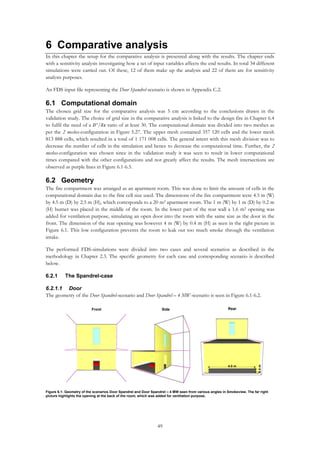
The chosen large-scale fire test was a heptane fire in a modified version of the recognized SP Fire 105 test rig,
simulating the facade of a three-storey apartment building with a fire in an apartment on ground floor. This
specific test was used as a reference test in Evergren, Rahm, Arvidsson and Hertzberg (2014) with no
sprinklers operating and 10 mm thick non-combustible Promatect® boards were placed on top of the
original test rig facade. Along the facade, thermocouples and plate thermometers were placed at six heights
recording the gas and surface temperatures. From the surface temperatures recorded by the plate
thermometers, the incident radiative heat flux (𝑞̇ 𝐼𝑅𝐻𝐹
′′
) was later calculated. For more information about the
chosen large-scale fire test the reader is referred to the experimental setup in Chapter 5.1.
The above-mentioned modified version of the SP Fire 105 test rig was then modelled in FDS where the input
parameters were chosen based on the background information in Chapter 5.1. The gas temperature- and
surface temperature outputs from both modelled plate thermometers and adiabatic surface temperature
devices were compared with the data collected from the reference test at the six heights. Also, the produced
𝑞̇ 𝐼𝑅𝐻𝐹
′′
-values in FDS were compared with the computed 𝑞̇ 𝐼𝑅𝐻𝐹
′′
from the fire test. This is presented in the
results chapter under Chapter 5.3.
Moreover, a comprehensive sensitivity analysis was conducted divided into six parts that started with
investigating the sensitivity in the choice of grid size followed by investigating the sensitivity in the choice of
mesh alignments and in the choice of thermocouple device positioning. The last three parts concerned the
sensitivity in the choice of radiation angles, the sensitivity in the choice of HRRPUA (Heat Release Rate Per
Unit Area) as well as in the choice of soot yield. The sensitivity analysis was followed by an uncertainty
analysis investigating the uncertainty in the computation of 𝑞̇ 𝐼𝑅𝐻𝐹
′′
obtained from Evergren et al. (2014).
The conclusions drawn from the validation study under Chapter 5.4 and Chapter 5.6 were taken into
consideration when performing the simulations in the comparative analysis.
4
2.3 Performing a risk assessment based on a relative comparison
The comparative analysis performed under Chapter 6 of this report was based on a risk assessment, which in
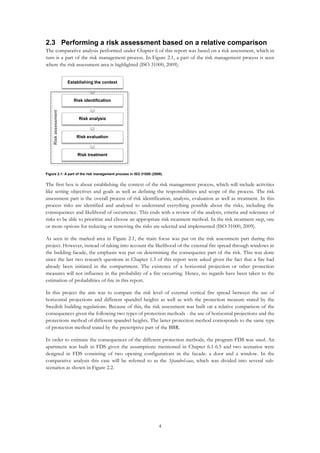
turn is a part of the risk management process. In Figure 2.1, a part of the risk management process is seen
where the risk assessment area is highlighted (ISO 31000, 2009).
Figure 2.1: A part of the risk management process in ISO 31000 (2009).
The first box is about establishing the context of the risk management process, which will include activities
like setting objectives and goals as well as defining the responsibilities and scope of the process. The risk
assessment part is the overall process of risk identification, analysis, evaluation as well as treatment. In this
process risks are identified and analysed to understand everything possible about the risks, including the
consequences and likelihood of occurrence. This ends with a review of the analysis, criteria and tolerance of
risks to be able to prioritize and choose an appropriate risk treatment method. In the risk treatment step, one
or more options for reducing or removing the risks are selected and implemented (ISO 31000, 2009).
As seen in the marked area in Figure 2.1, the main focus was put on the risk assessment part during this
project. However, instead of taking into account the likelihood of the external fire spread through windows in
the building facade, the emphasis was put on determining the consequence part of the risk. This was done
since the last two research questions in Chapter 1.3 of this report were asked given the fact that a fire had
already been initiated in the compartment. The existence of a horizontal projection or other protection
measures will not influence in the probability of a fire occurring. Hence, no regards have been taken to the
estimation of probabilities of fire in this report.
In this project the aim was to compare the risk level of external vertical fire spread between the use of
horizontal projections and different spandrel heights as well as with the protection measure stated by the
Swedish building regulations. Because of this, the risk assessment was built on a relative comparison of the
consequences given the following two types of protection methods - the use of horizontal projections and the
protections method of different spandrel heights. The latter protection method corresponds to the same type
of protection method stated by the prescriptive part of the BBR.
In order to estimate the consequences of the different protection methods, the program FDS was used. An
apartment was built in FDS given the assumptions mentioned in Chapter 6.1-6.5 and two scenarios were
designed in FDS consisting of two opening configurations in the facade: a door and a window. In the
comparative analysis this case will be referred to as the Spandrel-case, which was divided into several sub-
scenarios as shown in Figure 2.2.
Establishing the context
Risk identification
Risk analysis
Risk evaluation
Risk treatment
Riskassessment
5
Figure 2.2: The sub-division of the Spandrel-case into different scenarios. The grey number in the end of each scenario highlights the
specific scenarios that were compared given the combination of numbers in Figure 2.2-2.3.
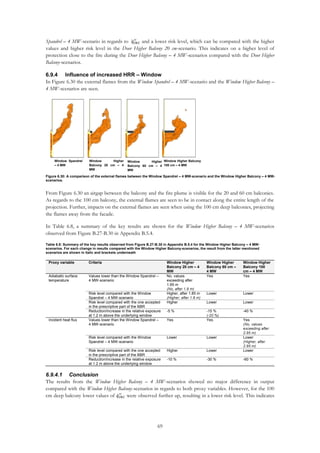
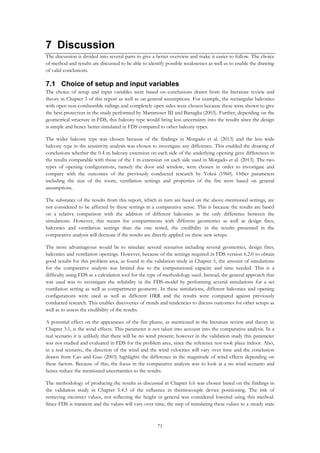
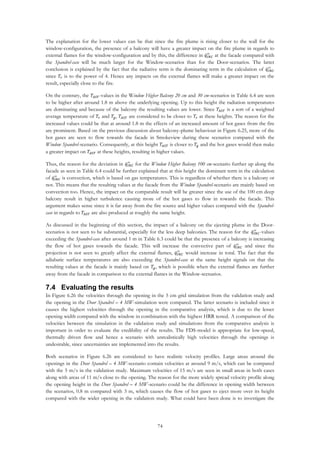
As seen in Figure 2.2, two additional FDS simulations were conducted for the purpose of a sensitivity
analysis, where a HRR of 4 MW was modelled instead of the original 3.1 MW. Given the geometry used in
the Spandrel-case, additional simulations were conducted including balconies of various depths and at different
heights in the facade as the only difference. This case is referred to as the Balcony-case, divided into several sub-
scenarios as shown in Figure 2.3.
Figure 2.3: The sub-division of the Balcony-case into different scenarios. The grey number in the end of each scenario highlights the
specific scenarios that were compared given the combination of numbers in Figure 2.2-2.3.
As seen in Figure 2.3, additional FDS simulations within this case were conducted for the sensitivity analysis.
As seen in Figure 2.2-2.3, 34 different simulations were carried out in total. Of these, 12 of them made up the
analysis and 22 of them were for sensitivity analysis purposes. For more information about the specific
geometry and other settings of the scenarios within the two cases presented above, the reader is referred to
Chapter 6.1-6.5.
In all the scenarios stated above, devices measuring the adiabatic surface temperature 𝑇𝐴𝑆𝑇 and the incident
heat flux quantity 𝑞̇ 𝐼𝑁𝐶
′′
in FDS were positioned along the facade above the opening. From these devices, a
value of the 𝑇𝐴𝑆𝑇 and the 𝑞̇ 𝐼𝑁𝐶
′′
at each height above the opening was obtained, according to the procedure
Spandrel-case
Door
Door Spandrel 1
Sensitivity analysis Door Spandrel – 4 MW 3
Window
Window Spandrel 2
Sensitivity analysis Window Spandrel 4 – MW4
Balcony-case
Door
A balcony between the
apartments Higher Balcony 20, 30, 60, 80 and 100 cm deep1
Sensitivity analysis
Lower Balcony 20, 30, 60, 80 and 100 cm deep 1
Lower Balcony 30 cm deep – less wide 1
Higher Balcony 60 cm deep – less wide 1
Higher Balcony 20, 60 and 100 cm – 4 MW fire 3
Window
Sensitivity analysis
Lower Balcony 20, 30, 60, 80 and 100 cm deep 2
Lower Balcony 30 cm deep – less wide 2
Higher Balcony 60 cm deep – less wide 2
Higher Balcony 20, 60 and 100 cm – 4 MW fire 4
A balcony between the
apartments Higher Balcony 20, 30, 60, 80 and 100 cm deep2
6
explained in Chapter 6.6. From this, two types of graphs were produced describing 𝑇𝐴𝑆𝑇 and 𝑞̇ 𝐼𝑁𝐶
′′
as a
function of the height above the opening. These results served as a basis for the determination of
consequences of the given scenario.
The above also means that the results from the Spandrel-case take into account the protection method stated
by the general recommendations in the prescriptive design of the BBR, as discussed in the background in
Chapter 1.1, since a spandrel height of 1.2 m is covered.
The use of 𝑇𝐴𝑆𝑇 and 𝑞̇ 𝐼𝑁𝐶
′′
as proxy variables for the consequence is justified because these variables take into
account the gas temperatures as well as the incident radiation perspective from the fire. These proxy variables
are independent of the type of building material used in the simulations and from the validation study these
variables were also shown to give promising results for this particular problem area.
The relative comparison of consequences was achieved by comparing scenarios from each of the two cases in
the same diagram. More specifically the scenarios that were compared were the combinations given by the
numbers in each of the scenarios in Figure 2.2-2.3. In other words, for these combinations of scenarios the
additions of balconies of various sizes were the only difference in input.
To explain how the results were analysed an example is shown below. In Figure 2.4 an example of 𝑇𝐴𝑆𝑇 as a
function of the height above the opening is shown for four different scenarios.
Since the criteria found in the general advices when performing alternative solution in Sweden are mainly
based on evacuation safety (Boverket, 2013), it is difficult in this case to define a risk criterion from which the
calculated consequences will be compared against. Instead, the consequences given the Spandrel-case were
considered to represent the risk level for the given geometry, design fire, ventilation properties and opening
configuration. The results in Figure 2.4 will answer the following research question stated in Chapter 1.3:
 What impact does a horizontal projection have on the fire in regards to temperature and receiving
radiation at the overlying facade?
In Figure 2.4 it is seen that the use of Balcony 2 and 3 results in values that are consistently lower than the
Spandrel-case, hence the existence of these balconies results in lower 𝑇𝐴𝑆𝑇 at the facade on all heights compared
with the Spandrel-case. The use of Balcony 1 however results in higher values from 1 m to 3.2 m above the
opening. These conclusions will also answer the first part of the second research question:
 How is the risk level for the risk of fire spread through openings along the building exterior affected
by different protection measures? And how are these risk levels compared with the risk level
accepted in the Swedish building regulations?
50
100
150
200
250
300
350
400
0.6 0.8 1 1.2 1.4 1.6 1.8 2 2.2 2.4 2.6 2.8 3 3.2
Adiabaticsurfacetemperature[ºC]
Height above door [m]
Figure 2.4: Example of adiabatic surface temperature as a
function of the height above the opening in the building facade for
various scenarios.
Figure 2.5: Example of normalized adiabatic surface temperature
values to the Spandrel-case 1.2 m above the opening. The point
of origin for the normalization is seen as a cross on the
Spandrel-case line.
0.3
0.4
0.5
0.6
0.7
0.8
0.9
1
1.1
1.2
1.3
1.4
1.5
1.6
0.6 0.8 1 1.2 1.4 1.6 1.8 2 2.2 2.4 2.6 2.8 3 3.2
Relativeexposure[-]
Height above door [m]
BBR Limit
7
Since the use of Balcony 2 and 3 result in lower values at the facade compared with the Spandrel-case, the
conclusion is that these balconies result in lower risk levels compared with the Spandrel-case. This means in
other words that the use of Balcony 2 and 3 results in lower risk levels above the projection compared with
the scenarios built up by different spandrel heights. The opposite is seen for Balcony 1, resulting in an
increase of the risk level for Balcony 1 after 1 m above the opening compared with the Spandrel-case.
The risks accepted in the prescriptive part of the Swedish building regulations in this case would be all the
values from the Balcony-scenarios that are beneath the grey horizontal line in Figure 2.4. The grey line
represents the BBR Limit highlighting the consequence at the facade 1.2 m above the opening, a criterion the
balconies also need to comply with further down. This will answer the last part of the above-mentioned
research question. Since Balcony 1 extends above this line from 0.6 to 1.3 m above the opening, this balcony
is considered to have a higher risk level compared with the risk level accepted in the BBR at these heights.
The use of Balcony 2 and 3 results in values that is consistently lower than the risk level accepted by the BBR.
This means that these balconies have a lower risk level in regards to the fire spread at these heights compared
with the risk level accepted in the prescriptive part of the Swedish building regulations.
Further, 𝑇𝐴𝑆𝑇 data from Figure 2.4 were normalized against the Spandrel-case 1.2 m above the opening, as seen
in Figure 2.5. From this it is seen that the reduction in 𝑇𝐴𝑆𝑇 for Balcony 2 and 3 compared with the Spandrel-
case is 10 % and 40 % respectively at 1.2 m above the opening. Another way of describing the latter
conclusions is by saying that the use of Balcony 2 and 3 result in 10 % and 40 % reduction in the relative
exposure at the facade at the given height above the underlying opening.
To get an understanding of the consequences for a non-fire rated glazed surface above the fire compartment,
an area of the facade was assigned the same properties as the common Swedish non-fire rated glass material
basic soda lime silicate glass. These areas were moved downwards from 1.2 m above the underlying opening
to just above the balcony when the projection was included in the model. The areas remained intact
throughout the simulations and did not affect the measurements of 𝑇𝐴𝑆𝑇 and 𝑞̇ 𝐼𝐻𝐹
′′
. However, the modelled
glass temperature differentials were then studied in diagrams in Excel and the failure of a glass was assumed
to occur when the difference in temperature reached 40 K (Swedish standards institute, 2012). This was done
to study the effect on the glazed surface due to the fire in the underlying compartment.
A sensitivity analysis was performed in order to evaluate the uncertainties. The sensitivity analysis studied the
effect of using balconies positioned just above the underlying door (the Lower Balcony-scenarios) and the effect
of a less wide balcony for both the Higher Balcony-scenarios and the Lower Balcony-scenarios. Also, the effect
when increasing the HRR was studied for both opening configurations.
The results under Chapter 6.8 and the conclusions from the sensitivity analysis under Chapter 6.9 were
processed using mainly the above-mentioned methods. From the results, a discussion was held in Chapter 7
and conclusions were drawn in Chapter 8 on whether the level of risk given by a shorter spandrel but with an
added horizontal projection gave risk levels similar, higher or lower compared with the Spandrel-case.
8
2.4 Reading guide
A reading guide is presented below to give a quick summary and description of the different main chapters of
the report.
1 Introduction -Introduction and background to the research conducted as well as
presentation of the purpose and aim of the report. Several research
questions are introduced and project delimitations are specified.
2 Methodology -The methodology is presented where the interconnections between
different parts of the report are clarified and how they are performed
as well as the rationale for why the specific parts of the report are
conducted.
3 Literature review and theory -The chapter provides the reader with a technical background for the
project, information of previous research on the subject and
examples of protection requirements from other countries’ building
regulations.
4 Fire Dynamics Simulator -Theory chapter of FDS providing the reader with a background to
the program as well as a review of technical terms used in the report.
5 Validation study -Validation study of FDS version 6.2.0 for the given problem area
also containing a comprehensive sensitivity analysis. Conclusions
drawn from this part are considered in the simulations of the
comparative analysis.
6 Comparative analysis -The comparative analysis for where the consequences from
simulations in FDS built up by different horizontal projections on the
building facade are compared with the consequences from
simulations built up by different spandrel heights.
7 Discussion -Discussion based on the findings in the report as well as
recommendations to the Swedish building regulations
8 Conclusion -Presents the conclusions drawn from the report.
9 Further research -Chapter provides some ideas on future research that have emerged
after looking deeper into the subject.
Appendix A - Validation of FDS -Provides all results from the validation study.
Appendix B - Comparative analysis -Provides all results from the comparative analysis.
Appendix C - FDS input files -Contains sample FDS-input files of the main setups from the
simulations in the validation study as well as from the scenarios in the
comparative analysis.
9
3 Literature review and theory
This chapter will provide a technical background for this project, provide information of previous research
on the subject and provide examples of protection requirements from other countries’ building regulations.
3.1 The concept of external fire spread
External fire spread is in this thesis defined as the spread of fire via openings in the building facade by
radiation or convection from an external plume or flame. The external plume and potential external flames
depends in turn on the fire conditions in the fire room and the opening conditions in the building exterior.
Hence, to understand the concept of external fire spread the fundamentals of fires in enclosures is described
below as a start.
The ignition is the first stage in an enclosure fire development. A spontaneous ignition or a piloted ignition
increases the temperature greatly above the ambient creating pyrolysis gases that later will ignite. The
combustion process can be either flaming or smoldering combustion (Karlsson & Quintiere, 2000).
The second stage is growth, where the fire grows in a certain rate depending on the type of fuel, access to
oxygen and interaction with the surroundings. A smoldering fire may have a very long growth period and it
may also die out before it reaches the fully development fire, which makes it irrelevant in this context. The
fire can also grow rapidly where the heat flux from one burning package is sufficient to ignite nearby fuel
packages in the room and where sufficient fuel and oxygen are available. A fire in a surrounding with
sufficient amount of oxygen available is named a fuel-controlled fire (Karlsson & Quintiere, 2000).
The next stage is a phenomenon called flashover. Flashover is the transition stage between the growth period
and the fully developed fire and is defined as “the rapid transition to a state of the total surface involvement
in a fire of combustible material within an enclosure.” by the International Standards Organization. Reaching
temperatures of 500-600 °C in the fire compartment, radiation levels of 15-20 kW/m2 to the floor or flames
appearing from the openings of the compartment are all different definitions of flashover found in the
literature. Fuel orientation, fuel properties, fuel position and enclosure geometry are factors that are strongly
linked to these occurrences (Karlsson & Quintiere, 2000).
The fourth stage is the fully developed fire. During this stage the fire is often limited by the availability of
oxygen. The type of burning taking place in a compartment with insufficient levels of oxygen is a ventilation-
controlled burning, since the oxygen is assumed to enter through the openings. The energy released in the fire
compartment is at its greatest and the temperatures are often very high, somewhere in the range of 700 °C to
1200 °C (Karlsson & Quintiere, 2000).
The fifth and last stage is decay. The fire may move on to a fuel-controlled fire in this period, since the fuel is
more and more consumed and the energy release rate diminishes resulting in less demands of oxygen for the
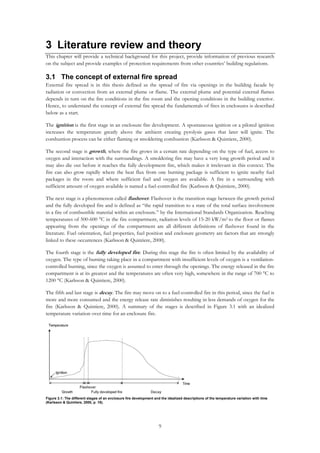
fire (Karlsson & Quintiere, 2000). A summary of the stages is described in Figure 3.1 with an idealized
temperature variation over time for an enclosure fire.
Figure 3.1: The different stages of an enclosure fire development and the idealized descriptions of the temperature variation with time
(Karlsson & Quintiere, 2000, p. 18).
10
In a fire development the term fire plume is often used. As cold gases surround hot gases in the flames of a
fire, the hotter and less dense gases will rise due to the density difference. This flow of hot buoyant gases,
including any flames, is called the fire plume (Karlsson & Quintiere, 2000).
During the stages of a fire development mentioned in the beginning of this chapter, the appearance of the
fire plume and its behaviour will change. Initially, a two-layer system is created with hot gases from the fire at
the ceiling and a lower layer with ambient air. This fuel-controlled fire will burn similar to a fire burning
outside and the fire plume will exist totally in the under layer (Gottuk & Lattimer, 2002). Figure 3.2 illustrates
the scenario.
Later on in the growth stage of the fire development the fire is starting to become ventilation-controlled due
to restricted airflows through the ventilations paths. The fire plume will normally extend to the upper layer
during this stage and the layer gases in the upper part of the plume are circulating. The size of the room and
the size of the fire can create fire plumes that cannot be contained within the room. If this occurs, there is a
possibility of having flame extensions out of the windows and other openings. This happens when the fire
plume impinges on the ceiling and the distance between the fire plume and the window is shorter than the
resulting ceiling jets. The phenomenon flame extension can occur during both fuel-controlled and ventilation-
controlled burning (Gottuk & Lattimer, 2002). In Figure 3.3 the scenario of flame extension is shown.
After some time the layer of hot gases will spill below the top of the windows or other openings in the
exterior and eject to outside. As the fire turns into a more ventilation-controlled fire the hot gases are not able
to burn because of the insufficient oxygen levels in the compartment. This leads to a build-up in fuel-rich
gases in the compartment and as the gases ejects out from the window the gases are mixed with air creating a
secondary burning, referred to as external burning. This occurrence can also be accompanied by layer
burning, which is the ignition of fuel-rich upper layer gases at the interface between the layers (Gottuk &
Lattimer, 2002).
Figure 3.2: Initial stage of a fire development illustrating a fuel-controlled fire and its fire plume creating two defined layers
(Gottuk & Lattimer, 2002, p. 2-55).
Figure 3.3: Picture illustrating ceiling jets flowing out from a room with flame extensions (Gottuk & Lattimer, 2002, p. 2-55).
11
The occurrence of external burning and layer burning is illustrated in Figure 3.4.
It is important to note the differences between the occurrences flame extensions and secondary burning. A
flame extension reaching out from windows is a result of a fire that is too large and cannot be contained in a
room. Secondary burning is a phenomenon unique for ventilation-controlled fires (Gottuk & Lattimer, 2002).
Both Figure 3.3 and Figure 3.4 illustrate flame extension and secondary burning to an adjacent room but a
similar scenario will happen from openings in the exterior to outside. The difference will be that the plume
will deflect upwards and travel along the building facade when it leaves the opening, due to the buoyancy of
the fire plume. As the fire plume ascends, the upper windows in the building facade will be exposed by the
hot gases and/or flames resulting in a temperature rise in the glass. This may lead to window panes cracking
due to the thermal stress induced across the glass surface by convection and radiation from the hot gases
(Walmerdahl & Werling, 2000).
If the glass falls out there is a risk of a secondary fire in the above fire compartment. A fraction of hot gases
from the plume may enter the room and expose the interior to convective and radiative heat flux. If the
interior of the upper fire compartment ignites, there is a scenario of two burning vertical compartments. A
fire in the lower fire compartment will then not only support the upper fire compartment with thermal
energy, but also with the supply of air with less quantity of oxygen, forcing the external plume from the upper
fire compartment to travel longer to obtain full combustion (Bech & Dragsted, 2005). Hence, there is a risk
of an accelerating vertical fire spread.
At the time a fire extends to the outside of the building, the geometry of the window and the presences of
other openings are some of the aspects that will control the shape of the plume outside the window along the
building facade (Klopovic & Turan, 2001). Yokoi (1960) discovered that the window geometry at the exterior
of the fire room impact on the fire plume behaviour. A fire plume ejecting out from a window with a width
longer than its height was observed rising more closely to the external wall than from a window with opposite
geometry (the height longer than the width). Consequently, the wall above the window was exposed to the
hot gases from the fire over a longer period of time in the case where the window width was longer than the
height. Mammoser III and Battaglia (2003) support the observations by Yokoi (1960) and explain the
phenomena as of the differences in velocity through the opening. A wide window will create lower gas
velocities through the window compared to a tall and narrow window, which makes it easier for the flames to
attach to the exterior wall.
Cao and Guo (2003) describe another variable that can have an impact on the appearance of the fire plume
outside the burn room: wind effects. A moderate velocity wind against the fire plume will push the plume
closer to the wall resulting in higher temperature and heat flux distributions at the wall compared to the no
wind scenario. However, if the wind is too strong, the plume will have problems ejecting smoke through the
window. If the plume is in the same direction as the wind it will be driven further away from the wall
resulting in lower temperatures and heat flux distributions at the wall above the window. However, much
more fuel will be driven out from the window in the latter case raising the temperatures in the plume with
some 100 °C. Klopovic and Turan (2001) mention that the environmental conditions, such as the room
Figure 3.4: Picture illustrating an under-ventilated compartment and the phenomena of external burning and layer burning
(Gottuk & Lattimer, 2002, p. 2-55).
12
geometry and position of the window, are other aspects that will affect the air entrainment into the plume and
swirling of the plume.
Of what is stated in this section, several factors are involved in the fire dynamics controlling the magnitude of
the external fire spread, which makes it difficult to compute the outcomes.
3.2 Previous research on horizontal projections
Previous research has been conducted on the use of horizontal projections as a protection method for the
vertical spread of fire in a building facade. Attempts with small-scale experiments whose results have been
compared with CFD software have been done (Cao & Guo, 2003; Mammoser III & Battaglia, 2003).
Moreover, large-scale experiments whose results were compared against results from CFD programs and/or
hand-calculation methods have been conducted (Klopovic & Turan, 2001; Morgado, Rodrigues & Laim,
2013; Oleszkiewicz, 1991; Yokoi, 1960). Brandskyddslaget AB has conducted research in collaboration with
Swedish Defence Research Agency where the impact of a fire plume against a double glass facade was studied
under various large-scale trials (Walmerdahl & Werling, 2000). Although the main purpose of the latter
research was to determine the efficiency of different geometries of double glass facade and glass types, the
impact of a horizontal projection on the fire plume could be observed. Lastly, a study of the performance of
horizontal projections compared with spandrels based on CFD calculations has been carried out (Luo Zhao
& Cheng, 2001).
Already in the 1960’s, large-scale and small-scale experiments were performed in Japan in order to investigate
different protection measures for the vertical spread of fire between openings in the facade (Yokoi, 1960).
After the Second World War, large windows were starting to become more common as a building design.
This was a big change compared to the previous design of small windows and large wall ratio because it
created new risks such as the risk of vertical fire spread between windows, due to the possible use of
insufficient fire-rated spandrel lengths. Therefore, the Japanese Ministry of Construction took actions and
conducted research on this subject (Yokoi, 1960).
An interesting finding from Yokoi’s work is the relation between projection width and trajectory of hot gases
from the fire plume. From small-scale experiments Yokoi discovered that even though the fire plume is
projected away from the facade due to a horizontal projection, it will converge to the trajectory of the
situation with no horizontal projection further up. The higher the hot gases travels after been projected away
from the horizontal projection, the more similar does its shape become to the shape when there is no
horizontal projection. This was regardless of the shape of the opening in the facade. The findings are shown
graphically in Figure 3.5.
Figure 3.5: Trajectories of ejected fire plumes from different opening dimensions (Yokoi, 1960, pp. 120).
13
The experimental work carried out by Yokoi (1960) led to building code changes in Japan, requiring new
structures to have 0.74 m deep horizontal projections above the windows in the building exterior to prevent
the upper windows from breaking.
The above-mentioned papers at the beginning of this section show that the inclusion of a horizontal
projection above the window reduces the temperatures and received radiation to the wall above (Cao & Guo,
2003; Luo et al., 2001; Mammoser III & Battaglia, 2003; Morgado et al., 2013; Walmerdahl & Werling, 2000;
Yokoi, 1960; Oleszkiewicz, 1991).
Mammoser III and Battaglia (2003) describes that the presence of a horizontal projection in the exterior wall
deflects the flame outwards and away from the building. Hence, the vertical fire spread will be inhibited and
the radiation to the wall and to storeys above will be reduced. Yokoi (1960) specifies though, based on
observations and the conclusions mentioned in Chapter 3.1 of this report, that a horizontal projection is
more effective as protection measures when the windows in the building facade are wide and short (the width
longer than the length). The reason is that the flames from this type of window do not reach as far out or
vertically from the window, providing better shielding against the fire plume.
The work published by Oleszkiewicz (1991) clearly illustrates the effects of a horizontal projection during a
fire. In a large-scale model, Oleszkiewicz studied the effect of horizontal projections with three projection
depths, inserted and moved instantaneously when the HRR (heat release rate) had stabilised (two heat release
rates were used). In Figure 3.6, the heat flux density at the facade (convection + radiation) is shown over time
on different heights, with and without a horizontal projection.
As seen in Figure 3.6, drastic reductions in heat fluxes are shown at the facade when the projection was
deployed and as soon as the projection is removed, the heat fluxes returns to the same level as before.
Oleszkiewicz also studied the difference between horizontal projections of different depths (0.3, 0.6 and 1.0
m), see Figure 3.7.
Figure 3.6: Measurements of the heat flux to the facade at 1,2 and 3 m above the opening for a 1 m deep horizontal projection
(Oleszkiewicz, 1991).
Figure 3.7: Picture showing relative heat flux data at different heights for various horizontal projection depths. The heat flux data is
normalized by data from the scenario with no projection, collected at 1 m above the opening (Oleszkiewicz, 1991).
14
Figure 3.7 describes that for a 1 m deep horizontal projection there is virtually no difference in heat flux from
0.5 to 3.5 m above the opening. From Figure 3.7 it is also shown at 1 m above the opening, that the heat
fluxes to the facade are reduced by 60 % for a 0.6 m deep horizontal projection compared to the scenario
with no projection. The corresponding reduction for the 1 m deep horizontal projection is 85 %.
Some of the scientific reports highlight other important aspects of the design of a balcony, signalling that not
only the depth of the balcony is of importance. Mammoser III and Battaglia (2003) for example present a
study differing from the other conducted studies. Their numerical study does not only treat observation of
how the outcome change for different depths of balconies, but also how the rest of the balcony geometry
impact on the vertical fire spread. After performing numerical simulations for scenarios containing each of
the different balcony types in Figure 3.8, it emerged that a rectangular balcony with open non-combustible
railings and completely open sides apart from the railings, gave the best protection (see Balcony a). This was
because the hot gases were projected away from the facade more effectively compared to the more enclosed
balconies with solid railings and separation walls. The latter balcony type was shown to trap the hot gases at
floor levels above the fire floor and thus increase the rate of vertical fire spread.
Moreover, Morgado et al. (2013) performed large-scale fire tests to validate the fire safety regulations in
Portugal regarding fire protection of building facades. In the experiment the distance between the openings
was 1.1 m and in total three tests were conducted comprising two tests with a balcony and one with just the
1.1 m spandrel. The balconies were both 0.55 m deep but with different widths giving two scenarios: A
balcony as wide as the opening and a balcony wider than the opening (the length of a balcony plus 1 m away
from each side of the opening). The results showed that the presence of a balcony wider than the window
resulted in lower temperatures in the wall above compared with the other balcony type and consequently the
wider balcony type was considered more viable. The reason for this was that the flames were kept further
away from the facade on the sides of the balcony lowering the risk of fire propagation to the upper floors.
3.3 Previous research on spandrels
The work carried out by Yokoi (1960) described earlier in this report also focused on spandrels. The author
developed a table-based method to calculate the necessary length of the spandrel, which was the height where
the plume temperature fell to 500 °C.
From Oleszkiewicz (1991) work it was concluded that a spandrel of 2.5 m was needed to achieve a 50 %
reduction in heat flux to the facade, see Figure 3.7. This means that using spandrels as a protection method
for the external fire spread is too impractical. If the use of spandrels and horizontal projections in
Oleszkiewicz’s work are compared in Figure 3.7 it is seen that a 0.3 m deep horizontal projection achieves the
same level of protection at 1 m above the opening as a 2.5 m spandrel. Moreover, a 0.6 m deep horizontal
Figure 3.8: Different geometries of balconies may have an impact on the fire plume behavior ejected from the window in the facade
below (Mammoser III and Battaglia, 2003, pp. 290-292)
15
projection achieves this level of protection at less than 0.5 m above the opening. In Oleszkiewicz (1991) it is
seen that the use of a horizontal projection as a protection measure for external fire spread is not only more
effective than spandrels for the same level of protection; it is also by far a more practical building design
solution.
3.4 Previous conducted validation studies of calculation tools
The increased use of computational fluid dynamics (CFD) and other calculation tools as means to predict the
effects of a fire put demands in the validity of the models. This results in needs of detailed large-scale fire
tests in similar environments in order to be able to validate the calculation tools. Klopovic and Turan (2001)
present a detailed study of large-scale fire tests with ambitions to provide basis for validation of calculation
tools regarding scenarios of external fire spread in non-combustible facades. In part two of the report the
results are compared with values from empirical approximations found in the literature. The study revealed
that the calculations from the empirical equations, developed by Yokoi (1960), underestimated the necessary
spandrel lengths to impede the vertical fire spread. The empirical equations developed by Thomas and Law
overestimated the predicted flame lengths, giving unrealistically high vertical reach of flames along the facade.
All things considered, the simplified equations seem to have difficulties in presenting a realistic and
representative picture of the fire plume behaviour.
In Sweden during the fall 2012, SP (Technical Research Institute of Sweden) conducted a series of large-scale
fire tests for an experimental setup simulating the facade of a three-storey apartment building with a fire in an
apartment on ground floor (Evergren et al., 2014). The test method used is called SP Fire 105 and first
introduced 1985 in Sweden, referred to a valid test method in Sweden, Denmark and Norway for testing
reaction to fire properties of facade systems. From this particular large-scale test setup, the original setup was
adjusted with ambitions to evaluate fire growth on external combustible ship surfaces (Evergren et al., 2014).
In one of the performed tests 10 mm thick non-combustible Promatect® boards were used instead of the
test panels, serving as a reference test with no sprinklers operating. The burning consisted of 60 litres of
heptane corresponding to a fire load of approximately 75 MJ/m2 placed in a room with dimensions: 3.2 m
(W) by 1.6 m (D) by 1.3 m (H). The corresponding HRR rate was approximately 3 MW at its peak and the
duration of the fire scenario was nearly 15 min. Temperatures were recorded along the symmetry line of the 6
m tall facade with both thermocouples and Inconel steel plate thermometers (Evergren et al., 2014).
The result of the reference test was later used in a validation study performed by SP (Anderson & Jansson,
2013). In test B of this study, the results from the large-scale fire subtest from Evergren et al. (2014) were
compared with the results from FDS version 5.5.3. In general, FDS showed good correspondence with the
data from the experiment but having problems resolving flows close to the fire source. This resulted in lower
temperatures than the actual measurements at the bottom of the facade however better correspondence was
found further up along the facade (Anderson & Jansson, 2013).
Another FDS validation study was performed in a thesis by two students from the Stord/Haugesund
University College in Norway (Gamlemshaug & Valen K., 2011). Even though the main goal with the use of
FDS in the thesis was to look at the thermal impact on external vertical steel structures due to a fire, the
thesis still showed some interesting results useful for this work. The fire room in the chosen large-scale fire
test had the dimensions 4.0 m (W) by 2.2 m (D) by 2.6 m (H), constructed of lightweight concrete. The fire
plume was ejecting out from a 3 m wide and 1.2 m high opening positioned 20 cm under the ceiling. When
analysing the results, the authors found an unrealistically shape of the fire plume ejecting out from the
window compared with the pictures and experimental data from the large-scale fire test. It turned out that
FDS version 5.5.3 was not able to simulate the high gas velocities through the window correctly. When the
authors added the command FDS6=.TRUE. in the input file, which activated the beta-version of the newer
version of FDS, the shape of the fire plume became more realistic. The use of improved models for the
turbulent viscosity (Deardorff, Dynamic Smagorinsky and Vreman) and the change in calculation method for
time steps given by the velocity vectors in the beta-version of FDS6 were stated as some of the likely reasons
to the changes in the results.
16
3.5 Protection requirements in countries’ building regulations
The following text gives a brief presentation of how different countries manage the protection against vertical
fire spread between openings in the building facade. The subchapter ends with a summary of the and a
conclusion.
3.5.1 Sweden
The protection requirements for windows that are vertically aligned in the building exterior and in different
fire compartments are specified in Section 5:553 of the BBR (BBR, 2015). According to the general
recommendations in the prescriptive design, one way to achieve protection against the external vertical fire
spread is to follow the guidelines in Table 5:553. Table 5:553 states that external windows belonging to
different fire compartments positioned within 1.2 m in height need to be fire-rated, either one window in fire
class E 30 or both windows in fire class E 15. For openings further away than 1.2 m there are no
requirements. The BBR also states that windows subject to fire resistance classification shall not be possible
to be opened other than by a tool, key or similar. There are no further advices or design solutions in the
general recommendations of the BBR.
It would be interesting to investigate the background to the recommended value of 1.2 m set by the
regulatory authorities. Therefore, the Swedish National Board of Housing Building and Planning was
contacted for information. Anders Johansson argues that the background to 1.2 m is generally unknown but
believes it is derived from Swedish building tradition in general1. He points out that the requirement has been
around for a long time and it is also considered to be a practical measure for situations where the overall floor
depth is between 2.5 and 3 m in buildings, which is a common way of building in Sweden. In these situations,
exterior walls with a spandrel of 1.2 m still accommodate windows of normal size and position. If the builder
deviate from normal window size and position, e.g. by placing windows along the entire facade, actions need
to be taken to ensure that fire spread won’t occur.
3.5.2 Finland
In Finland there are no prescriptive requirements presented in the building regulations for the external
vertical fire spread between openings in different fire compartments2. An official guidance document exists
which gives interpretations on acceptable solutions, stating a no-limit value except in the case of an inner
corner, where the minimum distance should be 2.0 m if the angle is less than 135 degrees2. However, there
are some local interpretations in Finland that the vertical distance between openings should be 1.0 m at
minimum2.
3.5.3 Norway
The Norwegian Building Codes (2015) states that the probability of external fire spread between fire
compartments can be reduced by a spandrel of at least 1.2 m or a horizontal projection extending at least 1.2
m out from the facade. These requirements can be omitted if an automatic sprinkler system is installed.
3.5.4 Denmark
In Denmark there are no prescriptive requirements in the building regulations for the external vertical fire
spread between openings in different fire compartments3.
3.5.5 Hong Kong
In Hong Kong, the Code of Practice for Fire Safety in Buildings prescribes a spandrel of not less than 0.9 m,
with an Fire Resistance Rating (FRR) of not less than that of the intervening storey. An alternative protection
method is to construct a horizontal projection of 0.5 m, with an FRR of not less than that of the intervening
storey (Hong Kong Buildings Department, 2012).
1 Anders Johansson, Fire Protection Engineer at Swedish National Board of Housing, Building and Planning, personal
communication 25th of September 2015
2 Esko Mikkola, Fire Protection Engineer at kk-palokonsultti Finland, e-mail communication 19th of October 2015
3 Annemarie Poulsen, Fire Protection Engineer at Rambøll Copenhagen, e-mail communication 19th of October 2015
17
3.5.6 Portugal
In accordance with Law 1532/2008 of the building regulations of Portugal, the protection method for the
vertical spread of fire between openings in the building facade is as follows (Morgado et al., 2013):
“The distance between openings in Portugal is 1.10 m, but when there is a balcony, with a span at least one meter
from each edge of the opening, this distance can be reduced by the span of the balcony. It is noticed that the balconies
have to be at least a fire resistance of EI60.”
3.5.7 Spain
In the Spanish building regulations, to limit the risk of fire spread between vertical fire compartments along
the facade the spandrel must be of at least 1.0 m and of fire class EI 60. A horizontal projection can also be
introduced and if so, the spandrel distance can be reduced by the length of the projection that extends out
from the facade (Morgado & Rodrigues 2013).
3.5.8 Australia
The Australian Building Codes (BCA) Volume One contains the requirements for multi-residential,
commercial industrial and public buildings. The vertical separation of openings in a building facade in the
Australian Building Codes is achieved by either of the following methods (BCA, 2015):
1. A spandrel of non-combustible material having an FRL (Fire Resistance Level) of 60/60/60 (REI
60) and an overall height of 0.9 m or more, extending at least 0.6 m or more above the upper
surface of the intermediate floor. The solution is shown graphically in Figure 3.9.
2. The use of a non-combustible horizontal projection, e.g. balcony, extending 1.1 m or more out from
the building facade and having an extension at least 0.45 m along the wall beyond the openings, and
having an FRL of 60/60/60. The solution is shown graphically in Figure 3.10.
Figure 3.9: One of the protection methods of the BCA describing the requirements of a non-combustible spandrel
(BuildSurv, 2015, april).
Figure 3.10: One of the protection methods of the BCA describing the use of a non-combustible horizontal projection
(BuildSurv, 2015, april).
18
3.5.9 USA
In the U.S., there are no official national building regulations developed through a national process. Instead,
several recognized organizations develop codes that are adopted by state or local governments. One example
of a recognized organization and their protection requirements are presented below.
The International Codes developed by the International Code Council (ICC) are one of the building
regulations used in the U.S. The International Building Code states that openings in external walls in adjacent
stories shall be separated vertically when the openings are within 1.524 m of each other horizontally and the
opening in the lower story is not a protected opening with a fire protection rating of not less than ¾ hour.
Such openings shall be separated vertically by either of the following (ICC, 2014):
1. Openings separated vertically not less than 0.914 m by spandrel girders, exterior walls or other
similar assemblies that have a fire-resistance rating of not less than 1 hour, rated for exposure to fire
from both sides.
2. Openings separated by flame barriers, with a fire-resistance rating of not less than 1 hour, extending
horizontally not less than 0.762 m beyond the exterior wall.
The requirements shall not apply to buildings that are three stories or less above grade plane, open parking
garages or buildings with a sprinkler system installed throughout.
3.5.10 France
The requirements for external fire spread in the French building codes shifts depending on building type and
use and also the heat effect of the combustible cladding in the facade. The French building codes first
differentiate between public and different residential buildings, then between the heat effects of the
combustible cladding, M. The dimensions of a horizontal projection is then described by the C & D rule,
where C stands for the vertical distance between the openings and D corresponds to the depth of the balcony
slab (Code de la construction et de l'habitation, 2009; Code de la construction et de l'habitation, 2015).
In public buildings,
 C + D must be equal to or more than 1.0 m if M ≤ 130 MJ/m2.
 C + D must be equal to or more than 1.3 m if M > 130 MJ/m2.
In residential buildings, for third class A (Building with ladder truck access, a highest floor of accommodation
at maximum 7 floors and an evacuation route less than 7 m from door to stair) buildings:
 C + D must be equal to or more than 0.6 m if M ≤ 25 MJ/m2.
 C + D must be equal to or more than 0.8 m if 25 MJ/m2 < M ≤ 80 MJ/m2.
 C + D must be equal to or more than 1.1 m if M > 80 MJ/m2.
In residential buildings, for third class B (Buildings other than third class A but containing a highest floor of
accommodation at a maximum of 28 m) and fourth class (Buildings with a highest floor of accommodation
between 28 m and 50 m) buildings:
 C + D must be equal to or more than 0.8 m if M ≤ 25 MJ/m2.
 C + D must be equal to or more than 1.0 m if 25 MJ/m2 < M ≤ 80 MJ/m2.
 C + D must be equal to or more than 1.3 m if M > 80 MJ/m2.
3.5.11 New Zealand
According to New Zealand Building codes (2014), unprotected openings in the external wall shall be
protected against vertical fire spread if the firecells contain sleeping risk groups, or if exitways have an escape
height of 10 m or more. Unprotected openings shall also be protected against vertical fire spread if firecells
containing other property are located one above the other. If these conditions occur and if the unprotected
areas are aligned above one another, a spandrel of not less than 1.5 m is to be constructed above the window.
If the unprotected areas on one level are horizontally offset from those on the other level, the windows shall
be separated by not less than 0.9 m. The New Zealand building regulations also states that spandrels may be
19
omitted if a horizontal projection is constructed projecting no less than 0.6 m. An exception of the above is
when the firecells are sprinklered.
Moreover, New Zealand Building codes (2014) states that the horizontal projections shall have FRRs of no
less than that of the floor separating the upper and lower fire cells. The horizontal projections need only to be
rated from the underside, whilst spandrels need to be rated from both sides.
A graphical summary of the above and a table with further combinations of different spandrel heights and
horizontal projection lengths are presented in Figure 3.11.
Figure 3.11: The requirements of spandrels and horizontal projections in the building facade according to New Zealand Building codes
(2014, pp. 99-100).
20
3.5.12 Summary
A summary of the protection requirements for external fire spread through windows in different countries is
presented in Table 3.1.
Table 3.1: Summary of the protection requirements for external fire spread through openings for different countries
Country/Region Spandrel (m) Horizontal projection (m) Note
Australia 0.9 1.1 -Non-combustible spandrel with an FRL of 60/60/60.
-Non-combustible horizontal projection with an FRL of
60/60/60, having an extension at least 450 mm along the wall.
Denmark - - There are no prescriptive requirements presented in the
building regulations in regards to the external vertical fire
spread.
Finland 1.0* - There are no prescriptive requirements presented in the
building regulations in regards to the external vertical fire
spread.
France 0.6 - 1 .3** 0.6 - 1.3** -The dimensions of horizontal projection and spandrel are
depending on the C + D rule, which in turn is dependent on
several variables.
Hong Kong 0.9 0.5 -Spandrel and horizontal projection are to be of a Fire
resistance rating not less than of the intervening storey.
New Zealand 1.5 0.6 -The New Zealand building codes also provides a table with
further combinations of different spandrel heights and
projection lengths.
Norway 1.2 1.2 These requirements can be omitted if the building contains an
automatic sprinkler system.
Portugal 1.1 1.1 - the depth of the
horizontal projection
-The horizontal projection need to have an extension of at
least 1000 mm along the wall and to be of fire resistance
EI60.
Spain 1.0 1.0 - the depth of the
horizontal projection
-Spandrel of fire class EI60.
Sweden 1.2 - -Vertical openings within 1200 mm need to be fire-rated,
either one window in fire class E 30 or both windows in fire
class E 15.
USA The
International
Codes: 0.914
The International Codes:
0.762
The International Codes: the openings shall be separately
vertically when the openings are within 1524 mm of each
other horizontally and the opening in the lower storey is not a
protected opening with fire protection rating of less than ¾
hour. The spandrel and horizontal projection to have a fire-
resistance rating of not less than 1 hour.
*This value is a local interpretation in Finland for the vertical distance between openings in the facade
**Values depending on several variables, the reader is referred to the text in Chapter 3.5 for a more complete description
A conclusion drawn based on the information provided in this chapter is that the level of protection of the
building regulations differs between the countries and there is very little consensus on the protective
measures between the countries. This implies that further research is needed on the subject of vertical fire
spread.
21
4 Fire Dynamics Simulator (FDS)
In this chapter the theory behind the program FDS is presented along with important user input aspects.
4.1 Brief theory of FDS
Computational fluid dynamics (CFD) is a type of fluid dynamics that uses numerical methods to solve the
governing equations of fluid flows using computers. The program FDS is developed by National Institute of
Standards and Technology (NIST) and the first public version was released in 2000. FDS is a type of CFD
model that solves a form of the Navier-Stokes equations. The model is appropriate for low-speed, thermally
driven flow especially for smoke and heat transport from fires (McGrattan et al., 2015).
CFD-modelling is a complex way of modelling. In each cell of the computational domain, the CFD-
programme numerically solves the Navier-Stokes equations. The Navier-Stokes equations contain expression
for the conservation of momentum, mass, pressure, species and turbulence and cannot be solved exactly
(Rubini, 2015). What FDS does is to write these partial equations in approximate form as finite differences
and solves them, where the accuracy of the approximation is determined by the numerical grid size. The
solutions are updated in time on a three-dimensional and rectilinear grid as seen in Figure 4.1 (McGrattan et
al., 2015).
The program FDS uses a general approach to solve the turbulence within the Navier-Stokes equations: Large
Eddy Simulation (LES). The assumption is that all turbulent energy is preserved in the largest scales of
motion, which means that nothing that occurs below this scale is calculated. Instead, the sub models in FDS
model the effect of the smallest scales of motion. It is possible to perform a Direct Numerical Solution
(DNS) with FDS and by this, resolve all scales of motion. However, the underlying numerical mesh needs to
be fine enough close to Kolmogorov micro scale, which is 10-6 m of length (Rubini, 2015). This is not
realistic for larger models considering the computational power of modern computer clusters.
All calculations in FDS are transient so that they use output from the previous time step as input to the next
time step. Because of this, LES-calculations require a lot of time and powerful computers to calculate the
time step (Rubini, 2015).
4.2 Improvements in the new version of FDS
In this study FDS version 6.2.0 will be used as a calculation tool. The major changes from previous versions
are how the governing equations are approximated on the numerical grid and how the sub grid-scale
turbulence is represented (McGrattan et al., 2015).
In versions 1 through 5 of FDS the program used a simple difference scheme that was reasonable fast and
accurate. However, spurious results were noticed at coarse mesh sizes for regions where temperatures would
change rapidly. This problem was corrected when implementing a more sophisticated finite difference
scheme for the convection term, but with the downside of creating simulations more costly in terms of CPU
(McGrattan et al., 2015).
Figure 4.1: The program FDS divides the enclosure into a large number of subvolumes where approximated solutions of the Navier-
Stokes equations take place over time (Karlsson & Quintiere, 2000).
22
The second major change is the turbulence model. As mentioned, the LES technique enables FDS to
represent the fluid motion that is too fine to resolve on the numerical grid. In versions 1 through 5 of FDS,
the program used the Smagorinsky turbulence model. The problem with this model was to simulate the
dynamics of a realistic plume on a relatively coarse numerical grid. With the new model, Deardorff, the
simulations performs relatively well at both coarse and fine resolution (McGrattan et al., 2015).
4.3 Mesh resolution
It is known that the choice of grid size gives the single most influence on the solution in FDS. The
entrainment of air is highly dependent on the cell size and is an important factor in smoke production
(Rubini, 2015). Hence, it is very crucial for fire applications to show consideration and properly resolve the
actual fire, as the fire itself is what drives the buoyant flow.
The non-dimensional ratio 𝐷∗
/𝛿𝑥 is a measure of how well the flow field is resolved and considered as a
critical parameter for an FDS-model (McGrattan et al., 2015). The parameter 𝛿𝑥 is the nominal size of a mesh
cell and the parameter 𝐷∗
is the characteristic fire diameter given by the following equation, Eq. 4.1:
𝐷∗
= (
𝑄̇
𝜌∞ 𝑐 𝑝 𝑇∞√ 𝑔
)
2
5
(4.1)
where quantity 𝑄̇ is the total heat release of the fire, 𝜌∞ the air density, 𝑐 𝑝 air thermal capacity, 𝑇∞ the ambient
air temperature and 𝑔 the gravitational acceleration. Hence, the following equation expresses the non-
dimensional ratio, Eq. 4.2:
𝐷∗
𝛿𝑥
= (
𝑄̇
𝜌∞ 𝑐 𝑝 𝑇∞√ 𝑔
)
2
5
∙
1
𝛿𝑥
(4.2)
The ratio 𝐷∗
/ 𝛿𝑥 can be thought of as the number of computational cells spanning the characteristic diameter
of the fire (McGrattan et al., 2015). According to McGrattan et al. (2015) this ratio should be between 4 and
16 because these values have shown to give good results from an accuracy and simulation time perspective.
Note that if the heat release of the fire changes over time, the corresponding change in resolution should be
considered.
4.4 Quality Metrics
As already mentioned, the quality of a simulation is often tied to the grid resolution. In FDS there is a
possibility to measure the quality of the simulation as a posteriori measure. Turbulence resolution is a quality
metrics used to measure the amount of unresolved turbulent kinetic energy (McGrattan et al., 2015). In FDS
the turbulence resolution, named MTR, is defined locally as:
𝑀𝑇𝑅(𝑥, 𝑡) =
𝑘 𝑠𝑔𝑠
𝑘 𝑟𝑒𝑠+𝑘 𝑠𝑔𝑠
(4.3)
where 𝑘 𝑠𝑔𝑠 is the kinetic energy from the subgrid model and 𝑘 𝑟𝑒𝑠 is the resolved kinetic energy. The idea
behind MTR is to provide an approximation to the Pope criterion. The output ranges between 0 and 1, where
0 refers to perfect resolution and 1 to poor resolution. According to McGrattan et al. (2015), MTR should be
equal to or less than 0.2 for a canonical case of isotropic turbulence. Another way to describe the ratio
expressed in equation 4.3 is a measure of how much of the turbulence that is modelled by the subgrid models
in LES and how much of the turbulence that actually is resolved in LES. An MTR-value of 0.2 means that 80
% of the turbulent kinetic energy is resolved by LES.
23
4.5 Adiabatic surface temperature
In FDS there is a way of expressing an artificial effective temperature that is both taking into account the
incident radiation temperature 𝑇𝑟 and the gas temperature 𝑇𝑔: the adiabatic surface temperature 𝑇𝐴𝑆𝑇
(McGrattan et al., 2015). This quantity is implemented into the FDS code from the work by Wickström
(2015). The definition of 𝑇𝐴𝑆𝑇 is a surface that cannot absorb any heat, hence the following heat balance
equation is satisfied, Eq. 4.4:
𝜀𝜎(𝑇𝑟
4
− 𝑇𝐴𝑆𝑇
4 ) + ℎ 𝑐(𝑇𝑔 − 𝑇𝐴𝑆𝑇) = 0 (4.4)
where 𝜀 is the emissivity of a surface [-] and ℎ 𝑐 is the convective heat transfer coefficient (W/[m2·K])
(Wickström, 2015). The adiabatic surface temperature is a sort of a weighted average temperature of 𝑇𝑟 and 𝑇𝑔
depending on the surface emissivity and the convective heat transfer coefficient, as seen in equation 4.4. In
other words, it is a function of 𝑇𝑟, 𝑇𝑔, and the parameter ratio ℎ 𝑐 / 𝜀 but independent of the surface
temperature of the exposed material. If an exposed body are far away from the fire source, radiation is the
dominating part and hence the 𝑇𝐴𝑆𝑇 will be closer to the radiation temperature 𝑇𝑟. If however the exposed
body is exposed by mainly convection from the hot gases, 𝑇𝐴𝑆𝑇 will be closer to the gas temperature 𝑇𝑔
(Wickström, 2015).
The quantity 𝑇𝐴𝑆𝑇 can then be used as an alternative means of expressing the thermal exposure to a surface in
FDS without taking into account the energy gain or loss through conduction from the exposed body. The
adiabatic surface temperature is the theoretical highest achieved temperature of an exposed body during a fire
scenario. Hence, this parameter is important in regards to the risk of ignition during longer fire exposure
times (Wickström, 2015).
24
25
5 Validation study
The SP Fire 105 facade test mentioned in Chapter 3.4 of this report is a recognized large-scale fire test with
geometry and setup (Evergren et al., 2014) well suited for the research problem of this report. Further, the
previous validation study of FDS version 5.5.3 performed by SP (Anderson & Jansson, 2013) was shown to
give promising results for this geometry. Considering this and the amount of detailed experimental data of
temperatures at different heights along the facade, the previous validation study conducted by Anderson and
Jansson (2013) of the reference test in Evergren et al. (2014) will be further developed in this thesis in order
to validate FDS version 6.2.0. In this chapter the setup of the large-scale fire test is presented followed by a
comparison of the results from the experiment and FDS. Lastly a sensitivity and uncertainty analysis is
performed to determine the sensitivity and uncertainty of the results.
5.1 Experimental setup and results
As mentioned in Chapter 3.4, the test method SP Fire 105 is a large-scale test method for testing reaction to
fire properties of facade systems. The test rig of the SP Fire 105 test method is simulating an apartment fire
where the fire plume emerges from the large opening in the lower compartment hence exposing the materials
in the facade above towards convective and radiative heat fluxes. The test method was developed from a
small-scale method introduced in 1958 but during the eighties, the lack of criterion for fire spread between
vertical windows and an observation of more intense fires due to the use of new facade materials caused an
amendment of the test method. In 1985 the design of the current SB Fire 105 method was released with a
larger size sample, corresponding to a large-scale test (Evergren et al., 2014). The modified SP Fire 105 test
rig used in the reference test in Evergren et al. (2014) will serve as the experimental setup for this validation
study. In the following text the setup and its key details are described.
5.1.1 SP Fire 105 test rig
The dimensions of the SP Fire 105 test rig and the underlying fire room are shown in Figure 5.1.
The test rig is constructed of 150 mm thick lightweight concrete and consist of a 4 000 mm (W) by 6 000 (H)
wall located above a fire room with an opening of dimensions 3 000 mm (W) by 710 mm (H). At the back of
Figure 5.1: The front and side with spatial dimensions of the original SP Fire 105 test rig (Left) and the spatial dimensions of the
underlying fire room (Right). (Anderson & Jansson, 2013, pp. 3)
26
the fire room close to the back wall there is an opening in the floor for air intake purpose, measuring 3 140
mm (W) by 300 mm (D).
The burner consists of two trays filled with 30 l of heptane each, placed next to each other forming a total
width of 2 000 mm, a total dimension of 2 000 mm (W) by 500 mm (D) by 100 mm (H) (Evergren et al.,
2014). On top of the tray edges, a flame suppressing lattice is installed consisting of perforated steel sheet
with pipes of 25 mm diameter (Jansson & Anderson, 2012). After the trays have been filled with heptane,
water is added such that the fuel level is touching the underside of the lattice (Evergren et al., 2014). The use
of water creates a free-board for the heptane, ensuring an even level at the base of the tray and facilitates
burning across the full tray area throughout the test. In Figure 5.2 the flame suppressing lattice is shown on
top of the edges of the fire trays.
5.1.2 Arrangement, instrumentation and measurements in the reference test
In the reference test, 10 mm thick non-combustible calcium silica boards (Promatect®) with a total
dimension of 3 750 mm (W) by 6 000 mm (H) were attached on the lightweight concrete wall covering the
two fictitious windows in the original SP Fire 105 test rig. To prevent fire spread to the backside of the
specimens, 10 mm thick Promatect® was also used at the bottom end of the wall (Evergren et al., 2014).
Figure 5.3 demonstrates the experimental setup for the reference test.
Temperature measurements were recorded along the centreline of the panels along the entire height of the
facade using nominally 0.7 mm thick, 150 mm by 150 mm Inconel steel plates with wire thermocouples spot-
welded on their backside. The temperature was recorded on six positions along the facade where the first
measuring point was 538 mm above the large opening. Also, the gas temperatures were measured using Ø 0.5
mm sheathed type K thermocouples 50 mm from the facade surface and 50 mm offset the surface
temperature measurement steel plates. The test rig was placed under an Industrial Calorimeter measuring gas
temperature, velocity and generation of gaseous species such as CO, CO2 and depletion of O2. This
arrangement means that both the convective and total HRR can be calculated (Evergren et al., 2014).
The positions of the Inconel steel plate thermometers and sheathed type K thermocouples as well as the large
Industrial Calorimeter are shown in Figure 5.3.
Figure 5.2: Flame suppressing lattice consisting of a perforated steel sheet with pipes of 25 mm diameter placed on the fire tray
(Jansson & Anderson, 2012, pp. 3).
27
Figure 5.3: The front of the modified SP Fire 105 test rig in the reference test. The upper picture illustrates the dimensions of the modified SP
Fire 105 facade test rig and the instrumentation consisting of six Inconel steel plate thermocouples (C21-C26) and six sheathed type K
thermocouples (C27-C32). The lower pictures illustrate the setup during the experiment, showing the black plate thermocouples at the front of
the test rig (left picture) and the large Industrial Calorimeter above (right picture). (Evergren et al., 2014)
537.5
1612.5
2687.5
3762.5
4837.5
5912.5
0
28
5.1.3 HRR
The produced HRR-curve from the reference test in Evergren et al. (2014) and the same curve produced
using a 10 s moving average are seen in Figure 5.4.
As seen in Figure 5.4, the HRR peaked at 1 800 kW after around 400 s then declined to around 1 500 kW the
following minutes. At around 600 s the fire developed rapidly creating a second peak at approximately 3 000
kW which lasted for about 120 s before it gradually declined as the level of heptane in the trays decreased.
Evergren et al. (2014) describes that a possible explanation for the rapid development between the two
phases could be the heptane starting to boil as the heat in the fire room reaches a significant level. The reason
for the rapid increase in HRR rate could then be this combined effect causing an intensive pyrolysis and
combustion of heptane. Due to defective measurements of HRR in the early stage of the fire the initiation of
the fire was set later in the construction of Figure 5.4. This resulted in a fire scenario of 1 160 s in total.
5.1.4 Recorded temperatures
In Figure 5.5-5.6 the temperatures retrieved from the thermocouples and thermometers during the reference
test in Evergren et al. (2014) are shown at heights as per the marked positions in Figure 5.3.
As indicated by the vertical lines in Figure 5.5, two of the thermocouples (C27 and C28) failed during the test.
The temperatures from both instrument types showed fluctuating behaviour and thus Figure 5.5 and Figure
5.6 are produced using a 30 s moving average.
0
500
1000
1500
2000
2500
3000
3500
0 200 400 600 800 1000 1200
HRR[kW]
Time [s]
Recorded HRR
Figure 5.4: HRR story of the reference test in Evergren et al. (2014). The left picture shows the recorded HRR and the right picture the
recorded HRR using a 10 s moving average to smooth out the data fluctuations.
0
500
1000
1500
2000
2500
3000
3500
0 200 400 600 800 1000 1200
HRR[kW]
Time [s]
HRR using a 10 s moving average
0
100
200
300
400
500
600
700
800
900
0 200 400 600 800 1000 1200
Temperature[ºC]
Time [s]
C21 EXP C22 EXP C23 EXP
C24 EXP C25 EXP C26 EXP
0
100
200
300
400
500
600
700
800
900
1000
0 200 400 600 800 1000 1200
Temperature[ºC]
Time [s]
C27 EXP C28 EXP C29 EXP
C30 EXP C31 EXP C32 EXP
Figure 5.6: Surface temperature measurements during the
reference test at different heights along the facade retrieved
from Inconel steel plate thermocouples.
Figure 5.5: Gas temperature measurements during the reference
test at different heights along the facade retrieved from sheathed
type K thermocouples.
29
5.1.5 Incident radiation
The incident radiation during the experiment was investigated using the surface temperature measurements
from the Inconel steel plates along the symmetry line of the facade and the gas temperatures retrieved from
the thermocouples. The incident radiation 𝑞̇ 𝐼𝑁𝐶_𝐸
′′
(W/m2) was then derived from the following equation, Eq.
5.1, found in Evergren et al. (2014):
𝑞̇ 𝐼𝑁𝐶_𝐸
′′
= 𝜎𝑇𝑠
4
−
ℎ 𝑐(𝑇𝑔−𝑇𝑠)
𝜀
+
𝑑𝑐𝜌
𝜀
∙
𝑑𝑇
𝑑𝑡
(5.1)
where 𝜎 is the Stefan Boltzmann constant (5.67·10-8 W/[m2·K4]), 𝑑 is the plate thickness (0.7 mm), 𝑐 is the
specific heat of steel (7 850 J/[kg·K]), ρ is the density of the steel plate (480 kg/m3) and 𝜀 is the emissivity
assumed to be of 0.9 [-] (Evergren et al., 2014). The variable 𝑇𝑠 is defined as the surface temperature of the
plate thermometer and 𝑇𝑔 is defined as the temperature of the free air flow (gas temperature). The forced
convective heat transfer coefficient, ℎ 𝑐 (W/[m2·K]), was estimated by the expression in the following
equation, Eq. 5.2 (Evergren et al., 2014):
ℎ 𝑐 = 2.4𝑇𝑓
0.085
∙ 𝑢∞
1/2
∙ 𝑥−1/2
(5.2)
where 𝑢 is the velocity of the vertical air flow and 𝑥 is a characteristic length. Based on video recordings from
the experiment the air velocity was estimated to 6 m/s and the characteristic length was set to 0.2 m (the side
measurement of the square plate). The film temperature 𝑇𝑓 is the average of the 𝑇𝑠 and 𝑇𝑔 (Evergren et al.,
2014). The resulting forced convective heat transfer coefficient ℎ 𝑐 at the various positions varied between 22
and 24 using equation 5.2.
Equation 5.1 is created using the simplified heat balance equation, Equation 289, in Wickström (2015) as a
basis. The heat balance equation describes the heat balance on the exposed plate surface of a plate
thermometer. The term 𝑞̇ 𝐼𝑁𝐶
′′
to the left is extracted from the heat balance equation and the heat loss through
conduction is neglected. However, the convective term is subtracted from the equation. This means, in other
words, that 𝑞̇ 𝐼𝑁𝐶_𝐸
′′
is the incident radiative part of the total heat transfer hence this output is referred to as
incident radiative heat flux, 𝑞̇ 𝐼𝑅𝐻𝐹
′′
(W/m2), in this report.
With equation 5.1 and 5.2 the 𝑞̇ 𝐼𝑅𝐻𝐹
′′
at the facade could be determined along the height of the facade at six
positions as per Figure 5.3. The results are presented in Figure 5.7-5.8.
Figure 5.7: Computed incident radiative heat fluxes to the facade
close to the opening during the reference test.
Figure 5.8: Computed incident radiative heat fluxes to the facade
further up during the reference test.
0
10
20
30
40
50
60
70
80
90
0 200 400 600 800 1000 1200
Incidentradiativeheatflux[kW/m2]
Time [s]
q_IRHF 1 q_IRHF 2 q_IRHF 3
0
0.5
1
1.5
2
2.5
3
3.5
4
4.5
0 200 400 600 800 1000 1200
Incidentradiativeheatflux[kW/m2]
Time [s]
q_IRHF 4 q_IRHF 5 q_IRHF 6
30
5.1.6 Fire development
During the experiment pictures were taken showing the fire development over time for the heptane fire. The
pictures are presented in Figure 5.9 together with their split times.
5.2 Validation of FDS
In this Section, the simulation setup for the main FDS-simulations is presented. An FDS input file
representing the 5 cm grid setup on a single mesh is shown in Appendix C.1.
5.2.1 Computational domain
The FDS-simulations were performed at three different grid sizes as seen in Table 5.1.
Table 5.1: Various measurements of the computational domain in FDS
Grid size [cm] Domain size Total number of cells Mesh resolution 𝑫∗
/𝜹𝒙
5 4 m (W) * 3.6 m (D) * 7.2 m (H) 829 440 30
10 4 m (W) * 3.6 m (D) * 7.2 m (H) 103 680 15
20 3.8 m (W) * 3.8 m (D) * 7.4 m (H) 13357 8
These simulations were built up by a single mesh, hence resulting in longer simulation times than for a
domain built up by multiple meshes. However, there is a risk that the mesh alignments affect the calculations
in FDS if they are placed in sensitive areas. This in turn can bring further uncertainties to the results. Because
of this, primary results from FDS for this validation study will be based on the single mesh calculations for
the grid sizes according to Table 5.1. In Chapter 5.4 of this report a sensitivity analysis is conducted covering
the potential influence on results of different mesh alignments.
As seen in Table 5.1, the ratio 𝐷∗
/𝛿𝑥 for the conducted simulations are approximately 8, 15 and 30 for the
coarse, medium and fine grid respectively. These values can be compared with the range of 4-16 as
mentioned in the theory in Chapter 4.3. In this case the fine grid size of 5 cm corresponds to a higher value
than 16, which means it is considered to give better results from the accuracy perspective but however less
from the simulation time perspective.
5.2.2 Design fire
The design fire in FDS is based on the chemical properties of heptane and the HRR measurements from the
large Industrial Calorimeter during the reference test. Because of the use of a flame suppressing lattice in the
large-scale fire test, the design fire in FDS cannot be modelled by letting FDS predict the HRR as a heptane
pool fire, since the HRR in the latter case would have been higher without the flame suppressing lattice.
Instead, the HRR measurements collected from the reference test were used to model the HRR-curve for a
surface with a specified HRRPUA using the Ramp Function in FDS.
t = 0 s t = 240 s t = 600 s t = 780 s
Figure 5.9: Pictures showing the fire development during the reference test in Evergren et al. (2014).
31
The following FDS-line is an extract from the input file in Appendix C.1 showing the fire properties set in
the FDS-simulation. Most of the details of the ramp up lines are removed in this part of the report to save
space, seen as three dots.
&REAC ID='HEPTANE',
FYI='NIST NRC FDS5 Validation',
FUEL='REAC_FUEL',
FORMULA='C7H16',
CO_YIELD=0.006,
SOOT_YIELD=0.037/
&SURF ID='BURNER',
COLOR='RED',
HRRPUA=3100.0,
RAMP_Q='BURNER_RAMP_Q',
TMP_FRONT=100.0/
&RAMP ID='BURNER_RAMP_Q', T=0.0, F=0.0/
…
&RAMP ID='BURNER_RAMP_Q', T=675.0, F=1.0/
…
&RAMP ID='BURNER_RAMP_Q', T=1160.0, F=0.0/
&OBST XB=-1.35,-0.85,-1.0,1.0,0.3,0.4, BNDF_OBST=.FALSE., SURF_IDS='BURNER','STEEL PLATE','STEEL
PLATE'/ Burner
The specified soot yield for heptane of 0.037 is collected from a validation study of smoke and toxic gas
concentrations in a test compartment performed by Rinne, Hietaniemi and Hostikka (2007). The radiative
fraction used in the simulations was the default value in FDS version 6.2.0 of 0.35, which is close to the
values found in the literature. For example, the value can be compared with the value of around 0.33 for well-
ventilated heptane fires as found in Tewarson (2002).
5.2.3 Geometry
The geometry of the reference test in FDS can be seen in Figure 5.10.
The six black squares along the symmetry line of the facade in the left picture represent the Inconel steel plate
thermometers. The green dots next to the black squares represent the sheathed type K thermocouples, as
seen in the picture second from the left or more visible in Figure 5.11. In the picture second from the right
the opening in the floor for ventilation purpose is visible and in the picture far to the right, the model is seen
from the side. To improve the simulation time inert blocks were put behind the test rig facade above the fire
room to fill up the void space. In the pictures in Figure 5.10 these inert blocks are not shown since they are
set invisible.
Figure 5.10: Geometry of the reference test in Smokeview seen from various angles in Smokeview.
32
5.2.3.1 Building materials
A list of building materials and the thermal properties used in the FDS-simulations are presented in Table 5.2.
Table 5.2: List of materials used in the FDS-simulations during the validation study and their specified thermal properties4
Material Specific heat
[kJ/KgK]
Conductivity
[W/mK]
Density
[kg/m
3
]
Emissivity
[-]
Steel 0.5 48 7800 0.9
Lightweight concrete 1.0 0.15 500 0.9
Promatect 0.975 0.242 1000 0.9
Concrete 1.0 Ramp function* 2300 0.9
Floor insulation 0.479 Ramp function* 140 0.9
Plate insulation Ramp function* Ramp function* 280 0.9
Plate thermometer Ramp function* Ramp function* 8430 0.8
*Ramp function specified in FDS input file in Appendix C.1
Steel was used as material parameter for the burner and concrete as material parameter for the floor. The
building material for the test rig was specified as lightweight concrete and the facade as Promatect.
5.2.4 Measurements
Measurements in FDS during the simulations were collected using slice files and devices for different types of
quantities. In this subsection, the positions and other properties of the measurements are described.
5.2.4.1 Devices
The devices used in the simulation were specified to output temperature and different kind of heat fluxes in
order to obtain comparable results as in Chapter 5.1.4 and 5.1.5. In Figure 5.1, the device positions are shown
in the FDS-model.
The thermocouples used in the simulations were specified to match the sheathed type K thermocouples in
the actual fire test (C27-C32). The default thermocouples in FDS were used as a basis, which is a
nickel/based thermocouple with specific heat of 0.44 kJ/KgK, density of 8908 kg/m3 and emissivity of 0.85.
4Johan Anderson, Research Scientist at SP, e-mail communication 22nd of September 2015
1. Inconel steel plate sheet (C21-C26)
2. Wall temperature device (C21-C26)
3. Thermocouple device as per position in drawing (C27-C32)
4. Thermocouple devices offset symmetry line (Sufix -1 to -10)
5. Velocity measurement device
6. Incident heat flux device
7. Convective heat flux device
8. Adiabatic surface temperature device
9. Oxygen level measurements
1
1
1
1
1
1
1
1
2, 6, 7, 8
3 4
5
3
4
1 m
2, 6, 7, 8
5
9
9
Figure 5.11: Picture showing device positions in FDS for the 5 cm grid simulation. The picture to the left shows the front of the test rig
along with the six thermometers. The middle picture is a close-up of the latter, which is also illustrated in 3D in the picture on the far
right.
33
However, the bead diameter was changed from 1 mm to 0.5 mm to be comparable with the 0.5 mm
thermocouples used during the reference test as already discussed in Chapter 5.1.2.
Additional ten thermocouples were placed every 10 cm offset the symmetry line along the facade, as seen in
position 4 in Figure 5.11. Six velocity devices were also placed just outside the facade at each height as seen in
position 5. Also, the amount of oxygen in the air was measured above the fire at ceiling level and through the
opening as seen in position 9.
In order to simulate the plate thermometers in FDS, six obstacles were placed along the symmetry line of the
facade (C21-C26). Two surfaces were created built up by 0.7 mm thin layer of metal (material specified in
Table 5.2: Plate thermometer) together with a 1 cm thick layer of insulation which then were applied on the
obstacles depending on the direction of heat transfer. At the facade surface, wall temperature devices were
placed to measure the surface temperature. The following FDS-line is an extract from the Input file in
Appendix C.1 for the above-mentioned plate thermometers in FDS.
&SURF ID='plateback',
COLOR='WHITE',
MATL_ID(1,1)='platetinsulation',
MATL_ID(2,1)='Inconel600',
MATL_MASS_FRACTION(1,1)=1.0,
MATL_MASS_FRACTION(2,1)=1.0,
THICKNESS(1:2)=0.01,7.0E-4,
GEOMETRY='CARTESIAN',
LENGTH=0.0,
WIDTH=0.0/
&SURF ID='platefront',
COLOR='BLACK',
MATL_ID(1,1)='Inconel600',
MATL_ID(2,1)='platetinsulation',
MATL_MASS_FRACTION(1,1)=1.0,
MATL_MASS_FRACTION(2,1)=1.0,
THICKNESS(1:2)=7.0E-4,0.01,
GEOMETRY='CARTESIAN',
LENGTH=0.0,
WIDTH=0.0/
&OBST XB=0.1,0.11,-0.1,0.1,1.45,1.65,
SURF_ID6='plateback','platefront','INERT','INERT','INERT','INERT'/ PT11
&DEVC ID='C21', QUANTITY='WALL TEMPERATURE', XYZ=0.1,0.0,1.45, IOR=1/
Also, devices measuring 𝑇𝐴𝑆𝑇 were placed at the same positions as for the wall temperature devices. This was
done in order to compare the retrieved surface temperatures during the reference test with the
theoretical 𝑇𝐴𝑆𝑇. Moreover, devices measuring 𝑞̇ 𝐼𝐻𝐹
′′
and convective heat flux in FDS were placed along these
positions.
5.2.4.2 Producing incident radiative heat flux results
In FDS there are no devices that directly produce the same form of heat flux, 𝑞̇ 𝐼𝑅𝐻𝐹
′′
, as computed in the
reference test in Chapter 5.1.5 (McGrattan et al., 2015). Instead, the information in Overholt (2015) was used
to produce the same outputs. Overholt (2015) describes that the quantity Incident heat flux, 𝑞̇ 𝐼𝑁𝐶
′′
(W/m2), in
FDS is the sum of the incoming radiation and convection, not including the outgoing radiation. In FDS, the
quantity incident heat flux is described in the following equation, Eq. 5.3 (McGrattan et al., 2015):
𝑞̇ 𝐼𝑁𝐶
′′
=
𝑞̇ 𝑟𝑎𝑑
′′
𝜀
+ 𝜎𝑇 𝑤
4 + 𝑞̇ 𝑐𝑜𝑛𝑣
′′ (5.3)
In FDS there is also a quantity called Radiative heat flux, which is described as the sum of the incoming and
reflecting radiation as seen in the equation, Eq. 5.4 (Overholt, 2015):
𝑞̇ 𝑟𝑎𝑑
′′
= 𝑞̇ 𝑟𝑎𝑑,𝑖𝑛
′′
− 𝑞̇ 𝑟𝑎𝑑,𝑜𝑢𝑡
′′
= 𝑞̇ 𝑟𝑎𝑑,𝑖𝑛
′′
− 𝜀𝜎𝑇 𝑤
4 (5.4)
34
Substituting Eq. 5.4 in 5.3 results in the following equation, Eq. 5.5:
𝑞̇ 𝐼𝑁𝐶
′′
=
𝑞̇ 𝑟𝑎𝑑,𝑖𝑛
′′
𝜀
+ 𝑞̇ 𝑐𝑜𝑛𝑣
′′ (5.5)
To be able to compare the radiation output 𝑞̇ 𝐼𝑁𝐶
′′
in FDS with the computed 𝑞̇ 𝐼𝑅𝐻𝐹
′′
-values from the reference
test in Chapter 5.1.5, the convection term was subtracted from Eq. 5.5. This means that in the validation
study 𝑞̇ 𝐼𝑅𝐻𝐹
′′
were produced in FDS by subtracting the 𝑞̇ 𝐼𝑁𝐶
′′
-values with the 𝑞̇ 𝑐 𝑜𝑛𝑣
′′ -values, resulting in the
following equation, Eq. 5.6:
𝑞̇ 𝐼𝑅𝐻𝐹
′′
= 𝑞̇ 𝐼𝑁𝐶
′′
− 𝑞̇ 𝑐 𝑜𝑛𝑣
′′
=
𝑞̇ 𝑟𝑎𝑑,𝑖𝑛
′′
𝜀
(5.6)
Again, this was done since in FDS there are no devices that directly produce the same form of heat flux
computed in the reference test in Chapter 5.1.5. The measurements were retrieved from the devices as seen in
Figure 5.11.
5.2.4.3 Slice files
In order to measure temperature and turbulence resolution in different planes of the computational domain, a
number of slice files were placed as seen in Figure 5.12.
5.2.5 Miscellaneous settings
In the simulations the following miscellaneous settings were used:
 The simulation time was set to 1 160 s
 The ambient temperature was set to 20 ºC
 To reflect the environment in the test hall during the large-scale fire test the exterior of the
boundaries of the computational domain were set open
1. Turbulence resolution slice file
2. Temperature slice file
1
2
2
22
2
1, 2
1, 2
Figure 5.12: Picture showing slice file positions in FDS for the 5 cm grid simulation (blue lines). The picture to the left shows the front
of the test rig and the right picture the top.
35
5.3 Results
This section presents output data from the main simulations performed on a single mesh. The results in this
subsection are referring to all the results found in Appendix A. Some of the graphs presented are modified to
clarify the results or to highlight important aspects. Data values named EXP are values retrieved from the
reference test and the data values named FDS are those retrieved from the FDS-simulations.
5.3.1 HRR and oxygen levels
In Figure 5.13 the modelled HRR in FDS for the 20, 10 and 5 cm grid simulation are presented.
Figure 5.13: Actual HRR in FDS for the 20, 10 and 5 cm grid simulations.
As seen in Figure 5.13, the fluctuations are decreasing the finer the grid becomes. The fluctuating behaviour
is as largest during the second peak of the fire scenario. The oxygen levels in the air at two positions during
the 5 cm grid simulation are shown in Figure 5.14.
Figure 5.14: Oxygen levels in the air at two positions during the 5 cm grid simulation.
In Figure 5.14, a fluctuating behaviour is seen above the fire at ceiling level between 1-4 percent oxygen
during the first peak. After this, the values are decreasing to zero percent oxygen during the second peak of
the test. At the opening, oxygen levels are varying between 12-14 percent during both peaks.
0
5
10
15
20
25
0 200 400 600 800 1000
Availableoxygen[%]
Time [s]
Above fire Opening
0
400
800
1200
1600
2000
2400
2800
3200
3600
0 200 400 600 800 1000
HRR[kW]
Time [s]
FDS 5 cm
0
400
800
1200
1600
2000
2400
2800
3200
3600
0 200 400 600 800 1000
HRR[kW]
Time [s]
FDS 10 cm
0
400
800
1200
1600
2000
2400
2800
3200
3600
0 200 400 600 800 1000
HRR[kW]
Time [s]
FDS 20 cm
36
5.3.2 Temperature
In Figure 5.15-5.16, comparisons of the gas temperature data retrieved from the thermocouples in the
reference test and FDS are presented for the 5 cm grid simulation on different heights along the facade.
As seen in Figure 5.15-5.16 a good correspondence is found close to the fire source but FDS slightly
overestimates the temperatures further up, particularly at position C29. This behaviour is fairly consistent for
both peaks during the HRR history.
The same correspondence is not found close to the opening for the 20 cm and 10 cm grid simulation, as seen
in Figure A.1-A.2 and Figure A.5-A.6 in Appendix A.1. The 20 cm grid consistently underestimates the gas
temperatures at all heights during the whole HRR history. The 10 cm grid underestimates the temperatures at
position C27 and C28.
At the position closest to the fire, C27, temperatures 300 C less than actual are produced at both peaks. At
position C28, a good correspondence is found at the first peak but underestimating the temperature with
some 200 C at the second peak. A good temperature representation is seen at position C29-C32 for the 10
cm grid. In Figure 5.17-5.18, comparisons of the surface temperature data retrieved from the thermometers
in the reference test and FDS are presented for the 5 cm grid simulation on different heights along the
facade.
A good agreement is seen at position C23-C26 except for a slight underestimation at position C25 and C26 as
well as for a slight overestimation at position C23 and C24. An underestimation of some 100 C can be found
0
50
100
150
200
250
300
350
400
450
500
0 200 400 600 800 1000 1200
Temperature[ºC]
Time [s]
C30 EXP C31 EXP C32 EXP
C30 FDS C31 FDS C32 FDS
Figure 5.15: FDS 5 cm cells, comparison of gas temperature during
the reference test and those calculated in FDS for the sheathed type
K thermocouples close to the opening.
Figure 5.16: FDS 5 cm cells, comparison of gas temperature during
the reference test and those calculated in FDS for the sheathed
type K thermocouples further up along the facade.
0
100
200
300
400
500
600
700
800
900
1000
0 200 400 600 800 1000 1200
Temperature[ºC]
Time [s]
C27 EXP C28 EXP C29 EXP
C27 FDS C28 FDS C29 FDS
Figure 5.17: FDS 5 cm cells, comparison of surface temperature
during the reference test and those calculated in FDS for the Inconel
steel plate thermometers close to the opening.
Figure 5.18: FDS 5 cm cells, comparison of surface temperature
during the reference test and those calculated in FDS for the
Inconel steel plate thermometers further up along the facade.
0
50
100
150
200
250
300
0 200 400 600 800 1000 1200
Surfacetemperature[ºC]
Time [s]
C24 EXP C25 EXP C26 EXP
C24 FDS C25 FDS C26 FDS
0
100
200
300
400
500
600
700
800
900
0 200 400 600 800 1000 1200
Surfacetemperature[ºC]
Time [s]
C21 EXP C22 EXP C23 EXP
C21 FDS C22 FDS C23 FDS
37
at position C28 closer to the fire. However, closest to the fire the modelled plate thermometers have
problems to produce correct transient temperatures in the early stage of the fire but in the second peak it
underestimates the temperature with some 100 C.
As for the 20 cm and 10 cm grid simulations found in Appendix A.1, temperature underestimations of
different sizes are seen. The 20 cm grid heavily underestimates the temperatures on all heights whereas in the
10 cm grid simulation there is a general trend of less underestimation the further up the facade that FDS
measures. Closest to the fire though, the 10 cm grid simulation calculate temperatures some 300 C less than
actual measurements.
In general, FDS version 6.2.0 seems to produce higher temperatures on all positions than in FDS version
5.5.3 based on comparisons to the validations study performed by Anderson and Jansson (2013), especially
the temperatures retrieved from the modelled plate thermometers.
5.3.3 Adiabatic surface temperature
In Figure 5.19-5.20, a comparison of 𝑇𝐴𝑆𝑇 in FDS and the retrieved surface temperatures from the
thermometers during the reference test are shown for the 5 cm grid.
Unlike the already discussed modelled thermometers in Figure 5.17-5.18, the 𝑇𝐴𝑆𝑇-values are slightly
overestimating the surface temperatures retrieved from the thermometers at position C22-C26 for the 5 cm
grid. At position C21, the transient representation of the temperature rise is better represented in this
simulation and just underestimating the actual measurements at the second peak. From Appendix A.2 it can
be seen that the 20 cm grid consistently generate lower temperatures than actual and for the 10 cm grid a
good correspondence is found at position C23-C26. However, at position C21 and C22 FDS consistently
generate lower temperatures than actual measurements for the 10 cm grid.
0
50
100
150
200
250
300
350
400
0 200 400 600 800 1000 1200
Surfacetemperature[ºC]
Time [s]
C24 EXP C25 EXP C26 EXP
C24 FDS 5 cm C25 FDS 5 cm C26 FDS 5 cm
Figure 5.19: Comparison of surface temperatures retrieved from the
Inconel thermometers and adiabatic surface temperatures from FDS
close to the opening during the reference test.
Figure 5.20: Comparison of surface temperatures retrieved from
the Inconel thermometers and adiabatic surface temperatures
from FDS further up along the facade during the reference test.
0
100
200
300
400
500
600
700
800
900
0 200 400 600 800 1000 1200
Surfacetemperature[ºC]
Time [s]
C21 EXP C22 EXP
C23 EXP C21 FDS 5 cm
C22 FDS 5 cm C23 FDS 5 cm
38
5.3.4 Incident radiation
The computed 𝑞̇ 𝐼𝑅𝐻𝐹
′′
at the facade during the reference test and the corresponding measurements in FDS are
shown in Figure 5.21-5.22 for the 5 cm grid simulation.
At position 2 and 5 a good agreement is found between the measurements. At position 3 and 4 however the
𝑞̇ 𝐼𝑅𝐻𝐹
′′
is twice the actual in FDS. A similar behaviour is seen at position 6. At position 1 closest to the fire,
FDS is having trouble to match the computed radiation in the transient approach. However, later on at the
second peak of the HRR story the 𝑞̇ 𝐼𝑅𝐻𝐹
′′
calculated in FDS underestimates the computed 𝑞̇ 𝐼𝑅𝐻𝐹
′′
with some 15
%.
The 20 cm grid simulation has problems matching the computed 𝑞̇ 𝐼𝑅𝐻𝐹
′′
as seen in Figure A.15-A.16 in
Appendix A.3, especially further up where negative values are produced. The 10 cm grid shows good
correspondence at position 3,4,5 and 6 but underestimates 𝑞̇ 𝐼𝑅𝐻𝐹
′′
at position 1 and 2 significantly.
In general, FDS version 6.2.0 seems to produce higher 𝑞̇ 𝐼𝑅𝐻𝐹
′′
-values on all positions than in FDS version 5.5.3
based on comparisons to the validations study performed by Anderson and Jansson (2013).
5.3.5 External flames
To predict the appearance of the external flames in FDS, pictures of the heat release rate per unit volume
were rendered from Smokeview, which gives an indication of the location of the combustion reaction. As
seen in Figure 5.23, a realistic picture of external flames is produced in the 10 cm grid simulation compared
with the 20 cm grid. The appearance of external flames for the 5 cm grid is more realistic though; having a
greater vertical reach which better corresponds to the reference test to the right. There is a small tendency of
a too narrow appearance of flames in the 5 cm grid compared with the actual flames.
Figure 5.21: FDS 5 cm cells, comparison of calculated incident
radiative heat flux and those computed by FDS close to the opening
during the reference test.
Figure 5.22: FDS 5 cm cells, comparison of calculated incident
radiative heat flux and those computed by FDS further up
along the facade during the reference test.
0
10
20
30
40
50
60
70
80
90
0 200 400 600 800 1000 1200
Incidentradiativeheatflux[kW/m2]
Time [s]
q_IRHF 1 q_IRHF 2 q_IRHF 3
FDS IRHF 1 FDS IRHF 2 FDS IRHF 3
0
2
4
6
8
10
0 200 400 600 800 1000 1200
Incidentradiativeheatflux[kW/m2]
Time [s]
q_IRHF 4 q_IRHF 5 q_IRHF 6
FDS IRHF 4 FDS IRHF 5 FDS IRHF 6
20 cm grid 10 cm grid 5 cm grid Reference test
Figure 5.23: Comparison of external flames in the FDS-simulations and the reference test at approximately 600 s.
39
In Figure 5.24 the external flames from the 10 cm and 5 cm grid simulations are compared at the second
peak.
5.3.6 Turbulence resolution
In Figure 5.25 the turbulence resolution is shown in Smokeview as slice files through the symmetry line of the
test rig and along the opening. Values below 0.2 has been truncated from the data range, hence the remaining
pattern mark areas where less than 80 % of the calculation in the FDS-model is resolved and not modelled by
the subgrids.
As seen in the pictures from Smokeview in Figure 5.25, the finer the grid becomes the more of the pattern is
dissolved. For the 5 cm grid there are areas around the opening that are resolved by the LES-model which
can be compared with the 20 cm grid where large areas in the fire room have an mtr-value larger than 0.2.
Still, the area around the opening is shown to be a sensitive part of the calculation, which is highlighted by a
large area of pattern in the far right picture.
10 cm grid - front 10 cm grid - side 5 cm grid - front 5 cm grid - side
Figure 5.24: Comparison of external flames in the FDS-simulations at the second peak around 680 s.
20 cm grid 10 cm grid 5 cm grid 5 cm grid - front
Figure 5.25: The turbulence resolution presented as a slice file along the symmetry line of the setup in Smokeview for all grid sizes. The
turbulence resolution is also presented as a slice file along the opening in the 5 cm grid simulation in the far right picture. Values below
0.2 have been truncated from the data range.
40
5.4 Sensitivity analysis
This section of the report is divided into seven subsections. The first subsection concerns the sensitivity in
the choice of grid size, the second subsection concerns the influence of different mesh alignments and the
third subsection presents the sensitivity in the choice of position of thermocouple devices in the simulation.
The following three subsections describe the sensitivity in the choice of radiation angles, the sensitivity in the
choice of HRRPUA as well as the sensitivity in the choice of soot yield. The last subsection is an overall
conclusion of the sensitivity study performed.
5.4.1 Grid sensitivity
The foundations of this grid sensitivity analysis can be seen in Appendix A.2 and A.4 where several graphs
and pictures are presented. In Figure 5.26, a transient representation of the mesh resolution is shown for the
coarse, medium as well as for the fine grid size.
Figure 5.26: Transient representation of the calculated 𝑫∗
/𝜹𝒙 for the fine, medium and coarse grid for the reference test simulations.
As previously been stated in the theory in Chapter 4.3 of this report, the ratio between 𝐷∗
and 𝛿𝑥 should be
between 4 and 16 according to McGrattan et al. (2015). The grid sizes used in these simulations result in
ratios of around 8, 15 and 30 for the 20, 10 and 5 cm simulation at maximum HRR 3.1 MW, which are well
within and even above the recommended ratio. In Figure 5.26 it can be seen that the coarse simulation and
fine simulation reaches the proposed value of 4 and 16 after around 180 s. Hence, all the simulations are
within the accepted range mentioned in Chapter 4.3 during both peaks in the HRR story, where the fine grid
size has a larger value than 16.
However, a finer grid resolution results in higher computational cost, which also has to be considered when
setting up FDS-simulations. For the current single mesh simulations, computational times of 1.5, 18 and 232
h were exhibited for the 20, 10 and 5 cm cells.
5.4.1.1 Observations from output – Temperatures
As seen in Figure A.13-A.14 in Appendix A.2 and A.21-A.24 in Appendix A.4.1, the overall difference
between the coarse grid size and the other grid sizes are large regarding devices measuring 𝑇𝐴𝑆𝑇,
thermocouples as well as for temperatures from thermometers. The 20 cm grid size does not only have
problems reaching the retrieved temperatures close to the fire, but also higher up the coarse grid size
consequently underestimates the actual temperatures. The 10 cm grid performs well at positions further up
along the facade in general, however close to the fire source large discrepancies are found. The 5 cm grid
performs well close to the fire source in general but slightly overestimates the temperatures further up along
the facade retrieved from the thermocouples and devices measuring 𝑇𝐴𝑆𝑇. Most problems can be seen in the
transient phase before the first and second peak in HRR for the modelled thermometers and 𝑇𝐴𝑆𝑇. In this
instance, 𝑇𝐴𝑆𝑇 performs better.
5.4.1.2 Observations from output – Incident radiation
Similar to the temperature outputs, the overall difference between the coarse grid size and the other grid sizes
are large in regards to 𝑞̇ 𝐼𝑅𝐻𝐹
′′
as seen in Figure A.25-A.26 in Appendix A.4.1. At position four, five and six
0
5
10
15
20
25
30
35
0 200 400 600 800 1000 1200
D*/δx[-]
Time [s]
Fine Medium Coarse
41
negative 𝑞̇ 𝐼𝑅𝐻𝐹
′′
are shown for the 20 cm simulation and close to the fire source FDS underestimates the
computed 𝑞̇ 𝐼𝑅𝐻𝐹
′′
for the 20 cm grid. The 10 cm grid show promising results higher up but exhibits only a
small increase in heat flux close to the fire source compared with the 20 cm grid. The 5 cm grid performs well
higher up except at position 3 and 4 where twice the 𝑞̇ 𝐼𝑅𝐻𝐹
′′
are shown for the 5 cm grid. Close to the fire
source the calculated 𝑞̇ 𝐼𝑅𝐻𝐹
′′
in FDS underestimate the computed 𝑞̇ 𝐼𝑅𝐻𝐹
′′
with 15 %, however the biggest
problem is the transient phase for position 1.
5.4.1.3 Conclusion
The grid sensitivity analysis showed that in order to obtain good results close to the fire a fine mesh size of 5
cm is needed. If the purpose of the simulation is to achieve consistent results further up along the facade a
grid size of 10 cm works well, especially regarding gas temperatures. The 20 cm grid consequently
underestimates the temperature and radiation outputs on all positions.
5.4.2 Influence of mesh alignments
This part of the sensitivity analysis studies the effect of dividing the computational domain into differently
aligned meshes. The study was conducted mainly on the 5 cm grid however one simulation was divided into
two meshes with different grid sizes (10 cm cells in the fire room and 5 cm cells outside) as seen in Figure
5.27. The 2 meshes 5 cm and 10 cm-configuration was important to investigate since a probable scenario in the
comparative analysis in Chapter 6 could be a very large apartment where the number of cells required would
be unsustainable in relation to the fine grid size needed.
5.4.2.1 Observations from output
As seen in Figure A.27-A.32 in Appendix A.4.2, little or less discrepancy is found for the 3 meshes and
2 meshes-configurations compared with the single mesh simulation. The 3 meshes configuration shows in general
slightly higher 𝑞̇ 𝐼𝑅𝐻𝐹
′′
and temperatures during the first peak in the HRR history otherwise comparable results.
Larger discrepancies are found for the 6 meshes and 2 meshes 5 cm and 10 cm-configurations compared with the
single mesh simulation as seen in Figure A.33-A.38. In general, the 6 meshes configuration shows slightly higher
𝑞̇ 𝐼𝑅𝐻𝐹
′′
-values and temperatures than the single mesh simulation. However, for 2 meshes 5 cm and 10 cm lower heat
fluxes and temperatures are shown. This is particularly prominent in the comparison of 𝑞̇ 𝐼𝑅𝐻𝐹
′′
where lower
heat fluxes are presented, especially at position 1 with some 10 kW/m2 less than the single mesh simulation.
The division of a domain into different meshes can save computational time. For example the computational
time for the 6 meshes configuration was 148 h, which is 84 h less than the single mesh simulation. The 3 meshes
simulation however was stopped at 736 s since it was considerably slower than the other setups, indicating
also that the choice of mesh divisions are important from the computational time saving perspective.
3 meshes 2 meshes 6 meshes 2 meshes 5 cm and 10 cm
Figure 5.27: Pictures from Smokeview showing the different mesh intersections of the computational domain used in the sensitivity
analysis.
42
5.4.2.2 Conclusion
In general, the different mesh alignments studied gave no or little change in output in regards to temperature
and radiation. However, this is based on the precondition that a uniform fine grid size is used in the
simulation on all meshes. Using a coarser grid size inside the fire compartment and a fine grid size outside
was seen to underestimate the output. An important finding is the computational time that can be saved
when dividing the domain into several meshes.
5.4.3 Influence of thermocouple position
As discussed in the measurements chapter in Chapter 5.2.4, offset the symmetry line extra thermocouples
were placed every 10 cm as seen in Figure 5.11. This was done to investigate the sensitivity in the choice of a
device position in FDS for this setup. In Figure A.39-A.50 in Appendix A.4.3, the result from this study is
presented for the 10 cm grid and the 5 cm grid for the single mesh simulations. Each graph represents
devices on a specific height where the preferred thermocouple position as per the drawing in Figure 5.3 is
marked in yellow.
5.4.3.1 Observations from output
In the results in Appendix A.4.3 it can be seen that generally the preferred position of the thermocouple as
per the drawing in Figure 5.3 generates the highest temperatures. An exception is the 10 cm grid at position
C27 and C28 where the yellow line is inverted at the first mentioned position. As a general rule for both grid
sizes, large differences in temperatures between the far most left and the far most right device are seen along
the surface of the facade, at some positions almost 400 C. This is seen on all heights except at the highest
position, C32, where an almost unified line is created. Also, the further up temperature measurements are
retrieved, the more the temperature differences between the devices between the far most left device and far
most right are evened out.
5.4.3.2 Conclusion
This study shows that the choice of device positions in FDS is a sensitive and important step for this specific
setup because of the large differences in outputs stated above. Depending on the choice of position, a
difference of 100 C can be achieved if a device is placed just 10 cm away.
5.4.4 Influence of increased radiation angles
The standard number of angles in FDS is 100, which is considered reasonable in most situations bearing in
mind the 20 % of the CPU time of a calculation is required for this setting (McGrattan et al., 2015). However
in some cases the default value is insufficient given the geometry and properties of the fire scenario. For the 5
cm grid simulation on a single mesh the default value of 100 angles was increased to 500 angles to study
potential changes in the result.
5.4.4.1 Observations from output and conclusion
The increase in radiation angles gave little or no difference in temperature and radiation outputs for this
specific scenario as seen in Figure A.51-A.56 in Appendix A.4.4. This change in input resulted in a
computational time of 305 h, which is an increase of 73 h or some 30 %.
5.4.5 Influence of increased HRRPUA
An increase in HRRPUA could affect the simulation outputs. To study eventual differences in the results,
twice the HRRPUA was modelled. Instead of 3100 kW/m2 on a 1 m2 burner, 6200 kW/m2 was used on a 0.5
m2 burner (2 000 mm (W) by 250 mm (D)). This means that the HRR modelled remain unchanged. Note that
the tray was modelled at the same width to prevent any potential differences in the output concerning the
flame spread along the facade from a less wide fire source.
5.4.5.1 Observations from output and conclusion
As seen in Figure A.57-A.62 in Appendix A.4.5, the increase from 3100 kW/m2 to 6200 kW/m2 gave minor
difference in temperature and radiation outputs.
43
5.4.6 Influence of increased soot yield
In this part the potential difference in output regarding an increase in soot yield was studied. In previous
simulations a soot yield of 0.037 was used found in a validation study of smoke and toxic gas concentrations
in a test compartment performed by Rinne, Hietaniemi and Hostikka (2007). The soot yield was increased to
0.1 in this part of the study.
5.4.6.1 Observations from output
The increase in soot yield made little or no impact on the gas temperatures as seen in Figure A.63-A.64 in
Appendix A.4.6. However, the surface temperatures in Figure A.65-A.66 are seen to increase especially on
position one and four nearly reaching the actual temperature during the second peak at the first position. An
increase in soot yield to 0.1 made impacts on 𝑞̇ 𝐼𝑅𝐻𝐹
′′
on all positions as seen in Figure A.67-A.68, especially at
position one closest to the fire and position four. At position one 𝑞̇ 𝐼𝑅𝐻𝐹
′′
increased with 10 kW/m2 during the
second peak reaching the same level as the actual computed 𝑞̇ 𝐼𝑅𝐻𝐹
′′
.
5.4.6.2 Conclusion
This study shows that the choice of soot yield is a sensitive and important variable for this particular setup
resulting in higher surface temperatures and incident radiation, especially close to the fire source. A soot yield
of 0.1 corresponds to the same 𝑞̇ 𝐼𝑅𝐻𝐹
′′
as the actual computed 𝑞̇ 𝐼𝑅𝐻𝐹
′′
closest to the fire during the second peak.
5.4.7 Overall conclusion sensitivity analysis
The performed sensitivity analysis highlights the importance of several input variables and their influence on
the results. Based on the results from this study, conclusions can be drawn in the choice of input variables for
the comparable analysis in Chapter 6 of this report.
The chosen grid size for presenting the main results and for further sensitivity studies was 5 cm. The
promising results from the 10 cm grid higher up along the facade, in combination with a moderate
computational time, was excluded because the main focus in the comparative analysis in Chapter 6 is the area
of the facade close to the fire. The improvements regarding temperature and particularly incident radiation
close to the fire source for the 5 cm grid is considered more valuable than the save in computational time for
the 10 cm grid. Hence, the comparative analysis in Chapter 6 will be based on a 𝐷∗/ 𝛿𝑥 of at least 30.
Regarding different mesh alignments, little or no changes in the output were seen for this particular setup
when uniform cell sizes were used. Therefore, simulations performed in the comparative analysis will be
divided into meshes in a computational time saving matter using uniform grid sizes.
An increase in radiation angles and HRRPUA in FDS gave little or no difference in the output for this setup.
The same input variables will be used in the comparative analysis thus saving computational time.
The study of thermocouple positions revealed the sensitivity of a chosen position along the facade in FDS
considering the difference in the results. This will be considered when performing temperature and incident
radiation measurements in the comparative analysis in Chapter 6.
Lastly, the increase in soot yield from 0.037 to 0.1 resulted in higher surface temperatures and 𝑞̇ 𝐼𝑅𝐻𝐹
′′
on all
positions. Since the change in soot yield resulted in especially higher 𝑞̇ 𝐼𝑅𝐻𝐹
′′
close to the fire, now reaching the
actual computed 𝑞̇ 𝐼𝑅𝐻𝐹
′′
during the second peak of the fire, a soot yield of 0.1 will be used when specifying a
design fire in the comparative analysis in Chapter 6. This value is also considered reasonable for an apartment
fire.
5.5 Uncertainty analysis
The 𝑞̇ 𝐼𝑅𝐻𝐹
′′
at the facade during the reference test was calculated using the plate thermometers and equation
5.1 in Chapter 5.1.5. Wickström (2015) states that the accuracy of a form of equation 5.1 (neglecting the rate
of heat stored in the plate) depends very much of the parameter ratio ℎ 𝑐/ 𝜀. There is an uncertainty in the
choice of expression for the convective heat transfer coefficient and in this particularly case also some of its
44
input parameters, which has been investigated further. This could impact the validity of the computed 𝑞̇ 𝐼𝑅𝐻𝐹
′′
that are used as results in the validation study.
Initially, the velocity parameter in the convective heat transfer coefficient was investigated since the
calculations in Evergren et al. (2014) only used a constant value estimated from video recordings. This was
done using numerical estimated velocity data from devices in the 5 cm grid simulation on a single mesh and
then implemented in the equation for the convective heat transfer coefficient. The devices were positioned
just outside the plate thermometers as seen in Figure 5.11. In Figure 5.28-5.29, the 𝑞̇ 𝐼𝑅𝐻𝐹
′′
is compared
between the cases.
The results in Figure 5.28-5.29 indicate that the change in velocity parameter made little or no impact on the
radiation output. The convective heat transfer coefficients based on a constant velocity used in the
calculations varies between 22-24 W/(m2·K). This range of values can be set in relation to the recommended
value of 25 W/(m2·K) stated by Buchanan H. (2002). Buchanan H. (2002) also states that in typical fires, heat
transfer is not very sensitive to this value since radiative heat transfer is the dominating factor. The latter is
also recognized by Wickström (2015).
To study the significance of the convective heat transfer term (second term to the right) as well as the rate of
heat stored in the plate (the far right term) in equation 5.1, a comparison was made between the calculated
𝑞̇ 𝐼𝑅𝐻𝐹
′′
as per equation 5.1 and the heat flux calculated only by the first term in in the equation. The results are
shown in Figure 5.30-5.31.
Figure 5.28: Comparison of different incident radiative heat fluxes
close to the opening during the reference test. Heat fluxes
produced either by assuming a constant gas velocity or by using
numerical estimated transient velocities (suffix –v).
Figure 5.29: Comparison of different incident radiative heat
fluxes further up along the facade during the reference test.
Heat fluxes produced either by assuming a constant gas
velocity or by using numerical estimated transient velocities
(suffix –v).
0
10
20
30
40
50
60
70
80
90
0 200 400 600 800 1000 1200
Incidentradiativeheatflux[kW/m2]
Time [s]
qinc1 qinc2 qinc3
qinc1 v qinc2 v qinc3 v
0
1
2
3
4
5
0 200 400 600 800 1000 1200Incidentradiativeheatflux[kW/m2]
Time [s]
qinc4 qinc5 qinc6
qinc4 v qinc5 v qinc6 v
Figure 5.30: Comparison of the output incident radiative heat flux as
per equation 5.1 and the output of just the first term (prefix T#) in
equation 5.1, close to the opening during the reference test.
Figure 5.31: Comparison of the output incident radiative heat
flux as per equation 5.1 and the output of just the first term
(prefix T#) in equation 5.1, further up along the facade during the
reference test.
0
10
20
30
40
50
60
70
80
90
0 200 400 600 800 1000 1200
Incidentheatflux[kW/m2]
Time [s]
qinc1 qinc2 qinc3
T4 1 T4 2 T4 3
0
1
2
3
4
5
0 200 400 600 800 1000 1200
Incidentheatflux[kW/m2]
Time [s]
qinc4 qinc5 qinc6
T4 4 T4 5 T46
45
As seen in Figure 5.30-5.31, the two last terms in equation 5.1 made little or no impact on the radiation
output in regards to the peaks, especially close to the fire. Hence, the input variable that is of most
importance in equation 5.1 for this particular setup is the surface temperature of the Inconel steel plate
thermometer. This conclusion is also in line with the statements in Buchanan H. (2002) and Wickström
(2015).
5.5.1.1 Conclusion
The analysis shows that the major uncertainty in the computation of 𝑞̇ 𝐼𝑅𝐻𝐹
′′
in the reference test in Evergren et
al. (2014) lies in the temperature measurements retrieved from the Inconel steel plate thermometers.
5.6 Discussion
In the introduction to this report, several research questions are presented. The first question is stated below:
 What is the potential in the use of the program FDS as calculation tool for the given problem area?
As discussed in Chapter 3.4 of this report, previous research on the performance of empirical equations
predicting external fires has shown to give unrealistic results. Because of this, the program FDS was chosen
for this problem area. However this choice of calculation tool introduces more difficulties given the structure
of the program and the demands in the user’s knowledge of the program.
There are great potential in FDS in predicting realistic outcomes of fire scenarios given just a set of input
parameters specified by the user and access to a computing power. On the other hand, there are also large
risks in using FDS in these situations if there is a lack of user knowledge, since FDS is highly dependent on
the input variables that are specified.
There is a risk in relying on results from previous validation studies of FDS performed in a different
geometry or setup than the intended or in situations where FDS is not yet valid, since it brings uncertainties
into the calculations. Also, as FDS is updated to improve the predictions of fire scenarios in some areas it
does not automatically mean that every area is improved. The validation study of FDS version 6.2.0 on the
modified SP Fire 105 test rig was conducted to avoid the above-mentioned risks. The scenario was chosen in
order to evaluate FDS for the given problem area and by this because of the similarities to an external fire in a
real apartment as well as the amount of detailed temperature and radiation data available. Furthermore, the
scenario was chosen since it previously only has been validated against FDS version 5.5.3 and possible
changes were important to address, as noted in Chapter 5.3.2 and 5.3.4. The knowledge of FDS was in this
way gained for the specific version 6.2.0 and for the specific area external fire spread, which in turn can be
used in the comparative analysis in Chapter 6 of this report.
One difficulty, which is found from the results and the sensitivity analysis, is the requirement of a fine grid to
obtain good results close to the opening. As been previously said, close to the opening is of great importance
since the main area of concern in the comparative analysis is close to the fire source. The problem is the
requirements in computational time, which was seen to significantly rise from 18 to 232 h in the performed
simulations in the validation study. This may interfere with the iterative work in the comparative analysis.
Even if the computational domain is divided into several meshes, that was shown to not greatly affect the
results in the sensitivity analysis, the gain in computational time between a 𝐷∗
/𝛿𝑥 ratio of 15 and 30 is still
substantial.
The reason for the difference in output between the fine grid size and the coarser grid sizes, especially close
to the opening, could be the finer grid’s ability to resolve more of the turbulence of the fire plume. The finer
the grid is, the more of the large eddies are resolved by FDS contributing to a more realistic appearance of
the plume with better air entrainment. Because a finer grid captures more of the motion in a fire the
difference in results will be more prominent close to the fire source since the turbulence is more dominant in
this region. Especially for this geometry a finer grid will resolve more of the turbulence around the opening,
which may create a more realistic plume ejecting out from the fire room. In Figure 5.25 the turbulence
resolution is shown around the opening, illustrating the difference between the grid sizes. These pictures
46
further motivate the statements above showing larger resolved areas for the finer grid size. The far right
picture highlights why the opening is a critical part of the simulation since most of the pattern are collected
around the opening. Considering this it is likely to assume that the plume in a finer grid will adapt more of
the balcony plume behaviour and appear more realistic, which is also seen in Figure 5.23-5.24.
 Are there any input variables that are of great importance when performing calculations in FDS for
the given problem area? Are there any uncertainties in the calculations performed by FDS?
The main reason for conducting a sensitivity analysis for this validation study was to highlight possible effects
in the output from varying different input parameters. It is of importance to investigate the sensitivity of the
input parameters to get an understanding of their importance for the end results. Conclusions drawn from
this can be used for the comparative analysis in Chapter 6 of this report.
The importance of grid size has already been discussed above. Another input variable that has shown to be
important in the sensitivity analysis is the soot yield parameter. The increase in soot yield from 0.037 to 0.1
made greatest impacts close to the fire source especially on radiation outputs. A reason for this increase could
be that in the reference test the amount of soot produced by the fire varied with the HRR story. The higher
the heat release became the more soot was produced since the burning rate was increased, which means more
of the heptane was consumed every second producing more soot. Hence, the choice of soot yield is of great
importance for this particular case. A soot yield of 0.1 is more than twice the original input parameter but in
this case it is considered more valid. Also, the fluctuating behaviour that was smoothened out using a moving
average in Figure 5.4 of the actual HRR is similar to the ones in Figure 5.13 in FDS, which suggest being on
the verge of an under-ventilated fire. A fire that is on the verge of becoming an under-ventilated fire also
produces more soot, which further motivates the higher soot yield value.
The increases in radiation outputs because of the refinement in grid size as discussed previously are in line
with previous research. The decrease in cell size enables more rays to be sent out from the flames that will
give a more detailed image of the radiation than for a coarser cell size, which will have the radiation
smoothened out along the surface. In these situations however, a larger amount of angles than default (100) is
required in the radiation model in order to give a realistic radiation picture, since the radiation pattern at the
target can look unrealistically and sprawling. In this particular case an increase in radiation angles from 100 to
500 gave little or no effect. This is because the fire plume is close to the facade during the whole fire scenario
and the increase in radiation angles are not as prominent as it would be if the plume was further away from
the facade. Also, the images of the radiation pattern at the facade in Smokeview are seen to be smooth during
both in the 100 angles and in the 500 angles simulation, which indicates that using 100 radiation angles is
enough for this geometry.
Studying the difference in output for various positions of thermocouples are important in order to get an
understanding for the consequences in the choice of where measurements are taking place in the simulations.
As seen from the sensitivity study, depending on the position of a thermocouple significant variations in
output are found. It is reasonable to think that the same can occur when doing measurements in the
comparative analysis, highlighting the sensitivity in the choice of a position for where the results are
produced.
During the sensitivity study the influence of mesh alignments was examined. The results showed minor
differences in the outputs as long as a uniform mesh resolution was used. The simulation with coarser grid
size within the fire compartment and finer grid size outside produced different outputs most likely because
the 10 cm grid was not able to resolve all of the turbulence as a 5 cm grid would and those errors were passed
on out to the finer grid outside the fire room. The 2 meshes configuration was expected to influence on the
results, however it is assumed that the critical division in height was not close enough to the most turbulent
regions close to the fire source. The turbulence resolution in Figure 5.25 shows mtr-values completely below
0.2 at this height signalling that the mentioned alignment was not at the most critical position.
In Figure 5.5-5.6 the recorded temperatures from the reference test can be observed. Generally there is a
trend in both graphs with drastically increasing temperatures after 600 s at the start of the second peak.
47
However for the position closest to the fire this trend is not as prominent, especially for the plate
thermometers. The temperature curve is seen to increase steadily during the whole scenario differently
compared with the other positions. In Figure 5.21 the computed 𝑞̇ 𝐼𝑅𝐻𝐹
′′
are shown and the appearance of the
curve at the first position is different compared with the other curves. The calculated 𝑞̇ 𝐼𝑅𝐻𝐹
′′
in FDS follows
the same peak as for the HRR story and the computed 𝑞̇ 𝐼𝑅𝐻𝐹
′′
. The problem is that a gap between the
calculated heat flux at position 1 after 600 s and the computed heat flux are more than 50 kW/m2, which is
not seen at the remaining positions. This problem can be explained by the findings in the uncertainty analysis,
discussed below.
The uncertainty analysis showed that the uncertainty in the computation of 𝑞̇ 𝐼𝑅𝐻𝐹
′′
in the reference test lies in
the temperature measurements retrieved from the Inconel steel plate thermometers. In the video footages it
can be seen that the lower part of the facade is hardly damaged after the test and the Promatect cladding is
hanging loose. There is a risk that the lowest device has been affected by this producing incorrect
temperature data from which the incident radiation data later are produced. This is likely since the lowest
thermocouples were also shown to fail after some time. What is believed to be a small gap between the Steel
plate and the Promatect cladding in the close-up video footage could be the reason for the difference in
Figure 5.7. If the plate thermometer insulation is damaged or hot gases are trapped behind the Promatect
sheet, energy will be supplied from behind to the steel plate throughout the whole test, which will affect the
idea of a plate thermometer as a surface that absorb as little heat as possible. Hence, the curve in Figure 5.7
for position 1 closest to the fire is seen to steadily increase from 200 s rather than during the second peak as
the other positions.
Other possible reasons for the appearance of the first plate thermometer could be the way the HRR is
measured. Since the HRR is based on measurements using a large Industrial Calorimeter and not actual mass
loss measurements in the burn room, there is a risk of losing some details in the HRR story because it takes
time for the hot gases to travel from the burn room up to the hood before it can be analysed. Especially in
this case when there were signs of an intense pyrolysis of heptane caused by boiling during the beginning of
the second peak, which caused a rapid increase in HRR. Also, there is a risk that the suction flow rate of the
Calorimeter has been changed which will affect the calculation of HRR over time from which the FDS is
ramped by.
The uncertainty around the lowest thermometer is not considered to affect the conclusions drawn from this
validation study since the measurement at the second peak is seen to correspond well, especially using a
higher soot yield. Also, at position 2 and 3 just above, good correspondence are found at the peaks as well as
during the build-ups.
48
49
6 Comparative analysis
In this chapter the setup for the comparative analysis is presented along with the results. The chapter ends
with a sensitivity analysis investigating how a set of input variables affects the end results. In total 34 different
simulations were carried out. Of these, 12 of them make up the analysis and 22 of them are for sensitivity
analysis purposes.
An FDS input file representing the Door Spandrel-scenario is shown in Appendix C.2.
6.1 Computational domain
The chosen grid size for the comparative analysis was 5 cm according to the conclusions drawn in the
validation study. The choice of grid size in the comparative analysis is linked to the design fire in Chapter 6.4
to fulfil the need of a 𝐷∗
/ 𝛿𝑥-ratio of at least 30. The computational domain was divided into two meshes as
per the 2 meshes-configuration in Figure 5.27. The upper mesh contained 357 120 cells and the lower mesh
813 888 cells, which resulted in a total of 1 171 008 cells. The general intent with this mesh division was to
decrease the number of cells in the simulation and hence to decrease the computational time. Further, the 2
meshes-configuration was chosen since in the validation study it was seen to result in lower computational
times compared with the other configurations and not greatly affect the results. The mesh intersections are
observed as purple lines in Figure 6.1-6.5.
6.2 Geometry
The fire compartment was arranged as an apartment room. This was done to limit the amount of cells in the
computational domain due to the fine cell size used. The dimensions of the fire compartment were 4.5 m (W)
by 4.5 m (D) by 2.5 m (H), which corresponds to a 20 m2 apartment room. The 1 m (W) by 1 m (D) by 0.2 m
(H) burner was placed in the middle of the room. In the lower part of the rear wall a 1.6 m2 opening was
added for ventilation purpose, simulating an open door into the room with the same size as the door in the
front. The dimension of the rear opening was however 4 m (W) by 0.4 m (H) as seen in the right picture in
Figure 6.1. This low configuration prevents the room to leak out too much smoke through the ventilation
intake.
The performed FDS-simulations were divided into two cases and several scenarios as described in the
methodology in Chapter 2.3. The specific geometry for each case and corresponding scenario is described
below.
6.2.1 The Spandrel-case
6.2.1.1 Door
The geometry of the Door Spandrel-scenario and Door Spandrel – 4 MW-scenario is seen in Figure 6.1-6.2.
4.0 m
0.4m
Figure 6.1: Geometry of the scenarios Door Spandrel and Door Spandrel – 4 MW seen from various angles in Smokeview. The far right
picture highlights the opening at the back of the room, which was added for ventilation purpose.
SideFront Rear
50
In Figure 6.1 the ventilation opening is seen in the lower part of the rear wall. Also, an area of the facade with
the same dimensions as the door underneath was assigned the same properties as the common Swedish non-
fire rated glass material basic soda lime silicate glass, as seen as a blue rectangle in Figure 6.2. The area was
positioned at the minimum distance of 1.2 m from the underlying door as per the BBR and remained intact
throughout the simulation without affecting the rest of the results. The intention of this assignment is
described further in Section 2.3.
6.2.1.2 Window
The geometry of the Window Spandrel-scenario and the Window Spandrel – 4 MW-scenario is seen in Figure 6.3.
Similar to the description for the Door-scenario, an area of the facade with the same dimensions as the
window underneath was assigned the common Swedish non-fire rated glass material properties and placed 1.2
m above the underlying window, as seen as a blue square in Figure 6.3.
6.2.2 The Higher Balcony-case
The geometry of the Door Higher Balcony-scenarios and Window Higher Balcony-scenarios is seen in Figure 6.4.
Figure 6.2: Geometry of the scenarios Door Spandrel and Door Spandrel – 4 MW seen from the front and the side in Smokeview.
Side
Burner
Front
2.0m
0.8 m
1.2m
Figure 6.3: Geometry of the Window Spandrel-scenario and the Window Spandrel – 4 MW-scenario seen from various angles in Smokeview.
1.2m
1.2m
1.2 m
Front Side
51
As seen in Figure 6.4, the balconies extend 0.4 m on each side of the openings. Furthermore, the 0.2 m thick
balconies were positioned at 0.35 m above the door and the rectangular blue areas were lowered so that the
distances to the underlying openings were 0.6 m.
6.2.3 Sensitivity analysis
6.2.3.1 The Lower Balcony-case
The geometry of the Door Lower Balcony-scenarios and Window Lower Balcony-scenarios is seen in Figure 6.5.
As seen in Figure 6.5, the balconies were positioned just above the opening however the rectangular blue
areas were positioned at the same height as in the Door Higher Balcony- and Window Higher Balcony-scenarios.
6.2.3.2 A less wide balcony
The geometry of the Door/Window Higher and Lower Balcony – less wide-scenarios is seen in Figure 6.6.
Figure 6.4: Geometry of the Door Higher Balcony-scenarios and Window Higher Balcony-scenarios seen from various angles in
Smokeview. In these specific pictures a balcony depth of 80 cm is used.
Door Higher Balcony
0.55m
0.35m
0.4 m
Window Higher Balcony
0.35m
0.55m
0.4 m
Figure 6.5: Geometry of the Door Lower Balcony-scenarios and Window Lower Balcony-scenarios in Smokeview.
Window Lower BalconyDoor Lower Balcony
0.2m
Figure 6.6: Geometry of the Door/Window Higher and Lower Balcony – less wide-scenarios in Smokeview.
Window Higher and Lower Balcony – less wideDoor Higher and Lower Balcony – less wide
52
As seen in Figure 6.6, the balconies were specified the same width as the corresponding opening.
6.2.4 Building materials
A list of building materials and the thermal properties used in the FDS-simulations are presented in Table 6.1.
Table 6.1: List of materials used in the FDS-simulations during the comparative analysis and their specified thermal properties
Material Specific heat
[kJ/KgK]
Conductivity
[W/mK]
Density
[kg/m
3
]
Emissivity
[-]
Absorption
coefficient [m
-1
]
Facade concrete* 1.04 1.8 2280 0.9 Default value in FDS
Concrete 0.0104** 1.8 2280 0.9 Default value in FDS
Basic soda lime silicate glass*** 0.72 1 2500 0.837 500****
*NBSIR 88-3752 - ATF NIST Multi-Floor Validation, FDS Library
**The original specific heat value of concrete divided by a factor of 100
***Thermal properties collected from Swedish standards institute (2012)
****Value collected from Dembele, Rosario, Wen, Warren and Dale (2008)
Concrete was used as material parameter for all the apartment walls, floor and ceiling. The reason for using a
specific heat divided by a factor of 100 in this modified material parameter is explained further in Chapter 6.6.
The material entitled facade concrete was used in the facade of the overlying apartment containing a glazed
surface, which in turn was denoted the material basic soda lime silicate glass. The backside boundary
condition BACKING='VOID' was set to the building material surface for all the apartment walls, floor and ceiling,
except for the facade where the condition BACKING='EXPOSED' was applied. The latter was specified since heat
calculations through the wall in FDS were assumed to occur from both sides of the facade due to the fire
plume ejecting from the opening in the facade.
6.3 Measurements
Measurements in FDS during the simulations were collected using slice files and devices for different types of
quantities. In this subsection, the positions and other properties of the measurements are described.
6.3.1 Devices
In Figure 6.7, the device positions are shown in the FDS-model for the Door Spandrel-scenarios.
As seen in the middle picture in Figure 6.7, devices measuring 𝑇𝐴𝑆𝑇 and 𝑞̇ 𝐼𝑁𝐶
′′
were placed in each cell at the
facade, starting just above the door and ending 3.2 m above. The reason for the measurements ending at this
height is the assumption of a similar door positioned in a compartment above with a 1.2 spandrel as per the
BBR. In total, 16 devices were included in each row with a total of 64 rows along the height, covering an area
of 0.8 (W) * 3.2 (H) m2 of the facade above. The window configuration was designed in the same way as in
Figure 6.7 however because the window is wider than the door, 24 devices were placed in each row.
1, 2
3
4
1, 2
3.2m
1. Adiabatic surface temperature devices
2. Incident heat flux devices
3. Door thermocouples
4. Wall temperature measurements
5. Oxygen level measurements
6. Thermocouple tree (3 devices in height)
Front of the fire compartment Fire compartment seen from above
5, door5, above fire
6
1, 2, 3, 4
Figure 6.7: Picture showing device positions in FDS for the Door Spandrel-scenarios. The picture to the left shows the front of the
compartment where the middle picture is a close-up of the latter. The picture on the far right illustrates the device positions in the
compartment seen from above.
53
A thermocouple tree was placed inside the fire compartment to measure the gas temperatures during the fire
scenario. Thermocouples were also placed in the upper part of the door to measure the gas temperature of
the plume ejecting out from the fire compartment. The available oxygen was measured above the fire at
ceiling level and in the door to be able to compare with the results from the validation study. Also, on several
places at the door above, wall temperature devices were placed to measure the glass temperature. These
devices were repositioned when the door or window above were moved downwards in the Balcony-case
simulations.
As regards to the simulations for different balconies, the devices that were blocked because of these obstacles
in the FDS-code were disabled during the simulations. The rest of the setup stayed the same for all the FDS-
runs.
6.3.2 Slice files
In order to measure temperature and turbulence resolution in different planes of the computational domain, a
number of slice files were placed as seen in Figure 6.8.
These slice files were placed at the same positions in all of the FDS-runs.
6.4 Design fire
The following FDS-line is an extract from the Input file in Appendix C.2 showing the fire properties set for
the FDS-simulations in the comparative analysis.
&REAC ID='APARTMENTFIRE',
FUEL='REAC_FUEL',
C=4.56,
H=6.56,
O=2.34,
N=0.4,
SOOT_YIELD=0.1/
&SURF ID='FIRE',
COLOR='RED',
HRRPUA=3100.0,
RAMP_Q='FIRE_RAMP_Q'/
&RAMP ID='FIRE_RAMP_Q', T=0.0, F=0.0/
&RAMP ID='FIRE_RAMP_Q', T=10.0, F=1.0/
&RAMP ID='FIRE_RAMP_Q', T=180.0, F=1.0/
&OBST XB=1.85,2.85,-0.5,0.5,0.0,0.2, COLOR='RED', BNDF_OBST=.FALSE., SURF_IDS='FIRE','INERT','INERT'/
Burner
The design fire is based on the recommendations in BIV (2013) when performing FDS-calculations in hotel,
residential and assembly hall environments as well as in healthcare facilities. From the sensitivity analysis in
Chapter 5.4.7 of the validation study, a soot yield of 0.1 was chosen for the comparative analysis, which is the
same value recommended by BIV (2013). According to BIV (2013), a fuel composition of C=4.56, H=6.56,
O=2.34, N=0.4, will give a heat of combustion of 19.8 MJ/kg. This value corresponds to the same heat of
1, 2
Figure 6.8: Picture showing slice file positions in FDS for the Spandrel-case.
1. Turbulence resolution slice file
2. Temperature slice file
1 2 2
Fire compartment seen from above
2
54
combustion as the weighted value of 40 mass percent of polyurethane and 60 mass percent of wood (BIV,
2013).
To avoid numerical instability the fire was ramped up to maximum HRR over 10 s from where it continued
throughout the simulation. A HRRPUA of 3100 kW/m2 on a 1 m2 burner resulted in a maximum HRR of
3.1 MW for the main simulations. Using Equation 5.24 in Karlsson and Quintiere (2000), the maximum HRR
for the Door- and Window-scenarios would be 5.3 MW and 4.1 MW respectively. This is for a fully
developed under-ventilated fire assuming all oxygen entering the room are used for combustion and each
kilogram of oxygen produces 13.2 MJ. The chosen HRR of 3.1 MW is smaller than these values for both
opening configurations and hence considered to be of a less under-ventilated variety, which is considered
favourable since previous research on FDS shows that large errors could occur when performing calculations
during under-ventilated fires (Nystedt & Frantzich, 2011). Also, a HRRPUA of 3100 kW/m2 and a 1 m2
burner was chosen because the same setup were used in the validation study, which enables one to compare
better.
A higher HRR of 4 MW was used for both opening configurations in the sensitivity study to investigate its
effect on the output. As for the Window-scenarios, this HRR is seen nearly as the maximum HRR that could
be obtained in the fire compartment according to Equation 5.24 in Karlsson and Quintiere (2000).
6.5 Miscellaneous settings
In the simulations the following miscellaneous settings were used:
 The simulation time was set to 180 s
 The ambient temperature was set to 20 ºC
 The boundary exterior of the computational domain were set open
6.6 Producing the results
Since FDS is transient and the data values from each device measuring 𝑇𝐴𝑆𝑇 and 𝑞̇ 𝐼𝑁𝐶
′′
seen in Figure 6.7 are
fluctuating over time, it is difficult to describe the damage at the facade in a comparative sense. As already
described in the methodology in Chapter 2 of this report, the goal was to produce graphs of the receiving
𝑇𝐴𝑆𝑇 and 𝑞̇ 𝐼𝑁𝐶
′′
at the facade as a function of the height above the opening. This means only one value at each
height above the opening will be addressed. To do this, the recorded data from the transient phase need to be
reworked.
In Figure 6.9 the recorded data from each device at the first row measuring 𝑇𝐴𝑆𝑇 are shown throughout the
simulation for the Door Spandrel-scenario.
As seen in the example Figure 6.9, the recorded data are at a fairly constant level after 40 s. This is because of
the use of concrete material inside the fire compartment with a specific heat divided by 100, as mentioned in
Figure 6.9: Adiabatic surface temperature data from each device at
the first row for the Door Spandrel-scenario.
Figure 6.10: Adiabatic surface temperature data from each device
as moving average over 10 s at the first row for the Door
Spandrel-scenario.
0
100
200
300
400
500
600
700
800
900
0 20 40 60 80 100 120 140 160 180
Adiabaticsurfacetemperature[ºC]
Time [s]
Dev 1 Dev 2 Dev 3 Dev 4
Dev 5 Dev 6 Dev 7 Dev 8
Dev 9 Dev 10 Dev 11 Dev 12
Dev 13 Dev 14 Dev 15 Dev 16
0
100
200
300
400
500
600
700
800
900
0 20 40 60 80 100 120 140 160 180
Adiabaticsurfacetemperature[ºC]
Time [s]
Dev 1 Dev 2 Dev 3 Dev 4
Dev 5 Dev 6 Dev 7 Dev 8
Dev 9 Dev 10 Dev 11 Dev 12
Dev 13 Dev 14 Dev 15 Dev 16
55
Chapter 6.2.4. During the iterative work when using normal concrete inside the fire compartment, these lines
were seen to constantly increase which was problematic, since one of the disadvantages with the finer grid
size is the rapid increase in computational time. Using the modified concrete speeds up the heating of the
concrete hence reaching the equilibrium state faster than for normal concrete. Since this procedure is done
for all the simulations and the aim of the report is to compare the Spandrel-case and the scenarios within the
Balcony-case, this is not seen to affect the credibility of the results. On the contrary, this procedure makes it
easier to do the comparative analysis since it is considered to be a single value not expected to increase a lot
more if a longer simulation time was specified. This will increase the credibility of the numbers in the results
in an absolute sense, which makes it easier also to relate to previous research.
The recorded data from each device were averaged over 10 s as a moving average, which is seen in Figure
6.10. This was done to remove some of the fluctuations over time. Since the interrelationship between the
data values from each device over time on every row was seen to be fairly constant, the maximum value
observed from each of the sixteen devices over time was used to describe the damage at the facade for that
specific row over time. In Figure 6.11 the maximum values over time for the specific example in Figure 6.10
are shown.
As seen in Figure 6.11, the data recorded before 10 s was removed since the fire is not reaching its maximum
HRR during these seconds. Lastly, to express the damage at the facade at a specific height without the time-
variable, a mean value was calculated of the curve, as seen in Figure 6.11. This value was then used in the
graph for that specific row and height. Since devices were distributed over 64 rows along the facade above
the opening, data was recorded and results produced following the above procedure at 64 positions.
The approach mentioned above for determining the damage to the facade along the height was used for all
the simulations. The only difference between producing results for the Window-scenarios and Door-
scenarios was that the max value at every row was determined based on the data from 24 devices at every row
instead of 16.
Figure 6.11: Maximum values of the sixteen devices over time at the first row in the Door Spandrel-scenario. The first 10 s are removed
since during these seconds the fire has not reached its maximum HRR.
0
100
200
300
400
500
600
700
800
900
0 20 40 60 80 100 120 140 160 180
Adiabaticsurfacetemperature[ºC]
Time [s]
Max over t Mean value
56
6.7 Summary of FDS-runs
In Table 6.2 a summary of all the FDS-runs is presented. The combination of the scenarios in the table,
which together form the comparative analysis, is illustrated graphically in Figure 2.2-2.3 in the methodology
in Chapter 2.3.
Table 6.2: Summary of the FDS-runs performed in the comparative analysis along with name references to the result. The X-sign
highlights the FDS-runs forming the sensitivity study
Case Scenario and name reference to results Description
Spandrel-case Door Spandrel -The protection from different spandrel heights above a door
Door Spandrel – 4 MW - The protection from different spandrel heights above a
door, 4 MW apartment fire
X
Window Spandrel - The protection from different spandrel heights above a
window
Window Spandrel – 4 MW - The protection from different spandrel heights above a
window, 4 MW apartment fire
X
Balcony-case Door Higher Balcony 20 cm -A 20 cm deep balcony positioned 35-55 cm above a door
Door Higher Balcony 20 cm – 4 MW -A 20 cm deep balcony positioned 35-55 cm above a door, 4
MW apartment fire
X
Door Higher Balcony 30 cm -A 30 cm deep balcony positioned 35-55 cm above a door
Door Higher Balcony 60 cm -A 60 cm deep balcony positioned 35-55 cm above a door
Door Higher Balcony 60 cm – 4 MW -A 60 cm deep balcony positioned 35-55 cm above a door, 4
MW apartment fire
X
Door Higher Balcony 60 cm – less wide -A 60 cm deep balcony positioned 35-55 cm above a door,
as wide as the door
X
Door Higher Balcony 80 cm -A 80 cm deep balcony positioned 35-55 cm above a door
Door Higher Balcony 100 cm -A 100 cm deep balcony positioned 35-55 cm above a door
Door Higher Balcony 100 cm – 4 MW -A 100 cm deep balcony positioned 35-55 cm above a door,
4 MW apartment fire
X
Door Lower Balcony 20 cm -A 20 cm deep balcony positioned 0-20 cm above a door X
Door Lower Balcony 30 cm -A 30 cm deep balcony positioned 0-20 cm above a door X
Door Lower Balcony 30 cm – less wide -A 30 cm deep balcony positioned 0-20 cm above a door, as
wide as the door
X
Door Lower Balcony 60 cm -A 60 cm deep balcony positioned 0-20 cm above a door X
Door Lower Balcony 80 cm -A 80 cm deep balcony positioned 0-20 cm above a door X
Door Lower Balcony 100 cm -A 100 cm deep balcony positioned 0-20 cm above a door X
Window Higher Balcony 20 cm -A 20 cm deep balcony positioned 35-55 cm above a window
Window Higher Balcony 20 cm – 4 MW -A 20 cm deep balcony positioned 35-55 cm above a
window, 4 MW apartment fire
X
Window Higher Balcony 30 cm -A 30 cm deep balcony positioned 35-55 cm above a window
Window Higher Balcony 60 cm -A 60 cm deep balcony positioned 35-55 cm above a window
Window Higher Balcony 60 cm – 4 MW -A 60 cm deep balcony positioned 35-55 cm above a
window, 4 MW apartment fire
X
Window Higher Balcony 60 cm – less wide -A 60 cm deep balcony positioned 35-55 cm above a
window, as wide as the window
X
Window Higher Balcony 80 cm -A 80 cm deep balcony positioned 35-55 cm above a window
Window Higher Balcony 100 cm -A 100 cm deep balcony positioned 35-55 cm above a
window
Window Higher Balcony 100 cm – 4 MW -A 100 cm deep balcony positioned 35-55 cm above a
window, 4 MW apartment fire
X
Window Lower Balcony 20 cm -A 20 cm deep balcony positioned 0-20 cm above a window X
Window Lower Balcony 30 cm -A 30 cm deep balcony positioned 0-20 cm above a window X
Window Lower Balcony 30 cm – less wide -A 30 cm deep balcony positioned 0-20 cm above a window,
as wide as the window
X
Window Lower Balcony 60 cm -A 60 cm deep balcony positioned 0-20 cm above a window X
Window Lower Balcony 80 cm -A 80 cm deep balcony positioned 0-20 cm above a window X
Window Lower Balcony 100 cm -A 100 cm deep balcony positioned 0-20 cm above a window X
57
6.8 Results
The results in this subsection are referring to all the results found in Appendix B. Some of the graphs
presented are modified to clarify the results or to highlight important aspects. The reader is referred to the
methodology in Chapter 2.3 for clarifications of how to read some of the results.
6.8.1 HRR and oxygen levels
In Figure 6.12 the HRR in FDS are presented for the scenarios within the Spandrel-case.
As seen in the figure, there are tendencies for a larger fluctuation in HRR for the Window-scenarios compare
to the Door-scenarios on both HRR-levels. The oxygen levels in the air at two positions for the scenarios
within the Spandrel-case are shown in Figure 6.13.
The results in Figure 6.13 can be compared with the results in Figure 5.14 in the validation study for the 5 cm
grid simulation. As seen in Figure 6.13 the oxygen levels above the fire are between 1-4 percent during the
simulation compared with the zero percent oxygen levels found in Figure 5.14 during the second peak of the
fire in the validation study.
6.8.2 Results from the scenarios within the Spandrel-case
In Figure B.1-B.2 in Appendix B.1 the 𝑇𝐴𝑆𝑇 data and 𝑞̇ 𝐼𝑁𝐶
′′
data are compared between the scenarios within the
Spandrel-case. In the figures it is seen that the values obtained from the 4 MW-scenarios are higher than each
of the values of the corresponding scenarios performed on a lower HRR. It is also seen that the values
obtained from the Window-scenarios are higher than each of the values from the corresponding Door-
scenarios.
0.0
0.5
1.0
1.5
2.0
2.5
3.0
3.5
4.0
4.5
5.0
0 90 180
HRR[MW]
Time [s]
HRR Door Spandrel
Figure 6.12: HRR story from the scenarios within the Spandrel-case.
0.0
0.5
1.0
1.5
2.0
2.5
3.0
3.5
4.0
4.5
5.0
0 90 180
HRR[MW]
Time [s]
HRR Door Spandrel – 4 MW
0.0
0.5
1.0
1.5
2.0
2.5
3.0
3.5
4.0
4.5
5.0
0 90 180
HRR[MW]
Time [s]
HRR Window Spandrel
0.0
0.5
1.0
1.5
2.0
2.5
3.0
3.5
4.0
4.5
5.0
0 90 180
HRR[MW]
Time [s]
HRR Window Spandrel – 4
MW
Figure 6.13: Oxygen levels in the air at two positions for the scenarios within the Spandrel-case.
0
5
10
15
20
25
0 90 180
Availableoxygen[%]
Time [s]
Door Spandrel
Above fire
Door
0
5
10
15
20
25
0 90 180
Availableoxygen[%]
Time [s]
Window Spandrel
Above fire
Window
0
5
10
15
20
25
0 90 180
Availableoxygen[%]
Time [s]
Door Spandrel- 4 MW
Above fire
Door
0
5
10
15
20
25
0 90 180
Availableoxygen[%]
Time [s]
Window Spandrel - 4 MW
Above fire
Window
58
6.8.3 Results from the Door Higher Balcony-scenarios
In Figure 6.14 the external flames from the Door Spandrel-scenario and the Door Higher Balcony-scenarios are
compared.
From Figure 6.14 an airgap between the balcony and the fire plume is visible for all the scenarios. For the 100
cm deep balcony it is seen that the outer part of the balcony is in contact with the plume.
In Figure 6.15-6.16, comparisons of 𝑇𝐴𝑆𝑇 data and 𝑞̇ 𝐼𝑁𝐶
′′
data are made between the Door Spandrel-scenario and
the Door Higher Balcony-scenarios. As seen in Figure 6.15-6.16, the measurements presented in the diagrams
start at 0.6 m due to the presence of balconies at 0.35-0.55 m above the door for the Door Higher Balcony-
scenarios.
50
100
150
200
250
300
350
400
0.6 0.8 1 1.2 1.4 1.6 1.8 2 2.2 2.4 2.6 2.8 3 3.2
Adiabaticsurfacetemperature[ºC]
Height above door [m]
AST Door Spandrel AST BBR Limit AST Door Higher Balcony 20 cm
AST Door Higher Balcony 30 cm AST Door Higher Balcony 60 cm AST Door Higher Balcony 80 cm
AST Door Higher Balcony 100 cm
Figure 6.15: A comparison of the adiabatic surface temperature at the facade above the door at different heights between the Door Spandrel-
scenario and the Door Higher Balcony-scenarios
Figure 6.14: A comparison of the external flames between the Door Spandrel-scenario and the Door Higher Balcony-scenarios.
Door Spandrel Door Higher Balcony
20 cm
Door Higher Balcony
30 cm
Door Higher Balcony
60 cm
Door Higher Balcony
80 cm
Door Higher Balcony
100 cm
59
In Figure 6.17-6.18, the 𝑇𝐴𝑆𝑇 data and 𝑞̇ 𝐼𝑁𝐶
′′
data from the Door Higher Balcony-scenarios are normalized against
the Spandrel-case 1.2 m above the door.
1
2
3
4
5
6
7
8
9
10
11
12
13
14
0.6 0.8 1 1.2 1.4 1.6 1.8 2 2.2 2.4 2.6 2.8 3 3.2
Incidentheatflux[kW/m2]
Height above door [m]
INC Door Spandrel INC BBR Limit INC Door Higher Balcony 20 cm
INC Door Higher Balcony 30 cm INC Door Higher Balcony 60 cm INC Door Higher Balcony 80 cm
INC Door Higher Balcony 100 cm
Figure 6.16: A comparison of the incident heat flux at the facade above the door at different heights between the Door Spandrel-scenario
and the Door Higher Balcony-scenarios
0.3
0.4
0.5
0.6
0.7
0.8
0.9
1
1.1
1.2
1.3
1.4
1.5
1.6
0.6 0.8 1 1.2 1.4 1.6 1.8 2 2.2 2.4 2.6 2.8 3 3.2
Relativeexposure[-]
Height above door [m]
AST Door Spandrel AST Door Higher Balcony 20 cm AST Door Higher Balcony 30 cm
AST Door Higher Balcony 60 cm AST Door Higher Balcony 80 cm AST Door Higher Balcony 100 cm
Figure 6.17: A comparison between the Door Spandrel-scenario and the Door Higher Balcony-scenarios using adiabatic surface temperature
data normalized against the Spandrel-case 1.2 m above the door. The point of origin for the normalization is highlighted as a cross on the
Spandrel-case line.
60
In Table 6.3, a summary of the key results are shown observed from the graphs above.
Table 6.3: Summary of the key results observed from Figure 6.15-6.18 for the Door Higher Balcony-scenarios
Proxy
variable
Criteria Door Higher
Balcony 20
cm
Door Higher
Balcony 30
cm
Door Higher
Balcony 60
cm
Door Higher
Balcony 80
cm
Door
Higher
Balcony
100 cm
Adiabatic
surface
temperature
Values lower than the Door
Spandrel-scenario
No, values
exceeding
after 1.0 m
Yes Yes Yes Yes
Risk level compared with the
Door Spandrel-scenario
Higher, after
1.0 m
Lower Lower Lower Lower
Risk level compared with the
one accepted in the
prescriptive part of the BBR
Higher Lower Lower Lower Lower
Reduction/increase in the
relative exposure at 1.2 m
above the underlying door
+5 % -10 % -20 % -30 % -40 %
Incident heat
flux
Values lower than the Door
Spandrel-scenario
No, values
exceeding
after 1.05 m
Yes Yes Yes Yes
Risk level compared with the
Door Spandrel-scenario
Higher, after
1.05 m
Lower Lower Lower Lower
Risk level compared with the
one accepted in the
prescriptive part of the BBR
Higher Lower Lower Lower Lower
Reduction/increase in the
relative exposure at 1.2 m
above the underlying door
+5 % -20 % -35 % -45 % -60 %
0.1
0.2
0.3
0.4
0.5
0.6
0.7
0.8
0.9
1
1.1
1.2
1.3
1.4
1.5
1.6
1.7
1.8
1.9
2
2.1
2.2
2.3
0.6 0.8 1 1.2 1.4 1.6 1.8 2 2.2 2.4 2.6 2.8 3 3.2
Relativeexposure[-]
Height above door [m]
INC Door Spandrel INC Door Higher Balcony 20 cm INC Door Higher Balcony 30 cm
INC Door Higher Balcony 60 cm INC Door Higher Balcony 80 cm INC Door Higher Balcony 100 cm
Figure 6.18: A comparison between the Door Spandrel-scenario and the Door Higher Balcony-scenarios using incident heat flux data
normalized against the Spandrel-case 1.2 m above the door. The point of origin for the normalization is highlighted as a cross on the
Spandrel-case line.
61
6.8.4 Results from the Window Higher Balcony-scenarios
In Figure 6.19 the external flames from the Window Spandrel-scenario and the Window Higher Balcony-scenarios
are compared.
From Figure 6.19 an airgap between the balcony and the fire plume is visible for the 20, 30 and 60 cm
balconies. As regards to the 80 cm and 100 cm balconies, the external flames are seen to be in contact along
the entire length of the projection. Further, impacts on the external flames are seen when using the 80 and
100 cm deep balconies, projecting the flames away from the facade.
In Figure 6.20-6.21, comparisons of 𝑇𝐴𝑆𝑇 data and 𝑞̇ 𝐼𝑁𝐶
′′
data are made between the Window Spandrel-scenario
and the Window Higher Balcony-scenarios. As seen in Figure 6.20-6.21, the measurements presented in the
diagrams start at 0.6 m due to the presence of balconies at 0.35-0.55 m above the window for the Window
Higher Balcony-scenarios.
100
150
200
250
300
350
400
450
500
0.6 0.8 1 1.2 1.4 1.6 1.8 2 2.2 2.4 2.6 2.8 3 3.2
Adiabaticsurfacetemperature[ºC]
Height above window [m]
AST Window Spandrel AST BBR Limit AST Window Higher Balcony 20 cm
AST Window Higher Balcony 30 cm AST Window Higher Balcony 60 cm AST Window Higher Balcony 80 cm
AST Window Higher Balcony 100 cm
Figure 6.20: A comparison of the adiabatic surface temperature at the facade above the window at different heights between the Window
Spandrel-scenario and the Window Higher Balcony-scenarios
Figure 6.19: A comparison of the external flames between the Window Spandrel-scenario and the Window Higher Balcony-scenarios.
Window Spandrel Window Higher
Balcony 20 cm
Window Higher
Balcony 30 cm
Window Higher
Balcony 60 cm
Window Higher
Balcony 80 cm
Window Higher
Balcony 100 cm
62
In Figure 6.22-6.23, the 𝑇𝐴𝑆𝑇 data and 𝑞̇ 𝐼𝑁𝐶
′′
data from the Window Higher Balcony-scenarios are normalized
against the Spandrel-case 1.2 m above the window.
1
3
5
7
9
11
13
15
17
19
21
23
0.6 0.8 1 1.2 1.4 1.6 1.8 2 2.2 2.4 2.6 2.8 3 3.2
Incidentheatflux[kW/m2]
Height above window [m]
INC Window Spandrel INC BBR Limit INC Window Higher Balcony 20 cm
INC Window Higher Balcony 30 cm INC Window Higher Balcony 60 cm INC Window Higher Balcony 80 cm
INC Window Higher Balcony 100 cm
Figure 6.21: A comparison of the incident heat flux at the facade above the window at different heights between the Window Spandrel-
scenario and the Window Higher Balcony-scenarios
0.3
0.4
0.5
0.6
0.7
0.8
0.9
1
1.1
1.2
1.3
1.4
1.5
0.6 0.8 1 1.2 1.4 1.6 1.8 2 2.2 2.4 2.6 2.8 3 3.2
Relativeexposure[-]
Height above window [m]
AST Window Spandrel AST Window Higher Balcony 20 cm AST Window Higher Balcony 30 cm
AST Window Higher Balcony 60 cm AST Window Higher Balcony 80 cm AST Window Higher Balcony 100 cm
Figure 6.22: A comparison between the Window Spandrel-scenario and the Window Higher Balcony-scenarios using adiabatic surface
temperature data normalized against the Spandrel-case 1.2 m above the window. The point of origin for the normalization is highlighted as a
cross on the Spandrel-case line.
63
In Table 6.4, a summary of the key results are shown observed from the graphs above.
Table 6.4: Summary of the key results observed from Figure 6.20-6.23 for the Window Higher Balcony-scenarios
Proxy
variable
Criteria Window
Higher
Balcony 20
cm
Window
Higher
Balcony 30
cm
Window
Higher
Balcony 60
cm
Window
Higher
Balcony 80
cm
Window
Higher
Balcony
100 cm
Adiabatic
surface
temperature
Values lower than the Window
Spandrel-scenario
No, values
exceeding
after 1.8 m
No, values
exceeding
after 1.85 m
Yes Yes No, values
exceeding
after 3.05 m
Risk level compared with the
Window Spandrel-scenario
Higher, after
1.8 m
Higher, after
1.85 m
Lower Lower Higher, after
3.05 m
Risk level compared with the
one accepted in the
prescriptive part of the BBR
Higher Higher Lower Lower Lower
Reduction/increase in the
relative exposure at 1.2 m
above the underlying window
-5 % -10 % -20 % -30 % -40 %
Incident heat
flux
Values lower than the Window
Spandrel-scenario
Yes Yes Yes Yes No, values
exceeding
after 2.95 m
Risk level compared with the
Window Spandrel-scenario
Lower Lower Lower Lower Higher, after
2.95 m
Risk level compared with the
one accepted in the
prescriptive part of the BBR
Higher Higher Lower Lower Lower
Reduction/increase in the
relative exposure at 1.2 m
above the underlying window
-10 % -15 % -30 % -45 % -60 %
6.8.5 Estimation of glass failure
From Figure B.11-B.14 in Appendix B.4 it is seen that during the Door Higher Balcony-scenarios, the glass
failure is estimated to occur for the Spandrel-case and in the 20 cm as well as the 30 cm balcony-scenario 10 s
before and 20 s after the Spandrel-case respectively. The corresponding result during the Window Higher Balcony-
scenarios is the estimation of failure for the Spandrel-case and in the 20 cm, 30 cm as well as the 60 cm
balcony-scenario 10 s before, 2 s after as well as 45 s after the Spandrel-case respectively. During the
Door/window Higher Balcony – 4 MW-scenarios, the glass failure is estimated to occur for the Spandrel-case and in
the 20 cm as well as the 60 cm balcony-scenario 5-10 s before and 20-30 s after the Spandrel-case respectively.
0.1
0.2
0.3
0.4
0.5
0.6
0.7
0.8
0.9
1
1.1
1.2
1.3
1.4
1.5
1.6
1.7
1.8
1.9
2
2.1
2.2
2.3
2.4
0.6 0.8 1 1.2 1.4 1.6 1.8 2 2.2 2.4 2.6 2.8 3 3.2
Relativeexposure[-]
Height above window [m]
INC Window Spandrel INC Window Higher Balcony 20 cm INC Window Higher Balcony 30 cm
INC Window Higher Balcony 60 cm INC Window Higher Balcony 80 cm INC Window Higher Balcony 100 cm
Figure 6.23: A comparison between the Window Spandrel-scenario and the Window Higher Balcony-scenarios using incident heat flux data
normalized against the Spandrel-case 1.2 m above the window. The point of origin for the normalization is highlighted as a cross on the
Spandrel-case line.
64
6.8.6 Turbulence resolution and temperature vector slice files
In Figure 6.24 the turbulence resolution is shown in Smokeview as slice files through the symmetry line of the
general setup as well as along the door or window.
As seen in the pictures from Smokeview, the areas around the door, window and balconies are shown to be a
sensitive part of the calculation. This is because remaining pattern is visible representing mtr-values larger
than 0.2 near these areas. These results are in line with the results from the validation study in Figure 5.25.
In Figure 6.25 the gas temperatures are illustrated as vectors in slice files through the symmetry line of the
general setup of some Door-scenarios.
As seen in all of the pictures from Smokeview, eddies formed by the hot gases are seen as circle-shaped
arrows mainly around the fire plume. The arrows appear as small dots in the black marked area above the
Door Higher Balcony Door Lower Balcony Window Higher Balcony Window Lower Balcony
Door Spandrel Window Spandrel
Figure 6.24: The turbulence resolution presented as slices files through the symmetry line of the general setup in Smokeview and along
the door or window. Values below 0.2 have been truncated from the data range.
Figure 6.25: The gas temperature presented as vectors in slice files through the symmetry line of the general setup in Smokeview.
Door Balcony 60 cmDoor Balcony 20 cmDoor Spandrel
65
balcony in the Door Higher Balcony 60 cm-scenario, which signals on little motion and hence a less turbulent
area compared with the Door Spandrel-scenario. This area is also seen to be cooler than the other scenarios
presented. In the Higher Balcony 20 cm-scenario, circular arrows are prominent in the marked area above the
balcony close to the facade. This area is also seen to have some warmer positions than the other scenarios
presented.
6.8.7 Velocity slice files
In Figure 6.26 below, the velocities through the opening in the 5 cm grid simulation from the validation study
and the opening in the Door Spandrel – 4 MW-simulation is compared.
As seen in the left picture in Figure 6.26, the velocities of the ejecting fire plume is nearly 5 m/s at the
opening and increasing to around 15 m/s further up along the facade. This can be compared with the
velocities of around 9 m/s around the door in the Door Spandrel – 4 MW-scenario in the right picture. In the
fire plume, small areas of 11-15 m/s are visible. In the right picture it is seen that the velocity profile is more
widely spread along the opening height compared with the opening in the validation study.
Figure 6.26: Comparison of velocities through the openings in the modified SP Fire 105 test rig from the validation study and the door
from the comparative analysis for the 4 MW-fire.
Validation study - 5 cm grid Door Spandrel – 4 MW
66
6.9 Sensitivity analysis
This section of the report is divided into six subsections. The first two subsections concerns the sensitivity in
the choice of a lower balcony for a door or window configuration and the following three concerns the
comparison and sensitivity in the choice of HRR. The last subsection concerns the sensitivity in the choice of
balcony width.
6.9.1 Influence of Lower Balconies – Door
In Figure 6.27 the external flames from the Door Spandrel-scenario and the Door Lower Balcony-scenarios are
seen.
From Figure 6.27 it is seen that for all the Balcony-scenarios the external flames are seen to be in contact
along the entire length of the projection. Further, impacts on the external flames are seen when using the 100
cm deep balconies, projecting the flames away from the facade.
In Table 6.5, a summary of the key results are shown for the Door Lower Balcony-scenarios observed from
Figure B.15-B.18 in Appendix B.5.1.
Table 6.5: Summary of the key results observed from Figure B.15-B.18 in Appendix B.5.1 for the Door Lower Balcony-scenarios. For each
change in results compared with the Door Higher Balcony-scenarios, the result from the latter mentioned scenarios are shown in italic
and brackets underneath
Proxy
variable
Criteria Door Lower
Balcony 20
cm
Door Lower
Balcony 30
cm
Door Lower
Balcony 60
cm
Door Lower
Balcony 80
cm
Door
Lower
Balcony
100 cm
Adiabatic
surface
temperature
Values lower than the Door
Spandrel-scenario
No, values
exceeding
after 1.0 m
No, values
exceeding
after 2.6 m
(Yes)
Yes Yes Yes
Risk level compared with the
Door Spandrel-scenario
Higher, after
1.0 m
Higher, after
2.6 m
(Lower)
Lower Lower Lower
Risk level compared with the
one accepted in the
prescriptive part of the BBR
Higher Higher
(Lower)
Lower Lower Lower
Reduction/increase in the
relative exposure at 1.2 m
above the underlying door
+3 %
(+5 %)
-3 %
(-10 %)
-20 % -30 % -40 %
Incident heat
flux
Values lower than the Door
Spandrel-scenario
No, values
exceeding
after 1.25 m
(No, after 1.05)
Yes Yes Yes Yes
Risk level compared with the
Door Spandrel-scenario
Higher, after
1.25 m
(Higher, after
1.05)
Lower Lower Lower Lower
Risk level compared with the
one accepted in the
prescriptive part of the BBR
Higher Higher
(Lower)
Lower Lower Lower
Reduction/increase in the
relative exposure at 1.2 m
above the underlying door
-2 %
(+5 %)
-10 %
(-20 %)
-30 %
(-35 %)
-40 %
(-45 %)
-55 %
(-60 %)
Figure 6.27: A comparison of the external flames between the Door Spandrel-scenario and the Door Lower Balcony-scenarios.
Door Spandrel Door Lower
Balcony 20 cm
Door Lower
Balcony 30 cm
Door Lower
Balcony 60 cm
Door Lower
Balcony 80 cm
Door Lower
Balcony 100 cm
67
6.9.1.1 Conclusion
The use of lower balconies for the door configuration resulted in no distinct difference in output compared
with the higher balconies in regards to the 20, 60, 80 and 100 cm deep balconies. However, in terms of 𝑇𝐴𝑆𝑇,
the use of a 30 cm deep balcony resulted in higher values than the Door Spandrel-scenario and a higher risk
level compared with the one accepted in the BBR. Also, in terms of 𝑞̇ 𝐼𝑁𝐶
′′
the use of a 30 cm deep balcony led
to a higher risk level compared with the one accepted in the BBR.
6.9.2 Influence of Lower Balconies – Window
In Figure 6.28 the external flames from the Window Spandrel-scenario and the Window Lower Balcony-scenarios
are seen.
From Figure 6.28 it is seen that for all the Balcony-scenarios the external flames are seen to be in contact
along the entire length of the projection. Flames are seen to eject out from the sides of the 100 cm deep
balcony. Further, impacts on the external flames are seen when using the 60, 80 and 100 cm deep balconies,
projecting the flames away from the facade. In Table 6.6, a summary of the key results are shown for the
Window Lower Balcony-scenarios observed from Figure B.19-B.22 in Appendix B.5.2.
Table 6.6: Summary of the key results observed from Figure B.19-B.22 in Appendix B.5.2 for the Window Lower Balcony-scenarios. For
each change in results compared with the Window Higher Balcony-scenarios, the result from the latter mentioned scenarios are shown in
italic and brackets underneath
Proxy
variable
Criteria Window
Lower
Balcony 20
cm
Window
Lower
Balcony 30
cm
Window
Lower
Balcony 60
cm
Window
Lower
Balcony 80
cm
Window
Lower
Balcony
100 cm
Adiabatic
surface
temperature
Values lower than the Window
Spandrel-scenario
Yes
(No, values
exceeding
after 1.8 m)
Yes
(No, values
exceeding
after 1.85 m)
Yes Yes Yes
(No, values
exceeding
after 3.05 m)
Risk level compared with the
Window Spandrel-scenario
Lower
(Higher, after
1.8m)
Lower
(Higher, after
1.85 m)
Lower Lower Lower
(Higher,
after 3.05 m)
Risk level compared with the
one accepted in the
prescriptive part of the BBR
Higher Higher Lower Lower Lower
Reduction/increase in the
relative exposure at 1.2 m
above the underlying window
-6 %
(-5 %)
-10 % -20 % -35 %
(-30 %)
-50 %
(-40 %)
Incident heat
flux
Values lower than the Window
Spandrel-scenario
Yes Yes Yes Yes Yes
(No, values
exceeding
after 2.95 m)
Risk level compared with the
Window Spandrel-scenario
Lower Lower Lower Lower Lower
(Higher,
after 2.95 m)
Risk level compared with the
one accepted in the
prescriptive part of the BBR
Higher Higher Lower Lower Lower
Reduction/increase in the
relative exposure at 1.2 m
above the underlying window
-15 %
(-10 %)
-20 %
(-15 %)
-40 %
(-30 %)
-60 %
(-45 %)
-70 %
(-60 %)
Figure 6.28: A comparison of the external flames between the Window Spandrel-scenario and the Window Lower Balcony-scenarios.
Window Spandrel Window Lower
Balcony 20 cm
Window Lower
Balcony 30 cm
Window Lower
Balcony 60 cm
Window Lower
Balcony 80 cm
Window Lower
Balcony 100
cm
68
6.9.2.1 Conclusion
The use of lower balconies for the window configuration resulted in a distinct difference in output compared
with the higher balconies for the 20 cm and 30 cm deep balconies in regards to 𝑇𝐴𝑆𝑇. The output was
consistently lower than the Window Spandrel-scenario hence resulting in a lower risk level compared with the
Window Spandrel-scenario. For the 100 cm deep balcony lower values than the Window Spandrel-scenario were
observed regarding both proxy variables, which can be compared with the higher values after around 3 m for
the corresponding Window Higher Balcony-scenario.
6.9.3 Influence of increased HRR – Door
In Figure 6.29 the external flames from the Door Spandrel – 4 MW-scenario and the Door Higher Balcony – 4
MW-scenarios are seen.
From Figure 6.29 an airgap between the balcony and the fire plume is visible for all the scenarios. For the 100
cm deep balcony it is seen that the outer part of the balcony is in contact with the plume. In Table 6.7, a
summary of the key results are shown for the Door Higher Balcony – 4 MW-scenarios observed from Figure
B.23-B.26 in Appendix B.5.3.
Table 6.7: Summary of the key results observed from Figure B.23-B.26 in Appendix B.5.3 for the Door Higher Balcony – 4 MW-scenarios.
For each change in results compared with the Door Higher Balcony-scenarios, the result from the latter mentioned scenarios are shown
in italic and brackets underneath
Proxy variable Criteria Door Higher Balcony
20 cm – 4 MW
Door Higher
Balcony 60 cm –
4 MW
Door Higher
Balcony 100
cm – 4 MW
Adiabatic surface
temperature
Values lower than the Door Spandrel –
4 MW-scenario
No, values exceeding
after 1.4 m
(No, after 1.0 m)
Yes Yes
Risk level compared with the Door
Spandrel – 4 MW-scenario
Higher, after 1.4 m
(Higher, after 1.0 m)
Lower Lower
Risk level compared with the one
accepted in the prescriptive part of the
BBR
Higher Lower Lower
Reduction/increase in the relative
exposure at 1.2 m above the
underlying door
-2.5 %
(+5 %)
-20 % -40 %
Incident heat flux Values lower than the Door Spandrel –
4 MW-scenario
Yes
(No, values exceeding
after 1.05 m)
Yes Yes
Risk level compared with the Door
Spandrel – 4 MW-scenario
Lower
(Higher, after 1.05 m)
Lower Lower
Risk level compared with the one
accepted in the prescriptive part of the
BBR
Higher Lower Lower
Reduction/increase in the relative
exposure at 1.2 m above the
underlying door
-10 %
(+5 %)
-35 % -60 %
6.9.3.1 Conclusion
The results from the Door Higher Balcony – 4 MW-scenarios showed no major difference in output compared
with the Door Higher Balcony-scenarios in regards to 𝑇𝐴𝑆𝑇. The same conclusion was drawn for the deeper
balconies in terms of 𝑞̇ 𝐼𝑁𝐶
′′
. However, the use of a 20 cm deep balcony resulted in lower values than the Door
Figure 6.29: A comparison of the external flames between the Door Spandrel – 4 MW-scenario and the Door Higher Balcony – 4 MW-
scenarios.
Door Spandrel
– 4 MW
Door Higher Balcony
20 cm – 4 MW
Door Higher Balcony
60 cm – 4 MW
Door Higher Balcony
100 cm – 4 MW
69
Spandrel – 4 MW-scenario in regards to 𝑞̇ 𝐼𝑁𝐶
′′
and a lower risk level, which can be compared with the higher
values and higher risk level in the Door Higher Balcony 20 cm-scenario. This indicates on a higher level of
protection close to the fire during the Door Higher Balcony – 4 MW-scenarios compared with the Door Higher
Balcony-scenarios.
6.9.4 Influence of increased HRR – Window
In Figure 6.30 the external flames from the Window Spandrel – 4 MW-scenario and the Window Higher Balcony –
4 MW-scenarios are seen.
From Figure 6.30 an airgap between the balcony and the fire plume is visible for the 20 and 60 cm balconies.
As regards to the 100 cm balcony, the external flames are seen to be in contact along the entire length of the
projection. Further, impacts on the external flames are seen when using the 100 cm deep balconies, projecting
the flames away from the facade.
In Table 6.8, a summary of the key results are shown for the Window Higher Balcony – 4 MW-scenarios
observed from Figure B.27-B.30 in Appendix B.5.4.
Table 6.8: Summary of the key results observed from Figure B.27-B.30 in Appendix B.5.4 for the Window Higher Balcony – 4 MW-
scenarios. For each change in results compared with the Window Higher Balcony-scenarios, the result from the latter mentioned
scenarios are shown in italic and brackets underneath
Proxy variable Criteria Window Higher
Balcony 20 cm – 4
MW
Window Higher
Balcony 60 cm –
4 MW
Window Higher
Balcony 100
cm – 4 MW
Adiabatic surface
temperature
Values lower than the Window Spandrel –
4 MW-scenario
No, values
exceeding after
1.85 m
(No, after 1.8 m)
Yes Yes
Risk level compared with the Window
Spandrel – 4 MW-scenario
Higher, after 1.85 m
(Higher, after 1.8 m)
Lower Lower
Risk level compared with the one accepted
in the prescriptive part of the BBR
Higher Lower Lower
Reduction/increase in the relative exposure
at 1.2 m above the underlying window
-5 % -15 %
(-20 %)
-40 %
Incident heat flux Values lower than the Window Spandrel –
4 MW-scenario
Yes Yes Yes
(No, values
exceeding after
2.95 m)
Risk level compared with the Window
Spandrel – 4 MW-scenario
Lower Lower Lower
(Higher, after
2.95 m)
Risk level compared with the one accepted
in the prescriptive part of the BBR
Higher Lower Lower
Reduction/increase in the relative exposure
at 1.2 m above the underlying window
-10 % -30 % -60 %
6.9.4.1 Conclusion
The results from the Window Higher Balcony – 4 MW-scenarios showed no major difference in output
compared with the Window Higher Balcony-scenarios in regards to both proxy variables. However, for the 100
cm deep balcony lower values of 𝑞̇ 𝐼𝑁𝐶
′′
were observed further up, resulting in a lower risk level. This indicates
Figure 6.30: A comparison of the external flames between the Window Spandrel – 4 MW-scenario and the Window Higher Balcony – 4 MW-
scenarios.
Window Spandrel
– 4 MW
Window Higher
Balcony 20 cm – 4
MW
Window Higher
Balcony 60 cm – 4
MW
Window Higher Balcony
100 cm – 4 MW
70
on a higher level of protection further up along the facade during the Window Higher Balcony – 4 MW-scenarios
compared with the Window Higher Balcony-scenarios.
6.9.5 Influence of a less wide balcony
Figure B.31-B.32 in Appendix B.5.5 show that the Door Higher Balcony 60 cm – less wide-scenarios result in lower
values than the Door Higher Balcony 60 cm-scenarios in regards to both proxy variables. For the Window Higher
Balcony 60-scenarios in Figure B.35-B.36 this is however not as prominent. However, in all the scenarios the
resulting values at the facade are lower compared with the Spandrel-case.
Figure B.33-B.34 in Appendix B.5.5 show that the Door Lower Balcony 30 cm – less wide-scenarios result in higher
values than the Door Lower Balcony 30 cm-scenarios in regards to both proxy variables. However, in the Door
Lower Balcony 30 cm – less wide -scenarios the resulting values at the facade are exceeding the Spandrel-case after
around 1.2 m in regards to both proxy variables, as seen in Figure B.33-B.34. This can be compared with the
Door Lower Balcony 30 cm -scenarios where the 𝑞̇ 𝐼𝑁𝐶
′′
-values are not seen to exceed however the 𝑇𝐴𝑆𝑇-values are
exceeding the Spandrel-case after around 2.6 m.
Figure B.37-B.38 in Appendix B.5.6 show that the Window Lower Balcony 30 cm – less wide-scenarios result in
higher values than the Window Lower Balcony 30 cm-scenarios in regards to both proxy variables. However, in
these scenarios the resulting values at the facade are lower compared with the Spandrel-case.
6.9.6 The difference in consequences to the Spandrel-case of an increased HRR
In Figure B.39-B.40 in Appendix B.5.7, the difference in 𝑇𝐴𝑆𝑇 and 𝑞̇ 𝐼𝑁𝐶
′′
against the Spandrel-case are shown for
the Door Higher Balcony-scenarios. As seen in the figures for all the scenarios, the difference in 𝑇𝐴𝑆𝑇 to the
Spandrel-case is higher for the 4 MW-scenarios compared with the 3.1 MW-scenarios, which means the level of
protection on all heights are better during the increased HRR-scenarios. Also, the relative distance between
the lines is fairly constant, especially for the 𝑇𝐴𝑆𝑇. This means that the difference in protection between the
scenarios is constant given the balcony depths used.
The same conclusion can be drawn for the Window Higher Balcony-scenarios in Figure B.41-B.42. In these
scenarios however, the relative difference between the lines are increasing the deeper the balconies become.
This means that the difference in level of protection for the Window Higher Balcony – 4 MW-scenarios is
increasing with the depth of the balconies compared with the Window Higher Balcony-scenarios.
71
7 Discussion
The discussion is divided into several parts to give a better overview and make it easier to follow. The choice
of method and results are discussed to be able to identify possible weaknesses as well as to enable the drawing
of valid conclusions.
7.1 Choice of setup and input variables
The choice of setup and input variables were based on conclusions drawn from the literature review and
theory in Chapter 3 of this report as well as on general assumptions. For example, the rectangular balconies
with open non-combustible railings and completely open sides were chosen because these were shown to give
the best protection in the study performed by Mammoser III and Battaglia (2003). Further, depending on the
geometrical structure in FDS, this balcony type would bring less uncertainty into the results since the design
is simple and hence better simulated in FDS compared to other balcony types.
The wider balcony type was chosen because of the findings in Morgado et al. (2013) and the less wide
balcony type in the sensitivity analysis was chosen to investigate any difference. This enabled the drawing of
conclusions whether the 0.4 m balcony extension on each side of the underlying opening gave differences in
the results comparable with those of the 1 m extension on each side used in Morgado et al. (2013). The two
types of opening configurations, namely the door and window, were chosen in order to investigate and
compare with the outcomes of the previously conducted research by Yokoi (1960). Other parameters
including the size of the room, ventilation settings and properties of the fire were based on general
assumptions.
The substance of the results from this report, which in turn are based on the above-mentioned settings, are
not considered to be affected by these settings in a comparative sense. This is because the results are based
on a relative comparison with the addition of different balconies as the only difference between the
simulations. However, this means for compartments with different geometries as well as design fires,
balconies and ventilation settings than the one tested, the credibility in the results presented in the
comparative analysis will decrease if the results are directly applied on these new setups.
The most advantageous would be to simulate several scenarios including several geometries, design fires,
balconies and ventilation openings. However, because of the settings required in FDS version 6.2.0 to obtain
good results for this problem area, as found in the validation study in Chapter 5, the amount of simulations
for the comparative analysis was limited due to the computational capacity and time needed. This is a
difficulty using FDS as a calculation tool for the type of methodology used. Instead, the general approach that
was used was to investigate the reliability in the FDS-model by performing several simulations for a set
ventilation setting as well as compartment geometry. In these simulations, different balconies and opening
configurations were used as well as different HRR and the results were compared against previously
conducted research. This enables discoveries of trends and tendencies to discuss outcomes for other setups as
well as to assess the credibility of the results.
A potential effect on the appearance of the fire plume, as mentioned in the literature review and theory in
Chapter 3.1, is the wind effects. This parameter is not taken into account into the comparative analysis. In a
real scenario it is unlikely that there will be no wind present; however in the validation study this parameter
was not studied and evaluated in FDS for the problem area, since the reference test took place indoor. Also,
in a real scenario, the direction of the wind and the wind velocities will vary over time and the conclusion
drawn from Cao and Guo (2003) highlights the difference in the magnitude of wind effects depending on
these factors. Because of this, the focus in the comparative analysis was to look at a no wind scenario and
hence reduce the mentioned uncertainties to the results.
The methodology of producing the results as discussed in Chapter 6.6 was chosen based on the findings in
the validation study in Chapter 5.4.3 of the influence in thermocouple device positioning. The risk of
retrieving incorrect values, not reflecting the height in general was considered lowered using this method.
Since FDS is transient and the values will vary over time, the step of translating these values to a steady state
72
value is crucial since the single value need to reflect a consequence at one height throughout the whole fire
scenario. The choice of method is considered to take into account that not only the middle positions are
necessarily the positions resulting in the highest values. Also, since the simulation time was 180 s the mean
values are considered more stable and reliable than if a shorter simulation time was chosen, which gives a
more realistic comparison between the scenarios. A longer simulation time would increase the average values
however this will come with a higher cost in computational capacity. Again, since the risk assessment is based
on a relative comparison and all the scenarios are compared after 180 s simulation time, a longer simulation
time is considered to increase the credibility of the average maximum values in an absolute sense but not
affect the credibility of the comparative assessment.
7.2 Reasonability assessment to previous conducted research
Some of the findings presented in the comparative analysis are in line with previous conducted research. For
example, the higher values of 𝑇𝐴𝑆𝑇 and 𝑞̇ 𝐼𝑁𝐶
′′
from the Window Spandrel-scenarios compared with the Door
Spandrel-scenarios can be explained by the conclusions drawn from Yokoi (1960) as well as from Mammoser
III and Battaglia (2003). The gas velocities of the fire plume ejecting out from the window were seen in
Smokeview to be lower than for the door, resulting in a fire plume rising closer to the wall than in the door-
scenarios, which is also seen when comparing the appearance of the external flames in Smokeview in Figure
6.14 and Figure 6.19. A fire plume rising closer to the wall will result in higher values at the facade. This is
seen in numbers and discussed for the scenarios within the Spandrel-case in Chapter 6.8.2.
The results from the comparative analysis also support the conclusions drawn in Mammoser III and Battaglia
(2003), which is about the presence of a horizontal projection in the exterior wall deflecting the flame
outwards away from the building. Again, this is seen in the appearance of external flames in Smokeview,
especially for the deeper balconies in Figure 6.19 for the Window Higher Balcony-scenarios and in Figure 6.27-
6.28 for the Door/Window Lower Balcony-scenarios. In Figure 6.14 of the Door Higher Balcony-scenarios the
impact of a balcony on the fire plume is not seen to be substantial because of the already outward directed
plume caused by the higher gas velocities.
Further, the conclusion drawn in Yokoi (1960), stating that a horizontal projection is more effective as
protection measures when the underlying window is wide and short, is seen in regards to 𝑞̇ 𝐼𝑁𝐶
′′
and partially in
regards to 𝑇𝐴𝑆𝑇 when comparing the results in Table 6.3-6.8. This is because the resulting 𝑞̇ 𝐼𝑁𝐶
′′
-values in each
of the Window Higher/Lower Balcony-scenarios are consistently lower compared with the Spandrel-case than for
the Door Higher/Lower Balcony-scenarios, with an exception for the 100 cm deep balcony discussed in Chapter
7.3 below. It is considered to be partially in line with Yokoi (1960) in regards to 𝑇𝐴𝑆𝑇 since the values are
exceeding the Spandrel-case further up along the facade in the Window-scenarios compared with the Door-
scenarios. This is however findings based on the given setup with two types of openings and two given HRR.
The results from the Door/Window Lower Balcony 30 cm – less wide-scenarios are in line with the observations in
Morgado et al. (2013), who states that the use of balconies wider than the opening result in lower
temperatures at the facade above. This is however not seen in the Door Higher Balcony 60 cm-scenarios where
the use of a less wide balcony result in little lower values at the facade regarding both proxy variables, which
is the opposite to the conclusions in Morgado et al. (2013). From the results in Figure 6.24-6.25 it is seen that
the areas around the balcony are turbulent and a larger area of remaining pattern with mtr-values larger than
0.2 can be seen underneath the balconies for the higher balcony-positions.
The reason for this difference could then be that FDS have problems with resolving the increased turbulence,
giving unrealistically results. However, the difference is not as prominent to be considered to compromise
with the trustworthiness of the rest of the results. In fact, in all the scenarios the resulting values at the facade
are lower compared with the Spandrel-case. Also, the same difference is not as prominent in the Window Higher
Balcony 60 cm-scenarios. Further, the horizontal projections that were used in Morgado et al. (2013) were 1 m
wider than the underlying opening on each side, which is 0.6 m wider on each side than the ones used in the
comparative analysis. Hence, it is difficult to make a direct comparison with the results in Morgado et al.
(2013).
73
The results in FDS from the comparative analysis are in line with the theory of the transition between growth
period and the fully developed fire, which is called flashover. The mean temperatures of the hot gases ejecting
out from the door or window are just above 600 °C in all of the scenarios. Also, radiation levels of 15-20
kW/m2 to the floor and external flames are seen in Smokeview. These are all signs indicating that the fire has
reached the fully developed state, which is the sought stage in the comparative analysis. This is also
reasonable bearing in mind the speedup of the building materials in the fire scenarios as described previously
in Chapter 6.6.
7.3 Analysis of results
The reason for the tendency of increased fluctuation behaviour for the HRR in the Window Spandrel-scenarios
is that the fire is closer to become under-ventilated. This is because the total area of ventilation is lesser for
the window-scenarios compared with the door-scenarios. However, this is not seen in the oxygen levels in
Figure 6.13. The reason for this could be that the oxygen level was measured above the fire underneath the
ceiling instead of in the corner at floor level, i.e. furthest away from the ventilation holes. The latter is the
preferable position since it reflects the environment in the compartment better. However, the main intention
with the position above the fire was to compare the result with the validation study since the same
positioning could not be done with the latter mentioned. As mentioned whilst presenting the design fire in
Chapter 6.4, previous versions of FDS show large errors when performing calculations during under-
ventilated fires and to avoid these errors, the goal was to perform simulations in an environment with
sufficient amount of oxygen.
Based on observations of the results from diagrams and tables of each scenario containing a balcony, the
general view is that the resulting values at the facade are decreasing with the depth of the balcony. This means
that a deeper balcony offers a higher protection, which is expected since the deeper balcony shields more of
the incident radiation from the fire plume and directs more of the hot gases away from the facade. In some
scenarios however, the inclusion of a balcony is seen to result in higher values at the facade. This is seen for
the 20 cm and the 30 cm deep balconies. The general explanation for this result can be a balcony-plume
behaviour caused by the balcony as illustrated in the middle picture of Figure 6.25. The circular arrows in the
marked area highlight the turbulence around the balcony, which causes more of the hot gases from the fire
plume to flow towards the facade. The consequence of this phenomenon is increased gas temperatures at the
facade compared with the Door Spandrel-scenario, which is seen when comparing the marked areas in the
middle picture and the left picture. Circular arrows are also seen for the Door Higher Balcony 60 cm-scenario,
however in this case the presence of a balcony projects the flames and hot gases further away from the facade
so that the turbulence occur further away, resulting in lower temperatures and turbulence at the facade. This
is seen as colder areas inside the marked area with no distinct arrows formed.
The above-mentioned observations are general but reflect the rest of the simulations performed in the
comparative analysis, including the window-scenarios. For one scenario however, the general view of
obtaining enhanced protection with an increased balcony depth does not entirely apply. This is seen in Table
6.4 for the Window Higher Balcony 100 cm-scenario around 3 m above the balcony. At the same time however
this is not seen in the corresponding scenario for the 4 MW-fire in Table 6.8. In addition the deviation occurs
far above the balcony in combination with a small difference compared with the Spandrel-case, which is
considered to have a small impact on the importance on the rest of the results. The reason for the deviation
can be described as similar to the explanation above, caused by turbulence from the presence of the balcony
further down which cause more of the hot gases to flow in towards the facade at this height compared with
the Window Spandrel-scenario.
With the above-mentioned observations in mind, the difference in consequence between the proxy variables
for some scenarios can be generally explained. Given the information in Table 6.3-6.8, the resulting 𝑞̇ 𝐼𝑁𝐶
′′
-
values for the less deep balconies are seen to be lower than the Spandrel-case for all the Window-scenarios
although the corresponding 𝑇𝐴𝑆𝑇 may result in higher values.
74
The explanation for the lower values can be that since the fire plume is rising closer to the wall for the
window-configuration, the presence of a balcony will have a greater impact on the fire plume in regards to
external flames for the window-configuration and by this, the difference in 𝑞̇ 𝐼𝑁𝐶
′′
at the facade compared with
the Spandrel-case will be much larger for the Window-scenarios than for the Door-scenarios. The latter
conclusion is explained by the fact that the radiative term is the dominating term in the calculation of 𝑞̇ 𝐼𝑁𝐶
′′
since 𝑇𝑟 is to the power of 4. Hence any impacts on the external flames will make a greater impact on the
result, especially close to the fire.
On the contrary, the 𝑇𝐴𝑆𝑇-values in the Window Higher Balcony 20 cm and 30 cm-scenarios in Table 6.4 are seen
to be higher after around 1.8 m above the underlying opening. Up to this height the radiation temperatures
are dominating and because of the balcony the resulting values are lower. Since 𝑇𝐴𝑆𝑇 is a sort of a weighted
average temperature of 𝑇𝑟 and 𝑇𝑔, 𝑇𝐴𝑆𝑇 are considered to be closer to 𝑇𝑟 at these heights. The reason for the
increased values could be that at around 1.8 m the effects of an increased amount of hot gases from the fire
are prominent. Based on the previous discussion about balcony-plume behaviour in Figure 6.25, more of the
hot gases are seen to flow towards the facade in Smokeview during these scenarios compared with the
Window Spandrel-scenario. Consequently, at this height 𝑇𝐴𝑆𝑇 is closer to 𝑇𝑔 and the hot gases would then make
a greater impact on 𝑇𝐴𝑆𝑇 at these heights, resulting in higher values.
Thus, the reason for the deviation in 𝑞̇ 𝐼𝑁𝐶
′′
for the Window Higher Balcony 100 cm-scenario further up along the
facade as seen in Table 6.4 could be further explained that at this height the dominant term in the calculation
of 𝑞̇ 𝐼𝑁𝐶
′′
is convection, which is based on gas temperatures. This is regardless of whether there is a balcony or
not. This means that the resulting values at the facade from the Window Spandrel-scenario are mainly based on
convection too. Hence, the impact on the comparable result will be greater since the use of the 100 cm deep
balcony result in higher turbulence causing more of the hot gases to flow in towards the facade. This
argument makes sense since it is far away from the fire source and higher values compared with the Spandrel-
case in regards to 𝑇𝐴𝑆𝑇 are also produced at roughly the same height.
As discussed in the beginning of this section, the impact of a balcony on the ejecting plume in the Door-
scenarios is not seen to be substantial, especially for the less deep balconies. The reason for the 𝑞̇ 𝐼𝑁𝐶
′′
-values
exceeding the Spandrel-case after around 1 m in Table 6.3 could be that the presence of a balcony is increasing
the flow of hot gases towards the facade. This will increase the convective part of 𝑞̇ 𝐼𝑁𝐶
′′
and since the
projection is not seen to greatly affect the external flames, 𝑞̇ 𝐼𝑁𝐶
′′
would increase in total. The fact that the
adiabatic surface temperatures are also exceeding the Spandrel-case at the same height signals on that the
resulting values at the facade is mainly based on 𝑇𝑔, which is possible when the external flames are further
away from the facade in comparison to the external flames in the Window-scenarios.
7.4 Evaluating the results
In Figure 6.26 the velocities through the opening in the 5 cm grid simulation from the validation study and
the opening in the Door Spandrel – 4 MW-simulation were compared. The latter scenario is included since it
causes the highest velocities through the opening in the comparative analysis, which is due to the lesser
opening width compared with the window in combination with the highest HRR tested. A comparison of the
velocities between the simulation in the validation study and simulations from the comparative analysis is
important in order to evaluate the credibility of the results. The FDS-model is appropriate for low-speed,
thermally driven flow and hence a scenario with unrealistically high velocities through the openings is
undesirable, since uncertainties are implemented into the results.
Both scenarios in Figure 6.26 are considered to have realistic velocity profiles. Large areas around the
openings in the Door Spandrel – 4 MW-scenario contain velocities at around 9 m/s, which can be compared
with the 5 m/s in the validation study. Maximum velocities of 15 m/s are seen in small areas in both cases
along with areas of 11 m/s close to the opening. The reason for the more widely spread velocity profile along
the opening height in the Door Spandrel – 4 MW-scenario could be the difference in opening width between
the scenarios, 0.8 m compared with 3 m, which causes the flow of hot gases to eject more over its height
compared with the wider opening in the validation study. What could have been done is to investigate the
75
effect on the velocities by further reducing the HRR below 3.1 MW, however this was not done due to time
constraints.
In the comparative analysis, two proxy variables were used to describe the consequence at the facade. The
reason for using these proxy variables is discussed in the methodology in Chapter 2.3. Two arguments used
are that these proxy variables take into account the temperature as well as the radiation perspective from the
fire and the variables are independent of the type of building material used. The reasons for the latter
argument are because 𝑇𝐴𝑆𝑇 and 𝑞̇ 𝐼𝑁𝐶
′′
are neglecting radiative losses. In the presented graphs in Appendix
B.5.1-B.5.2 one kind of deviation is found consistently at around 0.6 m above the opening. This is not due to
radiation losses from the building material but rather the difference in temperature between the building
materials in the facade, which affect the convective part of both proxy variables. This is explained by the
location of the intersection between the two types of building materials as discussed in Chapter 6.2.4 and
Chapter 6.6. The modified concrete material is considerable warmer than the overlying facade concrete hence
creating this temperature difference for the hot gases passing.
The discussion in Chapter 7.3 suggests the importance of the mentioned parameter in the consequences, i.e.
convection, especially for the less deep balconies. For the 20 cm and 30 cm deep balconies the proxy variable
𝑇𝐴𝑆𝑇 is seen to take into account this parameter better. Since 𝑇𝐴𝑆𝑇 is considered to be a sort of a weighted
average temperature of 𝑇𝑟 and 𝑇𝑔, the radiation perspective is still covered. Further, the representation of 𝑇𝐴𝑆𝑇
in FDS compared with the surface temperatures retrieved from the thermometers during the validation study
was seen to be as good, if not better than the representation of 𝑞̇ 𝐼𝑁𝐶
′′
. Hence, the conclusions from the
comparative analysis are primarily based on the results from the proxy variable 𝑇𝐴𝑆𝑇.
The risk assessment performed in this report is based on a relative comparison with emphasis on the
consequence part of the risk. This specialization is problematic if one type of balcony depth is seen to give
better protection in one instance and worse in another, which also is the case for the 20 cm and 30 cm deep
balconies in regards to both proxy variables as seen in Table 6.4-6.6 and Table 6.8. For example, in Table 6.4
the 𝑇𝐴𝑆𝑇-values are higher than the Window Spandrel-scenario, which can be compared with the corresponding
scenarios in regards to 𝑞̇ 𝐼𝑁𝐶
′′
where the values are lower than the Window Spandrel-scenario. In a standard risk
assessment the problem would have been solved with weighing in probabilities, which is not possible in this
assessment.
However, using 𝑇𝐴𝑆𝑇 as the primary proxy variable in order to determine the consequences is preferable in
this case since it also result in the choice of a deeper balcony in order to determine the substantial difference
in the use of different horizontal projections. The above-mentioned problem is in this case bypassed by using
larger balcony depths, which is considered conservative and good from a risk point of view.
Moreover, the variable 𝑇𝐴𝑆𝑇 is seen to have other benefits. The results based on 𝑇𝐴𝑆𝑇 in Table 6.3-6.8 are more
in line with the results from the estimation of glass failure compared with the results based on 𝑞̇ 𝐼𝑁𝐶
′′
. This is
especially seen in Figure B.13 in Appendix B.4 for the 20 cm and 30 cm balconies, where the glass
temperatures are seen to exceed and be close of exceeding the Spandrel-case for the balconies respectively.
Analogously, the use of these two balconies are seen in Table 6.4 to result in higher values than the Spandrel-
case after around 1.8 m in regards to 𝑇𝐴𝑆𝑇. However, at the same time the resulting values are lower compared
with the Spandrel-case in regards to 𝑞̇ 𝐼𝑁𝐶
′′
.
The use of 𝑇𝐴𝑆𝑇 as proxy variable is also favourable when assessing the results in Chapter 6.9.6 of this report.
It is already concluded that the difference in level of protection is fairly constant between the scenarios within
the Door Higher Balcony-scenarios hence the level of protection are higher for the balconies during the 4 MW-
fires. It is also seen that the difference in level of protection for the Window Higher Balcony – 4 MW-scenarios
is increasing with the depth of the balconies compared with the Window Higher Balcony-scenarios. Considering
only Figure B.39 and Figure B.41 concerning the proxy variable 𝑇𝐴𝑆𝑇, the conclusions drawn above are more
apparent and prominent compared with the graphs built up by results concerning 𝑞̇ 𝐼𝑁𝐶
′′
.
76
The advantages observed above of using 𝑇𝐴𝑆𝑇 in the comparative sense also favour the use of 𝑇𝐴𝑆𝑇 to describe
the consequences in the absolute sense for the given problem area. The retrieved values at the preferred
positions are independent of the building material and can be used in empirical equations as well as in
complex programs as input values in order to determine the actual damage on the exposed structure.
However, this places great demands in the chosen scenario in regards to the geometry, design fire, opening
configuration, and ventilation settings.
7.5 Closing discussion
The third research question presented in the introduction to this report is stated below:
 What impact does a horizontal projection have on the fire in regards to temperature and receiving
radiation at the overlying facade?
The answer to this question is discussed in Chapter 7.2-7.4 but the general answer is that the impact of a
balcony on the fire varies with the chosen proxy variable. For example in the 20 cm and 30 cm deep
balconies, the resulting values at the facade were seen to be higher compared with the Spandrel-case in regards
to 𝑇𝐴𝑆𝑇 and lower in regards to 𝑞̇ 𝐼𝑁𝐶
′′
. Based on observations however, since the use of the proxy variable 𝑞̇ 𝐼𝑁𝐶
′′
makes it hard to assess the change in convection between the scenario and the Spandrel-case properly, 𝑇𝐴𝑆𝑇 is
the chosen proxy variable for determining the impact. Since 𝑇𝐴𝑆𝑇 is considered to be an artificial temperature
lying between 𝑇𝑟 and 𝑇𝑔, both the gas temperatures and the radiation perspective are taken into account in
this proxy variable.
Since the impact on the fire of the 20 cm and 30 cm deep balconies are varying between the scenarios in
regards to 𝑇𝐴𝑆𝑇, the general conclusion is that the use of these balconies result in higher values at the facade
above the balcony compared with the Spandrel-case. The use of at least a 60 cm deep balcony generally results
in lower values at the facade above the balcony compared with the Spandrel-case. In other words, the general
conclusion is that the use of 20 cm and 30 cm deep horizontal projections result in greater consequences
above the projection compared with the scenarios built up by different spandrel heights. Consequently, the
general conclusion is that the use of at least a 60 cm deep horizontal projection results in lesser consequences
above the projection compared with the scenarios built up by different spandrel heights.
 How is the risk level for the risk of fire spread through openings along the building exterior affected
by different protection measures? And how are these risk levels compared with the risk level
accepted in the Swedish building regulations?
Since the general conclusion is that the use of 20 cm and 30 cm deep balconies result in higher values at the
facade compared with the Spandrel-case, the general conclusion is that the risk levels above these horizontal
projections are higher compared with the scenarios built up by different spandrel heights. In the same way,
the general conclusion is that the use of at least a 60 cm deep horizontal projection results in lower risk levels
above the projection compared with the scenarios built up by different spandrel heights.
The use of at least a 60 cm deep balcony is seen to result in values not exceeding the BBR Limit in all the
scenarios. Hence, the general conclusion is that the use of at least a 60 cm deep horizontal projection results
in lower risk levels above the projection compared with the risk level accepted in the prescriptive part of the
Swedish building regulations. The opposite is seen for the 20 cm and 30 cm deep horizontal projections.
The above-mentioned conclusions are the general view based on the results from simulations on specific
setups used in the comparative analysis. In these scenarios the balconies were 20 cm thick and positioned at
two specific heights where the minimum height was just above the underlying opening in the Door/Window
Lower balcony-scenarios. Hence, based on the findings in this report, a spandrel distance of at least 1.2 m in the
building exterior as stated by the Swedish building regulations can be replaced by at least a 60 cm deep
horizontal projection positioned at any height above the underlying opening. However, additional simulations
on other setups are needed to determine the general use of this outcome.
77
7.6 Recommendations to the Swedish building regulations
It is concluded based on the findings in this report that the use of at least a 60 cm deep horizontal projection
results in lesser consequences and lower risk levels compared with Swedish building regulations (BBR). Again,
this is based on the results from simulations on specific setups used in the comparative analysis and further
simulations are needed to determine the general use of this outcome. The conclusion however supports the
idea behind the New Zealand building codes since these codes state that spandrels may be omitted if a
horizontal projection is constructed projecting no less than 600 mm.
The design of the New Zealand building codes is beneficial because it contains either the selection of or
combinations of the report’s two tested protection methods in the prescriptive design, as seen in Table 5.4 of
the New Zeeland building codes in Figure 3.11. For example, it is seen in the table that if no horizontal
projection is constructed a spandrel height of 1.5 is required. If a 60 cm deep horizontal projection is
constructed the spandrel may be omitted. In the case of the Swedish building regulations, the 1.5 m
requirement would have been replaced with 1.2 m. Further combinations of different spandrel heights and
horizontal projection lengths can be presented between these requirements as in Table 5.4 in the New
Zealand codes.
However, based on the findings in this report the design of the horizontal projection need to be specified
since different designs may contribute to different effects on the external fire spread. For example, in this
study the main horizontal projections used were 20 cm thick rectangular non-combustible balconies with
open sides and no separation walls, extending 0.4 m on each side of the underlying openings.
A prescriptive design similar to the New Zealand building codes would offer flexible protection methods in
the BBR, still resulting in at least the same risk levels compared with the already specified spandrel height of
1.2 m.
78
79
8 Conclusion
The aim of the report was to investigate and compare the effect of horizontal projections and different
spandrel heights between unprotected openings in the building facade. The effect was more specifically the
effect on the risk level in regards to the external vertical fire spread. Furthermore, based upon the
performance requirements of the Swedish building regulations, the aim was to compare the effects of the
different protection methods.
This was done by first performing a literature review on previous research and then validate the program
FDS version 6.2.0 against a setup as closely linked as possible to the problem area within this report. The
project resulted in the following most important conclusions being drawn regarding FDS version 6.2.0 as
calculation tool for the problem area:
 In general, FDS version 6.2.0 performed well regarding estimation of gas and surface temperatures
as well as incident radiation.
 However, the sensitivity analysis showed that to obtain good results close to the fire a high mesh
resolution was needed, more specifically a 𝐷∗
/ 𝛿𝑥 of at least 30, which results in a higher
computational capacity needed.
Hence, given the above-mentioned as well as additional results presented in the report, FDS version 6.2.0 is
deemed to be well suited as calculation tool for the problem area.
Then, a comparative analysis was conducted comparing the consequences given two types of protection
methods - the use of horizontal projections and the protections method of different spandrel heights. The
latter protection method corresponds to the same type of protection method stated by the prescriptive part
of the BBR. Based on this comparison, a risk assessment was performed investigating the change in risk level
between the scenarios where the results from the scenarios built up by different spandrel heights represented
the risk level. The above-mentioned findings from the validation study, as well as additional, were considered
in the simulations. The comparative analysis resulted in the following conclusions being drawn in regards to
achieving the aim:
 The general conclusion is that the use of at least a 60 cm deep horizontal projection results in lesser
consequences and lower risk levels above the projection compared with scenarios built up by
different spandrel heights. The opposite is seen for the 20 cm and 30 cm deep horizontal
projections.
 The general conclusion is that the use of at least a 60 cm deep horizontal projection results in lower
risk levels above the projection compared with the risk level accepted in the prescriptive part of the
Swedish building regulations. The opposite is seen for the 20 cm and 30 cm deep horizontal
projections.
 The use of 60, 80 and 100 cm deep horizontal projections result in 15-50 % reduction in the relative
exposure of adiabatic surface temperature at the facade, 1.2 m above the underlying opening.
The above-mentioned conclusions are the general view based on the results from simulations on specific
setups used in the comparative analysis. The main horizontal projections used in the report were 20 cm thick
rectangular non-combustible balconies with open sides and no separation walls, extending 0.4 m on each side
of the underlying openings. Two types of openings were studied, more specifically a 0.8 m (W) by 2.0 m (H)
door and a 1.2 m (W) by 1.2 m (H) window. In some of the scenarios, the horizontal projections were
positioned just above the underlying opening. Hence, given the conditions in this study, a spandrel height of
at least 1.2 m in the building exterior as stated by the Swedish building regulations can be replaced by at least
a 60 cm deep horizontal projection positioned at any height above the underlying opening.
However, additional simulations on other setups are needed to determine the general use of this outcome. As
a recommendation to the BBR, a prescriptive design similar to the New Zealand building codes would be
beneficial since this design offers either the selection of one or combinations of the report’s two tested
protection methods. This would offer flexible protection methods in the BBR, still resulting in at least the
same risk levels compared with the specified spandrel of 1.2 m.
80
81
9 Further research
In this chapter some ideas on future research are presented that have emerged after looking deeper into the
subject.
The theory behind the concept of external fire spread in this report mentions several variables that are
directly affecting the outcomes of external venting flames. For example the geometry of the room, its
ventilation abilities, the HRR and the opening configuration in the facade are four variables that will impact
the behaviour of the external flames. In this report, the geometry of the room and the ventilation settings
remained fixed and the other two variables were changed while studying the effect on the external fire spread
of different horizontal projections in the building facade. It would be interesting to look at the effects on the
external flames and impacts of a horizontal projection while instead varying the room geometry and the
height between the ceiling and the upper edge of the opening. Performing simulations in different
compartment sizes on various HRR may contribute to different appearances of external flames, which could
have other effects on the external vertical fire spread than the simulations performed in this report were
showing. In a similar way the effect on the external flames by varying the ventilation settings to the fire
compartment would be interesting to observe.
This report covers the effects of a single horizontal projection between vertically aligned openings in the
building facade. It would be interesting to look at the effects of additional horizontal projections positioned
above the facade with similar shape to the ones tested in this study.
82
83
10 References
Anderson, J., & Jansson, R. (2013). Fire dynamics in facade fire tests: Measurements and modelling. 13th Interflam,
Royal Holloway College, London, UK. DOI: 10.13140/RG.2.1.3025.9684.
BCA (Building Codes of Australia). (2015). National Construction Code Series Volume 1: Class 2 to 9 buildings –
Building Code of Australia, Australian Building Codes Board.
Bech, R., & Dragsted, A. (2005). External fire spread. Lyngby: Technical University of Denmark, Department
of Civil Engineering.
BIV (2013). CFD-beräkningar med FDS. BIV:s tillämpningsdokument 2013-2 utgåva 1. Stockholm: Author.
Boverket. (2013). Boverkets ändring av verkets allmänna råd (2011:27) om analytisk dimensionering av byggnaders
brandskydd. BFS 2013:12 BBRAD 3. Karlskrona: Boverket.
Boverket. (2015). Regelsamling för byggande, BBR. Mölnlycke: Erlanders.
Buchanan H., A. (2002). Structural design for fire safety. Chichester, West Sussex, United Kingdom: John Wiley &
Sons Ltd.
BuildSurv. (2015, april). Vertical separation of openings and spandrel construction - how do they affect your
design? Building Surveyors & Certifiers. Retrieved September 29, 2015 from
http://www.buildsurv.com.au/news/2015/4/23/vertical-separation-of-openings-and-spandrel-construction-
how-do-they-affect-your-design.
Cao, L., & Guo, Y. (2003). Large eddy simulation of external fire spread through openings. International journal
on Engineering Performance-Based Fire Codes, Vol. 5(4), pp 176-180.
Code de la construction et de l'habitation [French building code]. (2009). Arrêté du 31 janvier 1986 relatif à la
protection contre l'incendie des bâtiments d'habitation. Latest version, 17 December 2009.
Code de la construction et de l'habitation [French building code]. (2015). Arrêté du 25 juin 1980 portant
approbation des dispositions générales du règlement de sécurité contre les risques d'incendie et de panique dans les établissements
recevant du public (ERP). Latest version 12 October.
Dembele, S., Rosario, R., Wen, J., Warren, P., & Dale, S. (2008). Simulation of glazing behavior in fires using
computational fluids dynamics and spectral radiation modeling. Fire safety science - proceedings of the ninth
international symposium, pp. 1029-1040.
Evergren, F., Rahm, M., Arvidsson, M., & Hertzberg, T. (2014). Fire testing of external combustible ship surfaces.
Proceedings of the 11th International Symposium on Fire Safety Science, Christchurch, New Zealand.
Gamlemshaug, A., & Valen K., K. (2011). Utvendig stålsøyle under brannforløp. Stord/Haugesund University
Collage: Faculty of Technology, Business, Maritime Education.
Gottuk, D.T., & Lattimer, B.Y. (2002). Section 2 - Chapter 5 – Effects of Combustion Conditions on Species
Production. SFPE Handbook of Fire Protection Engineering. 3rd ed. Quincy, Massachusetts: National Fire
Protection Association, pp. 54-82.
Hong Kong Buildings Department. (2012). Code of Practice for Fire Safety in Buildings 2011. The Government of
the Hong Kong Special Administrative Region: Buildings Department.
ICC. (2014). 2015 International Building Code. International Code Council, Inc, USA.
ISO 31000. (2009). Risk management - principles and guidelines. Geneva, Switzerland: ISO.
84
Jansson, R., & Anderson, J. (2012). Experimental and numerical investigation of fire dynamics in a facade test
rig, Proceedings of Fire Computer Modeling, Santander, Spain, 18-19th October, pp. 247.
Karlsson, B. & Quintiere, J.G. (2000). Enclosure Fire Dynamics. Boca Raton: CRC Press.
Klopovic, S., & Turan, O.F. (2001). A comprehensive study of externally venting flames – Part I.
Experimental plume characteristics for through-draft and no-through-draft ventilation conditions and
repeatability. Fire Safety Journal,Vol. 36, pp. 99-133.
Klopovic, S., & Turan, O.F. (2001). A comprehensive study of externally venting flames – Part II: Plume
envelope and centre-line temperature comparisons, secondary fires, wind effects and smoke management
system. Fire Safety Journal, Vol. 36, pp. 135-172.
Luo, M., Zhao, L., Cheng, V., & Yau, R. (2001). Performance-based fire engineering design: Application of a
CFD model for the prevention of external fire spread. Proceedings, 5th
International Association for Fire Safety
Science, Newcastle, Australia.
McGrattan, K. et al. (2015). Fire Dynamics Simulator User's Guide. NIST Special Publication 1019 Sixth Edition.
Baltimore, Maryland: National Institute of Standards and Technology National Institute of Standards and
Technology.
McGrattan, K. et al. (2015). Fire Dynamics Simulator Technical Reference Guide Volume 1: Mathematical model. NIST
Special Publication 1018-1 Sixth Edition. Baltimore, Maryland: National Institute of Standards and
Technology National Institute of Standards and Technology.
Mammoser III, J.H., & Battaglia, F. (2004). A computational study on the use of balconies to reduce flame
spread in high-rise apartment fires. Fire Safety Journal, Vol. 39, pp. 277-296.
Morgado, H.J.L., & Rodrigues, J.P.C. (2013). Avaliação experimental e numérica da propagação de incêndio
entre pisos sucessivos através de vãos de fachada em edifícios. The Congresso Ibero-Latino-Americano sobre
Segurança contra Incêndio, 29 May – 1 June, Coimbra, Portugal.
Morgado, H.J.L., Rodrigues, J.P.C., & Laim, L.M.S. (2013). Experimental and numerical study of balcony
effect in external fire spread into upper floors. Journal of Application of Structural Fire Engineering, 19-20 April,
Czech Republic.
New Zealand Building codes. (2014). Acceptable Solution for Buildings with Sleeping (non institutional) (Risk Group
SM). For New Zealand Building Code Clauses C1-C6 Protection from Fire. Ministry of Business, Innovation
& Employment, New Zealand Government.
Norwegian Building Codes. (2015). Veiledning om tekniske krav till byggverk Kapittel 11. Sikkerhet ved brann.
Direktoratet For Byggkvalitet, Norway.
Nystedt, F., & Frantzich, H. (2011). Kalitetsmanual för brandtekniska analyser vid svenska kärntekniska anläggningar.
(Report nr. 3160). Lund: Lund Technical University, Department of Fire Safety Engineering and Systems
Safety, Sweden.
Oleszkiewicz, I. (1991). Vertical separation of windows using spandrel walls and horizontal projections, Fire
Technology, Vol. 27(4), NFPA.
Overholt, K. (2015, November). Fire Dynamics – Heat fluxes in FDS. Kristopher Overholt, Scientific software
development and scientific computing. Retrieved November 11, 2015 from
http://www.koverholt.com/2014/01/heat-fluxes-in-fds/.
85
Rinne, T., Hietaniemi, J., & Hostikka, S. (2007). Experimental validation of the FDS simulations of Smoke and Toxic
Gas Concentrations (VTT Working Papers 66, ISBN 978-951-38-6617-4, ISSN 1459-7683). Espoo: VTT
Technical Research Centre of Finland.
Rubini Dr. P. (2015). Lecture: CFD Simulation of fires in Enclosures. Lund: Lund University, Division of Fire
Safety Engineering.
Swedish standards institute. (2012). Swedish standard SS-EN 572-1:2012. Glass in building – Basic soda lime
silicate glass products – Part 1: Definitions and general physical and mechanical properties. Third edition.
Stockholm: SIS Förlag AB.
Tewarson, A. (2002). Section 3 - Chapter 4 – Generation of Heat and Chemical Compounds in fires. SFPE
Handbook of Fire Protection Engineering. 3rd ed. Quincy, Massachusetts: National Fire Protection Association, pp.
82-161.
Walmerdahl, P., & Werling, P. (2000). Försök med brandpåverkan mot dubbelglasfasad (FOA-R-00-01549-990--SE)
Tumba: Försvarets forskningsanstalt, Avdelningen för Vapen och skydd.
Wickström, U. (2015). Temperature calculation in fire safety engineering. New York: Springer International
Publishing. ISBN: 978-3-319-30170-9.
Yokoi, S. (1960). Study on the Prevention of Fire-Spread Caused by Hot Upward Current. Building Tokyo: Building
Research Institute, Ministry of Construction, Japanese Government, Report No. 34.
86
87
Appendix A – Validation of FDS
This appendix is divided into several sections in order to distinguish between the different cases of the
validation analysis. Data values named EXP are values retrieved from the reference test and the data values
named FDS are those retrieved from the FDS-simulations. All positions refer to drawings specified in
Chapter 5.1.2 of this report.
A.1 Temperature results
In Figure A.1-A.12, comparisons of the temperature data from the reference test and FDS are presented for
the 20, 10 as well as the 5 cm grid simulation – single mesh.
0
100
200
300
400
500
600
700
800
900
1000
0 200 400 600 800 1000 1200
Temperature[ºC]
Time [s]
C27 EXP C28 EXP C29 EXP
C27 FDS C28 FDS C29 FDS
Figure A.1: FDS 20 cm cells, comparison of gas temperature
during the reference test and those calculated in FDS for the
sheathed type K thermocouples close to the opening.
Figure A.2: FDS 20 cm cells, comparison of gas temperature during
the reference test and those calculated in FDS for the sheathed type
K thermocouples further up along the facade.
0
50
100
150
200
250
300
350
400
0 200 400 600 800 1000 1200
Temperature[ºC]
Time [s]
C30 EXP C31 EXP C32 EXP
C30 FDS C31 FDS C32 FDS
Figure A.3: FDS 20 cm cells, comparison of surface temperature
during the reference test and those calculated in FDS for the
Inconel steel plate thermometers close to the opening.
Figure A.4: FDS 20 cm cells, comparison of surface temperature
during the reference test and those calculated in FDS for the Inconel
steel plate thermometers further up along the facade.
0
100
200
300
400
500
600
700
800
900
0 200 400 600 800 1000 1200
Surfacetemperature[ºC]
Time [s]
C21 EXP C22 EXP C23 EXP
C21 FDS C22 FDS C23 FDS
0
50
100
150
200
250
300
0 200 400 600 800 1000 1200
Surfacetemperature[ºC]
Time [s]
C24 EXP C25 EXP C26 EXP
C24 FDS C25 FDS C26 FDS
88
0
100
200
300
400
500
600
700
800
900
1000
0 200 400 600 800 1000 1200
Temperature[ºC]
Time [s]
C27 EXP C28 EXP C29 EXP
C27 FDS C28 FDS C29 FDS
0
50
100
150
200
250
300
350
400
0 200 400 600 800 1000 1200
Temperature[ºC]
Time [s]
C30 EXP C31 EXP C32 EXP
C30 FDS C31 FDS C32 FDS
Figure A.5: FDS 10 cm cells, comparison of gas temperature
during the reference test and those calculated in FDS for the
sheathed type K thermocouples close to the opening.
Figure A.6: FDS 10 cm cells, comparison of gas temperature during
the reference test and those calculated in FDS for the sheathed
type K thermocouples further up along the facade.
0
50
100
150
200
250
300
0 200 400 600 800 1000 1200
Surfacetemperature[ºC]
Time [s]
C24 EXP C25 EXP C26 EXP
C24 FDS C25 FDS C26 FDS
Figure A.7: FDS 10 cm cells, comparison of surface temperature
during the reference test and those calculated in FDS for the
Inconel steel plate thermometers close to the opening.
Figure A.8: FDS 10 cm cells, comparison of surface temperature
during the reference test and those calculated in FDS for the
Inconel steel plate thermometers further up along the facade.
0
100
200
300
400
500
600
700
800
900
0 200 400 600 800 1000 1200
Surfacetemperature[ºC]
Time [s]
C21 EXP C22 EXP C23 EXP
C21 FDS C22 FDS C23 FDS
0
50
100
150
200
250
300
350
400
450
500
0 200 400 600 800 1000 1200
Temperature[ºC]
Time [s]
C30 EXP C31 EXP C32 EXP
C30 FDS C31 FDS C32 FDS
Figure A.9: FDS 5 cm cells, comparison of gas temperature during
the reference test and those calculated in FDS for the sheathed
type K thermocouples close to the opening.
Figure A.10: FDS 5 cm cells, comparison of gas temperature during
the reference test and those calculated in FDS for the sheathed type
K thermocouples further up along the facade.
0
100
200
300
400
500
600
700
800
900
1000
0 200 400 600 800 1000 1200
Temperature[ºC]
Time [s]
C27 EXP C28 EXP C29 EXP
C27 FDS C28 FDS C29 FDS
89
A.2 Adiabatic surface temperature
In Figure A.13-A.14, a comparison of the temperature data retrieved from the Inconel steel plate
thermometers and the FDS output 𝑇𝐴𝑆𝑇 are presented for the 20, 10 as well as the 5 cm grid simulation –
single mesh.
Figure A.11: FDS 5 cm cells, comparison of surface temperature
during the reference test and those calculated in FDS for the Inconel
steel plate thermometers close to the opening.
Figure A.12: FDS 5 cm cells, comparison of surface temperature
during the reference test and those calculated in FDS for the
Inconel steel plate thermometers further up along the facade.
0
50
100
150
200
250
300
0 200 400 600 800 1000 1200
Surfacetemperature[ºC]
Time [s]
C24 EXP C25 EXP C26 EXP
C24 FDS C25 FDS C26 FDS
0
100
200
300
400
500
600
700
800
900
0 200 400 600 800 1000 1200
Surfacetemperature[ºC]
Time [s]
C21 EXP C22 EXP C23 EXP
C21 FDS C22 FDS C23 FDS
Figure A.13: Comparison of surface temperatures retrieved from the
Inconel thermometers and adiabatic surface temperatures from FDS
close to the opening during the reference test.
Figure A.14: Comparison of surface temperatures retrieved from the
Inconel thermometers and adiabatic surface temperatures from FDS
further up along the facade during the reference test.
0
100
200
300
400
500
600
700
800
900
0 200 400 600 800 1000 1200
Surfacetemperature[ºC]
Time [s]
C21 EXP C22 EXP
C23 EXP C21 FDS 5 cm
C22 FDS 5 cm C23 FDS 5 cm
C21 FDS 10 cm C22 FDS 10 cm
C23 FDS 10 cm C21 FDS 20 cm
C22 FDS 20 cm C23 FDS 20 cm
0
50
100
150
200
250
300
350
400
0 200 400 600 800 1000 1200
Surfacetemperature[ºC]
Time [s]
C24 EXP C25 EXP
C26 EXP C24 FDS 5 cm
C25 FDS 5 cm C26 FDS 5 cm
C24 FDS 10 cm C25 FDS 10 cm
C26 FDS 10 cm C24 FDS 20 cm
C25 FDS 20 cm C26 FDS 20 cm
90
A.3 Incident radiation results
In Figure A.15-A.20, comparisons of the calculated 𝑞̇ 𝐼𝑅𝐻𝐹
′′
from the reference test and FDS are presented for
the 20, 10 as well as the 5 cm grid simulation – single mesh.
-3
-2
-1
0
1
2
3
4
5
0 200 400 600 800 1000 1200
Incidentradiaiativeheatflux[kW/m2]
Time [s]
q_IRHF 4 q_IRHF 5 q_IRHF 6
FDS IRHF 4 FDS IRHF 5 FDS IRHF 6
Figure A.15: FDS 20 cm cells, comparison of calculated incident
radiative heat flux and those computed by FDS close to the opening
during the reference test.
Figure A.16: FDS 20 cm cells, comparison of calculated incident
radiative heat flux and those computed by FDS further up along
the facade during the reference test.
0
10
20
30
40
50
60
70
80
90
0 200 400 600 800 1000 1200
Incidentradiiativeheatflux[kW/m2]
Time [s]
q_IRHF 1 q_IRHF 2 q_IRHF 3
FDS IRHF 1 FDS IRHF 2 FDS IRHF 3
Figure A.17: FDS 10 cm cells, comparison of calculated incident
radiative heat flux and those computed by FDS close to the opening
during the reference test.
Figure A.18: FDS 10 cm cells, comparison of calculated incident
radiative heat flux and those computed by FDS further up along
the facade during the reference test.
0
10
20
30
40
50
60
70
80
90
0 200 400 600 800 1000 1200
Incidentradiativeheatflux[kW/m2]
Time [s]
q_IRHF 1 q_IRHF 2 q_IRHF 3
FDS IRHF 1 FDS IRHF 2 FDS IRHF 3
0
1
2
3
4
5
0 200 400 600 800 1000 1200
Incidentradiativeheatflux[kW/m2]
Time [s]
q_IRHF 4 q_IRHF 5 q_IRHF 6
FDS IRHF 4 FDS IRHF 5 FDS IRHF 6
Figure A.19: FDS 5 cm cells, comparison of calculated incident
radiative heat flux and those computed by FDS close to the opening
during the reference test.
Figure A.20: FDS 5 cm cells, comparison of calculated incident
radiative heat flux and those computed by FDS further up along
the facade during the reference test.
0
10
20
30
40
50
60
70
80
90
0 200 400 600 800 1000 1200
Incidentradiativeheatflux[kW/m2]
Time [s]
q_IRHF 1 q_IRHF 2 q_IRHF 3
FDS IRHF 1 FDS IRHF 2 FDS IRHF 3
0
2
4
6
8
10
0 200 400 600 800 1000 1200
Incidentradiativeheatflux[kW/m2]
Time [s]
q_IRHF 4 q_IRHF 5 q_IRHF 6
FDS IRHF 4 FDS IRHF 5 FDS IRHF 6
91
A.4 Sensitivity analysis
The sensitivity analysis is built up by a grid sensitivity analysis followed by a number of simulations where the
input parameters have been changed. The sensitivity analysis is mainly performed on the 5 cm grid.
A.4.1 Grid sensitivity
In Figure A.21-A.24 the calculated temperatures from the three different grid sizes are compared.
Figure A.21: Grid sensitivity, comparisons of gas temperature during
the reference test and those calculated in FDS for the sheathed type K
thermocouples close to the opening.
Figure A.22: Grid sensitivity, comparisons of gas temperature
during the reference test and those calculated in FDS for the
sheathed type K thermocouples further up along the facade.
0
100
200
300
400
500
600
700
800
900
1000
0 200 400 600 800 1000 1200
Temperature[ºC]
Time [s]
C27 EXP C28 EXP
C29 EXP C27 FDS 5 cm
C28 FDS 5 cm C29 FDS 5 cm
C27 FDS 10 cm C28 FDS 10 cm
C29 FDS 10 cm C27 FDS 20 cm
C28 FDS 20 cm C29 FDS 20 cm
0
50
100
150
200
250
300
350
400
450
0 200 400 600 800 1000 1200
Temperature[ºC]
Time [s]
C30 EXP C31 EXP
C32 EXP C30 FDS 5 cm
C31 FDS 5 cm C32 FDS 5 cm
C30 FDS 10 cm C31 FDS 10 cm
C32 FDS 10 cm C30 FDS 20 cm
C31 FDS 20 cm C32 FDS 20 cm
Figure A.23: Grid sensitivity, comparisons of surface temperature
during the reference test and those calculated in FDS for the Inconel
steel plate thermometers close to the opening.
Figure A.24: Grid sensitivity, comparisons of surface temperature
during the reference test and those calculated in FDS for the
Inconel steel plate thermometers further up along the facade.
0
100
200
300
400
500
600
700
800
900
0 200 400 600 800 1000 1200
Surfacetemperature[ºC]
Time [s]
C21 EXP C22 EXP
C23 EXP C21 FDS 5 cm
C22 FDS 5 cm C23 FDS 5 cm
C21 FDS 10 cm C22 FDS 10 cm
C23 FDS 10 cm C21 FDS 20 cm
C22 FDS 20 cm C23 FDS 20 cm
0
50
100
150
200
250
300
0 200 400 600 800 1000 1200
Surfacetemperature[ºC]
Time [s]
C24 EXP C25 EXP
C26 EXP C24 FDS 5 cm
C25 FDS 5 cm C26 FDS 5 cm
C24 FDS 10 cm C25 FDS 10 cm
C26 FDS 10 cm C24 FDS 20 cm
C25 FDS 20 cm C26 FDS 20 cm
92
In Figure A.25-A.26 the calculated incident radiation are compared for the three different grid sizes.
A.4.2 Influence of mesh alignments
The influence of different mesh alignments are shown in Figure A.27-A.32 for the setup 2 meshes and 3 meshes
according to the illustration in Figure 5.27 in Chapter 5.4.2. The temperature data and calculated incident
radiation from these setups are compared against the data from the single mesh simulation and the reference
test.
Figure A.25: Grid sensitivity, comparison of calculated incident
radiative heat flux and those computed by FDS close to the
opening during the reference test.
Figure A.26: Grid sensitivity, comparison of calculated incident
radiative heat flux and those computed by FDS further up along
the facade during the reference test.
0
10
20
30
40
50
60
70
80
90
0 200 400 600 800 1000 1200
Incidentradiativeheatflux[kW/m2]
Time [s]
q_IRHF 1 q_IRHF 2 q_IRHF 3
IRHF1 5 cm IRHF2 5 cm IRHF3 5 cm
IRHF1 10 cm IRHF2 10 cm IRHF3 10 cm
IRHF1 20 cm IRHF2 20 cm IRHF3 20 cm
-4
-2
0
2
4
6
8
10
0 200 400 600 800 1000 1200
Incidentradiativeheatflux[kW/m2]
Time [s]
q_IRHF 4 q_IRHF 5 q_IRHF 6
IRHF4 5 cm IRHF5 5 cm IRHF6 5 cm
IRHF4 10 cm IRHF5 10 cm IRHF6 10 cm
IRHF4 20 cm IRHF5 20 cm IRHF6 20 cm
0
50
100
150
200
250
300
350
400
450
500
0 200 400 600 800 1000 1200
Temperature[ºC]
Time [s]
C30 EXP C31 EXP
C32 EXP C30 FDS 5 cm
C31 FDS 5 cm C32 FDS 5 cm
C30 FDS 5 cm 3 meshes C31 FDS 5 cm 3 meshes
C32 FDS 5 cm 3 meshes C30 FDS 5 cm 2 meshes
C31 FDS 5 cm 2 meshes C32 FDS 5 cm 2 meshes
Figure A.27: Influence of mesh alignment, comparison of gas
temperature during the reference test and those calculated in FDS for
the sheathed type K thermocouples close to the opening.
Figure A.28: Influence of mesh alignment, comparison of gas
temperature during the reference test and those calculated in FDS
for the sheathed type K thermocouples further up along the facade.
0
100
200
300
400
500
600
700
800
900
1000
0 200 400 600 800 1000 1200
Temperature[ºC]
Time [s]
C27 EXP C28 EXP
C29 EXP C27 FDS 5 cm
C28 FDS 5 cm C29 FDS 5 cm
C27 FDS 5 cm 3 meshes C28 FDS 5 cm 3 meshes
C29 FDS 5 cm 3 meshes C27 FDS 5 cm 2 meshes
C28 FDS 5 cm 2 meshes C29 FDS 5 cm 2 meshes
93
The influence of different mesh alignments are shown in Figure A.33-A.38 for the setup 2 meshes 5 cm and 10
cm and 6 meshes according to the illustration in Figure 5.27 in Section 5.4.2. The temperature data and
calculated incident radiation from these setups are compared against the data from the single mesh simulation
and the reference test.
Figure A.29: Influence of mesh alignment, comparison of surface
temperature during the reference test and those calculated in FDS for
the Inconel steel plate thermometers close to the opening.
Figure A.30: Influence of mesh alignment, comparison of surface
temperature during the reference test and those calculated in FDS
for the Inconel steel plate thermometers further up along the
facade.
0
100
200
300
400
500
600
700
800
900
0 200 400 600 800 1000 1200
Surfacetemperature[ºC]
Time [s]
C21 EXP C22 EXP
C23 EXP C21 FDS 5 cm
C22 FDS 5 cm C23 FDS 5 cm
C21 FDS 5 cm 3 meshes C22 FDS 5 cm 3 meshes
C23 FDS 5 cm 3 meshes C21 FDS 5 cm 2 meshes
C22 FDS 5 cm 2 meshes C23 FDS 5 cm 2 meshes
0
50
100
150
200
250
300
0 200 400 600 800 1000 1200
Surfacetemperature[ºC]
Time [s]
C24 EXP C25 EXP
C26 EXP C24 FDS 5 cm
C25 FDS 5 cm C26 FDS 5 cm
C24 FDS 5 cm 3 meshes C25 FDS 5 cm 3 meshes
C26 FDS 5 cm 3 meshes C24 FDS 5 cm 2 meshes
C25 FDS 5 cm 2 meshes C26 FDS 5 cm 2 meshes
Figure A.31: Influence of mesh alignment, comparison of calculated
incident radiative heat flux and those computed by FDS close to the
opening during the reference test.
Figure A.32: Influence of mesh alignment, comparison of
calculated incident radiative heat flux and those computed by
FDS further up along the facade during the reference test.
0
10
20
30
40
50
60
70
80
90
0 200 400 600 800 1000 1200
Incidentradiativeheatflux[kW/m2]
Time [s]
q_IRHF 1 q_IRHF 2
q_IRHF 3 IRHF1 5 cm
IRHF2 5 cm IRHF3 5 cm
IRHF1 5 cm 3 meshes IRHF2 5 cm 3 meshes
IRHF3 5 cm 3 meshes IRHF1 5 cm 2 meshes
IRHF2 5 cm 2 meshes IRHF3 5 cm 2 meshes
0
2
4
6
8
10
12
0 200 400 600 800 1000 1200
Incidentradiativeheatflux[kW/m2]
Time [s]
q_IRHF 4 q_IRHF 5
q_IRHF 6 IRHF4 5 cm
IRHF5 5 cm IRHF6 5 cm
IRHF4 5 cm 3 meshes IRHF5 5 cm 3 meshes
IRHF6 5 cm 3 meshes IRHF4 5 cm 2 meshes
IRHF5 5 cm 2 meshes IRHF6 5 cm 2 meshes
94
0
50
100
150
200
250
300
350
400
450
500
0 200 400 600 800 1000 1200
Temperature[ºC]
Time [s]
C30 EXP C31 EXP
C32 EXP C30 FDS 5 cm
C31 FDS 5 cm C32 FDS 5 cm
C30 FDS 5 cm 6 meshes C31 FDS 5 cm 6 meshes
C32 FDS 5 cm 6 meshes C30 2 meshes 5 cm and 10 cm
C31 2 meshes 5 cm and 10 cm C32 2 meshes 5 cm and 10 cm
Figure A.33: Influence of mesh alignment, comparison of gas temperature
during the reference test and those calculated in FDS for the sheathed
type K thermocouples close to the opening.
Figure A.34: Influence of mesh alignment, comparison of gas
temperature during the reference test and those calculated in
FDS for the sheathed type K thermocouples further up along the
facade.
0
100
200
300
400
500
600
700
800
900
1000
0 200 400 600 800 1000 1200
Temperature[ºC]
Time [s]
C27 EXP C28 EXP
C29 EXP C27 FDS 5 cm
C28 FDS 5 cm C29 FDS 5 cm
C27 FDS 5 cm 6 meshes C28 FDS 5 cm 6 meshes
C29 FDS 5 cm 6 meshes C27 2 meshes 5 cm and 10 cm
C28 2 meshes 5 cm and 10 cm C29 2 meshes 5 cm and 10 cm
Figure A.35: Influence of mesh alignment, comparison of surface
temperature during the reference test and those calculated in FDS for the
Inconel steel plate thermometers close to the opening.
Figure A.36: Influence of mesh alignment, comparison of surface
temperature during the reference test and those calculated in FDS
for the Inconel steel plate thermometers further up along the
facade.
0
100
200
300
400
500
600
700
800
900
0 200 400 600 800 1000 1200
Surfacetemperature[ºC]
Time [s]
C21 EXP C22 EXP
C23 EXP C21 FDS 5 cm
C22 FDS 5 cm C23 FDS 5 cm
C21 FDS 5 cm 6 meshes C22 FDS 5 cm 6 meshes
C23 FDS 5 cm 6 meshes C21 2 meshes 5 cm and 10 cm
C22 2 meshes 5 cm and 10 cm C23 2 meshes 5 cm and 10 cm
0
50
100
150
200
250
300
0 200 400 600 800 1000 1200
Surfacetemperature[ºC]
Time [s]
C24 EXP C25 EXP
C26 EXP C24 FDS 5 cm
C25 FDS 5 cm C26 FDS 5 cm
C24 FDS 5 cm 6 meshes C25 FDS 5 cm 6 meshes
C26 FDS 5 cm 6 meshes C24 2 meshes 5 cm and 10 cm
C25 2 meshes 5 cm and 10 cm C26 2 meshes 5 cm and 10 cm
0
2
4
6
8
10
0 200 400 600 800 1000 1200
Incidentradiativeheatflux[kW/m2]
Time [s]
q_IRHF 4 q_IRHF 5
q_IRHF 6 IRHF4 5 cm
IRHF5 5 cm IRHF6 5 cm
IRHF4 5 cm 6 meshes IRHF5 5 cm 6 meshes
IRHF6 5 cm 6 meshes IRHF4 2 meshes 5 cm and 10 cm
IRHF5 2 meshes 5 cm and 10 cm IRHF6 2 meshes 5 cm and 10 cm
Figure A.37: Influence of mesh alignment, comparison of calculated
incident radiative heat flux and those computed by FDS close to the
opening during the reference test.
Figure A.38: Influence of mesh alignment, comparison of calculated
incident radiative heat flux and those computed by FDS further up
along the facade during the reference test.
0
10
20
30
40
50
60
70
80
90
0 200 400 600 800 1000 1200
Incidentradiativeheatflux[kW/m2]
Time [s]
q_IRHF 1 q_IRHF 2
q_IRHF 3 IRHF1 5 cm
IRHF2 5 cm IRHF3 5 cm
IRHF1 5 cm 6 meshes IRHF2 5 cm 6 meshes
IRHF3 5 cm 6 meshes IRHF1 2 meshes 5 cm and 10 cm
IRHF2 2 meshes 5 cm and 10 cm IRHF3 2 meshes 5 cm and 10 cm
95
A.4.3 Influence of thermocouple position
In Figure A.39-A.44, comparisons of the gas temperature data from the reference test and FDS are presented
at each position along the facade for the 10 cm grid, single mesh. The yellow marked line is the position of
the preferred thermocouple in FDS according to the drawing in Figure 5.3. The suffix -number is the lateral
position of a thermocouple from the symmetry line, according to the drawing in Figure 5.11.
0
100
200
300
400
500
600
700
800
900
1000
0 200 400 600 800 1000 1200
Temperature[ºC]
Tid [s]
C27 EXP C27 FDS 10 cm C27-1
C27-2 C27-3 C27-4
C27-5 C27-6 C27-7
C27-8 C27-9 C27-10
0
100
200
300
400
500
600
700
0 200 400 600 800 1000 1200
Temperature[ºC]
Time [s]
C28 EXP C28 FDS 10 cm C28-1
C28-2 C28-3 C28-4
C28-5 C28-6 C28-7
C28-8 C28-9 C28-10
Figure A.39: FDS 10 cm cells, comparison of gas temperature
during the reference test and those calculated in FDS at position
C27 and further positions in lateral.
Figure A.40: FDS 10 cm cells, comparison of gas temperature
during the reference test and those calculated in FDS at position
C28 and further positions in lateral.
0
100
200
300
400
500
0 200 400 600 800 1000 1200
Temperature[ºC]
Time [s]
C29 EXP C29 FDS 10 cm C29-1
C29-2 C29-3 C29-4
C29-5 C29-6 C29-7
C29-8 C29-9 C29-10
Figure A.41: FDS 10 cm cells, comparison of gas temperature
during the reference test and those calculated in FDS at position
C29 and further positions in lateral.
Figure A.42: FDS 10 cm cells, comparison of gas temperature
during the reference test and those calculated in FDS at position
C30 and further positions in lateral.
0
100
200
300
400
0 200 400 600 800 1000 1200
Temperature[ºC]
Time [s]
C30 EXP C30 FDS 10 cm C30-1
C30-2 C30-3 C30-4
C30-5 C30-6 C30-7
C30-8 C30-9 C30-10
96
In Figure A.45-A.50, comparisons of the gas temperature data from the reference test and FDS are presented
at each position along the facade for the 5 cm grid, single mesh. The yellow marked line is the position of the
preferred thermocouple in FDS according to the drawing in Figure 5.3. The suffix -number is the lateral
position of a thermocouple from the symmetry line, according to the drawing in Figure 5.11.
0
100
200
300
0 200 400 600 800 1000 1200
Temperature[ºC]
Time [s]
C31 EXP C31 FDS 10 cm C31-1
C31-2 C31-3 C31-4
C31-5 C31-6 C31-7
C31-8 C31-9 C31-10
Figure A.43: FDS 10 cm cells, comparison of gas temperature
during the reference test and those calculated in FDS at position
C31 and further positions in lateral.
Figure A.44: FDS 10 cm cells, comparison of gas temperature
during the reference test and those calculated in FDS at position
C32 and further positions in lateral.
0
100
200
300
0 200 400 600 800 1000 1200
Temperature[ºC]
Time [s]
C32 EXP C32 FDS 10 cm C32-1
C32-2 C32-3 C32-4
C32-5 C32-6 C32-7
C32-8 C32-9 C32-10
0
100
200
300
400
500
600
700
800
0 200 400 600 800 1000 1200
Temperature[ºC]
Time [s]
C28 EXP C28 FDS 5 cm C28-1
C28-2 C28-3 C28-4
C28-5 C28-6 C28-7
C28-8 C28-9 C28-10
0
100
200
300
400
500
600
700
800
900
1000
0 200 400 600 800 1000 1200
Temperature[ºC]
Time [s]
C27 EXP C27 FDS 5 cm C27-1
C27-2 C27-3 C27-4
C27-5 C27-6 C27-7
C27-8 C27-9 C27-10
Figure A.45: FDS 5 cm cells, comparison of gas temperature
during the reference test and those calculated in FDS at position
C27 and further positions in lateral.
Figure A.46: FDS 5 cm cells, comparison of gas temperature
during the reference test and those calculated in FDS at position
C28 and further positions in lateral.
97
0
100
200
300
400
500
600
0 200 400 600 800 1000 1200
Temperature[ºC]
Time [s]
C29 EXP C29 FDS 5 cm C29-1
C29-2 C29-3 C29-4
C29-5 C29-6 C29-7
C29-8 C29-9 C29-10
Figure A.47: FDS 5 cm cells, comparison of gas temperature
during the reference test and those calculated in FDS at position
C29 and further positions in lateral.
Figure A.48: FDS 5 cm cells, comparison of gas temperature
during the reference test and those calculated in FDS at
position C30 and further positions in lateral.
0
100
200
300
400
500
0 200 400 600 800 1000 1200
Temperature[ºC]
Time [s]
C30 EXP C30 FDS 5 cm C30-1
C30-2 C30-3 C30-4
C30-5 C30-6 C30-7
C30-8 C30-9 C30-10
Figure A.49: FDS 5 cm cells, comparison of gas temperature
during the reference test and those calculated in FDS at position
C31 and further positions in lateral.
Figure A.50: FDS 5 cm cells, comparison of gas temperature
during the reference test and those calculated in FDS at
position C32 and further positions in lateral.
0
100
200
300
400
0 200 400 600 800 1000 1200
Temperature[ºC]
Time [s]
C31 EXP C31 FDS 5 cm C31-1
C31-2 C31-3 C31-4
C31-5 C31-6 C31-7
C31-8 C31-9 C31-10
0
100
200
300
0 200 400 600 800 1000 1200
Temperature[ºC]
Time [s]
C32 EXP C32 FDS 5 cm C32-1
C32-2 C32-3 C32-4
C32-5 C32-6 C32-7
C32-8 C32-9 C32-10
98
A.4.4 Influence of increased radiation angles
In Figure A.51-A.56 the influence of increased radiation angles is illustrated.
0
50
100
150
200
250
300
350
400
450
0 200 400 600 800 1000 1200
Temperature[ºC]
Time [s]
C30 EXP C31 EXP
C32 EXP C30 FDS 5cm
C31 FDS 5cm C32 FDS 5cm
C30 FDS 5 cm 500 angles C31 FDS 5 cm 500 angles
C32 FDS 5 cm 500 angles
Figure A.51: Increase in radiation angles (Default in FDS is 100 angles),
comparison of gas temperature during the reference test and those
calculated in FDS for the sheathed type K thermocouples close to the
opening.
Figure A.52: Increase in radiation angles (Default in FDS is 100
angles), comparison of gas temperature during the reference test
and those calculated in FDS for the sheathed type K thermocouples
further up along the facade. Default in FDS is 100 angles.
0
100
200
300
400
500
600
700
800
900
1000
0 200 400 600 800 1000 1200
Temperature[ºC]
Time [s]
C27 EXP C28 EXP
C29 EXP C27 FDS 5cm
C28 FDS 5cm C29 FDS 5cm
C27 FDS 5 cm 500 angles C28 FDS 5 cm 500 angles
C29 FDS 5 cm 500 angles
Figure A.53: Increase in radiation angles (Default in FDS is 100 angles),
comparison of surface temperature during the reference test and those
calculated in FDS for the Inconel steel plate thermometers close to the
opening.
Figure A.54: Increase in radiation angles (Default in FDS is 100
angles), comparison of surface temperature during the reference
test and those calculated in FDS for the Inconel steel plate
thermometers further up along the facade.
0
100
200
300
400
500
600
700
800
900
0 200 400 600 800 1000 1200
Surfacetemperature[ºC]
Time [s]
C21 EXP C22 EXP
C23 EXP C21 FDS 5 cm
C22 FDS 5 cm C23 FDS 5 cm
C21 FDS 5 cm 500 angles C22 FDS 5 cm 500 angles
C23 FDS 5 cm 500 angles
0
50
100
150
200
250
300
0 200 400 600 800 1000 1200
Surfacetemperature[ºC]
Time [s]
C24 EXP C25 EXP
C26 EXP C24 FDS 5 cm
C25 FDS 5 cm C26 FDS 5 cm
C24 FDS 5 cm 500 angles C25 FDS 5 cm 500 angles
C26 FDS 5 cm 500 angles
99
A.4.5 Influence of increased HRRPUA
In Figure A.57-A.62 the influence of increased HRRPUA is illustrated.
Figure A.55: Increase in radiation angles (Default in FDS is 100 angles),
comparison of calculated incident radiative heat flux and those
computed by FDS close to the opening during the reference test.
Figure A.56: Increase in radiation angles (Default in FDS is 100
angles), comparison of calculated incident radiative heat flux and
those computed by FDS further up along the facade during the
reference test.
0
10
20
30
40
50
60
70
80
90
0 200 400 600 800 1000 1200
Incidentradiativeheatflux[kW/m2]
Time [s]
q_IRHF 1 q_IRHF 2
q_IRHF 3 IRHF1 5 cm
IRHF2 5 cm IRHF3 5 cm
IRHF1 5 cm 500 angles IRHF2 5 cm 500 angles
IRHF3 5 cm 500 angles
0
2
4
6
8
10
0 200 400 600 800 1000 1200
Incidentradiativeheatflux[kW/m2]
Time [s]k
q_IRHF 4 q_IRHF 5
q_IRHF 6 IRHF4 5 cm
IRHF5 5 cm IRHF6 5 cm
IRHF4 5 cm 500 angles IRHF5 5 cm 500 angles
IRHF6 5 cm 500 angles
Figure A.57: Increase in HRRPUA, comparison of gas temperature
during the reference test and those calculated in FDS for the
sheathed type K thermocouples close to the opening.
Figure A.58: Increase in HRRPUA, comparison of gas temperature
during the reference test and those calculated in FDS for the
sheathed type K thermocouples further up along the facade.
0
100
200
300
400
500
600
700
800
900
1000
0 200 400 600 800 1000 1200
Temperature[ºC]
Time [s]
C27 EXP C28 EXP
C29 EXP C27 FDS 5 cm
C28 FDS 5 cm C29 FDS 5 cm
C27 FDS 5 cm 2*HRRPUA C28 FDS 5 cm 2*HRRPUA
C29 FDS 5 cm 2*HRRPUA
0
50
100
150
200
250
300
350
400
450
0 200 400 600 800 1000 1200
Temperature[ºC]
Time [s]
C30 EXP C31 EXP
C32 EXP C30 FDS 5 cm
C31 FDS 5 cm C32 FDS 5 cm
C30 FDS 5 cm 2*HRRPUA C31 FDS 5 cm 2*HRRPUA
C32 FDS 5 cm 2*HRRPUA
100
Figure A.59: Increase in HRRPUA comparison of surface
temperature during the reference test and those calculated in FDS
for the Inconel steel plate thermometers close to the opening.
Figure A.60: Increase in HRRPUA, comparison of surface temperature
during the reference test and those calculated in FDS for the Inconel
steel plate thermometers further up along the facade.
0
100
200
300
400
500
600
700
800
900
1000
0 200 400 600 800 1000 1200
Surfacetemperature[ºC]
Time [s]
C21 EXP C22 EXP
C23 EXP C21 FDS 5 cm
C22 FDS 5 cm C23 FDS 5 cm
C21 FDS 5 cm 2*HRRPUA C22 FDS 5 cm 2*HRRPUA
C23 FDS 5 cm 2*HRRPUA
0
50
100
150
200
250
300
0 200 400 600 800 1000 1200
Surfacetemperature[ºC]
Time [s]
C24 EXP C25 EXP
C26 EXP C24 FDS 5 cm
C25 FDS 5 cm C26 FDS 5 cm
C24 FDS 5 cm 2*HRRPUA C25 FDS 5 cm 2*HRRPUA
C26 FDS 5 cm 2*HRRPUA
Figure A.61: Increase in HRRPUA, comparison of calculated incident
radiative heat flux and those computed by FDS close to the opening
during the reference test.
Figure A.62: Increase in HRRPUA, comparison of calculated incident
radiative heat flux and those computed by FDS further up along the
facade during the reference test.
0
10
20
30
40
50
60
70
80
90
0 200 400 600 800 1000 1200
Incidentradiativeheatflux[kW/m2]
Time [s]
q_IRHF 1 q_IRHF 2
q_IRHF 3 IRHF1 5 cm
IRHF2 5 cm IRHF3 5 cm
IRHF1 5 cm 2*HRRPUA IRHF2 5 cm 2*HRRPUA
IRHF3 5 cm 2*HRRPUA
0
2
4
6
8
10
0 200 400 600 800 1000 1200
Incidentradiativeheatflux[kW/m2]
Time [s]
q_IRHF 4 q_IRHF 5
q_IRHF 6 IRHF4 5 cm
IRHF5 5 cm IRHF6 5 cm
IRHF4 5 cm 2*HRRPUA IRHF5 5 cm 2*HRRPUA
IRHF6 5 cm 2*HRRPUA
101
A.4.6 Soot yield
In Figure A.63-A.68 the influence of increased soot yield is illustrated.
Figure A.63: Increase in soot yield, comparison of gas temperature
during the reference test and those calculated in FDS for the
sheathed type K thermocouples close to the opening.
Figure A.64: Increase in soot yield, comparison of gas temperature
during the reference test and those calculated in FDS for the
sheathed type K thermocouples further up along the facade.
0
100
200
300
400
500
600
700
800
900
1000
0 200 400 600 800 1000 1200
Temperature[ºC]
Time [s]
C27 EXP C28 EXP
C29 EXP C27 FDS 5 cm Soot yield 0.037
C28 FDS 5 cm Soot yield 0.037 C29 FDS 5 cm Soot yield 0.037
C27 FDS 5 cm Soot yield 0.1 C28 FDS 5 cm Soot yield 0.1
C29 FDS 5 cm Soot yield 0.1
0
50
100
150
200
250
300
350
400
450
0 200 400 600 800 1000 1200
Temperature[ºC]
Time [s]
C30 EXP C31 EXP
C32 EXP C30 FDS 5 cm Soot yield 0.037
C31 FDS 5 cm Soot yield 0.037 C32 FDS 5 cm Soot yield 0.037
C30 FDS 5 cm Soot yield 0.1 C31 FDS 5 cm Soot yield 0.1
C32 FDS 5 cm Soot yield 0.1
Figure A.65: Increase in soot yield, comparison of surface temperature
during the reference test and those calculated in FDS for the Inconel
steel plate thermometers close to the opening.
Figure A.66: Increase in soot yield, comparison of surface
temperature during the reference test and those calculated in FDS
for the Inconel steel plate thermometers further up along the facade.
0
100
200
300
400
500
600
700
800
900
0 200 400 600 800 1000 1200
Surfacetemperature[ºC]
Time [s]
C21 EXP C22 EXP
C23 EXP C21 FDS 5 cm Soot yield 0.037
C22 FDS 5 cm Soot yield 0.037 C23 FDS 5 cm Soot yield 0.037
C21 FDS 5 cm Soot yield 0.1 C22 FDS 5 cm Soot yield 0.1
C23 FDS 5 cm Soot yield 0.1
0
50
100
150
200
250
300
0 200 400 600 800 1000 1200
Surfacetemperature[ºC]
Time [s]
C24 EXP C25 EXP
C26 EXP C24 FDS 5 cm Soot yield 0.037
C25 FDS 5 cm Soot yield 0.037 C26 FDS 5 cm Soot yield 0.037
C24 FDS 5 cm Soot yield 0.1 C25 FDS 5 cm Soot yield 0.1
C26 FDS 5 cm Soot yield 0.1
Figure A.67: Increase in soot yield, comparison of calculated
incident radiative heat flux and those computed by FDS close to the
opening during the reference test.
Figure A.68: Increase in soot yield, comparison of calculated incident
radiative heat flux and those computed by FDS further up along the
facade during the reference test.
0
10
20
30
40
50
60
70
80
90
0 200 400 600 800 1000 1200
Incidentradiativeheatflux[kW/m2]
Time [s]
q_IRHF 1 q_IRHF 2
q_IRHF 3 IRHF1 5 cm Soot yield 0.037
IRHF2 5 cm Soot yield 0.037 IRHF3 5 cm Soot yield 0.037
IRHF1 5 cm Soot yield 0.1 IRHF2 5 cm Soot yield 0.1
IRHF3 5 cm Soot yield 0.1
0
2
4
6
8
10
12
0 200 400 600 800 1000 1200
Incidentradiativeheatflux[kW/m2]
Time [s]
q_IRHF 4 q_IRHF 5
q_IRHF 6 IRHF4 5 cm Soot yield 0.037
IRHF5 5 cm Soot yield 0.037 IRHF6 5 cm Soot yield 0.037
IRHF4 5 cm Soot yield 0.1 IRHF5 5 cm Soot yield 0.1
IRHF6 5 cm Soot yield 0.1
102
103
Appendix B – Comparative Analysis
This appendix is divided into several sections in order to be able to relate to the content in Chapter 6 and
distinguish between the different cases and scenarios of the comparative analysis.
B.1 Results from the Spandrel-case
In Figure B.1-B.2, comparisons of 𝑇𝐴𝑆𝑇 data and 𝑞̇ 𝐼𝑁𝐶
′′
data are made between the Door Spandrel-scenarios and
the Window Spandrel-scenarios.
50
100
150
200
250
300
350
400
450
500
550
600
650
700
750
800
850
900
950
0 0.2 0.4 0.6 0.8 1 1.2 1.4 1.6 1.8 2 2.2 2.4 2.6 2.8 3 3.2
Adiabaticsurfacetemperature[ºC]
Height above opening [m]
AST Door Spandrel AST Door Spandrel - 4 MW AST Window Spandrel AST Window Spandrel - 4 MW
Figure B.1: A comparison of the adiabatic surface temperature at the facade at different heights between the Door Spandrel-scenarios and
the Window Spandrel-scenarios.
0
5
10
15
20
25
30
35
40
45
50
55
60
65
70
75
80
85
90
95
100
105
110
115
120
125
0 0.2 0.4 0.6 0.8 1 1.2 1.4 1.6 1.8 2 2.2 2.4 2.6 2.8 3 3.2
Incidentheatflux[kW/m2]
Height above opening [m]
INC Door Spandrel INC Door Spandrel - 4 MW INC Window Spandrel INC Window Spandrel - 4 MW
Figure B.2: A comparison of the incident heat flux at the facade at different heights between the Door Spandrel-scenarios and the Window
Spandrel-scenarios.
104
B.2 Results from the Door Higher Balcony-scenarios
In Figure B.3-B.6, comparisons of 𝑇𝐴𝑆𝑇 data and 𝑞̇ 𝐼𝑁𝐶
′′
data are made between the Door Spandrel-scenario and
the Door Higher Balcony-scenarios.
50
100
150
200
250
300
350
400
0.6 0.8 1 1.2 1.4 1.6 1.8 2 2.2 2.4 2.6 2.8 3 3.2
Adiabaticsurfacetemperature[ºC]
Height above door [m]
AST Door Spandrel AST BBR Limit AST Door Higher Balcony 20 cm
AST Door Higher Balcony 30 cm AST Door Higher Balcony 60 cm AST Door Higher Balcony 80 cm
AST Door Higher Balcony 100 cm
Figure B.3: A comparison of the adiabatic surface temperature at the facade above the door at different heights between the Door Spandrel-
scenario and the Door Higher Balcony-scenarios
1
2
3
4
5
6
7
8
9
10
11
12
13
14
0.6 0.8 1 1.2 1.4 1.6 1.8 2 2.2 2.4 2.6 2.8 3 3.2
Incidentheatflux[kW/m2]
Height above door [m]
INC Door Spandrel INC BBR Limit INC Door Higher Balcony 20 cm
INC Door Higher Balcony 30 cm INC Door Higher Balcony 60 cm INC Door Higher Balcony 80 cm
INC Door Higher Balcony 100 cm
Figure B.4: A comparison of the incident heat flux at the facade above the door at different heights between the Door Spandrel-scenario and
the Door Higher Balcony-scenarios
105
0.3
0.4
0.5
0.6
0.7
0.8
0.9
1
1.1
1.2
1.3
1.4
1.5
1.6
0.6 0.8 1 1.2 1.4 1.6 1.8 2 2.2 2.4 2.6 2.8 3 3.2
Relativeexposure[-]
Height above door [m]
AST Door Spandrel AST Door Higher Balcony 20 cm AST Door Higher Balcony 30 cm
AST Door Higher Balcony 60 cm AST Door Higher Balcony 80 cm AST Door Higher Balcony 100 cm
Figure B.5: A comparison between the Door Spandrel-scenario and the Door Higher Balcony-scenarios using adiabatic surface temperature
data normalized against the Spandrel-case 1.2 m above the door. The point of origin for the normalization is highlighted as a cross on the
Spandrel-case line.
0.1
0.2
0.3
0.4
0.5
0.6
0.7
0.8
0.9
1
1.1
1.2
1.3
1.4
1.5
1.6
1.7
1.8
1.9
2
2.1
2.2
2.3
0.6 0.8 1 1.2 1.4 1.6 1.8 2 2.2 2.4 2.6 2.8 3 3.2
Relativeexposure[-]
Height above door [m]
INC Door Spandrel INC Door Higher Balcony 20 cm INC Door Higher Balcony 30 cm
INC Door Higher Balcony 60 cm INC Door Higher Balcony 80 cm INC Door Higher Balcony 100 cm
Figure B.6: A comparison between the Door Spandrel-scenario and the Door Higher Balcony-scenarios using incident heat flux data
normalized against the Spandrel-case 1.2 m above the door. The point of origin for the normalization is highlighted as a cross on the
Spandrel-case line.
106
B.3 Results from the Window Higher Balcony-scenarios
In Figure B.7-B.10, comparisons of 𝑇𝐴𝑆𝑇 data and 𝑞̇ 𝐼𝑁𝐶
′′
data are made between the Window Spandrel-scenario
and the Window Higher Balcony-scenarios.
100
150
200
250
300
350
400
450
500
0.6 0.8 1 1.2 1.4 1.6 1.8 2 2.2 2.4 2.6 2.8 3 3.2
Adiabaticsurfacetemperature[ºC]
Height above window [m]
AST Window Spandrel AST BBR Limit AST Window Higher Balcony 20 cm
AST Window Higher Balcony 30 cm AST Window Higher Balcony 60 cm AST Window Higher Balcony 80 cm
AST Window Higher Balcony 100 cm
Figure B.7: A comparison of the adiabatic surface temperature at the facade above the window at different heights between the Window
Spandrel-scenario and the Window Higher Balcony-scenarios
1
3
5
7
9
11
13
15
17
19
21
23
0.6 0.8 1 1.2 1.4 1.6 1.8 2 2.2 2.4 2.6 2.8 3 3.2
Incidentheatflux[kW/m2]
Height above window [m]
INC Window Spandrel INC BBR Limit INC Window Higher Balcony 20 cm
INC Window Higher Balcony 30 cm INC Window Higher Balcony 60 cm INC Window Higher Balcony 80 cm
INC Window Higher Balcony 100 cm
Figure B.8: A comparison of the incident heat flux at the facade above the window at different heights between the Window Spandrel-
scenario and the Window Higher Balcony-scenarios
107
0.3
0.4
0.5
0.6
0.7
0.8
0.9
1
1.1
1.2
1.3
1.4
1.5
0.6 0.8 1 1.2 1.4 1.6 1.8 2 2.2 2.4 2.6 2.8 3 3.2
Relativeexposure[-]
Height above window [m]
AST Window Spandrel AST Window Higher Balcony 20 cm AST Window Higher Balcony 30 cm
AST Window Higher Balcony 60 cm AST Window Higher Balcony 80 cm AST Window Higher Balcony 100 cm
Figure B.9: A comparison between the Window Spandrel-scenario and the Window Higher Balcony-scenarios using adiabatic surface
temperature data normalized against the Spandrel-case 1.2 m above the window. The point of origin for the normalization is highlighted as a
cross on the Spandrel-case line.
0.1
0.2
0.3
0.4
0.5
0.6
0.7
0.8
0.9
1
1.1
1.2
1.3
1.4
1.5
1.6
1.7
1.8
1.9
2
2.1
2.2
2.3
2.4
0.6 0.8 1 1.2 1.4 1.6 1.8 2 2.2 2.4 2.6 2.8 3 3.2
Relativeexposure[-]
Height above window [m]
INC Window Spandrel INC Window Higher Balcony 20 cm INC Window Higher Balcony 30 cm
INC Window Higher Balcony 60 cm INC Window Higher Balcony 80 cm INC Window Higher Balcony 100 cm
Figure B.10: A comparison between the Window Spandrel-scenario and the Window Higher Balcony-scenarios using incident heat flux data
normalized against the Spandrel-case 1.2 m above the window. The point of origin for the normalization is highlighted as a cross on the
Spandrel-case line.
108
B.4 Estimation of glass failure
In Figure B.11-B.14, the temperature differential in the overlying door and window over time is presented for
the Door/Window Spandrel-scenarios and the Door/Window Higher Balcony-scenarios.
0
10
20
30
40
50
60
70
80
90
100
0 10 20 30 40 50 60 70 80 90 100 110 120 130 140 150 160 170 180
DeltaT[K]
Time [s]
Resistance limit Delta T Spandrel Door Delta T Door Higher Balcony 20 cm
Delta T Door Higher Balcony 30 cm Delta T Door Higher Balcony 60 cm Delta T Door Higher Balcony 80 cm
Delta T Door Higher Balcony 100 cm
Figure B.11: A comparison of the temperature differential over time in the glass material of the overlying door between the Door Spandrel-
scenario and the Door Higher Balcony-scenarios.
0
10
20
30
40
50
60
70
80
90
100
110
0 10 20 30 40 50 60 70 80 90 100 110 120 130 140 150 160 170 180
DeltaT[K]
Time [s]
Resistance limit Delta T Spandrel Door - 4 MW
Delta T Door Higher Balcony 20 cm - 4 MW Delta T Door Higher Balcony 60 cm - 4 MW
Delta T Door Higher Balcony 100 cm - 4 MW
Figure B.12: A comparison of the temperature differential over time in the glass material of the overlying door between the Door Spandrel-
scenario and the Door Higher Balcony-scenarios during the 4 MW fire.
109
0
10
20
30
40
50
60
70
80
90
100
110
0 10 20 30 40 50 60 70 80 90 100 110 120 130 140 150 160 170 180
DeltaT[K]
Time [s]
Resistance limit Delta T Spandrel Window Delta T Window Higher Balcony 20 cm
Delta T Window Higher Balcony 30 cm Delta T Window Higher Balcony 60 cm Delta T Window Higher Balcony 80 cm
Delta T Window Higher Balcony 100 cm
Figure B.13: A comparison of the temperature differential over time in the glass material of the overlying window between the Window
Spandrel-scenario and the Window Higher Balcony-scenarios.
0
20
40
60
80
100
120
140
160
180
200
0 10 20 30 40 50 60 70 80 90 100 110 120 130 140 150 160 170 180
DeltaT[K]
Time [s]
Resistance limit Delta T Spandrel Window - 4 MW
Delta T Window Higher Balcony 20 cm - 4 MW Delta T Window Higher Balcony 60 cm - 4 MW
Delta T Window Higher Balcony 100 cm - 4 MW
Figure B.14: A comparison of the temperature differential over time in the glass material of the overlying window between the Window
Spandrel-scenario and the Window Higher Balcony-scenarios during the 4 MW fire.
110
B.5 Sensitivity analysis
B.5.1 Results from the Door Lower Balcony-scenarios
In Figure B.15-B.18, comparisons of 𝑇𝐴𝑆𝑇 data and 𝑞̇ 𝐼𝑁𝐶
′′
data are made between the Door Spandrel-scenario and
the Door Lower Balcony-scenarios.
50
100
150
200
250
300
350
400
450
500
550
0.25 0.45 0.65 0.85 1.05 1.25 1.45 1.65 1.85 2.05 2.25 2.45 2.65 2.85 3.05 3.25
Adiabaticsurfacetemperature[ºC]
Height above door [m]
AST Door Spandrel AST BBR Limit AST Door Lower Balcony 20 cm
AST Door Lower Balcony 30 cm AST Door Lower Balcony 60 cm AST Door Lower Balcony 80 cm
AST Door Lower Balcony 100 cm
Figure B.15: A comparison of the adiabatic surface temperature at the facade above the door at different heights between the Door Spandrel-
scenario and the Door Lower Balcony-scenarios
0
2
4
6
8
10
12
14
16
18
20
22
24
26
0.25 0.45 0.65 0.85 1.05 1.25 1.45 1.65 1.85 2.05 2.25 2.45 2.65 2.85 3.05 3.25
Incidentheatflux[kW/m2]
Height above door [m]
INC Door Spandrel INC BBR Limit INC Door Lower Balcony 20 cm
INC Door Lower Balcony 30 cm INC Door Lower Balcony 60 cm INC Door Lower Balcony 80 cm
INC Door Lower Balcony 100 cm
Figure B.16: A comparison of the incident heat flux at the facade above the door at different heights between the Door Spandrel-scenario
and the Door Lower Balcony-scenarios
111
0.2
0.3
0.4
0.5
0.6
0.7
0.8
0.9
1
1.1
1.2
1.3
1.4
1.5
1.6
1.7
1.8
1.9
2
2.1
0.25 0.45 0.65 0.85 1.05 1.25 1.45 1.65 1.85 2.05 2.25 2.45 2.65 2.85 3.05 3.25
Relativeexposure[-]
Height above door [m]
AST Door Spandrel AST Door Lower Balcony 20 cm AST Door Lower Balcony 30 cm
AST Door Lower Balcony 60 cm AST Door Lower Balcony 80 cm AST Door Lower Balcony 100 cm
Figure B.17: A comparison between the Door Spandrel-scenario and the Door Lower Balcony-scenarios using adiabatic surface temperature
data normalized against the Spandrel-case 1.2 m above the door. The point of origin for the normalization is highlighted as a cross on the
Spandrel-case line.
0
0.2
0.4
0.6
0.8
1
1.2
1.4
1.6
1.8
2
2.2
2.4
2.6
2.8
3
3.2
3.4
3.6
3.8
4
4.2
4.4
0.25 0.45 0.65 0.85 1.05 1.25 1.45 1.65 1.85 2.05 2.25 2.45 2.65 2.85 3.05 3.25
Relativeexposure[-]
Height above door [m]
INC Door Spandrel INC Door Lower Balcony 20 cm INC Door Lower Balcony 30 cm
INC Door Lower Balcony 60 cm INC Door Lower Balcony 80 cm INC Door Lower Balcony 100 cm
Figure B.18: A comparison between the Door Spandrel-scenario and the Door Lower Balcony-scenarios using incident heat flux data
normalized against the Spandrel-case 1.2 m above the door. The point of origin for the normalization is highlighted as a cross on the
Spandrel-case line.
112
B.5.2 Results from the Window Lower Balcony-scenarios
In Figure B.19-B.22, comparisons of 𝑇𝐴𝑆𝑇 data and 𝑞̇ 𝐼𝑁𝐶
′′
data are made between the Window Spandrel-scenario
and the Window Lower Balcony-scenarios.
50
100
150
200
250
300
350
400
450
500
550
600
650
0.25 0.45 0.65 0.85 1.05 1.25 1.45 1.65 1.85 2.05 2.25 2.45 2.65 2.85 3.05 3.25
Adiabaticsurfacetemperature[ºC]
Height above window [m]
AST Window Spandrel AST BBR Limit AST Window Lower Balcony 20 cm
AST Window Lower Balcony 30 cm AST Window Lower Balcony 60 cm AST Window Lower Balcony 80 cm
AST Window Lower Balcony 100 cm
Figure B.19: A comparison of the adiabatic surface temperature at the facade above the window at different heights between the Window
Spandrel-scenario and the Window Lower Balcony-scenarios
0
2
4
6
8
10
12
14
16
18
20
22
24
26
28
30
32
34
36
38
40
42
0.25 0.45 0.65 0.85 1.05 1.25 1.45 1.65 1.85 2.05 2.25 2.45 2.65 2.85 3.05 3.25
Incidentheatflux[kW/m2]
Height above window [m]
INC Window Spandrel INC BBR Limit INC Window Lower Balcony 20 cm
INC Window Lower Balcony 30 cm INC Window Lower Balcony 60 cm INC Window Lower Balcony 80 cm
INC Window Lower Balcony 100 cm
Figure B.20: A comparison of the incident heat flux at the facade above the window at different heights between the Window Spandrel-
scenario and the Window Lower Balcony-scenarios
113
0.2
0.3
0.4
0.5
0.6
0.7
0.8
0.9
1
1.1
1.2
1.3
1.4
1.5
1.6
1.7
1.8
1.9
0.25 0.45 0.65 0.85 1.05 1.25 1.45 1.65 1.85 2.05 2.25 2.45 2.65 2.85 3.05 3.25
Relativeexposure[-]
Height above window [m]
AST Window Spandrel AST Window Lower Balcony 20 cm AST Window Lower Balcony 30 cm
AST Window Lower Balcony 60 cm AST Window Lower Balcony 80 cm AST Window Lower Balcony 100 cm
Figure B.21: A comparison between the Window Spandrel-scenario and the Window Lower Balcony-scenarios using adiabatic surface
temperature data normalized against the Spandrel-case 1.2 m above the window. The point of origin for the normalization is highlighted as a
cross on the Spandrel-case line.
0
0.2
0.4
0.6
0.8
1
1.2
1.4
1.6
1.8
2
2.2
2.4
2.6
2.8
3
3.2
3.4
3.6
3.8
4
4.2
0.25 0.45 0.65 0.85 1.05 1.25 1.45 1.65 1.85 2.05 2.25 2.45 2.65 2.85 3.05 3.25
Relativeexposure[-]
Height above window [m]
INC Window Spandrel INC Window Lower Balcony 20 cm INC Window Lower Balcony 30 cm
INC Window Lower Balcony 60 cm INC Window Lower Balcony 80 cm INC Window Lower Balcony 100 cm
Figure B.22: A comparison between the Window Spandrel-scenario and the Window Lower Balcony-scenarios using incident heat flux data
normalized against the Spandrel-case 1.2 m above the Window. The point of origin for the normalization is highlighted as a cross on the
Spandrel-case line.
114
B.5.3 Results from the Door Higher Balcony – 4 MW-scenarios
In Figure B.23-B.26, comparisons of 𝑇𝐴𝑆𝑇 data and 𝑞̇ 𝐼𝑁𝐶
′′
data are made between the Door Spandrel-scenario and
the Door Higher Balcony-scenarios for the 4 MW fire.
100
150
200
250
300
350
400
450
0.6 0.8 1 1.2 1.4 1.6 1.8 2 2.2 2.4 2.6 2.8 3 3.2
Adiabaticsurfacetemperature[ºC]
Height above door [m]
AST Door Spandrel - 4 MW AST BBR Limit AST Door Higher Balcony 20 cm - 4 MW
AST Door Higher Balcony 60 cm - 4 MW AST Door Higher Balcony 100 cm - 4 MW
Figure B.23: A comparison of the adiabatic surface temperature at the facade above the door at different heights between the Door Spandrel
– 4 MW-scenario and the Door Higher Balcony – 4 MW-scenarios.
1
2
3
4
5
6
7
8
9
10
11
12
13
14
15
16
17
18
19
0.6 0.8 1 1.2 1.4 1.6 1.8 2 2.2 2.4 2.6 2.8 3 3.2
Incidentheatflux[kW/m2]
Height above door [m]
INC Door Spandrel - 4 MW INC BBR Limit INC Door Higher Balcony 20 cm - 4 MW
INC Door Higher Balcony 60 cm - 4 MW INC Door Higher Balcony 100 cm - 4 MW
Figure B.24: A comparison of the incident heat flux at the facade above the door at different heights between the Door Spandrel – 4 MW-
scenario and the Door Higher Balcony – 4 MW-scenarios.
115
0.3
0.35
0.4
0.45
0.5
0.55
0.6
0.65
0.7
0.75
0.8
0.85
0.9
0.95
1
1.05
1.1
1.15
1.2
1.25
1.3
1.35
1.4
1.45
0.6 0.7 0.8 0.9 1 1.1 1.2 1.3 1.4 1.5 1.6 1.7 1.8 1.9 2 2.1 2.2 2.3 2.4 2.5 2.6 2.7 2.8 2.9 3 3.1 3.2
Relativeexposure[-]
Height above door [m]
AST Door Spandrel - 4 MW AST Door Higher Balcony 20 cm - 4 MW
AST Door Higher Balcony 60 cm - 4 MW AST Door Higher Balcony 100 cm - 4 MW
Figure B.25: A comparison between the Door Spandrel – 4 MW-scenario and the Door Higher Balcony – 4 MW-scenarios adiabatic surface
temperature data normalized against the Spandrel-case 1.0 m above the Door. The point of origin for the normalization is highlighted as a
cross on the Spandrel-case line.
0.1
0.2
0.3
0.4
0.5
0.6
0.7
0.8
0.9
1
1.1
1.2
1.3
1.4
1.5
1.6
1.7
1.8
1.9
2
2.1
0.6 0.7 0.8 0.9 1 1.1 1.2 1.3 1.4 1.5 1.6 1.7 1.8 1.9 2 2.1 2.2 2.3 2.4 2.5 2.6 2.7 2.8 2.9 3 3.1 3.2
Relativeexposure[-]
Height above door [m]
INC Door Spandrel - 4 MW INC Door Higher Balcony 20 cm - 4 MW
INC Door Higher Balcony 60 cm - 4 MW INC Door Higher Balcony 100 cm - 4 MW
Figure B.26: A comparison between the Door Spandrel – 4 MW-scenario and the Door Higher Balcony – 4 MW-scenarios using incident heat
flux data normalized against the Spandrel-case 1.0 m above the Door. The point of origin for the normalization is highlighted as a cross on
the Spandrel-case line.
116
B.5.4 Results from the Window Higher Balcony – 4 MW-scenarios
In Figure B.27-B.30, comparisons of 𝑇𝐴𝑆𝑇 data and 𝑞̇ 𝐼𝑁𝐶
′′
data are made between the Window Spandrel-scenario
and the Window Higher Balcony-scenarios for the 4 MW fire.
150
200
250
300
350
400
450
500
550
600
650
0.6 0.7 0.8 0.9 1 1.1 1.2 1.3 1.4 1.5 1.6 1.7 1.8 1.9 2 2.1 2.2 2.3 2.4 2.5 2.6 2.7 2.8 2.9 3 3.1 3.2
Adiabaticsurfacetemperature[ºC]
Height above window [m]
AST Window Spandrel - 4 MW AST BBR Limit AST Window Higher Balcony 20 cm - 4 MW
AST Window Higher Balcony 60 cm - 4 MW AST Window Higher Balcony 100 cm - 4 MW
Figure B.27: A comparison of the adiabatic surface temperature at the facade above the window at different heights between the Window
Spandrel – 4 MW-scenario and the Window Higher Balcony – 4 MW-scenarios.
2
4
6
8
10
12
14
16
18
20
22
24
26
28
30
32
34
36
38
40
0.6 0.7 0.8 0.9 1 1.1 1.2 1.3 1.4 1.5 1.6 1.7 1.8 1.9 2 2.1 2.2 2.3 2.4 2.5 2.6 2.7 2.8 2.9 3 3.1 3.2
Incidentheatflux[kW/m2]
Height above window [m]
INC Window Spandrel - 4 MW INC BBR Limit
INC Window Higher Balcony 20 cm - 4 MW INC Window Higher Balcony 60 cm - 4 MW
INC Window Higher Balcony 100 cm - 4 MW
Figure B.28: A comparison of the incident heat flux at the facade above the window at different heights between the Window Spandrel – 4 MW-
scenario and the Window Higher Balcony – 4 MW-scenarios.
117
0.35
0.4
0.45
0.5
0.55
0.6
0.65
0.7
0.75
0.8
0.85
0.9
0.95
1
1.05
1.1
1.15
1.2
1.25
1.3
1.35
0.6 0.7 0.8 0.9 1 1.1 1.2 1.3 1.4 1.5 1.6 1.7 1.8 1.9 2 2.1 2.2 2.3 2.4 2.5 2.6 2.7 2.8 2.9 3 3.1 3.2
Relativeexposure[-]
Height above window [m]
AST Window Spandrel - 4 MW AST Window Higher Balcony 20 cm - 4 MW
AST Window Higher Balcony 60 cm - 4 MW AST Window Higher Balcony 100 cm - 4 MW
Figure B.29: A comparison between the Window Spandrel – 4 MW-scenario and the Window Higher Balcony – 4 MW-scenarios using adiabatic
surface temperature data normalized against the Spandrel-case 1.0 m above the Window. The point of origin for the normalization is highlighted
as a cross on the Spandrel-case line.
0.1
0.2
0.3
0.4
0.5
0.6
0.7
0.8
0.9
1
1.1
1.2
1.3
1.4
1.5
1.6
1.7
1.8
1.9
2
2.1
0.6 0.7 0.8 0.9 1 1.1 1.2 1.3 1.4 1.5 1.6 1.7 1.8 1.9 2 2.1 2.2 2.3 2.4 2.5 2.6 2.7 2.8 2.9 3 3.1 3.2
Relativeexposure[-]
Height above window [m]
INC Window Spandrel - 4 MW INC Window Higher Balcony 20 cm - 4 MW
INC Window Higher Balcony 60 cm - 4 MW INC Window Higher Balcony 100 cm - 4 MW
Figure B.30: A comparison between the Window Spandrel – 4 MW-scenario and the Window Higher Balcony – 4 MW-scenarios using incident
heat flux data normalized against the Spandrel-case 1.0 m above the Window. The point of origin for the normalization is highlighted as a
cross on the Spandrel-case line.
118
B.5.5 Results from using a less wide horizontal projection - Door
In Figure B.31-B.34, comparisons of 𝑇𝐴𝑆𝑇 data and 𝑞̇ 𝐼𝑁𝐶
′′
data are made between the Spandrel-case and the Door
Higher/Lower Balcony-scenarios in regards to less wide horizontal projections.
50
100
150
200
250
300
350
400
0.6 0.8 1 1.2 1.4 1.6 1.8 2 2.2 2.4 2.6 2.8 3 3.2
Adiabaticsurfacetemperature[ºC]
Height above door [m]
AST Door Spandrel AST BBR Limit AST Door Higher Balcony 60 cm AST Door Higher Balcony 60 cm - less wide
Figure B.31: A comparison of the adiabatic surface temperature at the facade above the door at different heights between the Door Spandrel-
scenario and the Door Higher Balcony 60 cm-scenario as well as the Door Higher Balcony 60 cm - less wide-scenario.
1
2
3
4
5
6
7
8
9
10
11
12
13
14
0.6 0.8 1 1.2 1.4 1.6 1.8 2 2.2 2.4 2.6 2.8 3 3.2
Incidentheatflux[kW/m2]
Height above door [m]
INC Door Spandrel INC BBR Limit INC Door Higher Balcony 60 cm INC Door Higher Balcony 60 cm - less wide
Figure B.32: A comparison of the incident heat flux at the facade above the door at different heights between the Door Spandrel-scenario and
the Door Higher Balcony 60 cm-scenario as well as the Door Higher Balcony 60 cm - less wide-scenario.
119
50
100
150
200
250
300
350
400
450
500
550
0.25 0.45 0.65 0.85 1.05 1.25 1.45 1.65 1.85 2.05 2.25 2.45 2.65 2.85 3.05 3.25
Adiabaticsurfacetemperature[ºC]
Height above door [m]
AST Door Spandrel AST BBR Limit AST Door Lower Balcony 30 cm AST Door Lower Balcony 30 cm - less wide
Figure B.33: A comparison of the adiabatic surface temperature at the facade above the door at different heights between the Door Spandrel-
scenario and the Door Lower Balcony 30 cm-scenario as well as the Door Lower Balcony 30 cm - less wide-scenario.
1
3
5
7
9
11
13
15
17
19
21
23
25
27
0.25 0.45 0.65 0.85 1.05 1.25 1.45 1.65 1.85 2.05 2.25 2.45 2.65 2.85 3.05 3.25
Incidentheatflux[kW/m2]
Height above door [m]
INC Door Spandrel INC BBR Limit INC Door Lower Balcony 30 cm INC Door Lower Balcony 30 cm - less wide
Figure B.34: A comparison of the incident heat flux at the facade above the door at different heights between the Door Spandrel-scenario
and the Door Lower Balcony 30 cm-scenario as well as the Door Lower Balcony 30 cm - less wide-scenario.
120
B.5.6 Results from using a less wide horizontal projection - Window
In Figure B.35-B.38, comparisons of 𝑇𝐴𝑆𝑇 data and 𝑞̇ 𝐼𝑁𝐶
′′
data are made between the Spandrel-case and the
Window Higher/Lower Balcony-scenarios in regards to less wide horizontal projections.
100
150
200
250
300
350
400
450
500
0.6 0.8 1 1.2 1.4 1.6 1.8 2 2.2 2.4 2.6 2.8 3 3.2
Adiabaticsurfacetemperature[ºC]
Height above window [m]
AST Window Spandrel AST BBR Limit AST Window Higher Balcony 60 cm AST Window Higher Balcony 60 cm - less wide
Figure B.35: A comparison of the adiabatic surface temperature at the facade above the window at different heights between the Window
Spandrel-scenario and the Window Higher Balcony 60 cm-scenario as well as the Window Higher Balcony 60 cm - less wide-scenario.
1
2
3
4
5
6
7
8
9
10
11
12
13
14
15
16
17
18
19
20
21
22
23
0.6 0.8 1 1.2 1.4 1.6 1.8 2 2.2 2.4 2.6 2.8 3 3.2
Incidentheatflux[kW/m2]
Height above window [m]
INC Window Spandrel INC BBR Limit INC Window Higher Balcony 60 cm INC Window Higher Balcony 60 cm - less wide
Figure B.36: A comparison of the incident heat flux at the facade above the window at different heights between the Window Spandrel-
scenario and the Window Higher Balcony 60 cm-scenario as well as the Window Higher Balcony 60 cm - less wide-scenario.
121
100
150
200
250
300
350
400
450
500
550
600
650
0.25 0.45 0.65 0.85 1.05 1.25 1.45 1.65 1.85 2.05 2.25 2.45 2.65 2.85 3.05 3.25
Adiabaticsurfacetemperature[ºC]
Height above window [m]
AST Window Spandrel AST BBR Limit AST Window Lower Balcony 30 cm AST Window Lower Balcony 30 cm - less wide
Figure B.37: A comparison of the adiabatic surface temperature at the facade above the window at different heights between the Window
Spandrel-scenario and the Window Lower Balcony 30 cm-scenario as well as the Window Lower Balcony 30 cm - less wide-scenario.
1
3
5
7
9
11
13
15
17
19
21
23
25
27
29
31
33
35
37
39
41
0.25 0.45 0.65 0.85 1.05 1.25 1.45 1.65 1.85 2.05 2.25 2.45 2.65 2.85 3.05 3.25
Incidentheatflux[kW/m2]
Height above window [m]
INC Window Spandrel INC BBR Limit INC Window Lower Balcony 30 cm INC Window Lower Balcony 30 cm - less wide
Figure B.38: A comparison of the incident heat flux at the facade above the window at different heights between the Window Spandrel-
scenario and the Window Lower Balcony 30 cm-scenario as well as the Window Lower Balcony 30 cm - less wide-scenario.
122
B.5.7 The difference in consequences to the Spandrel-case of an increased HRR
In Figure B.39-B.42, the difference in 𝑇𝐴𝑆𝑇 and 𝑞̇ 𝐼𝑁𝐶
′′
against the Spandrel-case is shown at each height for the
Higher Balcony-scenarios.
-50
0
50
100
150
200
250
300
0.6 0.8 1 1.2 1.4 1.6 1.8 2 2.2 2.4 2.6 2.8 3 3.2
Adiabaticsurfacetemperature[ºC]
Height above door [m]
AST Door Diff Higher Balcony 20 cm AST Door Diff Higher Balcony 20 cm - 4 MW
AST Door Diff Higher Balcony 60 cm AST Door Diff Higher Balcony 60 cm - 4 MW
AST Door Diff Higher Balcony 100 cm AST Door Diff Higher Balcony 100 cm - 4 MW
Figure B.39: Diagram showing the difference in adiabatic surface temperature against the Door Spandrel and the Door Spandrel – 4 MW-
scenarios for the Door Higher Balcony and the Door Higher Balcony – 4 MW-scenarios.
-1
0
1
2
3
4
5
6
7
8
9
10
11
12
13
14
15
16
0.6 0.8 1 1.2 1.4 1.6 1.8 2 2.2 2.4 2.6 2.8 3 3.2
Incidentheatflux[kW/m2]
Height above door [m]
INC Door Diff Higher Balcony 20 cm INC Door Diff Higher Balcony 20 cm - 4 MW
INC Door Diff Higher Balcony 60 cm INC Door Diff Higher Balcony 60 cm - 4 MW
INC Door Diff Higher Balcony 100 cm INC Door Diff Higher Balcony 100 cm - 4 MW
Figure B.40: Diagram showing the difference in incident heat flux against the Door Spandrel and the Door Spandrel – 4 MW-scenarios for
the Door Higher Balcony and the Door Higher Balcony – 4 MW-scenarios.
123
-50
0
50
100
150
200
250
300
350
400
0.6 0.8 1 1.2 1.4 1.6 1.8 2 2.2 2.4 2.6 2.8 3 3.2
Adiabaticsurfacetemperature[ºC]
Height above window [m]
AST Window Diff Higher Balcony 20 cm AST Window Diff Higher Balcony 20 cm - 4 MW
AST Window Diff Higher Balcony 60 cm AST Window Diff Higher Balcony 60 cm - 4 MW
AST Window Diff Higher Balcony 100 cm AST Window Diff Higher Balcony 100 cm - 4 MW
Figure B.41: Diagram showing the difference in adiabatic surface temperature against the Window Spandrel and the Window Spandrel – 4
MW-scenarios for the Window Higher Balcony and the Window Higher Balcony – 4 MW-scenarios.
-1
1
3
5
7
9
11
13
15
17
19
21
23
25
27
29
31
33
35
0.6 0.8 1 1.2 1.4 1.6 1.8 2 2.2 2.4 2.6 2.8 3 3.2
Incidentheatflux[kW/m2]
Height above window [m]
INC Window Diff Higher Balcony 20 cm INC Window Diff Higher Balcony 20 cm - 4 MW
INC Window Diff Higher Balcony 60 cm INC Window Diff Higher Balcony 60 cm - 4 MW
INC Window Diff Higher Balcony 100 cm INC Window Diff Higher Balcony 100 cm - 4 MW
Figure B.42: Diagram showing the difference in incident heat flux against the Window Spandrel and the Window Spandrel – 4 MW-
scenarios for the Window Higher Balcony and the Window Higher Balcony – 4 MW-scenarios.
124
125
Appendix C – FDS input files
The input files of the simulations in the validation study and the comparative analysis are presented below.
The highlighted sections correspond to sections where changes between different simulations were made.
C.1 Validation study
The following FDS input file is for the single mesh simulation and 5 cm grid of the reference test in Evergren
et al. (2014) discussed in Chapter 5.2 of this report.
&HEAD CHID='spfacadetest5cm4', TITLE='facade test 105 sp 5 cm cells'/
&TIME T_END=1160.0/
&DUMP RENDER_FILE='spfacadetest5cm4.ge1', COLUMN_DUMP_LIMIT=.TRUE., DT_DEVC=1.0, DT_HRR=1.0,
DT_RESTART=25.0/
&MISC INITIAL_UNMIXED_FRACTION=0/
&RADI NUMBER_RADIATION_ANGLES=100/
&MESH ID='Mesh', FYI='Mesh', IJK=72,80,144, XB=-1.8,1.8,-2.0,2.0,0.0,7.2/
&REAC ID='HEPTANE',
FYI='NIST NRC FDS5 Validation',
FUEL='REAC_FUEL',
FORMULA='C7H16',
CO_YIELD=0.006,
SOOT_YIELD=0.037/
&PROP ID='C27 props', BEAD_DIAMETER=5.0E-4/
&PROP ID='C28 props', BEAD_DIAMETER=5.0E-4/
&PROP ID='C29 props', BEAD_DIAMETER=5.0E-4/
&PROP ID='C30 props', BEAD_DIAMETER=5.0E-4/
&PROP ID='C31 props', BEAD_DIAMETER=5.0E-4/
&PROP ID='C32 props', BEAD_DIAMETER=5.0E-4/
&PROP ID='C27A props', BEAD_DIAMETER=5.0E-4/
&PROP ID='C28A props', BEAD_DIAMETER=5.0E-4/
&PROP ID='C29A props', BEAD_DIAMETER=5.0E-4/
&PROP ID='C30A props', BEAD_DIAMETER=5.0E-4/
&PROP ID='C31A props', BEAD_DIAMETER=5.0E-4/
&PROP ID='C32A props', BEAD_DIAMETER=5.0E-4/
&PROP ID='C27A01 props', BEAD_DIAMETER=5.0E-4/
&PROP ID='C28A01 props', BEAD_DIAMETER=5.0E-4/
&PROP ID='C29A01 props', BEAD_DIAMETER=5.0E-4/
&PROP ID='C30A01 props', BEAD_DIAMETER=5.0E-4/
&PROP ID='C31A01 props', BEAD_DIAMETER=5.0E-4/
&PROP ID='C32A01 props', BEAD_DIAMETER=5.0E-4/
&PROP ID='C27A02 props', BEAD_DIAMETER=5.0E-4/
&PROP ID='C28A02 props', BEAD_DIAMETER=5.0E-4/
&PROP ID='C29A02 props', BEAD_DIAMETER=5.0E-4/
&PROP ID='C30A02 props', BEAD_DIAMETER=5.0E-4/
&PROP ID='C31A02 props', BEAD_DIAMETER=5.0E-4/
&PROP ID='C32A02 props', BEAD_DIAMETER=5.0E-4/
&PROP ID='C27A03 props', BEAD_DIAMETER=5.0E-4/
&PROP ID='C28A03 props', BEAD_DIAMETER=5.0E-4/
&PROP ID='C29A03 props', BEAD_DIAMETER=5.0E-4/
&PROP ID='C30A03 props', BEAD_DIAMETER=5.0E-4/
&PROP ID='C31A03 props', BEAD_DIAMETER=5.0E-4/
&PROP ID='C32A03 props', BEAD_DIAMETER=5.0E-4/
&PROP ID='C27A04 props', BEAD_DIAMETER=5.0E-4/
&PROP ID='C28A04 props', BEAD_DIAMETER=5.0E-4/
&PROP ID='C29A04 props', BEAD_DIAMETER=5.0E-4/
&PROP ID='C30A04 props', BEAD_DIAMETER=5.0E-4/
&PROP ID='C31A04 props', BEAD_DIAMETER=5.0E-4/
&PROP ID='C32A04 props', BEAD_DIAMETER=5.0E-4/
&PROP ID='C27A05 props', BEAD_DIAMETER=5.0E-4/
&PROP ID='C28A05 props', BEAD_DIAMETER=5.0E-4/
&PROP ID='C29A05 props', BEAD_DIAMETER=5.0E-4/
&PROP ID='C30A05 props', BEAD_DIAMETER=5.0E-4/
&PROP ID='C31A05 props', BEAD_DIAMETER=5.0E-4/
&PROP ID='C32A05 props', BEAD_DIAMETER=5.0E-4/
&PROP ID='C27A06 props', BEAD_DIAMETER=5.0E-4/
&PROP ID='C28A06 props', BEAD_DIAMETER=5.0E-4/
&PROP ID='C29A06 props', BEAD_DIAMETER=5.0E-4/
&PROP ID='C30A06 props', BEAD_DIAMETER=5.0E-4/
&PROP ID='C31A06 props', BEAD_DIAMETER=5.0E-4/
&PROP ID='C32A06 props', BEAD_DIAMETER=5.0E-4/
126
&PROP ID='C27A07 props', BEAD_DIAMETER=5.0E-4/
&PROP ID='C28A07 props', BEAD_DIAMETER=5.0E-4/
&PROP ID='C29A07 props', BEAD_DIAMETER=5.0E-4/
&PROP ID='C30A07 props', BEAD_DIAMETER=5.0E-4/
&PROP ID='C31A07 props', BEAD_DIAMETER=5.0E-4/
&PROP ID='C32A07 props', BEAD_DIAMETER=5.0E-4/
&PROP ID='C27A08 props', BEAD_DIAMETER=5.0E-4/
&PROP ID='C28A08 props', BEAD_DIAMETER=5.0E-4/
&PROP ID='C29A08 props', BEAD_DIAMETER=5.0E-4/
&PROP ID='C30A08 props', BEAD_DIAMETER=5.0E-4/
&PROP ID='C31A08 props', BEAD_DIAMETER=5.0E-4/
&PROP ID='C32A08 props', BEAD_DIAMETER=5.0E-4/
&PROP ID='C27A09 props', BEAD_DIAMETER=5.0E-4/
&PROP ID='C28A09 props', BEAD_DIAMETER=5.0E-4/
&PROP ID='C29A09 props', BEAD_DIAMETER=5.0E-4/
&PROP ID='C30A09 props', BEAD_DIAMETER=5.0E-4/
&PROP ID='C31A09 props', BEAD_DIAMETER=5.0E-4/
&PROP ID='C32A09 props', BEAD_DIAMETER=5.0E-4/
&DEVC ID='C27', PROP_ID='C27 props', QUANTITY='THERMOCOUPLE', XYZ=0.15,0.15,1.525/
&DEVC ID='C28', PROP_ID='C28 props', QUANTITY='THERMOCOUPLE', XYZ=0.15,0.15,2.6/
&DEVC ID='C29', PROP_ID='C29 props', QUANTITY='THERMOCOUPLE', XYZ=0.15,0.15,3.675/
&DEVC ID='C30', PROP_ID='C30 props', QUANTITY='THERMOCOUPLE', XYZ=0.15,0.15,4.75/
&DEVC ID='C31', PROP_ID='C31 props', QUANTITY='THERMOCOUPLE', XYZ=0.15,0.15,5.85/
&DEVC ID='C32', PROP_ID='C32 props', QUANTITY='THERMOCOUPLE', XYZ=0.15,0.15,6.9/
&DEVC ID='C21A', QUANTITY='ADIABATIC SURFACE TEMPERATURE', XYZ=0.1,0.0,1.45, IOR=1/
&DEVC ID='C22A', QUANTITY='ADIABATIC SURFACE TEMPERATURE', XYZ=0.1,0.0,2.5, IOR=1/
&DEVC ID='C23A', QUANTITY='ADIABATIC SURFACE TEMPERATURE', XYZ=0.1,0.0,3.55, IOR=1/
&DEVC ID='C24A', QUANTITY='ADIABATIC SURFACE TEMPERATURE', XYZ=0.1,0.0,4.65, IOR=1/
&DEVC ID='C25A', QUANTITY='ADIABATIC SURFACE TEMPERATURE', XYZ=0.1,0.0,5.75, IOR=1/
&DEVC ID='C26A', QUANTITY='ADIABATIC SURFACE TEMPERATURE', XYZ=0.1,0.0,6.8, IOR=1/
&DEVC ID='C21', QUANTITY='WALL TEMPERATURE', XYZ=0.1,0.0,1.45, IOR=1/
&DEVC ID='C22', QUANTITY='WALL TEMPERATURE', XYZ=0.1,0.0,2.5, IOR=1/
&DEVC ID='C23', QUANTITY='WALL TEMPERATURE', XYZ=0.1,0.0,3.55, IOR=1/
&DEVC ID='C24', QUANTITY='WALL TEMPERATURE', XYZ=0.1,0.0,4.65, IOR=1/
&DEVC ID='C25', QUANTITY='WALL TEMPERATURE', XYZ=0.1,0.0,5.75, IOR=1/
&DEVC ID='C26', QUANTITY='WALL TEMPERATURE', XYZ=0.1,0.0,6.8, IOR=1/
&DEVC ID='HF1', QUANTITY='INCIDENT HEAT FLUX', XYZ=0.1,0.0,1.45, IOR=1/
&DEVC ID='HF2', QUANTITY='INCIDENT HEAT FLUX', XYZ=0.1,0.0,2.5, IOR=1/
&DEVC ID='HF3', QUANTITY='INCIDENT HEAT FLUX', XYZ=0.1,0.0,3.55, IOR=1/
&DEVC ID='HF4', QUANTITY='INCIDENT HEAT FLUX', XYZ=0.1,0.0,4.65, IOR=1/
&DEVC ID='HF5', QUANTITY='INCIDENT HEAT FLUX', XYZ=0.1,0.0,5.75, IOR=1/
&DEVC ID='HF6', QUANTITY='INCIDENT HEAT FLUX', XYZ=0.1,0.0,6.8, IOR=1/
&DEVC ID='HF1', QUANTITY='CONVECTIVE HEAT FLUX', XYZ=0.1,0.0,1.45, IOR=1/
&DEVC ID='HF2', QUANTITY='CONVECTIVE HEAT FLUX', XYZ=0.1,0.0,2.5, IOR=1/
&DEVC ID='HF3', QUANTITY='CONVECTIVE HEAT FLUX', XYZ=0.1,0.0,3.55, IOR=1/
&DEVC ID='HF4', QUANTITY='CONVECTIVE HEAT FLUX', XYZ=0.1,0.0,4.65, IOR=1/
&DEVC ID='HF5', QUANTITY='CONVECTIVE HEAT FLUX', XYZ=0.1,0.0,5.75, IOR=1/
&DEVC ID='HF6', QUANTITY='CONVECTIVE HEAT FLUX', XYZ=0.1,0.0,6.8, IOR=1/
&DEVC ID='R1', QUANTITY='RADIOMETER', XYZ=0.1,0.0,1.45, IOR=1/
&DEVC ID='R2', QUANTITY='RADIOMETER', XYZ=0.1,0.0,2.5, IOR=1/
&DEVC ID='R3', QUANTITY='RADIOMETER', XYZ=0.1,0.0,3.55, IOR=1/
&DEVC ID='R4', QUANTITY='RADIOMETER', XYZ=0.1,0.0,4.65, IOR=1/
&DEVC ID='R5', QUANTITY='RADIOMETER', XYZ=0.1,0.0,5.75, IOR=1/
&DEVC ID='R6', QUANTITY='RADIOMETER', XYZ=0.1,0.0,6.8, IOR=1/
&DEVC ID='RH1', QUANTITY='RADIATIVE HEAT FLUX', XYZ=0.1,0.0,1.45, IOR=1/
&DEVC ID='RH2', QUANTITY='RADIATIVE HEAT FLUX', XYZ=0.1,0.0,2.5, IOR=1/
&DEVC ID='RH3', QUANTITY='RADIATIVE HEAT FLUX', XYZ=0.1,0.0,3.55, IOR=1/
&DEVC ID='RH4', QUANTITY='RADIATIVE HEAT FLUX', XYZ=0.1,0.0,4.65, IOR=1/
&DEVC ID='RH5', QUANTITY='RADIATIVE HEAT FLUX', XYZ=0.1,0.0,5.75, IOR=1/
&DEVC ID='RH6', QUANTITY='RADIATIVE HEAT FLUX', XYZ=0.1,0.0,6.8, IOR=1/
&DEVC ID='H01', QUANTITY='NET HEAT FLUX', XYZ=0.1,0.0,1.45, IOR=1/
&DEVC ID='H02', QUANTITY='NET HEAT FLUX', XYZ=0.1,0.0,2.5, IOR=1/
&DEVC ID='H03', QUANTITY='NET HEAT FLUX', XYZ=0.1,0.0,3.55, IOR=1/
&DEVC ID='H04', QUANTITY='NET HEAT FLUX', XYZ=0.1,0.0,4.65, IOR=1/
&DEVC ID='H05', QUANTITY='NET HEAT FLUX', XYZ=0.1,0.0,5.75, IOR=1/
&DEVC ID='H06', QUANTITY='NET HEAT FLUX', XYZ=0.1,0.0,6.8, IOR=1/
&DEVC ID='V1', QUANTITY='VELOCITY', XYZ=0.125,0.025,1.45/
&DEVC ID='V2', QUANTITY='VELOCITY', XYZ=0.125,0.025,2.5/
&DEVC ID='V3', QUANTITY='VELOCITY', XYZ=0.125,0.025,3.55/
127
&DEVC ID='V4', QUANTITY='VELOCITY', XYZ=0.125,0.025,4.65/
&DEVC ID='V5', QUANTITY='VELOCITY', XYZ=0.125,0.025,5.75/
&DEVC ID='V6', QUANTITY='VELOCITY', XYZ=0.125,0.025,6.8/
&DEVC ID='V11', QUANTITY='W-VELOCITY', XYZ=0.125,0.025,1.45/
&DEVC ID='V22', QUANTITY='W-VELOCITY', XYZ=0.125,0.025,2.5/
&DEVC ID='V33', QUANTITY='W-VELOCITY', XYZ=0.125,0.025,3.55/
&DEVC ID='V44', QUANTITY='W-VELOCITY', XYZ=0.125,0.025,4.65/
&DEVC ID='V55', QUANTITY='W-VELOCITY', XYZ=0.125,0.025,5.75/
&DEVC ID='V66', QUANTITY='W-VELOCITY', XYZ=0.125,0.025,6.8/
&DEVC ID='C27A', PROP_ID='C27A props', QUANTITY='THERMOCOUPLE', XYZ=0.151,0.151,1.5375/
&DEVC ID='C28A', PROP_ID='C28A props', QUANTITY='THERMOCOUPLE', XYZ=0.151,0.151,2.6125/
&DEVC ID='C29A', PROP_ID='C29A props', QUANTITY='THERMOCOUPLE', XYZ=0.151,0.151,3.6825/
&DEVC ID='C30A', PROP_ID='C30A props', QUANTITY='THERMOCOUPLE', XYZ=0.151,0.151,4.7625/
&DEVC ID='C31A', PROP_ID='C31A props', QUANTITY='THERMOCOUPLE', XYZ=0.151,0.151,5.8375/
&DEVC ID='C32A', PROP_ID='C32A props', QUANTITY='THERMOCOUPLE', XYZ=0.151,0.151,6.9125/
&DEVC ID='C27A01', PROP_ID='C27A01 props', QUANTITY='THERMOCOUPLE', XYZ=0.151,0.251,1.5375/
&DEVC ID='C28A01', PROP_ID='C28A01 props', QUANTITY='THERMOCOUPLE', XYZ=0.151,0.251,2.6125/
&DEVC ID='C29A01', PROP_ID='C29A01 props', QUANTITY='THERMOCOUPLE', XYZ=0.151,0.251,3.6825/
&DEVC ID='C30A01', PROP_ID='C30A01 props', QUANTITY='THERMOCOUPLE', XYZ=0.151,0.251,4.7625/
&DEVC ID='C31A01', PROP_ID='C31A01 props', QUANTITY='THERMOCOUPLE', XYZ=0.151,0.251,5.8375/
&DEVC ID='C32A01', PROP_ID='C32A01 props', QUANTITY='THERMOCOUPLE', XYZ=0.151,0.251,6.9125/
&DEVC ID='C27A02', PROP_ID='C27A02 props', QUANTITY='THERMOCOUPLE', XYZ=0.151,0.351,1.5375/
&DEVC ID='C28A02', PROP_ID='C28A02 props', QUANTITY='THERMOCOUPLE', XYZ=0.151,0.351,2.6125/
&DEVC ID='C29A02', PROP_ID='C29A02 props', QUANTITY='THERMOCOUPLE', XYZ=0.151,0.351,3.6825/
&DEVC ID='C30A02', PROP_ID='C30A02 props', QUANTITY='THERMOCOUPLE', XYZ=0.151,0.351,4.7625/
&DEVC ID='C31A02', PROP_ID='C31A02 props', QUANTITY='THERMOCOUPLE', XYZ=0.151,0.351,5.8375/
&DEVC ID='C32A02', PROP_ID='C32A02 props', QUANTITY='THERMOCOUPLE', XYZ=0.151,0.351,6.9125/
&DEVC ID='C27A03', PROP_ID='C27A03 props', QUANTITY='THERMOCOUPLE', XYZ=0.151,0.451,1.5375/
&DEVC ID='C28A03', PROP_ID='C28A03 props', QUANTITY='THERMOCOUPLE', XYZ=0.151,0.451,2.6125/
&DEVC ID='C29A03', PROP_ID='C29A03 props', QUANTITY='THERMOCOUPLE', XYZ=0.151,0.451,3.6825/
&DEVC ID='C30A03', PROP_ID='C30A03 props', QUANTITY='THERMOCOUPLE', XYZ=0.151,0.451,4.7625/
&DEVC ID='C31A03', PROP_ID='C31A03 props', QUANTITY='THERMOCOUPLE', XYZ=0.151,0.451,5.8375/
&DEVC ID='C32A03', PROP_ID='C32A03 props', QUANTITY='THERMOCOUPLE', XYZ=0.151,0.451,6.9125/
&DEVC ID='C27A04', PROP_ID='C27A04 props', QUANTITY='THERMOCOUPLE', XYZ=0.151,0.551,1.5375/
&DEVC ID='C28A04', PROP_ID='C28A04 props', QUANTITY='THERMOCOUPLE', XYZ=0.151,0.551,2.6125/
&DEVC ID='C29A04', PROP_ID='C29A04 props', QUANTITY='THERMOCOUPLE', XYZ=0.151,0.551,3.6825/
&DEVC ID='C30A04', PROP_ID='C30A04 props', QUANTITY='THERMOCOUPLE', XYZ=0.151,0.551,4.7625/
&DEVC ID='C31A04', PROP_ID='C31A04 props', QUANTITY='THERMOCOUPLE', XYZ=0.151,0.551,5.8375/
&DEVC ID='C32A04', PROP_ID='C32A04 props', QUANTITY='THERMOCOUPLE', XYZ=0.151,0.551,6.9125/
&DEVC ID='C27A05', PROP_ID='C27A05 props', QUANTITY='THERMOCOUPLE', XYZ=0.151,0.651,1.5375/
&DEVC ID='C28A05', PROP_ID='C28A05 props', QUANTITY='THERMOCOUPLE', XYZ=0.151,0.651,2.6125/
&DEVC ID='C29A05', PROP_ID='C29A05 props', QUANTITY='THERMOCOUPLE', XYZ=0.151,0.651,3.6825/
&DEVC ID='C30A05', PROP_ID='C30A05 props', QUANTITY='THERMOCOUPLE', XYZ=0.151,0.651,4.7625/
&DEVC ID='C31A05', PROP_ID='C31A05 props', QUANTITY='THERMOCOUPLE', XYZ=0.151,0.651,5.8375/
&DEVC ID='C32A05', PROP_ID='C32A05 props', QUANTITY='THERMOCOUPLE', XYZ=0.151,0.651,6.9125/
&DEVC ID='C27A06', PROP_ID='C27A06 props', QUANTITY='THERMOCOUPLE', XYZ=0.151,0.751,1.5375/
&DEVC ID='C28A06', PROP_ID='C28A06 props', QUANTITY='THERMOCOUPLE', XYZ=0.151,0.751,2.6125/
&DEVC ID='C29A06', PROP_ID='C29A06 props', QUANTITY='THERMOCOUPLE', XYZ=0.151,0.751,3.6825/
&DEVC ID='C30A06', PROP_ID='C30A06 props', QUANTITY='THERMOCOUPLE', XYZ=0.151,0.751,4.7625/
&DEVC ID='C31A06', PROP_ID='C31A06 props', QUANTITY='THERMOCOUPLE', XYZ=0.151,0.751,5.8375/
&DEVC ID='C32A06', PROP_ID='C32A06 props', QUANTITY='THERMOCOUPLE', XYZ=0.151,0.751,6.9125/
&DEVC ID='C27A07', PROP_ID='C27A07 props', QUANTITY='THERMOCOUPLE', XYZ=0.151,0.851,1.5375/
&DEVC ID='C28A07', PROP_ID='C28A07 props', QUANTITY='THERMOCOUPLE', XYZ=0.151,0.851,2.6125/
&DEVC ID='C29A07', PROP_ID='C29A07 props', QUANTITY='THERMOCOUPLE', XYZ=0.151,0.851,3.6825/
&DEVC ID='C30A07', PROP_ID='C30A07 props', QUANTITY='THERMOCOUPLE', XYZ=0.151,0.851,4.7625/
&DEVC ID='C31A07', PROP_ID='C31A07 props', QUANTITY='THERMOCOUPLE', XYZ=0.151,0.851,5.8375/
&DEVC ID='C32A07', PROP_ID='C32A07 props', QUANTITY='THERMOCOUPLE', XYZ=0.151,0.851,6.9125/
&DEVC ID='C27A08', PROP_ID='C27A08 props', QUANTITY='THERMOCOUPLE', XYZ=0.151,0.951,1.5375/
&DEVC ID='C28A08', PROP_ID='C28A08 props', QUANTITY='THERMOCOUPLE', XYZ=0.151,0.951,2.6125/
&DEVC ID='C29A08', PROP_ID='C29A08 props', QUANTITY='THERMOCOUPLE', XYZ=0.151,0.951,3.6825/
&DEVC ID='C30A08', PROP_ID='C30A08 props', QUANTITY='THERMOCOUPLE', XYZ=0.151,0.951,4.7625/
&DEVC ID='C31A08', PROP_ID='C31A08 props', QUANTITY='THERMOCOUPLE', XYZ=0.151,0.951,5.8375/
&DEVC ID='C32A08', PROP_ID='C32A08 props', QUANTITY='THERMOCOUPLE', XYZ=0.151,0.951,6.9125/
&DEVC ID='C27A09', PROP_ID='C27A09 props', QUANTITY='THERMOCOUPLE', XYZ=0.151,1.051,1.5375/
&DEVC ID='C28A09', PROP_ID='C28A09 props', QUANTITY='THERMOCOUPLE', XYZ=0.151,1.051,2.6125/
&DEVC ID='C29A09', PROP_ID='C29A09 props', QUANTITY='THERMOCOUPLE', XYZ=0.151,1.051,3.6825/
&DEVC ID='C30A09', PROP_ID='C30A09 props', QUANTITY='THERMOCOUPLE', XYZ=0.151,1.051,4.7625/
&DEVC ID='C31A09', PROP_ID='C31A09 props', QUANTITY='THERMOCOUPLE', XYZ=0.151,1.051,5.8375/
&DEVC ID='C32A09', PROP_ID='C32A09 props', QUANTITY='THERMOCOUPLE', XYZ=0.151,1.051,6.9125/
&MATL ID='STEEL',
SPECIFIC_HEAT=0.5,
CONDUCTIVITY=48.0,
DENSITY=7800.0/
128
&MATL ID='lightweight_concrete',
SPECIFIC_HEAT=1.0,
CONDUCTIVITY=0.15,
DENSITY=500.0/
&MATL ID='wallmaterial',
SPECIFIC_HEAT=0.975,
CONDUCTIVITY=0.242,
DENSITY=1000.0/
&MATL ID='floorconcrete',
FYI='Concrete floor (STM1)',
SPECIFIC_HEAT=1.0,
CONDUCTIVITY_RAMP='floorconcrete_CONDUCTIVITY_RAMP',
DENSITY=2300.0/
&RAMP ID='floorconcrete_CONDUCTIVITY_RAMP', T=25.0, F=1.8/
&RAMP ID='floorconcrete_CONDUCTIVITY_RAMP', T=115.0, F=1.28/
&RAMP ID='floorconcrete_CONDUCTIVITY_RAMP', T=800.0, F=0.8/
&RAMP ID='floorconcrete_CONDUCTIVITY_RAMP', T=1200.0, F=0.52/
&MATL ID='floorinsulation',
FYI='insulation on floor in front of test rig 140 kg/m3 (STM4)',
SPECIFIC_HEAT=0.479,
CONDUCTIVITY_RAMP='floorinsulation_CONDUCTIVITY_RAMP',
DENSITY=140.0/
&RAMP ID='floorinsulation_CONDUCTIVITY_RAMP', T=0.0, F=0.0/
&RAMP ID='floorinsulation_CONDUCTIVITY_RAMP', T=400.0, F=0.127/
&RAMP ID='floorinsulation_CONDUCTIVITY_RAMP', T=800.0, F=0.326/
&RAMP ID='floorinsulation_CONDUCTIVITY_RAMP', T=900.0, F=0.424/
&RAMP ID='floorinsulation_CONDUCTIVITY_RAMP', T=1000.0, F=0.547/
&RAMP ID='floorinsulation_CONDUCTIVITY_RAMP', T=2000.0, F=1.78/
&MATL ID='platetinsulation',
FYI='plate insulation',
SPECIFIC_HEAT_RAMP='platetinsulation_SPECIFIC_HEAT_RAMP',
CONDUCTIVITY_RAMP='platetinsulation_CONDUCTIVITY_RAMP',
DENSITY=280.0/
&RAMP ID='platetinsulation_SPECIFIC_HEAT_RAMP', T=20.0, F=2.5/
&RAMP ID='platetinsulation_SPECIFIC_HEAT_RAMP', T=627.0, F=1.5/
&RAMP ID='platetinsulation_CONDUCTIVITY_RAMP', T=22.0, F=0.08/
&RAMP ID='platetinsulation_CONDUCTIVITY_RAMP', T=102.0, F=0.099/
&RAMP ID='platetinsulation_CONDUCTIVITY_RAMP', T=203.0, F=0.11/
&RAMP ID='platetinsulation_CONDUCTIVITY_RAMP', T=302.0, F=0.12/
&RAMP ID='platetinsulation_CONDUCTIVITY_RAMP', T=499.0, F=0.18/
&RAMP ID='platetinsulation_CONDUCTIVITY_RAMP', T=598.0, F=0.22/
&RAMP ID='platetinsulation_CONDUCTIVITY_RAMP', T=700.0, F=0.2/
&RAMP ID='platetinsulation_CONDUCTIVITY_RAMP', T=800.0, F=0.22/
&RAMP ID='platetinsulation_CONDUCTIVITY_RAMP', T=900.0, F=0.24/
&RAMP ID='platetinsulation_CONDUCTIVITY_RAMP', T=1000.0, F=0.26/
&RAMP ID='platetinsulation_CONDUCTIVITY_RAMP', T=1100.0, F=0.28/
&RAMP ID='platetinsulation_CONDUCTIVITY_RAMP', T=1200.0, F=0.3/
&MATL ID='Inconel600',
FYI='plate metal',
SPECIFIC_HEAT_RAMP='Inconel600_SPECIFIC_HEAT_RAMP',
CONDUCTIVITY_RAMP='Inconel600_CONDUCTIVITY_RAMP',
DENSITY=8430.0,
EMISSIVITY=0.8/
&RAMP ID='Inconel600_SPECIFIC_HEAT_RAMP', T=20.0, F=0.4/
&RAMP ID='Inconel600_SPECIFIC_HEAT_RAMP', T=727.0, F=0.6/
&RAMP ID='Inconel600_CONDUCTIVITY_RAMP', T=20.0, F=14.9/
&RAMP ID='Inconel600_CONDUCTIVITY_RAMP', T=727.0, F=25.0/
&SURF ID='STEEL PLATE',
COLOR='BROWN',
MATL_ID(1,1)='STEEL',
MATL_MASS_FRACTION(1,1)=1.0,
THICKNESS(1)=0.01,
GEOMETRY='CARTESIAN',
LENGTH=0.0,
WIDTH=0.0/
&SURF ID='BURNER',
COLOR='RED',
HRRPUA=3100.0,
RAMP_Q='BURNER_RAMP_Q',
TMP_FRONT=100.0/
&RAMP ID='BURNER_RAMP_Q', T=0.0, F=0.0/
129
&RAMP ID='BURNER_RAMP_Q', T=1.0, F=0.00425839/
&RAMP ID='BURNER_RAMP_Q', T=20.0, F=0.0145464/
&RAMP ID='BURNER_RAMP_Q', T=40.0, F=0.0168997/
&RAMP ID='BURNER_RAMP_Q', T=60.0, F=0.0198866/
&RAMP ID='BURNER_RAMP_Q', T=80.0, F=0.0226983/
&RAMP ID='BURNER_RAMP_Q', T=100.0, F=0.0233587/
&RAMP ID='BURNER_RAMP_Q', T=120.0, F=0.04618/
&RAMP ID='BURNER_RAMP_Q', T=140.0, F=0.0923437/
&RAMP ID='BURNER_RAMP_Q', T=160.0, F=0.159917/
&RAMP ID='BURNER_RAMP_Q', T=180.0, F=0.202092/
&RAMP ID='BURNER_RAMP_Q', T=200.0, F=0.222252/
&RAMP ID='BURNER_RAMP_Q', T=220.0, F=0.270188/
&RAMP ID='BURNER_RAMP_Q', T=240.0, F=0.330592/
&RAMP ID='BURNER_RAMP_Q', T=260.0, F=0.358881/
&RAMP ID='BURNER_RAMP_Q', T=280.0, F=0.372202/
&RAMP ID='BURNER_RAMP_Q', T=300.0, F=0.398978/
&RAMP ID='BURNER_RAMP_Q', T=320.0, F=0.432524/
&RAMP ID='BURNER_RAMP_Q', T=340.0, F=0.492181/
&RAMP ID='BURNER_RAMP_Q', T=360.0, F=0.533898/
&RAMP ID='BURNER_RAMP_Q', T=380.0, F=0.530517/
&RAMP ID='BURNER_RAMP_Q', T=400.0, F=0.54238/
&RAMP ID='BURNER_RAMP_Q', T=420.0, F=0.555338/
&RAMP ID='BURNER_RAMP_Q', T=440.0, F=0.572114/
&RAMP ID='BURNER_RAMP_Q', T=460.0, F=0.551234/
&RAMP ID='BURNER_RAMP_Q', T=480.0, F=0.551236/
&RAMP ID='BURNER_RAMP_Q', T=500.0, F=0.546457/
&RAMP ID='BURNER_RAMP_Q', T=520.0, F=0.528359/
&RAMP ID='BURNER_RAMP_Q', T=540.0, F=0.47262/
&RAMP ID='BURNER_RAMP_Q', T=560.0, F=0.480662/
&RAMP ID='BURNER_RAMP_Q', T=580.0, F=0.505624/
&RAMP ID='BURNER_RAMP_Q', T=600.0, F=0.542773/
&RAMP ID='BURNER_RAMP_Q', T=620.0, F=0.762323/
&RAMP ID='BURNER_RAMP_Q', T=640.0, F=0.959652/
&RAMP ID='BURNER_RAMP_Q', T=660.0, F=0.981352/
&RAMP ID='BURNER_RAMP_Q', T=665.0, F=0.99/
&RAMP ID='BURNER_RAMP_Q', T=675.0, F=1.0/
&RAMP ID='BURNER_RAMP_Q', T=680.0, F=1.0/
&RAMP ID='BURNER_RAMP_Q', T=700.0, F=0.973015/
&RAMP ID='BURNER_RAMP_Q', T=720.0, F=0.933066/
&RAMP ID='BURNER_RAMP_Q', T=740.0, F=0.944776/
&RAMP ID='BURNER_RAMP_Q', T=760.0, F=0.91657/
&RAMP ID='BURNER_RAMP_Q', T=780.0, F=0.87444/
&RAMP ID='BURNER_RAMP_Q', T=800.0, F=0.839874/
&RAMP ID='BURNER_RAMP_Q', T=820.0, F=0.842398/
&RAMP ID='BURNER_RAMP_Q', T=840.0, F=0.838113/
&RAMP ID='BURNER_RAMP_Q', T=860.0, F=0.848432/
&RAMP ID='BURNER_RAMP_Q', T=880.0, F=0.821376/
&RAMP ID='BURNER_RAMP_Q', T=900.0, F=0.786711/
&RAMP ID='BURNER_RAMP_Q', T=920.0, F=0.74613/
&RAMP ID='BURNER_RAMP_Q', T=940.0, F=0.660989/
&RAMP ID='BURNER_RAMP_Q', T=960.0, F=0.601677/
&RAMP ID='BURNER_RAMP_Q', T=980.0, F=0.540094/
&RAMP ID='BURNER_RAMP_Q', T=1000.0, F=0.413689/
&RAMP ID='BURNER_RAMP_Q', T=1020.0, F=0.169225/
&RAMP ID='BURNER_RAMP_Q', T=1040.0, F=0.056125/
&RAMP ID='BURNER_RAMP_Q', T=1060.0, F=0.024695/
&RAMP ID='BURNER_RAMP_Q', T=1080.0, F=0.0126984/
&RAMP ID='BURNER_RAMP_Q', T=1100.0, F=0.00914921/
&RAMP ID='BURNER_RAMP_Q', T=1120.0, F=0.0045076/
&RAMP ID='BURNER_RAMP_Q', T=1140.0, F=0.00110803/
&RAMP ID='BURNER_RAMP_Q', T=1160.0, F=0.0/
&SURF ID='masonry_wall',
COLOR='GRAY',
BACKING='VOID',
MATL_ID(1,1)='lightweight_concrete',
MATL_MASS_FRACTION(1,1)=1.0,
THICKNESS(1)=0.15,
GEOMETRY='CARTESIAN',
LENGTH=0.0,
WIDTH=0.0/
&SURF ID='wall_m',
COLOR='BROWN',
BACKING='INSULATED',
MATL_ID(1,1)='wallmaterial',
MATL_MASS_FRACTION(1,1)=1.0,
THICKNESS(1)=0.01,
130
GEOMETRY='CARTESIAN',
LENGTH=0.0,
WIDTH=0.0/
&SURF ID='floor',
COLOR='GRAY',
BACKING='INSULATED',
MATL_ID(1,1)='floorconcrete',
MATL_MASS_FRACTION(1,1)=1.0,
THICKNESS(1)=0.1,
GEOMETRY='CARTESIAN',
LENGTH=0.0,
WIDTH=0.0/
&SURF ID='insulation',
COLOR='YELLOW',
BACKING='INSULATED',
MATL_ID(1,1)='floorinsulation',
MATL_ID(2,1)='floorconcrete',
MATL_MASS_FRACTION(1,1)=1.0,
MATL_MASS_FRACTION(2,1)=1.0,
THICKNESS(1:2)=0.02,0.1,
GEOMETRY='CARTESIAN',
LENGTH=0.0,
WIDTH=0.0/
&SURF ID='plateback',
COLOR='WHITE',
MATL_ID(1,1)='platetinsulation',
MATL_ID(2,1)='Inconel600',
MATL_MASS_FRACTION(1,1)=1.0,
MATL_MASS_FRACTION(2,1)=1.0,
THICKNESS(1:2)=0.01,7.0E-4,
GEOMETRY='CARTESIAN',
LENGTH=0.0,
WIDTH=0.0/
&SURF ID='platefront',
COLOR='BLACK',
MATL_ID(1,1)='Inconel600',
MATL_ID(2,1)='platetinsulation',
MATL_MASS_FRACTION(1,1)=1.0,
MATL_MASS_FRACTION(2,1)=1.0,
THICKNESS(1:2)=7.0E-4,0.01,
GEOMETRY='CARTESIAN',
LENGTH=0.0,
WIDTH=0.0/
&OBST XB=-1.35,-0.85,-1.0,1.0,0.3,0.4, BNDF_OBST=.FALSE., SURF_IDS='BURNER','STEEL PLATE','STEEL
PLATE'/ Burner
&OBST XB=-1.7,-1.65,-1.65,1.65,0.2,0.3, SURF_ID='masonry_wall'/ Floor
&OBST XB=-1.65,-1.35,-1.65,-1.6,0.2,0.3, SURF_ID='masonry_wall'/ Floor
&OBST XB=-1.65,-1.35,1.6,1.65,0.2,0.3, SURF_ID='masonry_wall'/ Floor
&OBST XB=-0.1,0.0,-1.55,1.55,0.1,0.2, SURF_ID='masonry_wall'/ Floor Front
&OBST XB=-1.35,-1.25,-1.65,1.65,0.1,0.2, SURF_ID='masonry_wall'/ Floor Back close to opening
&OBST XB=-0.1,0.1,-2.0,2.0,1.0,7.1, SURF_ID='wall_m'/ Front wall
&OBST XB=-1.8,-1.7,-1.75,1.75,0.2,1.6, SURF_ID='masonry_wall'/ Rear wall
&OBST XB=-1.7,-0.1,1.65,1.75,0.0,1.6, SURF_ID='masonry_wall'/ Right_wall
&OBST XB=-0.1,9.99201E-16,1.5,1.75,0.0,1.0, SURF_ID='masonry_wall'/ Right_wall
&OBST XB=-1.7,-0.1,-1.75,-1.65,0.0,1.6, SURF_ID='masonry_wall'/ Left_wall
&OBST XB=-0.1,5.41234E-16,-1.75,-1.5,0.0,1.0, SURF_ID='masonry_wall'/ Left_wall
&OBST XB=-1.8,-0.1,-1.75,1.75,1.6,1.7, SURF_ID='masonry_wall'/ Ceiling
&OBST XB=-0.25,-0.1,-1.75,1.75,1.7,7.2, SURF_ID='masonry_wall'/ Ceiling
&OBST XB=-0.1,0.9,-2.0,2.0,7.1,7.2, SURF_ID='masonry_wall'/ Eave
&OBST XB=-1.8,0.0,-2.0,2.0,-0.1,0.0, SURF_ID='floor'/ Concrete floor
&OBST XB=0.0,1.8,-2.0,2.0,-0.12,0.0, SURF_ID='insulation'/ Insulation in front of rig
&OBST XB=0.1,0.11,-0.1,0.1,1.45,1.65,
SURF_ID6='plateback','platefront','INERT','INERT','INERT','INERT'/ PT11
&OBST XB=0.1,0.11,-0.1,0.1,2.5,2.7, SURF_ID6='plateback','platefront','INERT','INERT','INERT','INERT'/
PT12
&OBST XB=0.1,0.11,-0.1,0.1,3.55,3.75,
SURF_ID6='plateback','platefront','INERT','INERT','INERT','INERT'/ PT13
&OBST XB=0.1,0.11,-0.1,0.1,4.65,4.85,
SURF_ID6='plateback','platefront','INERT','INERT','INERT','INERT'/ PT14
&OBST XB=0.1,0.11,-0.1,0.1,5.75,5.95,
SURF_ID6='plateback','platefront','INERT','INERT','INERT','INERT'/ PT16
&OBST XB=0.1,0.11,-0.1,0.1,6.8,7.0, SURF_ID6='plateback','platefront','INERT','INERT','INERT','INERT'/
PT17
131
&OBST XB=-1.8,-0.25,-1.75,1.75,1.7,7.2, COLOR='INVISIBLE', SURF_ID='INERT'/ Obstruction
&OBST XB=-1.8,-0.1,1.75,2.0,1.7,7.2, COLOR='INVISIBLE', SURF_ID='INERT'/ Obstruction
&OBST XB=-1.8,-0.1,-2.0,-1.75,1.7,7.2, COLOR='INVISIBLE', SURF_ID='INERT'/ Obstruction
&OBST XB=-1.35,-0.1,-1.65,-1.55,0.2,0.3, SURF_ID='masonry_wall'/ Obstruction
&OBST XB=-1.35,-0.1,1.55,1.65,0.2,0.3, SURF_ID='masonry_wall'/ Obstruction
&OBST XB=-1.35,9.85323E-16,-1.55,1.55,0.2,0.3, SURF_ID='masonry_wall'/ Obstruction
&VENT SURF_ID='OPEN', XB=1.8,1.8,-2.0,2.0,0.0,7.2/ Mesh Vent: Fire mesh [XMAX]
&VENT SURF_ID='OPEN', XB=-1.8,-1.8,-2.0,2.0,0.0,7.2/ Mesh Vent: Fire mesh [XMIN]
&VENT SURF_ID='OPEN', XB=-1.8,1.8,2.0,2.0,0.0,7.2/ Mesh Vent: Fire mesh [YMAX]
&VENT SURF_ID='OPEN', XB=-1.8,1.8,-2.0,-2.0,0.0,7.2/ Mesh Vent: Fire mesh [YMIN]
&VENT SURF_ID='OPEN', XB=-1.8,1.8,-2.0,2.0,7.2,7.2/ Mesh Vent: Fire mesh [ZMAX]
&BNDF QUANTITY='ADIABATIC SURFACE TEMPERATURE'/
&BNDF QUANTITY='NET HEAT FLUX'/
&BNDF QUANTITY='INCIDENT HEAT FLUX'/
&BNDF QUANTITY='RADIATIVE HEAT FLUX'/
&BNDF QUANTITY='WALL TEMPERATURE'/
&ISOF QUANTITY='TEMPERATURE', VALUE=300.0/
&SLCF QUANTITY='VELOCITY', VECTOR=.TRUE., PBY=0.0/
&SLCF QUANTITY='VELOCITY', VECTOR=.TRUE., PBY=0.7/
&SLCF QUANTITY='VELOCITY', VECTOR=.TRUE., PBY=-0.7/
&SLCF QUANTITY='MIXTURE FRACTION', VECTOR=.TRUE., PBY=0.0/
&SLCF QUANTITY='MIXTURE FRACTION', VECTOR=.TRUE., PBY=0.7/
&SLCF QUANTITY='MIXTURE FRACTION', VECTOR=.TRUE., PBY=-0.7/
&SLCF QUANTITY='MIXTURE FRACTION', VECTOR=.TRUE., PBX=0.2/
&SLCF QUANTITY='MIXTURE FRACTION', VECTOR=.TRUE., PBX=0.4/
&SLCF QUANTITY='MIXTURE FRACTION', VECTOR=.TRUE., PBX=0.6/
&SLCF QUANTITY='MIXTURE FRACTION', PBX=1.0/
&SLCF QUANTITY='TEMPERATURE', VECTOR=.TRUE., PBY=0.0/
&SLCF QUANTITY='TEMPERATURE', VECTOR=.TRUE., PBY=0.7/
&SLCF QUANTITY='TEMPERATURE', VECTOR=.TRUE., PBY=-0.7/
&SLCF QUANTITY='TEMPERATURE', VECTOR=.TRUE., PBX=0.1/
&SLCF QUANTITY='TEMPERATURE', VECTOR=.TRUE., PBX=0.2/
&SLCF QUANTITY='TEMPERATURE', VECTOR=.TRUE., PBX=0.4/
&SLCF QUANTITY='TEMPERATURE', VECTOR=.TRUE., PBX=0.6/
&SLCF QUANTITY='TEMPERATURE', VECTOR=.TRUE., PBX=1.0/
&SLCF QUANTITY='TURBULENCE RESOLUTION', PBY=0.0/
&SLCF QUANTITY='TURBULENCE RESOLUTION', PBX=0.6/
&SLCF QUANTITY='TURBULENCE RESOLUTION', PBX=0.2/
&SLCF QUANTITY='TURBULENCE RESOLUTION', PBX=0.4/
&SLCF QUANTITY='VELOCITY', VECTOR=.TRUE., PBX=0.15/
&SLCF QUANTITY='TEMPERATURE', VECTOR=.TRUE., PBX=0.15/
&DEVC ID='[Extra Species: oxygen] Volume Fraction above fire_MEAN', QUANTITY='VOLUME FRACTION',
SPEC_ID='OXYGEN', STATISTICS='MEAN', XB=-1.35,-1.05,-0.15,0.15,1.3,1.6/
&DEVC ID='[Extra Species: oxygen] Volume Fraction door_MEAN', QUANTITY='VOLUME FRACTION',
SPEC_ID='OXYGEN', STATISTICS='MEAN', XB=-0.1,0.0,-1.5,1.5,0.3,1.0/
&TAIL /
132
C.2 Comparative analysis
The following FDS input file is the setup for the Door Spandrel-scenario simulation discussed in Section 6 of
this report. Marked areas are areas that were changed between the simulations. For example, just the first row
of devices along the wall is included. Also, an example row of an 80 cm deep balcony is included that were
used in the Door Higher Balcony 80 cm-scenario.
&HEAD CHID='compdoorspandrel11', TITLE='spandrel case door'/
&TIME T_END=180.0/
&DUMP RENDER_FILE='compdoorspandrel11.ge1', COLUMN_DUMP_LIMIT=.TRUE., DT_BNDF=1.0, DT_DEVC=1.0,
DT_HRR=1.0, DT_RESTART=10.0, DT_SLCF=1.0/
&MISC INITIAL_UNMIXED_FRACTION=0/
&MESH ID='Fire mesh', FYI='Fire mesh', IJK=157,96,54, XB=-3.0,4.85,-2.4,2.4,-0.05,2.65/
&MESH ID='Upper mesh', FYI='Upper mesh', IJK=62,96,60, XB=-3.0,0.1,-2.4,2.4,2.65,5.65/
&REAC ID='APARTMENTFIRE',
FUEL='REAC_FUEL',
C=4.56,
H=6.56,
O=2.34,
N=0.4,
SOOT_YIELD=0.1/
&PROP ID='C1-1 props', BEAD_DIAMETER=5.0E-4/
&PROP ID='C1-01 props', BEAD_DIAMETER=5.0E-4/
&PROP ID='C1-02 props', BEAD_DIAMETER=5.0E-4/
&PROP ID='C1-03 props', BEAD_DIAMETER=5.0E-4/
&PROP ID='C1-04 props', BEAD_DIAMETER=5.0E-4/
&PROP ID='C1-05 props', BEAD_DIAMETER=5.0E-4/
&PROP ID='C1-06 props', BEAD_DIAMETER=5.0E-4/
&PROP ID='C1-07 props', BEAD_DIAMETER=5.0E-4/
&PROP ID='C1-08 props', BEAD_DIAMETER=5.0E-4/
&PROP ID='C2-1 props', BEAD_DIAMETER=5.0E-4/
&PROP ID='C2-01 props', BEAD_DIAMETER=5.0E-4/
&PROP ID='C2-02 props', BEAD_DIAMETER=5.0E-4/
&DEVC ID='AST1', QUANTITY='ADIABATIC SURFACE TEMPERATURE', XYZ=0.05,0.375,2.025, IOR=-1/
&DEVC ID='AST01', QUANTITY='ADIABATIC SURFACE TEMPERATURE', XYZ=0.05,0.325,2.025, IOR=-1/
&DEVC ID='AST02', QUANTITY='ADIABATIC SURFACE TEMPERATURE', XYZ=0.05,0.275,2.025, IOR=-1/
&DEVC ID='AST03', QUANTITY='ADIABATIC SURFACE TEMPERATURE', XYZ=0.05,0.225,2.025, IOR=-1/
&DEVC ID='AST04', QUANTITY='ADIABATIC SURFACE TEMPERATURE', XYZ=0.05,0.175,2.025, IOR=-1/
&DEVC ID='AST05', QUANTITY='ADIABATIC SURFACE TEMPERATURE', XYZ=0.05,0.125,2.025, IOR=-1/
&DEVC ID='AST06', QUANTITY='ADIABATIC SURFACE TEMPERATURE', XYZ=0.05,0.075,2.025, IOR=-1/
&DEVC ID='AST07', QUANTITY='ADIABATIC SURFACE TEMPERATURE', XYZ=0.05,0.025,2.025, IOR=-1/
&DEVC ID='AST08', QUANTITY='ADIABATIC SURFACE TEMPERATURE', XYZ=0.05,-0.025,2.025, IOR=-1/
&DEVC ID='AST09', QUANTITY='ADIABATIC SURFACE TEMPERATURE', XYZ=0.05,-0.075,2.025, IOR=-1/
&DEVC ID='AST10', QUANTITY='ADIABATIC SURFACE TEMPERATURE', XYZ=0.05,-0.125,2.025, IOR=-1/
&DEVC ID='AST11', QUANTITY='ADIABATIC SURFACE TEMPERATURE', XYZ=0.05,-0.175,2.025, IOR=-1/
&DEVC ID='AST12', QUANTITY='ADIABATIC SURFACE TEMPERATURE', XYZ=0.05,-0.225,2.025, IOR=-1/
&DEVC ID='AST13', QUANTITY='ADIABATIC SURFACE TEMPERATURE', XYZ=0.05,-0.275,2.025, IOR=-1/
&DEVC ID='AST14', QUANTITY='ADIABATIC SURFACE TEMPERATURE', XYZ=0.05,-0.325,2.025, IOR=-1/
&DEVC ID='AST15', QUANTITY='ADIABATIC SURFACE TEMPERATURE', XYZ=0.05,-0.375,2.025, IOR=-1/
&DEVC ID='IHF1', QUANTITY='INCIDENT HEAT FLUX', XYZ=0.05,0.375,2.025, IOR=-1/
&DEVC ID='IHF01', QUANTITY='INCIDENT HEAT FLUX', XYZ=0.05,0.325,2.025, IOR=-1/
&DEVC ID='IHF02', QUANTITY='INCIDENT HEAT FLUX', XYZ=0.05,0.275,2.025, IOR=-1/
&DEVC ID='IHF03', QUANTITY='INCIDENT HEAT FLUX', XYZ=0.05,0.225,2.025, IOR=-1/
&DEVC ID='IHF04', QUANTITY='INCIDENT HEAT FLUX', XYZ=0.05,0.175,2.025, IOR=-1/
&DEVC ID='IHF05', QUANTITY='INCIDENT HEAT FLUX', XYZ=0.05,0.125,2.025, IOR=-1/
&DEVC ID='IHF06', QUANTITY='INCIDENT HEAT FLUX', XYZ=0.05,0.075,2.025, IOR=-1/
&DEVC ID='IHF07', QUANTITY='INCIDENT HEAT FLUX', XYZ=0.05,0.025,2.025, IOR=-1/
&DEVC ID='IHF08', QUANTITY='INCIDENT HEAT FLUX', XYZ=0.05,-0.025,2.025, IOR=-1/
&DEVC ID='IHF09', QUANTITY='INCIDENT HEAT FLUX', XYZ=0.05,-0.075,2.025, IOR=-1/
&DEVC ID='IHF10', QUANTITY='INCIDENT HEAT FLUX', XYZ=0.05,-0.125,2.025, IOR=-1/
&DEVC ID='IHF11', QUANTITY='INCIDENT HEAT FLUX', XYZ=0.05,-0.175,2.025, IOR=-1/
&DEVC ID='IHF12', QUANTITY='INCIDENT HEAT FLUX', XYZ=0.05,-0.225,2.025, IOR=-1/
&DEVC ID='IHF13', QUANTITY='INCIDENT HEAT FLUX', XYZ=0.05,-0.275,2.025, IOR=-1/
&DEVC ID='IHF14', QUANTITY='INCIDENT HEAT FLUX', XYZ=0.05,-0.325,2.025, IOR=-1/
&DEVC ID='IHF15', QUANTITY='INCIDENT HEAT FLUX', XYZ=0.05,-0.375,2.025, IOR=-1/
&DEVC ID='V1', QUANTITY='VELOCITY', XYZ=0.025,-0.025,2.025/
&DEVC ID='V01', QUANTITY='VELOCITY', XYZ=0.025,-0.025,2.525/
&DEVC ID='V02', QUANTITY='VELOCITY', XYZ=0.025,-0.025,3.025/
&DEVC ID='V03', QUANTITY='VELOCITY', XYZ=0.025,-0.025,3.525/
&DEVC ID='V04', QUANTITY='VELOCITY', XYZ=0.025,-0.025,4.025/
133
&DEVC ID='V05', QUANTITY='VELOCITY', XYZ=0.025,-0.025,4.525/
&DEVC ID='V06', QUANTITY='VELOCITY', XYZ=0.025,-0.025,5.025/
&DEVC ID='C1-1', PROP_ID='C1-1 props', QUANTITY='THERMOCOUPLE', XYZ=0.075,0.375,1.975/
&DEVC ID='C1-01', PROP_ID='C1-01 props', QUANTITY='THERMOCOUPLE', XYZ=0.075,0.275,1.975/
&DEVC ID='C1-02', PROP_ID='C1-02 props', QUANTITY='THERMOCOUPLE', XYZ=0.075,0.175,1.975/
&DEVC ID='C1-03', PROP_ID='C1-03 props', QUANTITY='THERMOCOUPLE', XYZ=0.075,0.075,1.975/
&DEVC ID='C1-04', PROP_ID='C1-04 props', QUANTITY='THERMOCOUPLE', XYZ=0.075,-0.025,1.975/
&DEVC ID='C1-05', PROP_ID='C1-05 props', QUANTITY='THERMOCOUPLE', XYZ=0.075,-0.125,1.975/
&DEVC ID='C1-06', PROP_ID='C1-06 props', QUANTITY='THERMOCOUPLE', XYZ=0.075,-0.225,1.975/
&DEVC ID='C1-07', PROP_ID='C1-07 props', QUANTITY='THERMOCOUPLE', XYZ=0.075,-0.325,1.975/
&DEVC ID='C1-08', PROP_ID='C1-08 props', QUANTITY='THERMOCOUPLE', XYZ=0.075,-0.425,1.975/
&DEVC ID='C2-1', PROP_ID='C2-1 props', QUANTITY='THERMOCOUPLE', XYZ=2.275,-2.075,0.275/
&DEVC ID='C2-01', PROP_ID='C2-01 props', QUANTITY='THERMOCOUPLE', XYZ=2.275,-2.075,1.25/
&DEVC ID='C2-02', PROP_ID='C2-02 props', QUANTITY='THERMOCOUPLE', XYZ=2.275,-2.075,2.375/
&DEVC ID='Flow Door', QUANTITY='VOLUME FLOW', XB=0.05,0.05,-0.4,0.4,0.0,2.0/
&DEVC ID='Flow Inlet', QUANTITY='VOLUME FLOW', XB=4.65,4.65,-2.0,2.0,0.0,0.4/
&DEVC ID='Cglass1', QUANTITY='WALL TEMPERATURE', XYZ=0.05,0.025,3.225, IOR=-1/
&DEVC ID='Cglass01', QUANTITY='WALL TEMPERATURE', XYZ=0.05,0.025,3.325, IOR=-1/
&DEVC ID='Cglass02', QUANTITY='WALL TEMPERATURE', XYZ=0.05,0.025,3.425, IOR=-1/
&DEVC ID='Cglass03', QUANTITY='WALL TEMPERATURE', XYZ=0.05,0.025,3.525, IOR=-1/
&DEVC ID='Cglass04', QUANTITY='WALL TEMPERATURE', XYZ=0.05,0.025,3.625, IOR=-1/
&DEVC ID='Cglass05', QUANTITY='WALL TEMPERATURE', XYZ=0.05,0.025,3.725, IOR=-1/
&DEVC ID='Cglass06', QUANTITY='WALL TEMPERATURE', XYZ=0.05,0.025,3.825, IOR=-1/
&DEVC ID='Cglass07', QUANTITY='WALL TEMPERATURE', XYZ=0.05,0.025,3.925, IOR=-1/
&DEVC ID='Cglass08', QUANTITY='WALL TEMPERATURE', XYZ=0.05,0.025,4.025, IOR=-1/
&DEVC ID='Cglass09', QUANTITY='WALL TEMPERATURE', XYZ=0.05,0.025,4.125, IOR=-1/
&DEVC ID='Cglass10', QUANTITY='WALL TEMPERATURE', XYZ=0.05,0.025,4.225, IOR=-1/
&DEVC ID='Cglass11', QUANTITY='WALL TEMPERATURE', XYZ=0.05,0.025,4.325, IOR=-1/
&DEVC ID='Cglass12', QUANTITY='WALL TEMPERATURE', XYZ=0.05,0.025,4.425, IOR=-1/
&DEVC ID='Cglass13', QUANTITY='WALL TEMPERATURE', XYZ=0.05,0.025,4.525, IOR=-1/
&DEVC ID='Cglass14', QUANTITY='WALL TEMPERATURE', XYZ=0.05,0.025,4.625, IOR=-1/
&DEVC ID='Cglass15', QUANTITY='WALL TEMPERATURE', XYZ=0.05,0.025,4.725, IOR=-1/
&DEVC ID='Cglass16', QUANTITY='WALL TEMPERATURE', XYZ=0.05,0.025,4.825, IOR=-1/
&DEVC ID='Cglass17', QUANTITY='WALL TEMPERATURE', XYZ=0.05,0.025,4.925, IOR=-1/
&DEVC ID='Cglass18', QUANTITY='WALL TEMPERATURE', XYZ=0.05,0.025,5.025, IOR=-1/
&DEVC ID='Cglass19', QUANTITY='WALL TEMPERATURE', XYZ=0.05,0.025,5.125, IOR=-1/
&MATL ID='FACADE CONCRETE',
FYI='NBSIR 88-3752 - ATF NIST Multi-Floor Validation',
SPECIFIC_HEAT=1.04,
CONDUCTIVITY=1.8,
DENSITY=2280.0/
&MATL ID='soda-lime silicate glass',
SPECIFIC_HEAT=0.72,
CONDUCTIVITY=1.0,
DENSITY=2500.0,
ABSORPTION_COEFFICIENT=500.0,
EMISSIVITY=0.837/
&MATL ID='CONCRETE',
FYI='NBSIR 88-3752 - ATF NIST Multi-Floor Validation',
SPECIFIC_HEAT=0.0104,
CONDUCTIVITY=1.8,
DENSITY=2280.0/
&SURF ID='FACADE WALL',
RGB=255,255,102,
MATL_ID(1,1)='FACADE CONCRETE',
MATL_MASS_FRACTION(1,1)=1.0,
THICKNESS(1)=0.1,
GEOMETRY='CARTESIAN',
LENGTH=0.0,
WIDTH=0.0/
&SURF ID='Window',
RGB=0,255,255,
TRANSPARENCY=0.247059,
MATL_ID(1,1)='soda-lime silicate glass',
MATL_MASS_FRACTION(1,1)=1.0,
THICKNESS(1)=0.004/
&SURF ID='FRONT WALL',
RGB=255,255,102,
MATL_ID(1,1)='CONCRETE',
134
MATL_MASS_FRACTION(1,1)=1.0,
THICKNESS(1)=0.1,
GEOMETRY='CARTESIAN',
LENGTH=0.0,
WIDTH=0.0/
&SURF ID='WALL',
RGB=255,255,102,
BACKING='VOID',
MATL_ID(1,1)='CONCRETE',
MATL_MASS_FRACTION(1,1)=1.0,
THICKNESS(1)=0.1,
GEOMETRY='CARTESIAN',
LENGTH=0.0,
WIDTH=0.0/
&SURF ID='FIRE',
COLOR='RED',
HRRPUA=3100.0,
RAMP_Q='FIRE_RAMP_Q'/
&RAMP ID='FIRE_RAMP_Q', T=0.0, F=0.0/
&RAMP ID='FIRE_RAMP_Q', T=10.0, F=1.0/
&RAMP ID='FIRE_RAMP_Q', T=180.0, F=1.0/
&OBST XB=0.05,0.1,-0.4,0.4,2.55,3.2, SURF_ID='FACADE WALL'/ Spandrel
&OBST XB=0.05,0.1,-0.4,0.4,3.2,5.2, SURF_ID='Window'/ Door up
&OBST XB=0.05,0.1,0.4,2.3,2.55,5.6, SURF_ID='FACADE WALL'/ WallUp
&OBST XB=0.05,0.1,-0.4,0.4,5.2,5.6, SURF_ID='FACADE WALL'/ WallUp
&OBST XB=0.05,0.1,-2.3,-0.4,2.55,5.6, SURF_ID='FACADE WALL'/ WallUp
&OBST XB=0.05,0.1,-2.3,2.3,0.0,2.5, SURF_ID='FRONT WALL'/ WallDown
&OBST XB=0.1,4.6,2.25,2.3,0.0,2.5, COLOR='INVISIBLE', SURF_ID='WALL'/ WallDown
&OBST XB=0.1,4.6,-2.3,-2.25,0.0,2.5, SURF_ID='WALL'/ WallDown
&OBST XB=4.6,4.65,-2.3,2.3,0.0,2.5, SURF_ID='WALL'/ WallDown
&OBST XB=0.05,4.65,-2.3,2.3,-0.05,0.0, COLOR='GRAY 40', SURF_ID='WALL'/ FloorGround
&OBST XB=0.05,4.65,-2.3,2.3,2.5,2.55, COLOR='GRAY 40', SURF_ID='WALL'/ FloorBetween
&OBST XB=1.85,2.85,-0.5,0.5,0.0,0.2, COLOR='RED', BNDF_OBST=.FALSE., SURF_IDS='FIRE','INERT','INERT'/
Burner
&OBST XB=0.05,0.1,-2.3,2.3,5.6,5.65, COLOR='GRAY 40', SURF_ID='FACADE WALL'/ FloorBetween
&OBST XB=0.1,4.65,-2.4,2.4,2.55,2.65, COLOR='INVISIBLE', SURF_ID='INERT'/ Inert Obstruction
&OBST XB=-0.75,0.05,-0.8,0.8,2.35,2.55, COLOR='GRAY 20', SURF_ID='FACADE WALL'/ Balcony 80 cm
&HOLE XB=4.6,4.65,-2.0,2.0,0.0,0.4/ Hole
&HOLE XB=0.05,0.1,-0.4,0.4,0.0,2.0/ DoorDown
&VENT SURF_ID='OPEN', XB=4.85,4.85,-2.4,2.4,-0.05,2.65/ Mesh Vent: Fire mesh [XMAX]
&VENT SURF_ID='OPEN', XB=-3.0,-3.0,-2.4,2.4,-0.05,2.65/ Mesh Vent: Fire mesh [XMIN]
&VENT SURF_ID='OPEN', XB=-3.0,4.85,2.4,2.4,-0.05,2.65/ Mesh Vent: Fire mesh [YMAX]
&VENT SURF_ID='OPEN', XB=-3.0,4.85,-2.4,-2.4,-0.05,2.65/ Mesh Vent: Fire mesh [YMIN]
&VENT SURF_ID='OPEN', XB=0.1,4.85,-2.4,2.4,2.65,2.65/ Mesh Vent: Fire mesh [ZMAX]
&VENT SURF_ID='OPEN', XB=-3.0,4.85,-2.4,2.4,-0.05,-0.05/ Mesh Vent: Fire mesh [ZMIN]
&VENT SURF_ID='OPEN', XB=0.1,0.1,-2.4,2.4,2.65,5.65/ Mesh Vent: Upper mesh [XMAX]
&VENT SURF_ID='OPEN', XB=-3.0,-3.0,-2.4,2.4,2.65,5.65/ Mesh Vent: Upper mesh [XMIN]
&VENT SURF_ID='OPEN', XB=-3.0,0.1,2.4,2.4,2.65,5.65/ Mesh Vent: Upper mesh [YMAX]
&VENT SURF_ID='OPEN', XB=-3.0,0.1,-2.4,-2.4,2.65,5.65/ Mesh Vent: Upper mesh [YMIN]
&VENT SURF_ID='OPEN', XB=-3.0,0.1,-2.4,2.4,5.65,5.65/ Mesh Vent: Upper mesh [ZMAX]
&BNDF QUANTITY='ADIABATIC SURFACE TEMPERATURE'/
&BNDF QUANTITY='CONVECTIVE HEAT FLUX'/
&BNDF QUANTITY='GAUGE HEAT FLUX'/
&BNDF QUANTITY='NET HEAT FLUX'/
&BNDF QUANTITY='INCIDENT HEAT FLUX'/
&BNDF QUANTITY='RADIATIVE HEAT FLUX'/
&BNDF QUANTITY='RADIOMETER'/
&BNDF QUANTITY='WALL TEMPERATURE'/
&ISOF QUANTITY='TEMPERATURE', VALUE=300.0/
&SLCF QUANTITY='PRESSURE', PBY=0.0/
&SLCF QUANTITY='MIXTURE FRACTION', VECTOR=.TRUE., PBX=-0.05/
&SLCF QUANTITY='MIXTURE FRACTION', VECTOR=.TRUE., PBX=-0.1/
&SLCF QUANTITY='MIXTURE FRACTION', VECTOR=.TRUE., PBX=-0.2/
&SLCF QUANTITY='MIXTURE FRACTION', VECTOR=.TRUE., PBX=-0.4/
&SLCF QUANTITY='MIXTURE FRACTION', VECTOR=.TRUE., PBX=-0.6/
&SLCF QUANTITY='MIXTURE FRACTION', VECTOR=.TRUE., PBX=-0.8/
&SLCF QUANTITY='MIXTURE FRACTION', VECTOR=.TRUE., PBX=-1.0/
&SLCF QUANTITY='MIXTURE FRACTION', VECTOR=.TRUE., PBX=-1.2/
&SLCF QUANTITY='MIXTURE FRACTION', VECTOR=.TRUE., PBX=-1.4/
&SLCF QUANTITY='MIXTURE FRACTION', VECTOR=.TRUE., PBX=-1.6/
135
&SLCF QUANTITY='MIXTURE FRACTION', VECTOR=.TRUE., PBY=0.0/
&SLCF QUANTITY='TURBULENCE RESOLUTION', PBY=0.0/
&SLCF QUANTITY='TURBULENCE RESOLUTION', PBX=-0.1/
&SLCF QUANTITY='VELOCITY', VECTOR=.TRUE., PBY=0.0/
&SLCF QUANTITY='VELOCITY', VECTOR=.TRUE., PBZ=0.2/
&SLCF QUANTITY='VELOCITY', VECTOR=.TRUE., PBX=-0.05/
&SLCF QUANTITY='TEMPERATURE', VECTOR=.TRUE., PBY=0.0/
&SLCF QUANTITY='TEMPERATURE', VECTOR=.TRUE., PBY=1.1/
&SLCF QUANTITY='TEMPERATURE', VECTOR=.TRUE., PBY=-1.1/
&SLCF QUANTITY='TEMPERATURE', VECTOR=.TRUE., PBX=0.0/
&SLCF QUANTITY='TEMPERATURE', VECTOR=.TRUE., PBX=-0.05/
&SLCF QUANTITY='TEMPERATURE', VECTOR=.TRUE., PBX=-0.1/
&SLCF QUANTITY='TEMPERATURE', VECTOR=.TRUE., PBX=-0.2/
&SLCF QUANTITY='TEMPERATURE', VECTOR=.TRUE., PBX=-0.4/
&SLCF QUANTITY='TEMPERATURE', VECTOR=.TRUE., PBX=-0.5/
&SLCF QUANTITY='TEMPERATURE', VECTOR=.TRUE., PBX=-0.6/
&SLCF QUANTITY='TEMPERATURE', VECTOR=.TRUE., PBX=-0.8/
&SLCF QUANTITY='TEMPERATURE', VECTOR=.TRUE., PBX=-1.0/
&SLCF QUANTITY='TEMPERATURE', VECTOR=.TRUE., PBX=-1.2/
&SLCF QUANTITY='TEMPERATURE', VECTOR=.TRUE., PBX=-1.4/
&SLCF QUANTITY='TEMPERATURE', VECTOR=.TRUE., PBX=-1.6/
&DEVC ID='[Extra Species: oxygen] Volume Fraction_MEAN', QUANTITY='VOLUME FRACTION', SPEC_ID='OXYGEN',
STATISTICS='MEAN', XB=0.1,0.4,-2.25,-1.95,0.0,0.3/
&DEVC ID='[Extra Species: oxygen] Volume Fraction door_MEAN', QUANTITY='VOLUME FRACTION',
SPEC_ID='OXYGEN', STATISTICS='MEAN', XB=0.05,0.1,-0.4,0.4,0.0,2.0/
&DEVC ID='[Extra Species: oxygen] Volume Fraction abbove fire_MEAN', QUANTITY='VOLUME FRACTION',
SPEC_ID='OXYGEN', STATISTICS='MEAN', XB=2.2,2.5,-0.15,0.15,2.2,2.5/
&DEVC ID='Gas Temperature door_MEAN', QUANTITY='GAS TEMPERATURE', STATISTICS='MEAN', XB=0.0,0.1,-
0.4,0.4,0.0,2.0/
&DEVC ID='Gas Temperature door_MAX', QUANTITY='GAS TEMPERATURE', STATISTICS='MAX', XB=0.0,0.1,-
0.4,0.4,0.0,2.0/
&DEVC ID='Glass temperature_MEAN', QUANTITY='WALL TEMPERATURE', STATISTICS='MEAN', XB=0.05,0.1,-
0.4,0.4,3.2,5.2/
&DEVC ID='Glass temperature_MIN', QUANTITY='WALL TEMPERATURE', STATISTICS='MIN', XB=0.05,0.1,-
0.4,0.4,3.2,5.2/
&DEVC ID='Glass temperature_MAX', QUANTITY='WALL TEMPERATURE', STATISTICS='MAX', XB=0.05,0.1,-
0.4,0.4,3.2,5.2/
&TAIL /.

Report_5510_Markus_Nilsson

  • 1.
    The impact ofhorizontal projections on external fire spread - A numerical comparative study Markus Nilsson Division of Fire Safety Engineering Lund University, Sweden Brandteknik Lunds tekniska högskola Lunds universitet Rapport 5510, Lund 2016 Examensarbete på civilingenjörsutbildningen i riskhantering
  • 3.
    The impact ofhorizontal projections on external fire spread - A numerical comparative study Markus Nilsson Lund 2016
  • 4.
    Titel Balkongplattors påverkan påextern brandspridning - En numerisk jämförande studie Title The impact of horizontal projections on external fire spread - A numerical comparative study Author Markus Nilsson Report 5510 ISRN: LUTVDG/TVBB--5510--SE Number of pages: 135 Illustrations: Markus Nilsson unless otherwise stated Keywords Horizontal projection, spandrel, balcony, FDS, FDS 6.2.0, external fire spread, vertical fire spread, adiabatic surface temperature, validation study, comparative analysis, numerical study, SP Fire 105 Sökord Horisontell projektion, balkong, balkongplatta, bröstning, fönsterbröstning, FDS, FDS 6.2.0, extern brandspridning, vertikal brandspridning, adiabatisk yttemperatur, valideringsstudie, jämförande analys, numerisk studie, SP Fire 105 Abstract The aim of the report was to investigate and compare the effect of horizontal projections along with different spandrel heights between the unprotected openings in the building facade. The effect was more specifically the effect on the risk level in regards to the external vertical fire spread. Furthermore, based upon the performance requirements of the Swedish building regulations (BBR), the aim was to compare the effects of the different protection methods. From the validation study it was shown that FDS version 6.2.0 is well suited as calculation tool for the problem area given the presented settings. The main conclusions drawn from the report was that the use of at least a 60 cm deep horizontal projection results in lesser consequences and lower risk levels at the facade above the projection compared with the scenarios built up by different spandrel heights. Also, the conclusion was that the use of at least a 60 cm deep horizontal projection results in lower risk levels above the projection compared with the risk level accepted in the prescriptive part of the BBR. The opposite was seen for the 20 cm and 30 cm deep horizontal projections. The use of 60, 80 and 100 cm deep horizontal projections resulted in 15-50 % reduction in the relative exposure of adiabatic surface temperature at the facade 1.2 m above the underlying opening. The main horizontal projections used in the report were 20 cm thick rectangular non-combustible balconies with open sides and no separation walls, extending 0.4 m on each side of the underlying openings. Based on the findings in this report, a spandrel distance of at least 1.2 m in the building exterior as stated by the BBR can be replaced by at least a 60 cm deep horizontal projection positioned at any height above the underlying opening. However, additional simulations on other setups are needed to determine the general use of this outcome. Furthermore, recommendations were given on the design of BBR for the problem area. Division of Fire Safety Engineering Faculty of Engineering Lund University P.O. Box 118 SE-221 00 Lund Sweden www.brand.lth.se Telephone: +46 46 222 73 60 Brandteknik Lunds tekniska högskola Lunds universitet Box 118 221 00 Lund www.brand.lth.se Telefon: 046 - 222 73 60 © Copyright: Brandteknik, Lunds tekniska högskola, Lunds universitet, Lund 2016.
  • 5.
    I Summary Previous experimental andnumerical research has shown that external fire spread commonly travels vertically between windows in the building facade of residential buildings. The aim of this report was to investigate and compare the effect of horizontal projections and different spandrel heights between unprotected openings in the building facade. The effect was more specifically the effect on the risk level in regards to the external vertical fire spread. Furthermore, based upon the performance requirements of the Swedish building regulations, the aim was to compare the effects of the different protection methods. Initially, a literature review of previous research was conducted and based on the findings the program FDS version 6.2.0 was chosen as calculation tool for the problem area. The program was then validated against data from a large-scale fire test on a modified SP Fire 105 test rig, whose design is closely linked to the problem area. Conclusions drawn from the validation study was that FDS version 6.2.0 performed well regarding estimation of gas and surface temperatures as well as incident radiation. However, the sensitivity analysis showed that to obtain similar results close to the fire a high mesh resolution was needed, more specifically a 𝐷∗ / 𝛿𝑥 of at least 30. Hence, given the aforementioned as well as additional results presented in the report, FDS version 6.2.0 is deemed to be well suited as calculation tool for the problem area. The findings from the validation study were considered in the comparative analysis in the second part of the report, which was performed to fulfil the aim. The comparative analysis was built up by several scenarios in FDS that were simulating fires in a smaller apartment on two different HRR. This caused external flames to eject out from either a given door or a window. The impacts on the fire after the inclusion of different types of balconies were studied and compared between the scenarios in regards to incident radiation and adiabatic surface temperatures at the facade above. The results from the scenarios were presented and compared in diagrams demonstrating the consequence as a function of the height above the underlying opening. Based on these results, a risk assessment was performed built by a relative comparison of the consequences given the following two types of protection methods - the use of horizontal projections and the protections method of different spandrel heights. The latter protection method corresponds to the same type of protection method stated by the prescriptive part of the BBR. By letting the consequences from the scenarios built up by different spandrel heights represent the risk level, the change in risk level was compared between the scenarios. The comparative analysis resulted in the following conclusions being drawn in regards to achieving the aim:  The general conclusion is that the use of at least a 60 cm deep horizontal projection results in lesser consequences and lower risk levels above the projection compared with scenarios built up by different spandrel heights. The opposite is seen for the 20 cm and 30 cm deep horizontal projections.  The general conclusion is that the use of at least a 60 cm deep horizontal projection results in lower risk levels above the projection compared with the risk level accepted in the prescriptive part of the Swedish building regulations. The opposite is seen for the 20 cm and 30 cm deep horizontal projections.  The use of 60, 80 and 100 cm deep horizontal projections result in 15-50 % reduction in the relative exposure of adiabatic surface temperature at the facade, 1.2 m above the underlying opening. The above-mentioned conclusions are the general view based on the results from simulations on specific setups used in the comparative analysis. The main horizontal projections used in the report were 20 cm thick rectangular non-combustible balconies with open sides and no separation walls, extending 0.4 m on each side of the underlying openings. Two types of openings were studied: a door and a window. In some of the scenarios, the horizontal projections were positioned just above the underlying opening. Hence, given the conditions in this study, a spandrel height of at least 1.2 m in the building exterior as stated by the Swedish building regulations can be replaced by at least a 60 cm deep horizontal projection positioned at any height above the underlying opening. However, additional simulations on other setups are needed to determine the general use of this outcome. As a recommendation to the BBR, a prescriptive design similar to the New Zealand building codes would be beneficial since this design offers either the selection of one or combinations of the report’s two tested protection methods. This would offer flexible protection methods in the BBR, still resulting in at least the same risk levels compared with the specified spandrel of 1.2 m.
  • 6.
  • 7.
    III Sammanfattning Tidigare forskning harvisat att den externa brandspridningen i bostadshus ofta sker vertikalt via fönstren i byggnadsfasaden. Målet med denna rapport var att undersöka och jämföra effekten av balkongplattor och olika bröstningshöjder mellan icke brandklassade fönster i byggnadsfasaden. Mer specifikt undersöktes påverkan på risknivån med hänsyn till den externa vertikala brandspridningen. Vidare var målet att jämföra denna påverkan mellan de olika skyddsmetoderna med de förenklade reglerna i de svenska byggreglerna (BBR) som grund. Inledningsvis genomfördes en litteraturstudie över tidigare bedriven forskning och baserat på resultatet utsågs programmet FDS version 6.2.0 som beräkningsverktyg för problemområdet. Programmet validerades därefter mot data från ett storskaligt brandförsök på en modifierad SP Fire 105 test rigg, vars geometri är nära knuten till problemområdet. Slutsatserna som drogs från valideringsstudien var att FDS väl uppskattade gas- och yttemperaturer såväl som infallande strålning. Känslighetsanalysen visade emellertid att en fin mesh- upplösning krävdes för att uppnå likvärdiga resultat nära branden, mer specifikt ett 𝐷∗/ 𝛿𝑥 av åtminstone 30. Givet resultaten presenterade i rapporten anses därmed FDS version 6.2.0 vara väl lämpad som beräkningsverktyg för problemområdet. Resultaten från valideringsstudien togs i beaktning i den jämförande analysen i den andra delen av rapporten, som i sin tur genomfördes för att uppfylla målet med rapporten. Den jämförande analysen bestod av ett flertal scenarier i FDS vilka simulerade brandförlopp i en mindre lägenhet på två olika effektutvecklingar. Detta gav upphov till externa flammor som spred sig ut genom antingen en bestämd dörr eller ett fönster. Därefter studerades effekterna på den externa branden efter införandet av olika typer av balkonger och värden på infallande strålning samt adiabatisk yttemperatur på den ovanliggande fasaden jämfördes mellan scenarierna. Resultatet från dessa scenarier presenterades och jämfördes i olika diagram där konsekvensen åskådliggjordes som en funktion av höjden ovanför den underliggande öppningen. Med utgångspunkt av resultatet från dessa scenarier utfördes en riskanalys som byggde på den relativa jämförelsen av konsekvenser mellan de följande två typerna av skyddsmetoder - användningen av balkongplattor i fasaden och användningen av olika bröstningshöjder. Den senare nämnda skyddsmetoden täcker in och motsvarar samma typ av skyddsmetod som anges i den föreskrivande delen av BBR. Genom att låta konsekvenserna från scenarierna uppbyggda av olika bröstningshöjder representera risknivån kunde ändringen i risknivån jämföras mellan scenarierna. Den jämförande analysen resulterade i följande slutsatser:  Den generella slutsatsen är att användningen av åtminstone en 60 cm djup balkongplatta resulterar i mindre konsekvenser och lägre risknivåer ovanför plattan jämfört med scenarier uppbyggda av olika bröstningshöjder. Det motsatta ses för de 20 cm och 30 cm djupa balkongplattorna.  Den generella slutsatsen är att användningen av åtminstone en 60 cm djup balkongplatta resulterar i lägre risknivåer ovanför plattan jämfört med den risknivå som är accepterad i de allmänna råden i de svenska byggreglerna. Det motsatta ses för de 20 cm och 30 cm djupa balkongplattorna.  Användningen av 60, 80 och 100 cm djupa balkongplattor resulterar i 15-50 % reduktion av den relativa exponeringen av adiabatisk yttemperatur på fasaden, 1,2 m ovanför den underliggande öppningen. De ovan nämnda slutsatserna är den allmänna uppfattningen baserat på resultat från simuleringar på specifika uppställningar i den jämförande analysen. De huvudsakligen använda balkongplattorna i rapporten var 20 cm tjocka, rektangulära och icke-brännbara balkonger med öppna sidor samt inga skiljeväggar, utstickande 0,4 m åt var sida om den underliggande öppningen. Två typer av öppningar studerades: en dörr och ett fönster. I några av scenarierna placerades balkongplattorna precis ovanför den underliggande öppningen. Givet förutsättningarna i denna studie kan därmed en bröstning av 1,2 m som anges i de svenska byggreglerna ersättas med åtminstone en 60 cm djup balkongplatta placerad på en valfri höjd ovanför den underliggande öppningen. Dock behövs ytterligare simuleringar med andra uppställningar för att fastställa resultatets allmänna tillämpning. En rekommendation till de svenska byggreglerna vore att utforma den föreskrivande delen likt utformningen av de Nya Zeeländska byggnadsreglerna. Detta är fördelaktigt eftersom de senare reglerna erbjuder antingen valet av en eller kombinationer av de skyddsmetoder som testats i rapporten. Detta skulle medföra att flexibla skyddsmetoder erbjuds i BBR som fortfarande resulterar i samma risknivåer jämfört med dagens bröstningskrav på 1,2 m.
  • 8.
  • 9.
    V Preface This master thesisis written at the Department of Fire Safety Engineering and the Division of Risk Management and Societal Safety at Lund University during the fall of 2015. The report is produced in collaboration with Brandskyddslaget AB, Stockholm. I, the author of this report, would like to show my gratitude to the people who have been of great help during the concluding part of my education and the realization of this master’s thesis. Thank you Bjarne Husted, my main supervisor, Senior Lecturer at Division of Fire Safety Engineering, Lund University. You have been of great help with the technical aspects that a project based on FDS involves and also been flexible so that important meetings could take place, which is much appreciated during distance education. Axel Jönsson, my external supervisor, Civil Engineer in Risk Management and Safety Engineering and Fire Protection Engineer at Brandskyddslaget AB, Stockholm. You have supported me throughout the project and provided me with not only specialist advice, but also the valuable exchange of information and knowledge, through conversations and reviews of the report. Henrik Hassel, Program Director for the Master’s program in Risk Management and Safety Engineering. You have been of great assistance in helping me integrate the risk aspect in this project through discussions and reviews. Johan Anderson and Robert Jansson, Research Scientists at SP Technical Research Institute of Sweden. You have provided unparalleled support sharing valuable data and other information from the large-scale fire test at SP. The data has been the basis for the validation study in this report from which important conclusions have been drawn. Stockholm, February 2016. Markus Nilsson ____________________
  • 10.
    VI Abbreviations AST - AdiabaticSurface Temperature BBR - Boverkets Byggregler (Swedish building regulations) FDS - Fire Dynamics Simulator HRR - Heat Release Rate HRRPUA- Heat Release Rate Per Unit Area INC - Incident heat flux (computed in FDS) IRHF - Incident Radiative Heat Flux SP - Technical Research Institute of Sweden
  • 11.
    Contents 1 INTRODUCTION.................................................................................................................... 1 1.1BACKGROUND............................................................................................................................................. 1 1.2 PURPOSE AND AIM..................................................................................................................................... 2 1.3 RESEARCH QUESTIONS............................................................................................................................. 2 1.4 DELIMITATIONS........................................................................................................................................... 2 2 METHODOLOGY................................................................................................................... 3 2.1 A REVIEW OF PREVIOUS RESEARCH ON THE SUBJECT........................................................................ 3 2.2 EVALUATING FDS VERSION 6.2.0 FOR THE GIVEN PROBLEM AREA..................................................... 3 2.3 PERFORMING A RISK ASSESSMENT BASED ON A RELATIVE COMPARISON ....................................... 4 2.4 READING GUIDE.......................................................................................................................................... 8 3 LITERATURE REVIEW AND THEORY ................................................................................ 9 3.1 THE CONCEPT OF EXTERNAL FIRE SPREAD........................................................................................... 9 3.2 PREVIOUS RESEARCH ON HORIZONTAL PROJECTIONS ..................................................................... 12 3.3 PREVIOUS RESEARCH ON SPANDRELS................................................................................................. 14 3.4 PREVIOUS CONDUCTED VALIDATION STUDIES OF CALCULATION TOOLS........................................ 15 3.5 PROTECTION REQUIREMENTS IN COUNTRIES’ BUILDING REGULATIONS......................................... 16 4 FIRE DYNAMICS SIMULATOR (FDS)................................................................................ 21 4.1 BRIEF THEORY OF FDS............................................................................................................................ 21 4.2 IMPROVEMENTS IN THE NEW VERSION OF FDS................................................................................... 21 4.3 MESH RESOLUTION.................................................................................................................................. 22 4.4 QUALITY METRICS.................................................................................................................................... 22 4.5 ADIABATIC SURFACE TEMPERATURE.................................................................................................... 23 5 VALIDATION STUDY .......................................................................................................... 25 5.1 EXPERIMENTAL SETUP AND RESULTS .................................................................................................. 25 5.2 VALIDATION OF FDS................................................................................................................................. 30 5.3 RESULTS ................................................................................................................................................... 35 5.4 SENSITIVITY ANALYSIS ............................................................................................................................ 40 5.5 UNCERTAINTY ANALYSIS......................................................................................................................... 43 5.6 DISCUSSION.............................................................................................................................................. 45 6 COMPARATIVE ANALYSIS ............................................................................................... 49 6.1 COMPUTATIONAL DOMAIN ...................................................................................................................... 49 6.2 GEOMETRY................................................................................................................................................ 49 6.3 MEASUREMENTS...................................................................................................................................... 52 6.4 DESIGN FIRE ............................................................................................................................................. 53 6.5 MISCELLANEOUS SETTINGS ................................................................................................................... 54 6.6 PRODUCING THE RESULTS ..................................................................................................................... 54 6.7 SUMMARY OF FDS-RUNS......................................................................................................................... 56 6.8 RESULTS ................................................................................................................................................... 57 6.9 SENSITIVITY ANALYSIS ............................................................................................................................ 66 7 DISCUSSION....................................................................................................................... 71 7.1 CHOICE OF SETUP AND INPUT VARIABLES ........................................................................................... 71 7.2 REASONABILITY ASSESSMENT TO PREVIOUS CONDUCTED RESEARCH.......................................... 72 7.3 ANALYSIS OF RESULTS............................................................................................................................ 73 7.4 EVALUATING THE RESULTS .................................................................................................................... 74 7.5 CLOSING DISCUSSION ............................................................................................................................. 76 7.6 RECOMMENDATIONS TO THE SWEDISH BUILDING REGULATIONS .................................................... 77 8 CONCLUSION ..................................................................................................................... 79 9 FURTHER RESEARCH....................................................................................................... 81 10 REFERENCES ..................................................................................................................... 83 APPENDIX A – VALIDATION OF FDS ...................................................................................... 87 APPENDIX B – COMPARATIVE ANALYSIS .......................................................................... 103 APPENDIX C – FDS INPUT FILES .......................................................................................... 125
  • 13.
    1 1 Introduction As anintroduction to this study and to clarify the meaning of two terms frequently used in the report, two definitions are made: The term horizontal projection described in this report is any type of building element that is perpendicular to the exterior of a vertical wall, hence extending horizontally from the building facade. The term is theoretical and considered to be a protection method against the external vertical spread of fire since it is positioned between vertically aligned windows in the building facade. This means in the same way that a balcony, which is a physical building element, may acts as a horizontal projection. A balcony may be designed in different ways with respect to different types of balustrades and the inclusion of separation walls or not. Still, the balcony is considered to act as a horizontal projection on the building facade. Moreover, the balcony depth or depth of the horizontal projection is the distance the balcony or projection protrudes from the wall. A spandrel is described as the vertical safety distance between external windows in the building facade. This is yet another protection method against the external vertical fire spread. 1.1 Background Previous experimental and numerical research has shown that external fire spread commonly travels vertically between windows in the building facade of residential buildings. Windows are weak points in the facade and overall structure, allowing fires to travel through when breaking. One of the fastest ways a fire spreads to other floors is also due to the open or broken windows along the exterior of a building, highlighting the sensitivity in the design of a building facade (Mammoser III & Battaglia, 2003). In Section 5:553 of the Swedish building regulations (BBR), the protection requirements for external vertical fire spread through windows in the building exterior are specified (Boverket, 2015). According to the general recommendations in the prescriptive design, the spandrel distance between windows in the building exterior belonging to different fire compartments is to be either at least 1.2 m, alternatively, at least one of the windows is to be fire rated in class E 30, or both fire rated in class E 15. Moreover, the BBR states that windows subject to fire resistance classification shall not be possible to be opened other than by a tool, key or similar. There are no further advices or design solutions in the general recommendations of the BBR. The design of the BBR creates problems since today’s buildings often features large glazed surfaces along the building facade with the intention of letting a lot of sunlight in. Also, solutions like French balconies with openable door sections pose potential problems. More specified, the problem is that the glazed surfaces can extend along the whole exterior of the floor plane that may lead to a shorter spandrel than 1.2 m to overlaying windows assuming normal roof height and floor slab thickness. At the same time there are countries offering balconies as an alternative solution to spandrels in the prescriptive part of the building regulations. An alternative solution offered by the building regulations is deemed to meet the performance requirements automatically, which means in these cases that the protection method of using a balcony in combination with a shorter spandrel is considered equivalent to the same fire protection as the longer spandrel. One way to solve the problem of reduced spandrel distances as a result of windows in new building designs could hence be to add a balcony with appropriate dimensions at the top of the window on the building facade. The balcony would act as a horizontal projection deflecting the flames from a fire outwards and away from the wall, thus reducing the impact of flames and hot gases to the floors above and by this impeding the vertical fire spread. The use of a balcony as protection method could work as an alternative solution to the general recommendation in the BBR, offering at minimum the same level of risk in regards to the external vertical fire spread at positions above the balcony compared with positions along the accepted spandrel distance of at least 1.2 m.
  • 14.
    2 1.2 Purpose andaim The purpose of this report is to compare the risk of fire spread through openings along the exterior of a building for protection measures given by a horizontal projection and protections measures given by different spandrel heights as well as those stated under the Swedish building regulations. The purpose is also to investigate the validity of the program Fire Dynamics Simulator version 6.2.0 for the given problem area. The aim of the report is to investigate and compare the effect of horizontal projections and different spandrel heights between unprotected openings in the building facade. The effect in this case is more specifically the effect on the risk level in regards to the external vertical fire spread. Furthermore, based upon the performance requirements of the Swedish building regulations, the aim is to compare the effects of the different protection methods. 1.3 Research questions In order to evaluate the program FDS version 6.2.0 as calculation tool for the problem area, the following research questions will be answered in the validation study:  What is the potential in the use of the program FDS as calculation tool for the given problem area?  Are there any input variables that are of great importance when performing calculations in FDS for the given problem area? Are there any uncertainties in the calculations performed by FDS? In order to achieve the aim the following research questions will be answered in the comparative analysis:  What impact does a horizontal projection have on the fire in regards to temperature and receiving radiation at the overlying facade?  How is the risk level for the risk of fire spread through openings along the building exterior affected by different protection measures? And how are these risk levels compared with the risk level accepted in the Swedish building regulations? 1.4 Delimitations The following delimitations are made in the report:  The report is based on the assumption that the building facade materials and its insulation are constructed of non-combustible material, which also applies to windows. Hence, no account is taken to additional effects of external fire growth at the facade.  The main horizontal projections used in the comparative analysis are 20 cm thick rectangular non- combustible balconies with open sides and no separation walls, extending 0.4 m on each side of the underlying openings. The horizontal projections, if seen as balconies, are assumed to be unfurnished.  The report covers the effects of a single horizontal projection between vertically aligned openings in the building facade. Hence, the effects of additional horizontal projections positioned above are not covered.  The report is not including protection methods as recessed openings or different heights of openings on every other floor. However, it is considered from the answers to the first research question stated above, which in turn are based on the results in this report, that the above- mentioned constructions can be studied using the same methods presented in the report.
  • 15.
    3 2 Methodology Since thereport is composed of three parts; a literature review and theory followed by two analysis parts, this chapter is divided into different subchapters to clarify the interconnections between these parts and describe how they were conducted as well as the rationale for why the specific parts of the report were conducted. 2.1 A review of previous research on the subject To gain an understanding of previous research in this field and how different countries manage the protection against external vertical fire spread between openings in the building facade, a literature review was conducted and necessary theory aspects were collected. Important aspects in this part of the report were conclusions drawn from the theory and the concept of external fire spread but also from previous studies of protection measures such as spandrels and horizontal projections. These aspects were considered when performing the analyses and when analysing the results. The review of how different countries manage the protection against the vertical fire spread between openings in the building facade is important in order to relate to the previous research conducted on the protective measures, as well as to the findings in this report. 2.2 Evaluating FDS version 6.2.0 for the given problem area To be able to answer the first two research questions stated in the introduction in Chapter 1.3 of this report, a validation study on FDS version 6.2.0 was performed. Since the main goal was to evaluate FDS as calculation tool for the given problem area, it was necessary to find a large-scale fire test with a suitable geometry for the research problem of this report together with useful data available on temperature as well as incident radiation at the facade. Validating FDS against a setup as closely linked as possible to the setup that was modelled in the comparative analysis was considered important in order to obtain valid results in the latter mentioned analysis. The chosen large-scale fire test was a heptane fire in a modified version of the recognized SP Fire 105 test rig, simulating the facade of a three-storey apartment building with a fire in an apartment on ground floor. This specific test was used as a reference test in Evergren, Rahm, Arvidsson and Hertzberg (2014) with no sprinklers operating and 10 mm thick non-combustible Promatect® boards were placed on top of the original test rig facade. Along the facade, thermocouples and plate thermometers were placed at six heights recording the gas and surface temperatures. From the surface temperatures recorded by the plate thermometers, the incident radiative heat flux (𝑞̇ 𝐼𝑅𝐻𝐹 ′′ ) was later calculated. For more information about the chosen large-scale fire test the reader is referred to the experimental setup in Chapter 5.1. The above-mentioned modified version of the SP Fire 105 test rig was then modelled in FDS where the input parameters were chosen based on the background information in Chapter 5.1. The gas temperature- and surface temperature outputs from both modelled plate thermometers and adiabatic surface temperature devices were compared with the data collected from the reference test at the six heights. Also, the produced 𝑞̇ 𝐼𝑅𝐻𝐹 ′′ -values in FDS were compared with the computed 𝑞̇ 𝐼𝑅𝐻𝐹 ′′ from the fire test. This is presented in the results chapter under Chapter 5.3. Moreover, a comprehensive sensitivity analysis was conducted divided into six parts that started with investigating the sensitivity in the choice of grid size followed by investigating the sensitivity in the choice of mesh alignments and in the choice of thermocouple device positioning. The last three parts concerned the sensitivity in the choice of radiation angles, the sensitivity in the choice of HRRPUA (Heat Release Rate Per Unit Area) as well as in the choice of soot yield. The sensitivity analysis was followed by an uncertainty analysis investigating the uncertainty in the computation of 𝑞̇ 𝐼𝑅𝐻𝐹 ′′ obtained from Evergren et al. (2014). The conclusions drawn from the validation study under Chapter 5.4 and Chapter 5.6 were taken into consideration when performing the simulations in the comparative analysis.
  • 16.
    4 2.3 Performing arisk assessment based on a relative comparison The comparative analysis performed under Chapter 6 of this report was based on a risk assessment, which in turn is a part of the risk management process. In Figure 2.1, a part of the risk management process is seen where the risk assessment area is highlighted (ISO 31000, 2009). Figure 2.1: A part of the risk management process in ISO 31000 (2009). The first box is about establishing the context of the risk management process, which will include activities like setting objectives and goals as well as defining the responsibilities and scope of the process. The risk assessment part is the overall process of risk identification, analysis, evaluation as well as treatment. In this process risks are identified and analysed to understand everything possible about the risks, including the consequences and likelihood of occurrence. This ends with a review of the analysis, criteria and tolerance of risks to be able to prioritize and choose an appropriate risk treatment method. In the risk treatment step, one or more options for reducing or removing the risks are selected and implemented (ISO 31000, 2009). As seen in the marked area in Figure 2.1, the main focus was put on the risk assessment part during this project. However, instead of taking into account the likelihood of the external fire spread through windows in the building facade, the emphasis was put on determining the consequence part of the risk. This was done since the last two research questions in Chapter 1.3 of this report were asked given the fact that a fire had already been initiated in the compartment. The existence of a horizontal projection or other protection measures will not influence in the probability of a fire occurring. Hence, no regards have been taken to the estimation of probabilities of fire in this report. In this project the aim was to compare the risk level of external vertical fire spread between the use of horizontal projections and different spandrel heights as well as with the protection measure stated by the Swedish building regulations. Because of this, the risk assessment was built on a relative comparison of the consequences given the following two types of protection methods - the use of horizontal projections and the protections method of different spandrel heights. The latter protection method corresponds to the same type of protection method stated by the prescriptive part of the BBR. In order to estimate the consequences of the different protection methods, the program FDS was used. An apartment was built in FDS given the assumptions mentioned in Chapter 6.1-6.5 and two scenarios were designed in FDS consisting of two opening configurations in the facade: a door and a window. In the comparative analysis this case will be referred to as the Spandrel-case, which was divided into several sub- scenarios as shown in Figure 2.2. Establishing the context Risk identification Risk analysis Risk evaluation Risk treatment Riskassessment
  • 17.
    5 Figure 2.2: Thesub-division of the Spandrel-case into different scenarios. The grey number in the end of each scenario highlights the specific scenarios that were compared given the combination of numbers in Figure 2.2-2.3. As seen in Figure 2.2, two additional FDS simulations were conducted for the purpose of a sensitivity analysis, where a HRR of 4 MW was modelled instead of the original 3.1 MW. Given the geometry used in the Spandrel-case, additional simulations were conducted including balconies of various depths and at different heights in the facade as the only difference. This case is referred to as the Balcony-case, divided into several sub- scenarios as shown in Figure 2.3. Figure 2.3: The sub-division of the Balcony-case into different scenarios. The grey number in the end of each scenario highlights the specific scenarios that were compared given the combination of numbers in Figure 2.2-2.3. As seen in Figure 2.3, additional FDS simulations within this case were conducted for the sensitivity analysis. As seen in Figure 2.2-2.3, 34 different simulations were carried out in total. Of these, 12 of them made up the analysis and 22 of them were for sensitivity analysis purposes. For more information about the specific geometry and other settings of the scenarios within the two cases presented above, the reader is referred to Chapter 6.1-6.5. In all the scenarios stated above, devices measuring the adiabatic surface temperature 𝑇𝐴𝑆𝑇 and the incident heat flux quantity 𝑞̇ 𝐼𝑁𝐶 ′′ in FDS were positioned along the facade above the opening. From these devices, a value of the 𝑇𝐴𝑆𝑇 and the 𝑞̇ 𝐼𝑁𝐶 ′′ at each height above the opening was obtained, according to the procedure Spandrel-case Door Door Spandrel 1 Sensitivity analysis Door Spandrel – 4 MW 3 Window Window Spandrel 2 Sensitivity analysis Window Spandrel 4 – MW4 Balcony-case Door A balcony between the apartments Higher Balcony 20, 30, 60, 80 and 100 cm deep1 Sensitivity analysis Lower Balcony 20, 30, 60, 80 and 100 cm deep 1 Lower Balcony 30 cm deep – less wide 1 Higher Balcony 60 cm deep – less wide 1 Higher Balcony 20, 60 and 100 cm – 4 MW fire 3 Window Sensitivity analysis Lower Balcony 20, 30, 60, 80 and 100 cm deep 2 Lower Balcony 30 cm deep – less wide 2 Higher Balcony 60 cm deep – less wide 2 Higher Balcony 20, 60 and 100 cm – 4 MW fire 4 A balcony between the apartments Higher Balcony 20, 30, 60, 80 and 100 cm deep2
  • 18.
    6 explained in Chapter6.6. From this, two types of graphs were produced describing 𝑇𝐴𝑆𝑇 and 𝑞̇ 𝐼𝑁𝐶 ′′ as a function of the height above the opening. These results served as a basis for the determination of consequences of the given scenario. The above also means that the results from the Spandrel-case take into account the protection method stated by the general recommendations in the prescriptive design of the BBR, as discussed in the background in Chapter 1.1, since a spandrel height of 1.2 m is covered. The use of 𝑇𝐴𝑆𝑇 and 𝑞̇ 𝐼𝑁𝐶 ′′ as proxy variables for the consequence is justified because these variables take into account the gas temperatures as well as the incident radiation perspective from the fire. These proxy variables are independent of the type of building material used in the simulations and from the validation study these variables were also shown to give promising results for this particular problem area. The relative comparison of consequences was achieved by comparing scenarios from each of the two cases in the same diagram. More specifically the scenarios that were compared were the combinations given by the numbers in each of the scenarios in Figure 2.2-2.3. In other words, for these combinations of scenarios the additions of balconies of various sizes were the only difference in input. To explain how the results were analysed an example is shown below. In Figure 2.4 an example of 𝑇𝐴𝑆𝑇 as a function of the height above the opening is shown for four different scenarios. Since the criteria found in the general advices when performing alternative solution in Sweden are mainly based on evacuation safety (Boverket, 2013), it is difficult in this case to define a risk criterion from which the calculated consequences will be compared against. Instead, the consequences given the Spandrel-case were considered to represent the risk level for the given geometry, design fire, ventilation properties and opening configuration. The results in Figure 2.4 will answer the following research question stated in Chapter 1.3:  What impact does a horizontal projection have on the fire in regards to temperature and receiving radiation at the overlying facade? In Figure 2.4 it is seen that the use of Balcony 2 and 3 results in values that are consistently lower than the Spandrel-case, hence the existence of these balconies results in lower 𝑇𝐴𝑆𝑇 at the facade on all heights compared with the Spandrel-case. The use of Balcony 1 however results in higher values from 1 m to 3.2 m above the opening. These conclusions will also answer the first part of the second research question:  How is the risk level for the risk of fire spread through openings along the building exterior affected by different protection measures? And how are these risk levels compared with the risk level accepted in the Swedish building regulations? 50 100 150 200 250 300 350 400 0.6 0.8 1 1.2 1.4 1.6 1.8 2 2.2 2.4 2.6 2.8 3 3.2 Adiabaticsurfacetemperature[ºC] Height above door [m] Figure 2.4: Example of adiabatic surface temperature as a function of the height above the opening in the building facade for various scenarios. Figure 2.5: Example of normalized adiabatic surface temperature values to the Spandrel-case 1.2 m above the opening. The point of origin for the normalization is seen as a cross on the Spandrel-case line. 0.3 0.4 0.5 0.6 0.7 0.8 0.9 1 1.1 1.2 1.3 1.4 1.5 1.6 0.6 0.8 1 1.2 1.4 1.6 1.8 2 2.2 2.4 2.6 2.8 3 3.2 Relativeexposure[-] Height above door [m] BBR Limit
  • 19.
    7 Since the useof Balcony 2 and 3 result in lower values at the facade compared with the Spandrel-case, the conclusion is that these balconies result in lower risk levels compared with the Spandrel-case. This means in other words that the use of Balcony 2 and 3 results in lower risk levels above the projection compared with the scenarios built up by different spandrel heights. The opposite is seen for Balcony 1, resulting in an increase of the risk level for Balcony 1 after 1 m above the opening compared with the Spandrel-case. The risks accepted in the prescriptive part of the Swedish building regulations in this case would be all the values from the Balcony-scenarios that are beneath the grey horizontal line in Figure 2.4. The grey line represents the BBR Limit highlighting the consequence at the facade 1.2 m above the opening, a criterion the balconies also need to comply with further down. This will answer the last part of the above-mentioned research question. Since Balcony 1 extends above this line from 0.6 to 1.3 m above the opening, this balcony is considered to have a higher risk level compared with the risk level accepted in the BBR at these heights. The use of Balcony 2 and 3 results in values that is consistently lower than the risk level accepted by the BBR. This means that these balconies have a lower risk level in regards to the fire spread at these heights compared with the risk level accepted in the prescriptive part of the Swedish building regulations. Further, 𝑇𝐴𝑆𝑇 data from Figure 2.4 were normalized against the Spandrel-case 1.2 m above the opening, as seen in Figure 2.5. From this it is seen that the reduction in 𝑇𝐴𝑆𝑇 for Balcony 2 and 3 compared with the Spandrel- case is 10 % and 40 % respectively at 1.2 m above the opening. Another way of describing the latter conclusions is by saying that the use of Balcony 2 and 3 result in 10 % and 40 % reduction in the relative exposure at the facade at the given height above the underlying opening. To get an understanding of the consequences for a non-fire rated glazed surface above the fire compartment, an area of the facade was assigned the same properties as the common Swedish non-fire rated glass material basic soda lime silicate glass. These areas were moved downwards from 1.2 m above the underlying opening to just above the balcony when the projection was included in the model. The areas remained intact throughout the simulations and did not affect the measurements of 𝑇𝐴𝑆𝑇 and 𝑞̇ 𝐼𝐻𝐹 ′′ . However, the modelled glass temperature differentials were then studied in diagrams in Excel and the failure of a glass was assumed to occur when the difference in temperature reached 40 K (Swedish standards institute, 2012). This was done to study the effect on the glazed surface due to the fire in the underlying compartment. A sensitivity analysis was performed in order to evaluate the uncertainties. The sensitivity analysis studied the effect of using balconies positioned just above the underlying door (the Lower Balcony-scenarios) and the effect of a less wide balcony for both the Higher Balcony-scenarios and the Lower Balcony-scenarios. Also, the effect when increasing the HRR was studied for both opening configurations. The results under Chapter 6.8 and the conclusions from the sensitivity analysis under Chapter 6.9 were processed using mainly the above-mentioned methods. From the results, a discussion was held in Chapter 7 and conclusions were drawn in Chapter 8 on whether the level of risk given by a shorter spandrel but with an added horizontal projection gave risk levels similar, higher or lower compared with the Spandrel-case.
  • 20.
    8 2.4 Reading guide Areading guide is presented below to give a quick summary and description of the different main chapters of the report. 1 Introduction -Introduction and background to the research conducted as well as presentation of the purpose and aim of the report. Several research questions are introduced and project delimitations are specified. 2 Methodology -The methodology is presented where the interconnections between different parts of the report are clarified and how they are performed as well as the rationale for why the specific parts of the report are conducted. 3 Literature review and theory -The chapter provides the reader with a technical background for the project, information of previous research on the subject and examples of protection requirements from other countries’ building regulations. 4 Fire Dynamics Simulator -Theory chapter of FDS providing the reader with a background to the program as well as a review of technical terms used in the report. 5 Validation study -Validation study of FDS version 6.2.0 for the given problem area also containing a comprehensive sensitivity analysis. Conclusions drawn from this part are considered in the simulations of the comparative analysis. 6 Comparative analysis -The comparative analysis for where the consequences from simulations in FDS built up by different horizontal projections on the building facade are compared with the consequences from simulations built up by different spandrel heights. 7 Discussion -Discussion based on the findings in the report as well as recommendations to the Swedish building regulations 8 Conclusion -Presents the conclusions drawn from the report. 9 Further research -Chapter provides some ideas on future research that have emerged after looking deeper into the subject. Appendix A - Validation of FDS -Provides all results from the validation study. Appendix B - Comparative analysis -Provides all results from the comparative analysis. Appendix C - FDS input files -Contains sample FDS-input files of the main setups from the simulations in the validation study as well as from the scenarios in the comparative analysis.
  • 21.
    9 3 Literature reviewand theory This chapter will provide a technical background for this project, provide information of previous research on the subject and provide examples of protection requirements from other countries’ building regulations. 3.1 The concept of external fire spread External fire spread is in this thesis defined as the spread of fire via openings in the building facade by radiation or convection from an external plume or flame. The external plume and potential external flames depends in turn on the fire conditions in the fire room and the opening conditions in the building exterior. Hence, to understand the concept of external fire spread the fundamentals of fires in enclosures is described below as a start. The ignition is the first stage in an enclosure fire development. A spontaneous ignition or a piloted ignition increases the temperature greatly above the ambient creating pyrolysis gases that later will ignite. The combustion process can be either flaming or smoldering combustion (Karlsson & Quintiere, 2000). The second stage is growth, where the fire grows in a certain rate depending on the type of fuel, access to oxygen and interaction with the surroundings. A smoldering fire may have a very long growth period and it may also die out before it reaches the fully development fire, which makes it irrelevant in this context. The fire can also grow rapidly where the heat flux from one burning package is sufficient to ignite nearby fuel packages in the room and where sufficient fuel and oxygen are available. A fire in a surrounding with sufficient amount of oxygen available is named a fuel-controlled fire (Karlsson & Quintiere, 2000). The next stage is a phenomenon called flashover. Flashover is the transition stage between the growth period and the fully developed fire and is defined as “the rapid transition to a state of the total surface involvement in a fire of combustible material within an enclosure.” by the International Standards Organization. Reaching temperatures of 500-600 °C in the fire compartment, radiation levels of 15-20 kW/m2 to the floor or flames appearing from the openings of the compartment are all different definitions of flashover found in the literature. Fuel orientation, fuel properties, fuel position and enclosure geometry are factors that are strongly linked to these occurrences (Karlsson & Quintiere, 2000). The fourth stage is the fully developed fire. During this stage the fire is often limited by the availability of oxygen. The type of burning taking place in a compartment with insufficient levels of oxygen is a ventilation- controlled burning, since the oxygen is assumed to enter through the openings. The energy released in the fire compartment is at its greatest and the temperatures are often very high, somewhere in the range of 700 °C to 1200 °C (Karlsson & Quintiere, 2000). The fifth and last stage is decay. The fire may move on to a fuel-controlled fire in this period, since the fuel is more and more consumed and the energy release rate diminishes resulting in less demands of oxygen for the fire (Karlsson & Quintiere, 2000). A summary of the stages is described in Figure 3.1 with an idealized temperature variation over time for an enclosure fire. Figure 3.1: The different stages of an enclosure fire development and the idealized descriptions of the temperature variation with time (Karlsson & Quintiere, 2000, p. 18).
  • 22.
    10 In a firedevelopment the term fire plume is often used. As cold gases surround hot gases in the flames of a fire, the hotter and less dense gases will rise due to the density difference. This flow of hot buoyant gases, including any flames, is called the fire plume (Karlsson & Quintiere, 2000). During the stages of a fire development mentioned in the beginning of this chapter, the appearance of the fire plume and its behaviour will change. Initially, a two-layer system is created with hot gases from the fire at the ceiling and a lower layer with ambient air. This fuel-controlled fire will burn similar to a fire burning outside and the fire plume will exist totally in the under layer (Gottuk & Lattimer, 2002). Figure 3.2 illustrates the scenario. Later on in the growth stage of the fire development the fire is starting to become ventilation-controlled due to restricted airflows through the ventilations paths. The fire plume will normally extend to the upper layer during this stage and the layer gases in the upper part of the plume are circulating. The size of the room and the size of the fire can create fire plumes that cannot be contained within the room. If this occurs, there is a possibility of having flame extensions out of the windows and other openings. This happens when the fire plume impinges on the ceiling and the distance between the fire plume and the window is shorter than the resulting ceiling jets. The phenomenon flame extension can occur during both fuel-controlled and ventilation- controlled burning (Gottuk & Lattimer, 2002). In Figure 3.3 the scenario of flame extension is shown. After some time the layer of hot gases will spill below the top of the windows or other openings in the exterior and eject to outside. As the fire turns into a more ventilation-controlled fire the hot gases are not able to burn because of the insufficient oxygen levels in the compartment. This leads to a build-up in fuel-rich gases in the compartment and as the gases ejects out from the window the gases are mixed with air creating a secondary burning, referred to as external burning. This occurrence can also be accompanied by layer burning, which is the ignition of fuel-rich upper layer gases at the interface between the layers (Gottuk & Lattimer, 2002). Figure 3.2: Initial stage of a fire development illustrating a fuel-controlled fire and its fire plume creating two defined layers (Gottuk & Lattimer, 2002, p. 2-55). Figure 3.3: Picture illustrating ceiling jets flowing out from a room with flame extensions (Gottuk & Lattimer, 2002, p. 2-55).
  • 23.
    11 The occurrence ofexternal burning and layer burning is illustrated in Figure 3.4. It is important to note the differences between the occurrences flame extensions and secondary burning. A flame extension reaching out from windows is a result of a fire that is too large and cannot be contained in a room. Secondary burning is a phenomenon unique for ventilation-controlled fires (Gottuk & Lattimer, 2002). Both Figure 3.3 and Figure 3.4 illustrate flame extension and secondary burning to an adjacent room but a similar scenario will happen from openings in the exterior to outside. The difference will be that the plume will deflect upwards and travel along the building facade when it leaves the opening, due to the buoyancy of the fire plume. As the fire plume ascends, the upper windows in the building facade will be exposed by the hot gases and/or flames resulting in a temperature rise in the glass. This may lead to window panes cracking due to the thermal stress induced across the glass surface by convection and radiation from the hot gases (Walmerdahl & Werling, 2000). If the glass falls out there is a risk of a secondary fire in the above fire compartment. A fraction of hot gases from the plume may enter the room and expose the interior to convective and radiative heat flux. If the interior of the upper fire compartment ignites, there is a scenario of two burning vertical compartments. A fire in the lower fire compartment will then not only support the upper fire compartment with thermal energy, but also with the supply of air with less quantity of oxygen, forcing the external plume from the upper fire compartment to travel longer to obtain full combustion (Bech & Dragsted, 2005). Hence, there is a risk of an accelerating vertical fire spread. At the time a fire extends to the outside of the building, the geometry of the window and the presences of other openings are some of the aspects that will control the shape of the plume outside the window along the building facade (Klopovic & Turan, 2001). Yokoi (1960) discovered that the window geometry at the exterior of the fire room impact on the fire plume behaviour. A fire plume ejecting out from a window with a width longer than its height was observed rising more closely to the external wall than from a window with opposite geometry (the height longer than the width). Consequently, the wall above the window was exposed to the hot gases from the fire over a longer period of time in the case where the window width was longer than the height. Mammoser III and Battaglia (2003) support the observations by Yokoi (1960) and explain the phenomena as of the differences in velocity through the opening. A wide window will create lower gas velocities through the window compared to a tall and narrow window, which makes it easier for the flames to attach to the exterior wall. Cao and Guo (2003) describe another variable that can have an impact on the appearance of the fire plume outside the burn room: wind effects. A moderate velocity wind against the fire plume will push the plume closer to the wall resulting in higher temperature and heat flux distributions at the wall compared to the no wind scenario. However, if the wind is too strong, the plume will have problems ejecting smoke through the window. If the plume is in the same direction as the wind it will be driven further away from the wall resulting in lower temperatures and heat flux distributions at the wall above the window. However, much more fuel will be driven out from the window in the latter case raising the temperatures in the plume with some 100 °C. Klopovic and Turan (2001) mention that the environmental conditions, such as the room Figure 3.4: Picture illustrating an under-ventilated compartment and the phenomena of external burning and layer burning (Gottuk & Lattimer, 2002, p. 2-55).
  • 24.
    12 geometry and positionof the window, are other aspects that will affect the air entrainment into the plume and swirling of the plume. Of what is stated in this section, several factors are involved in the fire dynamics controlling the magnitude of the external fire spread, which makes it difficult to compute the outcomes. 3.2 Previous research on horizontal projections Previous research has been conducted on the use of horizontal projections as a protection method for the vertical spread of fire in a building facade. Attempts with small-scale experiments whose results have been compared with CFD software have been done (Cao & Guo, 2003; Mammoser III & Battaglia, 2003). Moreover, large-scale experiments whose results were compared against results from CFD programs and/or hand-calculation methods have been conducted (Klopovic & Turan, 2001; Morgado, Rodrigues & Laim, 2013; Oleszkiewicz, 1991; Yokoi, 1960). Brandskyddslaget AB has conducted research in collaboration with Swedish Defence Research Agency where the impact of a fire plume against a double glass facade was studied under various large-scale trials (Walmerdahl & Werling, 2000). Although the main purpose of the latter research was to determine the efficiency of different geometries of double glass facade and glass types, the impact of a horizontal projection on the fire plume could be observed. Lastly, a study of the performance of horizontal projections compared with spandrels based on CFD calculations has been carried out (Luo Zhao & Cheng, 2001). Already in the 1960’s, large-scale and small-scale experiments were performed in Japan in order to investigate different protection measures for the vertical spread of fire between openings in the facade (Yokoi, 1960). After the Second World War, large windows were starting to become more common as a building design. This was a big change compared to the previous design of small windows and large wall ratio because it created new risks such as the risk of vertical fire spread between windows, due to the possible use of insufficient fire-rated spandrel lengths. Therefore, the Japanese Ministry of Construction took actions and conducted research on this subject (Yokoi, 1960). An interesting finding from Yokoi’s work is the relation between projection width and trajectory of hot gases from the fire plume. From small-scale experiments Yokoi discovered that even though the fire plume is projected away from the facade due to a horizontal projection, it will converge to the trajectory of the situation with no horizontal projection further up. The higher the hot gases travels after been projected away from the horizontal projection, the more similar does its shape become to the shape when there is no horizontal projection. This was regardless of the shape of the opening in the facade. The findings are shown graphically in Figure 3.5. Figure 3.5: Trajectories of ejected fire plumes from different opening dimensions (Yokoi, 1960, pp. 120).
  • 25.
    13 The experimental workcarried out by Yokoi (1960) led to building code changes in Japan, requiring new structures to have 0.74 m deep horizontal projections above the windows in the building exterior to prevent the upper windows from breaking. The above-mentioned papers at the beginning of this section show that the inclusion of a horizontal projection above the window reduces the temperatures and received radiation to the wall above (Cao & Guo, 2003; Luo et al., 2001; Mammoser III & Battaglia, 2003; Morgado et al., 2013; Walmerdahl & Werling, 2000; Yokoi, 1960; Oleszkiewicz, 1991). Mammoser III and Battaglia (2003) describes that the presence of a horizontal projection in the exterior wall deflects the flame outwards and away from the building. Hence, the vertical fire spread will be inhibited and the radiation to the wall and to storeys above will be reduced. Yokoi (1960) specifies though, based on observations and the conclusions mentioned in Chapter 3.1 of this report, that a horizontal projection is more effective as protection measures when the windows in the building facade are wide and short (the width longer than the length). The reason is that the flames from this type of window do not reach as far out or vertically from the window, providing better shielding against the fire plume. The work published by Oleszkiewicz (1991) clearly illustrates the effects of a horizontal projection during a fire. In a large-scale model, Oleszkiewicz studied the effect of horizontal projections with three projection depths, inserted and moved instantaneously when the HRR (heat release rate) had stabilised (two heat release rates were used). In Figure 3.6, the heat flux density at the facade (convection + radiation) is shown over time on different heights, with and without a horizontal projection. As seen in Figure 3.6, drastic reductions in heat fluxes are shown at the facade when the projection was deployed and as soon as the projection is removed, the heat fluxes returns to the same level as before. Oleszkiewicz also studied the difference between horizontal projections of different depths (0.3, 0.6 and 1.0 m), see Figure 3.7. Figure 3.6: Measurements of the heat flux to the facade at 1,2 and 3 m above the opening for a 1 m deep horizontal projection (Oleszkiewicz, 1991). Figure 3.7: Picture showing relative heat flux data at different heights for various horizontal projection depths. The heat flux data is normalized by data from the scenario with no projection, collected at 1 m above the opening (Oleszkiewicz, 1991).
  • 26.
    14 Figure 3.7 describesthat for a 1 m deep horizontal projection there is virtually no difference in heat flux from 0.5 to 3.5 m above the opening. From Figure 3.7 it is also shown at 1 m above the opening, that the heat fluxes to the facade are reduced by 60 % for a 0.6 m deep horizontal projection compared to the scenario with no projection. The corresponding reduction for the 1 m deep horizontal projection is 85 %. Some of the scientific reports highlight other important aspects of the design of a balcony, signalling that not only the depth of the balcony is of importance. Mammoser III and Battaglia (2003) for example present a study differing from the other conducted studies. Their numerical study does not only treat observation of how the outcome change for different depths of balconies, but also how the rest of the balcony geometry impact on the vertical fire spread. After performing numerical simulations for scenarios containing each of the different balcony types in Figure 3.8, it emerged that a rectangular balcony with open non-combustible railings and completely open sides apart from the railings, gave the best protection (see Balcony a). This was because the hot gases were projected away from the facade more effectively compared to the more enclosed balconies with solid railings and separation walls. The latter balcony type was shown to trap the hot gases at floor levels above the fire floor and thus increase the rate of vertical fire spread. Moreover, Morgado et al. (2013) performed large-scale fire tests to validate the fire safety regulations in Portugal regarding fire protection of building facades. In the experiment the distance between the openings was 1.1 m and in total three tests were conducted comprising two tests with a balcony and one with just the 1.1 m spandrel. The balconies were both 0.55 m deep but with different widths giving two scenarios: A balcony as wide as the opening and a balcony wider than the opening (the length of a balcony plus 1 m away from each side of the opening). The results showed that the presence of a balcony wider than the window resulted in lower temperatures in the wall above compared with the other balcony type and consequently the wider balcony type was considered more viable. The reason for this was that the flames were kept further away from the facade on the sides of the balcony lowering the risk of fire propagation to the upper floors. 3.3 Previous research on spandrels The work carried out by Yokoi (1960) described earlier in this report also focused on spandrels. The author developed a table-based method to calculate the necessary length of the spandrel, which was the height where the plume temperature fell to 500 °C. From Oleszkiewicz (1991) work it was concluded that a spandrel of 2.5 m was needed to achieve a 50 % reduction in heat flux to the facade, see Figure 3.7. This means that using spandrels as a protection method for the external fire spread is too impractical. If the use of spandrels and horizontal projections in Oleszkiewicz’s work are compared in Figure 3.7 it is seen that a 0.3 m deep horizontal projection achieves the same level of protection at 1 m above the opening as a 2.5 m spandrel. Moreover, a 0.6 m deep horizontal Figure 3.8: Different geometries of balconies may have an impact on the fire plume behavior ejected from the window in the facade below (Mammoser III and Battaglia, 2003, pp. 290-292)
  • 27.
    15 projection achieves thislevel of protection at less than 0.5 m above the opening. In Oleszkiewicz (1991) it is seen that the use of a horizontal projection as a protection measure for external fire spread is not only more effective than spandrels for the same level of protection; it is also by far a more practical building design solution. 3.4 Previous conducted validation studies of calculation tools The increased use of computational fluid dynamics (CFD) and other calculation tools as means to predict the effects of a fire put demands in the validity of the models. This results in needs of detailed large-scale fire tests in similar environments in order to be able to validate the calculation tools. Klopovic and Turan (2001) present a detailed study of large-scale fire tests with ambitions to provide basis for validation of calculation tools regarding scenarios of external fire spread in non-combustible facades. In part two of the report the results are compared with values from empirical approximations found in the literature. The study revealed that the calculations from the empirical equations, developed by Yokoi (1960), underestimated the necessary spandrel lengths to impede the vertical fire spread. The empirical equations developed by Thomas and Law overestimated the predicted flame lengths, giving unrealistically high vertical reach of flames along the facade. All things considered, the simplified equations seem to have difficulties in presenting a realistic and representative picture of the fire plume behaviour. In Sweden during the fall 2012, SP (Technical Research Institute of Sweden) conducted a series of large-scale fire tests for an experimental setup simulating the facade of a three-storey apartment building with a fire in an apartment on ground floor (Evergren et al., 2014). The test method used is called SP Fire 105 and first introduced 1985 in Sweden, referred to a valid test method in Sweden, Denmark and Norway for testing reaction to fire properties of facade systems. From this particular large-scale test setup, the original setup was adjusted with ambitions to evaluate fire growth on external combustible ship surfaces (Evergren et al., 2014). In one of the performed tests 10 mm thick non-combustible Promatect® boards were used instead of the test panels, serving as a reference test with no sprinklers operating. The burning consisted of 60 litres of heptane corresponding to a fire load of approximately 75 MJ/m2 placed in a room with dimensions: 3.2 m (W) by 1.6 m (D) by 1.3 m (H). The corresponding HRR rate was approximately 3 MW at its peak and the duration of the fire scenario was nearly 15 min. Temperatures were recorded along the symmetry line of the 6 m tall facade with both thermocouples and Inconel steel plate thermometers (Evergren et al., 2014). The result of the reference test was later used in a validation study performed by SP (Anderson & Jansson, 2013). In test B of this study, the results from the large-scale fire subtest from Evergren et al. (2014) were compared with the results from FDS version 5.5.3. In general, FDS showed good correspondence with the data from the experiment but having problems resolving flows close to the fire source. This resulted in lower temperatures than the actual measurements at the bottom of the facade however better correspondence was found further up along the facade (Anderson & Jansson, 2013). Another FDS validation study was performed in a thesis by two students from the Stord/Haugesund University College in Norway (Gamlemshaug & Valen K., 2011). Even though the main goal with the use of FDS in the thesis was to look at the thermal impact on external vertical steel structures due to a fire, the thesis still showed some interesting results useful for this work. The fire room in the chosen large-scale fire test had the dimensions 4.0 m (W) by 2.2 m (D) by 2.6 m (H), constructed of lightweight concrete. The fire plume was ejecting out from a 3 m wide and 1.2 m high opening positioned 20 cm under the ceiling. When analysing the results, the authors found an unrealistically shape of the fire plume ejecting out from the window compared with the pictures and experimental data from the large-scale fire test. It turned out that FDS version 5.5.3 was not able to simulate the high gas velocities through the window correctly. When the authors added the command FDS6=.TRUE. in the input file, which activated the beta-version of the newer version of FDS, the shape of the fire plume became more realistic. The use of improved models for the turbulent viscosity (Deardorff, Dynamic Smagorinsky and Vreman) and the change in calculation method for time steps given by the velocity vectors in the beta-version of FDS6 were stated as some of the likely reasons to the changes in the results.
  • 28.
    16 3.5 Protection requirementsin countries’ building regulations The following text gives a brief presentation of how different countries manage the protection against vertical fire spread between openings in the building facade. The subchapter ends with a summary of the and a conclusion. 3.5.1 Sweden The protection requirements for windows that are vertically aligned in the building exterior and in different fire compartments are specified in Section 5:553 of the BBR (BBR, 2015). According to the general recommendations in the prescriptive design, one way to achieve protection against the external vertical fire spread is to follow the guidelines in Table 5:553. Table 5:553 states that external windows belonging to different fire compartments positioned within 1.2 m in height need to be fire-rated, either one window in fire class E 30 or both windows in fire class E 15. For openings further away than 1.2 m there are no requirements. The BBR also states that windows subject to fire resistance classification shall not be possible to be opened other than by a tool, key or similar. There are no further advices or design solutions in the general recommendations of the BBR. It would be interesting to investigate the background to the recommended value of 1.2 m set by the regulatory authorities. Therefore, the Swedish National Board of Housing Building and Planning was contacted for information. Anders Johansson argues that the background to 1.2 m is generally unknown but believes it is derived from Swedish building tradition in general1. He points out that the requirement has been around for a long time and it is also considered to be a practical measure for situations where the overall floor depth is between 2.5 and 3 m in buildings, which is a common way of building in Sweden. In these situations, exterior walls with a spandrel of 1.2 m still accommodate windows of normal size and position. If the builder deviate from normal window size and position, e.g. by placing windows along the entire facade, actions need to be taken to ensure that fire spread won’t occur. 3.5.2 Finland In Finland there are no prescriptive requirements presented in the building regulations for the external vertical fire spread between openings in different fire compartments2. An official guidance document exists which gives interpretations on acceptable solutions, stating a no-limit value except in the case of an inner corner, where the minimum distance should be 2.0 m if the angle is less than 135 degrees2. However, there are some local interpretations in Finland that the vertical distance between openings should be 1.0 m at minimum2. 3.5.3 Norway The Norwegian Building Codes (2015) states that the probability of external fire spread between fire compartments can be reduced by a spandrel of at least 1.2 m or a horizontal projection extending at least 1.2 m out from the facade. These requirements can be omitted if an automatic sprinkler system is installed. 3.5.4 Denmark In Denmark there are no prescriptive requirements in the building regulations for the external vertical fire spread between openings in different fire compartments3. 3.5.5 Hong Kong In Hong Kong, the Code of Practice for Fire Safety in Buildings prescribes a spandrel of not less than 0.9 m, with an Fire Resistance Rating (FRR) of not less than that of the intervening storey. An alternative protection method is to construct a horizontal projection of 0.5 m, with an FRR of not less than that of the intervening storey (Hong Kong Buildings Department, 2012). 1 Anders Johansson, Fire Protection Engineer at Swedish National Board of Housing, Building and Planning, personal communication 25th of September 2015 2 Esko Mikkola, Fire Protection Engineer at kk-palokonsultti Finland, e-mail communication 19th of October 2015 3 Annemarie Poulsen, Fire Protection Engineer at Rambøll Copenhagen, e-mail communication 19th of October 2015
  • 29.
    17 3.5.6 Portugal In accordancewith Law 1532/2008 of the building regulations of Portugal, the protection method for the vertical spread of fire between openings in the building facade is as follows (Morgado et al., 2013): “The distance between openings in Portugal is 1.10 m, but when there is a balcony, with a span at least one meter from each edge of the opening, this distance can be reduced by the span of the balcony. It is noticed that the balconies have to be at least a fire resistance of EI60.” 3.5.7 Spain In the Spanish building regulations, to limit the risk of fire spread between vertical fire compartments along the facade the spandrel must be of at least 1.0 m and of fire class EI 60. A horizontal projection can also be introduced and if so, the spandrel distance can be reduced by the length of the projection that extends out from the facade (Morgado & Rodrigues 2013). 3.5.8 Australia The Australian Building Codes (BCA) Volume One contains the requirements for multi-residential, commercial industrial and public buildings. The vertical separation of openings in a building facade in the Australian Building Codes is achieved by either of the following methods (BCA, 2015): 1. A spandrel of non-combustible material having an FRL (Fire Resistance Level) of 60/60/60 (REI 60) and an overall height of 0.9 m or more, extending at least 0.6 m or more above the upper surface of the intermediate floor. The solution is shown graphically in Figure 3.9. 2. The use of a non-combustible horizontal projection, e.g. balcony, extending 1.1 m or more out from the building facade and having an extension at least 0.45 m along the wall beyond the openings, and having an FRL of 60/60/60. The solution is shown graphically in Figure 3.10. Figure 3.9: One of the protection methods of the BCA describing the requirements of a non-combustible spandrel (BuildSurv, 2015, april). Figure 3.10: One of the protection methods of the BCA describing the use of a non-combustible horizontal projection (BuildSurv, 2015, april).
  • 30.
    18 3.5.9 USA In theU.S., there are no official national building regulations developed through a national process. Instead, several recognized organizations develop codes that are adopted by state or local governments. One example of a recognized organization and their protection requirements are presented below. The International Codes developed by the International Code Council (ICC) are one of the building regulations used in the U.S. The International Building Code states that openings in external walls in adjacent stories shall be separated vertically when the openings are within 1.524 m of each other horizontally and the opening in the lower story is not a protected opening with a fire protection rating of not less than ¾ hour. Such openings shall be separated vertically by either of the following (ICC, 2014): 1. Openings separated vertically not less than 0.914 m by spandrel girders, exterior walls or other similar assemblies that have a fire-resistance rating of not less than 1 hour, rated for exposure to fire from both sides. 2. Openings separated by flame barriers, with a fire-resistance rating of not less than 1 hour, extending horizontally not less than 0.762 m beyond the exterior wall. The requirements shall not apply to buildings that are three stories or less above grade plane, open parking garages or buildings with a sprinkler system installed throughout. 3.5.10 France The requirements for external fire spread in the French building codes shifts depending on building type and use and also the heat effect of the combustible cladding in the facade. The French building codes first differentiate between public and different residential buildings, then between the heat effects of the combustible cladding, M. The dimensions of a horizontal projection is then described by the C & D rule, where C stands for the vertical distance between the openings and D corresponds to the depth of the balcony slab (Code de la construction et de l'habitation, 2009; Code de la construction et de l'habitation, 2015). In public buildings,  C + D must be equal to or more than 1.0 m if M ≤ 130 MJ/m2.  C + D must be equal to or more than 1.3 m if M > 130 MJ/m2. In residential buildings, for third class A (Building with ladder truck access, a highest floor of accommodation at maximum 7 floors and an evacuation route less than 7 m from door to stair) buildings:  C + D must be equal to or more than 0.6 m if M ≤ 25 MJ/m2.  C + D must be equal to or more than 0.8 m if 25 MJ/m2 < M ≤ 80 MJ/m2.  C + D must be equal to or more than 1.1 m if M > 80 MJ/m2. In residential buildings, for third class B (Buildings other than third class A but containing a highest floor of accommodation at a maximum of 28 m) and fourth class (Buildings with a highest floor of accommodation between 28 m and 50 m) buildings:  C + D must be equal to or more than 0.8 m if M ≤ 25 MJ/m2.  C + D must be equal to or more than 1.0 m if 25 MJ/m2 < M ≤ 80 MJ/m2.  C + D must be equal to or more than 1.3 m if M > 80 MJ/m2. 3.5.11 New Zealand According to New Zealand Building codes (2014), unprotected openings in the external wall shall be protected against vertical fire spread if the firecells contain sleeping risk groups, or if exitways have an escape height of 10 m or more. Unprotected openings shall also be protected against vertical fire spread if firecells containing other property are located one above the other. If these conditions occur and if the unprotected areas are aligned above one another, a spandrel of not less than 1.5 m is to be constructed above the window. If the unprotected areas on one level are horizontally offset from those on the other level, the windows shall be separated by not less than 0.9 m. The New Zealand building regulations also states that spandrels may be
  • 31.
    19 omitted if ahorizontal projection is constructed projecting no less than 0.6 m. An exception of the above is when the firecells are sprinklered. Moreover, New Zealand Building codes (2014) states that the horizontal projections shall have FRRs of no less than that of the floor separating the upper and lower fire cells. The horizontal projections need only to be rated from the underside, whilst spandrels need to be rated from both sides. A graphical summary of the above and a table with further combinations of different spandrel heights and horizontal projection lengths are presented in Figure 3.11. Figure 3.11: The requirements of spandrels and horizontal projections in the building facade according to New Zealand Building codes (2014, pp. 99-100).
  • 32.
    20 3.5.12 Summary A summaryof the protection requirements for external fire spread through windows in different countries is presented in Table 3.1. Table 3.1: Summary of the protection requirements for external fire spread through openings for different countries Country/Region Spandrel (m) Horizontal projection (m) Note Australia 0.9 1.1 -Non-combustible spandrel with an FRL of 60/60/60. -Non-combustible horizontal projection with an FRL of 60/60/60, having an extension at least 450 mm along the wall. Denmark - - There are no prescriptive requirements presented in the building regulations in regards to the external vertical fire spread. Finland 1.0* - There are no prescriptive requirements presented in the building regulations in regards to the external vertical fire spread. France 0.6 - 1 .3** 0.6 - 1.3** -The dimensions of horizontal projection and spandrel are depending on the C + D rule, which in turn is dependent on several variables. Hong Kong 0.9 0.5 -Spandrel and horizontal projection are to be of a Fire resistance rating not less than of the intervening storey. New Zealand 1.5 0.6 -The New Zealand building codes also provides a table with further combinations of different spandrel heights and projection lengths. Norway 1.2 1.2 These requirements can be omitted if the building contains an automatic sprinkler system. Portugal 1.1 1.1 - the depth of the horizontal projection -The horizontal projection need to have an extension of at least 1000 mm along the wall and to be of fire resistance EI60. Spain 1.0 1.0 - the depth of the horizontal projection -Spandrel of fire class EI60. Sweden 1.2 - -Vertical openings within 1200 mm need to be fire-rated, either one window in fire class E 30 or both windows in fire class E 15. USA The International Codes: 0.914 The International Codes: 0.762 The International Codes: the openings shall be separately vertically when the openings are within 1524 mm of each other horizontally and the opening in the lower storey is not a protected opening with fire protection rating of less than ¾ hour. The spandrel and horizontal projection to have a fire- resistance rating of not less than 1 hour. *This value is a local interpretation in Finland for the vertical distance between openings in the facade **Values depending on several variables, the reader is referred to the text in Chapter 3.5 for a more complete description A conclusion drawn based on the information provided in this chapter is that the level of protection of the building regulations differs between the countries and there is very little consensus on the protective measures between the countries. This implies that further research is needed on the subject of vertical fire spread.
  • 33.
    21 4 Fire DynamicsSimulator (FDS) In this chapter the theory behind the program FDS is presented along with important user input aspects. 4.1 Brief theory of FDS Computational fluid dynamics (CFD) is a type of fluid dynamics that uses numerical methods to solve the governing equations of fluid flows using computers. The program FDS is developed by National Institute of Standards and Technology (NIST) and the first public version was released in 2000. FDS is a type of CFD model that solves a form of the Navier-Stokes equations. The model is appropriate for low-speed, thermally driven flow especially for smoke and heat transport from fires (McGrattan et al., 2015). CFD-modelling is a complex way of modelling. In each cell of the computational domain, the CFD- programme numerically solves the Navier-Stokes equations. The Navier-Stokes equations contain expression for the conservation of momentum, mass, pressure, species and turbulence and cannot be solved exactly (Rubini, 2015). What FDS does is to write these partial equations in approximate form as finite differences and solves them, where the accuracy of the approximation is determined by the numerical grid size. The solutions are updated in time on a three-dimensional and rectilinear grid as seen in Figure 4.1 (McGrattan et al., 2015). The program FDS uses a general approach to solve the turbulence within the Navier-Stokes equations: Large Eddy Simulation (LES). The assumption is that all turbulent energy is preserved in the largest scales of motion, which means that nothing that occurs below this scale is calculated. Instead, the sub models in FDS model the effect of the smallest scales of motion. It is possible to perform a Direct Numerical Solution (DNS) with FDS and by this, resolve all scales of motion. However, the underlying numerical mesh needs to be fine enough close to Kolmogorov micro scale, which is 10-6 m of length (Rubini, 2015). This is not realistic for larger models considering the computational power of modern computer clusters. All calculations in FDS are transient so that they use output from the previous time step as input to the next time step. Because of this, LES-calculations require a lot of time and powerful computers to calculate the time step (Rubini, 2015). 4.2 Improvements in the new version of FDS In this study FDS version 6.2.0 will be used as a calculation tool. The major changes from previous versions are how the governing equations are approximated on the numerical grid and how the sub grid-scale turbulence is represented (McGrattan et al., 2015). In versions 1 through 5 of FDS the program used a simple difference scheme that was reasonable fast and accurate. However, spurious results were noticed at coarse mesh sizes for regions where temperatures would change rapidly. This problem was corrected when implementing a more sophisticated finite difference scheme for the convection term, but with the downside of creating simulations more costly in terms of CPU (McGrattan et al., 2015). Figure 4.1: The program FDS divides the enclosure into a large number of subvolumes where approximated solutions of the Navier- Stokes equations take place over time (Karlsson & Quintiere, 2000).
  • 34.
    22 The second majorchange is the turbulence model. As mentioned, the LES technique enables FDS to represent the fluid motion that is too fine to resolve on the numerical grid. In versions 1 through 5 of FDS, the program used the Smagorinsky turbulence model. The problem with this model was to simulate the dynamics of a realistic plume on a relatively coarse numerical grid. With the new model, Deardorff, the simulations performs relatively well at both coarse and fine resolution (McGrattan et al., 2015). 4.3 Mesh resolution It is known that the choice of grid size gives the single most influence on the solution in FDS. The entrainment of air is highly dependent on the cell size and is an important factor in smoke production (Rubini, 2015). Hence, it is very crucial for fire applications to show consideration and properly resolve the actual fire, as the fire itself is what drives the buoyant flow. The non-dimensional ratio 𝐷∗ /𝛿𝑥 is a measure of how well the flow field is resolved and considered as a critical parameter for an FDS-model (McGrattan et al., 2015). The parameter 𝛿𝑥 is the nominal size of a mesh cell and the parameter 𝐷∗ is the characteristic fire diameter given by the following equation, Eq. 4.1: 𝐷∗ = ( 𝑄̇ 𝜌∞ 𝑐 𝑝 𝑇∞√ 𝑔 ) 2 5 (4.1) where quantity 𝑄̇ is the total heat release of the fire, 𝜌∞ the air density, 𝑐 𝑝 air thermal capacity, 𝑇∞ the ambient air temperature and 𝑔 the gravitational acceleration. Hence, the following equation expresses the non- dimensional ratio, Eq. 4.2: 𝐷∗ 𝛿𝑥 = ( 𝑄̇ 𝜌∞ 𝑐 𝑝 𝑇∞√ 𝑔 ) 2 5 ∙ 1 𝛿𝑥 (4.2) The ratio 𝐷∗ / 𝛿𝑥 can be thought of as the number of computational cells spanning the characteristic diameter of the fire (McGrattan et al., 2015). According to McGrattan et al. (2015) this ratio should be between 4 and 16 because these values have shown to give good results from an accuracy and simulation time perspective. Note that if the heat release of the fire changes over time, the corresponding change in resolution should be considered. 4.4 Quality Metrics As already mentioned, the quality of a simulation is often tied to the grid resolution. In FDS there is a possibility to measure the quality of the simulation as a posteriori measure. Turbulence resolution is a quality metrics used to measure the amount of unresolved turbulent kinetic energy (McGrattan et al., 2015). In FDS the turbulence resolution, named MTR, is defined locally as: 𝑀𝑇𝑅(𝑥, 𝑡) = 𝑘 𝑠𝑔𝑠 𝑘 𝑟𝑒𝑠+𝑘 𝑠𝑔𝑠 (4.3) where 𝑘 𝑠𝑔𝑠 is the kinetic energy from the subgrid model and 𝑘 𝑟𝑒𝑠 is the resolved kinetic energy. The idea behind MTR is to provide an approximation to the Pope criterion. The output ranges between 0 and 1, where 0 refers to perfect resolution and 1 to poor resolution. According to McGrattan et al. (2015), MTR should be equal to or less than 0.2 for a canonical case of isotropic turbulence. Another way to describe the ratio expressed in equation 4.3 is a measure of how much of the turbulence that is modelled by the subgrid models in LES and how much of the turbulence that actually is resolved in LES. An MTR-value of 0.2 means that 80 % of the turbulent kinetic energy is resolved by LES.
  • 35.
    23 4.5 Adiabatic surfacetemperature In FDS there is a way of expressing an artificial effective temperature that is both taking into account the incident radiation temperature 𝑇𝑟 and the gas temperature 𝑇𝑔: the adiabatic surface temperature 𝑇𝐴𝑆𝑇 (McGrattan et al., 2015). This quantity is implemented into the FDS code from the work by Wickström (2015). The definition of 𝑇𝐴𝑆𝑇 is a surface that cannot absorb any heat, hence the following heat balance equation is satisfied, Eq. 4.4: 𝜀𝜎(𝑇𝑟 4 − 𝑇𝐴𝑆𝑇 4 ) + ℎ 𝑐(𝑇𝑔 − 𝑇𝐴𝑆𝑇) = 0 (4.4) where 𝜀 is the emissivity of a surface [-] and ℎ 𝑐 is the convective heat transfer coefficient (W/[m2·K]) (Wickström, 2015). The adiabatic surface temperature is a sort of a weighted average temperature of 𝑇𝑟 and 𝑇𝑔 depending on the surface emissivity and the convective heat transfer coefficient, as seen in equation 4.4. In other words, it is a function of 𝑇𝑟, 𝑇𝑔, and the parameter ratio ℎ 𝑐 / 𝜀 but independent of the surface temperature of the exposed material. If an exposed body are far away from the fire source, radiation is the dominating part and hence the 𝑇𝐴𝑆𝑇 will be closer to the radiation temperature 𝑇𝑟. If however the exposed body is exposed by mainly convection from the hot gases, 𝑇𝐴𝑆𝑇 will be closer to the gas temperature 𝑇𝑔 (Wickström, 2015). The quantity 𝑇𝐴𝑆𝑇 can then be used as an alternative means of expressing the thermal exposure to a surface in FDS without taking into account the energy gain or loss through conduction from the exposed body. The adiabatic surface temperature is the theoretical highest achieved temperature of an exposed body during a fire scenario. Hence, this parameter is important in regards to the risk of ignition during longer fire exposure times (Wickström, 2015).
  • 36.
  • 37.
    25 5 Validation study TheSP Fire 105 facade test mentioned in Chapter 3.4 of this report is a recognized large-scale fire test with geometry and setup (Evergren et al., 2014) well suited for the research problem of this report. Further, the previous validation study of FDS version 5.5.3 performed by SP (Anderson & Jansson, 2013) was shown to give promising results for this geometry. Considering this and the amount of detailed experimental data of temperatures at different heights along the facade, the previous validation study conducted by Anderson and Jansson (2013) of the reference test in Evergren et al. (2014) will be further developed in this thesis in order to validate FDS version 6.2.0. In this chapter the setup of the large-scale fire test is presented followed by a comparison of the results from the experiment and FDS. Lastly a sensitivity and uncertainty analysis is performed to determine the sensitivity and uncertainty of the results. 5.1 Experimental setup and results As mentioned in Chapter 3.4, the test method SP Fire 105 is a large-scale test method for testing reaction to fire properties of facade systems. The test rig of the SP Fire 105 test method is simulating an apartment fire where the fire plume emerges from the large opening in the lower compartment hence exposing the materials in the facade above towards convective and radiative heat fluxes. The test method was developed from a small-scale method introduced in 1958 but during the eighties, the lack of criterion for fire spread between vertical windows and an observation of more intense fires due to the use of new facade materials caused an amendment of the test method. In 1985 the design of the current SB Fire 105 method was released with a larger size sample, corresponding to a large-scale test (Evergren et al., 2014). The modified SP Fire 105 test rig used in the reference test in Evergren et al. (2014) will serve as the experimental setup for this validation study. In the following text the setup and its key details are described. 5.1.1 SP Fire 105 test rig The dimensions of the SP Fire 105 test rig and the underlying fire room are shown in Figure 5.1. The test rig is constructed of 150 mm thick lightweight concrete and consist of a 4 000 mm (W) by 6 000 (H) wall located above a fire room with an opening of dimensions 3 000 mm (W) by 710 mm (H). At the back of Figure 5.1: The front and side with spatial dimensions of the original SP Fire 105 test rig (Left) and the spatial dimensions of the underlying fire room (Right). (Anderson & Jansson, 2013, pp. 3)
  • 38.
    26 the fire roomclose to the back wall there is an opening in the floor for air intake purpose, measuring 3 140 mm (W) by 300 mm (D). The burner consists of two trays filled with 30 l of heptane each, placed next to each other forming a total width of 2 000 mm, a total dimension of 2 000 mm (W) by 500 mm (D) by 100 mm (H) (Evergren et al., 2014). On top of the tray edges, a flame suppressing lattice is installed consisting of perforated steel sheet with pipes of 25 mm diameter (Jansson & Anderson, 2012). After the trays have been filled with heptane, water is added such that the fuel level is touching the underside of the lattice (Evergren et al., 2014). The use of water creates a free-board for the heptane, ensuring an even level at the base of the tray and facilitates burning across the full tray area throughout the test. In Figure 5.2 the flame suppressing lattice is shown on top of the edges of the fire trays. 5.1.2 Arrangement, instrumentation and measurements in the reference test In the reference test, 10 mm thick non-combustible calcium silica boards (Promatect®) with a total dimension of 3 750 mm (W) by 6 000 mm (H) were attached on the lightweight concrete wall covering the two fictitious windows in the original SP Fire 105 test rig. To prevent fire spread to the backside of the specimens, 10 mm thick Promatect® was also used at the bottom end of the wall (Evergren et al., 2014). Figure 5.3 demonstrates the experimental setup for the reference test. Temperature measurements were recorded along the centreline of the panels along the entire height of the facade using nominally 0.7 mm thick, 150 mm by 150 mm Inconel steel plates with wire thermocouples spot- welded on their backside. The temperature was recorded on six positions along the facade where the first measuring point was 538 mm above the large opening. Also, the gas temperatures were measured using Ø 0.5 mm sheathed type K thermocouples 50 mm from the facade surface and 50 mm offset the surface temperature measurement steel plates. The test rig was placed under an Industrial Calorimeter measuring gas temperature, velocity and generation of gaseous species such as CO, CO2 and depletion of O2. This arrangement means that both the convective and total HRR can be calculated (Evergren et al., 2014). The positions of the Inconel steel plate thermometers and sheathed type K thermocouples as well as the large Industrial Calorimeter are shown in Figure 5.3. Figure 5.2: Flame suppressing lattice consisting of a perforated steel sheet with pipes of 25 mm diameter placed on the fire tray (Jansson & Anderson, 2012, pp. 3).
  • 39.
    27 Figure 5.3: Thefront of the modified SP Fire 105 test rig in the reference test. The upper picture illustrates the dimensions of the modified SP Fire 105 facade test rig and the instrumentation consisting of six Inconel steel plate thermocouples (C21-C26) and six sheathed type K thermocouples (C27-C32). The lower pictures illustrate the setup during the experiment, showing the black plate thermocouples at the front of the test rig (left picture) and the large Industrial Calorimeter above (right picture). (Evergren et al., 2014) 537.5 1612.5 2687.5 3762.5 4837.5 5912.5 0
  • 40.
    28 5.1.3 HRR The producedHRR-curve from the reference test in Evergren et al. (2014) and the same curve produced using a 10 s moving average are seen in Figure 5.4. As seen in Figure 5.4, the HRR peaked at 1 800 kW after around 400 s then declined to around 1 500 kW the following minutes. At around 600 s the fire developed rapidly creating a second peak at approximately 3 000 kW which lasted for about 120 s before it gradually declined as the level of heptane in the trays decreased. Evergren et al. (2014) describes that a possible explanation for the rapid development between the two phases could be the heptane starting to boil as the heat in the fire room reaches a significant level. The reason for the rapid increase in HRR rate could then be this combined effect causing an intensive pyrolysis and combustion of heptane. Due to defective measurements of HRR in the early stage of the fire the initiation of the fire was set later in the construction of Figure 5.4. This resulted in a fire scenario of 1 160 s in total. 5.1.4 Recorded temperatures In Figure 5.5-5.6 the temperatures retrieved from the thermocouples and thermometers during the reference test in Evergren et al. (2014) are shown at heights as per the marked positions in Figure 5.3. As indicated by the vertical lines in Figure 5.5, two of the thermocouples (C27 and C28) failed during the test. The temperatures from both instrument types showed fluctuating behaviour and thus Figure 5.5 and Figure 5.6 are produced using a 30 s moving average. 0 500 1000 1500 2000 2500 3000 3500 0 200 400 600 800 1000 1200 HRR[kW] Time [s] Recorded HRR Figure 5.4: HRR story of the reference test in Evergren et al. (2014). The left picture shows the recorded HRR and the right picture the recorded HRR using a 10 s moving average to smooth out the data fluctuations. 0 500 1000 1500 2000 2500 3000 3500 0 200 400 600 800 1000 1200 HRR[kW] Time [s] HRR using a 10 s moving average 0 100 200 300 400 500 600 700 800 900 0 200 400 600 800 1000 1200 Temperature[ºC] Time [s] C21 EXP C22 EXP C23 EXP C24 EXP C25 EXP C26 EXP 0 100 200 300 400 500 600 700 800 900 1000 0 200 400 600 800 1000 1200 Temperature[ºC] Time [s] C27 EXP C28 EXP C29 EXP C30 EXP C31 EXP C32 EXP Figure 5.6: Surface temperature measurements during the reference test at different heights along the facade retrieved from Inconel steel plate thermocouples. Figure 5.5: Gas temperature measurements during the reference test at different heights along the facade retrieved from sheathed type K thermocouples.
  • 41.
    29 5.1.5 Incident radiation Theincident radiation during the experiment was investigated using the surface temperature measurements from the Inconel steel plates along the symmetry line of the facade and the gas temperatures retrieved from the thermocouples. The incident radiation 𝑞̇ 𝐼𝑁𝐶_𝐸 ′′ (W/m2) was then derived from the following equation, Eq. 5.1, found in Evergren et al. (2014): 𝑞̇ 𝐼𝑁𝐶_𝐸 ′′ = 𝜎𝑇𝑠 4 − ℎ 𝑐(𝑇𝑔−𝑇𝑠) 𝜀 + 𝑑𝑐𝜌 𝜀 ∙ 𝑑𝑇 𝑑𝑡 (5.1) where 𝜎 is the Stefan Boltzmann constant (5.67·10-8 W/[m2·K4]), 𝑑 is the plate thickness (0.7 mm), 𝑐 is the specific heat of steel (7 850 J/[kg·K]), ρ is the density of the steel plate (480 kg/m3) and 𝜀 is the emissivity assumed to be of 0.9 [-] (Evergren et al., 2014). The variable 𝑇𝑠 is defined as the surface temperature of the plate thermometer and 𝑇𝑔 is defined as the temperature of the free air flow (gas temperature). The forced convective heat transfer coefficient, ℎ 𝑐 (W/[m2·K]), was estimated by the expression in the following equation, Eq. 5.2 (Evergren et al., 2014): ℎ 𝑐 = 2.4𝑇𝑓 0.085 ∙ 𝑢∞ 1/2 ∙ 𝑥−1/2 (5.2) where 𝑢 is the velocity of the vertical air flow and 𝑥 is a characteristic length. Based on video recordings from the experiment the air velocity was estimated to 6 m/s and the characteristic length was set to 0.2 m (the side measurement of the square plate). The film temperature 𝑇𝑓 is the average of the 𝑇𝑠 and 𝑇𝑔 (Evergren et al., 2014). The resulting forced convective heat transfer coefficient ℎ 𝑐 at the various positions varied between 22 and 24 using equation 5.2. Equation 5.1 is created using the simplified heat balance equation, Equation 289, in Wickström (2015) as a basis. The heat balance equation describes the heat balance on the exposed plate surface of a plate thermometer. The term 𝑞̇ 𝐼𝑁𝐶 ′′ to the left is extracted from the heat balance equation and the heat loss through conduction is neglected. However, the convective term is subtracted from the equation. This means, in other words, that 𝑞̇ 𝐼𝑁𝐶_𝐸 ′′ is the incident radiative part of the total heat transfer hence this output is referred to as incident radiative heat flux, 𝑞̇ 𝐼𝑅𝐻𝐹 ′′ (W/m2), in this report. With equation 5.1 and 5.2 the 𝑞̇ 𝐼𝑅𝐻𝐹 ′′ at the facade could be determined along the height of the facade at six positions as per Figure 5.3. The results are presented in Figure 5.7-5.8. Figure 5.7: Computed incident radiative heat fluxes to the facade close to the opening during the reference test. Figure 5.8: Computed incident radiative heat fluxes to the facade further up during the reference test. 0 10 20 30 40 50 60 70 80 90 0 200 400 600 800 1000 1200 Incidentradiativeheatflux[kW/m2] Time [s] q_IRHF 1 q_IRHF 2 q_IRHF 3 0 0.5 1 1.5 2 2.5 3 3.5 4 4.5 0 200 400 600 800 1000 1200 Incidentradiativeheatflux[kW/m2] Time [s] q_IRHF 4 q_IRHF 5 q_IRHF 6
  • 42.
    30 5.1.6 Fire development Duringthe experiment pictures were taken showing the fire development over time for the heptane fire. The pictures are presented in Figure 5.9 together with their split times. 5.2 Validation of FDS In this Section, the simulation setup for the main FDS-simulations is presented. An FDS input file representing the 5 cm grid setup on a single mesh is shown in Appendix C.1. 5.2.1 Computational domain The FDS-simulations were performed at three different grid sizes as seen in Table 5.1. Table 5.1: Various measurements of the computational domain in FDS Grid size [cm] Domain size Total number of cells Mesh resolution 𝑫∗ /𝜹𝒙 5 4 m (W) * 3.6 m (D) * 7.2 m (H) 829 440 30 10 4 m (W) * 3.6 m (D) * 7.2 m (H) 103 680 15 20 3.8 m (W) * 3.8 m (D) * 7.4 m (H) 13357 8 These simulations were built up by a single mesh, hence resulting in longer simulation times than for a domain built up by multiple meshes. However, there is a risk that the mesh alignments affect the calculations in FDS if they are placed in sensitive areas. This in turn can bring further uncertainties to the results. Because of this, primary results from FDS for this validation study will be based on the single mesh calculations for the grid sizes according to Table 5.1. In Chapter 5.4 of this report a sensitivity analysis is conducted covering the potential influence on results of different mesh alignments. As seen in Table 5.1, the ratio 𝐷∗ /𝛿𝑥 for the conducted simulations are approximately 8, 15 and 30 for the coarse, medium and fine grid respectively. These values can be compared with the range of 4-16 as mentioned in the theory in Chapter 4.3. In this case the fine grid size of 5 cm corresponds to a higher value than 16, which means it is considered to give better results from the accuracy perspective but however less from the simulation time perspective. 5.2.2 Design fire The design fire in FDS is based on the chemical properties of heptane and the HRR measurements from the large Industrial Calorimeter during the reference test. Because of the use of a flame suppressing lattice in the large-scale fire test, the design fire in FDS cannot be modelled by letting FDS predict the HRR as a heptane pool fire, since the HRR in the latter case would have been higher without the flame suppressing lattice. Instead, the HRR measurements collected from the reference test were used to model the HRR-curve for a surface with a specified HRRPUA using the Ramp Function in FDS. t = 0 s t = 240 s t = 600 s t = 780 s Figure 5.9: Pictures showing the fire development during the reference test in Evergren et al. (2014).
  • 43.
    31 The following FDS-lineis an extract from the input file in Appendix C.1 showing the fire properties set in the FDS-simulation. Most of the details of the ramp up lines are removed in this part of the report to save space, seen as three dots. &REAC ID='HEPTANE', FYI='NIST NRC FDS5 Validation', FUEL='REAC_FUEL', FORMULA='C7H16', CO_YIELD=0.006, SOOT_YIELD=0.037/ &SURF ID='BURNER', COLOR='RED', HRRPUA=3100.0, RAMP_Q='BURNER_RAMP_Q', TMP_FRONT=100.0/ &RAMP ID='BURNER_RAMP_Q', T=0.0, F=0.0/ … &RAMP ID='BURNER_RAMP_Q', T=675.0, F=1.0/ … &RAMP ID='BURNER_RAMP_Q', T=1160.0, F=0.0/ &OBST XB=-1.35,-0.85,-1.0,1.0,0.3,0.4, BNDF_OBST=.FALSE., SURF_IDS='BURNER','STEEL PLATE','STEEL PLATE'/ Burner The specified soot yield for heptane of 0.037 is collected from a validation study of smoke and toxic gas concentrations in a test compartment performed by Rinne, Hietaniemi and Hostikka (2007). The radiative fraction used in the simulations was the default value in FDS version 6.2.0 of 0.35, which is close to the values found in the literature. For example, the value can be compared with the value of around 0.33 for well- ventilated heptane fires as found in Tewarson (2002). 5.2.3 Geometry The geometry of the reference test in FDS can be seen in Figure 5.10. The six black squares along the symmetry line of the facade in the left picture represent the Inconel steel plate thermometers. The green dots next to the black squares represent the sheathed type K thermocouples, as seen in the picture second from the left or more visible in Figure 5.11. In the picture second from the right the opening in the floor for ventilation purpose is visible and in the picture far to the right, the model is seen from the side. To improve the simulation time inert blocks were put behind the test rig facade above the fire room to fill up the void space. In the pictures in Figure 5.10 these inert blocks are not shown since they are set invisible. Figure 5.10: Geometry of the reference test in Smokeview seen from various angles in Smokeview.
  • 44.
    32 5.2.3.1 Building materials Alist of building materials and the thermal properties used in the FDS-simulations are presented in Table 5.2. Table 5.2: List of materials used in the FDS-simulations during the validation study and their specified thermal properties4 Material Specific heat [kJ/KgK] Conductivity [W/mK] Density [kg/m 3 ] Emissivity [-] Steel 0.5 48 7800 0.9 Lightweight concrete 1.0 0.15 500 0.9 Promatect 0.975 0.242 1000 0.9 Concrete 1.0 Ramp function* 2300 0.9 Floor insulation 0.479 Ramp function* 140 0.9 Plate insulation Ramp function* Ramp function* 280 0.9 Plate thermometer Ramp function* Ramp function* 8430 0.8 *Ramp function specified in FDS input file in Appendix C.1 Steel was used as material parameter for the burner and concrete as material parameter for the floor. The building material for the test rig was specified as lightweight concrete and the facade as Promatect. 5.2.4 Measurements Measurements in FDS during the simulations were collected using slice files and devices for different types of quantities. In this subsection, the positions and other properties of the measurements are described. 5.2.4.1 Devices The devices used in the simulation were specified to output temperature and different kind of heat fluxes in order to obtain comparable results as in Chapter 5.1.4 and 5.1.5. In Figure 5.1, the device positions are shown in the FDS-model. The thermocouples used in the simulations were specified to match the sheathed type K thermocouples in the actual fire test (C27-C32). The default thermocouples in FDS were used as a basis, which is a nickel/based thermocouple with specific heat of 0.44 kJ/KgK, density of 8908 kg/m3 and emissivity of 0.85. 4Johan Anderson, Research Scientist at SP, e-mail communication 22nd of September 2015 1. Inconel steel plate sheet (C21-C26) 2. Wall temperature device (C21-C26) 3. Thermocouple device as per position in drawing (C27-C32) 4. Thermocouple devices offset symmetry line (Sufix -1 to -10) 5. Velocity measurement device 6. Incident heat flux device 7. Convective heat flux device 8. Adiabatic surface temperature device 9. Oxygen level measurements 1 1 1 1 1 1 1 1 2, 6, 7, 8 3 4 5 3 4 1 m 2, 6, 7, 8 5 9 9 Figure 5.11: Picture showing device positions in FDS for the 5 cm grid simulation. The picture to the left shows the front of the test rig along with the six thermometers. The middle picture is a close-up of the latter, which is also illustrated in 3D in the picture on the far right.
  • 45.
    33 However, the beaddiameter was changed from 1 mm to 0.5 mm to be comparable with the 0.5 mm thermocouples used during the reference test as already discussed in Chapter 5.1.2. Additional ten thermocouples were placed every 10 cm offset the symmetry line along the facade, as seen in position 4 in Figure 5.11. Six velocity devices were also placed just outside the facade at each height as seen in position 5. Also, the amount of oxygen in the air was measured above the fire at ceiling level and through the opening as seen in position 9. In order to simulate the plate thermometers in FDS, six obstacles were placed along the symmetry line of the facade (C21-C26). Two surfaces were created built up by 0.7 mm thin layer of metal (material specified in Table 5.2: Plate thermometer) together with a 1 cm thick layer of insulation which then were applied on the obstacles depending on the direction of heat transfer. At the facade surface, wall temperature devices were placed to measure the surface temperature. The following FDS-line is an extract from the Input file in Appendix C.1 for the above-mentioned plate thermometers in FDS. &SURF ID='plateback', COLOR='WHITE', MATL_ID(1,1)='platetinsulation', MATL_ID(2,1)='Inconel600', MATL_MASS_FRACTION(1,1)=1.0, MATL_MASS_FRACTION(2,1)=1.0, THICKNESS(1:2)=0.01,7.0E-4, GEOMETRY='CARTESIAN', LENGTH=0.0, WIDTH=0.0/ &SURF ID='platefront', COLOR='BLACK', MATL_ID(1,1)='Inconel600', MATL_ID(2,1)='platetinsulation', MATL_MASS_FRACTION(1,1)=1.0, MATL_MASS_FRACTION(2,1)=1.0, THICKNESS(1:2)=7.0E-4,0.01, GEOMETRY='CARTESIAN', LENGTH=0.0, WIDTH=0.0/ &OBST XB=0.1,0.11,-0.1,0.1,1.45,1.65, SURF_ID6='plateback','platefront','INERT','INERT','INERT','INERT'/ PT11 &DEVC ID='C21', QUANTITY='WALL TEMPERATURE', XYZ=0.1,0.0,1.45, IOR=1/ Also, devices measuring 𝑇𝐴𝑆𝑇 were placed at the same positions as for the wall temperature devices. This was done in order to compare the retrieved surface temperatures during the reference test with the theoretical 𝑇𝐴𝑆𝑇. Moreover, devices measuring 𝑞̇ 𝐼𝐻𝐹 ′′ and convective heat flux in FDS were placed along these positions. 5.2.4.2 Producing incident radiative heat flux results In FDS there are no devices that directly produce the same form of heat flux, 𝑞̇ 𝐼𝑅𝐻𝐹 ′′ , as computed in the reference test in Chapter 5.1.5 (McGrattan et al., 2015). Instead, the information in Overholt (2015) was used to produce the same outputs. Overholt (2015) describes that the quantity Incident heat flux, 𝑞̇ 𝐼𝑁𝐶 ′′ (W/m2), in FDS is the sum of the incoming radiation and convection, not including the outgoing radiation. In FDS, the quantity incident heat flux is described in the following equation, Eq. 5.3 (McGrattan et al., 2015): 𝑞̇ 𝐼𝑁𝐶 ′′ = 𝑞̇ 𝑟𝑎𝑑 ′′ 𝜀 + 𝜎𝑇 𝑤 4 + 𝑞̇ 𝑐𝑜𝑛𝑣 ′′ (5.3) In FDS there is also a quantity called Radiative heat flux, which is described as the sum of the incoming and reflecting radiation as seen in the equation, Eq. 5.4 (Overholt, 2015): 𝑞̇ 𝑟𝑎𝑑 ′′ = 𝑞̇ 𝑟𝑎𝑑,𝑖𝑛 ′′ − 𝑞̇ 𝑟𝑎𝑑,𝑜𝑢𝑡 ′′ = 𝑞̇ 𝑟𝑎𝑑,𝑖𝑛 ′′ − 𝜀𝜎𝑇 𝑤 4 (5.4)
  • 46.
    34 Substituting Eq. 5.4in 5.3 results in the following equation, Eq. 5.5: 𝑞̇ 𝐼𝑁𝐶 ′′ = 𝑞̇ 𝑟𝑎𝑑,𝑖𝑛 ′′ 𝜀 + 𝑞̇ 𝑐𝑜𝑛𝑣 ′′ (5.5) To be able to compare the radiation output 𝑞̇ 𝐼𝑁𝐶 ′′ in FDS with the computed 𝑞̇ 𝐼𝑅𝐻𝐹 ′′ -values from the reference test in Chapter 5.1.5, the convection term was subtracted from Eq. 5.5. This means that in the validation study 𝑞̇ 𝐼𝑅𝐻𝐹 ′′ were produced in FDS by subtracting the 𝑞̇ 𝐼𝑁𝐶 ′′ -values with the 𝑞̇ 𝑐 𝑜𝑛𝑣 ′′ -values, resulting in the following equation, Eq. 5.6: 𝑞̇ 𝐼𝑅𝐻𝐹 ′′ = 𝑞̇ 𝐼𝑁𝐶 ′′ − 𝑞̇ 𝑐 𝑜𝑛𝑣 ′′ = 𝑞̇ 𝑟𝑎𝑑,𝑖𝑛 ′′ 𝜀 (5.6) Again, this was done since in FDS there are no devices that directly produce the same form of heat flux computed in the reference test in Chapter 5.1.5. The measurements were retrieved from the devices as seen in Figure 5.11. 5.2.4.3 Slice files In order to measure temperature and turbulence resolution in different planes of the computational domain, a number of slice files were placed as seen in Figure 5.12. 5.2.5 Miscellaneous settings In the simulations the following miscellaneous settings were used:  The simulation time was set to 1 160 s  The ambient temperature was set to 20 ºC  To reflect the environment in the test hall during the large-scale fire test the exterior of the boundaries of the computational domain were set open 1. Turbulence resolution slice file 2. Temperature slice file 1 2 2 22 2 1, 2 1, 2 Figure 5.12: Picture showing slice file positions in FDS for the 5 cm grid simulation (blue lines). The picture to the left shows the front of the test rig and the right picture the top.
  • 47.
    35 5.3 Results This sectionpresents output data from the main simulations performed on a single mesh. The results in this subsection are referring to all the results found in Appendix A. Some of the graphs presented are modified to clarify the results or to highlight important aspects. Data values named EXP are values retrieved from the reference test and the data values named FDS are those retrieved from the FDS-simulations. 5.3.1 HRR and oxygen levels In Figure 5.13 the modelled HRR in FDS for the 20, 10 and 5 cm grid simulation are presented. Figure 5.13: Actual HRR in FDS for the 20, 10 and 5 cm grid simulations. As seen in Figure 5.13, the fluctuations are decreasing the finer the grid becomes. The fluctuating behaviour is as largest during the second peak of the fire scenario. The oxygen levels in the air at two positions during the 5 cm grid simulation are shown in Figure 5.14. Figure 5.14: Oxygen levels in the air at two positions during the 5 cm grid simulation. In Figure 5.14, a fluctuating behaviour is seen above the fire at ceiling level between 1-4 percent oxygen during the first peak. After this, the values are decreasing to zero percent oxygen during the second peak of the test. At the opening, oxygen levels are varying between 12-14 percent during both peaks. 0 5 10 15 20 25 0 200 400 600 800 1000 Availableoxygen[%] Time [s] Above fire Opening 0 400 800 1200 1600 2000 2400 2800 3200 3600 0 200 400 600 800 1000 HRR[kW] Time [s] FDS 5 cm 0 400 800 1200 1600 2000 2400 2800 3200 3600 0 200 400 600 800 1000 HRR[kW] Time [s] FDS 10 cm 0 400 800 1200 1600 2000 2400 2800 3200 3600 0 200 400 600 800 1000 HRR[kW] Time [s] FDS 20 cm
  • 48.
    36 5.3.2 Temperature In Figure5.15-5.16, comparisons of the gas temperature data retrieved from the thermocouples in the reference test and FDS are presented for the 5 cm grid simulation on different heights along the facade. As seen in Figure 5.15-5.16 a good correspondence is found close to the fire source but FDS slightly overestimates the temperatures further up, particularly at position C29. This behaviour is fairly consistent for both peaks during the HRR history. The same correspondence is not found close to the opening for the 20 cm and 10 cm grid simulation, as seen in Figure A.1-A.2 and Figure A.5-A.6 in Appendix A.1. The 20 cm grid consistently underestimates the gas temperatures at all heights during the whole HRR history. The 10 cm grid underestimates the temperatures at position C27 and C28. At the position closest to the fire, C27, temperatures 300 C less than actual are produced at both peaks. At position C28, a good correspondence is found at the first peak but underestimating the temperature with some 200 C at the second peak. A good temperature representation is seen at position C29-C32 for the 10 cm grid. In Figure 5.17-5.18, comparisons of the surface temperature data retrieved from the thermometers in the reference test and FDS are presented for the 5 cm grid simulation on different heights along the facade. A good agreement is seen at position C23-C26 except for a slight underestimation at position C25 and C26 as well as for a slight overestimation at position C23 and C24. An underestimation of some 100 C can be found 0 50 100 150 200 250 300 350 400 450 500 0 200 400 600 800 1000 1200 Temperature[ºC] Time [s] C30 EXP C31 EXP C32 EXP C30 FDS C31 FDS C32 FDS Figure 5.15: FDS 5 cm cells, comparison of gas temperature during the reference test and those calculated in FDS for the sheathed type K thermocouples close to the opening. Figure 5.16: FDS 5 cm cells, comparison of gas temperature during the reference test and those calculated in FDS for the sheathed type K thermocouples further up along the facade. 0 100 200 300 400 500 600 700 800 900 1000 0 200 400 600 800 1000 1200 Temperature[ºC] Time [s] C27 EXP C28 EXP C29 EXP C27 FDS C28 FDS C29 FDS Figure 5.17: FDS 5 cm cells, comparison of surface temperature during the reference test and those calculated in FDS for the Inconel steel plate thermometers close to the opening. Figure 5.18: FDS 5 cm cells, comparison of surface temperature during the reference test and those calculated in FDS for the Inconel steel plate thermometers further up along the facade. 0 50 100 150 200 250 300 0 200 400 600 800 1000 1200 Surfacetemperature[ºC] Time [s] C24 EXP C25 EXP C26 EXP C24 FDS C25 FDS C26 FDS 0 100 200 300 400 500 600 700 800 900 0 200 400 600 800 1000 1200 Surfacetemperature[ºC] Time [s] C21 EXP C22 EXP C23 EXP C21 FDS C22 FDS C23 FDS
  • 49.
    37 at position C28closer to the fire. However, closest to the fire the modelled plate thermometers have problems to produce correct transient temperatures in the early stage of the fire but in the second peak it underestimates the temperature with some 100 C. As for the 20 cm and 10 cm grid simulations found in Appendix A.1, temperature underestimations of different sizes are seen. The 20 cm grid heavily underestimates the temperatures on all heights whereas in the 10 cm grid simulation there is a general trend of less underestimation the further up the facade that FDS measures. Closest to the fire though, the 10 cm grid simulation calculate temperatures some 300 C less than actual measurements. In general, FDS version 6.2.0 seems to produce higher temperatures on all positions than in FDS version 5.5.3 based on comparisons to the validations study performed by Anderson and Jansson (2013), especially the temperatures retrieved from the modelled plate thermometers. 5.3.3 Adiabatic surface temperature In Figure 5.19-5.20, a comparison of 𝑇𝐴𝑆𝑇 in FDS and the retrieved surface temperatures from the thermometers during the reference test are shown for the 5 cm grid. Unlike the already discussed modelled thermometers in Figure 5.17-5.18, the 𝑇𝐴𝑆𝑇-values are slightly overestimating the surface temperatures retrieved from the thermometers at position C22-C26 for the 5 cm grid. At position C21, the transient representation of the temperature rise is better represented in this simulation and just underestimating the actual measurements at the second peak. From Appendix A.2 it can be seen that the 20 cm grid consistently generate lower temperatures than actual and for the 10 cm grid a good correspondence is found at position C23-C26. However, at position C21 and C22 FDS consistently generate lower temperatures than actual measurements for the 10 cm grid. 0 50 100 150 200 250 300 350 400 0 200 400 600 800 1000 1200 Surfacetemperature[ºC] Time [s] C24 EXP C25 EXP C26 EXP C24 FDS 5 cm C25 FDS 5 cm C26 FDS 5 cm Figure 5.19: Comparison of surface temperatures retrieved from the Inconel thermometers and adiabatic surface temperatures from FDS close to the opening during the reference test. Figure 5.20: Comparison of surface temperatures retrieved from the Inconel thermometers and adiabatic surface temperatures from FDS further up along the facade during the reference test. 0 100 200 300 400 500 600 700 800 900 0 200 400 600 800 1000 1200 Surfacetemperature[ºC] Time [s] C21 EXP C22 EXP C23 EXP C21 FDS 5 cm C22 FDS 5 cm C23 FDS 5 cm
  • 50.
    38 5.3.4 Incident radiation Thecomputed 𝑞̇ 𝐼𝑅𝐻𝐹 ′′ at the facade during the reference test and the corresponding measurements in FDS are shown in Figure 5.21-5.22 for the 5 cm grid simulation. At position 2 and 5 a good agreement is found between the measurements. At position 3 and 4 however the 𝑞̇ 𝐼𝑅𝐻𝐹 ′′ is twice the actual in FDS. A similar behaviour is seen at position 6. At position 1 closest to the fire, FDS is having trouble to match the computed radiation in the transient approach. However, later on at the second peak of the HRR story the 𝑞̇ 𝐼𝑅𝐻𝐹 ′′ calculated in FDS underestimates the computed 𝑞̇ 𝐼𝑅𝐻𝐹 ′′ with some 15 %. The 20 cm grid simulation has problems matching the computed 𝑞̇ 𝐼𝑅𝐻𝐹 ′′ as seen in Figure A.15-A.16 in Appendix A.3, especially further up where negative values are produced. The 10 cm grid shows good correspondence at position 3,4,5 and 6 but underestimates 𝑞̇ 𝐼𝑅𝐻𝐹 ′′ at position 1 and 2 significantly. In general, FDS version 6.2.0 seems to produce higher 𝑞̇ 𝐼𝑅𝐻𝐹 ′′ -values on all positions than in FDS version 5.5.3 based on comparisons to the validations study performed by Anderson and Jansson (2013). 5.3.5 External flames To predict the appearance of the external flames in FDS, pictures of the heat release rate per unit volume were rendered from Smokeview, which gives an indication of the location of the combustion reaction. As seen in Figure 5.23, a realistic picture of external flames is produced in the 10 cm grid simulation compared with the 20 cm grid. The appearance of external flames for the 5 cm grid is more realistic though; having a greater vertical reach which better corresponds to the reference test to the right. There is a small tendency of a too narrow appearance of flames in the 5 cm grid compared with the actual flames. Figure 5.21: FDS 5 cm cells, comparison of calculated incident radiative heat flux and those computed by FDS close to the opening during the reference test. Figure 5.22: FDS 5 cm cells, comparison of calculated incident radiative heat flux and those computed by FDS further up along the facade during the reference test. 0 10 20 30 40 50 60 70 80 90 0 200 400 600 800 1000 1200 Incidentradiativeheatflux[kW/m2] Time [s] q_IRHF 1 q_IRHF 2 q_IRHF 3 FDS IRHF 1 FDS IRHF 2 FDS IRHF 3 0 2 4 6 8 10 0 200 400 600 800 1000 1200 Incidentradiativeheatflux[kW/m2] Time [s] q_IRHF 4 q_IRHF 5 q_IRHF 6 FDS IRHF 4 FDS IRHF 5 FDS IRHF 6 20 cm grid 10 cm grid 5 cm grid Reference test Figure 5.23: Comparison of external flames in the FDS-simulations and the reference test at approximately 600 s.
  • 51.
    39 In Figure 5.24the external flames from the 10 cm and 5 cm grid simulations are compared at the second peak. 5.3.6 Turbulence resolution In Figure 5.25 the turbulence resolution is shown in Smokeview as slice files through the symmetry line of the test rig and along the opening. Values below 0.2 has been truncated from the data range, hence the remaining pattern mark areas where less than 80 % of the calculation in the FDS-model is resolved and not modelled by the subgrids. As seen in the pictures from Smokeview in Figure 5.25, the finer the grid becomes the more of the pattern is dissolved. For the 5 cm grid there are areas around the opening that are resolved by the LES-model which can be compared with the 20 cm grid where large areas in the fire room have an mtr-value larger than 0.2. Still, the area around the opening is shown to be a sensitive part of the calculation, which is highlighted by a large area of pattern in the far right picture. 10 cm grid - front 10 cm grid - side 5 cm grid - front 5 cm grid - side Figure 5.24: Comparison of external flames in the FDS-simulations at the second peak around 680 s. 20 cm grid 10 cm grid 5 cm grid 5 cm grid - front Figure 5.25: The turbulence resolution presented as a slice file along the symmetry line of the setup in Smokeview for all grid sizes. The turbulence resolution is also presented as a slice file along the opening in the 5 cm grid simulation in the far right picture. Values below 0.2 have been truncated from the data range.
  • 52.
    40 5.4 Sensitivity analysis Thissection of the report is divided into seven subsections. The first subsection concerns the sensitivity in the choice of grid size, the second subsection concerns the influence of different mesh alignments and the third subsection presents the sensitivity in the choice of position of thermocouple devices in the simulation. The following three subsections describe the sensitivity in the choice of radiation angles, the sensitivity in the choice of HRRPUA as well as the sensitivity in the choice of soot yield. The last subsection is an overall conclusion of the sensitivity study performed. 5.4.1 Grid sensitivity The foundations of this grid sensitivity analysis can be seen in Appendix A.2 and A.4 where several graphs and pictures are presented. In Figure 5.26, a transient representation of the mesh resolution is shown for the coarse, medium as well as for the fine grid size. Figure 5.26: Transient representation of the calculated 𝑫∗ /𝜹𝒙 for the fine, medium and coarse grid for the reference test simulations. As previously been stated in the theory in Chapter 4.3 of this report, the ratio between 𝐷∗ and 𝛿𝑥 should be between 4 and 16 according to McGrattan et al. (2015). The grid sizes used in these simulations result in ratios of around 8, 15 and 30 for the 20, 10 and 5 cm simulation at maximum HRR 3.1 MW, which are well within and even above the recommended ratio. In Figure 5.26 it can be seen that the coarse simulation and fine simulation reaches the proposed value of 4 and 16 after around 180 s. Hence, all the simulations are within the accepted range mentioned in Chapter 4.3 during both peaks in the HRR story, where the fine grid size has a larger value than 16. However, a finer grid resolution results in higher computational cost, which also has to be considered when setting up FDS-simulations. For the current single mesh simulations, computational times of 1.5, 18 and 232 h were exhibited for the 20, 10 and 5 cm cells. 5.4.1.1 Observations from output – Temperatures As seen in Figure A.13-A.14 in Appendix A.2 and A.21-A.24 in Appendix A.4.1, the overall difference between the coarse grid size and the other grid sizes are large regarding devices measuring 𝑇𝐴𝑆𝑇, thermocouples as well as for temperatures from thermometers. The 20 cm grid size does not only have problems reaching the retrieved temperatures close to the fire, but also higher up the coarse grid size consequently underestimates the actual temperatures. The 10 cm grid performs well at positions further up along the facade in general, however close to the fire source large discrepancies are found. The 5 cm grid performs well close to the fire source in general but slightly overestimates the temperatures further up along the facade retrieved from the thermocouples and devices measuring 𝑇𝐴𝑆𝑇. Most problems can be seen in the transient phase before the first and second peak in HRR for the modelled thermometers and 𝑇𝐴𝑆𝑇. In this instance, 𝑇𝐴𝑆𝑇 performs better. 5.4.1.2 Observations from output – Incident radiation Similar to the temperature outputs, the overall difference between the coarse grid size and the other grid sizes are large in regards to 𝑞̇ 𝐼𝑅𝐻𝐹 ′′ as seen in Figure A.25-A.26 in Appendix A.4.1. At position four, five and six 0 5 10 15 20 25 30 35 0 200 400 600 800 1000 1200 D*/δx[-] Time [s] Fine Medium Coarse
  • 53.
    41 negative 𝑞̇ 𝐼𝑅𝐻𝐹 ′′ areshown for the 20 cm simulation and close to the fire source FDS underestimates the computed 𝑞̇ 𝐼𝑅𝐻𝐹 ′′ for the 20 cm grid. The 10 cm grid show promising results higher up but exhibits only a small increase in heat flux close to the fire source compared with the 20 cm grid. The 5 cm grid performs well higher up except at position 3 and 4 where twice the 𝑞̇ 𝐼𝑅𝐻𝐹 ′′ are shown for the 5 cm grid. Close to the fire source the calculated 𝑞̇ 𝐼𝑅𝐻𝐹 ′′ in FDS underestimate the computed 𝑞̇ 𝐼𝑅𝐻𝐹 ′′ with 15 %, however the biggest problem is the transient phase for position 1. 5.4.1.3 Conclusion The grid sensitivity analysis showed that in order to obtain good results close to the fire a fine mesh size of 5 cm is needed. If the purpose of the simulation is to achieve consistent results further up along the facade a grid size of 10 cm works well, especially regarding gas temperatures. The 20 cm grid consequently underestimates the temperature and radiation outputs on all positions. 5.4.2 Influence of mesh alignments This part of the sensitivity analysis studies the effect of dividing the computational domain into differently aligned meshes. The study was conducted mainly on the 5 cm grid however one simulation was divided into two meshes with different grid sizes (10 cm cells in the fire room and 5 cm cells outside) as seen in Figure 5.27. The 2 meshes 5 cm and 10 cm-configuration was important to investigate since a probable scenario in the comparative analysis in Chapter 6 could be a very large apartment where the number of cells required would be unsustainable in relation to the fine grid size needed. 5.4.2.1 Observations from output As seen in Figure A.27-A.32 in Appendix A.4.2, little or less discrepancy is found for the 3 meshes and 2 meshes-configurations compared with the single mesh simulation. The 3 meshes configuration shows in general slightly higher 𝑞̇ 𝐼𝑅𝐻𝐹 ′′ and temperatures during the first peak in the HRR history otherwise comparable results. Larger discrepancies are found for the 6 meshes and 2 meshes 5 cm and 10 cm-configurations compared with the single mesh simulation as seen in Figure A.33-A.38. In general, the 6 meshes configuration shows slightly higher 𝑞̇ 𝐼𝑅𝐻𝐹 ′′ -values and temperatures than the single mesh simulation. However, for 2 meshes 5 cm and 10 cm lower heat fluxes and temperatures are shown. This is particularly prominent in the comparison of 𝑞̇ 𝐼𝑅𝐻𝐹 ′′ where lower heat fluxes are presented, especially at position 1 with some 10 kW/m2 less than the single mesh simulation. The division of a domain into different meshes can save computational time. For example the computational time for the 6 meshes configuration was 148 h, which is 84 h less than the single mesh simulation. The 3 meshes simulation however was stopped at 736 s since it was considerably slower than the other setups, indicating also that the choice of mesh divisions are important from the computational time saving perspective. 3 meshes 2 meshes 6 meshes 2 meshes 5 cm and 10 cm Figure 5.27: Pictures from Smokeview showing the different mesh intersections of the computational domain used in the sensitivity analysis.
  • 54.
    42 5.4.2.2 Conclusion In general,the different mesh alignments studied gave no or little change in output in regards to temperature and radiation. However, this is based on the precondition that a uniform fine grid size is used in the simulation on all meshes. Using a coarser grid size inside the fire compartment and a fine grid size outside was seen to underestimate the output. An important finding is the computational time that can be saved when dividing the domain into several meshes. 5.4.3 Influence of thermocouple position As discussed in the measurements chapter in Chapter 5.2.4, offset the symmetry line extra thermocouples were placed every 10 cm as seen in Figure 5.11. This was done to investigate the sensitivity in the choice of a device position in FDS for this setup. In Figure A.39-A.50 in Appendix A.4.3, the result from this study is presented for the 10 cm grid and the 5 cm grid for the single mesh simulations. Each graph represents devices on a specific height where the preferred thermocouple position as per the drawing in Figure 5.3 is marked in yellow. 5.4.3.1 Observations from output In the results in Appendix A.4.3 it can be seen that generally the preferred position of the thermocouple as per the drawing in Figure 5.3 generates the highest temperatures. An exception is the 10 cm grid at position C27 and C28 where the yellow line is inverted at the first mentioned position. As a general rule for both grid sizes, large differences in temperatures between the far most left and the far most right device are seen along the surface of the facade, at some positions almost 400 C. This is seen on all heights except at the highest position, C32, where an almost unified line is created. Also, the further up temperature measurements are retrieved, the more the temperature differences between the devices between the far most left device and far most right are evened out. 5.4.3.2 Conclusion This study shows that the choice of device positions in FDS is a sensitive and important step for this specific setup because of the large differences in outputs stated above. Depending on the choice of position, a difference of 100 C can be achieved if a device is placed just 10 cm away. 5.4.4 Influence of increased radiation angles The standard number of angles in FDS is 100, which is considered reasonable in most situations bearing in mind the 20 % of the CPU time of a calculation is required for this setting (McGrattan et al., 2015). However in some cases the default value is insufficient given the geometry and properties of the fire scenario. For the 5 cm grid simulation on a single mesh the default value of 100 angles was increased to 500 angles to study potential changes in the result. 5.4.4.1 Observations from output and conclusion The increase in radiation angles gave little or no difference in temperature and radiation outputs for this specific scenario as seen in Figure A.51-A.56 in Appendix A.4.4. This change in input resulted in a computational time of 305 h, which is an increase of 73 h or some 30 %. 5.4.5 Influence of increased HRRPUA An increase in HRRPUA could affect the simulation outputs. To study eventual differences in the results, twice the HRRPUA was modelled. Instead of 3100 kW/m2 on a 1 m2 burner, 6200 kW/m2 was used on a 0.5 m2 burner (2 000 mm (W) by 250 mm (D)). This means that the HRR modelled remain unchanged. Note that the tray was modelled at the same width to prevent any potential differences in the output concerning the flame spread along the facade from a less wide fire source. 5.4.5.1 Observations from output and conclusion As seen in Figure A.57-A.62 in Appendix A.4.5, the increase from 3100 kW/m2 to 6200 kW/m2 gave minor difference in temperature and radiation outputs.
  • 55.
    43 5.4.6 Influence ofincreased soot yield In this part the potential difference in output regarding an increase in soot yield was studied. In previous simulations a soot yield of 0.037 was used found in a validation study of smoke and toxic gas concentrations in a test compartment performed by Rinne, Hietaniemi and Hostikka (2007). The soot yield was increased to 0.1 in this part of the study. 5.4.6.1 Observations from output The increase in soot yield made little or no impact on the gas temperatures as seen in Figure A.63-A.64 in Appendix A.4.6. However, the surface temperatures in Figure A.65-A.66 are seen to increase especially on position one and four nearly reaching the actual temperature during the second peak at the first position. An increase in soot yield to 0.1 made impacts on 𝑞̇ 𝐼𝑅𝐻𝐹 ′′ on all positions as seen in Figure A.67-A.68, especially at position one closest to the fire and position four. At position one 𝑞̇ 𝐼𝑅𝐻𝐹 ′′ increased with 10 kW/m2 during the second peak reaching the same level as the actual computed 𝑞̇ 𝐼𝑅𝐻𝐹 ′′ . 5.4.6.2 Conclusion This study shows that the choice of soot yield is a sensitive and important variable for this particular setup resulting in higher surface temperatures and incident radiation, especially close to the fire source. A soot yield of 0.1 corresponds to the same 𝑞̇ 𝐼𝑅𝐻𝐹 ′′ as the actual computed 𝑞̇ 𝐼𝑅𝐻𝐹 ′′ closest to the fire during the second peak. 5.4.7 Overall conclusion sensitivity analysis The performed sensitivity analysis highlights the importance of several input variables and their influence on the results. Based on the results from this study, conclusions can be drawn in the choice of input variables for the comparable analysis in Chapter 6 of this report. The chosen grid size for presenting the main results and for further sensitivity studies was 5 cm. The promising results from the 10 cm grid higher up along the facade, in combination with a moderate computational time, was excluded because the main focus in the comparative analysis in Chapter 6 is the area of the facade close to the fire. The improvements regarding temperature and particularly incident radiation close to the fire source for the 5 cm grid is considered more valuable than the save in computational time for the 10 cm grid. Hence, the comparative analysis in Chapter 6 will be based on a 𝐷∗/ 𝛿𝑥 of at least 30. Regarding different mesh alignments, little or no changes in the output were seen for this particular setup when uniform cell sizes were used. Therefore, simulations performed in the comparative analysis will be divided into meshes in a computational time saving matter using uniform grid sizes. An increase in radiation angles and HRRPUA in FDS gave little or no difference in the output for this setup. The same input variables will be used in the comparative analysis thus saving computational time. The study of thermocouple positions revealed the sensitivity of a chosen position along the facade in FDS considering the difference in the results. This will be considered when performing temperature and incident radiation measurements in the comparative analysis in Chapter 6. Lastly, the increase in soot yield from 0.037 to 0.1 resulted in higher surface temperatures and 𝑞̇ 𝐼𝑅𝐻𝐹 ′′ on all positions. Since the change in soot yield resulted in especially higher 𝑞̇ 𝐼𝑅𝐻𝐹 ′′ close to the fire, now reaching the actual computed 𝑞̇ 𝐼𝑅𝐻𝐹 ′′ during the second peak of the fire, a soot yield of 0.1 will be used when specifying a design fire in the comparative analysis in Chapter 6. This value is also considered reasonable for an apartment fire. 5.5 Uncertainty analysis The 𝑞̇ 𝐼𝑅𝐻𝐹 ′′ at the facade during the reference test was calculated using the plate thermometers and equation 5.1 in Chapter 5.1.5. Wickström (2015) states that the accuracy of a form of equation 5.1 (neglecting the rate of heat stored in the plate) depends very much of the parameter ratio ℎ 𝑐/ 𝜀. There is an uncertainty in the choice of expression for the convective heat transfer coefficient and in this particularly case also some of its
  • 56.
    44 input parameters, whichhas been investigated further. This could impact the validity of the computed 𝑞̇ 𝐼𝑅𝐻𝐹 ′′ that are used as results in the validation study. Initially, the velocity parameter in the convective heat transfer coefficient was investigated since the calculations in Evergren et al. (2014) only used a constant value estimated from video recordings. This was done using numerical estimated velocity data from devices in the 5 cm grid simulation on a single mesh and then implemented in the equation for the convective heat transfer coefficient. The devices were positioned just outside the plate thermometers as seen in Figure 5.11. In Figure 5.28-5.29, the 𝑞̇ 𝐼𝑅𝐻𝐹 ′′ is compared between the cases. The results in Figure 5.28-5.29 indicate that the change in velocity parameter made little or no impact on the radiation output. The convective heat transfer coefficients based on a constant velocity used in the calculations varies between 22-24 W/(m2·K). This range of values can be set in relation to the recommended value of 25 W/(m2·K) stated by Buchanan H. (2002). Buchanan H. (2002) also states that in typical fires, heat transfer is not very sensitive to this value since radiative heat transfer is the dominating factor. The latter is also recognized by Wickström (2015). To study the significance of the convective heat transfer term (second term to the right) as well as the rate of heat stored in the plate (the far right term) in equation 5.1, a comparison was made between the calculated 𝑞̇ 𝐼𝑅𝐻𝐹 ′′ as per equation 5.1 and the heat flux calculated only by the first term in in the equation. The results are shown in Figure 5.30-5.31. Figure 5.28: Comparison of different incident radiative heat fluxes close to the opening during the reference test. Heat fluxes produced either by assuming a constant gas velocity or by using numerical estimated transient velocities (suffix –v). Figure 5.29: Comparison of different incident radiative heat fluxes further up along the facade during the reference test. Heat fluxes produced either by assuming a constant gas velocity or by using numerical estimated transient velocities (suffix –v). 0 10 20 30 40 50 60 70 80 90 0 200 400 600 800 1000 1200 Incidentradiativeheatflux[kW/m2] Time [s] qinc1 qinc2 qinc3 qinc1 v qinc2 v qinc3 v 0 1 2 3 4 5 0 200 400 600 800 1000 1200Incidentradiativeheatflux[kW/m2] Time [s] qinc4 qinc5 qinc6 qinc4 v qinc5 v qinc6 v Figure 5.30: Comparison of the output incident radiative heat flux as per equation 5.1 and the output of just the first term (prefix T#) in equation 5.1, close to the opening during the reference test. Figure 5.31: Comparison of the output incident radiative heat flux as per equation 5.1 and the output of just the first term (prefix T#) in equation 5.1, further up along the facade during the reference test. 0 10 20 30 40 50 60 70 80 90 0 200 400 600 800 1000 1200 Incidentheatflux[kW/m2] Time [s] qinc1 qinc2 qinc3 T4 1 T4 2 T4 3 0 1 2 3 4 5 0 200 400 600 800 1000 1200 Incidentheatflux[kW/m2] Time [s] qinc4 qinc5 qinc6 T4 4 T4 5 T46
  • 57.
    45 As seen inFigure 5.30-5.31, the two last terms in equation 5.1 made little or no impact on the radiation output in regards to the peaks, especially close to the fire. Hence, the input variable that is of most importance in equation 5.1 for this particular setup is the surface temperature of the Inconel steel plate thermometer. This conclusion is also in line with the statements in Buchanan H. (2002) and Wickström (2015). 5.5.1.1 Conclusion The analysis shows that the major uncertainty in the computation of 𝑞̇ 𝐼𝑅𝐻𝐹 ′′ in the reference test in Evergren et al. (2014) lies in the temperature measurements retrieved from the Inconel steel plate thermometers. 5.6 Discussion In the introduction to this report, several research questions are presented. The first question is stated below:  What is the potential in the use of the program FDS as calculation tool for the given problem area? As discussed in Chapter 3.4 of this report, previous research on the performance of empirical equations predicting external fires has shown to give unrealistic results. Because of this, the program FDS was chosen for this problem area. However this choice of calculation tool introduces more difficulties given the structure of the program and the demands in the user’s knowledge of the program. There are great potential in FDS in predicting realistic outcomes of fire scenarios given just a set of input parameters specified by the user and access to a computing power. On the other hand, there are also large risks in using FDS in these situations if there is a lack of user knowledge, since FDS is highly dependent on the input variables that are specified. There is a risk in relying on results from previous validation studies of FDS performed in a different geometry or setup than the intended or in situations where FDS is not yet valid, since it brings uncertainties into the calculations. Also, as FDS is updated to improve the predictions of fire scenarios in some areas it does not automatically mean that every area is improved. The validation study of FDS version 6.2.0 on the modified SP Fire 105 test rig was conducted to avoid the above-mentioned risks. The scenario was chosen in order to evaluate FDS for the given problem area and by this because of the similarities to an external fire in a real apartment as well as the amount of detailed temperature and radiation data available. Furthermore, the scenario was chosen since it previously only has been validated against FDS version 5.5.3 and possible changes were important to address, as noted in Chapter 5.3.2 and 5.3.4. The knowledge of FDS was in this way gained for the specific version 6.2.0 and for the specific area external fire spread, which in turn can be used in the comparative analysis in Chapter 6 of this report. One difficulty, which is found from the results and the sensitivity analysis, is the requirement of a fine grid to obtain good results close to the opening. As been previously said, close to the opening is of great importance since the main area of concern in the comparative analysis is close to the fire source. The problem is the requirements in computational time, which was seen to significantly rise from 18 to 232 h in the performed simulations in the validation study. This may interfere with the iterative work in the comparative analysis. Even if the computational domain is divided into several meshes, that was shown to not greatly affect the results in the sensitivity analysis, the gain in computational time between a 𝐷∗ /𝛿𝑥 ratio of 15 and 30 is still substantial. The reason for the difference in output between the fine grid size and the coarser grid sizes, especially close to the opening, could be the finer grid’s ability to resolve more of the turbulence of the fire plume. The finer the grid is, the more of the large eddies are resolved by FDS contributing to a more realistic appearance of the plume with better air entrainment. Because a finer grid captures more of the motion in a fire the difference in results will be more prominent close to the fire source since the turbulence is more dominant in this region. Especially for this geometry a finer grid will resolve more of the turbulence around the opening, which may create a more realistic plume ejecting out from the fire room. In Figure 5.25 the turbulence resolution is shown around the opening, illustrating the difference between the grid sizes. These pictures
  • 58.
    46 further motivate thestatements above showing larger resolved areas for the finer grid size. The far right picture highlights why the opening is a critical part of the simulation since most of the pattern are collected around the opening. Considering this it is likely to assume that the plume in a finer grid will adapt more of the balcony plume behaviour and appear more realistic, which is also seen in Figure 5.23-5.24.  Are there any input variables that are of great importance when performing calculations in FDS for the given problem area? Are there any uncertainties in the calculations performed by FDS? The main reason for conducting a sensitivity analysis for this validation study was to highlight possible effects in the output from varying different input parameters. It is of importance to investigate the sensitivity of the input parameters to get an understanding of their importance for the end results. Conclusions drawn from this can be used for the comparative analysis in Chapter 6 of this report. The importance of grid size has already been discussed above. Another input variable that has shown to be important in the sensitivity analysis is the soot yield parameter. The increase in soot yield from 0.037 to 0.1 made greatest impacts close to the fire source especially on radiation outputs. A reason for this increase could be that in the reference test the amount of soot produced by the fire varied with the HRR story. The higher the heat release became the more soot was produced since the burning rate was increased, which means more of the heptane was consumed every second producing more soot. Hence, the choice of soot yield is of great importance for this particular case. A soot yield of 0.1 is more than twice the original input parameter but in this case it is considered more valid. Also, the fluctuating behaviour that was smoothened out using a moving average in Figure 5.4 of the actual HRR is similar to the ones in Figure 5.13 in FDS, which suggest being on the verge of an under-ventilated fire. A fire that is on the verge of becoming an under-ventilated fire also produces more soot, which further motivates the higher soot yield value. The increases in radiation outputs because of the refinement in grid size as discussed previously are in line with previous research. The decrease in cell size enables more rays to be sent out from the flames that will give a more detailed image of the radiation than for a coarser cell size, which will have the radiation smoothened out along the surface. In these situations however, a larger amount of angles than default (100) is required in the radiation model in order to give a realistic radiation picture, since the radiation pattern at the target can look unrealistically and sprawling. In this particular case an increase in radiation angles from 100 to 500 gave little or no effect. This is because the fire plume is close to the facade during the whole fire scenario and the increase in radiation angles are not as prominent as it would be if the plume was further away from the facade. Also, the images of the radiation pattern at the facade in Smokeview are seen to be smooth during both in the 100 angles and in the 500 angles simulation, which indicates that using 100 radiation angles is enough for this geometry. Studying the difference in output for various positions of thermocouples are important in order to get an understanding for the consequences in the choice of where measurements are taking place in the simulations. As seen from the sensitivity study, depending on the position of a thermocouple significant variations in output are found. It is reasonable to think that the same can occur when doing measurements in the comparative analysis, highlighting the sensitivity in the choice of a position for where the results are produced. During the sensitivity study the influence of mesh alignments was examined. The results showed minor differences in the outputs as long as a uniform mesh resolution was used. The simulation with coarser grid size within the fire compartment and finer grid size outside produced different outputs most likely because the 10 cm grid was not able to resolve all of the turbulence as a 5 cm grid would and those errors were passed on out to the finer grid outside the fire room. The 2 meshes configuration was expected to influence on the results, however it is assumed that the critical division in height was not close enough to the most turbulent regions close to the fire source. The turbulence resolution in Figure 5.25 shows mtr-values completely below 0.2 at this height signalling that the mentioned alignment was not at the most critical position. In Figure 5.5-5.6 the recorded temperatures from the reference test can be observed. Generally there is a trend in both graphs with drastically increasing temperatures after 600 s at the start of the second peak.
  • 59.
    47 However for theposition closest to the fire this trend is not as prominent, especially for the plate thermometers. The temperature curve is seen to increase steadily during the whole scenario differently compared with the other positions. In Figure 5.21 the computed 𝑞̇ 𝐼𝑅𝐻𝐹 ′′ are shown and the appearance of the curve at the first position is different compared with the other curves. The calculated 𝑞̇ 𝐼𝑅𝐻𝐹 ′′ in FDS follows the same peak as for the HRR story and the computed 𝑞̇ 𝐼𝑅𝐻𝐹 ′′ . The problem is that a gap between the calculated heat flux at position 1 after 600 s and the computed heat flux are more than 50 kW/m2, which is not seen at the remaining positions. This problem can be explained by the findings in the uncertainty analysis, discussed below. The uncertainty analysis showed that the uncertainty in the computation of 𝑞̇ 𝐼𝑅𝐻𝐹 ′′ in the reference test lies in the temperature measurements retrieved from the Inconel steel plate thermometers. In the video footages it can be seen that the lower part of the facade is hardly damaged after the test and the Promatect cladding is hanging loose. There is a risk that the lowest device has been affected by this producing incorrect temperature data from which the incident radiation data later are produced. This is likely since the lowest thermocouples were also shown to fail after some time. What is believed to be a small gap between the Steel plate and the Promatect cladding in the close-up video footage could be the reason for the difference in Figure 5.7. If the plate thermometer insulation is damaged or hot gases are trapped behind the Promatect sheet, energy will be supplied from behind to the steel plate throughout the whole test, which will affect the idea of a plate thermometer as a surface that absorb as little heat as possible. Hence, the curve in Figure 5.7 for position 1 closest to the fire is seen to steadily increase from 200 s rather than during the second peak as the other positions. Other possible reasons for the appearance of the first plate thermometer could be the way the HRR is measured. Since the HRR is based on measurements using a large Industrial Calorimeter and not actual mass loss measurements in the burn room, there is a risk of losing some details in the HRR story because it takes time for the hot gases to travel from the burn room up to the hood before it can be analysed. Especially in this case when there were signs of an intense pyrolysis of heptane caused by boiling during the beginning of the second peak, which caused a rapid increase in HRR. Also, there is a risk that the suction flow rate of the Calorimeter has been changed which will affect the calculation of HRR over time from which the FDS is ramped by. The uncertainty around the lowest thermometer is not considered to affect the conclusions drawn from this validation study since the measurement at the second peak is seen to correspond well, especially using a higher soot yield. Also, at position 2 and 3 just above, good correspondence are found at the peaks as well as during the build-ups.
  • 60.
  • 61.
    49 6 Comparative analysis Inthis chapter the setup for the comparative analysis is presented along with the results. The chapter ends with a sensitivity analysis investigating how a set of input variables affects the end results. In total 34 different simulations were carried out. Of these, 12 of them make up the analysis and 22 of them are for sensitivity analysis purposes. An FDS input file representing the Door Spandrel-scenario is shown in Appendix C.2. 6.1 Computational domain The chosen grid size for the comparative analysis was 5 cm according to the conclusions drawn in the validation study. The choice of grid size in the comparative analysis is linked to the design fire in Chapter 6.4 to fulfil the need of a 𝐷∗ / 𝛿𝑥-ratio of at least 30. The computational domain was divided into two meshes as per the 2 meshes-configuration in Figure 5.27. The upper mesh contained 357 120 cells and the lower mesh 813 888 cells, which resulted in a total of 1 171 008 cells. The general intent with this mesh division was to decrease the number of cells in the simulation and hence to decrease the computational time. Further, the 2 meshes-configuration was chosen since in the validation study it was seen to result in lower computational times compared with the other configurations and not greatly affect the results. The mesh intersections are observed as purple lines in Figure 6.1-6.5. 6.2 Geometry The fire compartment was arranged as an apartment room. This was done to limit the amount of cells in the computational domain due to the fine cell size used. The dimensions of the fire compartment were 4.5 m (W) by 4.5 m (D) by 2.5 m (H), which corresponds to a 20 m2 apartment room. The 1 m (W) by 1 m (D) by 0.2 m (H) burner was placed in the middle of the room. In the lower part of the rear wall a 1.6 m2 opening was added for ventilation purpose, simulating an open door into the room with the same size as the door in the front. The dimension of the rear opening was however 4 m (W) by 0.4 m (H) as seen in the right picture in Figure 6.1. This low configuration prevents the room to leak out too much smoke through the ventilation intake. The performed FDS-simulations were divided into two cases and several scenarios as described in the methodology in Chapter 2.3. The specific geometry for each case and corresponding scenario is described below. 6.2.1 The Spandrel-case 6.2.1.1 Door The geometry of the Door Spandrel-scenario and Door Spandrel – 4 MW-scenario is seen in Figure 6.1-6.2. 4.0 m 0.4m Figure 6.1: Geometry of the scenarios Door Spandrel and Door Spandrel – 4 MW seen from various angles in Smokeview. The far right picture highlights the opening at the back of the room, which was added for ventilation purpose. SideFront Rear
  • 62.
    50 In Figure 6.1the ventilation opening is seen in the lower part of the rear wall. Also, an area of the facade with the same dimensions as the door underneath was assigned the same properties as the common Swedish non- fire rated glass material basic soda lime silicate glass, as seen as a blue rectangle in Figure 6.2. The area was positioned at the minimum distance of 1.2 m from the underlying door as per the BBR and remained intact throughout the simulation without affecting the rest of the results. The intention of this assignment is described further in Section 2.3. 6.2.1.2 Window The geometry of the Window Spandrel-scenario and the Window Spandrel – 4 MW-scenario is seen in Figure 6.3. Similar to the description for the Door-scenario, an area of the facade with the same dimensions as the window underneath was assigned the common Swedish non-fire rated glass material properties and placed 1.2 m above the underlying window, as seen as a blue square in Figure 6.3. 6.2.2 The Higher Balcony-case The geometry of the Door Higher Balcony-scenarios and Window Higher Balcony-scenarios is seen in Figure 6.4. Figure 6.2: Geometry of the scenarios Door Spandrel and Door Spandrel – 4 MW seen from the front and the side in Smokeview. Side Burner Front 2.0m 0.8 m 1.2m Figure 6.3: Geometry of the Window Spandrel-scenario and the Window Spandrel – 4 MW-scenario seen from various angles in Smokeview. 1.2m 1.2m 1.2 m Front Side
  • 63.
    51 As seen inFigure 6.4, the balconies extend 0.4 m on each side of the openings. Furthermore, the 0.2 m thick balconies were positioned at 0.35 m above the door and the rectangular blue areas were lowered so that the distances to the underlying openings were 0.6 m. 6.2.3 Sensitivity analysis 6.2.3.1 The Lower Balcony-case The geometry of the Door Lower Balcony-scenarios and Window Lower Balcony-scenarios is seen in Figure 6.5. As seen in Figure 6.5, the balconies were positioned just above the opening however the rectangular blue areas were positioned at the same height as in the Door Higher Balcony- and Window Higher Balcony-scenarios. 6.2.3.2 A less wide balcony The geometry of the Door/Window Higher and Lower Balcony – less wide-scenarios is seen in Figure 6.6. Figure 6.4: Geometry of the Door Higher Balcony-scenarios and Window Higher Balcony-scenarios seen from various angles in Smokeview. In these specific pictures a balcony depth of 80 cm is used. Door Higher Balcony 0.55m 0.35m 0.4 m Window Higher Balcony 0.35m 0.55m 0.4 m Figure 6.5: Geometry of the Door Lower Balcony-scenarios and Window Lower Balcony-scenarios in Smokeview. Window Lower BalconyDoor Lower Balcony 0.2m Figure 6.6: Geometry of the Door/Window Higher and Lower Balcony – less wide-scenarios in Smokeview. Window Higher and Lower Balcony – less wideDoor Higher and Lower Balcony – less wide
  • 64.
    52 As seen inFigure 6.6, the balconies were specified the same width as the corresponding opening. 6.2.4 Building materials A list of building materials and the thermal properties used in the FDS-simulations are presented in Table 6.1. Table 6.1: List of materials used in the FDS-simulations during the comparative analysis and their specified thermal properties Material Specific heat [kJ/KgK] Conductivity [W/mK] Density [kg/m 3 ] Emissivity [-] Absorption coefficient [m -1 ] Facade concrete* 1.04 1.8 2280 0.9 Default value in FDS Concrete 0.0104** 1.8 2280 0.9 Default value in FDS Basic soda lime silicate glass*** 0.72 1 2500 0.837 500**** *NBSIR 88-3752 - ATF NIST Multi-Floor Validation, FDS Library **The original specific heat value of concrete divided by a factor of 100 ***Thermal properties collected from Swedish standards institute (2012) ****Value collected from Dembele, Rosario, Wen, Warren and Dale (2008) Concrete was used as material parameter for all the apartment walls, floor and ceiling. The reason for using a specific heat divided by a factor of 100 in this modified material parameter is explained further in Chapter 6.6. The material entitled facade concrete was used in the facade of the overlying apartment containing a glazed surface, which in turn was denoted the material basic soda lime silicate glass. The backside boundary condition BACKING='VOID' was set to the building material surface for all the apartment walls, floor and ceiling, except for the facade where the condition BACKING='EXPOSED' was applied. The latter was specified since heat calculations through the wall in FDS were assumed to occur from both sides of the facade due to the fire plume ejecting from the opening in the facade. 6.3 Measurements Measurements in FDS during the simulations were collected using slice files and devices for different types of quantities. In this subsection, the positions and other properties of the measurements are described. 6.3.1 Devices In Figure 6.7, the device positions are shown in the FDS-model for the Door Spandrel-scenarios. As seen in the middle picture in Figure 6.7, devices measuring 𝑇𝐴𝑆𝑇 and 𝑞̇ 𝐼𝑁𝐶 ′′ were placed in each cell at the facade, starting just above the door and ending 3.2 m above. The reason for the measurements ending at this height is the assumption of a similar door positioned in a compartment above with a 1.2 spandrel as per the BBR. In total, 16 devices were included in each row with a total of 64 rows along the height, covering an area of 0.8 (W) * 3.2 (H) m2 of the facade above. The window configuration was designed in the same way as in Figure 6.7 however because the window is wider than the door, 24 devices were placed in each row. 1, 2 3 4 1, 2 3.2m 1. Adiabatic surface temperature devices 2. Incident heat flux devices 3. Door thermocouples 4. Wall temperature measurements 5. Oxygen level measurements 6. Thermocouple tree (3 devices in height) Front of the fire compartment Fire compartment seen from above 5, door5, above fire 6 1, 2, 3, 4 Figure 6.7: Picture showing device positions in FDS for the Door Spandrel-scenarios. The picture to the left shows the front of the compartment where the middle picture is a close-up of the latter. The picture on the far right illustrates the device positions in the compartment seen from above.
  • 65.
    53 A thermocouple treewas placed inside the fire compartment to measure the gas temperatures during the fire scenario. Thermocouples were also placed in the upper part of the door to measure the gas temperature of the plume ejecting out from the fire compartment. The available oxygen was measured above the fire at ceiling level and in the door to be able to compare with the results from the validation study. Also, on several places at the door above, wall temperature devices were placed to measure the glass temperature. These devices were repositioned when the door or window above were moved downwards in the Balcony-case simulations. As regards to the simulations for different balconies, the devices that were blocked because of these obstacles in the FDS-code were disabled during the simulations. The rest of the setup stayed the same for all the FDS- runs. 6.3.2 Slice files In order to measure temperature and turbulence resolution in different planes of the computational domain, a number of slice files were placed as seen in Figure 6.8. These slice files were placed at the same positions in all of the FDS-runs. 6.4 Design fire The following FDS-line is an extract from the Input file in Appendix C.2 showing the fire properties set for the FDS-simulations in the comparative analysis. &REAC ID='APARTMENTFIRE', FUEL='REAC_FUEL', C=4.56, H=6.56, O=2.34, N=0.4, SOOT_YIELD=0.1/ &SURF ID='FIRE', COLOR='RED', HRRPUA=3100.0, RAMP_Q='FIRE_RAMP_Q'/ &RAMP ID='FIRE_RAMP_Q', T=0.0, F=0.0/ &RAMP ID='FIRE_RAMP_Q', T=10.0, F=1.0/ &RAMP ID='FIRE_RAMP_Q', T=180.0, F=1.0/ &OBST XB=1.85,2.85,-0.5,0.5,0.0,0.2, COLOR='RED', BNDF_OBST=.FALSE., SURF_IDS='FIRE','INERT','INERT'/ Burner The design fire is based on the recommendations in BIV (2013) when performing FDS-calculations in hotel, residential and assembly hall environments as well as in healthcare facilities. From the sensitivity analysis in Chapter 5.4.7 of the validation study, a soot yield of 0.1 was chosen for the comparative analysis, which is the same value recommended by BIV (2013). According to BIV (2013), a fuel composition of C=4.56, H=6.56, O=2.34, N=0.4, will give a heat of combustion of 19.8 MJ/kg. This value corresponds to the same heat of 1, 2 Figure 6.8: Picture showing slice file positions in FDS for the Spandrel-case. 1. Turbulence resolution slice file 2. Temperature slice file 1 2 2 Fire compartment seen from above 2
  • 66.
    54 combustion as theweighted value of 40 mass percent of polyurethane and 60 mass percent of wood (BIV, 2013). To avoid numerical instability the fire was ramped up to maximum HRR over 10 s from where it continued throughout the simulation. A HRRPUA of 3100 kW/m2 on a 1 m2 burner resulted in a maximum HRR of 3.1 MW for the main simulations. Using Equation 5.24 in Karlsson and Quintiere (2000), the maximum HRR for the Door- and Window-scenarios would be 5.3 MW and 4.1 MW respectively. This is for a fully developed under-ventilated fire assuming all oxygen entering the room are used for combustion and each kilogram of oxygen produces 13.2 MJ. The chosen HRR of 3.1 MW is smaller than these values for both opening configurations and hence considered to be of a less under-ventilated variety, which is considered favourable since previous research on FDS shows that large errors could occur when performing calculations during under-ventilated fires (Nystedt & Frantzich, 2011). Also, a HRRPUA of 3100 kW/m2 and a 1 m2 burner was chosen because the same setup were used in the validation study, which enables one to compare better. A higher HRR of 4 MW was used for both opening configurations in the sensitivity study to investigate its effect on the output. As for the Window-scenarios, this HRR is seen nearly as the maximum HRR that could be obtained in the fire compartment according to Equation 5.24 in Karlsson and Quintiere (2000). 6.5 Miscellaneous settings In the simulations the following miscellaneous settings were used:  The simulation time was set to 180 s  The ambient temperature was set to 20 ºC  The boundary exterior of the computational domain were set open 6.6 Producing the results Since FDS is transient and the data values from each device measuring 𝑇𝐴𝑆𝑇 and 𝑞̇ 𝐼𝑁𝐶 ′′ seen in Figure 6.7 are fluctuating over time, it is difficult to describe the damage at the facade in a comparative sense. As already described in the methodology in Chapter 2 of this report, the goal was to produce graphs of the receiving 𝑇𝐴𝑆𝑇 and 𝑞̇ 𝐼𝑁𝐶 ′′ at the facade as a function of the height above the opening. This means only one value at each height above the opening will be addressed. To do this, the recorded data from the transient phase need to be reworked. In Figure 6.9 the recorded data from each device at the first row measuring 𝑇𝐴𝑆𝑇 are shown throughout the simulation for the Door Spandrel-scenario. As seen in the example Figure 6.9, the recorded data are at a fairly constant level after 40 s. This is because of the use of concrete material inside the fire compartment with a specific heat divided by 100, as mentioned in Figure 6.9: Adiabatic surface temperature data from each device at the first row for the Door Spandrel-scenario. Figure 6.10: Adiabatic surface temperature data from each device as moving average over 10 s at the first row for the Door Spandrel-scenario. 0 100 200 300 400 500 600 700 800 900 0 20 40 60 80 100 120 140 160 180 Adiabaticsurfacetemperature[ºC] Time [s] Dev 1 Dev 2 Dev 3 Dev 4 Dev 5 Dev 6 Dev 7 Dev 8 Dev 9 Dev 10 Dev 11 Dev 12 Dev 13 Dev 14 Dev 15 Dev 16 0 100 200 300 400 500 600 700 800 900 0 20 40 60 80 100 120 140 160 180 Adiabaticsurfacetemperature[ºC] Time [s] Dev 1 Dev 2 Dev 3 Dev 4 Dev 5 Dev 6 Dev 7 Dev 8 Dev 9 Dev 10 Dev 11 Dev 12 Dev 13 Dev 14 Dev 15 Dev 16
  • 67.
    55 Chapter 6.2.4. Duringthe iterative work when using normal concrete inside the fire compartment, these lines were seen to constantly increase which was problematic, since one of the disadvantages with the finer grid size is the rapid increase in computational time. Using the modified concrete speeds up the heating of the concrete hence reaching the equilibrium state faster than for normal concrete. Since this procedure is done for all the simulations and the aim of the report is to compare the Spandrel-case and the scenarios within the Balcony-case, this is not seen to affect the credibility of the results. On the contrary, this procedure makes it easier to do the comparative analysis since it is considered to be a single value not expected to increase a lot more if a longer simulation time was specified. This will increase the credibility of the numbers in the results in an absolute sense, which makes it easier also to relate to previous research. The recorded data from each device were averaged over 10 s as a moving average, which is seen in Figure 6.10. This was done to remove some of the fluctuations over time. Since the interrelationship between the data values from each device over time on every row was seen to be fairly constant, the maximum value observed from each of the sixteen devices over time was used to describe the damage at the facade for that specific row over time. In Figure 6.11 the maximum values over time for the specific example in Figure 6.10 are shown. As seen in Figure 6.11, the data recorded before 10 s was removed since the fire is not reaching its maximum HRR during these seconds. Lastly, to express the damage at the facade at a specific height without the time- variable, a mean value was calculated of the curve, as seen in Figure 6.11. This value was then used in the graph for that specific row and height. Since devices were distributed over 64 rows along the facade above the opening, data was recorded and results produced following the above procedure at 64 positions. The approach mentioned above for determining the damage to the facade along the height was used for all the simulations. The only difference between producing results for the Window-scenarios and Door- scenarios was that the max value at every row was determined based on the data from 24 devices at every row instead of 16. Figure 6.11: Maximum values of the sixteen devices over time at the first row in the Door Spandrel-scenario. The first 10 s are removed since during these seconds the fire has not reached its maximum HRR. 0 100 200 300 400 500 600 700 800 900 0 20 40 60 80 100 120 140 160 180 Adiabaticsurfacetemperature[ºC] Time [s] Max over t Mean value
  • 68.
    56 6.7 Summary ofFDS-runs In Table 6.2 a summary of all the FDS-runs is presented. The combination of the scenarios in the table, which together form the comparative analysis, is illustrated graphically in Figure 2.2-2.3 in the methodology in Chapter 2.3. Table 6.2: Summary of the FDS-runs performed in the comparative analysis along with name references to the result. The X-sign highlights the FDS-runs forming the sensitivity study Case Scenario and name reference to results Description Spandrel-case Door Spandrel -The protection from different spandrel heights above a door Door Spandrel – 4 MW - The protection from different spandrel heights above a door, 4 MW apartment fire X Window Spandrel - The protection from different spandrel heights above a window Window Spandrel – 4 MW - The protection from different spandrel heights above a window, 4 MW apartment fire X Balcony-case Door Higher Balcony 20 cm -A 20 cm deep balcony positioned 35-55 cm above a door Door Higher Balcony 20 cm – 4 MW -A 20 cm deep balcony positioned 35-55 cm above a door, 4 MW apartment fire X Door Higher Balcony 30 cm -A 30 cm deep balcony positioned 35-55 cm above a door Door Higher Balcony 60 cm -A 60 cm deep balcony positioned 35-55 cm above a door Door Higher Balcony 60 cm – 4 MW -A 60 cm deep balcony positioned 35-55 cm above a door, 4 MW apartment fire X Door Higher Balcony 60 cm – less wide -A 60 cm deep balcony positioned 35-55 cm above a door, as wide as the door X Door Higher Balcony 80 cm -A 80 cm deep balcony positioned 35-55 cm above a door Door Higher Balcony 100 cm -A 100 cm deep balcony positioned 35-55 cm above a door Door Higher Balcony 100 cm – 4 MW -A 100 cm deep balcony positioned 35-55 cm above a door, 4 MW apartment fire X Door Lower Balcony 20 cm -A 20 cm deep balcony positioned 0-20 cm above a door X Door Lower Balcony 30 cm -A 30 cm deep balcony positioned 0-20 cm above a door X Door Lower Balcony 30 cm – less wide -A 30 cm deep balcony positioned 0-20 cm above a door, as wide as the door X Door Lower Balcony 60 cm -A 60 cm deep balcony positioned 0-20 cm above a door X Door Lower Balcony 80 cm -A 80 cm deep balcony positioned 0-20 cm above a door X Door Lower Balcony 100 cm -A 100 cm deep balcony positioned 0-20 cm above a door X Window Higher Balcony 20 cm -A 20 cm deep balcony positioned 35-55 cm above a window Window Higher Balcony 20 cm – 4 MW -A 20 cm deep balcony positioned 35-55 cm above a window, 4 MW apartment fire X Window Higher Balcony 30 cm -A 30 cm deep balcony positioned 35-55 cm above a window Window Higher Balcony 60 cm -A 60 cm deep balcony positioned 35-55 cm above a window Window Higher Balcony 60 cm – 4 MW -A 60 cm deep balcony positioned 35-55 cm above a window, 4 MW apartment fire X Window Higher Balcony 60 cm – less wide -A 60 cm deep balcony positioned 35-55 cm above a window, as wide as the window X Window Higher Balcony 80 cm -A 80 cm deep balcony positioned 35-55 cm above a window Window Higher Balcony 100 cm -A 100 cm deep balcony positioned 35-55 cm above a window Window Higher Balcony 100 cm – 4 MW -A 100 cm deep balcony positioned 35-55 cm above a window, 4 MW apartment fire X Window Lower Balcony 20 cm -A 20 cm deep balcony positioned 0-20 cm above a window X Window Lower Balcony 30 cm -A 30 cm deep balcony positioned 0-20 cm above a window X Window Lower Balcony 30 cm – less wide -A 30 cm deep balcony positioned 0-20 cm above a window, as wide as the window X Window Lower Balcony 60 cm -A 60 cm deep balcony positioned 0-20 cm above a window X Window Lower Balcony 80 cm -A 80 cm deep balcony positioned 0-20 cm above a window X Window Lower Balcony 100 cm -A 100 cm deep balcony positioned 0-20 cm above a window X
  • 69.
    57 6.8 Results The resultsin this subsection are referring to all the results found in Appendix B. Some of the graphs presented are modified to clarify the results or to highlight important aspects. The reader is referred to the methodology in Chapter 2.3 for clarifications of how to read some of the results. 6.8.1 HRR and oxygen levels In Figure 6.12 the HRR in FDS are presented for the scenarios within the Spandrel-case. As seen in the figure, there are tendencies for a larger fluctuation in HRR for the Window-scenarios compare to the Door-scenarios on both HRR-levels. The oxygen levels in the air at two positions for the scenarios within the Spandrel-case are shown in Figure 6.13. The results in Figure 6.13 can be compared with the results in Figure 5.14 in the validation study for the 5 cm grid simulation. As seen in Figure 6.13 the oxygen levels above the fire are between 1-4 percent during the simulation compared with the zero percent oxygen levels found in Figure 5.14 during the second peak of the fire in the validation study. 6.8.2 Results from the scenarios within the Spandrel-case In Figure B.1-B.2 in Appendix B.1 the 𝑇𝐴𝑆𝑇 data and 𝑞̇ 𝐼𝑁𝐶 ′′ data are compared between the scenarios within the Spandrel-case. In the figures it is seen that the values obtained from the 4 MW-scenarios are higher than each of the values of the corresponding scenarios performed on a lower HRR. It is also seen that the values obtained from the Window-scenarios are higher than each of the values from the corresponding Door- scenarios. 0.0 0.5 1.0 1.5 2.0 2.5 3.0 3.5 4.0 4.5 5.0 0 90 180 HRR[MW] Time [s] HRR Door Spandrel Figure 6.12: HRR story from the scenarios within the Spandrel-case. 0.0 0.5 1.0 1.5 2.0 2.5 3.0 3.5 4.0 4.5 5.0 0 90 180 HRR[MW] Time [s] HRR Door Spandrel – 4 MW 0.0 0.5 1.0 1.5 2.0 2.5 3.0 3.5 4.0 4.5 5.0 0 90 180 HRR[MW] Time [s] HRR Window Spandrel 0.0 0.5 1.0 1.5 2.0 2.5 3.0 3.5 4.0 4.5 5.0 0 90 180 HRR[MW] Time [s] HRR Window Spandrel – 4 MW Figure 6.13: Oxygen levels in the air at two positions for the scenarios within the Spandrel-case. 0 5 10 15 20 25 0 90 180 Availableoxygen[%] Time [s] Door Spandrel Above fire Door 0 5 10 15 20 25 0 90 180 Availableoxygen[%] Time [s] Window Spandrel Above fire Window 0 5 10 15 20 25 0 90 180 Availableoxygen[%] Time [s] Door Spandrel- 4 MW Above fire Door 0 5 10 15 20 25 0 90 180 Availableoxygen[%] Time [s] Window Spandrel - 4 MW Above fire Window
  • 70.
    58 6.8.3 Results fromthe Door Higher Balcony-scenarios In Figure 6.14 the external flames from the Door Spandrel-scenario and the Door Higher Balcony-scenarios are compared. From Figure 6.14 an airgap between the balcony and the fire plume is visible for all the scenarios. For the 100 cm deep balcony it is seen that the outer part of the balcony is in contact with the plume. In Figure 6.15-6.16, comparisons of 𝑇𝐴𝑆𝑇 data and 𝑞̇ 𝐼𝑁𝐶 ′′ data are made between the Door Spandrel-scenario and the Door Higher Balcony-scenarios. As seen in Figure 6.15-6.16, the measurements presented in the diagrams start at 0.6 m due to the presence of balconies at 0.35-0.55 m above the door for the Door Higher Balcony- scenarios. 50 100 150 200 250 300 350 400 0.6 0.8 1 1.2 1.4 1.6 1.8 2 2.2 2.4 2.6 2.8 3 3.2 Adiabaticsurfacetemperature[ºC] Height above door [m] AST Door Spandrel AST BBR Limit AST Door Higher Balcony 20 cm AST Door Higher Balcony 30 cm AST Door Higher Balcony 60 cm AST Door Higher Balcony 80 cm AST Door Higher Balcony 100 cm Figure 6.15: A comparison of the adiabatic surface temperature at the facade above the door at different heights between the Door Spandrel- scenario and the Door Higher Balcony-scenarios Figure 6.14: A comparison of the external flames between the Door Spandrel-scenario and the Door Higher Balcony-scenarios. Door Spandrel Door Higher Balcony 20 cm Door Higher Balcony 30 cm Door Higher Balcony 60 cm Door Higher Balcony 80 cm Door Higher Balcony 100 cm
  • 71.
    59 In Figure 6.17-6.18,the 𝑇𝐴𝑆𝑇 data and 𝑞̇ 𝐼𝑁𝐶 ′′ data from the Door Higher Balcony-scenarios are normalized against the Spandrel-case 1.2 m above the door. 1 2 3 4 5 6 7 8 9 10 11 12 13 14 0.6 0.8 1 1.2 1.4 1.6 1.8 2 2.2 2.4 2.6 2.8 3 3.2 Incidentheatflux[kW/m2] Height above door [m] INC Door Spandrel INC BBR Limit INC Door Higher Balcony 20 cm INC Door Higher Balcony 30 cm INC Door Higher Balcony 60 cm INC Door Higher Balcony 80 cm INC Door Higher Balcony 100 cm Figure 6.16: A comparison of the incident heat flux at the facade above the door at different heights between the Door Spandrel-scenario and the Door Higher Balcony-scenarios 0.3 0.4 0.5 0.6 0.7 0.8 0.9 1 1.1 1.2 1.3 1.4 1.5 1.6 0.6 0.8 1 1.2 1.4 1.6 1.8 2 2.2 2.4 2.6 2.8 3 3.2 Relativeexposure[-] Height above door [m] AST Door Spandrel AST Door Higher Balcony 20 cm AST Door Higher Balcony 30 cm AST Door Higher Balcony 60 cm AST Door Higher Balcony 80 cm AST Door Higher Balcony 100 cm Figure 6.17: A comparison between the Door Spandrel-scenario and the Door Higher Balcony-scenarios using adiabatic surface temperature data normalized against the Spandrel-case 1.2 m above the door. The point of origin for the normalization is highlighted as a cross on the Spandrel-case line.
  • 72.
    60 In Table 6.3,a summary of the key results are shown observed from the graphs above. Table 6.3: Summary of the key results observed from Figure 6.15-6.18 for the Door Higher Balcony-scenarios Proxy variable Criteria Door Higher Balcony 20 cm Door Higher Balcony 30 cm Door Higher Balcony 60 cm Door Higher Balcony 80 cm Door Higher Balcony 100 cm Adiabatic surface temperature Values lower than the Door Spandrel-scenario No, values exceeding after 1.0 m Yes Yes Yes Yes Risk level compared with the Door Spandrel-scenario Higher, after 1.0 m Lower Lower Lower Lower Risk level compared with the one accepted in the prescriptive part of the BBR Higher Lower Lower Lower Lower Reduction/increase in the relative exposure at 1.2 m above the underlying door +5 % -10 % -20 % -30 % -40 % Incident heat flux Values lower than the Door Spandrel-scenario No, values exceeding after 1.05 m Yes Yes Yes Yes Risk level compared with the Door Spandrel-scenario Higher, after 1.05 m Lower Lower Lower Lower Risk level compared with the one accepted in the prescriptive part of the BBR Higher Lower Lower Lower Lower Reduction/increase in the relative exposure at 1.2 m above the underlying door +5 % -20 % -35 % -45 % -60 % 0.1 0.2 0.3 0.4 0.5 0.6 0.7 0.8 0.9 1 1.1 1.2 1.3 1.4 1.5 1.6 1.7 1.8 1.9 2 2.1 2.2 2.3 0.6 0.8 1 1.2 1.4 1.6 1.8 2 2.2 2.4 2.6 2.8 3 3.2 Relativeexposure[-] Height above door [m] INC Door Spandrel INC Door Higher Balcony 20 cm INC Door Higher Balcony 30 cm INC Door Higher Balcony 60 cm INC Door Higher Balcony 80 cm INC Door Higher Balcony 100 cm Figure 6.18: A comparison between the Door Spandrel-scenario and the Door Higher Balcony-scenarios using incident heat flux data normalized against the Spandrel-case 1.2 m above the door. The point of origin for the normalization is highlighted as a cross on the Spandrel-case line.
  • 73.
    61 6.8.4 Results fromthe Window Higher Balcony-scenarios In Figure 6.19 the external flames from the Window Spandrel-scenario and the Window Higher Balcony-scenarios are compared. From Figure 6.19 an airgap between the balcony and the fire plume is visible for the 20, 30 and 60 cm balconies. As regards to the 80 cm and 100 cm balconies, the external flames are seen to be in contact along the entire length of the projection. Further, impacts on the external flames are seen when using the 80 and 100 cm deep balconies, projecting the flames away from the facade. In Figure 6.20-6.21, comparisons of 𝑇𝐴𝑆𝑇 data and 𝑞̇ 𝐼𝑁𝐶 ′′ data are made between the Window Spandrel-scenario and the Window Higher Balcony-scenarios. As seen in Figure 6.20-6.21, the measurements presented in the diagrams start at 0.6 m due to the presence of balconies at 0.35-0.55 m above the window for the Window Higher Balcony-scenarios. 100 150 200 250 300 350 400 450 500 0.6 0.8 1 1.2 1.4 1.6 1.8 2 2.2 2.4 2.6 2.8 3 3.2 Adiabaticsurfacetemperature[ºC] Height above window [m] AST Window Spandrel AST BBR Limit AST Window Higher Balcony 20 cm AST Window Higher Balcony 30 cm AST Window Higher Balcony 60 cm AST Window Higher Balcony 80 cm AST Window Higher Balcony 100 cm Figure 6.20: A comparison of the adiabatic surface temperature at the facade above the window at different heights between the Window Spandrel-scenario and the Window Higher Balcony-scenarios Figure 6.19: A comparison of the external flames between the Window Spandrel-scenario and the Window Higher Balcony-scenarios. Window Spandrel Window Higher Balcony 20 cm Window Higher Balcony 30 cm Window Higher Balcony 60 cm Window Higher Balcony 80 cm Window Higher Balcony 100 cm
  • 74.
    62 In Figure 6.22-6.23,the 𝑇𝐴𝑆𝑇 data and 𝑞̇ 𝐼𝑁𝐶 ′′ data from the Window Higher Balcony-scenarios are normalized against the Spandrel-case 1.2 m above the window. 1 3 5 7 9 11 13 15 17 19 21 23 0.6 0.8 1 1.2 1.4 1.6 1.8 2 2.2 2.4 2.6 2.8 3 3.2 Incidentheatflux[kW/m2] Height above window [m] INC Window Spandrel INC BBR Limit INC Window Higher Balcony 20 cm INC Window Higher Balcony 30 cm INC Window Higher Balcony 60 cm INC Window Higher Balcony 80 cm INC Window Higher Balcony 100 cm Figure 6.21: A comparison of the incident heat flux at the facade above the window at different heights between the Window Spandrel- scenario and the Window Higher Balcony-scenarios 0.3 0.4 0.5 0.6 0.7 0.8 0.9 1 1.1 1.2 1.3 1.4 1.5 0.6 0.8 1 1.2 1.4 1.6 1.8 2 2.2 2.4 2.6 2.8 3 3.2 Relativeexposure[-] Height above window [m] AST Window Spandrel AST Window Higher Balcony 20 cm AST Window Higher Balcony 30 cm AST Window Higher Balcony 60 cm AST Window Higher Balcony 80 cm AST Window Higher Balcony 100 cm Figure 6.22: A comparison between the Window Spandrel-scenario and the Window Higher Balcony-scenarios using adiabatic surface temperature data normalized against the Spandrel-case 1.2 m above the window. The point of origin for the normalization is highlighted as a cross on the Spandrel-case line.
  • 75.
    63 In Table 6.4,a summary of the key results are shown observed from the graphs above. Table 6.4: Summary of the key results observed from Figure 6.20-6.23 for the Window Higher Balcony-scenarios Proxy variable Criteria Window Higher Balcony 20 cm Window Higher Balcony 30 cm Window Higher Balcony 60 cm Window Higher Balcony 80 cm Window Higher Balcony 100 cm Adiabatic surface temperature Values lower than the Window Spandrel-scenario No, values exceeding after 1.8 m No, values exceeding after 1.85 m Yes Yes No, values exceeding after 3.05 m Risk level compared with the Window Spandrel-scenario Higher, after 1.8 m Higher, after 1.85 m Lower Lower Higher, after 3.05 m Risk level compared with the one accepted in the prescriptive part of the BBR Higher Higher Lower Lower Lower Reduction/increase in the relative exposure at 1.2 m above the underlying window -5 % -10 % -20 % -30 % -40 % Incident heat flux Values lower than the Window Spandrel-scenario Yes Yes Yes Yes No, values exceeding after 2.95 m Risk level compared with the Window Spandrel-scenario Lower Lower Lower Lower Higher, after 2.95 m Risk level compared with the one accepted in the prescriptive part of the BBR Higher Higher Lower Lower Lower Reduction/increase in the relative exposure at 1.2 m above the underlying window -10 % -15 % -30 % -45 % -60 % 6.8.5 Estimation of glass failure From Figure B.11-B.14 in Appendix B.4 it is seen that during the Door Higher Balcony-scenarios, the glass failure is estimated to occur for the Spandrel-case and in the 20 cm as well as the 30 cm balcony-scenario 10 s before and 20 s after the Spandrel-case respectively. The corresponding result during the Window Higher Balcony- scenarios is the estimation of failure for the Spandrel-case and in the 20 cm, 30 cm as well as the 60 cm balcony-scenario 10 s before, 2 s after as well as 45 s after the Spandrel-case respectively. During the Door/window Higher Balcony – 4 MW-scenarios, the glass failure is estimated to occur for the Spandrel-case and in the 20 cm as well as the 60 cm balcony-scenario 5-10 s before and 20-30 s after the Spandrel-case respectively. 0.1 0.2 0.3 0.4 0.5 0.6 0.7 0.8 0.9 1 1.1 1.2 1.3 1.4 1.5 1.6 1.7 1.8 1.9 2 2.1 2.2 2.3 2.4 0.6 0.8 1 1.2 1.4 1.6 1.8 2 2.2 2.4 2.6 2.8 3 3.2 Relativeexposure[-] Height above window [m] INC Window Spandrel INC Window Higher Balcony 20 cm INC Window Higher Balcony 30 cm INC Window Higher Balcony 60 cm INC Window Higher Balcony 80 cm INC Window Higher Balcony 100 cm Figure 6.23: A comparison between the Window Spandrel-scenario and the Window Higher Balcony-scenarios using incident heat flux data normalized against the Spandrel-case 1.2 m above the window. The point of origin for the normalization is highlighted as a cross on the Spandrel-case line.
  • 76.
    64 6.8.6 Turbulence resolutionand temperature vector slice files In Figure 6.24 the turbulence resolution is shown in Smokeview as slice files through the symmetry line of the general setup as well as along the door or window. As seen in the pictures from Smokeview, the areas around the door, window and balconies are shown to be a sensitive part of the calculation. This is because remaining pattern is visible representing mtr-values larger than 0.2 near these areas. These results are in line with the results from the validation study in Figure 5.25. In Figure 6.25 the gas temperatures are illustrated as vectors in slice files through the symmetry line of the general setup of some Door-scenarios. As seen in all of the pictures from Smokeview, eddies formed by the hot gases are seen as circle-shaped arrows mainly around the fire plume. The arrows appear as small dots in the black marked area above the Door Higher Balcony Door Lower Balcony Window Higher Balcony Window Lower Balcony Door Spandrel Window Spandrel Figure 6.24: The turbulence resolution presented as slices files through the symmetry line of the general setup in Smokeview and along the door or window. Values below 0.2 have been truncated from the data range. Figure 6.25: The gas temperature presented as vectors in slice files through the symmetry line of the general setup in Smokeview. Door Balcony 60 cmDoor Balcony 20 cmDoor Spandrel
  • 77.
    65 balcony in theDoor Higher Balcony 60 cm-scenario, which signals on little motion and hence a less turbulent area compared with the Door Spandrel-scenario. This area is also seen to be cooler than the other scenarios presented. In the Higher Balcony 20 cm-scenario, circular arrows are prominent in the marked area above the balcony close to the facade. This area is also seen to have some warmer positions than the other scenarios presented. 6.8.7 Velocity slice files In Figure 6.26 below, the velocities through the opening in the 5 cm grid simulation from the validation study and the opening in the Door Spandrel – 4 MW-simulation is compared. As seen in the left picture in Figure 6.26, the velocities of the ejecting fire plume is nearly 5 m/s at the opening and increasing to around 15 m/s further up along the facade. This can be compared with the velocities of around 9 m/s around the door in the Door Spandrel – 4 MW-scenario in the right picture. In the fire plume, small areas of 11-15 m/s are visible. In the right picture it is seen that the velocity profile is more widely spread along the opening height compared with the opening in the validation study. Figure 6.26: Comparison of velocities through the openings in the modified SP Fire 105 test rig from the validation study and the door from the comparative analysis for the 4 MW-fire. Validation study - 5 cm grid Door Spandrel – 4 MW
  • 78.
    66 6.9 Sensitivity analysis Thissection of the report is divided into six subsections. The first two subsections concerns the sensitivity in the choice of a lower balcony for a door or window configuration and the following three concerns the comparison and sensitivity in the choice of HRR. The last subsection concerns the sensitivity in the choice of balcony width. 6.9.1 Influence of Lower Balconies – Door In Figure 6.27 the external flames from the Door Spandrel-scenario and the Door Lower Balcony-scenarios are seen. From Figure 6.27 it is seen that for all the Balcony-scenarios the external flames are seen to be in contact along the entire length of the projection. Further, impacts on the external flames are seen when using the 100 cm deep balconies, projecting the flames away from the facade. In Table 6.5, a summary of the key results are shown for the Door Lower Balcony-scenarios observed from Figure B.15-B.18 in Appendix B.5.1. Table 6.5: Summary of the key results observed from Figure B.15-B.18 in Appendix B.5.1 for the Door Lower Balcony-scenarios. For each change in results compared with the Door Higher Balcony-scenarios, the result from the latter mentioned scenarios are shown in italic and brackets underneath Proxy variable Criteria Door Lower Balcony 20 cm Door Lower Balcony 30 cm Door Lower Balcony 60 cm Door Lower Balcony 80 cm Door Lower Balcony 100 cm Adiabatic surface temperature Values lower than the Door Spandrel-scenario No, values exceeding after 1.0 m No, values exceeding after 2.6 m (Yes) Yes Yes Yes Risk level compared with the Door Spandrel-scenario Higher, after 1.0 m Higher, after 2.6 m (Lower) Lower Lower Lower Risk level compared with the one accepted in the prescriptive part of the BBR Higher Higher (Lower) Lower Lower Lower Reduction/increase in the relative exposure at 1.2 m above the underlying door +3 % (+5 %) -3 % (-10 %) -20 % -30 % -40 % Incident heat flux Values lower than the Door Spandrel-scenario No, values exceeding after 1.25 m (No, after 1.05) Yes Yes Yes Yes Risk level compared with the Door Spandrel-scenario Higher, after 1.25 m (Higher, after 1.05) Lower Lower Lower Lower Risk level compared with the one accepted in the prescriptive part of the BBR Higher Higher (Lower) Lower Lower Lower Reduction/increase in the relative exposure at 1.2 m above the underlying door -2 % (+5 %) -10 % (-20 %) -30 % (-35 %) -40 % (-45 %) -55 % (-60 %) Figure 6.27: A comparison of the external flames between the Door Spandrel-scenario and the Door Lower Balcony-scenarios. Door Spandrel Door Lower Balcony 20 cm Door Lower Balcony 30 cm Door Lower Balcony 60 cm Door Lower Balcony 80 cm Door Lower Balcony 100 cm
  • 79.
    67 6.9.1.1 Conclusion The useof lower balconies for the door configuration resulted in no distinct difference in output compared with the higher balconies in regards to the 20, 60, 80 and 100 cm deep balconies. However, in terms of 𝑇𝐴𝑆𝑇, the use of a 30 cm deep balcony resulted in higher values than the Door Spandrel-scenario and a higher risk level compared with the one accepted in the BBR. Also, in terms of 𝑞̇ 𝐼𝑁𝐶 ′′ the use of a 30 cm deep balcony led to a higher risk level compared with the one accepted in the BBR. 6.9.2 Influence of Lower Balconies – Window In Figure 6.28 the external flames from the Window Spandrel-scenario and the Window Lower Balcony-scenarios are seen. From Figure 6.28 it is seen that for all the Balcony-scenarios the external flames are seen to be in contact along the entire length of the projection. Flames are seen to eject out from the sides of the 100 cm deep balcony. Further, impacts on the external flames are seen when using the 60, 80 and 100 cm deep balconies, projecting the flames away from the facade. In Table 6.6, a summary of the key results are shown for the Window Lower Balcony-scenarios observed from Figure B.19-B.22 in Appendix B.5.2. Table 6.6: Summary of the key results observed from Figure B.19-B.22 in Appendix B.5.2 for the Window Lower Balcony-scenarios. For each change in results compared with the Window Higher Balcony-scenarios, the result from the latter mentioned scenarios are shown in italic and brackets underneath Proxy variable Criteria Window Lower Balcony 20 cm Window Lower Balcony 30 cm Window Lower Balcony 60 cm Window Lower Balcony 80 cm Window Lower Balcony 100 cm Adiabatic surface temperature Values lower than the Window Spandrel-scenario Yes (No, values exceeding after 1.8 m) Yes (No, values exceeding after 1.85 m) Yes Yes Yes (No, values exceeding after 3.05 m) Risk level compared with the Window Spandrel-scenario Lower (Higher, after 1.8m) Lower (Higher, after 1.85 m) Lower Lower Lower (Higher, after 3.05 m) Risk level compared with the one accepted in the prescriptive part of the BBR Higher Higher Lower Lower Lower Reduction/increase in the relative exposure at 1.2 m above the underlying window -6 % (-5 %) -10 % -20 % -35 % (-30 %) -50 % (-40 %) Incident heat flux Values lower than the Window Spandrel-scenario Yes Yes Yes Yes Yes (No, values exceeding after 2.95 m) Risk level compared with the Window Spandrel-scenario Lower Lower Lower Lower Lower (Higher, after 2.95 m) Risk level compared with the one accepted in the prescriptive part of the BBR Higher Higher Lower Lower Lower Reduction/increase in the relative exposure at 1.2 m above the underlying window -15 % (-10 %) -20 % (-15 %) -40 % (-30 %) -60 % (-45 %) -70 % (-60 %) Figure 6.28: A comparison of the external flames between the Window Spandrel-scenario and the Window Lower Balcony-scenarios. Window Spandrel Window Lower Balcony 20 cm Window Lower Balcony 30 cm Window Lower Balcony 60 cm Window Lower Balcony 80 cm Window Lower Balcony 100 cm
  • 80.
    68 6.9.2.1 Conclusion The useof lower balconies for the window configuration resulted in a distinct difference in output compared with the higher balconies for the 20 cm and 30 cm deep balconies in regards to 𝑇𝐴𝑆𝑇. The output was consistently lower than the Window Spandrel-scenario hence resulting in a lower risk level compared with the Window Spandrel-scenario. For the 100 cm deep balcony lower values than the Window Spandrel-scenario were observed regarding both proxy variables, which can be compared with the higher values after around 3 m for the corresponding Window Higher Balcony-scenario. 6.9.3 Influence of increased HRR – Door In Figure 6.29 the external flames from the Door Spandrel – 4 MW-scenario and the Door Higher Balcony – 4 MW-scenarios are seen. From Figure 6.29 an airgap between the balcony and the fire plume is visible for all the scenarios. For the 100 cm deep balcony it is seen that the outer part of the balcony is in contact with the plume. In Table 6.7, a summary of the key results are shown for the Door Higher Balcony – 4 MW-scenarios observed from Figure B.23-B.26 in Appendix B.5.3. Table 6.7: Summary of the key results observed from Figure B.23-B.26 in Appendix B.5.3 for the Door Higher Balcony – 4 MW-scenarios. For each change in results compared with the Door Higher Balcony-scenarios, the result from the latter mentioned scenarios are shown in italic and brackets underneath Proxy variable Criteria Door Higher Balcony 20 cm – 4 MW Door Higher Balcony 60 cm – 4 MW Door Higher Balcony 100 cm – 4 MW Adiabatic surface temperature Values lower than the Door Spandrel – 4 MW-scenario No, values exceeding after 1.4 m (No, after 1.0 m) Yes Yes Risk level compared with the Door Spandrel – 4 MW-scenario Higher, after 1.4 m (Higher, after 1.0 m) Lower Lower Risk level compared with the one accepted in the prescriptive part of the BBR Higher Lower Lower Reduction/increase in the relative exposure at 1.2 m above the underlying door -2.5 % (+5 %) -20 % -40 % Incident heat flux Values lower than the Door Spandrel – 4 MW-scenario Yes (No, values exceeding after 1.05 m) Yes Yes Risk level compared with the Door Spandrel – 4 MW-scenario Lower (Higher, after 1.05 m) Lower Lower Risk level compared with the one accepted in the prescriptive part of the BBR Higher Lower Lower Reduction/increase in the relative exposure at 1.2 m above the underlying door -10 % (+5 %) -35 % -60 % 6.9.3.1 Conclusion The results from the Door Higher Balcony – 4 MW-scenarios showed no major difference in output compared with the Door Higher Balcony-scenarios in regards to 𝑇𝐴𝑆𝑇. The same conclusion was drawn for the deeper balconies in terms of 𝑞̇ 𝐼𝑁𝐶 ′′ . However, the use of a 20 cm deep balcony resulted in lower values than the Door Figure 6.29: A comparison of the external flames between the Door Spandrel – 4 MW-scenario and the Door Higher Balcony – 4 MW- scenarios. Door Spandrel – 4 MW Door Higher Balcony 20 cm – 4 MW Door Higher Balcony 60 cm – 4 MW Door Higher Balcony 100 cm – 4 MW
  • 81.
    69 Spandrel – 4MW-scenario in regards to 𝑞̇ 𝐼𝑁𝐶 ′′ and a lower risk level, which can be compared with the higher values and higher risk level in the Door Higher Balcony 20 cm-scenario. This indicates on a higher level of protection close to the fire during the Door Higher Balcony – 4 MW-scenarios compared with the Door Higher Balcony-scenarios. 6.9.4 Influence of increased HRR – Window In Figure 6.30 the external flames from the Window Spandrel – 4 MW-scenario and the Window Higher Balcony – 4 MW-scenarios are seen. From Figure 6.30 an airgap between the balcony and the fire plume is visible for the 20 and 60 cm balconies. As regards to the 100 cm balcony, the external flames are seen to be in contact along the entire length of the projection. Further, impacts on the external flames are seen when using the 100 cm deep balconies, projecting the flames away from the facade. In Table 6.8, a summary of the key results are shown for the Window Higher Balcony – 4 MW-scenarios observed from Figure B.27-B.30 in Appendix B.5.4. Table 6.8: Summary of the key results observed from Figure B.27-B.30 in Appendix B.5.4 for the Window Higher Balcony – 4 MW- scenarios. For each change in results compared with the Window Higher Balcony-scenarios, the result from the latter mentioned scenarios are shown in italic and brackets underneath Proxy variable Criteria Window Higher Balcony 20 cm – 4 MW Window Higher Balcony 60 cm – 4 MW Window Higher Balcony 100 cm – 4 MW Adiabatic surface temperature Values lower than the Window Spandrel – 4 MW-scenario No, values exceeding after 1.85 m (No, after 1.8 m) Yes Yes Risk level compared with the Window Spandrel – 4 MW-scenario Higher, after 1.85 m (Higher, after 1.8 m) Lower Lower Risk level compared with the one accepted in the prescriptive part of the BBR Higher Lower Lower Reduction/increase in the relative exposure at 1.2 m above the underlying window -5 % -15 % (-20 %) -40 % Incident heat flux Values lower than the Window Spandrel – 4 MW-scenario Yes Yes Yes (No, values exceeding after 2.95 m) Risk level compared with the Window Spandrel – 4 MW-scenario Lower Lower Lower (Higher, after 2.95 m) Risk level compared with the one accepted in the prescriptive part of the BBR Higher Lower Lower Reduction/increase in the relative exposure at 1.2 m above the underlying window -10 % -30 % -60 % 6.9.4.1 Conclusion The results from the Window Higher Balcony – 4 MW-scenarios showed no major difference in output compared with the Window Higher Balcony-scenarios in regards to both proxy variables. However, for the 100 cm deep balcony lower values of 𝑞̇ 𝐼𝑁𝐶 ′′ were observed further up, resulting in a lower risk level. This indicates Figure 6.30: A comparison of the external flames between the Window Spandrel – 4 MW-scenario and the Window Higher Balcony – 4 MW- scenarios. Window Spandrel – 4 MW Window Higher Balcony 20 cm – 4 MW Window Higher Balcony 60 cm – 4 MW Window Higher Balcony 100 cm – 4 MW
  • 82.
    70 on a higherlevel of protection further up along the facade during the Window Higher Balcony – 4 MW-scenarios compared with the Window Higher Balcony-scenarios. 6.9.5 Influence of a less wide balcony Figure B.31-B.32 in Appendix B.5.5 show that the Door Higher Balcony 60 cm – less wide-scenarios result in lower values than the Door Higher Balcony 60 cm-scenarios in regards to both proxy variables. For the Window Higher Balcony 60-scenarios in Figure B.35-B.36 this is however not as prominent. However, in all the scenarios the resulting values at the facade are lower compared with the Spandrel-case. Figure B.33-B.34 in Appendix B.5.5 show that the Door Lower Balcony 30 cm – less wide-scenarios result in higher values than the Door Lower Balcony 30 cm-scenarios in regards to both proxy variables. However, in the Door Lower Balcony 30 cm – less wide -scenarios the resulting values at the facade are exceeding the Spandrel-case after around 1.2 m in regards to both proxy variables, as seen in Figure B.33-B.34. This can be compared with the Door Lower Balcony 30 cm -scenarios where the 𝑞̇ 𝐼𝑁𝐶 ′′ -values are not seen to exceed however the 𝑇𝐴𝑆𝑇-values are exceeding the Spandrel-case after around 2.6 m. Figure B.37-B.38 in Appendix B.5.6 show that the Window Lower Balcony 30 cm – less wide-scenarios result in higher values than the Window Lower Balcony 30 cm-scenarios in regards to both proxy variables. However, in these scenarios the resulting values at the facade are lower compared with the Spandrel-case. 6.9.6 The difference in consequences to the Spandrel-case of an increased HRR In Figure B.39-B.40 in Appendix B.5.7, the difference in 𝑇𝐴𝑆𝑇 and 𝑞̇ 𝐼𝑁𝐶 ′′ against the Spandrel-case are shown for the Door Higher Balcony-scenarios. As seen in the figures for all the scenarios, the difference in 𝑇𝐴𝑆𝑇 to the Spandrel-case is higher for the 4 MW-scenarios compared with the 3.1 MW-scenarios, which means the level of protection on all heights are better during the increased HRR-scenarios. Also, the relative distance between the lines is fairly constant, especially for the 𝑇𝐴𝑆𝑇. This means that the difference in protection between the scenarios is constant given the balcony depths used. The same conclusion can be drawn for the Window Higher Balcony-scenarios in Figure B.41-B.42. In these scenarios however, the relative difference between the lines are increasing the deeper the balconies become. This means that the difference in level of protection for the Window Higher Balcony – 4 MW-scenarios is increasing with the depth of the balconies compared with the Window Higher Balcony-scenarios.
  • 83.
    71 7 Discussion The discussionis divided into several parts to give a better overview and make it easier to follow. The choice of method and results are discussed to be able to identify possible weaknesses as well as to enable the drawing of valid conclusions. 7.1 Choice of setup and input variables The choice of setup and input variables were based on conclusions drawn from the literature review and theory in Chapter 3 of this report as well as on general assumptions. For example, the rectangular balconies with open non-combustible railings and completely open sides were chosen because these were shown to give the best protection in the study performed by Mammoser III and Battaglia (2003). Further, depending on the geometrical structure in FDS, this balcony type would bring less uncertainty into the results since the design is simple and hence better simulated in FDS compared to other balcony types. The wider balcony type was chosen because of the findings in Morgado et al. (2013) and the less wide balcony type in the sensitivity analysis was chosen to investigate any difference. This enabled the drawing of conclusions whether the 0.4 m balcony extension on each side of the underlying opening gave differences in the results comparable with those of the 1 m extension on each side used in Morgado et al. (2013). The two types of opening configurations, namely the door and window, were chosen in order to investigate and compare with the outcomes of the previously conducted research by Yokoi (1960). Other parameters including the size of the room, ventilation settings and properties of the fire were based on general assumptions. The substance of the results from this report, which in turn are based on the above-mentioned settings, are not considered to be affected by these settings in a comparative sense. This is because the results are based on a relative comparison with the addition of different balconies as the only difference between the simulations. However, this means for compartments with different geometries as well as design fires, balconies and ventilation settings than the one tested, the credibility in the results presented in the comparative analysis will decrease if the results are directly applied on these new setups. The most advantageous would be to simulate several scenarios including several geometries, design fires, balconies and ventilation openings. However, because of the settings required in FDS version 6.2.0 to obtain good results for this problem area, as found in the validation study in Chapter 5, the amount of simulations for the comparative analysis was limited due to the computational capacity and time needed. This is a difficulty using FDS as a calculation tool for the type of methodology used. Instead, the general approach that was used was to investigate the reliability in the FDS-model by performing several simulations for a set ventilation setting as well as compartment geometry. In these simulations, different balconies and opening configurations were used as well as different HRR and the results were compared against previously conducted research. This enables discoveries of trends and tendencies to discuss outcomes for other setups as well as to assess the credibility of the results. A potential effect on the appearance of the fire plume, as mentioned in the literature review and theory in Chapter 3.1, is the wind effects. This parameter is not taken into account into the comparative analysis. In a real scenario it is unlikely that there will be no wind present; however in the validation study this parameter was not studied and evaluated in FDS for the problem area, since the reference test took place indoor. Also, in a real scenario, the direction of the wind and the wind velocities will vary over time and the conclusion drawn from Cao and Guo (2003) highlights the difference in the magnitude of wind effects depending on these factors. Because of this, the focus in the comparative analysis was to look at a no wind scenario and hence reduce the mentioned uncertainties to the results. The methodology of producing the results as discussed in Chapter 6.6 was chosen based on the findings in the validation study in Chapter 5.4.3 of the influence in thermocouple device positioning. The risk of retrieving incorrect values, not reflecting the height in general was considered lowered using this method. Since FDS is transient and the values will vary over time, the step of translating these values to a steady state
  • 84.
    72 value is crucialsince the single value need to reflect a consequence at one height throughout the whole fire scenario. The choice of method is considered to take into account that not only the middle positions are necessarily the positions resulting in the highest values. Also, since the simulation time was 180 s the mean values are considered more stable and reliable than if a shorter simulation time was chosen, which gives a more realistic comparison between the scenarios. A longer simulation time would increase the average values however this will come with a higher cost in computational capacity. Again, since the risk assessment is based on a relative comparison and all the scenarios are compared after 180 s simulation time, a longer simulation time is considered to increase the credibility of the average maximum values in an absolute sense but not affect the credibility of the comparative assessment. 7.2 Reasonability assessment to previous conducted research Some of the findings presented in the comparative analysis are in line with previous conducted research. For example, the higher values of 𝑇𝐴𝑆𝑇 and 𝑞̇ 𝐼𝑁𝐶 ′′ from the Window Spandrel-scenarios compared with the Door Spandrel-scenarios can be explained by the conclusions drawn from Yokoi (1960) as well as from Mammoser III and Battaglia (2003). The gas velocities of the fire plume ejecting out from the window were seen in Smokeview to be lower than for the door, resulting in a fire plume rising closer to the wall than in the door- scenarios, which is also seen when comparing the appearance of the external flames in Smokeview in Figure 6.14 and Figure 6.19. A fire plume rising closer to the wall will result in higher values at the facade. This is seen in numbers and discussed for the scenarios within the Spandrel-case in Chapter 6.8.2. The results from the comparative analysis also support the conclusions drawn in Mammoser III and Battaglia (2003), which is about the presence of a horizontal projection in the exterior wall deflecting the flame outwards away from the building. Again, this is seen in the appearance of external flames in Smokeview, especially for the deeper balconies in Figure 6.19 for the Window Higher Balcony-scenarios and in Figure 6.27- 6.28 for the Door/Window Lower Balcony-scenarios. In Figure 6.14 of the Door Higher Balcony-scenarios the impact of a balcony on the fire plume is not seen to be substantial because of the already outward directed plume caused by the higher gas velocities. Further, the conclusion drawn in Yokoi (1960), stating that a horizontal projection is more effective as protection measures when the underlying window is wide and short, is seen in regards to 𝑞̇ 𝐼𝑁𝐶 ′′ and partially in regards to 𝑇𝐴𝑆𝑇 when comparing the results in Table 6.3-6.8. This is because the resulting 𝑞̇ 𝐼𝑁𝐶 ′′ -values in each of the Window Higher/Lower Balcony-scenarios are consistently lower compared with the Spandrel-case than for the Door Higher/Lower Balcony-scenarios, with an exception for the 100 cm deep balcony discussed in Chapter 7.3 below. It is considered to be partially in line with Yokoi (1960) in regards to 𝑇𝐴𝑆𝑇 since the values are exceeding the Spandrel-case further up along the facade in the Window-scenarios compared with the Door- scenarios. This is however findings based on the given setup with two types of openings and two given HRR. The results from the Door/Window Lower Balcony 30 cm – less wide-scenarios are in line with the observations in Morgado et al. (2013), who states that the use of balconies wider than the opening result in lower temperatures at the facade above. This is however not seen in the Door Higher Balcony 60 cm-scenarios where the use of a less wide balcony result in little lower values at the facade regarding both proxy variables, which is the opposite to the conclusions in Morgado et al. (2013). From the results in Figure 6.24-6.25 it is seen that the areas around the balcony are turbulent and a larger area of remaining pattern with mtr-values larger than 0.2 can be seen underneath the balconies for the higher balcony-positions. The reason for this difference could then be that FDS have problems with resolving the increased turbulence, giving unrealistically results. However, the difference is not as prominent to be considered to compromise with the trustworthiness of the rest of the results. In fact, in all the scenarios the resulting values at the facade are lower compared with the Spandrel-case. Also, the same difference is not as prominent in the Window Higher Balcony 60 cm-scenarios. Further, the horizontal projections that were used in Morgado et al. (2013) were 1 m wider than the underlying opening on each side, which is 0.6 m wider on each side than the ones used in the comparative analysis. Hence, it is difficult to make a direct comparison with the results in Morgado et al. (2013).
  • 85.
    73 The results inFDS from the comparative analysis are in line with the theory of the transition between growth period and the fully developed fire, which is called flashover. The mean temperatures of the hot gases ejecting out from the door or window are just above 600 °C in all of the scenarios. Also, radiation levels of 15-20 kW/m2 to the floor and external flames are seen in Smokeview. These are all signs indicating that the fire has reached the fully developed state, which is the sought stage in the comparative analysis. This is also reasonable bearing in mind the speedup of the building materials in the fire scenarios as described previously in Chapter 6.6. 7.3 Analysis of results The reason for the tendency of increased fluctuation behaviour for the HRR in the Window Spandrel-scenarios is that the fire is closer to become under-ventilated. This is because the total area of ventilation is lesser for the window-scenarios compared with the door-scenarios. However, this is not seen in the oxygen levels in Figure 6.13. The reason for this could be that the oxygen level was measured above the fire underneath the ceiling instead of in the corner at floor level, i.e. furthest away from the ventilation holes. The latter is the preferable position since it reflects the environment in the compartment better. However, the main intention with the position above the fire was to compare the result with the validation study since the same positioning could not be done with the latter mentioned. As mentioned whilst presenting the design fire in Chapter 6.4, previous versions of FDS show large errors when performing calculations during under- ventilated fires and to avoid these errors, the goal was to perform simulations in an environment with sufficient amount of oxygen. Based on observations of the results from diagrams and tables of each scenario containing a balcony, the general view is that the resulting values at the facade are decreasing with the depth of the balcony. This means that a deeper balcony offers a higher protection, which is expected since the deeper balcony shields more of the incident radiation from the fire plume and directs more of the hot gases away from the facade. In some scenarios however, the inclusion of a balcony is seen to result in higher values at the facade. This is seen for the 20 cm and the 30 cm deep balconies. The general explanation for this result can be a balcony-plume behaviour caused by the balcony as illustrated in the middle picture of Figure 6.25. The circular arrows in the marked area highlight the turbulence around the balcony, which causes more of the hot gases from the fire plume to flow towards the facade. The consequence of this phenomenon is increased gas temperatures at the facade compared with the Door Spandrel-scenario, which is seen when comparing the marked areas in the middle picture and the left picture. Circular arrows are also seen for the Door Higher Balcony 60 cm-scenario, however in this case the presence of a balcony projects the flames and hot gases further away from the facade so that the turbulence occur further away, resulting in lower temperatures and turbulence at the facade. This is seen as colder areas inside the marked area with no distinct arrows formed. The above-mentioned observations are general but reflect the rest of the simulations performed in the comparative analysis, including the window-scenarios. For one scenario however, the general view of obtaining enhanced protection with an increased balcony depth does not entirely apply. This is seen in Table 6.4 for the Window Higher Balcony 100 cm-scenario around 3 m above the balcony. At the same time however this is not seen in the corresponding scenario for the 4 MW-fire in Table 6.8. In addition the deviation occurs far above the balcony in combination with a small difference compared with the Spandrel-case, which is considered to have a small impact on the importance on the rest of the results. The reason for the deviation can be described as similar to the explanation above, caused by turbulence from the presence of the balcony further down which cause more of the hot gases to flow in towards the facade at this height compared with the Window Spandrel-scenario. With the above-mentioned observations in mind, the difference in consequence between the proxy variables for some scenarios can be generally explained. Given the information in Table 6.3-6.8, the resulting 𝑞̇ 𝐼𝑁𝐶 ′′ - values for the less deep balconies are seen to be lower than the Spandrel-case for all the Window-scenarios although the corresponding 𝑇𝐴𝑆𝑇 may result in higher values.
  • 86.
    74 The explanation forthe lower values can be that since the fire plume is rising closer to the wall for the window-configuration, the presence of a balcony will have a greater impact on the fire plume in regards to external flames for the window-configuration and by this, the difference in 𝑞̇ 𝐼𝑁𝐶 ′′ at the facade compared with the Spandrel-case will be much larger for the Window-scenarios than for the Door-scenarios. The latter conclusion is explained by the fact that the radiative term is the dominating term in the calculation of 𝑞̇ 𝐼𝑁𝐶 ′′ since 𝑇𝑟 is to the power of 4. Hence any impacts on the external flames will make a greater impact on the result, especially close to the fire. On the contrary, the 𝑇𝐴𝑆𝑇-values in the Window Higher Balcony 20 cm and 30 cm-scenarios in Table 6.4 are seen to be higher after around 1.8 m above the underlying opening. Up to this height the radiation temperatures are dominating and because of the balcony the resulting values are lower. Since 𝑇𝐴𝑆𝑇 is a sort of a weighted average temperature of 𝑇𝑟 and 𝑇𝑔, 𝑇𝐴𝑆𝑇 are considered to be closer to 𝑇𝑟 at these heights. The reason for the increased values could be that at around 1.8 m the effects of an increased amount of hot gases from the fire are prominent. Based on the previous discussion about balcony-plume behaviour in Figure 6.25, more of the hot gases are seen to flow towards the facade in Smokeview during these scenarios compared with the Window Spandrel-scenario. Consequently, at this height 𝑇𝐴𝑆𝑇 is closer to 𝑇𝑔 and the hot gases would then make a greater impact on 𝑇𝐴𝑆𝑇 at these heights, resulting in higher values. Thus, the reason for the deviation in 𝑞̇ 𝐼𝑁𝐶 ′′ for the Window Higher Balcony 100 cm-scenario further up along the facade as seen in Table 6.4 could be further explained that at this height the dominant term in the calculation of 𝑞̇ 𝐼𝑁𝐶 ′′ is convection, which is based on gas temperatures. This is regardless of whether there is a balcony or not. This means that the resulting values at the facade from the Window Spandrel-scenario are mainly based on convection too. Hence, the impact on the comparable result will be greater since the use of the 100 cm deep balcony result in higher turbulence causing more of the hot gases to flow in towards the facade. This argument makes sense since it is far away from the fire source and higher values compared with the Spandrel- case in regards to 𝑇𝐴𝑆𝑇 are also produced at roughly the same height. As discussed in the beginning of this section, the impact of a balcony on the ejecting plume in the Door- scenarios is not seen to be substantial, especially for the less deep balconies. The reason for the 𝑞̇ 𝐼𝑁𝐶 ′′ -values exceeding the Spandrel-case after around 1 m in Table 6.3 could be that the presence of a balcony is increasing the flow of hot gases towards the facade. This will increase the convective part of 𝑞̇ 𝐼𝑁𝐶 ′′ and since the projection is not seen to greatly affect the external flames, 𝑞̇ 𝐼𝑁𝐶 ′′ would increase in total. The fact that the adiabatic surface temperatures are also exceeding the Spandrel-case at the same height signals on that the resulting values at the facade is mainly based on 𝑇𝑔, which is possible when the external flames are further away from the facade in comparison to the external flames in the Window-scenarios. 7.4 Evaluating the results In Figure 6.26 the velocities through the opening in the 5 cm grid simulation from the validation study and the opening in the Door Spandrel – 4 MW-simulation were compared. The latter scenario is included since it causes the highest velocities through the opening in the comparative analysis, which is due to the lesser opening width compared with the window in combination with the highest HRR tested. A comparison of the velocities between the simulation in the validation study and simulations from the comparative analysis is important in order to evaluate the credibility of the results. The FDS-model is appropriate for low-speed, thermally driven flow and hence a scenario with unrealistically high velocities through the openings is undesirable, since uncertainties are implemented into the results. Both scenarios in Figure 6.26 are considered to have realistic velocity profiles. Large areas around the openings in the Door Spandrel – 4 MW-scenario contain velocities at around 9 m/s, which can be compared with the 5 m/s in the validation study. Maximum velocities of 15 m/s are seen in small areas in both cases along with areas of 11 m/s close to the opening. The reason for the more widely spread velocity profile along the opening height in the Door Spandrel – 4 MW-scenario could be the difference in opening width between the scenarios, 0.8 m compared with 3 m, which causes the flow of hot gases to eject more over its height compared with the wider opening in the validation study. What could have been done is to investigate the
  • 87.
    75 effect on thevelocities by further reducing the HRR below 3.1 MW, however this was not done due to time constraints. In the comparative analysis, two proxy variables were used to describe the consequence at the facade. The reason for using these proxy variables is discussed in the methodology in Chapter 2.3. Two arguments used are that these proxy variables take into account the temperature as well as the radiation perspective from the fire and the variables are independent of the type of building material used. The reasons for the latter argument are because 𝑇𝐴𝑆𝑇 and 𝑞̇ 𝐼𝑁𝐶 ′′ are neglecting radiative losses. In the presented graphs in Appendix B.5.1-B.5.2 one kind of deviation is found consistently at around 0.6 m above the opening. This is not due to radiation losses from the building material but rather the difference in temperature between the building materials in the facade, which affect the convective part of both proxy variables. This is explained by the location of the intersection between the two types of building materials as discussed in Chapter 6.2.4 and Chapter 6.6. The modified concrete material is considerable warmer than the overlying facade concrete hence creating this temperature difference for the hot gases passing. The discussion in Chapter 7.3 suggests the importance of the mentioned parameter in the consequences, i.e. convection, especially for the less deep balconies. For the 20 cm and 30 cm deep balconies the proxy variable 𝑇𝐴𝑆𝑇 is seen to take into account this parameter better. Since 𝑇𝐴𝑆𝑇 is considered to be a sort of a weighted average temperature of 𝑇𝑟 and 𝑇𝑔, the radiation perspective is still covered. Further, the representation of 𝑇𝐴𝑆𝑇 in FDS compared with the surface temperatures retrieved from the thermometers during the validation study was seen to be as good, if not better than the representation of 𝑞̇ 𝐼𝑁𝐶 ′′ . Hence, the conclusions from the comparative analysis are primarily based on the results from the proxy variable 𝑇𝐴𝑆𝑇. The risk assessment performed in this report is based on a relative comparison with emphasis on the consequence part of the risk. This specialization is problematic if one type of balcony depth is seen to give better protection in one instance and worse in another, which also is the case for the 20 cm and 30 cm deep balconies in regards to both proxy variables as seen in Table 6.4-6.6 and Table 6.8. For example, in Table 6.4 the 𝑇𝐴𝑆𝑇-values are higher than the Window Spandrel-scenario, which can be compared with the corresponding scenarios in regards to 𝑞̇ 𝐼𝑁𝐶 ′′ where the values are lower than the Window Spandrel-scenario. In a standard risk assessment the problem would have been solved with weighing in probabilities, which is not possible in this assessment. However, using 𝑇𝐴𝑆𝑇 as the primary proxy variable in order to determine the consequences is preferable in this case since it also result in the choice of a deeper balcony in order to determine the substantial difference in the use of different horizontal projections. The above-mentioned problem is in this case bypassed by using larger balcony depths, which is considered conservative and good from a risk point of view. Moreover, the variable 𝑇𝐴𝑆𝑇 is seen to have other benefits. The results based on 𝑇𝐴𝑆𝑇 in Table 6.3-6.8 are more in line with the results from the estimation of glass failure compared with the results based on 𝑞̇ 𝐼𝑁𝐶 ′′ . This is especially seen in Figure B.13 in Appendix B.4 for the 20 cm and 30 cm balconies, where the glass temperatures are seen to exceed and be close of exceeding the Spandrel-case for the balconies respectively. Analogously, the use of these two balconies are seen in Table 6.4 to result in higher values than the Spandrel- case after around 1.8 m in regards to 𝑇𝐴𝑆𝑇. However, at the same time the resulting values are lower compared with the Spandrel-case in regards to 𝑞̇ 𝐼𝑁𝐶 ′′ . The use of 𝑇𝐴𝑆𝑇 as proxy variable is also favourable when assessing the results in Chapter 6.9.6 of this report. It is already concluded that the difference in level of protection is fairly constant between the scenarios within the Door Higher Balcony-scenarios hence the level of protection are higher for the balconies during the 4 MW- fires. It is also seen that the difference in level of protection for the Window Higher Balcony – 4 MW-scenarios is increasing with the depth of the balconies compared with the Window Higher Balcony-scenarios. Considering only Figure B.39 and Figure B.41 concerning the proxy variable 𝑇𝐴𝑆𝑇, the conclusions drawn above are more apparent and prominent compared with the graphs built up by results concerning 𝑞̇ 𝐼𝑁𝐶 ′′ .
  • 88.
    76 The advantages observedabove of using 𝑇𝐴𝑆𝑇 in the comparative sense also favour the use of 𝑇𝐴𝑆𝑇 to describe the consequences in the absolute sense for the given problem area. The retrieved values at the preferred positions are independent of the building material and can be used in empirical equations as well as in complex programs as input values in order to determine the actual damage on the exposed structure. However, this places great demands in the chosen scenario in regards to the geometry, design fire, opening configuration, and ventilation settings. 7.5 Closing discussion The third research question presented in the introduction to this report is stated below:  What impact does a horizontal projection have on the fire in regards to temperature and receiving radiation at the overlying facade? The answer to this question is discussed in Chapter 7.2-7.4 but the general answer is that the impact of a balcony on the fire varies with the chosen proxy variable. For example in the 20 cm and 30 cm deep balconies, the resulting values at the facade were seen to be higher compared with the Spandrel-case in regards to 𝑇𝐴𝑆𝑇 and lower in regards to 𝑞̇ 𝐼𝑁𝐶 ′′ . Based on observations however, since the use of the proxy variable 𝑞̇ 𝐼𝑁𝐶 ′′ makes it hard to assess the change in convection between the scenario and the Spandrel-case properly, 𝑇𝐴𝑆𝑇 is the chosen proxy variable for determining the impact. Since 𝑇𝐴𝑆𝑇 is considered to be an artificial temperature lying between 𝑇𝑟 and 𝑇𝑔, both the gas temperatures and the radiation perspective are taken into account in this proxy variable. Since the impact on the fire of the 20 cm and 30 cm deep balconies are varying between the scenarios in regards to 𝑇𝐴𝑆𝑇, the general conclusion is that the use of these balconies result in higher values at the facade above the balcony compared with the Spandrel-case. The use of at least a 60 cm deep balcony generally results in lower values at the facade above the balcony compared with the Spandrel-case. In other words, the general conclusion is that the use of 20 cm and 30 cm deep horizontal projections result in greater consequences above the projection compared with the scenarios built up by different spandrel heights. Consequently, the general conclusion is that the use of at least a 60 cm deep horizontal projection results in lesser consequences above the projection compared with the scenarios built up by different spandrel heights.  How is the risk level for the risk of fire spread through openings along the building exterior affected by different protection measures? And how are these risk levels compared with the risk level accepted in the Swedish building regulations? Since the general conclusion is that the use of 20 cm and 30 cm deep balconies result in higher values at the facade compared with the Spandrel-case, the general conclusion is that the risk levels above these horizontal projections are higher compared with the scenarios built up by different spandrel heights. In the same way, the general conclusion is that the use of at least a 60 cm deep horizontal projection results in lower risk levels above the projection compared with the scenarios built up by different spandrel heights. The use of at least a 60 cm deep balcony is seen to result in values not exceeding the BBR Limit in all the scenarios. Hence, the general conclusion is that the use of at least a 60 cm deep horizontal projection results in lower risk levels above the projection compared with the risk level accepted in the prescriptive part of the Swedish building regulations. The opposite is seen for the 20 cm and 30 cm deep horizontal projections. The above-mentioned conclusions are the general view based on the results from simulations on specific setups used in the comparative analysis. In these scenarios the balconies were 20 cm thick and positioned at two specific heights where the minimum height was just above the underlying opening in the Door/Window Lower balcony-scenarios. Hence, based on the findings in this report, a spandrel distance of at least 1.2 m in the building exterior as stated by the Swedish building regulations can be replaced by at least a 60 cm deep horizontal projection positioned at any height above the underlying opening. However, additional simulations on other setups are needed to determine the general use of this outcome.
  • 89.
    77 7.6 Recommendations tothe Swedish building regulations It is concluded based on the findings in this report that the use of at least a 60 cm deep horizontal projection results in lesser consequences and lower risk levels compared with Swedish building regulations (BBR). Again, this is based on the results from simulations on specific setups used in the comparative analysis and further simulations are needed to determine the general use of this outcome. The conclusion however supports the idea behind the New Zealand building codes since these codes state that spandrels may be omitted if a horizontal projection is constructed projecting no less than 600 mm. The design of the New Zealand building codes is beneficial because it contains either the selection of or combinations of the report’s two tested protection methods in the prescriptive design, as seen in Table 5.4 of the New Zeeland building codes in Figure 3.11. For example, it is seen in the table that if no horizontal projection is constructed a spandrel height of 1.5 is required. If a 60 cm deep horizontal projection is constructed the spandrel may be omitted. In the case of the Swedish building regulations, the 1.5 m requirement would have been replaced with 1.2 m. Further combinations of different spandrel heights and horizontal projection lengths can be presented between these requirements as in Table 5.4 in the New Zealand codes. However, based on the findings in this report the design of the horizontal projection need to be specified since different designs may contribute to different effects on the external fire spread. For example, in this study the main horizontal projections used were 20 cm thick rectangular non-combustible balconies with open sides and no separation walls, extending 0.4 m on each side of the underlying openings. A prescriptive design similar to the New Zealand building codes would offer flexible protection methods in the BBR, still resulting in at least the same risk levels compared with the already specified spandrel height of 1.2 m.
  • 90.
  • 91.
    79 8 Conclusion The aimof the report was to investigate and compare the effect of horizontal projections and different spandrel heights between unprotected openings in the building facade. The effect was more specifically the effect on the risk level in regards to the external vertical fire spread. Furthermore, based upon the performance requirements of the Swedish building regulations, the aim was to compare the effects of the different protection methods. This was done by first performing a literature review on previous research and then validate the program FDS version 6.2.0 against a setup as closely linked as possible to the problem area within this report. The project resulted in the following most important conclusions being drawn regarding FDS version 6.2.0 as calculation tool for the problem area:  In general, FDS version 6.2.0 performed well regarding estimation of gas and surface temperatures as well as incident radiation.  However, the sensitivity analysis showed that to obtain good results close to the fire a high mesh resolution was needed, more specifically a 𝐷∗ / 𝛿𝑥 of at least 30, which results in a higher computational capacity needed. Hence, given the above-mentioned as well as additional results presented in the report, FDS version 6.2.0 is deemed to be well suited as calculation tool for the problem area. Then, a comparative analysis was conducted comparing the consequences given two types of protection methods - the use of horizontal projections and the protections method of different spandrel heights. The latter protection method corresponds to the same type of protection method stated by the prescriptive part of the BBR. Based on this comparison, a risk assessment was performed investigating the change in risk level between the scenarios where the results from the scenarios built up by different spandrel heights represented the risk level. The above-mentioned findings from the validation study, as well as additional, were considered in the simulations. The comparative analysis resulted in the following conclusions being drawn in regards to achieving the aim:  The general conclusion is that the use of at least a 60 cm deep horizontal projection results in lesser consequences and lower risk levels above the projection compared with scenarios built up by different spandrel heights. The opposite is seen for the 20 cm and 30 cm deep horizontal projections.  The general conclusion is that the use of at least a 60 cm deep horizontal projection results in lower risk levels above the projection compared with the risk level accepted in the prescriptive part of the Swedish building regulations. The opposite is seen for the 20 cm and 30 cm deep horizontal projections.  The use of 60, 80 and 100 cm deep horizontal projections result in 15-50 % reduction in the relative exposure of adiabatic surface temperature at the facade, 1.2 m above the underlying opening. The above-mentioned conclusions are the general view based on the results from simulations on specific setups used in the comparative analysis. The main horizontal projections used in the report were 20 cm thick rectangular non-combustible balconies with open sides and no separation walls, extending 0.4 m on each side of the underlying openings. Two types of openings were studied, more specifically a 0.8 m (W) by 2.0 m (H) door and a 1.2 m (W) by 1.2 m (H) window. In some of the scenarios, the horizontal projections were positioned just above the underlying opening. Hence, given the conditions in this study, a spandrel height of at least 1.2 m in the building exterior as stated by the Swedish building regulations can be replaced by at least a 60 cm deep horizontal projection positioned at any height above the underlying opening. However, additional simulations on other setups are needed to determine the general use of this outcome. As a recommendation to the BBR, a prescriptive design similar to the New Zealand building codes would be beneficial since this design offers either the selection of one or combinations of the report’s two tested protection methods. This would offer flexible protection methods in the BBR, still resulting in at least the same risk levels compared with the specified spandrel of 1.2 m.
  • 92.
  • 93.
    81 9 Further research Inthis chapter some ideas on future research are presented that have emerged after looking deeper into the subject. The theory behind the concept of external fire spread in this report mentions several variables that are directly affecting the outcomes of external venting flames. For example the geometry of the room, its ventilation abilities, the HRR and the opening configuration in the facade are four variables that will impact the behaviour of the external flames. In this report, the geometry of the room and the ventilation settings remained fixed and the other two variables were changed while studying the effect on the external fire spread of different horizontal projections in the building facade. It would be interesting to look at the effects on the external flames and impacts of a horizontal projection while instead varying the room geometry and the height between the ceiling and the upper edge of the opening. Performing simulations in different compartment sizes on various HRR may contribute to different appearances of external flames, which could have other effects on the external vertical fire spread than the simulations performed in this report were showing. In a similar way the effect on the external flames by varying the ventilation settings to the fire compartment would be interesting to observe. This report covers the effects of a single horizontal projection between vertically aligned openings in the building facade. It would be interesting to look at the effects of additional horizontal projections positioned above the facade with similar shape to the ones tested in this study.
  • 94.
  • 95.
    83 10 References Anderson, J.,& Jansson, R. (2013). Fire dynamics in facade fire tests: Measurements and modelling. 13th Interflam, Royal Holloway College, London, UK. DOI: 10.13140/RG.2.1.3025.9684. BCA (Building Codes of Australia). (2015). National Construction Code Series Volume 1: Class 2 to 9 buildings – Building Code of Australia, Australian Building Codes Board. Bech, R., & Dragsted, A. (2005). External fire spread. Lyngby: Technical University of Denmark, Department of Civil Engineering. BIV (2013). CFD-beräkningar med FDS. BIV:s tillämpningsdokument 2013-2 utgåva 1. Stockholm: Author. Boverket. (2013). Boverkets ändring av verkets allmänna råd (2011:27) om analytisk dimensionering av byggnaders brandskydd. BFS 2013:12 BBRAD 3. Karlskrona: Boverket. Boverket. (2015). Regelsamling för byggande, BBR. Mölnlycke: Erlanders. Buchanan H., A. (2002). Structural design for fire safety. Chichester, West Sussex, United Kingdom: John Wiley & Sons Ltd. BuildSurv. (2015, april). Vertical separation of openings and spandrel construction - how do they affect your design? Building Surveyors & Certifiers. Retrieved September 29, 2015 from http://www.buildsurv.com.au/news/2015/4/23/vertical-separation-of-openings-and-spandrel-construction- how-do-they-affect-your-design. Cao, L., & Guo, Y. (2003). Large eddy simulation of external fire spread through openings. International journal on Engineering Performance-Based Fire Codes, Vol. 5(4), pp 176-180. Code de la construction et de l'habitation [French building code]. (2009). Arrêté du 31 janvier 1986 relatif à la protection contre l'incendie des bâtiments d'habitation. Latest version, 17 December 2009. Code de la construction et de l'habitation [French building code]. (2015). Arrêté du 25 juin 1980 portant approbation des dispositions générales du règlement de sécurité contre les risques d'incendie et de panique dans les établissements recevant du public (ERP). Latest version 12 October. Dembele, S., Rosario, R., Wen, J., Warren, P., & Dale, S. (2008). Simulation of glazing behavior in fires using computational fluids dynamics and spectral radiation modeling. Fire safety science - proceedings of the ninth international symposium, pp. 1029-1040. Evergren, F., Rahm, M., Arvidsson, M., & Hertzberg, T. (2014). Fire testing of external combustible ship surfaces. Proceedings of the 11th International Symposium on Fire Safety Science, Christchurch, New Zealand. Gamlemshaug, A., & Valen K., K. (2011). Utvendig stålsøyle under brannforløp. Stord/Haugesund University Collage: Faculty of Technology, Business, Maritime Education. Gottuk, D.T., & Lattimer, B.Y. (2002). Section 2 - Chapter 5 – Effects of Combustion Conditions on Species Production. SFPE Handbook of Fire Protection Engineering. 3rd ed. Quincy, Massachusetts: National Fire Protection Association, pp. 54-82. Hong Kong Buildings Department. (2012). Code of Practice for Fire Safety in Buildings 2011. The Government of the Hong Kong Special Administrative Region: Buildings Department. ICC. (2014). 2015 International Building Code. International Code Council, Inc, USA. ISO 31000. (2009). Risk management - principles and guidelines. Geneva, Switzerland: ISO.
  • 96.
    84 Jansson, R., &Anderson, J. (2012). Experimental and numerical investigation of fire dynamics in a facade test rig, Proceedings of Fire Computer Modeling, Santander, Spain, 18-19th October, pp. 247. Karlsson, B. & Quintiere, J.G. (2000). Enclosure Fire Dynamics. Boca Raton: CRC Press. Klopovic, S., & Turan, O.F. (2001). A comprehensive study of externally venting flames – Part I. Experimental plume characteristics for through-draft and no-through-draft ventilation conditions and repeatability. Fire Safety Journal,Vol. 36, pp. 99-133. Klopovic, S., & Turan, O.F. (2001). A comprehensive study of externally venting flames – Part II: Plume envelope and centre-line temperature comparisons, secondary fires, wind effects and smoke management system. Fire Safety Journal, Vol. 36, pp. 135-172. Luo, M., Zhao, L., Cheng, V., & Yau, R. (2001). Performance-based fire engineering design: Application of a CFD model for the prevention of external fire spread. Proceedings, 5th International Association for Fire Safety Science, Newcastle, Australia. McGrattan, K. et al. (2015). Fire Dynamics Simulator User's Guide. NIST Special Publication 1019 Sixth Edition. Baltimore, Maryland: National Institute of Standards and Technology National Institute of Standards and Technology. McGrattan, K. et al. (2015). Fire Dynamics Simulator Technical Reference Guide Volume 1: Mathematical model. NIST Special Publication 1018-1 Sixth Edition. Baltimore, Maryland: National Institute of Standards and Technology National Institute of Standards and Technology. Mammoser III, J.H., & Battaglia, F. (2004). A computational study on the use of balconies to reduce flame spread in high-rise apartment fires. Fire Safety Journal, Vol. 39, pp. 277-296. Morgado, H.J.L., & Rodrigues, J.P.C. (2013). Avaliação experimental e numérica da propagação de incêndio entre pisos sucessivos através de vãos de fachada em edifícios. The Congresso Ibero-Latino-Americano sobre Segurança contra Incêndio, 29 May – 1 June, Coimbra, Portugal. Morgado, H.J.L., Rodrigues, J.P.C., & Laim, L.M.S. (2013). Experimental and numerical study of balcony effect in external fire spread into upper floors. Journal of Application of Structural Fire Engineering, 19-20 April, Czech Republic. New Zealand Building codes. (2014). Acceptable Solution for Buildings with Sleeping (non institutional) (Risk Group SM). For New Zealand Building Code Clauses C1-C6 Protection from Fire. Ministry of Business, Innovation & Employment, New Zealand Government. Norwegian Building Codes. (2015). Veiledning om tekniske krav till byggverk Kapittel 11. Sikkerhet ved brann. Direktoratet For Byggkvalitet, Norway. Nystedt, F., & Frantzich, H. (2011). Kalitetsmanual för brandtekniska analyser vid svenska kärntekniska anläggningar. (Report nr. 3160). Lund: Lund Technical University, Department of Fire Safety Engineering and Systems Safety, Sweden. Oleszkiewicz, I. (1991). Vertical separation of windows using spandrel walls and horizontal projections, Fire Technology, Vol. 27(4), NFPA. Overholt, K. (2015, November). Fire Dynamics – Heat fluxes in FDS. Kristopher Overholt, Scientific software development and scientific computing. Retrieved November 11, 2015 from http://www.koverholt.com/2014/01/heat-fluxes-in-fds/.
  • 97.
    85 Rinne, T., Hietaniemi,J., & Hostikka, S. (2007). Experimental validation of the FDS simulations of Smoke and Toxic Gas Concentrations (VTT Working Papers 66, ISBN 978-951-38-6617-4, ISSN 1459-7683). Espoo: VTT Technical Research Centre of Finland. Rubini Dr. P. (2015). Lecture: CFD Simulation of fires in Enclosures. Lund: Lund University, Division of Fire Safety Engineering. Swedish standards institute. (2012). Swedish standard SS-EN 572-1:2012. Glass in building – Basic soda lime silicate glass products – Part 1: Definitions and general physical and mechanical properties. Third edition. Stockholm: SIS Förlag AB. Tewarson, A. (2002). Section 3 - Chapter 4 – Generation of Heat and Chemical Compounds in fires. SFPE Handbook of Fire Protection Engineering. 3rd ed. Quincy, Massachusetts: National Fire Protection Association, pp. 82-161. Walmerdahl, P., & Werling, P. (2000). Försök med brandpåverkan mot dubbelglasfasad (FOA-R-00-01549-990--SE) Tumba: Försvarets forskningsanstalt, Avdelningen för Vapen och skydd. Wickström, U. (2015). Temperature calculation in fire safety engineering. New York: Springer International Publishing. ISBN: 978-3-319-30170-9. Yokoi, S. (1960). Study on the Prevention of Fire-Spread Caused by Hot Upward Current. Building Tokyo: Building Research Institute, Ministry of Construction, Japanese Government, Report No. 34.
  • 98.
  • 99.
    87 Appendix A –Validation of FDS This appendix is divided into several sections in order to distinguish between the different cases of the validation analysis. Data values named EXP are values retrieved from the reference test and the data values named FDS are those retrieved from the FDS-simulations. All positions refer to drawings specified in Chapter 5.1.2 of this report. A.1 Temperature results In Figure A.1-A.12, comparisons of the temperature data from the reference test and FDS are presented for the 20, 10 as well as the 5 cm grid simulation – single mesh. 0 100 200 300 400 500 600 700 800 900 1000 0 200 400 600 800 1000 1200 Temperature[ºC] Time [s] C27 EXP C28 EXP C29 EXP C27 FDS C28 FDS C29 FDS Figure A.1: FDS 20 cm cells, comparison of gas temperature during the reference test and those calculated in FDS for the sheathed type K thermocouples close to the opening. Figure A.2: FDS 20 cm cells, comparison of gas temperature during the reference test and those calculated in FDS for the sheathed type K thermocouples further up along the facade. 0 50 100 150 200 250 300 350 400 0 200 400 600 800 1000 1200 Temperature[ºC] Time [s] C30 EXP C31 EXP C32 EXP C30 FDS C31 FDS C32 FDS Figure A.3: FDS 20 cm cells, comparison of surface temperature during the reference test and those calculated in FDS for the Inconel steel plate thermometers close to the opening. Figure A.4: FDS 20 cm cells, comparison of surface temperature during the reference test and those calculated in FDS for the Inconel steel plate thermometers further up along the facade. 0 100 200 300 400 500 600 700 800 900 0 200 400 600 800 1000 1200 Surfacetemperature[ºC] Time [s] C21 EXP C22 EXP C23 EXP C21 FDS C22 FDS C23 FDS 0 50 100 150 200 250 300 0 200 400 600 800 1000 1200 Surfacetemperature[ºC] Time [s] C24 EXP C25 EXP C26 EXP C24 FDS C25 FDS C26 FDS
  • 100.
    88 0 100 200 300 400 500 600 700 800 900 1000 0 200 400600 800 1000 1200 Temperature[ºC] Time [s] C27 EXP C28 EXP C29 EXP C27 FDS C28 FDS C29 FDS 0 50 100 150 200 250 300 350 400 0 200 400 600 800 1000 1200 Temperature[ºC] Time [s] C30 EXP C31 EXP C32 EXP C30 FDS C31 FDS C32 FDS Figure A.5: FDS 10 cm cells, comparison of gas temperature during the reference test and those calculated in FDS for the sheathed type K thermocouples close to the opening. Figure A.6: FDS 10 cm cells, comparison of gas temperature during the reference test and those calculated in FDS for the sheathed type K thermocouples further up along the facade. 0 50 100 150 200 250 300 0 200 400 600 800 1000 1200 Surfacetemperature[ºC] Time [s] C24 EXP C25 EXP C26 EXP C24 FDS C25 FDS C26 FDS Figure A.7: FDS 10 cm cells, comparison of surface temperature during the reference test and those calculated in FDS for the Inconel steel plate thermometers close to the opening. Figure A.8: FDS 10 cm cells, comparison of surface temperature during the reference test and those calculated in FDS for the Inconel steel plate thermometers further up along the facade. 0 100 200 300 400 500 600 700 800 900 0 200 400 600 800 1000 1200 Surfacetemperature[ºC] Time [s] C21 EXP C22 EXP C23 EXP C21 FDS C22 FDS C23 FDS 0 50 100 150 200 250 300 350 400 450 500 0 200 400 600 800 1000 1200 Temperature[ºC] Time [s] C30 EXP C31 EXP C32 EXP C30 FDS C31 FDS C32 FDS Figure A.9: FDS 5 cm cells, comparison of gas temperature during the reference test and those calculated in FDS for the sheathed type K thermocouples close to the opening. Figure A.10: FDS 5 cm cells, comparison of gas temperature during the reference test and those calculated in FDS for the sheathed type K thermocouples further up along the facade. 0 100 200 300 400 500 600 700 800 900 1000 0 200 400 600 800 1000 1200 Temperature[ºC] Time [s] C27 EXP C28 EXP C29 EXP C27 FDS C28 FDS C29 FDS
  • 101.
    89 A.2 Adiabatic surfacetemperature In Figure A.13-A.14, a comparison of the temperature data retrieved from the Inconel steel plate thermometers and the FDS output 𝑇𝐴𝑆𝑇 are presented for the 20, 10 as well as the 5 cm grid simulation – single mesh. Figure A.11: FDS 5 cm cells, comparison of surface temperature during the reference test and those calculated in FDS for the Inconel steel plate thermometers close to the opening. Figure A.12: FDS 5 cm cells, comparison of surface temperature during the reference test and those calculated in FDS for the Inconel steel plate thermometers further up along the facade. 0 50 100 150 200 250 300 0 200 400 600 800 1000 1200 Surfacetemperature[ºC] Time [s] C24 EXP C25 EXP C26 EXP C24 FDS C25 FDS C26 FDS 0 100 200 300 400 500 600 700 800 900 0 200 400 600 800 1000 1200 Surfacetemperature[ºC] Time [s] C21 EXP C22 EXP C23 EXP C21 FDS C22 FDS C23 FDS Figure A.13: Comparison of surface temperatures retrieved from the Inconel thermometers and adiabatic surface temperatures from FDS close to the opening during the reference test. Figure A.14: Comparison of surface temperatures retrieved from the Inconel thermometers and adiabatic surface temperatures from FDS further up along the facade during the reference test. 0 100 200 300 400 500 600 700 800 900 0 200 400 600 800 1000 1200 Surfacetemperature[ºC] Time [s] C21 EXP C22 EXP C23 EXP C21 FDS 5 cm C22 FDS 5 cm C23 FDS 5 cm C21 FDS 10 cm C22 FDS 10 cm C23 FDS 10 cm C21 FDS 20 cm C22 FDS 20 cm C23 FDS 20 cm 0 50 100 150 200 250 300 350 400 0 200 400 600 800 1000 1200 Surfacetemperature[ºC] Time [s] C24 EXP C25 EXP C26 EXP C24 FDS 5 cm C25 FDS 5 cm C26 FDS 5 cm C24 FDS 10 cm C25 FDS 10 cm C26 FDS 10 cm C24 FDS 20 cm C25 FDS 20 cm C26 FDS 20 cm
  • 102.
    90 A.3 Incident radiationresults In Figure A.15-A.20, comparisons of the calculated 𝑞̇ 𝐼𝑅𝐻𝐹 ′′ from the reference test and FDS are presented for the 20, 10 as well as the 5 cm grid simulation – single mesh. -3 -2 -1 0 1 2 3 4 5 0 200 400 600 800 1000 1200 Incidentradiaiativeheatflux[kW/m2] Time [s] q_IRHF 4 q_IRHF 5 q_IRHF 6 FDS IRHF 4 FDS IRHF 5 FDS IRHF 6 Figure A.15: FDS 20 cm cells, comparison of calculated incident radiative heat flux and those computed by FDS close to the opening during the reference test. Figure A.16: FDS 20 cm cells, comparison of calculated incident radiative heat flux and those computed by FDS further up along the facade during the reference test. 0 10 20 30 40 50 60 70 80 90 0 200 400 600 800 1000 1200 Incidentradiiativeheatflux[kW/m2] Time [s] q_IRHF 1 q_IRHF 2 q_IRHF 3 FDS IRHF 1 FDS IRHF 2 FDS IRHF 3 Figure A.17: FDS 10 cm cells, comparison of calculated incident radiative heat flux and those computed by FDS close to the opening during the reference test. Figure A.18: FDS 10 cm cells, comparison of calculated incident radiative heat flux and those computed by FDS further up along the facade during the reference test. 0 10 20 30 40 50 60 70 80 90 0 200 400 600 800 1000 1200 Incidentradiativeheatflux[kW/m2] Time [s] q_IRHF 1 q_IRHF 2 q_IRHF 3 FDS IRHF 1 FDS IRHF 2 FDS IRHF 3 0 1 2 3 4 5 0 200 400 600 800 1000 1200 Incidentradiativeheatflux[kW/m2] Time [s] q_IRHF 4 q_IRHF 5 q_IRHF 6 FDS IRHF 4 FDS IRHF 5 FDS IRHF 6 Figure A.19: FDS 5 cm cells, comparison of calculated incident radiative heat flux and those computed by FDS close to the opening during the reference test. Figure A.20: FDS 5 cm cells, comparison of calculated incident radiative heat flux and those computed by FDS further up along the facade during the reference test. 0 10 20 30 40 50 60 70 80 90 0 200 400 600 800 1000 1200 Incidentradiativeheatflux[kW/m2] Time [s] q_IRHF 1 q_IRHF 2 q_IRHF 3 FDS IRHF 1 FDS IRHF 2 FDS IRHF 3 0 2 4 6 8 10 0 200 400 600 800 1000 1200 Incidentradiativeheatflux[kW/m2] Time [s] q_IRHF 4 q_IRHF 5 q_IRHF 6 FDS IRHF 4 FDS IRHF 5 FDS IRHF 6
  • 103.
    91 A.4 Sensitivity analysis Thesensitivity analysis is built up by a grid sensitivity analysis followed by a number of simulations where the input parameters have been changed. The sensitivity analysis is mainly performed on the 5 cm grid. A.4.1 Grid sensitivity In Figure A.21-A.24 the calculated temperatures from the three different grid sizes are compared. Figure A.21: Grid sensitivity, comparisons of gas temperature during the reference test and those calculated in FDS for the sheathed type K thermocouples close to the opening. Figure A.22: Grid sensitivity, comparisons of gas temperature during the reference test and those calculated in FDS for the sheathed type K thermocouples further up along the facade. 0 100 200 300 400 500 600 700 800 900 1000 0 200 400 600 800 1000 1200 Temperature[ºC] Time [s] C27 EXP C28 EXP C29 EXP C27 FDS 5 cm C28 FDS 5 cm C29 FDS 5 cm C27 FDS 10 cm C28 FDS 10 cm C29 FDS 10 cm C27 FDS 20 cm C28 FDS 20 cm C29 FDS 20 cm 0 50 100 150 200 250 300 350 400 450 0 200 400 600 800 1000 1200 Temperature[ºC] Time [s] C30 EXP C31 EXP C32 EXP C30 FDS 5 cm C31 FDS 5 cm C32 FDS 5 cm C30 FDS 10 cm C31 FDS 10 cm C32 FDS 10 cm C30 FDS 20 cm C31 FDS 20 cm C32 FDS 20 cm Figure A.23: Grid sensitivity, comparisons of surface temperature during the reference test and those calculated in FDS for the Inconel steel plate thermometers close to the opening. Figure A.24: Grid sensitivity, comparisons of surface temperature during the reference test and those calculated in FDS for the Inconel steel plate thermometers further up along the facade. 0 100 200 300 400 500 600 700 800 900 0 200 400 600 800 1000 1200 Surfacetemperature[ºC] Time [s] C21 EXP C22 EXP C23 EXP C21 FDS 5 cm C22 FDS 5 cm C23 FDS 5 cm C21 FDS 10 cm C22 FDS 10 cm C23 FDS 10 cm C21 FDS 20 cm C22 FDS 20 cm C23 FDS 20 cm 0 50 100 150 200 250 300 0 200 400 600 800 1000 1200 Surfacetemperature[ºC] Time [s] C24 EXP C25 EXP C26 EXP C24 FDS 5 cm C25 FDS 5 cm C26 FDS 5 cm C24 FDS 10 cm C25 FDS 10 cm C26 FDS 10 cm C24 FDS 20 cm C25 FDS 20 cm C26 FDS 20 cm
  • 104.
    92 In Figure A.25-A.26the calculated incident radiation are compared for the three different grid sizes. A.4.2 Influence of mesh alignments The influence of different mesh alignments are shown in Figure A.27-A.32 for the setup 2 meshes and 3 meshes according to the illustration in Figure 5.27 in Chapter 5.4.2. The temperature data and calculated incident radiation from these setups are compared against the data from the single mesh simulation and the reference test. Figure A.25: Grid sensitivity, comparison of calculated incident radiative heat flux and those computed by FDS close to the opening during the reference test. Figure A.26: Grid sensitivity, comparison of calculated incident radiative heat flux and those computed by FDS further up along the facade during the reference test. 0 10 20 30 40 50 60 70 80 90 0 200 400 600 800 1000 1200 Incidentradiativeheatflux[kW/m2] Time [s] q_IRHF 1 q_IRHF 2 q_IRHF 3 IRHF1 5 cm IRHF2 5 cm IRHF3 5 cm IRHF1 10 cm IRHF2 10 cm IRHF3 10 cm IRHF1 20 cm IRHF2 20 cm IRHF3 20 cm -4 -2 0 2 4 6 8 10 0 200 400 600 800 1000 1200 Incidentradiativeheatflux[kW/m2] Time [s] q_IRHF 4 q_IRHF 5 q_IRHF 6 IRHF4 5 cm IRHF5 5 cm IRHF6 5 cm IRHF4 10 cm IRHF5 10 cm IRHF6 10 cm IRHF4 20 cm IRHF5 20 cm IRHF6 20 cm 0 50 100 150 200 250 300 350 400 450 500 0 200 400 600 800 1000 1200 Temperature[ºC] Time [s] C30 EXP C31 EXP C32 EXP C30 FDS 5 cm C31 FDS 5 cm C32 FDS 5 cm C30 FDS 5 cm 3 meshes C31 FDS 5 cm 3 meshes C32 FDS 5 cm 3 meshes C30 FDS 5 cm 2 meshes C31 FDS 5 cm 2 meshes C32 FDS 5 cm 2 meshes Figure A.27: Influence of mesh alignment, comparison of gas temperature during the reference test and those calculated in FDS for the sheathed type K thermocouples close to the opening. Figure A.28: Influence of mesh alignment, comparison of gas temperature during the reference test and those calculated in FDS for the sheathed type K thermocouples further up along the facade. 0 100 200 300 400 500 600 700 800 900 1000 0 200 400 600 800 1000 1200 Temperature[ºC] Time [s] C27 EXP C28 EXP C29 EXP C27 FDS 5 cm C28 FDS 5 cm C29 FDS 5 cm C27 FDS 5 cm 3 meshes C28 FDS 5 cm 3 meshes C29 FDS 5 cm 3 meshes C27 FDS 5 cm 2 meshes C28 FDS 5 cm 2 meshes C29 FDS 5 cm 2 meshes
  • 105.
    93 The influence ofdifferent mesh alignments are shown in Figure A.33-A.38 for the setup 2 meshes 5 cm and 10 cm and 6 meshes according to the illustration in Figure 5.27 in Section 5.4.2. The temperature data and calculated incident radiation from these setups are compared against the data from the single mesh simulation and the reference test. Figure A.29: Influence of mesh alignment, comparison of surface temperature during the reference test and those calculated in FDS for the Inconel steel plate thermometers close to the opening. Figure A.30: Influence of mesh alignment, comparison of surface temperature during the reference test and those calculated in FDS for the Inconel steel plate thermometers further up along the facade. 0 100 200 300 400 500 600 700 800 900 0 200 400 600 800 1000 1200 Surfacetemperature[ºC] Time [s] C21 EXP C22 EXP C23 EXP C21 FDS 5 cm C22 FDS 5 cm C23 FDS 5 cm C21 FDS 5 cm 3 meshes C22 FDS 5 cm 3 meshes C23 FDS 5 cm 3 meshes C21 FDS 5 cm 2 meshes C22 FDS 5 cm 2 meshes C23 FDS 5 cm 2 meshes 0 50 100 150 200 250 300 0 200 400 600 800 1000 1200 Surfacetemperature[ºC] Time [s] C24 EXP C25 EXP C26 EXP C24 FDS 5 cm C25 FDS 5 cm C26 FDS 5 cm C24 FDS 5 cm 3 meshes C25 FDS 5 cm 3 meshes C26 FDS 5 cm 3 meshes C24 FDS 5 cm 2 meshes C25 FDS 5 cm 2 meshes C26 FDS 5 cm 2 meshes Figure A.31: Influence of mesh alignment, comparison of calculated incident radiative heat flux and those computed by FDS close to the opening during the reference test. Figure A.32: Influence of mesh alignment, comparison of calculated incident radiative heat flux and those computed by FDS further up along the facade during the reference test. 0 10 20 30 40 50 60 70 80 90 0 200 400 600 800 1000 1200 Incidentradiativeheatflux[kW/m2] Time [s] q_IRHF 1 q_IRHF 2 q_IRHF 3 IRHF1 5 cm IRHF2 5 cm IRHF3 5 cm IRHF1 5 cm 3 meshes IRHF2 5 cm 3 meshes IRHF3 5 cm 3 meshes IRHF1 5 cm 2 meshes IRHF2 5 cm 2 meshes IRHF3 5 cm 2 meshes 0 2 4 6 8 10 12 0 200 400 600 800 1000 1200 Incidentradiativeheatflux[kW/m2] Time [s] q_IRHF 4 q_IRHF 5 q_IRHF 6 IRHF4 5 cm IRHF5 5 cm IRHF6 5 cm IRHF4 5 cm 3 meshes IRHF5 5 cm 3 meshes IRHF6 5 cm 3 meshes IRHF4 5 cm 2 meshes IRHF5 5 cm 2 meshes IRHF6 5 cm 2 meshes
  • 106.
    94 0 50 100 150 200 250 300 350 400 450 500 0 200 400600 800 1000 1200 Temperature[ºC] Time [s] C30 EXP C31 EXP C32 EXP C30 FDS 5 cm C31 FDS 5 cm C32 FDS 5 cm C30 FDS 5 cm 6 meshes C31 FDS 5 cm 6 meshes C32 FDS 5 cm 6 meshes C30 2 meshes 5 cm and 10 cm C31 2 meshes 5 cm and 10 cm C32 2 meshes 5 cm and 10 cm Figure A.33: Influence of mesh alignment, comparison of gas temperature during the reference test and those calculated in FDS for the sheathed type K thermocouples close to the opening. Figure A.34: Influence of mesh alignment, comparison of gas temperature during the reference test and those calculated in FDS for the sheathed type K thermocouples further up along the facade. 0 100 200 300 400 500 600 700 800 900 1000 0 200 400 600 800 1000 1200 Temperature[ºC] Time [s] C27 EXP C28 EXP C29 EXP C27 FDS 5 cm C28 FDS 5 cm C29 FDS 5 cm C27 FDS 5 cm 6 meshes C28 FDS 5 cm 6 meshes C29 FDS 5 cm 6 meshes C27 2 meshes 5 cm and 10 cm C28 2 meshes 5 cm and 10 cm C29 2 meshes 5 cm and 10 cm Figure A.35: Influence of mesh alignment, comparison of surface temperature during the reference test and those calculated in FDS for the Inconel steel plate thermometers close to the opening. Figure A.36: Influence of mesh alignment, comparison of surface temperature during the reference test and those calculated in FDS for the Inconel steel plate thermometers further up along the facade. 0 100 200 300 400 500 600 700 800 900 0 200 400 600 800 1000 1200 Surfacetemperature[ºC] Time [s] C21 EXP C22 EXP C23 EXP C21 FDS 5 cm C22 FDS 5 cm C23 FDS 5 cm C21 FDS 5 cm 6 meshes C22 FDS 5 cm 6 meshes C23 FDS 5 cm 6 meshes C21 2 meshes 5 cm and 10 cm C22 2 meshes 5 cm and 10 cm C23 2 meshes 5 cm and 10 cm 0 50 100 150 200 250 300 0 200 400 600 800 1000 1200 Surfacetemperature[ºC] Time [s] C24 EXP C25 EXP C26 EXP C24 FDS 5 cm C25 FDS 5 cm C26 FDS 5 cm C24 FDS 5 cm 6 meshes C25 FDS 5 cm 6 meshes C26 FDS 5 cm 6 meshes C24 2 meshes 5 cm and 10 cm C25 2 meshes 5 cm and 10 cm C26 2 meshes 5 cm and 10 cm 0 2 4 6 8 10 0 200 400 600 800 1000 1200 Incidentradiativeheatflux[kW/m2] Time [s] q_IRHF 4 q_IRHF 5 q_IRHF 6 IRHF4 5 cm IRHF5 5 cm IRHF6 5 cm IRHF4 5 cm 6 meshes IRHF5 5 cm 6 meshes IRHF6 5 cm 6 meshes IRHF4 2 meshes 5 cm and 10 cm IRHF5 2 meshes 5 cm and 10 cm IRHF6 2 meshes 5 cm and 10 cm Figure A.37: Influence of mesh alignment, comparison of calculated incident radiative heat flux and those computed by FDS close to the opening during the reference test. Figure A.38: Influence of mesh alignment, comparison of calculated incident radiative heat flux and those computed by FDS further up along the facade during the reference test. 0 10 20 30 40 50 60 70 80 90 0 200 400 600 800 1000 1200 Incidentradiativeheatflux[kW/m2] Time [s] q_IRHF 1 q_IRHF 2 q_IRHF 3 IRHF1 5 cm IRHF2 5 cm IRHF3 5 cm IRHF1 5 cm 6 meshes IRHF2 5 cm 6 meshes IRHF3 5 cm 6 meshes IRHF1 2 meshes 5 cm and 10 cm IRHF2 2 meshes 5 cm and 10 cm IRHF3 2 meshes 5 cm and 10 cm
  • 107.
    95 A.4.3 Influence ofthermocouple position In Figure A.39-A.44, comparisons of the gas temperature data from the reference test and FDS are presented at each position along the facade for the 10 cm grid, single mesh. The yellow marked line is the position of the preferred thermocouple in FDS according to the drawing in Figure 5.3. The suffix -number is the lateral position of a thermocouple from the symmetry line, according to the drawing in Figure 5.11. 0 100 200 300 400 500 600 700 800 900 1000 0 200 400 600 800 1000 1200 Temperature[ºC] Tid [s] C27 EXP C27 FDS 10 cm C27-1 C27-2 C27-3 C27-4 C27-5 C27-6 C27-7 C27-8 C27-9 C27-10 0 100 200 300 400 500 600 700 0 200 400 600 800 1000 1200 Temperature[ºC] Time [s] C28 EXP C28 FDS 10 cm C28-1 C28-2 C28-3 C28-4 C28-5 C28-6 C28-7 C28-8 C28-9 C28-10 Figure A.39: FDS 10 cm cells, comparison of gas temperature during the reference test and those calculated in FDS at position C27 and further positions in lateral. Figure A.40: FDS 10 cm cells, comparison of gas temperature during the reference test and those calculated in FDS at position C28 and further positions in lateral. 0 100 200 300 400 500 0 200 400 600 800 1000 1200 Temperature[ºC] Time [s] C29 EXP C29 FDS 10 cm C29-1 C29-2 C29-3 C29-4 C29-5 C29-6 C29-7 C29-8 C29-9 C29-10 Figure A.41: FDS 10 cm cells, comparison of gas temperature during the reference test and those calculated in FDS at position C29 and further positions in lateral. Figure A.42: FDS 10 cm cells, comparison of gas temperature during the reference test and those calculated in FDS at position C30 and further positions in lateral. 0 100 200 300 400 0 200 400 600 800 1000 1200 Temperature[ºC] Time [s] C30 EXP C30 FDS 10 cm C30-1 C30-2 C30-3 C30-4 C30-5 C30-6 C30-7 C30-8 C30-9 C30-10
  • 108.
    96 In Figure A.45-A.50,comparisons of the gas temperature data from the reference test and FDS are presented at each position along the facade for the 5 cm grid, single mesh. The yellow marked line is the position of the preferred thermocouple in FDS according to the drawing in Figure 5.3. The suffix -number is the lateral position of a thermocouple from the symmetry line, according to the drawing in Figure 5.11. 0 100 200 300 0 200 400 600 800 1000 1200 Temperature[ºC] Time [s] C31 EXP C31 FDS 10 cm C31-1 C31-2 C31-3 C31-4 C31-5 C31-6 C31-7 C31-8 C31-9 C31-10 Figure A.43: FDS 10 cm cells, comparison of gas temperature during the reference test and those calculated in FDS at position C31 and further positions in lateral. Figure A.44: FDS 10 cm cells, comparison of gas temperature during the reference test and those calculated in FDS at position C32 and further positions in lateral. 0 100 200 300 0 200 400 600 800 1000 1200 Temperature[ºC] Time [s] C32 EXP C32 FDS 10 cm C32-1 C32-2 C32-3 C32-4 C32-5 C32-6 C32-7 C32-8 C32-9 C32-10 0 100 200 300 400 500 600 700 800 0 200 400 600 800 1000 1200 Temperature[ºC] Time [s] C28 EXP C28 FDS 5 cm C28-1 C28-2 C28-3 C28-4 C28-5 C28-6 C28-7 C28-8 C28-9 C28-10 0 100 200 300 400 500 600 700 800 900 1000 0 200 400 600 800 1000 1200 Temperature[ºC] Time [s] C27 EXP C27 FDS 5 cm C27-1 C27-2 C27-3 C27-4 C27-5 C27-6 C27-7 C27-8 C27-9 C27-10 Figure A.45: FDS 5 cm cells, comparison of gas temperature during the reference test and those calculated in FDS at position C27 and further positions in lateral. Figure A.46: FDS 5 cm cells, comparison of gas temperature during the reference test and those calculated in FDS at position C28 and further positions in lateral.
  • 109.
    97 0 100 200 300 400 500 600 0 200 400600 800 1000 1200 Temperature[ºC] Time [s] C29 EXP C29 FDS 5 cm C29-1 C29-2 C29-3 C29-4 C29-5 C29-6 C29-7 C29-8 C29-9 C29-10 Figure A.47: FDS 5 cm cells, comparison of gas temperature during the reference test and those calculated in FDS at position C29 and further positions in lateral. Figure A.48: FDS 5 cm cells, comparison of gas temperature during the reference test and those calculated in FDS at position C30 and further positions in lateral. 0 100 200 300 400 500 0 200 400 600 800 1000 1200 Temperature[ºC] Time [s] C30 EXP C30 FDS 5 cm C30-1 C30-2 C30-3 C30-4 C30-5 C30-6 C30-7 C30-8 C30-9 C30-10 Figure A.49: FDS 5 cm cells, comparison of gas temperature during the reference test and those calculated in FDS at position C31 and further positions in lateral. Figure A.50: FDS 5 cm cells, comparison of gas temperature during the reference test and those calculated in FDS at position C32 and further positions in lateral. 0 100 200 300 400 0 200 400 600 800 1000 1200 Temperature[ºC] Time [s] C31 EXP C31 FDS 5 cm C31-1 C31-2 C31-3 C31-4 C31-5 C31-6 C31-7 C31-8 C31-9 C31-10 0 100 200 300 0 200 400 600 800 1000 1200 Temperature[ºC] Time [s] C32 EXP C32 FDS 5 cm C32-1 C32-2 C32-3 C32-4 C32-5 C32-6 C32-7 C32-8 C32-9 C32-10
  • 110.
    98 A.4.4 Influence ofincreased radiation angles In Figure A.51-A.56 the influence of increased radiation angles is illustrated. 0 50 100 150 200 250 300 350 400 450 0 200 400 600 800 1000 1200 Temperature[ºC] Time [s] C30 EXP C31 EXP C32 EXP C30 FDS 5cm C31 FDS 5cm C32 FDS 5cm C30 FDS 5 cm 500 angles C31 FDS 5 cm 500 angles C32 FDS 5 cm 500 angles Figure A.51: Increase in radiation angles (Default in FDS is 100 angles), comparison of gas temperature during the reference test and those calculated in FDS for the sheathed type K thermocouples close to the opening. Figure A.52: Increase in radiation angles (Default in FDS is 100 angles), comparison of gas temperature during the reference test and those calculated in FDS for the sheathed type K thermocouples further up along the facade. Default in FDS is 100 angles. 0 100 200 300 400 500 600 700 800 900 1000 0 200 400 600 800 1000 1200 Temperature[ºC] Time [s] C27 EXP C28 EXP C29 EXP C27 FDS 5cm C28 FDS 5cm C29 FDS 5cm C27 FDS 5 cm 500 angles C28 FDS 5 cm 500 angles C29 FDS 5 cm 500 angles Figure A.53: Increase in radiation angles (Default in FDS is 100 angles), comparison of surface temperature during the reference test and those calculated in FDS for the Inconel steel plate thermometers close to the opening. Figure A.54: Increase in radiation angles (Default in FDS is 100 angles), comparison of surface temperature during the reference test and those calculated in FDS for the Inconel steel plate thermometers further up along the facade. 0 100 200 300 400 500 600 700 800 900 0 200 400 600 800 1000 1200 Surfacetemperature[ºC] Time [s] C21 EXP C22 EXP C23 EXP C21 FDS 5 cm C22 FDS 5 cm C23 FDS 5 cm C21 FDS 5 cm 500 angles C22 FDS 5 cm 500 angles C23 FDS 5 cm 500 angles 0 50 100 150 200 250 300 0 200 400 600 800 1000 1200 Surfacetemperature[ºC] Time [s] C24 EXP C25 EXP C26 EXP C24 FDS 5 cm C25 FDS 5 cm C26 FDS 5 cm C24 FDS 5 cm 500 angles C25 FDS 5 cm 500 angles C26 FDS 5 cm 500 angles
  • 111.
    99 A.4.5 Influence ofincreased HRRPUA In Figure A.57-A.62 the influence of increased HRRPUA is illustrated. Figure A.55: Increase in radiation angles (Default in FDS is 100 angles), comparison of calculated incident radiative heat flux and those computed by FDS close to the opening during the reference test. Figure A.56: Increase in radiation angles (Default in FDS is 100 angles), comparison of calculated incident radiative heat flux and those computed by FDS further up along the facade during the reference test. 0 10 20 30 40 50 60 70 80 90 0 200 400 600 800 1000 1200 Incidentradiativeheatflux[kW/m2] Time [s] q_IRHF 1 q_IRHF 2 q_IRHF 3 IRHF1 5 cm IRHF2 5 cm IRHF3 5 cm IRHF1 5 cm 500 angles IRHF2 5 cm 500 angles IRHF3 5 cm 500 angles 0 2 4 6 8 10 0 200 400 600 800 1000 1200 Incidentradiativeheatflux[kW/m2] Time [s]k q_IRHF 4 q_IRHF 5 q_IRHF 6 IRHF4 5 cm IRHF5 5 cm IRHF6 5 cm IRHF4 5 cm 500 angles IRHF5 5 cm 500 angles IRHF6 5 cm 500 angles Figure A.57: Increase in HRRPUA, comparison of gas temperature during the reference test and those calculated in FDS for the sheathed type K thermocouples close to the opening. Figure A.58: Increase in HRRPUA, comparison of gas temperature during the reference test and those calculated in FDS for the sheathed type K thermocouples further up along the facade. 0 100 200 300 400 500 600 700 800 900 1000 0 200 400 600 800 1000 1200 Temperature[ºC] Time [s] C27 EXP C28 EXP C29 EXP C27 FDS 5 cm C28 FDS 5 cm C29 FDS 5 cm C27 FDS 5 cm 2*HRRPUA C28 FDS 5 cm 2*HRRPUA C29 FDS 5 cm 2*HRRPUA 0 50 100 150 200 250 300 350 400 450 0 200 400 600 800 1000 1200 Temperature[ºC] Time [s] C30 EXP C31 EXP C32 EXP C30 FDS 5 cm C31 FDS 5 cm C32 FDS 5 cm C30 FDS 5 cm 2*HRRPUA C31 FDS 5 cm 2*HRRPUA C32 FDS 5 cm 2*HRRPUA
  • 112.
    100 Figure A.59: Increasein HRRPUA comparison of surface temperature during the reference test and those calculated in FDS for the Inconel steel plate thermometers close to the opening. Figure A.60: Increase in HRRPUA, comparison of surface temperature during the reference test and those calculated in FDS for the Inconel steel plate thermometers further up along the facade. 0 100 200 300 400 500 600 700 800 900 1000 0 200 400 600 800 1000 1200 Surfacetemperature[ºC] Time [s] C21 EXP C22 EXP C23 EXP C21 FDS 5 cm C22 FDS 5 cm C23 FDS 5 cm C21 FDS 5 cm 2*HRRPUA C22 FDS 5 cm 2*HRRPUA C23 FDS 5 cm 2*HRRPUA 0 50 100 150 200 250 300 0 200 400 600 800 1000 1200 Surfacetemperature[ºC] Time [s] C24 EXP C25 EXP C26 EXP C24 FDS 5 cm C25 FDS 5 cm C26 FDS 5 cm C24 FDS 5 cm 2*HRRPUA C25 FDS 5 cm 2*HRRPUA C26 FDS 5 cm 2*HRRPUA Figure A.61: Increase in HRRPUA, comparison of calculated incident radiative heat flux and those computed by FDS close to the opening during the reference test. Figure A.62: Increase in HRRPUA, comparison of calculated incident radiative heat flux and those computed by FDS further up along the facade during the reference test. 0 10 20 30 40 50 60 70 80 90 0 200 400 600 800 1000 1200 Incidentradiativeheatflux[kW/m2] Time [s] q_IRHF 1 q_IRHF 2 q_IRHF 3 IRHF1 5 cm IRHF2 5 cm IRHF3 5 cm IRHF1 5 cm 2*HRRPUA IRHF2 5 cm 2*HRRPUA IRHF3 5 cm 2*HRRPUA 0 2 4 6 8 10 0 200 400 600 800 1000 1200 Incidentradiativeheatflux[kW/m2] Time [s] q_IRHF 4 q_IRHF 5 q_IRHF 6 IRHF4 5 cm IRHF5 5 cm IRHF6 5 cm IRHF4 5 cm 2*HRRPUA IRHF5 5 cm 2*HRRPUA IRHF6 5 cm 2*HRRPUA
  • 113.
    101 A.4.6 Soot yield InFigure A.63-A.68 the influence of increased soot yield is illustrated. Figure A.63: Increase in soot yield, comparison of gas temperature during the reference test and those calculated in FDS for the sheathed type K thermocouples close to the opening. Figure A.64: Increase in soot yield, comparison of gas temperature during the reference test and those calculated in FDS for the sheathed type K thermocouples further up along the facade. 0 100 200 300 400 500 600 700 800 900 1000 0 200 400 600 800 1000 1200 Temperature[ºC] Time [s] C27 EXP C28 EXP C29 EXP C27 FDS 5 cm Soot yield 0.037 C28 FDS 5 cm Soot yield 0.037 C29 FDS 5 cm Soot yield 0.037 C27 FDS 5 cm Soot yield 0.1 C28 FDS 5 cm Soot yield 0.1 C29 FDS 5 cm Soot yield 0.1 0 50 100 150 200 250 300 350 400 450 0 200 400 600 800 1000 1200 Temperature[ºC] Time [s] C30 EXP C31 EXP C32 EXP C30 FDS 5 cm Soot yield 0.037 C31 FDS 5 cm Soot yield 0.037 C32 FDS 5 cm Soot yield 0.037 C30 FDS 5 cm Soot yield 0.1 C31 FDS 5 cm Soot yield 0.1 C32 FDS 5 cm Soot yield 0.1 Figure A.65: Increase in soot yield, comparison of surface temperature during the reference test and those calculated in FDS for the Inconel steel plate thermometers close to the opening. Figure A.66: Increase in soot yield, comparison of surface temperature during the reference test and those calculated in FDS for the Inconel steel plate thermometers further up along the facade. 0 100 200 300 400 500 600 700 800 900 0 200 400 600 800 1000 1200 Surfacetemperature[ºC] Time [s] C21 EXP C22 EXP C23 EXP C21 FDS 5 cm Soot yield 0.037 C22 FDS 5 cm Soot yield 0.037 C23 FDS 5 cm Soot yield 0.037 C21 FDS 5 cm Soot yield 0.1 C22 FDS 5 cm Soot yield 0.1 C23 FDS 5 cm Soot yield 0.1 0 50 100 150 200 250 300 0 200 400 600 800 1000 1200 Surfacetemperature[ºC] Time [s] C24 EXP C25 EXP C26 EXP C24 FDS 5 cm Soot yield 0.037 C25 FDS 5 cm Soot yield 0.037 C26 FDS 5 cm Soot yield 0.037 C24 FDS 5 cm Soot yield 0.1 C25 FDS 5 cm Soot yield 0.1 C26 FDS 5 cm Soot yield 0.1 Figure A.67: Increase in soot yield, comparison of calculated incident radiative heat flux and those computed by FDS close to the opening during the reference test. Figure A.68: Increase in soot yield, comparison of calculated incident radiative heat flux and those computed by FDS further up along the facade during the reference test. 0 10 20 30 40 50 60 70 80 90 0 200 400 600 800 1000 1200 Incidentradiativeheatflux[kW/m2] Time [s] q_IRHF 1 q_IRHF 2 q_IRHF 3 IRHF1 5 cm Soot yield 0.037 IRHF2 5 cm Soot yield 0.037 IRHF3 5 cm Soot yield 0.037 IRHF1 5 cm Soot yield 0.1 IRHF2 5 cm Soot yield 0.1 IRHF3 5 cm Soot yield 0.1 0 2 4 6 8 10 12 0 200 400 600 800 1000 1200 Incidentradiativeheatflux[kW/m2] Time [s] q_IRHF 4 q_IRHF 5 q_IRHF 6 IRHF4 5 cm Soot yield 0.037 IRHF5 5 cm Soot yield 0.037 IRHF6 5 cm Soot yield 0.037 IRHF4 5 cm Soot yield 0.1 IRHF5 5 cm Soot yield 0.1 IRHF6 5 cm Soot yield 0.1
  • 114.
  • 115.
    103 Appendix B –Comparative Analysis This appendix is divided into several sections in order to be able to relate to the content in Chapter 6 and distinguish between the different cases and scenarios of the comparative analysis. B.1 Results from the Spandrel-case In Figure B.1-B.2, comparisons of 𝑇𝐴𝑆𝑇 data and 𝑞̇ 𝐼𝑁𝐶 ′′ data are made between the Door Spandrel-scenarios and the Window Spandrel-scenarios. 50 100 150 200 250 300 350 400 450 500 550 600 650 700 750 800 850 900 950 0 0.2 0.4 0.6 0.8 1 1.2 1.4 1.6 1.8 2 2.2 2.4 2.6 2.8 3 3.2 Adiabaticsurfacetemperature[ºC] Height above opening [m] AST Door Spandrel AST Door Spandrel - 4 MW AST Window Spandrel AST Window Spandrel - 4 MW Figure B.1: A comparison of the adiabatic surface temperature at the facade at different heights between the Door Spandrel-scenarios and the Window Spandrel-scenarios. 0 5 10 15 20 25 30 35 40 45 50 55 60 65 70 75 80 85 90 95 100 105 110 115 120 125 0 0.2 0.4 0.6 0.8 1 1.2 1.4 1.6 1.8 2 2.2 2.4 2.6 2.8 3 3.2 Incidentheatflux[kW/m2] Height above opening [m] INC Door Spandrel INC Door Spandrel - 4 MW INC Window Spandrel INC Window Spandrel - 4 MW Figure B.2: A comparison of the incident heat flux at the facade at different heights between the Door Spandrel-scenarios and the Window Spandrel-scenarios.
  • 116.
    104 B.2 Results fromthe Door Higher Balcony-scenarios In Figure B.3-B.6, comparisons of 𝑇𝐴𝑆𝑇 data and 𝑞̇ 𝐼𝑁𝐶 ′′ data are made between the Door Spandrel-scenario and the Door Higher Balcony-scenarios. 50 100 150 200 250 300 350 400 0.6 0.8 1 1.2 1.4 1.6 1.8 2 2.2 2.4 2.6 2.8 3 3.2 Adiabaticsurfacetemperature[ºC] Height above door [m] AST Door Spandrel AST BBR Limit AST Door Higher Balcony 20 cm AST Door Higher Balcony 30 cm AST Door Higher Balcony 60 cm AST Door Higher Balcony 80 cm AST Door Higher Balcony 100 cm Figure B.3: A comparison of the adiabatic surface temperature at the facade above the door at different heights between the Door Spandrel- scenario and the Door Higher Balcony-scenarios 1 2 3 4 5 6 7 8 9 10 11 12 13 14 0.6 0.8 1 1.2 1.4 1.6 1.8 2 2.2 2.4 2.6 2.8 3 3.2 Incidentheatflux[kW/m2] Height above door [m] INC Door Spandrel INC BBR Limit INC Door Higher Balcony 20 cm INC Door Higher Balcony 30 cm INC Door Higher Balcony 60 cm INC Door Higher Balcony 80 cm INC Door Higher Balcony 100 cm Figure B.4: A comparison of the incident heat flux at the facade above the door at different heights between the Door Spandrel-scenario and the Door Higher Balcony-scenarios
  • 117.
    105 0.3 0.4 0.5 0.6 0.7 0.8 0.9 1 1.1 1.2 1.3 1.4 1.5 1.6 0.6 0.8 11.2 1.4 1.6 1.8 2 2.2 2.4 2.6 2.8 3 3.2 Relativeexposure[-] Height above door [m] AST Door Spandrel AST Door Higher Balcony 20 cm AST Door Higher Balcony 30 cm AST Door Higher Balcony 60 cm AST Door Higher Balcony 80 cm AST Door Higher Balcony 100 cm Figure B.5: A comparison between the Door Spandrel-scenario and the Door Higher Balcony-scenarios using adiabatic surface temperature data normalized against the Spandrel-case 1.2 m above the door. The point of origin for the normalization is highlighted as a cross on the Spandrel-case line. 0.1 0.2 0.3 0.4 0.5 0.6 0.7 0.8 0.9 1 1.1 1.2 1.3 1.4 1.5 1.6 1.7 1.8 1.9 2 2.1 2.2 2.3 0.6 0.8 1 1.2 1.4 1.6 1.8 2 2.2 2.4 2.6 2.8 3 3.2 Relativeexposure[-] Height above door [m] INC Door Spandrel INC Door Higher Balcony 20 cm INC Door Higher Balcony 30 cm INC Door Higher Balcony 60 cm INC Door Higher Balcony 80 cm INC Door Higher Balcony 100 cm Figure B.6: A comparison between the Door Spandrel-scenario and the Door Higher Balcony-scenarios using incident heat flux data normalized against the Spandrel-case 1.2 m above the door. The point of origin for the normalization is highlighted as a cross on the Spandrel-case line.
  • 118.
    106 B.3 Results fromthe Window Higher Balcony-scenarios In Figure B.7-B.10, comparisons of 𝑇𝐴𝑆𝑇 data and 𝑞̇ 𝐼𝑁𝐶 ′′ data are made between the Window Spandrel-scenario and the Window Higher Balcony-scenarios. 100 150 200 250 300 350 400 450 500 0.6 0.8 1 1.2 1.4 1.6 1.8 2 2.2 2.4 2.6 2.8 3 3.2 Adiabaticsurfacetemperature[ºC] Height above window [m] AST Window Spandrel AST BBR Limit AST Window Higher Balcony 20 cm AST Window Higher Balcony 30 cm AST Window Higher Balcony 60 cm AST Window Higher Balcony 80 cm AST Window Higher Balcony 100 cm Figure B.7: A comparison of the adiabatic surface temperature at the facade above the window at different heights between the Window Spandrel-scenario and the Window Higher Balcony-scenarios 1 3 5 7 9 11 13 15 17 19 21 23 0.6 0.8 1 1.2 1.4 1.6 1.8 2 2.2 2.4 2.6 2.8 3 3.2 Incidentheatflux[kW/m2] Height above window [m] INC Window Spandrel INC BBR Limit INC Window Higher Balcony 20 cm INC Window Higher Balcony 30 cm INC Window Higher Balcony 60 cm INC Window Higher Balcony 80 cm INC Window Higher Balcony 100 cm Figure B.8: A comparison of the incident heat flux at the facade above the window at different heights between the Window Spandrel- scenario and the Window Higher Balcony-scenarios
  • 119.
    107 0.3 0.4 0.5 0.6 0.7 0.8 0.9 1 1.1 1.2 1.3 1.4 1.5 0.6 0.8 11.2 1.4 1.6 1.8 2 2.2 2.4 2.6 2.8 3 3.2 Relativeexposure[-] Height above window [m] AST Window Spandrel AST Window Higher Balcony 20 cm AST Window Higher Balcony 30 cm AST Window Higher Balcony 60 cm AST Window Higher Balcony 80 cm AST Window Higher Balcony 100 cm Figure B.9: A comparison between the Window Spandrel-scenario and the Window Higher Balcony-scenarios using adiabatic surface temperature data normalized against the Spandrel-case 1.2 m above the window. The point of origin for the normalization is highlighted as a cross on the Spandrel-case line. 0.1 0.2 0.3 0.4 0.5 0.6 0.7 0.8 0.9 1 1.1 1.2 1.3 1.4 1.5 1.6 1.7 1.8 1.9 2 2.1 2.2 2.3 2.4 0.6 0.8 1 1.2 1.4 1.6 1.8 2 2.2 2.4 2.6 2.8 3 3.2 Relativeexposure[-] Height above window [m] INC Window Spandrel INC Window Higher Balcony 20 cm INC Window Higher Balcony 30 cm INC Window Higher Balcony 60 cm INC Window Higher Balcony 80 cm INC Window Higher Balcony 100 cm Figure B.10: A comparison between the Window Spandrel-scenario and the Window Higher Balcony-scenarios using incident heat flux data normalized against the Spandrel-case 1.2 m above the window. The point of origin for the normalization is highlighted as a cross on the Spandrel-case line.
  • 120.
    108 B.4 Estimation ofglass failure In Figure B.11-B.14, the temperature differential in the overlying door and window over time is presented for the Door/Window Spandrel-scenarios and the Door/Window Higher Balcony-scenarios. 0 10 20 30 40 50 60 70 80 90 100 0 10 20 30 40 50 60 70 80 90 100 110 120 130 140 150 160 170 180 DeltaT[K] Time [s] Resistance limit Delta T Spandrel Door Delta T Door Higher Balcony 20 cm Delta T Door Higher Balcony 30 cm Delta T Door Higher Balcony 60 cm Delta T Door Higher Balcony 80 cm Delta T Door Higher Balcony 100 cm Figure B.11: A comparison of the temperature differential over time in the glass material of the overlying door between the Door Spandrel- scenario and the Door Higher Balcony-scenarios. 0 10 20 30 40 50 60 70 80 90 100 110 0 10 20 30 40 50 60 70 80 90 100 110 120 130 140 150 160 170 180 DeltaT[K] Time [s] Resistance limit Delta T Spandrel Door - 4 MW Delta T Door Higher Balcony 20 cm - 4 MW Delta T Door Higher Balcony 60 cm - 4 MW Delta T Door Higher Balcony 100 cm - 4 MW Figure B.12: A comparison of the temperature differential over time in the glass material of the overlying door between the Door Spandrel- scenario and the Door Higher Balcony-scenarios during the 4 MW fire.
  • 121.
    109 0 10 20 30 40 50 60 70 80 90 100 110 0 10 2030 40 50 60 70 80 90 100 110 120 130 140 150 160 170 180 DeltaT[K] Time [s] Resistance limit Delta T Spandrel Window Delta T Window Higher Balcony 20 cm Delta T Window Higher Balcony 30 cm Delta T Window Higher Balcony 60 cm Delta T Window Higher Balcony 80 cm Delta T Window Higher Balcony 100 cm Figure B.13: A comparison of the temperature differential over time in the glass material of the overlying window between the Window Spandrel-scenario and the Window Higher Balcony-scenarios. 0 20 40 60 80 100 120 140 160 180 200 0 10 20 30 40 50 60 70 80 90 100 110 120 130 140 150 160 170 180 DeltaT[K] Time [s] Resistance limit Delta T Spandrel Window - 4 MW Delta T Window Higher Balcony 20 cm - 4 MW Delta T Window Higher Balcony 60 cm - 4 MW Delta T Window Higher Balcony 100 cm - 4 MW Figure B.14: A comparison of the temperature differential over time in the glass material of the overlying window between the Window Spandrel-scenario and the Window Higher Balcony-scenarios during the 4 MW fire.
  • 122.
    110 B.5 Sensitivity analysis B.5.1Results from the Door Lower Balcony-scenarios In Figure B.15-B.18, comparisons of 𝑇𝐴𝑆𝑇 data and 𝑞̇ 𝐼𝑁𝐶 ′′ data are made between the Door Spandrel-scenario and the Door Lower Balcony-scenarios. 50 100 150 200 250 300 350 400 450 500 550 0.25 0.45 0.65 0.85 1.05 1.25 1.45 1.65 1.85 2.05 2.25 2.45 2.65 2.85 3.05 3.25 Adiabaticsurfacetemperature[ºC] Height above door [m] AST Door Spandrel AST BBR Limit AST Door Lower Balcony 20 cm AST Door Lower Balcony 30 cm AST Door Lower Balcony 60 cm AST Door Lower Balcony 80 cm AST Door Lower Balcony 100 cm Figure B.15: A comparison of the adiabatic surface temperature at the facade above the door at different heights between the Door Spandrel- scenario and the Door Lower Balcony-scenarios 0 2 4 6 8 10 12 14 16 18 20 22 24 26 0.25 0.45 0.65 0.85 1.05 1.25 1.45 1.65 1.85 2.05 2.25 2.45 2.65 2.85 3.05 3.25 Incidentheatflux[kW/m2] Height above door [m] INC Door Spandrel INC BBR Limit INC Door Lower Balcony 20 cm INC Door Lower Balcony 30 cm INC Door Lower Balcony 60 cm INC Door Lower Balcony 80 cm INC Door Lower Balcony 100 cm Figure B.16: A comparison of the incident heat flux at the facade above the door at different heights between the Door Spandrel-scenario and the Door Lower Balcony-scenarios
  • 123.
    111 0.2 0.3 0.4 0.5 0.6 0.7 0.8 0.9 1 1.1 1.2 1.3 1.4 1.5 1.6 1.7 1.8 1.9 2 2.1 0.25 0.45 0.650.85 1.05 1.25 1.45 1.65 1.85 2.05 2.25 2.45 2.65 2.85 3.05 3.25 Relativeexposure[-] Height above door [m] AST Door Spandrel AST Door Lower Balcony 20 cm AST Door Lower Balcony 30 cm AST Door Lower Balcony 60 cm AST Door Lower Balcony 80 cm AST Door Lower Balcony 100 cm Figure B.17: A comparison between the Door Spandrel-scenario and the Door Lower Balcony-scenarios using adiabatic surface temperature data normalized against the Spandrel-case 1.2 m above the door. The point of origin for the normalization is highlighted as a cross on the Spandrel-case line. 0 0.2 0.4 0.6 0.8 1 1.2 1.4 1.6 1.8 2 2.2 2.4 2.6 2.8 3 3.2 3.4 3.6 3.8 4 4.2 4.4 0.25 0.45 0.65 0.85 1.05 1.25 1.45 1.65 1.85 2.05 2.25 2.45 2.65 2.85 3.05 3.25 Relativeexposure[-] Height above door [m] INC Door Spandrel INC Door Lower Balcony 20 cm INC Door Lower Balcony 30 cm INC Door Lower Balcony 60 cm INC Door Lower Balcony 80 cm INC Door Lower Balcony 100 cm Figure B.18: A comparison between the Door Spandrel-scenario and the Door Lower Balcony-scenarios using incident heat flux data normalized against the Spandrel-case 1.2 m above the door. The point of origin for the normalization is highlighted as a cross on the Spandrel-case line.
  • 124.
    112 B.5.2 Results fromthe Window Lower Balcony-scenarios In Figure B.19-B.22, comparisons of 𝑇𝐴𝑆𝑇 data and 𝑞̇ 𝐼𝑁𝐶 ′′ data are made between the Window Spandrel-scenario and the Window Lower Balcony-scenarios. 50 100 150 200 250 300 350 400 450 500 550 600 650 0.25 0.45 0.65 0.85 1.05 1.25 1.45 1.65 1.85 2.05 2.25 2.45 2.65 2.85 3.05 3.25 Adiabaticsurfacetemperature[ºC] Height above window [m] AST Window Spandrel AST BBR Limit AST Window Lower Balcony 20 cm AST Window Lower Balcony 30 cm AST Window Lower Balcony 60 cm AST Window Lower Balcony 80 cm AST Window Lower Balcony 100 cm Figure B.19: A comparison of the adiabatic surface temperature at the facade above the window at different heights between the Window Spandrel-scenario and the Window Lower Balcony-scenarios 0 2 4 6 8 10 12 14 16 18 20 22 24 26 28 30 32 34 36 38 40 42 0.25 0.45 0.65 0.85 1.05 1.25 1.45 1.65 1.85 2.05 2.25 2.45 2.65 2.85 3.05 3.25 Incidentheatflux[kW/m2] Height above window [m] INC Window Spandrel INC BBR Limit INC Window Lower Balcony 20 cm INC Window Lower Balcony 30 cm INC Window Lower Balcony 60 cm INC Window Lower Balcony 80 cm INC Window Lower Balcony 100 cm Figure B.20: A comparison of the incident heat flux at the facade above the window at different heights between the Window Spandrel- scenario and the Window Lower Balcony-scenarios
  • 125.
    113 0.2 0.3 0.4 0.5 0.6 0.7 0.8 0.9 1 1.1 1.2 1.3 1.4 1.5 1.6 1.7 1.8 1.9 0.25 0.45 0.650.85 1.05 1.25 1.45 1.65 1.85 2.05 2.25 2.45 2.65 2.85 3.05 3.25 Relativeexposure[-] Height above window [m] AST Window Spandrel AST Window Lower Balcony 20 cm AST Window Lower Balcony 30 cm AST Window Lower Balcony 60 cm AST Window Lower Balcony 80 cm AST Window Lower Balcony 100 cm Figure B.21: A comparison between the Window Spandrel-scenario and the Window Lower Balcony-scenarios using adiabatic surface temperature data normalized against the Spandrel-case 1.2 m above the window. The point of origin for the normalization is highlighted as a cross on the Spandrel-case line. 0 0.2 0.4 0.6 0.8 1 1.2 1.4 1.6 1.8 2 2.2 2.4 2.6 2.8 3 3.2 3.4 3.6 3.8 4 4.2 0.25 0.45 0.65 0.85 1.05 1.25 1.45 1.65 1.85 2.05 2.25 2.45 2.65 2.85 3.05 3.25 Relativeexposure[-] Height above window [m] INC Window Spandrel INC Window Lower Balcony 20 cm INC Window Lower Balcony 30 cm INC Window Lower Balcony 60 cm INC Window Lower Balcony 80 cm INC Window Lower Balcony 100 cm Figure B.22: A comparison between the Window Spandrel-scenario and the Window Lower Balcony-scenarios using incident heat flux data normalized against the Spandrel-case 1.2 m above the Window. The point of origin for the normalization is highlighted as a cross on the Spandrel-case line.
  • 126.
    114 B.5.3 Results fromthe Door Higher Balcony – 4 MW-scenarios In Figure B.23-B.26, comparisons of 𝑇𝐴𝑆𝑇 data and 𝑞̇ 𝐼𝑁𝐶 ′′ data are made between the Door Spandrel-scenario and the Door Higher Balcony-scenarios for the 4 MW fire. 100 150 200 250 300 350 400 450 0.6 0.8 1 1.2 1.4 1.6 1.8 2 2.2 2.4 2.6 2.8 3 3.2 Adiabaticsurfacetemperature[ºC] Height above door [m] AST Door Spandrel - 4 MW AST BBR Limit AST Door Higher Balcony 20 cm - 4 MW AST Door Higher Balcony 60 cm - 4 MW AST Door Higher Balcony 100 cm - 4 MW Figure B.23: A comparison of the adiabatic surface temperature at the facade above the door at different heights between the Door Spandrel – 4 MW-scenario and the Door Higher Balcony – 4 MW-scenarios. 1 2 3 4 5 6 7 8 9 10 11 12 13 14 15 16 17 18 19 0.6 0.8 1 1.2 1.4 1.6 1.8 2 2.2 2.4 2.6 2.8 3 3.2 Incidentheatflux[kW/m2] Height above door [m] INC Door Spandrel - 4 MW INC BBR Limit INC Door Higher Balcony 20 cm - 4 MW INC Door Higher Balcony 60 cm - 4 MW INC Door Higher Balcony 100 cm - 4 MW Figure B.24: A comparison of the incident heat flux at the facade above the door at different heights between the Door Spandrel – 4 MW- scenario and the Door Higher Balcony – 4 MW-scenarios.
  • 127.
    115 0.3 0.35 0.4 0.45 0.5 0.55 0.6 0.65 0.7 0.75 0.8 0.85 0.9 0.95 1 1.05 1.1 1.15 1.2 1.25 1.3 1.35 1.4 1.45 0.6 0.7 0.80.9 1 1.1 1.2 1.3 1.4 1.5 1.6 1.7 1.8 1.9 2 2.1 2.2 2.3 2.4 2.5 2.6 2.7 2.8 2.9 3 3.1 3.2 Relativeexposure[-] Height above door [m] AST Door Spandrel - 4 MW AST Door Higher Balcony 20 cm - 4 MW AST Door Higher Balcony 60 cm - 4 MW AST Door Higher Balcony 100 cm - 4 MW Figure B.25: A comparison between the Door Spandrel – 4 MW-scenario and the Door Higher Balcony – 4 MW-scenarios adiabatic surface temperature data normalized against the Spandrel-case 1.0 m above the Door. The point of origin for the normalization is highlighted as a cross on the Spandrel-case line. 0.1 0.2 0.3 0.4 0.5 0.6 0.7 0.8 0.9 1 1.1 1.2 1.3 1.4 1.5 1.6 1.7 1.8 1.9 2 2.1 0.6 0.7 0.8 0.9 1 1.1 1.2 1.3 1.4 1.5 1.6 1.7 1.8 1.9 2 2.1 2.2 2.3 2.4 2.5 2.6 2.7 2.8 2.9 3 3.1 3.2 Relativeexposure[-] Height above door [m] INC Door Spandrel - 4 MW INC Door Higher Balcony 20 cm - 4 MW INC Door Higher Balcony 60 cm - 4 MW INC Door Higher Balcony 100 cm - 4 MW Figure B.26: A comparison between the Door Spandrel – 4 MW-scenario and the Door Higher Balcony – 4 MW-scenarios using incident heat flux data normalized against the Spandrel-case 1.0 m above the Door. The point of origin for the normalization is highlighted as a cross on the Spandrel-case line.
  • 128.
    116 B.5.4 Results fromthe Window Higher Balcony – 4 MW-scenarios In Figure B.27-B.30, comparisons of 𝑇𝐴𝑆𝑇 data and 𝑞̇ 𝐼𝑁𝐶 ′′ data are made between the Window Spandrel-scenario and the Window Higher Balcony-scenarios for the 4 MW fire. 150 200 250 300 350 400 450 500 550 600 650 0.6 0.7 0.8 0.9 1 1.1 1.2 1.3 1.4 1.5 1.6 1.7 1.8 1.9 2 2.1 2.2 2.3 2.4 2.5 2.6 2.7 2.8 2.9 3 3.1 3.2 Adiabaticsurfacetemperature[ºC] Height above window [m] AST Window Spandrel - 4 MW AST BBR Limit AST Window Higher Balcony 20 cm - 4 MW AST Window Higher Balcony 60 cm - 4 MW AST Window Higher Balcony 100 cm - 4 MW Figure B.27: A comparison of the adiabatic surface temperature at the facade above the window at different heights between the Window Spandrel – 4 MW-scenario and the Window Higher Balcony – 4 MW-scenarios. 2 4 6 8 10 12 14 16 18 20 22 24 26 28 30 32 34 36 38 40 0.6 0.7 0.8 0.9 1 1.1 1.2 1.3 1.4 1.5 1.6 1.7 1.8 1.9 2 2.1 2.2 2.3 2.4 2.5 2.6 2.7 2.8 2.9 3 3.1 3.2 Incidentheatflux[kW/m2] Height above window [m] INC Window Spandrel - 4 MW INC BBR Limit INC Window Higher Balcony 20 cm - 4 MW INC Window Higher Balcony 60 cm - 4 MW INC Window Higher Balcony 100 cm - 4 MW Figure B.28: A comparison of the incident heat flux at the facade above the window at different heights between the Window Spandrel – 4 MW- scenario and the Window Higher Balcony – 4 MW-scenarios.
  • 129.
    117 0.35 0.4 0.45 0.5 0.55 0.6 0.65 0.7 0.75 0.8 0.85 0.9 0.95 1 1.05 1.1 1.15 1.2 1.25 1.3 1.35 0.6 0.7 0.80.9 1 1.1 1.2 1.3 1.4 1.5 1.6 1.7 1.8 1.9 2 2.1 2.2 2.3 2.4 2.5 2.6 2.7 2.8 2.9 3 3.1 3.2 Relativeexposure[-] Height above window [m] AST Window Spandrel - 4 MW AST Window Higher Balcony 20 cm - 4 MW AST Window Higher Balcony 60 cm - 4 MW AST Window Higher Balcony 100 cm - 4 MW Figure B.29: A comparison between the Window Spandrel – 4 MW-scenario and the Window Higher Balcony – 4 MW-scenarios using adiabatic surface temperature data normalized against the Spandrel-case 1.0 m above the Window. The point of origin for the normalization is highlighted as a cross on the Spandrel-case line. 0.1 0.2 0.3 0.4 0.5 0.6 0.7 0.8 0.9 1 1.1 1.2 1.3 1.4 1.5 1.6 1.7 1.8 1.9 2 2.1 0.6 0.7 0.8 0.9 1 1.1 1.2 1.3 1.4 1.5 1.6 1.7 1.8 1.9 2 2.1 2.2 2.3 2.4 2.5 2.6 2.7 2.8 2.9 3 3.1 3.2 Relativeexposure[-] Height above window [m] INC Window Spandrel - 4 MW INC Window Higher Balcony 20 cm - 4 MW INC Window Higher Balcony 60 cm - 4 MW INC Window Higher Balcony 100 cm - 4 MW Figure B.30: A comparison between the Window Spandrel – 4 MW-scenario and the Window Higher Balcony – 4 MW-scenarios using incident heat flux data normalized against the Spandrel-case 1.0 m above the Window. The point of origin for the normalization is highlighted as a cross on the Spandrel-case line.
  • 130.
    118 B.5.5 Results fromusing a less wide horizontal projection - Door In Figure B.31-B.34, comparisons of 𝑇𝐴𝑆𝑇 data and 𝑞̇ 𝐼𝑁𝐶 ′′ data are made between the Spandrel-case and the Door Higher/Lower Balcony-scenarios in regards to less wide horizontal projections. 50 100 150 200 250 300 350 400 0.6 0.8 1 1.2 1.4 1.6 1.8 2 2.2 2.4 2.6 2.8 3 3.2 Adiabaticsurfacetemperature[ºC] Height above door [m] AST Door Spandrel AST BBR Limit AST Door Higher Balcony 60 cm AST Door Higher Balcony 60 cm - less wide Figure B.31: A comparison of the adiabatic surface temperature at the facade above the door at different heights between the Door Spandrel- scenario and the Door Higher Balcony 60 cm-scenario as well as the Door Higher Balcony 60 cm - less wide-scenario. 1 2 3 4 5 6 7 8 9 10 11 12 13 14 0.6 0.8 1 1.2 1.4 1.6 1.8 2 2.2 2.4 2.6 2.8 3 3.2 Incidentheatflux[kW/m2] Height above door [m] INC Door Spandrel INC BBR Limit INC Door Higher Balcony 60 cm INC Door Higher Balcony 60 cm - less wide Figure B.32: A comparison of the incident heat flux at the facade above the door at different heights between the Door Spandrel-scenario and the Door Higher Balcony 60 cm-scenario as well as the Door Higher Balcony 60 cm - less wide-scenario.
  • 131.
    119 50 100 150 200 250 300 350 400 450 500 550 0.25 0.45 0.650.85 1.05 1.25 1.45 1.65 1.85 2.05 2.25 2.45 2.65 2.85 3.05 3.25 Adiabaticsurfacetemperature[ºC] Height above door [m] AST Door Spandrel AST BBR Limit AST Door Lower Balcony 30 cm AST Door Lower Balcony 30 cm - less wide Figure B.33: A comparison of the adiabatic surface temperature at the facade above the door at different heights between the Door Spandrel- scenario and the Door Lower Balcony 30 cm-scenario as well as the Door Lower Balcony 30 cm - less wide-scenario. 1 3 5 7 9 11 13 15 17 19 21 23 25 27 0.25 0.45 0.65 0.85 1.05 1.25 1.45 1.65 1.85 2.05 2.25 2.45 2.65 2.85 3.05 3.25 Incidentheatflux[kW/m2] Height above door [m] INC Door Spandrel INC BBR Limit INC Door Lower Balcony 30 cm INC Door Lower Balcony 30 cm - less wide Figure B.34: A comparison of the incident heat flux at the facade above the door at different heights between the Door Spandrel-scenario and the Door Lower Balcony 30 cm-scenario as well as the Door Lower Balcony 30 cm - less wide-scenario.
  • 132.
    120 B.5.6 Results fromusing a less wide horizontal projection - Window In Figure B.35-B.38, comparisons of 𝑇𝐴𝑆𝑇 data and 𝑞̇ 𝐼𝑁𝐶 ′′ data are made between the Spandrel-case and the Window Higher/Lower Balcony-scenarios in regards to less wide horizontal projections. 100 150 200 250 300 350 400 450 500 0.6 0.8 1 1.2 1.4 1.6 1.8 2 2.2 2.4 2.6 2.8 3 3.2 Adiabaticsurfacetemperature[ºC] Height above window [m] AST Window Spandrel AST BBR Limit AST Window Higher Balcony 60 cm AST Window Higher Balcony 60 cm - less wide Figure B.35: A comparison of the adiabatic surface temperature at the facade above the window at different heights between the Window Spandrel-scenario and the Window Higher Balcony 60 cm-scenario as well as the Window Higher Balcony 60 cm - less wide-scenario. 1 2 3 4 5 6 7 8 9 10 11 12 13 14 15 16 17 18 19 20 21 22 23 0.6 0.8 1 1.2 1.4 1.6 1.8 2 2.2 2.4 2.6 2.8 3 3.2 Incidentheatflux[kW/m2] Height above window [m] INC Window Spandrel INC BBR Limit INC Window Higher Balcony 60 cm INC Window Higher Balcony 60 cm - less wide Figure B.36: A comparison of the incident heat flux at the facade above the window at different heights between the Window Spandrel- scenario and the Window Higher Balcony 60 cm-scenario as well as the Window Higher Balcony 60 cm - less wide-scenario.
  • 133.
    121 100 150 200 250 300 350 400 450 500 550 600 650 0.25 0.45 0.650.85 1.05 1.25 1.45 1.65 1.85 2.05 2.25 2.45 2.65 2.85 3.05 3.25 Adiabaticsurfacetemperature[ºC] Height above window [m] AST Window Spandrel AST BBR Limit AST Window Lower Balcony 30 cm AST Window Lower Balcony 30 cm - less wide Figure B.37: A comparison of the adiabatic surface temperature at the facade above the window at different heights between the Window Spandrel-scenario and the Window Lower Balcony 30 cm-scenario as well as the Window Lower Balcony 30 cm - less wide-scenario. 1 3 5 7 9 11 13 15 17 19 21 23 25 27 29 31 33 35 37 39 41 0.25 0.45 0.65 0.85 1.05 1.25 1.45 1.65 1.85 2.05 2.25 2.45 2.65 2.85 3.05 3.25 Incidentheatflux[kW/m2] Height above window [m] INC Window Spandrel INC BBR Limit INC Window Lower Balcony 30 cm INC Window Lower Balcony 30 cm - less wide Figure B.38: A comparison of the incident heat flux at the facade above the window at different heights between the Window Spandrel- scenario and the Window Lower Balcony 30 cm-scenario as well as the Window Lower Balcony 30 cm - less wide-scenario.
  • 134.
    122 B.5.7 The differencein consequences to the Spandrel-case of an increased HRR In Figure B.39-B.42, the difference in 𝑇𝐴𝑆𝑇 and 𝑞̇ 𝐼𝑁𝐶 ′′ against the Spandrel-case is shown at each height for the Higher Balcony-scenarios. -50 0 50 100 150 200 250 300 0.6 0.8 1 1.2 1.4 1.6 1.8 2 2.2 2.4 2.6 2.8 3 3.2 Adiabaticsurfacetemperature[ºC] Height above door [m] AST Door Diff Higher Balcony 20 cm AST Door Diff Higher Balcony 20 cm - 4 MW AST Door Diff Higher Balcony 60 cm AST Door Diff Higher Balcony 60 cm - 4 MW AST Door Diff Higher Balcony 100 cm AST Door Diff Higher Balcony 100 cm - 4 MW Figure B.39: Diagram showing the difference in adiabatic surface temperature against the Door Spandrel and the Door Spandrel – 4 MW- scenarios for the Door Higher Balcony and the Door Higher Balcony – 4 MW-scenarios. -1 0 1 2 3 4 5 6 7 8 9 10 11 12 13 14 15 16 0.6 0.8 1 1.2 1.4 1.6 1.8 2 2.2 2.4 2.6 2.8 3 3.2 Incidentheatflux[kW/m2] Height above door [m] INC Door Diff Higher Balcony 20 cm INC Door Diff Higher Balcony 20 cm - 4 MW INC Door Diff Higher Balcony 60 cm INC Door Diff Higher Balcony 60 cm - 4 MW INC Door Diff Higher Balcony 100 cm INC Door Diff Higher Balcony 100 cm - 4 MW Figure B.40: Diagram showing the difference in incident heat flux against the Door Spandrel and the Door Spandrel – 4 MW-scenarios for the Door Higher Balcony and the Door Higher Balcony – 4 MW-scenarios.
  • 135.
    123 -50 0 50 100 150 200 250 300 350 400 0.6 0.8 11.2 1.4 1.6 1.8 2 2.2 2.4 2.6 2.8 3 3.2 Adiabaticsurfacetemperature[ºC] Height above window [m] AST Window Diff Higher Balcony 20 cm AST Window Diff Higher Balcony 20 cm - 4 MW AST Window Diff Higher Balcony 60 cm AST Window Diff Higher Balcony 60 cm - 4 MW AST Window Diff Higher Balcony 100 cm AST Window Diff Higher Balcony 100 cm - 4 MW Figure B.41: Diagram showing the difference in adiabatic surface temperature against the Window Spandrel and the Window Spandrel – 4 MW-scenarios for the Window Higher Balcony and the Window Higher Balcony – 4 MW-scenarios. -1 1 3 5 7 9 11 13 15 17 19 21 23 25 27 29 31 33 35 0.6 0.8 1 1.2 1.4 1.6 1.8 2 2.2 2.4 2.6 2.8 3 3.2 Incidentheatflux[kW/m2] Height above window [m] INC Window Diff Higher Balcony 20 cm INC Window Diff Higher Balcony 20 cm - 4 MW INC Window Diff Higher Balcony 60 cm INC Window Diff Higher Balcony 60 cm - 4 MW INC Window Diff Higher Balcony 100 cm INC Window Diff Higher Balcony 100 cm - 4 MW Figure B.42: Diagram showing the difference in incident heat flux against the Window Spandrel and the Window Spandrel – 4 MW- scenarios for the Window Higher Balcony and the Window Higher Balcony – 4 MW-scenarios.
  • 136.
  • 137.
    125 Appendix C –FDS input files The input files of the simulations in the validation study and the comparative analysis are presented below. The highlighted sections correspond to sections where changes between different simulations were made. C.1 Validation study The following FDS input file is for the single mesh simulation and 5 cm grid of the reference test in Evergren et al. (2014) discussed in Chapter 5.2 of this report. &HEAD CHID='spfacadetest5cm4', TITLE='facade test 105 sp 5 cm cells'/ &TIME T_END=1160.0/ &DUMP RENDER_FILE='spfacadetest5cm4.ge1', COLUMN_DUMP_LIMIT=.TRUE., DT_DEVC=1.0, DT_HRR=1.0, DT_RESTART=25.0/ &MISC INITIAL_UNMIXED_FRACTION=0/ &RADI NUMBER_RADIATION_ANGLES=100/ &MESH ID='Mesh', FYI='Mesh', IJK=72,80,144, XB=-1.8,1.8,-2.0,2.0,0.0,7.2/ &REAC ID='HEPTANE', FYI='NIST NRC FDS5 Validation', FUEL='REAC_FUEL', FORMULA='C7H16', CO_YIELD=0.006, SOOT_YIELD=0.037/ &PROP ID='C27 props', BEAD_DIAMETER=5.0E-4/ &PROP ID='C28 props', BEAD_DIAMETER=5.0E-4/ &PROP ID='C29 props', BEAD_DIAMETER=5.0E-4/ &PROP ID='C30 props', BEAD_DIAMETER=5.0E-4/ &PROP ID='C31 props', BEAD_DIAMETER=5.0E-4/ &PROP ID='C32 props', BEAD_DIAMETER=5.0E-4/ &PROP ID='C27A props', BEAD_DIAMETER=5.0E-4/ &PROP ID='C28A props', BEAD_DIAMETER=5.0E-4/ &PROP ID='C29A props', BEAD_DIAMETER=5.0E-4/ &PROP ID='C30A props', BEAD_DIAMETER=5.0E-4/ &PROP ID='C31A props', BEAD_DIAMETER=5.0E-4/ &PROP ID='C32A props', BEAD_DIAMETER=5.0E-4/ &PROP ID='C27A01 props', BEAD_DIAMETER=5.0E-4/ &PROP ID='C28A01 props', BEAD_DIAMETER=5.0E-4/ &PROP ID='C29A01 props', BEAD_DIAMETER=5.0E-4/ &PROP ID='C30A01 props', BEAD_DIAMETER=5.0E-4/ &PROP ID='C31A01 props', BEAD_DIAMETER=5.0E-4/ &PROP ID='C32A01 props', BEAD_DIAMETER=5.0E-4/ &PROP ID='C27A02 props', BEAD_DIAMETER=5.0E-4/ &PROP ID='C28A02 props', BEAD_DIAMETER=5.0E-4/ &PROP ID='C29A02 props', BEAD_DIAMETER=5.0E-4/ &PROP ID='C30A02 props', BEAD_DIAMETER=5.0E-4/ &PROP ID='C31A02 props', BEAD_DIAMETER=5.0E-4/ &PROP ID='C32A02 props', BEAD_DIAMETER=5.0E-4/ &PROP ID='C27A03 props', BEAD_DIAMETER=5.0E-4/ &PROP ID='C28A03 props', BEAD_DIAMETER=5.0E-4/ &PROP ID='C29A03 props', BEAD_DIAMETER=5.0E-4/ &PROP ID='C30A03 props', BEAD_DIAMETER=5.0E-4/ &PROP ID='C31A03 props', BEAD_DIAMETER=5.0E-4/ &PROP ID='C32A03 props', BEAD_DIAMETER=5.0E-4/ &PROP ID='C27A04 props', BEAD_DIAMETER=5.0E-4/ &PROP ID='C28A04 props', BEAD_DIAMETER=5.0E-4/ &PROP ID='C29A04 props', BEAD_DIAMETER=5.0E-4/ &PROP ID='C30A04 props', BEAD_DIAMETER=5.0E-4/ &PROP ID='C31A04 props', BEAD_DIAMETER=5.0E-4/ &PROP ID='C32A04 props', BEAD_DIAMETER=5.0E-4/ &PROP ID='C27A05 props', BEAD_DIAMETER=5.0E-4/ &PROP ID='C28A05 props', BEAD_DIAMETER=5.0E-4/ &PROP ID='C29A05 props', BEAD_DIAMETER=5.0E-4/ &PROP ID='C30A05 props', BEAD_DIAMETER=5.0E-4/ &PROP ID='C31A05 props', BEAD_DIAMETER=5.0E-4/ &PROP ID='C32A05 props', BEAD_DIAMETER=5.0E-4/ &PROP ID='C27A06 props', BEAD_DIAMETER=5.0E-4/ &PROP ID='C28A06 props', BEAD_DIAMETER=5.0E-4/ &PROP ID='C29A06 props', BEAD_DIAMETER=5.0E-4/ &PROP ID='C30A06 props', BEAD_DIAMETER=5.0E-4/ &PROP ID='C31A06 props', BEAD_DIAMETER=5.0E-4/ &PROP ID='C32A06 props', BEAD_DIAMETER=5.0E-4/
  • 138.
    126 &PROP ID='C27A07 props',BEAD_DIAMETER=5.0E-4/ &PROP ID='C28A07 props', BEAD_DIAMETER=5.0E-4/ &PROP ID='C29A07 props', BEAD_DIAMETER=5.0E-4/ &PROP ID='C30A07 props', BEAD_DIAMETER=5.0E-4/ &PROP ID='C31A07 props', BEAD_DIAMETER=5.0E-4/ &PROP ID='C32A07 props', BEAD_DIAMETER=5.0E-4/ &PROP ID='C27A08 props', BEAD_DIAMETER=5.0E-4/ &PROP ID='C28A08 props', BEAD_DIAMETER=5.0E-4/ &PROP ID='C29A08 props', BEAD_DIAMETER=5.0E-4/ &PROP ID='C30A08 props', BEAD_DIAMETER=5.0E-4/ &PROP ID='C31A08 props', BEAD_DIAMETER=5.0E-4/ &PROP ID='C32A08 props', BEAD_DIAMETER=5.0E-4/ &PROP ID='C27A09 props', BEAD_DIAMETER=5.0E-4/ &PROP ID='C28A09 props', BEAD_DIAMETER=5.0E-4/ &PROP ID='C29A09 props', BEAD_DIAMETER=5.0E-4/ &PROP ID='C30A09 props', BEAD_DIAMETER=5.0E-4/ &PROP ID='C31A09 props', BEAD_DIAMETER=5.0E-4/ &PROP ID='C32A09 props', BEAD_DIAMETER=5.0E-4/ &DEVC ID='C27', PROP_ID='C27 props', QUANTITY='THERMOCOUPLE', XYZ=0.15,0.15,1.525/ &DEVC ID='C28', PROP_ID='C28 props', QUANTITY='THERMOCOUPLE', XYZ=0.15,0.15,2.6/ &DEVC ID='C29', PROP_ID='C29 props', QUANTITY='THERMOCOUPLE', XYZ=0.15,0.15,3.675/ &DEVC ID='C30', PROP_ID='C30 props', QUANTITY='THERMOCOUPLE', XYZ=0.15,0.15,4.75/ &DEVC ID='C31', PROP_ID='C31 props', QUANTITY='THERMOCOUPLE', XYZ=0.15,0.15,5.85/ &DEVC ID='C32', PROP_ID='C32 props', QUANTITY='THERMOCOUPLE', XYZ=0.15,0.15,6.9/ &DEVC ID='C21A', QUANTITY='ADIABATIC SURFACE TEMPERATURE', XYZ=0.1,0.0,1.45, IOR=1/ &DEVC ID='C22A', QUANTITY='ADIABATIC SURFACE TEMPERATURE', XYZ=0.1,0.0,2.5, IOR=1/ &DEVC ID='C23A', QUANTITY='ADIABATIC SURFACE TEMPERATURE', XYZ=0.1,0.0,3.55, IOR=1/ &DEVC ID='C24A', QUANTITY='ADIABATIC SURFACE TEMPERATURE', XYZ=0.1,0.0,4.65, IOR=1/ &DEVC ID='C25A', QUANTITY='ADIABATIC SURFACE TEMPERATURE', XYZ=0.1,0.0,5.75, IOR=1/ &DEVC ID='C26A', QUANTITY='ADIABATIC SURFACE TEMPERATURE', XYZ=0.1,0.0,6.8, IOR=1/ &DEVC ID='C21', QUANTITY='WALL TEMPERATURE', XYZ=0.1,0.0,1.45, IOR=1/ &DEVC ID='C22', QUANTITY='WALL TEMPERATURE', XYZ=0.1,0.0,2.5, IOR=1/ &DEVC ID='C23', QUANTITY='WALL TEMPERATURE', XYZ=0.1,0.0,3.55, IOR=1/ &DEVC ID='C24', QUANTITY='WALL TEMPERATURE', XYZ=0.1,0.0,4.65, IOR=1/ &DEVC ID='C25', QUANTITY='WALL TEMPERATURE', XYZ=0.1,0.0,5.75, IOR=1/ &DEVC ID='C26', QUANTITY='WALL TEMPERATURE', XYZ=0.1,0.0,6.8, IOR=1/ &DEVC ID='HF1', QUANTITY='INCIDENT HEAT FLUX', XYZ=0.1,0.0,1.45, IOR=1/ &DEVC ID='HF2', QUANTITY='INCIDENT HEAT FLUX', XYZ=0.1,0.0,2.5, IOR=1/ &DEVC ID='HF3', QUANTITY='INCIDENT HEAT FLUX', XYZ=0.1,0.0,3.55, IOR=1/ &DEVC ID='HF4', QUANTITY='INCIDENT HEAT FLUX', XYZ=0.1,0.0,4.65, IOR=1/ &DEVC ID='HF5', QUANTITY='INCIDENT HEAT FLUX', XYZ=0.1,0.0,5.75, IOR=1/ &DEVC ID='HF6', QUANTITY='INCIDENT HEAT FLUX', XYZ=0.1,0.0,6.8, IOR=1/ &DEVC ID='HF1', QUANTITY='CONVECTIVE HEAT FLUX', XYZ=0.1,0.0,1.45, IOR=1/ &DEVC ID='HF2', QUANTITY='CONVECTIVE HEAT FLUX', XYZ=0.1,0.0,2.5, IOR=1/ &DEVC ID='HF3', QUANTITY='CONVECTIVE HEAT FLUX', XYZ=0.1,0.0,3.55, IOR=1/ &DEVC ID='HF4', QUANTITY='CONVECTIVE HEAT FLUX', XYZ=0.1,0.0,4.65, IOR=1/ &DEVC ID='HF5', QUANTITY='CONVECTIVE HEAT FLUX', XYZ=0.1,0.0,5.75, IOR=1/ &DEVC ID='HF6', QUANTITY='CONVECTIVE HEAT FLUX', XYZ=0.1,0.0,6.8, IOR=1/ &DEVC ID='R1', QUANTITY='RADIOMETER', XYZ=0.1,0.0,1.45, IOR=1/ &DEVC ID='R2', QUANTITY='RADIOMETER', XYZ=0.1,0.0,2.5, IOR=1/ &DEVC ID='R3', QUANTITY='RADIOMETER', XYZ=0.1,0.0,3.55, IOR=1/ &DEVC ID='R4', QUANTITY='RADIOMETER', XYZ=0.1,0.0,4.65, IOR=1/ &DEVC ID='R5', QUANTITY='RADIOMETER', XYZ=0.1,0.0,5.75, IOR=1/ &DEVC ID='R6', QUANTITY='RADIOMETER', XYZ=0.1,0.0,6.8, IOR=1/ &DEVC ID='RH1', QUANTITY='RADIATIVE HEAT FLUX', XYZ=0.1,0.0,1.45, IOR=1/ &DEVC ID='RH2', QUANTITY='RADIATIVE HEAT FLUX', XYZ=0.1,0.0,2.5, IOR=1/ &DEVC ID='RH3', QUANTITY='RADIATIVE HEAT FLUX', XYZ=0.1,0.0,3.55, IOR=1/ &DEVC ID='RH4', QUANTITY='RADIATIVE HEAT FLUX', XYZ=0.1,0.0,4.65, IOR=1/ &DEVC ID='RH5', QUANTITY='RADIATIVE HEAT FLUX', XYZ=0.1,0.0,5.75, IOR=1/ &DEVC ID='RH6', QUANTITY='RADIATIVE HEAT FLUX', XYZ=0.1,0.0,6.8, IOR=1/ &DEVC ID='H01', QUANTITY='NET HEAT FLUX', XYZ=0.1,0.0,1.45, IOR=1/ &DEVC ID='H02', QUANTITY='NET HEAT FLUX', XYZ=0.1,0.0,2.5, IOR=1/ &DEVC ID='H03', QUANTITY='NET HEAT FLUX', XYZ=0.1,0.0,3.55, IOR=1/ &DEVC ID='H04', QUANTITY='NET HEAT FLUX', XYZ=0.1,0.0,4.65, IOR=1/ &DEVC ID='H05', QUANTITY='NET HEAT FLUX', XYZ=0.1,0.0,5.75, IOR=1/ &DEVC ID='H06', QUANTITY='NET HEAT FLUX', XYZ=0.1,0.0,6.8, IOR=1/ &DEVC ID='V1', QUANTITY='VELOCITY', XYZ=0.125,0.025,1.45/ &DEVC ID='V2', QUANTITY='VELOCITY', XYZ=0.125,0.025,2.5/ &DEVC ID='V3', QUANTITY='VELOCITY', XYZ=0.125,0.025,3.55/
  • 139.
    127 &DEVC ID='V4', QUANTITY='VELOCITY',XYZ=0.125,0.025,4.65/ &DEVC ID='V5', QUANTITY='VELOCITY', XYZ=0.125,0.025,5.75/ &DEVC ID='V6', QUANTITY='VELOCITY', XYZ=0.125,0.025,6.8/ &DEVC ID='V11', QUANTITY='W-VELOCITY', XYZ=0.125,0.025,1.45/ &DEVC ID='V22', QUANTITY='W-VELOCITY', XYZ=0.125,0.025,2.5/ &DEVC ID='V33', QUANTITY='W-VELOCITY', XYZ=0.125,0.025,3.55/ &DEVC ID='V44', QUANTITY='W-VELOCITY', XYZ=0.125,0.025,4.65/ &DEVC ID='V55', QUANTITY='W-VELOCITY', XYZ=0.125,0.025,5.75/ &DEVC ID='V66', QUANTITY='W-VELOCITY', XYZ=0.125,0.025,6.8/ &DEVC ID='C27A', PROP_ID='C27A props', QUANTITY='THERMOCOUPLE', XYZ=0.151,0.151,1.5375/ &DEVC ID='C28A', PROP_ID='C28A props', QUANTITY='THERMOCOUPLE', XYZ=0.151,0.151,2.6125/ &DEVC ID='C29A', PROP_ID='C29A props', QUANTITY='THERMOCOUPLE', XYZ=0.151,0.151,3.6825/ &DEVC ID='C30A', PROP_ID='C30A props', QUANTITY='THERMOCOUPLE', XYZ=0.151,0.151,4.7625/ &DEVC ID='C31A', PROP_ID='C31A props', QUANTITY='THERMOCOUPLE', XYZ=0.151,0.151,5.8375/ &DEVC ID='C32A', PROP_ID='C32A props', QUANTITY='THERMOCOUPLE', XYZ=0.151,0.151,6.9125/ &DEVC ID='C27A01', PROP_ID='C27A01 props', QUANTITY='THERMOCOUPLE', XYZ=0.151,0.251,1.5375/ &DEVC ID='C28A01', PROP_ID='C28A01 props', QUANTITY='THERMOCOUPLE', XYZ=0.151,0.251,2.6125/ &DEVC ID='C29A01', PROP_ID='C29A01 props', QUANTITY='THERMOCOUPLE', XYZ=0.151,0.251,3.6825/ &DEVC ID='C30A01', PROP_ID='C30A01 props', QUANTITY='THERMOCOUPLE', XYZ=0.151,0.251,4.7625/ &DEVC ID='C31A01', PROP_ID='C31A01 props', QUANTITY='THERMOCOUPLE', XYZ=0.151,0.251,5.8375/ &DEVC ID='C32A01', PROP_ID='C32A01 props', QUANTITY='THERMOCOUPLE', XYZ=0.151,0.251,6.9125/ &DEVC ID='C27A02', PROP_ID='C27A02 props', QUANTITY='THERMOCOUPLE', XYZ=0.151,0.351,1.5375/ &DEVC ID='C28A02', PROP_ID='C28A02 props', QUANTITY='THERMOCOUPLE', XYZ=0.151,0.351,2.6125/ &DEVC ID='C29A02', PROP_ID='C29A02 props', QUANTITY='THERMOCOUPLE', XYZ=0.151,0.351,3.6825/ &DEVC ID='C30A02', PROP_ID='C30A02 props', QUANTITY='THERMOCOUPLE', XYZ=0.151,0.351,4.7625/ &DEVC ID='C31A02', PROP_ID='C31A02 props', QUANTITY='THERMOCOUPLE', XYZ=0.151,0.351,5.8375/ &DEVC ID='C32A02', PROP_ID='C32A02 props', QUANTITY='THERMOCOUPLE', XYZ=0.151,0.351,6.9125/ &DEVC ID='C27A03', PROP_ID='C27A03 props', QUANTITY='THERMOCOUPLE', XYZ=0.151,0.451,1.5375/ &DEVC ID='C28A03', PROP_ID='C28A03 props', QUANTITY='THERMOCOUPLE', XYZ=0.151,0.451,2.6125/ &DEVC ID='C29A03', PROP_ID='C29A03 props', QUANTITY='THERMOCOUPLE', XYZ=0.151,0.451,3.6825/ &DEVC ID='C30A03', PROP_ID='C30A03 props', QUANTITY='THERMOCOUPLE', XYZ=0.151,0.451,4.7625/ &DEVC ID='C31A03', PROP_ID='C31A03 props', QUANTITY='THERMOCOUPLE', XYZ=0.151,0.451,5.8375/ &DEVC ID='C32A03', PROP_ID='C32A03 props', QUANTITY='THERMOCOUPLE', XYZ=0.151,0.451,6.9125/ &DEVC ID='C27A04', PROP_ID='C27A04 props', QUANTITY='THERMOCOUPLE', XYZ=0.151,0.551,1.5375/ &DEVC ID='C28A04', PROP_ID='C28A04 props', QUANTITY='THERMOCOUPLE', XYZ=0.151,0.551,2.6125/ &DEVC ID='C29A04', PROP_ID='C29A04 props', QUANTITY='THERMOCOUPLE', XYZ=0.151,0.551,3.6825/ &DEVC ID='C30A04', PROP_ID='C30A04 props', QUANTITY='THERMOCOUPLE', XYZ=0.151,0.551,4.7625/ &DEVC ID='C31A04', PROP_ID='C31A04 props', QUANTITY='THERMOCOUPLE', XYZ=0.151,0.551,5.8375/ &DEVC ID='C32A04', PROP_ID='C32A04 props', QUANTITY='THERMOCOUPLE', XYZ=0.151,0.551,6.9125/ &DEVC ID='C27A05', PROP_ID='C27A05 props', QUANTITY='THERMOCOUPLE', XYZ=0.151,0.651,1.5375/ &DEVC ID='C28A05', PROP_ID='C28A05 props', QUANTITY='THERMOCOUPLE', XYZ=0.151,0.651,2.6125/ &DEVC ID='C29A05', PROP_ID='C29A05 props', QUANTITY='THERMOCOUPLE', XYZ=0.151,0.651,3.6825/ &DEVC ID='C30A05', PROP_ID='C30A05 props', QUANTITY='THERMOCOUPLE', XYZ=0.151,0.651,4.7625/ &DEVC ID='C31A05', PROP_ID='C31A05 props', QUANTITY='THERMOCOUPLE', XYZ=0.151,0.651,5.8375/ &DEVC ID='C32A05', PROP_ID='C32A05 props', QUANTITY='THERMOCOUPLE', XYZ=0.151,0.651,6.9125/ &DEVC ID='C27A06', PROP_ID='C27A06 props', QUANTITY='THERMOCOUPLE', XYZ=0.151,0.751,1.5375/ &DEVC ID='C28A06', PROP_ID='C28A06 props', QUANTITY='THERMOCOUPLE', XYZ=0.151,0.751,2.6125/ &DEVC ID='C29A06', PROP_ID='C29A06 props', QUANTITY='THERMOCOUPLE', XYZ=0.151,0.751,3.6825/ &DEVC ID='C30A06', PROP_ID='C30A06 props', QUANTITY='THERMOCOUPLE', XYZ=0.151,0.751,4.7625/ &DEVC ID='C31A06', PROP_ID='C31A06 props', QUANTITY='THERMOCOUPLE', XYZ=0.151,0.751,5.8375/ &DEVC ID='C32A06', PROP_ID='C32A06 props', QUANTITY='THERMOCOUPLE', XYZ=0.151,0.751,6.9125/ &DEVC ID='C27A07', PROP_ID='C27A07 props', QUANTITY='THERMOCOUPLE', XYZ=0.151,0.851,1.5375/ &DEVC ID='C28A07', PROP_ID='C28A07 props', QUANTITY='THERMOCOUPLE', XYZ=0.151,0.851,2.6125/ &DEVC ID='C29A07', PROP_ID='C29A07 props', QUANTITY='THERMOCOUPLE', XYZ=0.151,0.851,3.6825/ &DEVC ID='C30A07', PROP_ID='C30A07 props', QUANTITY='THERMOCOUPLE', XYZ=0.151,0.851,4.7625/ &DEVC ID='C31A07', PROP_ID='C31A07 props', QUANTITY='THERMOCOUPLE', XYZ=0.151,0.851,5.8375/ &DEVC ID='C32A07', PROP_ID='C32A07 props', QUANTITY='THERMOCOUPLE', XYZ=0.151,0.851,6.9125/ &DEVC ID='C27A08', PROP_ID='C27A08 props', QUANTITY='THERMOCOUPLE', XYZ=0.151,0.951,1.5375/ &DEVC ID='C28A08', PROP_ID='C28A08 props', QUANTITY='THERMOCOUPLE', XYZ=0.151,0.951,2.6125/ &DEVC ID='C29A08', PROP_ID='C29A08 props', QUANTITY='THERMOCOUPLE', XYZ=0.151,0.951,3.6825/ &DEVC ID='C30A08', PROP_ID='C30A08 props', QUANTITY='THERMOCOUPLE', XYZ=0.151,0.951,4.7625/ &DEVC ID='C31A08', PROP_ID='C31A08 props', QUANTITY='THERMOCOUPLE', XYZ=0.151,0.951,5.8375/ &DEVC ID='C32A08', PROP_ID='C32A08 props', QUANTITY='THERMOCOUPLE', XYZ=0.151,0.951,6.9125/ &DEVC ID='C27A09', PROP_ID='C27A09 props', QUANTITY='THERMOCOUPLE', XYZ=0.151,1.051,1.5375/ &DEVC ID='C28A09', PROP_ID='C28A09 props', QUANTITY='THERMOCOUPLE', XYZ=0.151,1.051,2.6125/ &DEVC ID='C29A09', PROP_ID='C29A09 props', QUANTITY='THERMOCOUPLE', XYZ=0.151,1.051,3.6825/ &DEVC ID='C30A09', PROP_ID='C30A09 props', QUANTITY='THERMOCOUPLE', XYZ=0.151,1.051,4.7625/ &DEVC ID='C31A09', PROP_ID='C31A09 props', QUANTITY='THERMOCOUPLE', XYZ=0.151,1.051,5.8375/ &DEVC ID='C32A09', PROP_ID='C32A09 props', QUANTITY='THERMOCOUPLE', XYZ=0.151,1.051,6.9125/ &MATL ID='STEEL', SPECIFIC_HEAT=0.5, CONDUCTIVITY=48.0, DENSITY=7800.0/
  • 140.
    128 &MATL ID='lightweight_concrete', SPECIFIC_HEAT=1.0, CONDUCTIVITY=0.15, DENSITY=500.0/ &MATL ID='wallmaterial', SPECIFIC_HEAT=0.975, CONDUCTIVITY=0.242, DENSITY=1000.0/ &MATLID='floorconcrete', FYI='Concrete floor (STM1)', SPECIFIC_HEAT=1.0, CONDUCTIVITY_RAMP='floorconcrete_CONDUCTIVITY_RAMP', DENSITY=2300.0/ &RAMP ID='floorconcrete_CONDUCTIVITY_RAMP', T=25.0, F=1.8/ &RAMP ID='floorconcrete_CONDUCTIVITY_RAMP', T=115.0, F=1.28/ &RAMP ID='floorconcrete_CONDUCTIVITY_RAMP', T=800.0, F=0.8/ &RAMP ID='floorconcrete_CONDUCTIVITY_RAMP', T=1200.0, F=0.52/ &MATL ID='floorinsulation', FYI='insulation on floor in front of test rig 140 kg/m3 (STM4)', SPECIFIC_HEAT=0.479, CONDUCTIVITY_RAMP='floorinsulation_CONDUCTIVITY_RAMP', DENSITY=140.0/ &RAMP ID='floorinsulation_CONDUCTIVITY_RAMP', T=0.0, F=0.0/ &RAMP ID='floorinsulation_CONDUCTIVITY_RAMP', T=400.0, F=0.127/ &RAMP ID='floorinsulation_CONDUCTIVITY_RAMP', T=800.0, F=0.326/ &RAMP ID='floorinsulation_CONDUCTIVITY_RAMP', T=900.0, F=0.424/ &RAMP ID='floorinsulation_CONDUCTIVITY_RAMP', T=1000.0, F=0.547/ &RAMP ID='floorinsulation_CONDUCTIVITY_RAMP', T=2000.0, F=1.78/ &MATL ID='platetinsulation', FYI='plate insulation', SPECIFIC_HEAT_RAMP='platetinsulation_SPECIFIC_HEAT_RAMP', CONDUCTIVITY_RAMP='platetinsulation_CONDUCTIVITY_RAMP', DENSITY=280.0/ &RAMP ID='platetinsulation_SPECIFIC_HEAT_RAMP', T=20.0, F=2.5/ &RAMP ID='platetinsulation_SPECIFIC_HEAT_RAMP', T=627.0, F=1.5/ &RAMP ID='platetinsulation_CONDUCTIVITY_RAMP', T=22.0, F=0.08/ &RAMP ID='platetinsulation_CONDUCTIVITY_RAMP', T=102.0, F=0.099/ &RAMP ID='platetinsulation_CONDUCTIVITY_RAMP', T=203.0, F=0.11/ &RAMP ID='platetinsulation_CONDUCTIVITY_RAMP', T=302.0, F=0.12/ &RAMP ID='platetinsulation_CONDUCTIVITY_RAMP', T=499.0, F=0.18/ &RAMP ID='platetinsulation_CONDUCTIVITY_RAMP', T=598.0, F=0.22/ &RAMP ID='platetinsulation_CONDUCTIVITY_RAMP', T=700.0, F=0.2/ &RAMP ID='platetinsulation_CONDUCTIVITY_RAMP', T=800.0, F=0.22/ &RAMP ID='platetinsulation_CONDUCTIVITY_RAMP', T=900.0, F=0.24/ &RAMP ID='platetinsulation_CONDUCTIVITY_RAMP', T=1000.0, F=0.26/ &RAMP ID='platetinsulation_CONDUCTIVITY_RAMP', T=1100.0, F=0.28/ &RAMP ID='platetinsulation_CONDUCTIVITY_RAMP', T=1200.0, F=0.3/ &MATL ID='Inconel600', FYI='plate metal', SPECIFIC_HEAT_RAMP='Inconel600_SPECIFIC_HEAT_RAMP', CONDUCTIVITY_RAMP='Inconel600_CONDUCTIVITY_RAMP', DENSITY=8430.0, EMISSIVITY=0.8/ &RAMP ID='Inconel600_SPECIFIC_HEAT_RAMP', T=20.0, F=0.4/ &RAMP ID='Inconel600_SPECIFIC_HEAT_RAMP', T=727.0, F=0.6/ &RAMP ID='Inconel600_CONDUCTIVITY_RAMP', T=20.0, F=14.9/ &RAMP ID='Inconel600_CONDUCTIVITY_RAMP', T=727.0, F=25.0/ &SURF ID='STEEL PLATE', COLOR='BROWN', MATL_ID(1,1)='STEEL', MATL_MASS_FRACTION(1,1)=1.0, THICKNESS(1)=0.01, GEOMETRY='CARTESIAN', LENGTH=0.0, WIDTH=0.0/ &SURF ID='BURNER', COLOR='RED', HRRPUA=3100.0, RAMP_Q='BURNER_RAMP_Q', TMP_FRONT=100.0/ &RAMP ID='BURNER_RAMP_Q', T=0.0, F=0.0/
  • 141.
    129 &RAMP ID='BURNER_RAMP_Q', T=1.0,F=0.00425839/ &RAMP ID='BURNER_RAMP_Q', T=20.0, F=0.0145464/ &RAMP ID='BURNER_RAMP_Q', T=40.0, F=0.0168997/ &RAMP ID='BURNER_RAMP_Q', T=60.0, F=0.0198866/ &RAMP ID='BURNER_RAMP_Q', T=80.0, F=0.0226983/ &RAMP ID='BURNER_RAMP_Q', T=100.0, F=0.0233587/ &RAMP ID='BURNER_RAMP_Q', T=120.0, F=0.04618/ &RAMP ID='BURNER_RAMP_Q', T=140.0, F=0.0923437/ &RAMP ID='BURNER_RAMP_Q', T=160.0, F=0.159917/ &RAMP ID='BURNER_RAMP_Q', T=180.0, F=0.202092/ &RAMP ID='BURNER_RAMP_Q', T=200.0, F=0.222252/ &RAMP ID='BURNER_RAMP_Q', T=220.0, F=0.270188/ &RAMP ID='BURNER_RAMP_Q', T=240.0, F=0.330592/ &RAMP ID='BURNER_RAMP_Q', T=260.0, F=0.358881/ &RAMP ID='BURNER_RAMP_Q', T=280.0, F=0.372202/ &RAMP ID='BURNER_RAMP_Q', T=300.0, F=0.398978/ &RAMP ID='BURNER_RAMP_Q', T=320.0, F=0.432524/ &RAMP ID='BURNER_RAMP_Q', T=340.0, F=0.492181/ &RAMP ID='BURNER_RAMP_Q', T=360.0, F=0.533898/ &RAMP ID='BURNER_RAMP_Q', T=380.0, F=0.530517/ &RAMP ID='BURNER_RAMP_Q', T=400.0, F=0.54238/ &RAMP ID='BURNER_RAMP_Q', T=420.0, F=0.555338/ &RAMP ID='BURNER_RAMP_Q', T=440.0, F=0.572114/ &RAMP ID='BURNER_RAMP_Q', T=460.0, F=0.551234/ &RAMP ID='BURNER_RAMP_Q', T=480.0, F=0.551236/ &RAMP ID='BURNER_RAMP_Q', T=500.0, F=0.546457/ &RAMP ID='BURNER_RAMP_Q', T=520.0, F=0.528359/ &RAMP ID='BURNER_RAMP_Q', T=540.0, F=0.47262/ &RAMP ID='BURNER_RAMP_Q', T=560.0, F=0.480662/ &RAMP ID='BURNER_RAMP_Q', T=580.0, F=0.505624/ &RAMP ID='BURNER_RAMP_Q', T=600.0, F=0.542773/ &RAMP ID='BURNER_RAMP_Q', T=620.0, F=0.762323/ &RAMP ID='BURNER_RAMP_Q', T=640.0, F=0.959652/ &RAMP ID='BURNER_RAMP_Q', T=660.0, F=0.981352/ &RAMP ID='BURNER_RAMP_Q', T=665.0, F=0.99/ &RAMP ID='BURNER_RAMP_Q', T=675.0, F=1.0/ &RAMP ID='BURNER_RAMP_Q', T=680.0, F=1.0/ &RAMP ID='BURNER_RAMP_Q', T=700.0, F=0.973015/ &RAMP ID='BURNER_RAMP_Q', T=720.0, F=0.933066/ &RAMP ID='BURNER_RAMP_Q', T=740.0, F=0.944776/ &RAMP ID='BURNER_RAMP_Q', T=760.0, F=0.91657/ &RAMP ID='BURNER_RAMP_Q', T=780.0, F=0.87444/ &RAMP ID='BURNER_RAMP_Q', T=800.0, F=0.839874/ &RAMP ID='BURNER_RAMP_Q', T=820.0, F=0.842398/ &RAMP ID='BURNER_RAMP_Q', T=840.0, F=0.838113/ &RAMP ID='BURNER_RAMP_Q', T=860.0, F=0.848432/ &RAMP ID='BURNER_RAMP_Q', T=880.0, F=0.821376/ &RAMP ID='BURNER_RAMP_Q', T=900.0, F=0.786711/ &RAMP ID='BURNER_RAMP_Q', T=920.0, F=0.74613/ &RAMP ID='BURNER_RAMP_Q', T=940.0, F=0.660989/ &RAMP ID='BURNER_RAMP_Q', T=960.0, F=0.601677/ &RAMP ID='BURNER_RAMP_Q', T=980.0, F=0.540094/ &RAMP ID='BURNER_RAMP_Q', T=1000.0, F=0.413689/ &RAMP ID='BURNER_RAMP_Q', T=1020.0, F=0.169225/ &RAMP ID='BURNER_RAMP_Q', T=1040.0, F=0.056125/ &RAMP ID='BURNER_RAMP_Q', T=1060.0, F=0.024695/ &RAMP ID='BURNER_RAMP_Q', T=1080.0, F=0.0126984/ &RAMP ID='BURNER_RAMP_Q', T=1100.0, F=0.00914921/ &RAMP ID='BURNER_RAMP_Q', T=1120.0, F=0.0045076/ &RAMP ID='BURNER_RAMP_Q', T=1140.0, F=0.00110803/ &RAMP ID='BURNER_RAMP_Q', T=1160.0, F=0.0/ &SURF ID='masonry_wall', COLOR='GRAY', BACKING='VOID', MATL_ID(1,1)='lightweight_concrete', MATL_MASS_FRACTION(1,1)=1.0, THICKNESS(1)=0.15, GEOMETRY='CARTESIAN', LENGTH=0.0, WIDTH=0.0/ &SURF ID='wall_m', COLOR='BROWN', BACKING='INSULATED', MATL_ID(1,1)='wallmaterial', MATL_MASS_FRACTION(1,1)=1.0, THICKNESS(1)=0.01,
  • 142.
    130 GEOMETRY='CARTESIAN', LENGTH=0.0, WIDTH=0.0/ &SURF ID='floor', COLOR='GRAY', BACKING='INSULATED', MATL_ID(1,1)='floorconcrete', MATL_MASS_FRACTION(1,1)=1.0, THICKNESS(1)=0.1, GEOMETRY='CARTESIAN', LENGTH=0.0, WIDTH=0.0/ &SURF ID='insulation', COLOR='YELLOW', BACKING='INSULATED', MATL_ID(1,1)='floorinsulation', MATL_ID(2,1)='floorconcrete', MATL_MASS_FRACTION(1,1)=1.0, MATL_MASS_FRACTION(2,1)=1.0, THICKNESS(1:2)=0.02,0.1, GEOMETRY='CARTESIAN', LENGTH=0.0, WIDTH=0.0/ &SURFID='plateback', COLOR='WHITE', MATL_ID(1,1)='platetinsulation', MATL_ID(2,1)='Inconel600', MATL_MASS_FRACTION(1,1)=1.0, MATL_MASS_FRACTION(2,1)=1.0, THICKNESS(1:2)=0.01,7.0E-4, GEOMETRY='CARTESIAN', LENGTH=0.0, WIDTH=0.0/ &SURF ID='platefront', COLOR='BLACK', MATL_ID(1,1)='Inconel600', MATL_ID(2,1)='platetinsulation', MATL_MASS_FRACTION(1,1)=1.0, MATL_MASS_FRACTION(2,1)=1.0, THICKNESS(1:2)=7.0E-4,0.01, GEOMETRY='CARTESIAN', LENGTH=0.0, WIDTH=0.0/ &OBST XB=-1.35,-0.85,-1.0,1.0,0.3,0.4, BNDF_OBST=.FALSE., SURF_IDS='BURNER','STEEL PLATE','STEEL PLATE'/ Burner &OBST XB=-1.7,-1.65,-1.65,1.65,0.2,0.3, SURF_ID='masonry_wall'/ Floor &OBST XB=-1.65,-1.35,-1.65,-1.6,0.2,0.3, SURF_ID='masonry_wall'/ Floor &OBST XB=-1.65,-1.35,1.6,1.65,0.2,0.3, SURF_ID='masonry_wall'/ Floor &OBST XB=-0.1,0.0,-1.55,1.55,0.1,0.2, SURF_ID='masonry_wall'/ Floor Front &OBST XB=-1.35,-1.25,-1.65,1.65,0.1,0.2, SURF_ID='masonry_wall'/ Floor Back close to opening &OBST XB=-0.1,0.1,-2.0,2.0,1.0,7.1, SURF_ID='wall_m'/ Front wall &OBST XB=-1.8,-1.7,-1.75,1.75,0.2,1.6, SURF_ID='masonry_wall'/ Rear wall &OBST XB=-1.7,-0.1,1.65,1.75,0.0,1.6, SURF_ID='masonry_wall'/ Right_wall &OBST XB=-0.1,9.99201E-16,1.5,1.75,0.0,1.0, SURF_ID='masonry_wall'/ Right_wall &OBST XB=-1.7,-0.1,-1.75,-1.65,0.0,1.6, SURF_ID='masonry_wall'/ Left_wall &OBST XB=-0.1,5.41234E-16,-1.75,-1.5,0.0,1.0, SURF_ID='masonry_wall'/ Left_wall &OBST XB=-1.8,-0.1,-1.75,1.75,1.6,1.7, SURF_ID='masonry_wall'/ Ceiling &OBST XB=-0.25,-0.1,-1.75,1.75,1.7,7.2, SURF_ID='masonry_wall'/ Ceiling &OBST XB=-0.1,0.9,-2.0,2.0,7.1,7.2, SURF_ID='masonry_wall'/ Eave &OBST XB=-1.8,0.0,-2.0,2.0,-0.1,0.0, SURF_ID='floor'/ Concrete floor &OBST XB=0.0,1.8,-2.0,2.0,-0.12,0.0, SURF_ID='insulation'/ Insulation in front of rig &OBST XB=0.1,0.11,-0.1,0.1,1.45,1.65, SURF_ID6='plateback','platefront','INERT','INERT','INERT','INERT'/ PT11 &OBST XB=0.1,0.11,-0.1,0.1,2.5,2.7, SURF_ID6='plateback','platefront','INERT','INERT','INERT','INERT'/ PT12 &OBST XB=0.1,0.11,-0.1,0.1,3.55,3.75, SURF_ID6='plateback','platefront','INERT','INERT','INERT','INERT'/ PT13 &OBST XB=0.1,0.11,-0.1,0.1,4.65,4.85, SURF_ID6='plateback','platefront','INERT','INERT','INERT','INERT'/ PT14 &OBST XB=0.1,0.11,-0.1,0.1,5.75,5.95, SURF_ID6='plateback','platefront','INERT','INERT','INERT','INERT'/ PT16 &OBST XB=0.1,0.11,-0.1,0.1,6.8,7.0, SURF_ID6='plateback','platefront','INERT','INERT','INERT','INERT'/ PT17
  • 143.
    131 &OBST XB=-1.8,-0.25,-1.75,1.75,1.7,7.2, COLOR='INVISIBLE',SURF_ID='INERT'/ Obstruction &OBST XB=-1.8,-0.1,1.75,2.0,1.7,7.2, COLOR='INVISIBLE', SURF_ID='INERT'/ Obstruction &OBST XB=-1.8,-0.1,-2.0,-1.75,1.7,7.2, COLOR='INVISIBLE', SURF_ID='INERT'/ Obstruction &OBST XB=-1.35,-0.1,-1.65,-1.55,0.2,0.3, SURF_ID='masonry_wall'/ Obstruction &OBST XB=-1.35,-0.1,1.55,1.65,0.2,0.3, SURF_ID='masonry_wall'/ Obstruction &OBST XB=-1.35,9.85323E-16,-1.55,1.55,0.2,0.3, SURF_ID='masonry_wall'/ Obstruction &VENT SURF_ID='OPEN', XB=1.8,1.8,-2.0,2.0,0.0,7.2/ Mesh Vent: Fire mesh [XMAX] &VENT SURF_ID='OPEN', XB=-1.8,-1.8,-2.0,2.0,0.0,7.2/ Mesh Vent: Fire mesh [XMIN] &VENT SURF_ID='OPEN', XB=-1.8,1.8,2.0,2.0,0.0,7.2/ Mesh Vent: Fire mesh [YMAX] &VENT SURF_ID='OPEN', XB=-1.8,1.8,-2.0,-2.0,0.0,7.2/ Mesh Vent: Fire mesh [YMIN] &VENT SURF_ID='OPEN', XB=-1.8,1.8,-2.0,2.0,7.2,7.2/ Mesh Vent: Fire mesh [ZMAX] &BNDF QUANTITY='ADIABATIC SURFACE TEMPERATURE'/ &BNDF QUANTITY='NET HEAT FLUX'/ &BNDF QUANTITY='INCIDENT HEAT FLUX'/ &BNDF QUANTITY='RADIATIVE HEAT FLUX'/ &BNDF QUANTITY='WALL TEMPERATURE'/ &ISOF QUANTITY='TEMPERATURE', VALUE=300.0/ &SLCF QUANTITY='VELOCITY', VECTOR=.TRUE., PBY=0.0/ &SLCF QUANTITY='VELOCITY', VECTOR=.TRUE., PBY=0.7/ &SLCF QUANTITY='VELOCITY', VECTOR=.TRUE., PBY=-0.7/ &SLCF QUANTITY='MIXTURE FRACTION', VECTOR=.TRUE., PBY=0.0/ &SLCF QUANTITY='MIXTURE FRACTION', VECTOR=.TRUE., PBY=0.7/ &SLCF QUANTITY='MIXTURE FRACTION', VECTOR=.TRUE., PBY=-0.7/ &SLCF QUANTITY='MIXTURE FRACTION', VECTOR=.TRUE., PBX=0.2/ &SLCF QUANTITY='MIXTURE FRACTION', VECTOR=.TRUE., PBX=0.4/ &SLCF QUANTITY='MIXTURE FRACTION', VECTOR=.TRUE., PBX=0.6/ &SLCF QUANTITY='MIXTURE FRACTION', PBX=1.0/ &SLCF QUANTITY='TEMPERATURE', VECTOR=.TRUE., PBY=0.0/ &SLCF QUANTITY='TEMPERATURE', VECTOR=.TRUE., PBY=0.7/ &SLCF QUANTITY='TEMPERATURE', VECTOR=.TRUE., PBY=-0.7/ &SLCF QUANTITY='TEMPERATURE', VECTOR=.TRUE., PBX=0.1/ &SLCF QUANTITY='TEMPERATURE', VECTOR=.TRUE., PBX=0.2/ &SLCF QUANTITY='TEMPERATURE', VECTOR=.TRUE., PBX=0.4/ &SLCF QUANTITY='TEMPERATURE', VECTOR=.TRUE., PBX=0.6/ &SLCF QUANTITY='TEMPERATURE', VECTOR=.TRUE., PBX=1.0/ &SLCF QUANTITY='TURBULENCE RESOLUTION', PBY=0.0/ &SLCF QUANTITY='TURBULENCE RESOLUTION', PBX=0.6/ &SLCF QUANTITY='TURBULENCE RESOLUTION', PBX=0.2/ &SLCF QUANTITY='TURBULENCE RESOLUTION', PBX=0.4/ &SLCF QUANTITY='VELOCITY', VECTOR=.TRUE., PBX=0.15/ &SLCF QUANTITY='TEMPERATURE', VECTOR=.TRUE., PBX=0.15/ &DEVC ID='[Extra Species: oxygen] Volume Fraction above fire_MEAN', QUANTITY='VOLUME FRACTION', SPEC_ID='OXYGEN', STATISTICS='MEAN', XB=-1.35,-1.05,-0.15,0.15,1.3,1.6/ &DEVC ID='[Extra Species: oxygen] Volume Fraction door_MEAN', QUANTITY='VOLUME FRACTION', SPEC_ID='OXYGEN', STATISTICS='MEAN', XB=-0.1,0.0,-1.5,1.5,0.3,1.0/ &TAIL /
  • 144.
    132 C.2 Comparative analysis Thefollowing FDS input file is the setup for the Door Spandrel-scenario simulation discussed in Section 6 of this report. Marked areas are areas that were changed between the simulations. For example, just the first row of devices along the wall is included. Also, an example row of an 80 cm deep balcony is included that were used in the Door Higher Balcony 80 cm-scenario. &HEAD CHID='compdoorspandrel11', TITLE='spandrel case door'/ &TIME T_END=180.0/ &DUMP RENDER_FILE='compdoorspandrel11.ge1', COLUMN_DUMP_LIMIT=.TRUE., DT_BNDF=1.0, DT_DEVC=1.0, DT_HRR=1.0, DT_RESTART=10.0, DT_SLCF=1.0/ &MISC INITIAL_UNMIXED_FRACTION=0/ &MESH ID='Fire mesh', FYI='Fire mesh', IJK=157,96,54, XB=-3.0,4.85,-2.4,2.4,-0.05,2.65/ &MESH ID='Upper mesh', FYI='Upper mesh', IJK=62,96,60, XB=-3.0,0.1,-2.4,2.4,2.65,5.65/ &REAC ID='APARTMENTFIRE', FUEL='REAC_FUEL', C=4.56, H=6.56, O=2.34, N=0.4, SOOT_YIELD=0.1/ &PROP ID='C1-1 props', BEAD_DIAMETER=5.0E-4/ &PROP ID='C1-01 props', BEAD_DIAMETER=5.0E-4/ &PROP ID='C1-02 props', BEAD_DIAMETER=5.0E-4/ &PROP ID='C1-03 props', BEAD_DIAMETER=5.0E-4/ &PROP ID='C1-04 props', BEAD_DIAMETER=5.0E-4/ &PROP ID='C1-05 props', BEAD_DIAMETER=5.0E-4/ &PROP ID='C1-06 props', BEAD_DIAMETER=5.0E-4/ &PROP ID='C1-07 props', BEAD_DIAMETER=5.0E-4/ &PROP ID='C1-08 props', BEAD_DIAMETER=5.0E-4/ &PROP ID='C2-1 props', BEAD_DIAMETER=5.0E-4/ &PROP ID='C2-01 props', BEAD_DIAMETER=5.0E-4/ &PROP ID='C2-02 props', BEAD_DIAMETER=5.0E-4/ &DEVC ID='AST1', QUANTITY='ADIABATIC SURFACE TEMPERATURE', XYZ=0.05,0.375,2.025, IOR=-1/ &DEVC ID='AST01', QUANTITY='ADIABATIC SURFACE TEMPERATURE', XYZ=0.05,0.325,2.025, IOR=-1/ &DEVC ID='AST02', QUANTITY='ADIABATIC SURFACE TEMPERATURE', XYZ=0.05,0.275,2.025, IOR=-1/ &DEVC ID='AST03', QUANTITY='ADIABATIC SURFACE TEMPERATURE', XYZ=0.05,0.225,2.025, IOR=-1/ &DEVC ID='AST04', QUANTITY='ADIABATIC SURFACE TEMPERATURE', XYZ=0.05,0.175,2.025, IOR=-1/ &DEVC ID='AST05', QUANTITY='ADIABATIC SURFACE TEMPERATURE', XYZ=0.05,0.125,2.025, IOR=-1/ &DEVC ID='AST06', QUANTITY='ADIABATIC SURFACE TEMPERATURE', XYZ=0.05,0.075,2.025, IOR=-1/ &DEVC ID='AST07', QUANTITY='ADIABATIC SURFACE TEMPERATURE', XYZ=0.05,0.025,2.025, IOR=-1/ &DEVC ID='AST08', QUANTITY='ADIABATIC SURFACE TEMPERATURE', XYZ=0.05,-0.025,2.025, IOR=-1/ &DEVC ID='AST09', QUANTITY='ADIABATIC SURFACE TEMPERATURE', XYZ=0.05,-0.075,2.025, IOR=-1/ &DEVC ID='AST10', QUANTITY='ADIABATIC SURFACE TEMPERATURE', XYZ=0.05,-0.125,2.025, IOR=-1/ &DEVC ID='AST11', QUANTITY='ADIABATIC SURFACE TEMPERATURE', XYZ=0.05,-0.175,2.025, IOR=-1/ &DEVC ID='AST12', QUANTITY='ADIABATIC SURFACE TEMPERATURE', XYZ=0.05,-0.225,2.025, IOR=-1/ &DEVC ID='AST13', QUANTITY='ADIABATIC SURFACE TEMPERATURE', XYZ=0.05,-0.275,2.025, IOR=-1/ &DEVC ID='AST14', QUANTITY='ADIABATIC SURFACE TEMPERATURE', XYZ=0.05,-0.325,2.025, IOR=-1/ &DEVC ID='AST15', QUANTITY='ADIABATIC SURFACE TEMPERATURE', XYZ=0.05,-0.375,2.025, IOR=-1/ &DEVC ID='IHF1', QUANTITY='INCIDENT HEAT FLUX', XYZ=0.05,0.375,2.025, IOR=-1/ &DEVC ID='IHF01', QUANTITY='INCIDENT HEAT FLUX', XYZ=0.05,0.325,2.025, IOR=-1/ &DEVC ID='IHF02', QUANTITY='INCIDENT HEAT FLUX', XYZ=0.05,0.275,2.025, IOR=-1/ &DEVC ID='IHF03', QUANTITY='INCIDENT HEAT FLUX', XYZ=0.05,0.225,2.025, IOR=-1/ &DEVC ID='IHF04', QUANTITY='INCIDENT HEAT FLUX', XYZ=0.05,0.175,2.025, IOR=-1/ &DEVC ID='IHF05', QUANTITY='INCIDENT HEAT FLUX', XYZ=0.05,0.125,2.025, IOR=-1/ &DEVC ID='IHF06', QUANTITY='INCIDENT HEAT FLUX', XYZ=0.05,0.075,2.025, IOR=-1/ &DEVC ID='IHF07', QUANTITY='INCIDENT HEAT FLUX', XYZ=0.05,0.025,2.025, IOR=-1/ &DEVC ID='IHF08', QUANTITY='INCIDENT HEAT FLUX', XYZ=0.05,-0.025,2.025, IOR=-1/ &DEVC ID='IHF09', QUANTITY='INCIDENT HEAT FLUX', XYZ=0.05,-0.075,2.025, IOR=-1/ &DEVC ID='IHF10', QUANTITY='INCIDENT HEAT FLUX', XYZ=0.05,-0.125,2.025, IOR=-1/ &DEVC ID='IHF11', QUANTITY='INCIDENT HEAT FLUX', XYZ=0.05,-0.175,2.025, IOR=-1/ &DEVC ID='IHF12', QUANTITY='INCIDENT HEAT FLUX', XYZ=0.05,-0.225,2.025, IOR=-1/ &DEVC ID='IHF13', QUANTITY='INCIDENT HEAT FLUX', XYZ=0.05,-0.275,2.025, IOR=-1/ &DEVC ID='IHF14', QUANTITY='INCIDENT HEAT FLUX', XYZ=0.05,-0.325,2.025, IOR=-1/ &DEVC ID='IHF15', QUANTITY='INCIDENT HEAT FLUX', XYZ=0.05,-0.375,2.025, IOR=-1/ &DEVC ID='V1', QUANTITY='VELOCITY', XYZ=0.025,-0.025,2.025/ &DEVC ID='V01', QUANTITY='VELOCITY', XYZ=0.025,-0.025,2.525/ &DEVC ID='V02', QUANTITY='VELOCITY', XYZ=0.025,-0.025,3.025/ &DEVC ID='V03', QUANTITY='VELOCITY', XYZ=0.025,-0.025,3.525/ &DEVC ID='V04', QUANTITY='VELOCITY', XYZ=0.025,-0.025,4.025/
  • 145.
    133 &DEVC ID='V05', QUANTITY='VELOCITY',XYZ=0.025,-0.025,4.525/ &DEVC ID='V06', QUANTITY='VELOCITY', XYZ=0.025,-0.025,5.025/ &DEVC ID='C1-1', PROP_ID='C1-1 props', QUANTITY='THERMOCOUPLE', XYZ=0.075,0.375,1.975/ &DEVC ID='C1-01', PROP_ID='C1-01 props', QUANTITY='THERMOCOUPLE', XYZ=0.075,0.275,1.975/ &DEVC ID='C1-02', PROP_ID='C1-02 props', QUANTITY='THERMOCOUPLE', XYZ=0.075,0.175,1.975/ &DEVC ID='C1-03', PROP_ID='C1-03 props', QUANTITY='THERMOCOUPLE', XYZ=0.075,0.075,1.975/ &DEVC ID='C1-04', PROP_ID='C1-04 props', QUANTITY='THERMOCOUPLE', XYZ=0.075,-0.025,1.975/ &DEVC ID='C1-05', PROP_ID='C1-05 props', QUANTITY='THERMOCOUPLE', XYZ=0.075,-0.125,1.975/ &DEVC ID='C1-06', PROP_ID='C1-06 props', QUANTITY='THERMOCOUPLE', XYZ=0.075,-0.225,1.975/ &DEVC ID='C1-07', PROP_ID='C1-07 props', QUANTITY='THERMOCOUPLE', XYZ=0.075,-0.325,1.975/ &DEVC ID='C1-08', PROP_ID='C1-08 props', QUANTITY='THERMOCOUPLE', XYZ=0.075,-0.425,1.975/ &DEVC ID='C2-1', PROP_ID='C2-1 props', QUANTITY='THERMOCOUPLE', XYZ=2.275,-2.075,0.275/ &DEVC ID='C2-01', PROP_ID='C2-01 props', QUANTITY='THERMOCOUPLE', XYZ=2.275,-2.075,1.25/ &DEVC ID='C2-02', PROP_ID='C2-02 props', QUANTITY='THERMOCOUPLE', XYZ=2.275,-2.075,2.375/ &DEVC ID='Flow Door', QUANTITY='VOLUME FLOW', XB=0.05,0.05,-0.4,0.4,0.0,2.0/ &DEVC ID='Flow Inlet', QUANTITY='VOLUME FLOW', XB=4.65,4.65,-2.0,2.0,0.0,0.4/ &DEVC ID='Cglass1', QUANTITY='WALL TEMPERATURE', XYZ=0.05,0.025,3.225, IOR=-1/ &DEVC ID='Cglass01', QUANTITY='WALL TEMPERATURE', XYZ=0.05,0.025,3.325, IOR=-1/ &DEVC ID='Cglass02', QUANTITY='WALL TEMPERATURE', XYZ=0.05,0.025,3.425, IOR=-1/ &DEVC ID='Cglass03', QUANTITY='WALL TEMPERATURE', XYZ=0.05,0.025,3.525, IOR=-1/ &DEVC ID='Cglass04', QUANTITY='WALL TEMPERATURE', XYZ=0.05,0.025,3.625, IOR=-1/ &DEVC ID='Cglass05', QUANTITY='WALL TEMPERATURE', XYZ=0.05,0.025,3.725, IOR=-1/ &DEVC ID='Cglass06', QUANTITY='WALL TEMPERATURE', XYZ=0.05,0.025,3.825, IOR=-1/ &DEVC ID='Cglass07', QUANTITY='WALL TEMPERATURE', XYZ=0.05,0.025,3.925, IOR=-1/ &DEVC ID='Cglass08', QUANTITY='WALL TEMPERATURE', XYZ=0.05,0.025,4.025, IOR=-1/ &DEVC ID='Cglass09', QUANTITY='WALL TEMPERATURE', XYZ=0.05,0.025,4.125, IOR=-1/ &DEVC ID='Cglass10', QUANTITY='WALL TEMPERATURE', XYZ=0.05,0.025,4.225, IOR=-1/ &DEVC ID='Cglass11', QUANTITY='WALL TEMPERATURE', XYZ=0.05,0.025,4.325, IOR=-1/ &DEVC ID='Cglass12', QUANTITY='WALL TEMPERATURE', XYZ=0.05,0.025,4.425, IOR=-1/ &DEVC ID='Cglass13', QUANTITY='WALL TEMPERATURE', XYZ=0.05,0.025,4.525, IOR=-1/ &DEVC ID='Cglass14', QUANTITY='WALL TEMPERATURE', XYZ=0.05,0.025,4.625, IOR=-1/ &DEVC ID='Cglass15', QUANTITY='WALL TEMPERATURE', XYZ=0.05,0.025,4.725, IOR=-1/ &DEVC ID='Cglass16', QUANTITY='WALL TEMPERATURE', XYZ=0.05,0.025,4.825, IOR=-1/ &DEVC ID='Cglass17', QUANTITY='WALL TEMPERATURE', XYZ=0.05,0.025,4.925, IOR=-1/ &DEVC ID='Cglass18', QUANTITY='WALL TEMPERATURE', XYZ=0.05,0.025,5.025, IOR=-1/ &DEVC ID='Cglass19', QUANTITY='WALL TEMPERATURE', XYZ=0.05,0.025,5.125, IOR=-1/ &MATL ID='FACADE CONCRETE', FYI='NBSIR 88-3752 - ATF NIST Multi-Floor Validation', SPECIFIC_HEAT=1.04, CONDUCTIVITY=1.8, DENSITY=2280.0/ &MATL ID='soda-lime silicate glass', SPECIFIC_HEAT=0.72, CONDUCTIVITY=1.0, DENSITY=2500.0, ABSORPTION_COEFFICIENT=500.0, EMISSIVITY=0.837/ &MATL ID='CONCRETE', FYI='NBSIR 88-3752 - ATF NIST Multi-Floor Validation', SPECIFIC_HEAT=0.0104, CONDUCTIVITY=1.8, DENSITY=2280.0/ &SURF ID='FACADE WALL', RGB=255,255,102, MATL_ID(1,1)='FACADE CONCRETE', MATL_MASS_FRACTION(1,1)=1.0, THICKNESS(1)=0.1, GEOMETRY='CARTESIAN', LENGTH=0.0, WIDTH=0.0/ &SURF ID='Window', RGB=0,255,255, TRANSPARENCY=0.247059, MATL_ID(1,1)='soda-lime silicate glass', MATL_MASS_FRACTION(1,1)=1.0, THICKNESS(1)=0.004/ &SURF ID='FRONT WALL', RGB=255,255,102, MATL_ID(1,1)='CONCRETE',
  • 146.
    134 MATL_MASS_FRACTION(1,1)=1.0, THICKNESS(1)=0.1, GEOMETRY='CARTESIAN', LENGTH=0.0, WIDTH=0.0/ &SURF ID='WALL', RGB=255,255,102, BACKING='VOID', MATL_ID(1,1)='CONCRETE', MATL_MASS_FRACTION(1,1)=1.0, THICKNESS(1)=0.1, GEOMETRY='CARTESIAN', LENGTH=0.0, WIDTH=0.0/ &SURF ID='FIRE', COLOR='RED', HRRPUA=3100.0, RAMP_Q='FIRE_RAMP_Q'/ &RAMPID='FIRE_RAMP_Q', T=0.0, F=0.0/ &RAMP ID='FIRE_RAMP_Q', T=10.0, F=1.0/ &RAMP ID='FIRE_RAMP_Q', T=180.0, F=1.0/ &OBST XB=0.05,0.1,-0.4,0.4,2.55,3.2, SURF_ID='FACADE WALL'/ Spandrel &OBST XB=0.05,0.1,-0.4,0.4,3.2,5.2, SURF_ID='Window'/ Door up &OBST XB=0.05,0.1,0.4,2.3,2.55,5.6, SURF_ID='FACADE WALL'/ WallUp &OBST XB=0.05,0.1,-0.4,0.4,5.2,5.6, SURF_ID='FACADE WALL'/ WallUp &OBST XB=0.05,0.1,-2.3,-0.4,2.55,5.6, SURF_ID='FACADE WALL'/ WallUp &OBST XB=0.05,0.1,-2.3,2.3,0.0,2.5, SURF_ID='FRONT WALL'/ WallDown &OBST XB=0.1,4.6,2.25,2.3,0.0,2.5, COLOR='INVISIBLE', SURF_ID='WALL'/ WallDown &OBST XB=0.1,4.6,-2.3,-2.25,0.0,2.5, SURF_ID='WALL'/ WallDown &OBST XB=4.6,4.65,-2.3,2.3,0.0,2.5, SURF_ID='WALL'/ WallDown &OBST XB=0.05,4.65,-2.3,2.3,-0.05,0.0, COLOR='GRAY 40', SURF_ID='WALL'/ FloorGround &OBST XB=0.05,4.65,-2.3,2.3,2.5,2.55, COLOR='GRAY 40', SURF_ID='WALL'/ FloorBetween &OBST XB=1.85,2.85,-0.5,0.5,0.0,0.2, COLOR='RED', BNDF_OBST=.FALSE., SURF_IDS='FIRE','INERT','INERT'/ Burner &OBST XB=0.05,0.1,-2.3,2.3,5.6,5.65, COLOR='GRAY 40', SURF_ID='FACADE WALL'/ FloorBetween &OBST XB=0.1,4.65,-2.4,2.4,2.55,2.65, COLOR='INVISIBLE', SURF_ID='INERT'/ Inert Obstruction &OBST XB=-0.75,0.05,-0.8,0.8,2.35,2.55, COLOR='GRAY 20', SURF_ID='FACADE WALL'/ Balcony 80 cm &HOLE XB=4.6,4.65,-2.0,2.0,0.0,0.4/ Hole &HOLE XB=0.05,0.1,-0.4,0.4,0.0,2.0/ DoorDown &VENT SURF_ID='OPEN', XB=4.85,4.85,-2.4,2.4,-0.05,2.65/ Mesh Vent: Fire mesh [XMAX] &VENT SURF_ID='OPEN', XB=-3.0,-3.0,-2.4,2.4,-0.05,2.65/ Mesh Vent: Fire mesh [XMIN] &VENT SURF_ID='OPEN', XB=-3.0,4.85,2.4,2.4,-0.05,2.65/ Mesh Vent: Fire mesh [YMAX] &VENT SURF_ID='OPEN', XB=-3.0,4.85,-2.4,-2.4,-0.05,2.65/ Mesh Vent: Fire mesh [YMIN] &VENT SURF_ID='OPEN', XB=0.1,4.85,-2.4,2.4,2.65,2.65/ Mesh Vent: Fire mesh [ZMAX] &VENT SURF_ID='OPEN', XB=-3.0,4.85,-2.4,2.4,-0.05,-0.05/ Mesh Vent: Fire mesh [ZMIN] &VENT SURF_ID='OPEN', XB=0.1,0.1,-2.4,2.4,2.65,5.65/ Mesh Vent: Upper mesh [XMAX] &VENT SURF_ID='OPEN', XB=-3.0,-3.0,-2.4,2.4,2.65,5.65/ Mesh Vent: Upper mesh [XMIN] &VENT SURF_ID='OPEN', XB=-3.0,0.1,2.4,2.4,2.65,5.65/ Mesh Vent: Upper mesh [YMAX] &VENT SURF_ID='OPEN', XB=-3.0,0.1,-2.4,-2.4,2.65,5.65/ Mesh Vent: Upper mesh [YMIN] &VENT SURF_ID='OPEN', XB=-3.0,0.1,-2.4,2.4,5.65,5.65/ Mesh Vent: Upper mesh [ZMAX] &BNDF QUANTITY='ADIABATIC SURFACE TEMPERATURE'/ &BNDF QUANTITY='CONVECTIVE HEAT FLUX'/ &BNDF QUANTITY='GAUGE HEAT FLUX'/ &BNDF QUANTITY='NET HEAT FLUX'/ &BNDF QUANTITY='INCIDENT HEAT FLUX'/ &BNDF QUANTITY='RADIATIVE HEAT FLUX'/ &BNDF QUANTITY='RADIOMETER'/ &BNDF QUANTITY='WALL TEMPERATURE'/ &ISOF QUANTITY='TEMPERATURE', VALUE=300.0/ &SLCF QUANTITY='PRESSURE', PBY=0.0/ &SLCF QUANTITY='MIXTURE FRACTION', VECTOR=.TRUE., PBX=-0.05/ &SLCF QUANTITY='MIXTURE FRACTION', VECTOR=.TRUE., PBX=-0.1/ &SLCF QUANTITY='MIXTURE FRACTION', VECTOR=.TRUE., PBX=-0.2/ &SLCF QUANTITY='MIXTURE FRACTION', VECTOR=.TRUE., PBX=-0.4/ &SLCF QUANTITY='MIXTURE FRACTION', VECTOR=.TRUE., PBX=-0.6/ &SLCF QUANTITY='MIXTURE FRACTION', VECTOR=.TRUE., PBX=-0.8/ &SLCF QUANTITY='MIXTURE FRACTION', VECTOR=.TRUE., PBX=-1.0/ &SLCF QUANTITY='MIXTURE FRACTION', VECTOR=.TRUE., PBX=-1.2/ &SLCF QUANTITY='MIXTURE FRACTION', VECTOR=.TRUE., PBX=-1.4/ &SLCF QUANTITY='MIXTURE FRACTION', VECTOR=.TRUE., PBX=-1.6/
  • 147.
    135 &SLCF QUANTITY='MIXTURE FRACTION',VECTOR=.TRUE., PBY=0.0/ &SLCF QUANTITY='TURBULENCE RESOLUTION', PBY=0.0/ &SLCF QUANTITY='TURBULENCE RESOLUTION', PBX=-0.1/ &SLCF QUANTITY='VELOCITY', VECTOR=.TRUE., PBY=0.0/ &SLCF QUANTITY='VELOCITY', VECTOR=.TRUE., PBZ=0.2/ &SLCF QUANTITY='VELOCITY', VECTOR=.TRUE., PBX=-0.05/ &SLCF QUANTITY='TEMPERATURE', VECTOR=.TRUE., PBY=0.0/ &SLCF QUANTITY='TEMPERATURE', VECTOR=.TRUE., PBY=1.1/ &SLCF QUANTITY='TEMPERATURE', VECTOR=.TRUE., PBY=-1.1/ &SLCF QUANTITY='TEMPERATURE', VECTOR=.TRUE., PBX=0.0/ &SLCF QUANTITY='TEMPERATURE', VECTOR=.TRUE., PBX=-0.05/ &SLCF QUANTITY='TEMPERATURE', VECTOR=.TRUE., PBX=-0.1/ &SLCF QUANTITY='TEMPERATURE', VECTOR=.TRUE., PBX=-0.2/ &SLCF QUANTITY='TEMPERATURE', VECTOR=.TRUE., PBX=-0.4/ &SLCF QUANTITY='TEMPERATURE', VECTOR=.TRUE., PBX=-0.5/ &SLCF QUANTITY='TEMPERATURE', VECTOR=.TRUE., PBX=-0.6/ &SLCF QUANTITY='TEMPERATURE', VECTOR=.TRUE., PBX=-0.8/ &SLCF QUANTITY='TEMPERATURE', VECTOR=.TRUE., PBX=-1.0/ &SLCF QUANTITY='TEMPERATURE', VECTOR=.TRUE., PBX=-1.2/ &SLCF QUANTITY='TEMPERATURE', VECTOR=.TRUE., PBX=-1.4/ &SLCF QUANTITY='TEMPERATURE', VECTOR=.TRUE., PBX=-1.6/ &DEVC ID='[Extra Species: oxygen] Volume Fraction_MEAN', QUANTITY='VOLUME FRACTION', SPEC_ID='OXYGEN', STATISTICS='MEAN', XB=0.1,0.4,-2.25,-1.95,0.0,0.3/ &DEVC ID='[Extra Species: oxygen] Volume Fraction door_MEAN', QUANTITY='VOLUME FRACTION', SPEC_ID='OXYGEN', STATISTICS='MEAN', XB=0.05,0.1,-0.4,0.4,0.0,2.0/ &DEVC ID='[Extra Species: oxygen] Volume Fraction abbove fire_MEAN', QUANTITY='VOLUME FRACTION', SPEC_ID='OXYGEN', STATISTICS='MEAN', XB=2.2,2.5,-0.15,0.15,2.2,2.5/ &DEVC ID='Gas Temperature door_MEAN', QUANTITY='GAS TEMPERATURE', STATISTICS='MEAN', XB=0.0,0.1,- 0.4,0.4,0.0,2.0/ &DEVC ID='Gas Temperature door_MAX', QUANTITY='GAS TEMPERATURE', STATISTICS='MAX', XB=0.0,0.1,- 0.4,0.4,0.0,2.0/ &DEVC ID='Glass temperature_MEAN', QUANTITY='WALL TEMPERATURE', STATISTICS='MEAN', XB=0.05,0.1,- 0.4,0.4,3.2,5.2/ &DEVC ID='Glass temperature_MIN', QUANTITY='WALL TEMPERATURE', STATISTICS='MIN', XB=0.05,0.1,- 0.4,0.4,3.2,5.2/ &DEVC ID='Glass temperature_MAX', QUANTITY='WALL TEMPERATURE', STATISTICS='MAX', XB=0.05,0.1,- 0.4,0.4,3.2,5.2/ &TAIL /.