


Resolution Institute 2019
Report Writing By Paul Ratcliff
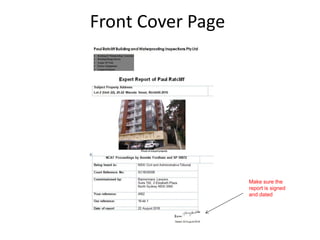
Front Cover Page
Make sure the
report is signed
and dated
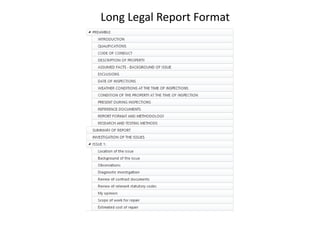
Long Legal Report Format
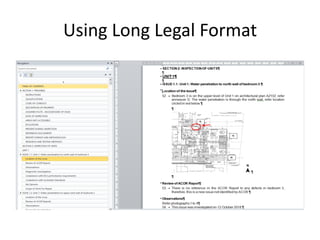
Using Long Legal Format
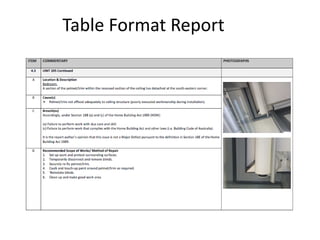
Table Format Report
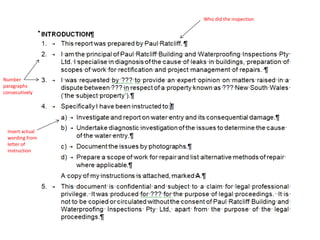
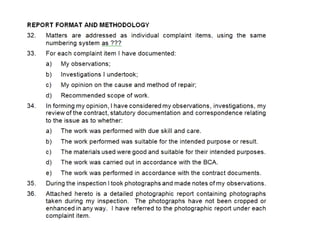
Number
paragraphs
consecutively
Who did the inspection
Insert actual
wording from
letter of
instruction
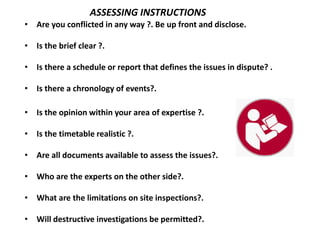
• Are you conflicted in any way ?. Be up front and disclose.
• Is the brief clear ?.
• Is there a schedule or report that defines the issues in dispute? .
• Is there a chronology of events?.
• Is the opinion within your area of expertise ?.
• Is the timetable realistic ?.
• Are all documents available to assess the issues?.
• Who are the experts on the other side?.
• What are the limitations on site inspections?.
• Will destructive investigations be permitted?.
ASSESSING INSTRUCTIONS
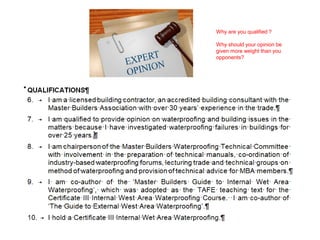
Why are you qualified ?
Why should your opinion be
given more weight than you
opponents?
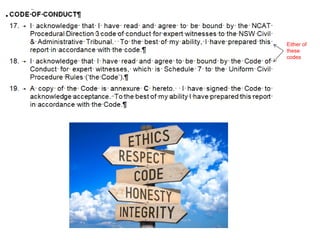
Either of
these
codes
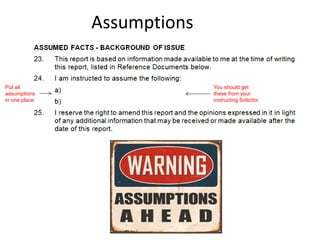
Assumptions
You should get
these from your
instructing Solicitor
Put all
assumptions
in one place
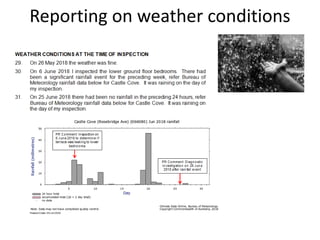
Reporting on weather conditions
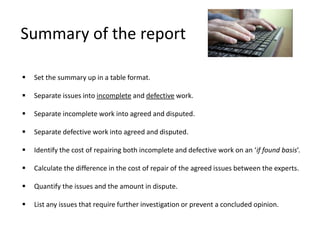
 Set the summary up in a table format.
 Separate issues into incomplete and defective work.
 Separate incomplete work into agreed and disputed.
 Separate defective work into agreed and disputed.
 Identify the cost of repairing both incomplete and defective work on an ‘if found basis’.
 Calculate the difference in the cost of repair of the agreed issues between the experts.
 Quantify the issues and the amount in dispute.
 List any issues that require further investigation or prevent a concluded opinion.
Summary of the report
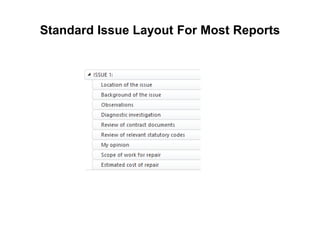
Standard Issue Layout For Most Reports
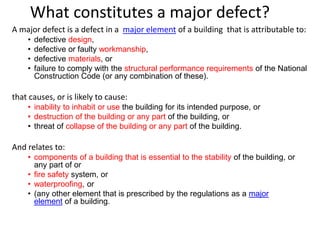
What constitutes a major defect?
A major defect is a defect in a major element of a building that is attributable to:
• defective design,
• defective or faulty workmanship,
• defective materials, or
• failure to comply with the structural performance requirements of the National
Construction Code (or any combination of these).
that causes, or is likely to cause:
• inability to inhabit or use the building for its intended purpose, or
• destruction of the building or any part of the building, or
• threat of collapse of the building or any part of the building.
And relates to:
• components of a building that is essential to the stability of the building, or
any part of or
• fire safety system, or
• waterproofing, or
• (any other element that is prescribed by the regulations as a major
element of a building.
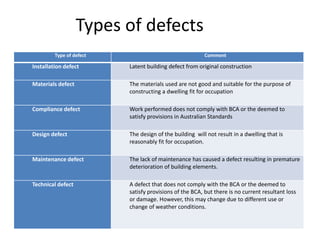
Types of defects
Type of defect Comment
Installation defect Latent building defect from original construction
Materials defect The materials used are not good and suitable for the purpose of
constructing a dwelling fit for occupation
Compliance defect Work performed does not comply with BCA or the deemed to
satisfy provisions in Australian Standards
Design defect The design of the building will not result in a dwelling that is
reasonably fit for occupation.
Maintenance defect The lack of maintenance has caused a defect resulting in premature
deterioration of building elements.
Technical defect A defect that does not comply with the BCA or the deemed to
satisfy provisions of the BCA, but there is no current resultant loss
or damage. However, this may change due to different use or
change of weather conditions.
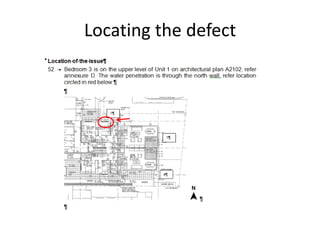
Locating the defect
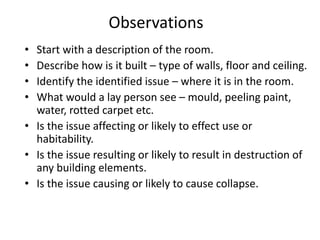
Observations
• Start with a description of the room.
• Describe how is it built – type of walls, floor and ceiling.
• Identify the identified issue – where it is in the room.
• What would a lay person see – mould, peeling paint,
water, rotted carpet etc.
• Is the issue affecting or likely to effect use or
habitability.
• Is the issue resulting or likely to result in destruction of
any building elements.
• Is the issue causing or likely to cause collapse.
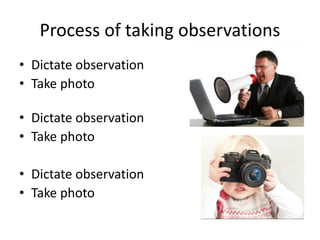
Process of taking observations
• Dictate observation
• Take photo
• Dictate observation
• Take photo
• Dictate observation
• Take photo
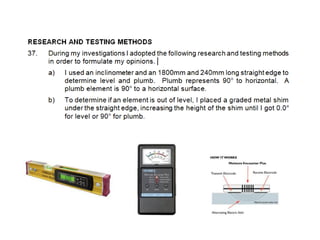
Diagnostic Investigation
 This is where an expert uses his skill and knowledge to identify the cause
of an identified defect.
 Be thorough.
 Identify all the variables.
 Test every variable.
 Say why you are testing and describe the findings in detail.
 Measure what ever you can.
 Document each stage with photographs.
 This is where you show why you are an expert in the field.
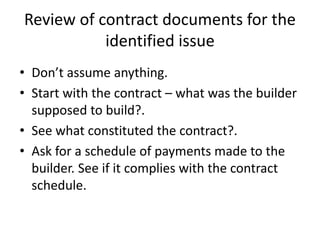
Review of contract documents for the
identified issue
• Don’t assume anything.
• Start with the contract – what was the builder
supposed to build?.
• See what constituted the contract?.
• Ask for a schedule of payments made to the
builder. See if it complies with the contract
schedule.
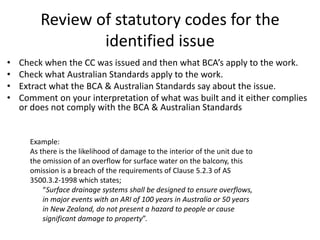
Review of statutory codes for the
identified issue
• Check when the CC was issued and then what BCA’s apply to the work.
• Check what Australian Standards apply to the work.
• Extract what the BCA & Australian Standards say about the issue.
• Comment on your interpretation of what was built and it either complies
or does not comply with the BCA & Australian Standards
Example:
As there is the likelihood of damage to the interior of the unit due to
the omission of an overflow for surface water on the balcony, this
omission is a breach of the requirements of Clause 5.2.3 of AS
3500.3.2-1998 which states;
“Surface drainage systems shall be designed to ensure overflows,
in major events with an ARI of 100 years in Australia or 50 years
in New Zealand, do not present a hazard to people or cause
significant damage to property”.
Your Opinion
What is the foundation or basis for your opinion?
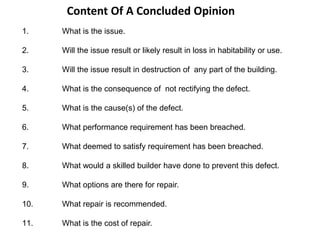
Content Of A Concluded Opinion
1. What is the issue.
2. Will the issue result or likely result in loss in habitability or use.
3. Will the issue result in destruction of any part of the building.
4. What is the consequence of not rectifying the defect.
5. What is the cause(s) of the defect.
6. What performance requirement has been breached.
7. What deemed to satisfy requirement has been breached.
8. What would a skilled builder have done to prevent this defect.
9. What options are there for repair.
10. What repair is recommended.
11. What is the cost of repair.
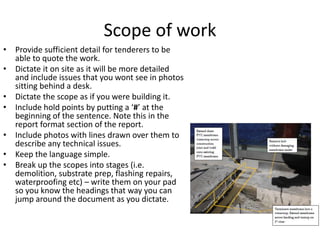
Scope of work
• Provide sufficient detail for tenderers to be
able to quote the work.
• Dictate it on site as it will be more detailed
and include issues that you wont see in photos
sitting behind a desk.
• Dictate the scope as if you were building it.
• Include hold points by putting a ‘#’ at the
beginning of the sentence. Note this in the
report format section of the report.
• Include photos with lines drawn over them to
describe any technical issues.
• Keep the language simple.
• Break up the scopes into stages (i.e.
demolition, substrate prep, flashing repairs,
waterproofing etc) – write them on your pad
so you know the headings that way you can
jump around the document as you dictate.
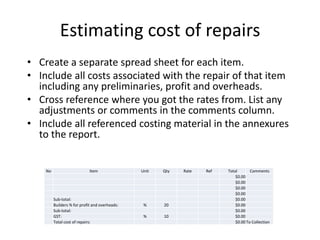
Estimating cost of repairs
• Create a separate spread sheet for each item.
• Include all costs associated with the repair of that item
including any preliminaries, profit and overheads.
• Cross reference where you got the rates from. List any
adjustments or comments in the comments column.
• Include all referenced costing material in the annexures
to the report.
No Item Unit Qty Rate Ref Total Comments
$0.00
$0.00
$0.00
$0.00
Sub-total: $0.00
Builders % for profit and overheads: % 20 $0.00
Sub-total: $0.00
GST: % 10 $0.00
Total cost of repairs: $0.00 To Collection
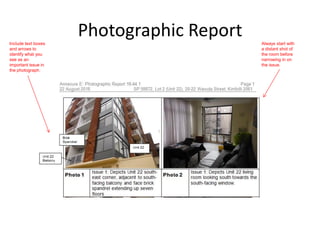
Photographic ReportInclude text boxes
and arrows to
identify what you
see as an
important issue in
the photograph.
Always start with
a distant shot of
the room before
narrowing in on
the issue.
QUESTIONS ?

Report writing

  • 1.
    Resolution Institute 2019 ReportWriting By Paul Ratcliff
  • 2.
    Front Cover Page Makesure the report is signed and dated
  • 3.
  • 4.
  • 5.
  • 6.
    Number paragraphs consecutively Who did theinspection Insert actual wording from letter of instruction
  • 7.
    • Are youconflicted in any way ?. Be up front and disclose. • Is the brief clear ?. • Is there a schedule or report that defines the issues in dispute? . • Is there a chronology of events?. • Is the opinion within your area of expertise ?. • Is the timetable realistic ?. • Are all documents available to assess the issues?. • Who are the experts on the other side?. • What are the limitations on site inspections?. • Will destructive investigations be permitted?. ASSESSING INSTRUCTIONS
  • 8.
    Why are youqualified ? Why should your opinion be given more weight than you opponents?
  • 9.
  • 11.
    Assumptions You should get thesefrom your instructing Solicitor Put all assumptions in one place
  • 13.
  • 16.
     Set thesummary up in a table format.  Separate issues into incomplete and defective work.  Separate incomplete work into agreed and disputed.  Separate defective work into agreed and disputed.  Identify the cost of repairing both incomplete and defective work on an ‘if found basis’.  Calculate the difference in the cost of repair of the agreed issues between the experts.  Quantify the issues and the amount in dispute.  List any issues that require further investigation or prevent a concluded opinion. Summary of the report
  • 17.
    Standard Issue LayoutFor Most Reports
  • 18.
    What constitutes amajor defect? A major defect is a defect in a major element of a building that is attributable to: • defective design, • defective or faulty workmanship, • defective materials, or • failure to comply with the structural performance requirements of the National Construction Code (or any combination of these). that causes, or is likely to cause: • inability to inhabit or use the building for its intended purpose, or • destruction of the building or any part of the building, or • threat of collapse of the building or any part of the building. And relates to: • components of a building that is essential to the stability of the building, or any part of or • fire safety system, or • waterproofing, or • (any other element that is prescribed by the regulations as a major element of a building.
  • 19.
    Types of defects Typeof defect Comment Installation defect Latent building defect from original construction Materials defect The materials used are not good and suitable for the purpose of constructing a dwelling fit for occupation Compliance defect Work performed does not comply with BCA or the deemed to satisfy provisions in Australian Standards Design defect The design of the building will not result in a dwelling that is reasonably fit for occupation. Maintenance defect The lack of maintenance has caused a defect resulting in premature deterioration of building elements. Technical defect A defect that does not comply with the BCA or the deemed to satisfy provisions of the BCA, but there is no current resultant loss or damage. However, this may change due to different use or change of weather conditions.
  • 20.
  • 21.
    Observations • Start witha description of the room. • Describe how is it built – type of walls, floor and ceiling. • Identify the identified issue – where it is in the room. • What would a lay person see – mould, peeling paint, water, rotted carpet etc. • Is the issue affecting or likely to effect use or habitability. • Is the issue resulting or likely to result in destruction of any building elements. • Is the issue causing or likely to cause collapse.
  • 22.
    Process of takingobservations • Dictate observation • Take photo • Dictate observation • Take photo • Dictate observation • Take photo
  • 23.
    Diagnostic Investigation  Thisis where an expert uses his skill and knowledge to identify the cause of an identified defect.  Be thorough.  Identify all the variables.  Test every variable.  Say why you are testing and describe the findings in detail.  Measure what ever you can.  Document each stage with photographs.  This is where you show why you are an expert in the field.
  • 24.
    Review of contractdocuments for the identified issue • Don’t assume anything. • Start with the contract – what was the builder supposed to build?. • See what constituted the contract?. • Ask for a schedule of payments made to the builder. See if it complies with the contract schedule.
  • 25.
    Review of statutorycodes for the identified issue • Check when the CC was issued and then what BCA’s apply to the work. • Check what Australian Standards apply to the work. • Extract what the BCA & Australian Standards say about the issue. • Comment on your interpretation of what was built and it either complies or does not comply with the BCA & Australian Standards Example: As there is the likelihood of damage to the interior of the unit due to the omission of an overflow for surface water on the balcony, this omission is a breach of the requirements of Clause 5.2.3 of AS 3500.3.2-1998 which states; “Surface drainage systems shall be designed to ensure overflows, in major events with an ARI of 100 years in Australia or 50 years in New Zealand, do not present a hazard to people or cause significant damage to property”.
  • 26.
    Your Opinion What isthe foundation or basis for your opinion?
  • 27.
    Content Of AConcluded Opinion 1. What is the issue. 2. Will the issue result or likely result in loss in habitability or use. 3. Will the issue result in destruction of any part of the building. 4. What is the consequence of not rectifying the defect. 5. What is the cause(s) of the defect. 6. What performance requirement has been breached. 7. What deemed to satisfy requirement has been breached. 8. What would a skilled builder have done to prevent this defect. 9. What options are there for repair. 10. What repair is recommended. 11. What is the cost of repair.
  • 28.
    Scope of work •Provide sufficient detail for tenderers to be able to quote the work. • Dictate it on site as it will be more detailed and include issues that you wont see in photos sitting behind a desk. • Dictate the scope as if you were building it. • Include hold points by putting a ‘#’ at the beginning of the sentence. Note this in the report format section of the report. • Include photos with lines drawn over them to describe any technical issues. • Keep the language simple. • Break up the scopes into stages (i.e. demolition, substrate prep, flashing repairs, waterproofing etc) – write them on your pad so you know the headings that way you can jump around the document as you dictate.
  • 29.
    Estimating cost ofrepairs • Create a separate spread sheet for each item. • Include all costs associated with the repair of that item including any preliminaries, profit and overheads. • Cross reference where you got the rates from. List any adjustments or comments in the comments column. • Include all referenced costing material in the annexures to the report. No Item Unit Qty Rate Ref Total Comments $0.00 $0.00 $0.00 $0.00 Sub-total: $0.00 Builders % for profit and overheads: % 20 $0.00 Sub-total: $0.00 GST: % 10 $0.00 Total cost of repairs: $0.00 To Collection
  • 30.
    Photographic ReportInclude textboxes and arrows to identify what you see as an important issue in the photograph. Always start with a distant shot of the room before narrowing in on the issue.
  • 31.