Dr.S.Sethupathy, M.D,Ph.D.,
Professor of Biochemistry,
Rajah Muthiah Medical College,
Annamalai university
Renal function tests are done for :
 Diagnosis of renal disease
 Assessment of its prognosis
 Monitoring renal function and
damage.
 Excretory function
 Excretion of endogenous waste
products such as :
urea, uric acid, creatinine and
exogenous drugs, it metabolites,
toxins etc.
Maintenance of water
balance
Maintenance of electrolyte
balance
 Maintenance of acid base
balance
 Kidney Synthesizes erythropoietin
which stimulates erythropoiesis.
 Activation of 25-OH cholecalciferol
to 1,25 dihydroxy cholecalciferol
(Calcitriol) by 1-alpha hydroxylase
enzyme in the kidney which
promotes calcium absorption in the
intestine.
 Nephron is the functional unit of kidney which
has two components :
 1.Glomerulus
 2. Tubules
 Glomerulus is the filtration unit and tubules
are reabsorbing unit.
 Through Bowman’s capsule, an ultra-filtrate
which is devoid of cells and protein formed
 Albumin does not pass through the membrane.
So in case of glomerular damage, albumin
appears in urine.
 Glomerular filtration depends on renal blood
supply and functional state of nephrons.
 Glomerular filtration rate (GFR) is :
1. Decreased in hemorrhagic shock, anaphylactic
shock due to decreased perfusion
2. In glomerulonephritis due to dysfunction of
nephrons.
Decrease in GFR leads to retention and
accumulation of waste products such as urea,
creatinine and uric acid in the plasma.
 Plasma creatinine: Normal level is 0.6-1.2
mg/dl.
 It is a better indicator of GFR as it is not
influenced by diet or protein catabolism as in
case of urea.
 It is inversely related to GFR.
 Plasma urea : Normal plasma urea level is 15-
40 mg/dl.
 Plasma urea nitrogen is 7-18 mg/dl.
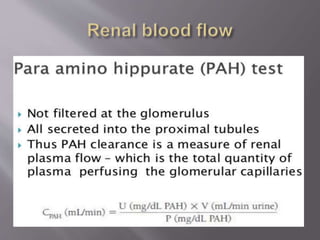
 PAH is filtered at the glomerulus as well as
secreted by the tubules
 Completely removed by the kidney by
single passage of blood through the kidney
 Renal perfusion flow(RBF)= Upah/ppah x V
V= volume of urine (ml/min)
normal – 600 ml min
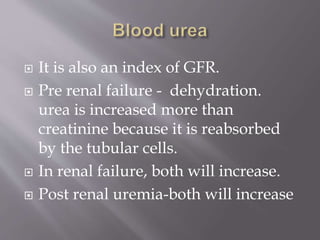
 It is also an index of GFR.
 Pre renal failure - dehydration.
urea is increased more than
creatinine because it is reabsorbed
by the tubular cells.
 In renal failure, both will increase.
 Post renal uremia-both will increase
 Clearance is defined as the
volume of blood or plasma in ml
that is completely cleared of a
substance (in case of creatinine
clearance creatinine is cleared)
per unit time and is expressed as
ml per min.
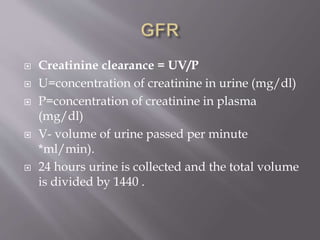
 Creatinine clearance = UV/P
 U=concentration of creatinine in urine (mg/dl)
 P=concentration of creatinine in plasma
(mg/dl)
 V- volume of urine passed per minute
*ml/min).
 24 hours urine is collected and the total volume
is divided by 1440 .
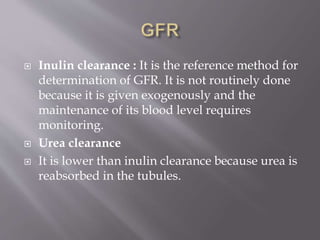
 Inulin clearance : It is the reference method for
determination of GFR. It is not routinely done
because it is given exogenously and the
maintenance of its blood level requires
monitoring.
 Urea clearance
 It is lower than inulin clearance because urea is
reabsorbed in the tubules.
 Marker should be freely filtered
 It should be neither secreted nor reabsorbed
and it’s blood level should be constant.
 Creatinine being an endogenous substance its
level is maintained, freely filtered but a small
amount is secreted by the tubules (10% of
creatinine excreted is tubular component).
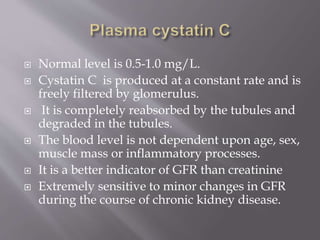
 Normal level is 0.5-1.0 mg/L.
 Cystatin C is produced at a constant rate and is
freely filtered by glomerulus.
 It is completely reabsorbed by the tubules and
degraded in the tubules.
 The blood level is not dependent upon age, sex,
muscle mass or inflammatory processes.
 It is a better indicator of GFR than creatinine
 Extremely sensitive to minor changes in GFR
during the course of chronic kidney disease.
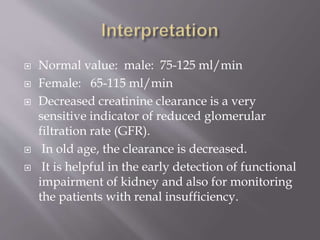
 Normal value: male: 75-125 ml/min
 Female: 65-115 ml/min
 Decreased creatinine clearance is a very
sensitive indicator of reduced glomerular
filtration rate (GFR).
 In old age, the clearance is decreased.
 It is helpful in the early detection of functional
impairment of kidney and also for monitoring
the patients with renal insufficiency.
 GFR mL/minute = [(140 – age in
years) × (wt, kg)]/ 72 × P (mg/L) ×
0.85 (if subject is female).
 If converting to SI units (GFR in
micromoles per liter) is desired,
replace 72 in the denominator with
0.84.
 GFR (mL/minute/(1.73 m2)) = 186
× (serum creatinine [mg/dL]–1.154)
× (age in years)-0.203 × (0.742 if
female) × (1.210 if
African American).
 If converting to SI units (GFR in
micromoles per liter) is desired,
replace 186 with 32,788.
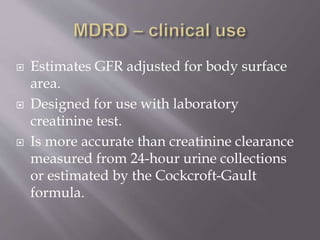
 Estimates GFR adjusted for body surface
area.
 Designed for use with laboratory
creatinine test.
 Is more accurate than creatinine clearance
measured from 24-hour urine collections
or estimated by the Cockcroft-Gault
formula.
 The glomerular membrane is impermeable to
albumin.
 Low molecular proteins are filtered reabsorbed
and catabolized by tubular cells.
 Albumin excretion is less than 30 mg/24 hours.
 Urine test for albumin is negative in normal
subjects.
It may be due to
 1.Increase in filtered load due to glomerular
damage and vascular permeability. It is called
glomerular proteinuria.
 2.Increased concentration of low molecular weight
proteins in circulation resulting in Overflow
proteinuria.
 3.Decrease in the tubular reabsorption of proteins
resulting in tubular proteinuria.
 Early morning urine specimen or 24hrs
urine specimen tested for albumin.
 Benign proteinuria- 300mg/day
 Pathological proteinuria- 300-1000
mg/day
 Glomerular proteinuria - > 1 gm/day.
 In nephrotic syndrome massive
proteinuria is seen >3 gm/day.
 Diabetic nephropathy,
 Chronic glomerulonephritis,
 Hypertension.
 If albumin is detected in a urine sample collected
at random, over 4 hours, or overnight, the test may
be repeated and/or confirmed with urine that is
collected over a 24-hour period (24-hour urine).
 The quantity of albumin in urine is 30-300 mg/day
in micro albuminuria.
 It is an early indication of nephropathy in diabetic
patients and hypertensive patients.
 It is also expressed as albumin creatinine ratio
 Albumin creatinine ratio – 30-300mg albumin /gm
of creatinine -0.03- 0.3
 Over flow proteinuria
 Hemoglobinuria in hemolytic diseases
 Myoglobinuria in muscle crush injury
 Bence- Jones protein in multiple myeloma
 Tubular proteinuria
 Due to decreased functional nephrons the
remaining nephrons over-work .
 Tubular reabsorption of proteins is
impaired causing tubular proteinuria.
 Proximal renal tubular damage -increased
excretion of β- microglobulin.
 Urine specific gravity
 Normal value is 1.016-1.022
 Fixed specific gravity at 1.010 is seen in chronic
kidney disease due to tubular dysfunction.
 Specific gravity is increased in diabetes
mellitus, adrenal insufficiency
 Specific gravity is decreased in diabetes
insipidus (ADH insufficiency).
 Normal range is 400-850 mOsm/kg
 Plasma osmolality is 285-295 mOsm/kg.
 Normally the urine- plasma osmolality ratio is
above 1.3.
 Urine osmolality - decreased in diabetes insipidus
and the ratio is lesser than 1.
 Concentrating ability of distal tubules and
collecting ducts decreased.
 Due to renal defect (nephrogenic diabetes
insipidus which do not response to ADH )
 Central diabetes insipidus due to ADH deficiency.
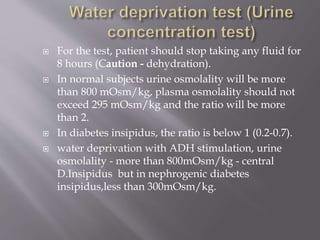
 For the test, patient should stop taking any fluid for
8 hours (Caution - dehydration).
 In normal subjects urine osmolality will be more
than 800 mOsm/kg, plasma osmolality should not
exceed 295 mOsm/kg and the ratio will be more
than 2.
 In diabetes insipidus, the ratio is below 1 (0.2-0.7).
 water deprivation with ADH stimulation, urine
osmolality - more than 800mOsm/kg - central
D.Insipidus but in nephrogenic diabetes
insipidus,less than 300mOsm/kg.
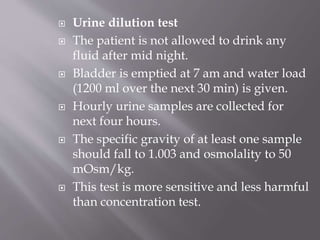
 Urine dilution test
 The patient is not allowed to drink any
fluid after mid night.
 Bladder is emptied at 7 am and water load
(1200 ml over the next 30 min) is given.
 Hourly urine samples are collected for
next four hours.
 The specific gravity of at least one sample
should fall to 1.003 and osmolality to 50
mOsm/kg.
 This test is more sensitive and less harmful
than concentration test.
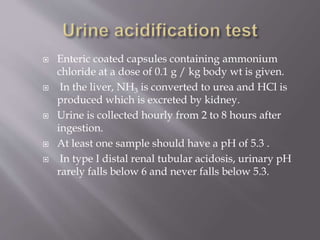
 Enteric coated capsules containing ammonium
chloride at a dose of 0.1 g / kg body wt is given.
 In the liver, NH3 is converted to urea and HCl is
produced which is excreted by kidney.
 Urine is collected hourly from 2 to 8 hours after
ingestion.
 At least one sample should have a pH of 5.3 .
 In type I distal renal tubular acidosis, urinary pH
rarely falls below 6 and never falls below 5.3.
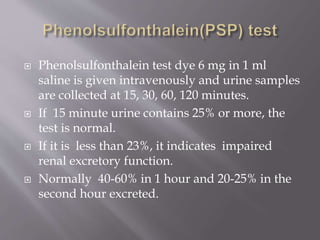
 Phenolsulfonthalein test dye 6 mg in 1 ml
saline is given intravenously and urine samples
are collected at 15, 30, 60, 120 minutes.
 If 15 minute urine contains 25% or more, the
test is normal.
 If it is less than 23%, it indicates impaired
renal excretory function.
 Normally 40-60% in 1 hour and 20-25% in the
second hour excreted.
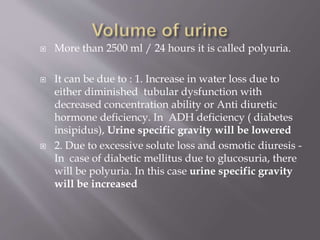
 More than 2500 ml / 24 hours it is called polyuria.
 It can be due to : 1. Increase in water loss due to
either diminished tubular dysfunction with
decreased concentration ability or Anti diuretic
hormone deficiency. In ADH deficiency ( diabetes
insipidus), Urine specific gravity will be lowered
 2. Due to excessive solute loss and osmotic diuresis -
In case of diabetic mellitus due to glucosuria, there
will be polyuria. In this case urine specific gravity
will be increased
Color of the urine
 Normally it is pale yellow or
amber color.
 Hematuria or hemoglobinuria
produce a dark brown color.
 By microscopy, hematuria can be
detected by the presence of
intact red blood cells.
 It can be due to stone, tumor,
injury, infection.
pH of urine
 usually acidic- pH 6 (4.5-8-pH )
Specific gravity
 normally varies from 1.016 to
1.032
Osmolality
 On average fluid intake, 300-900
mOsm/kg
Odor foul smell indicates
bacterial infection
 When urine output is lesser then 400 ml /
24 hours, it is called oliguria. If no urine is
passed, then, it is called anuria.
 Oliguria, anuria can be the result of
following:
 Diminished perfusion of kidney ( cardiac
failure, Hypotension, shock),
 Renal disease such as acute
glomerulonephritis, tubular necrosis,
 Obstruction to the outflow e.g. bilateral
tumor in the bladder, renal stones,
prostate enlargement etc.
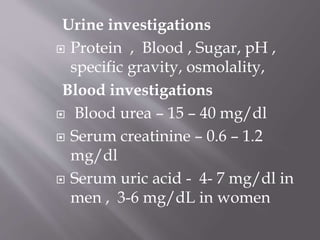
Urine investigations
 Protein , Blood , Sugar, pH ,
specific gravity, osmolality,
Blood investigations
 Blood urea – 15 – 40 mg/dl
 Serum creatinine – 0.6 – 1.2
mg/dl
 Serum uric acid - 4- 7 mg/dl in
men , 3-6 mg/dL in women
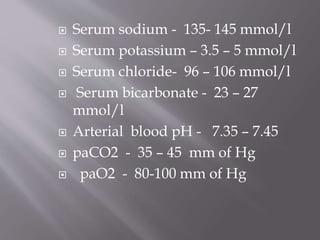
 Serum sodium - 135- 145 mmol/l
 Serum potassium – 3.5 – 5 mmol/l
 Serum chloride- 96 – 106 mmol/l
 Serum bicarbonate - 23 – 27
mmol/l
 Arterial blood pH - 7.35 – 7.45
 paCO2 - 35 – 45 mm of Hg
 paO2 - 80-100 mm of Hg
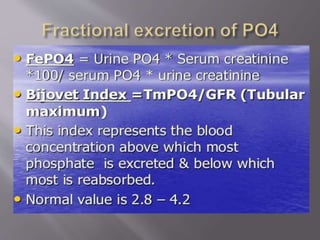
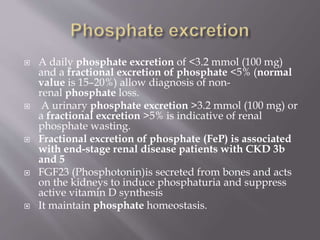
 A daily phosphate excretion of <3.2 mmol (100 mg)
and a fractional excretion of phosphate <5% (normal
value is 15–20%) allow diagnosis of non-
renal phosphate loss.
 A urinary phosphate excretion >3.2 mmol (100 mg) or
a fractional excretion >5% is indicative of renal
phosphate wasting.
 Fractional excretion of phosphate (FeP) is associated
with end-stage renal disease patients with CKD 3b
and 5
 FGF23 (Phosphotonin)is secreted from bones and acts
on the kidneys to induce phosphaturia and suppress
active vitamin D synthesis
 It maintain phosphate homeostasis.
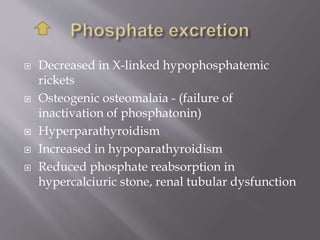
 Decreased in X-linked hypophosphatemic
rickets
 Osteogenic osteomalaia - (failure of
inactivation of phosphatonin)
 Hyperparathyroidism
 Increased in hypoparathyroidism
 Reduced phosphate reabsorption in
hypercalciuric stone, renal tubular dysfunction
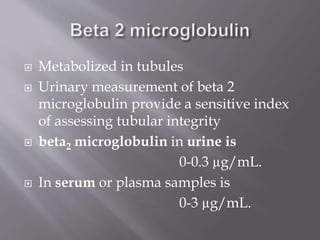
 Metabolized in tubules
 Urinary measurement of beta 2
microglobulin provide a sensitive index
of assessing tubular integrity
 beta2 microglobulin in urine is
0-0.3 µg/mL.
 In serum or plasma samples is
0-3 µg/mL.
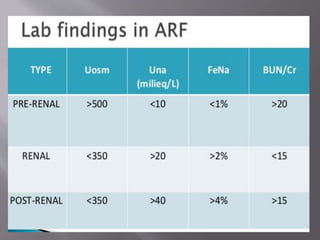
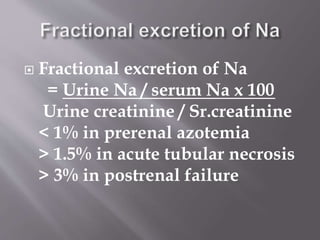
 Fractional excretion of Na
= Urine Na / serum Na x 100
Urine creatinine / Sr.creatinine
< 1% in prerenal azotemia
> 1.5% in acute tubular necrosis
> 3% in postrenal failure
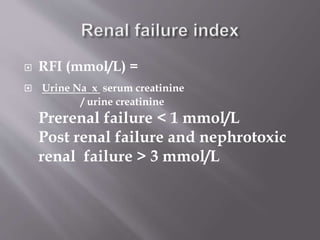
 RFI (mmol/L) =
 Urine Na x serum creatinine
/ urine creatinine
Prerenal failure < 1 mmol/L
Post renal failure and nephrotoxic
renal failure > 3 mmol/L
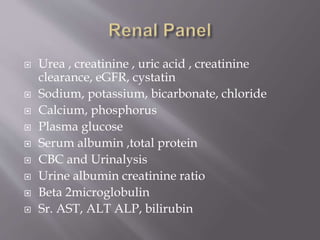
 Urea , creatinine , uric acid , creatinine
clearance, eGFR, cystatin
 Sodium, potassium, bicarbonate, chloride
 Calcium, phosphorus
 Plasma glucose
 Serum albumin ,total protein
 CBC and Urinalysis
 Urine albumin creatinine ratio
 Beta 2microglobulin
 Sr. AST, ALT ALP, bilirubin
Thank you

Renal function tests

  • 1.
    Dr.S.Sethupathy, M.D,Ph.D., Professor ofBiochemistry, Rajah Muthiah Medical College, Annamalai university
  • 2.
    Renal function testsare done for :  Diagnosis of renal disease  Assessment of its prognosis  Monitoring renal function and damage.
  • 3.
     Excretory function Excretion of endogenous waste products such as : urea, uric acid, creatinine and exogenous drugs, it metabolites, toxins etc.
  • 4.
    Maintenance of water balance Maintenanceof electrolyte balance  Maintenance of acid base balance
  • 5.
     Kidney Synthesizeserythropoietin which stimulates erythropoiesis.  Activation of 25-OH cholecalciferol to 1,25 dihydroxy cholecalciferol (Calcitriol) by 1-alpha hydroxylase enzyme in the kidney which promotes calcium absorption in the intestine.
  • 6.
     Nephron isthe functional unit of kidney which has two components :  1.Glomerulus  2. Tubules  Glomerulus is the filtration unit and tubules are reabsorbing unit.
  • 7.
     Through Bowman’scapsule, an ultra-filtrate which is devoid of cells and protein formed  Albumin does not pass through the membrane. So in case of glomerular damage, albumin appears in urine.  Glomerular filtration depends on renal blood supply and functional state of nephrons.
  • 8.
     Glomerular filtrationrate (GFR) is : 1. Decreased in hemorrhagic shock, anaphylactic shock due to decreased perfusion 2. In glomerulonephritis due to dysfunction of nephrons. Decrease in GFR leads to retention and accumulation of waste products such as urea, creatinine and uric acid in the plasma.
  • 9.
     Plasma creatinine:Normal level is 0.6-1.2 mg/dl.  It is a better indicator of GFR as it is not influenced by diet or protein catabolism as in case of urea.  It is inversely related to GFR.  Plasma urea : Normal plasma urea level is 15- 40 mg/dl.  Plasma urea nitrogen is 7-18 mg/dl.
  • 10.
     PAH isfiltered at the glomerulus as well as secreted by the tubules  Completely removed by the kidney by single passage of blood through the kidney  Renal perfusion flow(RBF)= Upah/ppah x V V= volume of urine (ml/min) normal – 600 ml min
  • 12.
     It isalso an index of GFR.  Pre renal failure - dehydration. urea is increased more than creatinine because it is reabsorbed by the tubular cells.  In renal failure, both will increase.  Post renal uremia-both will increase
  • 13.
     Clearance isdefined as the volume of blood or plasma in ml that is completely cleared of a substance (in case of creatinine clearance creatinine is cleared) per unit time and is expressed as ml per min.
  • 14.
     Creatinine clearance= UV/P  U=concentration of creatinine in urine (mg/dl)  P=concentration of creatinine in plasma (mg/dl)  V- volume of urine passed per minute *ml/min).  24 hours urine is collected and the total volume is divided by 1440 .
  • 15.
     Inulin clearance: It is the reference method for determination of GFR. It is not routinely done because it is given exogenously and the maintenance of its blood level requires monitoring.  Urea clearance  It is lower than inulin clearance because urea is reabsorbed in the tubules.
  • 16.
     Marker shouldbe freely filtered  It should be neither secreted nor reabsorbed and it’s blood level should be constant.  Creatinine being an endogenous substance its level is maintained, freely filtered but a small amount is secreted by the tubules (10% of creatinine excreted is tubular component).
  • 17.
     Normal levelis 0.5-1.0 mg/L.  Cystatin C is produced at a constant rate and is freely filtered by glomerulus.  It is completely reabsorbed by the tubules and degraded in the tubules.  The blood level is not dependent upon age, sex, muscle mass or inflammatory processes.  It is a better indicator of GFR than creatinine  Extremely sensitive to minor changes in GFR during the course of chronic kidney disease.
  • 18.
     Normal value:male: 75-125 ml/min  Female: 65-115 ml/min  Decreased creatinine clearance is a very sensitive indicator of reduced glomerular filtration rate (GFR).  In old age, the clearance is decreased.  It is helpful in the early detection of functional impairment of kidney and also for monitoring the patients with renal insufficiency.
  • 19.
     GFR mL/minute= [(140 – age in years) × (wt, kg)]/ 72 × P (mg/L) × 0.85 (if subject is female).  If converting to SI units (GFR in micromoles per liter) is desired, replace 72 in the denominator with 0.84.
  • 20.
     GFR (mL/minute/(1.73m2)) = 186 × (serum creatinine [mg/dL]–1.154) × (age in years)-0.203 × (0.742 if female) × (1.210 if African American).  If converting to SI units (GFR in micromoles per liter) is desired, replace 186 with 32,788.
  • 21.
     Estimates GFRadjusted for body surface area.  Designed for use with laboratory creatinine test.  Is more accurate than creatinine clearance measured from 24-hour urine collections or estimated by the Cockcroft-Gault formula.
  • 23.
     The glomerularmembrane is impermeable to albumin.  Low molecular proteins are filtered reabsorbed and catabolized by tubular cells.  Albumin excretion is less than 30 mg/24 hours.  Urine test for albumin is negative in normal subjects.
  • 24.
    It may bedue to  1.Increase in filtered load due to glomerular damage and vascular permeability. It is called glomerular proteinuria.  2.Increased concentration of low molecular weight proteins in circulation resulting in Overflow proteinuria.  3.Decrease in the tubular reabsorption of proteins resulting in tubular proteinuria.
  • 25.
     Early morningurine specimen or 24hrs urine specimen tested for albumin.  Benign proteinuria- 300mg/day  Pathological proteinuria- 300-1000 mg/day  Glomerular proteinuria - > 1 gm/day.  In nephrotic syndrome massive proteinuria is seen >3 gm/day.  Diabetic nephropathy,  Chronic glomerulonephritis,  Hypertension.
  • 26.
     If albuminis detected in a urine sample collected at random, over 4 hours, or overnight, the test may be repeated and/or confirmed with urine that is collected over a 24-hour period (24-hour urine).  The quantity of albumin in urine is 30-300 mg/day in micro albuminuria.  It is an early indication of nephropathy in diabetic patients and hypertensive patients.  It is also expressed as albumin creatinine ratio  Albumin creatinine ratio – 30-300mg albumin /gm of creatinine -0.03- 0.3
  • 27.
     Over flowproteinuria  Hemoglobinuria in hemolytic diseases  Myoglobinuria in muscle crush injury  Bence- Jones protein in multiple myeloma  Tubular proteinuria  Due to decreased functional nephrons the remaining nephrons over-work .  Tubular reabsorption of proteins is impaired causing tubular proteinuria.  Proximal renal tubular damage -increased excretion of β- microglobulin.
  • 28.
     Urine specificgravity  Normal value is 1.016-1.022  Fixed specific gravity at 1.010 is seen in chronic kidney disease due to tubular dysfunction.  Specific gravity is increased in diabetes mellitus, adrenal insufficiency  Specific gravity is decreased in diabetes insipidus (ADH insufficiency).
  • 29.
     Normal rangeis 400-850 mOsm/kg  Plasma osmolality is 285-295 mOsm/kg.  Normally the urine- plasma osmolality ratio is above 1.3.  Urine osmolality - decreased in diabetes insipidus and the ratio is lesser than 1.  Concentrating ability of distal tubules and collecting ducts decreased.  Due to renal defect (nephrogenic diabetes insipidus which do not response to ADH )  Central diabetes insipidus due to ADH deficiency.
  • 31.
     For thetest, patient should stop taking any fluid for 8 hours (Caution - dehydration).  In normal subjects urine osmolality will be more than 800 mOsm/kg, plasma osmolality should not exceed 295 mOsm/kg and the ratio will be more than 2.  In diabetes insipidus, the ratio is below 1 (0.2-0.7).  water deprivation with ADH stimulation, urine osmolality - more than 800mOsm/kg - central D.Insipidus but in nephrogenic diabetes insipidus,less than 300mOsm/kg.
  • 32.
     Urine dilutiontest  The patient is not allowed to drink any fluid after mid night.  Bladder is emptied at 7 am and water load (1200 ml over the next 30 min) is given.  Hourly urine samples are collected for next four hours.  The specific gravity of at least one sample should fall to 1.003 and osmolality to 50 mOsm/kg.  This test is more sensitive and less harmful than concentration test.
  • 33.
     Enteric coatedcapsules containing ammonium chloride at a dose of 0.1 g / kg body wt is given.  In the liver, NH3 is converted to urea and HCl is produced which is excreted by kidney.  Urine is collected hourly from 2 to 8 hours after ingestion.  At least one sample should have a pH of 5.3 .  In type I distal renal tubular acidosis, urinary pH rarely falls below 6 and never falls below 5.3.
  • 34.
     Phenolsulfonthalein testdye 6 mg in 1 ml saline is given intravenously and urine samples are collected at 15, 30, 60, 120 minutes.  If 15 minute urine contains 25% or more, the test is normal.  If it is less than 23%, it indicates impaired renal excretory function.  Normally 40-60% in 1 hour and 20-25% in the second hour excreted.
  • 35.
     More than2500 ml / 24 hours it is called polyuria.  It can be due to : 1. Increase in water loss due to either diminished tubular dysfunction with decreased concentration ability or Anti diuretic hormone deficiency. In ADH deficiency ( diabetes insipidus), Urine specific gravity will be lowered  2. Due to excessive solute loss and osmotic diuresis - In case of diabetic mellitus due to glucosuria, there will be polyuria. In this case urine specific gravity will be increased
  • 36.
    Color of theurine  Normally it is pale yellow or amber color.  Hematuria or hemoglobinuria produce a dark brown color.  By microscopy, hematuria can be detected by the presence of intact red blood cells.  It can be due to stone, tumor, injury, infection.
  • 37.
    pH of urine usually acidic- pH 6 (4.5-8-pH ) Specific gravity  normally varies from 1.016 to 1.032 Osmolality  On average fluid intake, 300-900 mOsm/kg Odor foul smell indicates bacterial infection
  • 38.
     When urineoutput is lesser then 400 ml / 24 hours, it is called oliguria. If no urine is passed, then, it is called anuria.  Oliguria, anuria can be the result of following:  Diminished perfusion of kidney ( cardiac failure, Hypotension, shock),  Renal disease such as acute glomerulonephritis, tubular necrosis,  Obstruction to the outflow e.g. bilateral tumor in the bladder, renal stones, prostate enlargement etc.
  • 39.
    Urine investigations  Protein, Blood , Sugar, pH , specific gravity, osmolality, Blood investigations  Blood urea – 15 – 40 mg/dl  Serum creatinine – 0.6 – 1.2 mg/dl  Serum uric acid - 4- 7 mg/dl in men , 3-6 mg/dL in women
  • 40.
     Serum sodium- 135- 145 mmol/l  Serum potassium – 3.5 – 5 mmol/l  Serum chloride- 96 – 106 mmol/l  Serum bicarbonate - 23 – 27 mmol/l  Arterial blood pH - 7.35 – 7.45  paCO2 - 35 – 45 mm of Hg  paO2 - 80-100 mm of Hg
  • 44.
     A dailyphosphate excretion of <3.2 mmol (100 mg) and a fractional excretion of phosphate <5% (normal value is 15–20%) allow diagnosis of non- renal phosphate loss.  A urinary phosphate excretion >3.2 mmol (100 mg) or a fractional excretion >5% is indicative of renal phosphate wasting.  Fractional excretion of phosphate (FeP) is associated with end-stage renal disease patients with CKD 3b and 5  FGF23 (Phosphotonin)is secreted from bones and acts on the kidneys to induce phosphaturia and suppress active vitamin D synthesis  It maintain phosphate homeostasis.
  • 45.
     Decreased inX-linked hypophosphatemic rickets  Osteogenic osteomalaia - (failure of inactivation of phosphatonin)  Hyperparathyroidism  Increased in hypoparathyroidism  Reduced phosphate reabsorption in hypercalciuric stone, renal tubular dysfunction
  • 46.
     Metabolized intubules  Urinary measurement of beta 2 microglobulin provide a sensitive index of assessing tubular integrity  beta2 microglobulin in urine is 0-0.3 µg/mL.  In serum or plasma samples is 0-3 µg/mL.
  • 47.
     Fractional excretionof Na = Urine Na / serum Na x 100 Urine creatinine / Sr.creatinine < 1% in prerenal azotemia > 1.5% in acute tubular necrosis > 3% in postrenal failure
  • 48.
     RFI (mmol/L)=  Urine Na x serum creatinine / urine creatinine Prerenal failure < 1 mmol/L Post renal failure and nephrotoxic renal failure > 3 mmol/L
  • 49.
     Urea ,creatinine , uric acid , creatinine clearance, eGFR, cystatin  Sodium, potassium, bicarbonate, chloride  Calcium, phosphorus  Plasma glucose  Serum albumin ,total protein  CBC and Urinalysis  Urine albumin creatinine ratio  Beta 2microglobulin  Sr. AST, ALT ALP, bilirubin
  • 50.