McGraw-Hill/Irwin
©2008 The McGraw-Hill Companies,
All Rights Reserved
Chapter Three
The Organization and Structure of
Banking and the Financial-Services
Industry
3-2
McGraw-Hill/Irwin
Bank Management and Financial Services, 7/e
© 2008 The McGraw-Hill Companies, Inc., All Rights Reserved.
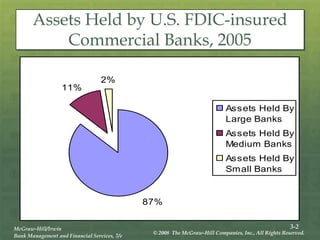
Assets Held by U.S. FDIC-insured
Commercial Banks, 2005
87%
11%
2%
Assets Held By
Large Banks
Assets Held By
Medium Banks
Assets Held By
Small Banks
3-3
McGraw-Hill/Irwin
Bank Management and Financial Services, 7/e
© 2008 The McGraw-Hill Companies, Inc., All Rights Reserved.
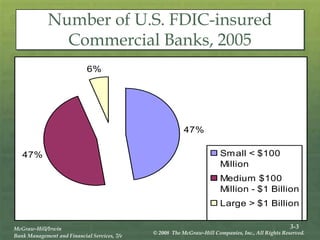
Number of U.S. FDIC-insured
Commercial Banks, 2005
47%
47%
6%
Small < $100
Million
Medium $100
Million - $1 Billion
Large > $1 Billion
3-4
McGraw-Hill/Irwin
Bank Management and Financial Services, 7/e
© 2008 The McGraw-Hill Companies, Inc., All Rights Reserved.
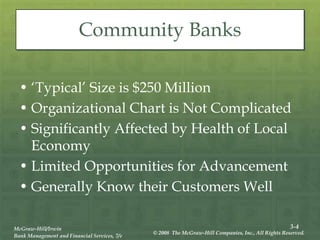
Community Banks
• ‘Typical’ Size is $250 Million
• Organizational Chart is Not Complicated
• Significantly Affected by Health of Local
Economy
• Limited Opportunities for Advancement
• Generally Know their Customers Well
3-5
McGraw-Hill/Irwin
Bank Management and Financial Services, 7/e
© 2008 The McGraw-Hill Companies, Inc., All Rights Reserved.
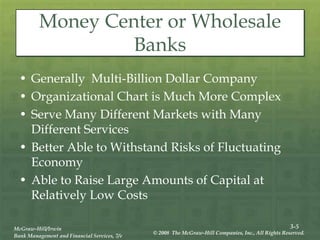
Money Center or Wholesale
Banks
• Generally Multi-Billion Dollar Company
• Organizational Chart is Much More Complex
• Serve Many Different Markets with Many
Different Services
• Better Able to Withstand Risks of Fluctuating
Economy
• Able to Raise Large Amounts of Capital at
Relatively Low Costs
3-6
McGraw-Hill/Irwin
Bank Management and Financial Services, 7/e
© 2008 The McGraw-Hill Companies, Inc., All Rights Reserved.
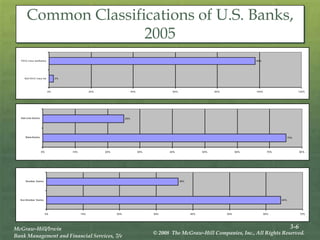
Common Classifications of U.S. Banks,
2005
2%
98%
0% 20% 40% 60% 80% 100% 120%
Not FDIC Insur ed
FDIC Insur ed Banks
75%
25%
0% 10% 20% 30% 40% 50% 60% 70% 80%
State Banks
Nati onal Banks
64%
36%
0% 10% 20% 30% 40% 50% 60% 70%
Non M ember Banks
M ember Banks
3-7
McGraw-Hill/Irwin
Bank Management and Financial Services, 7/e
© 2008 The McGraw-Hill Companies, Inc., All Rights Reserved.
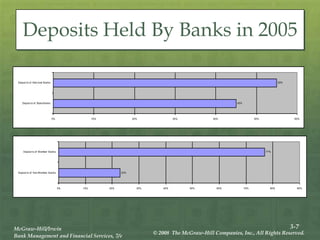
Deposits Held By Banks in 2005
23%
77%
0% 10% 20% 30% 40% 50% 60% 70% 80% 90%
Deposi ts of Non Member Banks
Deposi ts of Member Banks
45%
55%
0% 10% 20% 30% 40% 50% 60%
Deposi ts of State Banks
Deposi ts of Nati onal Banks
3-8
McGraw-Hill/Irwin
Bank Management and Financial Services, 7/e
© 2008 The McGraw-Hill Companies, Inc., All Rights Reserved.
Unit Banks
• Offer All Services From One Office
• One of the Oldest Kinds of Banks
• New Banks are Generally Unit Banks
3-9
McGraw-Hill/Irwin
Bank Management and Financial Services, 7/e
© 2008 The McGraw-Hill Companies, Inc., All Rights Reserved.
Branch Banks
• Offer Full Range of Services from Several
Locations
• Senior Management at the Home Office
• Each Branch has its Own Management
Team with Limited Decision Making
Ability
• Some Functions are Highly Centralized,
While Others are Decentralized
3-10
McGraw-Hill/Irwin
Bank Management and Financial Services, 7/e
© 2008 The McGraw-Hill Companies, Inc., All Rights Reserved.
Reasons for Growth of
Branching
• Exodus of Population to Suburban
Communities
• Increased Bank Failures in Recent Years
• Business Growth
3-11
McGraw-Hill/Irwin
Bank Management and Financial Services, 7/e
© 2008 The McGraw-Hill Companies, Inc., All Rights Reserved.
Electronic Branches
• Internet Banking Services
• Automated Teller Machines (ATMs)
• Point of Sale (POS) Terminals
3-12
McGraw-Hill/Irwin
Bank Management and Financial Services, 7/e
© 2008 The McGraw-Hill Companies, Inc., All Rights Reserved.
Virtual Banks
• Provides their services Exclusively
Through the Web
• Can Generate Cost Savings Over
Traditional Brick and Mortar Banks
• Have Not Yet Demonstrated They Can Be
Consistently Profitable
3-13
McGraw-Hill/Irwin
Bank Management and Financial Services, 7/e
© 2008 The McGraw-Hill Companies, Inc., All Rights Reserved.
Bank Holding Companies
(BHC)
• A Corporation Chartered for the Purpose
of Holding the Stock of One or More
Banks
• Control of a bank is Assumed When 25%
or More of the Stock is Owned
• Must Get Approval from Federal Reserve
Board to Control a Bank
3-14
McGraw-Hill/Irwin
Bank Management and Financial Services, 7/e
© 2008 The McGraw-Hill Companies, Inc., All Rights Reserved.
Nonbank Businesses of BHCs
• Finance Companies
• Mortgage Companies
• Data Processing
Companies
• Factoring Companies
• Security Brokerage Firms
• Financial Advising
• Credit Insurance
Underwriters
• Merchant Banking
• Investment Banking
Firms
• Trust Companies
• Credit Card Companies
• Leasing Companies
• Insurance Companies
and Agencies
• Real Estate Services
• Savings Associations
3-15
McGraw-Hill/Irwin
Bank Management and Financial Services, 7/e
© 2008 The McGraw-Hill Companies, Inc., All Rights Reserved.
Reasons for the Growth of BHCs
• Geographic Diversification
• Product Line Diversification
• Tax Sheltering
• Double Leveraging
• Source of Strength
• A Way Around Regulatory Restrictions
3-16
McGraw-Hill/Irwin
Bank Management and Financial Services, 7/e
© 2008 The McGraw-Hill Companies, Inc., All Rights Reserved.
Reasons for Full-Service
Interstate Banking
• Need to Bring New Capital to Revive Struggling
Local Economies
• The Expansion by Non Bank Financial
Institutions with Fewer Restrictions
• A Strong Desire by Large Banks to Expand
Geographically
• Belief Among Regulators that Large Banks are
More Efficient and Less Prone to Failure
• Advances in Technology
3-17
McGraw-Hill/Irwin
Bank Management and Financial Services, 7/e
© 2008 The McGraw-Hill Companies, Inc., All Rights Reserved.
Riegle-Neal Interstate Banking and
Branching Efficiency Act of 1994
• Allows BHCs to Acquire Banks Anywhere in the
U.S.
• Allows BHCs to Convert Banks to Branches –
June 1997
• States Can ‘Opt Out’ and Not Allow BHCs to
Convert to Branches
• States Can ‘Opt In’ Early
• Limits Deposits of One BHC to 10% Nationwide
and 30% Within One State
3-18
McGraw-Hill/Irwin
Bank Management and Financial Services, 7/e
© 2008 The McGraw-Hill Companies, Inc., All Rights Reserved.
Proponents and Opponents of
Interstate Banking
Proponents
• Efficient Use of Scarce
Resources
• Lower Prices for
Services
• Geographic
Diversification
• Efficient Flow of
Credit in the System
Opponents
• Increased Bank
Concentration
• Less Competition
• Higher Prices for
Services
• Drain Resources from
Community
3-19
McGraw-Hill/Irwin
Bank Management and Financial Services, 7/e
© 2008 The McGraw-Hill Companies, Inc., All Rights Reserved.
Financial Holding Companies
• Special Type of Holding Company
• Offers the Broadest Range of Services
• List of Activities Offered May Expand as
Regulators Decide What Services are
‘Compatible’ with Banking
• Each Affiliated Financial Firm has its Own
Capital and Management and its Own
Profit or Loss
3-20
McGraw-Hill/Irwin
Bank Management and Financial Services, 7/e
© 2008 The McGraw-Hill Companies, Inc., All Rights Reserved.
Bank Subsidiaries
• Bank Controls One or More Subsidiaries
• Subsidiaries Offer Other Services Such as
Insurance and Security Brokerage Services
• Profits and Losses of Each Subsidiary
Impact Parent Bank
3-21
McGraw-Hill/Irwin
Bank Management and Financial Services, 7/e
© 2008 The McGraw-Hill Companies, Inc., All Rights Reserved.
Structure and Organization of
Banks in Europe
• Germany – Largest European Banking Industry
– Private Sector Banks
– Public Sector Banks
• France – Second in Number of Banks
• Belgium – Dominated by Five Large Banks
• Great Britain – Dominated by a Half Dozen
Banking Firms
• Switzerland – Credit Suisse and UBS and Many
Smaller Firms
• Italy Privatized Banking in the 1990’s
3-22
McGraw-Hill/Irwin
Bank Management and Financial Services, 7/e
© 2008 The McGraw-Hill Companies, Inc., All Rights Reserved.
Structure and Organization of
Banks in Asia
• China – Large Dominating Government
Sector, Although Private Banks are
Expanding
• Japan – Dominated by the Big Four
Financial Group with More than One
Hundred Smaller Domestic Banks and
Seventy Foreign Banks
3-23
McGraw-Hill/Irwin
Bank Management and Financial Services, 7/e
© 2008 The McGraw-Hill Companies, Inc., All Rights Reserved.
Efficiency
• Economies of Scale
– As Output Doubles Economies of Scale Mean Less
Than the Doubling of Production Costs
– Producing Multiple Units of the Same Package Costs
Less Because of Efficiencies
• Economies of Scope
– A Financial Services Provider can Save Operating
Costs When it Expands the Mix of Products it Offers
– Resources are Used More Efficiently in Jointly
Producing Multiple Services
3-24
McGraw-Hill/Irwin
Bank Management and Financial Services, 7/e
© 2008 The McGraw-Hill Companies, Inc., All Rights Reserved.
Banking and Financial Firm Goals
• Expense Preference Behavior
– Managers Value Fringe Benefits Over Pursuit of
Maximizing Return for Shareholders
• Agency Theory
– Explores Whether Mechanisms Exist to Compel
Management to Act to Maximize the Return to
Shareholders
• Corporate Governance
– Relationships Among Managers, the Board of
Directors, the Stockholders and Other Stakeholders of
a Corporation

Remittance.ppt

  • 1.
    McGraw-Hill/Irwin ©2008 The McGraw-HillCompanies, All Rights Reserved Chapter Three The Organization and Structure of Banking and the Financial-Services Industry
  • 2.
    3-2 McGraw-Hill/Irwin Bank Management andFinancial Services, 7/e © 2008 The McGraw-Hill Companies, Inc., All Rights Reserved. Assets Held by U.S. FDIC-insured Commercial Banks, 2005 87% 11% 2% Assets Held By Large Banks Assets Held By Medium Banks Assets Held By Small Banks
  • 3.
    3-3 McGraw-Hill/Irwin Bank Management andFinancial Services, 7/e © 2008 The McGraw-Hill Companies, Inc., All Rights Reserved. Number of U.S. FDIC-insured Commercial Banks, 2005 47% 47% 6% Small < $100 Million Medium $100 Million - $1 Billion Large > $1 Billion
  • 4.
    3-4 McGraw-Hill/Irwin Bank Management andFinancial Services, 7/e © 2008 The McGraw-Hill Companies, Inc., All Rights Reserved. Community Banks • ‘Typical’ Size is $250 Million • Organizational Chart is Not Complicated • Significantly Affected by Health of Local Economy • Limited Opportunities for Advancement • Generally Know their Customers Well
  • 5.
    3-5 McGraw-Hill/Irwin Bank Management andFinancial Services, 7/e © 2008 The McGraw-Hill Companies, Inc., All Rights Reserved. Money Center or Wholesale Banks • Generally Multi-Billion Dollar Company • Organizational Chart is Much More Complex • Serve Many Different Markets with Many Different Services • Better Able to Withstand Risks of Fluctuating Economy • Able to Raise Large Amounts of Capital at Relatively Low Costs
  • 6.
    3-6 McGraw-Hill/Irwin Bank Management andFinancial Services, 7/e © 2008 The McGraw-Hill Companies, Inc., All Rights Reserved. Common Classifications of U.S. Banks, 2005 2% 98% 0% 20% 40% 60% 80% 100% 120% Not FDIC Insur ed FDIC Insur ed Banks 75% 25% 0% 10% 20% 30% 40% 50% 60% 70% 80% State Banks Nati onal Banks 64% 36% 0% 10% 20% 30% 40% 50% 60% 70% Non M ember Banks M ember Banks
  • 7.
    3-7 McGraw-Hill/Irwin Bank Management andFinancial Services, 7/e © 2008 The McGraw-Hill Companies, Inc., All Rights Reserved. Deposits Held By Banks in 2005 23% 77% 0% 10% 20% 30% 40% 50% 60% 70% 80% 90% Deposi ts of Non Member Banks Deposi ts of Member Banks 45% 55% 0% 10% 20% 30% 40% 50% 60% Deposi ts of State Banks Deposi ts of Nati onal Banks
  • 8.
    3-8 McGraw-Hill/Irwin Bank Management andFinancial Services, 7/e © 2008 The McGraw-Hill Companies, Inc., All Rights Reserved. Unit Banks • Offer All Services From One Office • One of the Oldest Kinds of Banks • New Banks are Generally Unit Banks
  • 9.
    3-9 McGraw-Hill/Irwin Bank Management andFinancial Services, 7/e © 2008 The McGraw-Hill Companies, Inc., All Rights Reserved. Branch Banks • Offer Full Range of Services from Several Locations • Senior Management at the Home Office • Each Branch has its Own Management Team with Limited Decision Making Ability • Some Functions are Highly Centralized, While Others are Decentralized
  • 10.
    3-10 McGraw-Hill/Irwin Bank Management andFinancial Services, 7/e © 2008 The McGraw-Hill Companies, Inc., All Rights Reserved. Reasons for Growth of Branching • Exodus of Population to Suburban Communities • Increased Bank Failures in Recent Years • Business Growth
  • 11.
    3-11 McGraw-Hill/Irwin Bank Management andFinancial Services, 7/e © 2008 The McGraw-Hill Companies, Inc., All Rights Reserved. Electronic Branches • Internet Banking Services • Automated Teller Machines (ATMs) • Point of Sale (POS) Terminals
  • 12.
    3-12 McGraw-Hill/Irwin Bank Management andFinancial Services, 7/e © 2008 The McGraw-Hill Companies, Inc., All Rights Reserved. Virtual Banks • Provides their services Exclusively Through the Web • Can Generate Cost Savings Over Traditional Brick and Mortar Banks • Have Not Yet Demonstrated They Can Be Consistently Profitable
  • 13.
    3-13 McGraw-Hill/Irwin Bank Management andFinancial Services, 7/e © 2008 The McGraw-Hill Companies, Inc., All Rights Reserved. Bank Holding Companies (BHC) • A Corporation Chartered for the Purpose of Holding the Stock of One or More Banks • Control of a bank is Assumed When 25% or More of the Stock is Owned • Must Get Approval from Federal Reserve Board to Control a Bank
  • 14.
    3-14 McGraw-Hill/Irwin Bank Management andFinancial Services, 7/e © 2008 The McGraw-Hill Companies, Inc., All Rights Reserved. Nonbank Businesses of BHCs • Finance Companies • Mortgage Companies • Data Processing Companies • Factoring Companies • Security Brokerage Firms • Financial Advising • Credit Insurance Underwriters • Merchant Banking • Investment Banking Firms • Trust Companies • Credit Card Companies • Leasing Companies • Insurance Companies and Agencies • Real Estate Services • Savings Associations
  • 15.
    3-15 McGraw-Hill/Irwin Bank Management andFinancial Services, 7/e © 2008 The McGraw-Hill Companies, Inc., All Rights Reserved. Reasons for the Growth of BHCs • Geographic Diversification • Product Line Diversification • Tax Sheltering • Double Leveraging • Source of Strength • A Way Around Regulatory Restrictions
  • 16.
    3-16 McGraw-Hill/Irwin Bank Management andFinancial Services, 7/e © 2008 The McGraw-Hill Companies, Inc., All Rights Reserved. Reasons for Full-Service Interstate Banking • Need to Bring New Capital to Revive Struggling Local Economies • The Expansion by Non Bank Financial Institutions with Fewer Restrictions • A Strong Desire by Large Banks to Expand Geographically • Belief Among Regulators that Large Banks are More Efficient and Less Prone to Failure • Advances in Technology
  • 17.
    3-17 McGraw-Hill/Irwin Bank Management andFinancial Services, 7/e © 2008 The McGraw-Hill Companies, Inc., All Rights Reserved. Riegle-Neal Interstate Banking and Branching Efficiency Act of 1994 • Allows BHCs to Acquire Banks Anywhere in the U.S. • Allows BHCs to Convert Banks to Branches – June 1997 • States Can ‘Opt Out’ and Not Allow BHCs to Convert to Branches • States Can ‘Opt In’ Early • Limits Deposits of One BHC to 10% Nationwide and 30% Within One State
  • 18.
    3-18 McGraw-Hill/Irwin Bank Management andFinancial Services, 7/e © 2008 The McGraw-Hill Companies, Inc., All Rights Reserved. Proponents and Opponents of Interstate Banking Proponents • Efficient Use of Scarce Resources • Lower Prices for Services • Geographic Diversification • Efficient Flow of Credit in the System Opponents • Increased Bank Concentration • Less Competition • Higher Prices for Services • Drain Resources from Community
  • 19.
    3-19 McGraw-Hill/Irwin Bank Management andFinancial Services, 7/e © 2008 The McGraw-Hill Companies, Inc., All Rights Reserved. Financial Holding Companies • Special Type of Holding Company • Offers the Broadest Range of Services • List of Activities Offered May Expand as Regulators Decide What Services are ‘Compatible’ with Banking • Each Affiliated Financial Firm has its Own Capital and Management and its Own Profit or Loss
  • 20.
    3-20 McGraw-Hill/Irwin Bank Management andFinancial Services, 7/e © 2008 The McGraw-Hill Companies, Inc., All Rights Reserved. Bank Subsidiaries • Bank Controls One or More Subsidiaries • Subsidiaries Offer Other Services Such as Insurance and Security Brokerage Services • Profits and Losses of Each Subsidiary Impact Parent Bank
  • 21.
    3-21 McGraw-Hill/Irwin Bank Management andFinancial Services, 7/e © 2008 The McGraw-Hill Companies, Inc., All Rights Reserved. Structure and Organization of Banks in Europe • Germany – Largest European Banking Industry – Private Sector Banks – Public Sector Banks • France – Second in Number of Banks • Belgium – Dominated by Five Large Banks • Great Britain – Dominated by a Half Dozen Banking Firms • Switzerland – Credit Suisse and UBS and Many Smaller Firms • Italy Privatized Banking in the 1990’s
  • 22.
    3-22 McGraw-Hill/Irwin Bank Management andFinancial Services, 7/e © 2008 The McGraw-Hill Companies, Inc., All Rights Reserved. Structure and Organization of Banks in Asia • China – Large Dominating Government Sector, Although Private Banks are Expanding • Japan – Dominated by the Big Four Financial Group with More than One Hundred Smaller Domestic Banks and Seventy Foreign Banks
  • 23.
    3-23 McGraw-Hill/Irwin Bank Management andFinancial Services, 7/e © 2008 The McGraw-Hill Companies, Inc., All Rights Reserved. Efficiency • Economies of Scale – As Output Doubles Economies of Scale Mean Less Than the Doubling of Production Costs – Producing Multiple Units of the Same Package Costs Less Because of Efficiencies • Economies of Scope – A Financial Services Provider can Save Operating Costs When it Expands the Mix of Products it Offers – Resources are Used More Efficiently in Jointly Producing Multiple Services
  • 24.
    3-24 McGraw-Hill/Irwin Bank Management andFinancial Services, 7/e © 2008 The McGraw-Hill Companies, Inc., All Rights Reserved. Banking and Financial Firm Goals • Expense Preference Behavior – Managers Value Fringe Benefits Over Pursuit of Maximizing Return for Shareholders • Agency Theory – Explores Whether Mechanisms Exist to Compel Management to Act to Maximize the Return to Shareholders • Corporate Governance – Relationships Among Managers, the Board of Directors, the Stockholders and Other Stakeholders of a Corporation