The Remittance Basis    for UK Taxation The new remittance rules & how they are working in practice
Andrew McKenzie-Smart FCCA CTA  Smart Solutions A Seminar for the  Chartered Institute of Taxation Sussex Area Branch
Introduction – What is the remittance basis? For UK domiciled individuals  taxed on an arising basis For non UK domiciled individuals taxed on an arising basis for UK income and gains Can claim for their foreign income and gains to be taxed on a “remittance basis” “ Remittance” being when the foreign income and gains are remitted directly or indirectly to the UK Changes made to the remittance basis in from 6 th  April 2008
Domicile Now UK Dom Non UK Dom –  born in US UK Dom But NR (?) Non UK Dom - Father born in Corfu
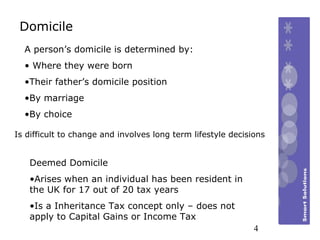
Domicile   A person’s domicile is determined by:  Where they were born Their father’s domicile position By marriage By choice Deemed Domicile Arises when an individual has been resident in the UK for 17 out of 20 tax years Is a Inheritance Tax concept only – does not apply to Capital Gains or Income Tax Is difficult to change and involves long term lifestyle decisions 4
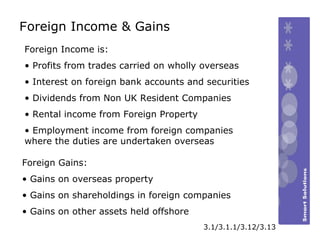
F oreign Income & Gains Foreign Income is:  Profits from trades carried on wholly overseas Interest on foreign bank accounts and securities Dividends from Non UK Resident Companies Rental income from Foreign Property Employment income from foreign companies  where the duties are undertaken overseas Foreign Gains:  Gains on overseas property Gains on shareholdings in foreign companies Gains on other assets held offshore 3.1/3.1.1/3.12/3.13
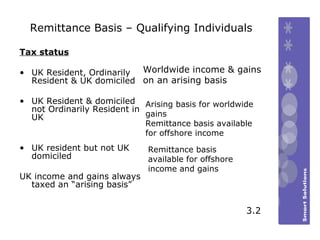
Remittance Basis – Qualifying Individuals Tax status UK Resident, Ordinarily Resident & UK domiciled UK Resident & domiciled not Ordinarily Resident in UK UK resident but not UK domiciled UK income and gains always taxed an “arising basis” Worldwide income & gains on an arising basis Arising basis for worldwide gains  Remittance basis available for offshore income Remittance basis available for offshore income and gains 3.2
Remittance Basis – Claim needed? It depends on: Less than £2,000 of unremitted income and gains?  –  s809D [5.1] S 809 E exemption? Under 18 at the end of the tax year? Not resident in the UK for more than 6 out of 9 preceding tax years Or eligible for the s828C exemption? [income if taxed in the UK would be subject to basic rate tax and they are employed in the UK]
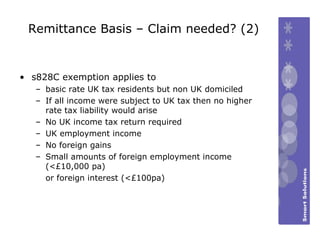
Remittance Basis – Claim needed? (2) s828C exemption applies to  basic rate UK tax residents but non UK domiciled If all income were subject to UK tax then no higher rate tax liability would arise No UK income tax return required UK employment income No foreign gains Small amounts of foreign employment income (<£10,000 pa) or foreign interest (<£100pa)
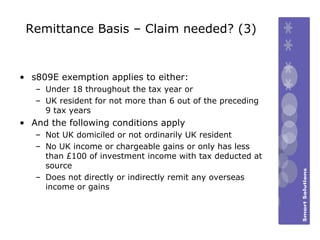
Remittance Basis – Claim needed? (3) s809E exemption applies to either:  Under 18 throughout the tax year or  UK resident for not more than 6 out of the preceding 9 tax years And the following conditions apply Not UK domiciled or not ordinarily UK resident No UK income or chargeable gains or only has less than £100 of investment income with tax deducted at source Does not directly or indirectly remit any overseas income or gains
Remittance Basis – Claim needed? (4) Exempt remittances Money paid to the Commissioners [s809V] Consideration for UK services [s809W] Public access rule [s809Z & s809Z1] Personal use rule [s809X(40 & s809Z2] Clothing, footwear and jewellery Repair rule [s809X(5)a & s809Z3] Temporary importation rule [s809X(5)b] De minimis provision - <£1000 [s809x(5)c]
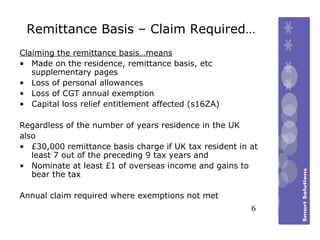
Remittance Basis – Claim Required… Claiming the remittance basis…means Made on the residence, remittance basis, etc supplementary pages Loss of personal allowances Loss of CGT annual exemption Capital loss relief entitlement affected (s16ZA) Regardless of the number of years residence in the UK  also £30,000 remittance basis charge if UK tax resident in at least 7 out of the preceding 9 tax years and Nominate at least £1 of overseas income and gains to bear the tax Annual claim required where exemptions not met   6
Remittance Basis –  Nominated income and Gains Where an individual pays the £30,000 [RBC] they must:  Nominate the overseas income and gains that the RBC is levied on. This can be as low as £1 – care needed if seeking to claim Double Tax Credit overseas for the RBC Funds from the nominated account must not be remitted to the UK, although the account can be used to pay the RBC direct to HMRC If funds remitted to the UK from the nominated account then s809J triggered which changes the basis of taxation for overseas assets to be as if they had arisen from a single mixed fund
Recent Tax Cases   “ The Residence Cases” Grace [4.3.1] Sheppard  Genovese vs HMRC [4.3.3] (ordinarily resident?) Tuczka  Tuberville  Gaines Cooper – the saga continues 3.2 Special Commissioners    –  lost High Court  - lost Court of Appeal – lost Supreme Court – watch this space… No Domicile Cases recently…..
Robert Gaines Cooper Gaines -Cooper  born in England,  lived in UK until 1974/75 Bought home in Seychelles in 1975 Lived in California 1975 – 1992 Remarried in 1993.  Wife from Seychelles  but UK resident Child born 1998, attended prep school in UK until Sep 2005 (Switzerland thereafter)  G-C travelled extensively (150 flights pa) Tax appeals concern 1993/94 – 2003/04 and concern whether he is UK resident or not 4.3.2
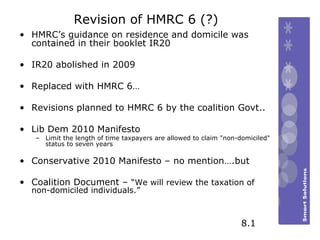
Revision of HMRC 6 (?) HMRC’s guidance on residence and domicile was contained in their booklet IR20  IR20 abolished in 2009 Replaced with HMRC 6… Revisions planned to HMRC 6 by the coalition Govt.. Lib Dem 2010 Manifesto  Limit the length of time taxpayers are allowed to claim &quot;non-domiciled&quot; status to seven years  Conservative 2010 Manifesto – no mention….but Coalition Document –  “We will review the taxation of non-domiciled individuals.” 8.1
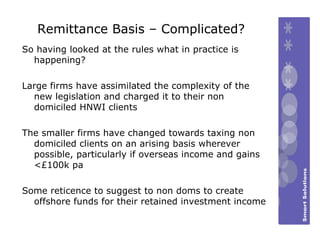
Remittance Basis – Complicated? So having looked at the rules what in practice is happening? Large firms have assimilated the complexity of the new legislation and charged it to their non domiciled HNWI clients The smaller firms have changed towards taxing non domiciled clients on an arising basis wherever possible, particularly if overseas income and gains <£100k pa Some reticence to suggest to non doms to create offshore funds for their retained investment income
What is a Remittance? A remittance is a transfer of money by a foreign worker to his or her home country  Remittance can also refer to the accounting concept of a monetary payment transferred by a customer to a business historical English meaning from the 19th century referring to money sent from Britain to a person living in a far away place such as a British colony - thus sending money in the opposite direction to today's usual usage of the term Within Victorian British culture, this often meant the black sheep of an upper or middle class family who was sent away (from the UK to the Empire), and paid to stay away. These men were generally of dissolute or drunken character, and may have been sent overseas after one or more disgraces at home
What is a Taxable Remittance? A remittance is a transfer from overseas in to the UK by a non UK domiciled individual Meeting one of 4 conditions s809L [7.1] Very wide definitions covering cash transfers, Goods Payments of UK related debts  traced directly or indirectly to previously unremitted foreign income or gains Money or other property representing or derived from foreign income or gains is brought to, used in, or received in the UK for the benefit of a relevant person
What is a Taxable Remittance?(2) Money or other property representing or derived from foreign income or gains is brought to, used in, or received in the UK [Condition A] for the benefit of a relevant person or A service is provided in the UK to,  or for the benefit of a relevant person Regardless whether the service is paid offshore or payment is made in the UK    [Condition B] Further provisions apply to gift recipients  [Condition C] And 3 rd  party connected operations provisions    [Condition D] 7.1/7.2/7.3
What is a Taxable Remittance?(3) Exclusions from condition D:  If the property or service is enjoyed virtually to the exclusion of all relevant persons If full consideration in money or money’s worth is given by the relevant person for the enjoyment or If the property or service is enjoyed by relevant persons in the same way and on the same terms as the general public 7.1/7.2/7.3
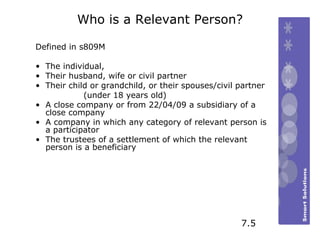
Who is a Relevant Person? Defined in s809M The individual, Their husband, wife or civil partner Their child or grandchild, or their spouses/civil partner (under 18 years old) A close company or from 22/04/09 a subsidiary of a close company A company in which any category of relevant person is a participator The trustees of a settlement of which the relevant person is a beneficiary 7.5
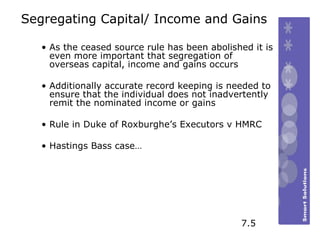
Segregating Capital/ Income and Gains As the ceased source rule has been abolished it is even more important that segregation of overseas capital, income and gains occurs  Additionally accurate record keeping is needed to ensure that the individual does not inadvertently remit the nominated income or gains Rule in Duke of Roxburghe’s Executors v HMRC Hastings Bass case… 7.5
Interaction of Capital Gains  Before 6 April 2008 foreign capital losses for someone on the remittance basis were unable to be set against UK capital gains [CG25330] Revision in FA 2008 allows this to occur by election under s16ZA TCGA 1992  Irrevocable Must be made in the first year in which s809B remittance basis is claimed by a non UK domiciled individual Practical considerations…. 9
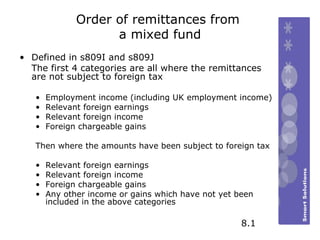
Order of remittances from  a mixed fund Defined in s809I and s809J The first 4 categories are all where the remittances are not subject to foreign tax Employment income (including UK employment income) Relevant foreign earnings Relevant foreign income  Foreign chargeable gains Then where the amounts have been subject to foreign tax Relevant foreign earnings Relevant foreign income  Foreign chargeable gains Any other income or gains which have not yet been included in the above categories 8.1
Interaction of Capital Gains  Before 6 April 2008 foreign capital losses for someone on the remittance basis were unable to be set against UK capital gains [CG25330] Revision in FA 2008 allows this to occur by election under s16ZA TCGA 1992  Irrevocable Must be made in the first year in which s809B remittance basis is claimed by a non UK domiciled individual Practical considerations…. 9
For Further Information Contact me at: Email :  [email_address] Website: www.smartsolutions-online.co.uk Tel: 01883 715848 Mob: 07952 217249 Smart Solutions 88 Pollards Oak Road Hurst Green  Oxted  Surrey RH8 0JW
Disclaimer The illustrations and information presented is produced for your general information. It is based upon our understanding of current legislation and correct at the time that the seminar was prepared and presented. You should contact us before taking any specific action based on the information shown on these slides or any handouts provided as part of the seminar. No responsibility can be accepted for any use made of the illustrations or information presented herewith.   Whilst every effort is made to ensure the accuracy of information contained herein, we cannot accept liability for any reliance placed on these seminar materials and strongly advise that you seek further specific advice relevant to your individual circumstances.  

Remittance Basis Presentation(16.10.10)

  • 1.
    The Remittance Basis for UK Taxation The new remittance rules & how they are working in practice
  • 2.
    Andrew McKenzie-Smart FCCACTA Smart Solutions A Seminar for the Chartered Institute of Taxation Sussex Area Branch
  • 3.
    Introduction – Whatis the remittance basis? For UK domiciled individuals taxed on an arising basis For non UK domiciled individuals taxed on an arising basis for UK income and gains Can claim for their foreign income and gains to be taxed on a “remittance basis” “ Remittance” being when the foreign income and gains are remitted directly or indirectly to the UK Changes made to the remittance basis in from 6 th April 2008
  • 4.
    Domicile Now UKDom Non UK Dom – born in US UK Dom But NR (?) Non UK Dom - Father born in Corfu
  • 5.
    Domicile A person’s domicile is determined by: Where they were born Their father’s domicile position By marriage By choice Deemed Domicile Arises when an individual has been resident in the UK for 17 out of 20 tax years Is a Inheritance Tax concept only – does not apply to Capital Gains or Income Tax Is difficult to change and involves long term lifestyle decisions 4
  • 6.
    F oreign Income& Gains Foreign Income is: Profits from trades carried on wholly overseas Interest on foreign bank accounts and securities Dividends from Non UK Resident Companies Rental income from Foreign Property Employment income from foreign companies where the duties are undertaken overseas Foreign Gains: Gains on overseas property Gains on shareholdings in foreign companies Gains on other assets held offshore 3.1/3.1.1/3.12/3.13
  • 7.
    Remittance Basis –Qualifying Individuals Tax status UK Resident, Ordinarily Resident & UK domiciled UK Resident & domiciled not Ordinarily Resident in UK UK resident but not UK domiciled UK income and gains always taxed an “arising basis” Worldwide income & gains on an arising basis Arising basis for worldwide gains Remittance basis available for offshore income Remittance basis available for offshore income and gains 3.2
  • 8.
    Remittance Basis –Claim needed? It depends on: Less than £2,000 of unremitted income and gains? – s809D [5.1] S 809 E exemption? Under 18 at the end of the tax year? Not resident in the UK for more than 6 out of 9 preceding tax years Or eligible for the s828C exemption? [income if taxed in the UK would be subject to basic rate tax and they are employed in the UK]
  • 9.
    Remittance Basis –Claim needed? (2) s828C exemption applies to basic rate UK tax residents but non UK domiciled If all income were subject to UK tax then no higher rate tax liability would arise No UK income tax return required UK employment income No foreign gains Small amounts of foreign employment income (<£10,000 pa) or foreign interest (<£100pa)
  • 10.
    Remittance Basis –Claim needed? (3) s809E exemption applies to either: Under 18 throughout the tax year or UK resident for not more than 6 out of the preceding 9 tax years And the following conditions apply Not UK domiciled or not ordinarily UK resident No UK income or chargeable gains or only has less than £100 of investment income with tax deducted at source Does not directly or indirectly remit any overseas income or gains
  • 11.
    Remittance Basis –Claim needed? (4) Exempt remittances Money paid to the Commissioners [s809V] Consideration for UK services [s809W] Public access rule [s809Z & s809Z1] Personal use rule [s809X(40 & s809Z2] Clothing, footwear and jewellery Repair rule [s809X(5)a & s809Z3] Temporary importation rule [s809X(5)b] De minimis provision - <£1000 [s809x(5)c]
  • 12.
    Remittance Basis –Claim Required… Claiming the remittance basis…means Made on the residence, remittance basis, etc supplementary pages Loss of personal allowances Loss of CGT annual exemption Capital loss relief entitlement affected (s16ZA) Regardless of the number of years residence in the UK also £30,000 remittance basis charge if UK tax resident in at least 7 out of the preceding 9 tax years and Nominate at least £1 of overseas income and gains to bear the tax Annual claim required where exemptions not met 6
  • 13.
    Remittance Basis – Nominated income and Gains Where an individual pays the £30,000 [RBC] they must: Nominate the overseas income and gains that the RBC is levied on. This can be as low as £1 – care needed if seeking to claim Double Tax Credit overseas for the RBC Funds from the nominated account must not be remitted to the UK, although the account can be used to pay the RBC direct to HMRC If funds remitted to the UK from the nominated account then s809J triggered which changes the basis of taxation for overseas assets to be as if they had arisen from a single mixed fund
  • 14.
    Recent Tax Cases “ The Residence Cases” Grace [4.3.1] Sheppard Genovese vs HMRC [4.3.3] (ordinarily resident?) Tuczka Tuberville Gaines Cooper – the saga continues 3.2 Special Commissioners – lost High Court - lost Court of Appeal – lost Supreme Court – watch this space… No Domicile Cases recently…..
  • 15.
    Robert Gaines CooperGaines -Cooper born in England, lived in UK until 1974/75 Bought home in Seychelles in 1975 Lived in California 1975 – 1992 Remarried in 1993. Wife from Seychelles but UK resident Child born 1998, attended prep school in UK until Sep 2005 (Switzerland thereafter) G-C travelled extensively (150 flights pa) Tax appeals concern 1993/94 – 2003/04 and concern whether he is UK resident or not 4.3.2
  • 16.
    Revision of HMRC6 (?) HMRC’s guidance on residence and domicile was contained in their booklet IR20 IR20 abolished in 2009 Replaced with HMRC 6… Revisions planned to HMRC 6 by the coalition Govt.. Lib Dem 2010 Manifesto Limit the length of time taxpayers are allowed to claim &quot;non-domiciled&quot; status to seven years Conservative 2010 Manifesto – no mention….but Coalition Document – “We will review the taxation of non-domiciled individuals.” 8.1
  • 17.
    Remittance Basis –Complicated? So having looked at the rules what in practice is happening? Large firms have assimilated the complexity of the new legislation and charged it to their non domiciled HNWI clients The smaller firms have changed towards taxing non domiciled clients on an arising basis wherever possible, particularly if overseas income and gains <£100k pa Some reticence to suggest to non doms to create offshore funds for their retained investment income
  • 18.
    What is aRemittance? A remittance is a transfer of money by a foreign worker to his or her home country Remittance can also refer to the accounting concept of a monetary payment transferred by a customer to a business historical English meaning from the 19th century referring to money sent from Britain to a person living in a far away place such as a British colony - thus sending money in the opposite direction to today's usual usage of the term Within Victorian British culture, this often meant the black sheep of an upper or middle class family who was sent away (from the UK to the Empire), and paid to stay away. These men were generally of dissolute or drunken character, and may have been sent overseas after one or more disgraces at home
  • 19.
    What is aTaxable Remittance? A remittance is a transfer from overseas in to the UK by a non UK domiciled individual Meeting one of 4 conditions s809L [7.1] Very wide definitions covering cash transfers, Goods Payments of UK related debts traced directly or indirectly to previously unremitted foreign income or gains Money or other property representing or derived from foreign income or gains is brought to, used in, or received in the UK for the benefit of a relevant person
  • 20.
    What is aTaxable Remittance?(2) Money or other property representing or derived from foreign income or gains is brought to, used in, or received in the UK [Condition A] for the benefit of a relevant person or A service is provided in the UK to, or for the benefit of a relevant person Regardless whether the service is paid offshore or payment is made in the UK [Condition B] Further provisions apply to gift recipients [Condition C] And 3 rd party connected operations provisions [Condition D] 7.1/7.2/7.3
  • 21.
    What is aTaxable Remittance?(3) Exclusions from condition D: If the property or service is enjoyed virtually to the exclusion of all relevant persons If full consideration in money or money’s worth is given by the relevant person for the enjoyment or If the property or service is enjoyed by relevant persons in the same way and on the same terms as the general public 7.1/7.2/7.3
  • 22.
    Who is aRelevant Person? Defined in s809M The individual, Their husband, wife or civil partner Their child or grandchild, or their spouses/civil partner (under 18 years old) A close company or from 22/04/09 a subsidiary of a close company A company in which any category of relevant person is a participator The trustees of a settlement of which the relevant person is a beneficiary 7.5
  • 23.
    Segregating Capital/ Incomeand Gains As the ceased source rule has been abolished it is even more important that segregation of overseas capital, income and gains occurs Additionally accurate record keeping is needed to ensure that the individual does not inadvertently remit the nominated income or gains Rule in Duke of Roxburghe’s Executors v HMRC Hastings Bass case… 7.5
  • 24.
    Interaction of CapitalGains Before 6 April 2008 foreign capital losses for someone on the remittance basis were unable to be set against UK capital gains [CG25330] Revision in FA 2008 allows this to occur by election under s16ZA TCGA 1992 Irrevocable Must be made in the first year in which s809B remittance basis is claimed by a non UK domiciled individual Practical considerations…. 9
  • 25.
    Order of remittancesfrom a mixed fund Defined in s809I and s809J The first 4 categories are all where the remittances are not subject to foreign tax Employment income (including UK employment income) Relevant foreign earnings Relevant foreign income Foreign chargeable gains Then where the amounts have been subject to foreign tax Relevant foreign earnings Relevant foreign income Foreign chargeable gains Any other income or gains which have not yet been included in the above categories 8.1
  • 26.
    Interaction of CapitalGains Before 6 April 2008 foreign capital losses for someone on the remittance basis were unable to be set against UK capital gains [CG25330] Revision in FA 2008 allows this to occur by election under s16ZA TCGA 1992 Irrevocable Must be made in the first year in which s809B remittance basis is claimed by a non UK domiciled individual Practical considerations…. 9
  • 27.
    For Further InformationContact me at: Email : [email_address] Website: www.smartsolutions-online.co.uk Tel: 01883 715848 Mob: 07952 217249 Smart Solutions 88 Pollards Oak Road Hurst Green Oxted Surrey RH8 0JW
  • 28.
    Disclaimer The illustrationsand information presented is produced for your general information. It is based upon our understanding of current legislation and correct at the time that the seminar was prepared and presented. You should contact us before taking any specific action based on the information shown on these slides or any handouts provided as part of the seminar. No responsibility can be accepted for any use made of the illustrations or information presented herewith.   Whilst every effort is made to ensure the accuracy of information contained herein, we cannot accept liability for any reliance placed on these seminar materials and strongly advise that you seek further specific advice relevant to your individual circumstances.