Relationship-Based
Guidance
Chapter 3 from Guiding children’s Social and Emotional Development: A
Reflective Approach. Katz. 2014
Book Learning vs. Real Life
• Read the case study on p. 36 in your text
• Real children and families in real care situations = a dynamic situation
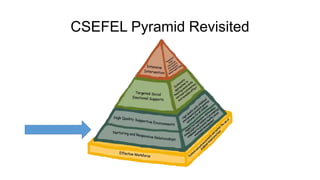
CSEFEL Pyramid Revisited
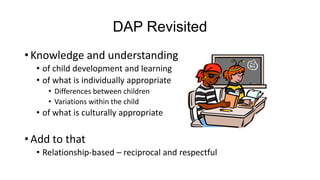
DAP Revisited
• Knowledge and understanding
• of child development and learning
• of what is individually appropriate
• Differences between children
• Variations within the child

• of what is culturally appropriate

• Add to that
• Relationship-based – reciprocal and respectful
Relationship-based guidance
• Still Face Experiment
• Notice how the mother is attuned to her baby and how her responsiveness or
lack of responsiveness impacts the baby’s stress levels.

• Which are you?
• Sage on the stage?
• Guide on the side?

See p. 40 in your text
Evaluate your personal motivations for
choosing to teach
More terms
• As we continue our self-awareness activities, look at the definition of
personality on p. 41. How does that differ from temperament?
• In the definition of personality, the definition mention “patterns of
affect”. What is affect when it’s a noun?
• In the definition of temperament in Table 3.1 at the bottom of the
page, what does constitutional predisposition mean?
Reframing Our Thinking
• Read the scenarios on p. 41. Which viewpoints are more helpful and
supportive for positive relationships with children?
• How you respond to children’s behaviors will depend on your
“interpretation of and emotional reaction to” those behaviors
• Look at the Reframing Activity from the CSEFEL Preschool Training Module
• In this activity, you are to write instances during the day that may “push
your buttons” or cause you to feel frustrated with a child. Can you think of
more positive ways to view what happened? Are you able to reframe your
thinking so that you can consider a more proactive and positive response
to the behavior? Can you consider ways to help a child improve her social
or emotional skill set so that those “annoying” behaviors are diminished?
CSEFEL
• Look at the Reframing Activity from the CSEFEL Preschool Training
Module
• In this activity, you are to write instances during the day that may
“push your buttons” or cause you to feel frustrated with a child. Can
you think of more positive ways to view what happened? Are you
able to reframe your thinking so that you can consider a more
proactive and positive response to the behavior? Can you consider
ways to help a child improve her social or emotional skill set so that
those “annoying” behaviors are diminished?
Looking back
• Remember goodness-of-fit?
• Complete the activity at the bottom of p. 42 and on p. 43 in your text
• After comparing your temperament to the temperament of a child in
your care, how can you adjust your expectations, responses and the
environment to better meet the needs of the child?
Let’s Evaluate
• Look at the scenario on p. 45 in your text.
• What steps does Peggy take to better meet the needs of Nolan?
• What patterns of behaviors do we have that cause problems for the
children in our care?
• What patterns of behaviors do we have that are helpful for dealing
with the children in our care?
• How can we determine what a child’s behaviors are trying to tell us?
Skill Building - Conversations
• Role play – model the use of extended discourse
• Two children are playing restaurant and they want you to be their
customer
• Two children have build a zoo out of the blocks in the block center
and have put a variety of animals in various parts of their zoo.
• A child is worried because he heard his mommy and daddy yelling last
night
• A child cries after lunch every day and has to go home. No one knows
why.
Skill Building - Observations
• How do young children communicate their inner states?
• How do we read their cues?
• Nonverbal communication – through body language, eye contact,
expressions, play, etc.
• Provide variety of opportunities for children to express their inner
states.
• Know child development to help interpret children’s communication
Skill Building – Demonstrating Respect
• Reciprocity and respect between adult and child enhance compliance
and cooperation
• Golden rule
• How do you “like to be guided and corrected”?
• What is the tone of your voice?

• Parallel process

Relationship based guidance

  • 1.
    Relationship-Based Guidance Chapter 3 fromGuiding children’s Social and Emotional Development: A Reflective Approach. Katz. 2014
  • 2.
    Book Learning vs.Real Life • Read the case study on p. 36 in your text • Real children and families in real care situations = a dynamic situation
  • 3.
  • 4.
    DAP Revisited • Knowledgeand understanding • of child development and learning • of what is individually appropriate • Differences between children • Variations within the child • of what is culturally appropriate • Add to that • Relationship-based – reciprocal and respectful
  • 5.
    Relationship-based guidance • StillFace Experiment • Notice how the mother is attuned to her baby and how her responsiveness or lack of responsiveness impacts the baby’s stress levels. • Which are you? • Sage on the stage? • Guide on the side? See p. 40 in your text Evaluate your personal motivations for choosing to teach
  • 6.
    More terms • Aswe continue our self-awareness activities, look at the definition of personality on p. 41. How does that differ from temperament? • In the definition of personality, the definition mention “patterns of affect”. What is affect when it’s a noun? • In the definition of temperament in Table 3.1 at the bottom of the page, what does constitutional predisposition mean?
  • 7.
    Reframing Our Thinking •Read the scenarios on p. 41. Which viewpoints are more helpful and supportive for positive relationships with children? • How you respond to children’s behaviors will depend on your “interpretation of and emotional reaction to” those behaviors • Look at the Reframing Activity from the CSEFEL Preschool Training Module • In this activity, you are to write instances during the day that may “push your buttons” or cause you to feel frustrated with a child. Can you think of more positive ways to view what happened? Are you able to reframe your thinking so that you can consider a more proactive and positive response to the behavior? Can you consider ways to help a child improve her social or emotional skill set so that those “annoying” behaviors are diminished?
  • 8.
    CSEFEL • Look atthe Reframing Activity from the CSEFEL Preschool Training Module • In this activity, you are to write instances during the day that may “push your buttons” or cause you to feel frustrated with a child. Can you think of more positive ways to view what happened? Are you able to reframe your thinking so that you can consider a more proactive and positive response to the behavior? Can you consider ways to help a child improve her social or emotional skill set so that those “annoying” behaviors are diminished?
  • 9.
    Looking back • Remembergoodness-of-fit? • Complete the activity at the bottom of p. 42 and on p. 43 in your text • After comparing your temperament to the temperament of a child in your care, how can you adjust your expectations, responses and the environment to better meet the needs of the child?
  • 10.
    Let’s Evaluate • Lookat the scenario on p. 45 in your text. • What steps does Peggy take to better meet the needs of Nolan? • What patterns of behaviors do we have that cause problems for the children in our care? • What patterns of behaviors do we have that are helpful for dealing with the children in our care? • How can we determine what a child’s behaviors are trying to tell us?
  • 11.
    Skill Building -Conversations • Role play – model the use of extended discourse • Two children are playing restaurant and they want you to be their customer • Two children have build a zoo out of the blocks in the block center and have put a variety of animals in various parts of their zoo. • A child is worried because he heard his mommy and daddy yelling last night • A child cries after lunch every day and has to go home. No one knows why.
  • 12.
    Skill Building -Observations • How do young children communicate their inner states? • How do we read their cues? • Nonverbal communication – through body language, eye contact, expressions, play, etc. • Provide variety of opportunities for children to express their inner states. • Know child development to help interpret children’s communication
  • 13.
    Skill Building –Demonstrating Respect • Reciprocity and respect between adult and child enhance compliance and cooperation • Golden rule • How do you “like to be guided and corrected”? • What is the tone of your voice? • Parallel process

Editor's Notes

  • #7 Personality differs from temperament in that personality is a combination of temperament and experiencesAffect is defined as a “feeling or emotion”; “constitutional predisposition” means “tendency towards characteristics of a person’s body or mind”