Promoting Children’s Success: Building Relationships and Creating Supportive Environments (Module 1) WestEd San Marcos
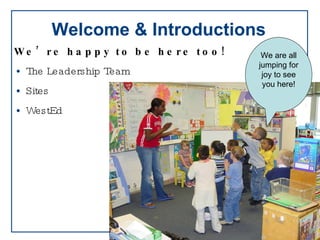
Welcome & Introductions We’re happy to be here too! The Leadership Team Sites WestEd We are all jumping for joy to see you here!
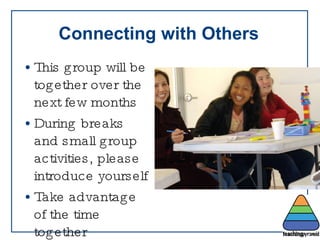
Connecting with Others This group will be together over the next few months During breaks and small group activities, please introduce yourself Take advantage of the time together
Who  Are We? WestEd San Marcos A part of the WestEd Center for Child & Family Studies Our projects focus on inclusive practice for all children Website:  www.CAinclusivechildcare.org CSEFEL:  Federally funded Office of Head Start/Child Care Bureau Center on the Social and Emotional Foundations for Early Learning Website:  www.vanderbilt.edu/csefel/ TACSEI:  Federally funded Office of Special Education Programs Technical Assistance Center on Social Emotional Interventions Website:  www.challengingbehavior.org
Materials For You! Notebook: Today is Module 1 Many of the Modules handouts will be added at future trainings Make the Materials Useful to You Take notes  (Paper provided or on the handouts) Mark for later review  (use the post-it notes) Articles provide lots of background information Bring the Notebook to every training
Climate for Learning Take Care of Yourself Move or stand if you need to (Stretch) Use the restroom as needed Jot down question as we go Make notes of ideas to try in your setting Take Care of Each Other Turn cell phones off or on silent  Speak up when sharing from the audience Be mindful of those around you
Learner Objectives Participants will be able to identify strategies that can be used to  build positive relationships with children, families and colleagues;  design environments, schedules, and routines;  structure transitions;  help children learn expectations and routines; and  plan activities that promote engagement acknowledge and encourage children’s positive social behaviors
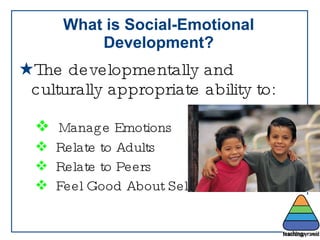
What is Social-Emotional Development? The developmentally and culturally appropriate ability to: Manage Emotions Relate to Adults Relate to Peers Feel Good About Self
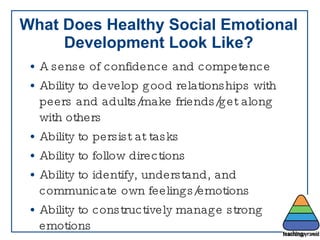
What Does Healthy Social Emotional Development Look Like? A sense of confidence and competence Ability to develop good relationships with peers and adults/make friends/get along with others Ability to persist at tasks Ability to follow directions Ability to identify, understand, and communicate own feelings/emotions Ability to constructively manage strong emotions Development of empathy
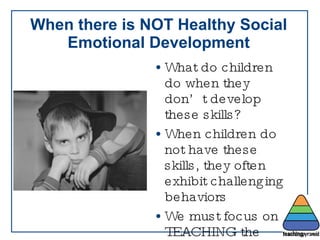
When there is NOT Healthy Social Emotional Development What do children do when they don’t develop these skills?  When children do not have these skills, they often exhibit challenging behaviors We must focus on TEACHING the skills!
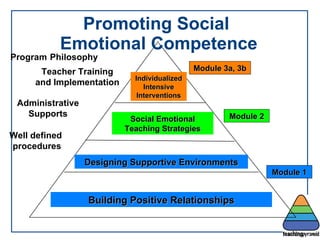
Promoting Social  Emotional Competence Teacher Training and Implementation Administrative Supports Program   Philosophy Well defined  procedures Designing Supportive Environments Building Positive Relationships Social Emotional Teaching Strategies Module 1 Module 2 Module 3a, 3b Individualized Intensive Interventions
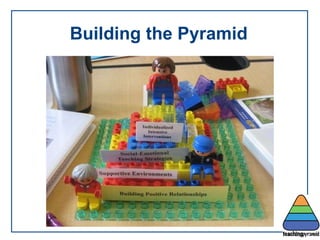
Building the Pyramid
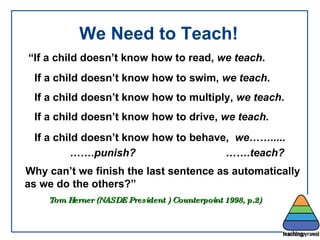
We Need to Teach! “ If a child doesn’t know how to read,  we teach . If a child doesn’t know how to swim,  we teach . If a child doesn’t know how to multiply,  we teach . If a child doesn’t know how to drive,  we teach. If a child doesn’t know how to behave,  we…….....    Why can’t we finish the last sentence as automatically as we do the others?” Tom Herner (NASDE President ) Counterpoint 1998, p.2) …… .teach?  …… .punish?
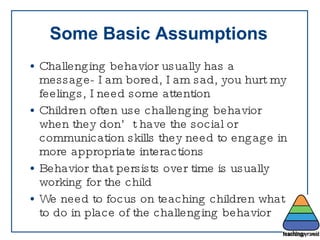
Some Basic Assumptions Challenging behavior usually has a message- I am bored, I am sad, you hurt my feelings, I need some attention Children often use challenging behavior when they don’t have the social or communication skills they need to engage in more appropriate interactions Behavior that persists over time is usually working for the child We need to focus on teaching children what to do in place of the challenging behavior
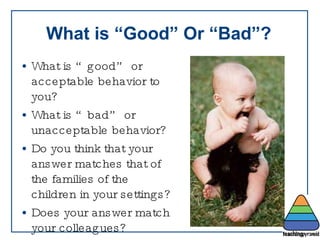
What is “Good” Or “Bad”? What is “good” or acceptable behavior to you?  What is “bad” or unacceptable behavior? Do you think that your answer matches that of the families of the children in your settings? Does your answer match your colleagues?
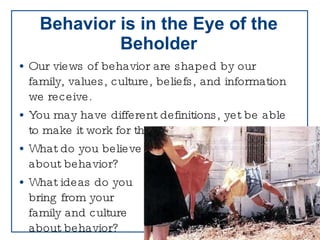
Behavior is in the Eye of the Beholder Our views of behavior are shaped by our family, values, culture, beliefs, and information we receive. You may have different definitions, yet be able to make it work for the child What do you believe  about behavior? What ideas do you  bring from your  family and culture  about behavior?
Getting To Agreements About Behavior Why do we have rules?  To let us know what we expect from each other When rules are “told” to children, they do not necessarily represent agreements We want agreements between all members of the class and school – adults & children Take a moment to write down the “rules” you have in your classroom
How Do Children Know What Is Expected of Them? Most classroom rules group together under three broad expectations We Are Safe We Are Respectful We Are Friendly Try this with your rules Keep this in mind as we move through the day
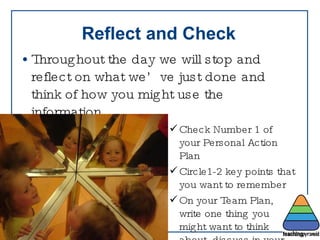
Reflect and Check Throughout the day we will stop and reflect on what we’ve just done and think of how you might use the information Check Number 1 of your Personal Action Plan Circle1-2 key points that you want to remember On your Team Plan, write one thing you might want to think about, discuss in your team,  or have help with in the third column
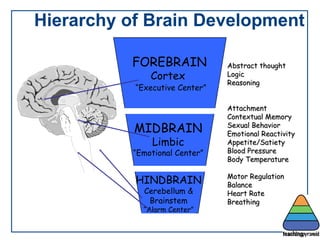
Hierarchy of Brain Development Abstract thought Logic Reasoning Attachment Contextual Memory Sexual Behavior Emotional Reactivity Appetite/Satiety Blood Pressure Body Temperature Motor Regulation Balance Heart Rate Breathing FOREBRAIN Cortex  “ Executive Center” MIDBRAIN Limbic “ Emotional Center” HINDBRAIN Cerebellum & Brainstem “ Alarm Center”
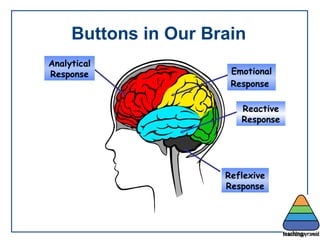
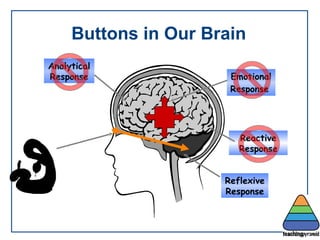
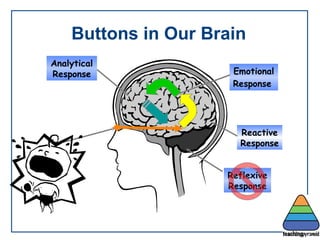
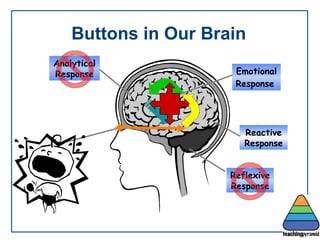
Buttons in Our Brain Analytical Response Emotional Response   Reactive Response Reflexive Response
Examining Our Attitudes about Challenging Behaviors What behaviors push your buttons? How do these behaviors make you feel? How does this impact your relationship with a child and his/her family? 1.2 Handout 1.2 Hot Button Activity Behaviors  Feelings Impact
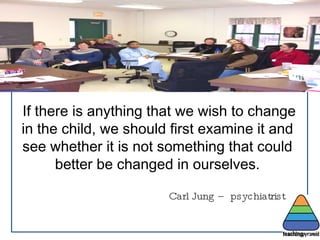
If there is anything that we wish to change in the child, we should first examine it and see whether it is not something that could better be changed in ourselves. Carl Jung – psychiatrist  .
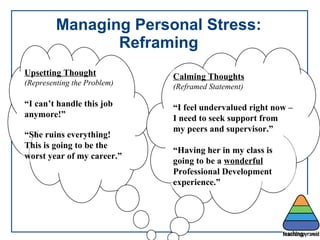
Managing Personal Stress: Reframing Upsetting Thought (Representing the Problem) “ I can’t handle this job anymore!” “ She ruins everything!  This is going to be the worst year of my career.” Calming Thoughts (Reframed Statement) “ I feel undervalued right now –  I need to seek support from  my peers and supervisor.” “ Having her in my class is going to be a  wonderful  Professional Development experience.”
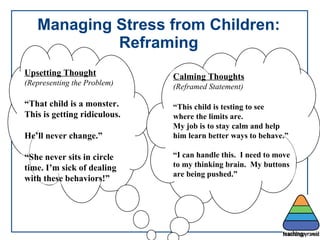
Managing Stress from Children: Reframing Upsetting Thought (Representing the Problem) “ That child is a monster.  This is getting ridiculous.  He’ll never change.” “ She never sits in circle time. I’m sick of dealing with these behaviors!” Calming Thoughts (Reframed Statement) “ This child is testing to see  where the limits are.  My job is to stay calm and help  him learn better ways to behave.” “ I can handle this.  I need to move to my thinking brain.  My buttons are being pushed.”
Reframing Activity In pairs or in groups of 3(no one from your classroom) See Handout 1.3 (Reframing Activity) Read the four examples listed and choose two to three other challenging behaviors from your hot button activity and how you might reframe your thinking about each one.  In reframing the challenging behaviors, do not come up with solutions but rather come up with a different way to think about it.  Be prepared to share your ideas with the large group.
Reflect and Check Get out the Action plan! Check Number 2 of your Personal Action Plan Circle1-2 key points that you want to remember On your Team Action Plan, write one thing you might want to do or have help with in the third column
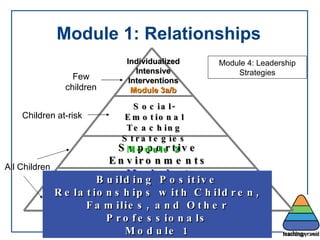
Module 1: Relationships Supportive Environments Module 1 Building Positive Relationships with Children, Families, and Other Professionals Module 1 Social-Emotional Teaching Strategies Module 2 Individualized Intensive Interventions Module 3a/b Few children Children at-risk All Children Module 4: Leadership Strategies
Why Build Relationships? Relationships are at the foundation of everything we do. Build relationships early – don’t wait until there is a problem Children learn and develop in the context of relationships Children with the most challenging behaviors especially need these relationships, and yet their behaviors often prevent them from benefiting from those relationships
Strong Relationships Help each child feel accepted in the group Assist children in learning to communicate and get along with others Encourage feelings of empathy and mutual respect among children and adults Provide a supportive environment in which children can learn and practice appropriate and acceptable behaviors as individuals and as a group
Building Positive Relationships Adults’ time and attention are very important to children  We need to give time and attention at times other than when they are engaging in challenging behavior Family members and other colleagues (mental health providers, therapists) are critical partners in building children’s social emotional competence We should all work together to ensure children’s success and prevent challenging behavior
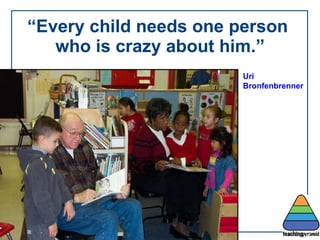
“ Every child needs one person  who is crazy about him.” Uri  Bronfenbrenner
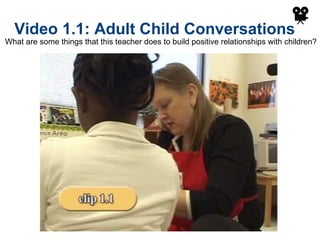
Video 1.1: Adult Child Conversations What are some things that this teacher does to build positive relationships with children?
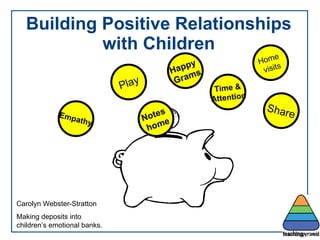
Building Positive Relationships with Children Play Time & Attention Home  visits Share Empathy Happy  Grams Carolyn Webster-Stratton Making deposits into children’s emotional banks.  Notes  home
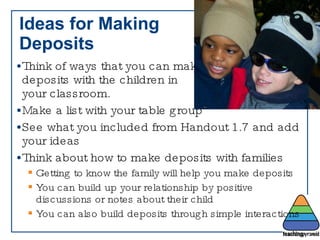
Ideas for Making  Deposits Think of ways that you can make deposits with the children in your classroom.  Make a list with your table group See what you included from Handout 1.7 and add your ideas Think about how to make deposits with families Getting to know the family will help you make deposits You can build up your relationship by positive discussions or notes about their child You can also build deposits through simple interactions
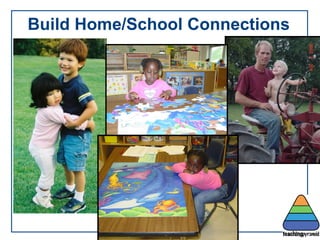
Build Home/School Connections
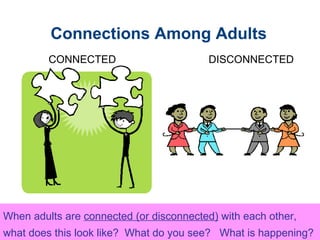
Connections Among Adults CONNECTED DISCONNECTED When adults are  connected (or disconnected)  with each other, what does this look like?  What do you see?  What is happening?
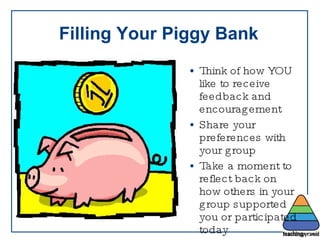
Filling Your Piggy Bank Think of how YOU like to receive feedback and encouragement Share your preferences with your group Take a moment to reflect back on how others in your group supported you or participated today
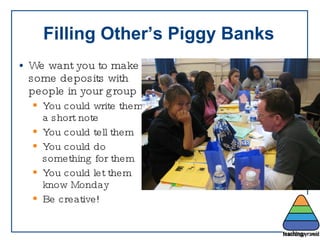
Filling Other’s Piggy Banks We want you to make some deposits with people in your group You could write them a short note You could tell them You could do something for them You could let them know Monday Be creative!
Reflect and Check Get out the Action plan! Check Number 3 of your Personal Action Plan Circle1-2 key points that you want to remember On your Team Action Plan, write one thing you might want to do or have help with in the third column
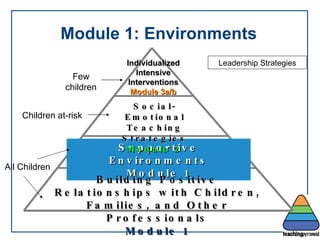
Module 1: Environments Supportive Environments Module 1 Building Positive Relationships with Children, Families, and Other Professionals Module 1 Social-Emotional Teaching Strategies Module 2 Individualized Intensive Interventions Module 3a/b Few children Children at-risk All Children Leadership Strategies
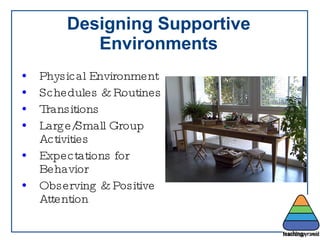
Designing Supportive Environments Physical Environment Schedules & Routines Transitions Large/Small Group Activities Expectations for Behavior  Observing & Positive Attention
1. Physical Environment Hot  and  Cool  Spots Teaching teams , sketch your current classroom.  Other staff , pick a common area to sketch in teams  Identify those places in the room that are  “ Hot Spots ” – Places where there are conflicts or problems among children regularly, places where you need to provide extra supervision “ Cool Spots ” where things usually work well, groups of children can be together without major conflicts
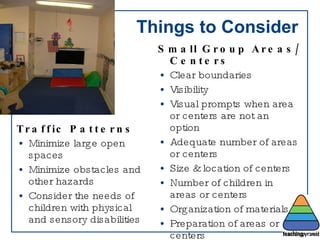
Things to Consider Traffic Patterns Minimize large open spaces Minimize obstacles and other hazards Consider the needs of children with physical and sensory disabilities Small Group Areas/Centers Clear boundaries Visibility Visual prompts when area or centers are not an option Adequate number of areas or centers Size & location of centers Number of children in areas or centers Organization of materials Preparation of areas or centers Sensory Environment
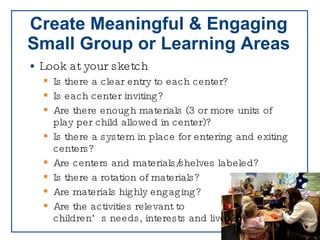
Create Meaningful & Engaging Small Group or Learning Areas Look at your sketch Is there a clear entry to each center? Is each center inviting? Are there enough materials (3 or more units of play per child allowed in center)? Is there a system in place for entering and exiting centers? Are centers and materials/shelves labeled? Is there a rotation of materials? Are materials highly engaging? Are the activities relevant to  children’s needs, interests and lives?
Reflect and Check Get out the Action plan! Check Number 4 of your Personal Action Plan Circle1-2 key points that you want to remember On your Team Action Plan, write one thing you might  want to do or have help with in the third column
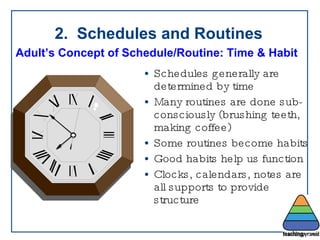
2.  Schedules and Routines Schedules generally are determined by time Many routines are done sub-consciously (brushing teeth, making coffee) Some routines become habits Good habits help us function Clocks, calendars, notes are all supports to provide structure Adult’s Concept of Schedule/Routine: Time & Habit
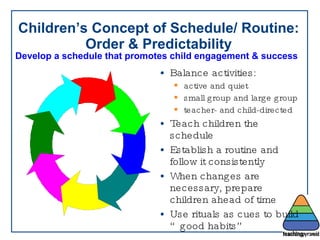
Children’s Concept of Schedule/ Routine: Order & Predictability Balance activities:  active and quiet small group and large group teacher- and child-directed  Teach children the schedule Establish a routine and follow it consistently When changes are necessary, prepare children ahead of time Use rituals as cues to build “good habits” Develop a schedule that promotes child engagement & success
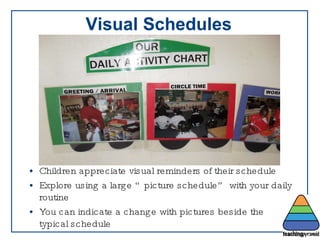
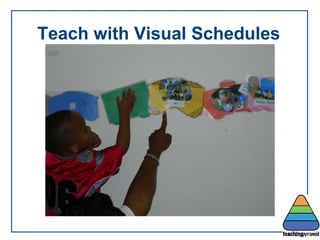
Visual Schedules Children appreciate visual reminders of their schedule Explore using a large “picture schedule” with your daily routine You can indicate a change with pictures beside the typical schedule
Teach with Visual Schedules
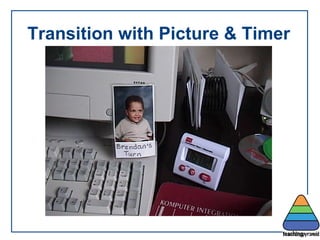
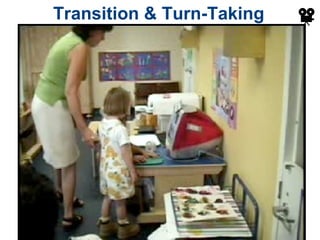
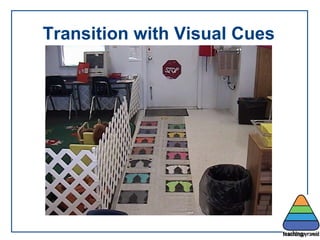
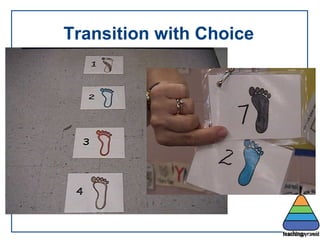
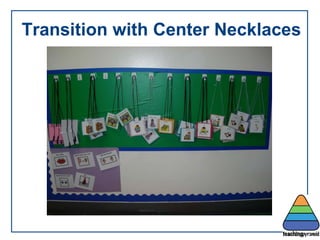
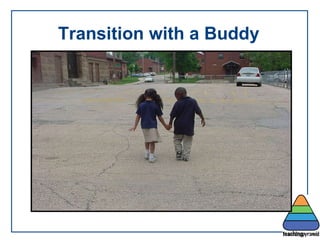
3. Transitions Plan for transitions   Minimize the  number  of transitions that children have during the day Minimize the length of time children spend  waiting  with nothing to do Prepare children for transitions by providing a  warning Structure the transitions so that children have  something   to do  while they wait Teach children the  expectations  related to transitions. Individualize  supports and cues. Songs, activities, and visual cues all work
Transition with Picture & Timer
Transition & Turn-Taking
Transition with Visual Cues
Transition with Choice
Transition with Center Necklaces
Transition with a Buddy
Reflect and Check Get out the Action plan! Check Number 5 & 6 of your Personal Action Plan Circle 1-2 key points that you want to remember in each On your Team Action Plan, write one thing you might want to do or have help with in the third column
4.  Planning Engaging Group Activities Planning any activity Consider the length Be clear about the purpose & goals of the activities Implementing large group activity Minimize large group activities! Provide opportunities for all children to be actively involved Assign jobs to children Have children lead activities Set up the environment to promote appropriate behavior (carpet squares, use objects/visuals, make  it interesting, make it infrequent, yet special)
Grouping Children Range of activities done in small groups Teaching new skills Skill building/Individualized attention Independent work Socialization Planning and implementing Small is age of children + one  (4 children for three year olds) Use materials that encourage collaboration  and communication  Make activities inviting and interesting
5. Expectations for Behavior Expectations are a framework for the behaviors that are “expected” for everyone in the program: children, staff, families while on the site Expectations are best when set “program-wide” and examples are created for specific settings such as in the classroom, in the outside yard, in the bathroom, in the hallway, and so forth
General Guidelines about Expectations Have a few simple expectations Involve the children in developing the examples Post the expectations and examples visually Teach the expectations systematically When first learning the expectations, call attention to children when they follow them, linking the behavior and expectation Wow, you walked quietly to the bathroom. That was really respectful!
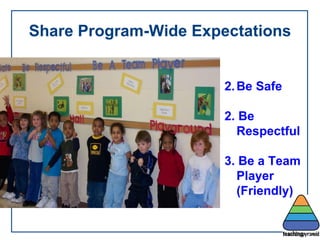
Share Program-Wide Expectations Be Safe 2. Be Respectful 3. Be a Team Player (Friendly)
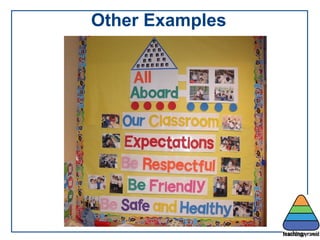
Other Examples
Developing Expectation Examples Keep examples positive – what you see when the behavior meets the expectation For “We Are Safe” an example could be picking up toys (to prevent tripping) Unlike rules, which may need constant additions, expectations are often broad enough to encompass new and unexpected situations After some juice spills, a child knows to wipe it up to keep people safe (not just to “clean up”)
Developing Expectation Examples In groups, you will focus on one or two activity areas Arrival & Departure Shared space (large group areas Work Time (small centers) Outside Meals (snack & lunch) Bathrooms For your assigned activity area, generate several examples for each Program-Wide Expectation We Are Respectful We Are Safe We Are Friendly
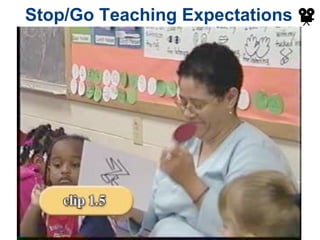
Stop/Go Teaching Expectations
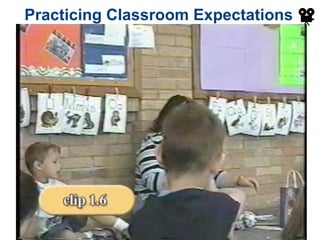
Practicing Classroom Expectations
Reflect and Check Get out the Action plan! Check Number 7, 8, & 9 of your Personal Action Plan Circle 1-2 key points that you want to remember in each On your Team Action Plan, write one thing you might want to do or have help with in the third column
6. Ongoing Observing and  Positive Attention Studies have shown that most adults talk to children by giving directions or correcting inappropriate behavior We need to monitor our behavior to ensure that we are spending more time in genuine conversation or positive commenting Give children attention when they are engaging in appropriate behaviors When giving attention, be specific in our acknowledgement of what they are doing
Close to Magic Acknowledgement Vs. Praise  Think of some positive behaviors you want to encourage List some examples of how you would praise a child for those behaviors How you would acknowledge and encourage instead? Being explicit and specific Be as specific as you can with your acknowledgment Instead of saying “You were so nice to Kendra” or You really were a big help to Juan” say “When you gave Kendra the toy when she was watching you, that was very kind and nice” or “Holding the jar for Juan as he filled it was very helpful.” Non-verbal acknowledgement is great too!
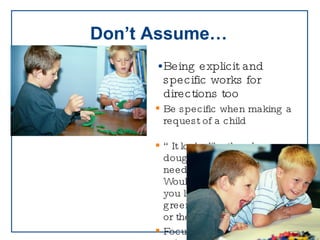
Don’t Assume… Being explicit and specific works for directions too Be specific when making a request of a child “ It looks like the play dough needs to be put away. Would  you like to put away the green or the red play dough?” Focus on teaching skills,  acknowledge them when they  are used, and apply the  strategies thoughtfully
Using Positive Feedback and Encouragement You can also use nonverbal forms of positive  feedback and encouragement You could arrange a special signal with a child who needs lots of encouragement Individualize use of positive feedback and  encouragement based on children’s needs and  preferences Some children prefer quiet, small-style encouragement Encourage other adults and peers to use positive feedback and encouragement Children can learn to give compliments (and they enjoy it!)
Action Plan Look over your Team Action Plans and see where you wanted to focus As a classroom team, select one or two areas you would like to focus on from the “Building Positive Relationships” and one or two areas from the “Designing Supportive Environments” You will have a few minutes to come together as a site to share your Team Action Plans The Action Plan will help guide the support that you receive from your coach Be sure the coach has a copy!
Continuous Improvement A Way of Fine-Tuning Together
What Worked?  Suggestions
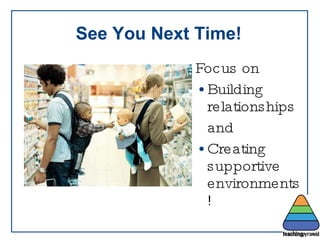
See You Next Time! Focus on  Building relationships  and  Creating supportive environments!

Module 1 Generic(2)

  • 1.
    Promoting Children’s Success:Building Relationships and Creating Supportive Environments (Module 1) WestEd San Marcos
  • 2.
    Welcome & IntroductionsWe’re happy to be here too! The Leadership Team Sites WestEd We are all jumping for joy to see you here!
  • 3.
    Connecting with OthersThis group will be together over the next few months During breaks and small group activities, please introduce yourself Take advantage of the time together
  • 4.
    Who AreWe? WestEd San Marcos A part of the WestEd Center for Child & Family Studies Our projects focus on inclusive practice for all children Website: www.CAinclusivechildcare.org CSEFEL: Federally funded Office of Head Start/Child Care Bureau Center on the Social and Emotional Foundations for Early Learning Website: www.vanderbilt.edu/csefel/ TACSEI: Federally funded Office of Special Education Programs Technical Assistance Center on Social Emotional Interventions Website: www.challengingbehavior.org
  • 5.
    Materials For You!Notebook: Today is Module 1 Many of the Modules handouts will be added at future trainings Make the Materials Useful to You Take notes (Paper provided or on the handouts) Mark for later review (use the post-it notes) Articles provide lots of background information Bring the Notebook to every training
  • 6.
    Climate for LearningTake Care of Yourself Move or stand if you need to (Stretch) Use the restroom as needed Jot down question as we go Make notes of ideas to try in your setting Take Care of Each Other Turn cell phones off or on silent Speak up when sharing from the audience Be mindful of those around you
  • 7.
    Learner Objectives Participantswill be able to identify strategies that can be used to build positive relationships with children, families and colleagues; design environments, schedules, and routines; structure transitions; help children learn expectations and routines; and plan activities that promote engagement acknowledge and encourage children’s positive social behaviors
  • 8.
    What is Social-EmotionalDevelopment? The developmentally and culturally appropriate ability to: Manage Emotions Relate to Adults Relate to Peers Feel Good About Self
  • 9.
    What Does HealthySocial Emotional Development Look Like? A sense of confidence and competence Ability to develop good relationships with peers and adults/make friends/get along with others Ability to persist at tasks Ability to follow directions Ability to identify, understand, and communicate own feelings/emotions Ability to constructively manage strong emotions Development of empathy
  • 10.
    When there isNOT Healthy Social Emotional Development What do children do when they don’t develop these skills? When children do not have these skills, they often exhibit challenging behaviors We must focus on TEACHING the skills!
  • 11.
    Promoting Social Emotional Competence Teacher Training and Implementation Administrative Supports Program Philosophy Well defined procedures Designing Supportive Environments Building Positive Relationships Social Emotional Teaching Strategies Module 1 Module 2 Module 3a, 3b Individualized Intensive Interventions
  • 12.
  • 13.
    We Need toTeach! “ If a child doesn’t know how to read, we teach . If a child doesn’t know how to swim, we teach . If a child doesn’t know how to multiply, we teach . If a child doesn’t know how to drive, we teach. If a child doesn’t know how to behave, we……..... Why can’t we finish the last sentence as automatically as we do the others?” Tom Herner (NASDE President ) Counterpoint 1998, p.2) …… .teach? …… .punish?
  • 14.
    Some Basic AssumptionsChallenging behavior usually has a message- I am bored, I am sad, you hurt my feelings, I need some attention Children often use challenging behavior when they don’t have the social or communication skills they need to engage in more appropriate interactions Behavior that persists over time is usually working for the child We need to focus on teaching children what to do in place of the challenging behavior
  • 15.
    What is “Good”Or “Bad”? What is “good” or acceptable behavior to you? What is “bad” or unacceptable behavior? Do you think that your answer matches that of the families of the children in your settings? Does your answer match your colleagues?
  • 16.
    Behavior is inthe Eye of the Beholder Our views of behavior are shaped by our family, values, culture, beliefs, and information we receive. You may have different definitions, yet be able to make it work for the child What do you believe about behavior? What ideas do you bring from your family and culture about behavior?
  • 17.
    Getting To AgreementsAbout Behavior Why do we have rules? To let us know what we expect from each other When rules are “told” to children, they do not necessarily represent agreements We want agreements between all members of the class and school – adults & children Take a moment to write down the “rules” you have in your classroom
  • 18.
    How Do ChildrenKnow What Is Expected of Them? Most classroom rules group together under three broad expectations We Are Safe We Are Respectful We Are Friendly Try this with your rules Keep this in mind as we move through the day
  • 19.
    Reflect and CheckThroughout the day we will stop and reflect on what we’ve just done and think of how you might use the information Check Number 1 of your Personal Action Plan Circle1-2 key points that you want to remember On your Team Plan, write one thing you might want to think about, discuss in your team, or have help with in the third column
  • 20.
    Hierarchy of BrainDevelopment Abstract thought Logic Reasoning Attachment Contextual Memory Sexual Behavior Emotional Reactivity Appetite/Satiety Blood Pressure Body Temperature Motor Regulation Balance Heart Rate Breathing FOREBRAIN Cortex “ Executive Center” MIDBRAIN Limbic “ Emotional Center” HINDBRAIN Cerebellum & Brainstem “ Alarm Center”
  • 21.
    Buttons in OurBrain Analytical Response Emotional Response Reactive Response Reflexive Response
  • 22.
    Buttons in OurBrain Analytical Response Emotional Response Reactive Response Reflexive Response
  • 23.
    Buttons in OurBrain Analytical Response Emotional Response Reactive Response Reflexive Response
  • 24.
    Buttons in OurBrain Analytical Response Emotional Response Reactive Response Reflexive Response
  • 25.
    Examining Our Attitudesabout Challenging Behaviors What behaviors push your buttons? How do these behaviors make you feel? How does this impact your relationship with a child and his/her family? 1.2 Handout 1.2 Hot Button Activity Behaviors Feelings Impact
  • 26.
    If there isanything that we wish to change in the child, we should first examine it and see whether it is not something that could better be changed in ourselves. Carl Jung – psychiatrist .
  • 27.
    Managing Personal Stress:Reframing Upsetting Thought (Representing the Problem) “ I can’t handle this job anymore!” “ She ruins everything! This is going to be the worst year of my career.” Calming Thoughts (Reframed Statement) “ I feel undervalued right now – I need to seek support from my peers and supervisor.” “ Having her in my class is going to be a wonderful Professional Development experience.”
  • 28.
    Managing Stress fromChildren: Reframing Upsetting Thought (Representing the Problem) “ That child is a monster. This is getting ridiculous. He’ll never change.” “ She never sits in circle time. I’m sick of dealing with these behaviors!” Calming Thoughts (Reframed Statement) “ This child is testing to see where the limits are. My job is to stay calm and help him learn better ways to behave.” “ I can handle this. I need to move to my thinking brain. My buttons are being pushed.”
  • 29.
    Reframing Activity Inpairs or in groups of 3(no one from your classroom) See Handout 1.3 (Reframing Activity) Read the four examples listed and choose two to three other challenging behaviors from your hot button activity and how you might reframe your thinking about each one. In reframing the challenging behaviors, do not come up with solutions but rather come up with a different way to think about it. Be prepared to share your ideas with the large group.
  • 30.
    Reflect and CheckGet out the Action plan! Check Number 2 of your Personal Action Plan Circle1-2 key points that you want to remember On your Team Action Plan, write one thing you might want to do or have help with in the third column
  • 31.
    Module 1: RelationshipsSupportive Environments Module 1 Building Positive Relationships with Children, Families, and Other Professionals Module 1 Social-Emotional Teaching Strategies Module 2 Individualized Intensive Interventions Module 3a/b Few children Children at-risk All Children Module 4: Leadership Strategies
  • 32.
    Why Build Relationships?Relationships are at the foundation of everything we do. Build relationships early – don’t wait until there is a problem Children learn and develop in the context of relationships Children with the most challenging behaviors especially need these relationships, and yet their behaviors often prevent them from benefiting from those relationships
  • 33.
    Strong Relationships Helpeach child feel accepted in the group Assist children in learning to communicate and get along with others Encourage feelings of empathy and mutual respect among children and adults Provide a supportive environment in which children can learn and practice appropriate and acceptable behaviors as individuals and as a group
  • 34.
    Building Positive RelationshipsAdults’ time and attention are very important to children We need to give time and attention at times other than when they are engaging in challenging behavior Family members and other colleagues (mental health providers, therapists) are critical partners in building children’s social emotional competence We should all work together to ensure children’s success and prevent challenging behavior
  • 35.
    “ Every childneeds one person who is crazy about him.” Uri Bronfenbrenner
  • 36.
    Video 1.1: AdultChild Conversations What are some things that this teacher does to build positive relationships with children?
  • 37.
    Building Positive Relationshipswith Children Play Time & Attention Home visits Share Empathy Happy Grams Carolyn Webster-Stratton Making deposits into children’s emotional banks. Notes home
  • 38.
    Ideas for Making Deposits Think of ways that you can make deposits with the children in your classroom. Make a list with your table group See what you included from Handout 1.7 and add your ideas Think about how to make deposits with families Getting to know the family will help you make deposits You can build up your relationship by positive discussions or notes about their child You can also build deposits through simple interactions
  • 39.
  • 40.
    Connections Among AdultsCONNECTED DISCONNECTED When adults are connected (or disconnected) with each other, what does this look like? What do you see? What is happening?
  • 41.
    Filling Your PiggyBank Think of how YOU like to receive feedback and encouragement Share your preferences with your group Take a moment to reflect back on how others in your group supported you or participated today
  • 42.
    Filling Other’s PiggyBanks We want you to make some deposits with people in your group You could write them a short note You could tell them You could do something for them You could let them know Monday Be creative!
  • 43.
    Reflect and CheckGet out the Action plan! Check Number 3 of your Personal Action Plan Circle1-2 key points that you want to remember On your Team Action Plan, write one thing you might want to do or have help with in the third column
  • 44.
    Module 1: EnvironmentsSupportive Environments Module 1 Building Positive Relationships with Children, Families, and Other Professionals Module 1 Social-Emotional Teaching Strategies Module 2 Individualized Intensive Interventions Module 3a/b Few children Children at-risk All Children Leadership Strategies
  • 45.
    Designing Supportive EnvironmentsPhysical Environment Schedules & Routines Transitions Large/Small Group Activities Expectations for Behavior Observing & Positive Attention
  • 46.
    1. Physical EnvironmentHot and Cool Spots Teaching teams , sketch your current classroom. Other staff , pick a common area to sketch in teams Identify those places in the room that are “ Hot Spots ” – Places where there are conflicts or problems among children regularly, places where you need to provide extra supervision “ Cool Spots ” where things usually work well, groups of children can be together without major conflicts
  • 47.
    Things to ConsiderTraffic Patterns Minimize large open spaces Minimize obstacles and other hazards Consider the needs of children with physical and sensory disabilities Small Group Areas/Centers Clear boundaries Visibility Visual prompts when area or centers are not an option Adequate number of areas or centers Size & location of centers Number of children in areas or centers Organization of materials Preparation of areas or centers Sensory Environment
  • 48.
    Create Meaningful &Engaging Small Group or Learning Areas Look at your sketch Is there a clear entry to each center? Is each center inviting? Are there enough materials (3 or more units of play per child allowed in center)? Is there a system in place for entering and exiting centers? Are centers and materials/shelves labeled? Is there a rotation of materials? Are materials highly engaging? Are the activities relevant to children’s needs, interests and lives?
  • 49.
    Reflect and CheckGet out the Action plan! Check Number 4 of your Personal Action Plan Circle1-2 key points that you want to remember On your Team Action Plan, write one thing you might want to do or have help with in the third column
  • 50.
    2. Schedulesand Routines Schedules generally are determined by time Many routines are done sub-consciously (brushing teeth, making coffee) Some routines become habits Good habits help us function Clocks, calendars, notes are all supports to provide structure Adult’s Concept of Schedule/Routine: Time & Habit
  • 51.
    Children’s Concept ofSchedule/ Routine: Order & Predictability Balance activities: active and quiet small group and large group teacher- and child-directed Teach children the schedule Establish a routine and follow it consistently When changes are necessary, prepare children ahead of time Use rituals as cues to build “good habits” Develop a schedule that promotes child engagement & success
  • 52.
    Visual Schedules Childrenappreciate visual reminders of their schedule Explore using a large “picture schedule” with your daily routine You can indicate a change with pictures beside the typical schedule
  • 53.
  • 54.
    3. Transitions Planfor transitions Minimize the number of transitions that children have during the day Minimize the length of time children spend waiting with nothing to do Prepare children for transitions by providing a warning Structure the transitions so that children have something to do while they wait Teach children the expectations related to transitions. Individualize supports and cues. Songs, activities, and visual cues all work
  • 55.
  • 56.
  • 57.
  • 58.
  • 59.
  • 60.
  • 61.
    Reflect and CheckGet out the Action plan! Check Number 5 & 6 of your Personal Action Plan Circle 1-2 key points that you want to remember in each On your Team Action Plan, write one thing you might want to do or have help with in the third column
  • 62.
    4. PlanningEngaging Group Activities Planning any activity Consider the length Be clear about the purpose & goals of the activities Implementing large group activity Minimize large group activities! Provide opportunities for all children to be actively involved Assign jobs to children Have children lead activities Set up the environment to promote appropriate behavior (carpet squares, use objects/visuals, make it interesting, make it infrequent, yet special)
  • 63.
    Grouping Children Rangeof activities done in small groups Teaching new skills Skill building/Individualized attention Independent work Socialization Planning and implementing Small is age of children + one (4 children for three year olds) Use materials that encourage collaboration and communication Make activities inviting and interesting
  • 64.
    5. Expectations forBehavior Expectations are a framework for the behaviors that are “expected” for everyone in the program: children, staff, families while on the site Expectations are best when set “program-wide” and examples are created for specific settings such as in the classroom, in the outside yard, in the bathroom, in the hallway, and so forth
  • 65.
    General Guidelines aboutExpectations Have a few simple expectations Involve the children in developing the examples Post the expectations and examples visually Teach the expectations systematically When first learning the expectations, call attention to children when they follow them, linking the behavior and expectation Wow, you walked quietly to the bathroom. That was really respectful!
  • 66.
    Share Program-Wide ExpectationsBe Safe 2. Be Respectful 3. Be a Team Player (Friendly)
  • 67.
  • 68.
    Developing Expectation ExamplesKeep examples positive – what you see when the behavior meets the expectation For “We Are Safe” an example could be picking up toys (to prevent tripping) Unlike rules, which may need constant additions, expectations are often broad enough to encompass new and unexpected situations After some juice spills, a child knows to wipe it up to keep people safe (not just to “clean up”)
  • 69.
    Developing Expectation ExamplesIn groups, you will focus on one or two activity areas Arrival & Departure Shared space (large group areas Work Time (small centers) Outside Meals (snack & lunch) Bathrooms For your assigned activity area, generate several examples for each Program-Wide Expectation We Are Respectful We Are Safe We Are Friendly
  • 70.
  • 71.
  • 72.
    Reflect and CheckGet out the Action plan! Check Number 7, 8, & 9 of your Personal Action Plan Circle 1-2 key points that you want to remember in each On your Team Action Plan, write one thing you might want to do or have help with in the third column
  • 73.
    6. Ongoing Observingand Positive Attention Studies have shown that most adults talk to children by giving directions or correcting inappropriate behavior We need to monitor our behavior to ensure that we are spending more time in genuine conversation or positive commenting Give children attention when they are engaging in appropriate behaviors When giving attention, be specific in our acknowledgement of what they are doing
  • 74.
    Close to MagicAcknowledgement Vs. Praise Think of some positive behaviors you want to encourage List some examples of how you would praise a child for those behaviors How you would acknowledge and encourage instead? Being explicit and specific Be as specific as you can with your acknowledgment Instead of saying “You were so nice to Kendra” or You really were a big help to Juan” say “When you gave Kendra the toy when she was watching you, that was very kind and nice” or “Holding the jar for Juan as he filled it was very helpful.” Non-verbal acknowledgement is great too!
  • 75.
    Don’t Assume… Beingexplicit and specific works for directions too Be specific when making a request of a child “ It looks like the play dough needs to be put away. Would you like to put away the green or the red play dough?” Focus on teaching skills, acknowledge them when they are used, and apply the strategies thoughtfully
  • 76.
    Using Positive Feedbackand Encouragement You can also use nonverbal forms of positive feedback and encouragement You could arrange a special signal with a child who needs lots of encouragement Individualize use of positive feedback and encouragement based on children’s needs and preferences Some children prefer quiet, small-style encouragement Encourage other adults and peers to use positive feedback and encouragement Children can learn to give compliments (and they enjoy it!)
  • 77.
    Action Plan Lookover your Team Action Plans and see where you wanted to focus As a classroom team, select one or two areas you would like to focus on from the “Building Positive Relationships” and one or two areas from the “Designing Supportive Environments” You will have a few minutes to come together as a site to share your Team Action Plans The Action Plan will help guide the support that you receive from your coach Be sure the coach has a copy!
  • 78.
    Continuous Improvement AWay of Fine-Tuning Together
  • 79.
    What Worked? Suggestions
  • 80.
    See You NextTime! Focus on Building relationships and Creating supportive environments!

Editor's Notes

  • #2 Module 1 Updated March 2010 WestEd Center for Child & Family Studies
  • #3 Module 1 Updated March 2010 WestEd Center for Child & Family Studies
  • #4 Module 1 Updated March 2010 WestEd Center for Child & Family Studies
  • #5 Module 1 Updated March 2010 WestEd Center for Child & Family Studies
  • #6 Module 1 Updated March 2010 WestEd Center for Child & Family Studies
  • #7 Module 1 Updated March 2010 WestEd Center for Child & Family Studies
  • #8 Module 1 Updated March 2010 WestEd Center for Child & Family Studies
  • #9 Module 1 Updated March 2010 WestEd Center for Child & Family Studies Source: Jane Knitzer, NCCP
  • #10 Module 1 Updated March 2010 WestEd Center for Child & Family Studies
  • #11 Module 1 Updated March 2010 WestEd Center for Child & Family Studies
  • #12 Module 1 Updated March 2010 WestEd Center for Child & Family Studies
  • #14 Module 1 Updated March 2010 WestEd Center for Child & Family Studies This sums it all up for me.
  • #15 Module 1 Updated March 2010 WestEd Center for Child & Family Studies
  • #18 Module 1 Updated March 2010 WestEd Center for Child & Family Studies
  • #19 Module 1 Updated March 2010 WestEd Center for Child & Family Studies
  • #21 Module 1 Updated March 2010 WestEd Center for Child & Family Studies
  • #22 Module 1 Updated March 2010 WestEd Center for Child & Family Studies
  • #23 Module 1 Updated March 2010 WestEd Center for Child & Family Studies
  • #24 Module 1 Updated March 2010 WestEd Center for Child & Family Studies
  • #25 Module 1 Updated March 2010 WestEd Center for Child & Family Studies
  • #26 Module 1 Updated March 2010 WestEd Center for Child & Family Studies
  • #27 Module 1 Updated March 2010 WestEd Center for Child & Family Studies It is often easier to change our behavior or our environments than it is to change the child.
  • #28 Module 1 Updated March 2010 WestEd Center for Child & Family Studies
  • #29 Module 1 Updated March 2010 WestEd Center for Child & Family Studies
  • #30 Module 1 Updated March 2010 WestEd Center for Child & Family Studies
  • #32 Module 1 Updated March 2010 WestEd Center for Child & Family Studies
  • #33 Module 1 Updated March 2010 WestEd Center for Child & Family Studies
  • #34 Module 1 Updated March 2010 WestEd Center for Child & Family Studies
  • #35 Module 1 Updated March 2010 WestEd Center for Child & Family Studies
  • #36 Module 1 Updated March 2010 WestEd Center for Child & Family Studies
  • #37 Module 1 Updated March 2010 WestEd Center for Child & Family Studies
  • #38 Module 1 Updated March 2010 WestEd Center for Child & Family Studies This metaphor is adopted from the work of Carolyn Webster-Stratton, of a piggy bank to illustrate making deposits as a way of building positive relationships.
  • #39 Module 1 Updated March 2010 WestEd Center for Child & Family Studies
  • #40 Module 1 Updated March 2010 WestEd Center for Child & Family Studies
  • #41 Module 1 Updated March 2010 WestEd Center for Child & Family Studies
  • #42 Module 1 Updated March 2010 WestEd Center for Child & Family Studies
  • #43 Module 1 Updated March 2010 WestEd Center for Child & Family Studies
  • #45 Module 1 Updated March 2010 WestEd Center for Child & Family Studies
  • #46 Module 1 Updated March 2010 WestEd Center for Child & Family Studies
  • #47 Module 1 Updated March 2010 WestEd Center for Child & Family Studies One person also found “cold” spots in looking at her room – areas where the children didn’t go much at all. She used that info to modify and open up those areas and found a much better overall flow.
  • #48 Module 1 Updated March 2010 WestEd Center for Child & Family Studies
  • #49 Module 1 Updated March 2010 WestEd Center for Child & Family Studies
  • #50 Module 1 Updated March 2010 WestEd Center for Child & Family Studies
  • #51 Module 1 Updated March 2010 WestEd Center for Child & Family Studies
  • #52 Module 1 Updated March 2010 WestEd Center for Child & Family Studies
  • #53 Module 1 Updated March 2010 WestEd Center for Child & Family Studies
  • #54 Module 1 Updated March 2010 WestEd Center for Child & Family Studies
  • #55 Module 1 Updated March 2010 WestEd Center for Child & Family Studies
  • #56 Module 1 Updated March 2010 WestEd Center for Child & Family Studies
  • #57 Module 1 Updated March 2010 WestEd Center for Child & Family Studies
  • #58 Module 1 Updated March 2010 WestEd Center for Child & Family Studies
  • #59 Module 1 Updated March 2010 WestEd Center for Child & Family Studies
  • #60 Module 1 Updated March 2010 WestEd Center for Child & Family Studies
  • #61 Module 1 Updated March 2010 WestEd Center for Child & Family Studies
  • #63 Module 1 Updated March 2010 WestEd Center for Child & Family Studies
  • #64 Module 1 Updated March 2010 WestEd Center for Child & Family Studies
  • #65 Module 1 Updated March 2010 WestEd Center for Child & Family Studies
  • #66 Module 1 Updated March 2010 WestEd Center for Child & Family Studies
  • #67 Module 1 Updated March 2010 WestEd Center for Child & Family Studies
  • #68 Module 1 Updated March 2010 WestEd Center for Child & Family Studies
  • #69 Module 1 Updated March 2010 WestEd Center for Child & Family Studies
  • #70 Module 1 Updated March 2010 WestEd Center for Child & Family Studies
  • #71 Module 1 Updated March 2010 WestEd Center for Child & Family Studies
  • #72 Module 1 Updated March 2010 WestEd Center for Child & Family Studies
  • #74 Module 1 Updated March 2010 WestEd Center for Child & Family Studies
  • #75 Module 1 Updated March 2010 Linda Brault
  • #76 Module 1 Updated March 2010 Linda Brault
  • #77 Module 1 Updated March 2010 WestEd Center for Child & Family Studies
  • #78 Module 1 Updated March 2010 WestEd Center for Child & Family Studies
  • #79 Module 1 Updated March 2010 WestEd Center for Child & Family Studies
  • #80 Module 1 Updated March 2010 WestEd Center for Child & Family Studies
  • #81 Module 1 Updated March 2010 WestEd Center for Child & Family Studies