Introduction
• Reinforcement Learning(RL) is a branch of machine learning that
focuses on how agents can learn to make decisions through trial and
error to maximize cumulative rewards.
• RL allows machines to learn by interacting with an environment and
receiving feedback based on their actions.
• This feedback comes in the form of rewards or penalties.
4.
Introduction
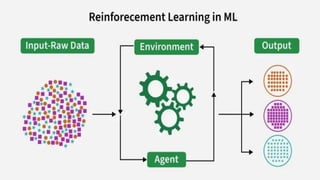
• Reinforcement Learningrevolves around the idea that an
agent (the learner or decision-maker) interacts with an
environment to achieve a goal.
• The agent performs actions and receives feedback to optimize
its decision-making over time.
5.
Introduction
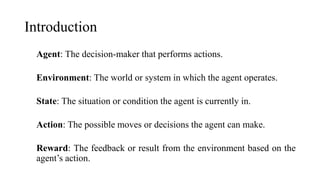
Agent: The decision-makerthat performs actions.
Environment: The world or system in which the agent operates.
State: The situation or condition the agent is currently in.
Action: The possible moves or decisions the agent can make.
Reward: The feedback or result from the environment based on the
agent’s action.
6.
Core Components
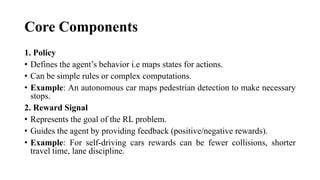
1. Policy
•Defines the agent’s behavior i.e maps states for actions.
• Can be simple rules or complex computations.
• Example: An autonomous car maps pedestrian detection to make necessary
stops.
2. Reward Signal
• Represents the goal of the RL problem.
• Guides the agent by providing feedback (positive/negative rewards).
• Example: For self-driving cars rewards can be fewer collisions, shorter
travel time, lane discipline.
7.
Core Components
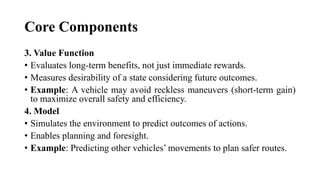
3. ValueFunction
• Evaluates long-term benefits, not just immediate rewards.
• Measures desirability of a state considering future outcomes.
• Example: A vehicle may avoid reckless maneuvers (short-term gain)
to maximize overall safety and efficiency.
4. Model
• Simulates the environment to predict outcomes of actions.
• Enables planning and foresight.
• Example: Predicting other vehicles’ movements to plan safer routes.
8.
Types of Reinforcements
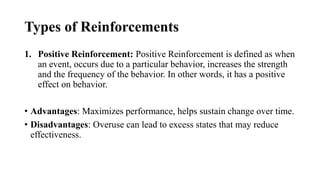
1.Positive Reinforcement: Positive Reinforcement is defined as when
an event, occurs due to a particular behavior, increases the strength
and the frequency of the behavior. In other words, it has a positive
effect on behavior.
• Advantages: Maximizes performance, helps sustain change over time.
• Disadvantages: Overuse can lead to excess states that may reduce
effectiveness.
9.
Types of Reinforcements
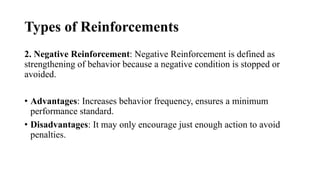
2.Negative Reinforcement: Negative Reinforcement is defined as
strengthening of behavior because a negative condition is stopped or
avoided.
• Advantages: Increases behavior frequency, ensures a minimum
performance standard.
• Disadvantages: It may only encourage just enough action to avoid
penalties.
10.
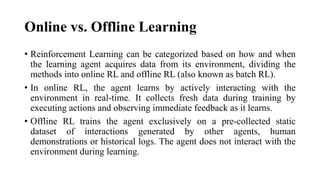
Online vs. OfflineLearning
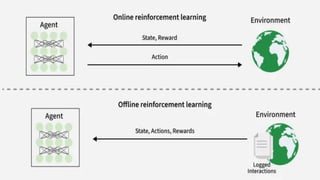
• Reinforcement Learning can be categorized based on how and when
the learning agent acquires data from its environment, dividing the
methods into online RL and offline RL (also known as batch RL).
• In online RL, the agent learns by actively interacting with the
environment in real-time. It collects fresh data during training by
executing actions and observing immediate feedback as it learns.
• Offline RL trains the agent exclusively on a pre-collected static
dataset of interactions generated by other agents, human
demonstrations or historical logs. The agent does not interact with the
environment during learning.
12.
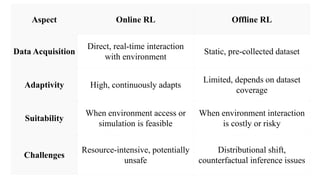
Aspect Online RLOffline RL
Data Acquisition
Direct, real-time interaction
with environment
Static, pre-collected dataset
Adaptivity High, continuously adapts
Limited, depends on dataset
coverage
Suitability
When environment access or
simulation is feasible
When environment interaction
is costly or risky
Challenges
Resource-intensive, potentially
unsafe
Distributional shift,
counterfactual inference issues
13.
Application
• Robotics: RLis used to automate tasks in structured environments such as
manufacturing, where robots learn to optimize movements and improve
efficiency.
• Games: Advanced RL algorithms have been used to develop strategies for
complex games like chess, Go and video games, outperforming human
players in many instances.
• Industrial Control: RL helps in real-time adjustments and optimization of
industrial operations, such as refining processes in the oil and gas industry.
• Personalized Training Systems: RL enables the customization of
instructional content based on an individual's learning patterns, improving
engagement and effectiveness.
14.
Advantages
• Solves complexsequential decision problems where other
approaches fail.
• Learns from real-time interaction, enabling adaptation to
changing environments.
• Does not require labeled data, unlike supervised learning.
• Can innovate by discovering new strategies beyond human
intuition.
• Handles uncertainty and stochastic environments effectively.
15.
Disadvantages
• Computationally intensive,requiring large amounts of data
and processing power.
• Reward function design is critical; poor design leads to
unintended behaviors.
• Not suitable for simple problems where traditional methods
are more efficient.
• Challenging to debug and interpret, making it hard to explain
decisions.
• Exploration-exploitation trade-off requires careful balancing
to optimize learning.
17.
Working of ReinforcementLearning
The agent interacts iteratively with its environment in a
feedback loop:
• The agent observes the current state of the environment.
• It chooses and performs an action based on its policy.
• The environment responds by transitioning to a new state and
providing a reward (or penalty).
18.
Working of ReinforcementLearning
• The agent updates its knowledge (policy, value function)
based on the reward received and the new state.
• This cycle repeats with the agent
balancing exploration (trying new actions)
and exploitation (using known good actions) to maximize
the cumulative reward over time.
This process is mathematically framed as a Markov Decision
Process (MDP) where future states depend only on the current
state and action, not on the prior sequence of events.
19.
Implementing Reinforcement Learning
Step1: Import libraries and Define Maze, Start and Goal
• We will import the required libraries such as numpy and matplotlib.
• The maze is represented as a 2D NumPy array.
• Zero values are safe paths; ones are obstacles the agent must avoid.
• Start and goal define the positions where the agent begins and where
it aims to reach.
20.
Implementing Reinforcement Learning
Step2: Define RL Parameters and Initialize Q-Table
• We will define RL parameters;
• num_episodes: Number of times the agent will attempt to navigate the maze.
• alpha: Learning rate that controls how much new information overrides old
information.
• gamma: Discount factor giving more weight to immediate rewards.
• epsilon: Probability of exploration vs exploitation; starts higher to explore more.
• Rewards are set to penalize hitting obstacles, reward reaching the goal and
slightly penalize each step to find shortest paths.
• actions define possible moves: left, right, up, down.
• Q is the Q-Table initialized to zero; it stores expected rewards for each state-
action pair.
21.
Implementing Reinforcement Learning
Step3: Helper Function for Maze Validity and Action Selection
We will define helper function,
• is_valid ensures the agent can only move inside the maze and avoids
obstacles.
• choose_action implements exploration (random action) vs
exploitation (best learned action) strategy.
22.
Implementing Reinforcement Learning
Q-
Table
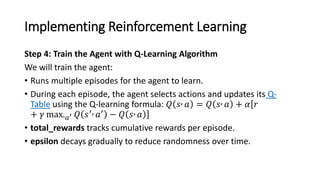
Step4: Train the Agent with Q-Learning Algorithm
We will train the agent:
• Runs multiple episodes for the agent to learn.
• During each episode, the agent selects actions and updates its Q-
Table using the Q-learning formula: 𝑄 𝑠 𝑎 = 𝑄 𝑠 𝑎 + 𝛼ሾ
ሿ
𝑟
+ 𝛾 max.𝑎′ 𝑄 𝑠′ 𝑎′ − 𝑄 𝑠 𝑎
• total_rewards tracks cumulative rewards per episode.
• epsilon decays gradually to reduce randomness over time.
23.
Implementing Reinforcement Learning
Step5: Extract the Optimal Path after Training
• This function follows the highest Q-values at each state to extract the
best path.
• It stops when the goal is reached or no valid next moves are available.
• The visited set prevents cycles.
24.
Implementing Reinforcement Learning
Step6: Visualize the Maze, Robot Path, Start and Goal
• The maze and path are visualized using a calming green color palette.
• The start and goal positions are visually highlighted.
• The learned path is drawn clearly to demonstrate the agent's
solution.
25.
Implementing Reinforcement Learning
Step7: Plot Rewards per Training
• This plot shows how the agent's overall performance improves across
training episodes.
• We can observe the total reward trend increasing as the agent learns
over time.