1
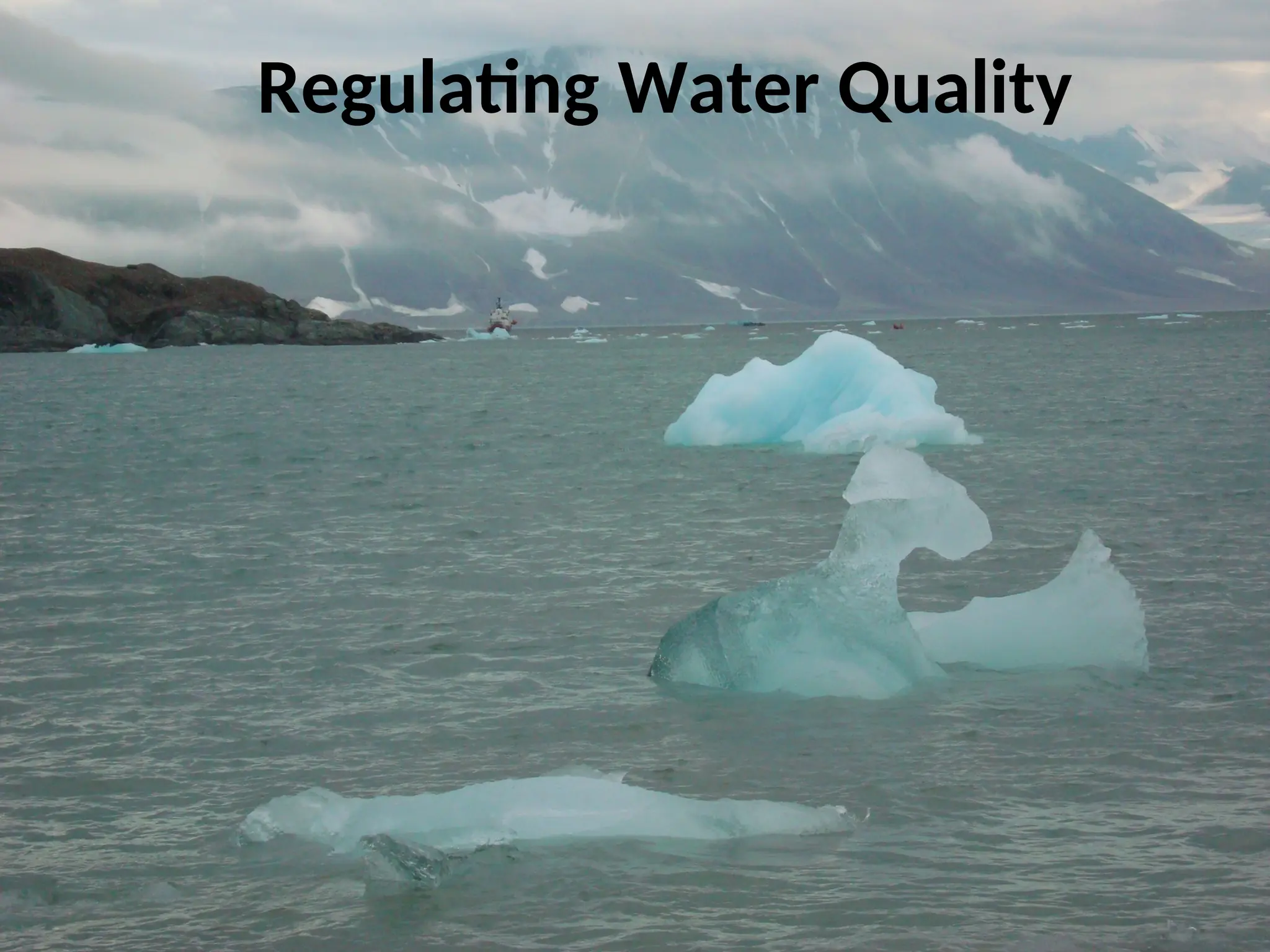
Regulating Water Quality
2
Water quality
Water quality is commonly defined by its physical,
chemical, biological and aesthetic (appearance and
smell) characteristics.
Water may be used for drinking, irrigating crops and
watering stock, industrial processes, production of
fish, shellfish and crustaceans, wildlife habitats,
protection of aquatic ecosystems, navigation and
shipping, recreation (swimming, boating), and
scientific study and education.
3
Protecting aquatic
ecosystems
• Aquatic ecosystems are an integral part of our environment.
They need to be maintained if the environment is to continue
to support people. World conservation strategies stress the
importance of maintaining healthy ecosystems and genetic
diversity.
• Aquatic ecosystems play an important role in maintaining
water quality and are a valuable indicator of water quality
and the suitability of the water for other uses.
• Aquatic ecosystems are valuable resources. Aquatic life is a
major source of protein for humans. In most countries, like
Portugal, commercial and sport fishing is economically
important.
4
The physicochemical indicators can be
classified into two groups:
● Those which have direct toxic effects on the
biota (e.g., heavy metals, salinity, pesticides,
and temperature)
● Those which affect ecosystems indirectly (e.g.,
nutrients, turbidity, and excess organic
matter)
5
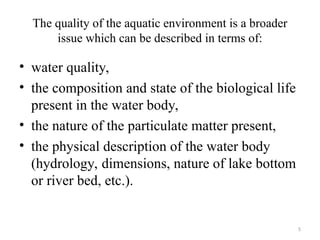
The quality of the aquatic environment is a broader
issue which can be described in terms of:
• water quality,
• the composition and state of the biological life
present in the water body,
• the nature of the particulate matter present,
• the physical description of the water body
(hydrology, dimensions, nature of lake bottom
or river bed, etc.).
6
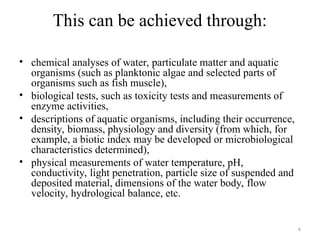
This can be achieved through:
• chemical analyses of water, particulate matter and aquatic
organisms (such as planktonic algae and selected parts of
organisms such as fish muscle),
• biological tests, such as toxicity tests and measurements of
enzyme activities,
• descriptions of aquatic organisms, including their occurrence,
density, biomass, physiology and diversity (from which, for
example, a biotic index may be developed or microbiological
characteristics determined),
• physical measurements of water temperature, pH,
conductivity, light penetration, particle size of suspended and
deposited material, dimensions of the water body, flow
velocity, hydrological balance, etc.
7
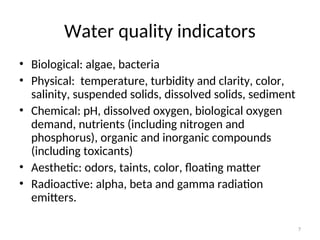
Water quality indicators
• Biological: algae, bacteria
• Physical: temperature, turbidity and clarity, color,
salinity, suspended solids, dissolved solids, sediment
• Chemical: pH, dissolved oxygen, biological oxygen
demand, nutrients (including nitrogen and
phosphorus), organic and inorganic compounds
(including toxicants)
• Aesthetic: odors, taints, color, floating matter
• Radioactive: alpha, beta and gamma radiation
emitters.
8
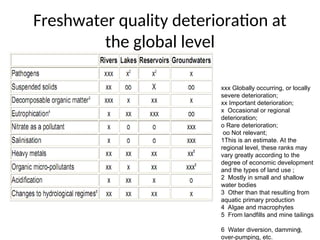
Freshwater quality deterioration at
the global level
xxx Globally occurring, or locally
severe deterioration;
xx Important deterioration;
x Occasional or regional
deterioration;
o Rare deterioration;
oo Not relevant;
1This is an estimate. At the
regional level, these ranks may
vary greatly according to the
degree of economic development
and the types of land use ;
2 Mostly in small and shallow
water bodies
3 Other than that resulting from
aquatic primary production
4 Algae and macrophytes
5 From landfills and mine tailings
6 Water diversion, damming,
over-pumping, etc.
9
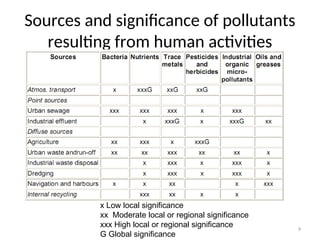
Sources and significance of pollutants
resulting from human activities
x Low local significance
xx Moderate local or regional significance
xxx High local or regional significance
G Global significance
10
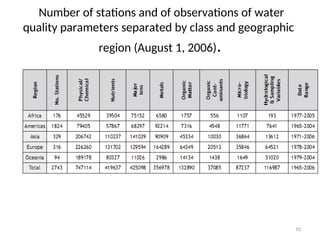
Number of stations and of observations of water
quality parameters separated by class and geographic
region (August 1, 2006).
11
Types of Stations
Baseline Stations are typically located in headwater lakes, undisturbed upstream
river stretches, and in aquifers where no known direct diffuse or point-
sources of pollutants are likely to be found. They are used to establish natural
water quality conditions; to provide a basis for comparison with trend and flux
stations; and to determine, through trend analysis, the influence of long-range
transport of contaminants and of climatic changes.
Trend Stations are typically located in major river basins, lakes or aquifers. They are
used to track long-term changes in water quality related to pollution sources and
land uses; to provide a basis for identifying causes or influences on measured
conditions or identified trends. Since trend stations are intended to capture
human impacts on water quality, the number of trend stations is relatively
higher than the other types of stations, to cover the variety of water quality
issues facing various basins. Most trend stations are located in basins with a range
of pollution-inducing activities. However , some stations can be located in
basins with single, dominant activities. Some trend stations may also serve as
global river flux stations.
Flux Stations are located at the mouth of rivers as they exit to the coast. They are
used to determine integrated annual fluxes of pollutants from river basins to
oceans or regional seas, thereby contributing to geochemical cycles. For
calculating chemical fluxes, water flow measurements must be obtained at the
location of the global river flux stations.
12
Physicochemical Indicators
• Color (this can influence primary production)
• Dissolved oxygen (this can adversely affect fish and invertebrates)
• Nutrients (in excess, these can result in cyanobacterial (blue-green algae)
blooms)
• pH (low pH can adversely affect aquatic biota directly and also can result
in release of
• heavy metals from sediments)
• Salinity (high salinity can adversely affect freshwater macrophytes and
other aquatic biota)
• Suspended particulate matter and turbidity (these can influence primary
production)
• Temperature (both high and low temperatures can adversely affect
aquatic biota)
13
Water quality parameters
• Temperature
• Salinity.
The total dissolved solids (TDS) in water consist
of inorganic salts and dissolved materials.
• Sediment
Sediment is composed of organic and inorganic
particles of various sizes.
14
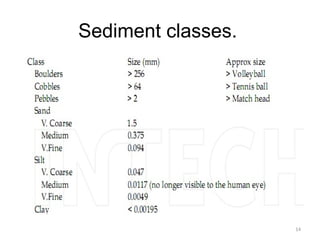
Sediment classes.
15
Water quality parameters
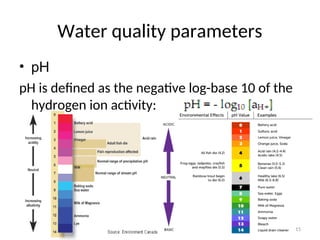
• pH
pH is defined as the negative log-base 10 of the
hydrogen ion activity:
16
Water quality parameters
• Dissolved oxygen
Dissolved oxygen (DO) refers to the volume of oxygen that is contained in
water.
• Nitrogen
Nitrogen makes up 78% of the atmosphere as gaseous molecular nitrogen,
but most plants can use it only in the fixed forms of nitrate and
ammonium. Nitrate and nitrite are inorganic ions occurring naturally as
part of the nitrogen cycle.
• Phosphorus
Phosphorus (P) is an essential nutrient for all life forms. It plays a role in
deoxyribonucleic acid (DNA), ribonucleic acid (RNA),
adenosinediphosphate (ADP), and adenosinetriphosphate (ATP).
Phosphorus is required for these necessary components of life to occur.
• Heavy metals
17
Toxicants
• Inorganic compounds (e.g., ammonia,
cyanide, and hydrogen sulfide)
• Heavy metals (e.g., copper, cadmium,
mercury, and arsenic)
• Organic compounds (e.g., pesticides, PCBs,
and dioxins)
18
Biological Indicators
• Species richness
• Species composition
• Primary production
• Ecosystem function
19
Regulating Water Quality
• According to the Sanitary Regulations and
Standards (SanPiN 2.1.4.1074-01), potable
water shall be safe with regard to
epidemiological and radiation properties,
harmless with regard to chemical composition
and shall have favorable organoleptic
properties.
20
Water quality
• Water quality means its content and properties, which
determine its applicability within certain types of water
use; however, quality indices are properties, which allow
assessment of the water quality.
• Sanitary properties help establish microbiological and
parasitologic properties of water (amount of
microorganisms and bacteria of the colon bacillus group
per volume unit). Toxicological properties of water,
characterizing safety of its chemical composition, are
determined depending on a composition of substances, the
amount of which shall not exceed the established
standards. And the last, but not the least: when assessing
water quality, organoleptic properties (temperature,
transparency, color, taste, hardness.
21
Water quality
• Sanitary Regulations and Standards SanPiN
2.1.4.1175-02 establish requirements to water
supplied through non-central supply systems,
regulating smell, taste, color, turbidity, and
specifying that the content of chemical
substances shall not exceed rates established
through relevant standards.
• Just like for the atmospheric air, water quality is
regulated through maximum permissible
concentrations (MPCs).
22
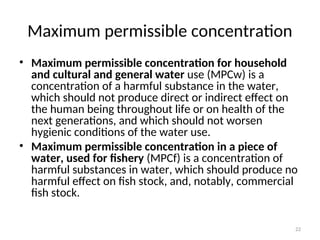
Maximum permissible concentration
• Maximum permissible concentration for household
and cultural and general water use (MPCw) is a
concentration of a harmful substance in the water,
which should not produce direct or indirect effect on
the human being throughout life or on health of the
next generations, and which should not worsen
hygienic conditions of the water use.
• Maximum permissible concentration in a piece of
water, used for fishery (MPCf) is a concentration of
harmful substances in water, which should produce no
harmful effect on fish stock, and, notably, commercial
fish stock.
23
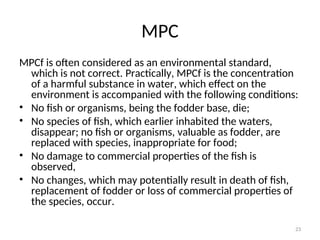
MPC
MPCf is often considered as an environmental standard,
which is not correct. Practically, MPCf is the concentration
of a harmful substance in water, which effect on the
environment is accompanied with the following conditions:
• No fish or organisms, being the fodder base, die;
• No species of fish, which earlier inhabited the waters,
disappear; no fish or organisms, valuable as fodder, are
replaced with species, inappropriate for food;
• No damage to commercial properties of the fish is
observed,
• No changes, which may potentially result in death of fish,
replacement of fodder or loss of commercial properties of
the species, occur.
24
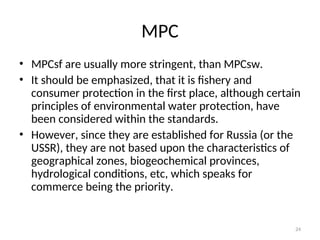
MPC
• MPCsf are usually more stringent, than MPCsw.
• It should be emphasized, that it is fishery and
consumer protection in the first place, although certain
principles of environmental water protection, have
been considered within the standards.
• However, since they are established for Russia (or the
USSR), they are not based upon the characteristics of
geographical zones, biogeochemical provinces,
hydrological conditions, etc, which speaks for
commerce being the priority.
25
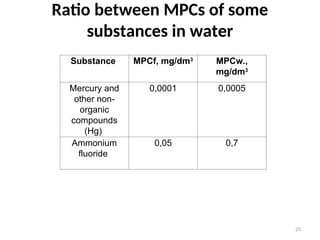
Ratio between MPCs of some
substances in water
Substance MPCf, mg/dm3
MPCw.,
mg/dm3
Mercury and
other non-
organic
compounds
(Hg)
0,0001 0,0005
Ammonium
fluoride
0,05 0,7
26
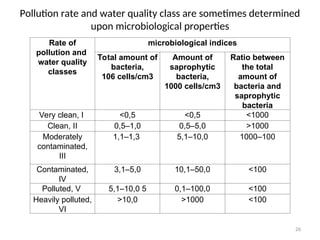
Pollution rate and water quality class are sometimes determined
upon microbiological properties
Rate of
pollution and
water quality
classes
microbiological indices
Total amount of
bacteria,
106 cells/cm3
Amount of
saprophytic
bacteria,
1000 cells/cm3
Ratio between
the total
amount of
bacteria and
saprophytic
bacteria
Very clean, I <0,5 <0,5 <1000
Clean, II 0,5–1,0 0,5–5,0 >1000
Moderately
contaminated,
III
1,1–1,3 5,1–10,0 1000–100
Contaminated,
IV
3,1–5,0 10,1–50,0 <100
Polluted, V 5,1–10,0 5 0,1–100,0 <100
Heavily polluted,
VI
>10,0 >1000 <100
27
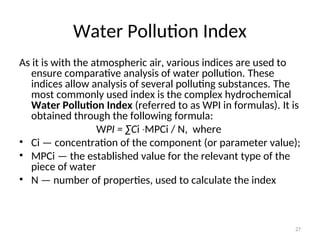
Water Pollution Index
As it is with the atmospheric air, various indices are used to
ensure comparative analysis of water pollution. These
indices allow analysis of several polluting substances. The
most commonly used index is the complex hydrochemical
Water Pollution Index (referred to as WPI in formulas). It is
obtained through the following formula:
WPI = ∑Ci MPCi
∙ / N, where
• Ci — concentration of the component (or parameter value);
• MPCi — the established value for the relevant type of the
piece of water
• N — number of properties, used to calculate the index
28
Water Pollution Index
• Normally, Water Pollution Indices are
calculated upon six or seven hydrochemical
properties, including content of dissolved
oxygen [O2], рН, biological consumption of
oxygen.
29
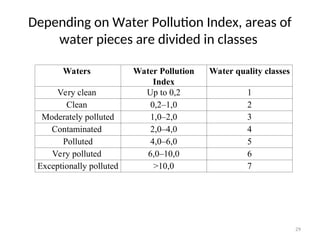
Depending on Water Pollution Index, areas of
water pieces are divided in classes
Waters Water Pollution
Index
Water quality classes
Very clean Up to 0,2 1
Clean 0,2–1,0 2
Moderately polluted 1,0–2,0 3
Contaminated 2,0–4,0 4
Polluted 4,0–6,0 5
Very polluted 6,0–10,0 6
Exceptionally polluted >10,0 7
30
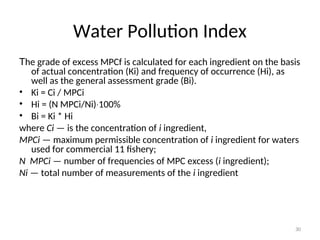
Water Pollution Index
The grade of excess MPCf is calculated for each ingredient on the basis
of actual concentration (Кi) and frequency of occurrence (Нi), as
well as the general assessment grade (Bi).
• Ki = Ci / MPCi
• Hi = (N MPCi/Ni) 100%
∙
• Bi = Ki * Hi
where Сi — is the concentration of i ingredient,
MPCi — maximum permissible concentration of i ingredient for waters
used for commercial 11 fishery;
N MPCi — number of frequencies of MPC excess (i ingredient);
Ni — total number of measurements of the i ingredient
31
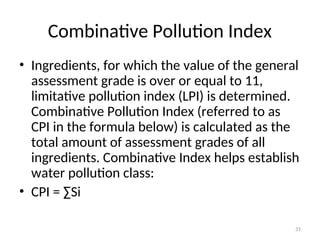
Combinative Pollution Index
• Ingredients, for which the value of the general
assessment grade is over or equal to 11,
limitative pollution index (LPI) is determined.
Combinative Pollution Index (referred to as
CPI in the formula below) is calculated as the
total amount of assessment grades of all
ingredients. Combinative Index helps establish
water pollution class:
• CPI = ∑Si
32
Combinative Pollution Index
• Combinative Pollution Index is applicable only when the
impact effect is aggravated through parallel impact
produced by several substances.
• Apart from approaches to regulating water quality upon
hydrochemical properties, there is a different approach,
based on bioindication. This approach implies analysis of
the presence and amount of organisms of certain species,
inhabiting the environment, as the indicators of natural
processes, conditions or man-caused changes in the
habitat.
• In Russia, hydrobiological assessment of water quality is
based mainly on the saprobity index and Woodiviss and
Mayer index.
33
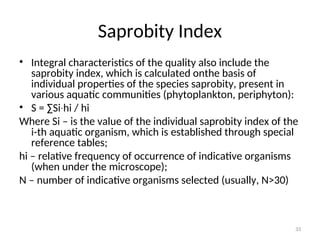
Saprobity Index
• Integral characteristics of the quality also include the
saprobity index, which is calculated onthe basis of
individual properties of the species saprobity, present in
various aquatic communities (phytoplankton, periphyton):
• S = ∑Si hi
∙ / hi
Where Si – is the value of the individual saprobity index of the
i-th aquatic organism, which is established through special
reference tables;
hi – relative frequency of occurrence of indicative organisms
(when under the microscope);
N – number of indicative organisms selected (usually, N>30)
34
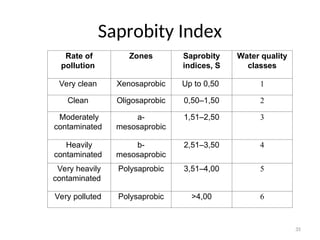
Saprobity Index
• The Si value represents the aggregate of the
physiological and biochemical properties of an
aquatic organisms, which pre-condition its
ability to inhabit in water, containing a certain
amount of organic substances. Therefore, the
index characterizes the nutritional status of
the water body. Water quality is regulated
according to the value of S
35
Saprobity Index
Rate of
pollution
Zones Saprobity
indices, S
Water quality
classes
Very clean Xenosaprobic Up to 0,50 1
Clean Oligosaprobic 0,50–1,50 2
Moderately
contaminated
a-
mesosaprobic
1,51–2,50 3
Heavily
contaminated
b-
mesosaprobic
2,51–3,50 4
Very heavily
contaminated
Polysaprobic 3,51–4,00 5
Very polluted Polysaprobic >4,00 6
36
Integral Indices
integral indices as such are not the assessment of the mancaused
environmental load.
High values of water pollution indices can also be preconditioned by natural
properties of the catchment area (for instance, by ashen-gray soils, peats,
which condition high content of organic substances in water, identified as
oil products through some techniques, high natural content of cuprum,
ore, manganese, low value of dissolved oxygen concentration, etc).
In this case, even rivers, experiencing minor mancaused loads, will be
referred to as exceedingly polluted or polluted on the basis of water
pollution indices.
Thus, state reports cover the case of the Pra river, which basin lies within the
protected areas of Meschyora and Meschyorskiy national parks. Man-
caused load isminor, certain sections of the river are included in the list of
wetlands of international significance as home for rare water fauna
species.
Therefore, one shall be careful assessing environmental load on the basis
values, grounded upon the MPC system. These values are expedient for
assessment of tendencies towards time changes or for comparison of
various sections of the water body.
37
http://echo2.epfl.ch/VICAIRE/mod_2/chapt_6/main.htm

regulating water quality................

  • 1.
  • 2.
    2 Water quality Water qualityis commonly defined by its physical, chemical, biological and aesthetic (appearance and smell) characteristics. Water may be used for drinking, irrigating crops and watering stock, industrial processes, production of fish, shellfish and crustaceans, wildlife habitats, protection of aquatic ecosystems, navigation and shipping, recreation (swimming, boating), and scientific study and education.
  • 3.
    3 Protecting aquatic ecosystems • Aquaticecosystems are an integral part of our environment. They need to be maintained if the environment is to continue to support people. World conservation strategies stress the importance of maintaining healthy ecosystems and genetic diversity. • Aquatic ecosystems play an important role in maintaining water quality and are a valuable indicator of water quality and the suitability of the water for other uses. • Aquatic ecosystems are valuable resources. Aquatic life is a major source of protein for humans. In most countries, like Portugal, commercial and sport fishing is economically important.
  • 4.
    4 The physicochemical indicatorscan be classified into two groups: ● Those which have direct toxic effects on the biota (e.g., heavy metals, salinity, pesticides, and temperature) ● Those which affect ecosystems indirectly (e.g., nutrients, turbidity, and excess organic matter)
  • 5.
    5 The quality ofthe aquatic environment is a broader issue which can be described in terms of: • water quality, • the composition and state of the biological life present in the water body, • the nature of the particulate matter present, • the physical description of the water body (hydrology, dimensions, nature of lake bottom or river bed, etc.).
  • 6.
    6 This can beachieved through: • chemical analyses of water, particulate matter and aquatic organisms (such as planktonic algae and selected parts of organisms such as fish muscle), • biological tests, such as toxicity tests and measurements of enzyme activities, • descriptions of aquatic organisms, including their occurrence, density, biomass, physiology and diversity (from which, for example, a biotic index may be developed or microbiological characteristics determined), • physical measurements of water temperature, pH, conductivity, light penetration, particle size of suspended and deposited material, dimensions of the water body, flow velocity, hydrological balance, etc.
  • 7.
    7 Water quality indicators •Biological: algae, bacteria • Physical: temperature, turbidity and clarity, color, salinity, suspended solids, dissolved solids, sediment • Chemical: pH, dissolved oxygen, biological oxygen demand, nutrients (including nitrogen and phosphorus), organic and inorganic compounds (including toxicants) • Aesthetic: odors, taints, color, floating matter • Radioactive: alpha, beta and gamma radiation emitters.
  • 8.
    8 Freshwater quality deteriorationat the global level xxx Globally occurring, or locally severe deterioration; xx Important deterioration; x Occasional or regional deterioration; o Rare deterioration; oo Not relevant; 1This is an estimate. At the regional level, these ranks may vary greatly according to the degree of economic development and the types of land use ; 2 Mostly in small and shallow water bodies 3 Other than that resulting from aquatic primary production 4 Algae and macrophytes 5 From landfills and mine tailings 6 Water diversion, damming, over-pumping, etc.
  • 9.
    9 Sources and significanceof pollutants resulting from human activities x Low local significance xx Moderate local or regional significance xxx High local or regional significance G Global significance
  • 10.
    10 Number of stationsand of observations of water quality parameters separated by class and geographic region (August 1, 2006).
  • 11.
    11 Types of Stations BaselineStations are typically located in headwater lakes, undisturbed upstream river stretches, and in aquifers where no known direct diffuse or point- sources of pollutants are likely to be found. They are used to establish natural water quality conditions; to provide a basis for comparison with trend and flux stations; and to determine, through trend analysis, the influence of long-range transport of contaminants and of climatic changes. Trend Stations are typically located in major river basins, lakes or aquifers. They are used to track long-term changes in water quality related to pollution sources and land uses; to provide a basis for identifying causes or influences on measured conditions or identified trends. Since trend stations are intended to capture human impacts on water quality, the number of trend stations is relatively higher than the other types of stations, to cover the variety of water quality issues facing various basins. Most trend stations are located in basins with a range of pollution-inducing activities. However , some stations can be located in basins with single, dominant activities. Some trend stations may also serve as global river flux stations. Flux Stations are located at the mouth of rivers as they exit to the coast. They are used to determine integrated annual fluxes of pollutants from river basins to oceans or regional seas, thereby contributing to geochemical cycles. For calculating chemical fluxes, water flow measurements must be obtained at the location of the global river flux stations.
  • 12.
    12 Physicochemical Indicators • Color(this can influence primary production) • Dissolved oxygen (this can adversely affect fish and invertebrates) • Nutrients (in excess, these can result in cyanobacterial (blue-green algae) blooms) • pH (low pH can adversely affect aquatic biota directly and also can result in release of • heavy metals from sediments) • Salinity (high salinity can adversely affect freshwater macrophytes and other aquatic biota) • Suspended particulate matter and turbidity (these can influence primary production) • Temperature (both high and low temperatures can adversely affect aquatic biota)
  • 13.
    13 Water quality parameters •Temperature • Salinity. The total dissolved solids (TDS) in water consist of inorganic salts and dissolved materials. • Sediment Sediment is composed of organic and inorganic particles of various sizes.
  • 14.
  • 15.
    15 Water quality parameters •pH pH is defined as the negative log-base 10 of the hydrogen ion activity:
  • 16.
    16 Water quality parameters •Dissolved oxygen Dissolved oxygen (DO) refers to the volume of oxygen that is contained in water. • Nitrogen Nitrogen makes up 78% of the atmosphere as gaseous molecular nitrogen, but most plants can use it only in the fixed forms of nitrate and ammonium. Nitrate and nitrite are inorganic ions occurring naturally as part of the nitrogen cycle. • Phosphorus Phosphorus (P) is an essential nutrient for all life forms. It plays a role in deoxyribonucleic acid (DNA), ribonucleic acid (RNA), adenosinediphosphate (ADP), and adenosinetriphosphate (ATP). Phosphorus is required for these necessary components of life to occur. • Heavy metals
  • 17.
    17 Toxicants • Inorganic compounds(e.g., ammonia, cyanide, and hydrogen sulfide) • Heavy metals (e.g., copper, cadmium, mercury, and arsenic) • Organic compounds (e.g., pesticides, PCBs, and dioxins)
  • 18.
    18 Biological Indicators • Speciesrichness • Species composition • Primary production • Ecosystem function
  • 19.
    19 Regulating Water Quality •According to the Sanitary Regulations and Standards (SanPiN 2.1.4.1074-01), potable water shall be safe with regard to epidemiological and radiation properties, harmless with regard to chemical composition and shall have favorable organoleptic properties.
  • 20.
    20 Water quality • Waterquality means its content and properties, which determine its applicability within certain types of water use; however, quality indices are properties, which allow assessment of the water quality. • Sanitary properties help establish microbiological and parasitologic properties of water (amount of microorganisms and bacteria of the colon bacillus group per volume unit). Toxicological properties of water, characterizing safety of its chemical composition, are determined depending on a composition of substances, the amount of which shall not exceed the established standards. And the last, but not the least: when assessing water quality, organoleptic properties (temperature, transparency, color, taste, hardness.
  • 21.
    21 Water quality • SanitaryRegulations and Standards SanPiN 2.1.4.1175-02 establish requirements to water supplied through non-central supply systems, regulating smell, taste, color, turbidity, and specifying that the content of chemical substances shall not exceed rates established through relevant standards. • Just like for the atmospheric air, water quality is regulated through maximum permissible concentrations (MPCs).
  • 22.
    22 Maximum permissible concentration •Maximum permissible concentration for household and cultural and general water use (MPCw) is a concentration of a harmful substance in the water, which should not produce direct or indirect effect on the human being throughout life or on health of the next generations, and which should not worsen hygienic conditions of the water use. • Maximum permissible concentration in a piece of water, used for fishery (MPCf) is a concentration of harmful substances in water, which should produce no harmful effect on fish stock, and, notably, commercial fish stock.
  • 23.
    23 MPC MPCf is oftenconsidered as an environmental standard, which is not correct. Practically, MPCf is the concentration of a harmful substance in water, which effect on the environment is accompanied with the following conditions: • No fish or organisms, being the fodder base, die; • No species of fish, which earlier inhabited the waters, disappear; no fish or organisms, valuable as fodder, are replaced with species, inappropriate for food; • No damage to commercial properties of the fish is observed, • No changes, which may potentially result in death of fish, replacement of fodder or loss of commercial properties of the species, occur.
  • 24.
    24 MPC • MPCsf areusually more stringent, than MPCsw. • It should be emphasized, that it is fishery and consumer protection in the first place, although certain principles of environmental water protection, have been considered within the standards. • However, since they are established for Russia (or the USSR), they are not based upon the characteristics of geographical zones, biogeochemical provinces, hydrological conditions, etc, which speaks for commerce being the priority.
  • 25.
    25 Ratio between MPCsof some substances in water Substance MPCf, mg/dm3 MPCw., mg/dm3 Mercury and other non- organic compounds (Hg) 0,0001 0,0005 Ammonium fluoride 0,05 0,7
  • 26.
    26 Pollution rate andwater quality class are sometimes determined upon microbiological properties Rate of pollution and water quality classes microbiological indices Total amount of bacteria, 106 cells/cm3 Amount of saprophytic bacteria, 1000 cells/cm3 Ratio between the total amount of bacteria and saprophytic bacteria Very clean, I <0,5 <0,5 <1000 Clean, II 0,5–1,0 0,5–5,0 >1000 Moderately contaminated, III 1,1–1,3 5,1–10,0 1000–100 Contaminated, IV 3,1–5,0 10,1–50,0 <100 Polluted, V 5,1–10,0 5 0,1–100,0 <100 Heavily polluted, VI >10,0 >1000 <100
  • 27.
    27 Water Pollution Index Asit is with the atmospheric air, various indices are used to ensure comparative analysis of water pollution. These indices allow analysis of several polluting substances. The most commonly used index is the complex hydrochemical Water Pollution Index (referred to as WPI in formulas). It is obtained through the following formula: WPI = ∑Ci MPCi ∙ / N, where • Ci — concentration of the component (or parameter value); • MPCi — the established value for the relevant type of the piece of water • N — number of properties, used to calculate the index
  • 28.
    28 Water Pollution Index •Normally, Water Pollution Indices are calculated upon six or seven hydrochemical properties, including content of dissolved oxygen [O2], рН, biological consumption of oxygen.
  • 29.
    29 Depending on WaterPollution Index, areas of water pieces are divided in classes Waters Water Pollution Index Water quality classes Very clean Up to 0,2 1 Clean 0,2–1,0 2 Moderately polluted 1,0–2,0 3 Contaminated 2,0–4,0 4 Polluted 4,0–6,0 5 Very polluted 6,0–10,0 6 Exceptionally polluted >10,0 7
  • 30.
    30 Water Pollution Index Thegrade of excess MPCf is calculated for each ingredient on the basis of actual concentration (Кi) and frequency of occurrence (Нi), as well as the general assessment grade (Bi). • Ki = Ci / MPCi • Hi = (N MPCi/Ni) 100% ∙ • Bi = Ki * Hi where Сi — is the concentration of i ingredient, MPCi — maximum permissible concentration of i ingredient for waters used for commercial 11 fishery; N MPCi — number of frequencies of MPC excess (i ingredient); Ni — total number of measurements of the i ingredient
  • 31.
    31 Combinative Pollution Index •Ingredients, for which the value of the general assessment grade is over or equal to 11, limitative pollution index (LPI) is determined. Combinative Pollution Index (referred to as CPI in the formula below) is calculated as the total amount of assessment grades of all ingredients. Combinative Index helps establish water pollution class: • CPI = ∑Si
  • 32.
    32 Combinative Pollution Index •Combinative Pollution Index is applicable only when the impact effect is aggravated through parallel impact produced by several substances. • Apart from approaches to regulating water quality upon hydrochemical properties, there is a different approach, based on bioindication. This approach implies analysis of the presence and amount of organisms of certain species, inhabiting the environment, as the indicators of natural processes, conditions or man-caused changes in the habitat. • In Russia, hydrobiological assessment of water quality is based mainly on the saprobity index and Woodiviss and Mayer index.
  • 33.
    33 Saprobity Index • Integralcharacteristics of the quality also include the saprobity index, which is calculated onthe basis of individual properties of the species saprobity, present in various aquatic communities (phytoplankton, periphyton): • S = ∑Si hi ∙ / hi Where Si – is the value of the individual saprobity index of the i-th aquatic organism, which is established through special reference tables; hi – relative frequency of occurrence of indicative organisms (when under the microscope); N – number of indicative organisms selected (usually, N>30)
  • 34.
    34 Saprobity Index • TheSi value represents the aggregate of the physiological and biochemical properties of an aquatic organisms, which pre-condition its ability to inhabit in water, containing a certain amount of organic substances. Therefore, the index characterizes the nutritional status of the water body. Water quality is regulated according to the value of S
  • 35.
    35 Saprobity Index Rate of pollution ZonesSaprobity indices, S Water quality classes Very clean Xenosaprobic Up to 0,50 1 Clean Oligosaprobic 0,50–1,50 2 Moderately contaminated a- mesosaprobic 1,51–2,50 3 Heavily contaminated b- mesosaprobic 2,51–3,50 4 Very heavily contaminated Polysaprobic 3,51–4,00 5 Very polluted Polysaprobic >4,00 6
  • 36.
    36 Integral Indices integral indicesas such are not the assessment of the mancaused environmental load. High values of water pollution indices can also be preconditioned by natural properties of the catchment area (for instance, by ashen-gray soils, peats, which condition high content of organic substances in water, identified as oil products through some techniques, high natural content of cuprum, ore, manganese, low value of dissolved oxygen concentration, etc). In this case, even rivers, experiencing minor mancaused loads, will be referred to as exceedingly polluted or polluted on the basis of water pollution indices. Thus, state reports cover the case of the Pra river, which basin lies within the protected areas of Meschyora and Meschyorskiy national parks. Man- caused load isminor, certain sections of the river are included in the list of wetlands of international significance as home for rare water fauna species. Therefore, one shall be careful assessing environmental load on the basis values, grounded upon the MPC system. These values are expedient for assessment of tendencies towards time changes or for comparison of various sections of the water body.
  • 37.