1. Physical WaterQuality Parameters
• Physical parameters define those characteristics of water that
respond to the senses of sight, touch, taste or smell.
• Suspended solids, turbidity, colour, taste and odour, and
temperature fall into this category.
2
Common Water Quality Parameters:
3.
(a). Solids
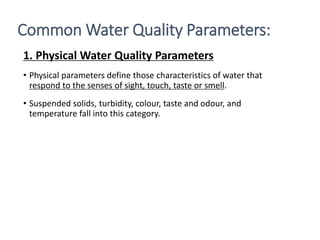
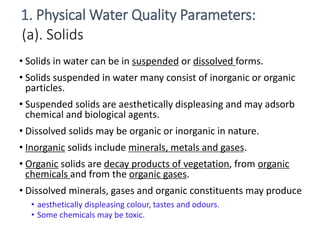
• Solidsin water can be in suspended or dissolved forms.
• Solids suspended in water many consist of inorganic or organic
particles.
• Suspended solids are aesthetically displeasing and may adsorb
chemical and biological agents.
• Dissolved solids may be organic or inorganic in nature.
• Inorganic solids include minerals, metals and gases.
• Organic solids are decay products of vegetation, from organic
chemicals and from the organic gases.
• Dissolved minerals, gases and organic constituents may produce
• aesthetically displeasing colour, tastes and odours.
• Some chemicals may be toxic.
3
1. Physical Water Quality Parameters:
4.
Solids (cont’d)
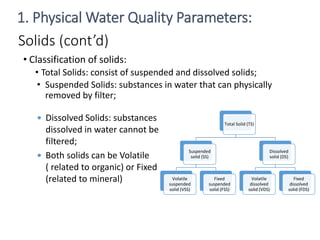
• Classificationof solids:
• Total Solids: consist of suspended and dissolved solids;
• Suspended Solids: substances in water that can physically
removed by filter;
4
Total Solid (TS)
Suspended
solid (SS)
Volatile
suspended
solid (VSS)
Fixed
suspended
solid (FSS)
Dissolved
solid (DS)
Volatile
dissolved
solid (VDS)
Fixed
dissolved
solid (FDS)
Dissolved Solids: substances
dissolved in water cannot be
filtered;
Both solids can be Volatile
( related to organic) or Fixed
(related to mineral)
1. Physical Water Quality Parameters:
5.
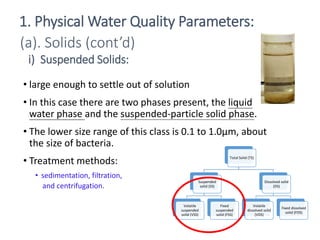
• large enoughto settle out of solution
• In this case there are two phases present, the liquid
water phase and the suspended-particle solid phase.
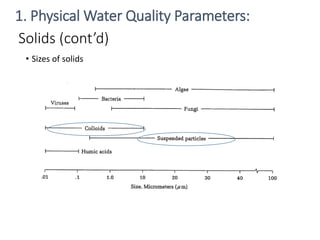
• The lower size range of this class is 0.1 to 1.0μm, about
the size of bacteria.
• Treatment methods:
• sedimentation, filtration,
and centrifugation.
5
Total Solid (TS)
Suspended
solid (SS)
Volatile
suspended
solid (VSS)
Fixed
suspended
solid (FSS)
Dissolved solid
(DS)
Volatile
dissolved solid
(VDS)
Fixed dissolved
solid (FDS)
(a). Solids (cont’d)
i) Suspended Solids:
1. Physical Water Quality Parameters:
6.
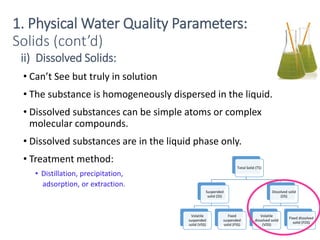
• Can’t Seebut truly in solution
• The substance is homogeneously dispersed in the liquid.
• Dissolved substances can be simple atoms or complex
molecular compounds.
• Dissolved substances are in the liquid phase only.
• Treatment method:
• Distillation, precipitation,
adsorption, or extraction.
6
Total Solid (TS)
Suspended
solid (SS)
Volatile
suspended
solid (VSS)
Fixed
suspended
solid (FSS)
Dissolved solid
(DS)
Volatile
dissolved solid
(VDS)
Fixed dissolved
solid (FDS)
Solids (cont’d)
ii) Dissolved Solids:
1. Physical Water Quality Parameters:
7.
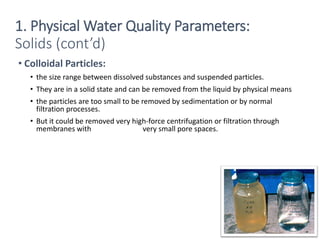
• Colloidal Particles:
•the size range between dissolved substances and suspended particles.
• They are in a solid state and can be removed from the liquid by physical means
• the particles are too small to be removed by sedimentation or by normal
filtration processes.
• But it could be removed very high-force centrifugation or filtration through
membranes with very small pore spaces.
7
Solids (cont’d)
1. Physical Water Quality Parameters:
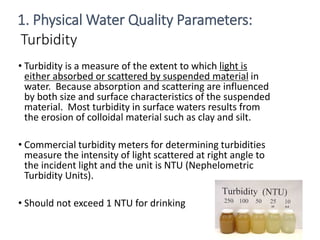
Turbidity
• Turbidity isa measure of the extent to which light is
either absorbed or scattered by suspended material in
water. Because absorption and scattering are influenced
by both size and surface characteristics of the suspended
material. Most turbidity in surface waters results from
the erosion of colloidal material such as clay and silt.
• Commercial turbidity meters for determining turbidities
measure the intensity of light scattered at right angle to
the incident light and the unit is NTU (Nephelometric
Turbidity Units).
• Should not exceed 1 NTU for drinking
9
1. Physical Water Quality Parameters:
10.
Colour
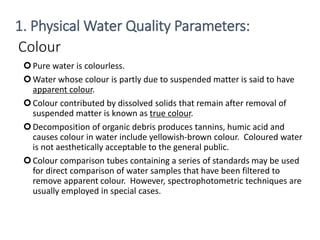
Pure water iscolourless.
Water whose colour is partly due to suspended matter is said to have
apparent colour.
Colour contributed by dissolved solids that remain after removal of
suspended matter is known as true colour.
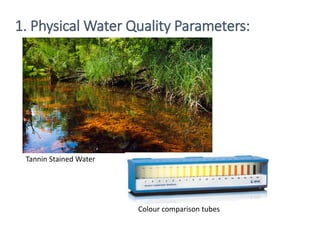
Decomposition of organic debris produces tannins, humic acid and
causes colour in water include yellowish-brown colour. Coloured water
is not aesthetically acceptable to the general public.
Colour comparison tubes containing a series of standards may be used
for direct comparison of water samples that have been filtered to
remove apparent colour. However, spectrophotometric techniques are
usually employed in special cases.
10
1. Physical Water Quality Parameters:
Temperature
The temperature ofsurface waters governs to a large
extent the biological species present and their rates of
activity.
An increase of 10 °C is usually sufficient to double
the biological activity if essential nutrients are present.
Temperature changes affect the reaction rates and
solubility levels of chemicals.
Most chemical reactions involving dissolution of
solids are accelerated by increased temperature.
12
1. Physical Water Quality Parameters:
13.
• pH
• Alkalinity
•Hardness
• Dissolved Oxygen (DO)
• Biochemical Oxygen Demand (BOD)
• Chemical Oxygen Demand (COD)
13
2. Chemical Water Quality Parameters:
14.
pH value
Is thehydrogen ion concentration in water is closely connected with
the extent to which water molecules dissociate for the acidity and/or
the alkaline reaction, which is defined as the negative logarithm of
hydrogen ion activity:
pH = -log10 [H+]
The pH of aqueous systems can be conveniently measured with a pH
meter. The pH scale, ranging from 0 to 14, is acid from 0 to 7 and basic
from 7 to 14. Pure water has a pH very close to 7 at 25°C
pH Indicators may be used to measure pH, by making use of the fact that
their color changes with pH. Visual comparison of the color of a test
solution with a standard color chart provides a means to measure pH
14
2. Chemical Water Quality Parameters:
15.
Alkalinity
• Alkalinity isdefined as the quantity of ions in water will react to
neutralise hydrogen ions.
• Alkalinity is thus a measure of the ability of water to neutralise acids.
In other words, it's a measurement of how much acid can be added to
water without changing its pH;
• alkalinity is related to pH, it isn't the same thing. High levels of
alkalinity stabilize the pH, but water does not have to have a high pH
to have a high level of alkalinity
15
2. Chemical Water Quality Parameters:
16.
Hardness
•Hardness is causedby multivalent metallic salts; those
most abundant in natural waters are calcium and
magnesium salts.
•Hard waters from both underground and surface
supplies are most common in areas having extensive
geological formations of limestone.
•Although satisfactory for human consumption, Ca 2+
and Mg 2+ precipitate soap, reducing its cleansing
action, and cause scale [CaCO3 and Mg(OH)2] in water
distribution mains and hot-water heaters.
16
2. Chemical Water Quality Parameters:
17.
•Hardness is classifiedas carbonate hardness and non-
carbonate hardness, depending upon the anion with
which it associates.
• Carbonate hardness - metals associated with HCO3
-,
• Non-carbonate hardness - metals associated with SO4
2-, Cl-, NO3
-.
•The hardness that is equivalent to the alkalinity is
termed carbonate hardness, with any remaining
hardness being called non-carbonate hardness
17
2. Chemical Water Quality Parameters:
18.
Dissolved Oxygen (DO)
•is an important elements in water quality assessment. Its presence is
essential to maintain biological life;
• DO is the amount of molecular oxygen dissolved in water. Lakes and
rivers should contain at least 5 mg/L of DO for aerobic condition;
• Clean surface waters normally have high amount DO, but such DO can
be rapidly removed by the oxygen demand of organic wastes. Oxygen-
saturated waters have a pleasant taste;
• Oxygen meter and probe are used to measure DO
18
2. Chemical Water Quality Parameters:
19.
Biochemical Oxygen Demand(BOD5)
• BOD is by definition the quantity of oxygen utilised by a mixed
population of micro-organisms in the aerobic oxidation at a temperature
of 20°C.
• The BOD is measured by determining the oxygen consumed from a
sample placed in an air-tight container and kept in a controlled
environment for a preselected period of time.
• In the standard test, the sample is incubated at 20°C for 5 days.
• Light must be excluded from the incubator to prevent the growth of
algal.
19
2. Chemical Water Quality Parameters:
20.
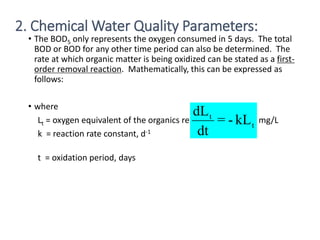
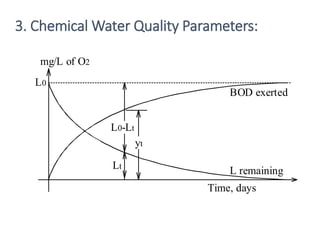
• The BOD5only represents the oxygen consumed in 5 days. The total
BOD or BOD for any other time period can also be determined. The
rate at which organic matter is being oxidized can be stated as a first-
order removal reaction. Mathematically, this can be expressed as
follows:
• where
Lt = oxygen equivalent of the organics remaining at time t, mg/L
k = reaction rate constant, d-1
t = oxidation period, days
20
t
t
kL
-
=
dt
dL
2. Chemical Water Quality Parameters:
22
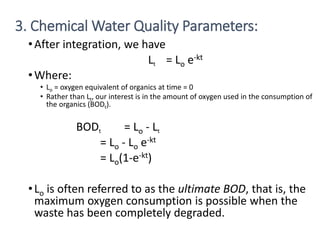
•After integration, wehave
Lt = Lo e-kt
•Where:
• Lo = oxygen equivalent of organics at time = 0
• Rather than Lt, our interest is in the amount of oxygen used in the consumption of
the organics (BODt).
BODt = Lo - Lt
= Lo - Lo e-kt
= Lo(1-e-kt)
•Lo is often referred to as the ultimate BOD, that is, the
maximum oxygen consumption is possible when the
waste has been completely degraded.
3. Chemical Water Quality Parameters:
23.
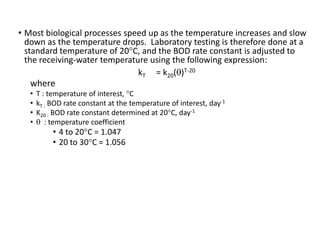
• Most biologicalprocesses speed up as the temperature increases and slow
down as the temperature drops. Laboratory testing is therefore done at a
standard temperature of 20°C, and the BOD rate constant is adjusted to
the receiving-water temperature using the following expression:
kT = k20(θ)T-20
where
• T : temperature of interest, °C
• kT : BOD rate constant at the temperature of interest, day-1
• K20 : BOD rate constant determined at 20°C, day-1
• θ : temperature coefficient
• 4 to 20°C = 1.047
• 20 to 30°C = 1.056
23
24.
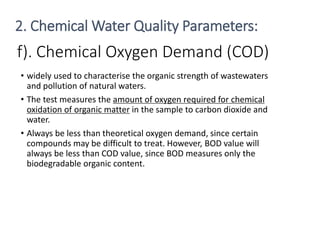
f). Chemical OxygenDemand (COD)
• widely used to characterise the organic strength of wastewaters
and pollution of natural waters.
• The test measures the amount of oxygen required for chemical
oxidation of organic matter in the sample to carbon dioxide and
water.
• Always be less than theoretical oxygen demand, since certain
compounds may be difficult to treat. However, BOD value will
always be less than COD value, since BOD measures only the
biodegradable organic content.
24
2. Chemical Water Quality Parameters:
25.
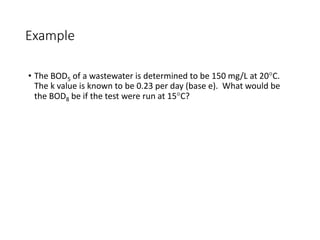
Example
• The BOD5of a wastewater is determined to be 150 mg/L at 20°C.
The k value is known to be 0.23 per day (base e). What would be
the BOD8 be if the test were run at 15°C?
25
26.
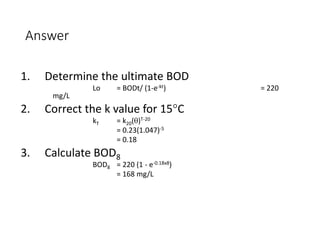
Answer
1. Determine theultimate BOD
Lo = BODt/ (1-e-kt) = 220
mg/L
2. Correct the k value for 15°C
kT = k20(θ)T-20
= 0.23(1.047)-5
= 0.18
3. Calculate BOD8
BOD8 = 220 (1 - e-0.18x8)
= 168 mg/L
26
27.
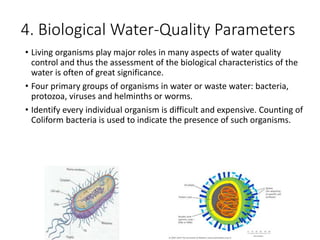
4. Biological Water-QualityParameters
• Living organisms play major roles in many aspects of water quality
control and thus the assessment of the biological characteristics of the
water is often of great significance.
• Four primary groups of organisms in water or waste water: bacteria,
protozoa, viruses and helminths or worms.
• Identify every individual organism is difficult and expensive. Counting of
Coliform bacteria is used to indicate the presence of such organisms.
27
28.
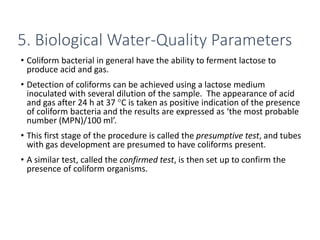
• Coliform bacterialin general have the ability to ferment lactose to
produce acid and gas.
• Detection of coliforms can be achieved using a lactose medium
inoculated with several dilution of the sample. The appearance of acid
and gas after 24 h at 37 °C is taken as positive indication of the presence
of coliform bacteria and the results are expressed as ‘the most probable
number (MPN)/100 ml’.
• This first stage of the procedure is called the presumptive test, and tubes
with gas development are presumed to have coliforms present.
• A similar test, called the confirmed test, is then set up to confirm the
presence of coliform organisms.
28
5. Biological Water-Quality Parameters
![pH value
Is the hydrogen ion concentration in water is closely connected with
the extent to which water molecules dissociate for the acidity and/or
the alkaline reaction, which is defined as the negative logarithm of
hydrogen ion activity:
pH = -log10 [H+]
The pH of aqueous systems can be conveniently measured with a pH
meter. The pH scale, ranging from 0 to 14, is acid from 0 to 7 and basic
from 7 to 14. Pure water has a pH very close to 7 at 25°C
pH Indicators may be used to measure pH, by making use of the fact that
their color changes with pH. Visual comparison of the color of a test
solution with a standard color chart provides a means to measure pH
14
2. Chemical Water Quality Parameters:](https://image.slidesharecdn.com/chapter2-waterqualityparameters-250505060733-588dda44/85/Chapter-2-Water-Quality-Parameters-pdf-14-320.jpg)
![Hardness
•Hardness is caused by multivalent metallic salts; those
most abundant in natural waters are calcium and
magnesium salts.
•Hard waters from both underground and surface
supplies are most common in areas having extensive
geological formations of limestone.
•Although satisfactory for human consumption, Ca 2+
and Mg 2+ precipitate soap, reducing its cleansing
action, and cause scale [CaCO3 and Mg(OH)2] in water
distribution mains and hot-water heaters.
16
2. Chemical Water Quality Parameters:](https://image.slidesharecdn.com/chapter2-waterqualityparameters-250505060733-588dda44/85/Chapter-2-Water-Quality-Parameters-pdf-16-320.jpg)