Reflections on transforming assessment and
feedback: complexity and collaboration.
Debbie Holley, Professor of Learning Innovation
and
Anne Quinney, University Lead for Pedagogical Innovations
in Assessment and Feedback
Bournemouth University
Keynote: Medway 'Creative and Inclusive Assessment and
Feedback' Festival September 10th 2020
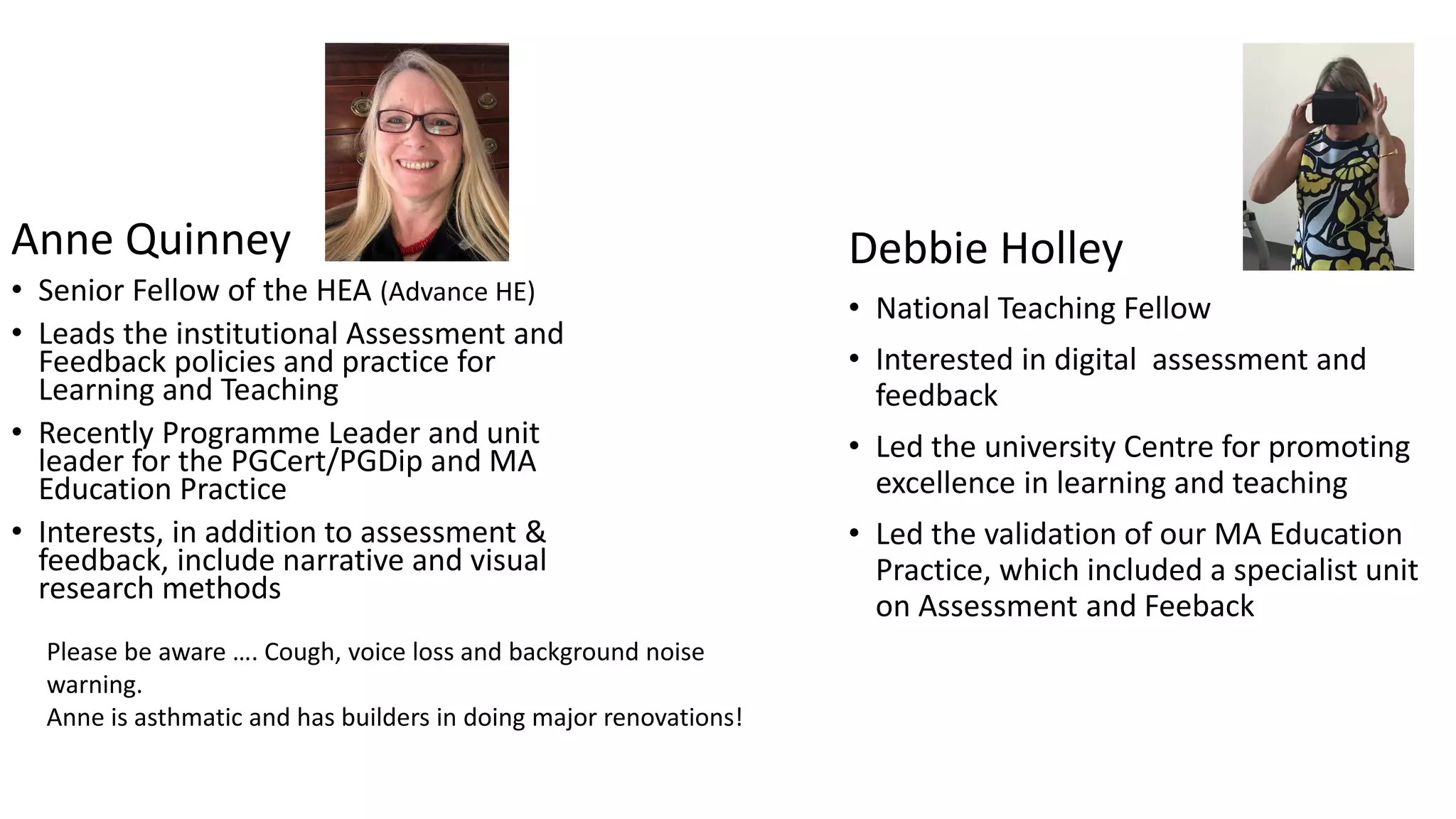
Anne Quinney
• Senior Fellow of the HEA (Advance HE)
• Leads the institutional Assessment and
Feedback policies and practice for
Learning and Teaching
• Recently Programme Leader and unit
leader for the PGCert/PGDip and MA
Education Practice
• Interests, in addition to assessment &
feedback, include narrative and visual
research methods
Debbie Holley
• National Teaching Fellow
• Interested in digital assessment and
feedback
• Led the university Centre for promoting
excellence in learning and teaching
• Led the validation of our MA Education
Practice, which included a specialist unit
on Assessment and Feeback
Please be aware …. Cough, voice loss and background noise
warning.
Anne is asthmatic and has builders in doing major renovations!
Audience
participation
invitation
What are the hot topics or sticky
problems in assessment and
feedback at your institution?
Please respond in the chat facility. We will collate the
anonymised responses, write a blog post and share it
back to be disseminated to conference participants
Assessment
and feedback
drivers
National drivers for Assessment &
Feedback
• National Student Survey (NSS)
• The Teaching Excellence and
Student Outcomes Framework
(TEF)
• The ongoing ‘tilt to online’ as a
response to Covid-19 (see
Nordmann et al 2020)
The challenge…..
Assessment practices in most universities have
not kept pace with the vast changes in the
context, aims and structure of higher
education. They can no longer do justice to
the outcomes we expect from a university
education in relation to wide-ranging
knowledge, skills and employability. (Ball et al
2012 p7)
Is a radical
rethink
overdue?
Is a radical rethink overdue?
• The HEA recommended "a radical rethink
of assessment practices and regulations"
and a "holistic and proactive approach (Ball
et al 2012 p8)
• "the greatest potential to improve
student learning is a shift in the balance of
summative and formative assessment (Ball
et all, 2012 p9)
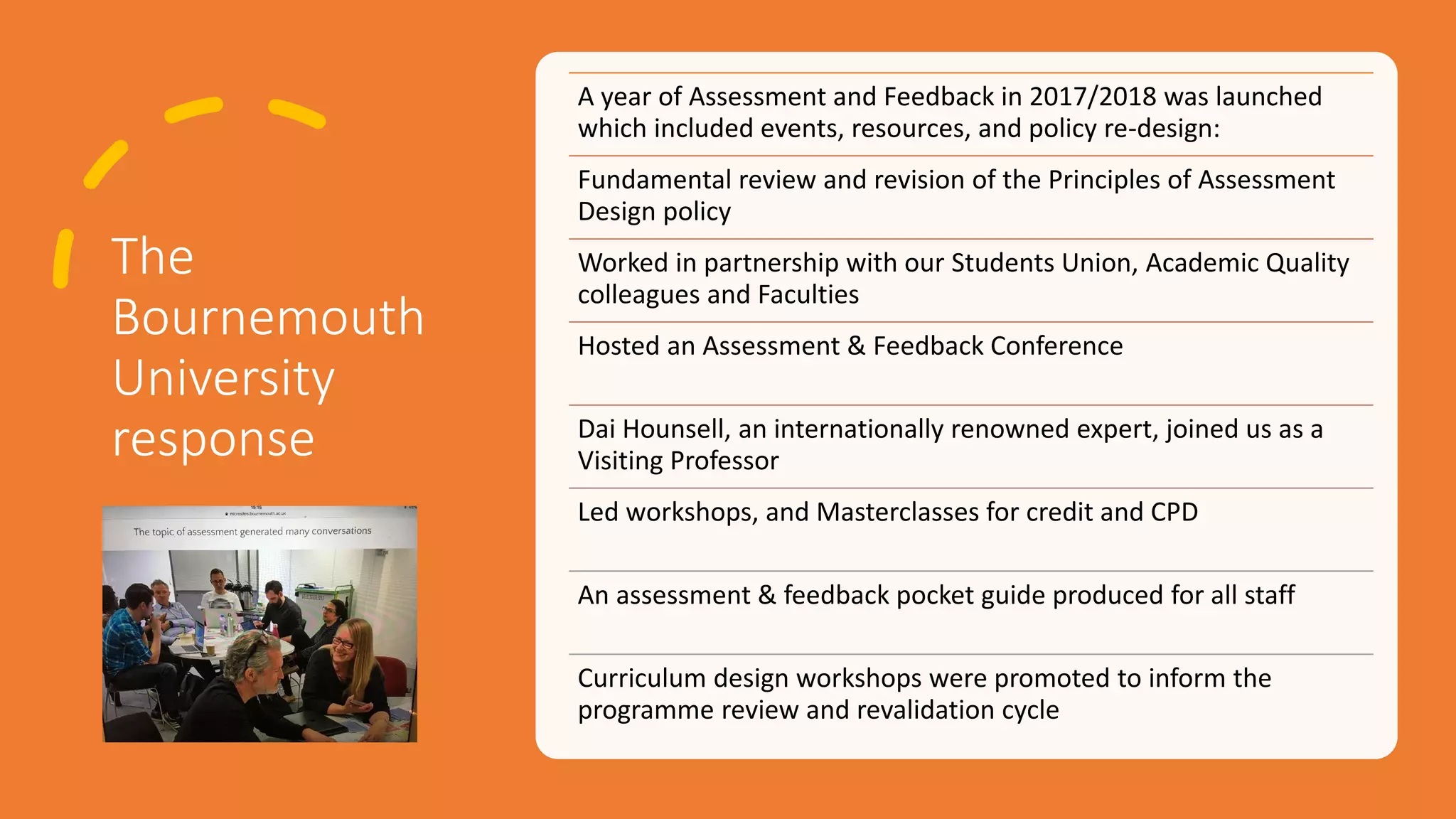
The
Bournemouth
University
response
A year of Assessment and Feedback in 2017/2018 was launched
which included events, resources, and policy re-design:
Fundamental review and revision of the Principles of Assessment
Design policy
Worked in partnership with our Students Union, Academic Quality
colleagues and Faculties
Hosted an Assessment & Feedback Conference
Dai Hounsell, an internationally renowned expert, joined us as a
Visiting Professor
Led workshops, and Masterclasses for credit and CPD
An assessment & feedback pocket guide produced for all staff
Curriculum design workshops were promoted to inform the
programme review and revalidation cycle
Key principles:
• Adopt assessment for learning (Sambell et al
2012) as the key principle for policy and
practice
• Promote of a broader menu of innovative
assessment tasks
• Reduce the volume and number of
assessment tasks
• Recognise the role that Technology
Enhanced Learning (TEL) can play
Academic dilemma 1:
Choosing an appropriate
assessment method:
How many different assessment methods are used on the
programmes you are familiar with?
Please respond with a number in the chat box
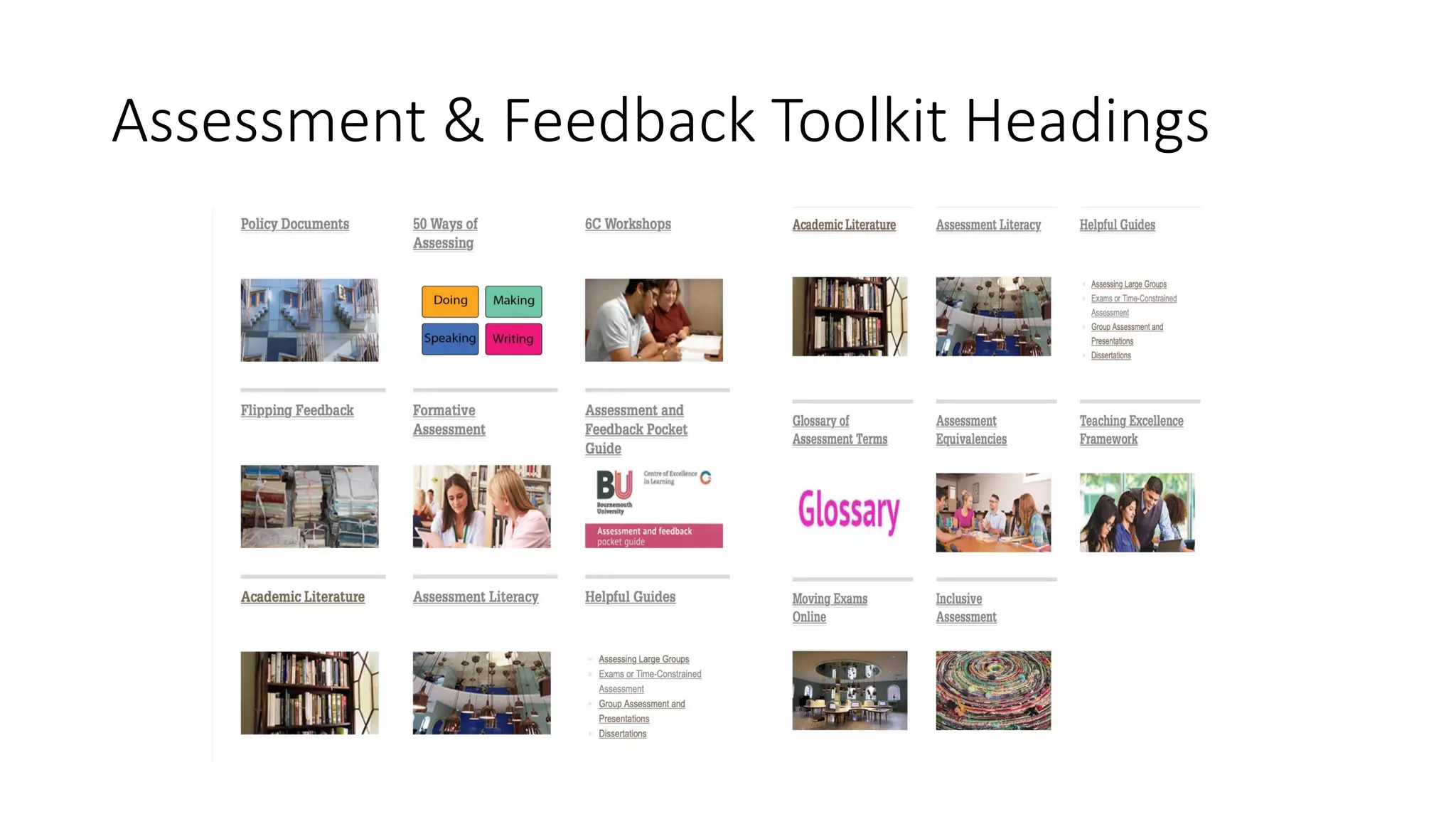
Assessment & Feedback Toolkit Headings
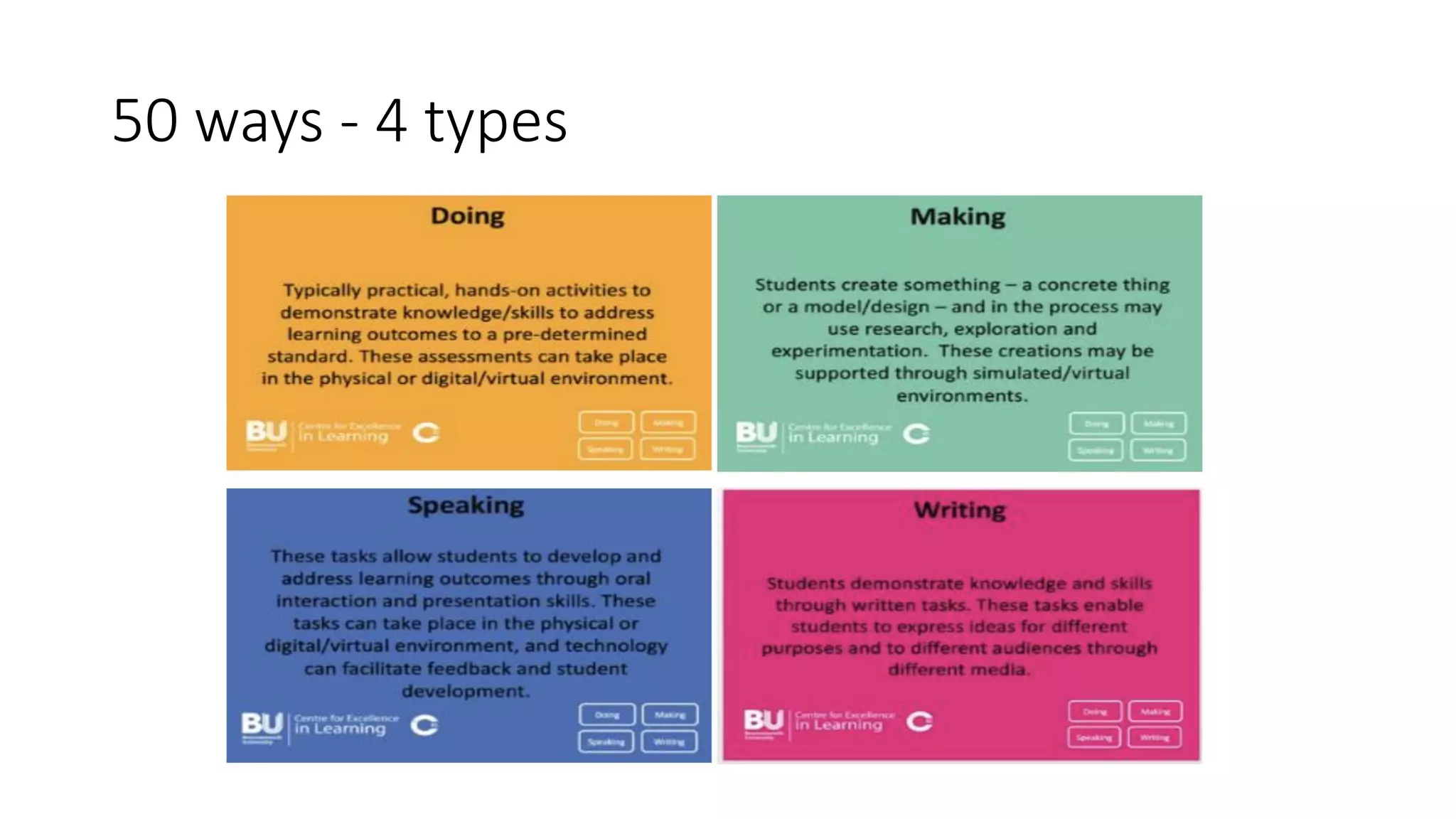
50 ways - 4 types
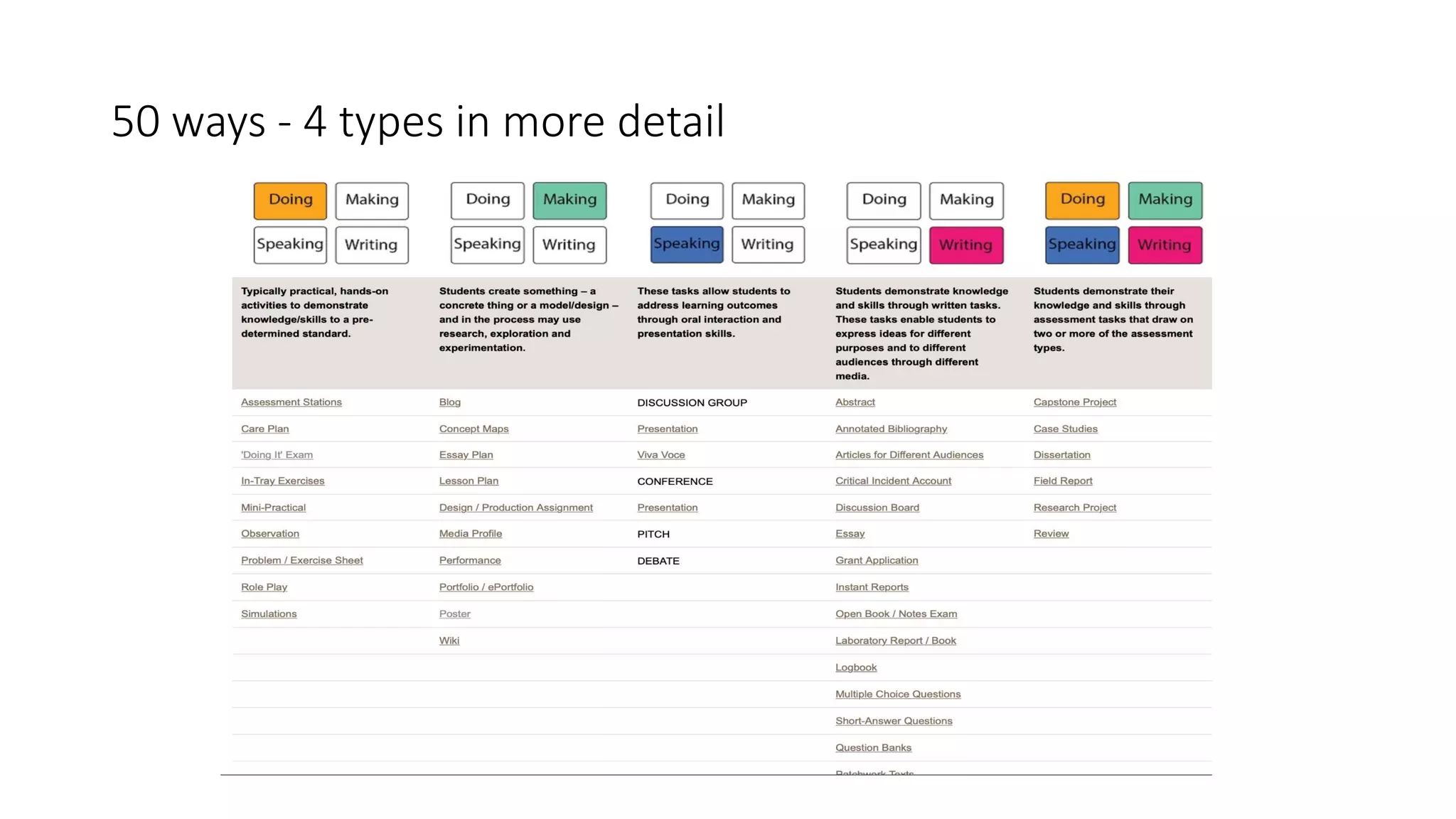
50 ways - 4 types in more detail
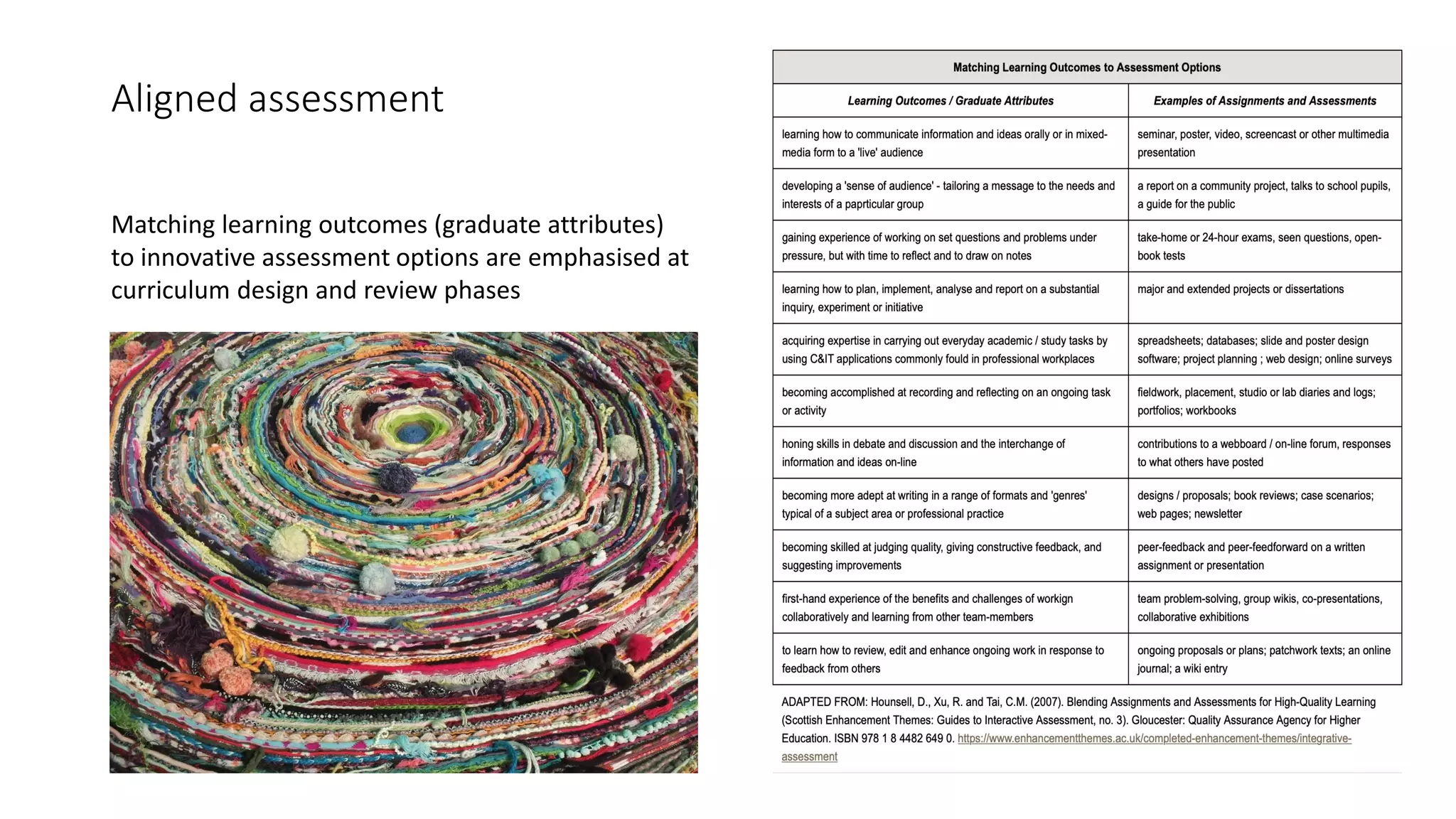
Aligned assessment
Matching learning outcomes (graduate attributes)
to innovative assessment options are emphasised at
curriculum design and review phases
Academic dilemma 2:
Students don’t always
understand how to use
feedback
What ideas do you use to help address this?
Please respond in the chat box
‘Flipping’ feedback
• A shift from retrospective feedback to
prospective feedforward
• Reconfiguring teaching and learning activities to
create more opportunities for ‘real-time’ or
‘just-in-time’ feedback for learning
• Embed opportunities for giving, receiving and
responding to feedback
These approaches emphasise feedback as a dialogue and an
exchange of ideas, not only the comments on summative
assignments.
‘Real-time’ feedback – online or on campus
• ‘Boot-grit’ feedback at the end of session: what didn’t you
understand; what needs more explanation. Responses,
explanations, clarification can be posted in the VLE
• In class quizzes and activities can provide rapid feedback on
learning. Breaking into pairs or groups for ‘peer instruction’ can
be used to discuss then revise answers. Team-based learning
works well.
• Adopt the ‘flipped classroom’. In-class time for engagement,
collaboration, understanding is maximised.
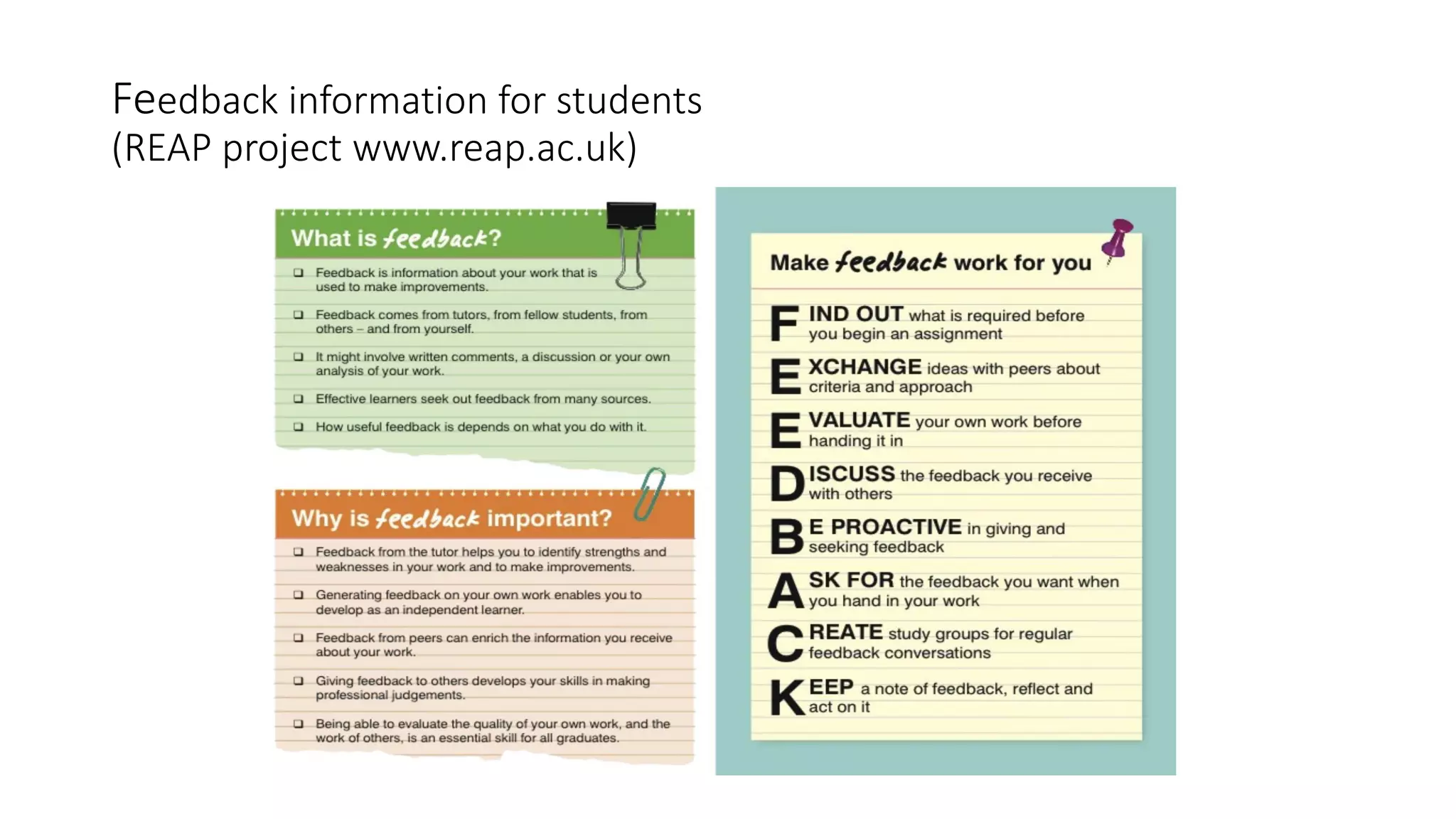
Feedback information for students
(REAP project www.reap.ac.uk)
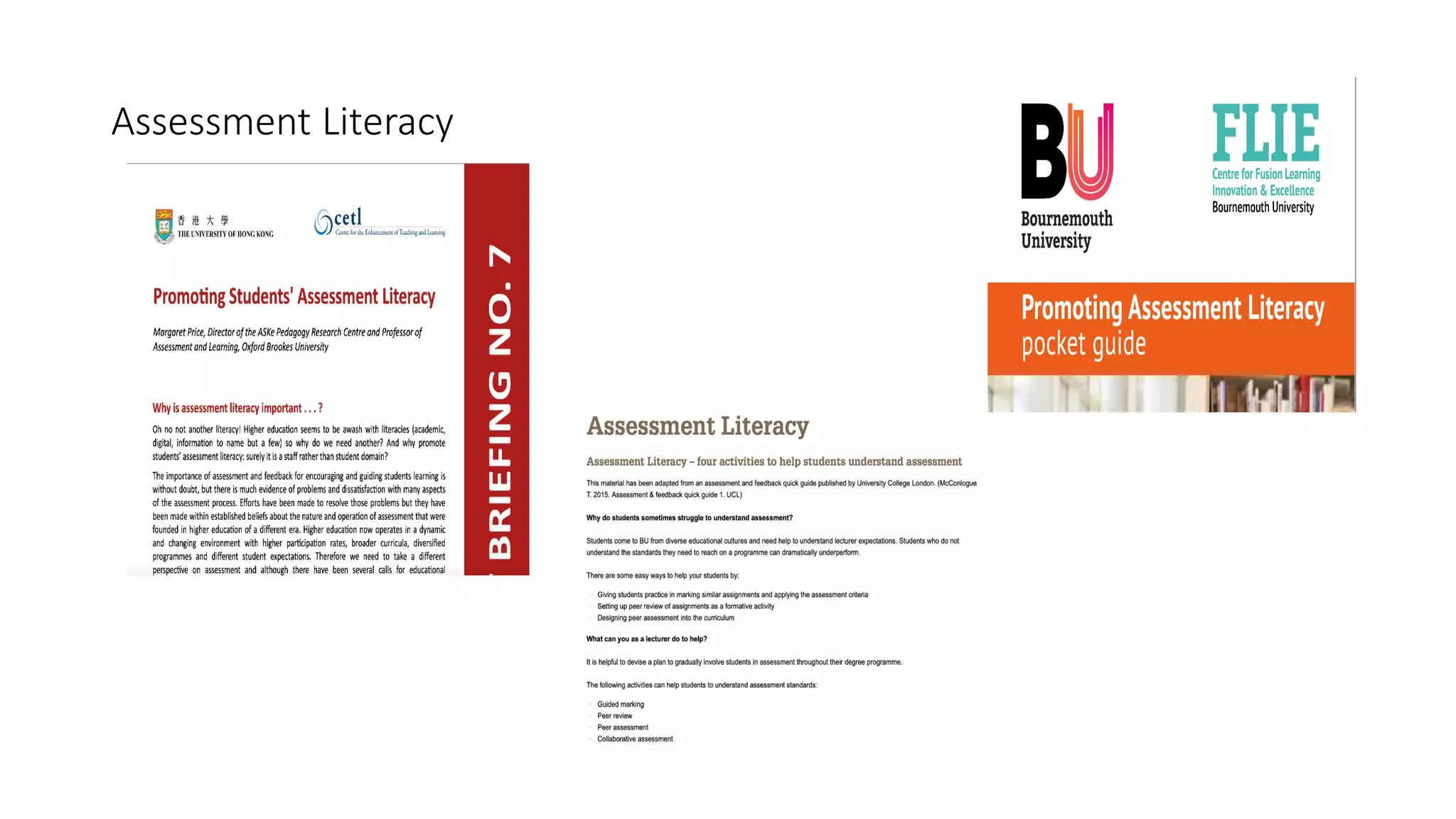
Assessment Literacy
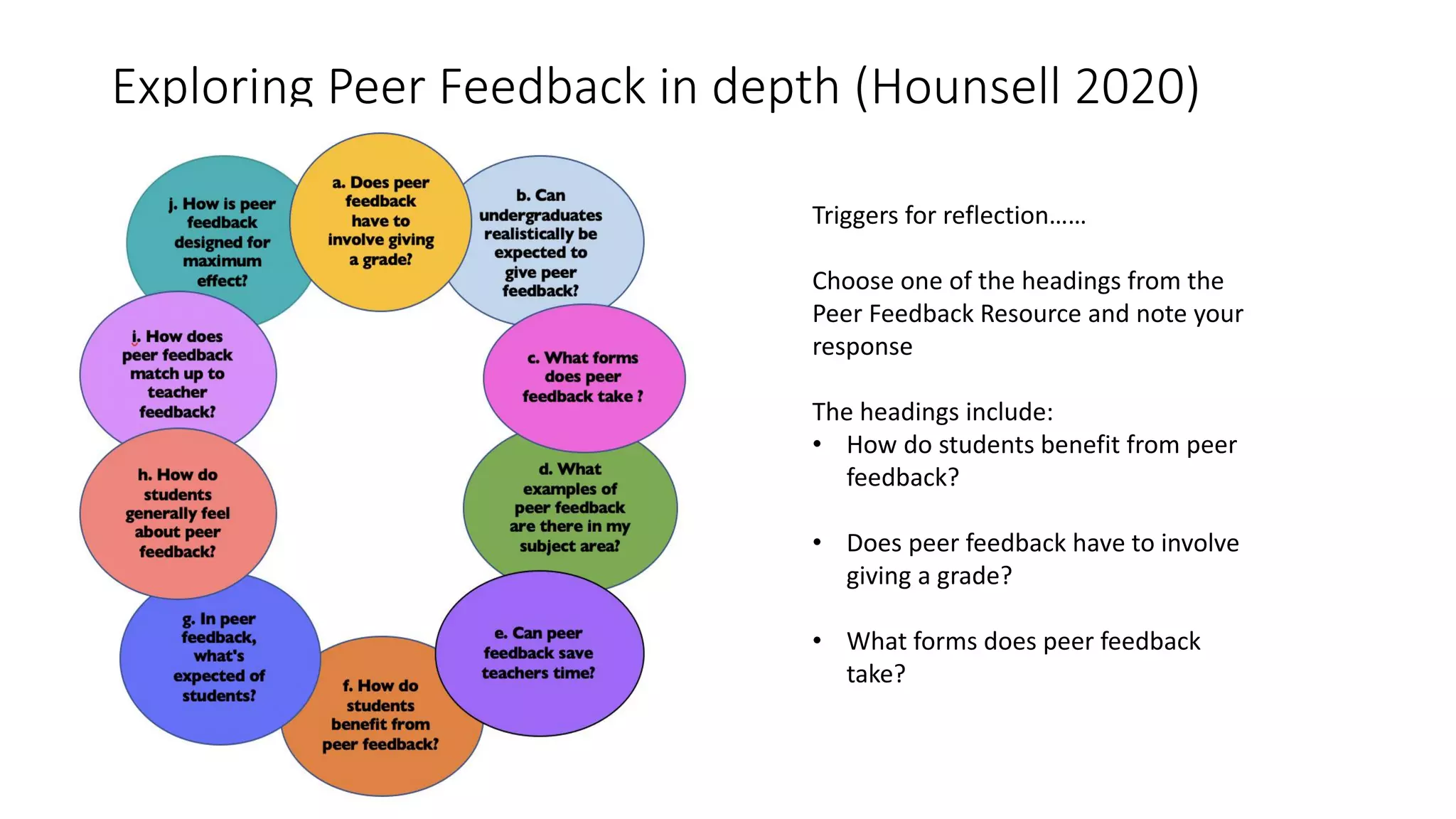
Exploring Peer Feedback in depth (Hounsell 2020)
Triggers for reflection……
Choose one of the headings from the
Peer Feedback Resource and note your
response
The headings include:
• How do students benefit from peer
feedback?
• Does peer feedback have to involve
giving a grade?
• What forms does peer feedback
take?
Authentic
Assessments designed to prepare students for what they
do next, using technology they will use in their careers
Accessible
Assessments designed with an accessibility-first principle
Appropriately automated
A balance found of automated and human marking to
deliver maximum benefit to students
Continuous
Assessment data used to explore opportunities for
continuous assessment to improve the learning
experience
Secure
Authoring detection and biometric authentication
adopted for identification and remote proctoring
JISC 2020
Harnessing the power of new technologies
technologies
How might you use technology to support this?
Please respond in the chat box
Academic dilemma 3:
How to adopt authentic
learning experiences?
Response: Augmented
Reality/Virtual Reality
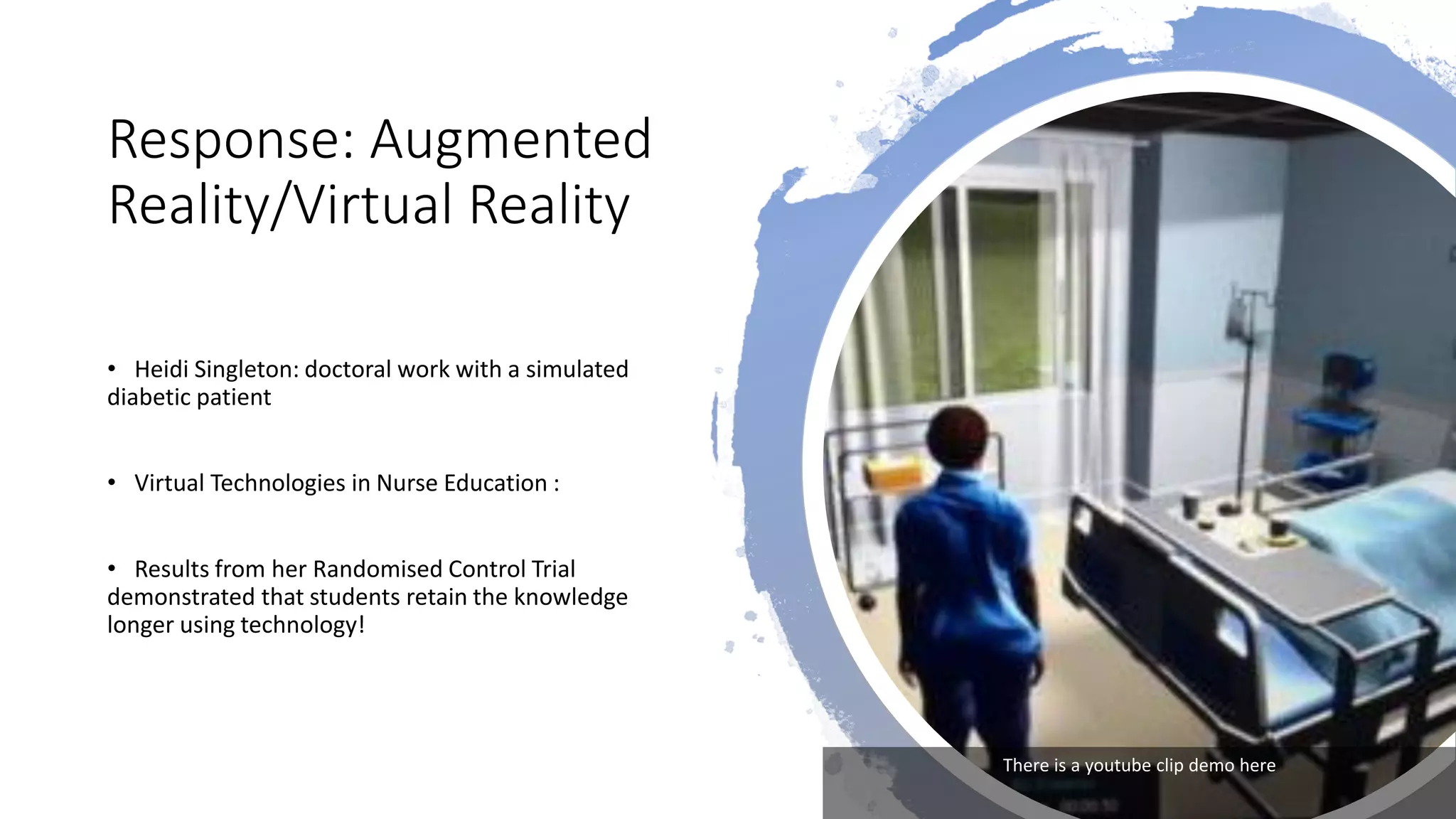
• Heidi Singleton: doctoral work with a simulated
diabetic patient
• Virtual Technologies in Nurse Education :
• Results from her Randomised Control Trial
demonstrated that students retain the knowledge
longer using technology!
There is a youtube clip demo here
Reflections on transforming pedagogic policy and practice
Underpinned by a collaborative and trans-disciplinary approach
Used the triple helix model of educational innovation (Hutchings and
Quinney 2015, Quinney et al 2017)
But….
Not everyone will embrace change and some will actively resist
Our solution was a shared vision, a robust team approach, the need for
ongoing horizon scanning and the application of soft skills to deliver
‘optimal disruption’
Ball S et al (2012) A marked improvement: transforming assessment in higher education. York: HEA
Boud D and Falkinov N. (2006) Aligning assessment with long term learning. Assessment
and evaluationin higher education. 38(6) p698-712
Hounsell D. Flipping feedback. Undated. Wise Assessment Briefing 12. University of Hong Kong.
https://www.cetl.hku.hk/teaching-learning-cop/wp-content/uploads/2015/08/wise-assessment-briefing12.pdf
Hutchings M and Quinney A, (2015). The flipped classroom, disruptive pedagogies, enabling technologies and wicked problems: responding to the
‘bomb in the basement’. Electronic Journal of E-learning. 13(2) p106-119
Jessop T. (2017). Inspiring transformation through TESTA’s programme approach. In Carless D et al eds. Scaling up assessment for learning in higher education. Springer.
Nicol D and McFarlane D (2006) Formative assessment and self-regulated learning; a model and seven principles of good feedback practice. Studies in Higher Education. 32(2)
p199-21.
Nordmann E, Horlin C, Hutchison J, Murray J-A, Robson L, Seery MK, and MacKay JRD. (2020). 10 simple rules for supporting a temporary online pivot in higher education.
PsyArXiv Preprints
https://psyarxiv.com/qdh25
Price M. undated. Promoting student assessment literacy. Wise Assessment Briefing 7. University of Hong Kong.
https://www.cetl.hku.hk/teaching-learning-cop/wp-content/uploads/2015/08/wise-assessment-briefing7.pdf
Quinney A, Lamont C, Biggins D and Holley D. (2017). Optimising disruptive approaches: extending academic roles and identities in higher education. Journal of Learning
~Development in Higher Education. Issue 12.
Sambell K, McDowell L, and Montgomery, C. (2012). Assessment for learning in higher education. Routledge.
Useful resources
• The Bournemouth University Assessment and Feedback
toolkit. (This externally facing version is incomplete as
work halted to prioritise developments for the internal Toolkit).
• Sally Brown’s blog https://sally-brown.net
• FLIE blog https://microsites.bournemouth.ac.uk/flie/
• Winstone N and Carless D. 2019. Designing effective feedback processes in Higher Education: A learning-
focused approach.

Reflections on transforming assessment and feedback: complexity and collaboration

  • 1.
    Reflections on transformingassessment and feedback: complexity and collaboration. Debbie Holley, Professor of Learning Innovation and Anne Quinney, University Lead for Pedagogical Innovations in Assessment and Feedback Bournemouth University Keynote: Medway 'Creative and Inclusive Assessment and Feedback' Festival September 10th 2020
  • 2.
    Anne Quinney • SeniorFellow of the HEA (Advance HE) • Leads the institutional Assessment and Feedback policies and practice for Learning and Teaching • Recently Programme Leader and unit leader for the PGCert/PGDip and MA Education Practice • Interests, in addition to assessment & feedback, include narrative and visual research methods Debbie Holley • National Teaching Fellow • Interested in digital assessment and feedback • Led the university Centre for promoting excellence in learning and teaching • Led the validation of our MA Education Practice, which included a specialist unit on Assessment and Feeback Please be aware …. Cough, voice loss and background noise warning. Anne is asthmatic and has builders in doing major renovations!
  • 3.
    Audience participation invitation What are thehot topics or sticky problems in assessment and feedback at your institution? Please respond in the chat facility. We will collate the anonymised responses, write a blog post and share it back to be disseminated to conference participants
  • 4.
    Assessment and feedback drivers National driversfor Assessment & Feedback • National Student Survey (NSS) • The Teaching Excellence and Student Outcomes Framework (TEF) • The ongoing ‘tilt to online’ as a response to Covid-19 (see Nordmann et al 2020)
  • 5.
    The challenge….. Assessment practicesin most universities have not kept pace with the vast changes in the context, aims and structure of higher education. They can no longer do justice to the outcomes we expect from a university education in relation to wide-ranging knowledge, skills and employability. (Ball et al 2012 p7)
  • 6.
    Is a radical rethink overdue? Isa radical rethink overdue? • The HEA recommended "a radical rethink of assessment practices and regulations" and a "holistic and proactive approach (Ball et al 2012 p8) • "the greatest potential to improve student learning is a shift in the balance of summative and formative assessment (Ball et all, 2012 p9)
  • 7.
    The Bournemouth University response A year ofAssessment and Feedback in 2017/2018 was launched which included events, resources, and policy re-design: Fundamental review and revision of the Principles of Assessment Design policy Worked in partnership with our Students Union, Academic Quality colleagues and Faculties Hosted an Assessment & Feedback Conference Dai Hounsell, an internationally renowned expert, joined us as a Visiting Professor Led workshops, and Masterclasses for credit and CPD An assessment & feedback pocket guide produced for all staff Curriculum design workshops were promoted to inform the programme review and revalidation cycle
  • 8.
    Key principles: • Adoptassessment for learning (Sambell et al 2012) as the key principle for policy and practice • Promote of a broader menu of innovative assessment tasks • Reduce the volume and number of assessment tasks • Recognise the role that Technology Enhanced Learning (TEL) can play
  • 9.
    Academic dilemma 1: Choosingan appropriate assessment method: How many different assessment methods are used on the programmes you are familiar with? Please respond with a number in the chat box
  • 10.
    Assessment & FeedbackToolkit Headings
  • 11.
    50 ways -4 types
  • 12.
    50 ways -4 types in more detail
  • 13.
    Aligned assessment Matching learningoutcomes (graduate attributes) to innovative assessment options are emphasised at curriculum design and review phases
  • 14.
    Academic dilemma 2: Studentsdon’t always understand how to use feedback What ideas do you use to help address this? Please respond in the chat box
  • 15.
    ‘Flipping’ feedback • Ashift from retrospective feedback to prospective feedforward • Reconfiguring teaching and learning activities to create more opportunities for ‘real-time’ or ‘just-in-time’ feedback for learning • Embed opportunities for giving, receiving and responding to feedback These approaches emphasise feedback as a dialogue and an exchange of ideas, not only the comments on summative assignments.
  • 16.
    ‘Real-time’ feedback –online or on campus • ‘Boot-grit’ feedback at the end of session: what didn’t you understand; what needs more explanation. Responses, explanations, clarification can be posted in the VLE • In class quizzes and activities can provide rapid feedback on learning. Breaking into pairs or groups for ‘peer instruction’ can be used to discuss then revise answers. Team-based learning works well. • Adopt the ‘flipped classroom’. In-class time for engagement, collaboration, understanding is maximised.
  • 17.
    Feedback information forstudents (REAP project www.reap.ac.uk)
  • 18.
  • 19.
    Exploring Peer Feedbackin depth (Hounsell 2020) Triggers for reflection…… Choose one of the headings from the Peer Feedback Resource and note your response The headings include: • How do students benefit from peer feedback? • Does peer feedback have to involve giving a grade? • What forms does peer feedback take?
  • 20.
    Authentic Assessments designed toprepare students for what they do next, using technology they will use in their careers Accessible Assessments designed with an accessibility-first principle Appropriately automated A balance found of automated and human marking to deliver maximum benefit to students Continuous Assessment data used to explore opportunities for continuous assessment to improve the learning experience Secure Authoring detection and biometric authentication adopted for identification and remote proctoring JISC 2020 Harnessing the power of new technologies technologies
  • 21.
    How might youuse technology to support this? Please respond in the chat box Academic dilemma 3: How to adopt authentic learning experiences?
  • 22.
    Response: Augmented Reality/Virtual Reality •Heidi Singleton: doctoral work with a simulated diabetic patient • Virtual Technologies in Nurse Education : • Results from her Randomised Control Trial demonstrated that students retain the knowledge longer using technology! There is a youtube clip demo here
  • 23.
    Reflections on transformingpedagogic policy and practice Underpinned by a collaborative and trans-disciplinary approach Used the triple helix model of educational innovation (Hutchings and Quinney 2015, Quinney et al 2017) But…. Not everyone will embrace change and some will actively resist Our solution was a shared vision, a robust team approach, the need for ongoing horizon scanning and the application of soft skills to deliver ‘optimal disruption’
  • 24.
    Ball S etal (2012) A marked improvement: transforming assessment in higher education. York: HEA Boud D and Falkinov N. (2006) Aligning assessment with long term learning. Assessment and evaluationin higher education. 38(6) p698-712 Hounsell D. Flipping feedback. Undated. Wise Assessment Briefing 12. University of Hong Kong. https://www.cetl.hku.hk/teaching-learning-cop/wp-content/uploads/2015/08/wise-assessment-briefing12.pdf Hutchings M and Quinney A, (2015). The flipped classroom, disruptive pedagogies, enabling technologies and wicked problems: responding to the ‘bomb in the basement’. Electronic Journal of E-learning. 13(2) p106-119 Jessop T. (2017). Inspiring transformation through TESTA’s programme approach. In Carless D et al eds. Scaling up assessment for learning in higher education. Springer. Nicol D and McFarlane D (2006) Formative assessment and self-regulated learning; a model and seven principles of good feedback practice. Studies in Higher Education. 32(2) p199-21. Nordmann E, Horlin C, Hutchison J, Murray J-A, Robson L, Seery MK, and MacKay JRD. (2020). 10 simple rules for supporting a temporary online pivot in higher education. PsyArXiv Preprints https://psyarxiv.com/qdh25 Price M. undated. Promoting student assessment literacy. Wise Assessment Briefing 7. University of Hong Kong. https://www.cetl.hku.hk/teaching-learning-cop/wp-content/uploads/2015/08/wise-assessment-briefing7.pdf Quinney A, Lamont C, Biggins D and Holley D. (2017). Optimising disruptive approaches: extending academic roles and identities in higher education. Journal of Learning ~Development in Higher Education. Issue 12. Sambell K, McDowell L, and Montgomery, C. (2012). Assessment for learning in higher education. Routledge.
  • 25.
    Useful resources • TheBournemouth University Assessment and Feedback toolkit. (This externally facing version is incomplete as work halted to prioritise developments for the internal Toolkit). • Sally Brown’s blog https://sally-brown.net • FLIE blog https://microsites.bournemouth.ac.uk/flie/ • Winstone N and Carless D. 2019. Designing effective feedback processes in Higher Education: A learning- focused approach.