add the assessment approaches you have
used/are currently using
to our tree on the flipchart


                      assessment and feedback

                                         PGCAP, LTHE module


       1
Intended Learning Outcomes
•       to participate and collaborate in small group PBL
•
        • to identify and critically analyse issues linked to the
        given PBL triggers
•
        • to present findings to another team


    2
So what is Problem-Based Learning?
       An introduction


    3
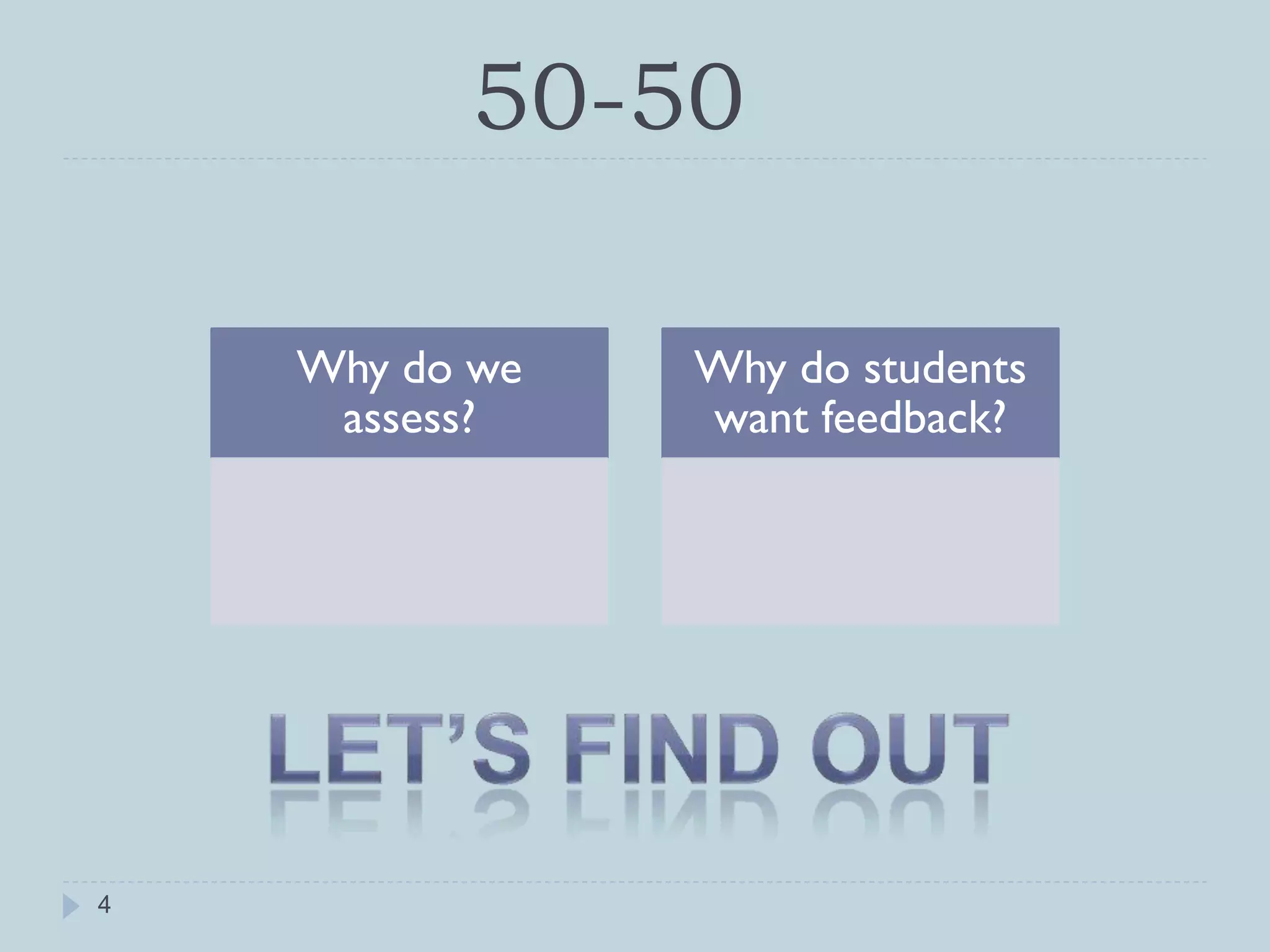
50-50

    Why do we   Why do students
     assess?    want feedback?


4
About assessment
       “There is too much emphasis in higher education on summative assessment […] a
        shift away from the „testing‟ and judgement culture associated with summative
        assessment would alter the learning environment in higher education and provide
        positive student learning opportunities, encourage dialogue between teachers and
        students (and between students and students), enhance the learning experience,
        provide motivation for students by moving towards a formative assessment ethos
        and allow students to take responsibility and ownership for their learning and
        education.” (Irons, 2008, 8)


       What does this mean for your practice?
       How can Irons‟ approach be implemented?


       Capture your thoughts on sticky notes and swap.
       Discuss.


    5
PBL trigger
    assessment and feedback


6
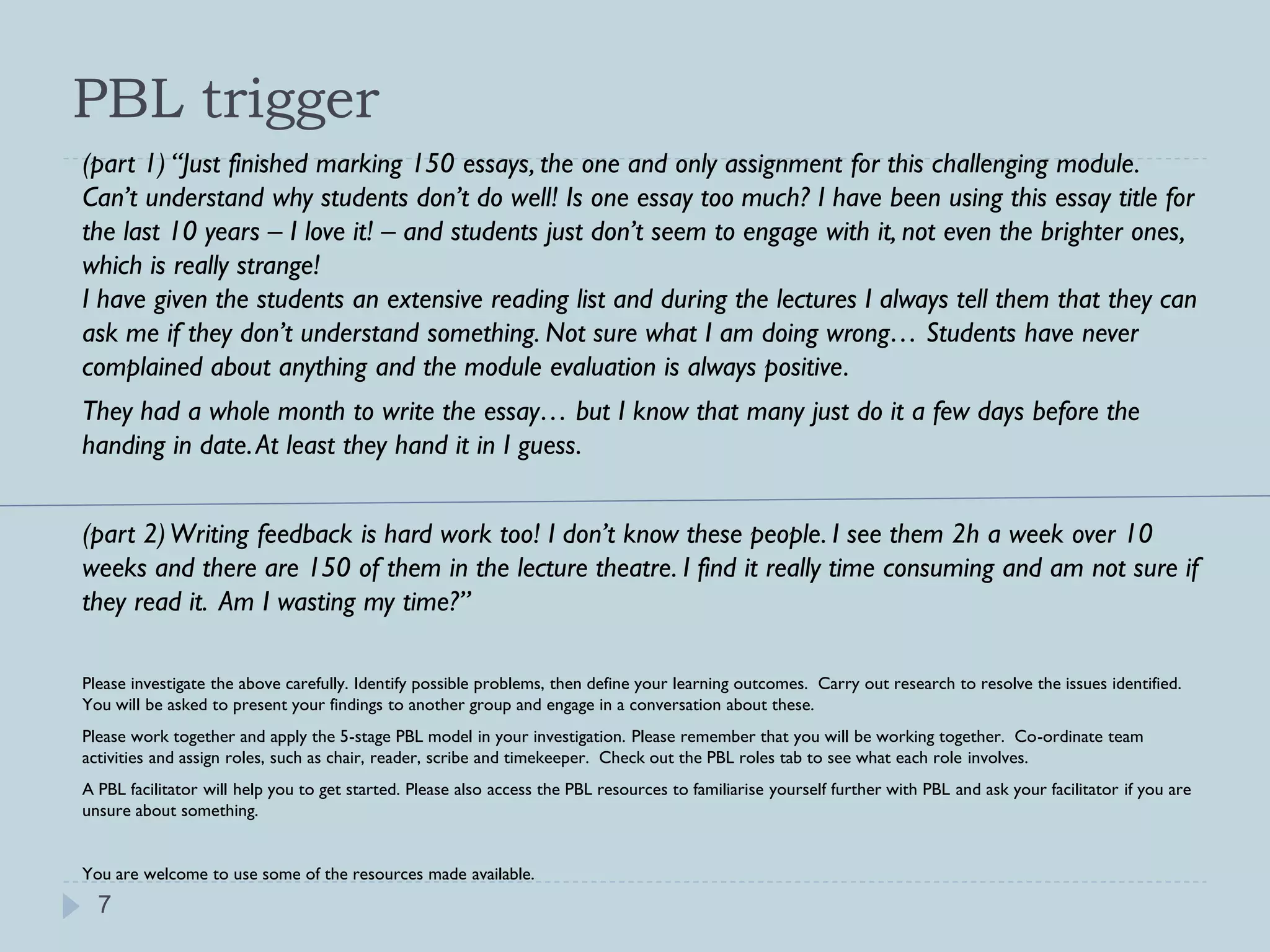
PBL trigger
(part 1) “Just finished marking 150 essays, the one and only assignment for this challenging module.
Can’t understand why students don’t do well! Is one essay too much? I have been using this essay title for
the last 10 years – I love it! – and students just don’t seem to engage with it, not even the brighter ones,
which is really strange!
I have given the students an extensive reading list and during the lectures I always tell them that they can
ask me if they don’t understand something. Not sure what I am doing wrong… Students have never
complained about anything and the module evaluation is always positive.
They had a whole month to write the essay… but I know that many just do it a few days before the
handing in date. At least they hand it in I guess.


(part 2) Writing feedback is hard work too! I don’t know these people. I see them 2h a week over 10
weeks and there are 150 of them in the lecture theatre. I find it really time consuming and am not sure if
they read it. Am I wasting my time?”

Please investigate the above carefully. Identify possible problems, then define your learning outcomes. Carry out research to resolve the issues identified.
You will be asked to present your findings to another group and engage in a conversation about these.
Please work together and apply the 5-stage PBL model in your investigation. Please remember that you will be working together. Co-ordinate team
activities and assign roles, such as chair, reader, scribe and timekeeper. Check out the PBL roles tab to see what each role involves.
A PBL facilitator will help you to get started. Please also access the PBL resources to familiarise yourself further with PBL and ask your facilitator if you are
unsure about something.


You are welcome to use some of the resources made available.
  7
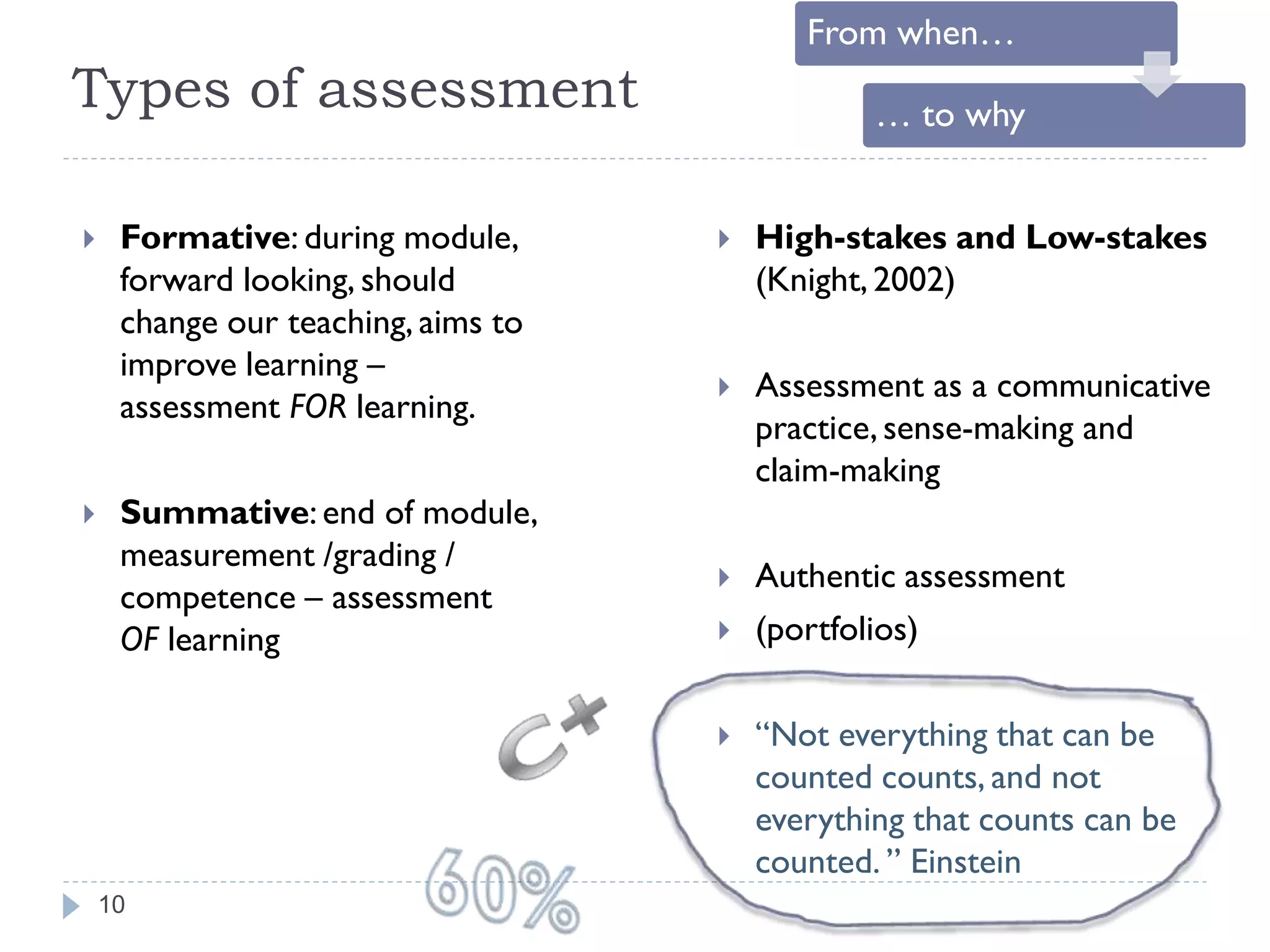
From when…
Types of assessment                             … to why


    Formative: during module,         High-stakes and Low-stakes
     forward looking, should            (Knight, 2002)
     change our teaching, aims to
     improve learning –
                                       Assessment as a communicative
     assessment FOR learning.
                                        practice, sense-making and
                                        claim-making
    Summative: end of module,
     measurement /grading /
                                       Authentic assessment
     competence – assessment
     OF learning                       (portfolios)

                                       “Not everything that can be
                                        counted counts, and not
                                        everything that counts can be
                                        counted. ” Einstein
    10
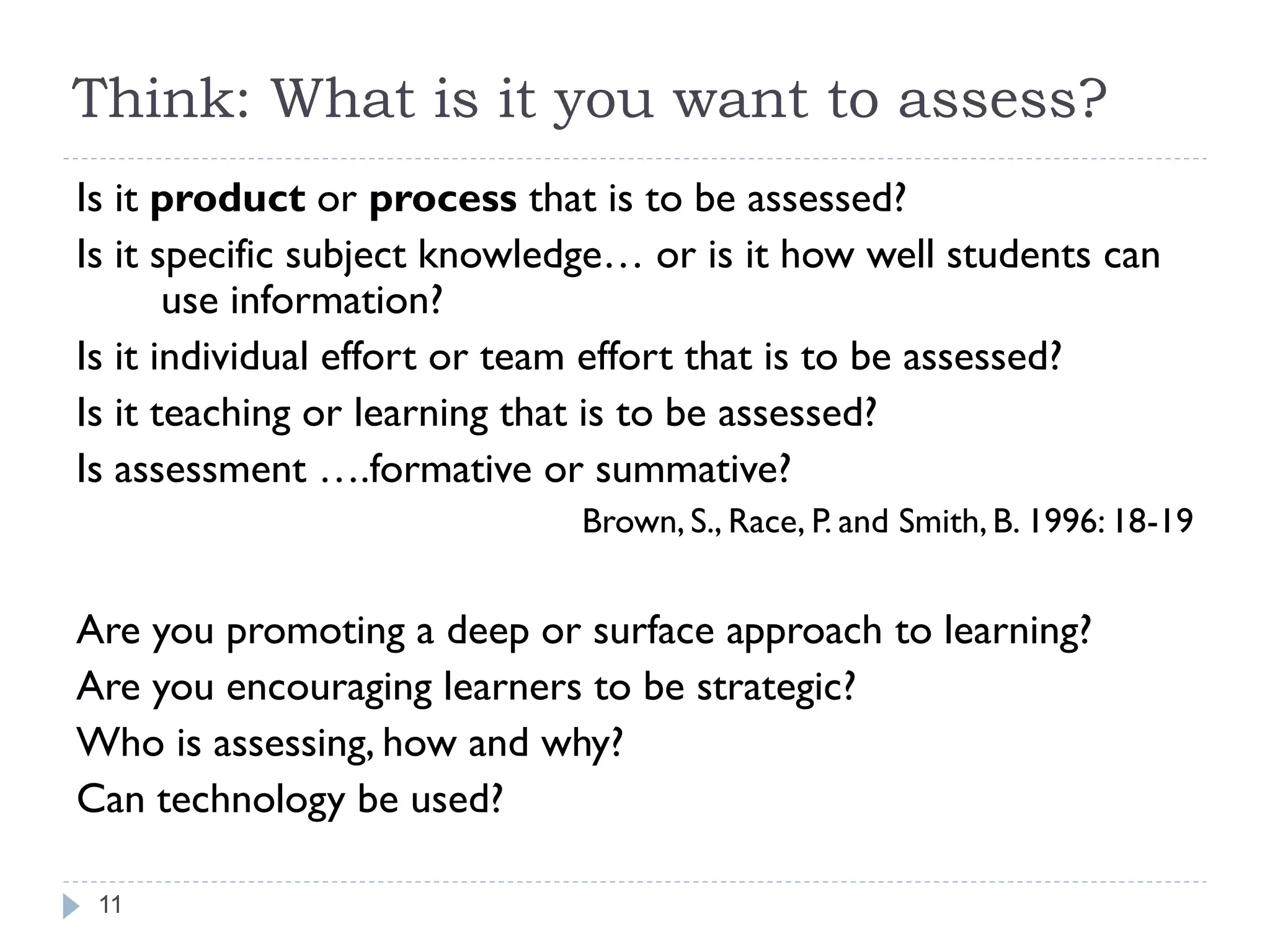
Think: What is it you want to assess?
Is it product or process that is to be assessed?
Is it specific subject knowledge… or is it how well students can
       use information?
Is it individual effort or team effort that is to be assessed?
Is it teaching or learning that is to be assessed?
Is assessment ….formative or summative?
                             Brown, S., Race, P. and Smith, B. 1996: 18-19


Are you promoting a deep or surface approach to learning?
Are you encouraging learners to be strategic?
Who is assessing, how and why?
Can technology be used?

 11
Good Practice?
    Avoid
        Generic assessment questions
        repeating the same questions / task every year
        bunching all assignments at the end of the semester
        setting tasks that require information that is easily obtained from
         Google searches.
    Do
        personalised tasks
        collaborative tasks
        self- and peer assessment and feedback opportunities (benefits/challenges?)
        performance assessment
        reflection
        real-life & contemporary situations


    12
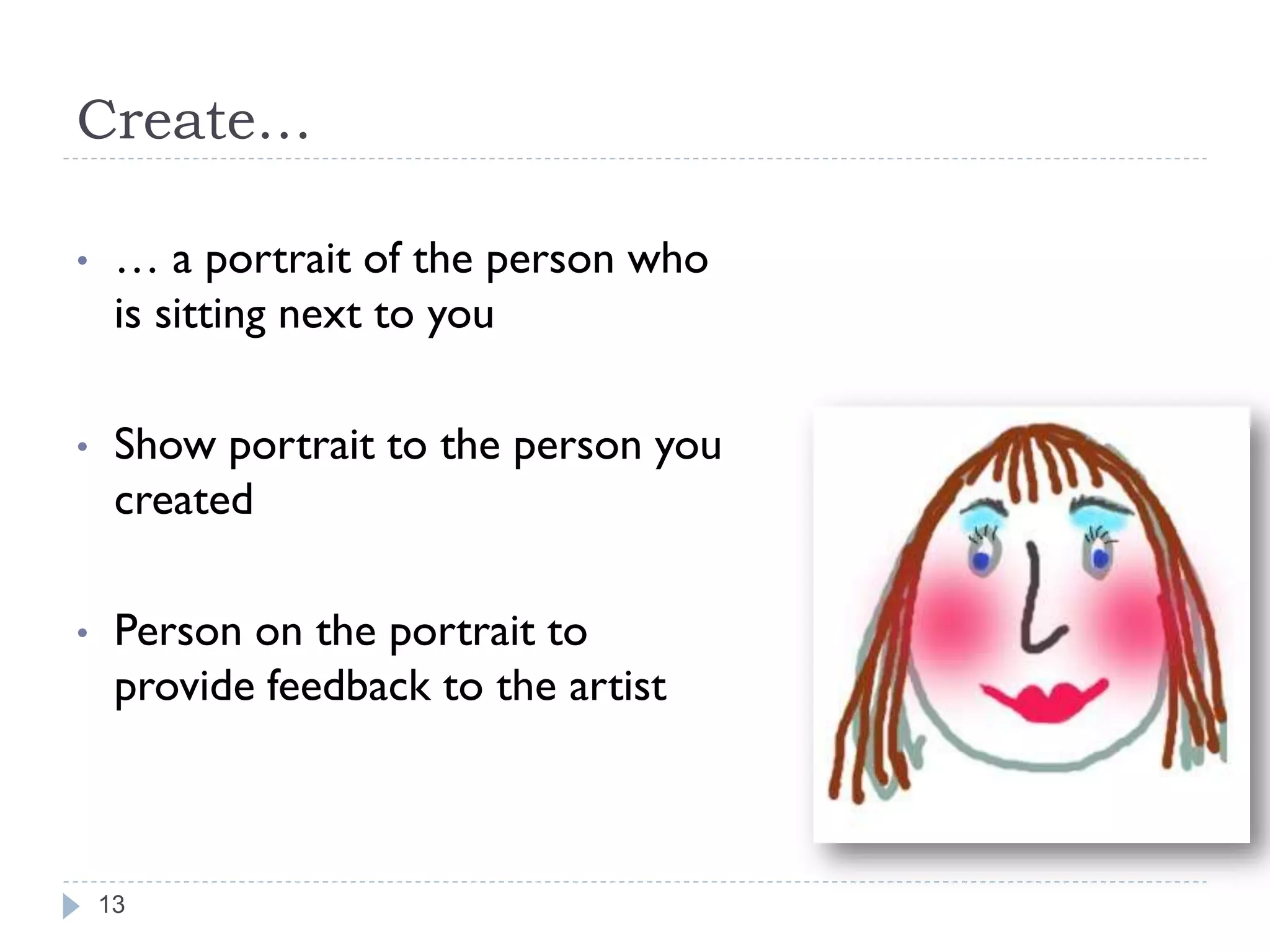
Create…

•    … a portrait of the person who
     is sitting next to you

•    Show portrait to the person you
     created

•    Person on the portrait to
     provide feedback to the artist


    13
Feedback, the student voice

                               (HEA clip)


                    watch „n‟ discuss
 http://www.heacademy.ac.uk/ourwork/teachingandlearning/assessment/alldi
 splay?type=resources&newid=resource_database/audioandvideo/assessm
                ent_and_feedback_student_views&site=york


14
The seven principles of good
feedback practice
1.   Facilitates the development of self–assessment (reflection) in
     learning.
2.   Encourages teacher and peer dialogue around learning.
3.   Helps clarify what good performance is.
4.   Provides opportunities to close the gap between current and
     desired performance.
5.   Delivers high quality information to students about their learning.
6.   Encourages positive motivational beliefs and self-esteem.
7.   Provides information to teachers that can be used to help shape
     teaching.

                                                          Juwah et.al.(2004)
 15
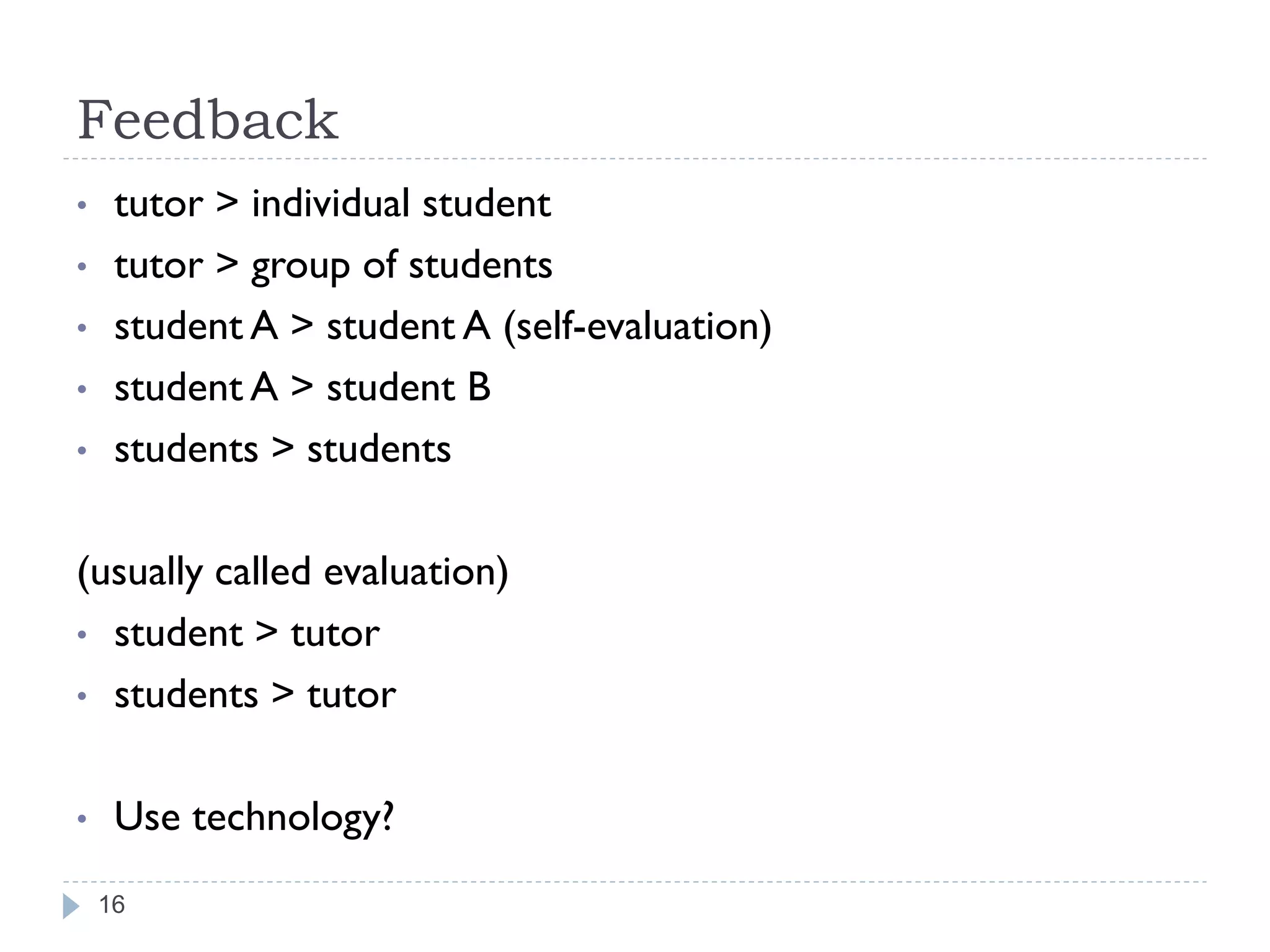
Feedback
•    tutor > individual student
•    tutor > group of students
•    student A > student A (self-evaluation)
•    student A > student B
•    students > students

(usually called evaluation)
• student > tutor
• students > tutor


•    Use technology?
    16
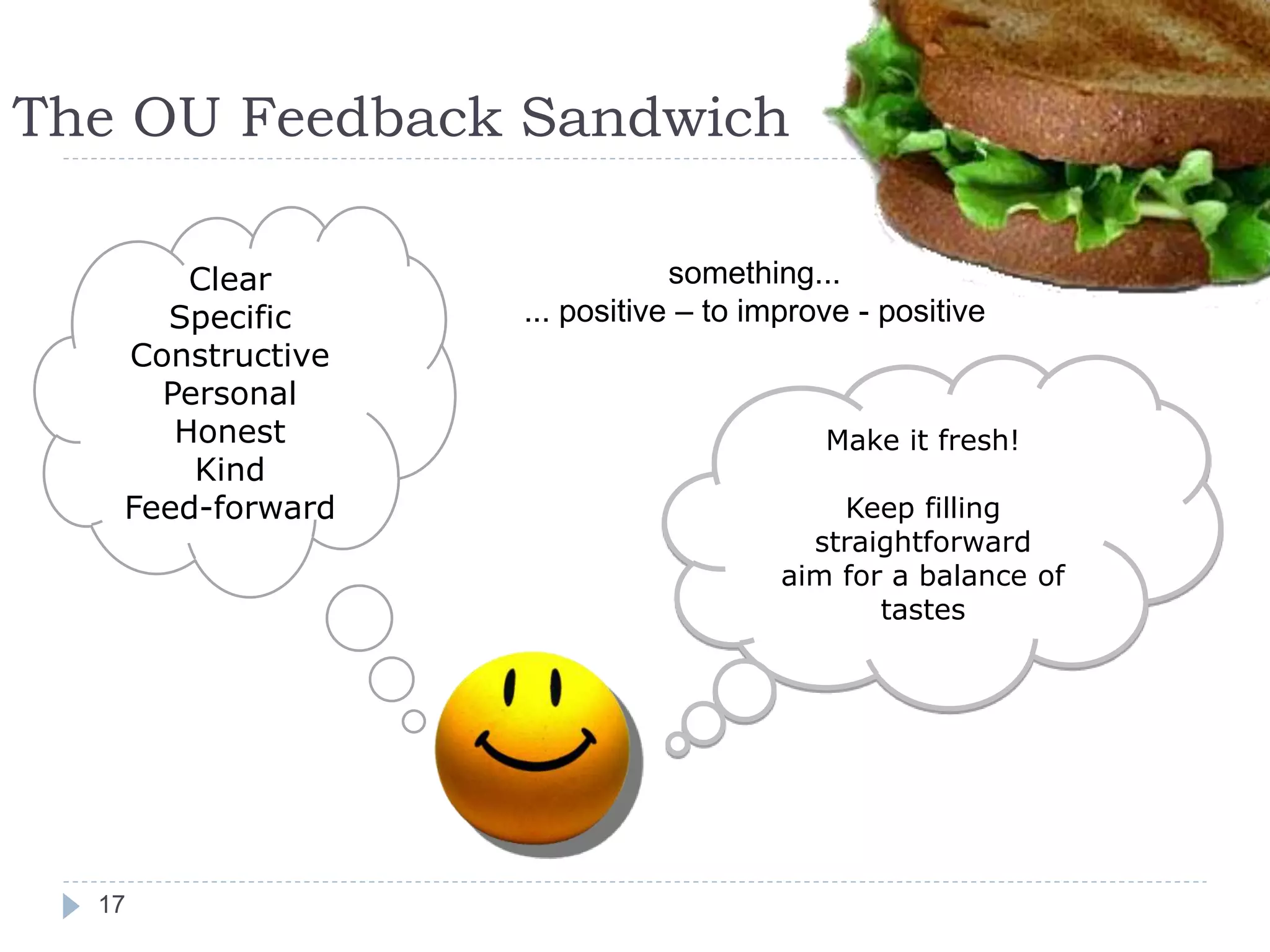
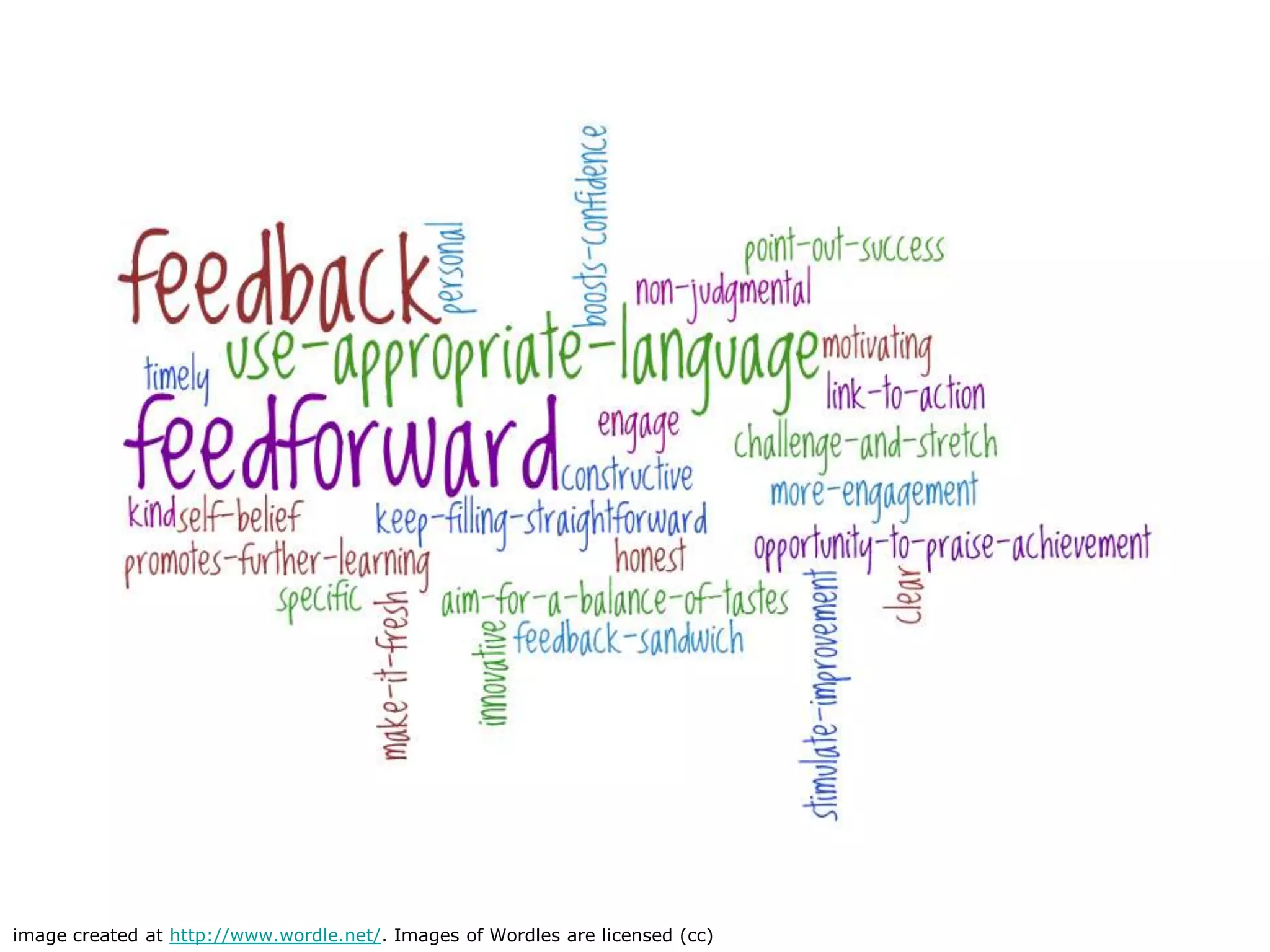
The OU Feedback Sandwich

       Clear                  something...
     Specific     ... positive – to improve - positive
   Constructive
     Personal
      Honest                             Make it fresh!
       Kind
   Feed-forward                           Keep filling
                                        straightforward
                                      aim for a balance of
                                             tastes


  17
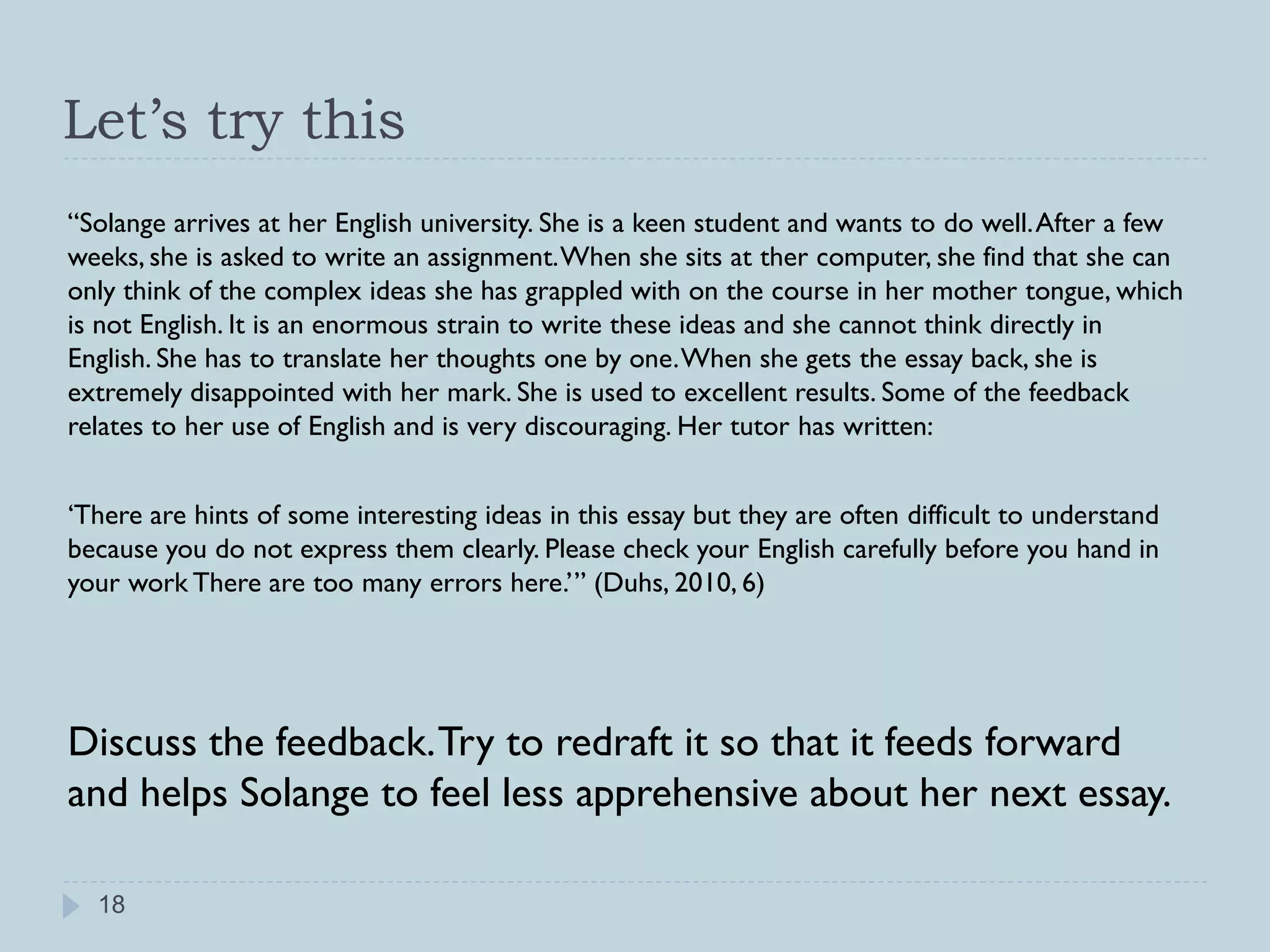
Let’s try this
“Solange arrives at her English university. She is a keen student and wants to do well. After a few
weeks, she is asked to write an assignment. When she sits at ther computer, she find that she can
only think of the complex ideas she has grappled with on the course in her mother tongue, which
is not English. It is an enormous strain to write these ideas and she cannot think directly in
English. She has to translate her thoughts one by one. When she gets the essay back, she is
extremely disappointed with her mark. She is used to excellent results. Some of the feedback
relates to her use of English and is very discouraging. Her tutor has written:


„There are hints of some interesting ideas in this essay but they are often difficult to understand
because you do not express them clearly. Please check your English carefully before you hand in
your work There are too many errors here.‟” (Duhs, 2010, 6)


Discuss the feedback. Try to redraft it so that it feeds forward
and helps Solange to feel less apprehensive about her next essay.

  18
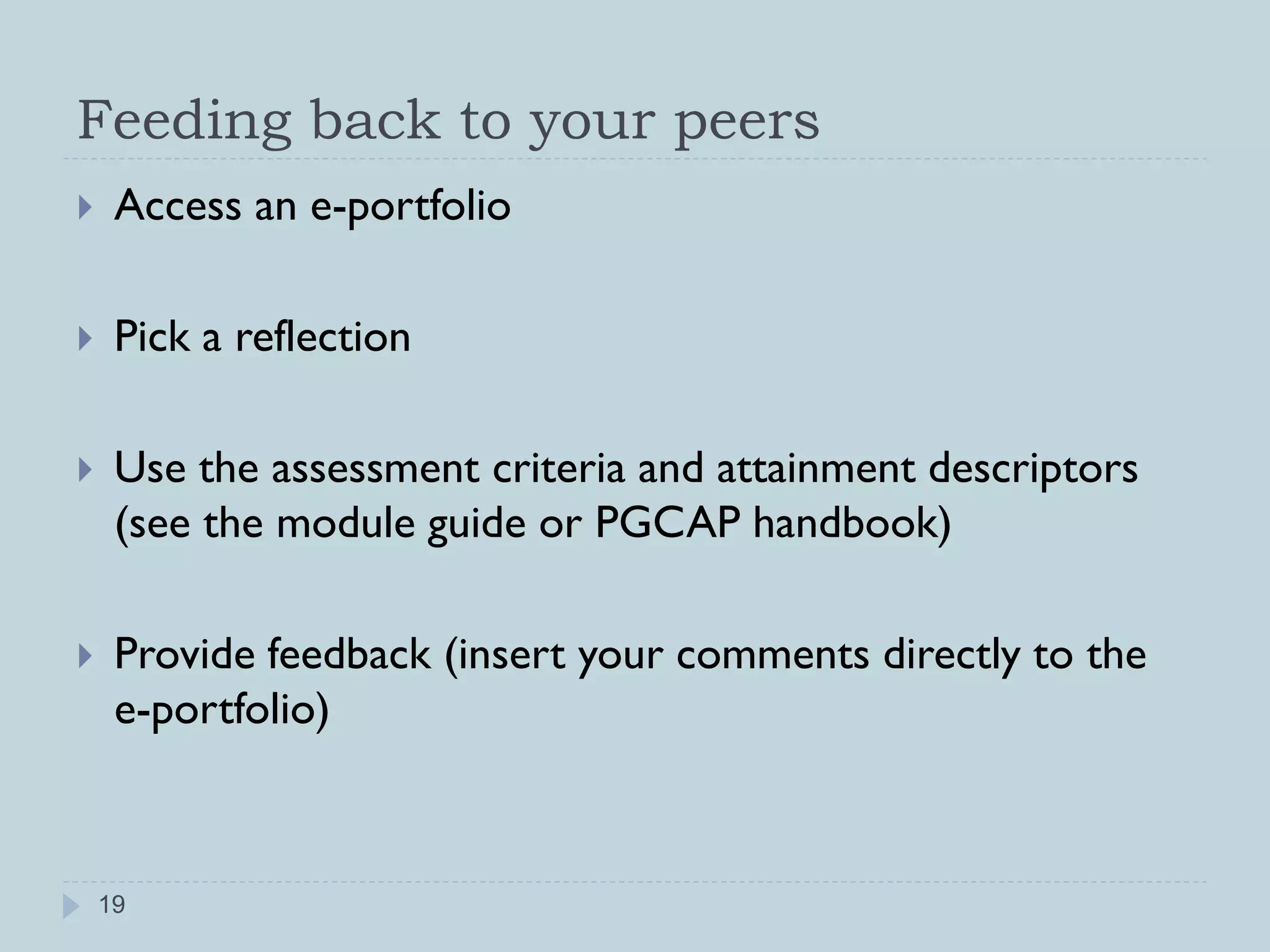
Feeding back to your peers
    Access an e-portfolio

    Pick a reflection

    Use the assessment criteria and attainment descriptors
     (see the module guide or PGCAP handbook)

    Provide feedback (insert your comments directly to the
     e-portfolio)


    19
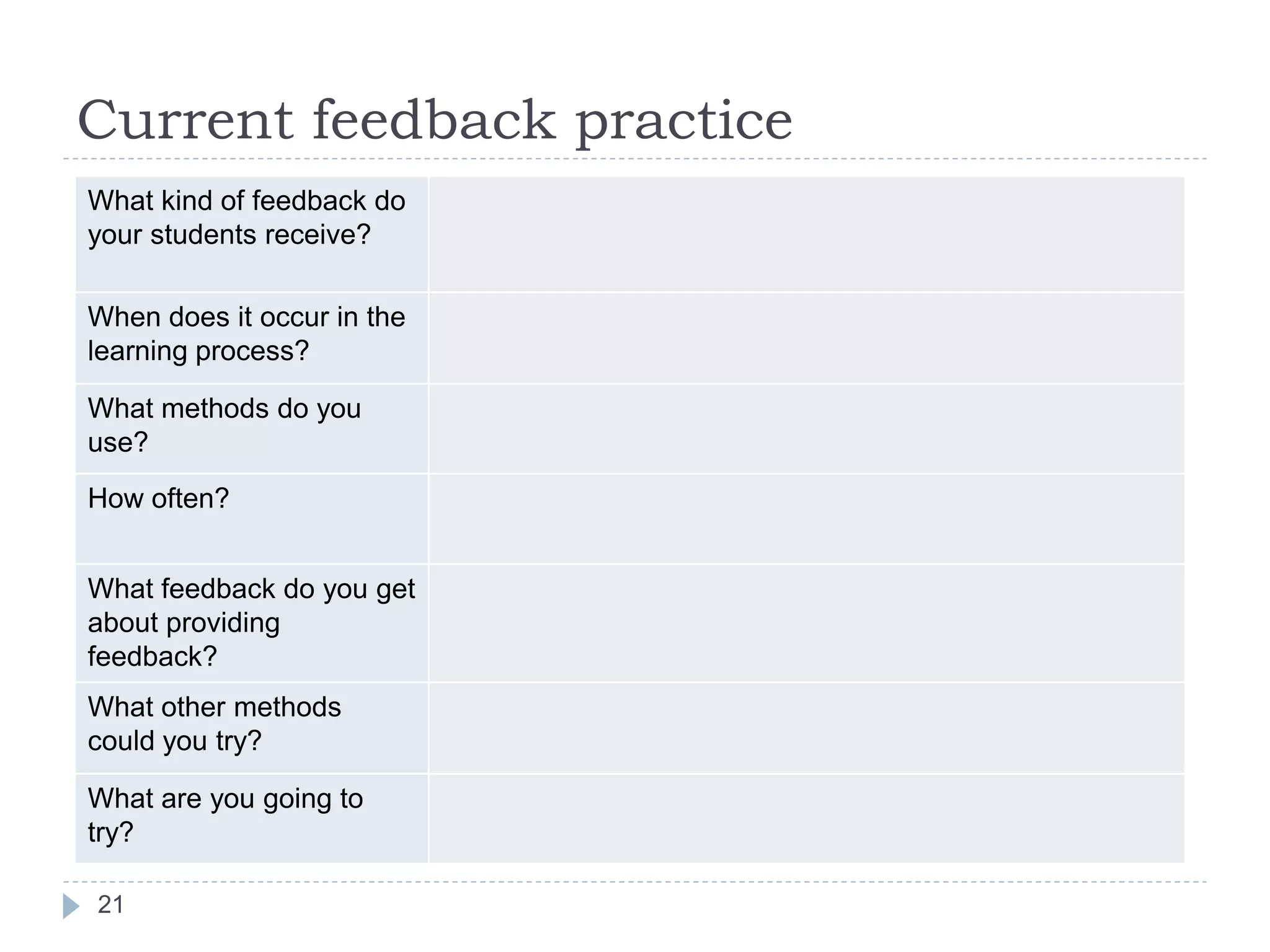
Current feedback practice
What kind of feedback do
your students receive?

When does it occur in the
learning process?

What methods do you
use?
How often?


What feedback do you get
about providing
feedback?
What other methods
could you try?

What are you going to
try?

21
1 min paper
    What are the 3 things you are taking away today?


    22
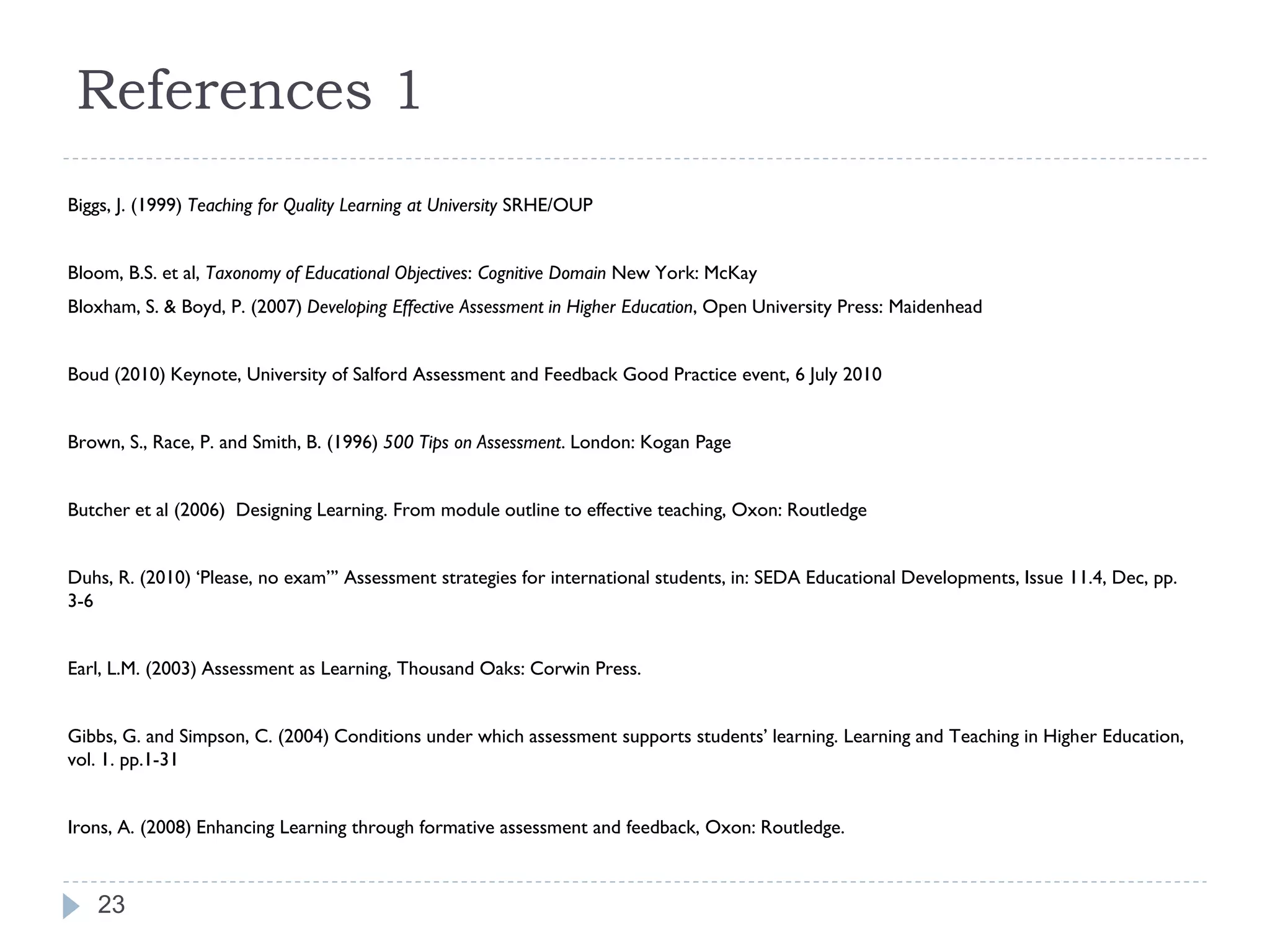
References 1
Biggs, J. (1999) Teaching for Quality Learning at University SRHE/OUP


Bloom, B.S. et al, Taxonomy of Educational Objectives: Cognitive Domain New York: McKay
Bloxham, S. & Boyd, P. (2007) Developing Effective Assessment in Higher Education, Open University Press: Maidenhead


Boud (2010) Keynote, University of Salford Assessment and Feedback Good Practice event, 6 July 2010


Brown, S., Race, P. and Smith, B. (1996) 500 Tips on Assessment. London: Kogan Page


Butcher et al (2006) Designing Learning. From module outline to effective teaching, Oxon: Routledge


Duhs, R. (2010) „Please, no exam”‟ Assessment strategies for international students, in: SEDA Educational Developments, Issue 11.4, Dec, pp.
3-6


Earl, L.M. (2003) Assessment as Learning, Thousand Oaks: Corwin Press.


Gibbs, G. and Simpson, C. (2004) Conditions under which assessment supports students‟ learning. Learning and Teaching in Higher Education,
vol. 1. pp.1-31


Irons, A. (2008) Enhancing Learning through formative assessment and feedback, Oxon: Routledge.


   23
References 2

Juwah, C. et.al (2004) Enhancing student learning through
effective formative feedback. HEA. At
http://www.heacademy.ac.uk/assets/York/documents/res
ources/resourcedatabase/id353_senlef_guide.pdf

Knight, P. T. (2002) Summative assessment and higher education:
practices in disarray, in: Studies in Higher Education, 27, 3, pp.
275-286.

Price (2007) „Should we be giving less written feedback?‟ in
Centre for Biosciences Bulletin Autumn 2007, HEA

Schofield, M. (2010) “Taking the „ass‟ out of assessment”
[keynote], First level assessment project conference, 16th June
2010, LeedsMet university

 24
assessment and feedback

                        extras


25
How?

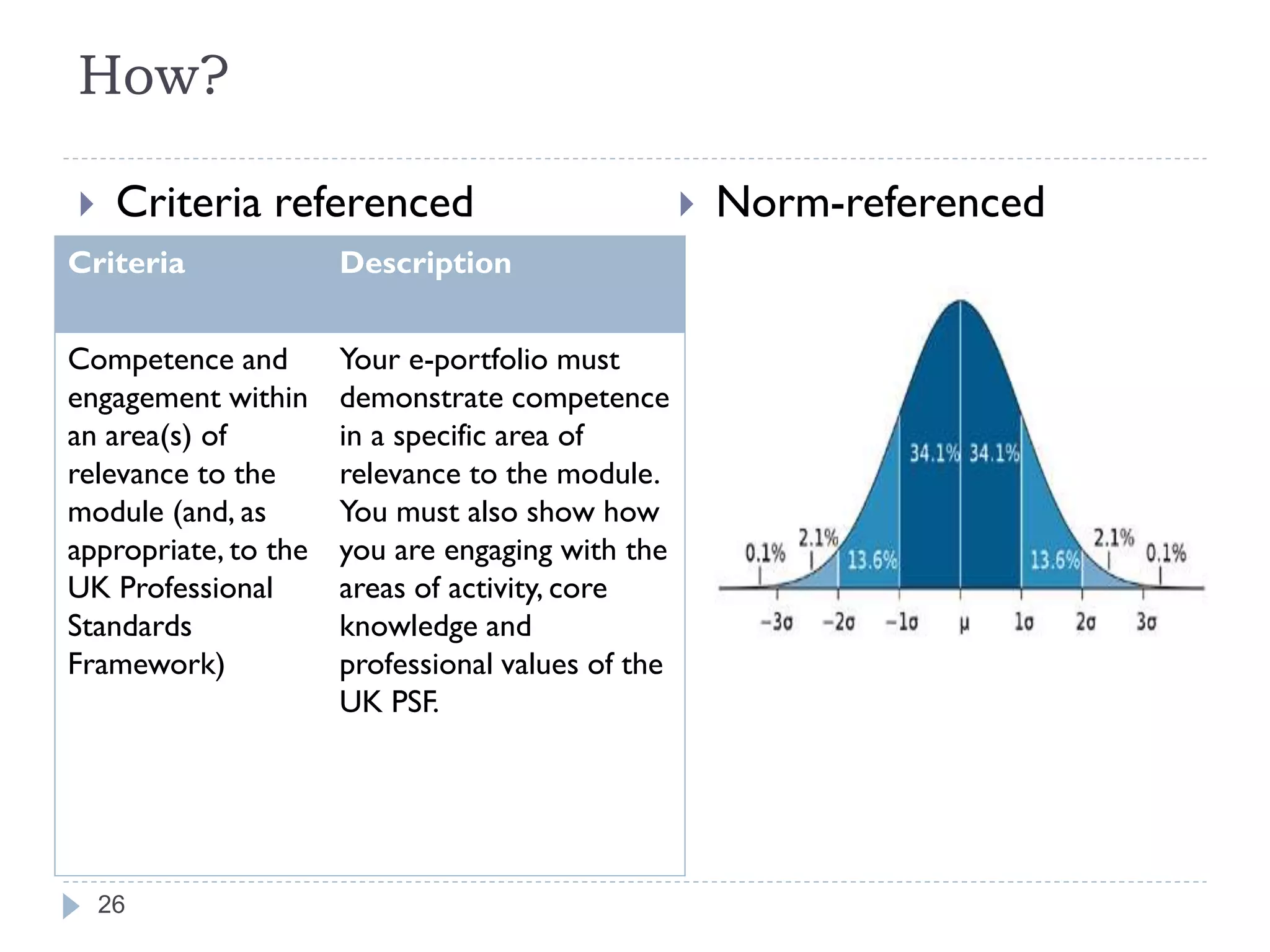
    Criteria referenced                              Norm-referenced
Criteria              Description


Competence and        Your e-portfolio must
engagement within     demonstrate competence
an area(s) of         in a specific area of
relevance to the      relevance to the module.
module (and, as       You must also show how
appropriate, to the   you are engaging with the
UK Professional       areas of activity, core
Standards             knowledge and
Framework)            professional values of the
                      UK PSF.


    26
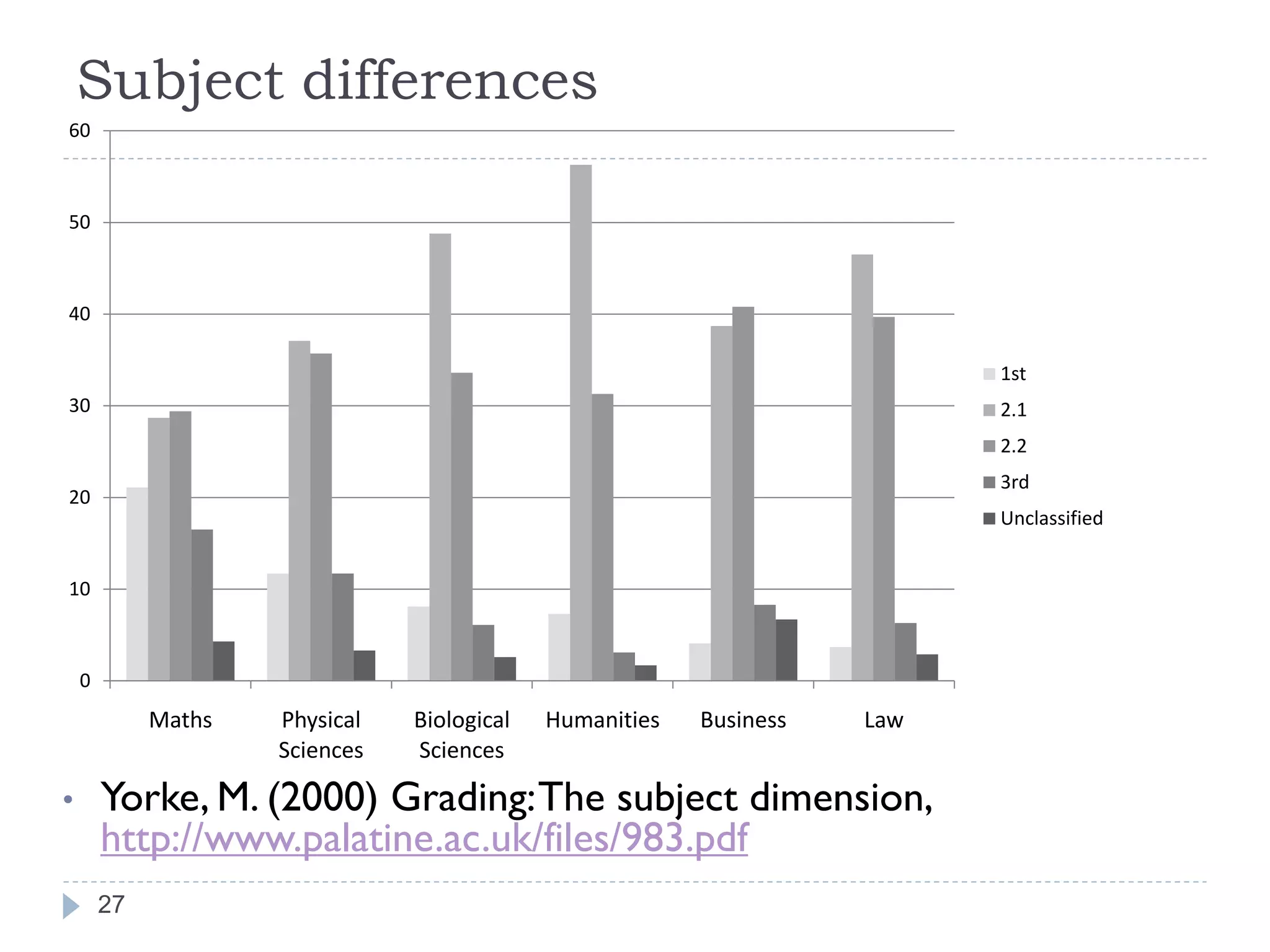
Subject differences
60


50


40

                                                                           1st
30                                                                         2.1
                                                                           2.2
                                                                           3rd
20
                                                                           Unclassified


10


    0
             Maths   Physical   Biological   Humanities   Business   Law
                     Sciences   Sciences

•       Yorke, M. (2000) Grading: The subject dimension,
        http://www.palatine.ac.uk/files/983.pdf
        27
… and
    Marks for coursework are usually higher than marks for
     exams, most notably in biology, business, computing & law.

    Bridges (2000) Relative performance in coursework and
     examinations, http://www.palatine.ac.uk/files/992.pdf


    28
Self- and peer-assessment
•    Learners need training in order to benefit
     –   Exposing their own work to others
     –   Being critical of others
     –   Seeing benefit for effort
     –   Understanding standards required
•    Skills needed by graduates for working and learning
     lives
     –   Self-efficacy
     –   Metacognition
•    Potential to minimise staff costs/time (efficiency)

    29
flashcards


30
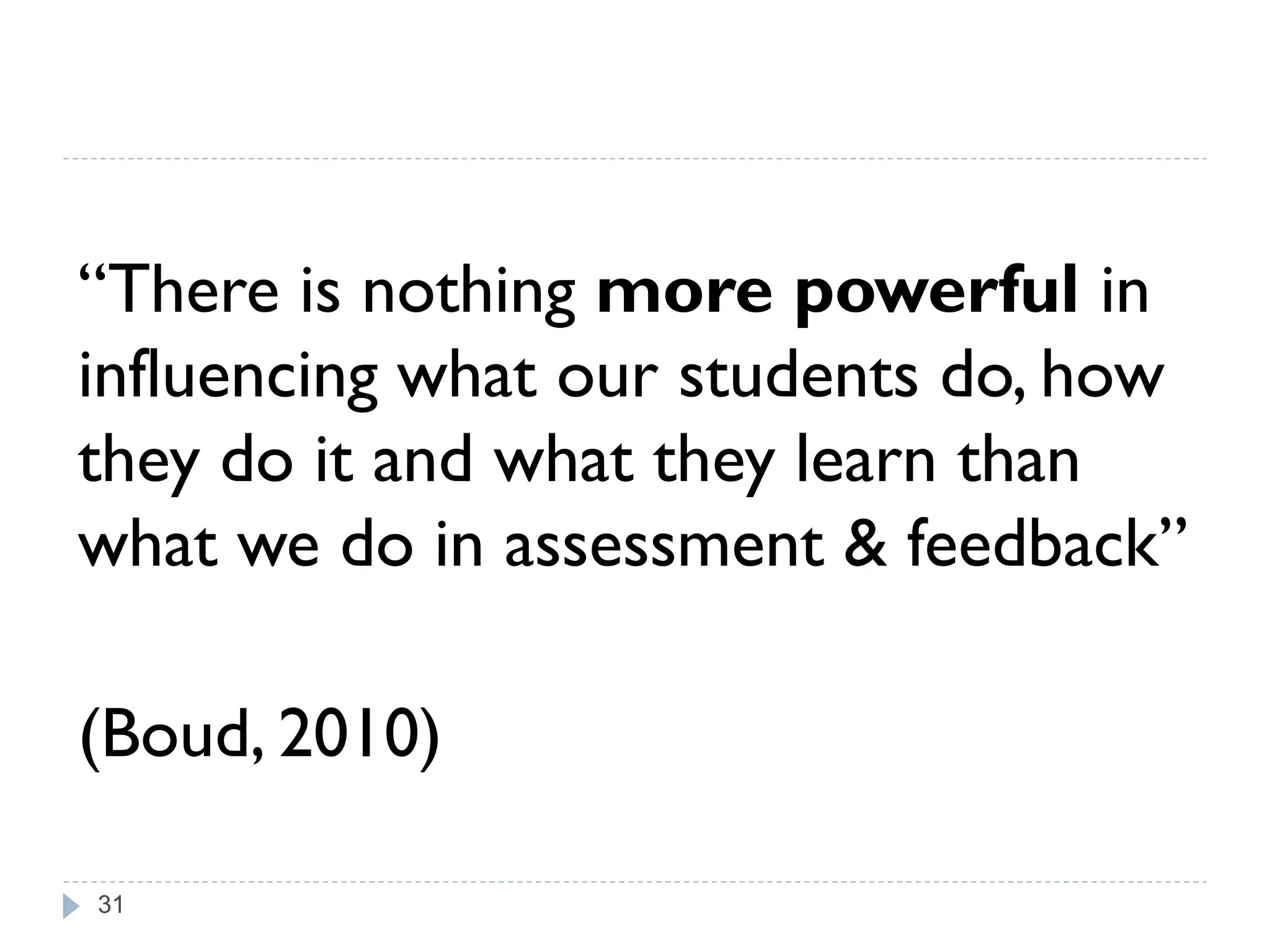
“There is nothing more powerful in
influencing what our students do, how
they do it and what they learn than
what we do in assessment & feedback”

(Boud, 2010)

31
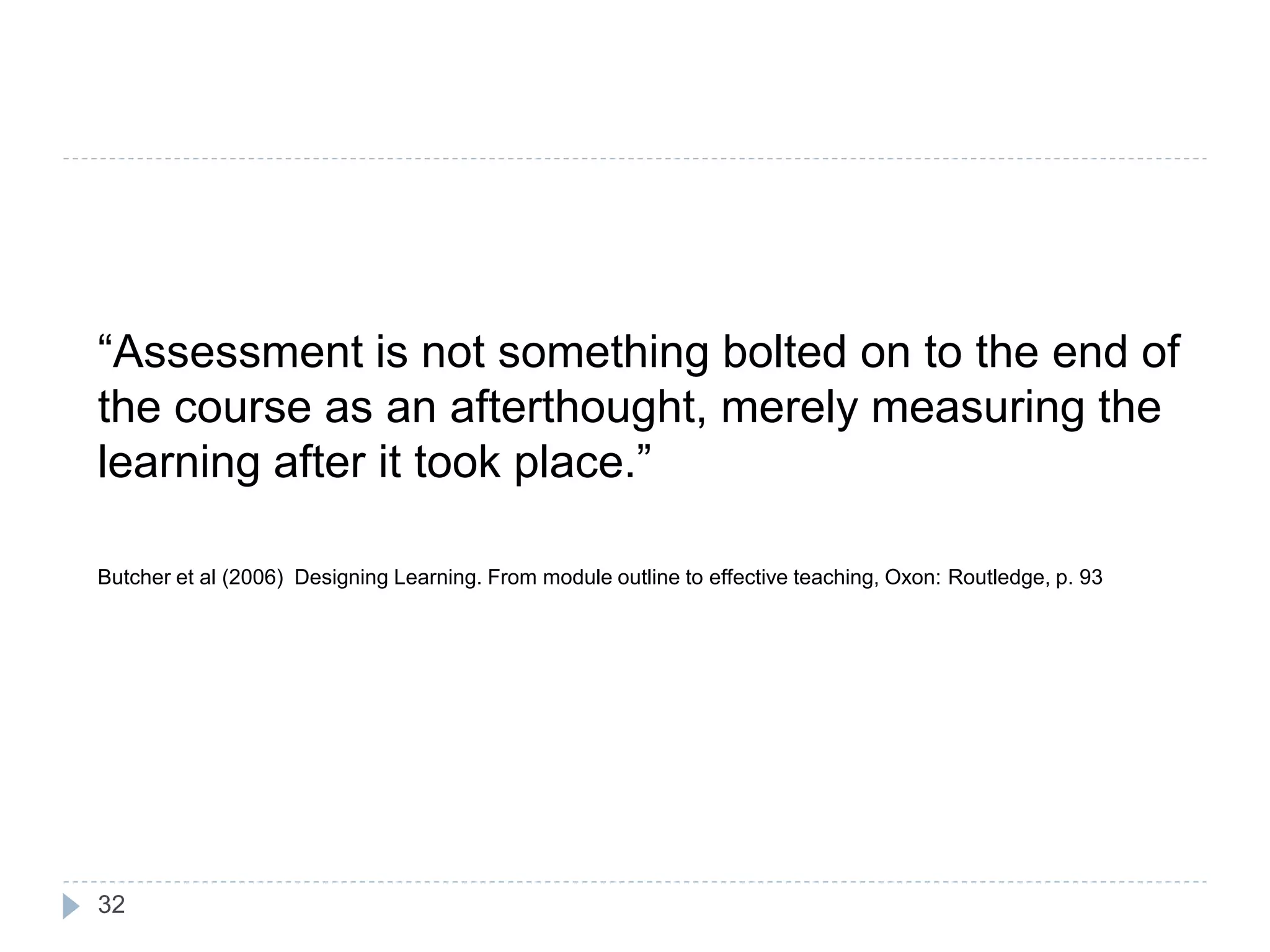
“Assessment is not something bolted on to the end of
the course as an afterthought, merely measuring the
learning after it took place.”

Butcher et al (2006) Designing Learning. From module outline to effective teaching, Oxon: Routledge, p. 93


32
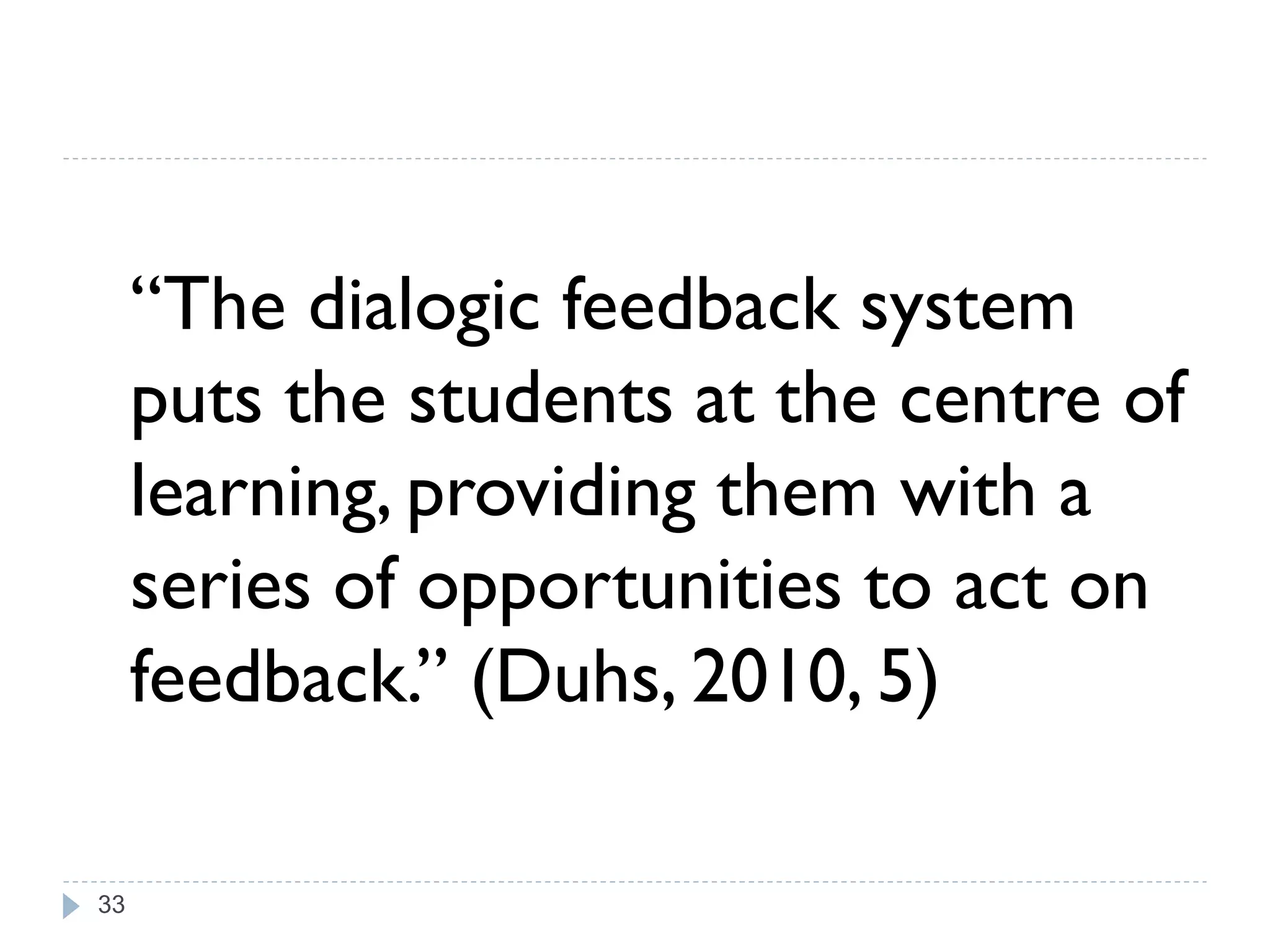
“The dialogic feedback system
     puts the students at the centre of
     learning, providing them with a
     series of opportunities to act on
     feedback.” (Duhs, 2010, 5)

33
“Non-authentic assessments produce non-authentic curriculum, regardless of what the
validated curriculum claims. This is serious in systems mandated to evoke complex student
learning, as when governments expect universities to develop four dimensions of employability
in students; namely, subject understanding, skills, robust self-theories and re•
                                                                               ective or
metacognitive casts of mind. There is a real danger that the frustrations of trying to assess
such accomplishments in reliable ways will lead to the use of national, content-free tests, such
as American College Test (ACT), Graduate Record Examination (GRE) and Graduate
Management Admissions Test (GMAT), as proxies for sound authentic assessment. Not
only is their predictive validity in doubt (Sternberg, 1997), but if students concentrate on
becoming test-smart, the tests‟ consequential validity decreases because they actually distract
students from the curriculum designed to teach those things that the tests claim to measure
by proxy.”


(Knight, 2002, p. 281)


 34
image created at http://www.wordle.net/. Images of Wordles are licensed (cc)

CoreSep11: assessment_and_feedback

  • 1.
    add the assessmentapproaches you have used/are currently using to our tree on the flipchart assessment and feedback PGCAP, LTHE module 1
  • 2.
    Intended Learning Outcomes • to participate and collaborate in small group PBL • • to identify and critically analyse issues linked to the given PBL triggers • • to present findings to another team 2
  • 3.
    So what isProblem-Based Learning?  An introduction 3
  • 4.
    50-50 Why do we Why do students assess? want feedback? 4
  • 5.
    About assessment  “There is too much emphasis in higher education on summative assessment […] a shift away from the „testing‟ and judgement culture associated with summative assessment would alter the learning environment in higher education and provide positive student learning opportunities, encourage dialogue between teachers and students (and between students and students), enhance the learning experience, provide motivation for students by moving towards a formative assessment ethos and allow students to take responsibility and ownership for their learning and education.” (Irons, 2008, 8)  What does this mean for your practice?  How can Irons‟ approach be implemented?  Capture your thoughts on sticky notes and swap.  Discuss. 5
  • 6.
    PBL trigger assessment and feedback 6
  • 7.
    PBL trigger (part 1)“Just finished marking 150 essays, the one and only assignment for this challenging module. Can’t understand why students don’t do well! Is one essay too much? I have been using this essay title for the last 10 years – I love it! – and students just don’t seem to engage with it, not even the brighter ones, which is really strange! I have given the students an extensive reading list and during the lectures I always tell them that they can ask me if they don’t understand something. Not sure what I am doing wrong… Students have never complained about anything and the module evaluation is always positive. They had a whole month to write the essay… but I know that many just do it a few days before the handing in date. At least they hand it in I guess. (part 2) Writing feedback is hard work too! I don’t know these people. I see them 2h a week over 10 weeks and there are 150 of them in the lecture theatre. I find it really time consuming and am not sure if they read it. Am I wasting my time?” Please investigate the above carefully. Identify possible problems, then define your learning outcomes. Carry out research to resolve the issues identified. You will be asked to present your findings to another group and engage in a conversation about these. Please work together and apply the 5-stage PBL model in your investigation. Please remember that you will be working together. Co-ordinate team activities and assign roles, such as chair, reader, scribe and timekeeper. Check out the PBL roles tab to see what each role involves. A PBL facilitator will help you to get started. Please also access the PBL resources to familiarise yourself further with PBL and ask your facilitator if you are unsure about something. You are welcome to use some of the resources made available. 7
  • 8.
    From when… Types ofassessment … to why  Formative: during module,  High-stakes and Low-stakes forward looking, should (Knight, 2002) change our teaching, aims to improve learning –  Assessment as a communicative assessment FOR learning. practice, sense-making and claim-making  Summative: end of module, measurement /grading /  Authentic assessment competence – assessment OF learning  (portfolios)  “Not everything that can be counted counts, and not everything that counts can be counted. ” Einstein 10
  • 9.
    Think: What isit you want to assess? Is it product or process that is to be assessed? Is it specific subject knowledge… or is it how well students can use information? Is it individual effort or team effort that is to be assessed? Is it teaching or learning that is to be assessed? Is assessment ….formative or summative? Brown, S., Race, P. and Smith, B. 1996: 18-19 Are you promoting a deep or surface approach to learning? Are you encouraging learners to be strategic? Who is assessing, how and why? Can technology be used? 11
  • 10.
    Good Practice?  Avoid  Generic assessment questions  repeating the same questions / task every year  bunching all assignments at the end of the semester  setting tasks that require information that is easily obtained from Google searches.  Do  personalised tasks  collaborative tasks  self- and peer assessment and feedback opportunities (benefits/challenges?)  performance assessment  reflection  real-life & contemporary situations 12
  • 11.
    Create… • … a portrait of the person who is sitting next to you • Show portrait to the person you created • Person on the portrait to provide feedback to the artist 13
  • 12.
    Feedback, the studentvoice (HEA clip) watch „n‟ discuss http://www.heacademy.ac.uk/ourwork/teachingandlearning/assessment/alldi splay?type=resources&newid=resource_database/audioandvideo/assessm ent_and_feedback_student_views&site=york 14
  • 13.
    The seven principlesof good feedback practice 1. Facilitates the development of self–assessment (reflection) in learning. 2. Encourages teacher and peer dialogue around learning. 3. Helps clarify what good performance is. 4. Provides opportunities to close the gap between current and desired performance. 5. Delivers high quality information to students about their learning. 6. Encourages positive motivational beliefs and self-esteem. 7. Provides information to teachers that can be used to help shape teaching. Juwah et.al.(2004) 15
  • 14.
    Feedback • tutor > individual student • tutor > group of students • student A > student A (self-evaluation) • student A > student B • students > students (usually called evaluation) • student > tutor • students > tutor • Use technology? 16
  • 15.
    The OU FeedbackSandwich Clear something... Specific ... positive – to improve - positive Constructive Personal Honest Make it fresh! Kind Feed-forward Keep filling straightforward aim for a balance of tastes 17
  • 16.
    Let’s try this “Solangearrives at her English university. She is a keen student and wants to do well. After a few weeks, she is asked to write an assignment. When she sits at ther computer, she find that she can only think of the complex ideas she has grappled with on the course in her mother tongue, which is not English. It is an enormous strain to write these ideas and she cannot think directly in English. She has to translate her thoughts one by one. When she gets the essay back, she is extremely disappointed with her mark. She is used to excellent results. Some of the feedback relates to her use of English and is very discouraging. Her tutor has written: „There are hints of some interesting ideas in this essay but they are often difficult to understand because you do not express them clearly. Please check your English carefully before you hand in your work There are too many errors here.‟” (Duhs, 2010, 6) Discuss the feedback. Try to redraft it so that it feeds forward and helps Solange to feel less apprehensive about her next essay. 18
  • 17.
    Feeding back toyour peers  Access an e-portfolio  Pick a reflection  Use the assessment criteria and attainment descriptors (see the module guide or PGCAP handbook)  Provide feedback (insert your comments directly to the e-portfolio) 19
  • 18.
    Current feedback practice Whatkind of feedback do your students receive? When does it occur in the learning process? What methods do you use? How often? What feedback do you get about providing feedback? What other methods could you try? What are you going to try? 21
  • 19.
    1 min paper  What are the 3 things you are taking away today? 22
  • 20.
    References 1 Biggs, J.(1999) Teaching for Quality Learning at University SRHE/OUP Bloom, B.S. et al, Taxonomy of Educational Objectives: Cognitive Domain New York: McKay Bloxham, S. & Boyd, P. (2007) Developing Effective Assessment in Higher Education, Open University Press: Maidenhead Boud (2010) Keynote, University of Salford Assessment and Feedback Good Practice event, 6 July 2010 Brown, S., Race, P. and Smith, B. (1996) 500 Tips on Assessment. London: Kogan Page Butcher et al (2006) Designing Learning. From module outline to effective teaching, Oxon: Routledge Duhs, R. (2010) „Please, no exam”‟ Assessment strategies for international students, in: SEDA Educational Developments, Issue 11.4, Dec, pp. 3-6 Earl, L.M. (2003) Assessment as Learning, Thousand Oaks: Corwin Press. Gibbs, G. and Simpson, C. (2004) Conditions under which assessment supports students‟ learning. Learning and Teaching in Higher Education, vol. 1. pp.1-31 Irons, A. (2008) Enhancing Learning through formative assessment and feedback, Oxon: Routledge. 23
  • 21.
    References 2 Juwah, C.et.al (2004) Enhancing student learning through effective formative feedback. HEA. At http://www.heacademy.ac.uk/assets/York/documents/res ources/resourcedatabase/id353_senlef_guide.pdf Knight, P. T. (2002) Summative assessment and higher education: practices in disarray, in: Studies in Higher Education, 27, 3, pp. 275-286. Price (2007) „Should we be giving less written feedback?‟ in Centre for Biosciences Bulletin Autumn 2007, HEA Schofield, M. (2010) “Taking the „ass‟ out of assessment” [keynote], First level assessment project conference, 16th June 2010, LeedsMet university 24
  • 22.
  • 23.
    How?  Criteria referenced  Norm-referenced Criteria Description Competence and Your e-portfolio must engagement within demonstrate competence an area(s) of in a specific area of relevance to the relevance to the module. module (and, as You must also show how appropriate, to the you are engaging with the UK Professional areas of activity, core Standards knowledge and Framework) professional values of the UK PSF. 26
  • 24.
    Subject differences 60 50 40 1st 30 2.1 2.2 3rd 20 Unclassified 10 0 Maths Physical Biological Humanities Business Law Sciences Sciences • Yorke, M. (2000) Grading: The subject dimension, http://www.palatine.ac.uk/files/983.pdf 27
  • 25.
    … and  Marks for coursework are usually higher than marks for exams, most notably in biology, business, computing & law.  Bridges (2000) Relative performance in coursework and examinations, http://www.palatine.ac.uk/files/992.pdf 28
  • 26.
    Self- and peer-assessment • Learners need training in order to benefit – Exposing their own work to others – Being critical of others – Seeing benefit for effort – Understanding standards required • Skills needed by graduates for working and learning lives – Self-efficacy – Metacognition • Potential to minimise staff costs/time (efficiency) 29
  • 27.
  • 28.
    “There is nothingmore powerful in influencing what our students do, how they do it and what they learn than what we do in assessment & feedback” (Boud, 2010) 31
  • 29.
    “Assessment is notsomething bolted on to the end of the course as an afterthought, merely measuring the learning after it took place.” Butcher et al (2006) Designing Learning. From module outline to effective teaching, Oxon: Routledge, p. 93 32
  • 30.
    “The dialogic feedbacksystem puts the students at the centre of learning, providing them with a series of opportunities to act on feedback.” (Duhs, 2010, 5) 33
  • 31.
    “Non-authentic assessments producenon-authentic curriculum, regardless of what the validated curriculum claims. This is serious in systems mandated to evoke complex student learning, as when governments expect universities to develop four dimensions of employability in students; namely, subject understanding, skills, robust self-theories and re• ective or metacognitive casts of mind. There is a real danger that the frustrations of trying to assess such accomplishments in reliable ways will lead to the use of national, content-free tests, such as American College Test (ACT), Graduate Record Examination (GRE) and Graduate Management Admissions Test (GMAT), as proxies for sound authentic assessment. Not only is their predictive validity in doubt (Sternberg, 1997), but if students concentrate on becoming test-smart, the tests‟ consequential validity decreases because they actually distract students from the curriculum designed to teach those things that the tests claim to measure by proxy.” (Knight, 2002, p. 281) 34
  • 32.
    image created athttp://www.wordle.net/. Images of Wordles are licensed (cc)