www.minedu.govt.nz
© New Zealand Ministry of Education 2009 - copying restricted to use by New Zealand education sector.
Page 1
Reflection
www.minedu.govt.nz
© New Zealand Ministry of Education 2009 - copying restricted to use by New Zealand education sector.
Page 2
Reflective learners assimilate new learning, relate it to
what they already know, adapt it for their own
purposes, and translate thought into action. Over
time, they develop their creativity, their ability to think
critically about information and ideas, and their
metacognitive ability (that is, their ability to think
about their own thinking).
Effective Pedagogy, NZ Curriculum p. 34
www.minedu.govt.nz
© New Zealand Ministry of Education 2009 - copying restricted to use by New Zealand education sector.
Page 3
Reflection is about becoming aware of your own thinking
processes, and being able to make those transparent to others.
Reflection captures the idea that if a gap is found between how we
would want teaching and learning to be and how it actually is,
then something will be done to close that gap; it is not enough
just to reflect or identify that there is a gap.
Teachers themselves can become reflective practitioners who
reflect with their students on the teaching and learning process,
and teach their students to use reflective strategies to
strengthen their own capacity to learn.
Absolum, M. pp 142-143
www.minedu.govt.nz
© New Zealand Ministry of Education 2009 - copying restricted to use by New Zealand education sector.
Page 4
You can use this presentation to:
• Update, review and/or reflect on the formative
assessment practices of Reflection in your classroom or
school
• Use as a resource for exploring professional
development in Reflection/metacognition.
In the presentation you can:
• clarify the purpose and value of reflecting on the
learning and the learning process
• identify strategies that teachers can use when teaching
students how to reflect.
www.minedu.govt.nz
© New Zealand Ministry of Education 2009 - copying restricted to use by New Zealand education sector.
Page 5
Reflection asks and answers the question:
“How is my learning going?”
Reflection assesses the ‘why’ and ‘how’ of the
learning and what to do as a result.
Prior to reflection, students must self assess
against criteria. This addresses the ‘what’ of the
learning and the learning process.
www.minedu.govt.nz
© New Zealand Ministry of Education 2009 - copying restricted to use by New Zealand education sector.
Page 6
Reflection - why the emphasis ?
“Powerful learners are reflective. They are able to step
back and take stock of progress. They are able to mull
over their actions and consider how they might have done
things differently. Good learners are self aware, able to
contemplate their actions to continually ‘grow’ their
learning power.”
Guy Claxton, from “What’s the Point of School?”
www.minedu.govt.nz
© New Zealand Ministry of Education 2009 - copying restricted to use by New Zealand education sector.
Page 7
A case for Reflection
• Reflection is a ‘metacognitive’ skill which is considered
integral to good learning.
• Reflection provides information for teachers and
students about the quality of the teaching and learning
taking place.
• Reflection is what enables teacher and students to co-
construct next learning.
• Students need to be able to reflect in order to ‘own’ or
make decisions about their learning.
• Students who can reflect are more likely to be engaged
in their learning.
• Reflection builds the learning-focused relationship.
www.minedu.govt.nz
© New Zealand Ministry of Education 2009 - copying restricted to use by New Zealand education sector.
Page 8
What is necessary , to ensure both teacher
and students become routinely reflective?
Making time for reflection
Planning opportunities for reflection
Training yourself and your students in reflective
techniques
www.minedu.govt.nz
© New Zealand Ministry of Education 2009 - copying restricted to use by New Zealand education sector.
Page 9
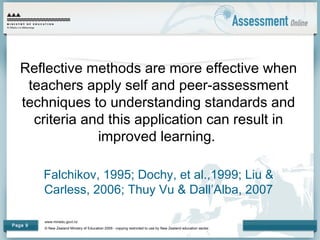
Reflective methods are more effective when
teachers apply self and peer-assessment
techniques to understanding standards and
criteria and this application can result in
improved learning.
Falchikov, 1995; Dochy, et al.,1999; Liu &
Carless, 2006; Thuy Vu & Dall’Alba, 2007
www.minedu.govt.nz
© New Zealand Ministry of Education 2009 - copying restricted to use by New Zealand education sector.
Page 10
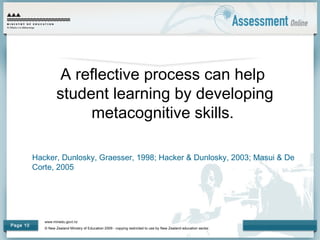
A reflective process can help
student learning by developing
metacognitive skills.
Hacker, Dunlosky, Graesser, 1998; Hacker & Dunlosky, 2003; Masui & De
Corte, 2005
www.minedu.govt.nz
© New Zealand Ministry of Education 2009 - copying restricted to use by New Zealand education sector.
Page 11
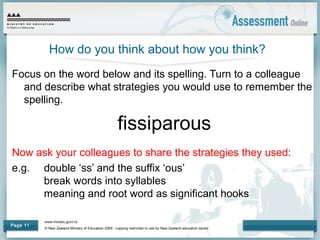
How do you think about how you think?
Focus on the word below and its spelling. Turn to a colleague
and describe what strategies you would use to remember the
spelling.
fissiparous
Now ask your colleagues to share the strategies they used:
e.g. double ‘ss’ and the suffix ‘ous’
break words into syllables
meaning and root word as significant hooks
www.minedu.govt.nz
© New Zealand Ministry of Education 2009 - copying restricted to use by New Zealand education sector.
Page 12
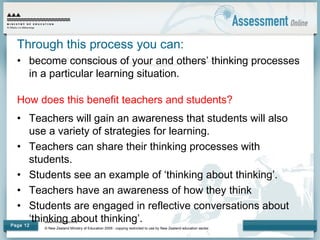
Through this process you can:
• become conscious of your and others’ thinking processes
in a particular learning situation.
How does this benefit teachers and students?
• Teachers will gain an awareness that students will also
use a variety of strategies for learning.
• Teachers can share their thinking processes with
students.
• Students see an example of ‘thinking about thinking’.
• Teachers have an awareness of how they think
• Students are engaged in reflective conversations about
‘thinking about thinking’.
www.minedu.govt.nz
© New Zealand Ministry of Education 2009 - copying restricted to use by New Zealand education sector.
Page 13
“Metacognition is what people know
or think about their own thought
processes and is the individual
monitoring of one’s own thoughts.”
(Hacker & Dunlosky,
2003)
www.minedu.govt.nz
© New Zealand Ministry of Education 2009 - copying restricted to use by New Zealand education sector.
Page 14
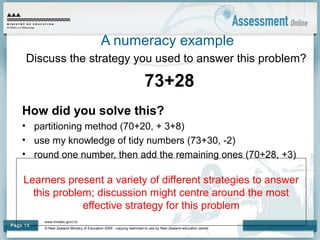
Learners present a variety of different strategies to answer
this problem; discussion might centre around the most
effective strategy for this problem
A numeracy example
Discuss the strategy you used to answer this problem?
73+28
How did you solve this?
• partitioning method (70+20, + 3+8)
• use my knowledge of tidy numbers (73+30, -2)
• round one number, then add the remaining ones (70+28, +3)
www.minedu.govt.nz
© New Zealand Ministry of Education 2009 - copying restricted to use by New Zealand education sector.
Page 15
You can take the learning further, by reflecting or
thinking metacognitively about the strategy
used:
Was it easy or hard?
What helped you?
How would you do it next time?
Why will you change the way you solve it?
This leads on to identifying the ‘where to
next’ with the learning
Do I need to change my way of learning?
Where do we go from here?
www.minedu.govt.nz
© New Zealand Ministry of Education 2009 - copying restricted to use by New Zealand education sector.
Page 16
Reflection for students works best at the end
of a lesson:
• to consolidate the learning
• to recap on the ‘why’ of the learning
• to give students opportunities to discuss
strategies for learning, and possible ‘tricky’
bits
• to establish a ‘where to from here’
and a recap at the beginning of a lesson is
very effective too.
www.minedu.govt.nz
© New Zealand Ministry of Education 2009 - copying restricted to use by New Zealand education sector.
Page 17
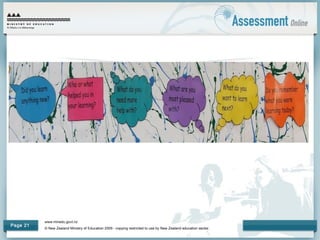
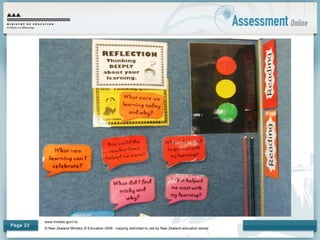
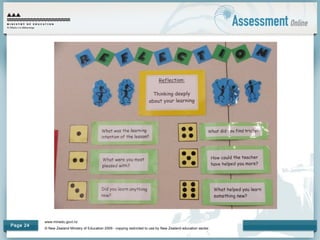
Some possible reflective questions
• What were you learning and why?
• How did the learning go? What were the tricky
bits and why?
• What new learning can we celebrate?
• What helped the learning to happen?
• Who needs more help and what needs to be re-
taught?
from Clarity in the Classroom
by Michael Absolum
www.minedu.govt.nz
© New Zealand Ministry of Education 2009 - copying restricted to use by New Zealand education sector.
Page 18
You will probably have to train students to reflect
well (or at all!)
• If it’s a new process in your classroom, tell
students what’s happening and why.
• Model the type of answers you expect:
• To give students possible and appropriate
responses to reflective questions
• To show students that all learners find
things difficult.
www.minedu.govt.nz
© New Zealand Ministry of Education 2009 - copying restricted to use by New Zealand education sector.
Page 19
Possible process for active reflection
Getting started with reflection
• Re-cap the learning intention and success criteria
• Ask a reflective question
• Give students 15-30 seconds thinking time to:
• let them think!
• create the expectation that all take part
• Model appropriate responses (at first)
• Give students opportunities to respond:
• Whole class
• In groups
• In pairs
www.minedu.govt.nz
© New Zealand Ministry of Education 2009 - copying restricted to use by New Zealand education sector.
Page 20
And now?
Considerations for your classroom practice
• Where can this fit into the overall plan of the
learning?
• Where to next? As individuals and as a class
• Reflection is an assessment strategy that links with
and feeds back into planning
www.minedu.govt.nz
© New Zealand Ministry of Education 2009 - copying restricted to use by New Zealand education sector.
Page 21
www.minedu.govt.nz
© New Zealand Ministry of Education 2009 - copying restricted to use by New Zealand education sector.
Page 22
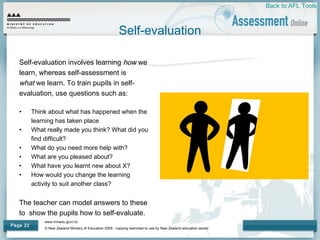
Self-evaluation
Self-evaluation involves learning how we
learn, whereas self-assessment is
what we learn. To train pupils in self-
evaluation, use questions such as:
• Think about what has happened when the
learning has taken place
• What really made you think? What did you
find difficult?
• What do you need more help with?
• What are you pleased about?
• What have you learnt new about X?
• How would you change the learning
activity to suit another class?
The teacher can model answers to these
to show the pupils how to self-evaluate.
Back to AFL Tools
www.minedu.govt.nz
© New Zealand Ministry of Education 2009 - copying restricted to use by New Zealand education sector.
Page 23
www.minedu.govt.nz
© New Zealand Ministry of Education 2009 - copying restricted to use by New Zealand education sector.
Page 24
www.minedu.govt.nz
© New Zealand Ministry of Education 2009 - copying restricted to use by New Zealand education sector.
Page 25
www.minedu.govt.nz
© New Zealand Ministry of Education 2009 - copying restricted to use by New Zealand education sector.
Page 26
Talk Partners
As a plenary or a starter
referring to the previous
lesson, students share
with a partner:
• three new things they have
learnt
• what they found easy
• what they found difficult
• something they would like
to learn in the future
Back to AFL Tools
www.minedu.govt.nz
© New Zealand Ministry of Education 2009 - copying restricted to use by New Zealand education sector.
Page 27
References and readings
Absolum, M. (2006). Clarity in the classroom. Auckland: Hodder Education.
pp.142 – 163.
Clarke, S. (2001). Unlocking formative assessment: Practical strategies for
enhancing pupils’ learning in the primary classroom. London: Hodder and
Stoughton. pp.39-49.
Claxton, G. (2008). What’s the point of school? Re-discovering the heart of
education. Oxford: Oneworld Publications.
Claxton, G. (2006). Expanding the Capacity to Learn: A new end for Education?
Conference Warwick University, September 6, 2006.
Discusses the teacher’s role in developing the students’ capacity for learning,
helping them to become better learners. Particularly pp.9-13.
Stoll, L., Fink, D., & Earl, L. RoutledgeFalmer (2002). It’s About Learning (and
it’s about time), Chapter 2, entitled ‘Learning about learning’.
Chapter of a text by international authors, discussing metacognition and the
science of learning.
 

Reflection

  • 1.
    www.minedu.govt.nz © New ZealandMinistry of Education 2009 - copying restricted to use by New Zealand education sector. Page 1 Reflection
  • 2.
    www.minedu.govt.nz © New ZealandMinistry of Education 2009 - copying restricted to use by New Zealand education sector. Page 2 Reflective learners assimilate new learning, relate it to what they already know, adapt it for their own purposes, and translate thought into action. Over time, they develop their creativity, their ability to think critically about information and ideas, and their metacognitive ability (that is, their ability to think about their own thinking). Effective Pedagogy, NZ Curriculum p. 34
  • 3.
    www.minedu.govt.nz © New ZealandMinistry of Education 2009 - copying restricted to use by New Zealand education sector. Page 3 Reflection is about becoming aware of your own thinking processes, and being able to make those transparent to others. Reflection captures the idea that if a gap is found between how we would want teaching and learning to be and how it actually is, then something will be done to close that gap; it is not enough just to reflect or identify that there is a gap. Teachers themselves can become reflective practitioners who reflect with their students on the teaching and learning process, and teach their students to use reflective strategies to strengthen their own capacity to learn. Absolum, M. pp 142-143
  • 4.
    www.minedu.govt.nz © New ZealandMinistry of Education 2009 - copying restricted to use by New Zealand education sector. Page 4 You can use this presentation to: • Update, review and/or reflect on the formative assessment practices of Reflection in your classroom or school • Use as a resource for exploring professional development in Reflection/metacognition. In the presentation you can: • clarify the purpose and value of reflecting on the learning and the learning process • identify strategies that teachers can use when teaching students how to reflect.
  • 5.
    www.minedu.govt.nz © New ZealandMinistry of Education 2009 - copying restricted to use by New Zealand education sector. Page 5 Reflection asks and answers the question: “How is my learning going?” Reflection assesses the ‘why’ and ‘how’ of the learning and what to do as a result. Prior to reflection, students must self assess against criteria. This addresses the ‘what’ of the learning and the learning process.
  • 6.
    www.minedu.govt.nz © New ZealandMinistry of Education 2009 - copying restricted to use by New Zealand education sector. Page 6 Reflection - why the emphasis ? “Powerful learners are reflective. They are able to step back and take stock of progress. They are able to mull over their actions and consider how they might have done things differently. Good learners are self aware, able to contemplate their actions to continually ‘grow’ their learning power.” Guy Claxton, from “What’s the Point of School?”
  • 7.
    www.minedu.govt.nz © New ZealandMinistry of Education 2009 - copying restricted to use by New Zealand education sector. Page 7 A case for Reflection • Reflection is a ‘metacognitive’ skill which is considered integral to good learning. • Reflection provides information for teachers and students about the quality of the teaching and learning taking place. • Reflection is what enables teacher and students to co- construct next learning. • Students need to be able to reflect in order to ‘own’ or make decisions about their learning. • Students who can reflect are more likely to be engaged in their learning. • Reflection builds the learning-focused relationship.
  • 8.
    www.minedu.govt.nz © New ZealandMinistry of Education 2009 - copying restricted to use by New Zealand education sector. Page 8 What is necessary , to ensure both teacher and students become routinely reflective? Making time for reflection Planning opportunities for reflection Training yourself and your students in reflective techniques
  • 9.
    www.minedu.govt.nz © New ZealandMinistry of Education 2009 - copying restricted to use by New Zealand education sector. Page 9 Reflective methods are more effective when teachers apply self and peer-assessment techniques to understanding standards and criteria and this application can result in improved learning. Falchikov, 1995; Dochy, et al.,1999; Liu & Carless, 2006; Thuy Vu & Dall’Alba, 2007
  • 10.
    www.minedu.govt.nz © New ZealandMinistry of Education 2009 - copying restricted to use by New Zealand education sector. Page 10 A reflective process can help student learning by developing metacognitive skills. Hacker, Dunlosky, Graesser, 1998; Hacker & Dunlosky, 2003; Masui & De Corte, 2005
  • 11.
    www.minedu.govt.nz © New ZealandMinistry of Education 2009 - copying restricted to use by New Zealand education sector. Page 11 How do you think about how you think? Focus on the word below and its spelling. Turn to a colleague and describe what strategies you would use to remember the spelling. fissiparous Now ask your colleagues to share the strategies they used: e.g. double ‘ss’ and the suffix ‘ous’ break words into syllables meaning and root word as significant hooks
  • 12.
    www.minedu.govt.nz © New ZealandMinistry of Education 2009 - copying restricted to use by New Zealand education sector. Page 12 Through this process you can: • become conscious of your and others’ thinking processes in a particular learning situation. How does this benefit teachers and students? • Teachers will gain an awareness that students will also use a variety of strategies for learning. • Teachers can share their thinking processes with students. • Students see an example of ‘thinking about thinking’. • Teachers have an awareness of how they think • Students are engaged in reflective conversations about ‘thinking about thinking’.
  • 13.
    www.minedu.govt.nz © New ZealandMinistry of Education 2009 - copying restricted to use by New Zealand education sector. Page 13 “Metacognition is what people know or think about their own thought processes and is the individual monitoring of one’s own thoughts.” (Hacker & Dunlosky, 2003)
  • 14.
    www.minedu.govt.nz © New ZealandMinistry of Education 2009 - copying restricted to use by New Zealand education sector. Page 14 Learners present a variety of different strategies to answer this problem; discussion might centre around the most effective strategy for this problem A numeracy example Discuss the strategy you used to answer this problem? 73+28 How did you solve this? • partitioning method (70+20, + 3+8) • use my knowledge of tidy numbers (73+30, -2) • round one number, then add the remaining ones (70+28, +3)
  • 15.
    www.minedu.govt.nz © New ZealandMinistry of Education 2009 - copying restricted to use by New Zealand education sector. Page 15 You can take the learning further, by reflecting or thinking metacognitively about the strategy used: Was it easy or hard? What helped you? How would you do it next time? Why will you change the way you solve it? This leads on to identifying the ‘where to next’ with the learning Do I need to change my way of learning? Where do we go from here?
  • 16.
    www.minedu.govt.nz © New ZealandMinistry of Education 2009 - copying restricted to use by New Zealand education sector. Page 16 Reflection for students works best at the end of a lesson: • to consolidate the learning • to recap on the ‘why’ of the learning • to give students opportunities to discuss strategies for learning, and possible ‘tricky’ bits • to establish a ‘where to from here’ and a recap at the beginning of a lesson is very effective too.
  • 17.
    www.minedu.govt.nz © New ZealandMinistry of Education 2009 - copying restricted to use by New Zealand education sector. Page 17 Some possible reflective questions • What were you learning and why? • How did the learning go? What were the tricky bits and why? • What new learning can we celebrate? • What helped the learning to happen? • Who needs more help and what needs to be re- taught? from Clarity in the Classroom by Michael Absolum
  • 18.
    www.minedu.govt.nz © New ZealandMinistry of Education 2009 - copying restricted to use by New Zealand education sector. Page 18 You will probably have to train students to reflect well (or at all!) • If it’s a new process in your classroom, tell students what’s happening and why. • Model the type of answers you expect: • To give students possible and appropriate responses to reflective questions • To show students that all learners find things difficult.
  • 19.
    www.minedu.govt.nz © New ZealandMinistry of Education 2009 - copying restricted to use by New Zealand education sector. Page 19 Possible process for active reflection Getting started with reflection • Re-cap the learning intention and success criteria • Ask a reflective question • Give students 15-30 seconds thinking time to: • let them think! • create the expectation that all take part • Model appropriate responses (at first) • Give students opportunities to respond: • Whole class • In groups • In pairs
  • 20.
    www.minedu.govt.nz © New ZealandMinistry of Education 2009 - copying restricted to use by New Zealand education sector. Page 20 And now? Considerations for your classroom practice • Where can this fit into the overall plan of the learning? • Where to next? As individuals and as a class • Reflection is an assessment strategy that links with and feeds back into planning
  • 21.
    www.minedu.govt.nz © New ZealandMinistry of Education 2009 - copying restricted to use by New Zealand education sector. Page 21
  • 22.
    www.minedu.govt.nz © New ZealandMinistry of Education 2009 - copying restricted to use by New Zealand education sector. Page 22 Self-evaluation Self-evaluation involves learning how we learn, whereas self-assessment is what we learn. To train pupils in self- evaluation, use questions such as: • Think about what has happened when the learning has taken place • What really made you think? What did you find difficult? • What do you need more help with? • What are you pleased about? • What have you learnt new about X? • How would you change the learning activity to suit another class? The teacher can model answers to these to show the pupils how to self-evaluate. Back to AFL Tools
  • 23.
    www.minedu.govt.nz © New ZealandMinistry of Education 2009 - copying restricted to use by New Zealand education sector. Page 23
  • 24.
    www.minedu.govt.nz © New ZealandMinistry of Education 2009 - copying restricted to use by New Zealand education sector. Page 24
  • 25.
    www.minedu.govt.nz © New ZealandMinistry of Education 2009 - copying restricted to use by New Zealand education sector. Page 25
  • 26.
    www.minedu.govt.nz © New ZealandMinistry of Education 2009 - copying restricted to use by New Zealand education sector. Page 26 Talk Partners As a plenary or a starter referring to the previous lesson, students share with a partner: • three new things they have learnt • what they found easy • what they found difficult • something they would like to learn in the future Back to AFL Tools
  • 27.
    www.minedu.govt.nz © New ZealandMinistry of Education 2009 - copying restricted to use by New Zealand education sector. Page 27 References and readings Absolum, M. (2006). Clarity in the classroom. Auckland: Hodder Education. pp.142 – 163. Clarke, S. (2001). Unlocking formative assessment: Practical strategies for enhancing pupils’ learning in the primary classroom. London: Hodder and Stoughton. pp.39-49. Claxton, G. (2008). What’s the point of school? Re-discovering the heart of education. Oxford: Oneworld Publications. Claxton, G. (2006). Expanding the Capacity to Learn: A new end for Education? Conference Warwick University, September 6, 2006. Discusses the teacher’s role in developing the students’ capacity for learning, helping them to become better learners. Particularly pp.9-13. Stoll, L., Fink, D., & Earl, L. RoutledgeFalmer (2002). It’s About Learning (and it’s about time), Chapter 2, entitled ‘Learning about learning’. Chapter of a text by international authors, discussing metacognition and the science of learning.