Reflected Intelligence: Evolving self-learning data systems
Trey Grainger
SVP of Engineering
Khalifeh AlJadda
Lead Data Scientist
Agenda
• Introductions
• Key Technologies
○ Hadoop, Spark, Solr, Cloud/AWS
• Information Retrieval Overview
○ Overview
○ Feedback Loops
• Reflected Intelligence Use Cases
○ Recommendations
○ Semantic Search / Query Intent
○ Learning to Rank
○ Search QA
• Conclusion
Introductions
Trey Grainger
SVP of Engineering
• Previously Director of Engineering @ CareerBuilder
• MBA, Management of Technology – Georgia Tech
• BA, Computer Science, Business, & Philosophy – Furman University
• Mining Massive Datasets (in progress) - Stanford University
Fun outside of CB:
• Co-author of Solr in Action, plus a handful of research papers
• Frequent conference speaker
• Founder of Celiaccess.com, the gluten-free search engine
• Lucene/Solr contributor
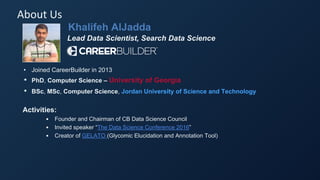
About Us
Khalifeh AlJadda
Lead Data Scientist, Search Data Science
• Joined CareerBuilder in 2013
• PhD, Computer Science – University of Georgia
• BSc, MSc, Computer Science, Jordan University of Science and Technology
Activities:
• Founder and Chairman of CB Data Science Council
• Invited speaker “The Data Science Conference 2016”
• Creator of GELATO (Glycomic Elucidation and Annotation Tool)
About Us
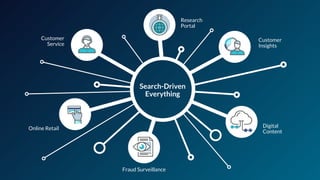
Search-Driven
Everything
Customer
Service
Customer
Insights
Fraud Surveillance
Research
Portal
Online Retail Digital
Content
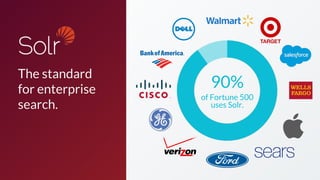
The standard
for enterprise
search.
of Fortune 500
uses Solr.
90%
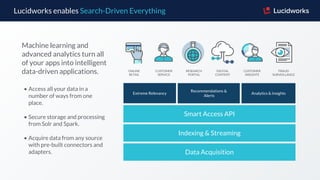
Lucidworks enables Search-Driven Everything
Data Acquisition
Indexing & Streaming
Smart Access API
Recommendations &
Alerts
Analytics & InsightsExtreme Relevancy
CUSTOMER
SERVICE
RESEARCH
PORTAL
DIGITAL
CONTENT
CUSTOMER
INSIGHTS
FRAUD
SURVEILLANCE
ONLINE
RETAIL
• Access all your data in a
number of ways from one
place.
• Secure storage and processing
from Solr and Spark.
• Acquire data from any source
with pre-built connectors and
adapters.
Machine learning and
advanced analytics turn all
of your apps into intelligent
data-driven applications.
Bay Area Search
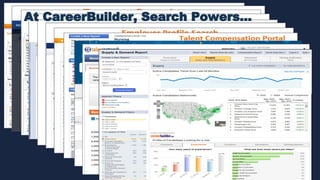
At CareerBuilder, Search Powers...At CareerBuilder, Search Powers...
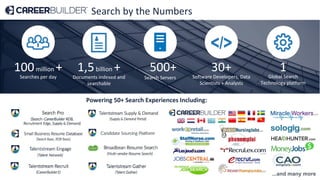
Search by the Numbers
14
Powering 50+ Search Experiences Including:
100million +
Searches per day
30+
Software Developers, Data
Scientists + Analysts
500+
Search Servers
1,5billion +
Documents indexed and
searchable
1
Global Search
Technology platform
...and many more
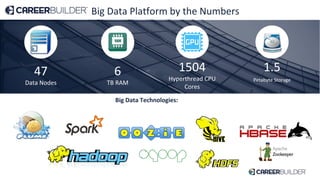
Big Data Platform by the Numbers
Big Data Technologies:
47
Data Nodes
1.5
Petabyte Storage
1504
Hyperthread CPU
Cores
6
TB RAM
what is “reflected intelligence”?
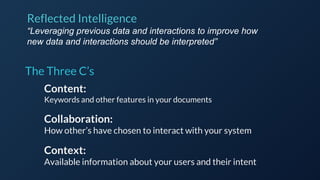
The Three C’s
Content:
Keywords and other features in your documents
Collaboration:
How other’s have chosen to interact with your system
Context:
Available information about your users and their intent
Reflected Intelligence
“Leveraging previous data and interactions to improve how
new data and interactions should be interpreted”
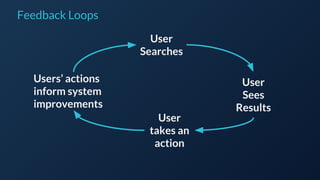
Feedback Loops
User
Searches
User
Sees
Results
User
takes an
action
Users’ actions
inform system
improvements
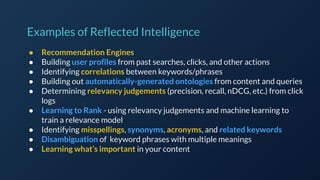
● Recommendation Engines
● Building user profiles from past searches, clicks, and other actions
● Identifying correlations between keywords/phrases
● Building out automatically-generated ontologies from content and queries
● Determining relevancy judgements (precision, recall, nDCG, etc.) from click
logs
● Learning to Rank - using relevancy judgements and machine learning to
train a relevance model
● Identifying misspellings, synonyms, acronyms, and related keywords
● Disambiguation of keyword phrases with multiple meanings
● Learning what’s important in your content
Examples of Reflected Intelligence
big data ecosystem
Bay Area Search
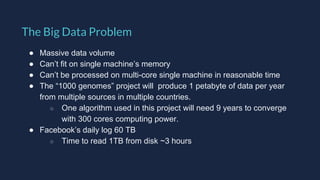
• Massive data volume
• Can’t fit on single machine’s memory
• Can’t be processed on multi-core single machine in reasonable time
• The “1000 genomes” project will produce 1 petabyte of data per year
from multiple sources in multiple countries.
○ One algorithm used in this project will need 9 years to converge
with 300 cores computing power.
• Facebook’s daily log 60 TB
○ Time to read 1TB from disk ~3 hours
The Big Data Problem
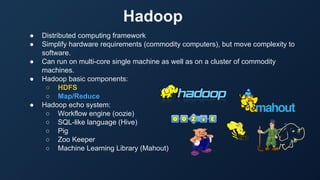
Hadoop
● Distributed computing framework
● Simplify hardware requirements (commodity computers), but move complexity to
software.
● Can run on multi-core single machine as well as on a cluster of commodity
machines.
● Hadoop basic components:
○ HDFS
○ Map/Reduce
● Hadoop echo system:
○ Workflow engine (oozie)
○ SQL-like language (Hive)
○ Pig
○ Zoo Keeper
○ Machine Learning Library (Mahout)
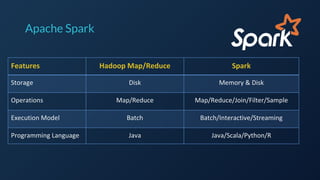
Apache Spark
Features Hadoop Map/Reduce Spark
Storage Disk Memory & Disk
Operations Map/Reduce Map/Reduce/Join/Filter/Sample
Execution Model Batch Batch/Interactive/Streaming
Programming Language Java Java/Scala/Python/R
Solr is the popular, blazing-fast,
open source enterprise search
platform built on Apache Lucene™.
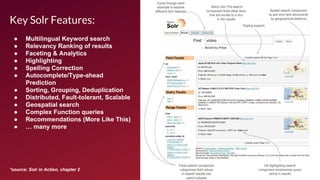
Key Solr Features:
● Multilingual Keyword search
● Relevancy Ranking of results
● Faceting & Analytics
● Highlighting
● Spelling Correction
● Autocomplete/Type-ahead
Prediction
● Sorting, Grouping, Deduplication
● Distributed, Fault-tolerant, Scalable
● Geospatial search
● Complex Function queries
● Recommendations (More Like This)
● … many more
*source: Solr in Action, chapter 2
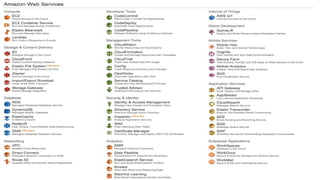
Cloud Computing / Amazon Web Services
● On-demand Storage
● On-demand Processing
● Auto-scaling
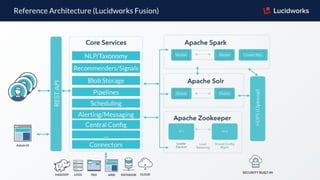
Reference Architecture (Lucidworks Fusion)
Traditional Keyword Search
The mechanics of querying and ranking search results
What is an “inverted index”?
Term Documents
a doc1 [2x]
brown doc3 [1x]
, doc5 [1x]
cat doc4 [1x]
cow doc2 [1x]
, doc5 [1x]
… ...
once doc1 [1x]
, doc5 [1x]
over doc2 [1x]
, doc3 [1x]
the doc2 [2x]
, doc3 [2x]
,
doc4[2x]
, doc5 [1x]
… …
Document Content Field
doc1 once upon a time, in a land far, far
away
doc2 the cow jumped over the moon.
doc3 the quick brown fox jumped over
the lazy dog.
doc4 the cat in the hat
doc5 The brown cow said “moo” once.
… …
What you SEND to Lucene/Solr:
How the content is INDEXED into
Lucene/Solr (conceptually):
The inverted index
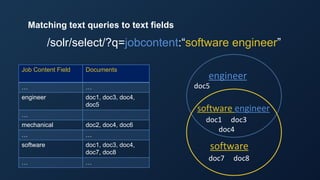
Matching text queries to text fields
/solr/select/?q=jobcontent:“software engineer”
Job Content Field Documents
… …
engineer doc1, doc3, doc4,
doc5
…
mechanical doc2, doc4, doc6
… …
software doc1, doc3, doc4,
doc7, doc8
… …
doc5
doc7 doc8
doc1 doc3
doc4
engineer
software
software engineer
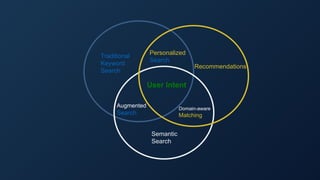
relevancy
Traditional
Keyword
Search
Recommendations
Semantic
Search
User Intent
Personalized
Search
Augmented
Search
Domain-aware
Matching
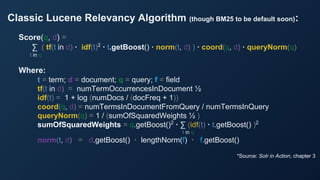
Classic Lucene Relevancy Algorithm (though BM25 to be default soon):
*Source: Solr in Action, chapter 3
Score(q, d) =
∑ ( tf(t in d) · idf(t)2
· t.getBoost() · norm(t, d) ) · coord(q, d) · queryNorm(q)
t in q
Where:
t = term; d = document; q = query; f = field
tf(t in d) = numTermOccurrencesInDocument ½
idf(t) = 1 + log (numDocs / (docFreq + 1))
coord(q, d) = numTermsInDocumentFromQuery / numTermsInQuery
queryNorm(q) = 1 / (sumOfSquaredWeights ½ )
sumOfSquaredWeights = q.getBoost()2
· ∑ (idf(t) · t.getBoost() )2
t in q
norm(t, d) = d.getBoost() · lengthNorm(f) · f.getBoost()
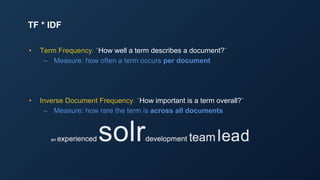
• Term Frequency: “How well a term describes a document?”
– Measure: how often a term occurs per document
• Inverse Document Frequency: “How important is a term overall?”
– Measure: how rare the term is across all documents
TF * IDF
News Search : popularity and freshness drive relevance
Restaurant Search: geographical proximity and price range are critical
Ecommerce: likelihood of a purchase is key
Movie search: More popular titles are generally more relevant
Job search: category of job, salary range, and geographical proximity matter
TF * IDF of keywords can’t hold it’s own against good
domain-specific relevance factors!
That’s great, but what about domain-specific knowledge?
Recommendations
Leveraging context to automatically suggest relevant results
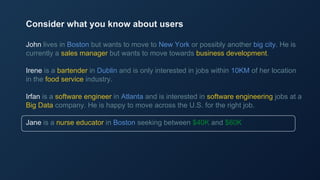
John lives in Boston but wants to move to New York or possibly another big city. He is
currently a sales manager but wants to move towards business development.
Irene is a bartender in Dublin and is only interested in jobs within 10KM of her location
in the food service industry.
Irfan is a software engineer in Atlanta and is interested in software engineering jobs at a
Big Data company. He is happy to move across the U.S. for the right job.
Jane is a nurse educator in Boston seeking between $40K and $60K
Consider what you know about users
http://localhost:8983/solr/jobs/select/?
fl=jobtitle,city,state,salary&
q=(
jobtitle:"nurse educator"^25 OR jobtitle:(nurse educator)^10
)
AND (
(city:"Boston" AND state:"MA")^15
OR state:"MA")
AND _val_:"map(salary, 40000, 60000,10, 0)”
*Example from chapter 16 of Solr in Action
Query for Jane
Jane is a nurse educator in Boston seeking between $40K and $60K
{ ...
"response":{"numFound":22,"start":0,"docs":[
{"jobtitle":" Clinical Educator
(New England/ Boston)",
"city":"Boston",
"state":"MA",
"salary":41503},
…]}}
*Example documents available @ http://github.com/treygrainger/solr-in-action/
Search Results for Jane
{"jobtitle":"Nurse Educator",
"city":"Braintree",
"state":"MA",
"salary":56183},
{"jobtitle":"Nurse Educator",
"city":"Brighton",
"state":"MA",
"salary":71359}
We built a recommendation engine!
What is a recommendation engine?
“A system that uses known information (or derived information from that known
information) to automatically suggest relevant content”
Our example was just an attribute based recommendation… but we can also use
any behavioral-based features, as well (i.e. collaborative filtering).
What did we just do?
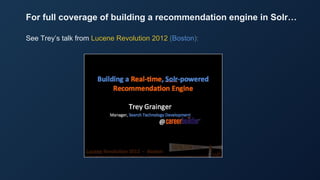
For full coverage of building a recommendation engine in Solr…
See Trey’s talk from Lucene Revolution 2012 (Boston):
Personalized Search
Why limit yourself to JUST explicit search or JUST automated recommendations?
By augmenting your user’s explicit queries with information you know about them, you can
personalize their search results.
Examples:
A known software engineer runs a blank job search in New York…
Why not show software engineering higher in the results?
A new user runs a keyword-only search for nurse
Why not use the user’s IP address to boost documents geographically closer?
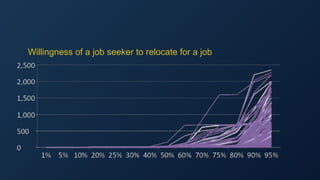
Willingness of a job seeker to relocate for a job
Bay Area Search
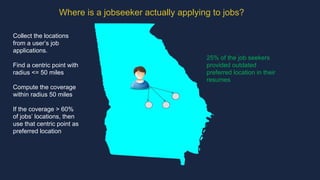
Collect the locations
from a user’s job
applications.
Find a centric point with
radius <= 50 miles
Compute the coverage
within radius 50 miles
If the coverage > 60%
of jobs’ locations, then
use that centric point as
preferred location
25% of the job seekers
provided outdated
preferred location in their
resumes
Where is a jobseeker actually applying to jobs?
Semantic Search
Understanding the meaning of documents and queries
Bay Area Search
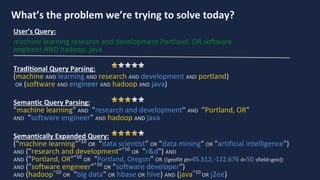
What’s the problem we’re trying to solve today?
User’s Query:
machine learning research and development Portland, OR software
engineer AND hadoop, java
Traditional Query Parsing:
(machine AND learning AND research AND development AND portland)
OR (software AND engineer AND hadoop AND java)
Semantic Query Parsing:
"machine learning" AND "research and development" AND "Portland, OR"
AND "software engineer" AND hadoop AND java
Semantically Expanded Query:
("machine learning"^10
OR "data scientist" OR "data mining" OR "artificial intelligence")
AND ("research and development"^10
OR "r&d") AND
AND ("Portland, OR"^10
OR "Portland, Oregon" OR {!geofilt pt=45.512,-122.676 d=50 sfield=geo})
AND ("software engineer"^10
OR "software developer")
AND (hadoop^10
OR "big data" OR hbase OR hive) AND (java^10
OR j2ee)
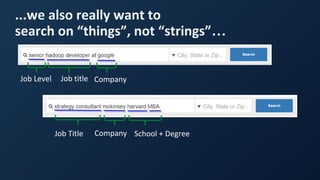
...we also really want to
search on “things”, not “strings”…
Job Level Job title Company
Job Title Company School + Degree
Bay Area Search
Type-ahead
Prediction
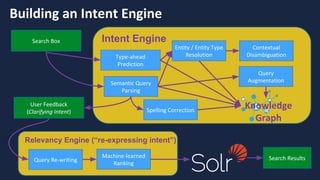
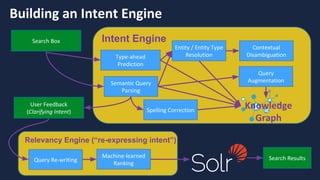
Building an Intent Engine
Search Box
Semantic Query
Parsing
Intent Engine
Spelling Correction
Entity / Entity Type
Resolution
Machine-learned
Ranking
Relevancy Engine (“re-expressing intent”)
User Feedback
(Clarifying Intent)
Query Re-writing Search Results
Query
Augmentation
Knowledge
Graph
Contextual
Disambiguation
entity recognition
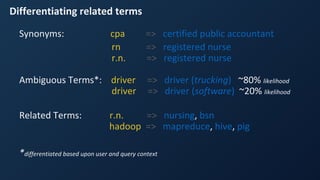
Differentiating related terms
Synonyms: cpa => certified public accountant
rn => registered nurse
r.n. => registered nurse
Ambiguous Terms*: driver => driver (trucking) ~80% likelihood
driver => driver (software) ~20% likelihood
Related Terms: r.n. => nursing, bsn
hadoop => mapreduce, hive, pig
*differentiated based upon user and query context
Bay Area Search
Building a Taxonomy of Entities
Many ways to generate this:
• Topic Modelling
• Clustering of documents
• Statistical Analysis of interesting phrases
• Buy a dictionary (often doesn’t work for
domain-specific search problems)
• …
CareerBuilder’s strategy:
Generate a model of domain-specific phrases by
mining query logs for commonly searched phrases within the domain [1]
[1] K. Aljadda, M. Korayem, T. Grainger, C. Russell. "Crowdsourced Query Augmentation through Semantic Discovery of Domain-specific Jargon," in IEEE Big Data
2014.
Bay Area Search
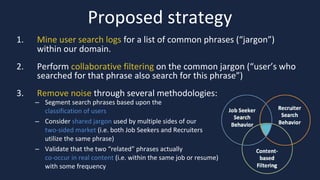
Proposed strategy
1. Mine user search logs for a list of common phrases (“jargon”)
within our domain.
2. Perform collaborative filtering on the common jargon (“user’s who
searched for that phrase also search for this phrase”)
3. Remove noise through several methodologies:
– Segment search phrases based upon the
classification of users
– Consider shared jargon used by multiple sides of our
two-sided market (i.e. both Job Seekers and Recruiters
utilize the same phrase)
– Validate that the two “related” phrases actually
co-occur in real content (i.e. within the same job or resume)
with some frequency
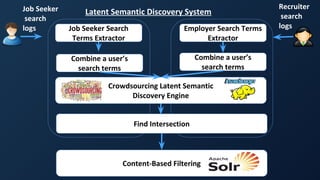
Job Seeker Search
Terms Extractor
Employer Search Terms
Extractor
Combine a user’s
search terms
Combine a user’s
search terms
Crowdsourcing Latent Semantic
Discovery Engine
Content-Based Filtering
Find Intersection
Job Seeker
search
logs
Recruiter
search
logs
Latent Semantic Discovery System
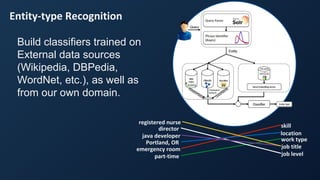
Entity-type Recognition
Build classifiers trained on
External data sources
(Wikipedia, DBPedia,
WordNet, etc.), as well as
from our own domain.
java developer
registered nurse
emergency room
director
job title
skill
job level
location
work typePortland, OR
part-time
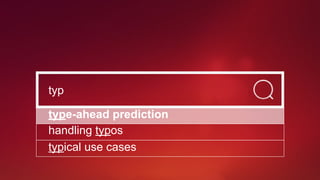
typ
type-ahead prediction
handling typos
typical use cases
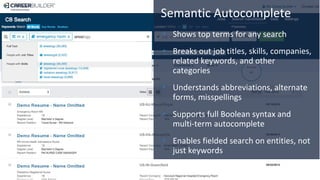
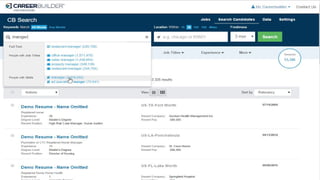
Semantic Autocomplete
• Shows top terms for any search
• Breaks out job titles, skills, companies,
related keywords, and other
categories
• Understands abbreviations, alternate
forms, misspellings
• Supports full Boolean syntax and
multi-term autocomplete
• Enables fielded search on entities, not
just keywords
spelling corection
Did you mean: spelling correction?
contextual disambiguation
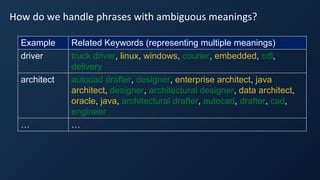
How do we handle phrases with ambiguous meanings?
Example Related Keywords (representing multiple meanings)
driver truck driver, linux, windows, courier, embedded, cdl,
delivery
architect autocad drafter, designer, enterprise architect, java
architect, designer, architectural designer, data architect,
oracle, java, architectural drafter, autocad, drafter, cad,
engineer
… …
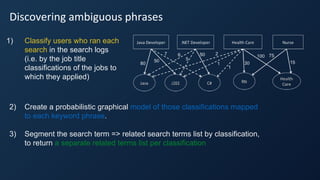
Discovering ambiguous phrases
1) Classify users who ran each
search in the search logs
(i.e. by the job title
classifications of the jobs to
which they applied)
3) Segment the search term => related search terms list by classification,
to return a separate related terms list per classification
2) Create a probabilistic graphical model of those classifications mapped
to each keyword phrase.
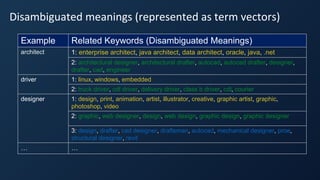
Disambiguated meanings (represented as term vectors)
Example Related Keywords (Disambiguated Meanings)
architect 1: enterprise architect, java architect, data architect, oracle, java, .net
2: architectural designer, architectural drafter, autocad, autocad drafter, designer,
drafter, cad, engineer
driver 1: linux, windows, embedded
2: truck driver, cdl driver, delivery driver, class b driver, cdl, courier
designer 1: design, print, animation, artist, illustrator, creative, graphic artist, graphic,
photoshop, video
2: graphic, web designer, design, web design, graphic design, graphic designer
3: design, drafter, cad designer, draftsman, autocad, mechanical designer, proe,
structural designer, revit
… …
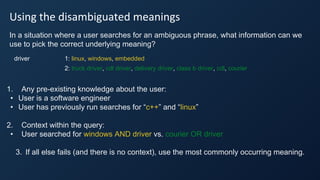
Using the disambiguated meanings
In a situation where a user searches for an ambiguous phrase, what information can we
use to pick the correct underlying meaning?
1. Any pre-existing knowledge about the user:
• User is a software engineer
• User has previously run searches for “c++” and “linux”
2. Context within the query:
• User searched for windows AND driver vs. courier OR driver
3. If all else fails (and there is no context), use the most commonly occurring meaning.
driver 1: linux, windows, embedded
2: truck driver, cdl driver, delivery driver, class b driver, cdl, courier
query parsing
Bay Area Search
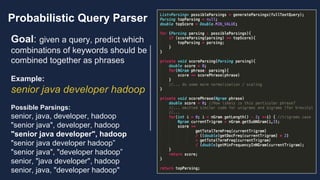
Probabilistic Query Parser
Goal: given a query, predict which
combinations of keywords should be
combined together as phrases
Example:
senior java developer hadoop
Possible Parsings:
senior, java, developer, hadoop
"senior java", developer, hadoop
"senior java developer", hadoop
"senior java developer hadoop”
"senior java", "developer hadoop”
senior, "java developer", hadoop
senior, java, "developer hadoop"
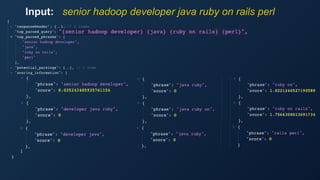
Input: senior hadoop developer java ruby on rails perl
Bay Area Search
Semantic Search Architecture – Query Parsing
Identification of phrases in queries using two steps:
1) Check a dictionary of known terms that is continuously
built, cleaned, and refined based upon common inputs from
interactions with real users of the system [1]
2) Also invoke a statistical phrase identifier to dynamically
identify unknown phrases using statistics from a corpus of data
(language model)
Shown on next slides:
Pass extracted entities to a Query Augmentation phase to
rewrite the query with enhanced semantic understanding
[1] K. Aljadda, M. Korayem, T. Grainger, C. Russell. "Crowdsourced Query Augmentation through Semantic Discovery of
Domain-specific Jargon," in IEEE Big Data 2014.
query augmentation
Bay Area Search
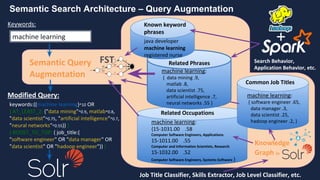
machine learning
Keywords:
Search Behavior,
Application Behavior, etc.
Job Title Classifier, Skills Extractor, Job Level Classifier, etc.
Semantic Query
Augmentation
keywords:((machine learning)^10 OR
{ AT_LEAST_2: ("data mining"^0.9, matlab^0.8,
"data scientist"^0.75, "artificial intelligence"^0.7,
"neural networks"^0.55)) }
{ BOOST_TO_TOP: ( job_title:(
"software engineer" OR "data manager" OR
"data scientist" OR "hadoop engineer")) }
Modified Query:
Related Occupations
machine learning:
{15-1031.00 .58
Computer Software Engineers, Applications
15-1011.00 .55
Computer and Information Scientists, Research
15-1032.00 .52
Computer Software Engineers, Systems Software }
machine learning:
{ software engineer .65,
data manager .3,
data scientist .25,
hadoop engineer .2, }
Common Job Titles
Semantic Search Architecture – Query Augmentation
Related Phrases
machine learning:
{ data mining .9,
matlab .8,
data scientist .75,
artificial intelligence .7,
neural networks .55 }
Known keyword
phrases
java developer
machine learning
registered nurse
FST
Knowledge
Graph in
+
Bay Area Search
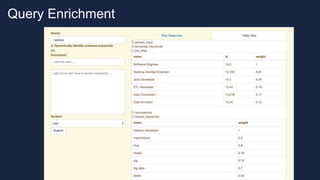
Query Enrichment
Bay Area Search
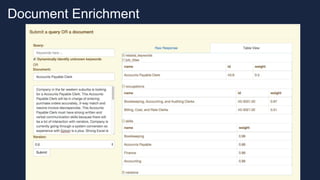
Document Enrichment
Bay Area Search
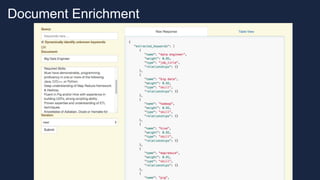
Document Enrichment
Bay Area Search
measuring & improving relevancy
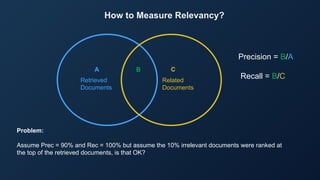
How to Measure Relevancy?
A B C
Retrieved
Documents
Related
Documents
Precision = B/A
Recall = B/C
Problem:
Assume Prec = 90% and Rec = 100% but assume the 10% irrelevant documents were ranked at
the top of the retrieved documents, is that OK?
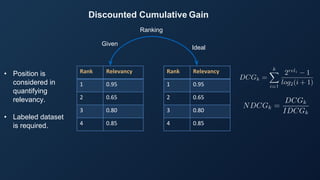
Discounted Cumulative Gain
Rank Relevancy
1 0.95
2 0.65
3 0.80
4 0.85
Rank Relevancy
1 0.95
2 0.65
3 0.80
4 0.85
Ranking
Ideal
Given
• Position is
considered in
quantifying
relevancy.
• Labeled dataset
is required.
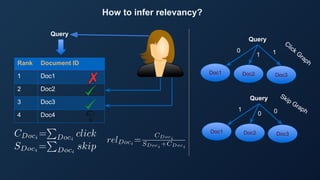
How to infer relevancy?
Rank Document ID
1 Doc1
2 Doc2
3 Doc3
4 Doc4
Query
Query
Doc1 Doc2 Doc3
0
1 1
Query
Doc1 Doc2 Doc3
1
0 0
Click
G
raph
Skip Graph
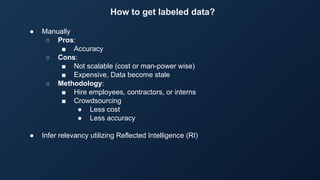
How to get labeled data?
● Manually
○ Pros:
■ Accuracy
○ Cons:
■ Not scalable (cost or man-power wise)
■ Expensive, Data become stale
○ Methodology:
■ Hire employees, contractors, or interns
■ Crowdsourcing
● Less cost
● Less accuracy
● Infer relevancy utilizing Reflected Intelligence (RI)
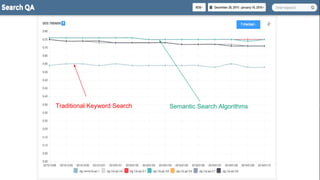
Search QA System:
Traditional Keyword Search Semantic Search Algorithms
learning to rank
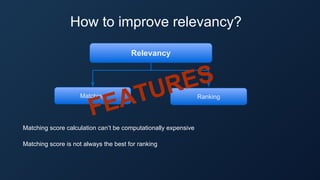
How to improve relevancy?
Relevancy
Matching Ranking
Matching score calculation can’t be computationally expensive
Matching score is not always the best for ranking
FEATURES
Learning to Rank (LTR)
● It applies machine learning techniques to discover the best combination of features that
provide best ranking.
● It requires labeled set of documents with relevancy scores for given set of queries
● Features used for ranking are usually more computationally expensive than the ones
used for matching
● It works on subset of the matched documents (e.g. top 100)
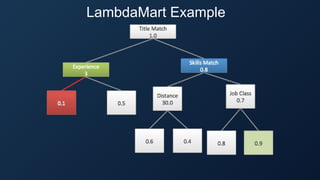
Common LTR Algorithms
• RankNet*
(Neural Network, boosted trees)
• LambdaMart*
(set of regression trees)
• SVM Rank**
(SVM classifier)
** http://research.microsoft.com/en-us/people/hangli/cao-et-al-sigir2006.pdf
* http://research.microsoft.com/pubs/132652/MSR-TR-2010-82.pdf
LambdaMart Example
Bay Area Search
Type-ahead
Prediction
Building an Intent Engine
Search Box
Semantic Query
Parsing
Intent Engine
Spelling Correction
Entity / Entity Type
Resolution
Machine-learned
Ranking
Relevancy Engine (“re-expressing intent”)
User Feedback
(Clarifying Intent)
Query Re-writing Search Results
Query
Augmentation
Knowledge
Graph
Contextual
Disambiguation
Additional References:
Bay Area Search
2014-2015 Publications & Presentations
Books:
Solr in Action - A comprehensive guide to implementing scalable search using Apache Solr
Research papers:
● Crowdsourced Query Augmentation through Semantic Discovery of Domain-specific jargon - 2014
● Towards a Job title Classification System - 2014
● Augmenting Recommendation Systems Using a Model of Semantically-related Terms
Extracted from User Behavior - 2014
● sCooL: A system for academic institution name normalization - 2014
● PGMHD: A Scalable Probabilistic Graphical Model for Massive Hierarchical Data Problems - 2014
● SKILL: A System for Skill Identification and Normalization – 2015
● Carotene: A Job Title Classification System for the Online Recruitment Domain - 2015
● WebScalding: A Framework for Big Data Web Services - 2015
● A Pipeline for Extracting and Deduplicating Domain-Specific Knowledge Bases - 2015
● Macau: Large-Scale Skill Sense Disambiguation in the Online Recruitment Domain - 2015
● Improving the Quality of Semantic Relationships Extracted from Massive User Behavioral Data – 2015
● Query Sense Disambiguation Leveraging Large Scale User Behavioral Data - 2015
● Entity Type Recognition using an Ensemble of Distributional Semantic Models to Enhance Query Understanding - 2016
Speaking Engagements:
● Over a dozen in the last year: Lucene/Solr Revolution 2014, WSDM 2014, Atlanta Solr Meetup, Atlanta Big Data Meetup, Second
International Symposium on Big Data and Data Analytics, RecSys 2014, IEEE Big Data Conference 2014 (x2), AAAI/IAAI 2015, IEEE Big Data
2015 (x6), Lucene/Solr Revolution 2015, and Bay Area Search Meetup
Bay Area Search
Contact Info
Trey Grainger
trey@lucidworks.com
@treygrainger
Other presentations:
http://www.treygrainger.com http://www.aljadda.com
Khalifeh AlJadda
khalifeh.aljadda@careerbuilder.com
@aljadda

Reflected intelligence evolving self-learning data systems

  • 1.
    Reflected Intelligence: Evolvingself-learning data systems Trey Grainger SVP of Engineering Khalifeh AlJadda Lead Data Scientist
  • 2.
    Agenda • Introductions • KeyTechnologies ○ Hadoop, Spark, Solr, Cloud/AWS • Information Retrieval Overview ○ Overview ○ Feedback Loops • Reflected Intelligence Use Cases ○ Recommendations ○ Semantic Search / Query Intent ○ Learning to Rank ○ Search QA • Conclusion
  • 3.
  • 4.
    Trey Grainger SVP ofEngineering • Previously Director of Engineering @ CareerBuilder • MBA, Management of Technology – Georgia Tech • BA, Computer Science, Business, & Philosophy – Furman University • Mining Massive Datasets (in progress) - Stanford University Fun outside of CB: • Co-author of Solr in Action, plus a handful of research papers • Frequent conference speaker • Founder of Celiaccess.com, the gluten-free search engine • Lucene/Solr contributor About Us
  • 5.
    Khalifeh AlJadda Lead DataScientist, Search Data Science • Joined CareerBuilder in 2013 • PhD, Computer Science – University of Georgia • BSc, MSc, Computer Science, Jordan University of Science and Technology Activities: • Founder and Chairman of CB Data Science Council • Invited speaker “The Data Science Conference 2016” • Creator of GELATO (Glycomic Elucidation and Annotation Tool) About Us
  • 8.
  • 9.
    The standard for enterprise search. ofFortune 500 uses Solr. 90%
  • 10.
    Lucidworks enables Search-DrivenEverything Data Acquisition Indexing & Streaming Smart Access API Recommendations & Alerts Analytics & InsightsExtreme Relevancy CUSTOMER SERVICE RESEARCH PORTAL DIGITAL CONTENT CUSTOMER INSIGHTS FRAUD SURVEILLANCE ONLINE RETAIL • Access all your data in a number of ways from one place. • Secure storage and processing from Solr and Spark. • Acquire data from any source with pre-built connectors and adapters. Machine learning and advanced analytics turn all of your apps into intelligent data-driven applications.
  • 13.
    Bay Area Search AtCareerBuilder, Search Powers...At CareerBuilder, Search Powers...
  • 14.
    Search by theNumbers 14 Powering 50+ Search Experiences Including: 100million + Searches per day 30+ Software Developers, Data Scientists + Analysts 500+ Search Servers 1,5billion + Documents indexed and searchable 1 Global Search Technology platform ...and many more
  • 15.
    Big Data Platformby the Numbers Big Data Technologies: 47 Data Nodes 1.5 Petabyte Storage 1504 Hyperthread CPU Cores 6 TB RAM
  • 16.
    what is “reflectedintelligence”?
  • 17.
    The Three C’s Content: Keywordsand other features in your documents Collaboration: How other’s have chosen to interact with your system Context: Available information about your users and their intent Reflected Intelligence “Leveraging previous data and interactions to improve how new data and interactions should be interpreted”
  • 18.
  • 19.
    ● Recommendation Engines ●Building user profiles from past searches, clicks, and other actions ● Identifying correlations between keywords/phrases ● Building out automatically-generated ontologies from content and queries ● Determining relevancy judgements (precision, recall, nDCG, etc.) from click logs ● Learning to Rank - using relevancy judgements and machine learning to train a relevance model ● Identifying misspellings, synonyms, acronyms, and related keywords ● Disambiguation of keyword phrases with multiple meanings ● Learning what’s important in your content Examples of Reflected Intelligence
  • 20.
  • 21.
    Bay Area Search •Massive data volume • Can’t fit on single machine’s memory • Can’t be processed on multi-core single machine in reasonable time • The “1000 genomes” project will produce 1 petabyte of data per year from multiple sources in multiple countries. ○ One algorithm used in this project will need 9 years to converge with 300 cores computing power. • Facebook’s daily log 60 TB ○ Time to read 1TB from disk ~3 hours The Big Data Problem
  • 22.
    Hadoop ● Distributed computingframework ● Simplify hardware requirements (commodity computers), but move complexity to software. ● Can run on multi-core single machine as well as on a cluster of commodity machines. ● Hadoop basic components: ○ HDFS ○ Map/Reduce ● Hadoop echo system: ○ Workflow engine (oozie) ○ SQL-like language (Hive) ○ Pig ○ Zoo Keeper ○ Machine Learning Library (Mahout)
  • 23.
    Apache Spark Features HadoopMap/Reduce Spark Storage Disk Memory & Disk Operations Map/Reduce Map/Reduce/Join/Filter/Sample Execution Model Batch Batch/Interactive/Streaming Programming Language Java Java/Scala/Python/R
  • 24.
    Solr is thepopular, blazing-fast, open source enterprise search platform built on Apache Lucene™.
  • 25.
    Key Solr Features: ●Multilingual Keyword search ● Relevancy Ranking of results ● Faceting & Analytics ● Highlighting ● Spelling Correction ● Autocomplete/Type-ahead Prediction ● Sorting, Grouping, Deduplication ● Distributed, Fault-tolerant, Scalable ● Geospatial search ● Complex Function queries ● Recommendations (More Like This) ● … many more *source: Solr in Action, chapter 2
  • 26.
    Cloud Computing /Amazon Web Services ● On-demand Storage ● On-demand Processing ● Auto-scaling
  • 28.
  • 29.
    Traditional Keyword Search Themechanics of querying and ranking search results
  • 30.
    What is an“inverted index”?
  • 31.
    Term Documents a doc1[2x] brown doc3 [1x] , doc5 [1x] cat doc4 [1x] cow doc2 [1x] , doc5 [1x] … ... once doc1 [1x] , doc5 [1x] over doc2 [1x] , doc3 [1x] the doc2 [2x] , doc3 [2x] , doc4[2x] , doc5 [1x] … … Document Content Field doc1 once upon a time, in a land far, far away doc2 the cow jumped over the moon. doc3 the quick brown fox jumped over the lazy dog. doc4 the cat in the hat doc5 The brown cow said “moo” once. … … What you SEND to Lucene/Solr: How the content is INDEXED into Lucene/Solr (conceptually): The inverted index
  • 32.
    Matching text queriesto text fields /solr/select/?q=jobcontent:“software engineer” Job Content Field Documents … … engineer doc1, doc3, doc4, doc5 … mechanical doc2, doc4, doc6 … … software doc1, doc3, doc4, doc7, doc8 … … doc5 doc7 doc8 doc1 doc3 doc4 engineer software software engineer
  • 33.
  • 34.
  • 35.
    Classic Lucene RelevancyAlgorithm (though BM25 to be default soon): *Source: Solr in Action, chapter 3 Score(q, d) = ∑ ( tf(t in d) · idf(t)2 · t.getBoost() · norm(t, d) ) · coord(q, d) · queryNorm(q) t in q Where: t = term; d = document; q = query; f = field tf(t in d) = numTermOccurrencesInDocument ½ idf(t) = 1 + log (numDocs / (docFreq + 1)) coord(q, d) = numTermsInDocumentFromQuery / numTermsInQuery queryNorm(q) = 1 / (sumOfSquaredWeights ½ ) sumOfSquaredWeights = q.getBoost()2 · ∑ (idf(t) · t.getBoost() )2 t in q norm(t, d) = d.getBoost() · lengthNorm(f) · f.getBoost()
  • 36.
    • Term Frequency:“How well a term describes a document?” – Measure: how often a term occurs per document • Inverse Document Frequency: “How important is a term overall?” – Measure: how rare the term is across all documents TF * IDF
  • 37.
    News Search :popularity and freshness drive relevance Restaurant Search: geographical proximity and price range are critical Ecommerce: likelihood of a purchase is key Movie search: More popular titles are generally more relevant Job search: category of job, salary range, and geographical proximity matter TF * IDF of keywords can’t hold it’s own against good domain-specific relevance factors! That’s great, but what about domain-specific knowledge?
  • 38.
    Recommendations Leveraging context toautomatically suggest relevant results
  • 39.
    John lives inBoston but wants to move to New York or possibly another big city. He is currently a sales manager but wants to move towards business development. Irene is a bartender in Dublin and is only interested in jobs within 10KM of her location in the food service industry. Irfan is a software engineer in Atlanta and is interested in software engineering jobs at a Big Data company. He is happy to move across the U.S. for the right job. Jane is a nurse educator in Boston seeking between $40K and $60K Consider what you know about users
  • 40.
    http://localhost:8983/solr/jobs/select/? fl=jobtitle,city,state,salary& q=( jobtitle:"nurse educator"^25 ORjobtitle:(nurse educator)^10 ) AND ( (city:"Boston" AND state:"MA")^15 OR state:"MA") AND _val_:"map(salary, 40000, 60000,10, 0)” *Example from chapter 16 of Solr in Action Query for Jane Jane is a nurse educator in Boston seeking between $40K and $60K
  • 41.
    { ... "response":{"numFound":22,"start":0,"docs":[ {"jobtitle":" ClinicalEducator (New England/ Boston)", "city":"Boston", "state":"MA", "salary":41503}, …]}} *Example documents available @ http://github.com/treygrainger/solr-in-action/ Search Results for Jane {"jobtitle":"Nurse Educator", "city":"Braintree", "state":"MA", "salary":56183}, {"jobtitle":"Nurse Educator", "city":"Brighton", "state":"MA", "salary":71359}
  • 42.
    We built arecommendation engine! What is a recommendation engine? “A system that uses known information (or derived information from that known information) to automatically suggest relevant content” Our example was just an attribute based recommendation… but we can also use any behavioral-based features, as well (i.e. collaborative filtering). What did we just do?
  • 43.
    For full coverageof building a recommendation engine in Solr… See Trey’s talk from Lucene Revolution 2012 (Boston):
  • 44.
    Personalized Search Why limityourself to JUST explicit search or JUST automated recommendations? By augmenting your user’s explicit queries with information you know about them, you can personalize their search results. Examples: A known software engineer runs a blank job search in New York… Why not show software engineering higher in the results? A new user runs a keyword-only search for nurse Why not use the user’s IP address to boost documents geographically closer?
  • 45.
    Willingness of ajob seeker to relocate for a job
  • 46.
    Bay Area Search Collectthe locations from a user’s job applications. Find a centric point with radius <= 50 miles Compute the coverage within radius 50 miles If the coverage > 60% of jobs’ locations, then use that centric point as preferred location 25% of the job seekers provided outdated preferred location in their resumes Where is a jobseeker actually applying to jobs?
  • 47.
    Semantic Search Understanding themeaning of documents and queries
  • 48.
    Bay Area Search What’sthe problem we’re trying to solve today? User’s Query: machine learning research and development Portland, OR software engineer AND hadoop, java Traditional Query Parsing: (machine AND learning AND research AND development AND portland) OR (software AND engineer AND hadoop AND java) Semantic Query Parsing: "machine learning" AND "research and development" AND "Portland, OR" AND "software engineer" AND hadoop AND java Semantically Expanded Query: ("machine learning"^10 OR "data scientist" OR "data mining" OR "artificial intelligence") AND ("research and development"^10 OR "r&d") AND AND ("Portland, OR"^10 OR "Portland, Oregon" OR {!geofilt pt=45.512,-122.676 d=50 sfield=geo}) AND ("software engineer"^10 OR "software developer") AND (hadoop^10 OR "big data" OR hbase OR hive) AND (java^10 OR j2ee)
  • 49.
    ...we also reallywant to search on “things”, not “strings”… Job Level Job title Company Job Title Company School + Degree
  • 50.
    Bay Area Search Type-ahead Prediction Buildingan Intent Engine Search Box Semantic Query Parsing Intent Engine Spelling Correction Entity / Entity Type Resolution Machine-learned Ranking Relevancy Engine (“re-expressing intent”) User Feedback (Clarifying Intent) Query Re-writing Search Results Query Augmentation Knowledge Graph Contextual Disambiguation
  • 51.
  • 52.
    Differentiating related terms Synonyms:cpa => certified public accountant rn => registered nurse r.n. => registered nurse Ambiguous Terms*: driver => driver (trucking) ~80% likelihood driver => driver (software) ~20% likelihood Related Terms: r.n. => nursing, bsn hadoop => mapreduce, hive, pig *differentiated based upon user and query context
  • 53.
    Bay Area Search Buildinga Taxonomy of Entities Many ways to generate this: • Topic Modelling • Clustering of documents • Statistical Analysis of interesting phrases • Buy a dictionary (often doesn’t work for domain-specific search problems) • … CareerBuilder’s strategy: Generate a model of domain-specific phrases by mining query logs for commonly searched phrases within the domain [1] [1] K. Aljadda, M. Korayem, T. Grainger, C. Russell. "Crowdsourced Query Augmentation through Semantic Discovery of Domain-specific Jargon," in IEEE Big Data 2014.
  • 54.
    Bay Area Search Proposedstrategy 1. Mine user search logs for a list of common phrases (“jargon”) within our domain. 2. Perform collaborative filtering on the common jargon (“user’s who searched for that phrase also search for this phrase”) 3. Remove noise through several methodologies: – Segment search phrases based upon the classification of users – Consider shared jargon used by multiple sides of our two-sided market (i.e. both Job Seekers and Recruiters utilize the same phrase) – Validate that the two “related” phrases actually co-occur in real content (i.e. within the same job or resume) with some frequency
  • 55.
    Job Seeker Search TermsExtractor Employer Search Terms Extractor Combine a user’s search terms Combine a user’s search terms Crowdsourcing Latent Semantic Discovery Engine Content-Based Filtering Find Intersection Job Seeker search logs Recruiter search logs Latent Semantic Discovery System
  • 56.
    Entity-type Recognition Build classifierstrained on External data sources (Wikipedia, DBPedia, WordNet, etc.), as well as from our own domain. java developer registered nurse emergency room director job title skill job level location work typePortland, OR part-time
  • 57.
  • 58.
    Semantic Autocomplete • Showstop terms for any search • Breaks out job titles, skills, companies, related keywords, and other categories • Understands abbreviations, alternate forms, misspellings • Supports full Boolean syntax and multi-term autocomplete • Enables fielded search on entities, not just keywords
  • 59.
    spelling corection Did youmean: spelling correction?
  • 61.
  • 62.
    How do wehandle phrases with ambiguous meanings? Example Related Keywords (representing multiple meanings) driver truck driver, linux, windows, courier, embedded, cdl, delivery architect autocad drafter, designer, enterprise architect, java architect, designer, architectural designer, data architect, oracle, java, architectural drafter, autocad, drafter, cad, engineer … …
  • 63.
    Discovering ambiguous phrases 1)Classify users who ran each search in the search logs (i.e. by the job title classifications of the jobs to which they applied) 3) Segment the search term => related search terms list by classification, to return a separate related terms list per classification 2) Create a probabilistic graphical model of those classifications mapped to each keyword phrase.
  • 64.
    Disambiguated meanings (representedas term vectors) Example Related Keywords (Disambiguated Meanings) architect 1: enterprise architect, java architect, data architect, oracle, java, .net 2: architectural designer, architectural drafter, autocad, autocad drafter, designer, drafter, cad, engineer driver 1: linux, windows, embedded 2: truck driver, cdl driver, delivery driver, class b driver, cdl, courier designer 1: design, print, animation, artist, illustrator, creative, graphic artist, graphic, photoshop, video 2: graphic, web designer, design, web design, graphic design, graphic designer 3: design, drafter, cad designer, draftsman, autocad, mechanical designer, proe, structural designer, revit … …
  • 65.
    Using the disambiguatedmeanings In a situation where a user searches for an ambiguous phrase, what information can we use to pick the correct underlying meaning? 1. Any pre-existing knowledge about the user: • User is a software engineer • User has previously run searches for “c++” and “linux” 2. Context within the query: • User searched for windows AND driver vs. courier OR driver 3. If all else fails (and there is no context), use the most commonly occurring meaning. driver 1: linux, windows, embedded 2: truck driver, cdl driver, delivery driver, class b driver, cdl, courier
  • 66.
  • 67.
    Bay Area Search ProbabilisticQuery Parser Goal: given a query, predict which combinations of keywords should be combined together as phrases Example: senior java developer hadoop Possible Parsings: senior, java, developer, hadoop "senior java", developer, hadoop "senior java developer", hadoop "senior java developer hadoop” "senior java", "developer hadoop” senior, "java developer", hadoop senior, java, "developer hadoop"
  • 68.
    Input: senior hadoopdeveloper java ruby on rails perl
  • 69.
    Bay Area Search SemanticSearch Architecture – Query Parsing Identification of phrases in queries using two steps: 1) Check a dictionary of known terms that is continuously built, cleaned, and refined based upon common inputs from interactions with real users of the system [1] 2) Also invoke a statistical phrase identifier to dynamically identify unknown phrases using statistics from a corpus of data (language model) Shown on next slides: Pass extracted entities to a Query Augmentation phase to rewrite the query with enhanced semantic understanding [1] K. Aljadda, M. Korayem, T. Grainger, C. Russell. "Crowdsourced Query Augmentation through Semantic Discovery of Domain-specific Jargon," in IEEE Big Data 2014.
  • 70.
  • 71.
    Bay Area Search machinelearning Keywords: Search Behavior, Application Behavior, etc. Job Title Classifier, Skills Extractor, Job Level Classifier, etc. Semantic Query Augmentation keywords:((machine learning)^10 OR { AT_LEAST_2: ("data mining"^0.9, matlab^0.8, "data scientist"^0.75, "artificial intelligence"^0.7, "neural networks"^0.55)) } { BOOST_TO_TOP: ( job_title:( "software engineer" OR "data manager" OR "data scientist" OR "hadoop engineer")) } Modified Query: Related Occupations machine learning: {15-1031.00 .58 Computer Software Engineers, Applications 15-1011.00 .55 Computer and Information Scientists, Research 15-1032.00 .52 Computer Software Engineers, Systems Software } machine learning: { software engineer .65, data manager .3, data scientist .25, hadoop engineer .2, } Common Job Titles Semantic Search Architecture – Query Augmentation Related Phrases machine learning: { data mining .9, matlab .8, data scientist .75, artificial intelligence .7, neural networks .55 } Known keyword phrases java developer machine learning registered nurse FST Knowledge Graph in +
  • 72.
  • 73.
  • 74.
  • 75.
  • 76.
  • 77.
    How to MeasureRelevancy? A B C Retrieved Documents Related Documents Precision = B/A Recall = B/C Problem: Assume Prec = 90% and Rec = 100% but assume the 10% irrelevant documents were ranked at the top of the retrieved documents, is that OK?
  • 78.
    Discounted Cumulative Gain RankRelevancy 1 0.95 2 0.65 3 0.80 4 0.85 Rank Relevancy 1 0.95 2 0.65 3 0.80 4 0.85 Ranking Ideal Given • Position is considered in quantifying relevancy. • Labeled dataset is required.
  • 79.
    How to inferrelevancy? Rank Document ID 1 Doc1 2 Doc2 3 Doc3 4 Doc4 Query Query Doc1 Doc2 Doc3 0 1 1 Query Doc1 Doc2 Doc3 1 0 0 Click G raph Skip Graph
  • 80.
    How to getlabeled data? ● Manually ○ Pros: ■ Accuracy ○ Cons: ■ Not scalable (cost or man-power wise) ■ Expensive, Data become stale ○ Methodology: ■ Hire employees, contractors, or interns ■ Crowdsourcing ● Less cost ● Less accuracy ● Infer relevancy utilizing Reflected Intelligence (RI)
  • 81.
    Search QA System: TraditionalKeyword Search Semantic Search Algorithms
  • 82.
  • 83.
    How to improverelevancy? Relevancy Matching Ranking Matching score calculation can’t be computationally expensive Matching score is not always the best for ranking FEATURES
  • 84.
    Learning to Rank(LTR) ● It applies machine learning techniques to discover the best combination of features that provide best ranking. ● It requires labeled set of documents with relevancy scores for given set of queries ● Features used for ranking are usually more computationally expensive than the ones used for matching ● It works on subset of the matched documents (e.g. top 100)
  • 85.
    Common LTR Algorithms •RankNet* (Neural Network, boosted trees) • LambdaMart* (set of regression trees) • SVM Rank** (SVM classifier) ** http://research.microsoft.com/en-us/people/hangli/cao-et-al-sigir2006.pdf * http://research.microsoft.com/pubs/132652/MSR-TR-2010-82.pdf
  • 86.
  • 87.
    Bay Area Search Type-ahead Prediction Buildingan Intent Engine Search Box Semantic Query Parsing Intent Engine Spelling Correction Entity / Entity Type Resolution Machine-learned Ranking Relevancy Engine (“re-expressing intent”) User Feedback (Clarifying Intent) Query Re-writing Search Results Query Augmentation Knowledge Graph Contextual Disambiguation
  • 88.
  • 89.
    Bay Area Search 2014-2015Publications & Presentations Books: Solr in Action - A comprehensive guide to implementing scalable search using Apache Solr Research papers: ● Crowdsourced Query Augmentation through Semantic Discovery of Domain-specific jargon - 2014 ● Towards a Job title Classification System - 2014 ● Augmenting Recommendation Systems Using a Model of Semantically-related Terms Extracted from User Behavior - 2014 ● sCooL: A system for academic institution name normalization - 2014 ● PGMHD: A Scalable Probabilistic Graphical Model for Massive Hierarchical Data Problems - 2014 ● SKILL: A System for Skill Identification and Normalization – 2015 ● Carotene: A Job Title Classification System for the Online Recruitment Domain - 2015 ● WebScalding: A Framework for Big Data Web Services - 2015 ● A Pipeline for Extracting and Deduplicating Domain-Specific Knowledge Bases - 2015 ● Macau: Large-Scale Skill Sense Disambiguation in the Online Recruitment Domain - 2015 ● Improving the Quality of Semantic Relationships Extracted from Massive User Behavioral Data – 2015 ● Query Sense Disambiguation Leveraging Large Scale User Behavioral Data - 2015 ● Entity Type Recognition using an Ensemble of Distributional Semantic Models to Enhance Query Understanding - 2016 Speaking Engagements: ● Over a dozen in the last year: Lucene/Solr Revolution 2014, WSDM 2014, Atlanta Solr Meetup, Atlanta Big Data Meetup, Second International Symposium on Big Data and Data Analytics, RecSys 2014, IEEE Big Data Conference 2014 (x2), AAAI/IAAI 2015, IEEE Big Data 2015 (x6), Lucene/Solr Revolution 2015, and Bay Area Search Meetup
  • 90.
    Bay Area Search ContactInfo Trey Grainger trey@lucidworks.com @treygrainger Other presentations: http://www.treygrainger.com http://www.aljadda.com Khalifeh AlJadda khalifeh.aljadda@careerbuilder.com @aljadda