SEMANTICS
Reference,
Sense and
Referring
English Language and Literature
                          Program
                              4B
Group 1

• Fira Nursya’bani
  0906856
• Luciyana Dwiningrum
  0902428
• Meyza Pritama         0902467
• Riestia Handayani
  0902434
Semantics
 ‘’Semantics is the study of
 meaning in language.’’
 ‘’Linguistic semantics is the
 study of meaning that is used by
 humans to express themselves
 through language.’’
 (Hurford, Heasley & Smith, 2007)
REFERENCE

  SENSE
Reference
Reference deals with the
relationship between language
and the world.
Reference is a relationship
between parts of language and
things outside the language (in
the world).
Types of
Reference
• Variable Reference
    a. One word
    b. Many expressions
    c. Refer to different type 0f that object
• Constant Reference
    a. One word
    b. Many expressions
    c. Refer to the same thing
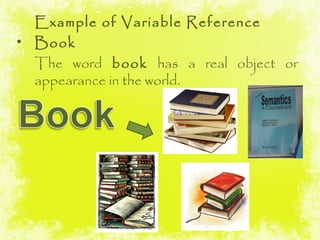
Example of Variable Reference
• Book
  The word book has a real object or
  appearance in the world.
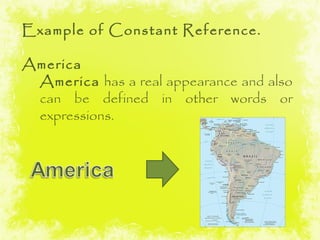
Example of Constant Reference.

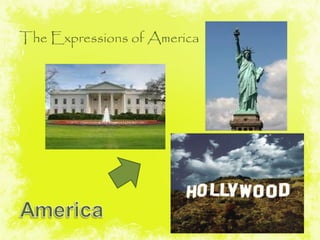
America
 America has a real appearance and also
 can be defined in other words or
 expressions.
The Expressions of America
Sense
Sense deals with relationships
inside the language.
Sense of an expression is its
place in a system of semantic
relationships     with    other
expressions in the language.
Example of Sense
1. The example of sense in word-form
   GUILT
• Blame, Culpability, Guiltiness, Iniquity,
   Wrong, etc.
• Feeling of shame for having done wrong,
   Fact that somebody has done something
   illegal, Blame or responsibility for
   wrongdoing.
Example of Sense

2. The example of sense in phrase or
   sentence
   A prisoner escaped from jail yesterday.

• A prisoner ran away from the jail
  yesterday.
• A prisoner got free from the jail
  yesterday.
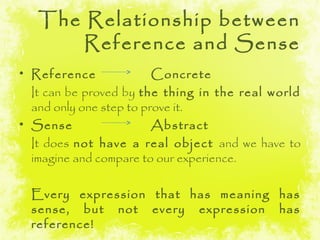
The Relationship between
       Reference and Sense
• Reference              Concrete
  It can be proved by the thing in the real world
  and only one step to prove it.
• Sense                  Abstract
  It does not have a real object and we have to
  imagine and compare to our experience.

  Every expression that has meaning has
  sense, but not every expression has
  reference!
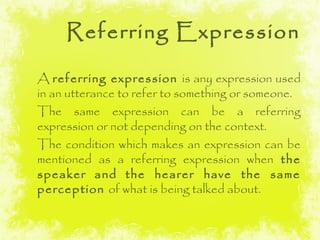
Referring Expression

A referring expression is any expression used
in an utterance to refer to something or someone.
The same expression can be a referring
expression or not depending on the context.
The condition which makes an expression can be
mentioned as a referring expression when the
speaker and the hearer have the same
perception of what is being talked about.
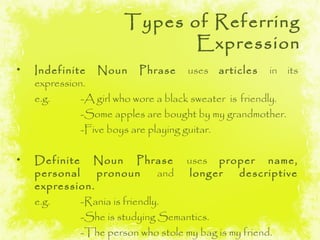
Types of Referring
                             Expression
•   Indefinite Noun Phrase uses articles in its
    expression.
    e.g.      -A girl who wore a black sweater is friendly.
              -Some apples are bought by my grandmother.
              -Five boys are playing guitar.

•   Definite Noun Phrase uses proper name,
    personal    pronoun        and longer      descriptive
    expression.
    e.g.     -Rania is friendly.
             -She is studying Semantics.
             -The person who stole my bag is my friend.
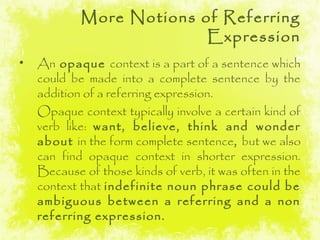
More Notions of Referring
                          Expression
•   An opaque context is a part of a sentence which
    could be made into a complete sentence by the
    addition of a referring expression.
    Opaque context typically involve a certain kind of
    verb like: want, believe, think and wonder
    about in the form complete sentence, but we also
    can find opaque context in shorter expression.
    Because of those kinds of verb, it was often in the
    context that indefinite noun phrase could be
    ambiguous between a referring and a non
    referring expression.
More Notions of Referring
                        Expression

• An equative sentence is a part of a
  sentence which could be made into a
  complete sentence by the addition of
  referring expression, but it is different from
  opaque context, an equative sentence is
  one which is used to make sure the identity
  of the referents.
References…
Anonymous. Reference and Sense. Retrieved February 18,
 2011, from http://www.phil.muni.cz/~materna/sense.html

Hurford, James R. Heasley, Brendan. and Smith, Michael
 B. (2007). Semantics a Coursebook. United Kingdom:
 Cambridge University Press.

Sundayana, Wachyu. and Aziz, E. Aminudin. (2000).
 Semantik. Jakarta: Universitas Terbuka.

Wahab, Abdul. (1995). Teori Semantik. Surabaya:
 Airlangga University Press.
Thanks for your
  attention..

Reference, sense and referring expression

  • 1.
  • 2.
    English Language andLiterature Program 4B Group 1 • Fira Nursya’bani 0906856 • Luciyana Dwiningrum 0902428 • Meyza Pritama 0902467 • Riestia Handayani 0902434
  • 3.
    Semantics ‘’Semantics isthe study of meaning in language.’’ ‘’Linguistic semantics is the study of meaning that is used by humans to express themselves through language.’’ (Hurford, Heasley & Smith, 2007)
  • 4.
  • 5.
    Reference Reference deals withthe relationship between language and the world. Reference is a relationship between parts of language and things outside the language (in the world).
  • 6.
    Types of Reference • VariableReference a. One word b. Many expressions c. Refer to different type 0f that object • Constant Reference a. One word b. Many expressions c. Refer to the same thing
  • 7.
    Example of VariableReference • Book The word book has a real object or appearance in the world.
  • 8.
    Example of ConstantReference. America America has a real appearance and also can be defined in other words or expressions.
  • 9.
  • 10.
    Sense Sense deals withrelationships inside the language. Sense of an expression is its place in a system of semantic relationships with other expressions in the language.
  • 11.
    Example of Sense 1.The example of sense in word-form GUILT • Blame, Culpability, Guiltiness, Iniquity, Wrong, etc. • Feeling of shame for having done wrong, Fact that somebody has done something illegal, Blame or responsibility for wrongdoing.
  • 12.
    Example of Sense 2.The example of sense in phrase or sentence A prisoner escaped from jail yesterday. • A prisoner ran away from the jail yesterday. • A prisoner got free from the jail yesterday.
  • 13.
    The Relationship between Reference and Sense • Reference Concrete It can be proved by the thing in the real world and only one step to prove it. • Sense Abstract It does not have a real object and we have to imagine and compare to our experience. Every expression that has meaning has sense, but not every expression has reference!
  • 14.
    Referring Expression A referringexpression is any expression used in an utterance to refer to something or someone. The same expression can be a referring expression or not depending on the context. The condition which makes an expression can be mentioned as a referring expression when the speaker and the hearer have the same perception of what is being talked about.
  • 15.
    Types of Referring Expression • Indefinite Noun Phrase uses articles in its expression. e.g. -A girl who wore a black sweater is friendly. -Some apples are bought by my grandmother. -Five boys are playing guitar. • Definite Noun Phrase uses proper name, personal pronoun and longer descriptive expression. e.g. -Rania is friendly. -She is studying Semantics. -The person who stole my bag is my friend.
  • 16.
    More Notions ofReferring Expression • An opaque context is a part of a sentence which could be made into a complete sentence by the addition of a referring expression. Opaque context typically involve a certain kind of verb like: want, believe, think and wonder about in the form complete sentence, but we also can find opaque context in shorter expression. Because of those kinds of verb, it was often in the context that indefinite noun phrase could be ambiguous between a referring and a non referring expression.
  • 17.
    More Notions ofReferring Expression • An equative sentence is a part of a sentence which could be made into a complete sentence by the addition of referring expression, but it is different from opaque context, an equative sentence is one which is used to make sure the identity of the referents.
  • 18.
    References… Anonymous. Reference andSense. Retrieved February 18, 2011, from http://www.phil.muni.cz/~materna/sense.html Hurford, James R. Heasley, Brendan. and Smith, Michael B. (2007). Semantics a Coursebook. United Kingdom: Cambridge University Press. Sundayana, Wachyu. and Aziz, E. Aminudin. (2000). Semantik. Jakarta: Universitas Terbuka. Wahab, Abdul. (1995). Teori Semantik. Surabaya: Airlangga University Press.
  • 19.
    Thanks for your attention..