Reclaiming the alternative
The transformative
potential of the sharing
economy
Adam Parsons
31st October 2014
Reclaiming the alternative www.sharing.org
STWR is an independent civil society organisation campaigning for a
fairer sharing of wealth, power and resources within and between
nations.
Through our research and activities, we make a case for implementing
economic sharing as a pragmatic solution to a broad range of
interconnected crises that governments are failing to adequately
address – including hunger, poverty, climate change and
environmental destruction, and conflict over the world’s natural
resources.
About Share The World’s Resources
www.sharing.org
Reclaiming the alternative www.sharing.org
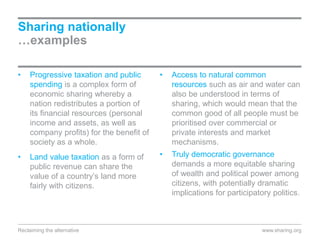
Sharing nationally
…examples
• Progressive taxation and public
spending is a complex form of
economic sharing whereby a
nation redistributes a portion of
its financial resources (personal
income and assets, as well as
company profits) for the benefit of
society as a whole.
• Land value taxation as a form of
public revenue can share the
value of a country’s land more
fairly with citizens.
• Access to natural common
resources such as air and water can
also be understood in terms of
sharing, which would mean that the
common good of all people must be
prioritised over commercial or
private interests and market
mechanisms.
• Truly democratic governance
demands a more equitable sharing
of wealth and political power among
citizens, with potentially dramatic
implications for participatory politics.
www.sharing.orgReclaiming the alternative
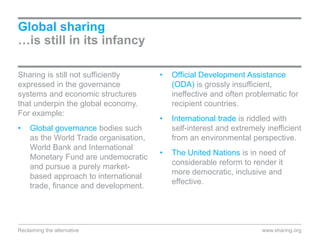
Global sharing
…is still in its infancy
Sharing is still not sufficiently
expressed in the governance
systems and economic structures
that underpin the global economy.
For example:
• Global governance bodies such
as the World Trade organisation,
World Bank and International
Monetary Fund are undemocratic
and pursue a purely market-
based approach to international
trade, finance and development.
• Official Development Assistance
(ODA) is grossly insufficient,
ineffective and often problematic for
recipient countries.
• International trade is riddled with
self-interest and extremely inefficient
from an environmental perspective.
• The United Nations is in need of
considerable reform to render it
more democratic, inclusive and
effective.
www.sharing.orgReclaiming the alternative
“The sharing economy is a broad term used in this report that
encompasses the many systems of sharing and redistribution that exist
locally, nationally and globally - whether facilitated by individuals, states or
other institutions. It is concerned with the social, economic, environmental,
political and spiritual benefits of sharing both material and non-material
resources - everything from time and love to money and natural resources.
In comparison, the global sharing economy refers specifically to systems of
sharing and redistribution that are international or global in nature - whether
facilitated directly by people and governments or by global institutions like
the United Nations. It refers to the many methods by which the international
community can share their financial, technical, natural and other resources
for the common good of all people. The global sharing economy is still in its
infancy, but is nonetheless an important expression of the growing sense of
solidarity and unity between people and nations.”
The sharing economy – nationally and globally
Broadening the definition
www.sharing.orgReclaiming the alternative
As global citizens and organisations who uphold the common good of all
humanity, we recognise that:
• Sharing is our human nature…
• Our failure to share is a root cause of the world’s crises…
• Sharing is the key to creating a better world…
• A demand for sharing is on the rise across the world…
• Sharing is a common cause that unites us all…
By signing this statement, we affirm the fundamental importance of
strengthening and scaling up all genuine forms of sharing in our divided
world. We therefore add our voice to an emerging worldwide call for
sharing, and commit to engage in this crucial debate at every opportunity.
A global call for sharing
Sign-on statement
www.sharing.orgReclaiming the alternative
Campaigning for a fairer
sharing of wealth, power
and resources within and
between nations
www.stwr.org
Reclaiming the alternative

Reclaiming the Alternative: the transformative potential of the sharing economy

  • 1.
    Reclaiming the alternative Thetransformative potential of the sharing economy Adam Parsons 31st October 2014 Reclaiming the alternative www.sharing.org
  • 2.
    STWR is anindependent civil society organisation campaigning for a fairer sharing of wealth, power and resources within and between nations. Through our research and activities, we make a case for implementing economic sharing as a pragmatic solution to a broad range of interconnected crises that governments are failing to adequately address – including hunger, poverty, climate change and environmental destruction, and conflict over the world’s natural resources. About Share The World’s Resources www.sharing.org Reclaiming the alternative www.sharing.org
  • 3.
    Sharing nationally …examples • Progressivetaxation and public spending is a complex form of economic sharing whereby a nation redistributes a portion of its financial resources (personal income and assets, as well as company profits) for the benefit of society as a whole. • Land value taxation as a form of public revenue can share the value of a country’s land more fairly with citizens. • Access to natural common resources such as air and water can also be understood in terms of sharing, which would mean that the common good of all people must be prioritised over commercial or private interests and market mechanisms. • Truly democratic governance demands a more equitable sharing of wealth and political power among citizens, with potentially dramatic implications for participatory politics. www.sharing.orgReclaiming the alternative
  • 4.
    Global sharing …is stillin its infancy Sharing is still not sufficiently expressed in the governance systems and economic structures that underpin the global economy. For example: • Global governance bodies such as the World Trade organisation, World Bank and International Monetary Fund are undemocratic and pursue a purely market- based approach to international trade, finance and development. • Official Development Assistance (ODA) is grossly insufficient, ineffective and often problematic for recipient countries. • International trade is riddled with self-interest and extremely inefficient from an environmental perspective. • The United Nations is in need of considerable reform to render it more democratic, inclusive and effective. www.sharing.orgReclaiming the alternative
  • 5.
    “The sharing economyis a broad term used in this report that encompasses the many systems of sharing and redistribution that exist locally, nationally and globally - whether facilitated by individuals, states or other institutions. It is concerned with the social, economic, environmental, political and spiritual benefits of sharing both material and non-material resources - everything from time and love to money and natural resources. In comparison, the global sharing economy refers specifically to systems of sharing and redistribution that are international or global in nature - whether facilitated directly by people and governments or by global institutions like the United Nations. It refers to the many methods by which the international community can share their financial, technical, natural and other resources for the common good of all people. The global sharing economy is still in its infancy, but is nonetheless an important expression of the growing sense of solidarity and unity between people and nations.” The sharing economy – nationally and globally Broadening the definition www.sharing.orgReclaiming the alternative
  • 6.
    As global citizensand organisations who uphold the common good of all humanity, we recognise that: • Sharing is our human nature… • Our failure to share is a root cause of the world’s crises… • Sharing is the key to creating a better world… • A demand for sharing is on the rise across the world… • Sharing is a common cause that unites us all… By signing this statement, we affirm the fundamental importance of strengthening and scaling up all genuine forms of sharing in our divided world. We therefore add our voice to an emerging worldwide call for sharing, and commit to engage in this crucial debate at every opportunity. A global call for sharing Sign-on statement www.sharing.orgReclaiming the alternative
  • 7.
    Campaigning for afairer sharing of wealth, power and resources within and between nations www.stwr.org Reclaiming the alternative