Train The
Trainer
On
Recent Trends in
Training and
Development

By: Ruhi Beri
AGENDA
• Latest trends
• Latest methods used by organizations
• Latest technologies used
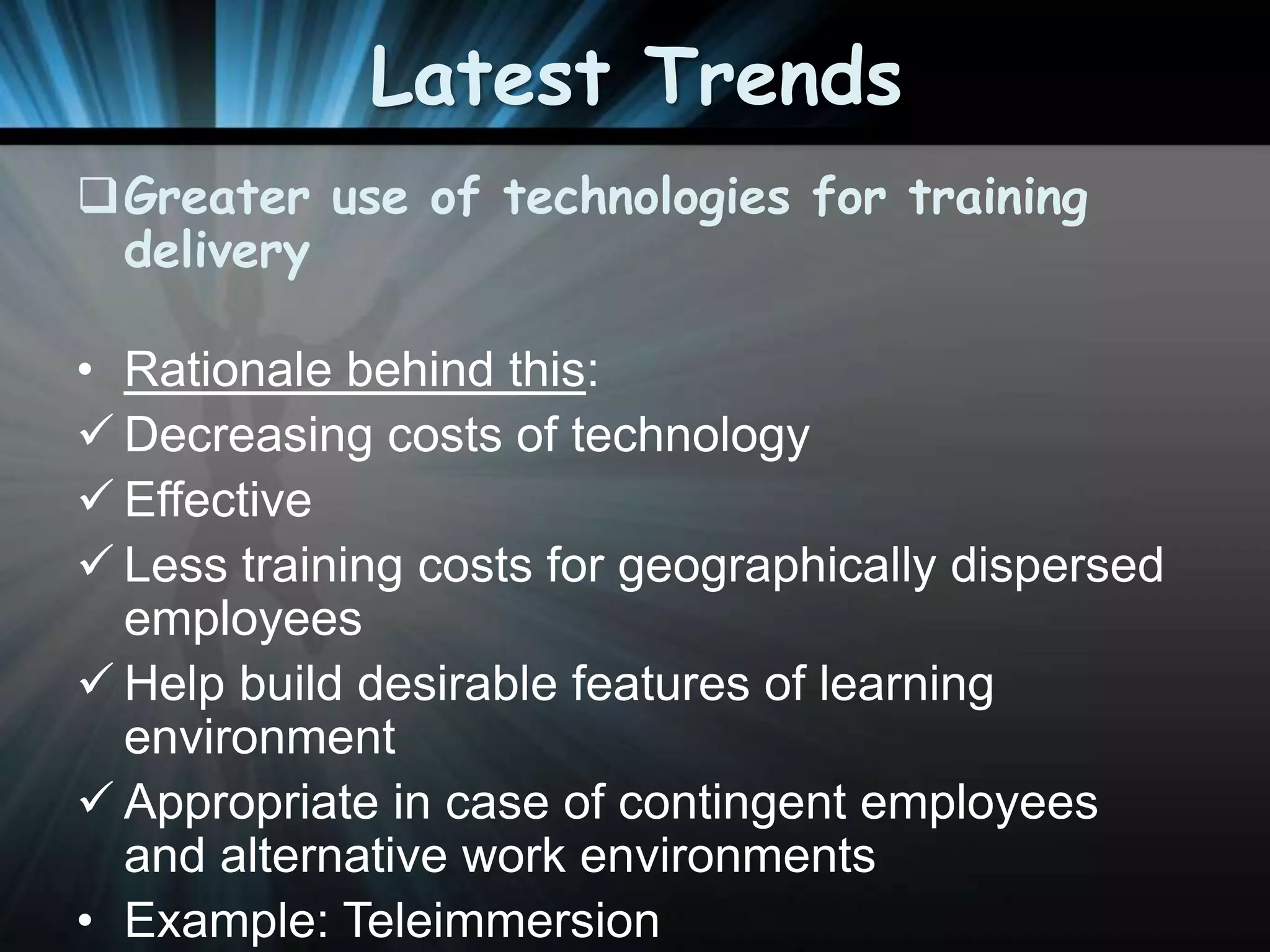
Latest Trends
Greater use of technologies for training
delivery
• Rationale behind this:
 Decreasing costs of technology
 Effective
 Less training costs for geographically dispersed
employees
 Help build desirable features of learning
environment
 Appropriate in case of contingent employees
and alternative work environments
• Example: Teleimmersion
Latest Trends
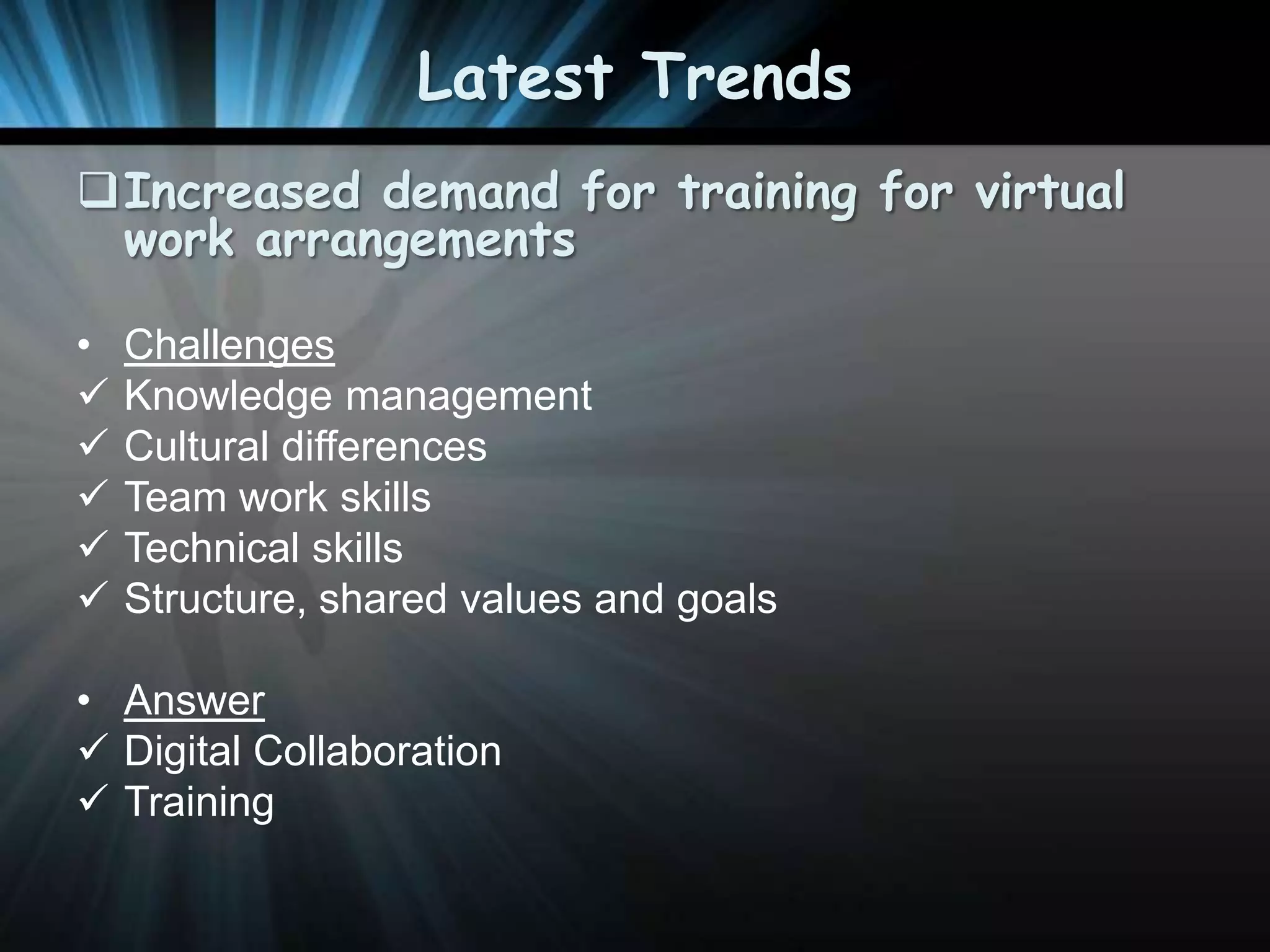
Increased demand for training for virtual
work arrangements
•






Challenges
Knowledge management
Cultural differences
Team work skills
Technical skills
Structure, shared values and goals

• Answer
 Digital Collaboration
 Training
Latest Trends
Increased emphasis on speed in design,
focus in content, and use of multiple
delivery methods
• Rapid Instructional Design (RID)
 Just-in-time
 Resource allocation to design and delivery
• Shorter training courses focused on content (yet
interesting)
• Multiple delivery methods
Latest Trends
Increased emphasis on capturing and
sharing intellectual capital
• Rationale behind this:
 Loss of valuable knowledge due to retirement of baby
boomers
 Strategic value of learning organizations

• Trainers need to be technically literate to covert
organizations into learning organizations by the use of
latest technologies.
Latest Trends
Increased use of true performance support
• Embedded learning
 Task specific, real-time content and simulation
 Accessible during work as well as real-time
collaboration in virtual work spaces

• Future
 Short learning episodes embedded with work
 Alert when need arises
 Direct connection with experts
 Simulations for guidance
Latest Trends
Increased emphasis on performance analysis
and learning on business enhancement
• Performance Analysis approach
 Focusing on interventions related to
performance improvement
 Providing support for high-performance work
systems
 Developing systems for training administration,
development and delivery that reduces costs
and increases employees’ access to learning
Latest Trends
Increased use of training partnerships and
outsourcing training
• Need of specialized knowledge, access to best
practices and cost savings.
• External suppliers: Consultants, academicians,
etc
• Key decision is how much to outsource (and not
whether to outsource)
• Example: Application Service Provider
Latest Trends
Recognition of importance of EQ and SQ at
the workplace
Globalization will shape more leadership
programs
• Highlights

Conducts Leadership Programs and a host of other workshops for many Fortune
500 Companies
These programs revolve around spiritual knowledge and its practical applicability in
professional and personal life.
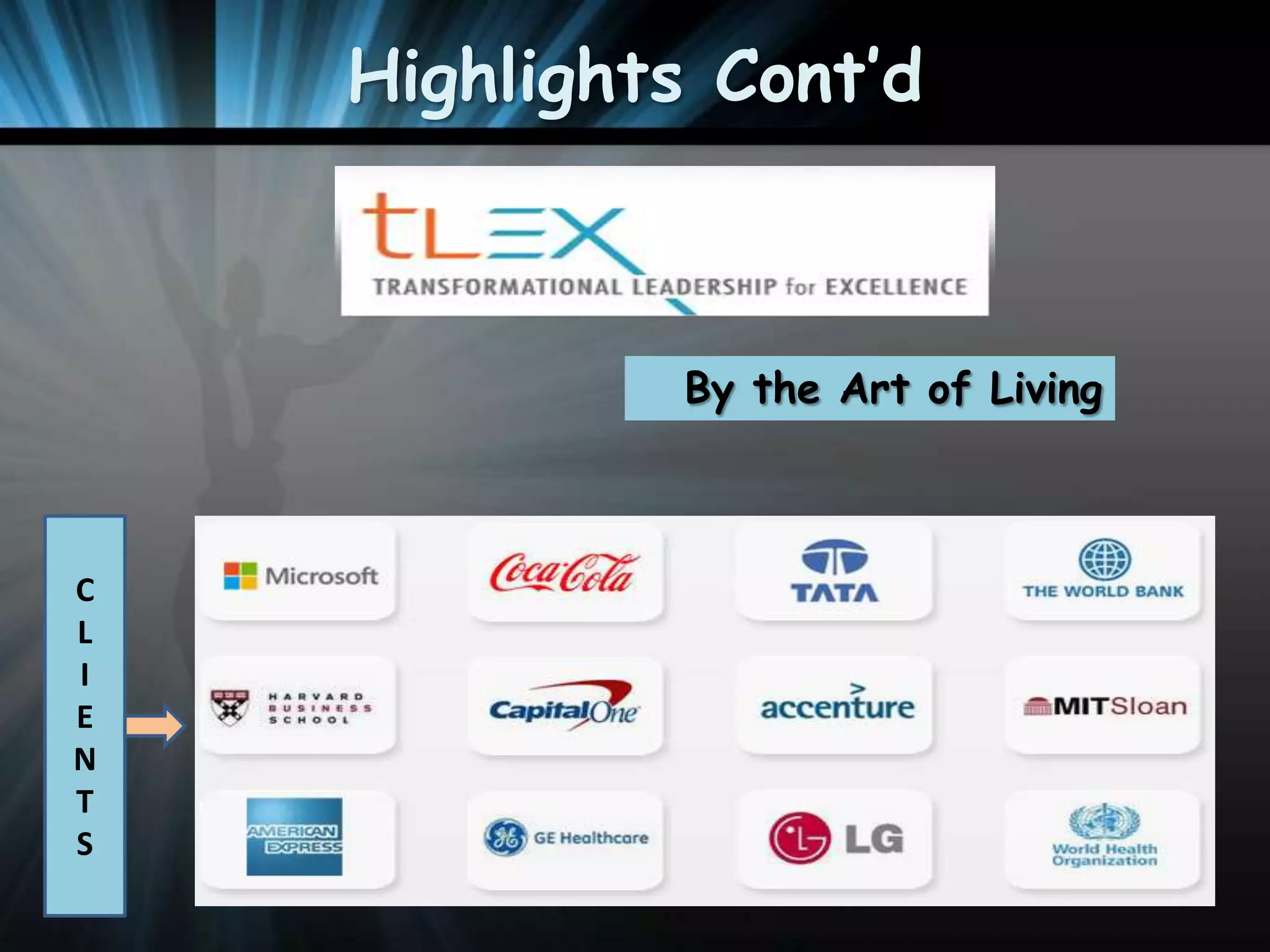
Highlights Cont’d

By the Art of Living

C
L
I
E
N
T
S
Latest Trends
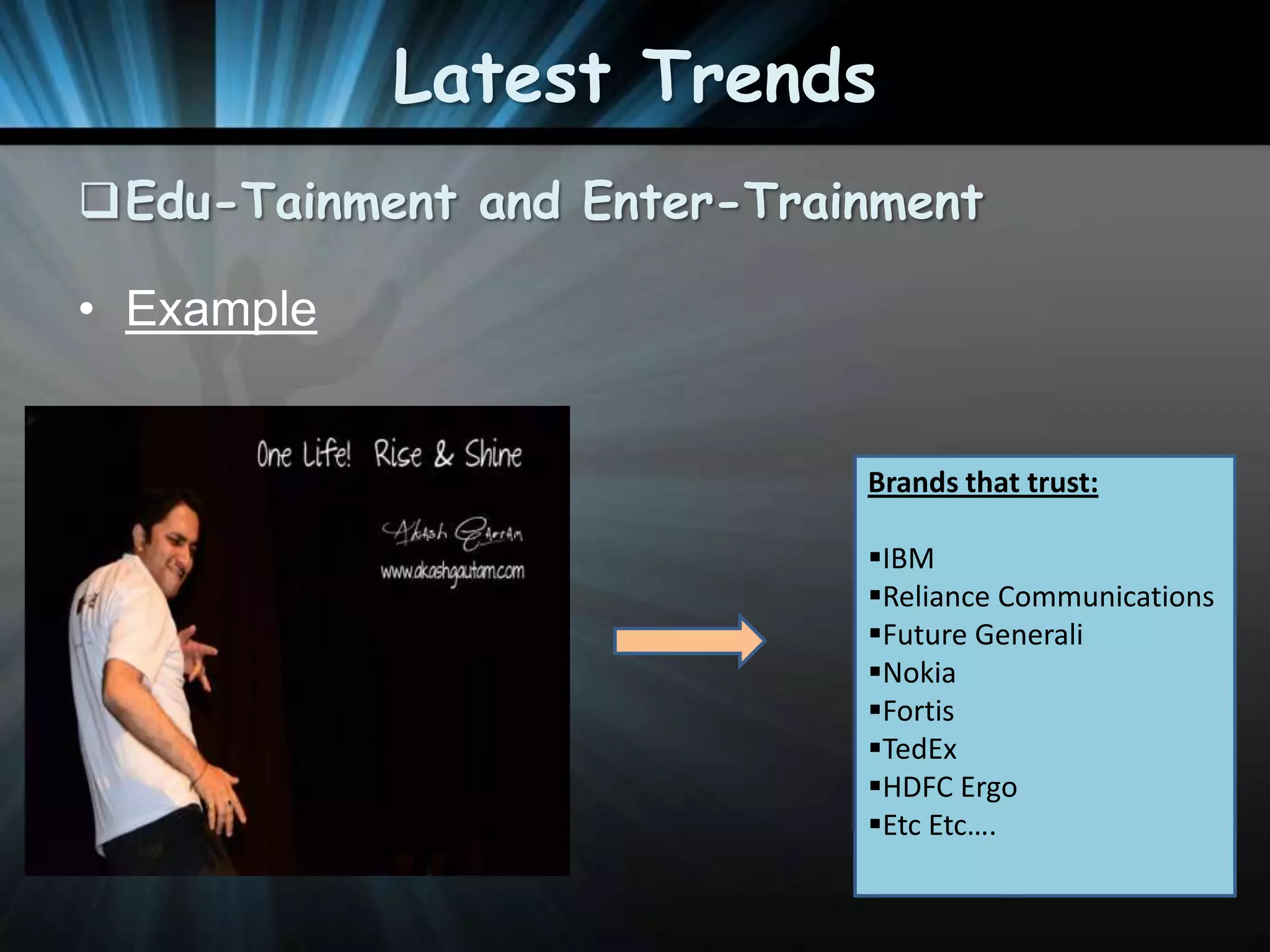
Edu-Tainment and Enter-Trainment
• Example

Brands that trust:
IBM
Reliance Communications
Future Generali
Nokia
Fortis
TedEx
HDFC Ergo
Etc Etc….
Latest methods used by
organizations
COMPUTER BASED
TRAINING

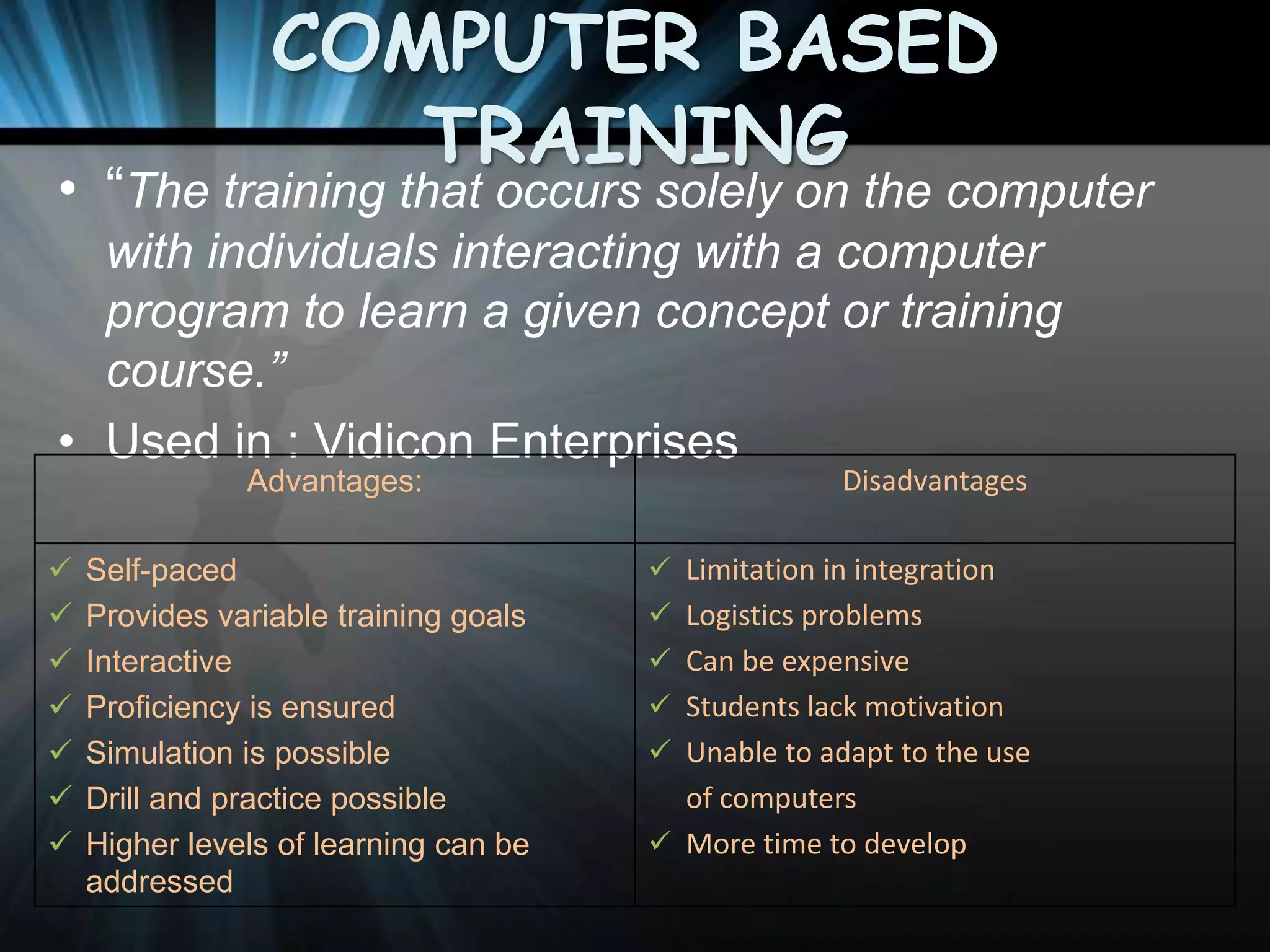
• “The training that occurs solely on the computer
with individuals interacting with a computer
program to learn a given concept or training
course.”
• Used in : Vidicon Enterprises
Advantages:








Self-paced
Provides variable training goals
Interactive
Proficiency is ensured
Simulation is possible
Drill and practice possible
Higher levels of learning can be
addressed

Disadvantages

 Limitation in integration
 Logistics problems
 Can be expensive
 Students lack motivation

 Unable to adapt to the use

of computers
 More time to develop
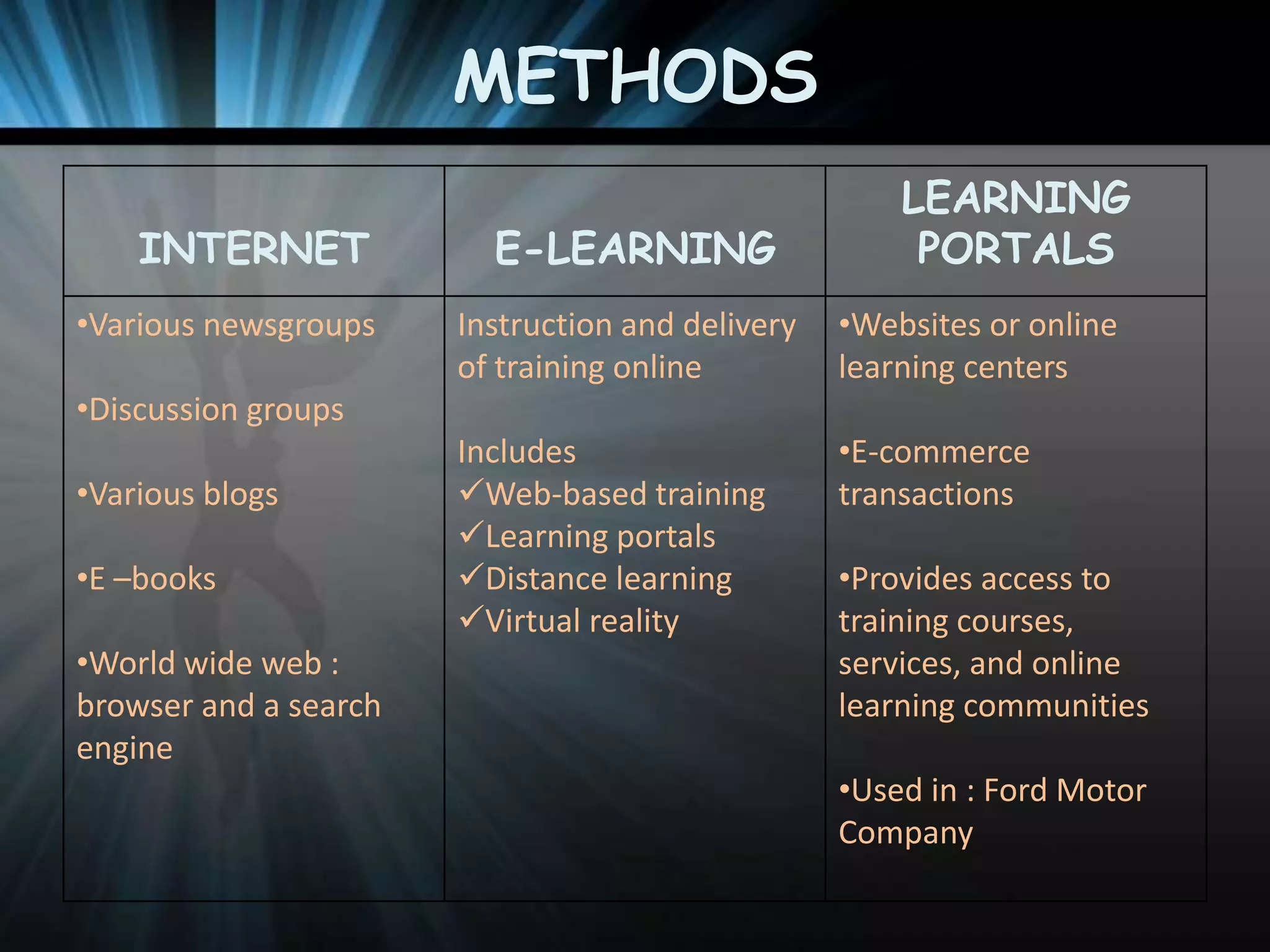
METHODS
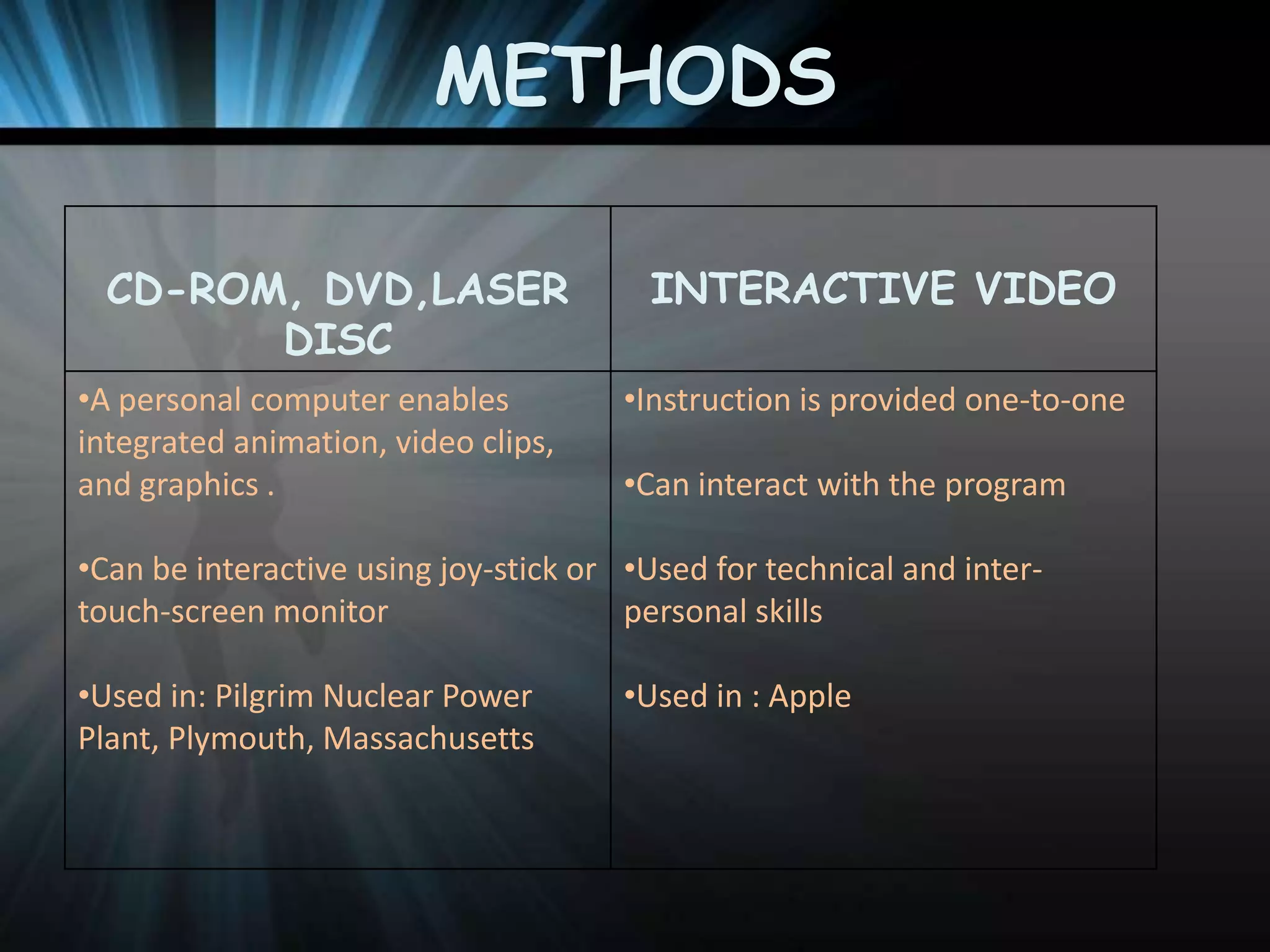
CD-ROM, DVD,LASER
DISC
•A personal computer enables
integrated animation, video clips,
and graphics .

INTERACTIVE VIDEO
•Instruction is provided one-to-one
•Can interact with the program

•Can be interactive using joy-stick or •Used for technical and intertouch-screen monitor
personal skills

•Used in: Pilgrim Nuclear Power
Plant, Plymouth, Massachusetts

•Used in : Apple
METHODS
INTERNET
•Various newsgroups

E-LEARNING

LEARNING
PORTALS

Instruction and delivery
of training online

•Websites or online
learning centers

Includes
Web-based training
Learning portals
Distance learning
Virtual reality

•E-commerce
transactions

•Discussion groups
•Various blogs
•E –books
•World wide web :
browser and a search
engine

•Provides access to
training courses,
services, and online
learning communities
•Used in : Ford Motor
Company
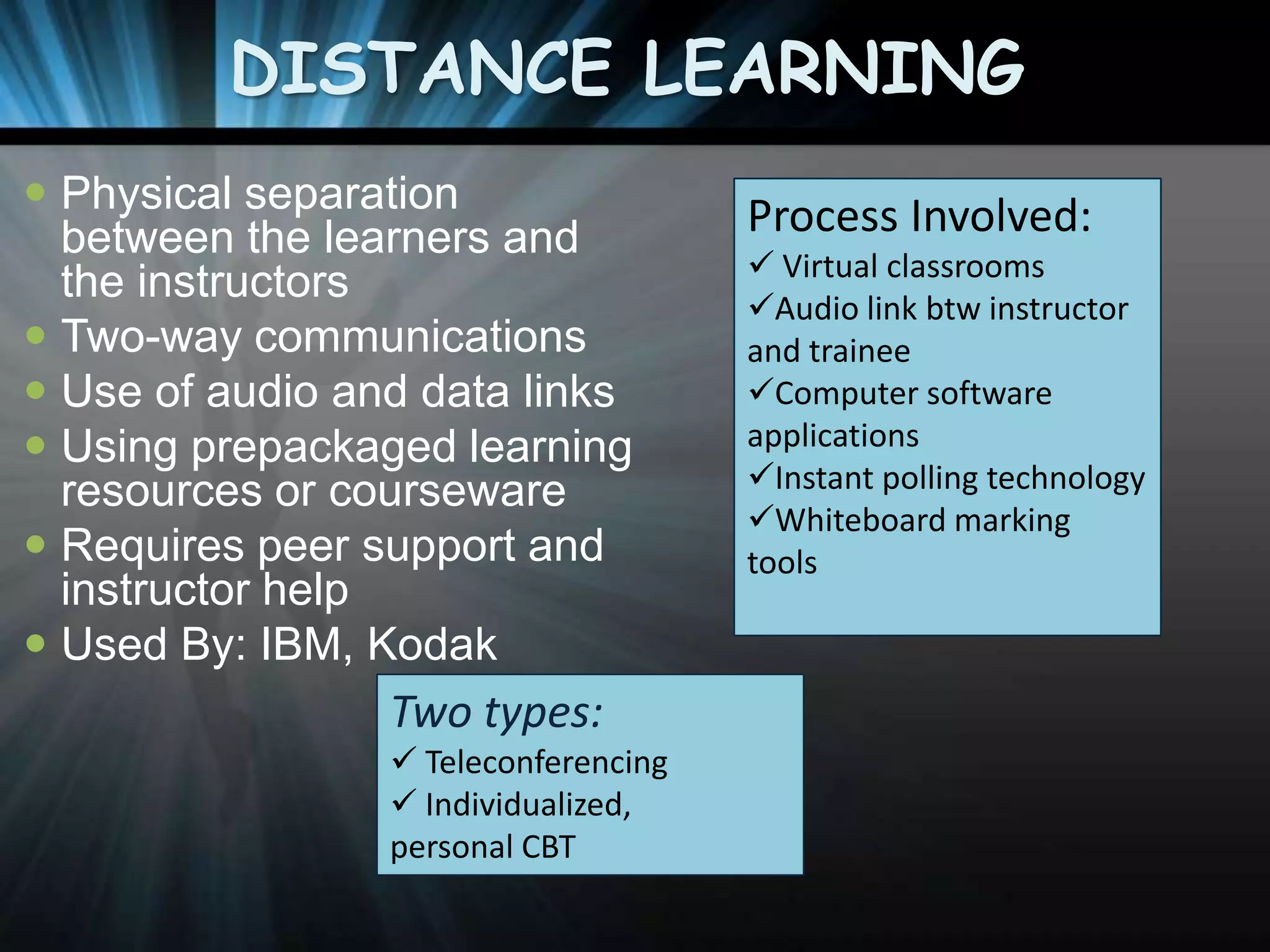
DISTANCE LEARNING
 Physical separation
between the learners and
the instructors
 Two-way communications
 Use of audio and data links
 Using prepackaged learning
resources or courseware
 Requires peer support and
instructor help
 Used By: IBM, Kodak

Two types:
 Teleconferencing
 Individualized,
personal CBT

Process Involved:
 Virtual classrooms
Audio link btw instructor
and trainee
Computer software
applications
Instant polling technology
Whiteboard marking
tools
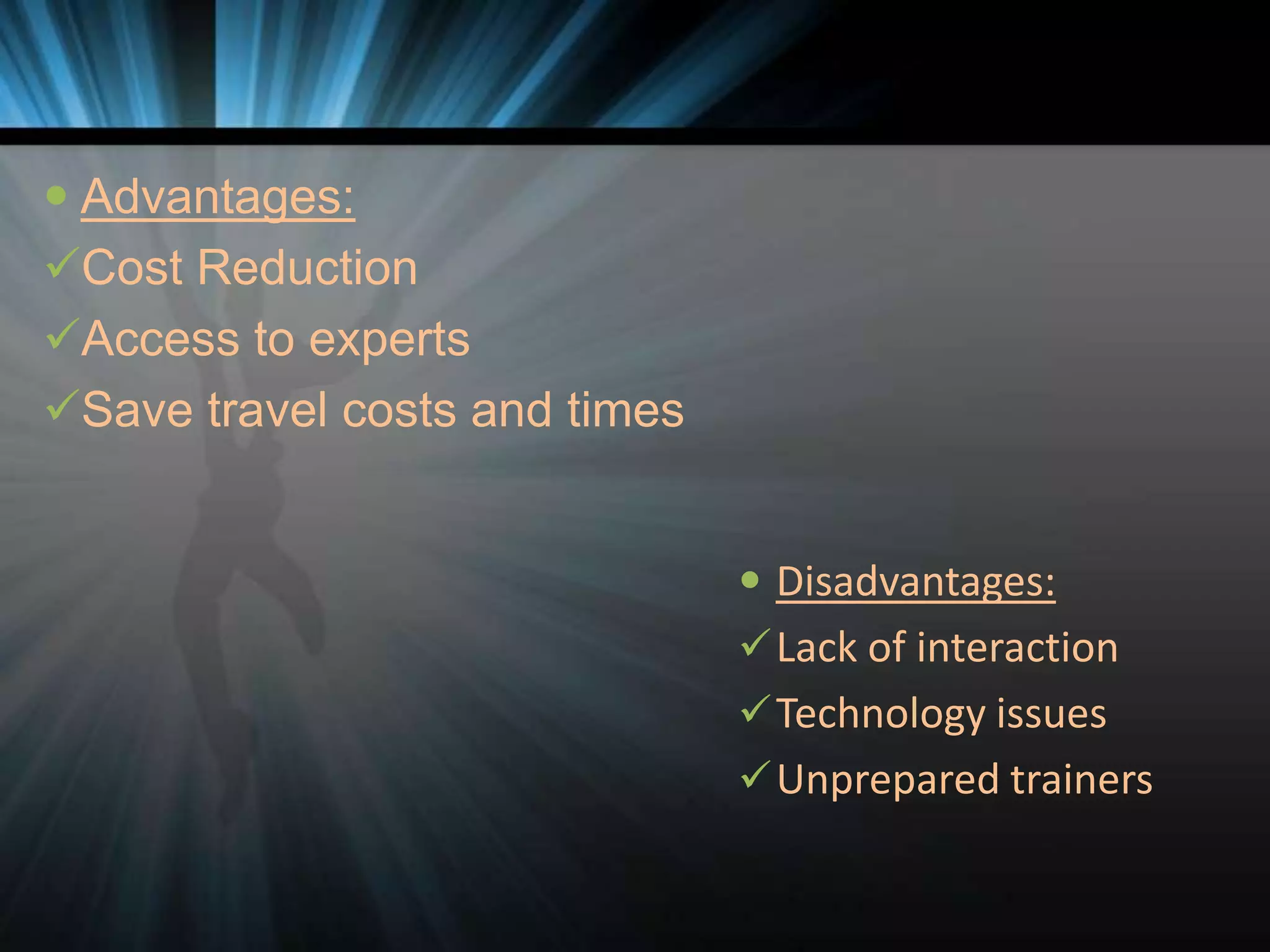
 Advantages:
Cost Reduction
Access to experts
Save travel costs and times
 Disadvantages:
 Lack of interaction
 Technology issues
 Unprepared trainers
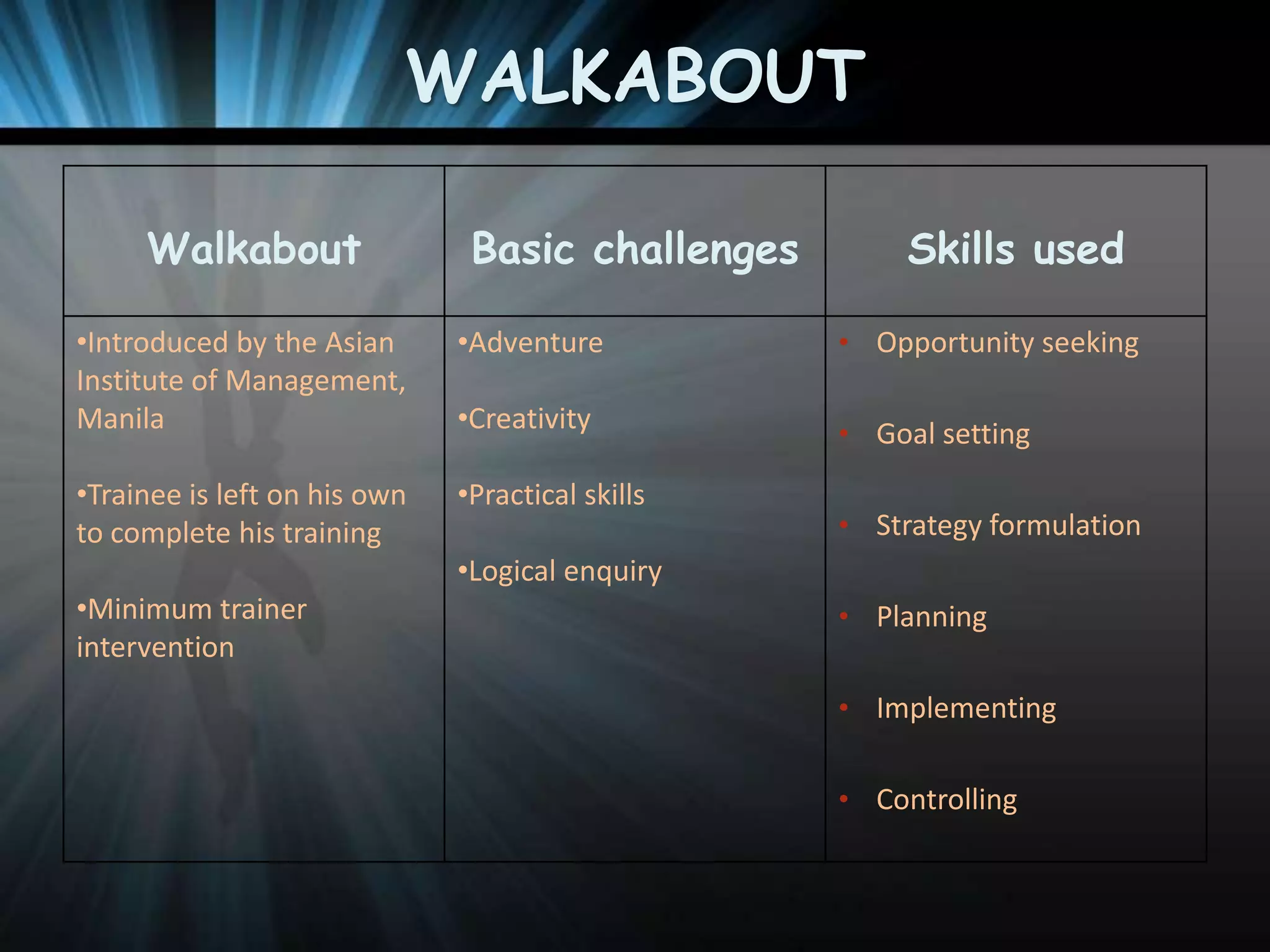
WALKABOUT
Walkabout

Basic challenges

•Introduced by the Asian
Institute of Management,
Manila

•Adventure

•Trainee is left on his own
to complete his training

•Practical skills

•Creativity

Skills used
• Opportunity seeking
• Goal setting

• Strategy formulation

•Logical enquiry
•Minimum trainer
intervention

• Planning
• Implementing
• Controlling
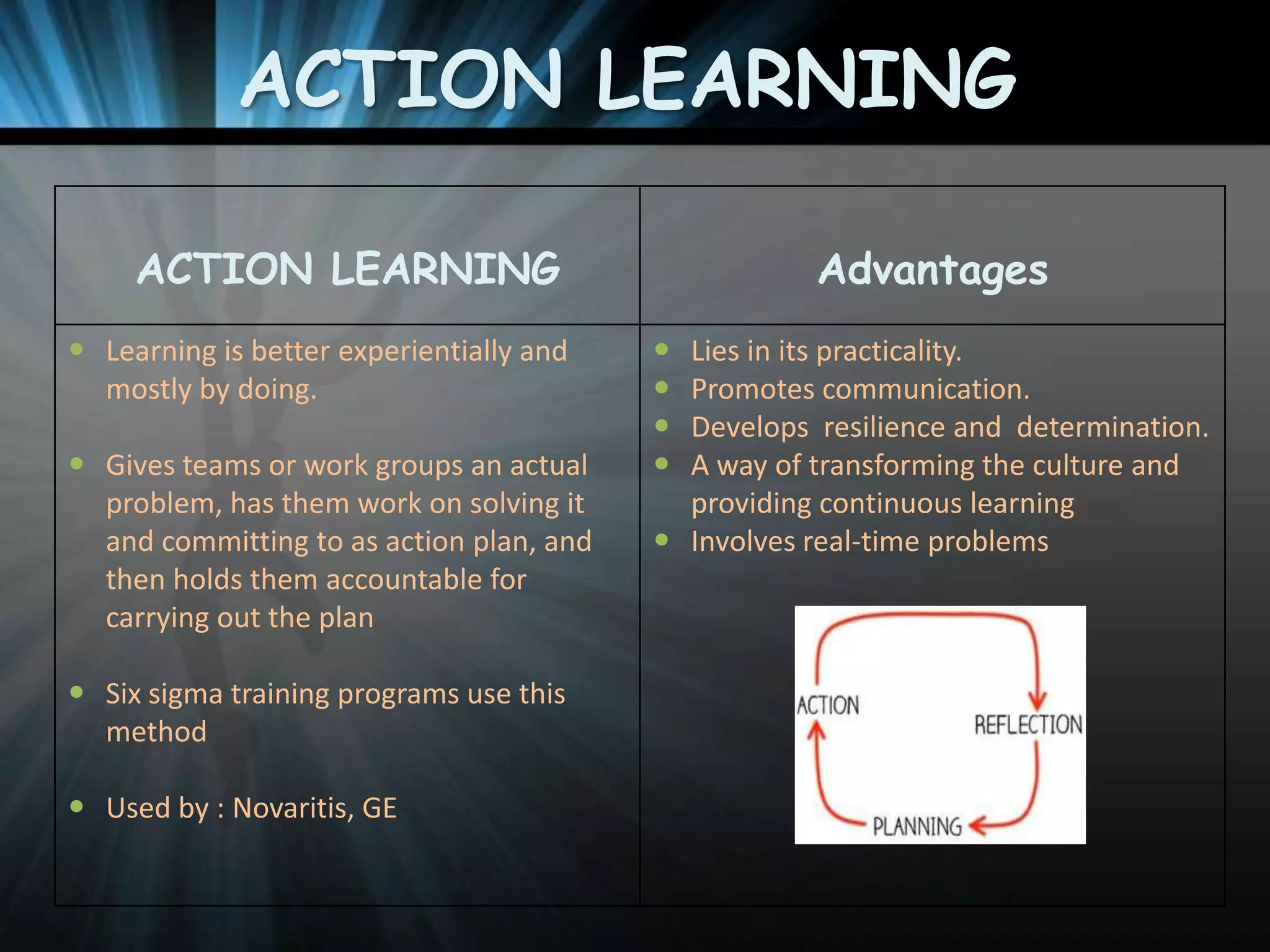
ACTION LEARNING
ACTION LEARNING
 Learning is better experientially and
mostly by doing.
 Gives teams or work groups an actual
problem, has them work on solving it
and committing to as action plan, and
then holds them accountable for
carrying out the plan
 Six sigma training programs use this
method

 Used by : Novaritis, GE

Advantages





Lies in its practicality.
Promotes communication.
Develops resilience and determination.
A way of transforming the culture and
providing continuous learning
 Involves real-time problems
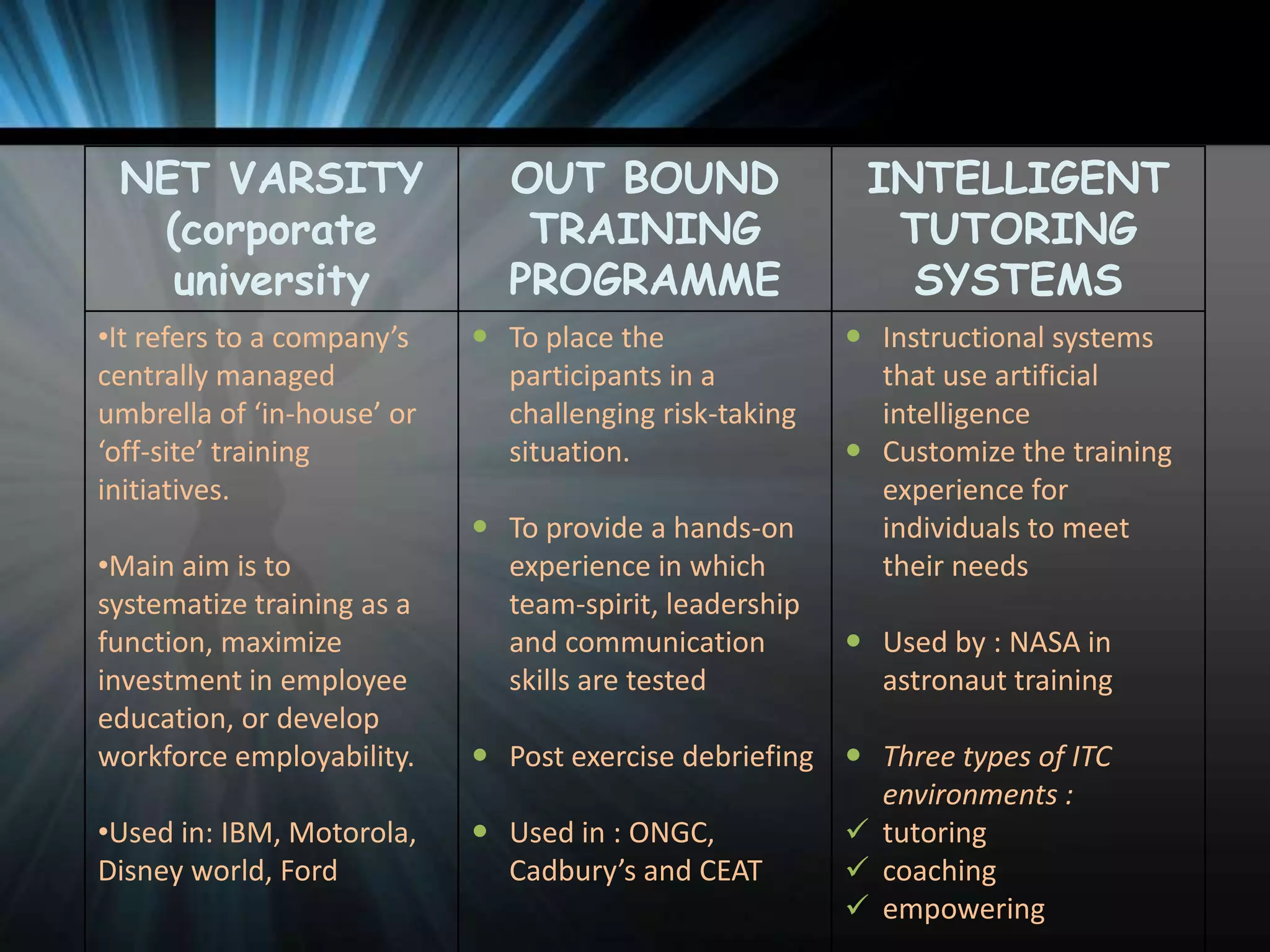
NET VARSITY
(corporate
university
•It refers to a company’s
centrally managed
umbrella of ‘in-house’ or
‘off-site’ training
initiatives.

•Main aim is to
systematize training as a
function, maximize
investment in employee
education, or develop
workforce employability.
•Used in: IBM, Motorola,
Disney world, Ford

OUT BOUND
TRAINING
PROGRAMME
 To place the
participants in a
challenging risk-taking
situation.
 To provide a hands-on
experience in which
team-spirit, leadership
and communication
skills are tested

INTELLIGENT
TUTORING
SYSTEMS
 Instructional systems
that use artificial
intelligence
 Customize the training
experience for
individuals to meet
their needs
 Used by : NASA in
astronaut training

 Post exercise debriefing  Three types of ITC
environments :
 Used in : ONGC,
 tutoring
Cadbury’s and CEAT
 coaching
 empowering
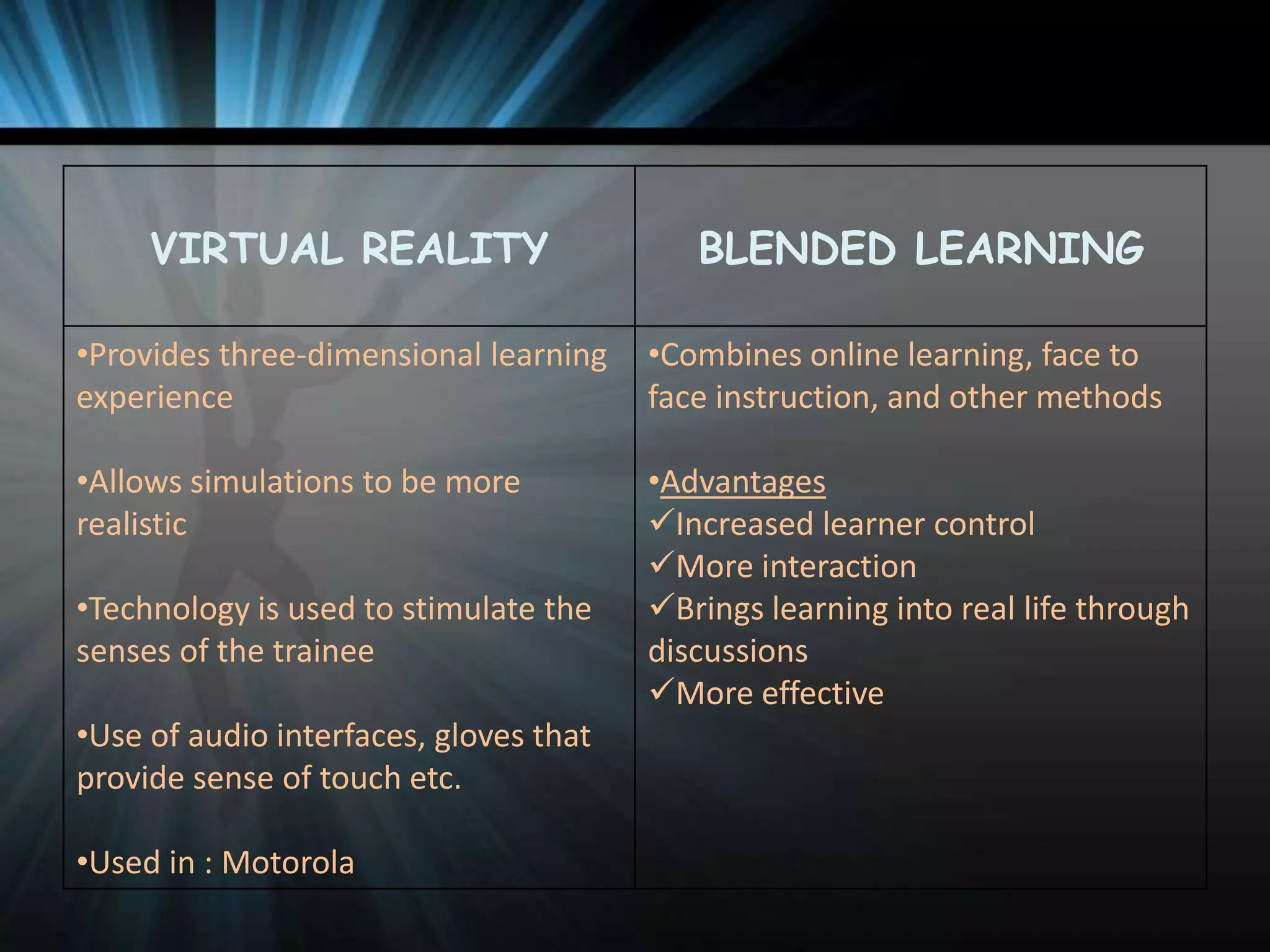
VIRTUAL REALITY

BLENDED LEARNING

•Provides three-dimensional learning
experience

•Combines online learning, face to
face instruction, and other methods

•Allows simulations to be more
realistic

•Advantages
Increased learner control
More interaction
Brings learning into real life through
discussions
More effective

•Technology is used to stimulate the
senses of the trainee
•Use of audio interfaces, gloves that
provide sense of touch etc.
•Used in : Motorola
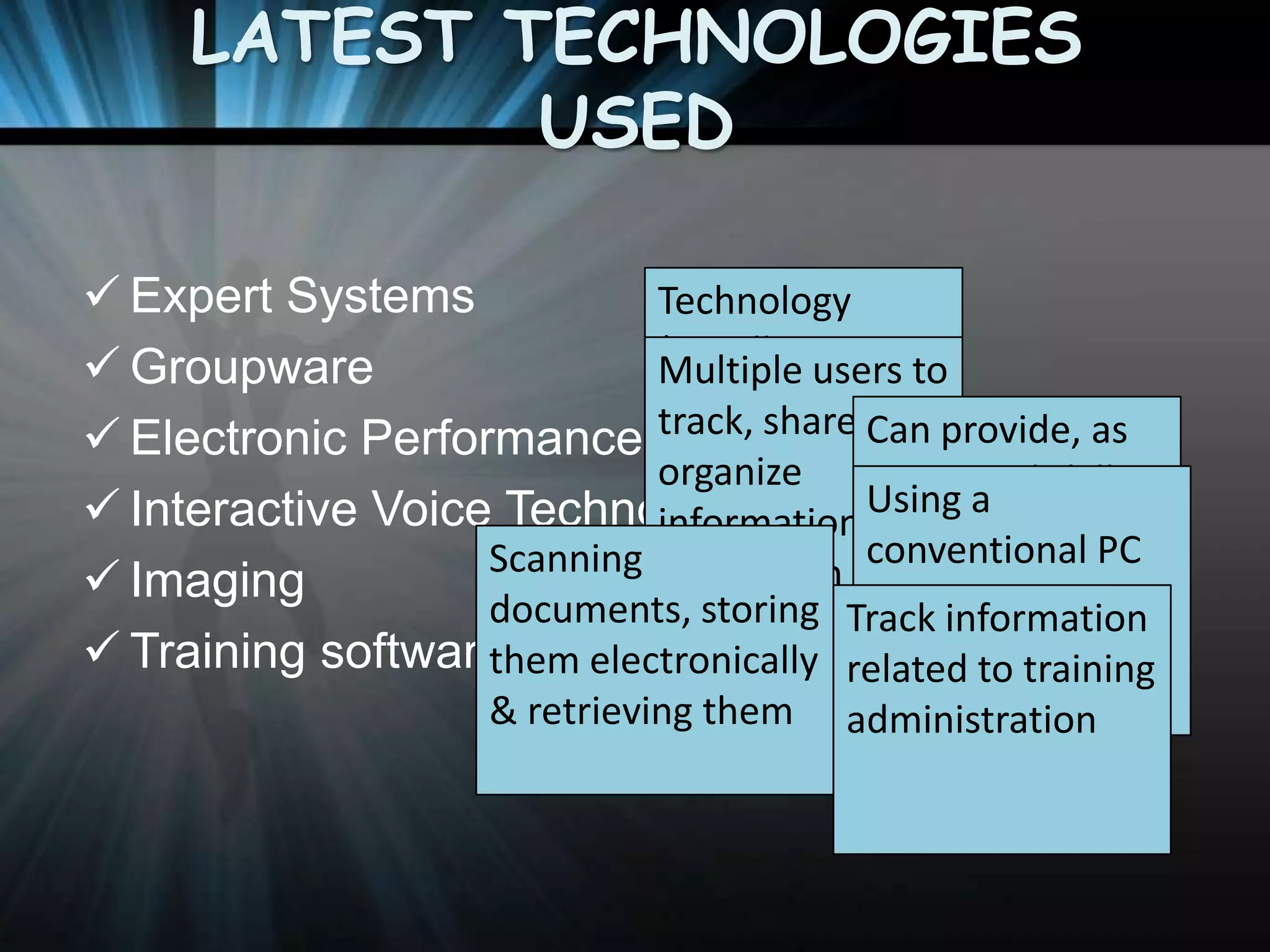
LATEST TECHNOLOGIES
USED
 Expert Systems
Technology
(usually users to
Multiple
 Groupware
software ) that
track, share, and
 Electronic Performance Support& Can provide, as
organizes Systems
organize
requested skills
Using
applies
 Interactive Voice Technology human a
information training,
and
conventional PC
Scanning experts on the
to work
information
 Imaging
knowledgeTrack information
to create a
documents, storing to
same document and
access,
 Training software applications related to training
specific
them electronically phone-response
simultaneously
expert advice
problems system
& retrieving them administration
FINALLY
AMA Enterprise identifies the following
trends that will have an impact on the
industry in 2013:
 Training executives are being pressed for
transparency
 Coaching programs will draw greater scrutiny
 Demand for basic skills training is expected to reemerge
 Globalization will shape more leadership programs
 Companies will turn to training to build employee
loyalty
 Workers will be more assertive about high-potential
programs
 Learning will continue to go mobile
REFERENCES
• Raymond A Noe, “Employee Training and
Development” McGraw-Hill
• P.L.Rao., “Enriching Human Capital through
Training and Development”, Excel Books
• Irwin L. Goldstein, “Training in Organizations”,
Cengage Learning
• http://www.akashgautam.com
• http://www.tlexprogram.com
• http://www.robinsharma.com

Recent trends in training and development

  • 1.
    Train The Trainer On Recent Trendsin Training and Development By: Ruhi Beri
  • 2.
    AGENDA • Latest trends •Latest methods used by organizations • Latest technologies used
  • 3.
    Latest Trends Greater useof technologies for training delivery • Rationale behind this:  Decreasing costs of technology  Effective  Less training costs for geographically dispersed employees  Help build desirable features of learning environment  Appropriate in case of contingent employees and alternative work environments • Example: Teleimmersion
  • 4.
    Latest Trends Increased demandfor training for virtual work arrangements •      Challenges Knowledge management Cultural differences Team work skills Technical skills Structure, shared values and goals • Answer  Digital Collaboration  Training
  • 5.
    Latest Trends Increased emphasison speed in design, focus in content, and use of multiple delivery methods • Rapid Instructional Design (RID)  Just-in-time  Resource allocation to design and delivery • Shorter training courses focused on content (yet interesting) • Multiple delivery methods
  • 6.
    Latest Trends Increased emphasison capturing and sharing intellectual capital • Rationale behind this:  Loss of valuable knowledge due to retirement of baby boomers  Strategic value of learning organizations • Trainers need to be technically literate to covert organizations into learning organizations by the use of latest technologies.
  • 7.
    Latest Trends Increased useof true performance support • Embedded learning  Task specific, real-time content and simulation  Accessible during work as well as real-time collaboration in virtual work spaces • Future  Short learning episodes embedded with work  Alert when need arises  Direct connection with experts  Simulations for guidance
  • 8.
    Latest Trends Increased emphasison performance analysis and learning on business enhancement • Performance Analysis approach  Focusing on interventions related to performance improvement  Providing support for high-performance work systems  Developing systems for training administration, development and delivery that reduces costs and increases employees’ access to learning
  • 9.
    Latest Trends Increased useof training partnerships and outsourcing training • Need of specialized knowledge, access to best practices and cost savings. • External suppliers: Consultants, academicians, etc • Key decision is how much to outsource (and not whether to outsource) • Example: Application Service Provider
  • 10.
    Latest Trends Recognition ofimportance of EQ and SQ at the workplace Globalization will shape more leadership programs • Highlights Conducts Leadership Programs and a host of other workshops for many Fortune 500 Companies These programs revolve around spiritual knowledge and its practical applicability in professional and personal life.
  • 11.
    Highlights Cont’d By theArt of Living C L I E N T S
  • 13.
    Latest Trends Edu-Tainment andEnter-Trainment • Example Brands that trust: IBM Reliance Communications Future Generali Nokia Fortis TedEx HDFC Ergo Etc Etc….
  • 14.
    Latest methods usedby organizations
  • 15.
    COMPUTER BASED TRAINING • “Thetraining that occurs solely on the computer with individuals interacting with a computer program to learn a given concept or training course.” • Used in : Vidicon Enterprises Advantages:        Self-paced Provides variable training goals Interactive Proficiency is ensured Simulation is possible Drill and practice possible Higher levels of learning can be addressed Disadvantages  Limitation in integration  Logistics problems  Can be expensive  Students lack motivation  Unable to adapt to the use of computers  More time to develop
  • 16.
    METHODS CD-ROM, DVD,LASER DISC •A personalcomputer enables integrated animation, video clips, and graphics . INTERACTIVE VIDEO •Instruction is provided one-to-one •Can interact with the program •Can be interactive using joy-stick or •Used for technical and intertouch-screen monitor personal skills •Used in: Pilgrim Nuclear Power Plant, Plymouth, Massachusetts •Used in : Apple
  • 17.
    METHODS INTERNET •Various newsgroups E-LEARNING LEARNING PORTALS Instruction anddelivery of training online •Websites or online learning centers Includes Web-based training Learning portals Distance learning Virtual reality •E-commerce transactions •Discussion groups •Various blogs •E –books •World wide web : browser and a search engine •Provides access to training courses, services, and online learning communities •Used in : Ford Motor Company
  • 18.
    DISTANCE LEARNING  Physicalseparation between the learners and the instructors  Two-way communications  Use of audio and data links  Using prepackaged learning resources or courseware  Requires peer support and instructor help  Used By: IBM, Kodak Two types:  Teleconferencing  Individualized, personal CBT Process Involved:  Virtual classrooms Audio link btw instructor and trainee Computer software applications Instant polling technology Whiteboard marking tools
  • 19.
     Advantages: Cost Reduction Accessto experts Save travel costs and times  Disadvantages:  Lack of interaction  Technology issues  Unprepared trainers
  • 20.
    WALKABOUT Walkabout Basic challenges •Introduced bythe Asian Institute of Management, Manila •Adventure •Trainee is left on his own to complete his training •Practical skills •Creativity Skills used • Opportunity seeking • Goal setting • Strategy formulation •Logical enquiry •Minimum trainer intervention • Planning • Implementing • Controlling
  • 21.
    ACTION LEARNING ACTION LEARNING Learning is better experientially and mostly by doing.  Gives teams or work groups an actual problem, has them work on solving it and committing to as action plan, and then holds them accountable for carrying out the plan  Six sigma training programs use this method  Used by : Novaritis, GE Advantages     Lies in its practicality. Promotes communication. Develops resilience and determination. A way of transforming the culture and providing continuous learning  Involves real-time problems
  • 22.
    NET VARSITY (corporate university •It refersto a company’s centrally managed umbrella of ‘in-house’ or ‘off-site’ training initiatives. •Main aim is to systematize training as a function, maximize investment in employee education, or develop workforce employability. •Used in: IBM, Motorola, Disney world, Ford OUT BOUND TRAINING PROGRAMME  To place the participants in a challenging risk-taking situation.  To provide a hands-on experience in which team-spirit, leadership and communication skills are tested INTELLIGENT TUTORING SYSTEMS  Instructional systems that use artificial intelligence  Customize the training experience for individuals to meet their needs  Used by : NASA in astronaut training  Post exercise debriefing  Three types of ITC environments :  Used in : ONGC,  tutoring Cadbury’s and CEAT  coaching  empowering
  • 23.
    VIRTUAL REALITY BLENDED LEARNING •Providesthree-dimensional learning experience •Combines online learning, face to face instruction, and other methods •Allows simulations to be more realistic •Advantages Increased learner control More interaction Brings learning into real life through discussions More effective •Technology is used to stimulate the senses of the trainee •Use of audio interfaces, gloves that provide sense of touch etc. •Used in : Motorola
  • 24.
    LATEST TECHNOLOGIES USED  ExpertSystems Technology (usually users to Multiple  Groupware software ) that track, share, and  Electronic Performance Support& Can provide, as organizes Systems organize requested skills Using applies  Interactive Voice Technology human a information training, and conventional PC Scanning experts on the to work information  Imaging knowledgeTrack information to create a documents, storing to same document and access,  Training software applications related to training specific them electronically phone-response simultaneously expert advice problems system & retrieving them administration
  • 25.
    FINALLY AMA Enterprise identifiesthe following trends that will have an impact on the industry in 2013:  Training executives are being pressed for transparency  Coaching programs will draw greater scrutiny  Demand for basic skills training is expected to reemerge  Globalization will shape more leadership programs  Companies will turn to training to build employee loyalty  Workers will be more assertive about high-potential programs  Learning will continue to go mobile
  • 26.
    REFERENCES • Raymond ANoe, “Employee Training and Development” McGraw-Hill • P.L.Rao., “Enriching Human Capital through Training and Development”, Excel Books • Irwin L. Goldstein, “Training in Organizations”, Cengage Learning • http://www.akashgautam.com • http://www.tlexprogram.com • http://www.robinsharma.com