Bringing real-time text to WebRTC
for NG Emergency Services
Lorenzo Miniero
@lminiero@fosstodon.org
Kamailio World
June 7th 2023,
Who am I?
Lorenzo Miniero
• Ph.D @ UniNA
• Chairman @ Meetecho
• Main author of Janus
Contacts and info
• lorenzo@meetecho.com
• https://fosstodon.org/@lminiero
• https://www.slideshare.net/LorenzoMiniero
• https://lminiero.bandcamp.com
Just a few words on Meetecho
• Co-founded in 2009 as an academic spin-off
• University research efforts brought to the market
• Completely independent from the University
• Focus on real-time multimedia applications
• Strong perspective on standardization and open source
• Several activities
• Consulting services
• Commercial support and Janus licenses
• Streaming of live events (IETF, ACM, etc.)
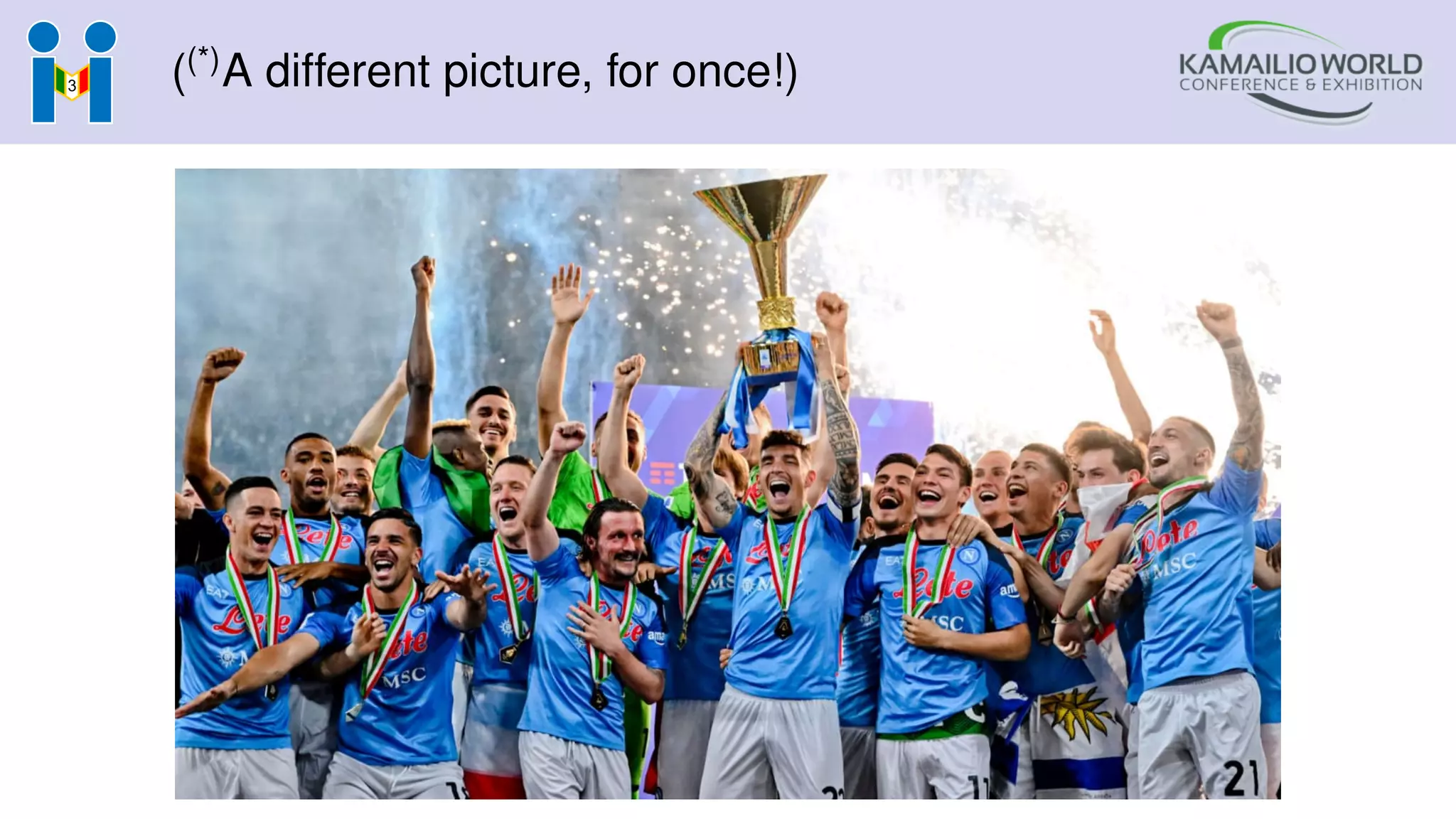
• Proudly brewed in sunny Napoli(*), Italy
((*)
A different picture, for once!)
Emergency Services for the Hearing Impaired
• Ad-hoc text telephones and telecommunication devices
• Originally conceived and implemented in the 60’s
• Commonly known as TDD / TTY / TT
• “Telecommunications Device for the Deaf”
• Units made of keyboard, small screen and modem
• Messages converted to electric signals
• Phone line used to deliver messages
• Widely used in legacy Emergency Services
• e.g., to allow 911 operators to engage with hard of hearing people
• Uses phone line + batteries −→ still works in power failure
Emergency Services for the Hearing Impaired
• Ad-hoc text telephones and telecommunication devices
• Originally conceived and implemented in the 60’s
• Commonly known as TDD / TTY / TT
• “Telecommunications Device for the Deaf”
• Units made of keyboard, small screen and modem
• Messages converted to electric signals
• Phone line used to deliver messages
• Widely used in legacy Emergency Services
• e.g., to allow 911 operators to engage with hard of hearing people
• Uses phone line + batteries −→ still works in power failure
Emergency Services for the Hearing Impaired
• Ad-hoc text telephones and telecommunication devices
• Originally conceived and implemented in the 60’s
• Commonly known as TDD / TTY / TT
• “Telecommunications Device for the Deaf”
• Units made of keyboard, small screen and modem
• Messages converted to electric signals
• Phone line used to deliver messages
• Widely used in legacy Emergency Services
• e.g., to allow 911 operators to engage with hard of hearing people
• Uses phone line + batteries −→ still works in power failure
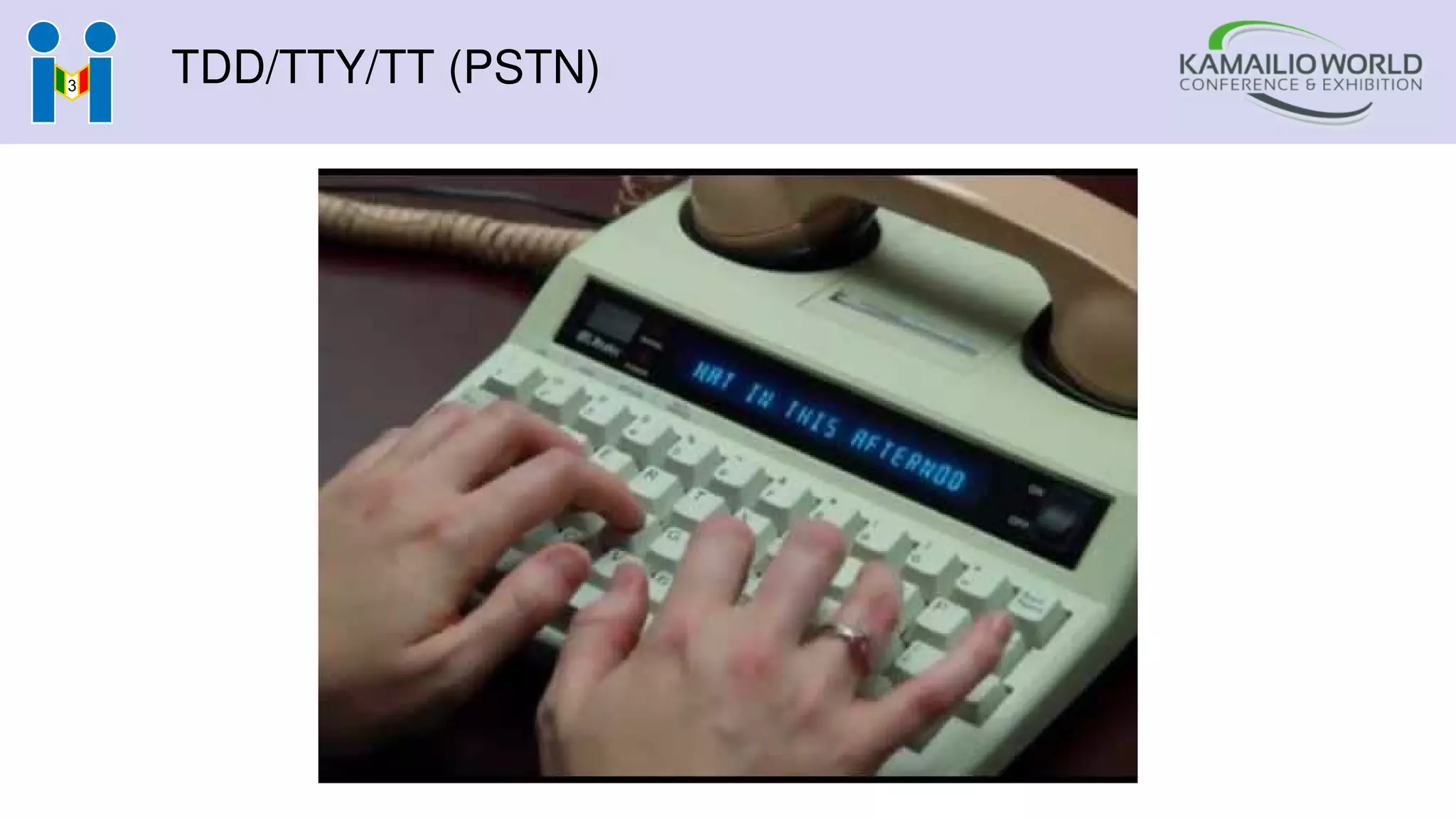
TDD/TTY/TT (PSTN)
TDD/TTY/TT (PSTN)
• Different acronyms for mostly similar things
• TDD (Telecommunications Device for the Deaf)
• TTY (TeleTYpe)
• TT (Text Telephone)
• Some important limitations
• Half-duplex (GA = GO AHEAD)
• Can’t be interrupted (garbled output)
• Limited set of “characters” (e.g., Baudot)
• No specific handshake, and no error correction
• Requires specific device
TDD/TTY/TT (PSTN)
• Different acronyms for mostly similar things
• TDD (Telecommunications Device for the Deaf)
• TTY (TeleTYpe)
• TT (Text Telephone)
• Some important limitations
• Half-duplex (GA = GO AHEAD)
• Can’t be interrupted (garbled output)
• Limited set of “characters” (e.g., Baudot)
• No specific handshake, and no error correction
• Requires specific device
Next Generation Emergency Services
• Multiple efforts in different areas
• NG9-1-1 (https://www.911.gov/issues/ng911/)
• NG112 (https://eena.org/next-generation-112/)
• Attempt to switch to modern ways of communication
• Existing NG services based on PSTN
• Internet-based communication allows for richer media, though
• Location, , photos, videos, etc.
Next Generation Emergency Services
• Multiple efforts in different areas
• NG9-1-1 (https://www.911.gov/issues/ng911/)
• NG112 (https://eena.org/next-generation-112/)
• Attempt to switch to modern ways of communication
• Existing NG services based on PSTN
• Internet-based communication allows for richer media, though
• Location, , photos, videos, etc.
Next Generation Emergency Services
• Multiple efforts in different areas
• NG9-1-1 (https://www.911.gov/issues/ng911/)
• NG112 (https://eena.org/next-generation-112/)
• Attempt to switch to modern ways of communication
• Existing NG services based on PSTN
• Internet-based communication allows for richer media, though
• Location, real-time text, photos, videos, etc.
Next Generation Emergency Services
• Multiple efforts in different areas
• NG9-1-1 (https://www.911.gov/issues/ng911/)
• NG112 (https://eena.org/next-generation-112/)
• Attempt to switch to modern ways of communication
• Existing NG services based on PSTN
• Internet-based communication allows for richer media, though
• Location, real-time text, photos, videos, etc.
Real-Time Text (RTT)
• Text transmitted instantly, as it is typed or created
• TDD/TTY work that way too
• How to do it over IP, though?
• Text over IP (ToIP)
• ITU-T T.140 (Protocol for multimedia application text conversation)
• Allows for real-time editing (e.g., backspace, rewriting)
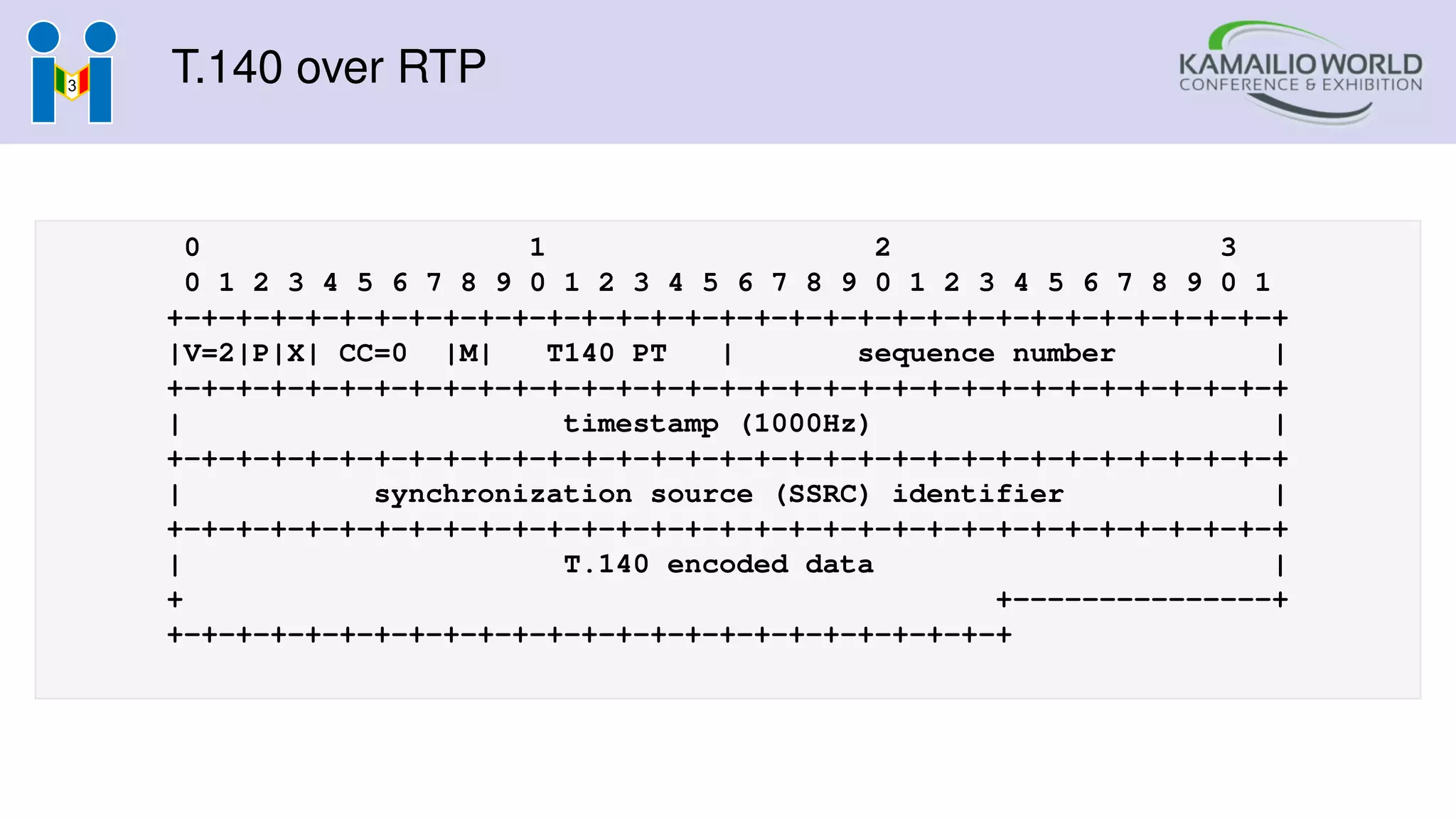
• T.140 messages transported over RTP
• RFC 4103 (RTP Payload for Text Conversation)
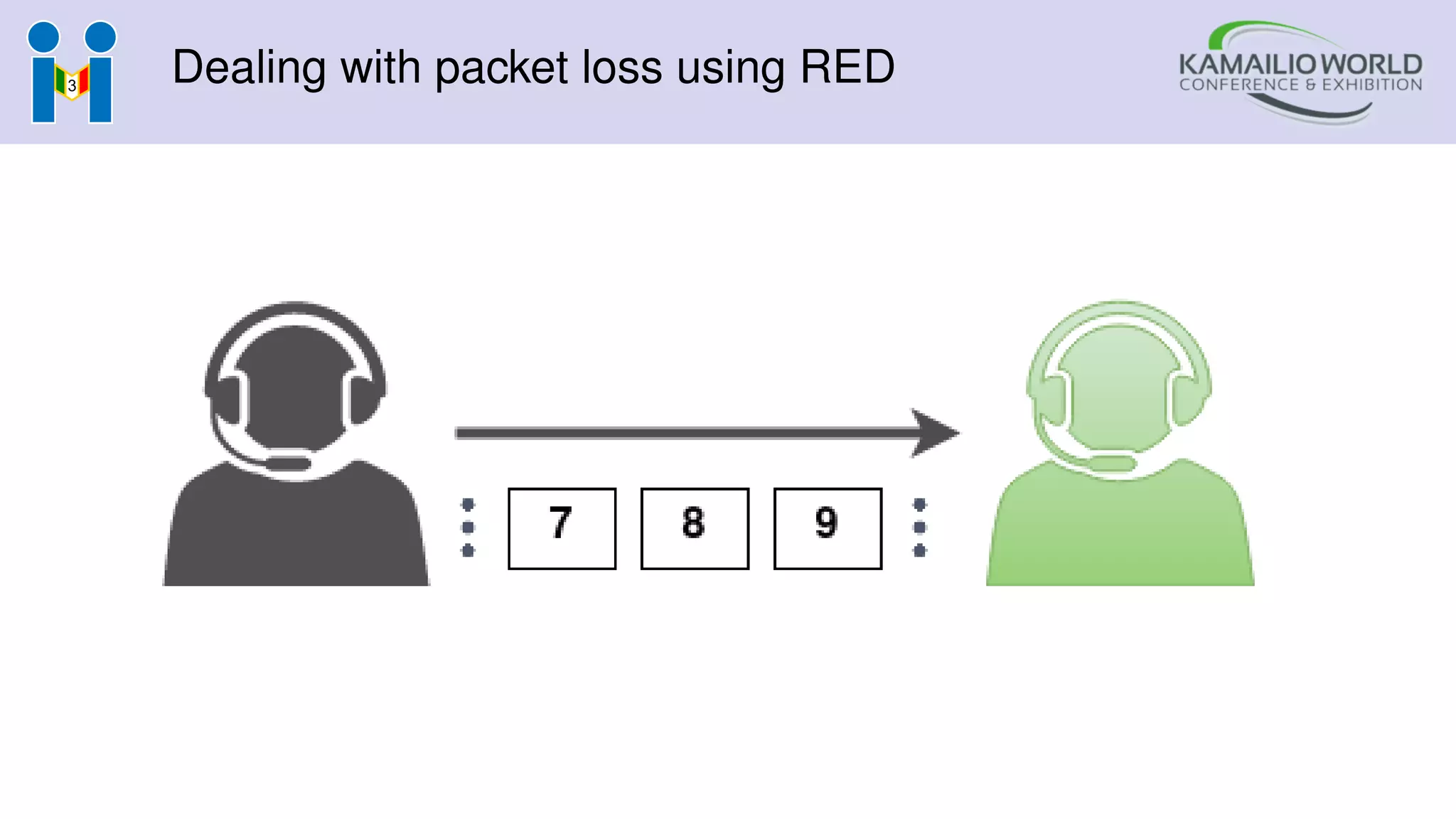
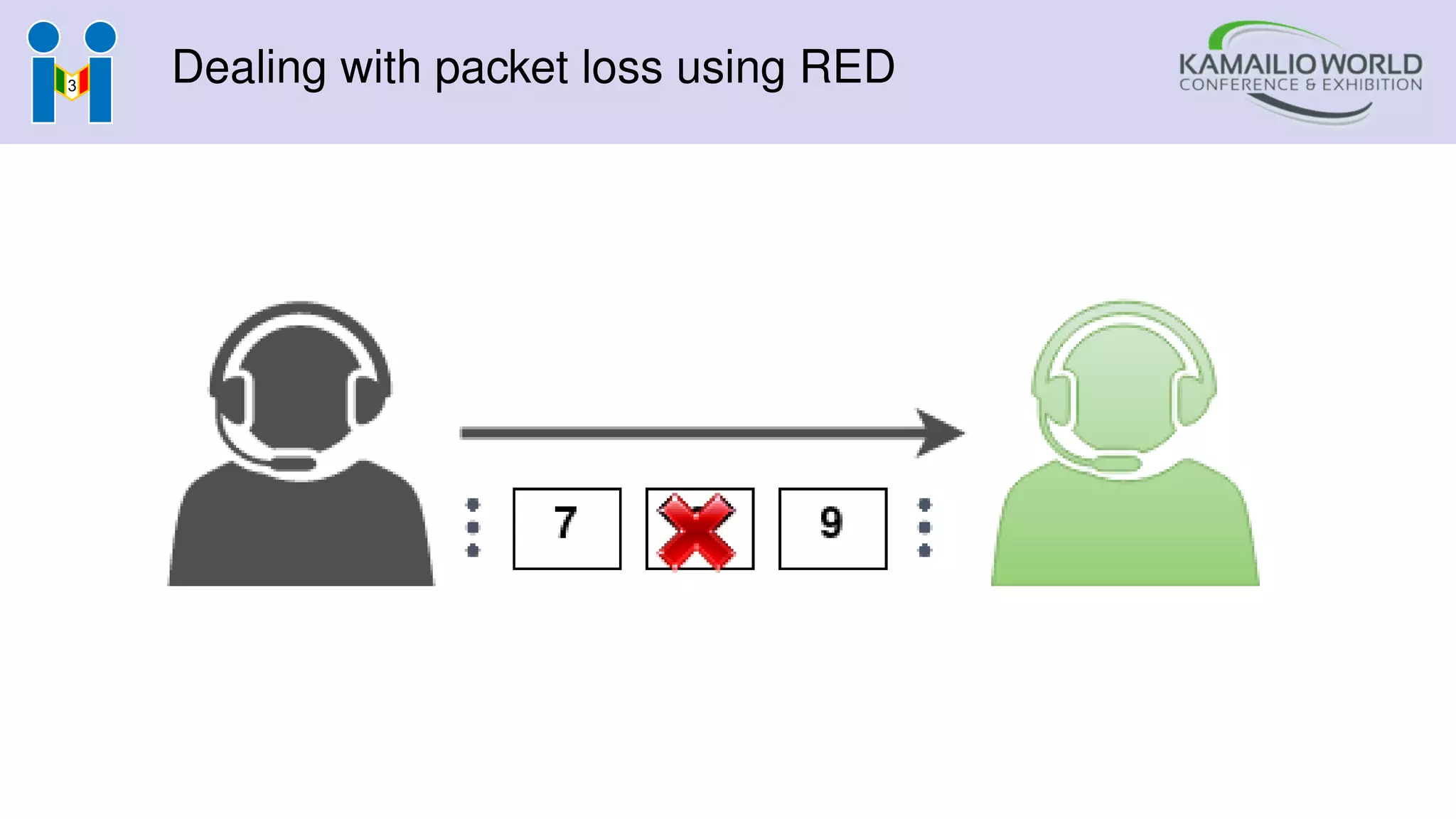
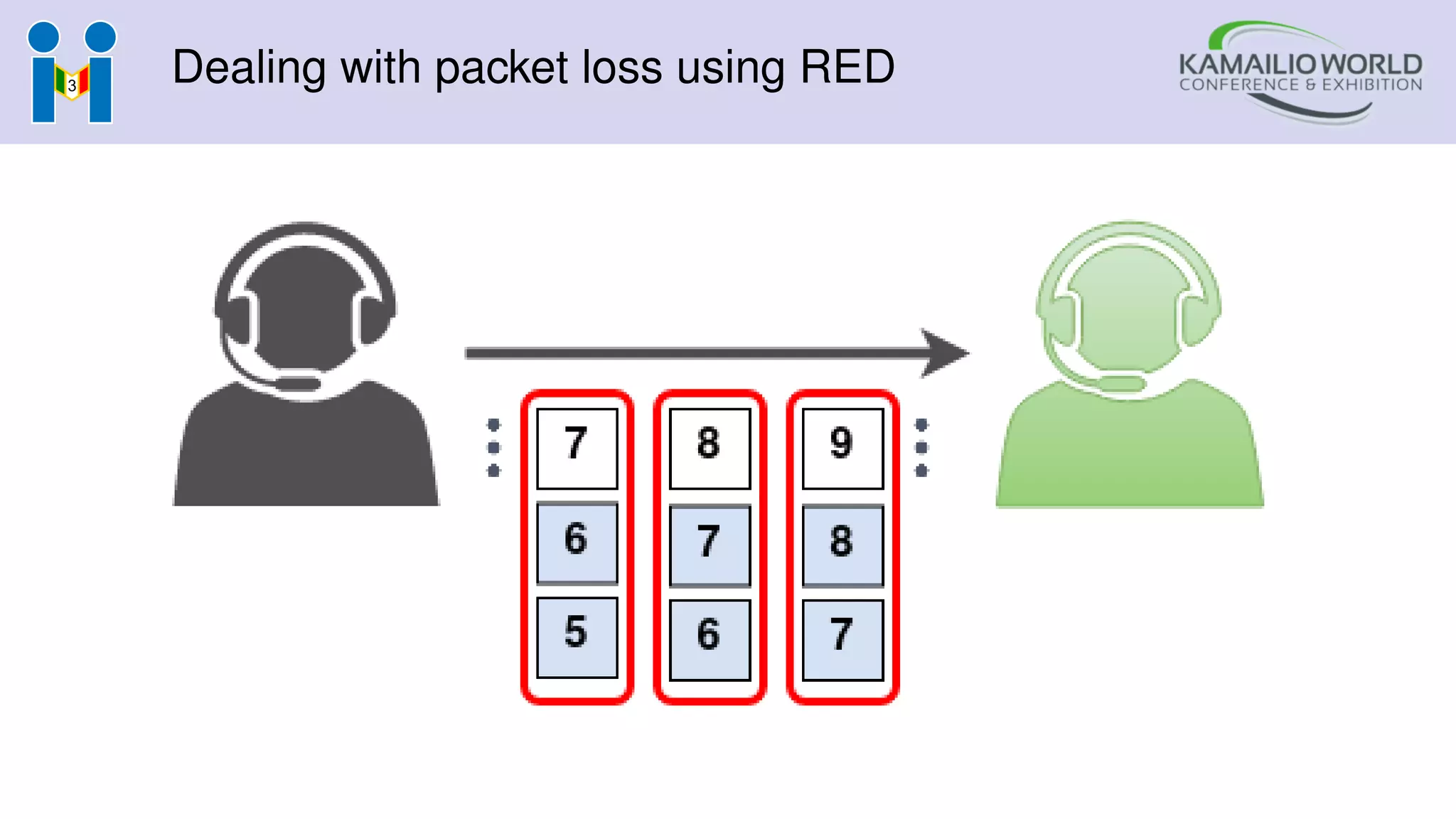
• Redundancy implemented via RED (RFC 2198)
Real-Time Text (RTT)
• Text transmitted instantly, as it is typed or created
• TDD/TTY work that way too
• How to do it over IP, though?
• Text over IP (ToIP)
• ITU-T T.140 (Protocol for multimedia application text conversation)
• Allows for real-time editing (e.g., backspace, rewriting)
• T.140 messages transported over RTP
• RFC 4103 (RTP Payload for Text Conversation)
• Redundancy implemented via RED (RFC 2198)
Real-Time Text (RTT)
• Text transmitted instantly, as it is typed or created
• TDD/TTY work that way too
• How to do it over IP, though?
• Text over IP (ToIP)
• ITU-T T.140 (Protocol for multimedia application text conversation)
• Allows for real-time editing (e.g., backspace, rewriting)
• T.140 messages transported over RTP
• RFC 4103 (RTP Payload for Text Conversation)
• Redundancy implemented via RED (RFC 2198)
T.140
• ITU-T T.140 (Protocol for multimedia application text conversation)
• https://www.itu.int/rec/T-REC-T.140/
• Protocol based on the concept of T140blocks
• Set of characters or special codes that one party is delivering to one or more others
• Participant typing −→ typed characters bundled together in a T.140 block
• Buffering size up to sender (overhead vs. latency)
• UTF-8 used for characters, including special codes (actions)
• e.g., Byte Order Mark (BOM), backspace, etc.
T.140
• ITU-T T.140 (Protocol for multimedia application text conversation)
• https://www.itu.int/rec/T-REC-T.140/
• Protocol based on the concept of T140blocks
• Set of characters or special codes that one party is delivering to one or more others
• Participant typing −→ typed characters bundled together in a T.140 block
• Buffering size up to sender (overhead vs. latency)
• UTF-8 used for characters, including special codes (actions)
• e.g., Byte Order Mark (BOM), backspace, etc.
T.140
• ITU-T T.140 (Protocol for multimedia application text conversation)
• https://www.itu.int/rec/T-REC-T.140/
• Protocol based on the concept of T140blocks
• Set of characters or special codes that one party is delivering to one or more others
• Participant typing −→ typed characters bundled together in a T.140 block
• Buffering size up to sender (overhead vs. latency)
• UTF-8 used for characters, including special codes (actions)
• e.g., Byte Order Mark (BOM), backspace, etc.
T.140 over RTP
0 1 2 3
0 1 2 3 4 5 6 7 8 9 0 1 2 3 4 5 6 7 8 9 0 1 2 3 4 5 6 7 8 9 0 1
+-+-+-+-+-+-+-+-+-+-+-+-+-+-+-+-+-+-+-+-+-+-+-+-+-+-+-+-+-+-+-+-+
|V=2|P|X| CC=0 |M| T140 PT | sequence number |
+-+-+-+-+-+-+-+-+-+-+-+-+-+-+-+-+-+-+-+-+-+-+-+-+-+-+-+-+-+-+-+-+
| timestamp (1000Hz) |
+-+-+-+-+-+-+-+-+-+-+-+-+-+-+-+-+-+-+-+-+-+-+-+-+-+-+-+-+-+-+-+-+
| synchronization source (SSRC) identifier |
+-+-+-+-+-+-+-+-+-+-+-+-+-+-+-+-+-+-+-+-+-+-+-+-+-+-+-+-+-+-+-+-+
| T.140 encoded data |
+ +---------------+
+-+-+-+-+-+-+-+-+-+-+-+-+-+-+-+-+-+-+-+-+-+-+-+-+
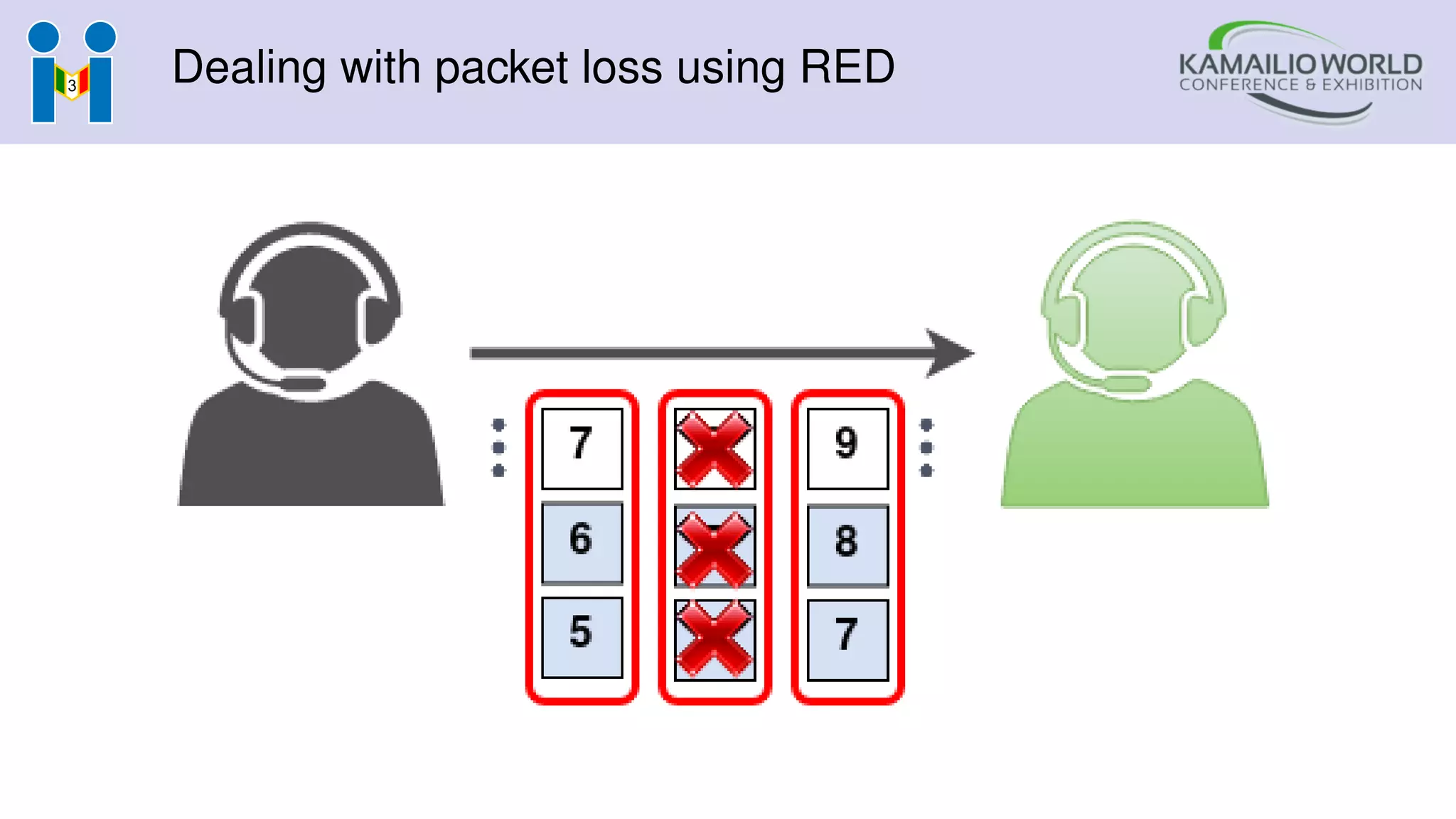
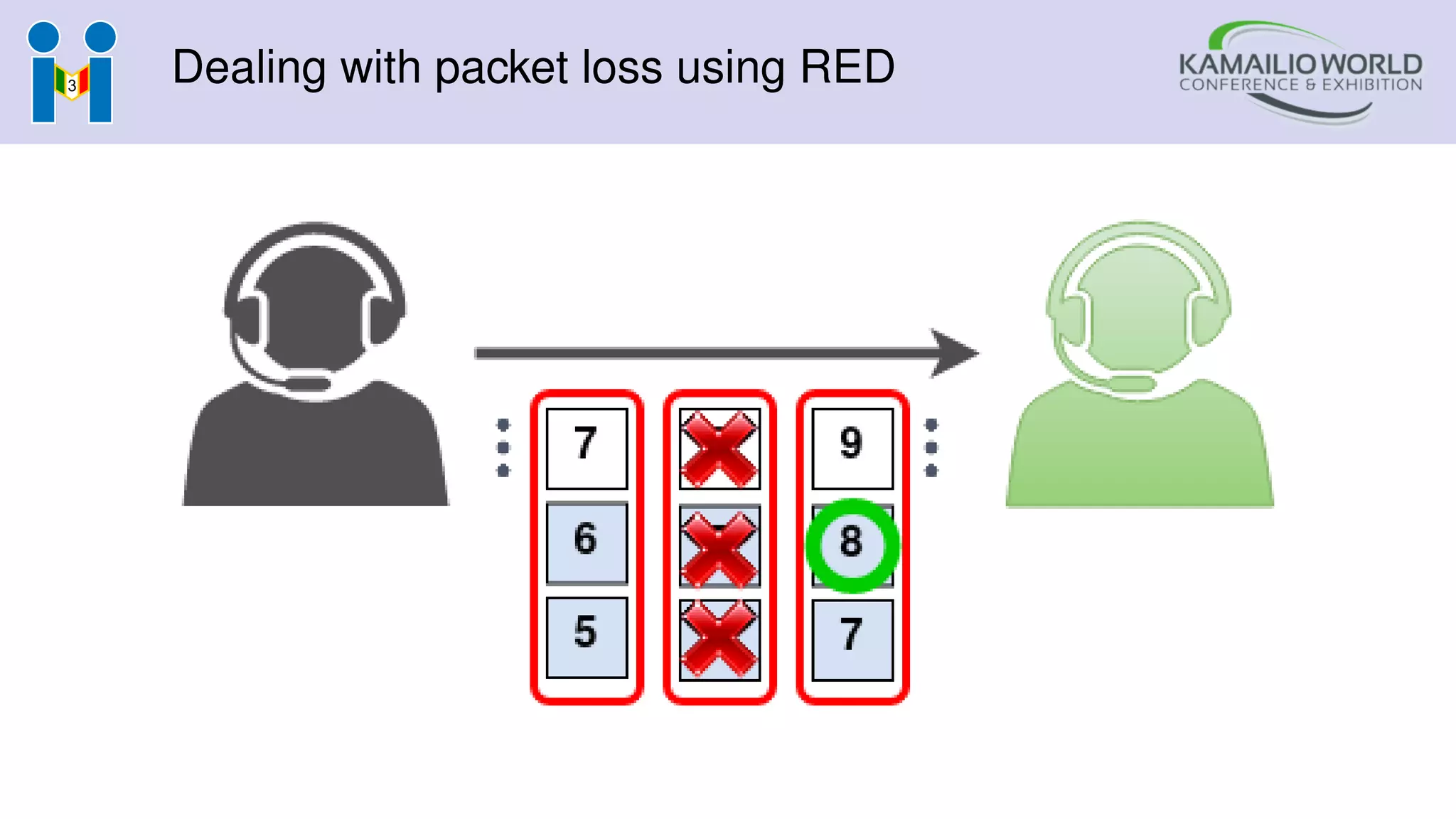
Dealing with packet loss using RED
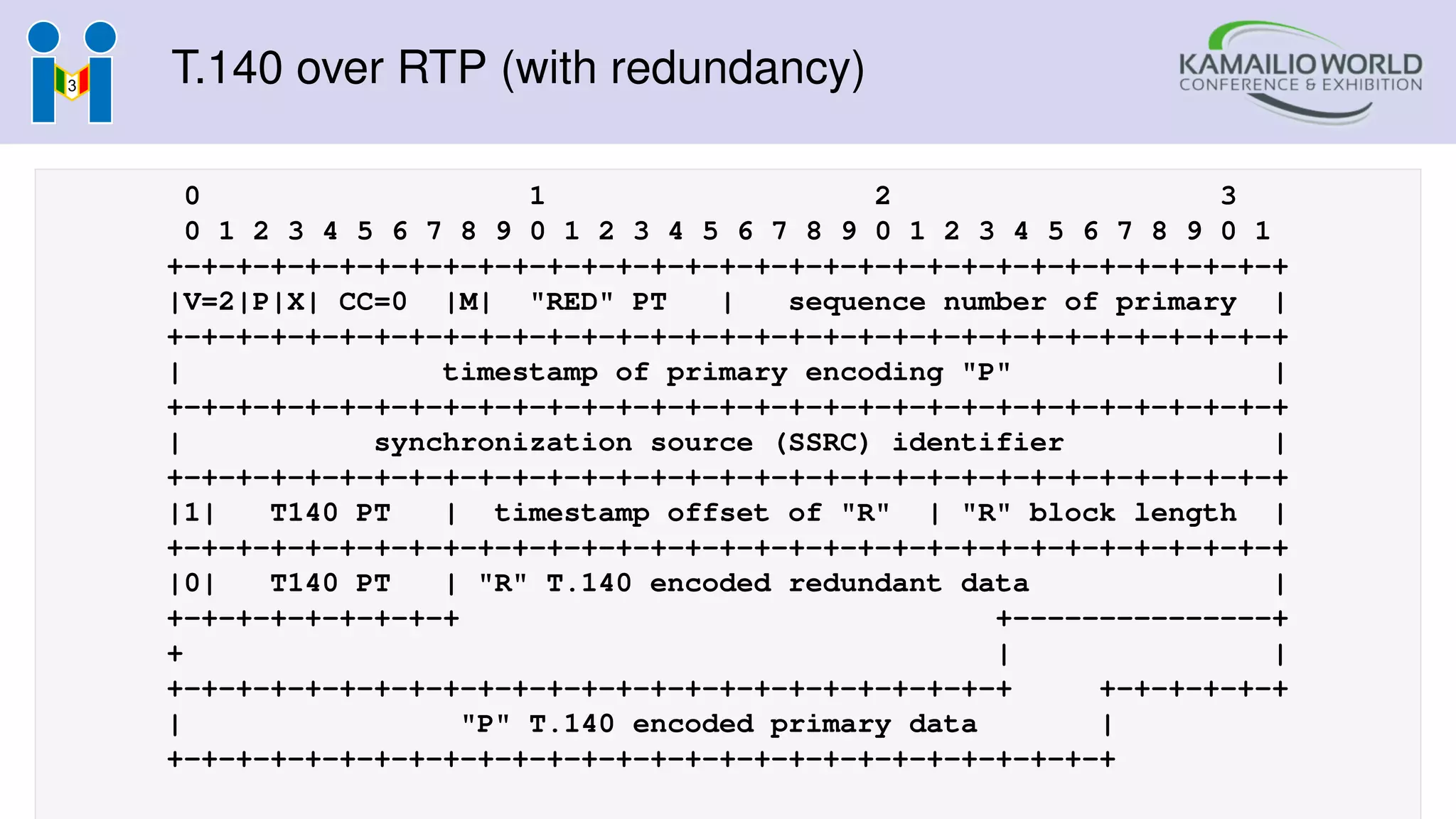
T.140 over RTP (with redundancy)
0 1 2 3
0 1 2 3 4 5 6 7 8 9 0 1 2 3 4 5 6 7 8 9 0 1 2 3 4 5 6 7 8 9 0 1
+-+-+-+-+-+-+-+-+-+-+-+-+-+-+-+-+-+-+-+-+-+-+-+-+-+-+-+-+-+-+-+-+
|V=2|P|X| CC=0 |M| "RED" PT | sequence number of primary |
+-+-+-+-+-+-+-+-+-+-+-+-+-+-+-+-+-+-+-+-+-+-+-+-+-+-+-+-+-+-+-+-+
| timestamp of primary encoding "P" |
+-+-+-+-+-+-+-+-+-+-+-+-+-+-+-+-+-+-+-+-+-+-+-+-+-+-+-+-+-+-+-+-+
| synchronization source (SSRC) identifier |
+-+-+-+-+-+-+-+-+-+-+-+-+-+-+-+-+-+-+-+-+-+-+-+-+-+-+-+-+-+-+-+-+
|1| T140 PT | timestamp offset of "R" | "R" block length |
+-+-+-+-+-+-+-+-+-+-+-+-+-+-+-+-+-+-+-+-+-+-+-+-+-+-+-+-+-+-+-+-+
|0| T140 PT | "R" T.140 encoded redundant data |
+-+-+-+-+-+-+-+-+ +---------------+
+ | |
+-+-+-+-+-+-+-+-+-+-+-+-+-+-+-+-+-+-+-+-+-+-+-+-+ +-+-+-+-+-+
| "P" T.140 encoded primary data |
+-+-+-+-+-+-+-+-+-+-+-+-+-+-+-+-+-+-+-+-+-+-+-+-+-+-+-+
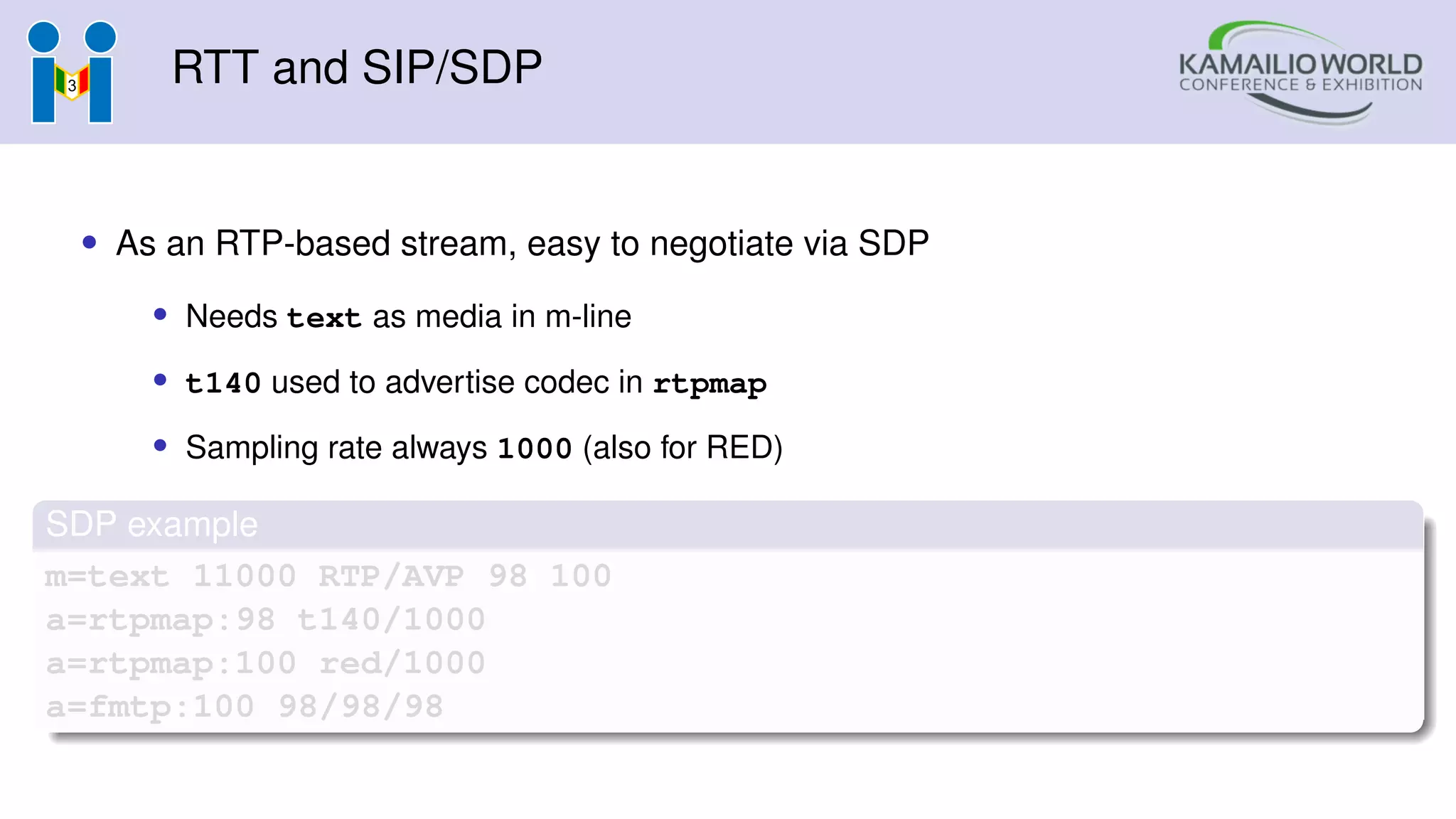
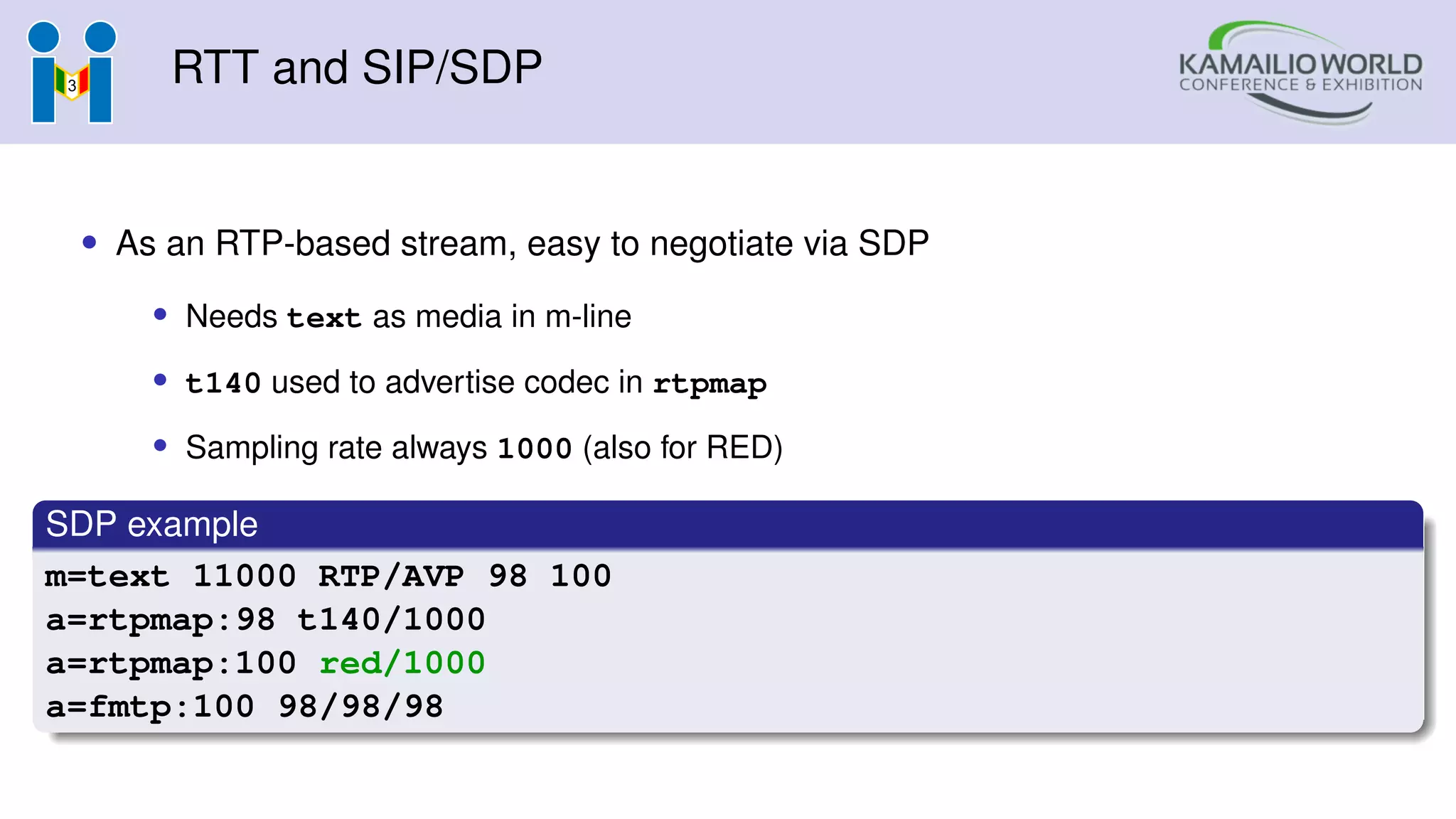
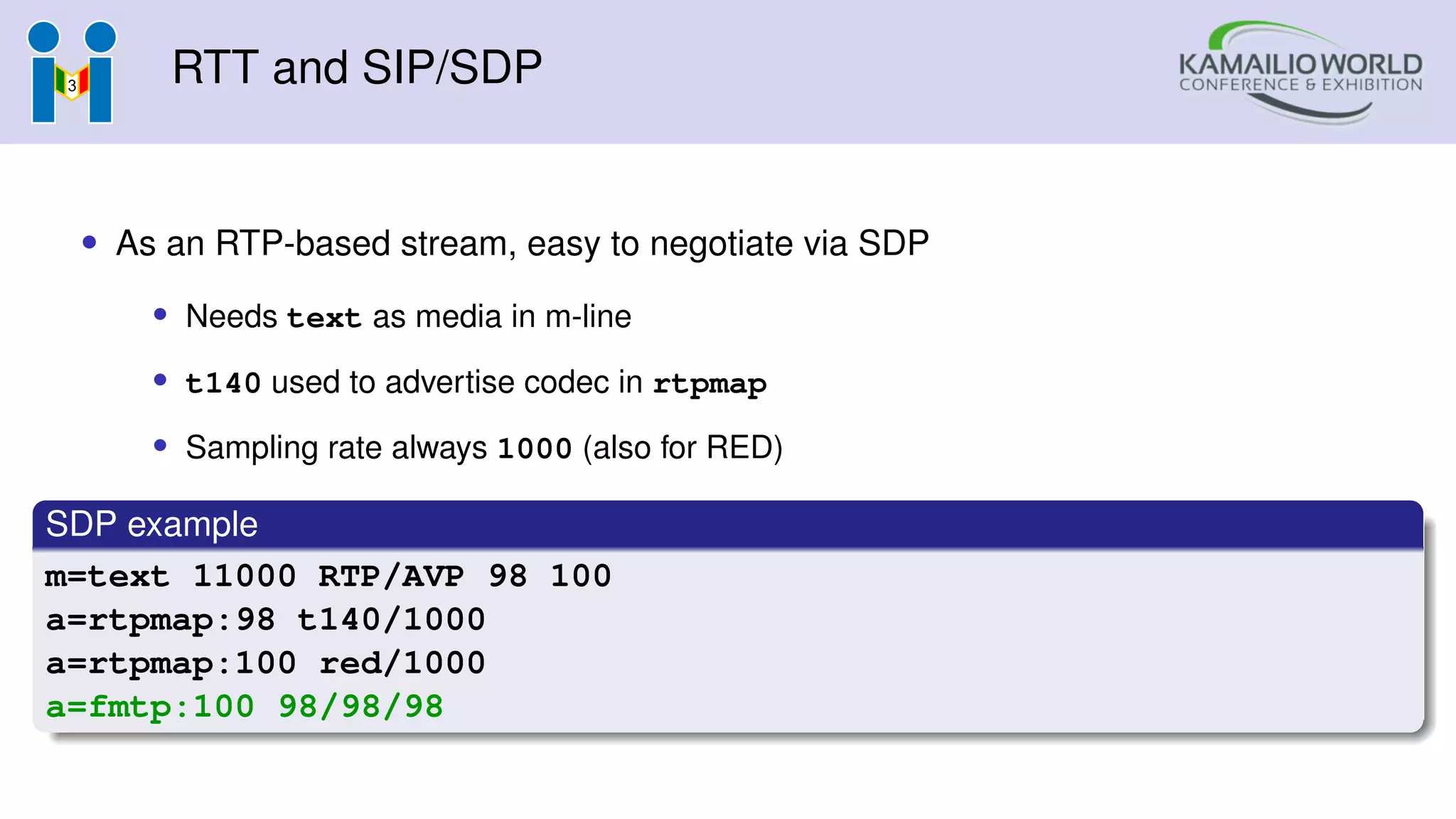
RTT and SIP/SDP
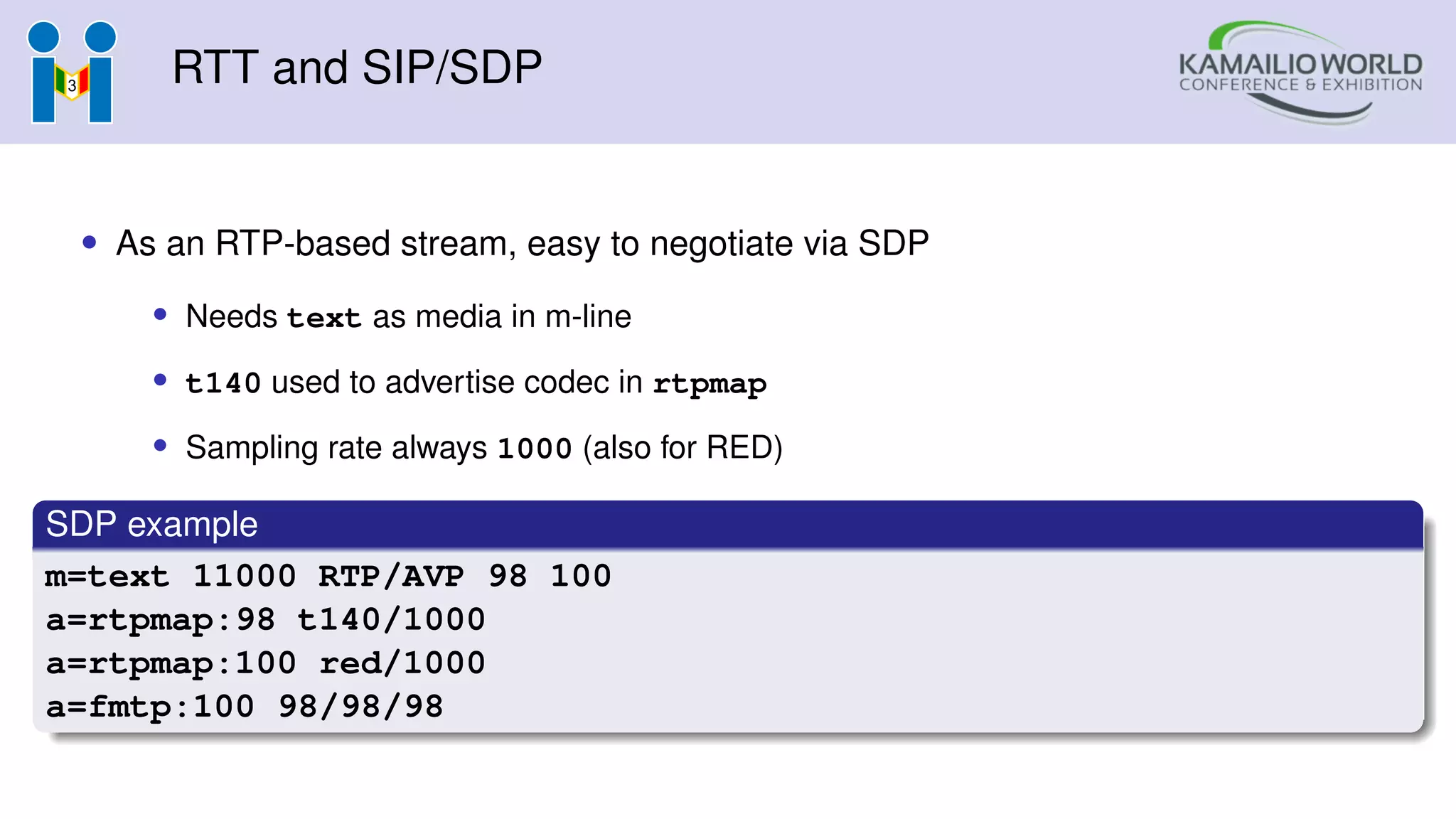
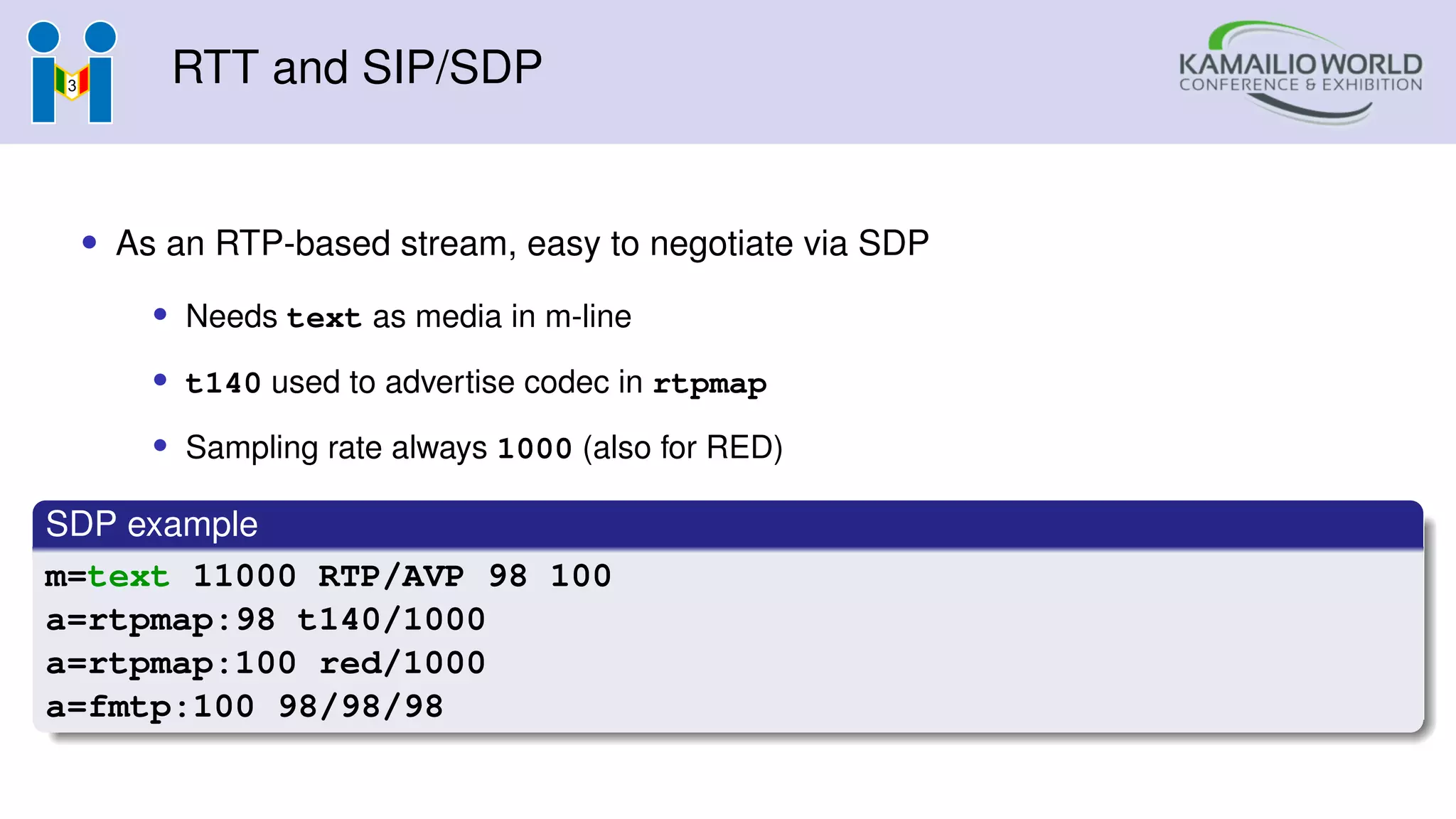
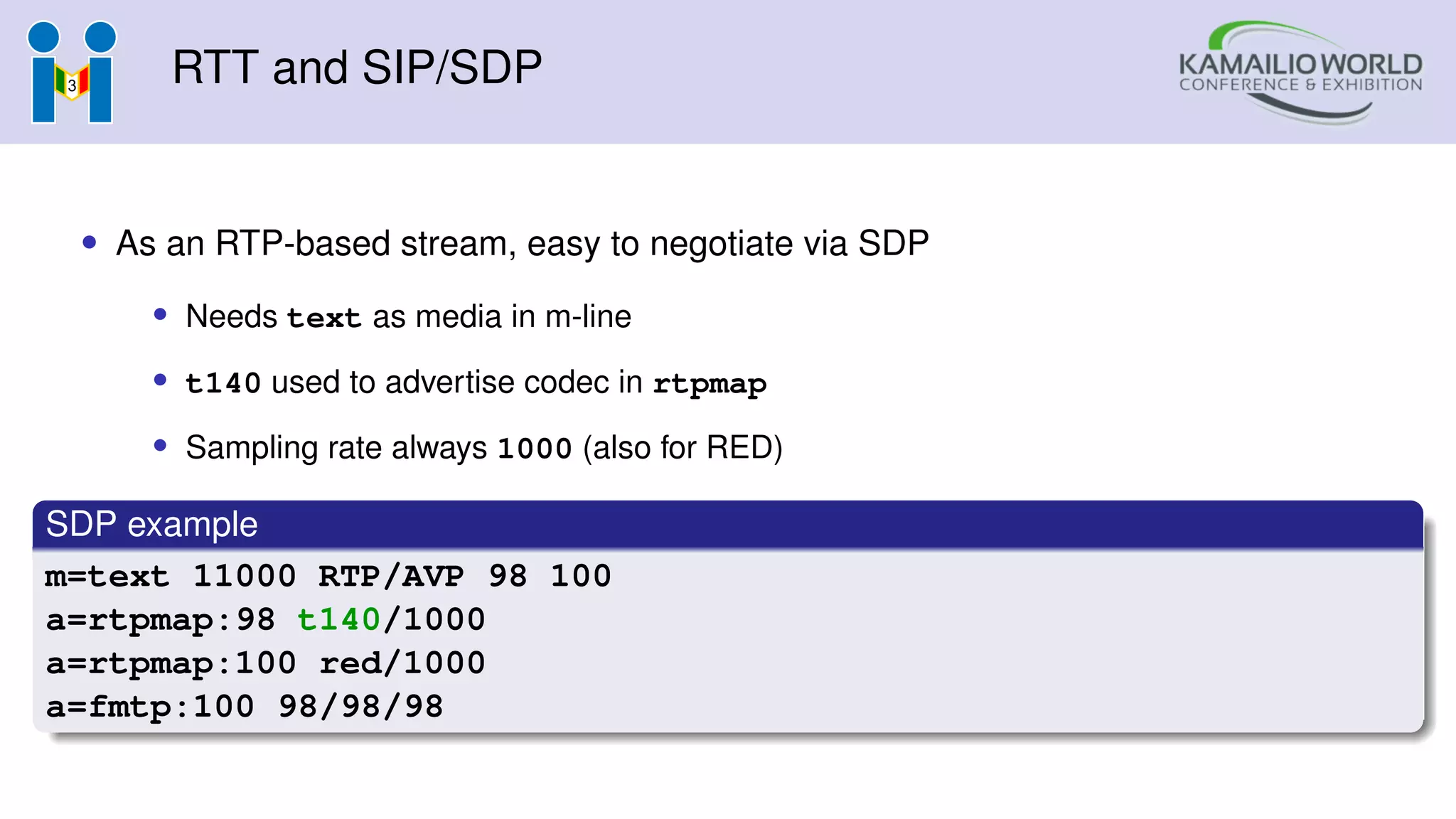
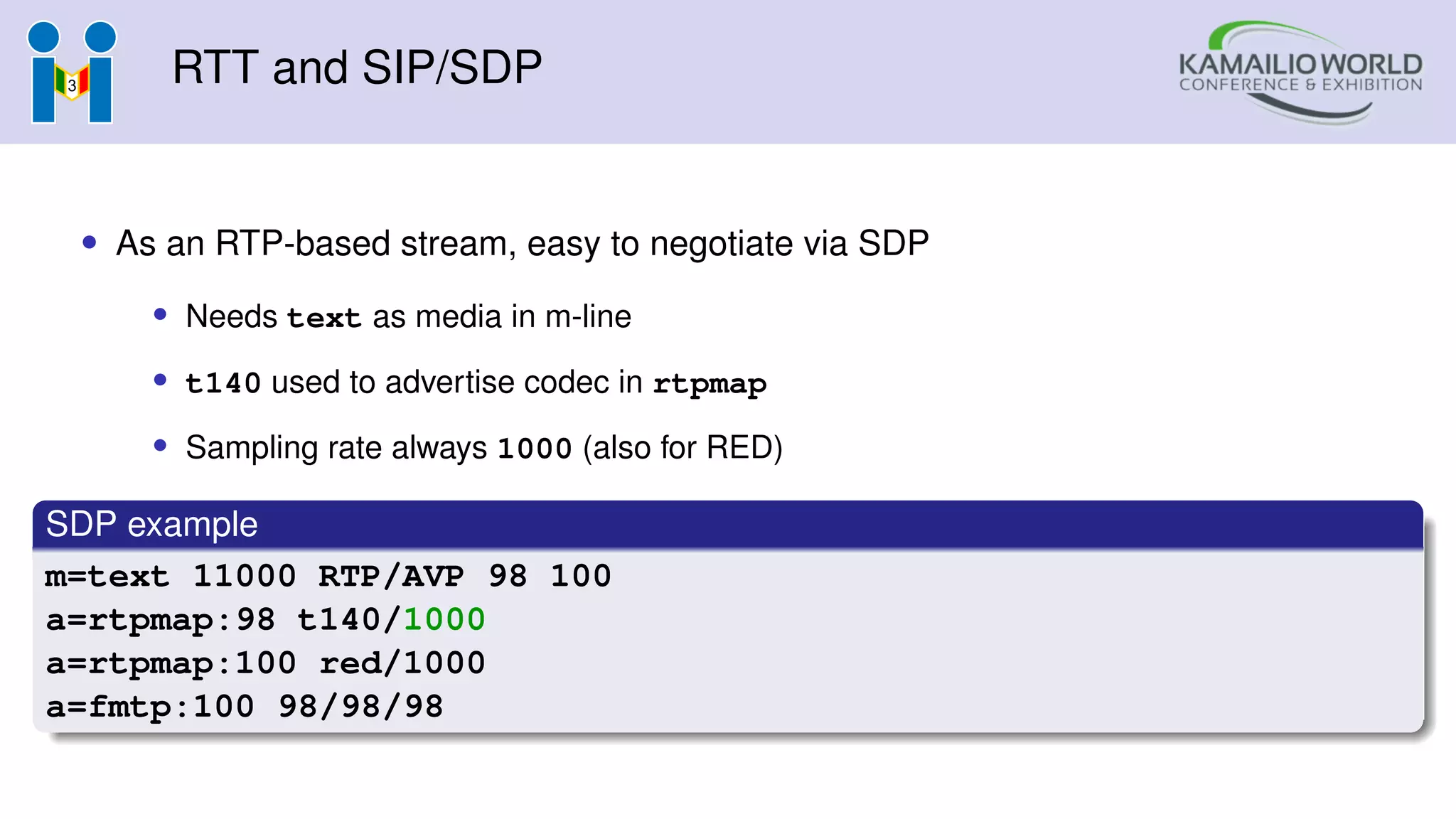
• As an RTP-based stream, easy to negotiate via SDP
• Needs text as media in m-line
• t140 used to advertise codec in rtpmap
• Sampling rate always 1000 (also for RED)
SDP example
m=text 11000 RTP/AVP 98 100
a=rtpmap:98 t140/1000
a=rtpmap:100 red/1000
a=fmtp:100 98/98/98
RTT and SIP/SDP
• As an RTP-based stream, easy to negotiate via SDP
• Needs text as media in m-line
• t140 used to advertise codec in rtpmap
• Sampling rate always 1000 (also for RED)
SDP example
m=text 11000 RTP/AVP 98 100
a=rtpmap:98 t140/1000
a=rtpmap:100 red/1000
a=fmtp:100 98/98/98
RTT and SIP/SDP
• As an RTP-based stream, easy to negotiate via SDP
• Needs text as media in m-line
• t140 used to advertise codec in rtpmap
• Sampling rate always 1000 (also for RED)
SDP example
m=text 11000 RTP/AVP 98 100
a=rtpmap:98 t140/1000
a=rtpmap:100 red/1000
a=fmtp:100 98/98/98
RTT and SIP/SDP
• As an RTP-based stream, easy to negotiate via SDP
• Needs text as media in m-line
• t140 used to advertise codec in rtpmap
• Sampling rate always 1000 (also for RED)
SDP example
m=text 11000 RTP/AVP 98 100
a=rtpmap:98 t140/1000
a=rtpmap:100 red/1000
a=fmtp:100 98/98/98
RTT and SIP/SDP
• As an RTP-based stream, easy to negotiate via SDP
• Needs text as media in m-line
• t140 used to advertise codec in rtpmap
• Sampling rate always 1000 (also for RED)
SDP example
m=text 11000 RTP/AVP 98 100
a=rtpmap:98 t140/1000
a=rtpmap:100 red/1000
a=fmtp:100 98/98/98
RTT and SIP/SDP
• As an RTP-based stream, easy to negotiate via SDP
• Needs text as media in m-line
• t140 used to advertise codec in rtpmap
• Sampling rate always 1000 (also for RED)
SDP example
m=text 11000 RTP/AVP 98 100
a=rtpmap:98 t140/1000
a=rtpmap:100 red/1000
a=fmtp:100 98/98/98
RTT and SIP/SDP
• As an RTP-based stream, easy to negotiate via SDP
• Needs text as media in m-line
• t140 used to advertise codec in rtpmap
• Sampling rate always 1000 (also for RED)
SDP example
m=text 11000 RTP/AVP 98 100
a=rtpmap:98 t140/1000
a=rtpmap:100 red/1000
a=fmtp:100 98/98/98
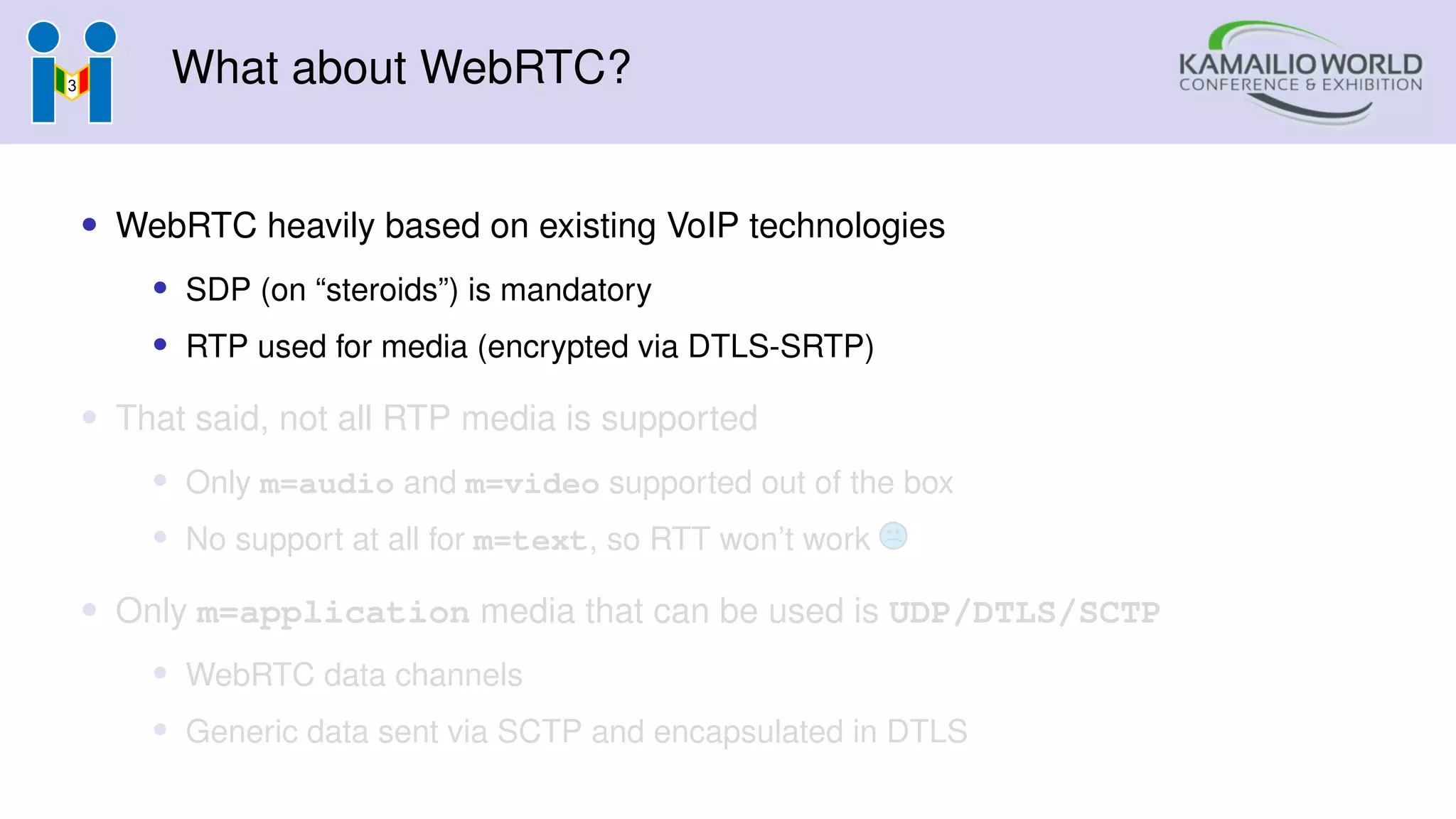
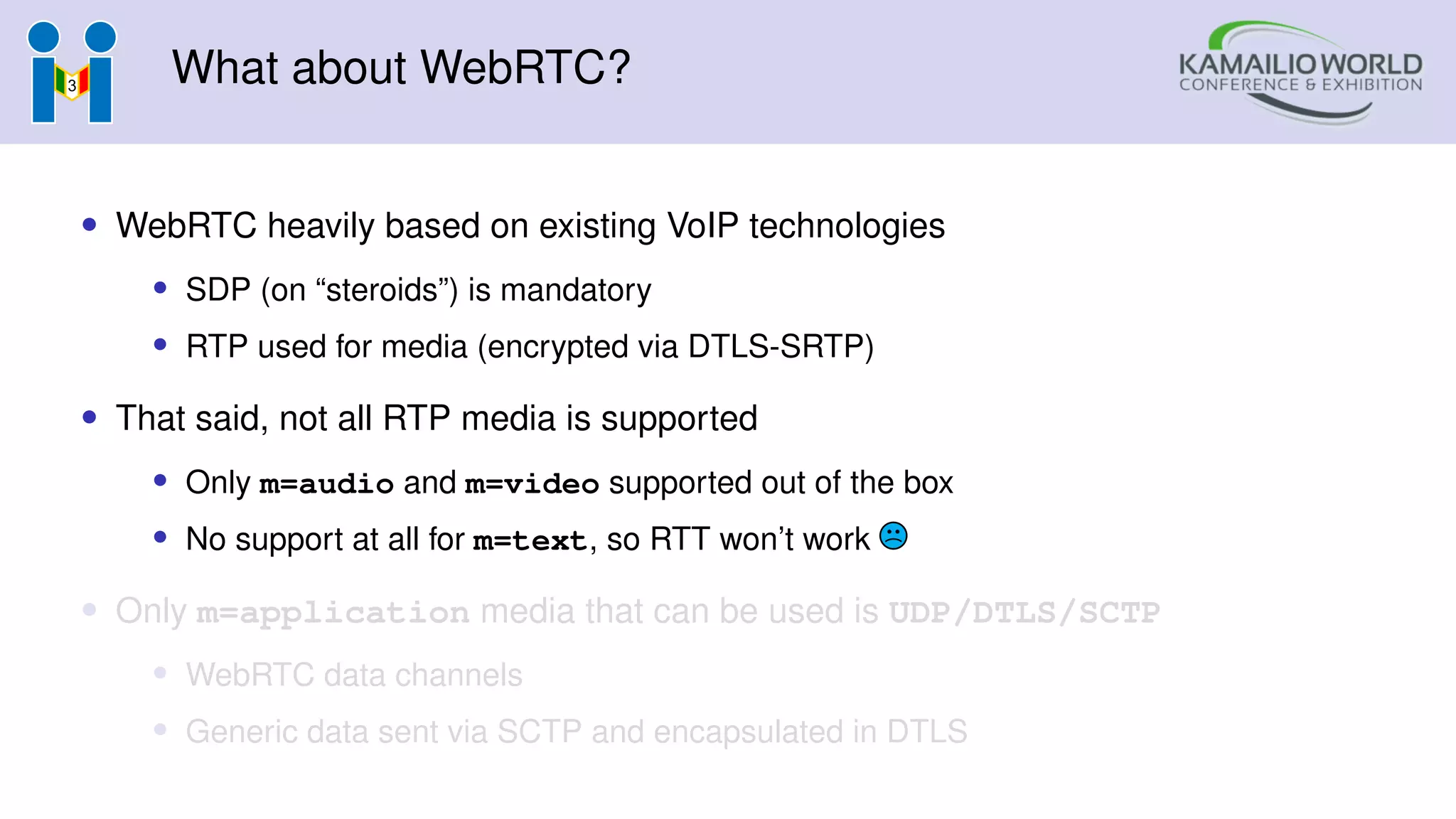
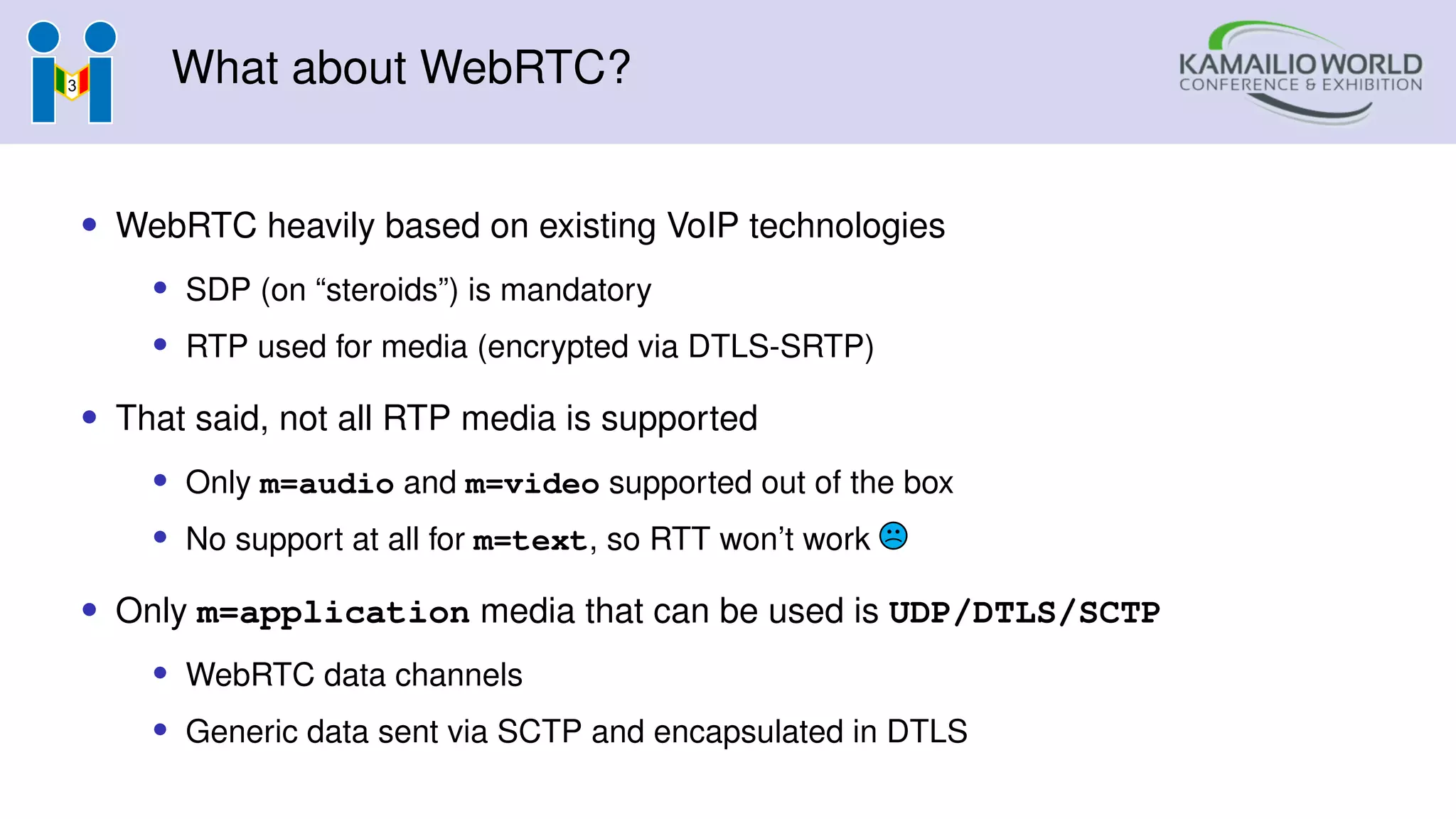
What about WebRTC?
• WebRTC heavily based on existing VoIP technologies
• SDP (on “steroids”) is mandatory
• RTP used for media (encrypted via DTLS-SRTP)
• That said, not all RTP media is supported
• Only m=audio and m=video supported out of the box
• No support at all for m=text, so RTT won’t work
• Only m=application media that can be used is UDP/DTLS/SCTP
• WebRTC data channels
• Generic data sent via SCTP and encapsulated in DTLS
What about WebRTC?
• WebRTC heavily based on existing VoIP technologies
• SDP (on “steroids”) is mandatory
• RTP used for media (encrypted via DTLS-SRTP)
• That said, not all RTP media is supported
• Only m=audio and m=video supported out of the box
• No support at all for m=text, so RTT won’t work
• Only m=application media that can be used is UDP/DTLS/SCTP
• WebRTC data channels
• Generic data sent via SCTP and encapsulated in DTLS
What about WebRTC?
• WebRTC heavily based on existing VoIP technologies
• SDP (on “steroids”) is mandatory
• RTP used for media (encrypted via DTLS-SRTP)
• That said, not all RTP media is supported
• Only m=audio and m=video supported out of the box
• No support at all for m=text, so RTT won’t work
• Only m=application media that can be used is UDP/DTLS/SCTP
• WebRTC data channels
• Generic data sent via SCTP and encapsulated in DTLS
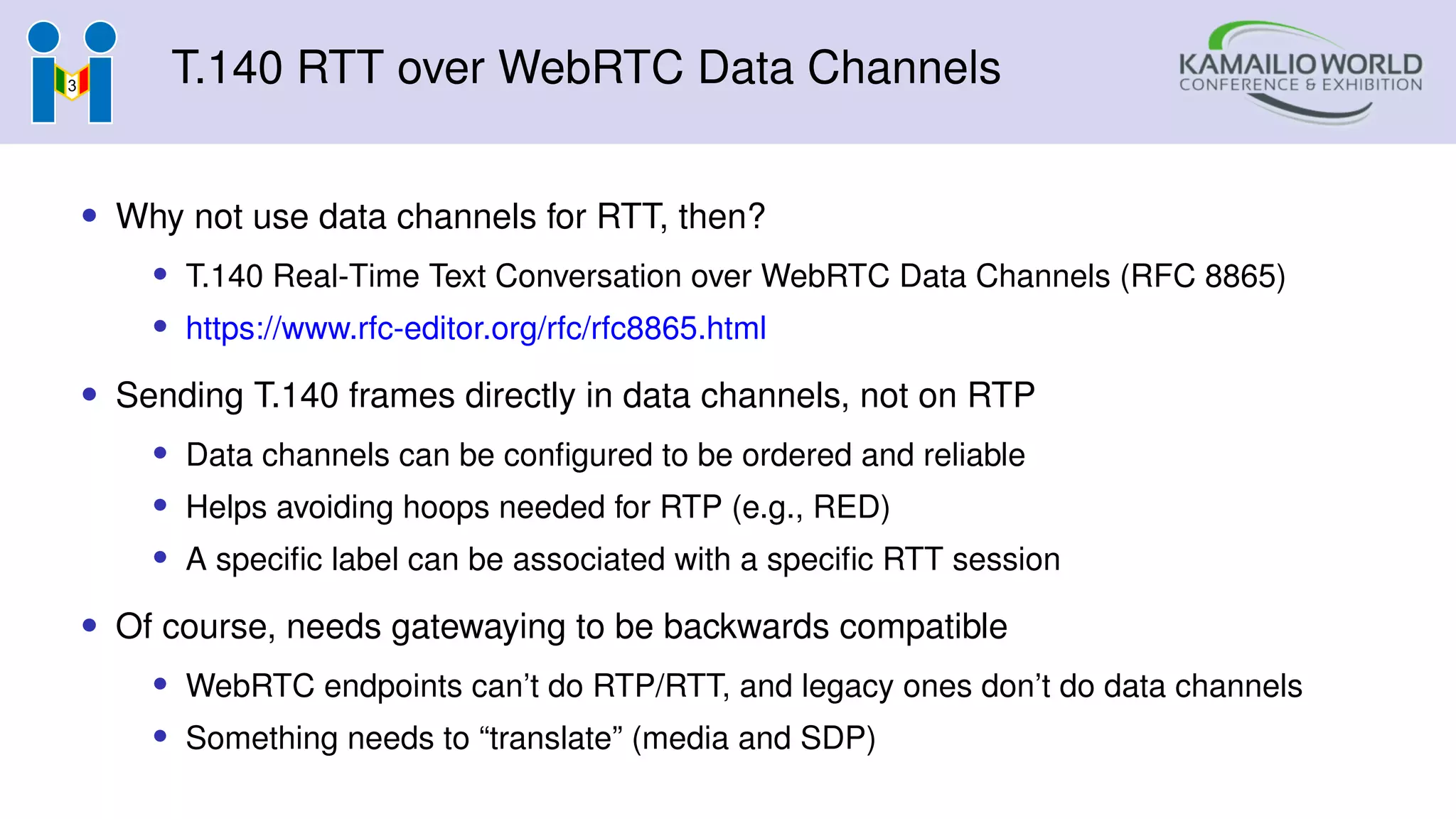
T.140 RTT over WebRTC Data Channels
• Why not use data channels for RTT, then?
• T.140 Real-Time Text Conversation over WebRTC Data Channels (RFC 8865)
• https://www.rfc-editor.org/rfc/rfc8865.html
• Sending T.140 frames directly in data channels, not on RTP
• Data channels can be configured to be ordered and reliable
• Helps avoiding hoops needed for RTP (e.g., RED)
• A specific label can be associated with a specific RTT session
• Of course, needs gatewaying to be backwards compatible
• WebRTC endpoints can’t do RTP/RTT, and legacy ones don’t do data channels
• Something needs to “translate” (media and SDP)
T.140 RTT over WebRTC Data Channels
• Why not use data channels for RTT, then?
• T.140 Real-Time Text Conversation over WebRTC Data Channels (RFC 8865)
• https://www.rfc-editor.org/rfc/rfc8865.html
• Sending T.140 frames directly in data channels, not on RTP
• Data channels can be configured to be ordered and reliable
• Helps avoiding hoops needed for RTP (e.g., RED)
• A specific label can be associated with a specific RTT session
• Of course, needs gatewaying to be backwards compatible
• WebRTC endpoints can’t do RTP/RTT, and legacy ones don’t do data channels
• Something needs to “translate” (media and SDP)
T.140 RTT over WebRTC Data Channels
• Why not use data channels for RTT, then?
• T.140 Real-Time Text Conversation over WebRTC Data Channels (RFC 8865)
• https://www.rfc-editor.org/rfc/rfc8865.html
• Sending T.140 frames directly in data channels, not on RTP
• Data channels can be configured to be ordered and reliable
• Helps avoiding hoops needed for RTP (e.g., RED)
• A specific label can be associated with a specific RTT session
• Of course, needs gatewaying to be backwards compatible
• WebRTC endpoints can’t do RTP/RTT, and legacy ones don’t do data channels
• Something needs to “translate” (media and SDP)
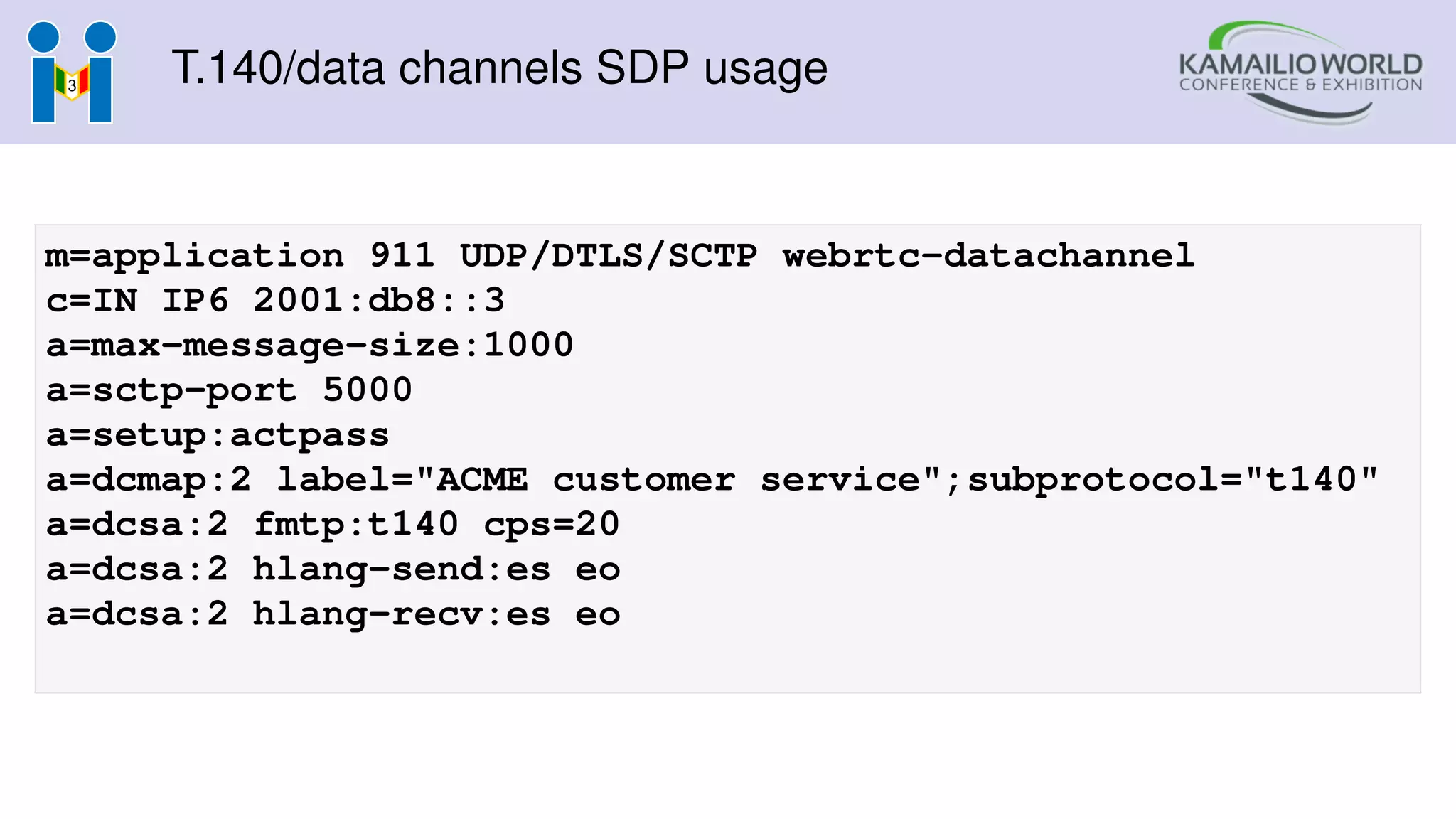
T.140/data channels SDP usage
m=application 911 UDP/DTLS/SCTP webrtc-datachannel
c=IN IP6 2001:db8::3
a=max-message-size:1000
a=sctp-port 5000
a=setup:actpass
a=dcmap:2 label="ACME customer service";subprotocol="t140"
a=dcsa:2 fmtp:t140 cps=20
a=dcsa:2 hlang-send:es eo
a=dcsa:2 hlang-recv:es eo
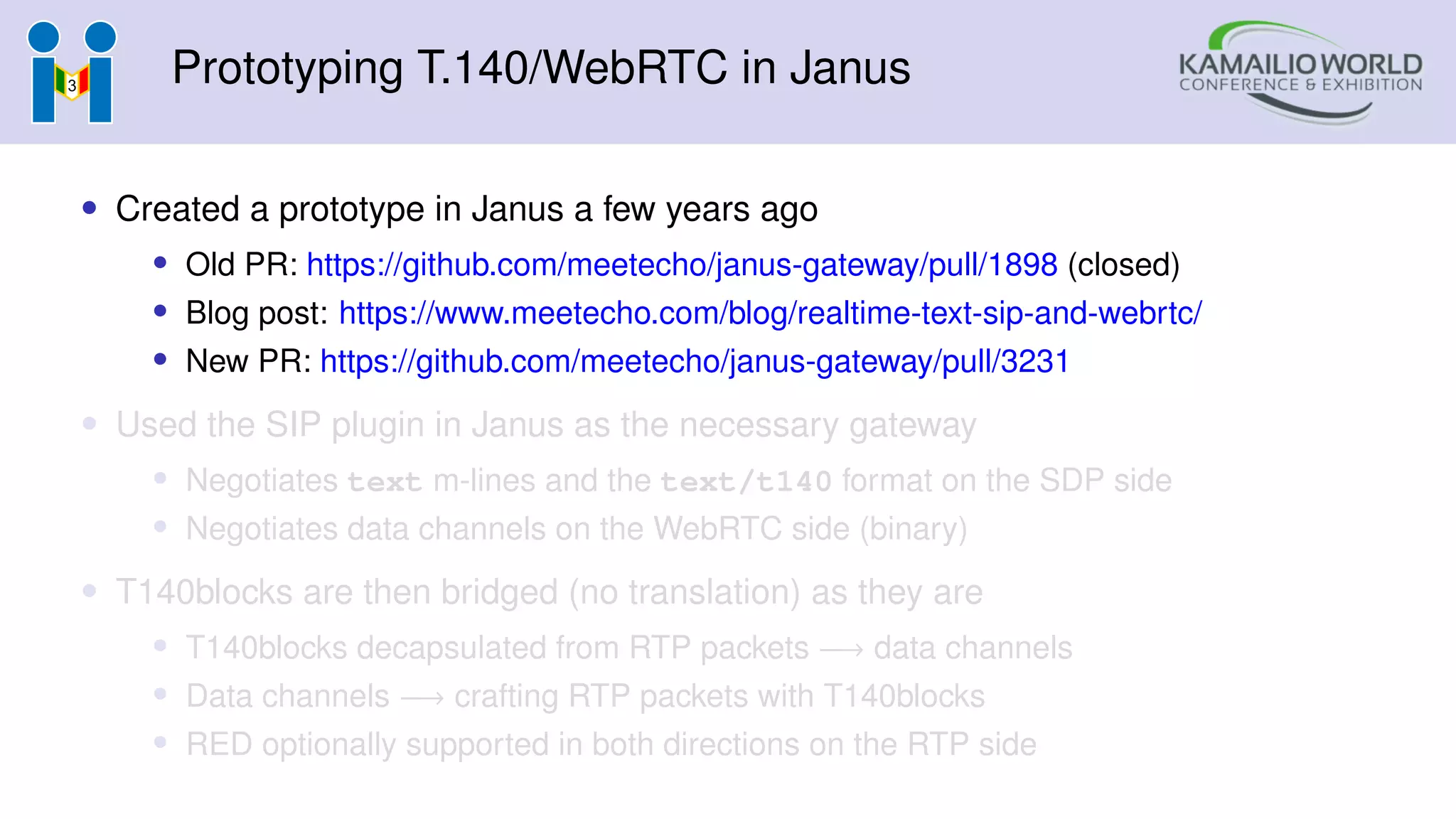
Prototyping T.140/WebRTC in Janus
• Created a prototype in Janus a few years ago
• Old PR: https://github.com/meetecho/janus-gateway/pull/1898 (closed)
• Blog post: https://www.meetecho.com/blog/realtime-text-sip-and-webrtc/
• New PR: https://github.com/meetecho/janus-gateway/pull/3231
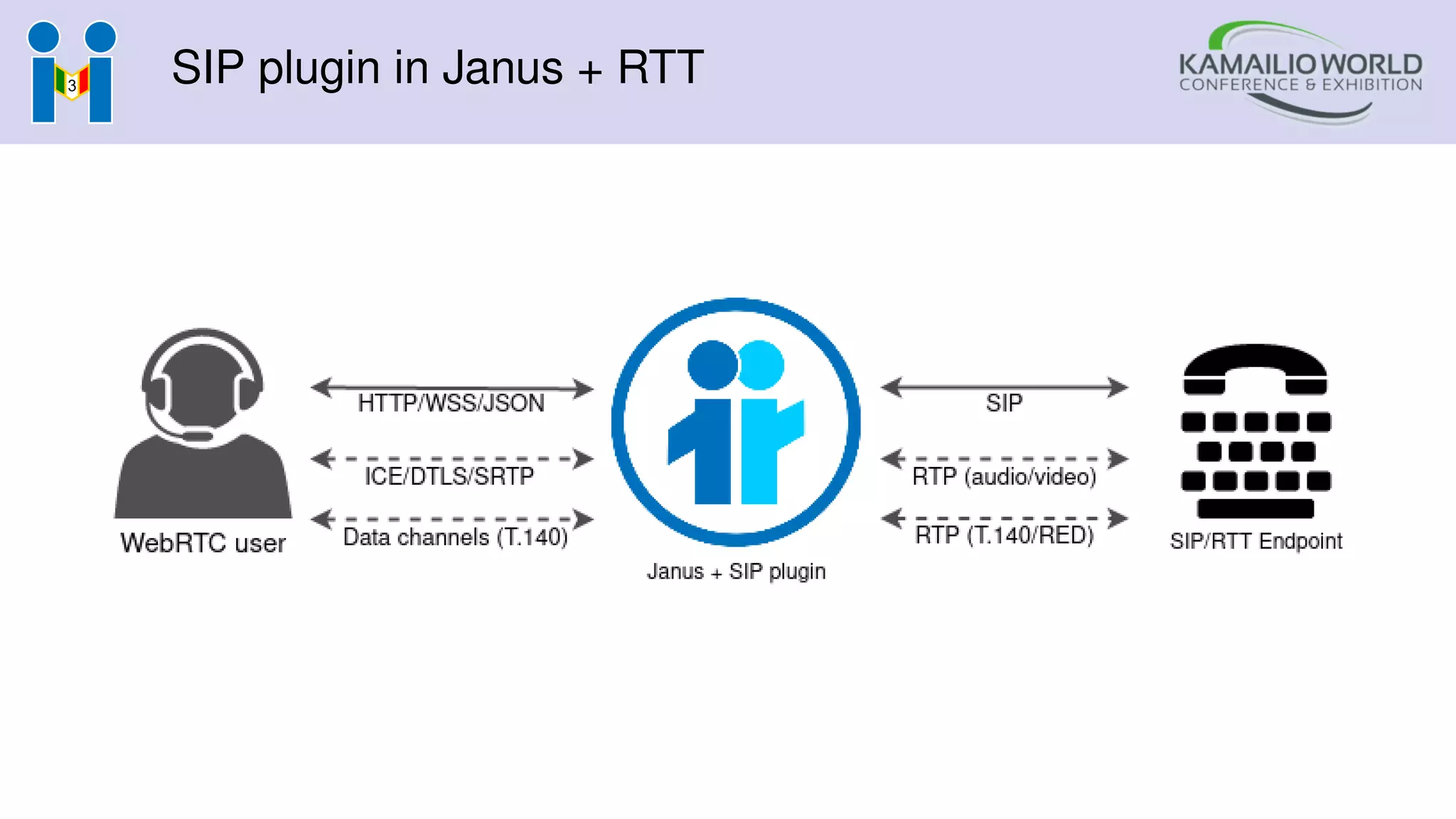
• Used the SIP plugin in Janus as the necessary gateway
• Negotiates text m-lines and the text/t140 format on the SDP side
• Negotiates data channels on the WebRTC side (binary)
• T140blocks are then bridged (no translation) as they are
• T140blocks decapsulated from RTP packets −→ data channels
• Data channels −→ crafting RTP packets with T140blocks
• RED optionally supported in both directions on the RTP side
Prototyping T.140/WebRTC in Janus
• Created a prototype in Janus a few years ago
• Old PR: https://github.com/meetecho/janus-gateway/pull/1898 (closed)
• Blog post: https://www.meetecho.com/blog/realtime-text-sip-and-webrtc/
• New PR: https://github.com/meetecho/janus-gateway/pull/3231
• Used the SIP plugin in Janus as the necessary gateway
• Negotiates text m-lines and the text/t140 format on the SDP side
• Negotiates data channels on the WebRTC side (binary)
• T140blocks are then bridged (no translation) as they are
• T140blocks decapsulated from RTP packets −→ data channels
• Data channels −→ crafting RTP packets with T140blocks
• RED optionally supported in both directions on the RTP side
Prototyping T.140/WebRTC in Janus
• Created a prototype in Janus a few years ago
• Old PR: https://github.com/meetecho/janus-gateway/pull/1898 (closed)
• Blog post: https://www.meetecho.com/blog/realtime-text-sip-and-webrtc/
• New PR: https://github.com/meetecho/janus-gateway/pull/3231
• Used the SIP plugin in Janus as the necessary gateway
• Negotiates text m-lines and the text/t140 format on the SDP side
• Negotiates data channels on the WebRTC side (binary)
• T140blocks are then bridged (no translation) as they are
• T140blocks decapsulated from RTP packets −→ data channels
• Data channels −→ crafting RTP packets with T140blocks
• RED optionally supported in both directions on the RTP side
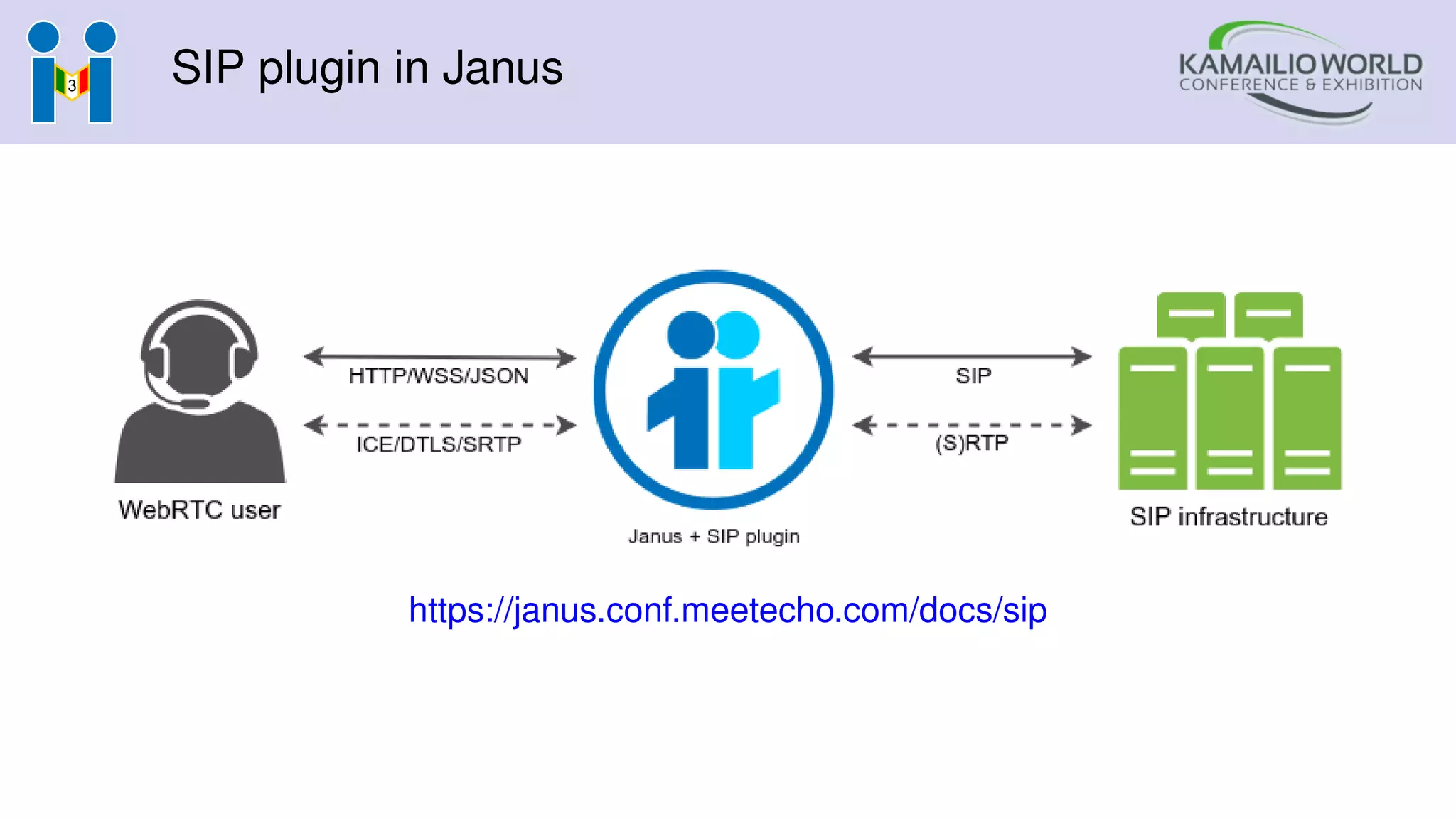
SIP plugin in Janus
https://janus.conf.meetecho.com/docs/sip
SIP plugin in Janus + RTT
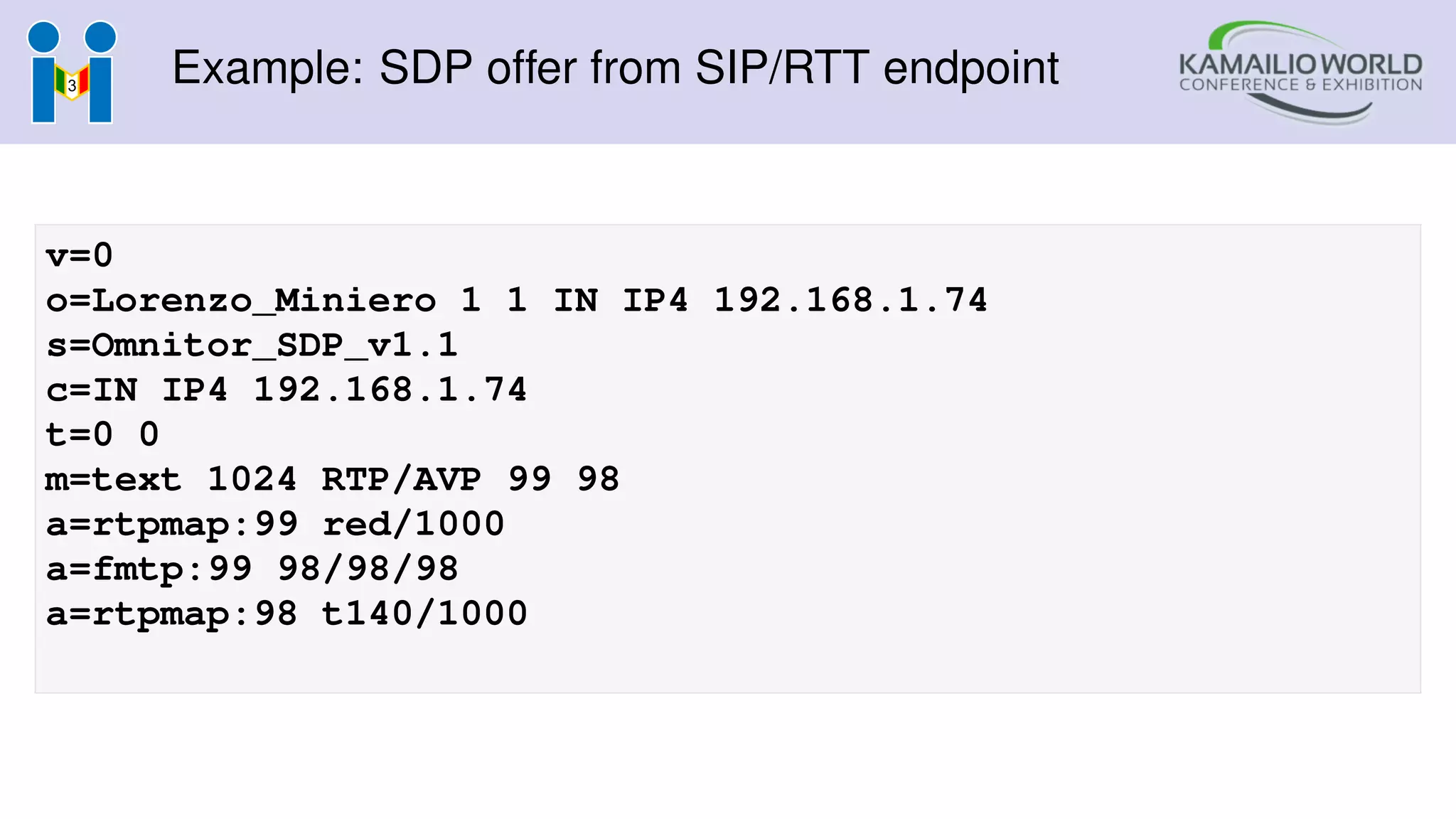
Example: SDP offer from SIP/RTT endpoint
v=0
o=Lorenzo_Miniero 1 1 IN IP4 192.168.1.74
s=Omnitor_SDP_v1.1
c=IN IP4 192.168.1.74
t=0 0
m=text 1024 RTP/AVP 99 98
a=rtpmap:99 red/1000
a=fmtp:99 98/98/98
a=rtpmap:98 t140/1000
Example: SDP offer to WebRTC endpoint
v=0
o=Lorenzo_Miniero 1 1 IN IP4 192.168.1.74
s=Omnitor_SDP_v1.1 t=0 0
a=group:BUNDLE data
a=msid-semantic: WMS janus
m=application 9 UDP/DTLS/SCTP webrtc-datachannel
c=IN IP4 192.168.1.74
a=sendrecv
a=sctp-port:5000
a=mid:0
[.. ICE/DTLS details follow..]
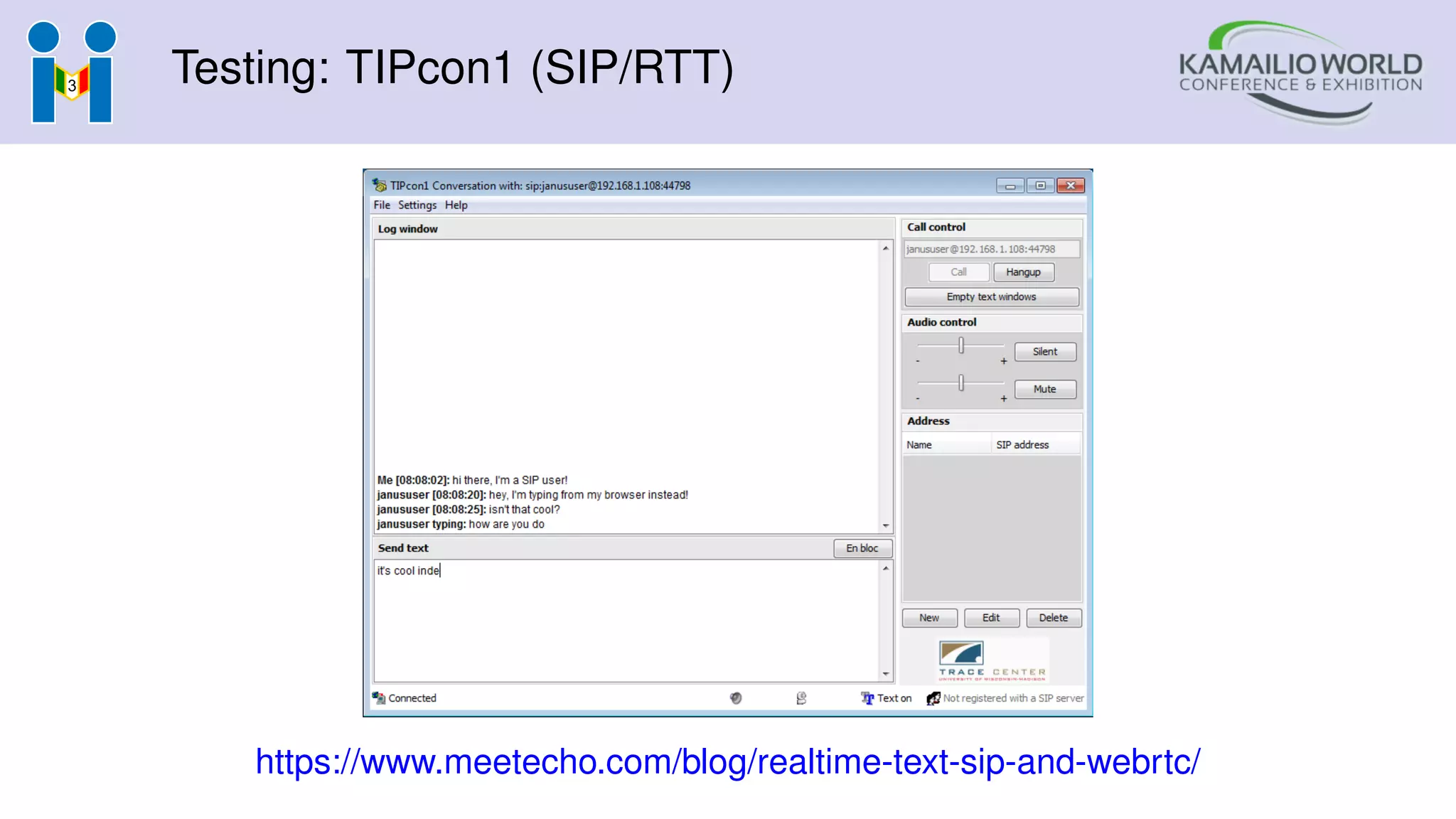
Testing: TIPcon1 (SIP/RTT)
https://www.meetecho.com/blog/realtime-text-sip-and-webrtc/
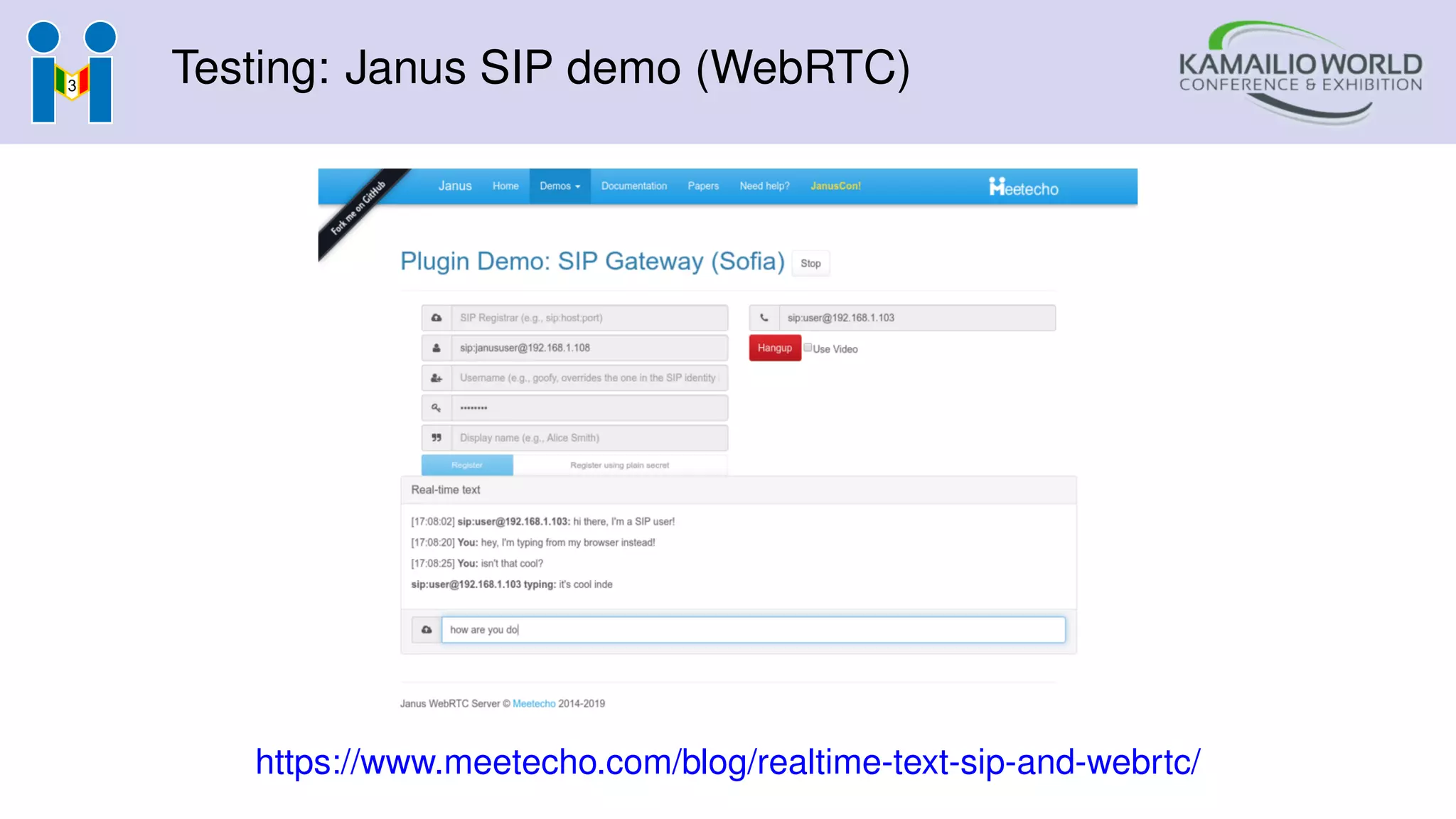
Testing: Janus SIP demo (WebRTC)
https://www.meetecho.com/blog/realtime-text-sip-and-webrtc/
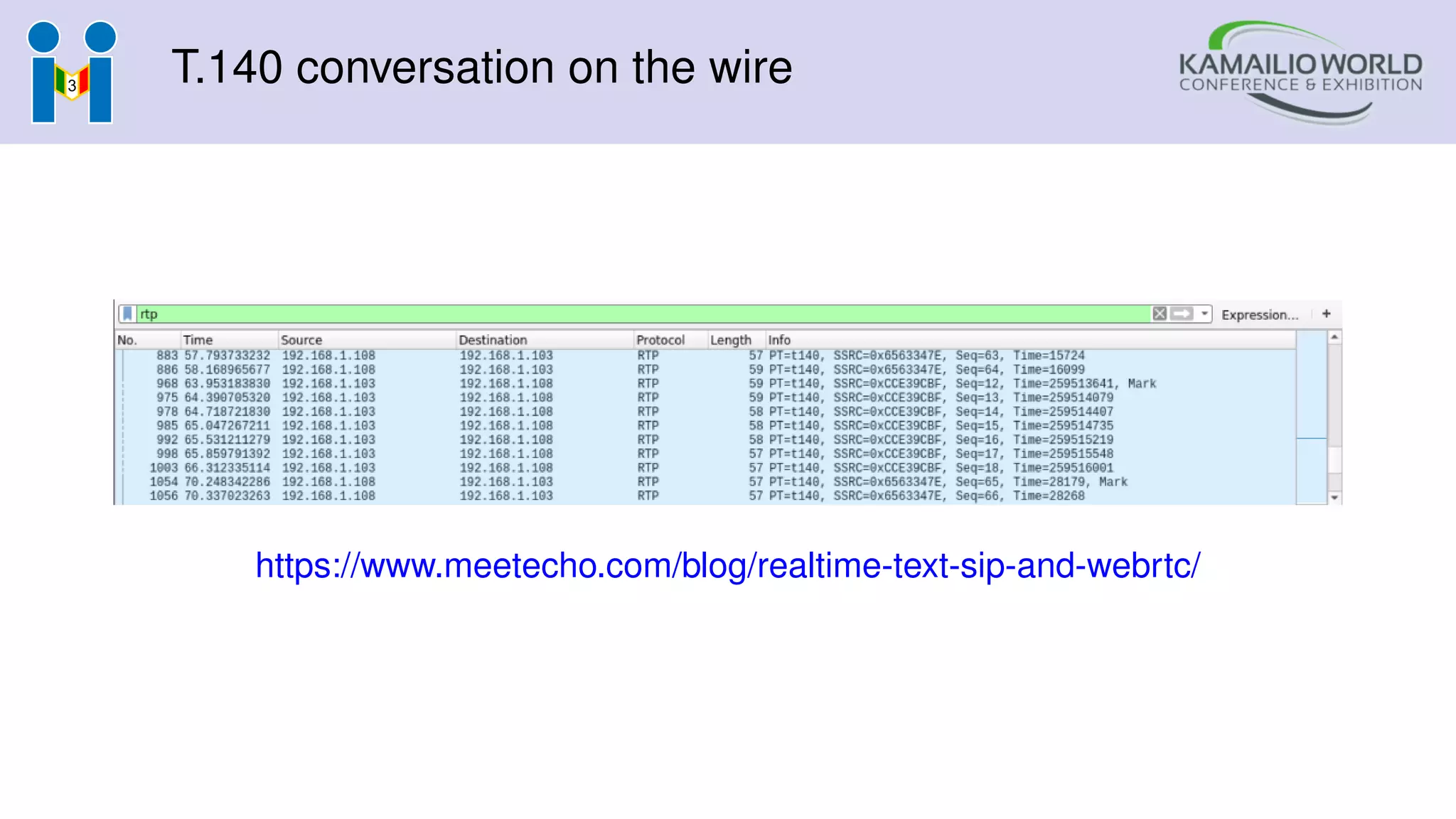
T.140 conversation on the wire
https://www.meetecho.com/blog/realtime-text-sip-and-webrtc/
What’s next?
• First of all, revive the effort
• The original PR was closed a few months ago
• Little to no feedback, and core had changed a lot in the meanwhile
• New PR: https://github.com/meetecho/janus-gateway/pull/3231
• New revision can take advantage of some new features
• e.g., RED supported in the Janus core, now
• Maybe write a prettier and more functional UI too...
• Possibly test with something more complex than TIPcon1
• TIPcon1 good for basic functional testing, but very limited
• RTT endpoints very hard to find, especially in FOSS
• Possibly integration tests with actual RTT deployments?
What’s next?
• First of all, revive the effort
• The original PR was closed a few months ago
• Little to no feedback, and core had changed a lot in the meanwhile
• New PR: https://github.com/meetecho/janus-gateway/pull/3231
• New revision can take advantage of some new features
• e.g., RED supported in the Janus core, now
• Maybe write a prettier and more functional UI too...
• Possibly test with something more complex than TIPcon1
• TIPcon1 good for basic functional testing, but very limited
• RTT endpoints very hard to find, especially in FOSS
• Possibly integration tests with actual RTT deployments?
What’s next?
• First of all, revive the effort
• The original PR was closed a few months ago
• Little to no feedback, and core had changed a lot in the meanwhile
• New PR: https://github.com/meetecho/janus-gateway/pull/3231
• New revision can take advantage of some new features
• e.g., RED supported in the Janus core, now
• Maybe write a prettier and more functional UI too...
• Possibly test with something more complex than TIPcon1
• TIPcon1 good for basic functional testing, but very limited
• RTT endpoints very hard to find, especially in FOSS
• Possibly integration tests with actual RTT deployments?
What’s next?
• First of all, revive the effort
• The original PR was closed a few months ago
• Little to no feedback, and core had changed a lot in the meanwhile
• New PR: https://github.com/meetecho/janus-gateway/pull/3231
• New revision can take advantage of some new features
• e.g., RED supported in the Janus core, now
• Maybe write a prettier and more functional UI too...
• Possibly test with something more complex than TIPcon1
• TIPcon1 good for basic functional testing, but very limited
• RTT endpoints very hard to find, especially in FOSS
• Possibly integration tests with actual RTT deployments?
What’s next?
• First of all, revive the effort
• The original PR was closed a few months ago
• Little to no feedback, and core had changed a lot in the meanwhile
• New PR: https://github.com/meetecho/janus-gateway/pull/3231
• New revision can take advantage of some new features
• e.g., RED supported in the Janus core, now
• Maybe write a prettier and more functional UI too...
• Possibly test with something more complex than TIPcon1
• TIPcon1 good for basic functional testing, but very limited
• RTT endpoints very hard to find, especially in FOSS
• Possibly integration tests with actual RTT deployments?
Thanks! Questions? Comments?
Get in touch!
• https://fosstodon.org/@lminiero
• https://twitter.com/elminiero
• https://twitter.com/meetecho
• https://www.meetecho.com/blog/

Real-Time Text and WebRTC @ Kamailio World 2023

  • 1.
    Bringing real-time textto WebRTC for NG Emergency Services Lorenzo Miniero @lminiero@fosstodon.org Kamailio World June 7th 2023,
  • 2.
    Who am I? LorenzoMiniero • Ph.D @ UniNA • Chairman @ Meetecho • Main author of Janus Contacts and info • lorenzo@meetecho.com • https://fosstodon.org/@lminiero • https://www.slideshare.net/LorenzoMiniero • https://lminiero.bandcamp.com
  • 3.
    Just a fewwords on Meetecho • Co-founded in 2009 as an academic spin-off • University research efforts brought to the market • Completely independent from the University • Focus on real-time multimedia applications • Strong perspective on standardization and open source • Several activities • Consulting services • Commercial support and Janus licenses • Streaming of live events (IETF, ACM, etc.) • Proudly brewed in sunny Napoli(*), Italy
  • 4.
  • 5.
    Emergency Services forthe Hearing Impaired • Ad-hoc text telephones and telecommunication devices • Originally conceived and implemented in the 60’s • Commonly known as TDD / TTY / TT • “Telecommunications Device for the Deaf” • Units made of keyboard, small screen and modem • Messages converted to electric signals • Phone line used to deliver messages • Widely used in legacy Emergency Services • e.g., to allow 911 operators to engage with hard of hearing people • Uses phone line + batteries −→ still works in power failure
  • 6.
    Emergency Services forthe Hearing Impaired • Ad-hoc text telephones and telecommunication devices • Originally conceived and implemented in the 60’s • Commonly known as TDD / TTY / TT • “Telecommunications Device for the Deaf” • Units made of keyboard, small screen and modem • Messages converted to electric signals • Phone line used to deliver messages • Widely used in legacy Emergency Services • e.g., to allow 911 operators to engage with hard of hearing people • Uses phone line + batteries −→ still works in power failure
  • 7.
    Emergency Services forthe Hearing Impaired • Ad-hoc text telephones and telecommunication devices • Originally conceived and implemented in the 60’s • Commonly known as TDD / TTY / TT • “Telecommunications Device for the Deaf” • Units made of keyboard, small screen and modem • Messages converted to electric signals • Phone line used to deliver messages • Widely used in legacy Emergency Services • e.g., to allow 911 operators to engage with hard of hearing people • Uses phone line + batteries −→ still works in power failure
  • 8.
  • 9.
    TDD/TTY/TT (PSTN) • Differentacronyms for mostly similar things • TDD (Telecommunications Device for the Deaf) • TTY (TeleTYpe) • TT (Text Telephone) • Some important limitations • Half-duplex (GA = GO AHEAD) • Can’t be interrupted (garbled output) • Limited set of “characters” (e.g., Baudot) • No specific handshake, and no error correction • Requires specific device
  • 10.
    TDD/TTY/TT (PSTN) • Differentacronyms for mostly similar things • TDD (Telecommunications Device for the Deaf) • TTY (TeleTYpe) • TT (Text Telephone) • Some important limitations • Half-duplex (GA = GO AHEAD) • Can’t be interrupted (garbled output) • Limited set of “characters” (e.g., Baudot) • No specific handshake, and no error correction • Requires specific device
  • 11.
    Next Generation EmergencyServices • Multiple efforts in different areas • NG9-1-1 (https://www.911.gov/issues/ng911/) • NG112 (https://eena.org/next-generation-112/) • Attempt to switch to modern ways of communication • Existing NG services based on PSTN • Internet-based communication allows for richer media, though • Location, , photos, videos, etc.
  • 12.
    Next Generation EmergencyServices • Multiple efforts in different areas • NG9-1-1 (https://www.911.gov/issues/ng911/) • NG112 (https://eena.org/next-generation-112/) • Attempt to switch to modern ways of communication • Existing NG services based on PSTN • Internet-based communication allows for richer media, though • Location, , photos, videos, etc.
  • 13.
    Next Generation EmergencyServices • Multiple efforts in different areas • NG9-1-1 (https://www.911.gov/issues/ng911/) • NG112 (https://eena.org/next-generation-112/) • Attempt to switch to modern ways of communication • Existing NG services based on PSTN • Internet-based communication allows for richer media, though • Location, real-time text, photos, videos, etc.
  • 14.
    Next Generation EmergencyServices • Multiple efforts in different areas • NG9-1-1 (https://www.911.gov/issues/ng911/) • NG112 (https://eena.org/next-generation-112/) • Attempt to switch to modern ways of communication • Existing NG services based on PSTN • Internet-based communication allows for richer media, though • Location, real-time text, photos, videos, etc.
  • 15.
    Real-Time Text (RTT) •Text transmitted instantly, as it is typed or created • TDD/TTY work that way too • How to do it over IP, though? • Text over IP (ToIP) • ITU-T T.140 (Protocol for multimedia application text conversation) • Allows for real-time editing (e.g., backspace, rewriting) • T.140 messages transported over RTP • RFC 4103 (RTP Payload for Text Conversation) • Redundancy implemented via RED (RFC 2198)
  • 16.
    Real-Time Text (RTT) •Text transmitted instantly, as it is typed or created • TDD/TTY work that way too • How to do it over IP, though? • Text over IP (ToIP) • ITU-T T.140 (Protocol for multimedia application text conversation) • Allows for real-time editing (e.g., backspace, rewriting) • T.140 messages transported over RTP • RFC 4103 (RTP Payload for Text Conversation) • Redundancy implemented via RED (RFC 2198)
  • 17.
    Real-Time Text (RTT) •Text transmitted instantly, as it is typed or created • TDD/TTY work that way too • How to do it over IP, though? • Text over IP (ToIP) • ITU-T T.140 (Protocol for multimedia application text conversation) • Allows for real-time editing (e.g., backspace, rewriting) • T.140 messages transported over RTP • RFC 4103 (RTP Payload for Text Conversation) • Redundancy implemented via RED (RFC 2198)
  • 18.
    T.140 • ITU-T T.140(Protocol for multimedia application text conversation) • https://www.itu.int/rec/T-REC-T.140/ • Protocol based on the concept of T140blocks • Set of characters or special codes that one party is delivering to one or more others • Participant typing −→ typed characters bundled together in a T.140 block • Buffering size up to sender (overhead vs. latency) • UTF-8 used for characters, including special codes (actions) • e.g., Byte Order Mark (BOM), backspace, etc.
  • 19.
    T.140 • ITU-T T.140(Protocol for multimedia application text conversation) • https://www.itu.int/rec/T-REC-T.140/ • Protocol based on the concept of T140blocks • Set of characters or special codes that one party is delivering to one or more others • Participant typing −→ typed characters bundled together in a T.140 block • Buffering size up to sender (overhead vs. latency) • UTF-8 used for characters, including special codes (actions) • e.g., Byte Order Mark (BOM), backspace, etc.
  • 20.
    T.140 • ITU-T T.140(Protocol for multimedia application text conversation) • https://www.itu.int/rec/T-REC-T.140/ • Protocol based on the concept of T140blocks • Set of characters or special codes that one party is delivering to one or more others • Participant typing −→ typed characters bundled together in a T.140 block • Buffering size up to sender (overhead vs. latency) • UTF-8 used for characters, including special codes (actions) • e.g., Byte Order Mark (BOM), backspace, etc.
  • 21.
    T.140 over RTP 01 2 3 0 1 2 3 4 5 6 7 8 9 0 1 2 3 4 5 6 7 8 9 0 1 2 3 4 5 6 7 8 9 0 1 +-+-+-+-+-+-+-+-+-+-+-+-+-+-+-+-+-+-+-+-+-+-+-+-+-+-+-+-+-+-+-+-+ |V=2|P|X| CC=0 |M| T140 PT | sequence number | +-+-+-+-+-+-+-+-+-+-+-+-+-+-+-+-+-+-+-+-+-+-+-+-+-+-+-+-+-+-+-+-+ | timestamp (1000Hz) | +-+-+-+-+-+-+-+-+-+-+-+-+-+-+-+-+-+-+-+-+-+-+-+-+-+-+-+-+-+-+-+-+ | synchronization source (SSRC) identifier | +-+-+-+-+-+-+-+-+-+-+-+-+-+-+-+-+-+-+-+-+-+-+-+-+-+-+-+-+-+-+-+-+ | T.140 encoded data | + +---------------+ +-+-+-+-+-+-+-+-+-+-+-+-+-+-+-+-+-+-+-+-+-+-+-+-+
  • 22.
    Dealing with packetloss using RED
  • 23.
    Dealing with packetloss using RED
  • 24.
    Dealing with packetloss using RED
  • 25.
    Dealing with packetloss using RED
  • 26.
    Dealing with packetloss using RED
  • 27.
    T.140 over RTP(with redundancy) 0 1 2 3 0 1 2 3 4 5 6 7 8 9 0 1 2 3 4 5 6 7 8 9 0 1 2 3 4 5 6 7 8 9 0 1 +-+-+-+-+-+-+-+-+-+-+-+-+-+-+-+-+-+-+-+-+-+-+-+-+-+-+-+-+-+-+-+-+ |V=2|P|X| CC=0 |M| "RED" PT | sequence number of primary | +-+-+-+-+-+-+-+-+-+-+-+-+-+-+-+-+-+-+-+-+-+-+-+-+-+-+-+-+-+-+-+-+ | timestamp of primary encoding "P" | +-+-+-+-+-+-+-+-+-+-+-+-+-+-+-+-+-+-+-+-+-+-+-+-+-+-+-+-+-+-+-+-+ | synchronization source (SSRC) identifier | +-+-+-+-+-+-+-+-+-+-+-+-+-+-+-+-+-+-+-+-+-+-+-+-+-+-+-+-+-+-+-+-+ |1| T140 PT | timestamp offset of "R" | "R" block length | +-+-+-+-+-+-+-+-+-+-+-+-+-+-+-+-+-+-+-+-+-+-+-+-+-+-+-+-+-+-+-+-+ |0| T140 PT | "R" T.140 encoded redundant data | +-+-+-+-+-+-+-+-+ +---------------+ + | | +-+-+-+-+-+-+-+-+-+-+-+-+-+-+-+-+-+-+-+-+-+-+-+-+ +-+-+-+-+-+ | "P" T.140 encoded primary data | +-+-+-+-+-+-+-+-+-+-+-+-+-+-+-+-+-+-+-+-+-+-+-+-+-+-+-+
  • 28.
    RTT and SIP/SDP •As an RTP-based stream, easy to negotiate via SDP • Needs text as media in m-line • t140 used to advertise codec in rtpmap • Sampling rate always 1000 (also for RED) SDP example m=text 11000 RTP/AVP 98 100 a=rtpmap:98 t140/1000 a=rtpmap:100 red/1000 a=fmtp:100 98/98/98
  • 29.
    RTT and SIP/SDP •As an RTP-based stream, easy to negotiate via SDP • Needs text as media in m-line • t140 used to advertise codec in rtpmap • Sampling rate always 1000 (also for RED) SDP example m=text 11000 RTP/AVP 98 100 a=rtpmap:98 t140/1000 a=rtpmap:100 red/1000 a=fmtp:100 98/98/98
  • 30.
    RTT and SIP/SDP •As an RTP-based stream, easy to negotiate via SDP • Needs text as media in m-line • t140 used to advertise codec in rtpmap • Sampling rate always 1000 (also for RED) SDP example m=text 11000 RTP/AVP 98 100 a=rtpmap:98 t140/1000 a=rtpmap:100 red/1000 a=fmtp:100 98/98/98
  • 31.
    RTT and SIP/SDP •As an RTP-based stream, easy to negotiate via SDP • Needs text as media in m-line • t140 used to advertise codec in rtpmap • Sampling rate always 1000 (also for RED) SDP example m=text 11000 RTP/AVP 98 100 a=rtpmap:98 t140/1000 a=rtpmap:100 red/1000 a=fmtp:100 98/98/98
  • 32.
    RTT and SIP/SDP •As an RTP-based stream, easy to negotiate via SDP • Needs text as media in m-line • t140 used to advertise codec in rtpmap • Sampling rate always 1000 (also for RED) SDP example m=text 11000 RTP/AVP 98 100 a=rtpmap:98 t140/1000 a=rtpmap:100 red/1000 a=fmtp:100 98/98/98
  • 33.
    RTT and SIP/SDP •As an RTP-based stream, easy to negotiate via SDP • Needs text as media in m-line • t140 used to advertise codec in rtpmap • Sampling rate always 1000 (also for RED) SDP example m=text 11000 RTP/AVP 98 100 a=rtpmap:98 t140/1000 a=rtpmap:100 red/1000 a=fmtp:100 98/98/98
  • 34.
    RTT and SIP/SDP •As an RTP-based stream, easy to negotiate via SDP • Needs text as media in m-line • t140 used to advertise codec in rtpmap • Sampling rate always 1000 (also for RED) SDP example m=text 11000 RTP/AVP 98 100 a=rtpmap:98 t140/1000 a=rtpmap:100 red/1000 a=fmtp:100 98/98/98
  • 35.
    What about WebRTC? •WebRTC heavily based on existing VoIP technologies • SDP (on “steroids”) is mandatory • RTP used for media (encrypted via DTLS-SRTP) • That said, not all RTP media is supported • Only m=audio and m=video supported out of the box • No support at all for m=text, so RTT won’t work • Only m=application media that can be used is UDP/DTLS/SCTP • WebRTC data channels • Generic data sent via SCTP and encapsulated in DTLS
  • 36.
    What about WebRTC? •WebRTC heavily based on existing VoIP technologies • SDP (on “steroids”) is mandatory • RTP used for media (encrypted via DTLS-SRTP) • That said, not all RTP media is supported • Only m=audio and m=video supported out of the box • No support at all for m=text, so RTT won’t work • Only m=application media that can be used is UDP/DTLS/SCTP • WebRTC data channels • Generic data sent via SCTP and encapsulated in DTLS
  • 37.
    What about WebRTC? •WebRTC heavily based on existing VoIP technologies • SDP (on “steroids”) is mandatory • RTP used for media (encrypted via DTLS-SRTP) • That said, not all RTP media is supported • Only m=audio and m=video supported out of the box • No support at all for m=text, so RTT won’t work • Only m=application media that can be used is UDP/DTLS/SCTP • WebRTC data channels • Generic data sent via SCTP and encapsulated in DTLS
  • 38.
    T.140 RTT overWebRTC Data Channels • Why not use data channels for RTT, then? • T.140 Real-Time Text Conversation over WebRTC Data Channels (RFC 8865) • https://www.rfc-editor.org/rfc/rfc8865.html • Sending T.140 frames directly in data channels, not on RTP • Data channels can be configured to be ordered and reliable • Helps avoiding hoops needed for RTP (e.g., RED) • A specific label can be associated with a specific RTT session • Of course, needs gatewaying to be backwards compatible • WebRTC endpoints can’t do RTP/RTT, and legacy ones don’t do data channels • Something needs to “translate” (media and SDP)
  • 39.
    T.140 RTT overWebRTC Data Channels • Why not use data channels for RTT, then? • T.140 Real-Time Text Conversation over WebRTC Data Channels (RFC 8865) • https://www.rfc-editor.org/rfc/rfc8865.html • Sending T.140 frames directly in data channels, not on RTP • Data channels can be configured to be ordered and reliable • Helps avoiding hoops needed for RTP (e.g., RED) • A specific label can be associated with a specific RTT session • Of course, needs gatewaying to be backwards compatible • WebRTC endpoints can’t do RTP/RTT, and legacy ones don’t do data channels • Something needs to “translate” (media and SDP)
  • 40.
    T.140 RTT overWebRTC Data Channels • Why not use data channels for RTT, then? • T.140 Real-Time Text Conversation over WebRTC Data Channels (RFC 8865) • https://www.rfc-editor.org/rfc/rfc8865.html • Sending T.140 frames directly in data channels, not on RTP • Data channels can be configured to be ordered and reliable • Helps avoiding hoops needed for RTP (e.g., RED) • A specific label can be associated with a specific RTT session • Of course, needs gatewaying to be backwards compatible • WebRTC endpoints can’t do RTP/RTT, and legacy ones don’t do data channels • Something needs to “translate” (media and SDP)
  • 41.
    T.140/data channels SDPusage m=application 911 UDP/DTLS/SCTP webrtc-datachannel c=IN IP6 2001:db8::3 a=max-message-size:1000 a=sctp-port 5000 a=setup:actpass a=dcmap:2 label="ACME customer service";subprotocol="t140" a=dcsa:2 fmtp:t140 cps=20 a=dcsa:2 hlang-send:es eo a=dcsa:2 hlang-recv:es eo
  • 42.
    Prototyping T.140/WebRTC inJanus • Created a prototype in Janus a few years ago • Old PR: https://github.com/meetecho/janus-gateway/pull/1898 (closed) • Blog post: https://www.meetecho.com/blog/realtime-text-sip-and-webrtc/ • New PR: https://github.com/meetecho/janus-gateway/pull/3231 • Used the SIP plugin in Janus as the necessary gateway • Negotiates text m-lines and the text/t140 format on the SDP side • Negotiates data channels on the WebRTC side (binary) • T140blocks are then bridged (no translation) as they are • T140blocks decapsulated from RTP packets −→ data channels • Data channels −→ crafting RTP packets with T140blocks • RED optionally supported in both directions on the RTP side
  • 43.
    Prototyping T.140/WebRTC inJanus • Created a prototype in Janus a few years ago • Old PR: https://github.com/meetecho/janus-gateway/pull/1898 (closed) • Blog post: https://www.meetecho.com/blog/realtime-text-sip-and-webrtc/ • New PR: https://github.com/meetecho/janus-gateway/pull/3231 • Used the SIP plugin in Janus as the necessary gateway • Negotiates text m-lines and the text/t140 format on the SDP side • Negotiates data channels on the WebRTC side (binary) • T140blocks are then bridged (no translation) as they are • T140blocks decapsulated from RTP packets −→ data channels • Data channels −→ crafting RTP packets with T140blocks • RED optionally supported in both directions on the RTP side
  • 44.
    Prototyping T.140/WebRTC inJanus • Created a prototype in Janus a few years ago • Old PR: https://github.com/meetecho/janus-gateway/pull/1898 (closed) • Blog post: https://www.meetecho.com/blog/realtime-text-sip-and-webrtc/ • New PR: https://github.com/meetecho/janus-gateway/pull/3231 • Used the SIP plugin in Janus as the necessary gateway • Negotiates text m-lines and the text/t140 format on the SDP side • Negotiates data channels on the WebRTC side (binary) • T140blocks are then bridged (no translation) as they are • T140blocks decapsulated from RTP packets −→ data channels • Data channels −→ crafting RTP packets with T140blocks • RED optionally supported in both directions on the RTP side
  • 45.
    SIP plugin inJanus https://janus.conf.meetecho.com/docs/sip
  • 46.
    SIP plugin inJanus + RTT
  • 47.
    Example: SDP offerfrom SIP/RTT endpoint v=0 o=Lorenzo_Miniero 1 1 IN IP4 192.168.1.74 s=Omnitor_SDP_v1.1 c=IN IP4 192.168.1.74 t=0 0 m=text 1024 RTP/AVP 99 98 a=rtpmap:99 red/1000 a=fmtp:99 98/98/98 a=rtpmap:98 t140/1000
  • 48.
    Example: SDP offerto WebRTC endpoint v=0 o=Lorenzo_Miniero 1 1 IN IP4 192.168.1.74 s=Omnitor_SDP_v1.1 t=0 0 a=group:BUNDLE data a=msid-semantic: WMS janus m=application 9 UDP/DTLS/SCTP webrtc-datachannel c=IN IP4 192.168.1.74 a=sendrecv a=sctp-port:5000 a=mid:0 [.. ICE/DTLS details follow..]
  • 49.
  • 50.
    Testing: Janus SIPdemo (WebRTC) https://www.meetecho.com/blog/realtime-text-sip-and-webrtc/
  • 51.
    T.140 conversation onthe wire https://www.meetecho.com/blog/realtime-text-sip-and-webrtc/
  • 52.
    What’s next? • Firstof all, revive the effort • The original PR was closed a few months ago • Little to no feedback, and core had changed a lot in the meanwhile • New PR: https://github.com/meetecho/janus-gateway/pull/3231 • New revision can take advantage of some new features • e.g., RED supported in the Janus core, now • Maybe write a prettier and more functional UI too... • Possibly test with something more complex than TIPcon1 • TIPcon1 good for basic functional testing, but very limited • RTT endpoints very hard to find, especially in FOSS • Possibly integration tests with actual RTT deployments?
  • 53.
    What’s next? • Firstof all, revive the effort • The original PR was closed a few months ago • Little to no feedback, and core had changed a lot in the meanwhile • New PR: https://github.com/meetecho/janus-gateway/pull/3231 • New revision can take advantage of some new features • e.g., RED supported in the Janus core, now • Maybe write a prettier and more functional UI too... • Possibly test with something more complex than TIPcon1 • TIPcon1 good for basic functional testing, but very limited • RTT endpoints very hard to find, especially in FOSS • Possibly integration tests with actual RTT deployments?
  • 54.
    What’s next? • Firstof all, revive the effort • The original PR was closed a few months ago • Little to no feedback, and core had changed a lot in the meanwhile • New PR: https://github.com/meetecho/janus-gateway/pull/3231 • New revision can take advantage of some new features • e.g., RED supported in the Janus core, now • Maybe write a prettier and more functional UI too... • Possibly test with something more complex than TIPcon1 • TIPcon1 good for basic functional testing, but very limited • RTT endpoints very hard to find, especially in FOSS • Possibly integration tests with actual RTT deployments?
  • 55.
    What’s next? • Firstof all, revive the effort • The original PR was closed a few months ago • Little to no feedback, and core had changed a lot in the meanwhile • New PR: https://github.com/meetecho/janus-gateway/pull/3231 • New revision can take advantage of some new features • e.g., RED supported in the Janus core, now • Maybe write a prettier and more functional UI too... • Possibly test with something more complex than TIPcon1 • TIPcon1 good for basic functional testing, but very limited • RTT endpoints very hard to find, especially in FOSS • Possibly integration tests with actual RTT deployments?
  • 56.
    What’s next? • Firstof all, revive the effort • The original PR was closed a few months ago • Little to no feedback, and core had changed a lot in the meanwhile • New PR: https://github.com/meetecho/janus-gateway/pull/3231 • New revision can take advantage of some new features • e.g., RED supported in the Janus core, now • Maybe write a prettier and more functional UI too... • Possibly test with something more complex than TIPcon1 • TIPcon1 good for basic functional testing, but very limited • RTT endpoints very hard to find, especially in FOSS • Possibly integration tests with actual RTT deployments?
  • 57.
    Thanks! Questions? Comments? Getin touch! • https://fosstodon.org/@lminiero • https://twitter.com/elminiero • https://twitter.com/meetecho • https://www.meetecho.com/blog/