Lecture 1: EE 179 Course Introduction
John M Pauly
September 19, 2021
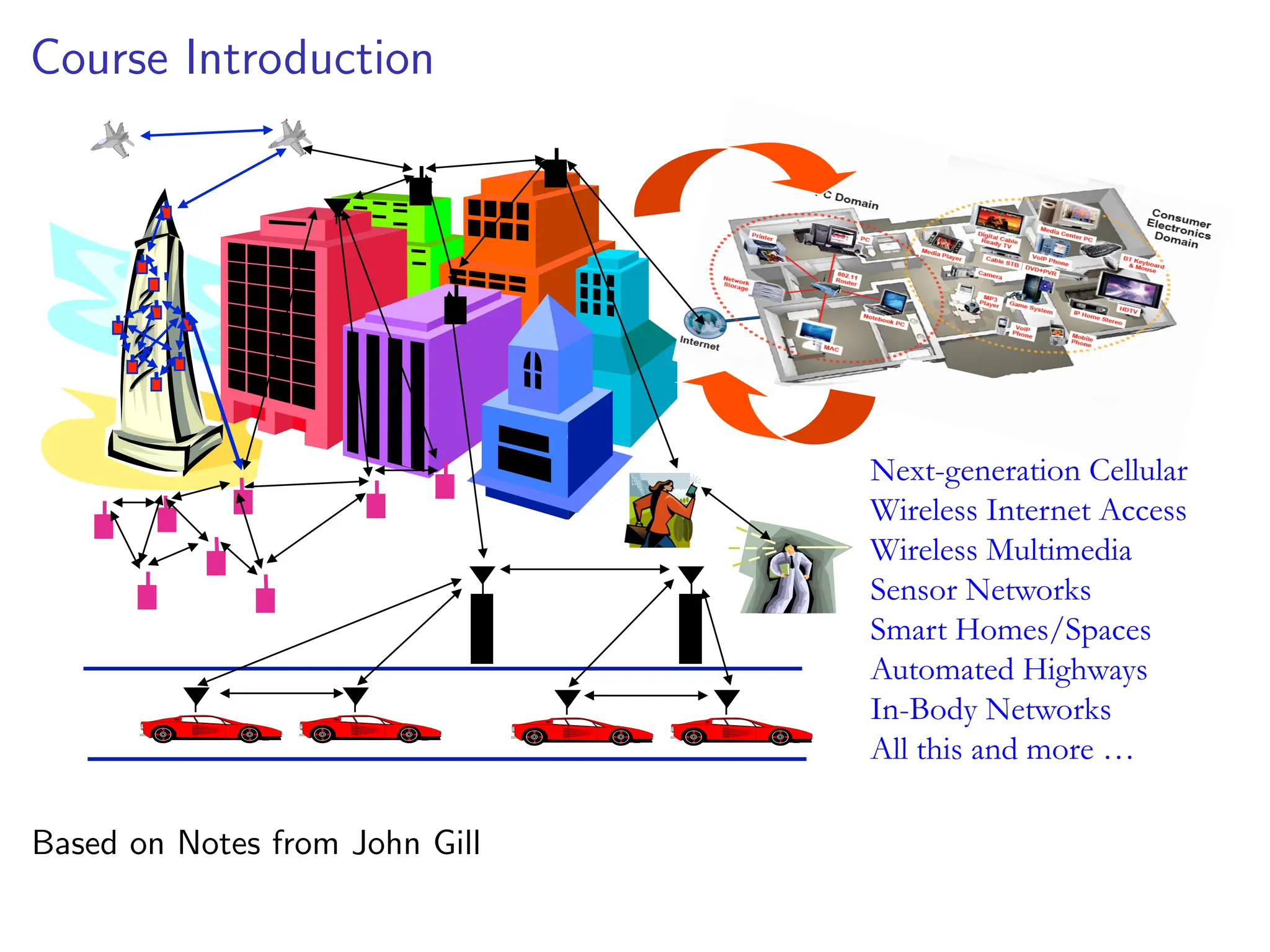
Course Introduction
Professor Andrea Goldsmith
Next-generation Cellular
Wireless Internet Access
Wireless Multimedia
Sensor Networks
Smart Homes/Spaces
Automated Highways
In-Body Networks
All this and more …
Based on Notes from John Gill
Today’s Topics
I Course Information and Policies
I Course Syllabus
I Communication Systems Today
I Examples of Communication Systems
I Design Challenges
Course Information
I Instructor: John Pauly, pauly@stanford.edu
Packard 358, 650-723-4569
Office hours: Th 11-12.
I Class homepage: http://ee179.stanford.edu
I Prerequisites: EE 102A or equivalent
I Recommended Textbook: Lathi & Ding, Modern Digital and Analog
Communications Systems, 5th ed.
I Weekly homework/lab assignments due on Fridays
I Grading: HW and Labs 40%, midterm project 20%, final project 40%
Assignments and Projects
I Homework and Labs
I Assigned on Fridays, due following Friday at class time.
I You are free to talk with other students about the homework and
problems, but everyone should turn in their own write up.
I Midterm and Final Projects
I Midterm will be a short project (essentially a lab you do on your own)
I The final project topic will be given to you. Last time it was decoding the
digital packets that planes use to identify themselves.
I Final project presentations will be during the scheduled final time, Wed 8,
form 7-10 PM. You will have 10 minutes to present your project and
results.
Labs
I The labs will be based on acquiring and processing real RF data
I You will be given software defined radios to capture RF data
I Currently we have RTL-SDR’s, which are receive only
I We have Lime SDR’s on order, which transmit and receive.
Unfortunately the chip shortage is real!
I Processing will be in matlab and gnuradio
I Friday classes will be devoted to talking about the new lab, and
acquiring and processing data.
I Be sure to bring your computers and sdr’s on Fridays
Amateur Radio License
I We’ll be having a zoom class on getting your Amateur Radio License
I This is a great way to really learn and use what we cover in this class
I Thursday evenings at 7 PM, starting next week
I We’ll give you a free VHF/UHF handheld radio when you pass
I If we get the Lime SDR’s you will need a license to be able to transmit.
Course Outline
I Modern communications systems
I Focus on transport layer. How do you encode information on a carrier?
I Signal processing in 2πf, instead of ω as in 102A
I Finding your way around the RF spectrum
I Analog Systems
I Amplitude modulation (AM, SSB, QAM)
I Pulse modulation (PAM, PWM, PPM)
I Angle modulation (FM, PM, PSK, and FSK)
I Digital systems
I Sampling and Quantization
I Pulse code modulation (PCM)
I Digital modulation (PAM, ASK, FSK, PSK, QPSK, and QAM)
I Line Coding and ISI
I SNR and performance
Early Communication Systems
I Telegraph
I 1830, Joseph Henry
I 1832, Pavel Schilling
I 1837, Samuel B. Morese, Morse code
I 1844, What Hath God Wrought
I Telephone
I 1876, Alexander G. Bell (“Watson come here; I need you.”)
I 1888, Strowger stepper switch
I 1915, US transcontinental service (requires amplifiers)
I Wireless telegraphy
I 1895, Jagadish Chandra Bose builds radio transmitter
I 1896, Marconi patents radio telegraphy
I 1901, Marconi, first transatlantic transmission
I Radio
I 1906, Reginald Fessendend, first broadcast
I 1920, first commercial AM radio station (Montreal XWA → CINW)
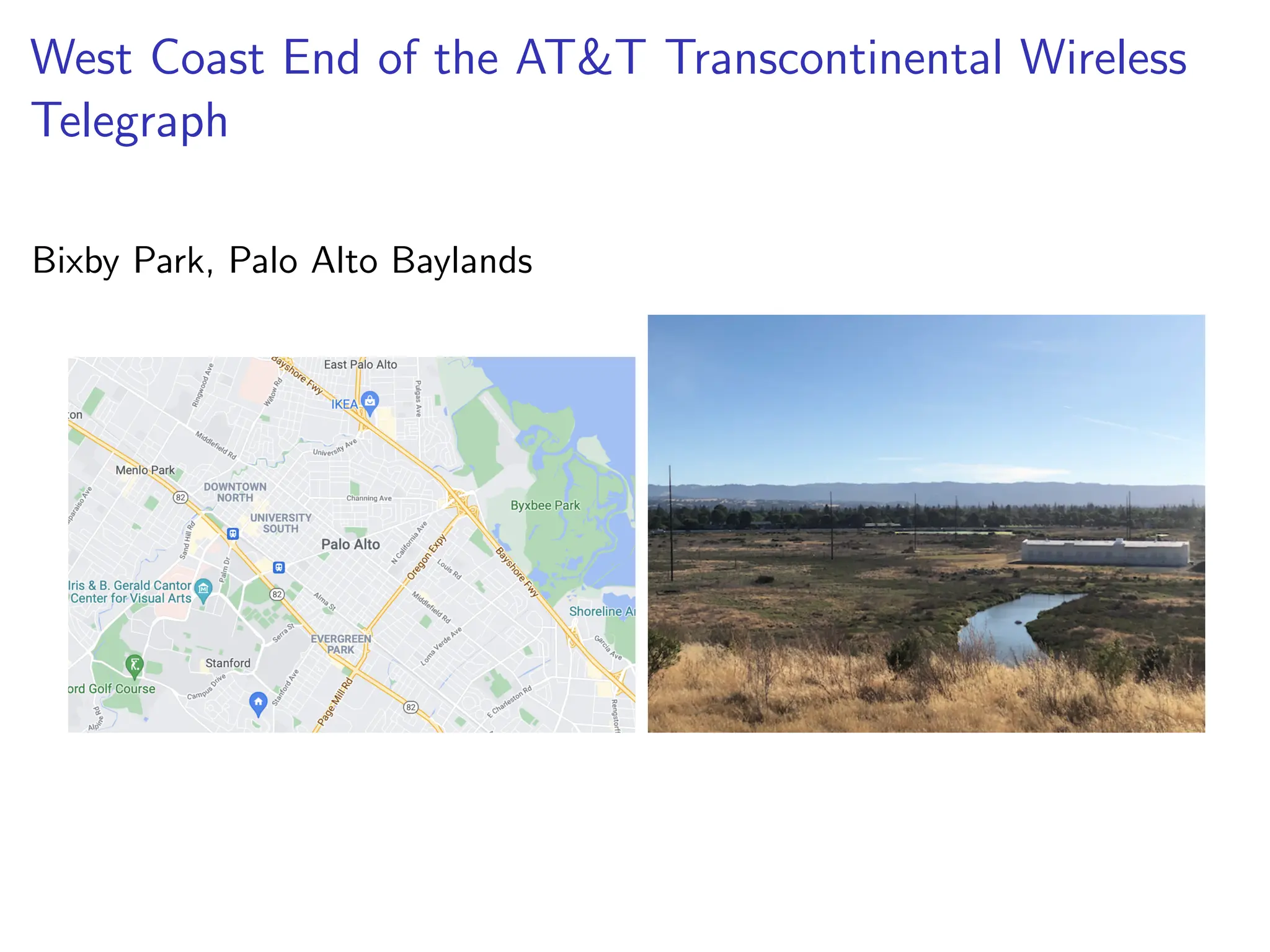
West Coast End of the AT&T Transcontinental Wireless
Telegraph
Bixby Park, Palo Alto Baylands
Communication Systems Today
I Public Switched Telephone Network (PSTN) for voice, fax, modem
I Radio and TV broadcasting
I Citizens’ band radio; ham short-wave radio
I Computer networks (LANs, WANs, and the Internet)
I Satellite systems (pagers, voice/data, movie broadcasts)
I Cable television (CATV) for video and data
I Cellular phones
I Bluetooth
I GPS
I Many others...
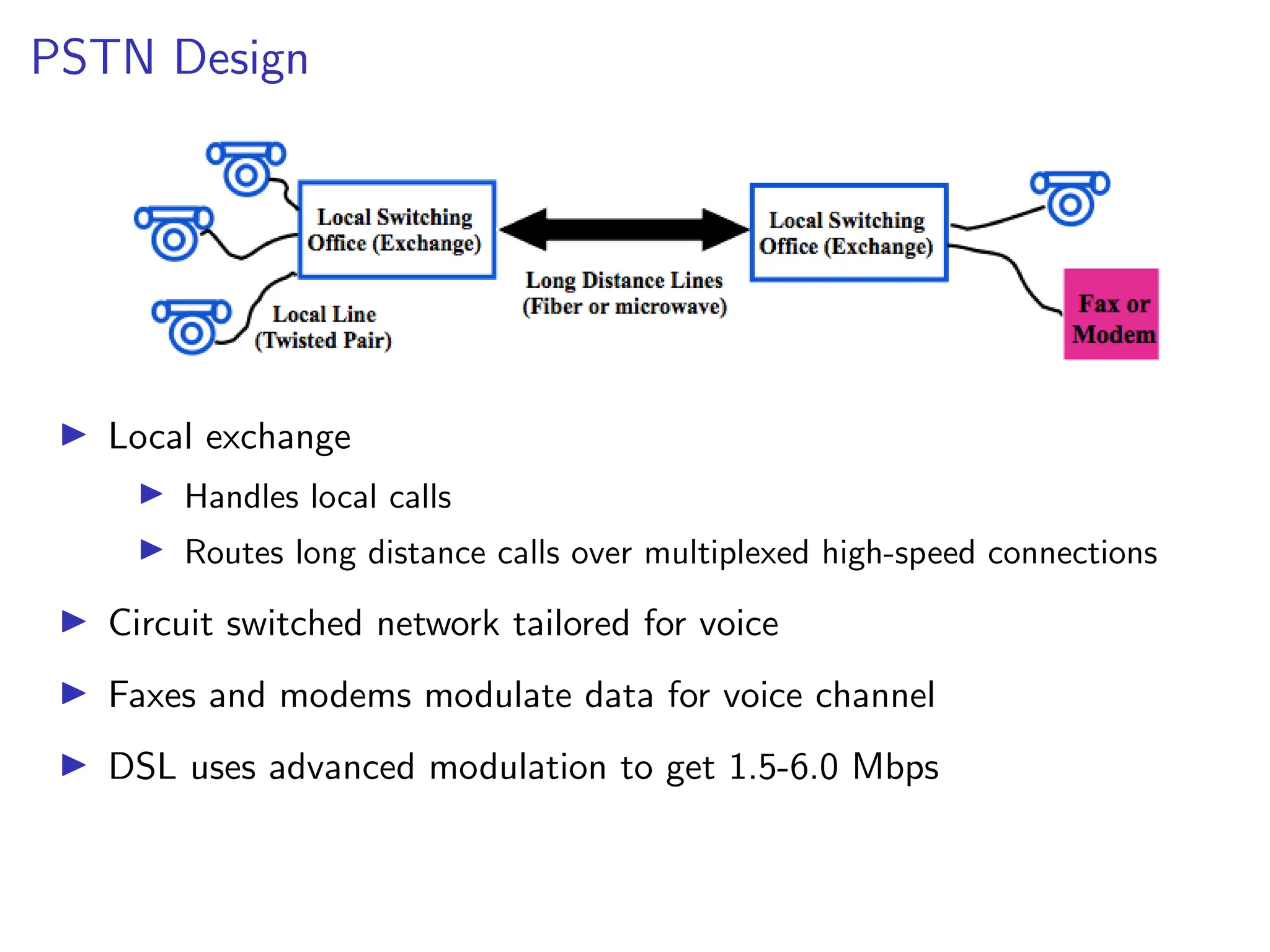
PSTN Design
I Local exchange
I Handles local calls
I Routes long distance calls over multiplexed high-speed connections
I Circuit switched network tailored for voice
I Faxes and modems modulate data for voice channel
I DSL uses advanced modulation to get 1.5-6.0 Mbps
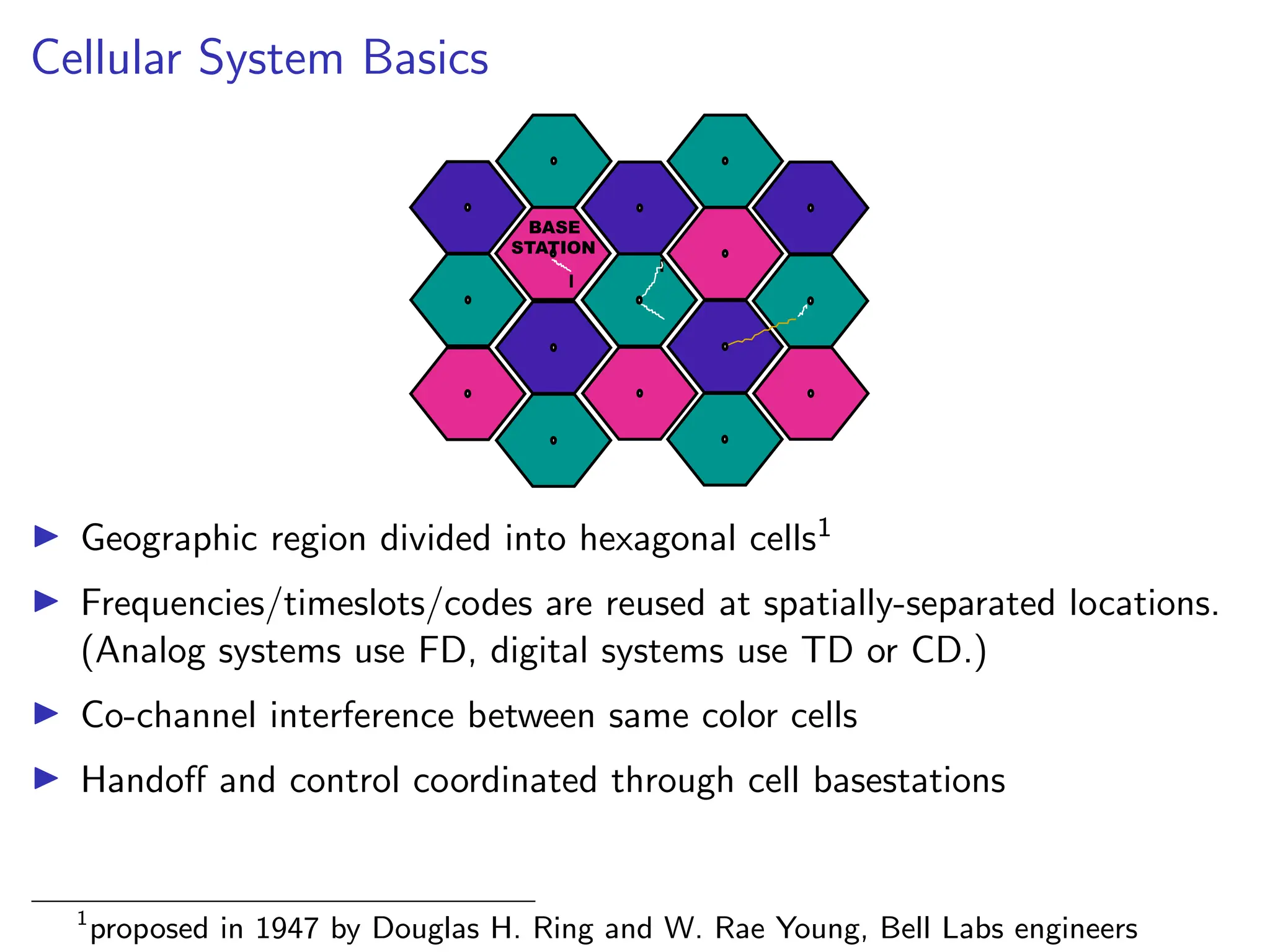
Cellular System Basics
BASE
STATION
I Geographic region divided into hexagonal cells1
I Frequencies/timeslots/codes are reused at spatially-separated locations.
(Analog systems use FD, digital systems use TD or CD.)
I Co-channel interference between same color cells
I Handoff and control coordinated through cell basestations
1
proposed in 1947 by Douglas H. Ring and W. Rae Young, Bell Labs engineers
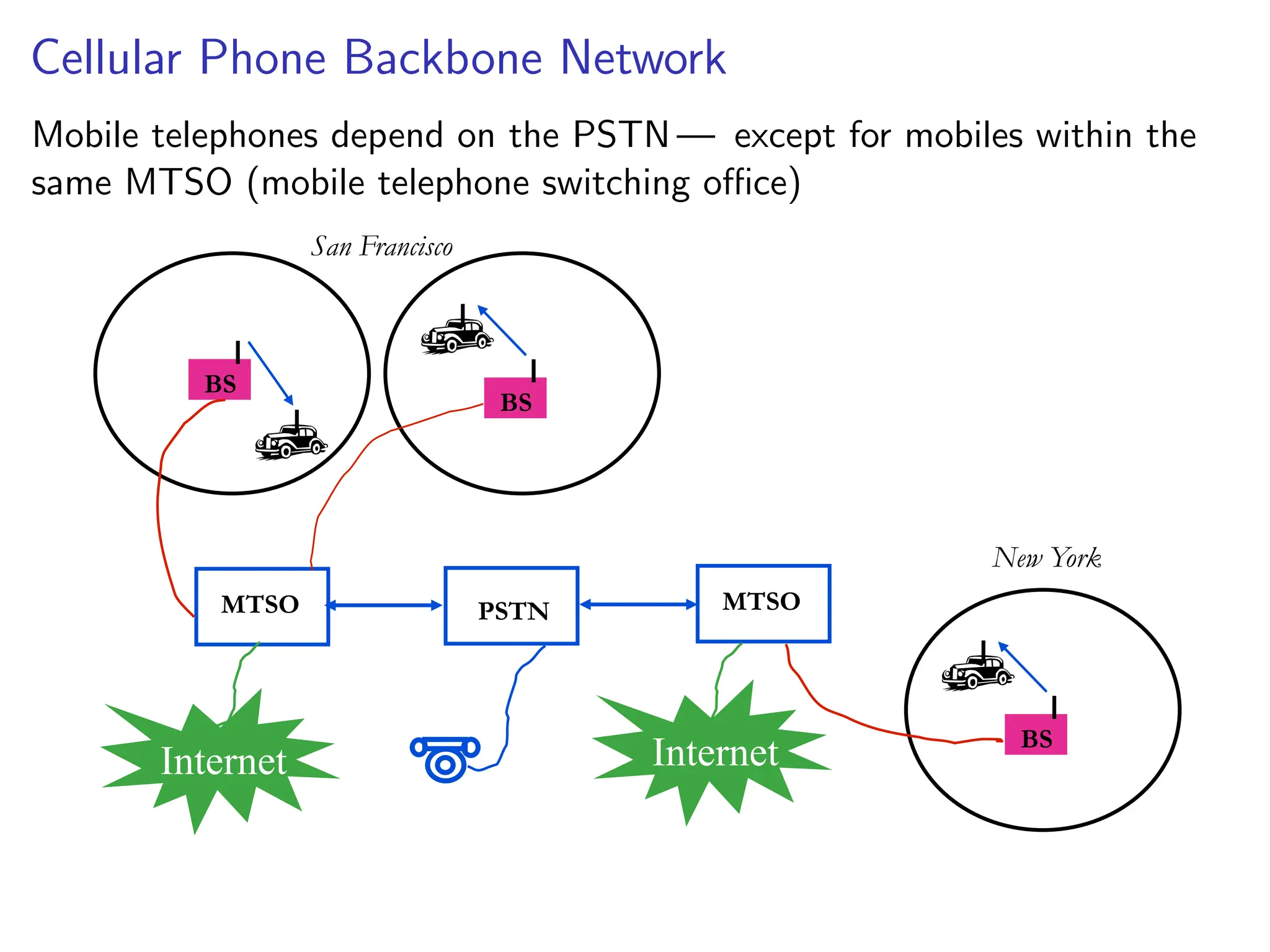
Cellular Phone Backbone Network
Mobile telephones depend on the PSTN — except for mobiles within the
same MTSO (mobile telephone switching office)
BS
BS
MTSO PSTN MTSO
BS
San Francisco
New York
Internet
Internet
Internet
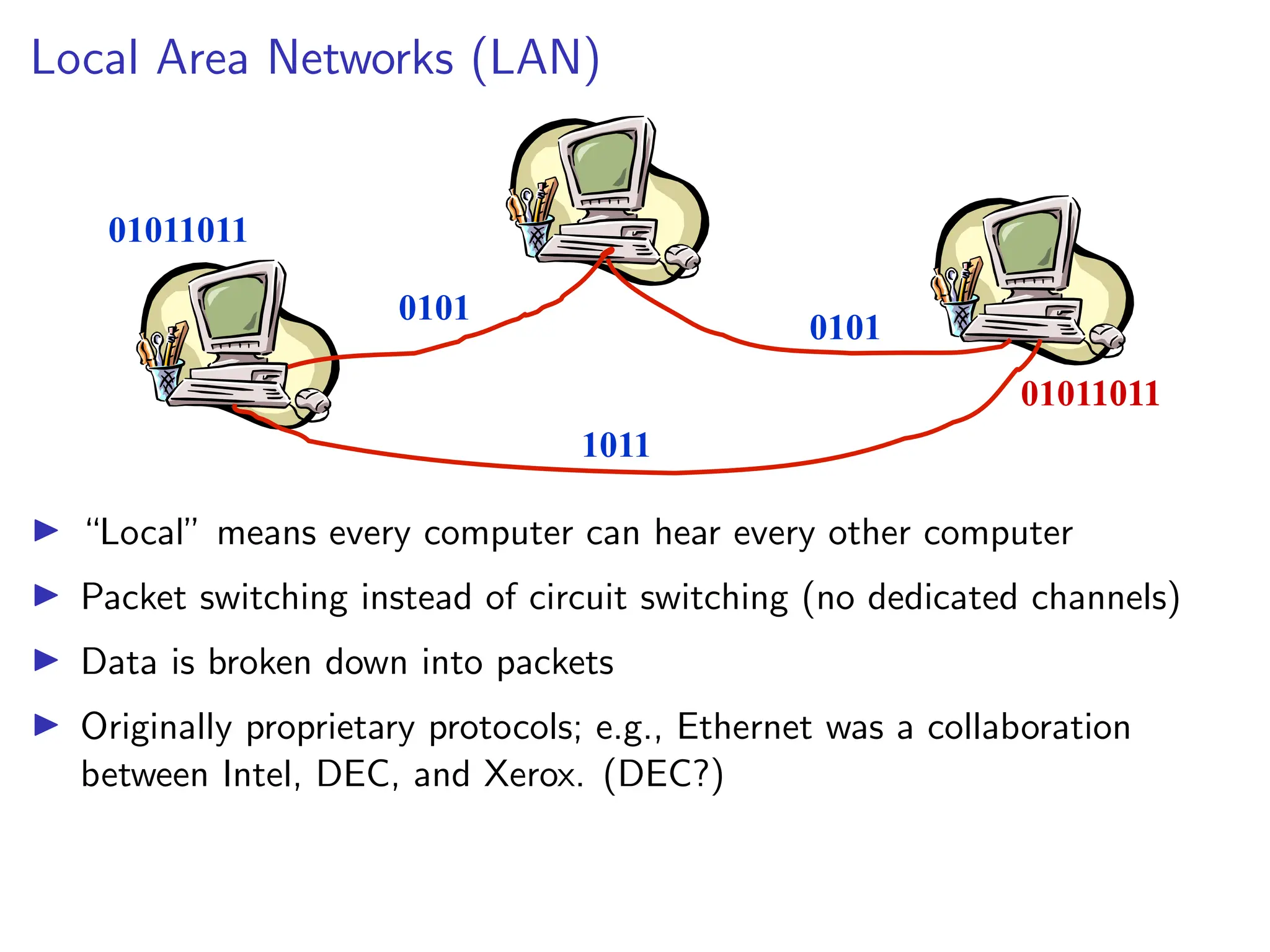
Local Area Networks (LAN)
01011011
1011
0101
0101
1011
01011011
I “Local” means every computer can hear every other computer
I Packet switching instead of circuit switching (no dedicated channels)
I Data is broken down into packets
I Originally proprietary protocols; e.g., Ethernet was a collaboration
between Intel, DEC, and Xerox. (DEC?)
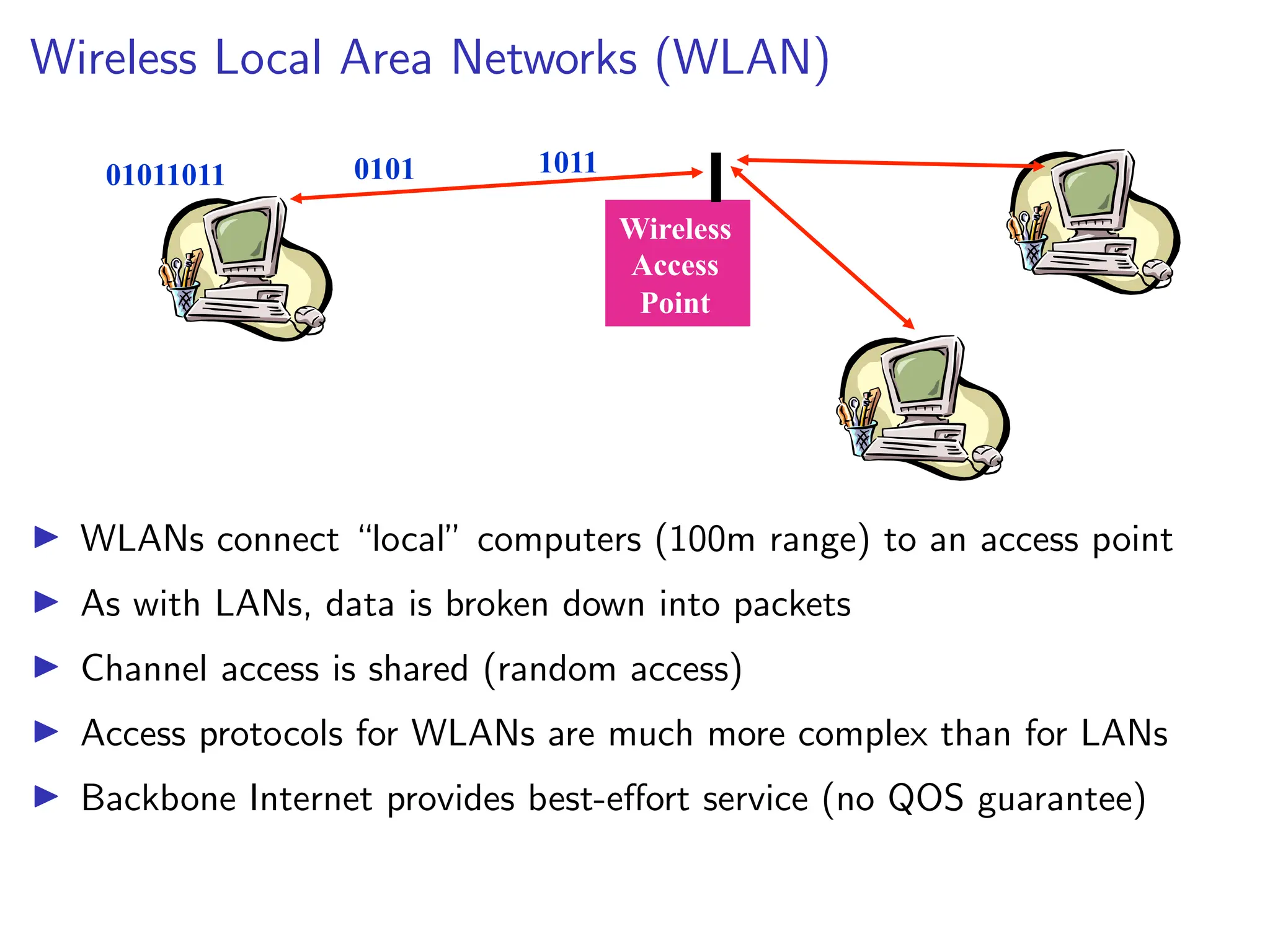
Wireless Local Area Networks (WLAN)
01011011
Wireless
Access
Point
0101 1011
I WLANs connect “local” computers (100m range) to an access point
I As with LANs, data is broken down into packets
I Channel access is shared (random access)
I Access protocols for WLANs are much more complex than for LANs
I Backbone Internet provides best-effort service (no QOS guarantee)
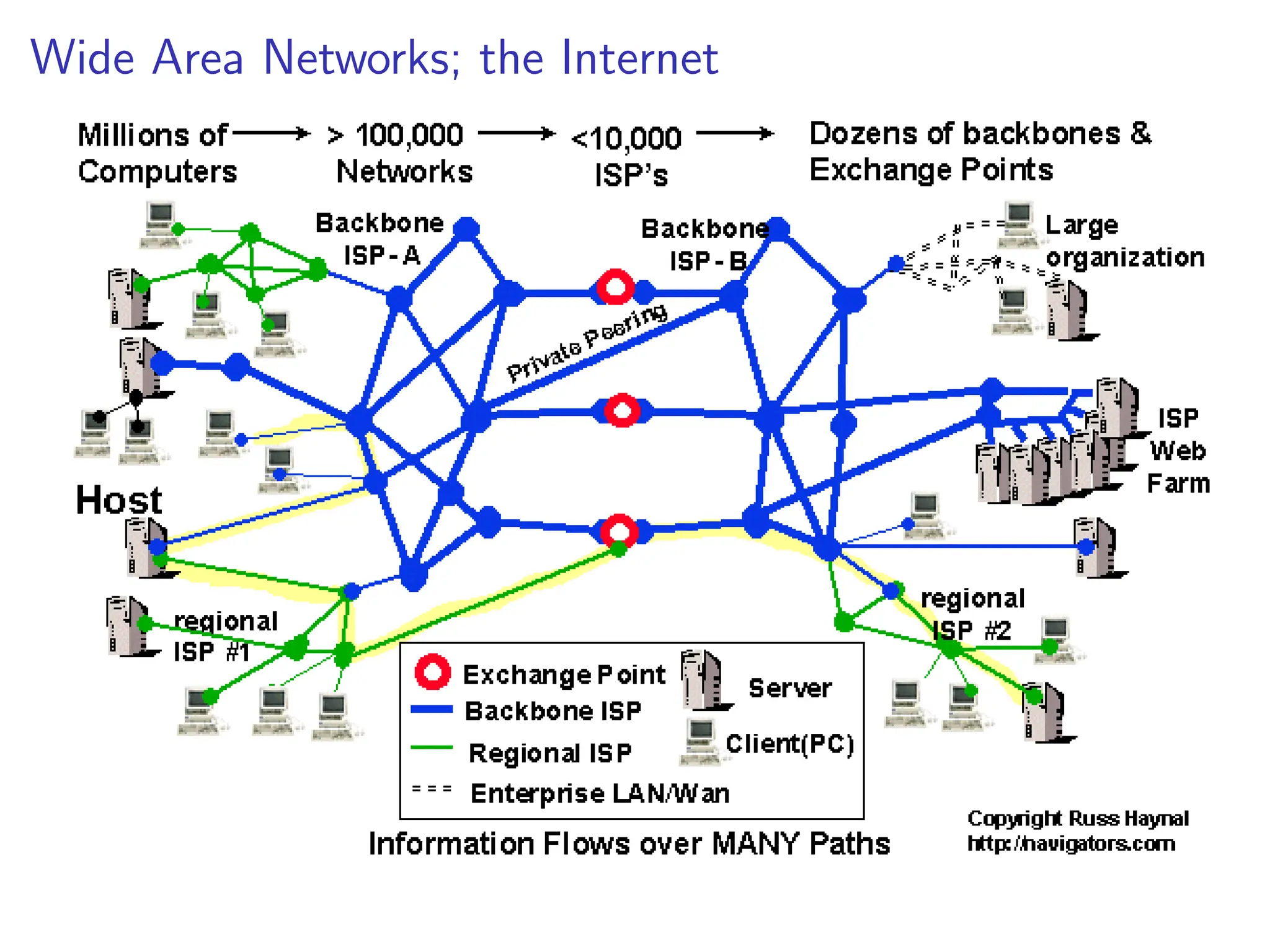
Wide Area Networks; the Internet
Satellite Systems
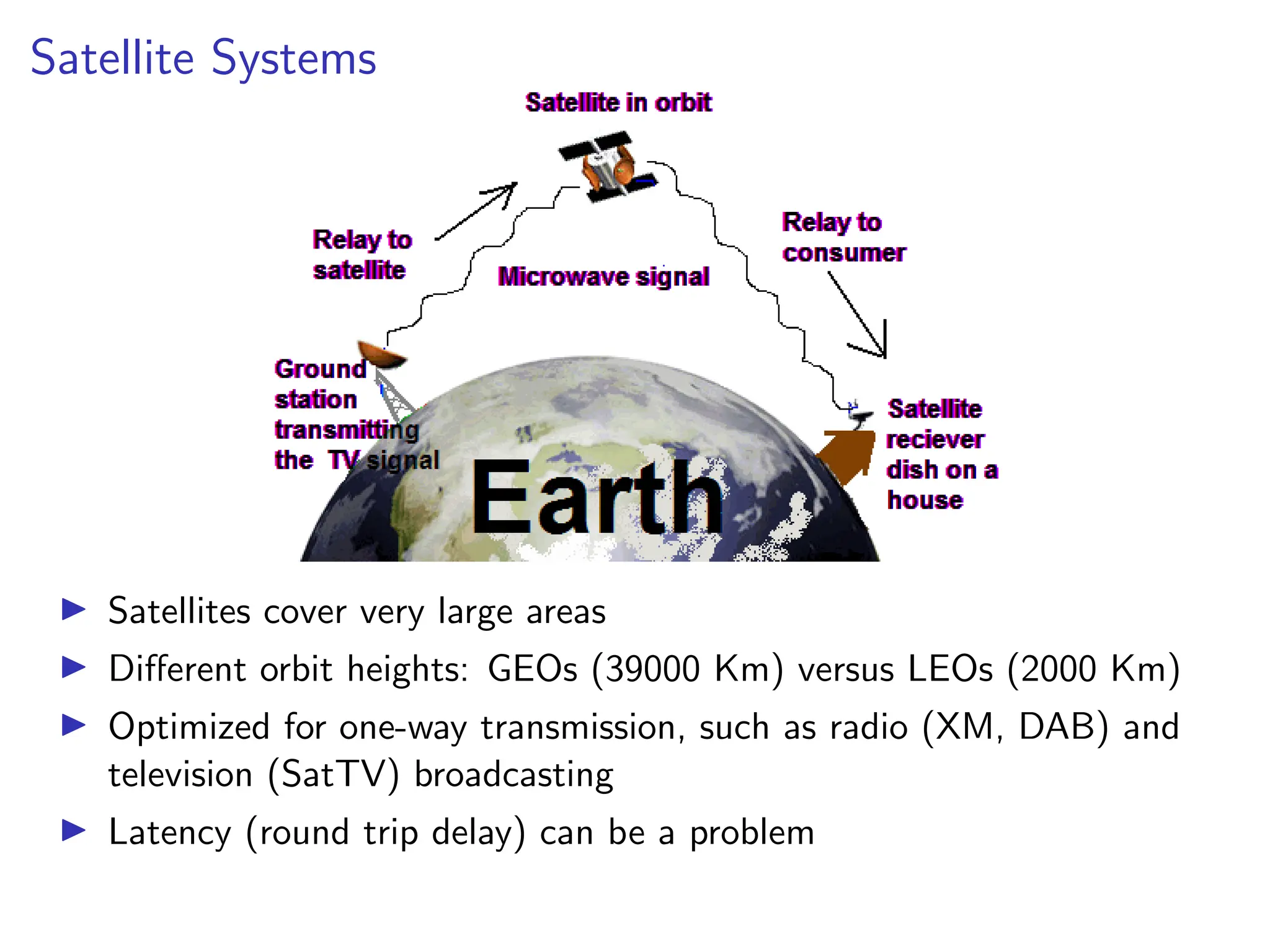
I Satellites cover very large areas
I Different orbit heights: GEOs (39000 Km) versus LEOs (2000 Km)
I Optimized for one-way transmission, such as radio (XM, DAB) and
television (SatTV) broadcasting
I Latency (round trip delay) can be a problem
Bluetooth
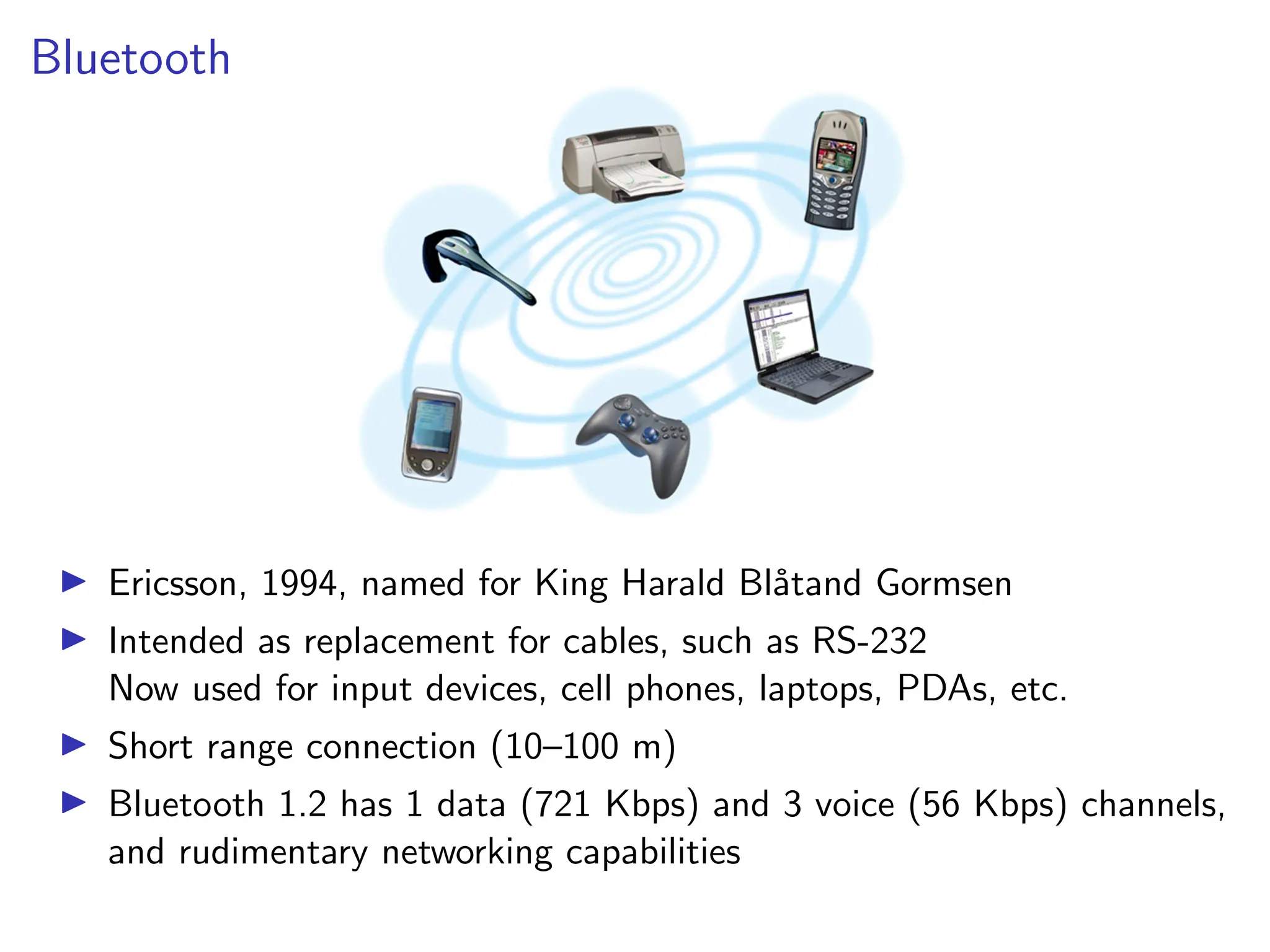
I Ericsson, 1994, named for King Harald Blåtand Gormsen
I Intended as replacement for cables, such as RS-232
Now used for input devices, cell phones, laptops, PDAs, etc.
I Short range connection (10–100 m)
I Bluetooth 1.2 has 1 data (721 Kbps) and 3 voice (56 Kbps) channels,
and rudimentary networking capabilities

lecture 1: introduction to wired and wireless communications

  • 1.
    Lecture 1: EE179 Course Introduction John M Pauly September 19, 2021
  • 2.
    Course Introduction Professor AndreaGoldsmith Next-generation Cellular Wireless Internet Access Wireless Multimedia Sensor Networks Smart Homes/Spaces Automated Highways In-Body Networks All this and more … Based on Notes from John Gill
  • 3.
    Today’s Topics I CourseInformation and Policies I Course Syllabus I Communication Systems Today I Examples of Communication Systems I Design Challenges
  • 4.
    Course Information I Instructor:John Pauly, pauly@stanford.edu Packard 358, 650-723-4569 Office hours: Th 11-12. I Class homepage: http://ee179.stanford.edu I Prerequisites: EE 102A or equivalent I Recommended Textbook: Lathi & Ding, Modern Digital and Analog Communications Systems, 5th ed. I Weekly homework/lab assignments due on Fridays I Grading: HW and Labs 40%, midterm project 20%, final project 40%
  • 5.
    Assignments and Projects IHomework and Labs I Assigned on Fridays, due following Friday at class time. I You are free to talk with other students about the homework and problems, but everyone should turn in their own write up. I Midterm and Final Projects I Midterm will be a short project (essentially a lab you do on your own) I The final project topic will be given to you. Last time it was decoding the digital packets that planes use to identify themselves. I Final project presentations will be during the scheduled final time, Wed 8, form 7-10 PM. You will have 10 minutes to present your project and results.
  • 6.
    Labs I The labswill be based on acquiring and processing real RF data I You will be given software defined radios to capture RF data I Currently we have RTL-SDR’s, which are receive only I We have Lime SDR’s on order, which transmit and receive. Unfortunately the chip shortage is real! I Processing will be in matlab and gnuradio I Friday classes will be devoted to talking about the new lab, and acquiring and processing data. I Be sure to bring your computers and sdr’s on Fridays
  • 7.
    Amateur Radio License IWe’ll be having a zoom class on getting your Amateur Radio License I This is a great way to really learn and use what we cover in this class I Thursday evenings at 7 PM, starting next week I We’ll give you a free VHF/UHF handheld radio when you pass I If we get the Lime SDR’s you will need a license to be able to transmit.
  • 8.
    Course Outline I Moderncommunications systems I Focus on transport layer. How do you encode information on a carrier? I Signal processing in 2πf, instead of ω as in 102A I Finding your way around the RF spectrum I Analog Systems I Amplitude modulation (AM, SSB, QAM) I Pulse modulation (PAM, PWM, PPM) I Angle modulation (FM, PM, PSK, and FSK) I Digital systems I Sampling and Quantization I Pulse code modulation (PCM) I Digital modulation (PAM, ASK, FSK, PSK, QPSK, and QAM) I Line Coding and ISI I SNR and performance
  • 9.
    Early Communication Systems ITelegraph I 1830, Joseph Henry I 1832, Pavel Schilling I 1837, Samuel B. Morese, Morse code I 1844, What Hath God Wrought I Telephone I 1876, Alexander G. Bell (“Watson come here; I need you.”) I 1888, Strowger stepper switch I 1915, US transcontinental service (requires amplifiers) I Wireless telegraphy I 1895, Jagadish Chandra Bose builds radio transmitter I 1896, Marconi patents radio telegraphy I 1901, Marconi, first transatlantic transmission I Radio I 1906, Reginald Fessendend, first broadcast I 1920, first commercial AM radio station (Montreal XWA → CINW)
  • 10.
    West Coast Endof the AT&T Transcontinental Wireless Telegraph Bixby Park, Palo Alto Baylands
  • 11.
    Communication Systems Today IPublic Switched Telephone Network (PSTN) for voice, fax, modem I Radio and TV broadcasting I Citizens’ band radio; ham short-wave radio I Computer networks (LANs, WANs, and the Internet) I Satellite systems (pagers, voice/data, movie broadcasts) I Cable television (CATV) for video and data I Cellular phones I Bluetooth I GPS I Many others...
  • 12.
    PSTN Design I Localexchange I Handles local calls I Routes long distance calls over multiplexed high-speed connections I Circuit switched network tailored for voice I Faxes and modems modulate data for voice channel I DSL uses advanced modulation to get 1.5-6.0 Mbps
  • 13.
    Cellular System Basics BASE STATION IGeographic region divided into hexagonal cells1 I Frequencies/timeslots/codes are reused at spatially-separated locations. (Analog systems use FD, digital systems use TD or CD.) I Co-channel interference between same color cells I Handoff and control coordinated through cell basestations 1 proposed in 1947 by Douglas H. Ring and W. Rae Young, Bell Labs engineers
  • 14.
    Cellular Phone BackboneNetwork Mobile telephones depend on the PSTN — except for mobiles within the same MTSO (mobile telephone switching office) BS BS MTSO PSTN MTSO BS San Francisco New York Internet Internet Internet
  • 15.
    Local Area Networks(LAN) 01011011 1011 0101 0101 1011 01011011 I “Local” means every computer can hear every other computer I Packet switching instead of circuit switching (no dedicated channels) I Data is broken down into packets I Originally proprietary protocols; e.g., Ethernet was a collaboration between Intel, DEC, and Xerox. (DEC?)
  • 16.
    Wireless Local AreaNetworks (WLAN) 01011011 Wireless Access Point 0101 1011 I WLANs connect “local” computers (100m range) to an access point I As with LANs, data is broken down into packets I Channel access is shared (random access) I Access protocols for WLANs are much more complex than for LANs I Backbone Internet provides best-effort service (no QOS guarantee)
  • 17.
    Wide Area Networks;the Internet
  • 18.
    Satellite Systems I Satellitescover very large areas I Different orbit heights: GEOs (39000 Km) versus LEOs (2000 Km) I Optimized for one-way transmission, such as radio (XM, DAB) and television (SatTV) broadcasting I Latency (round trip delay) can be a problem
  • 19.
    Bluetooth I Ericsson, 1994,named for King Harald Blåtand Gormsen I Intended as replacement for cables, such as RS-232 Now used for input devices, cell phones, laptops, PDAs, etc. I Short range connection (10–100 m) I Bluetooth 1.2 has 1 data (721 Kbps) and 3 voice (56 Kbps) channels, and rudimentary networking capabilities