Readings In Social Research Methods 3rd Edition Third Edition Diane Kholos Wysocki
Readings In Social Research Methods 3rd Edition Third Edition Diane Kholos Wysocki
Readings In Social Research Methods 3rd Edition Third Edition Diane Kholos Wysocki
Readings In Social Research Methods 3rd Edition Third Edition Diane Kholos Wysocki
Readings In Social Research Methods 3rd Edition Third Edition Diane Kholos Wysocki
1.
Readings In SocialResearch Methods 3rd Edition
Third Edition Diane Kholos Wysocki download
https://ebookbell.com/product/readings-in-social-research-
methods-3rd-edition-third-edition-diane-kholos-wysocki-2500946
Explore and download more ebooks at ebookbell.com
2.
Here are somerecommended products that we believe you will be
interested in. You can click the link to download.
Readings In Methodology African Perspectives Jeanbernard Oudraogo
Carlos Cardoso
https://ebookbell.com/product/readings-in-methodology-african-
perspectives-jeanbernard-oudraogo-carlos-cardoso-46083858
Personal Finance Supplementary Reading Material Department Of
Education In Social Sciences
https://ebookbell.com/product/personal-finance-supplementary-reading-
material-department-of-education-in-social-sciences-7108524
Readings In Social Case Work 19201938 Selected Reprints For The Case
Work Practitioner Fern Lowry Editor
https://ebookbell.com/product/readings-in-social-case-
work-19201938-selected-reprints-for-the-case-work-practitioner-fern-
lowry-editor-51909244
Timed Readings In Social Studiesbook 6 Jamestown Education
https://ebookbell.com/product/timed-readings-in-social-
studiesbook-6-jamestown-education-37184246
3.
Readings In CatholicSocial Teaching John T Richardson
https://ebookbell.com/product/readings-in-catholic-social-teaching-
john-t-richardson-59370426
Nso And Its Neighbours Readings In The Social History Of The Western
Grassfields Of Cameroon Readings In The Social History Of The Western
Grassfields Of Cameroon 1st Edition B Chemlanghee Vg Fanso Eds
https://ebookbell.com/product/nso-and-its-neighbours-readings-in-the-
social-history-of-the-western-grassfields-of-cameroon-readings-in-the-
social-history-of-the-western-grassfields-of-cameroon-1st-edition-b-
chemlanghee-vg-fanso-eds-51254246
Mapping The Social Landscape Readings In Sociology 9th Edition Susan J
Ferguson
https://ebookbell.com/product/mapping-the-social-landscape-readings-
in-sociology-9th-edition-susan-j-ferguson-46208824
Social Justice Blackwell Readings In Philosophy 1st Edition Matthew
Clayton
https://ebookbell.com/product/social-justice-blackwell-readings-in-
philosophy-1st-edition-matthew-clayton-1695986
The Social Significance Of Reconciliation In Pauls Theology Narrative
Readings In Romans The Library Of New Testament Studies Vol 421
Corneliu Constantineanu
https://ebookbell.com/product/the-social-significance-of-
reconciliation-in-pauls-theology-narrative-readings-in-romans-the-
library-of-new-testament-studies-vol-421-corneliu-
constantineanu-48423138
c
Readings in SocialResearch Methods
T H IR D E D IT I O N
DIANE KHOLOS WYSOCKI
University of Nebraska at Kearney
Australia • Brazil • Canada • Mexico • Singapore • Spain
United Kingdom • United States
9.
Readings in SocialResearch Methods,
Third Edition
Diane Kholos Wysocki
Acquisitions Editor: Chris Caldeira
Assistant Editor: Christina Ho
Editorial Assistant: Tali Beesley
Marketing Manager: Michelle Williams
Marketing Assistant: Emily Elrod
Marketing Communications Manager: Linda Yip
Project Manager, Editorial Production: Samen Iqbal
Creative Director: Rob Hugel
Art Director: John Walker
Print Buyer: Nora Massuda
Permissions Editor: Bob Kauser
Production Service: Aaron Downey, Matrix Productions Inc.
Copy Editor: Patricia Herbst
Cover Designer: Yvo Riezebos Design
Cover Image: Frederic Cirou/Getty Images
Compositor: Integra
Text and Cover Printer: Thomson West
Ó 2008, 2004. Thomson Wadsworth, a part of The Thomson
Corporation. Thomson, the Star logo, and Wadsworth are
trademarks used herein under license.
ALL RIGHTS RESERVED. No part of this work covered by the
copyright hereon may be reproduced or used in any form or by any
means—graphic, electronic, or mechanical, including photocopy-
ing, recording, taping, Web distribution, information storage and
retrieval systems, or in any other manner—without the written
permission of the publisher.
Printed in the United States of America
1 2 3 4 5 6 11 10 09 08 07
Library of Congress Control Number: 2006939174
ISBN-13: 978-0-495-09337-4
ISBN-10: 0-495-09337-8
Thomson Higher Education
10 Davis Drive
Belmont, CA 94002-3098
USA
For more information about our products, contact us at:
Thomson Learning Academic Resource Center
1-800-423-0563
For permission to use material from this text or product,
submit a request online at
http://www.thomsonrights.com.
Any additional questions about permissions can be submitted
by e-mail to
thomsonrights@thomson.com.
10.
c
To my husbandBill
Thanks for all of your love, support, and commitment.
and
To Julia Stumkat, our German host daughter
For all your help and insight into what students would want in a research methods book.
11.
c
Contents
PREFACE X
P AR T I An Introduction to Inquiry
1 Here We Go! Get Ready to Find Out Why You Should
Learn About Research Methods 1
1 From The Sociological Imagination 7
C. Wright Mills
2 The Reality of Everyday Life 11
Peter Berger and Thomas Luckmann
2 Research and Theory: They Go Hand in Hand 17
3 School Tracking and Student Violence 23
Lissa J. Yogan
4 Murder Followed by Suicide in Australia, 1973–1992:
A Research Note 33
Jo Barnes
3 Ethics: You Must Have Ethics in Life and Especially in
Research 41
5 Taking Names: The Ethics of Indirect Recruitment in
Research on Sexual Networks 47
Lewis H. Margolis
6 The Ethics of Conducting Social-Science Research on the
Internet 55
James C. Hamilton
vi
12.
7 Code ofEthics 58
American Sociological Association
P A R T II The Structuring of Inquiry
4 Research Design: Now It’s Time to Plan 61
8 Public Assistance Receipt Among Immigrants and
Natives: How the Unit of Analysis Affects Research
Findings 66
Jennifer Van Hook, Jennifer E. Glick, and
Frank D. Bean
9 Consequences of Participating in a Longitudinal Study of
Marriage 74
Joseph Veroff, Shirley Hatchett, and Elizabeth Douvan
5 Conceptualization and Operationalization: We Have to
Explain What We Are Studying 82
10 An Epidemiological Survey on the Presence of Toxic Chemicals
in Soaps and Cosmetics Used by Adolescent Female Students
from a Nigerian University 86
Ifeyinwa Flossy Obuekwe, Mabel Ochei Uche, and
M. Pharm
11 Conceptualization of Terrorism 91
Jack P. Gibbs
6 Indexes and Scales: Now We Get to Measure It All! 98
12 A Study of Differences in Business Ethical Values in
Mainland China, the U.S., and Jamaica 103
Lillian Y. Fok, Sandra J. Hartman, and Kern Kwong
13 The Reverse Social Distance Scale 111
Motoko Y. Lee, Stephen G. Sapp, and Melvin C. Ray
7 Sampling Made Easy 117
14 Sex in America 123
Robert T. Michael, John H. Gagnon, Edward O. Laumann,
and Gina Kolata
15 The Eurowinter Project: The Use of Market/Social
Research Methods in an International Scientific Study 130
Colin McDonald
C O N T E N T S vii
13.
P A RT III Methods of Observation
8 Experimental and Survey Research: Putting It All
Together 138
16 Prepaid Monetary Incentives and Data Quality in
Face-to-Face Interviews: Data from the 1996
Survey of Income and Program Participation Incentive
Experiment 144
Michael Davern, Todd H. Rockwood, Randy Sherrod, and
Stephen Campbell
17 Sex in America—The Sex Survey 151
Robert T. Michael, John H. Gagnon, Edward O. Laumann,
and Gina Kolata
18 The Internet and Opinion Measurement: Surveying
Marginalized Populations 157
Nadine S. Koch and Jolly A. Emrey
9 Field Research and Unobtrusive Measures: Fun in the
Field 163
19 Comparisons Between Thai Adolescent Voices and Thai
Adolescent Health Literature 169
Vipavee Thongpriwan and Beverly J. McElmurry
20 Amateur Stripping and Gaming Encounters: Fun in Games or
Gaming as Fun? 176
Julie Ann Harms Cannon, Thomas C. Calhoun, and Rhonda
Fisher
21 Thinking Through the Heart 185
Ann Goetting
10 Existing Data and Evaluation Research: Let’s Find Out
What Works 191
22 What Sociologists Do and Where They Do It:
The NSF Survey on Sociologists’ Work
Activities and Workplaces 194
Robert J. Dotzler and Ross Koppel
23 Professors Who Make the Grade:
(Factors That Affect Students’ Grades
of Professors) 202
Vicky L. Seiler and Michael J. Seiler
viii C O N T E N T S
14.
APPENDIX: Writing andReading a Research Paper 213
24 Construction of Masculinity: A Look into the Lives of
Heterosexual Male Transvestites 222
Diane Kholos Wysocki
GLOSSARY 227
INDEX 231
C O N T E N T S ix
15.
c
Preface
I have beenteaching research meth-
ods and working with students on
their own research projects since I
began teaching in 1996. I love working
with undergraduates and helping them
as they make sense of the world in
which they live by conducting research.
It’s great fun to watch students think of
a research question about something
they see in their day-to-day lives and
be able to turn that idea into a project,
see their projects come alive, and help
them present their projects at various
conferences around the country. Whether
you are a student who wants to go to
graduate school or not, the research
experience is priceless and most often times a lot of fun. Plus, you never know,
you might decide later on, after working for a few years, that you do want to go
onto graduate school. And voilà—you already have experience with research and
presentations at conferences to put on your academic résumé. Maybe you have
even been fortunate enough to have published your work with the help of a
wonderful professor who has been mentoring you.
Five or six years ago, I had a student named Jay in some of my classes. We
have kept in touch, and my husband and I even visited Jay and his wife in Alaska
while we were on an Alaskan cruise. Jay is now an officer in the military. A few
weeks ago, he decided to take classes to obtain his master’s degree. But since he is
in the military and the school he is going through is all online, he won’t be able
to write a master’s thesis. Well, thinking ahead, he realizes that one day he is
going to get out of the military and will want a Ph.D. The master’s will help, and
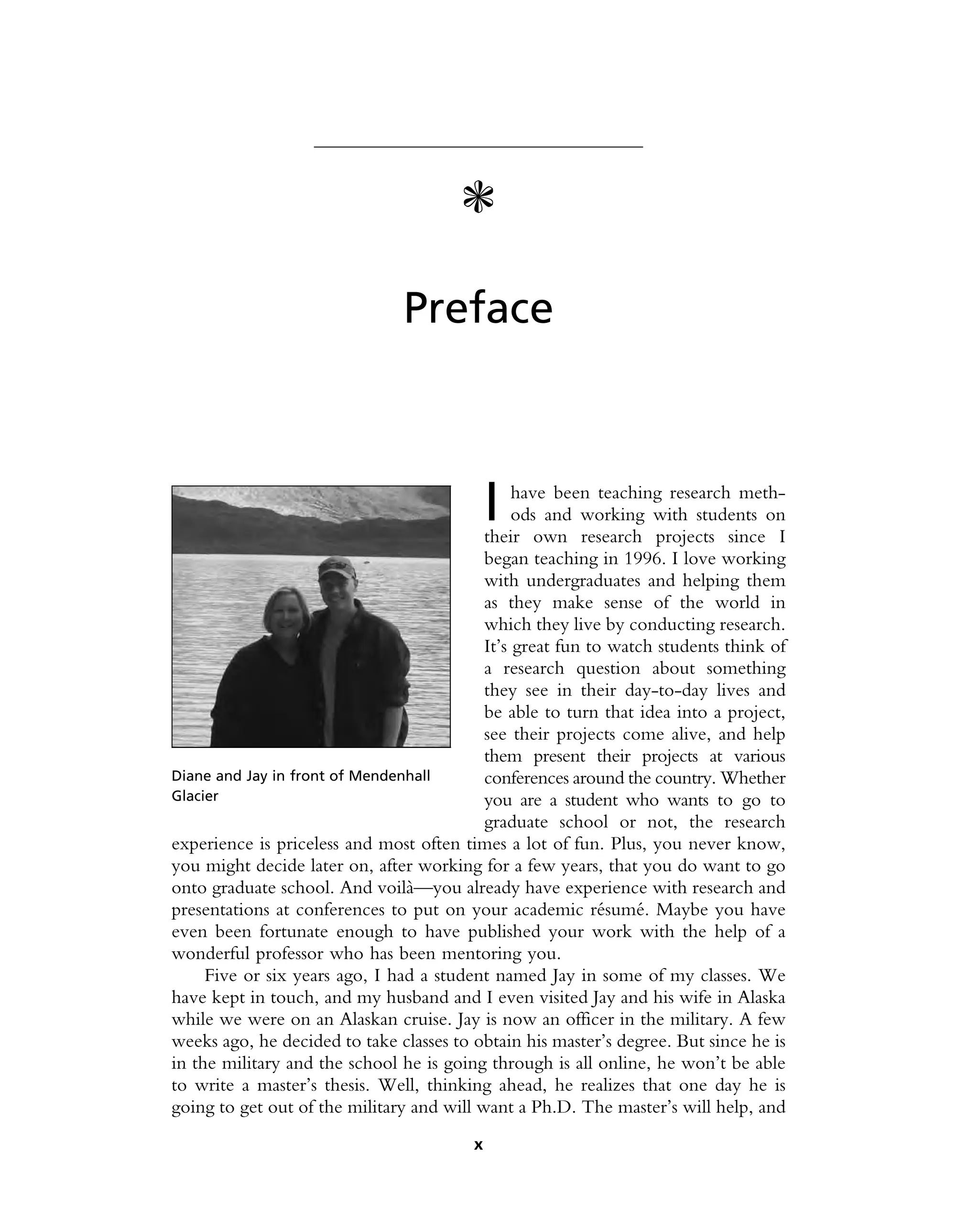
Diane and Jay in front of Mendenhall
Glacier
x
16.
he is excitedto find out that his undergraduate research methods class is coming
in really handy now because he understands research design in his graduate
courses. So, he has connections to me and to other people who can help him
write a master’s thesis and really do a good study. Jay knows that there is much
more to education than taking classes and that research is an important key. Plus
it is always a good idea to build a relationship with your professors. You never
know when you will need them in the future.
I know that sometimes research can be difficult and that some students are
even a little hesitant to take a research methods course. I worry about that. I want
all of you to understand that research can be a lot of fun, and I want to help you
enjoy it. There are some great textbooks available about research methods.
However, it has been my experience that students like to hear not only about
the concepts they need to learn but also how those concepts have been used in
original studies. It has also been my experience that the more interesting a
research topic is and the more closely it connects with students’ lives, the easier
the material is to understand.
I cannot possibly cover everything there is to know about research methods
in this reader. That isn’t even the point of a reader. It would be an impossible
undertaking and would just replicate what you learn from a textbook. Instead, I
have compiled a series of brief readings that can be used to support the terms and
concepts you will learn in your research methods class. You will find that these
chapters parallel Earl Babbie’s The Practice of Social Research, 12th edition, and The
Basics of Social Research, 4th edition, which makes this reader a perfect companion
for Babbie’s widely used texts. However, this reader may also be used with any
other research text currently on the market because the concepts it illuminates are
those central to any course in research methods.
Readings in Social Research Method, 3rd edition, is intended for undergraduate
students who are taking their first research methods course. The goal is to provide
an introduction to the important issues and topics while supporting those ideas
with interesting original research articles.
O R GA N I Z A T I O N O F T H E R E A D E R
Readings in Social Research Methods, 3rd edition, is divided into three parts and has
10 chapters. This book is organized to follow the format of Earl Babbie’s The
Practice of Social Research, 12th edition, and The Basics of Social Research, 4th
edition. The reader can be used along with his textbooks or by itself. What I
have tried to do is gather articles that are relevant and that I thought would hold
your interest. There are two or three articles in each chapter supporting the
concepts discussed and three review questions at the end of each article. The
glossary at the end of the book contains important terms that appear in bold type
throughout the text.
Chapter 1, ‘‘Here We Go! Get Ready to Find Out Why You Should Learn
About Research Methods,’’ begins Part 1, covering the basics about research.
P R E F A C E xi
17.
This chapter tellsyou that our ideas about the world around us might not be as
accurate as our ‘‘commonsense’’ ideas would have us believe. You will learn that
we all have two realities in our lives: one that is based on what we see and know
to be real and the other that we believe to be real because someone else told us it
is real. In this chapter you will learn how important this idea is to research.
Chapter 2, ‘‘Research and Theory: They Go Hand in Hand,’’ focuses on
how the data we collect are empty and meaningless unless they are combined
with theory. You will learn about four different paradigms that can be used in
your research and learn the difference between deductive and inductive theory.
Chapter 3, ‘‘Ethics: You Must Have Ethics in Life and Especially In
Research,’’ appears early in this reader. In some other textbooks, you will see it
as a chapter toward the end of the book or as an appendix. This placements leads
me to believe that ethics could be an afterthought. I believe that having a good
grasp of the ethical problems in research is important to remember while you
read this book. Thus, you will be able to think about important ethical issues as
you design a project or read about someone else’s. You need to understand why
participation should be voluntary, why you should not deceive or harm your
subjects, and what role the institutional review board plays. It is also important
when you are reading the research of other people to be able to tell if they
ethically conducted their research.
Part 2 begins with Chapter 4 ‘‘Research Design: Now It’s Time to Plan.’’ In
this chapter, you will learn that the purpose of research is to explore, describe, and
explain the phenomenon you want to study. You will also learn that units of
analysis can be very confusing at times and that the most common units of analysis
are the individual, the group, the organization, the social category, the social
artifact, the social institution, and the society. Finally, you will learn why time
plays such an important role in research. It helps to describe changes or differences
in behaviors within a framework of different ages or stages across the life span.
Chapter 5, ‘‘Conceptualization and Operationalization: We Have to Explain
What We Are Studying,’’ will tell you how to take variables and put them into
identifying concepts that you can ultimately measure during your project. For
instance, if you are investigating religiosity, you can conceptualize that concept
by giving it a definition. Let’s say you define religiosity as someone who goes to
his or her place of worship at least once a week. You can then operationalize that
concept and measure it by asking the question: ‘‘How many times a week do you
go to your place of worship?’’
Once you know what you are studying, Chapter 6, ‘‘Indexes and Scales:
Now We Get to Measure It All!,’’ can help you construct a way to measure your
variables. You will also learn the difference between using an index and a scale
and how to determine which would be best for your particular research question.
An important topic within research methods is in Chapter 7, ‘‘Sampling
Made Easy,’’ where you will learn how you pick the group you want to conduct
research on. Often, it is impossible to pick the entire population because it is
much too large. Therefore, you must somehow find a sample that represents the
population. You will learn various sampling techniques and how to pick the best
one for your project.
xii P R E F A C E
18.
In Part 3,you will learn various modes of observations. Chapter 8 is called
‘‘Experimental and Survey Research: Putting It All Together.’’ Experiments are the
easiest way to explain concepts that you need to know such as that the independent
variable causes the dependent variable. This works well in controlled environments
such as a lab, but when experiments are done on people, you have to think about
other variables that can affect the dependent variable. Survey research is probably
the most common method used in the social sciences and involves administering a
questionnaire in person, through the mail, or over the Internet.
Chapter 9 is called ‘‘Field Research and Unobtrusive Measures: Fun in the
Field.’’ Field research involves going where some type of action is happening and
observing it. This action can be on a street corner, at a public library, or on a
grade school playground. Narrative research involves listening to people’s
‘‘voices’’ and letting people tell their own stories. As researchers, we are some-
times so busy asking questions that we forget to just listen and may miss what our
subject is trying to tell us. Regardless, interviewing is important in research, and
you will learn various techniques for asking questions. In content analysis, you
can analyze anything such as books, newspaper articles, pictures in magazines, or
bumper stickers. For example, you might be interested in how women are
portrayed in computer advertisements. What are their roles? Are they actually
shown working with the computer, or are they helping a man who is working
with the computer?
In Chapter 10, ‘‘Existing Data and Evaluation Research: Let’s Find Out
What Works,’’ you will learn how existing data can support any type of research
you are conducting. Suppose you are interested in gender differences in sixth-
grade math classes. You can go to the U.S. Department of Education database
where they have been surveying large numbers of students about their feelings
and beliefs regarding their own math abilities. This type of existing data can
support and guide your project. Evaluation research is used to find out how well
programs are working to cause the desired change in either individual behaviors
or programs.
The Appendix, ‘‘Writing and Reading a Research Paper,’’ is something that
you might want to read at the beginning of the semester. Most professors will
want you to write a paper and will have you reading articles not only in this book
but ones that you have to find in the library. Because both reading and writing
are so important and students are often confused about both, I have included this
appendix. It will increase your knowledge about each part of an article, how to
properly use citations, and how to make sure you stay out of trouble with
unintentional plagiarism.
A C K NO W L E D G M E N T S
I have many people to thank who have helped me with this book. To begin, I
must thank Dr. Earl Babbie for his support with every edition. It is truly an honor
to have my reader paired with his textbooks. There is no better name in research
P R E F A C E xiii
19.
methods. He isvery much the research guru in my world and also a very nice
man. I would like to thank Susan Badger and Sean Wakely for making sure this
book went to its third edition. I really appreciate your support and help. Next, I
must thank my outside reviewers, who made numerous suggestions and com-
ments about the third edition. Having been a reviewer myself, I know that a
constructive review requires time away from other activities that are very impor-
tant. To Elizabeth Chute, Carroll College; Qingwen Dong, University of the
Pacific; Terri Earnest, Arkansas Tech University; Mike Lacey, Colorado State
University; William McDonald, Georgetown University; Angela G. Mertig,
Middle Tennessee State University; Adina Nack, California Lutheran University;
Ellen S. Parham, Northern Illinois University; Mary Virnoche, Humboldt State
University; and Carlos E. Zeisel, Salem State College. I appreciate the time you
took to make comments on the drafts of this book. I also want to thank Aaron
Downey at Matrix Productions for overseeing the production of this edition,
Samen Iqbal who is the production manager, and my copyeditor, Patricia Herbst.
Knowing what an author wants to say and making it come alive on the pages is an
amazing ability. I can’t thank you enough for your help and comments. I also
want to thank my husband, Bill Rasmussen, who makes sure I have everything I
need when I am writing, especially under a deadline. He is my retired house-
husband whose willingness to clean, cook, and do laundry allows me the ability
to work and write. He is truly my partner in a feminist marriage. And finally,
there wouldn’t be a need for a reader without students who have developed an
interest in research and gone on to conduct their own projects with me over the
years. Having students who love research as much as I do is what teaching is all
about. So, with that said, thanks to Julia Stumkat, Laura Logan, Jennifer Thalken,
Sandi Nielsen, Jessica Reinert, Jessica Seberger, Alyse Sutton, Sierra Whitney,
Josh Hagel, Jena Lynch, Thomas Threlkeld, and Nathan Wragne—to name just a
few—who remind me frequently why I love my job so much. I also want to
personally thank Dr. Charles Frankum and Dr. Alice Luknic. Dr. Frankum said
he always wanted his name in a book and who knows why he made it possible for
this book to be written. Thanks and here you are, I didn’t forget. Dr. Luknic,
thanks for being my partner in health care for so many years. You have made
such a difference in my life. I can’t thank you enough.
xiv P R E F A C E
20.
1
c
Here We Go!Get Ready to Find
Out Why You Should Learn
About Research Methods
Anytime you read the newspaper or listen to a news report, you hear
about some type of research study. So whether you like it or not, you
are always going to hear about research and be around research. For example,
my husband Bill reads a lot of newspapers online everyday (he is retired
from Boeing and has the time to e-mail my students and me what he thinks
would interest us). Over the past few weeks alone, USAToday.com published
information about many research studies. For instance, it has been reported
that although Americans spend billions of dollars on vitamins each year, there
is not enough scientific evidence to determine whether a multivitamin/
mineral supplement taken every day helps prevent chronic diseases such as
heart disease and cancer (Hellmich, 2006). In another study, the human
papilloma virus, or HPV, the most common sexually transmitted infection
in the United States, is believed to be the cause of about 70 percent of
cervical cancers and most cases of genital warts, which are spread by skin-to-
skin contact. Also, patients with HIV/AIDS can receive a single pill that
combines the three drugs known as the cocktail therapy (Anonymous,
2006a). Furthermore, the Food and Drug Administration is working to
approve a vaccine against the HPV virus (Rubin, 2006), and it is reported
that although the use of illegal drugs has dropped, about 4.5 million teens
have tried prescription drug painkillers such as Vicodin and OxyContin to get
high because they believe that using prescription drugs is safer than using
illegal drugs (Anonymous, 2006b).
Readings in Social Methods Research, 3rd edition, is designed to help students
learn about scientific research methods and know how to decipher the studies
that you hear about every day in the newspaper, on TV, and on the radio.
1
21.
Although you willbe learning about research methods to reach your goal of
completing this course, you will find that the things you learn, the way you will
be taught to think, your ability to gather information, and your capacity to
draw your own conclusions will go far beyond this class. I find that many
students are quite fearful of taking a research methods course and have precon-
ceived ideas about how difficult the course will be. Sometimes they even dig
their heels in, making it difficult for me to teach and difficult for them to learn.
(Did you put off taking this course until the end of your college career?)
I believe it is best to take the methods causes early in your college career
because then you can possibly find some topic you are really interested in
researching and present it at conferences or even get it published with the
help of your professor.
Some textbooks are overwhelming and lack strong examples, primary
sources, and exciting readings. My desire is to make research methods as fun
to learn as they are for me to teach. So Readings in Social Methods Research,
3rd edition, is designed as a reader with basic information and brief, stimulat-
ing, readings that will capture your attention, along with a variety of ques-
tions to help you incorporate what you have learned with what you have
read.
This book is suitable for students in basic research methodology classes
who are just beginning to learn about research. The process of reading
research is important because most of us read much more research than we
actually conduct. However, knowing how to read a research paper and
understand it is a skill that must be learned and practiced, and this reader
will help you. This takes us back to the beginning of the chapter where
we started out with examples of research that my husband found on
USAToday.com. You, too, hear about these kinds of research projects all
the time. But how do you know if what you hear on the news, in the
newspapers, and even from your friends is accurate and should be believed?
What you are going to learn from this book is how to tell the difference
between good and bad science.
W H Y A R E Y O U T A K I N G TH I S C L A S S ?
Why are you taking this class? Are you interested in social research methods? Are
you required to take the course? Do you want to understand certain types of
articles that you have read for your school courses or for your job? Whether you
are taking this class for any of those reasons or for any number of your own
reasons, an important part of learning about research is understanding how the
research is conducted and how the conclusions are reached. The only way for
you to understand the conclusions, however, is to learn how researchers plan and
conduct their research projects.
Just think about it. What types of questions do you have about the world in
which you live? In May 2006, Anthony Bell, 25, of Baton Rouge walked into the
2 P A R T I A N I N T R O D U C T I O N T O I N Q U I R Y
22.
Ministry of JesusChrist Church and shot five people before fleeing with his wife
and three children. Leaving his children unharmed, Bell killed his wife before
being captured by police. ‘‘This is going to be one of the worst days in the
history of our city,’’ Police Chief Jeff Leduff said after Bell was captured
(Simpson, 2006). As a budding researcher, you might wonder about Bell’s
motives and about the effects of this disaster on society. Why would a man
carry a gun into a church, kill five people, and then kill the mother of his
children? What conditions were these children and their parents living in before
this tragedy? Could those conditions in any way influence the rest of the
children’s lives? Why did Bell think that shooting people was the way to
handle his problems? Did he learn this strategy at home? Did he learn it
from television? Was that day in May 2006 really one of the ‘‘worst days’’ in
Baton Rouge’s history as the police chief suggested? How would you go
about finding answers to some of these questions? We are all curious about
one thing or another, and the key to satisfying our curiosity is to find out if our
ideas are correct, to learn which ideas are not, and to make recommendations
for change.
Here is another important reason to learn about research methods. We
often see TV sales pitches that say things like ‘‘75 percent of doctors inter-
viewed prescribed drug X for relief of arthritic pain.’’ Would you believe
this claim? Would it make you want to purchase drug X? What questions
might you ask about this claim? An understanding of research methods will
help you figure out what questions you should ask. For instance, how many
doctors were interviewed? What if there were only four interviews? Would
you feel confident about a drug that three doctors said they liked? What kinds
of questions were the doctors asked about prescribing drug X? If they were
asked, ‘‘Have you ever prescribed drug X?,’’ were they just as likely to have
prescribed drugs A, B, C, or D? Who interviewed the doctors? If the manu-
facturers of drug X did the interviewing, were the doctors compensated
for their participation in the study? Could compensation have swayed
their responses? You might think you have received correct answers to
your questions from those who conducted the study, but the answers might
be to encourage you to buy the product and have nothing to do with reality
or truth.
D I F F E R E N T R E A L I T I E S
Research1
is a series of steps, techniques, exercises, and events that can be
applied to every sphere of life to help you understand the world in which you
live. If you want to actually conduct research on doctors to determine how likely
1 Words in boldface are defined in the glossary at the back of the book.
C H A P T E R 1 W H Y Y O U S H O U L D L E A R N A B O U T R E S E A R C H M E T H O D S 3
23.
they are toprescribe drug X to their patients, you need to come up with
some sort of plan to help guide your research. Your plan of action can also
be called research methods because the methods you use are an essential set
of skills, insights, and tools needed to answer any kinds of questions. If you
still think about the drug X study, you might ask some questions about the
types of methods that were used to conclude that 75 percent of the doctors
prescribed drug X. Who did the researchers actually talk to? How did they
find the doctors to interview? If, before conducting the study, the researchers
had a plan about how they were going to do their research, you could
actually go back and look at their methods if you had a question or a doubt.
The methods the researchers used could help you decide if the findings were
reliable and could be trusted.
Why do you think methods sections are so important to research? One
problem in research is that it is easy for any of us to be uncertain about what is
real and what is not. How do you view the world? What kinds of practices,
thoughts, values, and insights do you have about the world based on where you
came from? Would they be different for someone who grew up in a different
situation or a different culture? Where do you get your ideas about different
cultures, people, and countries?
In 1999, I spent four weeks traveling through Singapore, Malaysia, and
Thailand with my youngest son Jonathan, who was 19 years old at the time
and had been backpacking around the world by himself. By the time I met up
with him in Singapore, he had already been in numerous countries over a seven-
month span. As you can imagine, I was worried sick about him. Some countries
that he planned on going to concerned me because my notions about those
countries were based on movies I had seen in the past.
Years earlier, I had seen Midnight Express (1978), in which Turkish autho-
rities arrest a young American tourist after he tries to smuggle hashish out of the
country. This young man is sentenced to 30 years in prison, where his realities
are pretty harsh, and his parents are unable to get him out and back into the
United States. The things done to him in the prison were so terrible I had to
leave the theater and couldn’t watch the rest of the movie, but the memory
stayed with me as my reality of a foreign country. In another film, Return to
Paradise (1998), one American is arrested in Malaysia for a prankish misdemea-
nor. Although he and his friends all shared in the prank, he takes the rap for all
of them, and is sentenced to be hanged as a drug trafficker, and is held for years
in a terrible Malaysian prison. In a more recent movie of this type, The Beach
(2000), Richard (Leonardo DiCaprio) travels to Thailand and end’s up in grave
danger on an island with some friends. We actually visited this island and it is
very beautiful. Even though I am a sociologist and understand there are
different types of realities, movies like these heightened my concern about
my son going to Asia. This would be my agreement reality because the
things I considered real were real only because I had learned about them
through the media and people around me. This agreement reality took pre-
cedence over anything else.
4 P A R T I A N I N T R O D U C T I O N T O I N Q U I R Y
24.
Not until Iactually went to Asia with my son and traveled all around, met the
people, ate their food, and learned about the culture did I develop my experimental
reality, where the things I knew were a function of my own direct experiences
rather than the experiences of others. I found that the things I had been concerned
about originally were not as real as I had thought. The people were wonderful, they
were helpful, I learned about lifestyles different from my own, and my concerns were
unfounded. When I left my son in Thailand and came back to Nebraska, I wasn’t as
worried as I had been before I experienced the realities of these countries myself and
saw that the people were not out to capture young Americans and throw them into
prisons never to be seen again. This doesn’t mean, however, that you can break the
law in these countries and get away with it. The real reality is that if you do
something illegal in another country, you are subject to that country’s laws and
punishments.
How would two different realities affect the outcomes of research? Precon-
ceived ideas about the situations you are studying can blind you to things that are
right in front of you. You might be looking at something from only one point
of view and be completely unaware of other points of view. What do you think?
Do you believe that your agreement reality and your experimental reality could
affect the outcome of the research you are conducting? The methods a researcher
uses give us an idea about the researcher’s perspective and the way data were
gathered and help us to understand the methods and to interpret the findings
accurately.
H U M A N I N Q U I R Y
Although your own realities play a big part in the type of research you are interested
in and the conclusions you come up with, one thing you need to know is that you
don’t need to reinvent the wheel when you begin a research project. Furthermore,
your topic doesn’t have to be something no one else has ever thought about. You
already know some things for sure about the world around you—for instance, that
the world is round and that if you drop something it will fall. Such ideas are based on
tradition. So if you accept what everyone ‘‘knows’’ to be true, then you don’t have
to start from scratch. You can look at research reports to see what other researchers
have found, because their findings may provide a basis for your own research.
Tradition is good; it saves some time and energy. But be aware that it also
can be bad. There is a good chance that the findings are inaccurate and that you
do not look far enough to find another ‘‘truth.’’ Similarly, judgment errors can be
made because all of us tend to believe people who are in positions of authority.
Suppose you go to the doctor’s office for a checkup and you are told that
something might be wrong and you need major surgery. Would you question
the doctor, who seems to be an authority on the subject? Or would you believe
you must have the surgery regardless of how you feel about it because the doctor
is an authority figure and you believe that doctors’ suggestions are legitimate?
C H A P T E R 1 W H Y Y O U S H O U L D L E A R N A B O U T R E S E A R C H M E T H O D S 5
25.
S T EP P I N G B A C K
If you are reading about research, how can you see beyond your personal realities
and tradition and the authority of those who have conducted research previously?
In The Sociological Imagination (1956), the theorist C. Wright Mills distinguishes
between personal troubles and public issues and stresses the difference
between them. Personal troubles occur within all of us and within our immediate
relationships with others. Public issues, in contrast, have to do with the environ-
ments in which we live. If you get a job after graduating from college but you
aren’t earning enough money to support your children and pay the rent, you
have a personal trouble. If you believe that you might have been tracked in
school to take home economics or shop classes rather than math and science and
that this tracking happened not only to you but to many other young people,
who like you today lack the skills needed for a better paying job, then your
earning ability is a public issue (Claus, 1999).
How can you know the difference between personal troubles and public
issues in your own research? Mills (1916–1962) describes five basic steps to
follow. First, you must distance yourself. Often, you are so immersed in your
everyday life that it is difficult to see things that are right in front of you. You
need to think yourself ‘‘out of the immediacy.’’ Second, you must engage in a
systematic examination of empirical methods and observations. This means you must
conduct research to help you find answers to your questions. To do this,
however, you must work within your own experiences. Third, you must
eliminate ethnocentrism. Ethnocentrism is the feeling and belief that your group’s
attitudes, customs, and behaviors are superior to those of other groups. Let’s say
you grew up in a rural area and your sociology assignment is to observe gang
members in the inner city. Would the fact that you have never been to an inner
city and have never seen a gang member, except in movies, influence the
conclusions you might draw about their behaviors? Fourth, you must analyze
the data that you collect. An analysis of your data may tell you that your
commonsense ideas about a topic are actually incorrect. Fifth, you should take
action. If you know something is amiss, you must do something about it.
Improvements in society depend on action. Whether you take action by publish-
ing your results in an academic journal or by standing on a picket line, your
research can help to transform society.
R E FE RE N C E S
Anonymous. 2006a, July 12. HIV/AIDS patients get first once-daily, 3-in-1 pill. USA
Today. Retrieved July 12, 2006, from http://www.usatoday.com
Anonymous. 2006b, May 16. Teen abuse of prescription drugs grows. USA Today.
Retrieved from http://www.usatoday.com
Claus, J. 1999. You can’t avoid the politics: Lessons for teacher education from a case
study of teacher-initiated tracking reform. Journal of Teacher Education, 50(1): 5.
6 P A R T I A N I N T R O D U C T I O N T O I N Q U I R Y
26.
Hellmich, N. 2006,May 17. Panel neutral on multivitamins. USA Today. Retrieved from
http://www.usatoday.com
Mills, C. Wright. 1956. The sociological imagination. New York: Oxford University Press.
Rubin, R. 2006, May 17. Cervical cancer vaccine up for FDA review. USA Today.
Retrived from http://www.usatoday.com
Simpson, D. 2006, May 21. Suspect captured after 5 killed in Louisiana. Retrieved May
21, 2006, from http://news.yahoo.com/s/ap/20060521/ap_on_re_us/
church_shooting;_ylt=AiDrk0m9b4J3whBnqpbS8KOs0NUE;_ylu=
X3oDMTA2Z2szazkxBHNlYwN0bQ–
S U G G E ST E D FI L M S
Tribute to C. Wright Mills (T. Hayden et al., 2001) (119 min.). Washington, DC: National
Cable Satellite Corp. Friends and colleagues read from the book C. Wright Mills:
Letters and Autobiographical Writings, published by the University of California Press.
They also talk about their connections with Mills and about the inspiration of his
writings on their lives. Mills was a sociologist and teacher whose anti-establishment
writings influenced the reformist social thinking of the 1960s.
Research Methods for the Social Sciences (V. Dalli, B.K. Lary, M. Gunn, M. Swift, and
M. Fortunato, 1996) (33 min). Austin, TX: Horizon Film and Video. Describes
the research methods used in the social sciences and the steps used to apply the
scientific method. Ethical research methods are discussed.
1
From The Sociological Imagination
C. WRIGHT MILLS
It is important to start a research course by learning about C. Wright Mills, who argues that
although the social sciences are filled with what researchers have done in the past, the
questions and conclusions that are found can be constructed differently depending on who
conducts the research. You must remember that your own reality may influence the ways in
which you look at life and may blind you to other possibilities. By using your sociological
SOURCE: From Mills, C. Wright. 1959. The promise. In The Sociological Imagination. New York: Oxford University
Press, pp. 3–8. Reprinted by permission of the publisher.
C H A P T E R 1 W H Y Y O U S H O U L D L E A R N A B O U T R E S E A R C H M E T H O D S 7
27.
imagination, you canunderstand the larger context and how it affects individual lives. As
you read this selection, think about how your life is affected by the bigger picture that Mills
writes about.
Nowadays men often feel that their private lives
are a series of traps. They sense that within
their everyday worlds, they cannot overcome their
troubles, and in this feeling, they are often quite
correct: What ordinary men are directly aware of
and what they try to do are bounded by the private
orbits in which they live; their visions and their
powers are limited to the close-up scenes of job,
family, neighborhood; in other milieus, they move
vicariously and remain spectators. And the more
aware they become, however vaguely, of ambitions
and of threats which transcend their mediate
locales, the more trapped they seem to feel.
Underlying this sense of being trapped are seem-
ingly impersonal changes in the very structure of
continent-wide societies. The facts of contemporary
history are also facts about the success and the failure
of individual men and women. When a society is
industrialized, a peasant becomes a worker; a feudal
lord is liquidated or becomes a businessman. When
classes rise or fall, a man is employed or unemployed;
when the rate of investment goes up or down, a man
takes new heart or goes broke. When wars happen,
an insurance salesman becomes a rocket launcher; a
store clerk, a radar man; a wife lives alone; a child
grows up without a father. Neither the life of an
individual nor the history of a society can be under-
stood without understanding both.
Yet men do not usually define the troubles
they endure in terms of historical change and insti-
tutional contradiction. The well-being they enjoy,
they do not usually impute to the big ups and
downs of the societies in which they live. Seldom
aware of the intricate connection between the pat-
terns of their own lives and the course of world
history, ordinary men do not usually know what
this connection means for the kinds of men they
are becoming and for the kinds of history-making
in which they might take part. They do not possess
the quality of mind essential to grasp the interplay
of man and society, of biography and history, of self
and world. They cannot cope with their personal
troubles in such ways as to control the structural
transformations that usually lie behind them. Surely
it is no wonder. In what period have so many men
been so totally exposed at so fast a pace to such
earthquakes of change? That Americans have not
known such catastrophic changes as have the men
and women of other societies is due to historical
facts that are now quickly becoming ‘‘merely his-
tory.’’ The history that now affects every man is
world history. Within this scene and this period, in
the course of a single generation, one sixth of
mankind is transformed from all that is feudal and
backward into all that is modern, advanced, and
fearful. Political colonies are freed; new and less
visible forms of imperialism installed. Revolutions
occur; men feel the intimate grip of new kinds of
authority. Totalitarian societies rise, and are
smashed to bits—or succeed fabulously. After two
centuries of ascendancy, capitalism is shown up as
only one way to make society into an industrial
apparatus. After two centuries of hope, even formal
democracy is restricted to a quite small portion of
mankind. Everywhere in the underdeveloped
world, ancient ways of life are broken up and vague
expectations become urgent demands. Everywhere
in the overdeveloped world, the means of authority
and of violence become total in scope and bureau-
cratic in form. Humanity itself now lies before us,
the super-nation at either pole concentrating its
most coordinated and massive efforts upon the
preparation of World War Three.
The very shaping of history now outpaces the
ability of men to orient themselves in accordance
with cherished values. And which values? Even
when they do not panic, men often sense that older
ways of feeling and thinking have collapsed and that
newer beginnings are ambiguous to the point of
moral stasis. Is it any wonder that ordinary men feel
they cannot cope with the larger worlds with which
they are so suddenly confronted? That they cannot
understand the meaning of their epoch for their own
lives? That—in defense of selfhood—they become
8 P A R T I A N I N T R O D U C T I O N T O I N Q U I R Y
28.
morally insensible, tryingto remain altogether
private men? Is it any wonder that they come to
be possessed by a sense of the trap? It is not only
information that they need—in this Age of Fact,
information often dominates their attention and
overwhelms their capacities to assimilate it. It is
not only the skills of reason that they need—
although their struggles to acquire these often
exhaust their limited moral energy.
What they need, and what they feel they need,
is a quality of mind that will help them to use
information and to develop reason in order to
achieve lucid summations of what is going on in
the world and of what may be happening within
themselves. It is this quality, I am going to contend,
that journalists and scholars, artists and publics,
scientists and editors are coming to expect of what
may be called the sociological imagination. The
sociological imagination enables its possessor to
understand the larger historical scene in terms of
its meaning for the inner life and the external career
of a variety of individuals. It enables him to take
into account how individuals, in the welter of their
daily experience, often become falsely conscious of
their positions. Within that welter, the framework
of modern society is sought, and within that frame-
work the psychologies of a variety of men and
women are formulated. By such means the personal
uneasiness of individuals is focused upon explicit
troubles and the indifference of publics is trans-
formed into involvement with public issues.
The first fruit of this imagination—and the first
lesson of the social science that embodies it—is the
idea that the individual can understand his own
experience and gauge his own fate only by locating
himself within his period, that he can know his own
chances in life only by becoming aware of those of
all individuals in his circumstances. In many ways it
is a terrible lesson; in many ways a magnificent one.
We do not know the limits of man’s capacities for
supreme effort or willing degradation, for agony or
glee, for pleasurable brutality or the sweetness of
reason. But in our time we have come to know that
the limits of human nature are frighteningly broad.
We have come to know that every individual lives,
from one generation to the next, in some society;
that he lives out a biography, and that he lives it out
within some historical sequence. By the fact of his
living he contributes, however minutely, to the
shaping of this society and to the course of its
history, even as he is made by society and by its
historical push and shove.
The sociological imagination enables us to grasp
history and biography and the relations between the
two within society. That is its task and its promise.
And it is the signal of what is best in contemporary
studies of man and society. No social study that does
not come back to the problems of biography, of
history and of their intersections within a society
has completed its intellectual journey. Whatever the
specific problems of the classic social analysts, how-
ever limited or however broad the features of social
reality they have examined, those who have been
imaginatively aware of the promise of their work
have consistently asked three sorts of questions:
1. What is the structure of this particular society as
a whole? What are its essential components, and
how are they related to one another? How does
it differ from other varieties of social order?
Within it, what is the meaning of any particular
feature for its continuance and for its change?
2. Where does this society stand in human
history? What are the mechanics by which it
is changing? What is its place within and its
meaning for the development of humanity as a
whole? How does any particular feature we are
examining affect, and how is it affected by, the
historical period in which it moves? And this
period—what are its essential features? How
does it differ from other periods? What are its
characteristic ways of history-making?
3. What varieties of men and women now prevail
in this society and in this period? And what
varieties are coming to prevail? In what ways
are they selected and formed, liberated and
repressed, made sensitive and blunted? What
kinds of ‘‘human nature’’ are revealed in the
conduct and character we observe in this
society in this period? And what is the meaning
for ‘‘human nature’’ of each and every feature
of the society we are examining?
C H A P T E R 1 W H Y Y O U S H O U L D L E A R N A B O U T R E S E A R C H M E T H O D S 9
29.
Whether the pointof interest is a great power
state or a minor literary mood, a family, a prison, a
creed—these are the kinds of questions the best
social analysts have asked. They are the intellectual
pivots of classic studies of man in society—and they
are the questions inevitably raised by any mind
possessing the sociological imagination. For that
imagination is the capacity to shift from one
perspective to another—from the political to the
psychological; from examination of a single family
to comparative assessment of the national budgets
of the world; from the theological school to the
military establishment; from considerations of an
industry to studies of contemporary poetry. It is
the capacity to range from the most impersonal
and remote transformations to the most intimate
features of the human self—and to see the relations
between the two. Back of its use there is always the
urge to know the social and historical meaning of
the individual in the society and in the period in
which he has his quality and his being.
That, in brief, is why it is by means of the socio-
logical imagination that men now hope to grasp what
is going on in the world, and to understand what is
happening in themselves as minute points of the
intersections of biography and history within society.
In large part, contemporary man’s self-conscious
view of himself as at least an outsider, if not a perma-
nent stranger, rests upon an absorbed realization of
social relativity and of the transformative power of
history. The sociological imagination is the most
fruitful form of this self-consciousness. By its use
men whose mentalities have swept only a series of
limited orbits often come to feel as if suddenly awa-
kened in a house with which they had only supposed
themselves to be familiar. Correctly or incorrectly,
they often come to feel that they can now provide
themselves with adequate summations, cohesive
assessments, comprehensive orientations. Older deci-
sions that once appeared sound now seem to them
products of a mind unaccountably dense. Their capa-
city for astonishment is made lively again. They
acquire a new way of thinking, they experience a
transvaluation of values: in a word, by their reflection
and by their sensibility, they realize the cultural
meaning of the social sciences.
Perhaps the most fruitful distinction with which
the sociological imagination works is between ‘‘the
personal troubles of milieu’’ and ‘‘the public issues of
social structure.’’ This distinction is an essential tool
of the sociological imagination and a feature of all
classic work in social science.
What we experience in various and specific
milieus, I have noted, is often caused by structural
changes. Accordingly, to understand the changes of
many personal milieus we are required to look
beyond them. And the number and variety of such
structural changes increase as the institutions within
which we live become more embracing and more
intricately connected with one another. To be aware
of the idea of social structure and to use it with
sensibility is to be capable of tracing such linkages
among a great variety of milieus. To be able to do
that is to possess the sociological imagination.
RE V I E W Q U E ST I O N S
1. What does C. Wright Mills mean when he says,
‘‘in this Age of Fact, information often dominates
their attention and overwhelms their capacities to
assimilate it’’?
2. How does Mills’s belief that individuals can
understand their own experiences and gauge
their own fate by locating themselves within
their respective periods affect the outcomes of
research?
3. Mills states, ‘‘No social study that does not come
back to the problems of biography, of history and of
their intersections within a society has completed its
intellectual journey.’’ Apply Mills’s statement to a
topic that might be of interest to you to research.
10 P A R T I A N I N T R O D U C T I O N T O I N Q U I R Y
30.
C H AP T E R 1 W H Y Y O U S H O U L D L E A R N A B O U T R E S E A R C H M E T H O D S 11
Text not available due to copyright restrictions
31.
12 P AR T I A N I N T R O D U C T I O N T O I N Q U I R Y
Text not available due to copyright restrictions
32.
C H AP T E R 1 W H Y Y O U S H O U L D L E A R N A B O U T R E S E A R C H M E T H O D S 13
Text not available due to copyright restrictions
33.
14 P AR T I A N I N T R O D U C T I O N T O I N Q U I R Y
Text not available due to copyright restrictions
34.
C H AP T E R 1 W H Y Y O U S H O U L D L E A R N A B O U T R E S E A R C H M E T H O D S 15
Text not available due to copyright restrictions
35.
16 P AR T I A N I N T R O D U C T I O N T O I N Q U I R Y
Text not available due to copyright restrictions
36.
2
c
Research and Theory:They Go
Hand in Hand
W hy is research conducted? The main reason is that researchers hope
their findings will contribute to the discipline while enhancing the
various ways we all have of knowing about life and the world. I have found
that theory is one of the least understood and most difficult terms for students
who are learning about social science research. Regardless, it seems to me that it
is most important for you to understand theories, to be able to describe various
theories, and to know how to use theories in your own research. A theory is
basically nothing more than a system of ideas that help explain various patterns
in the world. Let’s say it is finals time and you believe that you learn more if
you study for a few hours the night before the test rather than for an hour or
two every night during the semester. That belief is a theory. Theories guide
you and give you clues about the direction in which to conduct research
(Babbie, 2007).
Let me give you an example of how combining theories with research
actually works. While I was in graduate school, I conducted a research
project on transvestites (Wysocki, 1993). A transvestite is a person who wears
the clothing of the opposite sex. I was investigating males who considered
themselves to be heterosexual but who liked to wear women’s clothing. At
the beginning of the project I thought I would just describe what they were
telling me about their lives: when they started cross-dressing, why they cross-
dressed, and how they cross-dressed. That would have been descriptive
research, but that type of research had already been done by other research-
ers. I realized (and my thesis committee did as well) that a descriptive study
would not add much to the literature on transvestism. So I went looking
through the literature and found many different perspectives—or theories—
that I could draw from for this project. For instance, I could have used the
medical model, which states that a genetic problem that can be cured by
medicine makes some men want to cross-dress (Rubenstein & Engel, 1996).
17
37.
Or I couldhave used the literature on deviance, which states that any
behavior outside of the norm is considered deviant (Thio & Calhoun,
2001), and that a man who wears women’s clothing is deviant because society
does not considered cross-dressing normal. However, I consider myself a
feminist sociologist, so I wanted to investigate transvestism from the perspec-
tive of the social construction of sex, gender, and sexuality, which states that
we all have been taught how to portray ourselves based on what we have
seen in the culture in which we live (Berger & Luckmann, 1966). When I
used this theory as my guide, the focus of my project changed. Instead of
using a descriptive, medical, or deviance perspective, I explored the aspects of
femininity that my respondents wanted to take on and the aspects of mascu-
linity that they wanted to get rid of (Wysocki, 1993).
L E V E L S O F A N A L Y S I S A N D T HE O R I E S
There are many different ways to make sense of our social world, and each way
has resulted in different explanations. In 1970, Thomas Kuhn stated that scientists
work within paradigms—models or frameworks that help us observe and
understand what we are studying. Paradigms are ways of viewing the world that
dictate the type of scientific work that should be conducted and the kinds of
theories that are acceptable. Because nothing stays the same, old paradigms over
time are replaced by new ones (Kuhn, 1970).
As I stated earlier, theories involve constructing abstract interpretations
that can be used to explain a wide variety of situations in the social world
from various levels. Let me give you an example. Sagy, Stern, and Krakover
(1996) examined factors that influenced the development of a sense of
community in Israel. They looked at two different populations: 242 immi-
grants from the former USSR and 60 Israeli veterans who lived in five
different temporary neighborhoods. First the researchers used a macrolevel
analysis, which looks at large-scale social systems such as the government
or economys and they examined population size, population density,
number of dwelling units in the site, urbanity of the area, ethnic hetero-
geneity, and peripheriality of the region. Then they used a microlevel
analysis, which looks at everyday behavior in face-to-face interactions such
as how people decide whom to marry or how children communicate on a
playground. The Sagy team used three kinds of variables to accomplish
their goals: (1) personal attitudes: evaluation of the dwelling unit and satisfac-
tion with public services; (2) social networks; and (3) sociodemographic
characteristics. As a result of using both macro and micro analysis, they found
some differences. In the veteran sample only one macrolevel variable
(the number of dwelling units in the site), and in the immigrant sample three
microlevel factors (evaluation of the dwelling unit, external network, and
age), played a part in the underlying sense of community for different groups
of people.
18 P A R T I A N I N T R O D U C T I O N T O I N Q U I R Y
38.
Even though theSagy (1996) study didn’t mention it, between the macro
and micro levels would be a mesolevel analysis focusing on social groups and
organizations such as classrooms or offices. If the Sagy team had conducted a
mesolevel analysis, reseachers might have looked at the two different groups to
see how they interacted with each other.
Here is another example. Let’s say you have an interest in researching
education. If you investigated education from the macro level, you could ask
the question ‘‘How does college A differ from college B?’’ From the micro level,
you could ask ‘‘How do women interact differently from men in the classroom?’’
From a meso level, you could ask, ‘‘How do computer science classes differ from
sociology classes?’’
Although you can use many different theories in your research, I am going to
briefly describe the four types of theory that you are most likely to come across in
your reading. They are conflict theory, functionalist theory, symbolic interac-
tionism, and feminist theory.
Conflict theory can be traced back to the writings of Karl Marx (1818–
1883), who stated that power, ideology, and conflict are closely connected and
that individuals are always in competition for resources or advantages. Those who
hold the most power maintain their dominance over those with less power. If
you want to study domestic violence, you might use conflict theory to suggest
that one person in the relationship has more power than the other and therefore
has more control over some of the household situations, which could lead to
violence.
Functionalist theory was pioneered by Auguste Comte (1798–1857),
who believed society is similar to an organism because it is made up of various
parts that contribute to keep society functioning as a whole. If everything in
society has a function, then society maintains equilibrium because everyone, and
every social institution, has a job or a specific role to play. Think about your own
family and how each member probably has his or her own job to do. One person
might be responsible for taking out the trash, another for cooking dinner, and
another for paying the bills. Everyone in the family has a function, and therefore,
the home retains its equilibrium if everyone does his or her part. This is the way to
use functionalist theory in your day-to-day life.
Symbolic interactionism is a theory that has been influenced by the work
of George Herbert Mead (1863–1931), who believed that language allows us to
become self-conscious beings and that the key element in this process is the
symbol. Social life actually depends on our ability to imagine ourselves in other
social roles and on our ability to communicate with others. One way to com-
municate is by using symbols and gestures. Having a common understanding of
symbols and gestures help us to make decisions about what is going on and how
to respond in each situation. Have you recently told someone that you love
him or her? Did you need to say this with words, or did you use symbols to
convey the message? If you sent a dozen long-stemmed roses to this person
at work, were the roses a symbol of your feelings? What about religious
symbols worn on necklaces? What does the symbol tell you about the person?
If you meet someone who is wearing a Star of David, you might assume that the
C H A P T E R 2 R E S E A R C H A N D T H E O R Y : T H E Y G O H A N D I N H A N D 19
39.
person is Jewishwithout the person ever telling you so. Could that symbol
influence your behavior toward that person? How? Could it change or influence
your research?
Feminist theory has greatly influenced the way in which some researchers
analyze women’s positions in society (Ollenburger & Moore, 1998). With origins
in the women’s movement of the 1960s and 1970s, feminist theory explores the
variables of sex, gender, race, and sexuality and focuses on inequality in all areas
of life. In other words, feminist theory poses questions about identity and differences
(Reinharz, 1992). Research on gender differences will help you understand why
men and women tend to work in different areas of a production plant and usually
don’t work side by side (Bielby and Bielby, 1987), why women on average make
less money than men who have the same amount of education (U.S. Department
of Labor, 2005), and why the division of labor within the household is not equal
(Berk, 1985). In my own work on various bleeding disorders (Wysocki, 1999,
2001, 2003), I focus on how women have been underdiagnosed and misdiagnosed
when they show symptoms of a specific illness. I ask questions about the power
differential between doctors and patients, and I explore whether or not women’s
complaints are minimized because they are women. Keep in mind that you
don’t have to be female to consider yourself a feminist or to use a feminist
perspective.
R E S E A R CH M E T H OD S 10 1
Although we are going to spend more time on these concepts in later chapters, I
think it will be helpful for you as you read some of the selectious in this book to
understand some of the key terms used in research. We have already talked about
theories that guide us as we discover the ins and outs of the subject we are
studying. We accomplish this task through the use of concepts, mental images
that summarize a set of similar observations, feelings, or ideas used to explain
exactly what is meant by the term we are using. Consider the term social class, and
assume that I ask you the question ‘‘What social class are you in?’’ What does this
term mean to you? Does it mean the same thing to you as it does to me?
According to WordNet (2003), social class is ‘‘people who have the same social
or economic status.’’ But how do we really know for sure what your social class
is? Do your parents ever say, ‘‘We are lower class’’? Or do you assume that you
are in a lower social class because your parents are not paying for your college
education and you have to work to pay for your tuition?
To be able to measure social class, we need a variable—a characteristic that
can change from one subject to another and must have at least two aspects. The
variable ‘‘social class’’ could have three aspects: ‘‘upper class,’’ ‘‘middle class,’’ and
‘‘lower class.’’ Suppose we believe that the higher a person’s social class is, the
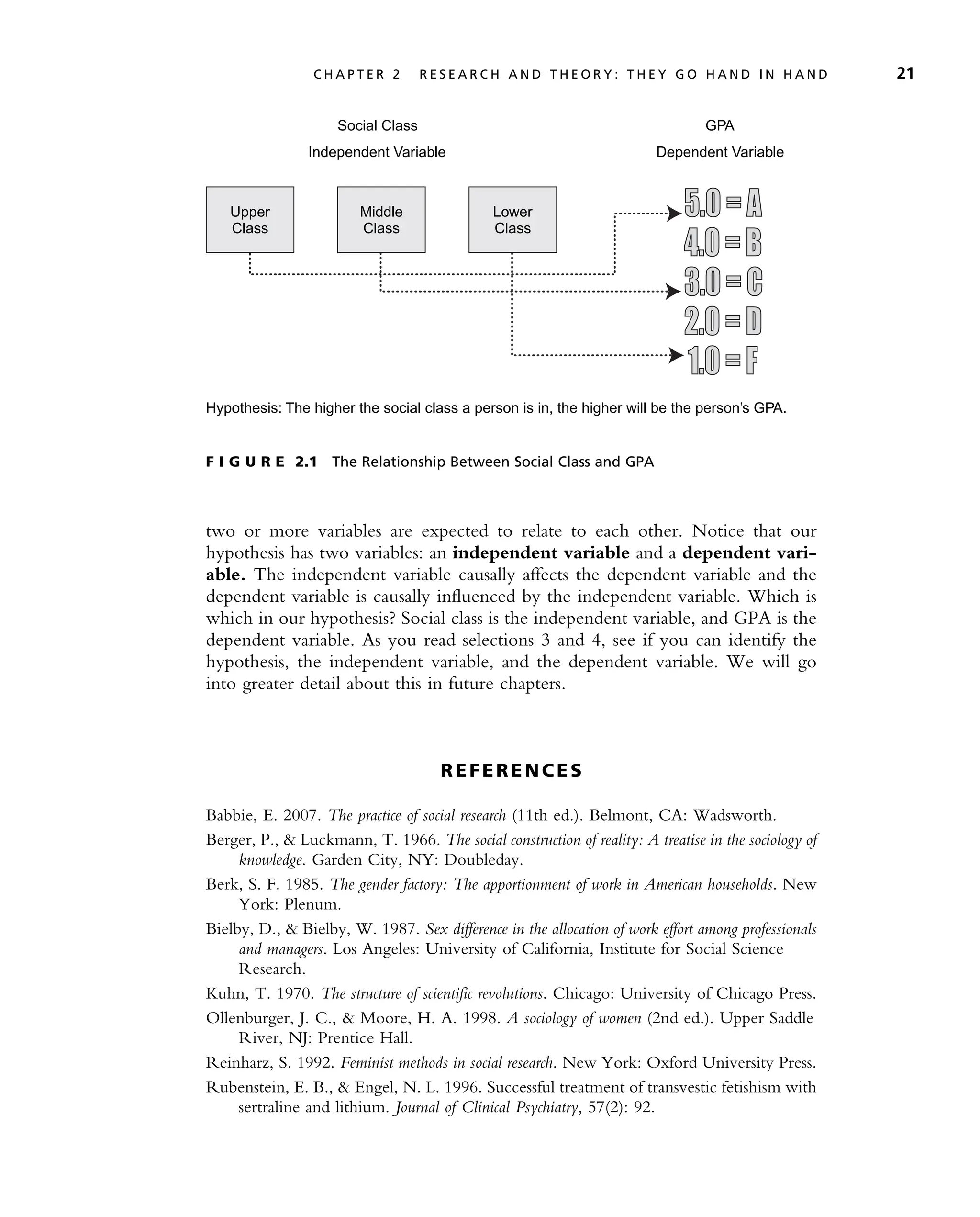
higher the person’s GPA will be, as shown in Figure 2.1. This means that we
have an expectation of what we will find when the research is completed. This
expectation is stated in the form of a hypothesis, which is a statement about how
20 P A R T I A N I N T R O D U C T I O N T O I N Q U I R Y
40.
two or morevariables are expected to relate to each other. Notice that our
hypothesis has two variables: an independent variable and a dependent vari-
able. The independent variable causally affects the dependent variable and the
dependent variable is causally influenced by the independent variable. Which is
which in our hypothesis? Social class is the independent variable, and GPA is the
dependent variable. As you read selections 3 and 4, see if you can identify the
hypothesis, the independent variable, and the dependent variable. We will go
into greater detail about this in future chapters.
R E F E RE N C E S
Babbie, E. 2007. The practice of social research (11th ed.). Belmont, CA: Wadsworth.
Berger, P., & Luckmann, T. 1966. The social construction of reality: A treatise in the sociology of
knowledge. Garden City, NY: Doubleday.
Berk, S. F. 1985. The gender factory: The apportionment of work in American households. New
York: Plenum.
Bielby, D., & Bielby, W. 1987. Sex difference in the allocation of work effort among professionals
and managers. Los Angeles: University of California, Institute for Social Science
Research.
Kuhn, T. 1970. The structure of scientific revolutions. Chicago: University of Chicago Press.
Ollenburger, J. C., & Moore, H. A. 1998. A sociology of women (2nd ed.). Upper Saddle
River, NJ: Prentice Hall.
Reinharz, S. 1992. Feminist methods in social research. New York: Oxford University Press.
Rubenstein, E. B., & Engel, N. L. 1996. Successful treatment of transvestic fetishism with
sertraline and lithium. Journal of Clinical Psychiatry, 57(2): 92.
Upper
Class
Middle
Class
Lower
Class
Social Class GPA
Independent Variable Dependent Variable
Hypothesis: The higher the social class a person is in, the higher will be the person’s GPA.
F I G U R E 2.1 The Relationship Between Social Class and GPA
C H A P T E R 2 R E S E A R C H A N D T H E O R Y : T H E Y G O H A N D I N H A N D 21
41.
Sagy, S., Stern,E., & Krakover, S. 1996. Macro- and microlevel factors related to sense of
community: The case of temporary neighborhoods in Israel. American Journal of
Community Psychology, 24(5): 657–677.
Thio, A., & Calhoun, T. 2001. Readings in deviant behavior (2nd ed.). Boston: Allyn and Bacon.
U.S. Department of Labor. 2005. Highlights of womens’ earnings in 2005. http://
www.bls.gov/cps/cpswom2005.pdf.
WordNet. 2003. Social class. http://wordnet.princeton.edu/perl/webwn
Wysocki, D. K. 1993. Construction of masculinity: A look into the lives of heterosexual
male transvestites. Feminism and Psychology, 3(2): 374–380.
Wysocki, D. K. 1999. The psychosocial and gynecological issues of women with bleeding
disorders. The Female Patient, 24(5): 15–27.
Wysocki, D. K. 2001. Inherited bleeding disorders: Gynecologic and obstetric compli-
cations. The Female Patient, 26(2): 20–27.
Wysocki, D. K. 2003, January/February. You must be a mutant: Only men can have bleeding
disorders—not women. Off Our Backs—Special Women and Disability Issue, 48–51.
S U GG E ST E D FI L M S
Gender Dynamics in Intimate Environments: Feminist Insights for Families (Constance
L. Shehan, Michael P. Johnson, 1994) (32 min.). Minneapolis, MN: National
Council on Family Relations. This film briefly discusses recent, broad shifts in the
basic paradigms of feminist scholarship, then uses domestic violence, household
labor, and the labor market to explain recent feminist research.
Jacqui’s Story: Reflections on the Doing of Feminist Research (Fran Crawford, Kisane Slaney,
Jacqui Wyatt, 1998) (22 min.). Perth: Media Productions, Centre for Educational
Advancement, Curtin University. Kisane Slaney, a feminist researcher who produced
a video in 1990 called Mum’s the Word, about mothers whose children were sexually
abused, converses some years later with Jacqui Wyatt, one of the subjects of the
video. Jacqui Wyatt reflects on her experience of having been a subject of research
and on the relationship between researcher and subject.
The History of Sociology (Banning K. Lary, Anna Carlton, Michael Westin, Dax Xenos,
2004) (32 min.). New York, NY: Promedion Productions. This is an introductory
exploration of the history of sociology and sociologists from premodern times to the
present, covering a broad spectrum of the world’s cultures. This film also talks about
social conflict paradigm, structural functional paradigm, and symbolic interactionism.
Ethnomethodology as a Topic (Mike Emmison interviews Rod Watson, 1984) (50 min.).
Brisbane: University of Queensland DAVS TV Unit. Mike Emmison interviews
Rod Watson from the University of Manchester about the difference between
ethnomethodology and symbolic interactionism.
How to Conduct an Experiment (Educational Video Network, 2004) (20 min.). Huntsville,
TX: Educational Video Network. Although this film is about experiments described
later in this book, it also shows students how every experiment that’s conducted adds
to our collective knowledge of the world and shows why experimentation is crucial
to scientific discovery, how to use the scientific method, and how to distinguish
between an independent variable and a dependent variable.
22 P A R T I A N I N T R O D U C T I O N T O I N Q U I R Y
42.
The Scientific Method(Robert Willgoos, Don Hall, Charlotte Angel, Jim Wolfe, Alice
Look, 1999) (25 min.). Charleston, WV: Cambridge Educational. You will explore
the basic steps in scientific methodology: defining the problem and forming a
hypothesis, experiments and observations, analyzing data, forming conclusions, and
communicating results.
3
School Tracking and Student Violence
LISSA J. YOGAN
There has been much attention in the media recently regarding violence in schools, especially
since the Columbine High School shootings in April 1999. It is important to find ways to
curb this type of violence. Yogan uses the theory of symbolic interactionism to explain the
moral development children share with their teachers, how that moral development is affected
by school practices, how these changes affect peer group interaction, and how schools can
positively influence and channel group formation and ultimately reduce violence in schools.
Do you think that the explanations that Yogan uses in her research decrease the violence in
schools?
During the late 1990s, parents and educators alike
became increasingly worried about the safety of
schools. Their concern was warranted. The U.S.
Department of Education reports that while the
overall incidence of school crime had not greatly
changed in recent years, there had been an increase
in some types of school crime. School crime became
more violent. Since 1992, there had been more
than 211 school deaths associated with violence
(Wolf, 1998). A few of these killings made the
national news. When the suspects and victims were
identified as small-town, white, middle-class chil-
dren, the nation became alarmed. Over the past
two years, there have been numerous cries to form
national, state, and local task forces to confront
the growing problem of school violence. Many of
these task forces began to examine school security
systems, specifically the school’s measures of crime
prevention and control. Were there enough metal
detectors? Were the entrances locked? Were there
enough security guards in place? While these security
measures might prevent some incidents of violence,
they do nothing to help us understand why violent
crime within schools has increased. In particular,
they ignore the structure of the organization of
schooling.
This article will focus on one aspect of school
organizational structure: the effects that tracking
(placing students in ability-based groups) has had
on students’ interactions with peers and adults.
Looking at how and why students are tracked and
how track placement affects their sense of self is one
SOURCE: From Yogan, L. J. 2000. School tracking and student violence. Annals of the American Academy of Political
and Social Science, 567: 108–122.
C H A P T E R 2 R E S E A R C H A N D T H E O R Y : T H E Y G O H A N D I N H A N D 23
43.
way of understandingthe increase in school violence,
and it can suggest organizational changes as a way to
combat it. I will begin by reviewing several theories
and concepts that underlie the process of self-devel-
opment. Understanding how a person grows and
develops and understanding how a school’s structure
may influence a person’s self-development toward
violent behavior can suggest organizational changes
that will ultimately result in decreased use of violence.
S Y M B O LI C I N T E R A C TI O N I S T
T H EO R Y A N D S TU D E N T- T E AC H E R
I N T E R A C T I O N
Social interaction, or, specifically, the interaction of
students with peers and adults, is the subject matter
of symbolic interactionism, one of the main
branches of sociological theory. Symbolic interac-
tionism is based on the assumption that meaning
and learning (education) are gained through inter-
action with others. How a person understands
others, how others come to understand that person,
and how the person comes to understand and
identify himself or herself are part of the symbolic
interaction process. It is through symbolic interac-
tion that an individual develops a sense of self; who
we are is partly a reflection of how others see us, as
Charles Horton Cooley (1909) first pointed out.
He called this idea the ‘‘looking glass self.’’ In
particular, we are shaped by our interactions with
people who are significant to us. What is different
for each of us is the group of people we consider to
be significant; thus each of us undergoes a similar
process to develop a unique self. Symbolic inter-
actionism also delves into the role that perception
and meaning play in these significant interactions.
We can use symbolic interactionism to under-
stand the role of shared meaning in student-teacher
interaction. Herbert Blumer (1969) states that sym-
bolic interactionism rests on three simple premises.
The first is that human beings act toward things on
the basis of the meanings that the things have for
them. The second premise is that the meaning of
these things is derived from or arises out of the
social interaction that one has with one’s social
counterparts. The third premise is that these mean-
ings are handled and modified through an inter-
pretive process used by the person in dealing with
the things he or she encounters.
Using these three premises to look at teachers,
it can be hypothesized that teachers will act toward
students based on the meanings that students (as
objects) have for them. This hypothesis was sup-
ported by the classic studies of Rosenthal and
Jacobson (1968) and Rubovitz and Maehr (1971,
1975). In the Rosenthal and Jacobson study, the
meaning that students had for teachers was con-
trolled by the researchers. The researchers told the
teachers that some of the students were likely to do
well that year. In reality, the researchers randomly
selected the students they labeled as likely to do
well, yet the teachers acted toward the students
based on the meanings that were given by the
researchers (not by any actual measure of ability).
The second premise, that the meaning that
students have for the teachers will be based on the
social interaction that teachers have with their self-
identified social counterparts, was also shown in the
Rosenthal and Jacobson study. Teachers identified
the researchers as their social counterparts and
adopted their meanings rather than developing
meanings independently.
The third premise, that the meanings given to
students by the teacher’s social counterparts will
be modified through an interpretive process of
the teacher, suggests that it is possible to change
socially constructed meanings rather than simply
adopt them. The changing of socially constructed
meanings can be seen in the story of Jaime
Escalante (Mathews, 1988). Escalante was the
subject of the movie Stand and Deliver (1988).
Escalante’s social counterparts (other teachers) had
decided that the Hispanic youths in their school
would not be capable of learning, could not
achieve at a college level, and would be doing
well simply to graduate. He modified this inter-
pretation and arrived at a new meaning. His
new meaning of students was that these students
could work college mathematical problems, could
24 P A R T I A N I N T R O D U C T I O N T O I N Q U I R Y
44.
simultaneously manage schooland home lives, and
could succeed in high school. Escalante was able to
modify the beliefs of his counterparts through the
ideas he held about his abilities (self-evaluation) and
through his beliefs about the barriers produced by
racism and school ability groupings.
Understanding these three basic tenets of sym-
bolic interaction is therefore helpful in formulating
ideas about successful teacher-student interactions,
but it does not completely address the process
through which the three tenets are filtered. Two
important questions that affect student-teacher
interaction are (1) From where do groups of social
counterparts (that is, teachers) derive their mean-
ings of others? And (2) what are the interpretive
processes that teachers use in modifying students’
meanings?
George Herbert Mead (1934) provides one
answer to the first question. He states that we each
belong to a number of different socially function-
ing groups. Teachers and students may identify
themselves as members of many different groups,
including professional teachers’ organizations,
neighborhood communities, families, athletic organi-
zations, and ethnic and religious groups. An indivi-
dual identifies with a group or groups because he or
she is able to understand the behaviors of members of
these groups and integrate his or her own behavior
with the behavior of the members. When individuals
find it difficult to understand and integrate their
behaviors with the behaviors of others, as sometimes
happens in social interactions between students and
teachers, it is likely that difficulty arises because the
individuals are acting as members of two or more
different social groups. In his description of social
organization and the ideal of human society, Mead
states, ‘‘We often find the existence of castes in a
community which make it impossible for persons to
enter into the attitude of other people although they
are actually affecting and are affected by these other
people. The ideal of human society is one which
does bring people so closely together in their inter-
relationships, so fully develops the necessary system of
communication, that the individuals who exercise
their own peculiar functions can take the attitude of
those whom they affect. Remember that what is
essential to a significant symbol is that the gesture
which affects others should affect the individual him-
self in the same way. Human communication takes
place through such significant symbols, and the pro-
blem is one of organizing a community which makes
this possible.’’
This passage outlines two significant points that
should be considered in teacher-student interac-
tions. The first is that castes exist in communities
and affect both members of the caste group and
outsiders. Castes also exist in schools.1
There are
several ways castes at school are generated and
affected, not least through race, class, and gender
stereotypes in the wider society. However, one
way these social forces come together to produce
school castes that are found to be ‘‘virtually irre-
versible’’ is through tracking (Lawrence, 1998, 52;
see also Schafer, Olexa, and Polk, 1972). Tracking
is the placement of students into groups based
on perceived intellectual ability or readiness to
learn. However, because schools are not pure caste
societies, it is assumed that the shared meaning
described in Mead’s ideal human society can be
approximated within a carefully structured class-
room environment.
The creation of this special classroom environ-
ment is the second key point of Mead’s passage for
the present analysis. For the creation of such an
environment, it is necessary that the teacher (one
who initiates interaction for the purpose of educa-
tion) understand how his or her significant symbols
of communication affect students differently. In
addition, the teacher must understand when and
why students are using different symbols to com-
municate. Thus knowledge of a student’s primary
social reference group and how that group differs
from other students’ reference groups and the tea-
cher’s social reference group is necessary for socially
congruent instruction. If the instruction is not
socially congruent, students are not likely to under-
stand their teacher, and they are less likely to
engage in the learning process.
The point is that current interactions are com-
plicated by past interactions. Just as the literature on
HIV and AIDS warns that when one has sexual
intercourse with someone, one is, in effect, making
C H A P T E R 2 R E S E A R C H A N D T H E O R Y : T H E Y G O H A N D I N H A N D 25
45.
sexual contact withall the previous partners of that
person, the theory on social interaction tells us that
we bring aspects of our past interactions into our
present ones. It is precisely because of this link
between the past and the present that interactions
become both the problem of and the solution to
school violence.
Students who enter the classroom with a his-
tory of exposure to violence may carry that vio-
lence and the ways of thinking that rationalize
violence into all their interactions. They may inter-
pret some actions through this way of thinking. A
teacher, who typically is not living in a violence-
filled community, may not understand how
students interpret his or her actions, may not
understand how students resolve and make sense
of their own interactions, and may draw on stereo-
types as a reference for meaning. Unless we change
the organizational structure of schools to break
down castes and create a more heterogeneous
grouping of people, students who do not share
the teacher’s background are not likely to be influ-
enced by that teacher or the institution that the
teacher represents. A lack of bonding with an
important societal institution such as school can
lead to deviant behavior and to more serious forms
of rule violation involving violence.
Violence that results in death is an extreme
form of deviance. Deviance or delinquency among
youths has been studied for many years. Hirschi’s
social control theory (1969) says that delinquency
occurs when youths fail to bond with conventional
social institutions. Within society, there are several
conventional institutions; one of these is the
institution of education represented by schools
and schoolteachers. Strong bonds with school,
described by Hirschi as the individual’s relationship
with school or teachers, and the amount of time
spent on school-related activities compared to
the amount of time spent on non-school-related
activities contribute to an individual’s willingness
to conform to societal conventions. When indivi-
duals are bonded to conventional institutions, they
are less likely to act in deviant ways. Thus one of
the keys to reducing violence within schools is to
increase the bonds that students feel to the school
or to conventional others within the school.How-
ever, one of the aspects of school organization that
reduces bonding for certain groups is tracking.
T R A CK I N G
Increasing the bonds that students form to school
through teachers is made more difficult by the
process of tracking. ‘‘Tracking’’ is a word that is
used to describe the ability groups established by
the schools. Theoretically, these ability groups are
supposed to enable more effective education
because students with similar ability levels and
readiness to learn will be taught together to their
optimum level of academic performance. Teachers
can concentrate on just one type of student instead
of having to prepare lesson plans that account for
more than one type, such as advanced, average, and
remedial students.
In reality, however, tracking has not made
education more effective. Instead, it has created
and perpetuated many of society’s problems. The
institutional practice of tracking that is now com-
mon in most public schools has numerous effects
on both teachers and students. It has been found to
affect how students view themselves (self-identity),
how they evaluate themselves (self-image), and
how others view them (public identity) (Kelly and
Pink, 1982, 55; Lawrence, 1998, 52). It has been
criticized for the following reasons:
More minority and lower income students are
in the basic or low-ability tracks; placement in
the track tends to be permanent, with little
movement up or down in spite of students’
learning and progress; and tracking has a
labeling and stigmatizing effect so that
teachers expect less of lower tracked students
and frequently their expectations are correct.
(LAWRENCE, 1998, 52)
Many of these effects can be related to self-development
and social bonding. Tracking affects teachers’ expecta-
tions of students’ performance (Oakes, 1985; Kelly
26 P A R T I A N I N T R O D U C T I O N T O I N Q U I R Y
46.
and Pink, 1982;Rosenthal and Jacobson, 1968). The
concept of self-fulfilling prophecy tells us that if students
are labeled as educationally inferior or superior, that
is how they will perform. Thus tracking sends messages
to students about inferiority and superiority.
Tracking also separates students on variables
other than intellectual ability (Alexander, Cook,
and McDill, 1978), including race, class, father’s
occupation, misconduct, and past academic record
rather than IQ (Kelly and Grove, 1981). This means
that students are denied the opportunity to interact
in the classroom with a heterogeneous group of
students. The odds are good that those in their
classes will mirror their socioeconomic and minority
or majority status.
Tracking also has produced qualitative and
quantitative instructional differences (Gamoran,
1986; Karweit, 1987). For those at the top, the belief
is that their way is best, and their educational
achievement provides all the evidence of success
they need. For those at the bottom, school becomes
yet another hurdle to achieving self-esteem and
developing a positive sense of self. Studies have
documented the harmful effects of tracking on the
academic achievement of those students in the lower
tracks (Oakes, 1985, 1990). Tracking has also cre-
ated a structure in which students do not receive
equal knowledge, skills, or credentials for success
beyond high school. Those in the upper tracks
usually receive an education that prepares them for
college, while those in the bottom tracks receive an
education that focuses on remedial skills, or what
Willis (1993) described as ‘‘learning to labor.’’
In addition to the inequality in educational out-
come associated with tracking, studies show that
placement in tracks reflects a student’s race and socio-
economic status. Low-income, African American,
and Latino children are more frequently placed in
low-level classes (regardless of achievement) than
Euro-American children with higher family incomes
(Oakes and Guiton, 1995; Welner and Oakes, 1996).
Indeed, evidence suggests that, even controlling for
IQ and previous ability, ‘‘blacks and low income
students were still more likely to be found in
the basic or low ability tracks’’ (Lawrence, 1998, 52;
see also Schafer, Olexa, and Polk, 1972). Because
tracking favors the students in the upper tracks over
those in the lower tracks, it is easy to hypothesize that
those in the lower tracks will be less likely to bond
with the institution of school. It is still likely, how-
ever, that the students will bond with other students
within their ability group, or track, especially those of
similar racial, ethnic, gender, or class background.
This is one of the problems of interaction: it is an
ongoing process that can produce negative as well as
positive outcomes, if organizational arrangements do
not take account of its existence.
If students form bonds with other students who
are similar to them, they are not as likely to diver-
sify and expand their thinking as are students who
bond with students who are dissimilar to them.
Our knowledge grows as our range of experiences,
both vicarious and real, grow. Each new experi-
ence or new way of thinking to which we are
exposed may cause us to reevaluate that which we
thought we knew (Perry, 1970). When we receive
more supports than challenges, our thinking
becomes stagnant. Thus students who are sur-
rounded by students who share their social, ethnic,
and class position in society (a support) are less
likely to be challenged in their thinking. Stagnant
thinking is not the goal of education.
One possible way to remedy this situation is for
the students to form bonds with the teacher, who
can then challenge their ways of thinking and help
them grow. However, this option is complicated
by reality. As discussed earlier, often the teacher is
different from the student in age—sometimes by
many years—as well as in other demographic char-
acteristics. Not only are these differences magnified
by tracking; they also may reflect differences
in socioeconomic status and race. Even though
the majority of students in many urban schools
belong to a minority group, teachers continue
to be predominantly white (U.S. Department of
Education, 1993). Also, teachers belong to the
middle class, but many students (particularly those
in lower tracks) belong to the lower class. Thus it
takes great effort and desire on the part of the
student and the teacher to form a common bond.
It is more likely that students will initially bond
with other students. If we are to change thinking
C H A P T E R 2 R E S E A R C H A N D T H E O R Y : T H E Y G O H A N D I N H A N D 27
47.
processes, students haveto be given more oppor-
tunities to bond with other students who are both
similar and dissimilar to them. The opinions of
other students matter. How others see us affects
our development of self. How others view us also
affects our self-esteem.
SE LF -ES T EE M
Social interactions and the development of self are
linked to self-esteem and the process of self-
development described earlier. The concept of self-
esteem is embedded in the theory of symbolic
interaction. Self-esteem is also a conceptual compo-
nent of the more inclusive process of self-conception.
The process of self-conception is considered a key
element in the relationship between individual beha-
vior and the social organization of which the indivi-
dual is a part. Linkages have been made between self--
esteem and racial bias (Ashmore and Del Boca, 1976;
Harding et al., 1969) and between self-esteem and
teacher effectiveness (Edeburn and Landry, 1976). In
both instances, the link between a person’s self-evalua-
tion and subsequent behavior can be seen.
At an individual level, needs for self-esteem and
superior status are considered to be among the
major causes and perpetuators of prejudice and racial
discrimination (Allport, 1954; Ashmore and Del
Boca, 1976; Harding et al., 1969; Tajfel and Turner,
1979). Self-esteem works through group identifica-
tion to produce discriminatory behaviors in some
individuals. All people desire positive evaluation by
others and self. Tajfel and Turner (1979) have
shown that people who have low self-esteem tend
to seek positive evaluation by identifying a unique-
ness (positive specialness) for their in-group over an
identified out-group. In the United States, this often
takes the form of (perceived) positive white in-
group norms compared to (perceived) negative
black out-group norms.
However, this identification can also take the
reverse form. In the reverse form, minority students
perceive or declare their culture and its norms
as superior to those of their white, middle-class
teacher. This need for positive distinctiveness leads
to perceived intergroup competition and motivates
prejudice and discriminatory behaviors. Within
school, the need for positive distinctiveness may
lead students and teachers in upper-level tracks to
perceive the tracks as a form of competition and
thus develop a prejudice against those in lower-
level tracks. This phenomenon was demonstrated
by Finley (1984), who noted that a competition
existed between teachers for high-level or high-
status students.
It has also been noted that a particular anti-
achievement culture has developed among African
American students, who are typically placed in
lower tracks (Suskind, 1998; Fordham, 1988).
The ideology within this culture says that to suc-
ceed academically is to become ‘‘white.’’ Thus,
within some groups that are typically relegated to
the lower tracks, the need for positive distinctive-
ness leads to the formation of a culture that is the
antithesis of the culture of the teacher, the educa-
tional process, and the school’s perceived culture of
academic success (Cohen, 1955).
Self-esteem has also been linked to achieve-
ment and performance. Research has shown a posi-
tive correlation between self-esteem and school
achievement (Stevens, 1956; Fink, 1962; Williams
and Cole, 1968; Simon and Simon, 1975). Addi-
tional studies have shown that teacher-student
interaction is an important variable in the student’s
self-esteem and achievement. Edeburn and Landry
(1976) state that teachers who themselves have a
positive self-image affect their students more posi-
tively than do teachers who have a low or negative
self-image. Davidson and Lang (1960) found that
the more that children perceive their teachers’ feel-
ings toward themselves as positive, the better the
academic achievement of the children. Thus posi-
tive teacher self-esteem is an important variable in
reducing culturally induced prejudicial attitudes
and is important in the successful educational inter-
action of teachers and students.
Unfortunately, tracking sends a message to
those in the lower tracks that they are not as good
as other students. Teachers all too often support this
message as they talk down to students or dumb
28 P A R T I A N I N T R O D U C T I O N T O I N Q U I R Y
48.
down the courserequirements. Power (1993)
found that track level does have a direct effect on
self-esteem; as track level increases, so does self-
esteem. Her analyses also indicate that a student’s
self-esteem is susceptible to the effects of track
placement even years after the placement occurred.
Students who were placed in the lower tracks in
elementary school still showed decreased self-
esteem in high school. This tells us that, although
students age, they rarely are able to overcome the
negative effects of tracking.
What has been described so far is theory and
research evidence on self-formation, an explanation
of why some students become deviant, and the
relationship of tracking to the development of self
and to the development of bonds with schools or
with individuals in schools. I would now like to
discuss how these processes can lead to both the
expression of violence and the elimination of vio-
lence by linking theory and research with the real-
ity of life in today’s society.
S CH O O L S , S O C I E TY , A N D
V I O L E N C E
During the 1990s, many people pointed to the
change in the family as the cause of violence.2
They
suggested that the increase in one-parent house-
holds and two-income families had led to decreased
attention to what our youths were doing. Of
course, this change in family structure is linked to
both political and economic changes in society.
Through the implementation of no-fault divorce
laws, the political system has made it easier for men
and women to end marriages. The increased
divorce rate has led to an increase in one-parent
households. Our economic structure has increased
opportunities for women to become employed
outside the home, and downsizing and technologi-
cal advances have made two incomes in a family
more of a necessity than in the past. Thus the
change in adult family members’ ability to spend
time with children reflects more than just a change
in the institution of the family. It reflects much
broader changes in society.
From their beginnings, schools have mirrored
society. The school model still commonly used is
one that is based on the structure of factories. Stu-
dents enter at a set time (similar to punching a time
clock); they move down the assembly line of reading,
writing, and arithmetic; and they emerge at gradu-
ation as a finished product. Through tracking, schools
reflect the economic and racial segregation of society.
School districts are tied to place of residence, and
school funds are commonly tied to property taxes.
Both districts and their property taxes reflect the
extreme residential segregation common in the Uni-
ted States. What is intriguing is why schools mirror
society when they do not have to do so.
One of the American school’s early tasks was
to socialize immigrants. In other words, early in the
history of public education, schools were seen as
the institution most able to change individuals.
Schools could socialize and make those deemed
inferior (immigrants) into model citizens who
would understand and support the norms and
values (such as democracy and equality for all) of
their new culture. Somewhere along the way,
schools quit socializing into model citizens those
deemed inferior and instead instituted processes
that maintained the inferior student’s entering sta-
tus. Today, when students graduate, their master
status is still likely to be their race or socioeconomic
status. In the past, an immigrant’s ethnicity or
socioeconomic status became less important if he
or she were educated. In large part, society’s accep-
tance of an immigrant was due to the fact that the
immigrant had been socialized through heteroge-
neous interaction. That interaction took place in
schools where there were no tracks. There was
simply a heterogeneous group of students who
interacted with and learned about each other over
the course of several years. Both immigrant and
native born were changed by the experience.
Values and norms merged, and, at the end, both
immigrant and native born had roughly the same
status in society.
Remember that symbolic interactionists tell
us that who we are is determined by our social
C H A P T E R 2 R E S E A R C H A N D T H E O R Y : T H E Y G O H A N D I N H A N D 29
49.
interactions with significantothers. If I have a
family and friends who are moral, law-abiding,
happy people who tell me consistently good things
about myself, I am probably a person who is moral,
law abiding, and happy. But if I have family,
friends, or a society that tells me I am worthless,
that breaking some laws is acceptable, and that
others’ lives are not worth much, then I am likely
to become a person that is angry, disobedient, and
potentially dangerous. What happens if I am iso-
lated? I get the message that society does not want
to be with me, and I might interpret that in such a
way as to become jealous of or angry with society.
Insofar as tracking contributes to this separation and
isolation, it also contributes to the general level of
school violence, although evidence of a direct rela-
tionship between tracking and delinquency remains
unclear (Lawrence, 1998). Schools are the one
institution that have in the past proved themselves
successful at transforming individuals’ place in
society. They did this through carefully structured
interactions between students and teachers. Today,
instead of mirroring society’s faults, schools should
use the opportunity and time given to them to
model a more positive society.
They can and should help create a society in
which students from all different educational, racial,
and economic backgrounds interact. Tracking does
not do this. Currently tracking reinforces social
class and racial segregation patterns. Moreover, it does
not just separate; it tells one group that it is better than
another. One of the most common ways that peer
groups and friendships are formed is through class-
roomformation and sharedexperiences. Itis critical to
the development of self and to cognitive growth that
individuals are exposed to diverse ways of thinking.
Good teachers can make this happen.
Clearly, there is also a strong need for leadership
within schools and, specifically, within classrooms.
In recent years, the teaching profession has not
attracted the nation’s best and brightest. This is a
serious problem. Teachers may be one of the few
adults whom children have in their lives on any
consistent basis. The economic demand on parents,
particularly mothers, has decreased the amount of
time they have to spend with their children. Thus
the responsibility of teachers to be role models and
moral guides is increased. Teachers need to take
time to talk about what is right and wrong. They
need to help teach citizenship, civility, respect, and
compassion for others. They need to offer thought-
ful critiques of society and the media and thought-
provoking questions about how to handle difficult
situations without resorting to violence. As a
society, we cannot afford for teachers to be moral
relativists. Too many children do not have enough
adults willing or present to offer solid moral teach-
ing and guidance. If students are taught problem-
solving skills by watching action films or by other
teens who see multiple reasons why it is acceptable
to use violence against someone else, they are more
likely to resort to violence when they face a pro-
blem. Students today need more than heteroge-
neous groupings within their schools. They need
strong teachers who know how to connect with
them and how to simultaneously build their self-
esteem and challenge their ways of thinking and
problem solving.
N O T E S
1. Castes might also operate in subgroups at schools, such
as jocks, preppies, skaters, thespians, gangstas, goths,
and so on.
2. In a nonscientific survey of Internet users, a CNN
(1999) poll reported that parents were seen as the
leading cause of school violence by 29 percent of the
59,698 respondents, followed by access to guns and
the media.
30 P A R T I A N I N T R O D U C T I O N T O I N Q U I R Y
50.
R E FE RE N C E S
Alexander, Karl L., Martha Cook, & Edward L. McDill.
1978. Curriculum tracking and educational stratifi-
cation: Some further evidence. American Sociological
Review, 43: 47–66.
Allport, Gordon W. 1954. The nature of prejudice. Reading,
MA: Addison-Wesley.
Ashmore, Richard D., & Frances K. Del Boca. 1976.
Psychological approaches to understanding inter-
group conflicts. In Towards the elimination of racism,
ed. Phyllis A. Katz. New York: Pergamon.
Blumer, Herbert. 1969. Symbolic interactionism: Perspective
and method. Berkeley: University of California Press.
CNN. 1999. CNN Interactive Quickvote. Available
http://www.cnn.com/.
Cohen, Albert. K. 1955. Delinquent boys: The culture of the
gang. New York: Free Press.
Cooley, Charles Horton. 1909. Social organization. New
York: Scribner.
Davidson, Helen H., & Gerhard Lang. 1960. Children’s
perceptions of their teachers’ feelings toward them
related to self-perception, school achievement,
and behavior. Journal of Experiential Education, 29:
107–118.
Edeburn, Carl E., & Richard G. Landry. 1976. Teacher
self-concept and student self-concept in grades
three, four, and five. Journal of Educational Research,
69: 372–375.
Fink, Martin B. 1962. Self-concept as it relates to academic
underachievement. California Journal of Education
Research, 13: 57–62.
Finley, Merrilee K. 1984. Teachers and tracking in a
comprehensive high school. Sociology of Education,
57: 233–243.
Fordham, Signithia. 1988. Racelessness as a factor in Black
students’ school success: Pragmatic strategy or pyrrhic
victory? Harvard Educational Review, 58: 54–84.
Gamoran, Adam. 1986. Instructional and institutional
effects of ability grouping. Sociology of Education, 59:
185–198.
Harding, John, Harold Prochansky, Bernard Kutner, &
Isidor Chein. 1969. Prejudice and ethnic relations. In
Handbook of social psychology, ed. Lindzay Gardner &
Elliot Aronson, 2nd ed., vol. 5. Reading, MA:
Addison-Wesley.
Hirschi, Travis. 1969. Causes of delinquency. Berkeley:
University of California Press.
Karweit, Nancy. 1987. Diversity, equity, and
classroom processes. In The social organization of
schools, ed. Maureen T. Hallinan. New York:
Plenum.
Kelly, Delos H., & Winthrop D. Grove. 1981. Teachers’
nominations and the production of academic ‘‘misfits.’’
Education, 101: 246–263.
Kelly, Delos H., & William T. Pink. 1982. School crime
and individual responsibility: The perpetuation of a
myth? Urban Review, 14(1): 47–63.
Lareau, Annette. 1989. Home advantage: Social class and
parental intervention in elementary education.
Washington, DC: Falmer.
Lawrence, Richard. 1998. School crime and juvenile justice.
New York: Oxford University Press.
Lee, Valerie E., & Julia B. Smith. 1995. Effects of high
school restructuring and size on early gains in
achievement and engagement for early secondary
school students. Sociology of Education, 68: 241–270.
Mathews, Jay. 1988. Escalante: The best teacher in America.
New York: Henry Holt.
Mead, George Herbert. 1934. Mind, self, and society: From
the standpoint of a social behaviorist. Chicago: University
of Chicago Press.
Oakes, Jeannie. 1985. Keeping track: How schools structure
inequality. New Haven, CT: Yale University Press.
Oakes, Jeannie 1990. Multiplying inequalities: The effects of
race, social class, and tracking on opportunities to learn
math and science. Santa Monica, CA: Rand.
Oakes, Jeannie, & Gretchen Guiton. 1995. Matchmaking:
The dynamics of high school tracking decision.
American Educational Research Journal, 32(1): 3–33.
Perry, William, Jr.1970. Intellectual and ethical development
in the college years. New York: Holt, Rinehart &
Winston.
Power, Ann Marie R. 1993. The effects of tracking on high
school students’ self-esteem. Master’s thesis, University
of Notre Dame.
Ray, Karen. 1995. Grant High School case report. Los
Angeles: University of California at Los Angeles,
Center for Research for Democratic School
Communities.
C H A P T E R 2 R E S E A R C H A N D T H E O R Y : T H E Y G O H A N D I N H A N D 31
51.
Rosenthal, Robert, &Lenore Jacobson. 1968. Pygmalion in
the classroom: Teacher expectation and pupils’ intellectual
development. New York: Holt, Rinehart & Winston.
Rubovitz, Pamela C., & Martin L. Maehr. 1971. Pyg-
malion analyzed: Toward an explanation of the
Rosenthal-Jacobson findings. Journal of Personality
and Social Psychology, 19: 197–203.
Rubovitz, Pamela C., & Martin L. Maehr. 1975.
Teacher expectations: A special problem for Black
children with White teachers? In Culture, child, and
school: Sociocultural influences on learning, ed. Martin L.
Maehr and William M. Stallings. Monterey, CA:
Brooks/Cole.
Schafer, Walter, Carol Olexa, & Kenneth Polk. 1972.
Programmed for social class: Tracking in high
school. In Schools and delinquency, ed. Kenneth Polk
& Walter Schafer. Englewood Cliffs, NJ: Prentice
Hall.
Simon, William E., & Marilyn G. Simon. 1975. Self-
esteem, intelligence, and standardized academic
achievement. Psychology in the Schools, 12: 97–100.
Stand and Deliver. 1988. An American Playhouse Theatrical
Film, Menendez/Musca & Olmos Production.
Burbank, CA: Warner Brothers.
Stevens, Peter H. 1956. An investigation of the relationship
between certain aspects of self-concept and student’s aca-
demic achievement. Ph.D. dissertation, New York
University, 1956. Abstract in Dissertation Abstracts,
16: 2531–2532.
Suskind, Ron. 1998. A hope in the unseen: An American
odyssey from the inner city to the Ivy League.
New York: Broadway Books.
Tajfel, Henri, & John C. Turner. 1979. An integrative
theory of intergroup conflict. In The social psychology
of intergroup relations, ed. William G. Austin &
Stephen Worchel. Monterey, CA: Brooks/Cole.
U.S. Department of Education. National Center for
Education Statistics. 1993. Digest of education
statistics. Washington, DC: Government Printing
Office.
Van Galen, Jane. 1987. Maintaining control: The struc-
turing of parent involvement. In schooling in social
context: Qualitative studies, ed. G. W. Noblit &
W. T. Pink. Norwood, NJ: Ablex.
Wells, Amy Stuart, & Jeannie Oakes. 1998. Tracking,
detracking, and the politics of educational reform: A
sociological perspective. In Sociology of education:
Emerging perspectives, ed. Carlos Alberto Torres &
Theodore R. Mitchell. Albany: State University of
New York Press.
Welner, Kevin G., & Jeannie Oakes. 1996. (Li)ability
grouping: The new susceptibility of school tracking
systems to legal challenges. Harvard Educational
Review, 66(3): 451–470.
Williams, Robert L., & Spurgeon Cole. 1968. Self-
concept and school adjustment. Personnel and
Guidance Journal, 46: 478–481.
Willis, Paul E. 1993. Learning to labour: How working class
kids get working class jobs. Aldershot, United
Kingdom: Ashgate.
Wolf, Stephen M. 1998. Curbing school violence: Our
youth, and our schools, need support before an
incident occurs—not after. Attache (U.S. Airways)
Sept. 9.
RE V I E W Q U E ST I O N S
1. How does Yogan use the theory of symbolic
interactionism in this paper? What would
have been different if the author used some other
theory?
2. What does the author mean when she hypothesizes
that ‘‘teachers will act toward students based on
the meanings that students (as objects) have for
them’’?
3. Can you come up with your own questions and
thoughts about a study you might consider on
school violence? What theory would you use and
why?
32 P A R T I A N I N T R O D U C T I O N T O I N Q U I R Y
52.
4
Murder Followed bySuicide in Australia,
1973–1992
A research note
JO BARNES
Barnes reports on the findings of a study of murder-suicide in Australia from a feminist
perspective. The study is based on the analysis of 188 events in four states of Australia spread
over a period of 20 years from 1973 to 1992. It focuses on two types of murder-suicide—events
in which a male offender kills his female partner and events in which a parent kills his or her
child or children. The motivations of men and women who commit murder and then kill
themselves are qualitatively different. Suicide is often studied from criminal justice and a mental
health perspective; in addition, some studies are purely descriptive. Notice how the focus changes
when muder-suicide is studied from a feminist perspective.
I N T R O D U C T I O N
Murder-suicide has been a somewhat neglected
topic of study in sociology and has mainly been
the domain of mental health and epidemiology
studies. As a consequence, the conclusions drawn
have concentrated on the occurrence of murder-
suicide as a rare event that is perpetrated by a
mentally unstable person who has finally lost con-
trol. This has meant that the social circumstances
that surround the event have been ignored or
accepted as a given. This study focuses on intimate
and familial murder-suicide and places these types
of murder-suicide in a feminist framework in
order to add an extra dimension to existing
explanations.
A general overview of the literature reveals
three distinct approaches to the study of murder
followed by suicide. The first approach is the
comparison of murder-suicide with the separate
acts of murder and suicide (e.g. Wolfgang 1958;
West 1965; Mackenzie 1961; Wallace 1986). The
second approach is that which accounts for mur-
der-suicide in terms of mental illness (e.g. Berman
1979; Goldney 1977; Rosenbaum 1990). And
finally, there have been a number of empirical
studies which seek to describe murder-suicide in
terms of the profiles of offender and victim, the
relationship of the offender to the victim, and the
context in which the murder-suicide took place
(e.g. Palmer and Humphrey 1980; Allen 1983;
Easteal 1994).
SOURCE: From Barnes, J. 2000. Murder followed by suicide in Australia, 1973–1992: A research note. Journal of
Sociology, 36(1): 1–12.
C H A P T E R 2 R E S E A R C H A N D T H E O R Y : T H E Y G O H A N D I N H A N D 33
53.
The various studieshave been useful in identi-
fying the actors involved in murder-suicide and in
describing the relationships and circumstances that
surround many of the events. Murder-suicide is a
gendered activity—in the majority of cases men are
the instigators of murder-suicide and women and
children are the victims. It is also familial—the
victims are predominantly intimately involved with
the offender or they are the children of the offen-
der. Expressions of jealousy, frustration and hostil-
ity that culminate in violence, which is often an
ongoing factor within the relationship, are also
recognized as important components in the mur-
der-suicide event. Yet previous researchers have
taken their existence for granted and have failed
to question why men should feel jealous or hostile
towards their wives or lovers. Why is it that men,
in particular, are so determined not to allow their
partner to leave? Why do the male offenders feel
jealous and hostile to such an extent that they
would rather kill the one they love and die them-
selves than accept that their partner no longer
wishes to be part of their lives? The social context
within which notions of ownership and control
have developed and the use of violence to enforce
them is an important element which needs to be
addressed in relation to the murder-suicide event.
There has generally been a lack of gender
differentiation in the studies of murder-suicide.
The lack of concentration on women as offenders
is understandable because of the much smaller inci-
dence of women offenders in the murder-suicide
event. However, the omission of a discussion
around gender from the descriptions of murder-
suicide results in two outcomes. First, an assump-
tion is made that the conditions of women’s lives
are essentially the same as those of men and there-
fore an analysis that reflects men’s experience is
basis enough to describe the role of men and
women in the murder-suicide event. Second,
although the conditions of women’s lives may dif-
fer from those of men, these differences are not
seen as pertinent to the murder-suicide event.
While some studies acknowledge that children
are often the victims in murder-suicides, most
researchers have concentrated on the intimate rela-
tionship between offender and victim. This has
meant that general descriptions of murder-suicide
have tended to include male and female offenders as
one category with only passing reference to the fact
that while male offenders tend to murder adult
females and sometimes their own children, female
offenders are much more likely to kill only their
children. Although the question of why women
who kill their intimate partners rarely kill them-
selves is beyond the scope of the present study, we
need to ask why in the majority of female initiated
murder-suicides the victims are children. Why is it
that women take such positive steps to kill their
own children—an act that is contrary to the strong
emphasis on the mothering role that is inherent in a
modern capitalist society such as Australia?
M E T H O D
Although the definition of murder-suicide appears
to be a simple one in which one person kills one or
more people and then kills himself or herself, it is
still problematic. Murder-suicide is a not a mono-
lithic act. The event itself has many dimensions and
it is the varying conditions within murder-suicide
that confound the attempt to understand all murder-
suicides within a single explanation. Indeed what is
defined as murder-suicide, often by those who
investigate the crime, can also be seen variously as
murder and suicide as separate events; murder that is
followed by the suicide of the offender in an act of
remorse; double suicide in which one persons kills
another and himself or herself in collusion with that
person; or murder-suicide as an entity in itself, in
which both the murder and the suicide are planned
and carried out. It is with this latter definition of
murder-suicide that this research is concerned.
Data for this project were collected on each
event classified by the State Coroner as a murder-
suicide. A function of the Coroner is to investigate
every aspect of any death that is reported to him or
her in order to ascertain and confirm the deceased’s
identity, the circumstances surrounding the death,
the clinical cause of death, and the identity of any
34 P A R T I A N I N T R O D U C T I O N T O I N Q U I R Y
54.
person who mayhave contributed to that death. In
order to do this, the Coroner is assisted by specialist
investigators such as police experts, scientists, forensic
pathologists and other specialists who may be needed.
In each state the Coroner collects information on
both the offender and victim which usually consists
of personal details such as age, gender and other
demographic details, a detailed account of the dis-
covery of the bodies, accounts by witnesses and rela-
tives that may offer some background information, as
well as copies of suicide notes and autopsy reports.
Using the Coroner’s records, demographic
details such as age, gender, occupation and nation-
ality were examined. In addition, background
information such as accounts from witnesses and
relatives, copies of suicide notes and autopsy reports
were also studied. Problems related to the data must
be acknowledged when using them for purposes
other than that for which they were collected. The
information is collected by police officers in order
to ensure that no prosecuting actions need to be
taken and it is these officials whose decisions impact
on what information is collected. At the same time,
researchers are totally reliant on the objectivity of
those collecting the information initially. It is these
officials who make decisions as to which informa-
tion is important in terms of what they require.
Additionally, many of the witness statements are
written in language that is stilted and concise,
reflecting police procedure, rather than the emotive
language that can be assumed to have been exhib-
ited so shortly after such a traumatic event. Never-
theless, in most cases statements by relatives and
friends often give detailed information on relation-
ships and circumstances which, at least in the police
and Coroner’s minds, contexualize the event so
that he or she is able to conclude that a verdict of
murder-suicide is appropriate.
F I N D I N G S
As can be seen from Table 1, a total of 405 known
murder-suicides were recorded as such between the
years 1973 and 1992 in five states. The number of
incidents ranged from 13 in 1974 to 34 in 1987,
with an average of 20 per year. It is apparent that
NSW (average 8.6) and Victoria (average 7.4) have
the greatest number of murder-suicides each year
while South Australia averages two murder-suicides
per year. Because of the lack of complete figures for
Western Australia and Tasmania it would be
unwise to calculate statistics for these states; how-
ever, if the available figures are extrapolated to
those missing periods, one could estimate that Wes-
tern Australia averages approximately two murder-
suicides per year and Tasmania one per year. While
overall the number of murder-suicides remains
fairly consistent each year, 1987 inexplicably stands
out as having an abnormally high number of
reported murder-suicide events in Victoria and
NSW. Of the 188 cases in the present sample there
were 188 offenders (those who murdered and sub-
sequently committed suicide) and 250 murdered
victims. The most distinctive feature overall was
that 90 percent (170) of the offenders were male
while 70 percent (177) of the victims were female.
Male offenders were older than female offenders—
the mean age of male offenders being around 43
years (n ¼ 169), while the mean age of female
offenders was about 32 years (n ¼ 17). The major-
ity of male offenders (53 percent) were in the 30–
49 age group, while the majority (82 percent) of
female offenders were in the 20–39 age group.
Male victims, too, were generally older than female
victims. The mean age of male adult victims was 43
years (n ¼ 37), while the mean age of female adult
victims was 39 years. Around 28 percent of the
victims were aged 15 years or less.
Of the 250 victims in this sample, 50.4 percent
were or had been in an intimate relationship with the
offender (intimates are defined as present and past
spouses, defactos and lovers). The second largest cate-
gory (29 percent) was that of ‘‘own child.’’ An inter-
esting observation arising out of the data is that the
victim of a male offender is more likely to be an
intimate of the offender (54 percent), while the victim
of a female offender is more likely to be her own child
(75 percent). Those victims in an existing relationship
with the offender accounted for 40 percent of all
victims, while victims who had terminated their
C H A P T E R 2 R E S E A R C H A N D T H E O R Y : T H E Y G O H A N D I N H A N D 35
these is themarked layer of ganglion-cells (gl.), similar to those
seen in the flabellum of Limulus. The rest of the space in the section
of the tooth is filled up with nerves (n.) and blood-spaces (bl.) just
as in the section, Fig. 146, of the flabellum of Limulus.
Gaubert does not appear to have seen the goblets at all clearly; he
describes them simply as conical eminences, and states that they
"recouvrent un pore analogue a celui des poils mais plus petit; il est
rempli par le protoplasma de la couche hypodermique." From the
ganglion, according to him, nervous prolongations pass, which
traverse the chitinogenous layer and terminate at the base of the
conical eminences. Each of these prolongations "présente sur son
trajet, mais un peu plus près du ganglion que de sa terminaison
périphérique, une cellule nerveuse fusiforme (g.) offrant, comme
celles du ganglion, un gros noyau." He illustrates his description with
the following, Fig. 153, taken from his paper.
Fig. 153 (from Gaubert).—Section
of a Tooth of Pecten of Scorpion.
n., nerve; gl., ganglion.
I have not been able to obtain any evidence of a fusiform nerve-cell
on the course of the terminal nerve-fibres as depicted by him;
fusiform cells there are in plenty, as depicted in my drawing, but
none with a large nucleus resembling those of the main ganglion. In
no case, either in the flabellum or in the branchial organs of Limulus,
or in the pecten-organs, have I ever seen a ganglion-cell within the
chitin-layer; all the nuclei seen there resemble those of the cells of
57.
the hypodermis orelse the elongated nuclei characteristic of the
presence of nerve-fibres. Gaubert's drawing is a striking one, and I
have looked through my specimens to see whether there was
anything similar, but have hitherto failed to obtain any definite
evidence of anything of the kind.
I feel, myself, that an exhaustive examination of the structure and
function of the pecten of scorpions ought to be undertaken. At
present I can only draw the attention of my readers to the similarity
of the arrangement of parts, and of the nature of the end-organs, in
the sense-organs of the flabellum of Limulus and of the pecten of
the scorpion. In both cases the special nerve-fibres terminate in a
massive ganglion, situated just below the chitinogenous layer. In
both cases the terminal fibres from these ganglion-cells pass through
the modified chitinous layer to supply end-organs of a striking
character; and although the end-organ of the pecten of the scorpion
does not closely resemble the majority of the end-organs of the
flabellum, yet it does resemble, on the one hand, the isolated
poriferous spikes found on the flabellum (Fig. 149) and, on the
other, the poriferous goblets found on the sense-patches of the
branchial appendages of Limulus (Fig. 144, A), so that a combination
of these two end-organs would give an appearance very closely
resembling that of the pecten of the scorpion.
Finally, the special so-called 'racquet-organs' of Galeodes, which are
found on the most basal segments of the last pair of prosomatic
appendages, ought also to be considered here. Gaubert has
described their structure, and shown how the nerve-trunk in the
handle of the racquet splits up into a great number of separate
bundles, which spread out fan-shaped to the free edge of the
racquet; each of these separate bundles supplies a special sense-
organ, which terminates as a conical eminence on the floor of a
deep groove, running round the whole free edge of the racquet. This
groove is almost converted into a canal, owing to the projection of
its two sides. Gaubert imagines that the sense-organs are pushed
58.
forward out ofthe groove to the exterior by the turgescence of the
whole organ; each of the nerve-fibres forming a bundle is, according
to Gaubert, connected with a nerve-cell before it reaches its
termination.
This sketch of the special sense-organs on the appendages of
Limulus, of the scorpions, of Galeodes, and other arachnids, and
their comparison with the porous chordotonal organs of insects,
affords reason for the belief that we are dealing here with a common
group of organs, which, although their nature is not definitely
known, have largely been accredited with the functions of
equilibration and audition, a group of organs among which the origin
of the auditory organ of vertebrates must be sought for, upon any
theory of the origin of vertebrates from arthropods.
Whenever in any animal these organs are concentrated together to
form a special organ, it is invariably found that the nerve going to
this organ is very large, out of all proportion to the size of the organ,
and also that the nerve possesses, close to its termination in the
organ, large masses of nerve-cells. Thus, although the whole hind
wing in the blow-fly has been reduced to the insignificant balancers
or 'halteres,' yet, as Lowne states, the nerves to them are the
largest in the body.
The pectinal nerve in the scorpion is remarkable for its size, and so,
also, is the nerve to the flabellum in Limulus, while the large size of
the auditory nerve in the vertebrate, in distinction to the size of the
auditory apparatus, has always aroused the attention of anatomists.
Throughout this book my attention has been especially directed to
both Limulus and the scorpion group in endeavouring to picture to
myself the ancestor of the earliest vertebrates, because the
Eurypteridæ possessed such marked scorpion-like characteristics; so
that in considering the origin of a special sense-organ, such as the
59.
vertebrate auditory organnear the junction of the prosoma and
mesosoma, it seems to me that the presence of such marked special
sense-organs as the flabellum on the one hand and the pecten on
the other, must both be taken into account, even although the
former is an adjunct to a prosomatic appendage, while the latter
represents, according to present ideas, the whole of a mesosomatic
appendage.
From the point of view that the VIIIth nerve represents a segment
immediately posterior to that of the VIIth, it is evident that an organ
in the situation of the pecten, immediately posterior to the
operculum, i.e. according to my view, posterior to the segment
originally represented by the VIIth nerve, is more correctly situated
than an organ like the flabellum, which belongs to a segment
anterior to the operculum.
On the other hand, from the point of view of the relationship
between the scorpions and the king-crabs, it is a possibly debatable
question whether the pecten really belongs to a segment posterior
to the operculum. The position of any nerve in a series depends
upon its position of origin in the central nervous system, rather than
upon the position of its peripheral organ. Now, Patten gives two
figures of the brain of the scorpion built up from serial sections. In
both he shows that the main portion of the pectinal nerve arises
from a swelling, to which he gives the name ganglion nodosum. This
swelling arises on each side in close connection with the origin of the
most posterior prosomatic appendage-nerve, according to his
drawings, and posteriorly to such origin he figures a small nerve
which he says supplies the distal parts of the sexual organs. This
nerve is the only nerve which can be called the opercular nerve, and
apparently arises posteriorly to the main part of the pectinal nerve.
If this is so, it would indicate that the pectens arose from sense-
organs which were originally, like the flabella, pre-opercular in
position, but have shifted to a post-opercular position.
60.
The Origin ofthe Parachordals and Auditory Cartilaginous Capsule.
In addition to what I have already said, there is another reason why
a special sense-organ such as the pecten is suggestive of the origin
of the vertebrate auditory organ, in that such a suggestion gives a
clue to the possible origin of the parachordals and auditory
cartilaginous capsules.
In the lower vertebrates the auditory organ is characterized by being
surrounded with a cartilaginous capsule which springs from a special
part of the axial cartilaginous skeleton on each side, known as the
pair of parachordals. The latter, in Ammocœtes, form a pair of
cartilaginous bars, which unite the trabecular bars with the branchial
cartilaginous basket-work. They are recognized throughout the
Vertebrata as distinct from the trabecular bars, thus forming a
separate paired cartilaginous element between the trabeculæ and
the branchial cartilaginous system, which of itself indicates a position
for the auditory capsule between the prosomatic trabeculæ and the
mesosomatic branchial cartilaginous system.
The auditory capsule and parachordals when formed are made of
the same kind of cartilage as the trabeculæ, i.e. of hard cartilage,
and are therefore formed from a gelatin-containing tissue, and not
from muco-cartilage. Judging from the origin already ascribed to the
trabeculæ, viz. their formation from the great prosomatic
entochondrite or plastron, this would indicate that a second
entochondrite existed in the ancestor of the vertebrate in the region
of the junction of the prosoma and mesosoma, which was especially
connected with the sense-organ to which the auditory organ owes
its origin. This pair of entochondrites becoming cartilaginous would
give origin to the parachordals, and subsequently to the auditory
capsules, their position being such that the nerve to the operculum
would be surrounded at its origin by the growth of cartilage.
61.
On this lineof argument it is very significant to find that the
scorpions do possess a second pair of entochondrites, viz. the supra-
pectinal entochondrites, situated between the nerve-cord and the
pectens, so that if the ancestor of the Cephalaspid was sufficiently
scorpion-like to have possessed a second pair of entochondrites and
at the same time a pair of special sense-organs of the nature either
of the pectens or flabella, then the origin of the auditory apparatus
would present no difficulty.
It is also easy to see that the formation of the parachordals from
entochondrites homologous with the supra-pectinal entochondrites,
would give a reason why the VIIth or opercular nerve is involved
with the VIIIth in the formation of the auditory capsule, especially if
the special sense-organ which gave origin to the auditory organ was
originally a pre-opercular sense-organ such as the flabellum, which
subsequently took up a post-opercular position like that of the
pecten.
The Evidence of Ammocœtes.
As to the auditory apparatus itself, we see that the elaborate organ
for hearing—the cochlea—has been evolved in the vertebrate
phylum itself. In the lowest vertebrates the auditory apparatus tends
more and more to resolve itself into a simple epithelial sac, the walls
of which in places bear auditory hairs projecting into the sac, and in
part form otoliths. Such a simple sac forms the early stage of the
auditory vesicle in Ammocœtes, according to Shipley; subsequently,
by a series of foldings and growings together, the chambers of the
ear of the adult Petromyzon, as figured and described by Retzius,
are formed. Further, we see that throughout the Vertebrata this sac
was originally open to the exterior, the auditory vesicle being first an
open pit, which forms a vesicle by the approximating of its sides, the
last part to close being known as the recessus labyrinthicus; in many
cases, as in elasmobranchs, this part remains open, or
62.
communicates with theexterior by means of the ductus
endolymphaticus.
Judging, therefore, from the embryological evidence, it would appear
that the auditory organ originated as a special sense-organ, formed
by modified epithelial cells of the surface, which epithelial surface
becoming invaginated, came to line a closed auditory vesicle under
the surface. This special sense-organ was innervated from a large
ganglionic mass of nerve-cells, situated close against the peripheral
sense-cells, the axis-cylinder processes of which formed the sensory
roots of the nerve.
Yet another peculiarity of striking significance is seen in connection
with the auditory organ of Ammocœtes. The opening of the
cartilaginous capsule towards the brain is a large one (Fig. 154), and
admits the passage not only of the auditory and facial nerves, but
also of a portion of the peculiar tissue which surrounds the brain.
The large cells of this tissue, with their feebly staining nuclei and the
pigment between them, make them quite unmistakable; and, as I
have already stated, nowhere else in the whole of Ammocœtes is
such a tissue found. When I first noticed these cells within the
auditory capsule, it seemed to me almost impossible that my
interpretation of them as the remnant of the generative and hepatic
tissue which surrounds the brain of animals such as Limulus could be
true, for it seemed too unlikely that a part of the generative system
could ever have become included in the auditory capsule. Still, they
are undoubtedly there; and, as already argued with respect to the
substance round the brain, they must represent some pre-existing
tissue which was functional in the ancestor of Ammocœtes. If my
interpretation is right, this tissue must be generative and hepatic
tissue, and its presence in the auditory capsule immediately
becomes a most important piece of evidence, for it proves that the
auditory organ must have been originally so situated that a portion
of the generative and hepatic mass surrounding the cephalic region
63.
of the nervoussystem followed the auditory nerve to the peripheral
sense-organ.
Fig. 154.—Transverse Section
through Auditory Capsules and
Brain of Ammocœtes.
Au., auditory organ; VIII,
auditory nerve; gl., ganglion
cells of VIIIth nerve; Au. cart.,
cartilaginous auditory capsule;
gen., cells of old generative
tissue round brain and in
auditory capsule; bl., blood-
vessels
Here there was a test of the truth of my theory ranking second only
to the test of the median eyes; the strongest possible evidence of
the truth of any theory is given when by its aid new and unexpected
facts are brought to light. The theory said that in the group of
animals from which the vertebrates arose, a special sense-organ of
the nature of an auditory organ must have existed on the base of
one of the appendages situated at the junction of the prosoma and
mesosoma, and that into this basal part of the appendage a portion
of the cephalic mass of generative and hepatic material must have
made its way in close contiguity to the nerve of the special organ.
The only living example which nearly approaches the ancient extinct
forms from which, according to the theory, the vertebrates arose, is
Limulus, and, as has already been shown, in this animal, in the very
64.
position postulated bythe theory, a large special sense-organ—the
flabellum—exists, which, as already stated, may well have given rise
to a sense-organ concerned with equilibration and audition. If,
further, it be found that a diverticulum of the generative and hepatic
material does accompany the nerve of the flabellum in the basal part
of the appendage, then the evidence becomes very strong that the
auditory organ of Ammocœtes, i.e. of the ancient Cephalaspids, was
derived from an organ homologous with the flabellum; that,
therefore, the material round the brain of Ammocœtes was originally
generative and hepatic material; that, in fact, the whole theory is
true, for all the parts of it hang together so closely that, if one
portion is accepted, all the rest must follow. As pointed out in my
address at Liverpool, and at the meeting of the Philosophical Society
at Cambridge, it is a most striking fact that a mass of the generative
and hepatic tissue does accompany the flabellar nerve into the basal
part of this appendage. Into no other appendage of Limulus is there
the slightest sign of any intrusion of the generative and hepatic
masses; nowhere, except in the auditory capsule, is there any sign
of the peculiar large-celled tissue which surrounds the brain and
upper part of the spinal cord of Ammocœtes. The actual position of
the flabellum on the basal part of the ectognath is shown in Fig.
155, A, and in Fig. 155, B, I have removed the chitin, to show the
generative and hepatic tissue (gen.) lying beneath.
The reason why, to all appearance, the generative and hepatic mass
penetrates into the basal part of this appendage only is apparent
when we see (as Patten and Redenbaugh have pointed out) to what
part of the appendage the flabellum in reality belongs.
65.
Fig. 155.—A, TheDigging Appendage or
Ectognath of Limulus; B, The Middle
Protuberance (2) of the Entocoxite
opened, to show the Generative and
Hepatic Tissue (gen.) within it; C,
One of the Prosomatic Locomotor
Appendages or Endognaths of
Limulus, for comparison with A.
fl., flabellum; cox., coxopodite; ent.,
entocoxite; m., mandible; i.m.,
inner mandible or epicoxite.
Patten and Redenbaugh, in their description of the prosomatic
appendages of Limulus, describe the segments of the limbs as (1)
the dactylopodite, (2) the propodite, (3) the mero- and carpo-
podites, (4) the ischiopodite, (5) the basipodite, and (6) the
coxopodite (cox. in Fig. 155). Still more basal than the coxopodite is
situated the entocoxite (ent. in Fig. 155), which is composed of
three sclerites or sensory knobs, to use Patten's description. The
middle one of these three sclerites enlarges greatly in the digging
appendage, and grows over the coxopodite to form the base from
which the flabellum springs. Thus, as they have pointed out, the
flabellum does not belong to the coxopodite of the appendage, but
to the middle sensory knob of the entocoxite. Upon opening the
prosomatic carapace, it is seen that the cephalic generative and
66.
hepatic masses pressclosely against the internal surface of the
prosomatic carapace and also of the entocoxite, so that any
enlargement of one of the sensory knobs of the entocoxite would
necessarily be filled with a protrusion of the generative and hepatic
masses. This is the reason why the generative and hepatic material
apparently passes into the basal segment of the ectognath, and not
into that of the endognaths; it does not really pass into the
coxopodite of the appendage, but into an enlarged portion of the
entocoxite, which can hardly be considered as truly belonging to the
appendage. Kishinouye has stated that a knob arises in the embryo
at the base of each of the prosomatic locomotor appendages, but
that this knob develops only in the last or digging appendage
(ectognath) forming the flabellum. Doubtless the median sclerites of
the entocoxites of the endognaths represent Kishinouye's
undeveloped knobs.
I conclude, therefore, that the flabellum, together with its basal part,
is an adjunct to the appendage rather than a part of it, and might,
therefore, easily remain as a separate and well-developed entity,
even although the appendage itself dwindled down to a mere
tentacle.
The evidence appears to me very strong that the flabellum of
Limulus and the pecten of scorpions are the most likely organs to
give a clue to the origin of the auditory apparatus of vertebrates. At
present both the Eurypterids and Cephalaspids have left us in the
lurch; in the former there is no sign of either flabellum or pecten; in
the latter, no sign of any auditory capsule beyond Rohon's discovery
of two small apertures situated dorsally on each side of the middle
line in Tremataspis, which he considers to be the termination of the
ductus endolymphaticus on each side. In both cases it is probable,
one might almost say certain, that any such special sense-organ, if
present, was not situated externally, but was sunk below the surface
as in Ammocœtes.
67.
The method bywhich such a sense-organ, situated externally on the
surface of the animal, comes phylogenetically to form the lining wall
of an internally situated membranous capsule is given by the
ontogeny of this capsule, which shows step by step how the sense-
organ sinks in and forms a capsule, and finally is entirely removed
from the surface except as regards the ductus endolymphaticus.
Summary.
The special apparatus for hearing is of a very different character from that for
vision or for smell, for its nerve belongs to the infra-infundibular group of
nerves, and not to the supra-infundibular, as do those of the other two
special senses. Of the five special senses the nerves for touch, taste, and
hearing, all belong to the infra-infundibular segmental nerve-groups. The
invertebrate origin, then, of the vertebrate auditory nerve must be sought for
in the infra-œsophageal segmental group of nerves, and not in the supra-
œsophageal.
The organs supplied by the auditory nerve are only partly for the purpose of
hearing; there is always present also an apparatus—the semicircular canals—
concerned with equilibration and co-ordination of movements. Such
equilibration organs are not confined to the auditory nerve, but in the water-
living vertebrates are arranged segmentally along the body, forming the
organs of the lateral line in fishes; the auditory organ is but one of these
lateral line organs, which has been specially developed.
These lateral line organs have been compared to similar segmental organs
found in connection with the appendages in worms, especially the respiratory
appendages. In accordance with this suggestion we see that they are all
innervated from the region of the respiratory nerves—the vagus, glosso-
pharyngeal, and facial—nerves which originally supplied the respiratory
appendages of the palæostracan ancestor.
The logical conclusion is that the appendages of the Palæostraca possessed
special sense-organs concerned with the perception of special vibrations,
especially in the mesosomatic or respiratory region, and that somewhere at
the junction of the prosoma and mesosoma, one of these sense-organs was
specially developed to form the origin of the vertebrate auditory apparatus.
68.
Impressed by thisreasoning I made search for some specially striking sense-
organ at the base of one of the appendages of Limulus, at the junction of the
prosoma and mesosoma, and was immediately rewarded by the discovery of
the extraordinary nature of the flabellum, which revealed itself as an
elaborate sense-organ supplied with a nerve out of all proportion to its size.
Up to this time no one had the slightest conception that this flabellum was a
special sense-organ; the discovery of its nature was entirely due to the logical
following out of the theory of the origin of vertebrates described in this book.
The structure of this large sense-organ is comparable with that of the sense-
organs of the pectens of the scorpion, and of many other organs found on
the appendages of various members of the scorpion group, of arachnids and
other air-breathing arthropods. Many of these organs, such as the lyriform
organs of arachnids, and the 'halteres' or balancers of the Diptera, are usually
regarded as auditory and equilibration organs.
On all the mesosomatic appendages of Limulus very remarkable sense-organs
are found, apparently for estimating pressures, which, when the appendages
sank into the body to form with their basal parts the branchial diaphragms of
Ammocœtes, could easily be conceived as remaining at the surface, and so
giving rise to the lateral line organs.
Further confirmation of the view that an organ, such as the flabellum, must
be looked upon as the originator of the vertebrate auditory organ, is afforded
by the extraordinary coincidence that in Limulus a diverticulum of the
generative and hepatic mass accompanies the flabellar nerve into the basal
part of the digging appendage, while in Ammocœtes, accompanying the
auditory nerve into the auditory capsule, there is seen a mass of cells
belonging to that peculiar tissue which fills up the space between the brain
and the cranial walls, and has already, on other grounds, been homologized
with the generative and hepatic masses which fill up the encephalic region of
Limulus.
For all these reasons special sense-organs, such as are found in the flabellum
of Limulus and in the pectens of scorpions, may be looked upon as giving
origin to the vertebrate auditory apparatus. In such case it is highly probable
that the parachordals, with the auditory capsules attached, arose from a
second entochondrite of the same nature as the plastron; a probability which
is increased by the fact that the scorpion does possess a second
entochondrite, which, owing to its special relations to the pecten, is known as
the supra-pectinal entochondrite.
69.
CHAPTER XII
THE REGIONOF THE SPINAL CORD
Difference between cranial and spinal regions.—Absence of lateral root.—
Meristic variation.—Segmentation of cœlom.—Segmental excretory organs.
—Development of nephric organs; pronephric, mesonephric, metanephric.
—Excretory organs of Amphioxus.—Solenocytes.—Excretory organs of
Branchipus and of Peripatus, appendicular and somatic.—Comparison of
cœlom of Peripatus and of vertebrate.—Pronephric organs compared to
coxal glands.—Origin of vertebrate body-cavity (metacœle).—Segmental
duct.—Summary of formation of excretory organs.—Origin of somatic trunk-
musculature.—Atrial cavity of Amphioxus.—Pleural folds.—Ventral growth of
pleural folds and somatic musculature.—Pleural folds of Cephalaspidæ and
of Trilobita.—Significance of the ductless glands.—Alteration in structure of
excretory organs which have lost their duct in vertebrates and in
invertebrates.—Formation of lymphatic glands.—Segmental coxal glands of
arthropods and of vertebrates.—Origin of adrenals, pituitary body, thymus,
tonsils, thyroid, and other ductless glands.—Summary.
The consideration of the auditory nerve and the auditory apparatus
terminates the comparison between the cranial nerves of the
vertebrate and the prosomatic and mesosomatic nerves of the
arthropod, and leaves us now free to pass on to the consideration of
the vertebrate spinal nerves and the organs they supply. Before
doing so, it is advisable to pass in review the conclusions already
attained.
Starting with the working hypothesis that the central nervous system
of the vertebrate has arisen from the central nervous system of the
arthropod, but has involved and enclosed the alimentary canal of the
latter in the process, so that there has been no reversal of surfaces
in the derivation of the one form from the other, we have been
enabled to compare closely all the organs of the head-region in the
two groups of animals, and in no single case have we been
compelled to make any startling or improbable assumptions. The
70.
simple following outof this clue has led in every case in the most
natural manner to the interpretation of all the organs in the head-
region of the vertebrate from the corresponding organs of the
arthropod.
That it is possible to bring together all the striking resemblances
between organs in the two classes of animals, such as I have done
in preceding chapters, has been ascribed to a perverted ingenuity on
my part—a suggestion which is flattering to my imaginative powers,
but has no foundation of fact. There has been absolutely no
ingenuity on my part; all I have done is to compare organs and their
nerve-supply, as they actually exist in the two groups of animals, on
the supposition that there has been no turning over on to the back,
no reversal of dorsal and ventral surfaces. The comparison is there
for all to read; it is all so simple, so self-evident that, given the one
clue, the only ingenuity required is on the part of those who fail to
see it.
The great distinction that has arisen between the two head-regions
is the disappearance of appendages as such, never, however, of
important organs on those appendages. If the olfactory organs of
the one group were originally situated on antennules, the olfactory
organs still remain, although the antennules as such have
disappeared. The coxal excretory organs at the base of the
endognaths remain and become the pituitary body. A special sense-
organ, such as the flabellum of Limulus or the pecten of scorpion,
remains and gives rise to the auditory organ. A special glandular
organ, the uterus in the base of the operculum, remains, and gives
rise to the thyroid gland. The branchiæ and sense-organs on the
mesosomatic appendages remain, and even the very muscles to a
large extent. As will be seen later, the excretory organs at the base
of the metasomatic appendages remain. It is merely the appendage
as such which vanishes either by dwindling away, or by so great an
alteration as no longer to be recognizable as an appendage.
71.
This dwindling processwas already in full swing before the
vertebrate stage; it is only a continuation of a previous tendency, as
is seen in the dwindling of the prosomatic appendages in the
Merostomata and the inclusion of the branchiæ within the body of
the scorpion. Already among the Palæostraca, swimming had largely
taken the place of crawling. The whole gradual transformation from
the arthropod to the vertebrate is associated with a transformation
from a crawling to a swimming animal—with the concomitant loss of
locomotor appendages as such, and the alteration of the shape of
the animal into the lithe fish-like form. The consideration of the
manner in which this latter change was brought about, takes us out
of the cranial into the spinal region.
If we take Limulus as the only living type of the Palæostraca, we are
struck with the fact that the animal consists to all intents and
purposes of prosomatic and mesosomatic regions only; the
metasoma consisting of the segments posterior to the mesosoma is
very insignificant, so that the large mass of the animal consists of
what has become the head-region in the vertebrate; the spinal
region, which has become in the higher vertebrates by far the
largest region of the body, can hardly be said to exist in such an
animal as Limulus. As to the Eurypterids and others, similar remarks
may be made, though not to the same extent, for in them a distinct
metasoma does exist.
In this book I have considered up to the present the cranial region
as a system of segments, and shown how such segments are
comparable, one by one, with the corresponding segments in the
prosoma and mesosoma of the presumed arthropod ancestor.
In the spinal region such direct comparison is not possible, as is
evident on the face of it; for even among vertebrates themselves the
spinal segments are not comparable one by one, so great is the
variation, so unsettled is the number of segments in this region. This
72.
meristic variation, asBateson calls it, is the great distinctive
character of the spinal region, which distinguishes it from the cranial
region with its fixed number of nerves, and its substantive rather
than meristic variation. At the borderland, between the two regions,
we see how the one type merges into the other; how difficult it is to
fix the segmental position of the spino-occipital nerves; how much
more variable in number are the segments supplied by the vagus
nerves than those anterior to them.
This meristic variation is a sign of instability, of want of fixedness in
the type, and is evidence, as already pointed out, that the spinal
region is newer than the cranial. This instability in the number of
spinal segments does not necessarily imply a variability in the
number of segments of the metasoma of the invertebrate ancestor;
it may simply be an expression of adaptability in the vertebrate
phylum itself, according to the requirements necessitated by the
conversion of a crawling into a swimming animal, and the
subsequent conversion of the swimming into a terrestrial or flying
animal.
However many may have been the original number of segments
belonging to the spinal region, one thing is certain—the segmental
character of this region is remarkably clearly shown, not only by the
presence of the segmental spinal nerves, but also by the marked
segmentation of the mesoblastic structures. The question, therefore,
that requires elucidation above all others is the origin of the spinal
mesoblastic segments, i.e. of the cœlomic cavities of the trunk-
region, and the structures derived from their walls.
Proceeding on the same lines as in the case of the cranial segments,
it is necessary in the first instance to inquire of the vertebrate itself
as to the scope of the problem in this region. In addition to the
variability in the number of segments so characteristic of the spinal
region, the complete absence in each spinal segment of a lateral
73.
root affords anothermarked difference between the two regions.
Here, except, of course, at the junction of the spinal and cranial
regions, each segmental nerve arises from two roots only, dorsal and
ventral, and these roots are separately sensory and motor, and not
mixed in function as was the lateral root of each cranial segment.
Now, these lateral roots were originally the nerves supplying the
prosomatic and mesosomatic appendages with motor as well as
sensory fibres. The absence, therefore, of lateral roots in the spinal
region implies that in the vertebrate none of the musculature
belonging to the metasomatic appendages has remained.
Consequently, as far as muscles are concerned, the clue to the origin
of the spinal segments must be sought for in the segmentation of
the body-muscles.
Here, in contradistinction to the cranial region, the segmentation is
most marked, for the somatic spinal musculature of all vertebrates
can be traced back to a simple sheet of longitudinal ventral and
dorsal muscles, such as are seen in all fishes. This sheet is split into
segments or myotomes by transverse connective tissue septa or
myo-commata; each myotome corresponding to one spinal segment.
In addition to the evidence of segmentation afforded by the body-
musculature in all the higher vertebrates, similar evidence is given
by the segmental arrangement of parts of the supporting tissue to
form vertebræ. Such segments have received the name of
sclerotomes, and each sclerotome corresponds to one spinal
segment.
Yet another marked peculiarity of this region is the segmental
arrangement of the excretory organs. Just as our body-musculature
has arisen from the uniformly segmented simple longitudinal
musculature of the lowest fish, so, as we pass down the vertebrate
phylum, we find more and more of a uniform segmental
arrangement in the excretory organs.
74.
The origin ofall these three separate segmentations may, in
accordance with the phraseology of the day, be included in the one
term—the origin of the spinal mesoblastic segments—i.e. of the
cœlomic cavities of the trunk-region and the structures derived from
their walls.
The Origin of the Segmental Excretory Organs.
Of these three clues to the past history of the spinal region, the
segmentation manifested by the presence of vertebræ is the least
important, for in Ammocœtes there is no sign of vertebræ, and their
indications only appear at transformation. Especially interesting is
the segmentation due to the excretory organs, for the evidence
distinctly shows that such excretory organs have steadily shifted
more and more posteriorly during the evolution of the vertebrate.
In Limulus the excretory organs are in the prosomatic region—the
coxal glands; these become in the vertebrate the pituitary body.
In Amphioxus the excretory organs are in the mesosomatic region,
segmentally arranged with the gills.
In vertebrates the excretory organs are in the metasomatic region
posterior to the gills, and are segmentally arranged in this region.
Their investigation has demonstrated the existence of three distinct
stages in these organs: 1. A series of segmental excretory organs in
segments immediately following the branchial segments. This is the
oldest of the three sets, and to these organs the name of the
pronephros is given. 2. A second series which extends more
posteriorly than the first, overlaps them to an extent which is not yet
settled, and takes their place; to them is given the name of the
mesonephros. 3. A third series continuous with the mesonephric is
situated in segments still more posterior, supplants the mesonephros
75.
and forms thekidneys of all the higher vertebrates. This forms the
metanephros.
These three sets of excretory organs are not exactly alike in their
origin, in that the pronephric tubules are formed from a different
portion of the cœlomic walls to that from which the meso- and
metanephric tubules are formed, and the former alone gives origin
to a duct, which forms the basis for the generative and urinary
ducts, and is called the segmental duct. The mesonephric tubules,
called also the Wolffian body, open into this duct.
In order to make the embryology of these excretory organs quite
clear, I will make use of van Wijhe's phraseology and also of his
illustrations. He terms the whole cœlomic cavity the procœlom,
which is divisible into a ventral unsegmented part, the body-cavity or
metacœlom, and a dorsal segmented part, the somite. This latter
part again is divided into a dorsal part—the epimere—and a part
connecting the dorsal part with the body-cavity, to which therefore
he gives the name of mesomere.
The cavity of the epimere disappears, and its walls form the muscle
and cutis plates of the body. The part which forms the muscles is
known as the myotome, which separates off from the mesomere,
leaving the latter as a blind sac—the mesocœlom—communicating
by a narrow passage with the body cavity or metacœlom. At the
same time, from the mesomere is formed the sclerotome, which
gives rise to the skeletal tissues of the vertebræ, etc., so that van
Wijhe's epimere and mesomere together correspond to the original
term, protovertebra, or somite of Balfour; and when the myotome
and sclerotome have separated off, there is still left the intermediate
cell-mass of Balfour and Sedgwick, i.e. the sac-like mesocœle of van
Wijhe, the walls of which give origin to the mesonephrotome or
mesonephros. Further, according to van Wijhe, the dorsal part of the
unsegmented metacœlom is itself segmented, but not, as in the
76.
case of themesocœle, with respect to both splanchnopleuric and
somatopleuric walls. The segmentation is manifest only on the
somatopleuric side, and consists of a distinct series of hollow
somatopleuric outgrowths, called by him hypomeres, which give rise
to the pronephros and the segmental duct.
Van Wijhe considers that the whole metacœlom was originally
segmented, because in the lower vertebrates the segmentation
reaches further ventral-wards, so that in Selachia the body-cavity is
almost truly segmental. Also in the gill-region of Amphioxus the
cavities which are homologous with the body-cavity arise
segmentally.
Fig. 156.—Diagrams to illustrate the
Development of the Vertebrate
Cœlom. (After van Wijhe.)
N., central nervous system; Nc.,
notochord; Ao., aorta; Mg.,
midgut. A, My., myocœle; Mes.,
mesocœle; Met., metacœle; Hyp.,
77.
hypomere (pronephric). Band C,
My., myotome; Mes.,
mesonephros; S.d., segmental
duct (pronephric); Met., body
cavity.
As is well known, Balfour and Semper were led, from their
embryological researches, to compare the nephric organs of
vertebrates with those of annelids, and, indeed, the nature of the
vertebrate segmental excretory organs has always been the fact
which has kept alive the belief in the origin of vertebrates from a
segmented annelid. These segmental organs thus compared were
the mesonephric tubules, and doubts arose, especially in the mind of
Gegenbaur, as to the validity of such a comparison, because the
mesonephric tubules did not open to the exterior, but into a duct—
the segmental duct—which was an unsegmented structure opening
into the cloaca; also because the segmental duct, which was the
excretory duct of the pronephros, was formed first, and the
mesonephric tubules only opened into it after it was fully formed.
Further, the pronephros was said to arise from an outbulging of the
somatopleuric mesoblast, which extended over a limited number of
metameres, and was not segmental, but continuous. Gegenbaur and
others therefore argued that the original prevertebrate excretory
organ was the pronephros and its duct, not the mesonephros, from
which they concluded that the vertebrate must have been derived
from an unsegmented type of animal, and not from the segmented
annelid type.
Such a view, however, has no further reason for acceptance, as it
was based on wrong premises, for Rückert has shown that the
pronephros does arise as a series of segmental nephric tubules, and
is not unsegmented. He also has pointed out that in Torpedo the
anterior part of the pronephric duct shows indications of being
segmented, a statement fully borne out by the researches of Maas
on Myxine, who gives the clearest evidence that in this animal the
anterior part of the pronephric duct is formed by the fusion of a
78.
Welcome to ourwebsite – the perfect destination for book lovers and
knowledge seekers. We believe that every book holds a new world,
offering opportunities for learning, discovery, and personal growth.
That’s why we are dedicated to bringing you a diverse collection of
books, ranging from classic literature and specialized publications to
self-development guides and children's books.
More than just a book-buying platform, we strive to be a bridge
connecting you with timeless cultural and intellectual values. With an
elegant, user-friendly interface and a smart search system, you can
quickly find the books that best suit your interests. Additionally,
our special promotions and home delivery services help you save time
and fully enjoy the joy of reading.
Join us on a journey of knowledge exploration, passion nurturing, and
personal growth every day!
ebookbell.com