On the inaccuracy of numerical ratings:
A pairwise based reputation
mechanism in MOOCs
July 1st, 2015
Roberto Centeno
rcenteno@lsi.uned.es
Dpto. Lenguajes y Sistemas Informáticos
UNED
Outline
1. Introduction
2. Motivation
3. From opinion ratings to pairwise queries: PWRM
4. Towards ranking resources in MOOCs
5. Conclusions & future work
2
Introduction
3
Social Networks (Online Review Systems) & Reputation
4
1. Introduction
Social Networks (Online Review Systems) & Reputation
4
1. Introduction
Social Networks (Online Review
Systems)
Reputation
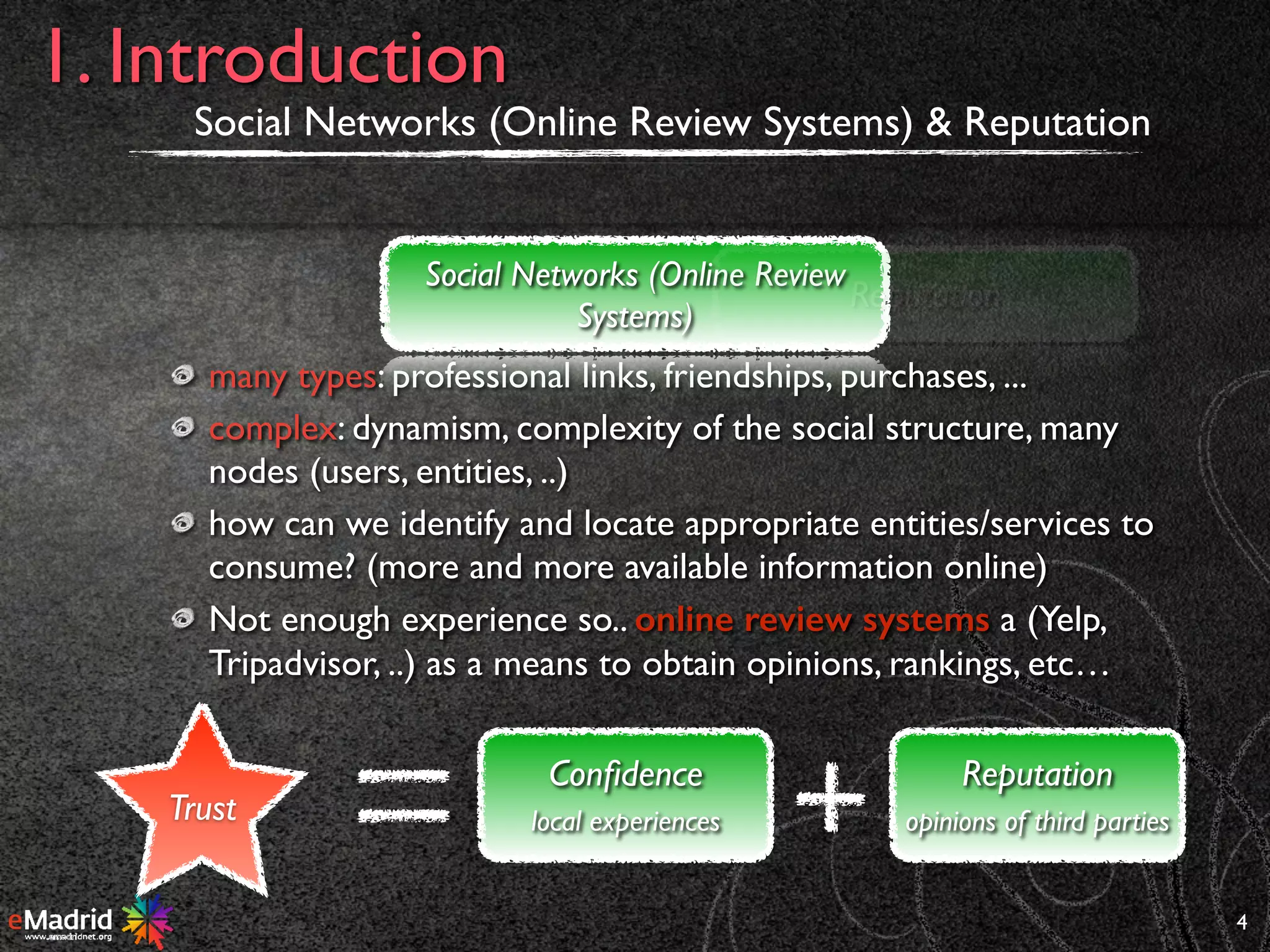
many types: professional links, friendships, purchases, ...
complex: dynamism, complexity of the social structure, many
nodes (users, entities, ..)
how can we identify and locate appropriate entities/services to
consume? (more and more available information online)
Not enough experience so.. online review systems a (Yelp,
Tripadvisor, ..) as a means to obtain opinions, rankings, etc…
Social Networks (Online Review Systems) & Reputation
4
1. Introduction
Social Networks (Online Review
Systems)
Reputation
many types: professional links, friendships, purchases, ...
complex: dynamism, complexity of the social structure, many
nodes (users, entities, ..)
how can we identify and locate appropriate entities/services to
consume? (more and more available information online)
Not enough experience so.. online review systems a (Yelp,
Tripadvisor, ..) as a means to obtain opinions, rankings, etc…
Social Networks (Online Review Systems) & Reputation
4
1. Introduction
Social Networks (Online Review
Systems)
Reputation
Trust
Reputation
opinions of third parties
Confidence
local experiences
many types
complex
nodes (users, entities, ..)
how can we identify and locate appropriate entities/services to
consume?
Not enough experience so..
Tripadvisor, ..) as a means to obtain opinions, rankings, etc…
Social Networks (Online Review Systems) & Reputation
4
1. Introduction
Social Networks (Online Review
Systems)
Reputation
Trust
Reputation
opinions of third parties
Confidence
local experiences
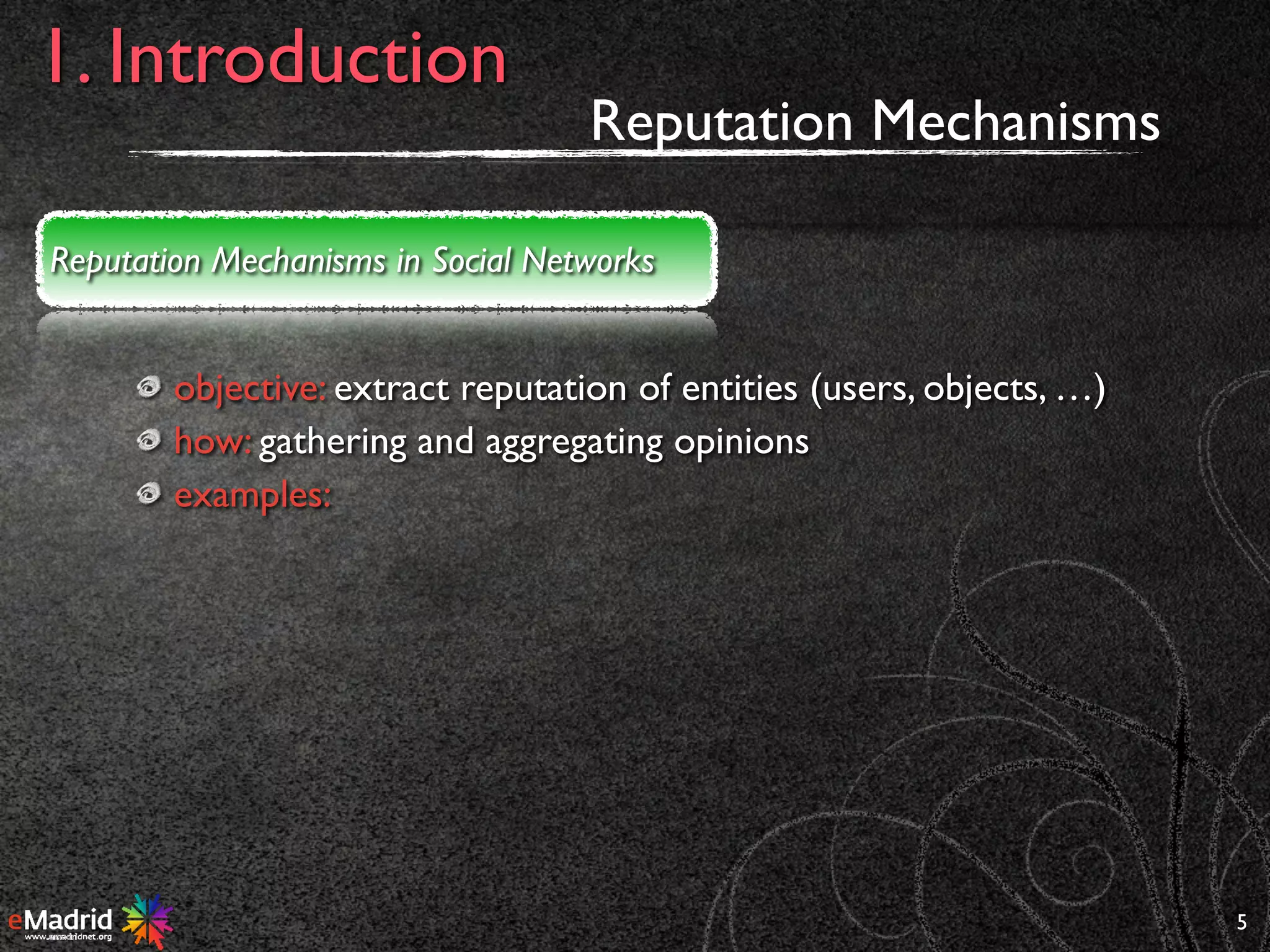
objective: extract reputation of entities (users, objects, …)
how: gathering and aggregating opinions
examples:
5
1. Introduction
Reputation Mechanisms in Social Networks
Reputation Mechanisms
objective:
how:
examples:
5
1. Introduction
Reputation Mechanisms in Social Networks
Reputation Mechanisms
objective:
how:
examples:
5
1. Introduction
Reputation Mechanisms in Social Networks
Reputation Mechanisms
objective:
how:
examples:
5
1. Introduction
Reputation Mechanisms in Social Networks
Reputation Mechanisms
Motivation
6
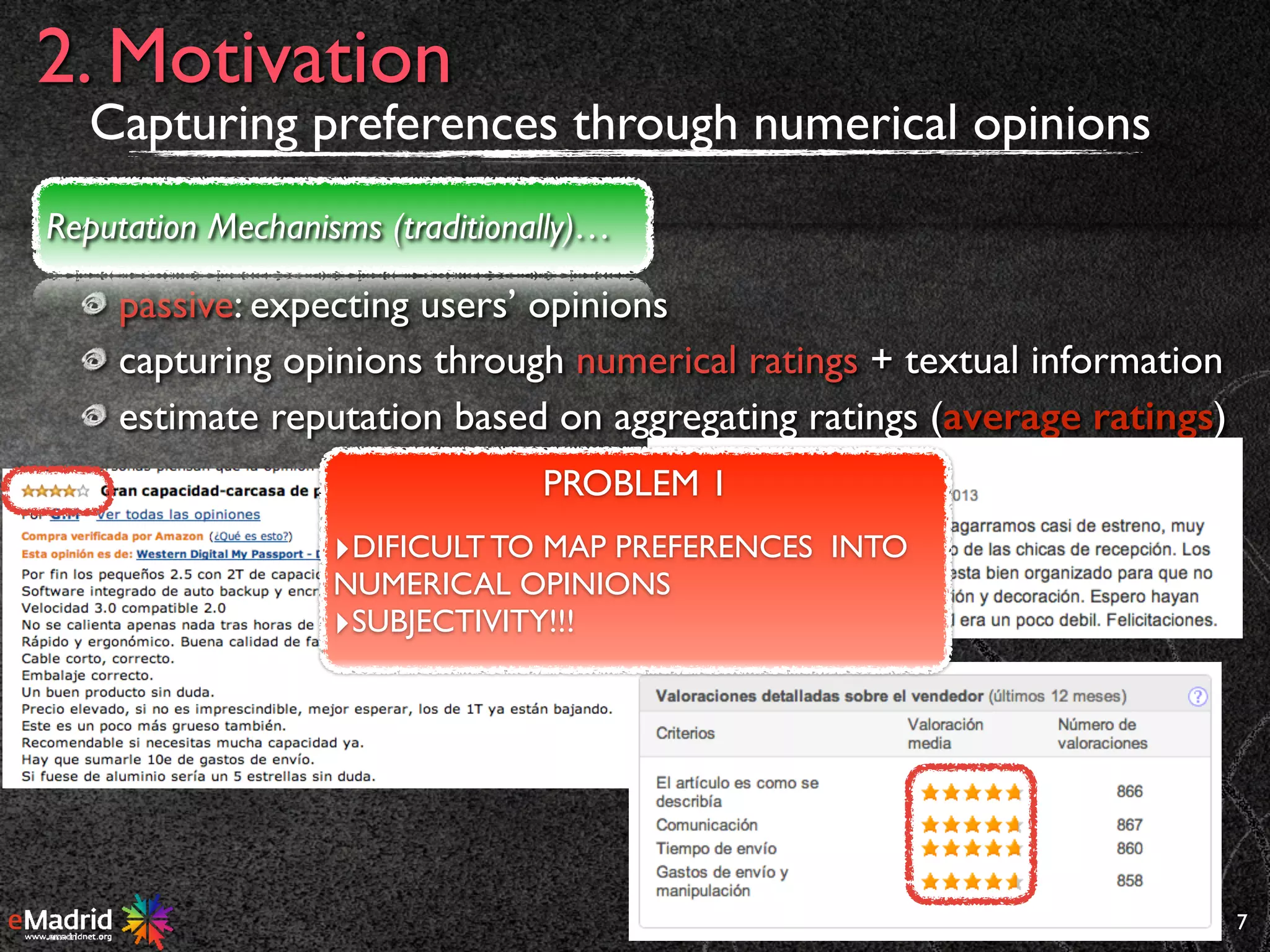
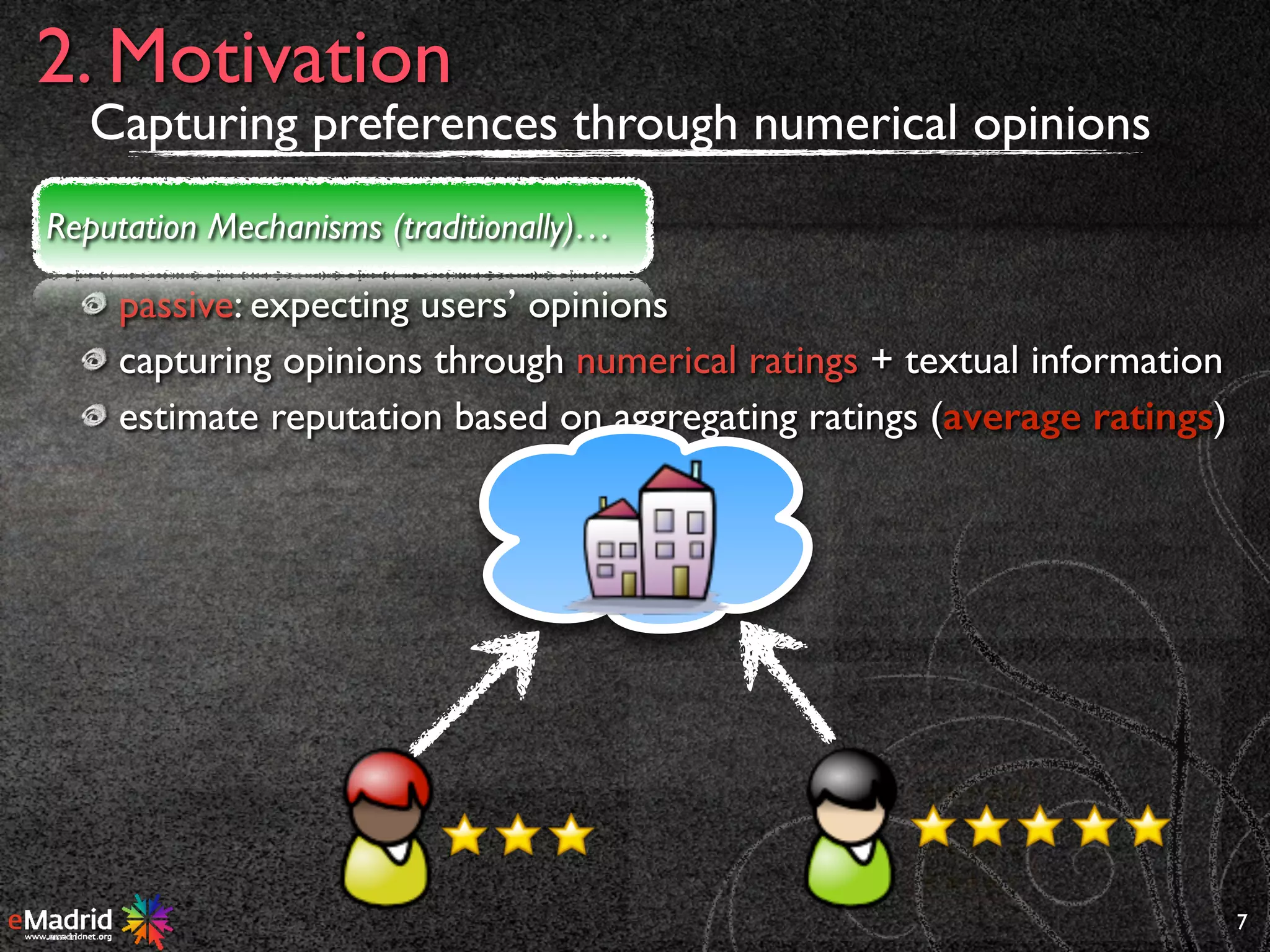
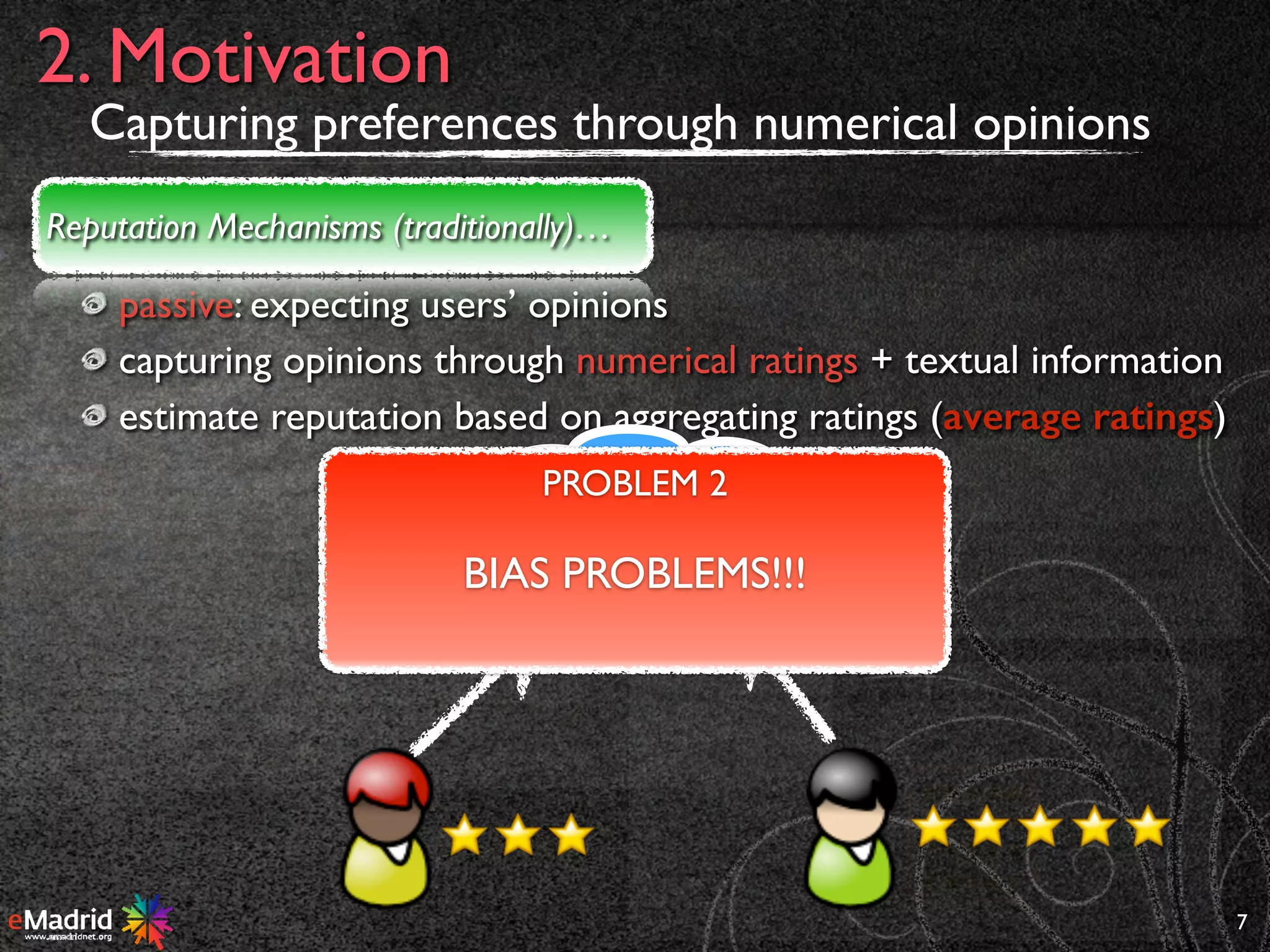
passive: expecting users’ opinions
capturing opinions through numerical ratings + textual information
estimate reputation based on aggregating ratings (average ratings)
7
2. Motivation
Reputation Mechanisms (traditionally)…
Capturing preferences through numerical opinions
passive: expecting users’ opinions
capturing opinions through numerical ratings + textual information
estimate reputation based on aggregating ratings (average ratings)
7
2. Motivation
Reputation Mechanisms (traditionally)…
Capturing preferences through numerical opinions
passive: expecting users’ opinions
capturing opinions through numerical ratings + textual information
estimate reputation based on aggregating ratings (average ratings)
7
2. Motivation
Reputation Mechanisms (traditionally)…
PROBLEM 1
‣DIFICULT TO MAP PREFERENCES INTO
NUMERICAL OPINIONS
‣SUBJECTIVITY!!!
Capturing preferences through numerical opinions
passive: expecting users’ opinions
capturing opinions through numerical ratings + textual information
estimate reputation based on aggregating ratings (average ratings)
7
2. Motivation
Reputation Mechanisms (traditionally)…
AGR
Capturing preferences through numerical opinions
passive: expecting users’ opinions
capturing opinions through numerical ratings + textual information
estimate reputation based on aggregating ratings (average ratings)
7
2. Motivation
Reputation Mechanisms (traditionally)…
AGR
PROBLEM 2
BIAS PROBLEMS!!!
Capturing preferences through numerical opinions
passive: expecting users’ opinions
capturing opinions through numerical ratings + textual information
estimate reputation based on aggregating ratings (average ratings)
7
2. Motivation
Reputation Mechanisms (traditionally)…
AGR
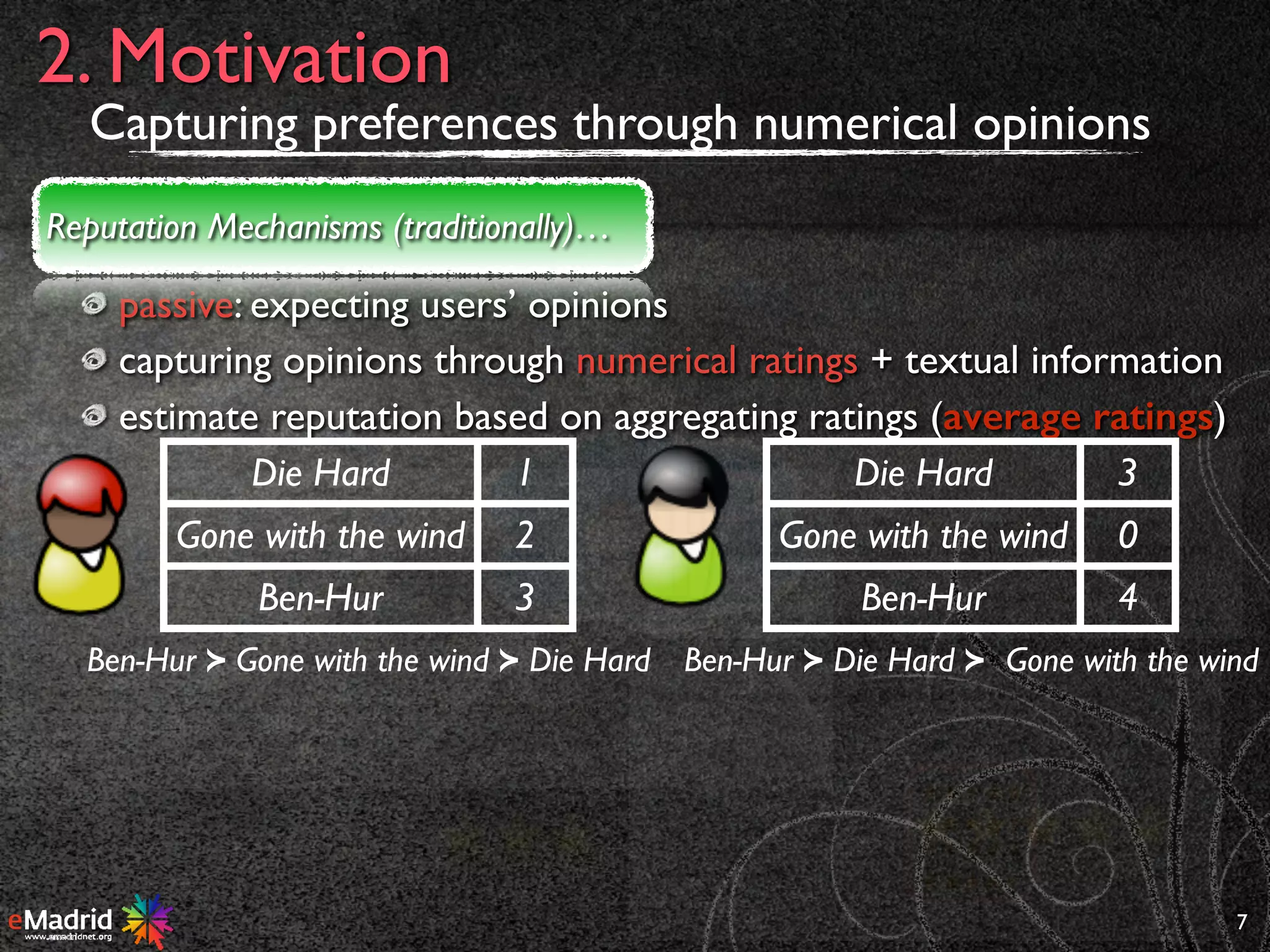
Die Hard 1
Gone with the wind 2
Ben-Hur 3
Ben-Hur ≻ Gone with the wind ≻ Die Hard
Die Hard 3
Gone with the wind 0
Ben-Hur 4
Ben-Hur ≻ Die Hard ≻ Gone with the wind
Capturing preferences through numerical opinions
passive: expecting users’ opinions
capturing opinions through numerical ratings + textual information
estimate reputation based on aggregating ratings (average ratings)
7
2. Motivation
Reputation Mechanisms (traditionally)…
AGR
Die Hard 1
Gone with the wind 2
Ben-Hur 3
Ben-Hur ≻ Gone with the wind ≻ Die Hard
Die Hard 3
Gone with the wind 0
Ben-Hur 4
Ben-Hur ≻ Die Hard ≻ Gone with the wind
Capturing preferences through numerical opinions
passive: expecting users’ opinions
capturing opinions through numerical ratings + textual information
estimate reputation based on aggregating ratings (average ratings)
7
2. Motivation
Reputation Mechanisms (traditionally)…
AGR
Die Hard 1
Gone with the wind 2
Ben-Hur 3
Ben-Hur ≻ Gone with the wind ≻ Die Hard Ben-Hur ≻ Die Hard ≻ Gone with the wind
Ben-Hur ≻ Die Hard ≻ Gone with the wind
Die Hard 0.2
Gone with the wind 0.1
Ben-Hur 1.0
Capturing preferences through numerical opinions
passive: expecting users’ opinions
capturing opinions through numerical ratings + textual information
estimate reputation based on aggregating ratings (average ratings)
7
2. Motivation
Reputation Mechanisms (traditionally)…
AGR
Die Hard 1
Gone with the wind 2
Ben-Hur 3
Ben-Hur ≻ Gone with the wind ≻ Die Hard Ben-Hur ≻ Die Hard ≻ Gone with the wind
Ben-Hur ≻ Die Hard ≻ Gone with the wind
Die Hard 0.2
Gone with the wind 0.1
Ben-Hur 1.0
Ben-Hur ≻ Gone with the wind ≻ Die Hard
Capturing preferences through numerical opinions
8
2. Motivation
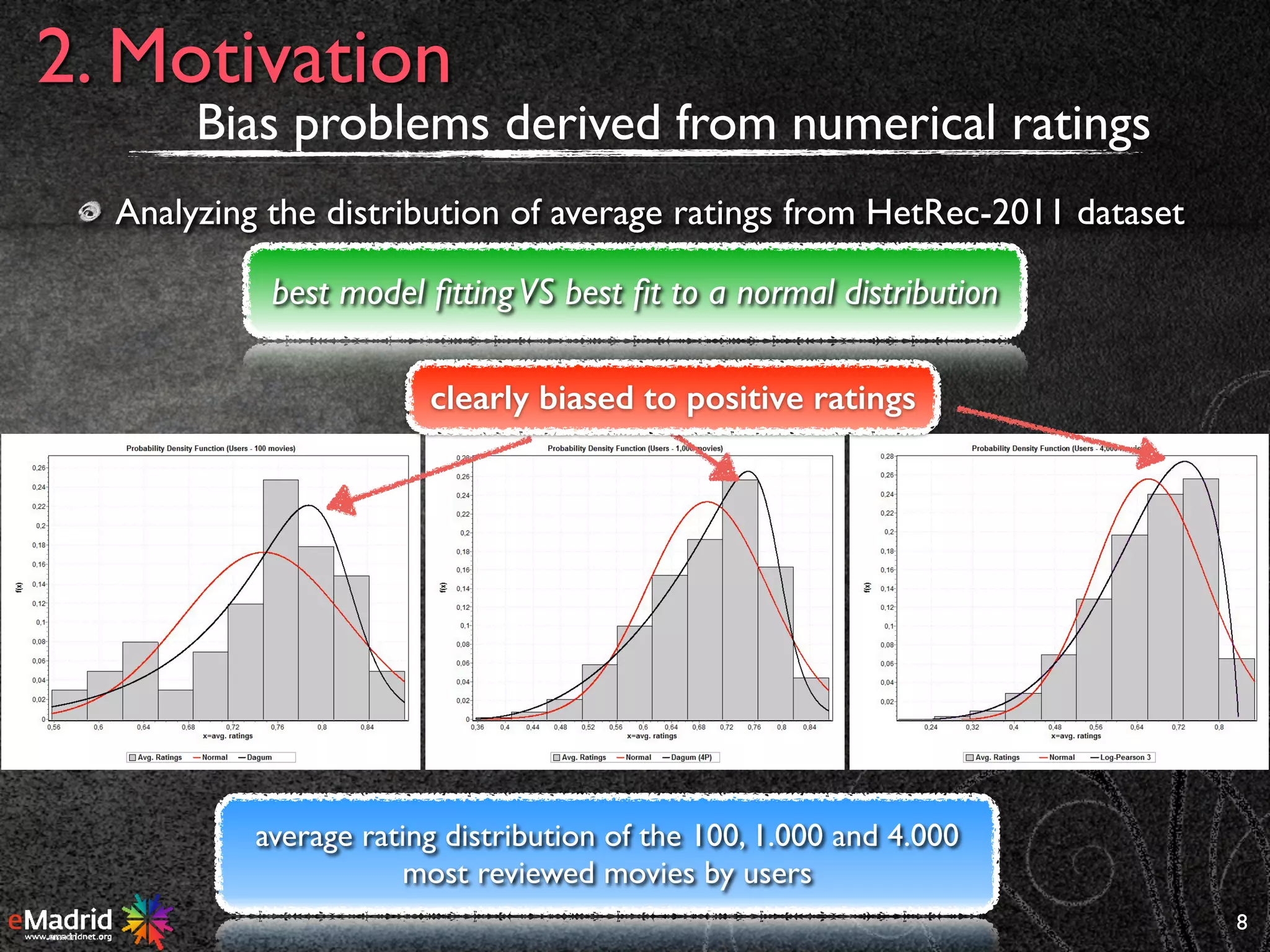
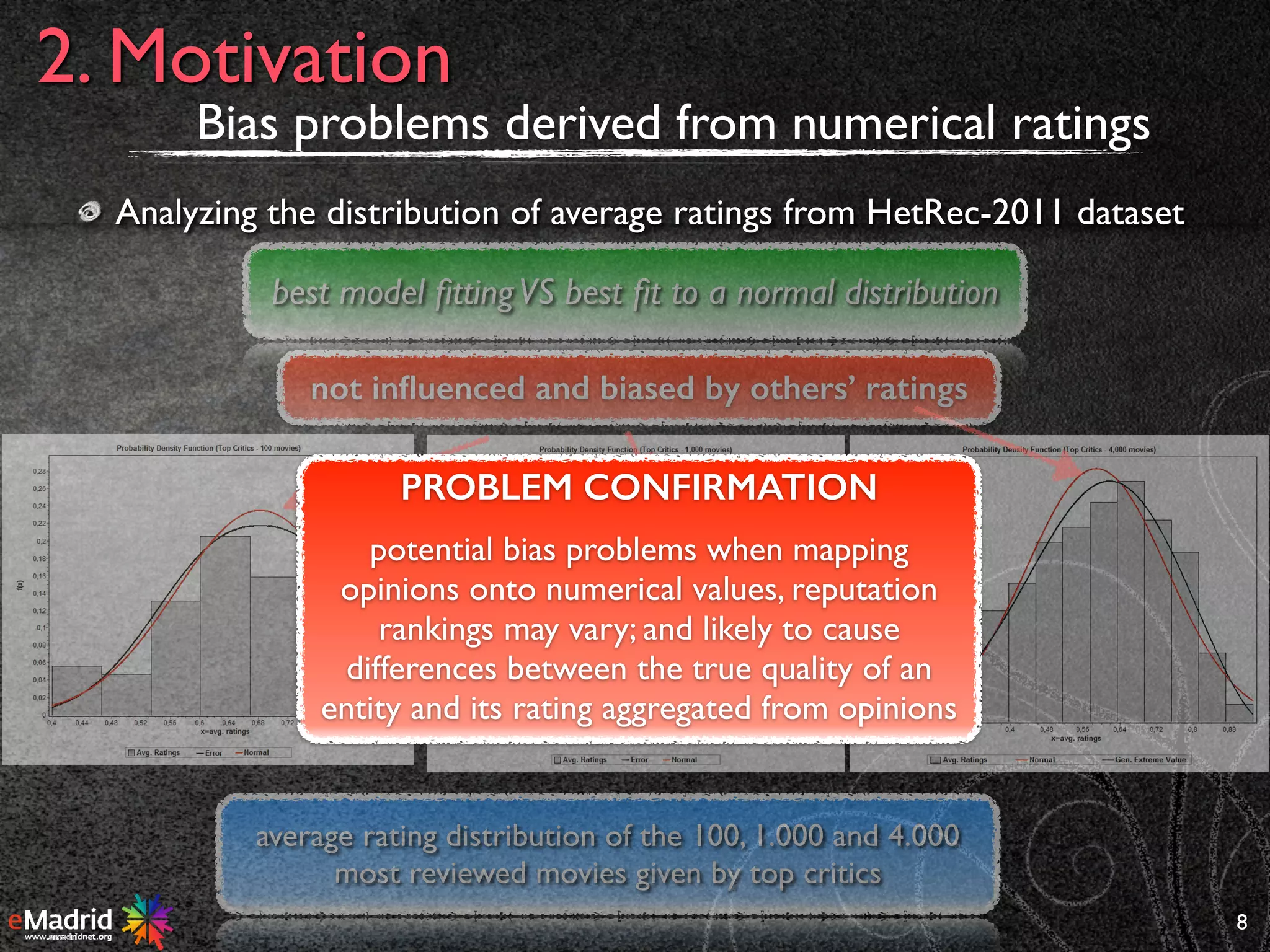
best model fittingVS best fit to a normal distribution
Bias problems derived from numerical ratings
Analyzing the distribution of average ratings from HetRec-2011 dataset
8
2. Motivation
best model fittingVS best fit to a normal distribution
Bias problems derived from numerical ratings
Analyzing the distribution of average ratings from HetRec-2011 dataset
average rating distribution of the 100, 1.000 and 4.000
most reviewed movies by users
8
2. Motivation
best model fittingVS best fit to a normal distribution
Bias problems derived from numerical ratings
Analyzing the distribution of average ratings from HetRec-2011 dataset
average rating distribution of the 100, 1.000 and 4.000
most reviewed movies by users
clearly biased to positive ratings
8
2. Motivation
best model fittingVS best fit to a normal distribution
Bias problems derived from numerical ratings
Analyzing the distribution of average ratings from HetRec-2011 dataset
average rating distribution of the 100, 1.000 and 4.000
most reviewed movies given by top critics
8
2. Motivation
best model fittingVS best fit to a normal distribution
Bias problems derived from numerical ratings
Analyzing the distribution of average ratings from HetRec-2011 dataset
average rating distribution of the 100, 1.000 and 4.000
most reviewed movies given by top critics
not influenced and biased by others’ ratings
8
2. Motivation
best model fittingVS best fit to a normal distribution
Bias problems derived from numerical ratings
Analyzing the distribution of average ratings from HetRec-2011 dataset
average rating distribution of the 100, 1.000 and 4.000
most reviewed movies given by top critics
not influenced and biased by others’ ratings
PROBLEM CONFIRMATION
potential bias problems when mapping
opinions onto numerical values, reputation
rankings may vary; and likely to cause
differences between the true quality of an
entity and its rating aggregated from opinions
9
2. Motivation
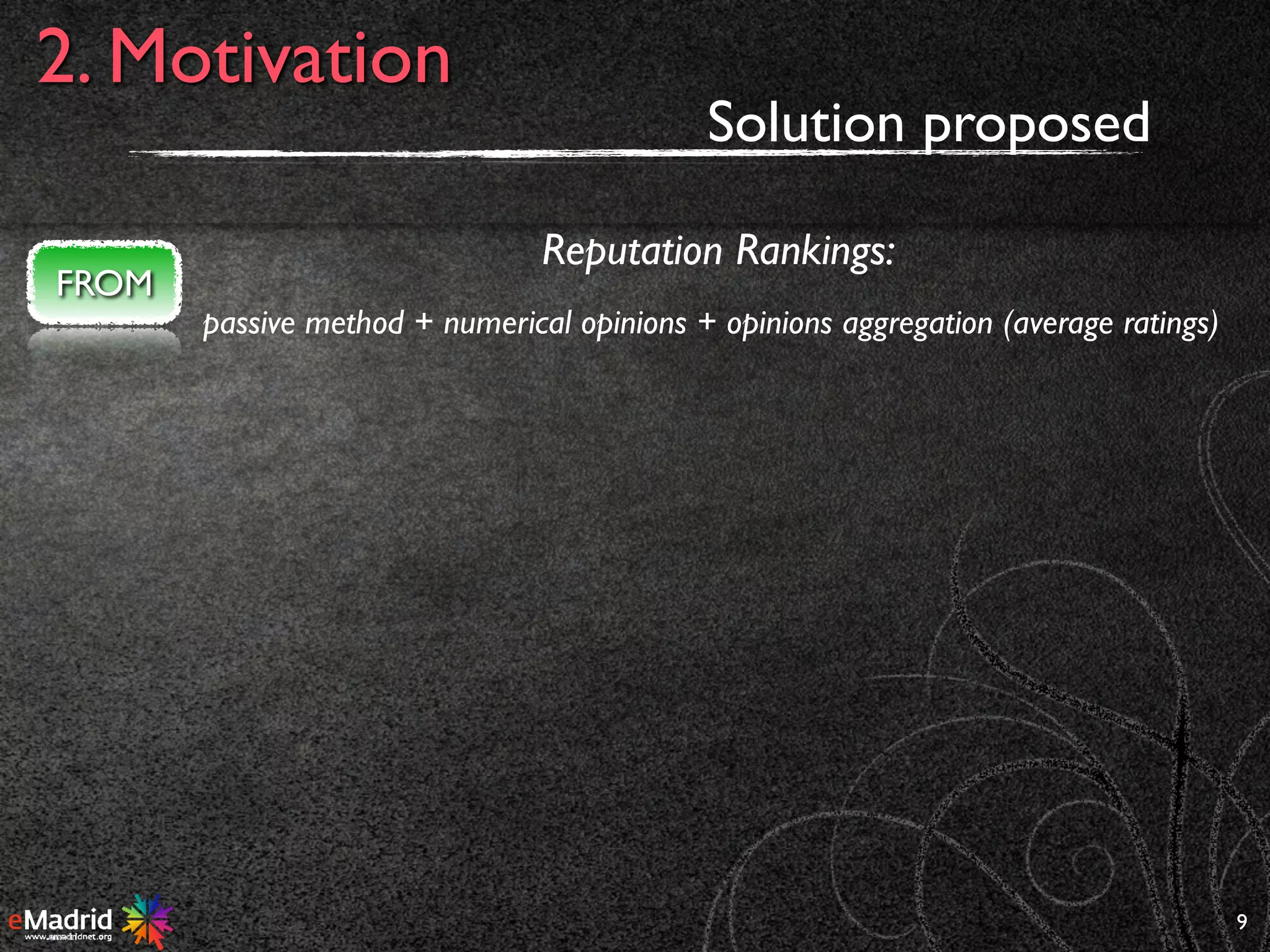
FROM
Reputation Rankings:
passive method + numerical opinions + opinions aggregation (average ratings)
Solution proposed
9
2. Motivation
FROM
Reputation Rankings:
passive method + numerical opinions + opinions aggregation (average ratings)
Reputation Rankings:
pro-active method + comparative opinions + comparative aggregation
TO
Solution proposed
9
2. Motivation
FROM
Reputation Rankings:
passive method + numerical opinions + opinions aggregation (average ratings)
Reputation Rankings:
pro-active method + comparative opinions + comparative aggregation
Pairwise preference
elicitation
Aggregation mechanism
TO
Solution proposed
From opinion ratings to
pairwise queries: PWRM
10
11
3. From opinion ratings to pairwise queries: PWRM
Comparative opinions: Pairwise preference elicitation
Based on pairwise queries:
11
3. From opinion ratings to pairwise queries: PWRM
Comparative opinions: Pairwise preference elicitation
Based on pairwise queries:
FROM
Ben-Hur
[0..1]
[Awful, fairly bad, It’s OK,
Will enjoy, Must see]
Gone with
the wind
:
15. Ben-Hur 4.3
:
23. Gone with the wind 4.1
:
11
3. From opinion ratings to pairwise queries: PWRM
Comparative opinions: Pairwise preference elicitation
Based on pairwise queries:
FROM
Ben-Hur
[0..1]
[Awful, fairly bad, It’s OK,
Will enjoy, Must see]
Gone with
the wind
:
15. Ben-Hur 4.3
:
23. Gone with the wind 4.1
:
TO Which movie do you prefer, Ben-Hur
or Gone with the wind?
:
15. Ben-Hur
:
23. Gone with the wind
:
easier for users to state opinions when the queries compare objects in a
pairwise fashion…
“… between these two objects, which one do you prefer?”
12
3. From opinion ratings to pairwise queries: PWRM
Pairwise comparison dynamics (I)
Reputation (opinions aggregation) as an iterative process based on …
12
3. From opinion ratings to pairwise queries: PWRM
Pairwise comparison dynamics (I)
Knock-Out tournaments:
Reputation (opinions aggregation) as an iterative process based on …
12
3. From opinion ratings to pairwise queries: PWRM
Pairwise comparison dynamics (I)
Knock-Out tournaments:
Reputation (opinions aggregation) as an iterative process based on …
A
B
C
D
A
D
D
Match: pairwise comparison between two
entities
Dynamics: every match sent to a set of
users that reply to the query
Policies:
‣ Entity selection
‣Tournament schedule
‣ Users selection
‣Winner determination
13
3. From opinion ratings to pairwise queries: PWRM
Pairwise comparison dynamics (II)
Policies
Entities selection: which pair of entities should I select to be
compared?
‣ Mixed: current ranking vs new objects (ExploitationVs Exploration)
‣ Random
‣ Domain-dependent: objects with no information/fuzzy positions
Tournament schedule: how to initialize the tournament
‣ Random schedule (iterative process)
14
3. From opinion ratings to pairwise queries: PWRM
Pairwise comparison dynamics (III)
Policies
Users selection: who receives the queries (matches)?
‣ Random selection
‣Clustering of users by their preferences (representative users)
‣ Using (social) network properties: degree distribution, centrality of
nodes, …
Winner determination: how to decide which entity wins in a match
‣Voting procedures: preference replies from users count as votes
‣ Alternatives: absolute majority / full agreement (voting protocols)
‣ If there is no winner, no object gets through the next round
15
3. From opinion ratings to pairwise queries: PWRM
Comparative aggregation: from matches to a ranking
When:After each match, the ranking is updated (iterative method)
How: Adaptation of a method for aggregating partial pairwise
comparison results into a ranking (Negahban et al., 2012)
‣Ranking approximation = random walk on G (weighted graph):
‣ An edge <ei,ej> if the pair has already been compared
‣The weights define the outcome of the comparisons
‣ Random walk uses a transition matrix P where:
‣ It moves from state ei to state ej with probability equal to the
chance that entity ej is preferred over entity ei
‣ Under these conditions, a vector w is a valid stationary distribution
for matrix P (wT
t+1 = wT · P)
‣ w defines the scores for each entity => ranking
16
3. From opinion ratings to pairwise queries: PWRM
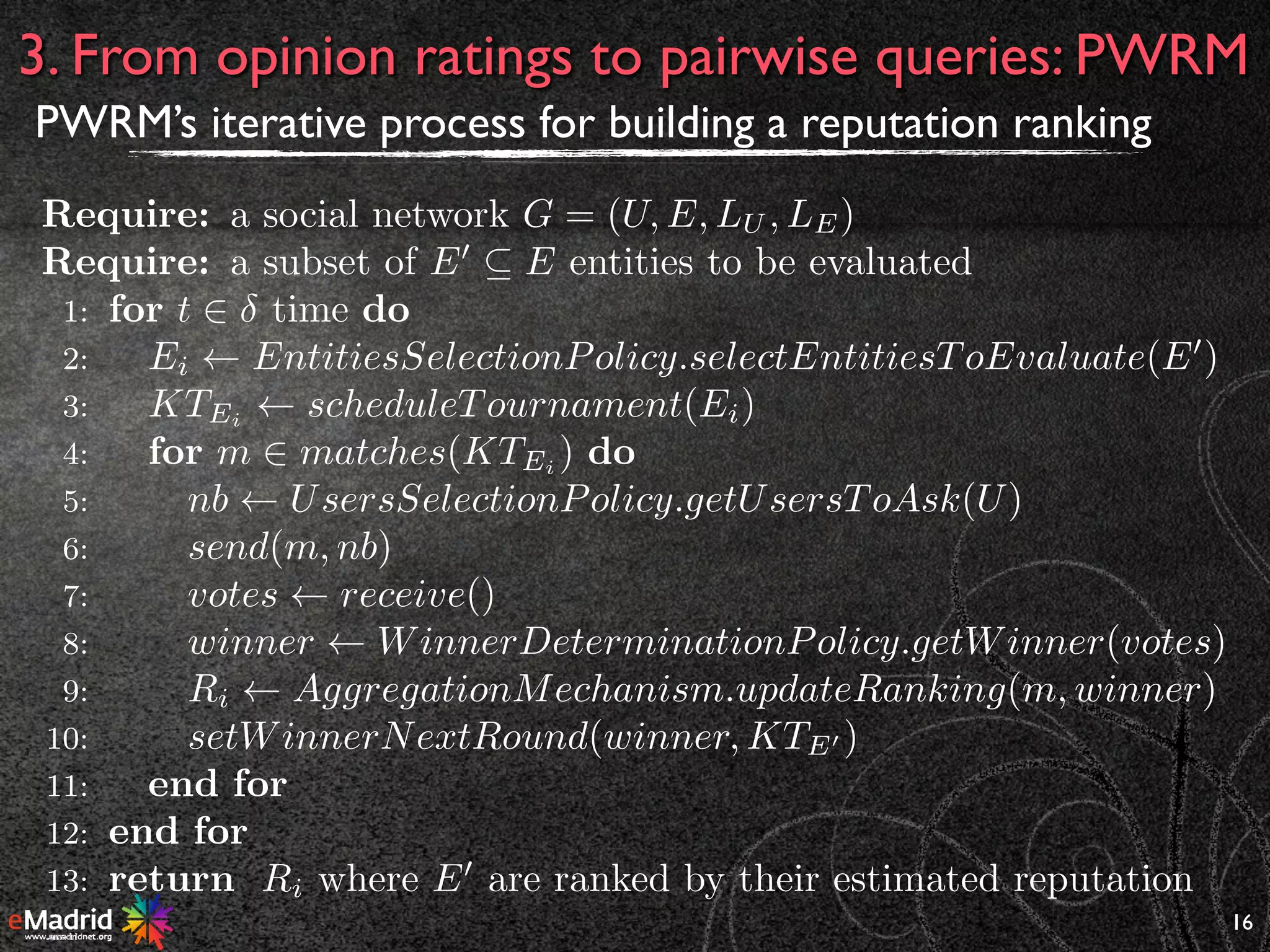
PWRM’s iterative process for building a reputation ranking
Require: a social network G = (U, E, LU , LE)
Require: a subset of E0
✓ E entities to be evaluated
1: for t 2 time do
2: Ei EntitiesSelectionPolicy.selectEntitiesToEvaluate(E0
)
3: KTEi
scheduleTournament(Ei)
4: for m 2 matches(KTEi ) do
5: nb UsersSelectionPolicy.getUsersToAsk(U)
6: send(m, nb)
7: votes receive()
8: winner WinnerDeterminationPolicy.getWinner(votes)
9: Ri AggregationMechanism.updateRanking(m, winner)
10: setWinnerNextRound(winner, KTE0 )
11: end for
12: end for
13: return Ri where E0
are ranked by their estimated reputation
Towards ranking resources in
MOOCs
17
Towards ranking resources in
MOOCs
17
18
4.Towards ranking resources in MOOCs
Opinions in MOOCs?
18
4.Towards ranking resources in MOOCs
Opinions in MOOCs?
opinions to rank
courses/resources
19
4.Towards ranking resources in MOOCs
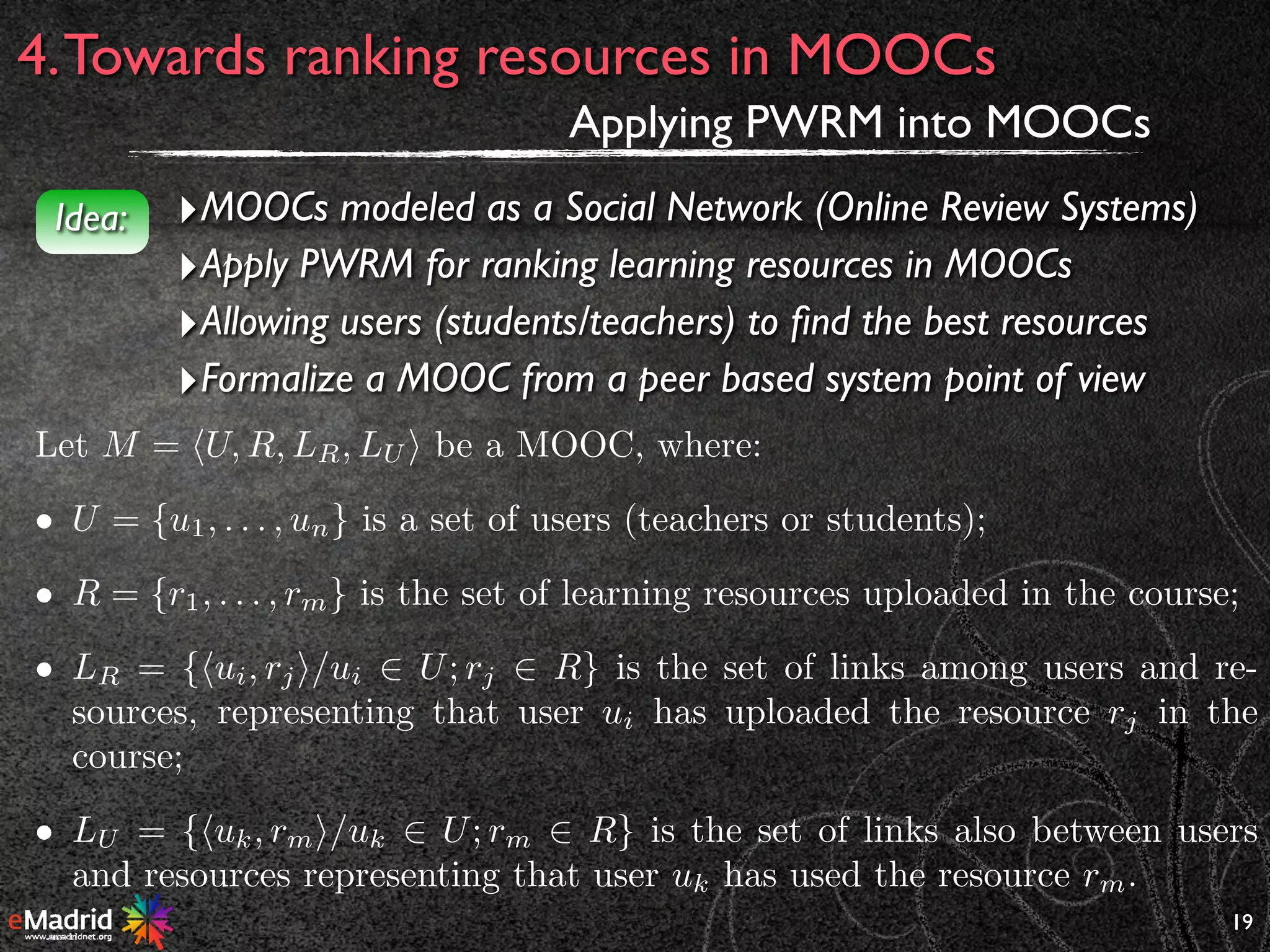
Applying PWRM into MOOCs
‣MOOCs modeled as a Social Network (Online Review Systems)
‣Apply PWRM for ranking learning resources in MOOCs
‣Allowing users (students/teachers) to find the best resources
‣Formalize a MOOC from a peer based system point of view
Idea:
Let M = hU, R, LR, LU i be a MOOC, where:
• U = {u1, . . . , un} is a set of users (teachers or students);
• R = {r1, . . . , rm} is the set of learning resources uploaded in the course;
• LR = {hui, rji/ui 2 U; rj 2 R} is the set of links among users and re-
sources, representing that user ui has uploaded the resource rj in the
course;
• LU = {huk, rmi/uk 2 U; rm 2 R} is the set of links also between users
and resources representing that user uk has used the resource rm.
20
4.Towards ranking resources in MOOCs
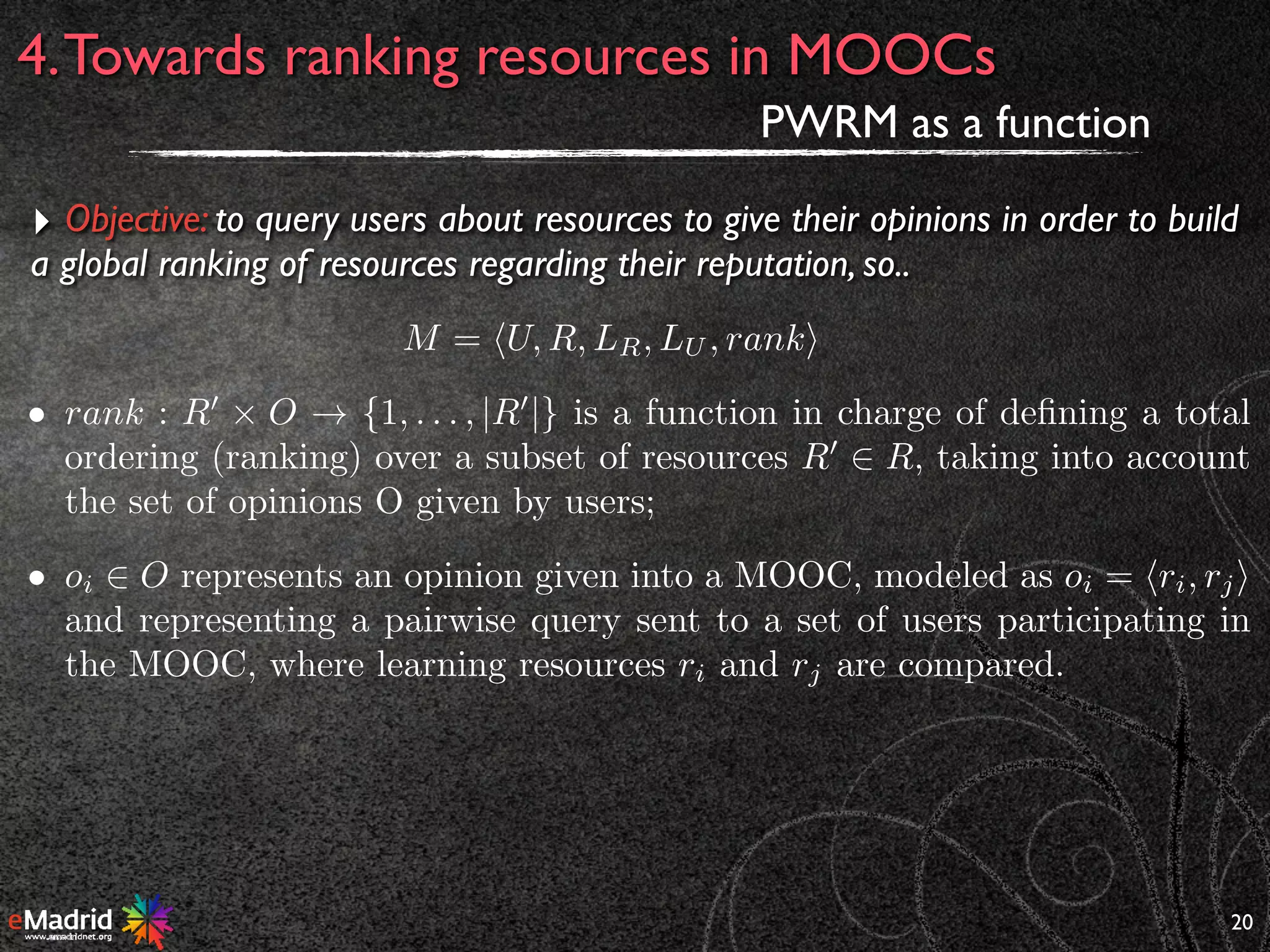
PWRM as a function
‣ Objective: to query users about resources to give their opinions in order to build
a global ranking of resources regarding their reputation, so..
M = hU, R, LR, LU , ranki
• rank : R0
⇥ O ! {1, . . . , |R0
|} is a function in charge of defining a total
ordering (ranking) over a subset of resources R0
2 R, taking into account
the set of opinions O given by users;
• oi 2 O represents an opinion given into a MOOC, modeled as oi = hri, rji
and representing a pairwise query sent to a set of users participating in
the MOOC, where learning resources ri and rj are compared.
20
4.Towards ranking resources in MOOCs
PWRM as a function
‣ Objective: to query users about resources to give their opinions in order to build
a global ranking of resources regarding their reputation, so..
M = hU, R, LR, LU , ranki
• rank : R0
⇥ O ! {1, . . . , |R0
|} is a function in charge of defining a total
ordering (ranking) over a subset of resources R0
2 R, taking into account
the set of opinions O given by users;
• oi 2 O represents an opinion given into a MOOC, modeled as oi = hri, rji
and representing a pairwise query sent to a set of users participating in
the MOOC, where learning resources ri and rj are compared.
rank = PWRM
21
4.Towards ranking resources in MOOCs
PWRM algorithm in MOOCs
Require: a MOOC M = hU, R, LR, LU , ranki
Require: a subset of R0
✓ R of learning resources to be ranked
1: for t 2 time do
2: Ri ResourcesSelectionPolicy.selectResourcesToEvaluate(R0
)
3: KTRi
scheduleTournament(Ri)
4: for m 2 matches(KTRi ) do
5: Ui UsersSelectionPolicy.getUsersToAsk(U)
6: send(m, Ui)
7: Oi ReceiveOpinions()
8: winner WinnerDeterminationPolicy.getWinner(votes, Oi)
9: Ranki AggregationMechanism.updateRanking(Oi, winner)
10: promoteResourceWinnerToNextRound(winner, KTRi )
11: end for
12: end for
13: return Ranki where the subset R0
of learning resources are ranked by their
reputation
22
4.Towards ranking resources in MOOCs
PWRM algorithm in MOOCs: Policies
‣ Resource selection policy:
- resources clustered regarding their typology (e.g. videos, recorded class…)
- regarding the number of opinions received by each resource (lowest/
highest number)
- opinions in terms of the result of each match (matches with tight results)
‣ User selection policy:
- taking advantage of the underlying structure generated by interactions
between users and resources
‣Winner determination policy:
- voting theory: simple majority, complete agreement, …
Conclusions & Future Work
23
24
Contributions
Current reputation mechanisms
✓ follow a very passive/static and quantitative dependent approach
‣ easy to manipulate
‣ bias problems due to difficulty/subjectivity to map opinions into numerical values
Our Approach: PWRM
(1) based on comparative
(2) preference aggregation in reputation rankings (iterative process - tournaments)
(3) applied to MOOCs (ranking learning resources)
5. Conclusions & Future work
24
Contributions
Current reputation mechanisms
✓ follow a very passive/static and quantitative dependent approach
‣ easy to manipulate
‣ bias problems
Our Approach: PWRM
(1) based on comparative opinions, elicited through pairwise preference request
(2) preference aggregation in reputation rankings (iterative process - tournaments)
(3) applied to MOOCs (ranking learning resources)
5. Conclusions & Future work
25
Future work
5. Conclusions & Future work
‣ Adding social network properties:
- cluster users, centrality, betweenness, …
‣ Partial cooperative users:
- incentive mechanisms fostering cooperation (“what do you think users
prefer,A or B?”)
‣ Reputation of MOOCs:
- resources = courses, finding opinions in other opinions sites: twitter,
Facebook, forums, etc..
‣ Individual recommendation:
- resources/courses: from global reputation ranking to individual
recommendations
That’s all
Thank you for your attention!!
26
On the inaccuracy of numerical ratings:
A pairwise based reputation
mechanism in MOOCs
July 1st, 2015
Roberto Centeno
rcenteno@lsi.uned.es
Dpto. Lenguajes y Sistemas Informáticos
UNED

V Jornadas eMadrid sobre “Educación Digital”. Roberto Centeno, Universidad Nacional de Educación a Distancia: Mecanismos de reputación en MOOCs

  • 1.
    On the inaccuracyof numerical ratings: A pairwise based reputation mechanism in MOOCs July 1st, 2015 Roberto Centeno rcenteno@lsi.uned.es Dpto. Lenguajes y Sistemas Informáticos UNED
  • 2.
    Outline 1. Introduction 2. Motivation 3.From opinion ratings to pairwise queries: PWRM 4. Towards ranking resources in MOOCs 5. Conclusions & future work 2
  • 3.
  • 4.
    Social Networks (OnlineReview Systems) & Reputation 4 1. Introduction
  • 5.
    Social Networks (OnlineReview Systems) & Reputation 4 1. Introduction Social Networks (Online Review Systems) Reputation
  • 6.
    many types: professionallinks, friendships, purchases, ... complex: dynamism, complexity of the social structure, many nodes (users, entities, ..) how can we identify and locate appropriate entities/services to consume? (more and more available information online) Not enough experience so.. online review systems a (Yelp, Tripadvisor, ..) as a means to obtain opinions, rankings, etc… Social Networks (Online Review Systems) & Reputation 4 1. Introduction Social Networks (Online Review Systems) Reputation
  • 7.
    many types: professionallinks, friendships, purchases, ... complex: dynamism, complexity of the social structure, many nodes (users, entities, ..) how can we identify and locate appropriate entities/services to consume? (more and more available information online) Not enough experience so.. online review systems a (Yelp, Tripadvisor, ..) as a means to obtain opinions, rankings, etc… Social Networks (Online Review Systems) & Reputation 4 1. Introduction Social Networks (Online Review Systems) Reputation Trust Reputation opinions of third parties Confidence local experiences
  • 8.
    many types complex nodes (users,entities, ..) how can we identify and locate appropriate entities/services to consume? Not enough experience so.. Tripadvisor, ..) as a means to obtain opinions, rankings, etc… Social Networks (Online Review Systems) & Reputation 4 1. Introduction Social Networks (Online Review Systems) Reputation Trust Reputation opinions of third parties Confidence local experiences
  • 9.
    objective: extract reputationof entities (users, objects, …) how: gathering and aggregating opinions examples: 5 1. Introduction Reputation Mechanisms in Social Networks Reputation Mechanisms
  • 10.
  • 11.
  • 12.
  • 13.
  • 14.
    passive: expecting users’opinions capturing opinions through numerical ratings + textual information estimate reputation based on aggregating ratings (average ratings) 7 2. Motivation Reputation Mechanisms (traditionally)… Capturing preferences through numerical opinions
  • 15.
    passive: expecting users’opinions capturing opinions through numerical ratings + textual information estimate reputation based on aggregating ratings (average ratings) 7 2. Motivation Reputation Mechanisms (traditionally)… Capturing preferences through numerical opinions
  • 16.
    passive: expecting users’opinions capturing opinions through numerical ratings + textual information estimate reputation based on aggregating ratings (average ratings) 7 2. Motivation Reputation Mechanisms (traditionally)… PROBLEM 1 ‣DIFICULT TO MAP PREFERENCES INTO NUMERICAL OPINIONS ‣SUBJECTIVITY!!! Capturing preferences through numerical opinions
  • 17.
    passive: expecting users’opinions capturing opinions through numerical ratings + textual information estimate reputation based on aggregating ratings (average ratings) 7 2. Motivation Reputation Mechanisms (traditionally)… AGR Capturing preferences through numerical opinions
  • 18.
    passive: expecting users’opinions capturing opinions through numerical ratings + textual information estimate reputation based on aggregating ratings (average ratings) 7 2. Motivation Reputation Mechanisms (traditionally)… AGR PROBLEM 2 BIAS PROBLEMS!!! Capturing preferences through numerical opinions
  • 19.
    passive: expecting users’opinions capturing opinions through numerical ratings + textual information estimate reputation based on aggregating ratings (average ratings) 7 2. Motivation Reputation Mechanisms (traditionally)… AGR Die Hard 1 Gone with the wind 2 Ben-Hur 3 Ben-Hur ≻ Gone with the wind ≻ Die Hard Die Hard 3 Gone with the wind 0 Ben-Hur 4 Ben-Hur ≻ Die Hard ≻ Gone with the wind Capturing preferences through numerical opinions
  • 20.
    passive: expecting users’opinions capturing opinions through numerical ratings + textual information estimate reputation based on aggregating ratings (average ratings) 7 2. Motivation Reputation Mechanisms (traditionally)… AGR Die Hard 1 Gone with the wind 2 Ben-Hur 3 Ben-Hur ≻ Gone with the wind ≻ Die Hard Die Hard 3 Gone with the wind 0 Ben-Hur 4 Ben-Hur ≻ Die Hard ≻ Gone with the wind Ben-Hur ≻ Die Hard ≻ Gone with the wind Capturing preferences through numerical opinions
  • 21.
    passive: expecting users’opinions capturing opinions through numerical ratings + textual information estimate reputation based on aggregating ratings (average ratings) 7 2. Motivation Reputation Mechanisms (traditionally)… AGR Die Hard 1 Gone with the wind 2 Ben-Hur 3 Ben-Hur ≻ Gone with the wind ≻ Die Hard Ben-Hur ≻ Die Hard ≻ Gone with the wind Ben-Hur ≻ Die Hard ≻ Gone with the wind Die Hard 0.2 Gone with the wind 0.1 Ben-Hur 1.0 Capturing preferences through numerical opinions
  • 22.
    passive: expecting users’opinions capturing opinions through numerical ratings + textual information estimate reputation based on aggregating ratings (average ratings) 7 2. Motivation Reputation Mechanisms (traditionally)… AGR Die Hard 1 Gone with the wind 2 Ben-Hur 3 Ben-Hur ≻ Gone with the wind ≻ Die Hard Ben-Hur ≻ Die Hard ≻ Gone with the wind Ben-Hur ≻ Die Hard ≻ Gone with the wind Die Hard 0.2 Gone with the wind 0.1 Ben-Hur 1.0 Ben-Hur ≻ Gone with the wind ≻ Die Hard Capturing preferences through numerical opinions
  • 23.
    8 2. Motivation best modelfittingVS best fit to a normal distribution Bias problems derived from numerical ratings Analyzing the distribution of average ratings from HetRec-2011 dataset
  • 24.
    8 2. Motivation best modelfittingVS best fit to a normal distribution Bias problems derived from numerical ratings Analyzing the distribution of average ratings from HetRec-2011 dataset average rating distribution of the 100, 1.000 and 4.000 most reviewed movies by users
  • 25.
    8 2. Motivation best modelfittingVS best fit to a normal distribution Bias problems derived from numerical ratings Analyzing the distribution of average ratings from HetRec-2011 dataset average rating distribution of the 100, 1.000 and 4.000 most reviewed movies by users clearly biased to positive ratings
  • 26.
    8 2. Motivation best modelfittingVS best fit to a normal distribution Bias problems derived from numerical ratings Analyzing the distribution of average ratings from HetRec-2011 dataset average rating distribution of the 100, 1.000 and 4.000 most reviewed movies given by top critics
  • 27.
    8 2. Motivation best modelfittingVS best fit to a normal distribution Bias problems derived from numerical ratings Analyzing the distribution of average ratings from HetRec-2011 dataset average rating distribution of the 100, 1.000 and 4.000 most reviewed movies given by top critics not influenced and biased by others’ ratings
  • 28.
    8 2. Motivation best modelfittingVS best fit to a normal distribution Bias problems derived from numerical ratings Analyzing the distribution of average ratings from HetRec-2011 dataset average rating distribution of the 100, 1.000 and 4.000 most reviewed movies given by top critics not influenced and biased by others’ ratings PROBLEM CONFIRMATION potential bias problems when mapping opinions onto numerical values, reputation rankings may vary; and likely to cause differences between the true quality of an entity and its rating aggregated from opinions
  • 29.
    9 2. Motivation FROM Reputation Rankings: passivemethod + numerical opinions + opinions aggregation (average ratings) Solution proposed
  • 30.
    9 2. Motivation FROM Reputation Rankings: passivemethod + numerical opinions + opinions aggregation (average ratings) Reputation Rankings: pro-active method + comparative opinions + comparative aggregation TO Solution proposed
  • 31.
    9 2. Motivation FROM Reputation Rankings: passivemethod + numerical opinions + opinions aggregation (average ratings) Reputation Rankings: pro-active method + comparative opinions + comparative aggregation Pairwise preference elicitation Aggregation mechanism TO Solution proposed
  • 32.
    From opinion ratingsto pairwise queries: PWRM 10
  • 33.
    11 3. From opinionratings to pairwise queries: PWRM Comparative opinions: Pairwise preference elicitation Based on pairwise queries:
  • 34.
    11 3. From opinionratings to pairwise queries: PWRM Comparative opinions: Pairwise preference elicitation Based on pairwise queries: FROM Ben-Hur [0..1] [Awful, fairly bad, It’s OK, Will enjoy, Must see] Gone with the wind : 15. Ben-Hur 4.3 : 23. Gone with the wind 4.1 :
  • 35.
    11 3. From opinionratings to pairwise queries: PWRM Comparative opinions: Pairwise preference elicitation Based on pairwise queries: FROM Ben-Hur [0..1] [Awful, fairly bad, It’s OK, Will enjoy, Must see] Gone with the wind : 15. Ben-Hur 4.3 : 23. Gone with the wind 4.1 : TO Which movie do you prefer, Ben-Hur or Gone with the wind? : 15. Ben-Hur : 23. Gone with the wind : easier for users to state opinions when the queries compare objects in a pairwise fashion… “… between these two objects, which one do you prefer?”
  • 36.
    12 3. From opinionratings to pairwise queries: PWRM Pairwise comparison dynamics (I) Reputation (opinions aggregation) as an iterative process based on …
  • 37.
    12 3. From opinionratings to pairwise queries: PWRM Pairwise comparison dynamics (I) Knock-Out tournaments: Reputation (opinions aggregation) as an iterative process based on …
  • 38.
    12 3. From opinionratings to pairwise queries: PWRM Pairwise comparison dynamics (I) Knock-Out tournaments: Reputation (opinions aggregation) as an iterative process based on … A B C D A D D Match: pairwise comparison between two entities Dynamics: every match sent to a set of users that reply to the query Policies: ‣ Entity selection ‣Tournament schedule ‣ Users selection ‣Winner determination
  • 39.
    13 3. From opinionratings to pairwise queries: PWRM Pairwise comparison dynamics (II) Policies Entities selection: which pair of entities should I select to be compared? ‣ Mixed: current ranking vs new objects (ExploitationVs Exploration) ‣ Random ‣ Domain-dependent: objects with no information/fuzzy positions Tournament schedule: how to initialize the tournament ‣ Random schedule (iterative process)
  • 40.
    14 3. From opinionratings to pairwise queries: PWRM Pairwise comparison dynamics (III) Policies Users selection: who receives the queries (matches)? ‣ Random selection ‣Clustering of users by their preferences (representative users) ‣ Using (social) network properties: degree distribution, centrality of nodes, … Winner determination: how to decide which entity wins in a match ‣Voting procedures: preference replies from users count as votes ‣ Alternatives: absolute majority / full agreement (voting protocols) ‣ If there is no winner, no object gets through the next round
  • 41.
    15 3. From opinionratings to pairwise queries: PWRM Comparative aggregation: from matches to a ranking When:After each match, the ranking is updated (iterative method) How: Adaptation of a method for aggregating partial pairwise comparison results into a ranking (Negahban et al., 2012) ‣Ranking approximation = random walk on G (weighted graph): ‣ An edge <ei,ej> if the pair has already been compared ‣The weights define the outcome of the comparisons ‣ Random walk uses a transition matrix P where: ‣ It moves from state ei to state ej with probability equal to the chance that entity ej is preferred over entity ei ‣ Under these conditions, a vector w is a valid stationary distribution for matrix P (wT t+1 = wT · P) ‣ w defines the scores for each entity => ranking
  • 42.
    16 3. From opinionratings to pairwise queries: PWRM PWRM’s iterative process for building a reputation ranking Require: a social network G = (U, E, LU , LE) Require: a subset of E0 ✓ E entities to be evaluated 1: for t 2 time do 2: Ei EntitiesSelectionPolicy.selectEntitiesToEvaluate(E0 ) 3: KTEi scheduleTournament(Ei) 4: for m 2 matches(KTEi ) do 5: nb UsersSelectionPolicy.getUsersToAsk(U) 6: send(m, nb) 7: votes receive() 8: winner WinnerDeterminationPolicy.getWinner(votes) 9: Ri AggregationMechanism.updateRanking(m, winner) 10: setWinnerNextRound(winner, KTE0 ) 11: end for 12: end for 13: return Ri where E0 are ranked by their estimated reputation
  • 43.
  • 44.
  • 45.
    18 4.Towards ranking resourcesin MOOCs Opinions in MOOCs?
  • 46.
    18 4.Towards ranking resourcesin MOOCs Opinions in MOOCs? opinions to rank courses/resources
  • 47.
    19 4.Towards ranking resourcesin MOOCs Applying PWRM into MOOCs ‣MOOCs modeled as a Social Network (Online Review Systems) ‣Apply PWRM for ranking learning resources in MOOCs ‣Allowing users (students/teachers) to find the best resources ‣Formalize a MOOC from a peer based system point of view Idea: Let M = hU, R, LR, LU i be a MOOC, where: • U = {u1, . . . , un} is a set of users (teachers or students); • R = {r1, . . . , rm} is the set of learning resources uploaded in the course; • LR = {hui, rji/ui 2 U; rj 2 R} is the set of links among users and re- sources, representing that user ui has uploaded the resource rj in the course; • LU = {huk, rmi/uk 2 U; rm 2 R} is the set of links also between users and resources representing that user uk has used the resource rm.
  • 48.
    20 4.Towards ranking resourcesin MOOCs PWRM as a function ‣ Objective: to query users about resources to give their opinions in order to build a global ranking of resources regarding their reputation, so.. M = hU, R, LR, LU , ranki • rank : R0 ⇥ O ! {1, . . . , |R0 |} is a function in charge of defining a total ordering (ranking) over a subset of resources R0 2 R, taking into account the set of opinions O given by users; • oi 2 O represents an opinion given into a MOOC, modeled as oi = hri, rji and representing a pairwise query sent to a set of users participating in the MOOC, where learning resources ri and rj are compared.
  • 49.
    20 4.Towards ranking resourcesin MOOCs PWRM as a function ‣ Objective: to query users about resources to give their opinions in order to build a global ranking of resources regarding their reputation, so.. M = hU, R, LR, LU , ranki • rank : R0 ⇥ O ! {1, . . . , |R0 |} is a function in charge of defining a total ordering (ranking) over a subset of resources R0 2 R, taking into account the set of opinions O given by users; • oi 2 O represents an opinion given into a MOOC, modeled as oi = hri, rji and representing a pairwise query sent to a set of users participating in the MOOC, where learning resources ri and rj are compared. rank = PWRM
  • 50.
    21 4.Towards ranking resourcesin MOOCs PWRM algorithm in MOOCs Require: a MOOC M = hU, R, LR, LU , ranki Require: a subset of R0 ✓ R of learning resources to be ranked 1: for t 2 time do 2: Ri ResourcesSelectionPolicy.selectResourcesToEvaluate(R0 ) 3: KTRi scheduleTournament(Ri) 4: for m 2 matches(KTRi ) do 5: Ui UsersSelectionPolicy.getUsersToAsk(U) 6: send(m, Ui) 7: Oi ReceiveOpinions() 8: winner WinnerDeterminationPolicy.getWinner(votes, Oi) 9: Ranki AggregationMechanism.updateRanking(Oi, winner) 10: promoteResourceWinnerToNextRound(winner, KTRi ) 11: end for 12: end for 13: return Ranki where the subset R0 of learning resources are ranked by their reputation
  • 51.
    22 4.Towards ranking resourcesin MOOCs PWRM algorithm in MOOCs: Policies ‣ Resource selection policy: - resources clustered regarding their typology (e.g. videos, recorded class…) - regarding the number of opinions received by each resource (lowest/ highest number) - opinions in terms of the result of each match (matches with tight results) ‣ User selection policy: - taking advantage of the underlying structure generated by interactions between users and resources ‣Winner determination policy: - voting theory: simple majority, complete agreement, …
  • 52.
  • 53.
    24 Contributions Current reputation mechanisms ✓follow a very passive/static and quantitative dependent approach ‣ easy to manipulate ‣ bias problems due to difficulty/subjectivity to map opinions into numerical values Our Approach: PWRM (1) based on comparative (2) preference aggregation in reputation rankings (iterative process - tournaments) (3) applied to MOOCs (ranking learning resources) 5. Conclusions & Future work
  • 54.
    24 Contributions Current reputation mechanisms ✓follow a very passive/static and quantitative dependent approach ‣ easy to manipulate ‣ bias problems Our Approach: PWRM (1) based on comparative opinions, elicited through pairwise preference request (2) preference aggregation in reputation rankings (iterative process - tournaments) (3) applied to MOOCs (ranking learning resources) 5. Conclusions & Future work
  • 55.
    25 Future work 5. Conclusions& Future work ‣ Adding social network properties: - cluster users, centrality, betweenness, … ‣ Partial cooperative users: - incentive mechanisms fostering cooperation (“what do you think users prefer,A or B?”) ‣ Reputation of MOOCs: - resources = courses, finding opinions in other opinions sites: twitter, Facebook, forums, etc.. ‣ Individual recommendation: - resources/courses: from global reputation ranking to individual recommendations
  • 56.
    That’s all Thank youfor your attention!! 26
  • 57.
    On the inaccuracyof numerical ratings: A pairwise based reputation mechanism in MOOCs July 1st, 2015 Roberto Centeno rcenteno@lsi.uned.es Dpto. Lenguajes y Sistemas Informáticos UNED