Smart Cities, IoT, SDN, 5G Networks, Cloud
Computing…
Managing Complexity with SDN Orchestration
Service & Content Providers’ Perspective of Smart Cities - How to enrich citizen
experience using a pervasive urban SDN connectivity environment
Ramon Casellas, Ricard Vilalta, Raül Muñoz and Ricardo Martínez
The Software Defined Network – Programmable City Workshop - Bristol
The Software Defined Network – Programmable City Workshop – BiO/ONF 2015/07/07
Introduction: Smart cities & IoT
 Smart city  Monitors critical infrastructures, optimizes resources, plans maintenance, offers services to citizens
and users.
 50 billion devices expected to connect to the Internet by 2020 [Cisco, 2013]
 Complexity management of monitoring, real-time data evaluation, …
 Enhance/Automate decision-making?
 Key elements:
 Sensors/actuators (monitoring functionality, large amount of data flows)
 Network (dynamic, large bandwidth)
 Cloud (centralized approach) / Fog (distributed approach – end-user proximity)
 Key requirements:
 More agile IoT to accommodate the increased amount of transmitted data along with the expansion of connected devices
 Flexible/elastic, dynamically adapting and large bandwidth network to connect sensors-to-cloud, cloud-to-cloud and multiple
end-users
 High-capacity, fast processing, low latency to ensure quality of service and quality of experience
http://smartcity.bcn.cat
The Software Defined Network – Programmable City Workshop – BiO/ONF 2015/07/07
Take-away message 1:
Underlying Infrastructure to be complex & heterogeneous
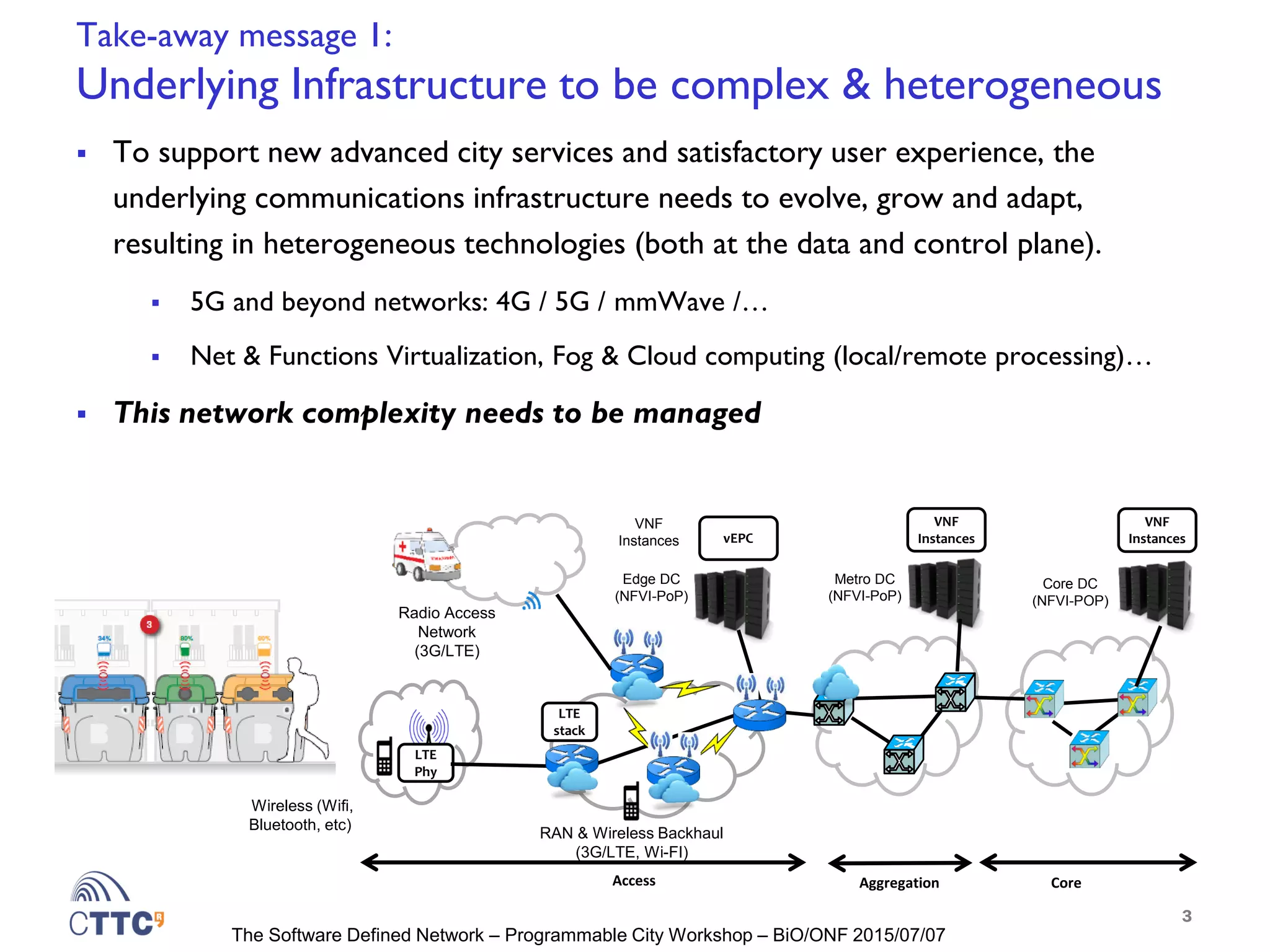
 To support new advanced city services and satisfactory user experience, the
underlying communications infrastructure needs to evolve, grow and adapt,
resulting in heterogeneous technologies (both at the data and control plane).
 5G and beyond networks: 4G / 5G / mmWave /…
 Net & Functions Virtualization, Fog & Cloud computing (local/remote processing)…
 This network complexity needs to be managed
3
VNF
InstancesvEPC
VNF
Instances
Edge DC
(NFVI-PoP)
Core DC
(NFVI-POP)
Access Aggregation Core
RAN & Wireless Backhaul
(3G/LTE, Wi-FI)
LTE
Phy
LTE
stack
Metro DC
(NFVI-PoP)
VNF
Instances
Radio Access
Network
(3G/LTE)
Wireless (Wifi,
Bluetooth, etc)
The Software Defined Network – Programmable City Workshop – BiO/ONF 2015/07/07
Take-away message 2:
Programmable optical technologies still much relevant
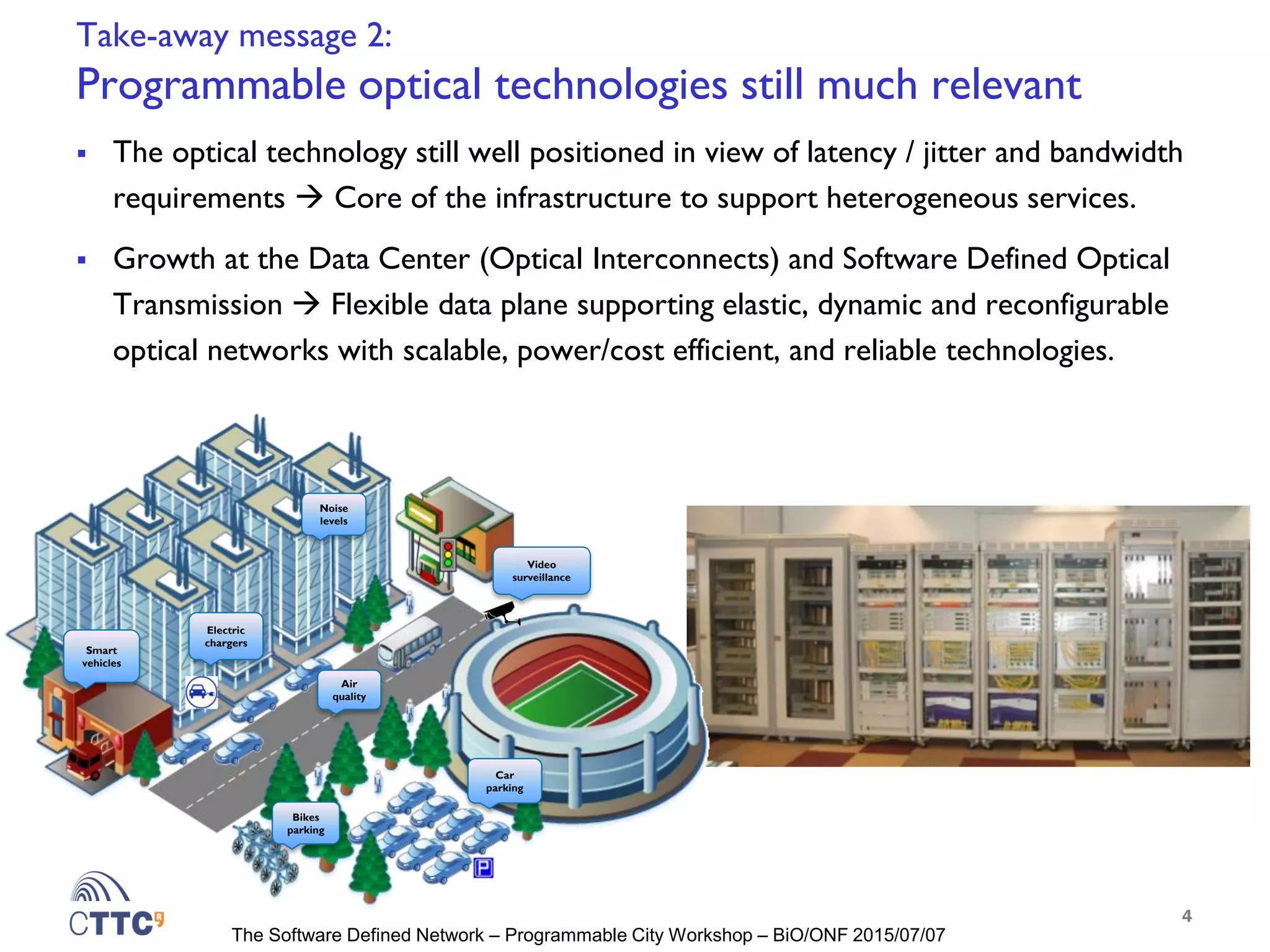
 The optical technology still well positioned in view of latency / jitter and bandwidth
requirements  Core of the infrastructure to support heterogeneous services.
 Growth at the Data Center (Optical Interconnects) and Software Defined Optical
Transmission  Flexible data plane supporting elastic, dynamic and reconfigurable
optical networks with scalable, power/cost efficient, and reliable technologies.
4
Electric
chargers
Air
quality
Noise
levels
Bikes
parking
Video
surveillance
Smart
vehicles
Car
parking
The Software Defined Network – Programmable City Workshop – BiO/ONF 2015/07/07
Take-away message 3:
Integration of SDN in a “CityOS” environment
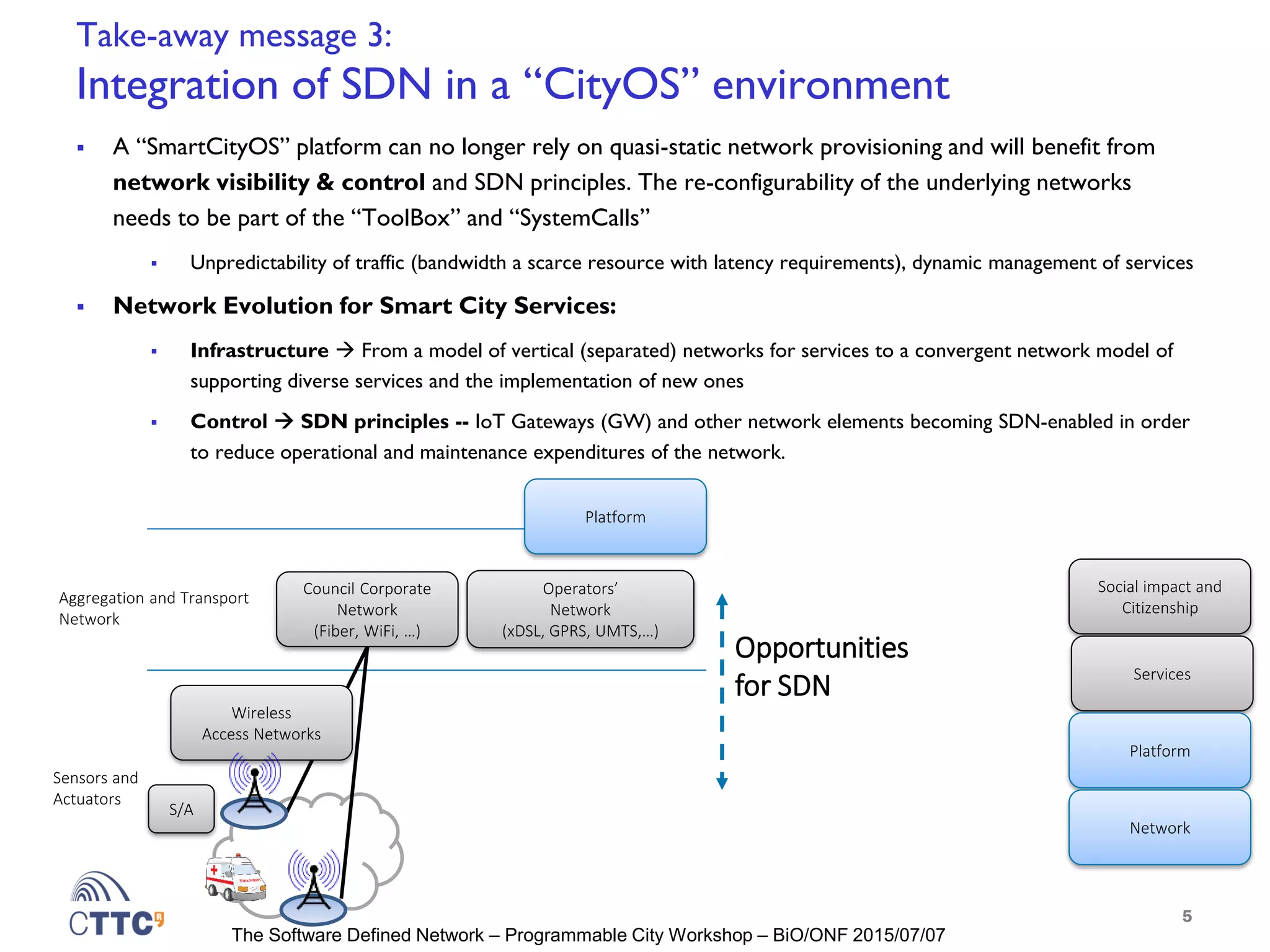
 A “SmartCityOS” platform can no longer rely on quasi-static network provisioning and will benefit from
network visibility & control and SDN principles. The re-configurability of the underlying networks
needs to be part of the “ToolBox” and “SystemCalls”
 Unpredictability of traffic (bandwidth a scarce resource with latency requirements), dynamic management of services
 Network Evolution for Smart City Services:
 Infrastructure  From a model of vertical (separated) networks for services to a convergent network model of
supporting diverse services and the implementation of new ones
 Control  SDN principles -- IoT Gateways (GW) and other network elements becoming SDN-enabled in order
to reduce operational and maintenance expenditures of the network.
5
Social impact and
Citizenship
Services
Platform
Network
Council Corporate
Network
(Fiber, WiFi, …)
Operators’
Network
(xDSL, GPRS, UMTS,…)
Sensors and
Actuators
Aggregation and Transport
Network
S/A
Wireless
Access Networks
Opportunities
for SDN
Platform
The Software Defined Network – Programmable City Workshop – BiO/ONF 2015/07/07
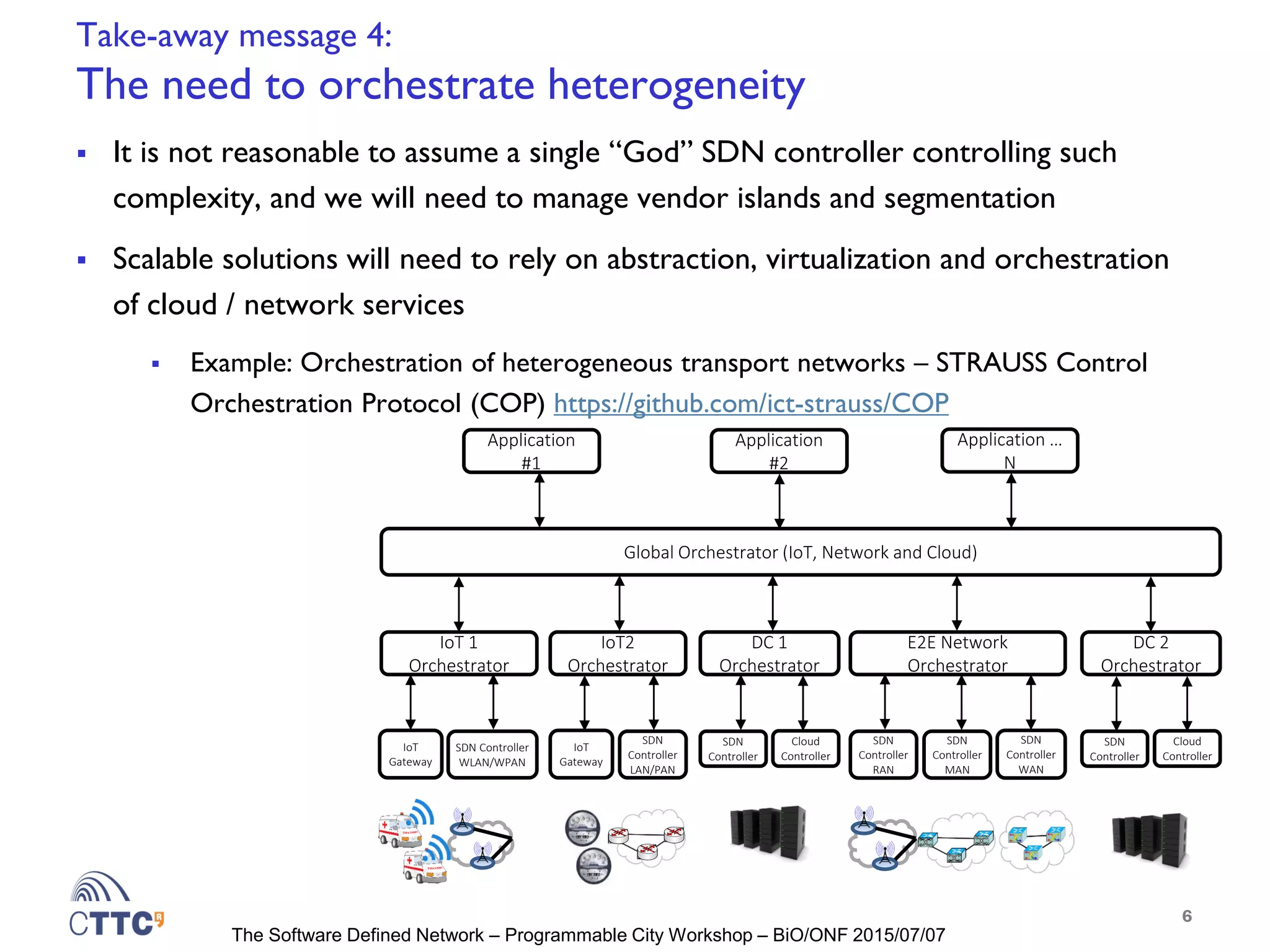
Take-away message 4:
The need to orchestrate heterogeneity
 It is not reasonable to assume a single “God” SDN controller controlling such
complexity, and we will need to manage vendor islands and segmentation
 Scalable solutions will need to rely on abstraction, virtualization and orchestration
of cloud / network services
 Example: Orchestration of heterogeneous transport networks – STRAUSS Control
Orchestration Protocol (COP) https://github.com/ict-strauss/COP
6
SDN
Controller
DC 2
Orchestrator
SDN
Controller
MAN
E2E Network
Orchestrator
SDN
Controller
WAN
Global Orchestrator (IoT, Network and Cloud)
Cloud
Controller
SDN
Controller
RAN
SDN
Controller
DC 1
Orchestrator
Cloud
Controller
IoT
Gateway
SDN Controller
WLAN/WPAN
IoT 1
Orchestrator
SDN
Controller
LAN/PAN
IoT2
Orchestrator
IoT
Gateway
Application
#1
Application
#2
Application …
N
The Software Defined Network – Programmable City Workshop – BiO/ONF 2015/07/07
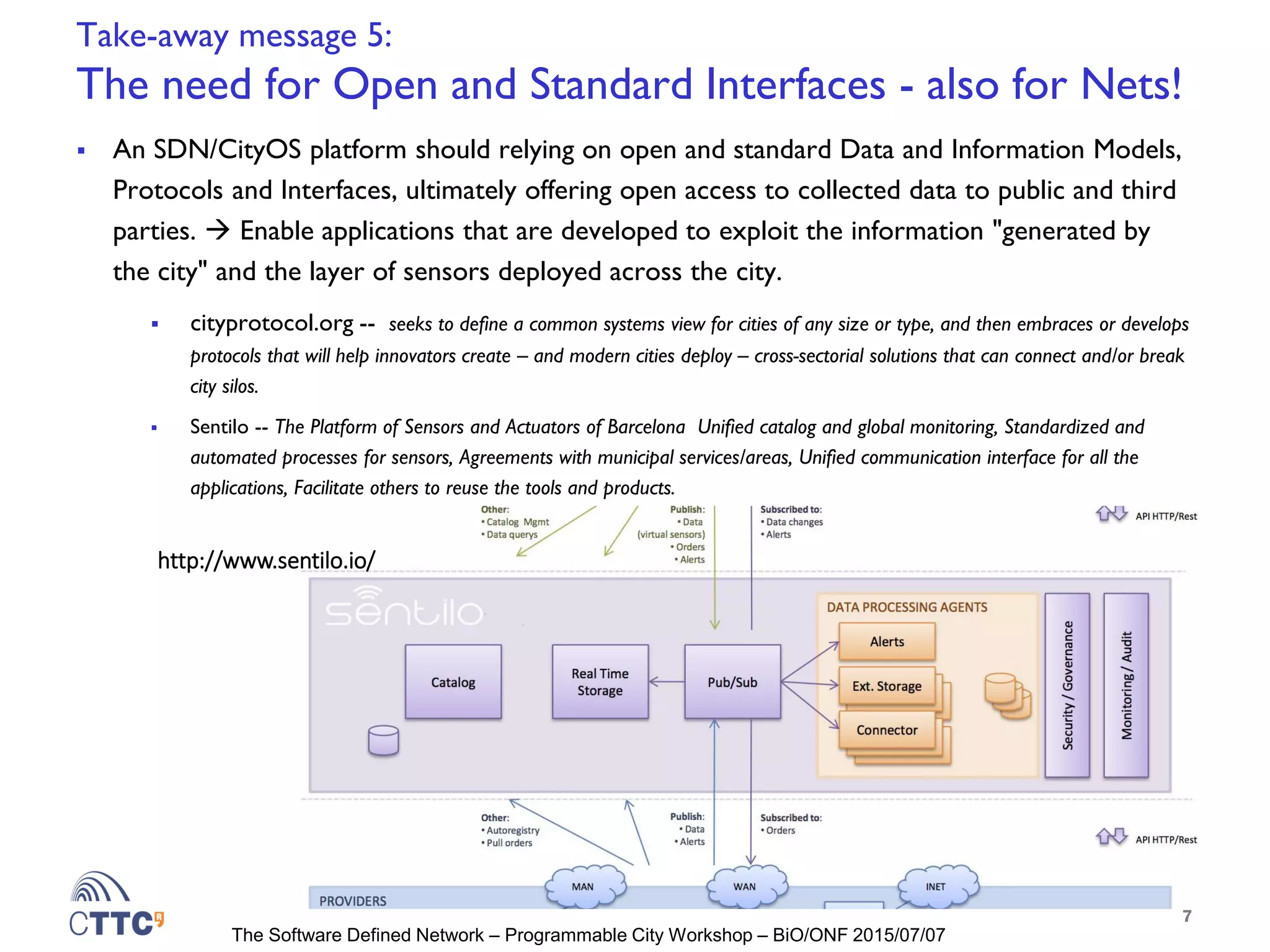
Take-away message 5:
The need for Open and Standard Interfaces - also for Nets!
 An SDN/CityOS platform should relying on open and standard Data and Information Models,
Protocols and Interfaces, ultimately offering open access to collected data to public and third
parties.  Enable applications that are developed to exploit the information "generated by
the city" and the layer of sensors deployed across the city.
 cityprotocol.org -- seeks to define a common systems view for cities of any size or type, and then embraces or develops
protocols that will help innovators create – and modern cities deploy – cross-sectorial solutions that can connect and/or break
city silos.
 Sentilo -- The Platform of Sensors and Actuators of Barcelona Unified catalog and global monitoring, Standardized and
automated processes for sensors, Agreements with municipal services/areas, Unified communication interface for all the
applications, Facilitate others to reuse the tools and products.
7
http://www.sentilo.io/
The Software Defined Network – Programmable City Workshop – BiO/ONF 2015/07/07
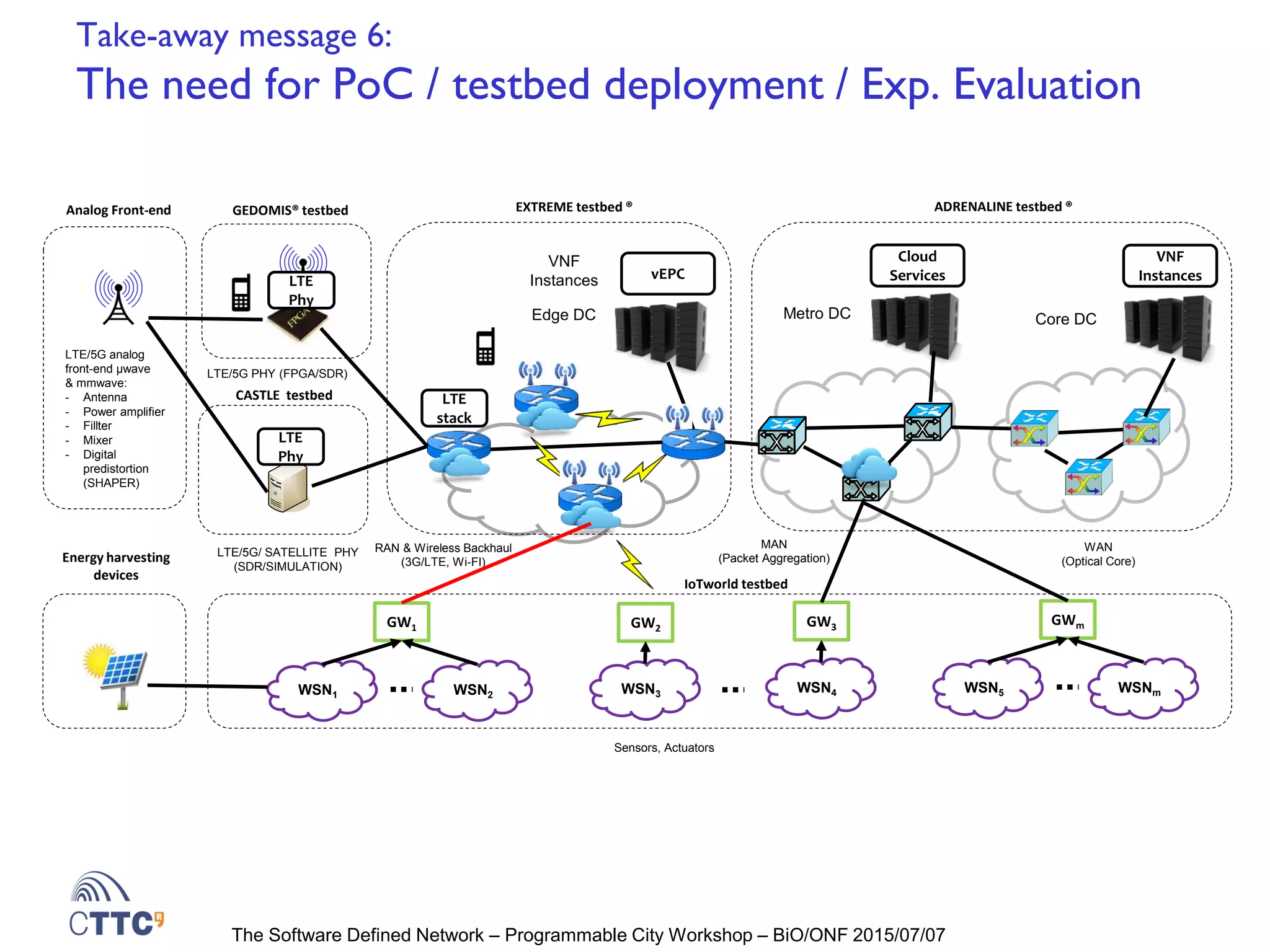
Take-away message 6:
The need for PoC / testbed deployment / Exp. Evaluation
VNF
InstancesvEPC
VNF
Instances
Edge DC Core DC
ADRENALINE testbed ®EXTREME testbed ®
RAN & Wireless Backhaul
(3G/LTE, Wi-FI)
MAN
(Packet Aggregation)
WAN
(Optical Core)
LTE/5G/ SATELLITE PHY
(SDR/SIMULATION)
CASTLE testbed LTE
stack
Metro DC
Cloud
Services
IoTworld testbed
Analog Front-end GEDOMIS® testbed
LTE/5G analog
front-end µwave
& mmwave:
- Antenna
- Power amplifier
- Fillter
- Mixer
- Digital
predistortion
(SHAPER)
GWmGW3
WSNmWSN5WSN4
GW2
WSN3
GW1
WSN2WSN1
Sensors, Actuators
LTE
Phy
LTE
Phy
LTE/5G PHY (FPGA/SDR)
Energy harvesting
devices
Thank you!
Questions?
ramon.casellas@cttc.es
http://networks.cttc.es/ons
This work was supported by the European Community’s Seventh Framework Programme FP7/2007-2013
through the STRAUSS project (608528) and IDEALIST project (317999)

Smart Cities, IoT, SDN, 5G Networks, Cloud Computing… Managing Complexity with SDN Orchestration

  • 1.
    Smart Cities, IoT,SDN, 5G Networks, Cloud Computing… Managing Complexity with SDN Orchestration Service & Content Providers’ Perspective of Smart Cities - How to enrich citizen experience using a pervasive urban SDN connectivity environment Ramon Casellas, Ricard Vilalta, Raül Muñoz and Ricardo Martínez The Software Defined Network – Programmable City Workshop - Bristol
  • 2.
    The Software DefinedNetwork – Programmable City Workshop – BiO/ONF 2015/07/07 Introduction: Smart cities & IoT  Smart city  Monitors critical infrastructures, optimizes resources, plans maintenance, offers services to citizens and users.  50 billion devices expected to connect to the Internet by 2020 [Cisco, 2013]  Complexity management of monitoring, real-time data evaluation, …  Enhance/Automate decision-making?  Key elements:  Sensors/actuators (monitoring functionality, large amount of data flows)  Network (dynamic, large bandwidth)  Cloud (centralized approach) / Fog (distributed approach – end-user proximity)  Key requirements:  More agile IoT to accommodate the increased amount of transmitted data along with the expansion of connected devices  Flexible/elastic, dynamically adapting and large bandwidth network to connect sensors-to-cloud, cloud-to-cloud and multiple end-users  High-capacity, fast processing, low latency to ensure quality of service and quality of experience http://smartcity.bcn.cat
  • 3.
    The Software DefinedNetwork – Programmable City Workshop – BiO/ONF 2015/07/07 Take-away message 1: Underlying Infrastructure to be complex & heterogeneous  To support new advanced city services and satisfactory user experience, the underlying communications infrastructure needs to evolve, grow and adapt, resulting in heterogeneous technologies (both at the data and control plane).  5G and beyond networks: 4G / 5G / mmWave /…  Net & Functions Virtualization, Fog & Cloud computing (local/remote processing)…  This network complexity needs to be managed 3 VNF InstancesvEPC VNF Instances Edge DC (NFVI-PoP) Core DC (NFVI-POP) Access Aggregation Core RAN & Wireless Backhaul (3G/LTE, Wi-FI) LTE Phy LTE stack Metro DC (NFVI-PoP) VNF Instances Radio Access Network (3G/LTE) Wireless (Wifi, Bluetooth, etc)
  • 4.
    The Software DefinedNetwork – Programmable City Workshop – BiO/ONF 2015/07/07 Take-away message 2: Programmable optical technologies still much relevant  The optical technology still well positioned in view of latency / jitter and bandwidth requirements  Core of the infrastructure to support heterogeneous services.  Growth at the Data Center (Optical Interconnects) and Software Defined Optical Transmission  Flexible data plane supporting elastic, dynamic and reconfigurable optical networks with scalable, power/cost efficient, and reliable technologies. 4 Electric chargers Air quality Noise levels Bikes parking Video surveillance Smart vehicles Car parking
  • 5.
    The Software DefinedNetwork – Programmable City Workshop – BiO/ONF 2015/07/07 Take-away message 3: Integration of SDN in a “CityOS” environment  A “SmartCityOS” platform can no longer rely on quasi-static network provisioning and will benefit from network visibility & control and SDN principles. The re-configurability of the underlying networks needs to be part of the “ToolBox” and “SystemCalls”  Unpredictability of traffic (bandwidth a scarce resource with latency requirements), dynamic management of services  Network Evolution for Smart City Services:  Infrastructure  From a model of vertical (separated) networks for services to a convergent network model of supporting diverse services and the implementation of new ones  Control  SDN principles -- IoT Gateways (GW) and other network elements becoming SDN-enabled in order to reduce operational and maintenance expenditures of the network. 5 Social impact and Citizenship Services Platform Network Council Corporate Network (Fiber, WiFi, …) Operators’ Network (xDSL, GPRS, UMTS,…) Sensors and Actuators Aggregation and Transport Network S/A Wireless Access Networks Opportunities for SDN Platform
  • 6.
    The Software DefinedNetwork – Programmable City Workshop – BiO/ONF 2015/07/07 Take-away message 4: The need to orchestrate heterogeneity  It is not reasonable to assume a single “God” SDN controller controlling such complexity, and we will need to manage vendor islands and segmentation  Scalable solutions will need to rely on abstraction, virtualization and orchestration of cloud / network services  Example: Orchestration of heterogeneous transport networks – STRAUSS Control Orchestration Protocol (COP) https://github.com/ict-strauss/COP 6 SDN Controller DC 2 Orchestrator SDN Controller MAN E2E Network Orchestrator SDN Controller WAN Global Orchestrator (IoT, Network and Cloud) Cloud Controller SDN Controller RAN SDN Controller DC 1 Orchestrator Cloud Controller IoT Gateway SDN Controller WLAN/WPAN IoT 1 Orchestrator SDN Controller LAN/PAN IoT2 Orchestrator IoT Gateway Application #1 Application #2 Application … N
  • 7.
    The Software DefinedNetwork – Programmable City Workshop – BiO/ONF 2015/07/07 Take-away message 5: The need for Open and Standard Interfaces - also for Nets!  An SDN/CityOS platform should relying on open and standard Data and Information Models, Protocols and Interfaces, ultimately offering open access to collected data to public and third parties.  Enable applications that are developed to exploit the information "generated by the city" and the layer of sensors deployed across the city.  cityprotocol.org -- seeks to define a common systems view for cities of any size or type, and then embraces or develops protocols that will help innovators create – and modern cities deploy – cross-sectorial solutions that can connect and/or break city silos.  Sentilo -- The Platform of Sensors and Actuators of Barcelona Unified catalog and global monitoring, Standardized and automated processes for sensors, Agreements with municipal services/areas, Unified communication interface for all the applications, Facilitate others to reuse the tools and products. 7 http://www.sentilo.io/
  • 8.
    The Software DefinedNetwork – Programmable City Workshop – BiO/ONF 2015/07/07 Take-away message 6: The need for PoC / testbed deployment / Exp. Evaluation VNF InstancesvEPC VNF Instances Edge DC Core DC ADRENALINE testbed ®EXTREME testbed ® RAN & Wireless Backhaul (3G/LTE, Wi-FI) MAN (Packet Aggregation) WAN (Optical Core) LTE/5G/ SATELLITE PHY (SDR/SIMULATION) CASTLE testbed LTE stack Metro DC Cloud Services IoTworld testbed Analog Front-end GEDOMIS® testbed LTE/5G analog front-end µwave & mmwave: - Antenna - Power amplifier - Fillter - Mixer - Digital predistortion (SHAPER) GWmGW3 WSNmWSN5WSN4 GW2 WSN3 GW1 WSN2WSN1 Sensors, Actuators LTE Phy LTE Phy LTE/5G PHY (FPGA/SDR) Energy harvesting devices
  • 9.
    Thank you! Questions? ramon.casellas@cttc.es http://networks.cttc.es/ons This workwas supported by the European Community’s Seventh Framework Programme FP7/2007-2013 through the STRAUSS project (608528) and IDEALIST project (317999)