From rails-way to
modular architecture
Ivan Nemytchenko,
independent consultant
DevConf 2014
@inem, @inemation
Icon made by <a href="http://www.freepik.com" alt="Freepik.com">Freepik</a>
from <a href="http://www.flaticon.com/free-icon/graduate-cap_46045">flaticon.com</a>
Icon made by Icons8 from <a href="http://www.flaticon.com">flaticon.com</a>
4 bit.ly/rails-community
!"---→----→----→----→----#
Rails-way
Модульная архитектура -
это что?
4 изменения в коде делать легко
4 код легко переиспользовать
4 код легко тестировать
Чем плох rails-
way?
Single Responsibility
Principle
- Не, не слышали
Skinny controllers,
fat models.
ORLY?
Conventions over
configuration
DB ⇆ Forms
Проект
4 Монолитное приложение на Grails
4 База данных на 70 таблиц
4 Мы упоролись
Решение заказчика
4 Фронтенд на AngularJS
4 Бэкэнд на рельсе для отдачи API
Ок, rails, значит
rails
Точнее, rails-api
Модели
class ImageSettings < ActiveRecord::Base
end
class Profile < ActiveRecord::Base
self.table_name = 'profile'
belongs_to :image, foreign_key: :picture_id
end
Модели
class Image < ActiveRecord::Base
self.table_name = 'image'
has_and_belongs_to_many :image_variants,
join_table: "image_image",
class_name: "Image",
association_foreign_key: :image_images_id
belongs_to :settings,
foreign_key: :settings_id,
class_name: 'ImageSettings'
belongs_to :asset
end
RABL - github.com/nesquena/
rabl
collection @object
attribute :id, :deleted, :username, :age
node :gender do |object|
object.gender.to_s
end
node :thumbnail_image_url do |obj|
obj.thumbnail_image.asset.url
end
node :standard_image_url do |obj|
obj.standard_image.asset.url
end
!-"--→----→----→----→----#
def redeem
unless bonuscode = Bonuscode.find_by_hash(params[:code])
render json: {error: 'Bonuscode not found'}, status: 404 and return
end
if bonuscode.used?
render json: {error: 'Bonuscode is already used'}, status: 404 and return
end
unless recipient = User.find_by_id(params[:receptor_id])
render json: {error: 'Recipient not found'}, status: 404 and return
end
unless ['regular', 'paying'].include?(recipient.type)
render json: {error: 'Incorrect user type'}, status: 404 and return
end
ActiveRecord::Base.transaction do
amount = bonuscode.mark_as_used!(params[:receptor_id])
recipient.increase_balance!(amount)
if recipient.save && bonuscode.save
render json: {balance: recipient.balance}, status: 200 and return
else
render json: {error: 'Error during transaction'}, status: 500 and return
end
end
end
def redeem
begin
recipient_balance = ??????????
rescue BonuscodeNotFound, BonuscodeIsAlreadyUsed, RecipientNotFound => ex
render json: {error: ex.message}, status: 404 and return
rescue IncorrectRecipientType => ex
render json: {error: ex.message}, status: 403 and return
rescue TransactionError => ex
render json: {error: ex.message}, status: 500 and return
end
render json: {balance: recipient_balance}
end
bonuscode.redeem(user)
или
user.redeem_bonuscode(code)
?
Service/Use case:
def redeem
use_case = RedeemBonuscode.new
begin
recipient_balance = use_case.run!(params[:code], params[:receptor_id])
rescue BonuscodeNotFound, BonuscodeIsAlreadyUsed, RecipientNotFound => ex
render json: {error: ex.message}, status: 404 and return
rescue IncorrectRecipientType => ex
render json: {error: ex.message}, status: 403 and return
rescue TransactionError => ex
render json: {error: ex.message}, status: 500 and return
end
render json: {balance: recipient_balance}
end
class RedeemBonuscode
def run!(hashcode, recipient_id)
raise BonuscodeNotFound.new unless bonuscode = find_bonuscode(hashcode)
raise RecipientNotFound.new unless recipient = find_recipient(recipient_id)
raise BonuscodeIsAlreadyUsed.new if bonuscode.used?
raise IncorrectRecipientType.new unless correct_user_type?(recipient.type)
ActiveRecord::Base.transaction do
amount = bonuscode.redeem!(recipient_id)
recipient.increase_balance!(amount)
recipient.save! && bonuscode.save!
end
recipient.balance
end
private
...
end
!---→-"---→----→----→----#
Incoming!!!
4 В таблице "users" по
факту хранятся разные
типы пользователей и
для них нужны разные
правила валидации
4 Это как минимум
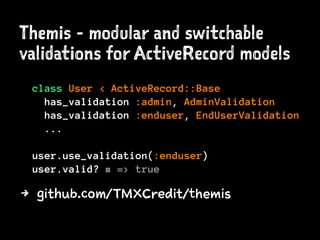
Themis - modular and switchable
validations for ActiveRecord models
class User < ActiveRecord::Base
has_validation :admin, AdminValidation
has_validation :enduser, EndUserValidation
...
user.use_validation(:enduser)
user.valid? # => true
4 github.com/TMXCredit/themis
module EndUserValidation
extend Themis::Validation
validates_presence_of :username, :password, :email
validates :password, length: { minimum: 6 }
validates :email, email: true
end
!---→---"-→----→----→----#
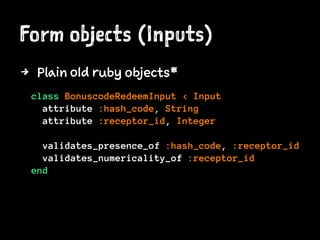
Form objects (Inputs)
4 Plain old ruby objects*
class BonuscodeRedeemInput < Input
attribute :hash_code, String
attribute :receptor_id, Integer
validates_presence_of :hash_code, :receptor_id
validates_numericality_of :receptor_id
end
Form objects (Inputs)
class Input
include Virtus.model
include ActiveModel::Validations
class ValidationError < StandardError; end
def validate!
raise ValidationError.new, errors unless valid?
end
end
!---→----→---"-→----→----#
Incoming!
Заказчику нужен небольшой
сервис сбоку
mkdir sinatra-app
cd sinatra-app
git init .
class SenderApp < Sinatra::Base
get '/sms/create/:message/:number' do
input = MessageInput.new(params)
sender = TwilioMessageSender.new('xxxxxx', 'xxxxxx', '+15005550006')
use_case = SendSms.new(input, sender)
begin
use_case.run!
rescue ValidationError => ex
status 403 and return ex.message
rescue SendingError => ex
status 500 and return ex.message
end
status 201
end
end
Sinatra
4 встраивается в рельсовые роуты или
запускается в связке с другими rack-
приложениями
4 рельсовые роуты оказались ненужной
абстракцией
4 отчего бы не применить такой подход для
всего приложения?!
!---→----→----→--"--→----#
А как же разделение
бизнес-логики и
хранения данных?
4 Очень хочется но непонятно как
4 Репозитории?
Entities
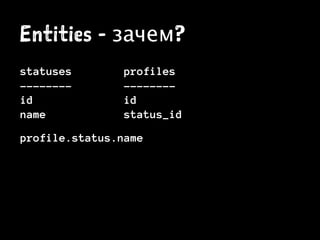
Entities - зачем?
statuses profiles
-------- --------
id id
name status_id
profile.status.name
Entities
4 Plain old ruby objects*
class User < Entity
attribute :id, Integer
attribute :username, String
attribute :max_profiles, Integer, default: 3
attribute :profiles, Array[Profile]
attribute :roles, Array
end
Entities
4 Plain old ruby objects*
class Entity
include Virtus.model
def new_record?
!id
end
end
Repositories
Repositories - чем
занимаются?
4 найди мне объект с таким-то id
4 дай мне все объекты по такому-то
условию
4 сохрани вот эти данные в виде объекта
AR-flavored repositories
4 под капотом все те же ActiveRecord
модели
4 репозиторий отдает инстансы Entities
Первая попытка:
AR-flavored repositories
NEVER AGAIN!
Sequel FTW!
sequel.jeremyevans.net
4 DSL для построения SQL-запросов
4 реализация паттерна ActiveRecord
Repositories
def find(id)
dataset = table.select(:id, :username, :enabled,
:date_created, :last_updated).where(id: id)
user = User.new(dataset.first)
user.roles = get_roles(id)
user
end
Repositories
def find(id)
to_add = [:gender__name___gender, :profile_status__name___status,
:picture_id___image_id]
dataset = table.join(:profile_status, id: :profile_status_id)
.join(:gender, id: :profile__gender_id)
.select_all(:profile).select_append(*to_add)
.where(profile__id: id)
all = dataset.all.map do |record|
Profile.new(record)
end
all.size > 1 ? all : all.first
end
Repositories
def persist(profile)
status_id = DB[:online_profile_status].select(:id).where(name: profile.status).get(:id)
gender_id = DB[:gender].select(:id).where(name: profile.gender).get(:id)
hash = { username: profile.username,
profile_status_id: status_id,
gender_id: gender_id,
picture_id: profile.image_id }
if profile.new_record?
dates = { date_created: Time.now.utc, last_updated: Time.now.utc }
profile.id = table.insert(hash.merge! dates)
else
table.where(id: profile.id).update(hash)
end
end
Repositories
class ImageRepo
class ImageData < Sequel::Model
set_dataset DB[:image].join(:asset, asset__id: :image__asset_id)
many_to_many :images,
join_table: :image_image,
left_key: :image_id,
right_key: :image_images_id,
class: self
end
...
Benefits?
!---→----→----→----→---"-#
Presenters
class ProfilePresenter
def initialize(p, viewer)
...
def wrap!
hash = { id: p.id, deleted: p.deleted,
username: p.username, is_online: p.is_online }
hash[:user_id] = p.user_id if viewer.admin?
hash[:image] = p.image.to_hash if add_image?
hash
end
def self.wrap!(profiles, viewer)
profiles.map do |profile|
new(profile, viewer).wrap!
end
end
...
end
Presenters
post '/profile' do
begin
use_case = CreateProfile.new(current_user)
profile = use_case.run!(params)
rescue Input::ValidationError => ex
halt 403
end
wrapped_profiles = ProfilePresenter.wrap!([profile], current_user)
json(data: wrapped_profiles)
end
!---→----→----→----→----"#
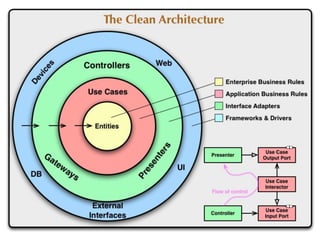
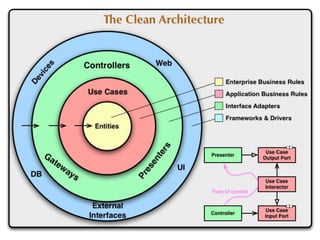
Hexagonal/Clean
Architecture
From rails-way to
modular architecture
Ivan Nemytchenko,
independent consultant
DevConf 2014
@inem, @inemation

От Rails-way к модульной архитектуре

  • 1.
    From rails-way to modulararchitecture Ivan Nemytchenko, independent consultant DevConf 2014 @inem, @inemation
  • 2.
    Icon made by<a href="http://www.freepik.com" alt="Freepik.com">Freepik</a> from <a href="http://www.flaticon.com/free-icon/graduate-cap_46045">flaticon.com</a> Icon made by Icons8 from <a href="http://www.flaticon.com">flaticon.com</a>
  • 4.
  • 6.
  • 7.
  • 8.
    Модульная архитектура - эточто? 4 изменения в коде делать легко 4 код легко переиспользовать 4 код легко тестировать
  • 9.
  • 10.
  • 11.
  • 12.
  • 13.
    Проект 4 Монолитное приложениена Grails 4 База данных на 70 таблиц 4 Мы упоролись
  • 14.
    Решение заказчика 4 Фронтендна AngularJS 4 Бэкэнд на рельсе для отдачи API
  • 15.
  • 16.
    Модели class ImageSettings <ActiveRecord::Base end class Profile < ActiveRecord::Base self.table_name = 'profile' belongs_to :image, foreign_key: :picture_id end
  • 17.
    Модели class Image <ActiveRecord::Base self.table_name = 'image' has_and_belongs_to_many :image_variants, join_table: "image_image", class_name: "Image", association_foreign_key: :image_images_id belongs_to :settings, foreign_key: :settings_id, class_name: 'ImageSettings' belongs_to :asset end
  • 18.
    RABL - github.com/nesquena/ rabl collection@object attribute :id, :deleted, :username, :age node :gender do |object| object.gender.to_s end node :thumbnail_image_url do |obj| obj.thumbnail_image.asset.url end node :standard_image_url do |obj| obj.standard_image.asset.url end
  • 19.
  • 20.
    def redeem unless bonuscode= Bonuscode.find_by_hash(params[:code]) render json: {error: 'Bonuscode not found'}, status: 404 and return end if bonuscode.used? render json: {error: 'Bonuscode is already used'}, status: 404 and return end unless recipient = User.find_by_id(params[:receptor_id]) render json: {error: 'Recipient not found'}, status: 404 and return end unless ['regular', 'paying'].include?(recipient.type) render json: {error: 'Incorrect user type'}, status: 404 and return end ActiveRecord::Base.transaction do amount = bonuscode.mark_as_used!(params[:receptor_id]) recipient.increase_balance!(amount) if recipient.save && bonuscode.save render json: {balance: recipient.balance}, status: 200 and return else render json: {error: 'Error during transaction'}, status: 500 and return end end end
  • 22.
    def redeem begin recipient_balance =?????????? rescue BonuscodeNotFound, BonuscodeIsAlreadyUsed, RecipientNotFound => ex render json: {error: ex.message}, status: 404 and return rescue IncorrectRecipientType => ex render json: {error: ex.message}, status: 403 and return rescue TransactionError => ex render json: {error: ex.message}, status: 500 and return end render json: {balance: recipient_balance} end
  • 23.
  • 24.
    Service/Use case: def redeem use_case= RedeemBonuscode.new begin recipient_balance = use_case.run!(params[:code], params[:receptor_id]) rescue BonuscodeNotFound, BonuscodeIsAlreadyUsed, RecipientNotFound => ex render json: {error: ex.message}, status: 404 and return rescue IncorrectRecipientType => ex render json: {error: ex.message}, status: 403 and return rescue TransactionError => ex render json: {error: ex.message}, status: 500 and return end render json: {balance: recipient_balance} end
  • 25.
    class RedeemBonuscode def run!(hashcode,recipient_id) raise BonuscodeNotFound.new unless bonuscode = find_bonuscode(hashcode) raise RecipientNotFound.new unless recipient = find_recipient(recipient_id) raise BonuscodeIsAlreadyUsed.new if bonuscode.used? raise IncorrectRecipientType.new unless correct_user_type?(recipient.type) ActiveRecord::Base.transaction do amount = bonuscode.redeem!(recipient_id) recipient.increase_balance!(amount) recipient.save! && bonuscode.save! end recipient.balance end private ... end
  • 26.
  • 27.
    Incoming!!! 4 В таблице"users" по факту хранятся разные типы пользователей и для них нужны разные правила валидации 4 Это как минимум
  • 28.
    Themis - modularand switchable validations for ActiveRecord models class User < ActiveRecord::Base has_validation :admin, AdminValidation has_validation :enduser, EndUserValidation ... user.use_validation(:enduser) user.valid? # => true 4 github.com/TMXCredit/themis
  • 29.
    module EndUserValidation extend Themis::Validation validates_presence_of:username, :password, :email validates :password, length: { minimum: 6 } validates :email, email: true end
  • 30.
  • 31.
    Form objects (Inputs) 4Plain old ruby objects* class BonuscodeRedeemInput < Input attribute :hash_code, String attribute :receptor_id, Integer validates_presence_of :hash_code, :receptor_id validates_numericality_of :receptor_id end
  • 32.
    Form objects (Inputs) classInput include Virtus.model include ActiveModel::Validations class ValidationError < StandardError; end def validate! raise ValidationError.new, errors unless valid? end end
  • 33.
  • 34.
    Incoming! Заказчику нужен небольшой сервиссбоку mkdir sinatra-app cd sinatra-app git init .
  • 35.
    class SenderApp <Sinatra::Base get '/sms/create/:message/:number' do input = MessageInput.new(params) sender = TwilioMessageSender.new('xxxxxx', 'xxxxxx', '+15005550006') use_case = SendSms.new(input, sender) begin use_case.run! rescue ValidationError => ex status 403 and return ex.message rescue SendingError => ex status 500 and return ex.message end status 201 end end
  • 36.
    Sinatra 4 встраивается врельсовые роуты или запускается в связке с другими rack- приложениями 4 рельсовые роуты оказались ненужной абстракцией 4 отчего бы не применить такой подход для всего приложения?!
  • 37.
  • 38.
    А как жеразделение бизнес-логики и хранения данных? 4 Очень хочется но непонятно как 4 Репозитории?
  • 39.
  • 40.
    Entities - зачем? statusesprofiles -------- -------- id id name status_id profile.status.name
  • 41.
    Entities 4 Plain oldruby objects* class User < Entity attribute :id, Integer attribute :username, String attribute :max_profiles, Integer, default: 3 attribute :profiles, Array[Profile] attribute :roles, Array end
  • 42.
    Entities 4 Plain oldruby objects* class Entity include Virtus.model def new_record? !id end end
  • 43.
  • 44.
    Repositories - чем занимаются? 4найди мне объект с таким-то id 4 дай мне все объекты по такому-то условию 4 сохрани вот эти данные в виде объекта
  • 45.
    AR-flavored repositories 4 подкапотом все те же ActiveRecord модели 4 репозиторий отдает инстансы Entities
  • 46.
  • 47.
    Sequel FTW! sequel.jeremyevans.net 4 DSLдля построения SQL-запросов 4 реализация паттерна ActiveRecord
  • 48.
    Repositories def find(id) dataset =table.select(:id, :username, :enabled, :date_created, :last_updated).where(id: id) user = User.new(dataset.first) user.roles = get_roles(id) user end
  • 49.
    Repositories def find(id) to_add =[:gender__name___gender, :profile_status__name___status, :picture_id___image_id] dataset = table.join(:profile_status, id: :profile_status_id) .join(:gender, id: :profile__gender_id) .select_all(:profile).select_append(*to_add) .where(profile__id: id) all = dataset.all.map do |record| Profile.new(record) end all.size > 1 ? all : all.first end
  • 50.
    Repositories def persist(profile) status_id =DB[:online_profile_status].select(:id).where(name: profile.status).get(:id) gender_id = DB[:gender].select(:id).where(name: profile.gender).get(:id) hash = { username: profile.username, profile_status_id: status_id, gender_id: gender_id, picture_id: profile.image_id } if profile.new_record? dates = { date_created: Time.now.utc, last_updated: Time.now.utc } profile.id = table.insert(hash.merge! dates) else table.where(id: profile.id).update(hash) end end
  • 51.
    Repositories class ImageRepo class ImageData< Sequel::Model set_dataset DB[:image].join(:asset, asset__id: :image__asset_id) many_to_many :images, join_table: :image_image, left_key: :image_id, right_key: :image_images_id, class: self end ...
  • 52.
  • 53.
  • 54.
  • 55.
    class ProfilePresenter def initialize(p,viewer) ... def wrap! hash = { id: p.id, deleted: p.deleted, username: p.username, is_online: p.is_online } hash[:user_id] = p.user_id if viewer.admin? hash[:image] = p.image.to_hash if add_image? hash end def self.wrap!(profiles, viewer) profiles.map do |profile| new(profile, viewer).wrap! end end ... end
  • 56.
    Presenters post '/profile' do begin use_case= CreateProfile.new(current_user) profile = use_case.run!(params) rescue Input::ValidationError => ex halt 403 end wrapped_profiles = ProfilePresenter.wrap!([profile], current_user) json(data: wrapped_profiles) end
  • 57.
  • 58.
  • 60.
    From rails-way to modulararchitecture Ivan Nemytchenko, independent consultant DevConf 2014 @inem, @inemation