Radiochemical methods
Ayesha shafi
Objectives
• Basic concept of nuclide and isotopes
• Introduction
• Radiochemical method
• Types of radiochemical methods
• Radiometric analysis
• Isotope dilution analysis
Basic concepts of nuclides and isotopes
• The composition of any nucleus is defined by two numbers.
• The atomic number is the number of protons in the nucleus.
• This defines the chemical nature of the atom.
• It is equal to the total charge on the nucleus.
• The mass number is the total number of nucleons (protons and
neutrons) in the nucleus.
• E.g. has an atomic number of 6 and a mass number of 12.
• A nuclide is an atom with a particular mass number and atomic number.
• Nuclei with the same atomic number but different mass numbers are called isotopes.
12
6C
Radiochemical methods
• Radiochemical methods of analysis depend on the
specific properties include the type and energy of the
radiation emitted, the half-life (t1/2), and the decay
schemes of that particular nuclide.
• Radiochemical methods are both sensitive and
specific.
Types of the radiochemical methods
There are three general types of radio-analytical
methods of analysis:
1. Radiometric analysis (measurement of naturally
occurring radioactivity present in sample).
2. Isotope dilution
3. Activation analysis (activity is introduced in one
or more elements of the sample by radiation).
Radiometric analysis
Radiometric analysis – the use of a radioactive reagent of
known activity to isolate the analyte from the other
components of the sample. The activity of the product is
directly proportional to the amount of the analyte.
Example: Chromate has been determined by precipitating it
with radioactive Ag+ (Ag-111, , , 7.5d) of a known activity.
The limited reactant is the analyte, here CrO4
-2. Determining
the activity of the precipitate of Ag2CrO4 allows for the
determination of the amount of chromate.
Isotope dilution method
Isotopic dilution analysis was introduced by von Hevesy and Hofer
in 1934. It involves the preparation of the analyte in a radioactive
form. A known weight of this compound labeled with isotope
(such as an acid with O-18 or a hydrocarbon with H-2) is then
mixed with the mixture containing the compound to be analyzed.
After treatment to ensure homogeneity between the labeled and
unlabelled species, a portion is recovered as a chemically pure
substance.
Isotope dilution method
• The pure substance is weighed and its radioactivity measured.
• The extent of the dilution of the radioactive sample may then be
calculated and related to the amount of the nonradioactive substance
in the original sample.
• Quantitative recovery (100% yield) is not required for a successful
analysis.
Isotope dilution method
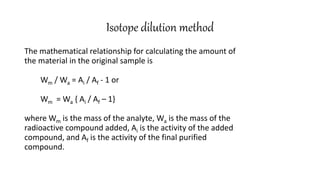
The mathematical relationship for calculating the amount of
the material in the original sample is
Wm / Wa = Ai / Af - 1 or
Wm = Wa { Ai / Af – 1}
where Wm is the mass of the analyte, Wa is the mass of the
radioactive compound added, Ai is the activity of the added
compound, and Af is the activity of the final purified
compound.
Isotope dilution method
Importance of Isotope dilution method:
• Isotopic dilution is especially useful in the analysis of complex
biochemical substances, such as vitamins D and B, insulin,
steroids, that occur a complicated matrix such that methods of
separation and analysis are difficult.
• In a recent work the isotopes are detected by a highly sensitive mass
spectrometer the radioactive form of the compound then acts as an
internal standard for the analysis because the mass of the isotope
used for labeling is different than the non-radioactive form of the
element.
Neutron activation analysis
• Neutron activation analysis (NAA) was discovered in 1936 when
Hevesy and Levi found that samples containing certain rare earth
elements became highly radioactive after exposure to a source of
neutrons. From this observation, they recognized the potential of
employing nuclear reactions on samples followed by measurement of
the induced radioactivity to facilitate both qualitative and quantitative
identification of the elements present in the samples
Neutron activation analysis
There are several ways of inducing the radioactivity in the
atoms present in the sample for analysis. The most
common is neutron activation in which the sample is
irradiated with neutrons. After the irradiation, the gamma
or beta spectrum is obtained, depending on the type of
emission produced by the irradiated element. For
quantitative work, both may be used.
Radiochemical Methods
The basic essentials required to carry out an analysis of
samples by NAA are a source of neutrons,
instrumentation suitable for detecting gamma rays, and a
detailed knowledge of the reactions that occur when
neutrons interact with target nuclei.
Uses of radiochemical method
1. The analysis is used for the determination of cadmium Cd in food
products:
2. The analysis is used for the determination of arsenic As in sea food.
The analysis is used for the determination of mercury Hg in fish.
3. The analysis is used for the determination of Nitrogen N2, Oxygen
O2, Fluorine F2 in organic compounds.
4. The analysis is used for the determination of metal ions in water
(mercury, arsenic, zinc, cadmium, antimony).
Other methods
• Radio immune assay RIA:
• This method is based upon the completion between radiolabelled antigen
(Ag*) and unlabeled antigens (Ag) for binding to a specific antibody (Ab)
serum.
• Ag* + Ag + Ab [Ag*Ab] + [Ag Ab] + [Ag* + Ag]
. Autoradiography:
• The method is used for the detection of separated compounds on the
surface of thin layer plate or paper can be done by this technique.
• Example:
• 16 different amino acids can be located and separated on thin layer plate
by this method.

Radiochemical methods lec

  • 1.
  • 2.
    Objectives • Basic conceptof nuclide and isotopes • Introduction • Radiochemical method • Types of radiochemical methods • Radiometric analysis • Isotope dilution analysis
  • 3.
    Basic concepts ofnuclides and isotopes • The composition of any nucleus is defined by two numbers. • The atomic number is the number of protons in the nucleus. • This defines the chemical nature of the atom. • It is equal to the total charge on the nucleus. • The mass number is the total number of nucleons (protons and neutrons) in the nucleus. • E.g. has an atomic number of 6 and a mass number of 12. • A nuclide is an atom with a particular mass number and atomic number. • Nuclei with the same atomic number but different mass numbers are called isotopes. 12 6C
  • 4.
    Radiochemical methods • Radiochemicalmethods of analysis depend on the specific properties include the type and energy of the radiation emitted, the half-life (t1/2), and the decay schemes of that particular nuclide. • Radiochemical methods are both sensitive and specific.
  • 5.
    Types of theradiochemical methods There are three general types of radio-analytical methods of analysis: 1. Radiometric analysis (measurement of naturally occurring radioactivity present in sample). 2. Isotope dilution 3. Activation analysis (activity is introduced in one or more elements of the sample by radiation).
  • 6.
    Radiometric analysis Radiometric analysis– the use of a radioactive reagent of known activity to isolate the analyte from the other components of the sample. The activity of the product is directly proportional to the amount of the analyte. Example: Chromate has been determined by precipitating it with radioactive Ag+ (Ag-111, , , 7.5d) of a known activity. The limited reactant is the analyte, here CrO4 -2. Determining the activity of the precipitate of Ag2CrO4 allows for the determination of the amount of chromate.
  • 7.
    Isotope dilution method Isotopicdilution analysis was introduced by von Hevesy and Hofer in 1934. It involves the preparation of the analyte in a radioactive form. A known weight of this compound labeled with isotope (such as an acid with O-18 or a hydrocarbon with H-2) is then mixed with the mixture containing the compound to be analyzed. After treatment to ensure homogeneity between the labeled and unlabelled species, a portion is recovered as a chemically pure substance.
  • 8.
    Isotope dilution method •The pure substance is weighed and its radioactivity measured. • The extent of the dilution of the radioactive sample may then be calculated and related to the amount of the nonradioactive substance in the original sample. • Quantitative recovery (100% yield) is not required for a successful analysis.
  • 9.
    Isotope dilution method Themathematical relationship for calculating the amount of the material in the original sample is Wm / Wa = Ai / Af - 1 or Wm = Wa { Ai / Af – 1} where Wm is the mass of the analyte, Wa is the mass of the radioactive compound added, Ai is the activity of the added compound, and Af is the activity of the final purified compound.
  • 10.
    Isotope dilution method Importanceof Isotope dilution method: • Isotopic dilution is especially useful in the analysis of complex biochemical substances, such as vitamins D and B, insulin, steroids, that occur a complicated matrix such that methods of separation and analysis are difficult. • In a recent work the isotopes are detected by a highly sensitive mass spectrometer the radioactive form of the compound then acts as an internal standard for the analysis because the mass of the isotope used for labeling is different than the non-radioactive form of the element.
  • 11.
    Neutron activation analysis •Neutron activation analysis (NAA) was discovered in 1936 when Hevesy and Levi found that samples containing certain rare earth elements became highly radioactive after exposure to a source of neutrons. From this observation, they recognized the potential of employing nuclear reactions on samples followed by measurement of the induced radioactivity to facilitate both qualitative and quantitative identification of the elements present in the samples
  • 12.
    Neutron activation analysis Thereare several ways of inducing the radioactivity in the atoms present in the sample for analysis. The most common is neutron activation in which the sample is irradiated with neutrons. After the irradiation, the gamma or beta spectrum is obtained, depending on the type of emission produced by the irradiated element. For quantitative work, both may be used.
  • 13.
    Radiochemical Methods The basicessentials required to carry out an analysis of samples by NAA are a source of neutrons, instrumentation suitable for detecting gamma rays, and a detailed knowledge of the reactions that occur when neutrons interact with target nuclei.
  • 14.
    Uses of radiochemicalmethod 1. The analysis is used for the determination of cadmium Cd in food products: 2. The analysis is used for the determination of arsenic As in sea food. The analysis is used for the determination of mercury Hg in fish. 3. The analysis is used for the determination of Nitrogen N2, Oxygen O2, Fluorine F2 in organic compounds. 4. The analysis is used for the determination of metal ions in water (mercury, arsenic, zinc, cadmium, antimony).
  • 15.
    Other methods • Radioimmune assay RIA: • This method is based upon the completion between radiolabelled antigen (Ag*) and unlabeled antigens (Ag) for binding to a specific antibody (Ab) serum. • Ag* + Ag + Ab [Ag*Ab] + [Ag Ab] + [Ag* + Ag] . Autoradiography: • The method is used for the detection of separated compounds on the surface of thin layer plate or paper can be done by this technique. • Example: • 16 different amino acids can be located and separated on thin layer plate by this method.