1
INDEX
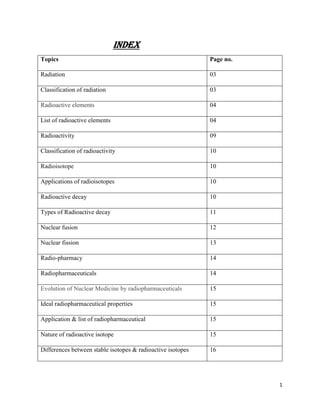
Topics Page no.
Radiation 03
Classification of radiation 03
Radioactive elements 04
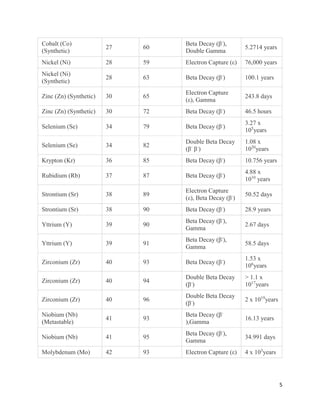
List of radioactive elements 04
Radioactivity 09
Classification of radioactivity 10
Radioisotope 10
Applications of radioisotopes 10
Radioactive decay 10
Types of Radioactive decay 11
Nuclear fusion 12
Nuclear fission 13
Radio-pharmacy 14
Radiopharmaceuticals 14
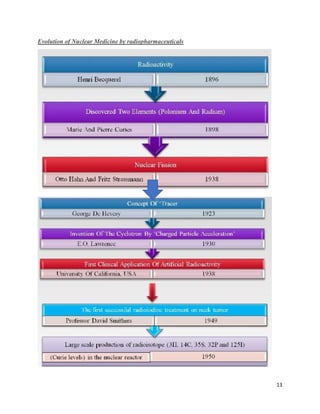
Evolution of Nuclear Medicine by radiopharmaceuticals 15
Ideal radiopharmaceutical properties 15
Application & list of radiopharmaceutical 15
Nature of radioactive isotope 15
Differences between stable isotopes & radioactive isotopes 16
2
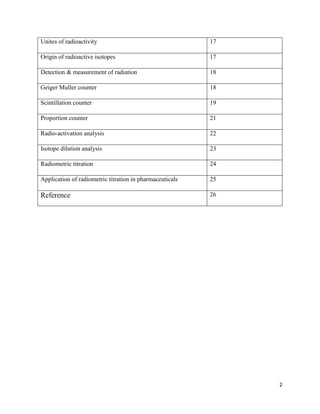
Unites of radioactivity 17
Origin of radioactive isotopes 17
Detection & measurement of radiation 18
Geiger Muller counter 18
Scintillation counter 19
Proportion counter 21
Radio-activation analysis 22
Isotope dilution analysis 23
Radiometric titration 24
Application of radiometric titration in pharmaceuticals 25
Reference 26
3
Radiation
Radiation is the emission and propagation of energy in the form of waves, rays or particles.
Radiation includes emanation of any portion of the electromagnetic spectrum, plus it includes the
release of particles. Examples include:
 A burning candle emits radiation in the form of heat and light.
 The Sun emits radiation in the form of light, heat, and particles.
 Uranium-238 decaying into Thorium-234 emits radiation in the form of alpha particles.
 Electrons dropping from one energy state to a lower state emit radiation in the form of
a photon.
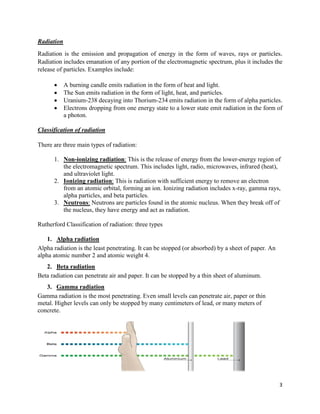
Classification of radiation
There are three main types of radiation:
1. Non-ionizing radiation: This is the release of energy from the lower-energy region of
the electromagnetic spectrum. This includes light, radio, microwaves, infrared (heat),
and ultraviolet light.
2. Ionizing radiation: This is radiation with sufficient energy to remove an electron
from an atomic orbital, forming an ion. Ionizing radiation includes x-ray, gamma rays,
alpha particles, and beta particles.
3. Neutrons: Neutrons are particles found in the atomic nucleus. When they break off of
the nucleus, they have energy and act as radiation.
Rutherford Classification of radiation: three types
1. Alpha radiation
Alpha radiation is the least penetrating. It can be stopped (or absorbed) by a sheet of paper. An
alpha atomic number 2 and atomic weight 4.
2. Beta radiation
Beta radiation can penetrate air and paper. It can be stopped by a thin sheet of aluminum.
3. Gamma radiation
Gamma radiation is the most penetrating. Even small levels can penetrate air, paper or thin
metal. Higher levels can only be stopped by many centimeters of lead, or many meters of
concrete.
4
Radioactive elements
Radioactive elements are the elements that subject to spontaneous degeneration of its nucleus
accompanied by the emission of alpha particles, beta particles, or gamma rays. All elements with
atomic numbers greater than 83 are radioactive. Naturally occurring radioactive elements include
radium, thorium, and uranium.
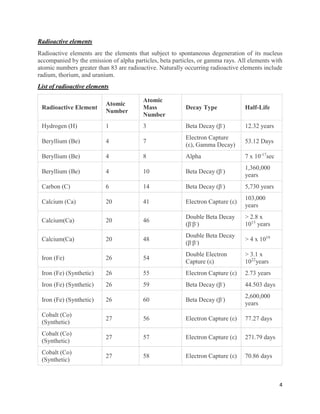
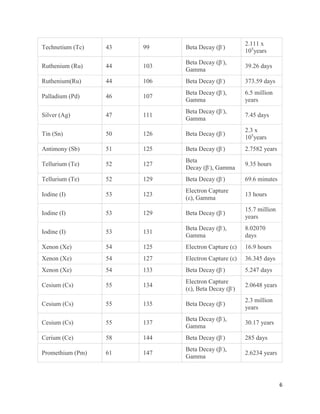
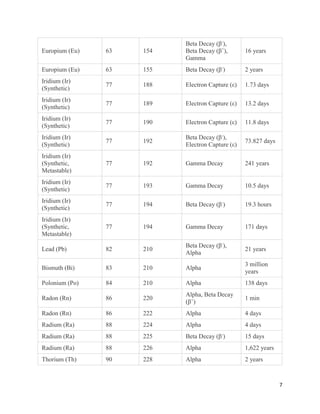
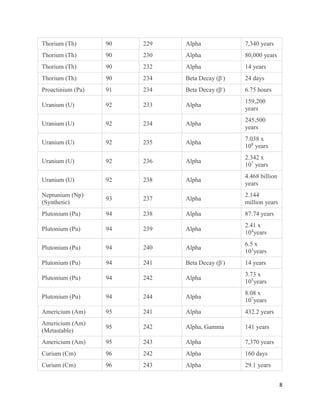
List of radioactive elements
Radioactive Element
Atomic
Number
Atomic
Mass
Number
Decay Type Half-Life
Hydrogen (H) 1 3 Beta Decay (β-
) 12.32 years
Beryllium (Be) 4 7
Electron Capture
(ε), Gamma Decay)
53.12 Days
Beryllium (Be) 4 8 Alpha 7 x 10-17
sec
Beryllium (Be) 4 10 Beta Decay (β-
)
1,360,000
years
Carbon (C) 6 14 Beta Decay (β-
) 5,730 years
Calcium (Ca) 20 41 Electron Capture (ε)
103,000
years
Calcium(Ca) 20 46
Double Beta Decay
(β-
β-
)
> 2.8 x
1015
years
Calcium(Ca) 20 48
Double Beta Decay
(β-
β-
)
> 4 x 10¹⁹
Iron (Fe) 26 54
Double Electron
Capture (ε)
> 3.1 x
1022
years
Iron (Fe) (Synthetic) 26 55 Electron Capture (ε) 2.73 years
Iron (Fe) (Synthetic) 26 59 Beta Decay (β-
) 44.503 days
Iron (Fe) (Synthetic) 26 60 Beta Decay (β-
)
2,600,000
years
Cobalt (Co)
(Synthetic)
27 56 Electron Capture (ε) 77.27 days
Cobalt (Co)
(Synthetic)
27 57 Electron Capture (ε) 271.79 days
Cobalt (Co)
(Synthetic)
27 58 Electron Capture (ε) 70.86 days
5
Cobalt (Co)
(Synthetic)
27 60
Beta Decay (β-
),
Double Gamma
5.2714 years
Nickel (Ni) 28 59 Electron Capture (ε) 76,000 years
Nickel (Ni)
(Synthetic)
28 63 Beta Decay (β-
) 100.1 years
Zinc (Zn) (Synthetic) 30 65
Electron Capture
(ε), Gamma
243.8 days
Zinc (Zn) (Synthetic) 30 72 Beta Decay (β-
) 46.5 hours
Selenium (Se) 34 79 Beta Decay (β-
)
3.27 x
105
years
Selenium (Se) 34 82
Double Beta Decay
(β-
β-
)
1.08 x
1020
years
Krypton (Kr) 36 85 Beta Decay (β-
) 10.756 years
Rubidium (Rb) 37 87 Beta Decay (β-
)
4.88 x
1010
years
Strontium (Sr) 38 89
Electron Capture
(ε), Beta Decay (β-
)
50.52 days
Strontium (Sr) 38 90 Beta Decay (β-
) 28.9 years
Yttrium (Y) 39 90
Beta Decay (β-
),
Gamma
2.67 days
Yttrium (Y) 39 91
Beta Decay (β-
),
Gamma
58.5 days
Zirconium (Zr) 40 93 Beta Decay (β-
)
1.53 x
106
years
Zirconium (Zr) 40 94
Double Beta Decay
(β-
)
> 1.1 x
1017
years
Zirconium (Zr) 40 96
Double Beta Decay
(β-
)
2 x 10¹⁹
years
Niobium (Nb)
(Metastable)
41 93
Beta Decay (β-
),Gamma
16.13 years
Niobium (Nb) 41 95
Beta Decay (β-
),
Gamma
34.991 days
Molybdenum (Mo) 42 93 Electron Capture (ε) 4 x 10³
years
6
Technetium (Tc) 43 99 Beta Decay (β-
)
2.111 x
105
years
Ruthenium (Ru) 44 103
Beta Decay (β-
),
Gamma
39.26 days
Ruthenium(Ru) 44 106 Beta Decay (β-
) 373.59 days
Palladium (Pd) 46 107
Beta Decay (β-
),
Gamma
6.5 million
years
Silver (Ag) 47 111
Beta Decay (β-
),
Gamma
7.45 days
Tin (Sn) 50 126 Beta Decay (β-
)
2.3 x
105
years
Antimony (Sb) 51 125 Beta Decay (β-
) 2.7582 years
Tellurium (Te) 52 127
Beta
Decay (β-
), Gamma
9.35 hours
Tellurium (Te) 52 129 Beta Decay (β-
) 69.6 minutes
Iodine (I) 53 123
Electron Capture
(ε), Gamma
13 hours
Iodine (I) 53 129 Beta Decay (β-
)
15.7 million
years
Iodine (I) 53 131
Beta Decay (β-
),
Gamma
8.02070
days
Xenon (Xe) 54 125 Electron Capture (ε) 16.9 hours
Xenon (Xe) 54 127 Electron Capture (ε) 36.345 days
Xenon (Xe) 54 133 Beta Decay (β-
) 5.247 days
Cesium (Cs) 55 134
Electron Capture
(ε), Beta Decay (β-
)
2.0648 years
Cesium (Cs) 55 135 Beta Decay (β-
)
2.3 million
years
Cesium (Cs) 55 137
Beta Decay (β-
),
Gamma
30.17 years
Cerium (Ce) 58 144 Beta Decay (β-
) 285 days
Promethium (Pm) 61 147
Beta Decay (β-
),
Gamma
2.6234 years
7
Europium (Eu) 63 154
Beta Decay (β-
),
Beta Decay (β+
),
Gamma
16 years
Europium (Eu) 63 155 Beta Decay (β-
) 2 years
Iridium (Ir)
(Synthetic)
77 188 Electron Capture (ε) 1.73 days
Iridium (Ir)
(Synthetic)
77 189 Electron Capture (ε) 13.2 days
Iridium (Ir)
(Synthetic)
77 190 Electron Capture (ε) 11.8 days
Iridium (Ir)
(Synthetic)
77 192
Beta Decay (β-
),
Electron Capture (ε)
73.827 days
Iridium (Ir)
(Synthetic,
Metastable)
77 192 Gamma Decay 241 years
Iridium (Ir)
(Synthetic)
77 193 Gamma Decay 10.5 days
Iridium (Ir)
(Synthetic)
77 194 Beta Decay (β-
) 19.3 hours
Iridium (Ir)
(Synthetic,
Metastable)
77 194 Gamma Decay 171 days
Lead (Pb) 82 210
Beta Decay (β-
),
Alpha
21 years
Bismuth (Bi) 83 210 Alpha
3 million
years
Polonium (Po) 84 210 Alpha 138 days
Radon (Rn) 86 220
Alpha, Beta Decay
(β+
)
1 min
Radon (Rn) 86 222 Alpha 4 days
Radium (Ra) 88 224 Alpha 4 days
Radium (Ra) 88 225 Beta Decay (β-
) 15 days
Radium (Ra) 88 226 Alpha 1,622 years
Thorium (Th) 90 228 Alpha 2 years
8
Thorium (Th) 90 229 Alpha 7,340 years
Thorium (Th) 90 230 Alpha 80,000 years
Thorium (Th) 90 232 Alpha 14 years
Thorium (Th) 90 234 Beta Decay (β-
) 24 days
Proactinium (Pa) 91 234 Beta Decay (β-
) 6.75 hours
Uranium (U) 92 233 Alpha
159,200
years
Uranium (U) 92 234 Alpha
245,500
years
Uranium (U) 92 235 Alpha
7.038 x
108
years
Uranium (U) 92 236 Alpha
2.342 x
107
years
Uranium (U) 92 238 Alpha
4.468 billion
years
Neptunium (Np)
(Synthetic)
93 237 Alpha
2.144
million years
Plutonium (Pu) 94 238 Alpha 87.74 years
Plutonium (Pu) 94 239 Alpha
2.41 x
104
years
Plutonium (Pu) 94 240 Alpha
6.5 x
103
years
Plutonium (Pu) 94 241 Beta Decay (β-
) 14 years
Plutonium (Pu) 94 242 Alpha
3.73 x
105
years
Plutonium (Pu) 94 244 Alpha
8.08 x
107
years
Americium (Am) 95 241 Alpha 432.2 years
Americium (Am)
(Metastable)
95 242 Alpha, Gamma 141 years
Americium (Am) 95 243 Alpha 7,370 years
Curium (Cm) 96 242 Alpha 160 days
Curium (Cm) 96 243 Alpha 29.1 years
9
Curium (Cm) 96 244 Alpha 18.1 years
Curium (Cm) 96 247 Alpha
15.6 million
years
Radioactivity
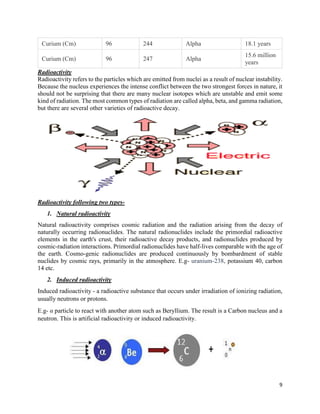
Radioactivity refers to the particles which are emitted from nuclei as a result of nuclear instability.
Because the nucleus experiences the intense conflict between the two strongest forces in nature, it
should not be surprising that there are many nuclear isotopes which are unstable and emit some
kind of radiation. The most common types of radiation are called alpha, beta, and gamma radiation,
but there are several other varieties of radioactive decay.
Radioactivity following two types-
1. Natural radioactivity
Natural radioactivity comprises cosmic radiation and the radiation arising from the decay of
naturally occurring radionuclides. The natural radionuclides include the primordial radioactive
elements in the earth's crust, their radioactive decay products, and radionuclides produced by
cosmic-radiation interactions. Primordial radionuclides have half-lives comparable with the age of
the earth. Cosmo-genic radionuclides are produced continuously by bombardment of stable
nuclides by cosmic rays, primarily in the atmosphere. E.g- uranium-238, potassium 40, carbon
14 etc.
2. Induced radioactivity
Induced radioactivity - a radioactive substance that occurs under irradiation of ionizing radiation,
usually neutrons or protons.
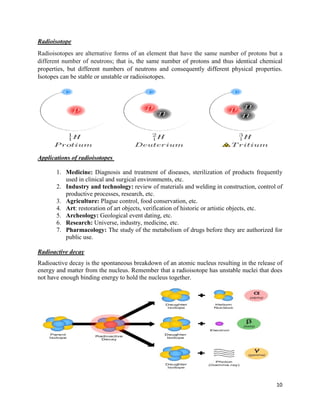
E.g- α particle to react with another atom such as Beryllium. The result is a Carbon nucleus and a
neutron. This is artificial radioactivity or induced radioactivity.
10
Radioisotope
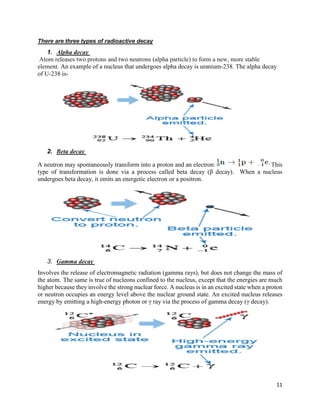
Radioisotopes are alternative forms of an element that have the same number of protons but a
different number of neutrons; that is, the same number of protons and thus identical chemical
properties, but different numbers of neutrons and consequently different physical properties.
Isotopes can be stable or unstable or radioisotopes.
Applications of radioisotopes
1. Medicine: Diagnosis and treatment of diseases, sterilization of products frequently
used in clinical and surgical environments, etc.
2. Industry and technology: review of materials and welding in construction, control of
productive processes, research, etc.
3. Agriculture: Plague control, food conservation, etc.
4. Art: restoration of art objects, verification of historic or artistic objects, etc.
5. Archeology: Geological event dating, etc.
6. Research: Universe, industry, medicine, etc.
7. Pharmacology: The study of the metabolism of drugs before they are authorized for
public use.
Radioactive decay
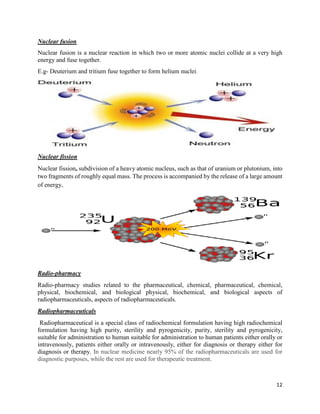
Radioactive decay is the spontaneous breakdown of an atomic nucleus resulting in the release of
energy and matter from the nucleus. Remember that a radioisotope has unstable nuclei that does
not have enough binding energy to hold the nucleus together.
11
There are three types of radioactive decay
1. Alpha decay
Atom releases two protons and two neutrons (alpha particle) to form a new, more stable
element. An example of a nucleus that undergoes alpha decay is uranium-238. The alpha decay
of U-238 is-
2. Beta decay
A neutron may spontaneously transform into a proton and an electron: This
type of transformation is done via a process called beta decay (β decay). When a nucleus
undergoes beta decay, it emits an energetic electron or a positron.
3. Gamma decay
Involves the release of electromagnetic radiation (gamma rays), but does not change the mass of
the atom. The same is true of nucleons confined to the nucleus, except that the energies are much
higher because they involve the strong nuclear force. A nucleus is in an excited state when a proton
or neutron occupies an energy level above the nuclear ground state. An excited nucleus releases
energy by emitting a high-energy photon or γ ray via the process of gamma decay (γ decay).
12
Nuclear fusion
Nuclear fusion is a nuclear reaction in which two or more atomic nuclei collide at a very high
energy and fuse together.
E.g- Deuterium and tritium fuse together to form helium nuclei.
Nuclear fission
Nuclear fission, subdivision of a heavy atomic nucleus, such as that of uranium or plutonium, into
two fragments of roughly equal mass. The process is accompanied by the release of a large amount
of energy.
Radio-pharmacy
Radio-pharmacy studies related to the pharmaceutical, chemical, pharmaceutical, chemical,
physical, biochemical, and biological physical, biochemical, and biological aspects of
radiopharmaceuticals, aspects of radiopharmaceuticals.
Radiopharmaceuticals
Radiopharmaceutical is a special class of radiochemical formulation having high radiochemical
formulation having high purity, sterility and pyrogenicity, purity, sterility and pyrogenicity,
suitable for administration to human suitable for administration to human patients either orally or
intravenously, patients either orally or intravenously, either for diagnosis or therapy either for
diagnosis or therapy. In nuclear medicine nearly 95% of the radiopharmaceuticals are used for
diagnostic purposes, while the rest are used for therapeutic treatment.
13
Evolution of Nuclear Medicine by radiopharmaceuticals
14
Ideal radiopharmaceutical properties
a. Short half-life isotope (Ideally 1.5 times the duration of the diagnostic procedure.)
b. Energy of Gamma Rays: (Ideal: 100-250 keV)
c. Pure gamma emitter
d. Target to Non target Ratio
e. Localization only in tissue desired
f. Easy preparation
g. Economy price
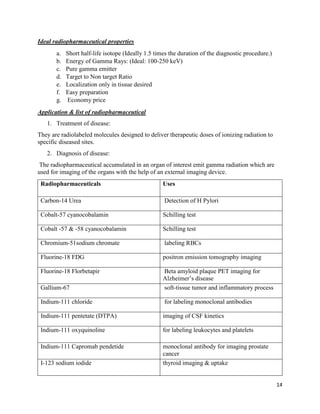
Application & list of radiopharmaceutical
1. Treatment of disease:
They are radiolabeled molecules designed to deliver therapeutic doses of ionizing radiation to
specific diseased sites.
2. Diagnosis of disease:
The radiopharmaceutical accumulated in an organ of interest emit gamma radiation which are
used for imaging of the organs with the help of an external imaging device.
Radiopharmaceuticals Uses
Carbon-14 Urea Detection of H Pylori
Cobalt-57 cyanocobalamin Schilling test
Cobalt -57 & -58 cyanocobalamin Schilling test
Chromium-51sodium chromate labeling RBCs
Fluorine-18 FDG positron emission tomography imaging
Fluorine-18 Florbetapir Beta amyloid plaque PET imaging for
Alzheimer’s disease
Gallium-67 soft-tissue tumor and inflammatory process
Indium-111 chloride for labeling monoclonal antibodies
Indium-111 pentetate (DTPA) imaging of CSF kinetics
Indium-111 oxyquinoline for labeling leukocytes and platelets
Indium-111 Capromab pendetide monoclonal antibody for imaging prostate
cancer
I-123 sodium iodide thyroid imaging & uptake
15
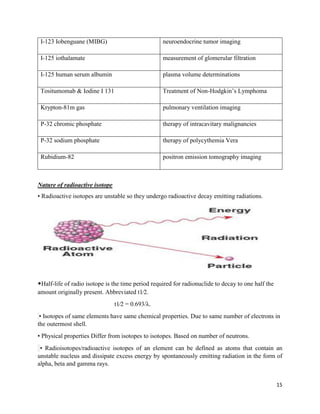
I-123 Iobenguane (MIBG) neuroendocrine tumor imaging
I-125 iothalamate measurement of glomerular filtration
I-125 human serum albumin plasma volume determinations
Tositumomab & Iodine I 131 Treatment of Non-Hodgkin’s Lymphoma
Krypton-81m gas pulmonary ventilation imaging
P-32 chromic phosphate therapy of intracavitary malignancies
P-32 sodium phosphate therapy of polycythemia Vera
Rubidium-82 positron emission tomography imaging
Nature of radioactive isotope
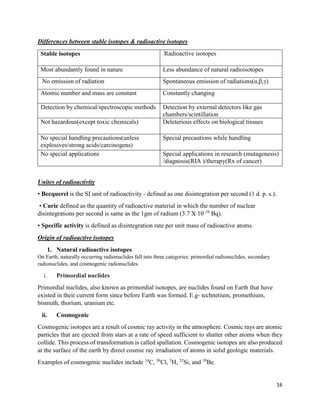
• Radioactive isotopes are unstable so they undergo radioactive decay emitting radiations.
•Half-life of radio isotope is the time period required for radionuclide to decay to one half the
amount originally present. Abbreviated t1⁄2.
t1⁄2 = 0.693/λ.
• Isotopes of same elements have same chemical properties. Due to same number of electrons in
the outermost shell.
• Physical properties Differ from isotopes to isotopes. Based on number of neutrons.
• Radioisotopes/radioactive isotopes of an element can be defined as atoms that contain an
unstable nucleus and dissipate excess energy by spontaneously emitting radiation in the form of
alpha, beta and gamma rays.
16
Differences between stable isotopes & radioactive isotopes
Stable isotopes Radioactive isotopes
Most abundantly found in nature Less abundance of natural radioisotopes
No emission of radiation Spontaneous emission of radiations(α,β,γ)
Atomic number and mass are constant Constantly changing
Detection by chemical/spectroscopic methods Detection by external detectors like gas
chambers/scintillation
Not hazardous(except toxic chemicals) Deleterious effects on biological tissues
No special handling precautions(unless
explosives/strong acids/carcinogens)
Special precautions while handling
No special applications Special applications in research (mutagenesis)
/diagnosis(RIA )/therapy(Rx of cancer)
Unites of radioactivity
• Becquerel is the SI unit of radioactivity - defined as one disintegration per second (1 d. p. s.).
• Curie defined as the quantity of radioactive material in which the number of nuclear
disintegrations per second is same as the 1gm of radium (3.7 X 10 10
Bq).
• Specific activity is defined as disintegration rate per unit mass of radioactive atoms.
Origin of radioactive isotopes
1. Natural radioactive isotopes
On Earth, naturally occurring radionuclides fall into three categories: primordial radionuclides, secondary
radionuclides, and cosmogenic radionuclides.
i. Primordial nuclides
Primordial nuclides, also known as primordial isotopes, are nuclides found on Earth that have
existed in their current form since before Earth was formed. E.g- technetium, promethium,
bismuth, thorium, uranium etc.
ii. Cosmogenic
Cosmogenic isotopes are a result of cosmic ray activity in the atmosphere. Cosmic rays are atomic
particles that are ejected from stars at a rate of speed sufficient to shatter other atoms when they
collide. This process of transformation is called spallation. Cosmogenic isotopes are also produced
at the surface of the earth by direct cosmic ray irradiation of atoms in solid geologic materials.
Examples of cosmogenic nuclides include 14
C, 36
Cl, 3
H, 32
Si, and 10
Be.
17
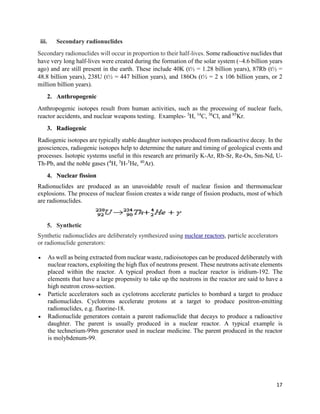
iii. Secondary radionuclides
Secondary radionuclides will occur in proportion to their half-lives. Some radioactive nuclides that
have very long half-lives were created during the formation of the solar system (~4.6 billion years
ago) and are still present in the earth. These include 40K (t½ = 1.28 billion years), 87Rb (t½ =
48.8 billion years), 238U (t½ = 447 billion years), and 186Os (t½ = 2 x 10⁶ billion years, or 2
million billion years).
2. Anthropogenic
Anthropogenic isotopes result from human activities, such as the processing of nuclear fuels,
reactor accidents, and nuclear weapons testing. Examples- 3
H, 14
C, 36
Cl, and 85
Kr.
3. Radiogenic
Radiogenic isotopes are typically stable daughter isotopes produced from radioactive decay. In the
geosciences, radiogenic isotopes help to determine the nature and timing of geological events and
processes. Isotopic systems useful in this research are primarily K-Ar, Rb-Sr, Re-Os, Sm-Nd, U-
Th-Pb, and the noble gases (4
H, 3
H-3
He, 40
Ar).
4. Nuclear fission
Radionuclides are produced as an unavoidable result of nuclear fission and thermonuclear
explosions. The process of nuclear fission creates a wide range of fission products, most of which
are radionuclides.
5. Synthetic
Synthetic radionuclides are deliberately synthesized using nuclear reactors, particle accelerators
or radionuclide generators:
 As well as being extracted from nuclear waste, radioisotopes can be produced deliberately with
nuclear reactors, exploiting the high flux of neutrons present. These neutrons activate elements
placed within the reactor. A typical product from a nuclear reactor is iridium-192. The
elements that have a large propensity to take up the neutrons in the reactor are said to have a
high neutron cross-section.
 Particle accelerators such as cyclotrons accelerate particles to bombard a target to produce
radionuclides. Cyclotrons accelerate protons at a target to produce positron-emitting
radionuclides, e.g. fluorine-18.
 Radionuclide generators contain a parent radionuclide that decays to produce a radioactive
daughter. The parent is usually produced in a nuclear reactor. A typical example is
the technetium-99m generator used in nuclear medicine. The parent produced in the reactor
is molybdenum-99.
18
Detection & measurement of radiation
The following equipment can be used to detect radiation (radioactivity):
 Geiger Muller counters
 Proportion counters
 Ionization chambers
 Gaseous ionization detectors
 Scintillation counters
Geiger Muller counter
Geiger Muller counters are instruments that can detect and measure radioactivity. They do so
using a Geiger Mueller (GM) tube. The original design of the GM tube by H. Geiger and E.W.
Mueller in 1928. A GM meter is often portable, and the efficiency of a GM for detecting
radiation depends on four factors:
1. The type of radiation.
2. The energy of the radiation.
3. The amount of activity in the source.
4. The direction of the source relative to the instrument detector active area.
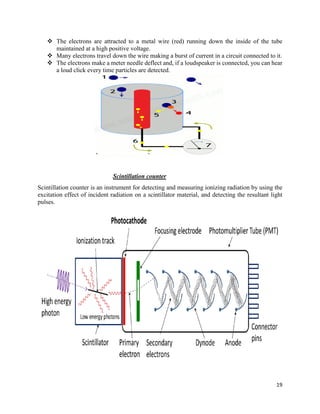
Operating principle of Geiger Muller counter
 Radiation (dark blue) is moving about randomly outside the detector tube.
 Some of the radiation enters the window (gray) at the end of the tube.
 When radiation (dark blue) crash with gas molecules in the tube (orange), it causes
ionization: some of the gas molecules are turned into positive ions (red) and electrons
(yellow).
 The positive ions are attracted to the outside of the tube (light blue).
19
 The electrons are attracted to a metal wire (red) running down the inside of the tube
maintained at a high positive voltage.
 Many electrons travel down the wire making a burst of current in a circuit connected to it.
 The electrons make a meter needle deflect and, if a loudspeaker is connected, you can hear
a loud click every time particles are detected.
Scintillation counter
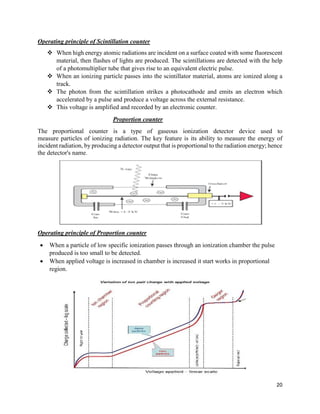
Scintillation counter is an instrument for detecting and measuring ionizing radiation by using the
excitation effect of incident radiation on a scintillator material, and detecting the resultant light
pulses.
20
Operating principle of Scintillation counter
 When high energy atomic radiations are incident on a surface coated with some fluorescent
material, then flashes of lights are produced. The scintillations are detected with the help
of a photomultiplier tube that gives rise to an equivalent electric pulse.
 When an ionizing particle passes into the scintillator material, atoms are ionized along a
track.
 The photon from the scintillation strikes a photocathode and emits an electron which
accelerated by a pulse and produce a voltage across the external resistance.
 This voltage is amplified and recorded by an electronic counter.
Proportion counter
The proportional counter is a type of gaseous ionization detector device used to
measure particles of ionizing radiation. The key feature is its ability to measure the energy of
incident radiation, by producing a detector output that is proportional to the radiation energy; hence
the detector's name.
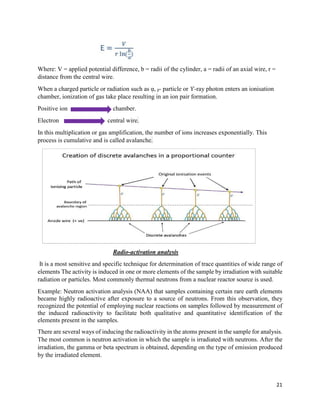
Operating principle of Proportion counter
 When a particle of low specific ionization passes through an ionization chamber the pulse
produced is too small to be detected.
 When applied voltage is increased in chamber is increased it start works in proportional
region.
21
Where: V = applied potential difference, b = radii of the cylinder, a = radii of an axial wire, r =
distance from the central wire.
When a charged particle or radiation such as ᾳ, ᵦ- particle or ϒ-ray photon enters an ionisation
chamber, ionization of gas take place resulting in an ion pair formation.
Positive ion chamber.
Electron central wire.
In this multiplication or gas amplification, the number of ions increases exponentially. This
process is cumulative and is called avalanche.
Radio-activation analysis
It is a most sensitive and specific technique for determination of trace quantities of wide range of
elements The activity is induced in one or more elements of the sample by irradiation with suitable
radiation or particles. Most commonly thermal neutrons from a nuclear reactor source is used.
Example: Neutron activation analysis (NAA) that samples containing certain rare earth elements
became highly radioactive after exposure to a source of neutrons. From this observation, they
recognized the potential of employing nuclear reactions on samples followed by measurement of
the induced radioactivity to facilitate both qualitative and quantitative identification of the
elements present in the samples.
There are several ways of inducing the radioactivity in the atoms present in the sample for analysis.
The most common is neutron activation in which the sample is irradiated with neutrons. After the
irradiation, the gamma or beta spectrum is obtained, depending on the type of emission produced
by the irradiated element.
22
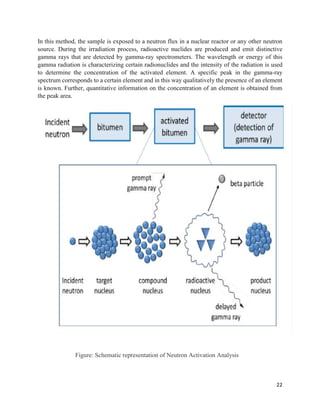
In this method, the sample is exposed to a neutron flux in a nuclear reactor or any other neutron
source. During the irradiation process, radioactive nuclides are produced and emit distinctive
gamma rays that are detected by gamma-ray spectrometers. The wavelength or energy of this
gamma radiation is characterizing certain radionuclides and the intensity of the radiation is used
to determine the concentration of the activated element. A specific peak in the gamma-ray
spectrum corresponds to a certain element and in this way qualitatively the presence of an element
is known. Further, quantitative information on the concentration of an element is obtained from
the peak area.
Figure: Schematic representation of Neutron Activation Analysis
23
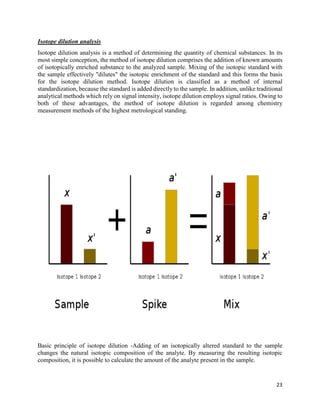
Isotope dilution analysis
Isotope dilution analysis is a method of determining the quantity of chemical substances. In its
most simple conception, the method of isotope dilution comprises the addition of known amounts
of isotopically enriched substance to the analyzed sample. Mixing of the isotopic standard with
the sample effectively "dilutes" the isotopic enrichment of the standard and this forms the basis
for the isotope dilution method. Isotope dilution is classified as a method of internal
standardization, because the standard is added directly to the sample. In addition, unlike traditional
analytical methods which rely on signal intensity, isotope dilution employs signal ratios. Owing to
both of these advantages, the method of isotope dilution is regarded among chemistry
measurement methods of the highest metrological standing.
Basic principle of isotope dilution -Adding of an isotopically altered standard to the sample
changes the natural isotopic composition of the analyte. By measuring the resulting isotopic
composition, it is possible to calculate the amount of the analyte present in the sample.
24
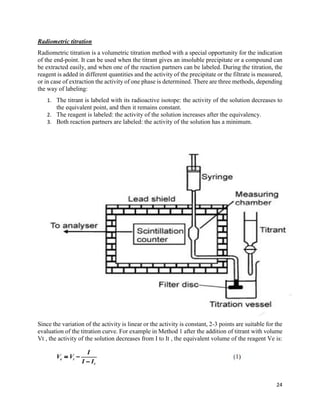
Radiometric titration
Radiometric titration is a volumetric titration method with a special opportunity for the indication
of the end-point. It can be used when the titrant gives an insoluble precipitate or a compound can
be extracted easily, and when one of the reaction partners can be labeled. During the titration, the
reagent is added in different quantities and the activity of the precipitate or the filtrate is measured,
or in case of extraction the activity of one phase is determined. There are three methods, depending
the way of labeling:
1. The titrant is labeled with its radioactive isotope: the activity of the solution decreases to
the equivalent point, and then it remains constant.
2. The reagent is labeled: the activity of the solution increases after the equivalency.
3. Both reaction partners are labeled: the activity of the solution has a minimum.
Since the variation of the activity is linear or the activity is constant, 2-3 points are suitable for the
evaluation of the titration curve. For example in Method 1 after the addition of titrant with volume
Vt , the activity of the solution decreases from I to It , the equivalent volume of the reagent Ve is:
25
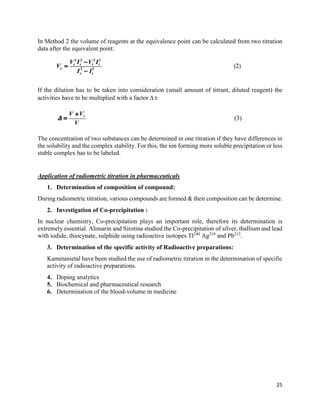
In Method 2 the volume of reagents at the equivalence point can be calculated from two titration
data after the equivalent point:
If the dilution has to be taken into consideration (small amount of titrant, diluted reagent) the
activities have to be multiplied with a factor  t:
The concentration of two substances can be determined in one titration if they have differences in
the solubility and the complex stability. For this, the ion forming more soluble precipitation or less
stable complex has to be labeled.
Application of radiometric titration in pharmaceuticals
1. Determination of composition of compound:
During radiometric titration, various compounds are formed & their composition can be determine.
2. Investigation of Co-precipitation :
In nuclear chemistry, Co-precipitation plays an important role, therefore its determination is
extremely essential. Alimarin and Sirotina studied the Co-precipitation of silver, thallium and lead
with iodide, thiocynate, sulphide using radioactive isotopes Tl240
Ag210
and Pb212
.
3. Determination of the specific activity of Radioactive preparations:
Kametanietal have been studied the use of radiometric titration in the determination of specific
activity of radioactive preparations.
4. Doping analytics
5. Biochemical and pharmaceutical research
6. Determination of the blood-volume in medicine
26
Reference
1. http://view6.workcast.net/register?cpak=1823308392828913
2. https://www.google.com/search?q=Radio-
activation+analysis&source=lnms&tbm=isch&sa=X&ved=0ahUKEwiYy9bkkf_aAhVFs
o8KHRmzBQEQ_AUICigB#imgrc=wA2nc5PXmxlusM:
3. https://www.slideshare.net/arundeepa/radioactive-isotopes-72515767
4. https://www.researchgate.net/figure/Schematic-representation-of-Neutron-Activation-
Analysis-steps-and-illustration-of-the_fig1_272388331
5. https://en.wikipedia.org/wiki/Neutron_activation_analysis
6. https://www.google.com/search?q=isotope+dilution+analysis&oq=Isotope+dilution+anal
ysis&aqs=chrome.0.0l6.1322j0j9&sourceid=chrome&ie=UTF-8
7. http://kolloid.unideb.hu/wp-content/uploads/2013/12/radiometric-titration.pdf
8. https://www.google.com/search?q=application+of+radiometric+titration&source=lnms&
sa=X&ved=0ahUKEwjZ2ZSco__aAhULrI8KHX47CVAQ_AUICSgA
9. http://www.bcp.fuberlin.de/chemie/chemie/forschung/InorgChem/agabram/pdf/radioche
mie/07_radioenglish.pdf
10. https://goldbook.iupac.org/html/R/R05114.html

Radio-chemical method Pdf

  • 1.
    1 INDEX Topics Page no. Radiation03 Classification of radiation 03 Radioactive elements 04 List of radioactive elements 04 Radioactivity 09 Classification of radioactivity 10 Radioisotope 10 Applications of radioisotopes 10 Radioactive decay 10 Types of Radioactive decay 11 Nuclear fusion 12 Nuclear fission 13 Radio-pharmacy 14 Radiopharmaceuticals 14 Evolution of Nuclear Medicine by radiopharmaceuticals 15 Ideal radiopharmaceutical properties 15 Application & list of radiopharmaceutical 15 Nature of radioactive isotope 15 Differences between stable isotopes & radioactive isotopes 16
  • 2.
    2 Unites of radioactivity17 Origin of radioactive isotopes 17 Detection & measurement of radiation 18 Geiger Muller counter 18 Scintillation counter 19 Proportion counter 21 Radio-activation analysis 22 Isotope dilution analysis 23 Radiometric titration 24 Application of radiometric titration in pharmaceuticals 25 Reference 26
  • 3.
    3 Radiation Radiation is theemission and propagation of energy in the form of waves, rays or particles. Radiation includes emanation of any portion of the electromagnetic spectrum, plus it includes the release of particles. Examples include:  A burning candle emits radiation in the form of heat and light.  The Sun emits radiation in the form of light, heat, and particles.  Uranium-238 decaying into Thorium-234 emits radiation in the form of alpha particles.  Electrons dropping from one energy state to a lower state emit radiation in the form of a photon. Classification of radiation There are three main types of radiation: 1. Non-ionizing radiation: This is the release of energy from the lower-energy region of the electromagnetic spectrum. This includes light, radio, microwaves, infrared (heat), and ultraviolet light. 2. Ionizing radiation: This is radiation with sufficient energy to remove an electron from an atomic orbital, forming an ion. Ionizing radiation includes x-ray, gamma rays, alpha particles, and beta particles. 3. Neutrons: Neutrons are particles found in the atomic nucleus. When they break off of the nucleus, they have energy and act as radiation. Rutherford Classification of radiation: three types 1. Alpha radiation Alpha radiation is the least penetrating. It can be stopped (or absorbed) by a sheet of paper. An alpha atomic number 2 and atomic weight 4. 2. Beta radiation Beta radiation can penetrate air and paper. It can be stopped by a thin sheet of aluminum. 3. Gamma radiation Gamma radiation is the most penetrating. Even small levels can penetrate air, paper or thin metal. Higher levels can only be stopped by many centimeters of lead, or many meters of concrete.
  • 4.
    4 Radioactive elements Radioactive elementsare the elements that subject to spontaneous degeneration of its nucleus accompanied by the emission of alpha particles, beta particles, or gamma rays. All elements with atomic numbers greater than 83 are radioactive. Naturally occurring radioactive elements include radium, thorium, and uranium. List of radioactive elements Radioactive Element Atomic Number Atomic Mass Number Decay Type Half-Life Hydrogen (H) 1 3 Beta Decay (β- ) 12.32 years Beryllium (Be) 4 7 Electron Capture (ε), Gamma Decay) 53.12 Days Beryllium (Be) 4 8 Alpha 7 x 10-17 sec Beryllium (Be) 4 10 Beta Decay (β- ) 1,360,000 years Carbon (C) 6 14 Beta Decay (β- ) 5,730 years Calcium (Ca) 20 41 Electron Capture (ε) 103,000 years Calcium(Ca) 20 46 Double Beta Decay (β- β- ) > 2.8 x 10¹⁵ years Calcium(Ca) 20 48 Double Beta Decay (β- β- ) > 4 x 10¹⁹ Iron (Fe) 26 54 Double Electron Capture (ε) > 3.1 x 10²² years Iron (Fe) (Synthetic) 26 55 Electron Capture (ε) 2.73 years Iron (Fe) (Synthetic) 26 59 Beta Decay (β- ) 44.503 days Iron (Fe) (Synthetic) 26 60 Beta Decay (β- ) 2,600,000 years Cobalt (Co) (Synthetic) 27 56 Electron Capture (ε) 77.27 days Cobalt (Co) (Synthetic) 27 57 Electron Capture (ε) 271.79 days Cobalt (Co) (Synthetic) 27 58 Electron Capture (ε) 70.86 days
  • 5.
    5 Cobalt (Co) (Synthetic) 27 60 BetaDecay (β- ), Double Gamma 5.2714 years Nickel (Ni) 28 59 Electron Capture (ε) 76,000 years Nickel (Ni) (Synthetic) 28 63 Beta Decay (β- ) 100.1 years Zinc (Zn) (Synthetic) 30 65 Electron Capture (ε), Gamma 243.8 days Zinc (Zn) (Synthetic) 30 72 Beta Decay (β- ) 46.5 hours Selenium (Se) 34 79 Beta Decay (β- ) 3.27 x 10⁵ years Selenium (Se) 34 82 Double Beta Decay (β- β- ) 1.08 x 10²⁰ years Krypton (Kr) 36 85 Beta Decay (β- ) 10.756 years Rubidium (Rb) 37 87 Beta Decay (β- ) 4.88 x 10¹⁰ years Strontium (Sr) 38 89 Electron Capture (ε), Beta Decay (β- ) 50.52 days Strontium (Sr) 38 90 Beta Decay (β- ) 28.9 years Yttrium (Y) 39 90 Beta Decay (β- ), Gamma 2.67 days Yttrium (Y) 39 91 Beta Decay (β- ), Gamma 58.5 days Zirconium (Zr) 40 93 Beta Decay (β- ) 1.53 x 10⁶ years Zirconium (Zr) 40 94 Double Beta Decay (β- ) > 1.1 x 10¹⁷ years Zirconium (Zr) 40 96 Double Beta Decay (β- ) 2 x 10¹⁹ years Niobium (Nb) (Metastable) 41 93 Beta Decay (β- ),Gamma 16.13 years Niobium (Nb) 41 95 Beta Decay (β- ), Gamma 34.991 days Molybdenum (Mo) 42 93 Electron Capture (ε) 4 x 10³ years
  • 6.
    6 Technetium (Tc) 4399 Beta Decay (β- ) 2.111 x 10⁵ years Ruthenium (Ru) 44 103 Beta Decay (β- ), Gamma 39.26 days Ruthenium(Ru) 44 106 Beta Decay (β- ) 373.59 days Palladium (Pd) 46 107 Beta Decay (β- ), Gamma 6.5 million years Silver (Ag) 47 111 Beta Decay (β- ), Gamma 7.45 days Tin (Sn) 50 126 Beta Decay (β- ) 2.3 x 10⁵ years Antimony (Sb) 51 125 Beta Decay (β- ) 2.7582 years Tellurium (Te) 52 127 Beta Decay (β- ), Gamma 9.35 hours Tellurium (Te) 52 129 Beta Decay (β- ) 69.6 minutes Iodine (I) 53 123 Electron Capture (ε), Gamma 13 hours Iodine (I) 53 129 Beta Decay (β- ) 15.7 million years Iodine (I) 53 131 Beta Decay (β- ), Gamma 8.02070 days Xenon (Xe) 54 125 Electron Capture (ε) 16.9 hours Xenon (Xe) 54 127 Electron Capture (ε) 36.345 days Xenon (Xe) 54 133 Beta Decay (β- ) 5.247 days Cesium (Cs) 55 134 Electron Capture (ε), Beta Decay (β- ) 2.0648 years Cesium (Cs) 55 135 Beta Decay (β- ) 2.3 million years Cesium (Cs) 55 137 Beta Decay (β- ), Gamma 30.17 years Cerium (Ce) 58 144 Beta Decay (β- ) 285 days Promethium (Pm) 61 147 Beta Decay (β- ), Gamma 2.6234 years
  • 7.
    7 Europium (Eu) 63154 Beta Decay (β- ), Beta Decay (β+ ), Gamma 16 years Europium (Eu) 63 155 Beta Decay (β- ) 2 years Iridium (Ir) (Synthetic) 77 188 Electron Capture (ε) 1.73 days Iridium (Ir) (Synthetic) 77 189 Electron Capture (ε) 13.2 days Iridium (Ir) (Synthetic) 77 190 Electron Capture (ε) 11.8 days Iridium (Ir) (Synthetic) 77 192 Beta Decay (β- ), Electron Capture (ε) 73.827 days Iridium (Ir) (Synthetic, Metastable) 77 192 Gamma Decay 241 years Iridium (Ir) (Synthetic) 77 193 Gamma Decay 10.5 days Iridium (Ir) (Synthetic) 77 194 Beta Decay (β- ) 19.3 hours Iridium (Ir) (Synthetic, Metastable) 77 194 Gamma Decay 171 days Lead (Pb) 82 210 Beta Decay (β- ), Alpha 21 years Bismuth (Bi) 83 210 Alpha 3 million years Polonium (Po) 84 210 Alpha 138 days Radon (Rn) 86 220 Alpha, Beta Decay (β+ ) 1 min Radon (Rn) 86 222 Alpha 4 days Radium (Ra) 88 224 Alpha 4 days Radium (Ra) 88 225 Beta Decay (β- ) 15 days Radium (Ra) 88 226 Alpha 1,622 years Thorium (Th) 90 228 Alpha 2 years
  • 8.
    8 Thorium (Th) 90229 Alpha 7,340 years Thorium (Th) 90 230 Alpha 80,000 years Thorium (Th) 90 232 Alpha 14 years Thorium (Th) 90 234 Beta Decay (β- ) 24 days Proactinium (Pa) 91 234 Beta Decay (β- ) 6.75 hours Uranium (U) 92 233 Alpha 159,200 years Uranium (U) 92 234 Alpha 245,500 years Uranium (U) 92 235 Alpha 7.038 x 10⁸ years Uranium (U) 92 236 Alpha 2.342 x 10⁷ years Uranium (U) 92 238 Alpha 4.468 billion years Neptunium (Np) (Synthetic) 93 237 Alpha 2.144 million years Plutonium (Pu) 94 238 Alpha 87.74 years Plutonium (Pu) 94 239 Alpha 2.41 x 10⁴ years Plutonium (Pu) 94 240 Alpha 6.5 x 10³ years Plutonium (Pu) 94 241 Beta Decay (β- ) 14 years Plutonium (Pu) 94 242 Alpha 3.73 x 10⁵ years Plutonium (Pu) 94 244 Alpha 8.08 x 10⁷ years Americium (Am) 95 241 Alpha 432.2 years Americium (Am) (Metastable) 95 242 Alpha, Gamma 141 years Americium (Am) 95 243 Alpha 7,370 years Curium (Cm) 96 242 Alpha 160 days Curium (Cm) 96 243 Alpha 29.1 years
  • 9.
    9 Curium (Cm) 96244 Alpha 18.1 years Curium (Cm) 96 247 Alpha 15.6 million years Radioactivity Radioactivity refers to the particles which are emitted from nuclei as a result of nuclear instability. Because the nucleus experiences the intense conflict between the two strongest forces in nature, it should not be surprising that there are many nuclear isotopes which are unstable and emit some kind of radiation. The most common types of radiation are called alpha, beta, and gamma radiation, but there are several other varieties of radioactive decay. Radioactivity following two types- 1. Natural radioactivity Natural radioactivity comprises cosmic radiation and the radiation arising from the decay of naturally occurring radionuclides. The natural radionuclides include the primordial radioactive elements in the earth's crust, their radioactive decay products, and radionuclides produced by cosmic-radiation interactions. Primordial radionuclides have half-lives comparable with the age of the earth. Cosmo-genic radionuclides are produced continuously by bombardment of stable nuclides by cosmic rays, primarily in the atmosphere. E.g- uranium-238, potassium 40, carbon 14 etc. 2. Induced radioactivity Induced radioactivity - a radioactive substance that occurs under irradiation of ionizing radiation, usually neutrons or protons. E.g- α particle to react with another atom such as Beryllium. The result is a Carbon nucleus and a neutron. This is artificial radioactivity or induced radioactivity.
  • 10.
    10 Radioisotope Radioisotopes are alternativeforms of an element that have the same number of protons but a different number of neutrons; that is, the same number of protons and thus identical chemical properties, but different numbers of neutrons and consequently different physical properties. Isotopes can be stable or unstable or radioisotopes. Applications of radioisotopes 1. Medicine: Diagnosis and treatment of diseases, sterilization of products frequently used in clinical and surgical environments, etc. 2. Industry and technology: review of materials and welding in construction, control of productive processes, research, etc. 3. Agriculture: Plague control, food conservation, etc. 4. Art: restoration of art objects, verification of historic or artistic objects, etc. 5. Archeology: Geological event dating, etc. 6. Research: Universe, industry, medicine, etc. 7. Pharmacology: The study of the metabolism of drugs before they are authorized for public use. Radioactive decay Radioactive decay is the spontaneous breakdown of an atomic nucleus resulting in the release of energy and matter from the nucleus. Remember that a radioisotope has unstable nuclei that does not have enough binding energy to hold the nucleus together.
  • 11.
    11 There are threetypes of radioactive decay 1. Alpha decay Atom releases two protons and two neutrons (alpha particle) to form a new, more stable element. An example of a nucleus that undergoes alpha decay is uranium-238. The alpha decay of U-238 is- 2. Beta decay A neutron may spontaneously transform into a proton and an electron: This type of transformation is done via a process called beta decay (β decay). When a nucleus undergoes beta decay, it emits an energetic electron or a positron. 3. Gamma decay Involves the release of electromagnetic radiation (gamma rays), but does not change the mass of the atom. The same is true of nucleons confined to the nucleus, except that the energies are much higher because they involve the strong nuclear force. A nucleus is in an excited state when a proton or neutron occupies an energy level above the nuclear ground state. An excited nucleus releases energy by emitting a high-energy photon or γ ray via the process of gamma decay (γ decay).
  • 12.
    12 Nuclear fusion Nuclear fusionis a nuclear reaction in which two or more atomic nuclei collide at a very high energy and fuse together. E.g- Deuterium and tritium fuse together to form helium nuclei. Nuclear fission Nuclear fission, subdivision of a heavy atomic nucleus, such as that of uranium or plutonium, into two fragments of roughly equal mass. The process is accompanied by the release of a large amount of energy. Radio-pharmacy Radio-pharmacy studies related to the pharmaceutical, chemical, pharmaceutical, chemical, physical, biochemical, and biological physical, biochemical, and biological aspects of radiopharmaceuticals, aspects of radiopharmaceuticals. Radiopharmaceuticals Radiopharmaceutical is a special class of radiochemical formulation having high radiochemical formulation having high purity, sterility and pyrogenicity, purity, sterility and pyrogenicity, suitable for administration to human suitable for administration to human patients either orally or intravenously, patients either orally or intravenously, either for diagnosis or therapy either for diagnosis or therapy. In nuclear medicine nearly 95% of the radiopharmaceuticals are used for diagnostic purposes, while the rest are used for therapeutic treatment.
  • 13.
    13 Evolution of NuclearMedicine by radiopharmaceuticals
  • 14.
    14 Ideal radiopharmaceutical properties a.Short half-life isotope (Ideally 1.5 times the duration of the diagnostic procedure.) b. Energy of Gamma Rays: (Ideal: 100-250 keV) c. Pure gamma emitter d. Target to Non target Ratio e. Localization only in tissue desired f. Easy preparation g. Economy price Application & list of radiopharmaceutical 1. Treatment of disease: They are radiolabeled molecules designed to deliver therapeutic doses of ionizing radiation to specific diseased sites. 2. Diagnosis of disease: The radiopharmaceutical accumulated in an organ of interest emit gamma radiation which are used for imaging of the organs with the help of an external imaging device. Radiopharmaceuticals Uses Carbon-14 Urea Detection of H Pylori Cobalt-57 cyanocobalamin Schilling test Cobalt -57 & -58 cyanocobalamin Schilling test Chromium-51sodium chromate labeling RBCs Fluorine-18 FDG positron emission tomography imaging Fluorine-18 Florbetapir Beta amyloid plaque PET imaging for Alzheimer’s disease Gallium-67 soft-tissue tumor and inflammatory process Indium-111 chloride for labeling monoclonal antibodies Indium-111 pentetate (DTPA) imaging of CSF kinetics Indium-111 oxyquinoline for labeling leukocytes and platelets Indium-111 Capromab pendetide monoclonal antibody for imaging prostate cancer I-123 sodium iodide thyroid imaging & uptake
  • 15.
    15 I-123 Iobenguane (MIBG)neuroendocrine tumor imaging I-125 iothalamate measurement of glomerular filtration I-125 human serum albumin plasma volume determinations Tositumomab & Iodine I 131 Treatment of Non-Hodgkin’s Lymphoma Krypton-81m gas pulmonary ventilation imaging P-32 chromic phosphate therapy of intracavitary malignancies P-32 sodium phosphate therapy of polycythemia Vera Rubidium-82 positron emission tomography imaging Nature of radioactive isotope • Radioactive isotopes are unstable so they undergo radioactive decay emitting radiations. •Half-life of radio isotope is the time period required for radionuclide to decay to one half the amount originally present. Abbreviated t1⁄2. t1⁄2 = 0.693/λ. • Isotopes of same elements have same chemical properties. Due to same number of electrons in the outermost shell. • Physical properties Differ from isotopes to isotopes. Based on number of neutrons. • Radioisotopes/radioactive isotopes of an element can be defined as atoms that contain an unstable nucleus and dissipate excess energy by spontaneously emitting radiation in the form of alpha, beta and gamma rays.
  • 16.
    16 Differences between stableisotopes & radioactive isotopes Stable isotopes Radioactive isotopes Most abundantly found in nature Less abundance of natural radioisotopes No emission of radiation Spontaneous emission of radiations(α,β,γ) Atomic number and mass are constant Constantly changing Detection by chemical/spectroscopic methods Detection by external detectors like gas chambers/scintillation Not hazardous(except toxic chemicals) Deleterious effects on biological tissues No special handling precautions(unless explosives/strong acids/carcinogens) Special precautions while handling No special applications Special applications in research (mutagenesis) /diagnosis(RIA )/therapy(Rx of cancer) Unites of radioactivity • Becquerel is the SI unit of radioactivity - defined as one disintegration per second (1 d. p. s.). • Curie defined as the quantity of radioactive material in which the number of nuclear disintegrations per second is same as the 1gm of radium (3.7 X 10 10 Bq). • Specific activity is defined as disintegration rate per unit mass of radioactive atoms. Origin of radioactive isotopes 1. Natural radioactive isotopes On Earth, naturally occurring radionuclides fall into three categories: primordial radionuclides, secondary radionuclides, and cosmogenic radionuclides. i. Primordial nuclides Primordial nuclides, also known as primordial isotopes, are nuclides found on Earth that have existed in their current form since before Earth was formed. E.g- technetium, promethium, bismuth, thorium, uranium etc. ii. Cosmogenic Cosmogenic isotopes are a result of cosmic ray activity in the atmosphere. Cosmic rays are atomic particles that are ejected from stars at a rate of speed sufficient to shatter other atoms when they collide. This process of transformation is called spallation. Cosmogenic isotopes are also produced at the surface of the earth by direct cosmic ray irradiation of atoms in solid geologic materials. Examples of cosmogenic nuclides include 14 C, 36 Cl, 3 H, 32 Si, and 10 Be.
  • 17.
    17 iii. Secondary radionuclides Secondaryradionuclides will occur in proportion to their half-lives. Some radioactive nuclides that have very long half-lives were created during the formation of the solar system (~4.6 billion years ago) and are still present in the earth. These include 40K (t½ = 1.28 billion years), 87Rb (t½ = 48.8 billion years), 238U (t½ = 447 billion years), and 186Os (t½ = 2 x 10⁶ billion years, or 2 million billion years). 2. Anthropogenic Anthropogenic isotopes result from human activities, such as the processing of nuclear fuels, reactor accidents, and nuclear weapons testing. Examples- 3 H, 14 C, 36 Cl, and 85 Kr. 3. Radiogenic Radiogenic isotopes are typically stable daughter isotopes produced from radioactive decay. In the geosciences, radiogenic isotopes help to determine the nature and timing of geological events and processes. Isotopic systems useful in this research are primarily K-Ar, Rb-Sr, Re-Os, Sm-Nd, U- Th-Pb, and the noble gases (4 H, 3 H-3 He, 40 Ar). 4. Nuclear fission Radionuclides are produced as an unavoidable result of nuclear fission and thermonuclear explosions. The process of nuclear fission creates a wide range of fission products, most of which are radionuclides. 5. Synthetic Synthetic radionuclides are deliberately synthesized using nuclear reactors, particle accelerators or radionuclide generators:  As well as being extracted from nuclear waste, radioisotopes can be produced deliberately with nuclear reactors, exploiting the high flux of neutrons present. These neutrons activate elements placed within the reactor. A typical product from a nuclear reactor is iridium-192. The elements that have a large propensity to take up the neutrons in the reactor are said to have a high neutron cross-section.  Particle accelerators such as cyclotrons accelerate particles to bombard a target to produce radionuclides. Cyclotrons accelerate protons at a target to produce positron-emitting radionuclides, e.g. fluorine-18.  Radionuclide generators contain a parent radionuclide that decays to produce a radioactive daughter. The parent is usually produced in a nuclear reactor. A typical example is the technetium-99m generator used in nuclear medicine. The parent produced in the reactor is molybdenum-99.
  • 18.
    18 Detection & measurementof radiation The following equipment can be used to detect radiation (radioactivity):  Geiger Muller counters  Proportion counters  Ionization chambers  Gaseous ionization detectors  Scintillation counters Geiger Muller counter Geiger Muller counters are instruments that can detect and measure radioactivity. They do so using a Geiger Mueller (GM) tube. The original design of the GM tube by H. Geiger and E.W. Mueller in 1928. A GM meter is often portable, and the efficiency of a GM for detecting radiation depends on four factors: 1. The type of radiation. 2. The energy of the radiation. 3. The amount of activity in the source. 4. The direction of the source relative to the instrument detector active area. Operating principle of Geiger Muller counter  Radiation (dark blue) is moving about randomly outside the detector tube.  Some of the radiation enters the window (gray) at the end of the tube.  When radiation (dark blue) crash with gas molecules in the tube (orange), it causes ionization: some of the gas molecules are turned into positive ions (red) and electrons (yellow).  The positive ions are attracted to the outside of the tube (light blue).
  • 19.
    19  The electronsare attracted to a metal wire (red) running down the inside of the tube maintained at a high positive voltage.  Many electrons travel down the wire making a burst of current in a circuit connected to it.  The electrons make a meter needle deflect and, if a loudspeaker is connected, you can hear a loud click every time particles are detected. Scintillation counter Scintillation counter is an instrument for detecting and measuring ionizing radiation by using the excitation effect of incident radiation on a scintillator material, and detecting the resultant light pulses.
  • 20.
    20 Operating principle ofScintillation counter  When high energy atomic radiations are incident on a surface coated with some fluorescent material, then flashes of lights are produced. The scintillations are detected with the help of a photomultiplier tube that gives rise to an equivalent electric pulse.  When an ionizing particle passes into the scintillator material, atoms are ionized along a track.  The photon from the scintillation strikes a photocathode and emits an electron which accelerated by a pulse and produce a voltage across the external resistance.  This voltage is amplified and recorded by an electronic counter. Proportion counter The proportional counter is a type of gaseous ionization detector device used to measure particles of ionizing radiation. The key feature is its ability to measure the energy of incident radiation, by producing a detector output that is proportional to the radiation energy; hence the detector's name. Operating principle of Proportion counter  When a particle of low specific ionization passes through an ionization chamber the pulse produced is too small to be detected.  When applied voltage is increased in chamber is increased it start works in proportional region.
  • 21.
    21 Where: V =applied potential difference, b = radii of the cylinder, a = radii of an axial wire, r = distance from the central wire. When a charged particle or radiation such as ᾳ, ᵦ- particle or ϒ-ray photon enters an ionisation chamber, ionization of gas take place resulting in an ion pair formation. Positive ion chamber. Electron central wire. In this multiplication or gas amplification, the number of ions increases exponentially. This process is cumulative and is called avalanche. Radio-activation analysis It is a most sensitive and specific technique for determination of trace quantities of wide range of elements The activity is induced in one or more elements of the sample by irradiation with suitable radiation or particles. Most commonly thermal neutrons from a nuclear reactor source is used. Example: Neutron activation analysis (NAA) that samples containing certain rare earth elements became highly radioactive after exposure to a source of neutrons. From this observation, they recognized the potential of employing nuclear reactions on samples followed by measurement of the induced radioactivity to facilitate both qualitative and quantitative identification of the elements present in the samples. There are several ways of inducing the radioactivity in the atoms present in the sample for analysis. The most common is neutron activation in which the sample is irradiated with neutrons. After the irradiation, the gamma or beta spectrum is obtained, depending on the type of emission produced by the irradiated element.
  • 22.
    22 In this method,the sample is exposed to a neutron flux in a nuclear reactor or any other neutron source. During the irradiation process, radioactive nuclides are produced and emit distinctive gamma rays that are detected by gamma-ray spectrometers. The wavelength or energy of this gamma radiation is characterizing certain radionuclides and the intensity of the radiation is used to determine the concentration of the activated element. A specific peak in the gamma-ray spectrum corresponds to a certain element and in this way qualitatively the presence of an element is known. Further, quantitative information on the concentration of an element is obtained from the peak area. Figure: Schematic representation of Neutron Activation Analysis
  • 23.
    23 Isotope dilution analysis Isotopedilution analysis is a method of determining the quantity of chemical substances. In its most simple conception, the method of isotope dilution comprises the addition of known amounts of isotopically enriched substance to the analyzed sample. Mixing of the isotopic standard with the sample effectively "dilutes" the isotopic enrichment of the standard and this forms the basis for the isotope dilution method. Isotope dilution is classified as a method of internal standardization, because the standard is added directly to the sample. In addition, unlike traditional analytical methods which rely on signal intensity, isotope dilution employs signal ratios. Owing to both of these advantages, the method of isotope dilution is regarded among chemistry measurement methods of the highest metrological standing. Basic principle of isotope dilution -Adding of an isotopically altered standard to the sample changes the natural isotopic composition of the analyte. By measuring the resulting isotopic composition, it is possible to calculate the amount of the analyte present in the sample.
  • 24.
    24 Radiometric titration Radiometric titrationis a volumetric titration method with a special opportunity for the indication of the end-point. It can be used when the titrant gives an insoluble precipitate or a compound can be extracted easily, and when one of the reaction partners can be labeled. During the titration, the reagent is added in different quantities and the activity of the precipitate or the filtrate is measured, or in case of extraction the activity of one phase is determined. There are three methods, depending the way of labeling: 1. The titrant is labeled with its radioactive isotope: the activity of the solution decreases to the equivalent point, and then it remains constant. 2. The reagent is labeled: the activity of the solution increases after the equivalency. 3. Both reaction partners are labeled: the activity of the solution has a minimum. Since the variation of the activity is linear or the activity is constant, 2-3 points are suitable for the evaluation of the titration curve. For example in Method 1 after the addition of titrant with volume Vt , the activity of the solution decreases from I to It , the equivalent volume of the reagent Ve is:
  • 25.
    25 In Method 2the volume of reagents at the equivalence point can be calculated from two titration data after the equivalent point: If the dilution has to be taken into consideration (small amount of titrant, diluted reagent) the activities have to be multiplied with a factor  t: The concentration of two substances can be determined in one titration if they have differences in the solubility and the complex stability. For this, the ion forming more soluble precipitation or less stable complex has to be labeled. Application of radiometric titration in pharmaceuticals 1. Determination of composition of compound: During radiometric titration, various compounds are formed & their composition can be determine. 2. Investigation of Co-precipitation : In nuclear chemistry, Co-precipitation plays an important role, therefore its determination is extremely essential. Alimarin and Sirotina studied the Co-precipitation of silver, thallium and lead with iodide, thiocynate, sulphide using radioactive isotopes Tl240 Ag210 and Pb212 . 3. Determination of the specific activity of Radioactive preparations: Kametanietal have been studied the use of radiometric titration in the determination of specific activity of radioactive preparations. 4. Doping analytics 5. Biochemical and pharmaceutical research 6. Determination of the blood-volume in medicine
  • 26.
    26 Reference 1. http://view6.workcast.net/register?cpak=1823308392828913 2. https://www.google.com/search?q=Radio- activation+analysis&source=lnms&tbm=isch&sa=X&ved=0ahUKEwiYy9bkkf_aAhVFs o8KHRmzBQEQ_AUICigB#imgrc=wA2nc5PXmxlusM: 3.https://www.slideshare.net/arundeepa/radioactive-isotopes-72515767 4. https://www.researchgate.net/figure/Schematic-representation-of-Neutron-Activation- Analysis-steps-and-illustration-of-the_fig1_272388331 5. https://en.wikipedia.org/wiki/Neutron_activation_analysis 6. https://www.google.com/search?q=isotope+dilution+analysis&oq=Isotope+dilution+anal ysis&aqs=chrome.0.0l6.1322j0j9&sourceid=chrome&ie=UTF-8 7. http://kolloid.unideb.hu/wp-content/uploads/2013/12/radiometric-titration.pdf 8. https://www.google.com/search?q=application+of+radiometric+titration&source=lnms& sa=X&ved=0ahUKEwjZ2ZSco__aAhULrI8KHX47CVAQ_AUICSgA 9. http://www.bcp.fuberlin.de/chemie/chemie/forschung/InorgChem/agabram/pdf/radioche mie/07_radioenglish.pdf 10. https://goldbook.iupac.org/html/R/R05114.html