SOLAR RADIATION
GEOMETRY
-VANITA THAKKAR
ASSOCIATE PROFESSOR,
MECHANICAL ENGINEERING DEPARTMENT,
BABARIA INSTITUTE OF TECHNOLOGY, VARNAMA,
VADODARA.
SOLAR ENERGY
• Sun is the basic source of
Energy for Earth.
• Solar Energy is available in
the form of Electromagnetic
Radiations.
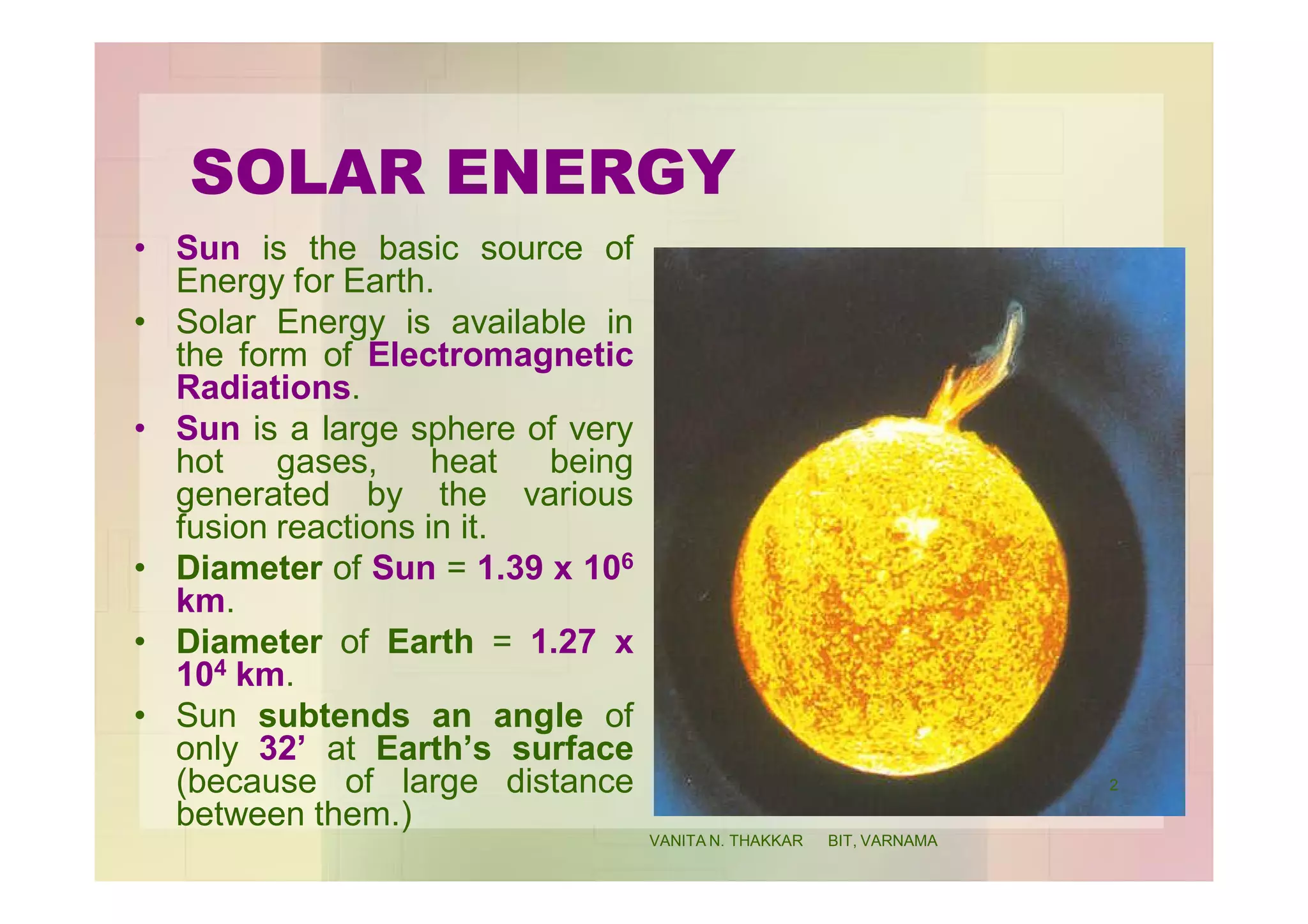
• Sun is a large sphere of very
hot gases, heat being
generated by the various
fusion reactions in it.
• Diameter of Sun = 1.39 x 10⁶
km.
• Diameter of Earth = 1.27 x
104 km.
• Sun subtends an angle of
only 32’ at Earth’s surface
(because of large distance
between them.)
2
VANITA N. THAKKAR BIT, VARNAMA
SOLAR ENERGY
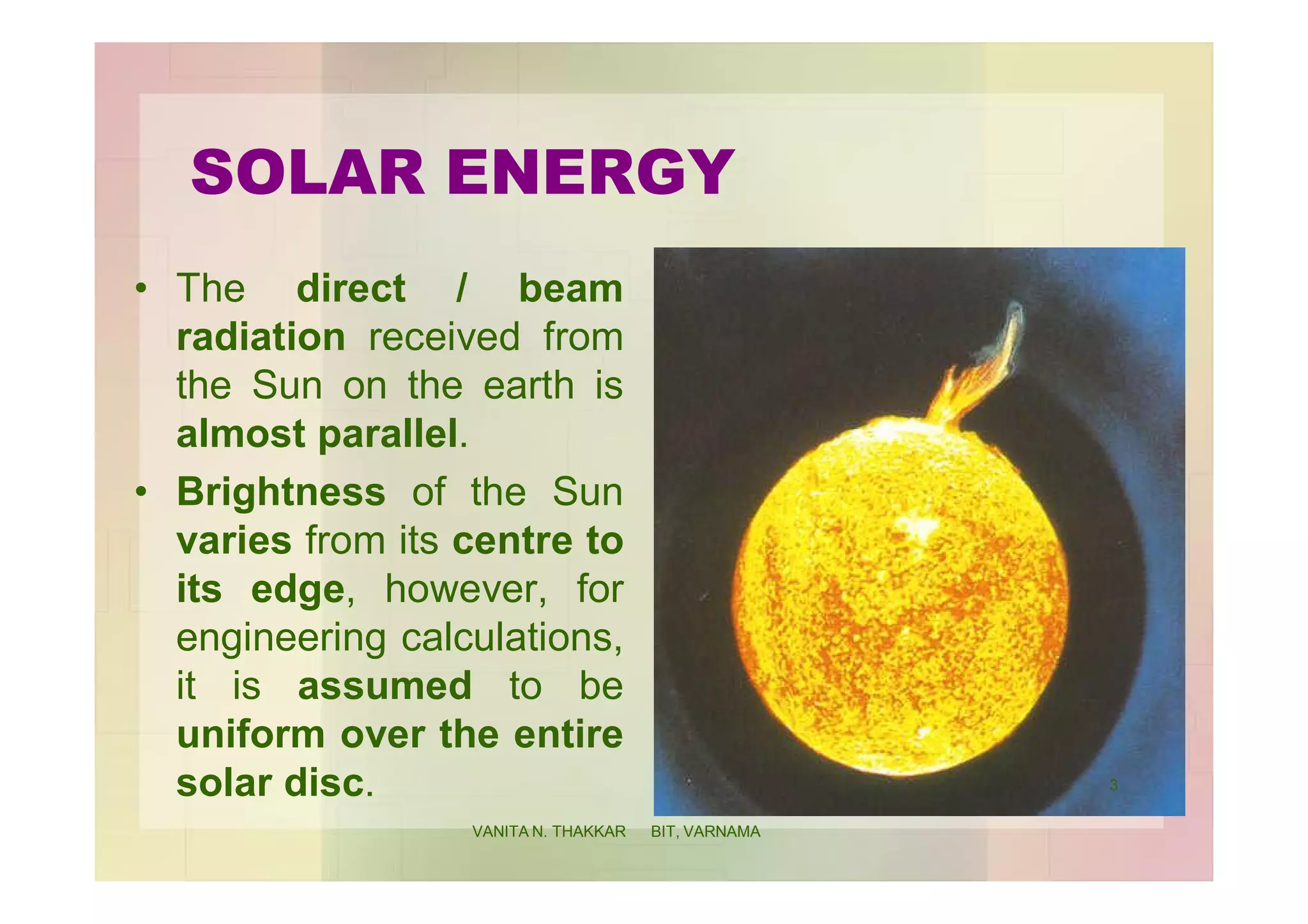
• The direct / beam
radiation received from
the Sun on the earth is
almost parallel.
• Brightness of the Sun
varies from its centre to
its edge, however, for
engineering calculations,
it is assumed to be
uniform over the entire
solar disc. 3
VANITA N. THAKKAR BIT, VARNAMA
SOLAR ENERGY
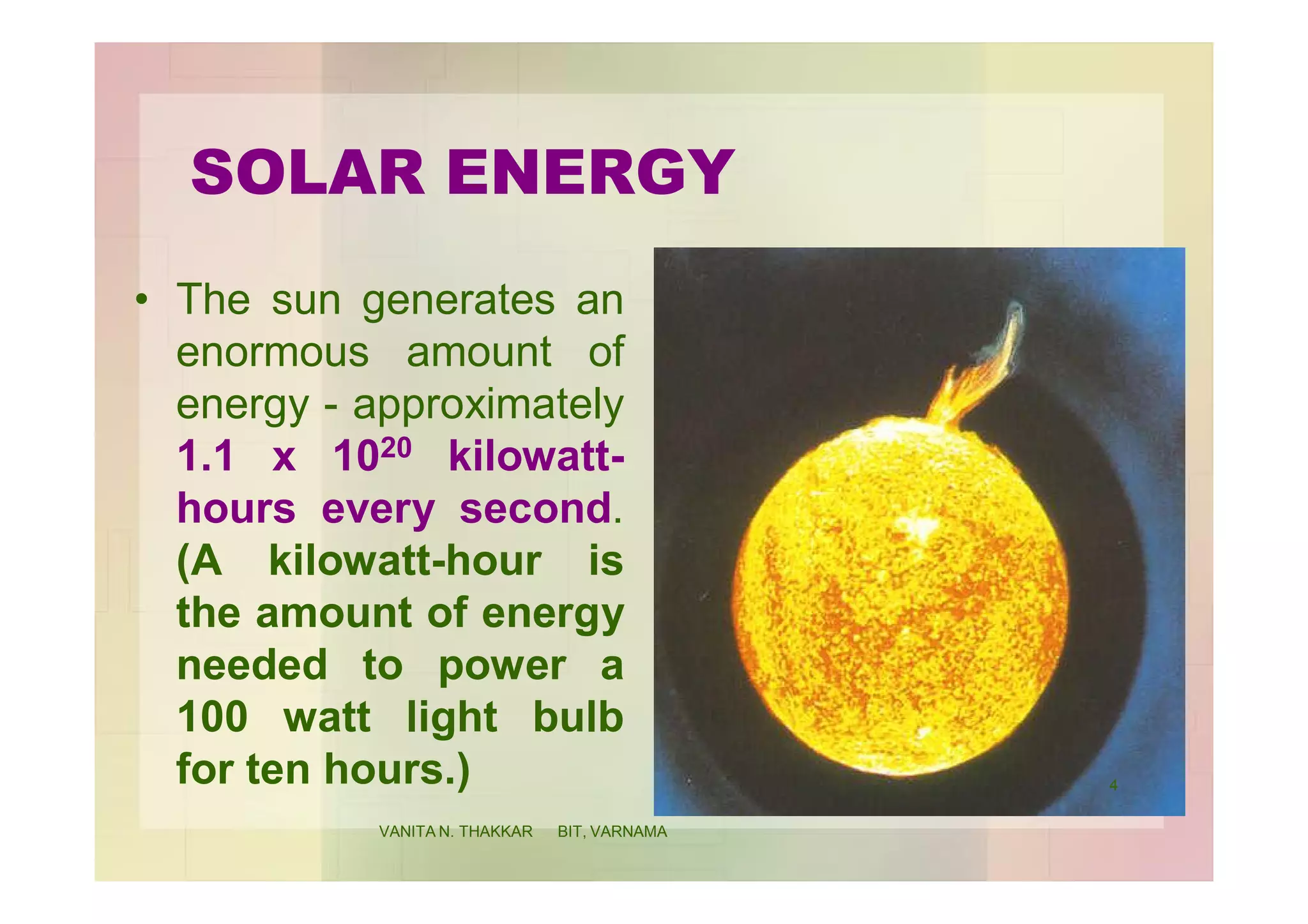
• The sun generates an
enormous amount of
energy - approximately
1.1 x 10²⁰ kilowatt-
hours every second.
(A kilowatt-hour is
the amount of energy
needed to power a
100 watt light bulb
for ten hours.) 4
VANITA N. THAKKAR BIT, VARNAMA
SOLAR ENERGY ON EARTH
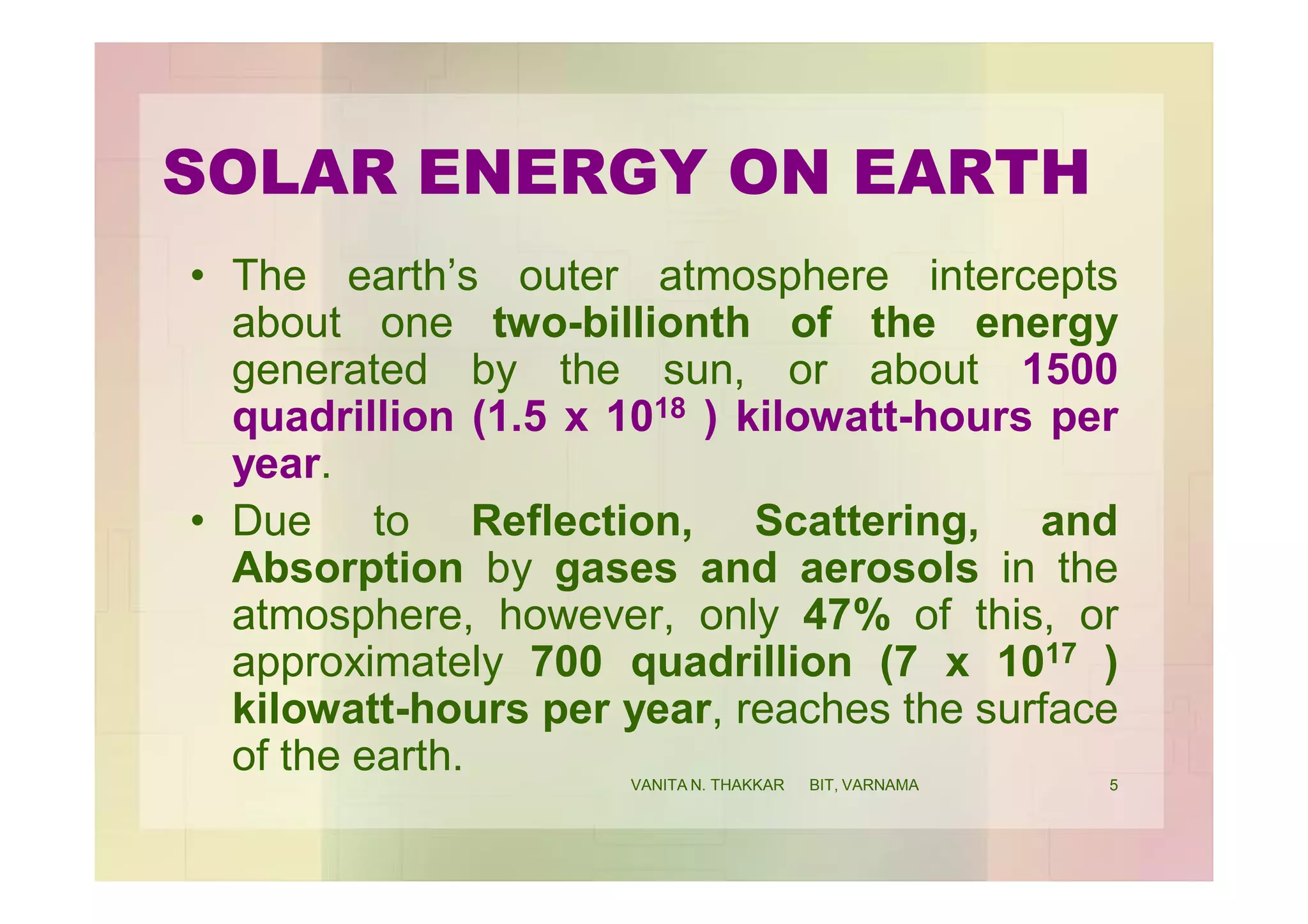
• The earth’s outer atmosphere intercepts
about one two-billionth of the energy
generated by the sun, or about 1500
quadrillion (1.5 x 10¹⁸ ) kilowatt-hours per
year.
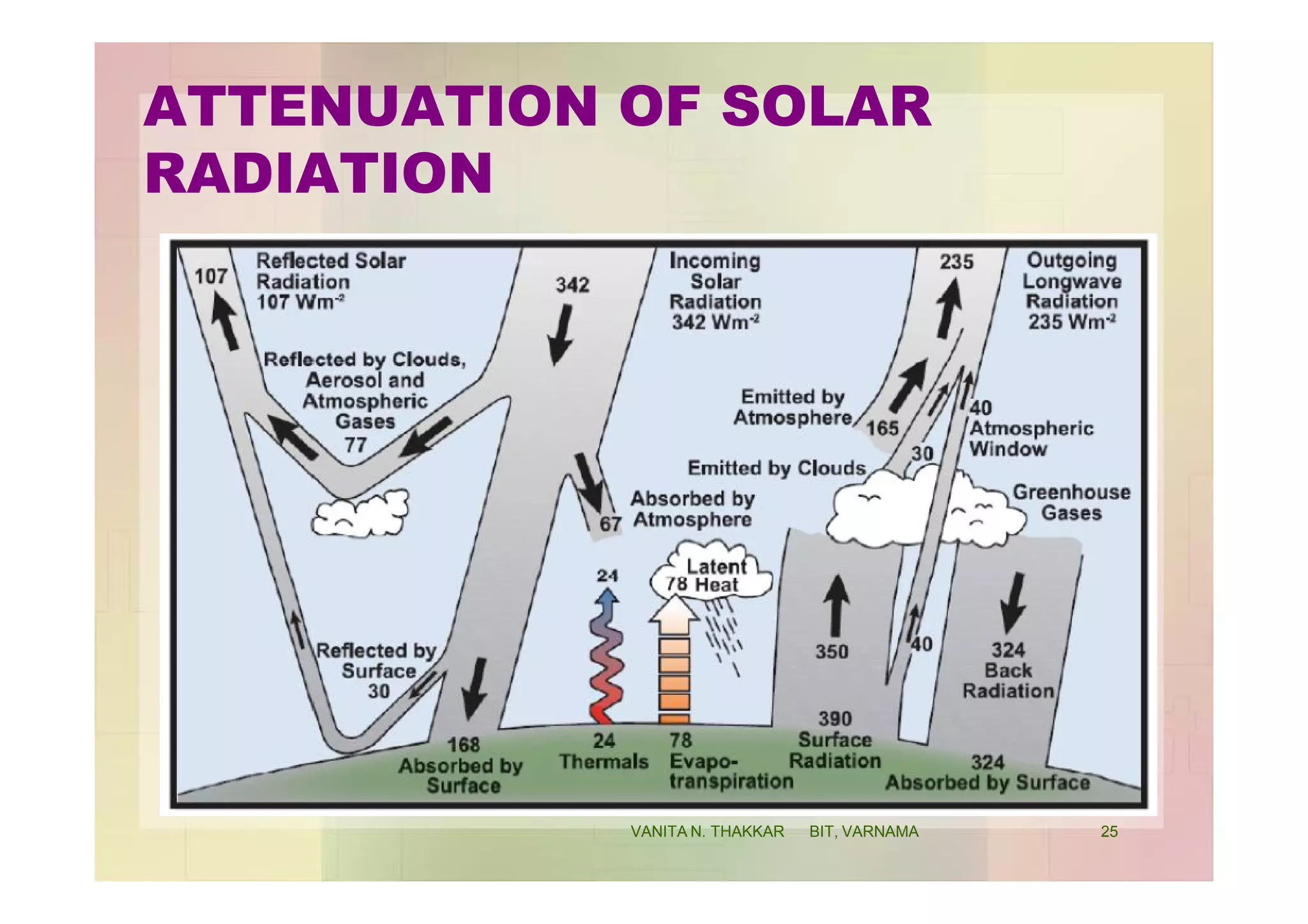
• Due to Reflection, Scattering, and
Absorption by gases and aerosols in the
atmosphere, however, only 47% of this, or
approximately 700 quadrillion (7 x 10¹⁷ )
kilowatt-hours per year, reaches the surface
of the earth. 5VANITA N. THAKKAR BIT, VARNAMA
SOLAR ENERGY ON EARTH (contd.)
• In the earth’s atmosphere, solar radiation is received :
– directly (Direct Radiation) and
– by diffusion in air, dust, water, etc., contained in the
atmosphere (Diffuse Radiation).
• Global radiation = Direct Radiation + Diffuse
Radiation.
• The amount of incident energy per unit area and day
depends on a number of factors, e.g. :
– Solar Radiation Geometry, which includes Solar
Angles, Locational or Geographical factors and
Season / Time of the year.
– Local climate.
– Inclination of the collecting surface in the direction of
the sun.
6VANITA N. THAKKAR BIT, VARNAMA
EARTH’S ROTATION
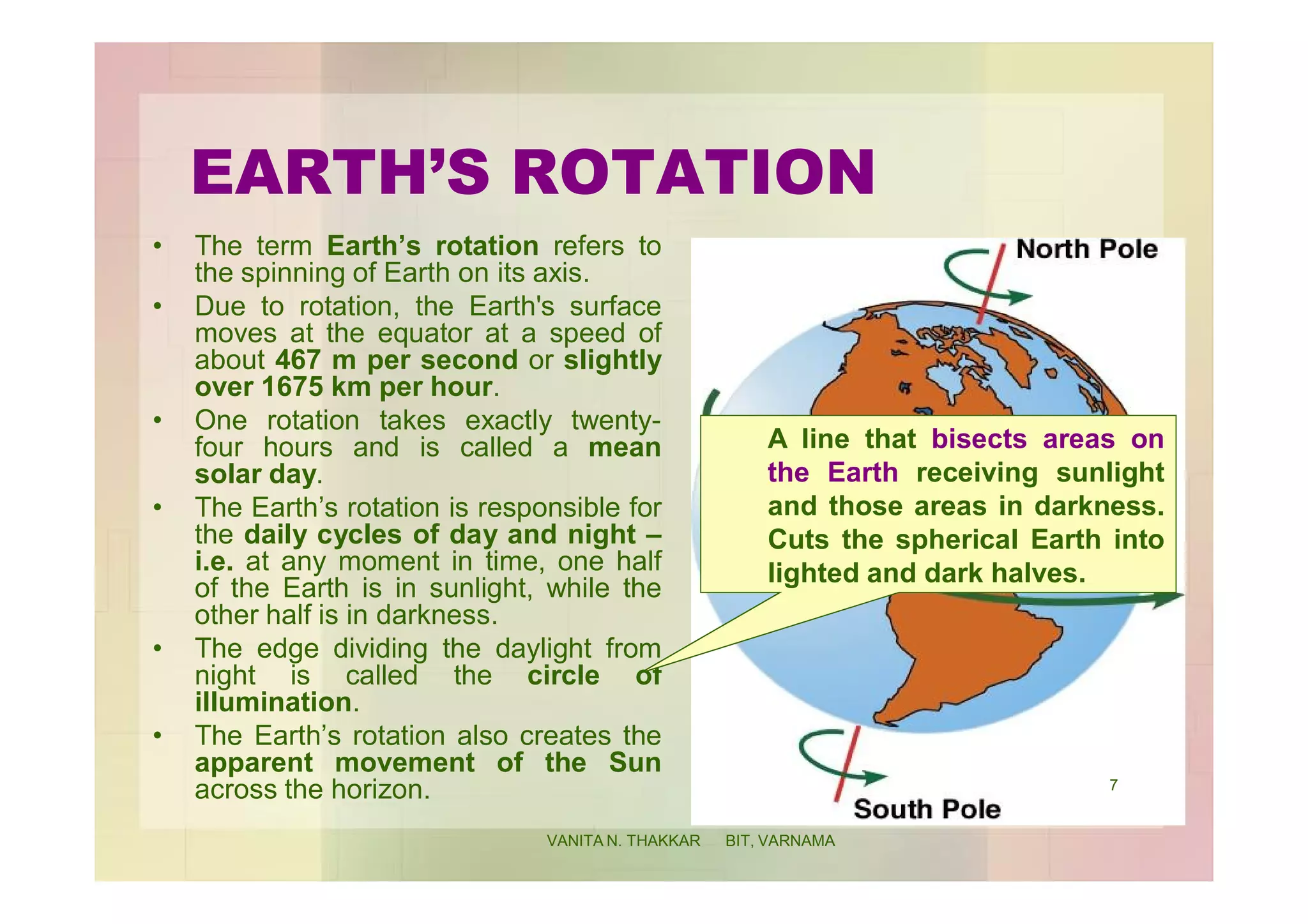
• The term Earth’s rotation refers to
the spinning of Earth on its axis.
• Due to rotation, the Earth's surface
moves at the equator at a speed of
about 467 m per second or slightly
over 1675 km per hour.
• One rotation takes exactly twenty-
four hours and is called a mean
solar day.
• The Earth’s rotation is responsible for
the daily cycles of day and night –
i.e. at any moment in time, one half
of the Earth is in sunlight, while the
other half is in darkness.
• The edge dividing the daylight from
night is called the circle of
illumination.
• The Earth’s rotation also creates the
apparent movement of the Sun
across the horizon.
A line that bisects areas on
the Earth receiving sunlight
and those areas in darkness.
Cuts the spherical Earth into
lighted and dark halves.
7
VANITA N. THAKKAR BIT, VARNAMA
EARTH’S ROTATION (contd.)
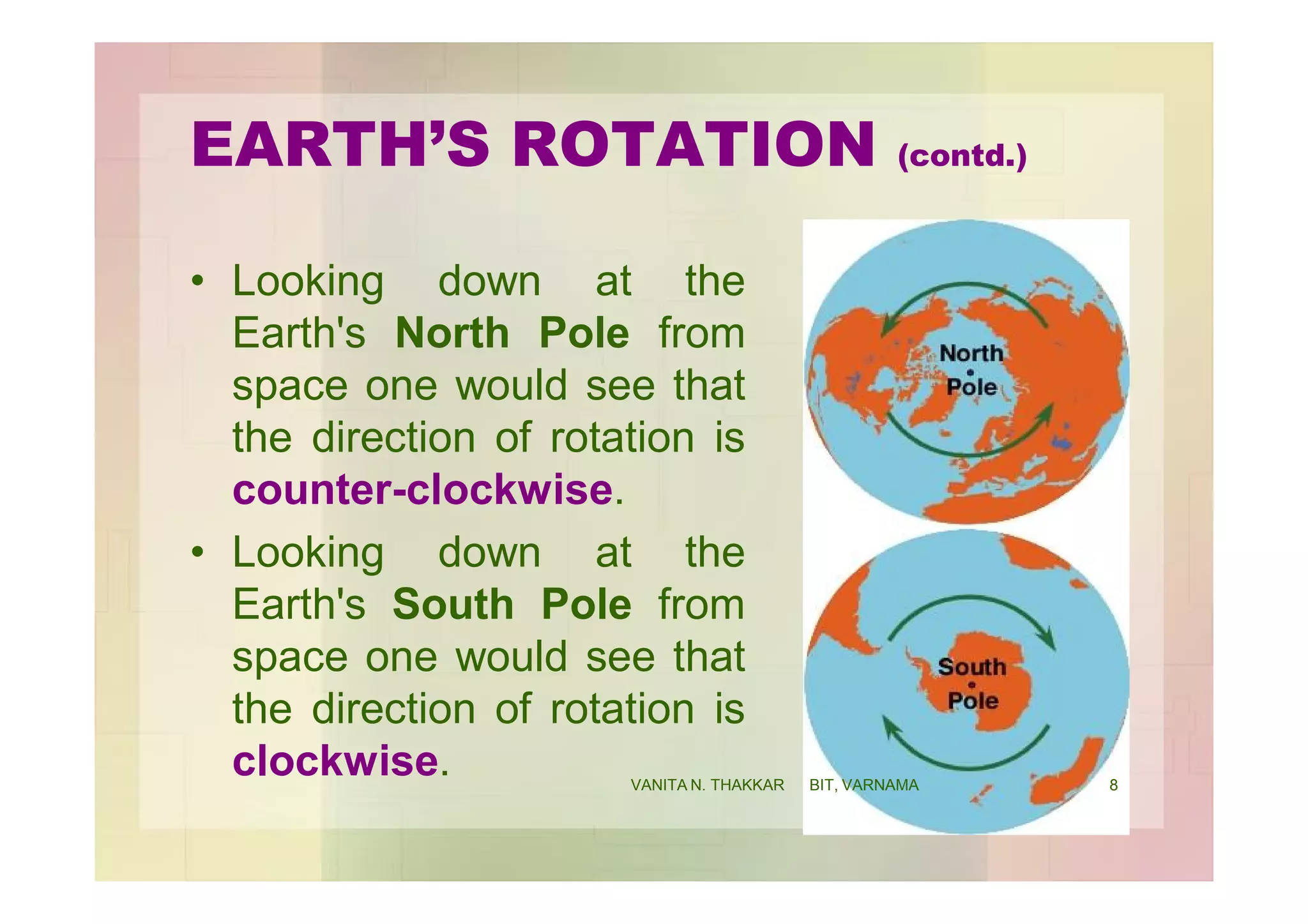
• Looking down at the
Earth's North Pole from
space one would see that
the direction of rotation is
counter-clockwise.
• Looking down at the
Earth's South Pole from
space one would see that
the direction of rotation is
clockwise. 8VANITA N. THAKKAR BIT, VARNAMA
EARTH REVOLUTION
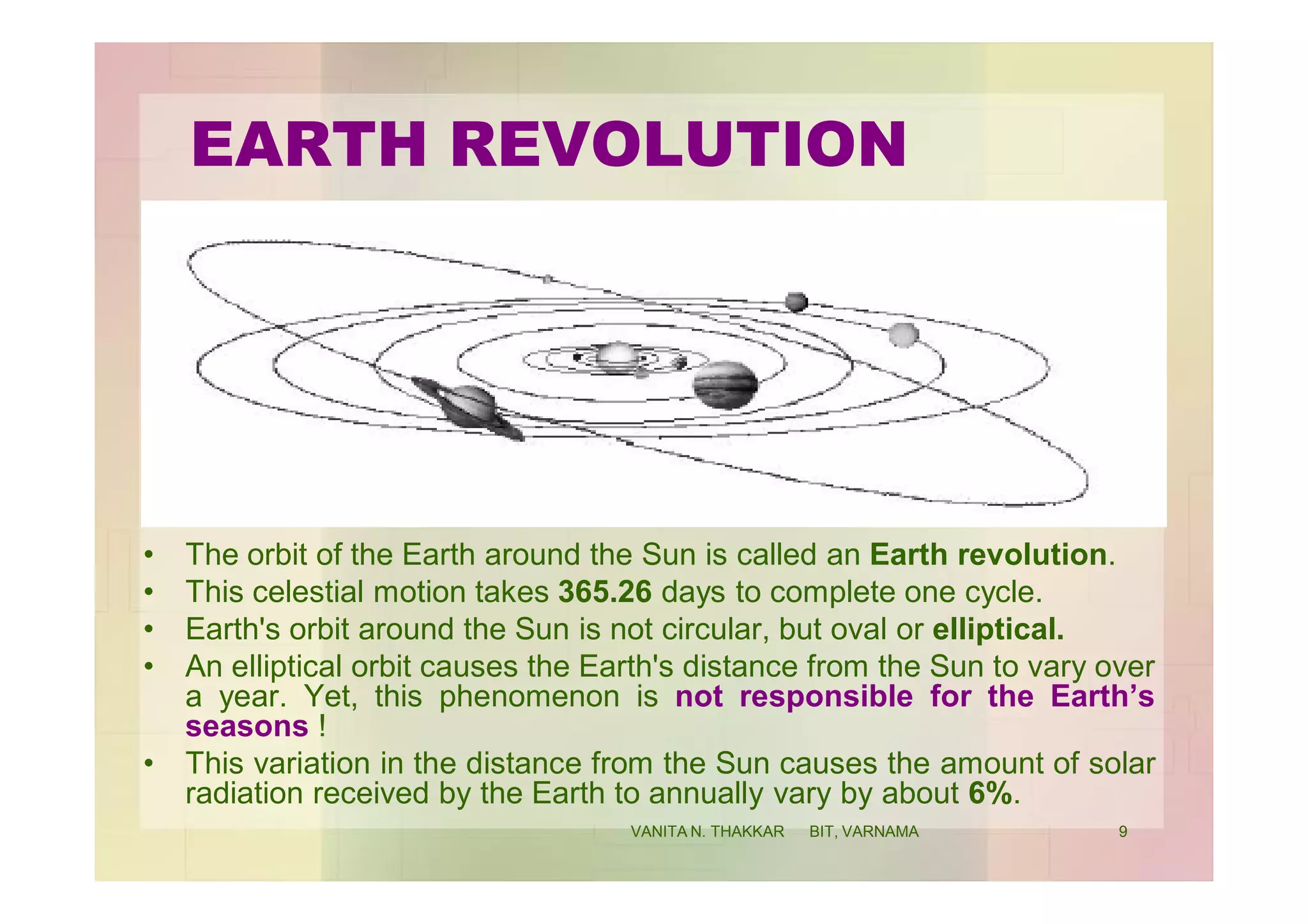
• The orbit of the Earth around the Sun is called an Earth revolution.
• This celestial motion takes 365.26 days to complete one cycle.
• Earth's orbit around the Sun is not circular, but oval or elliptical.
• An elliptical orbit causes the Earth's distance from the Sun to vary over
a year. Yet, this phenomenon is not responsible for the Earth’s
seasons !
• This variation in the distance from the Sun causes the amount of solar
radiation received by the Earth to annually vary by about 6%.
9VANITA N. THAKKAR BIT, VARNAMA
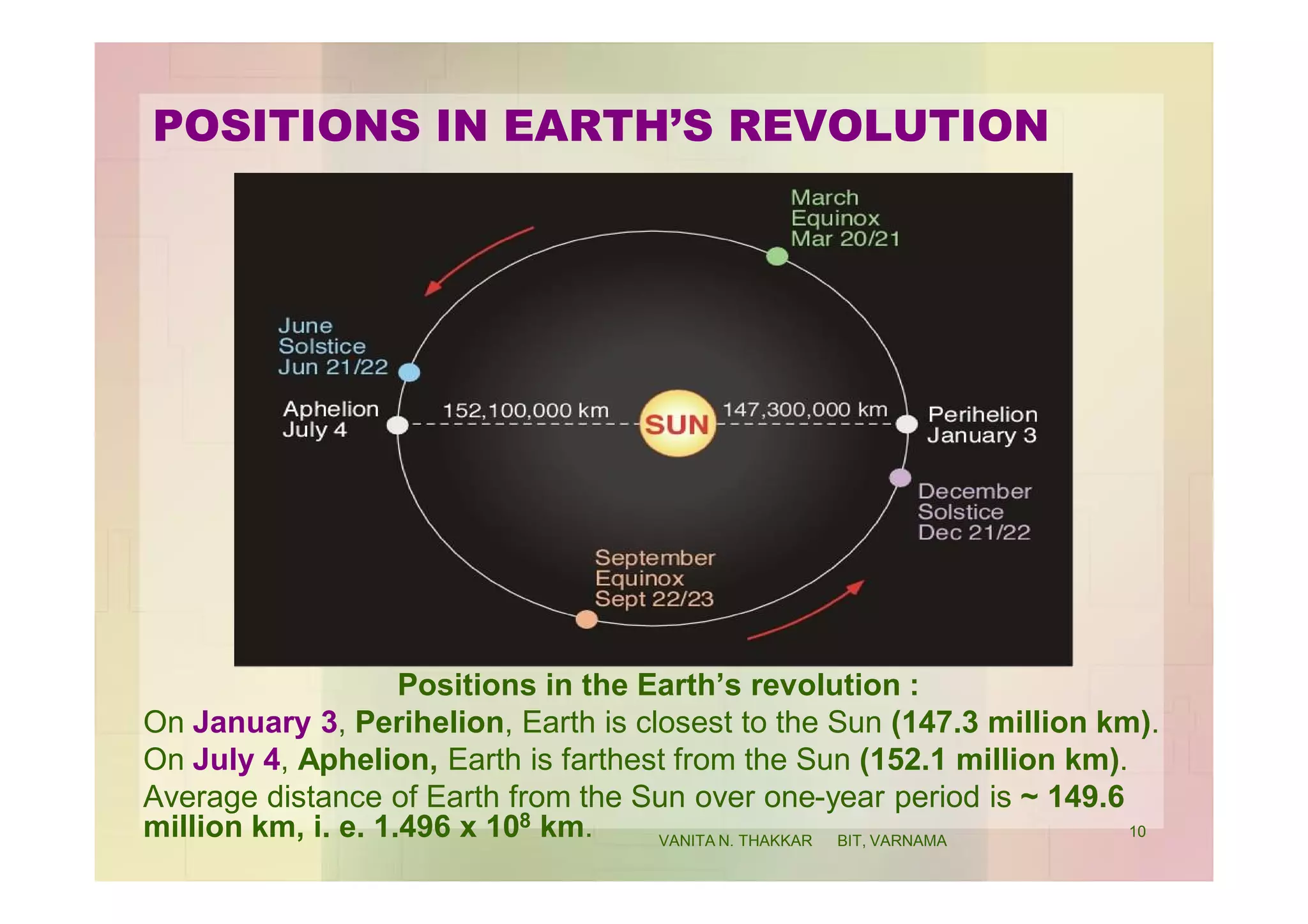
POSITIONS IN EARTH’S REVOLUTION
Positions in the Earth’s revolution :
On January 3, Perihelion, Earth is closest to the Sun (147.3 million km).
On July 4, Aphelion, Earth is farthest from the Sun (152.1 million km).
Average distance of Earth from the Sun over one-year period is ~ 149.6
million km, i. e. 1.496 x 10⁸ km. 10
VANITA N. THAKKAR BIT, VARNAMA
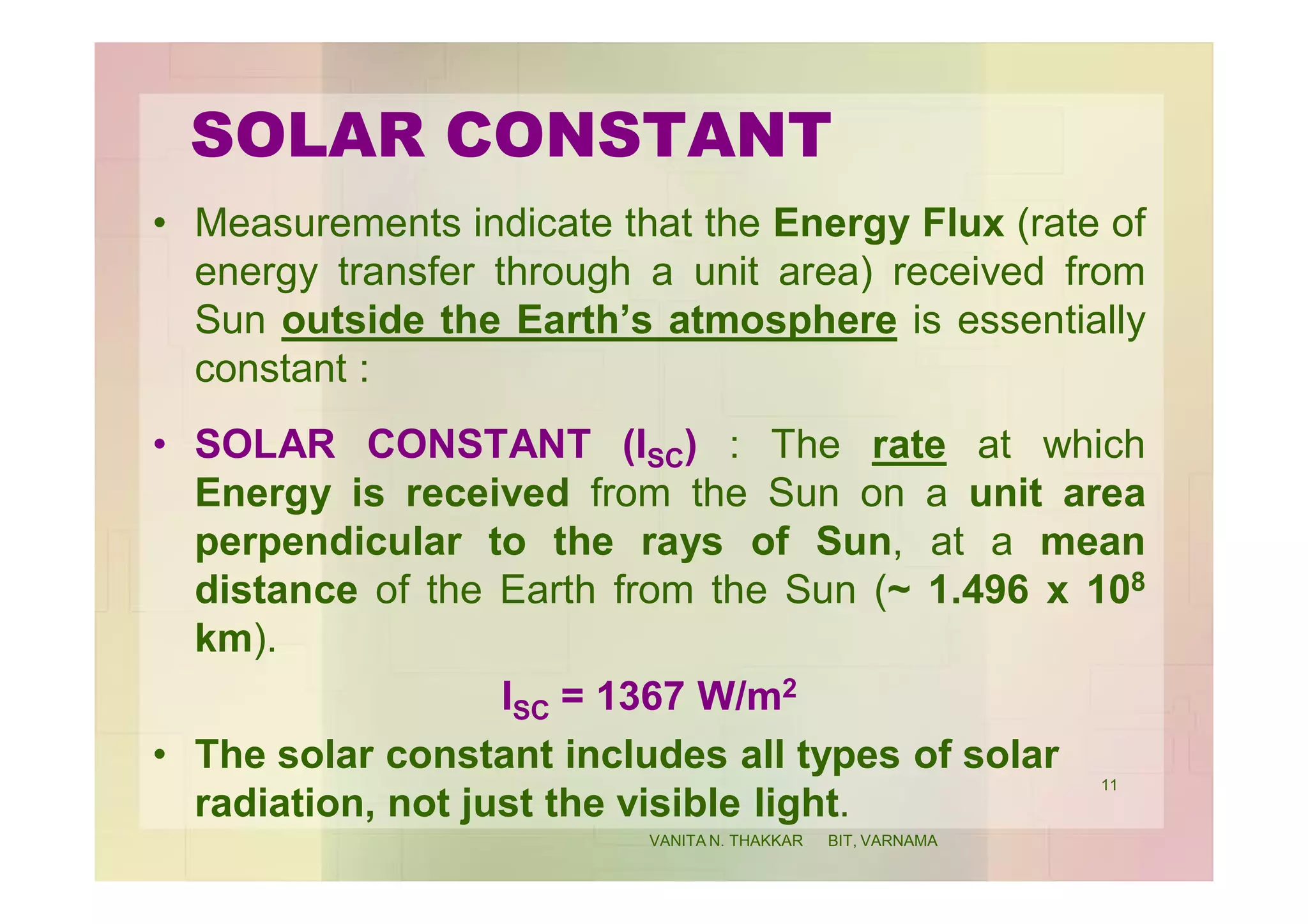
SOLAR CONSTANT
• Measurements indicate that the Energy Flux (rate of
energy transfer through a unit area) received from
Sun outside the Earth’s atmosphere is essentially
constant :
• SOLAR CONSTANT (ISC) : The rate at which
Energy is received from the Sun on a unit area
perpendicular to the rays of Sun, at a mean
distance of the Earth from the Sun (~ 1.496 x 10⁸
km).
ISC = 1367 W/m2
• The solar constant includes all types of solar
radiation, not just the visible light.
11
VANITA N. THAKKAR BIT, VARNAMA
VARIATION IN EXTRA-TERRESTRIAL
FLUX
• Due to variation in Earth-Sun distance
throughout the year, the Extra-
terrestrial Flux varies, which can be
calculated from the equation :
ISC’ = ISC [1 + 0.033 cos (360n/365)],
Where, n = the number of day of the
year.
12VANITA N. THAKKAR BIT, VARNAMA
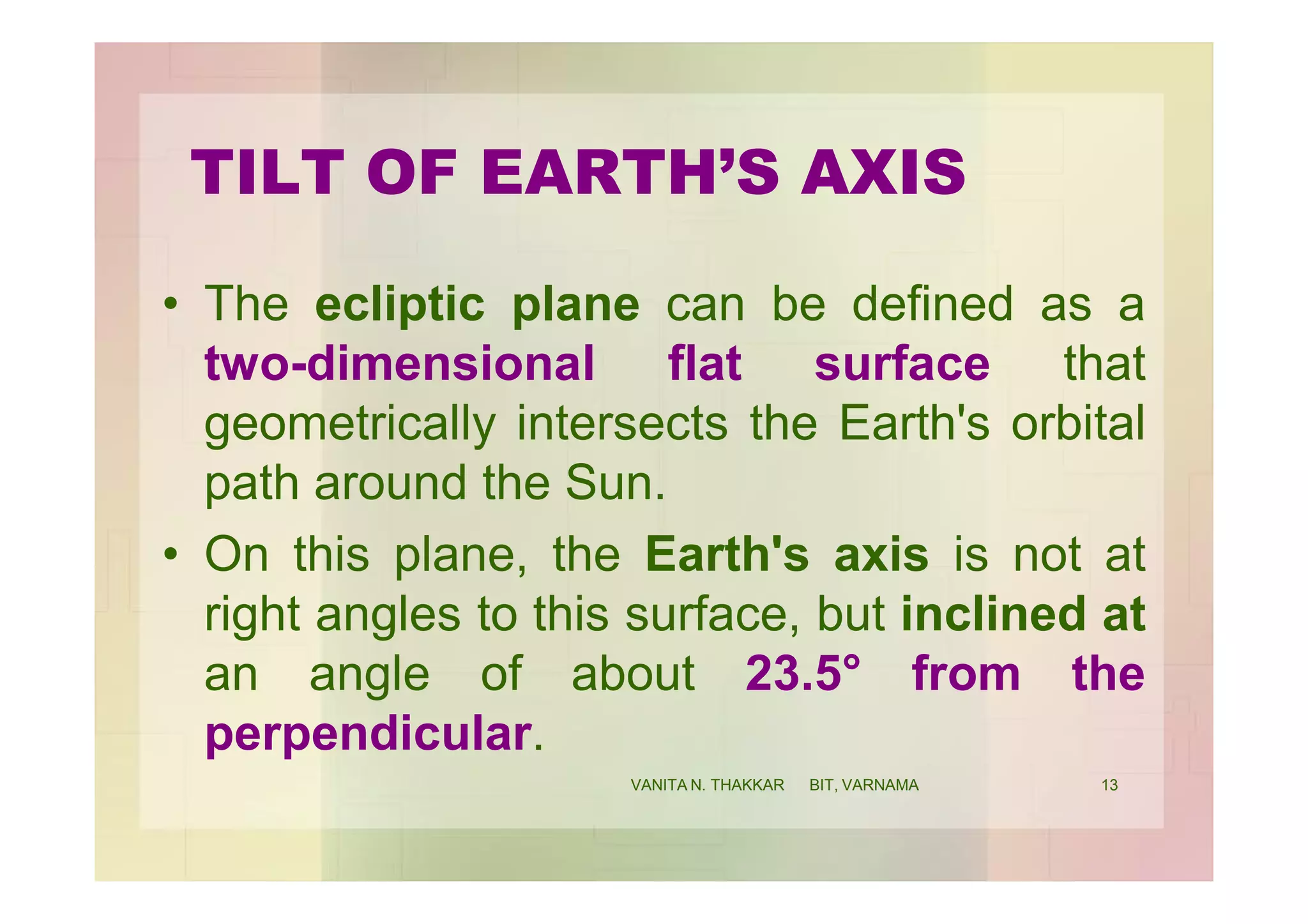
TILT OF EARTH’S AXIS
• The ecliptic plane can be defined as a
two-dimensional flat surface that
geometrically intersects the Earth's orbital
path around the Sun.
• On this plane, the Earth's axis is not at
right angles to this surface, but inclined at
an angle of about 23.5° from the
perpendicular.
13VANITA N. THAKKAR BIT, VARNAMA
SOLISTICE AND EQUINOX
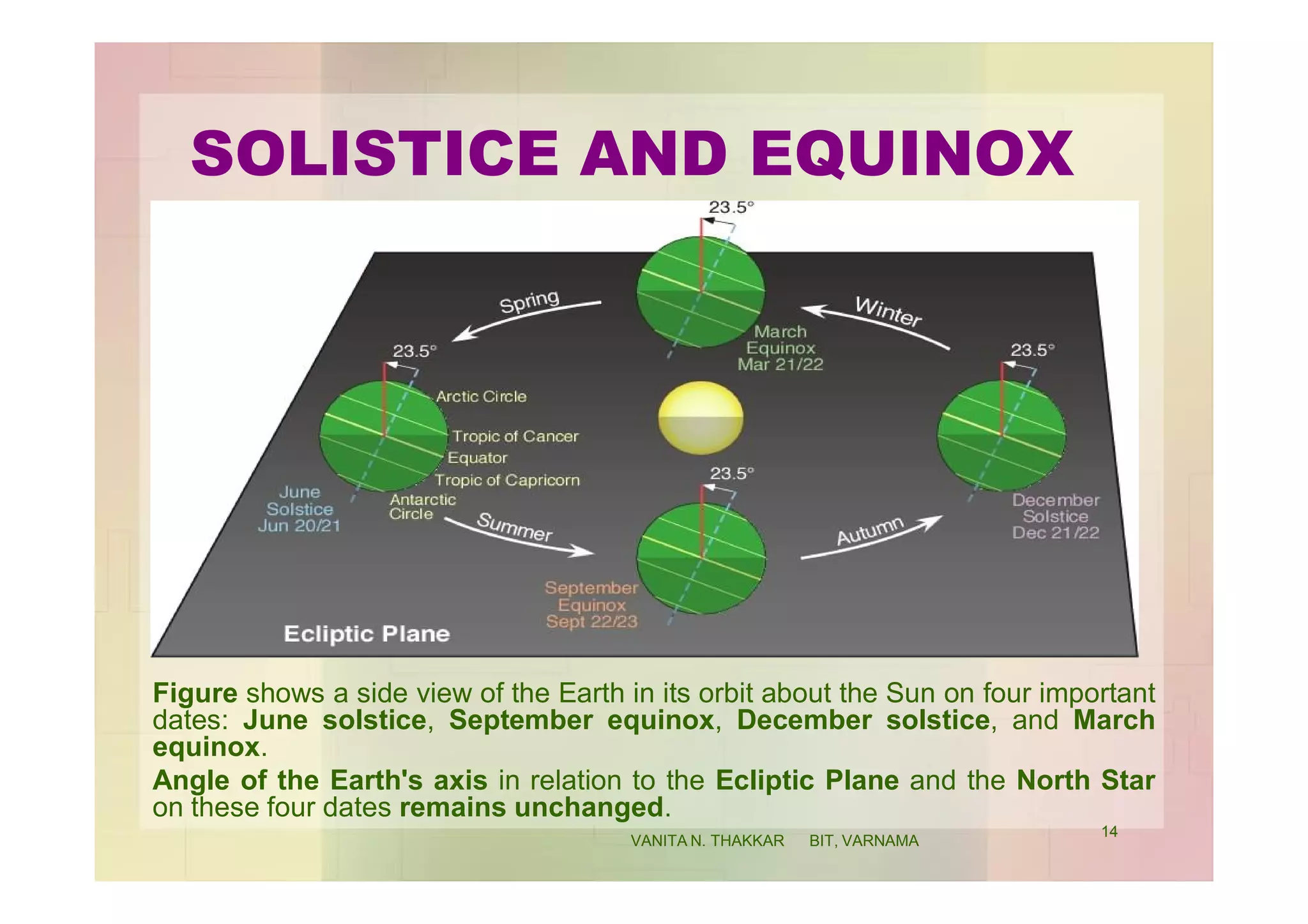
Figure shows a side view of the Earth in its orbit about the Sun on four important
dates: June solstice, September equinox, December solstice, and March
equinox.
Angle of the Earth's axis in relation to the Ecliptic Plane and the North Star
on these four dates remains unchanged.
14
VANITA N. THAKKAR BIT, VARNAMA
SOLISTICE AND EQUINOX (contd.)
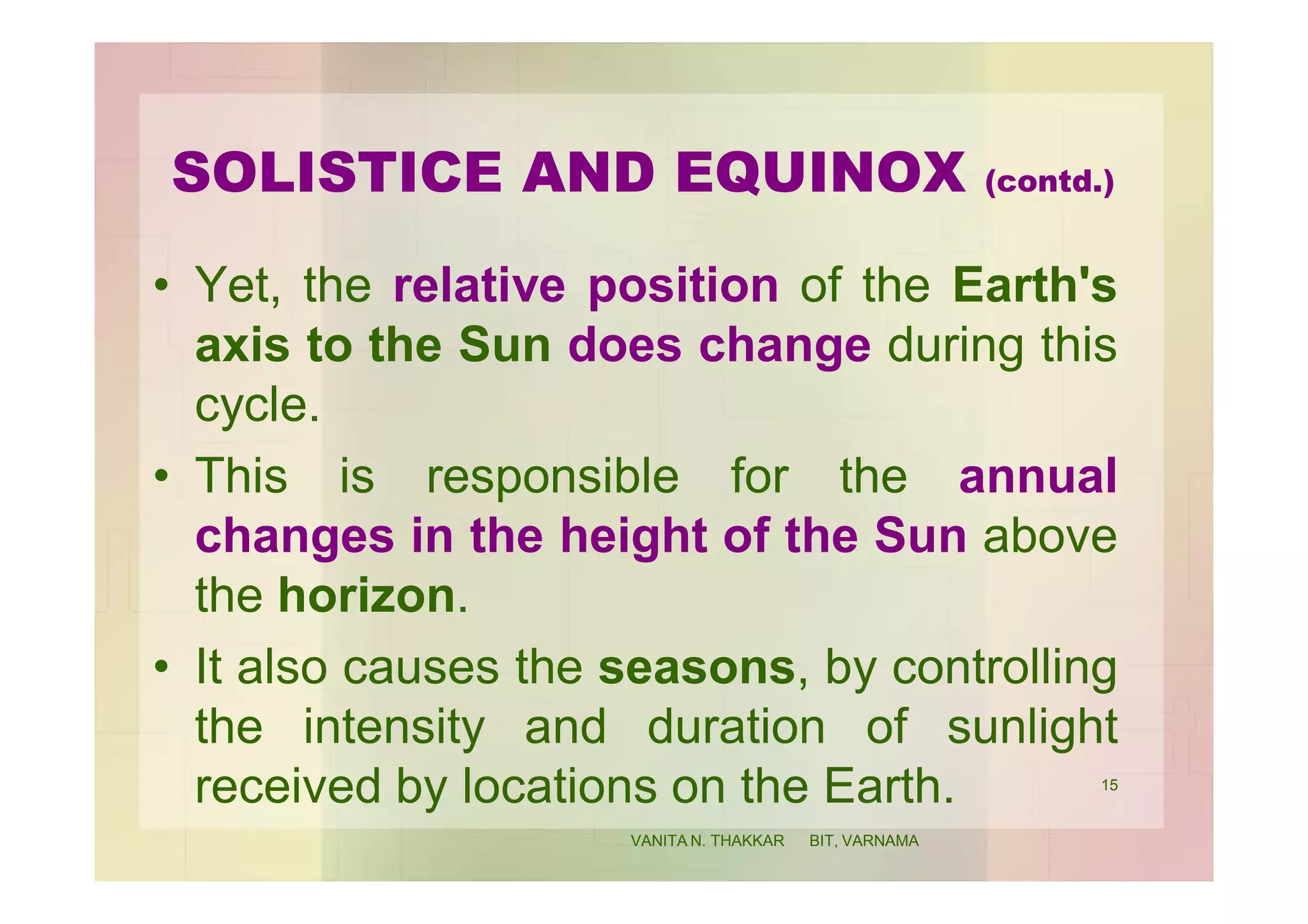
• Yet, the relative position of the Earth's
axis to the Sun does change during this
cycle.
• This is responsible for the annual
changes in the height of the Sun above
the horizon.
• It also causes the seasons, by controlling
the intensity and duration of sunlight
received by locations on the Earth. 15
VANITA N. THAKKAR BIT, VARNAMA
SOLISTICE AND EQUINOX (contd.)
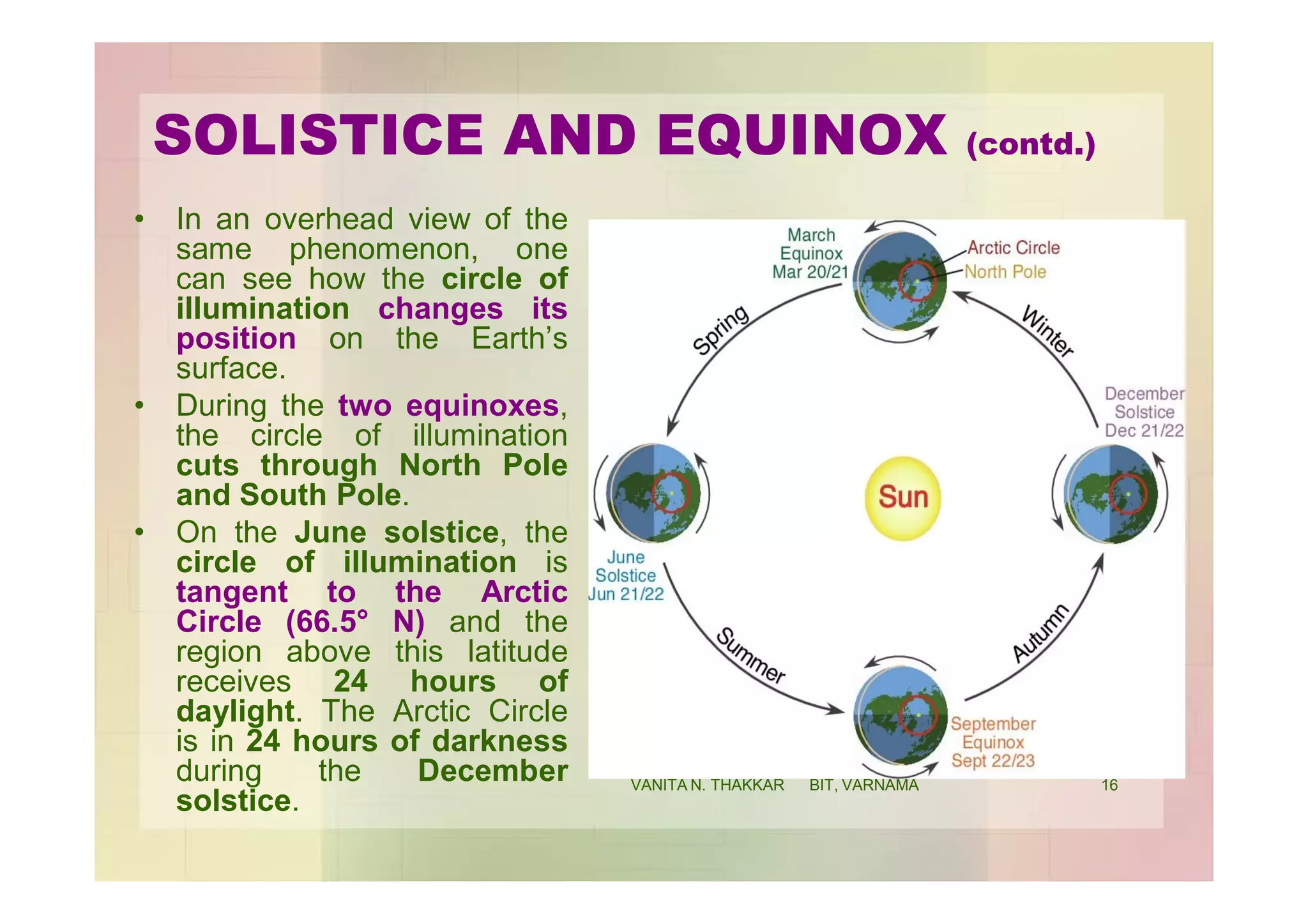
• In an overhead view of the
same phenomenon, one
can see how the circle of
illumination changes its
position on the Earth’s
surface.
• During the two equinoxes,
the circle of illumination
cuts through North Pole
and South Pole.
• On the June solstice, the
circle of illumination is
tangent to the Arctic
Circle (66.5° N) and the
region above this latitude
receives 24 hours of
daylight. The Arctic Circle
is in 24 hours of darkness
during the December
solstice.
16VANITA N. THAKKAR BIT, VARNAMA
SOLISTICE
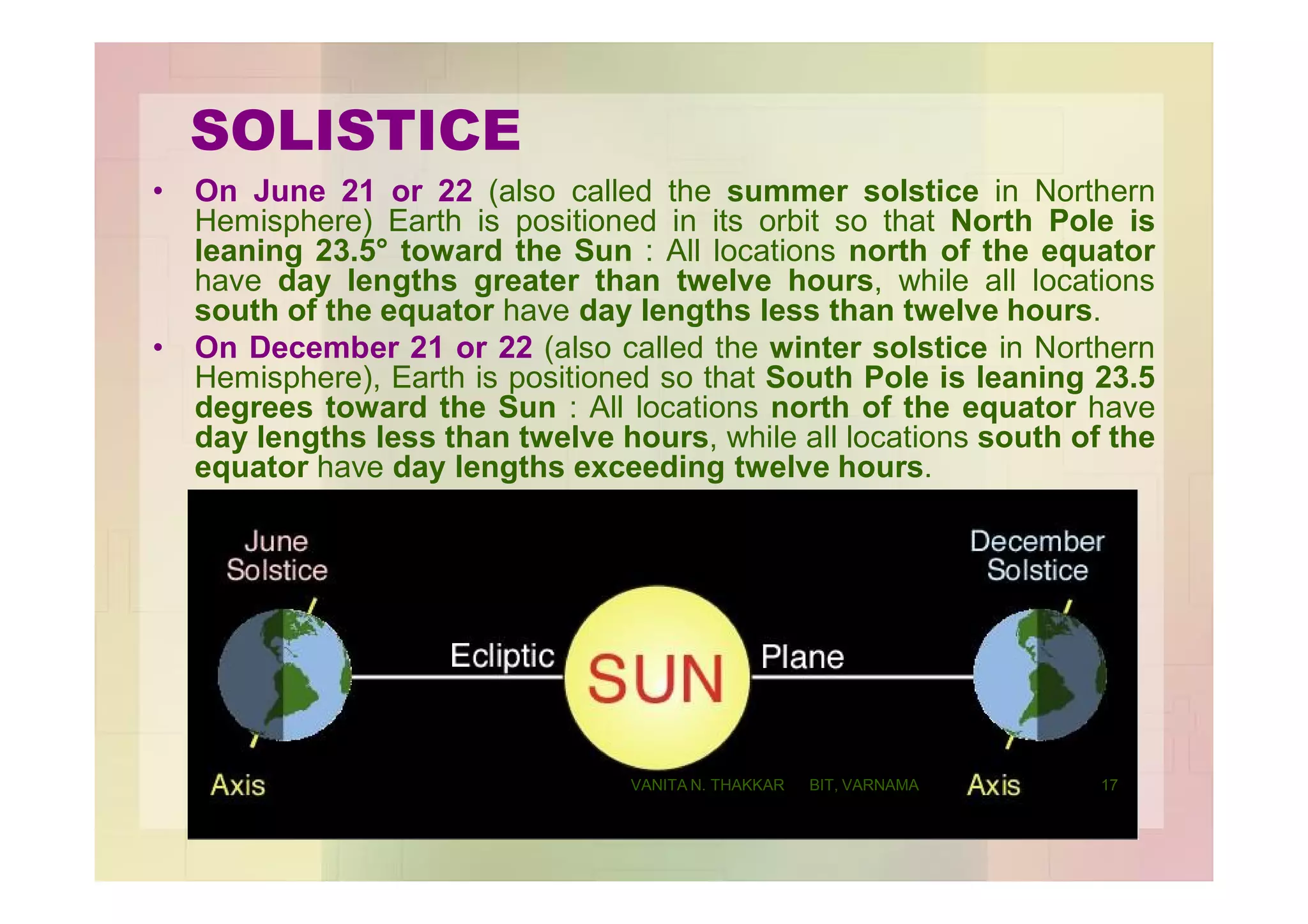
• On June 21 or 22 (also called the summer solstice in Northern
Hemisphere) Earth is positioned in its orbit so that North Pole is
leaning 23.5° toward the Sun : All locations north of the equator
have day lengths greater than twelve hours, while all locations
south of the equator have day lengths less than twelve hours.
• On December 21 or 22 (also called the winter solstice in Northern
Hemisphere), Earth is positioned so that South Pole is leaning 23.5
degrees toward the Sun : All locations north of the equator have
day lengths less than twelve hours, while all locations south of the
equator have day lengths exceeding twelve hours.
17VANITA N. THAKKAR BIT, VARNAMA
EQUINOX
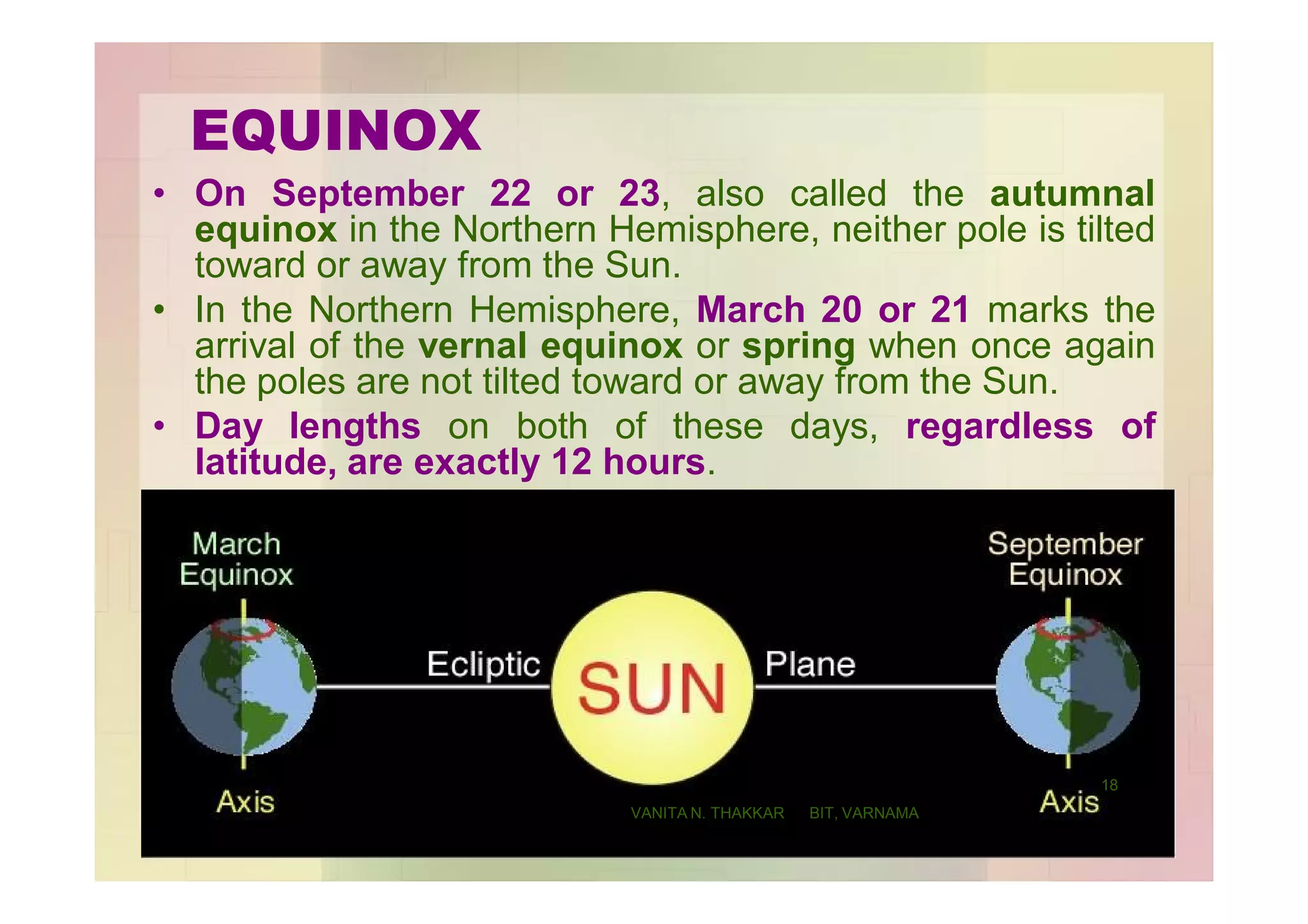
• On September 22 or 23, also called the autumnal
equinox in the Northern Hemisphere, neither pole is tilted
toward or away from the Sun.
• In the Northern Hemisphere, March 20 or 21 marks the
arrival of the vernal equinox or spring when once again
the poles are not tilted toward or away from the Sun.
• Day lengths on both of these days, regardless of
latitude, are exactly 12 hours.
18
VANITA N. THAKKAR BIT, VARNAMA
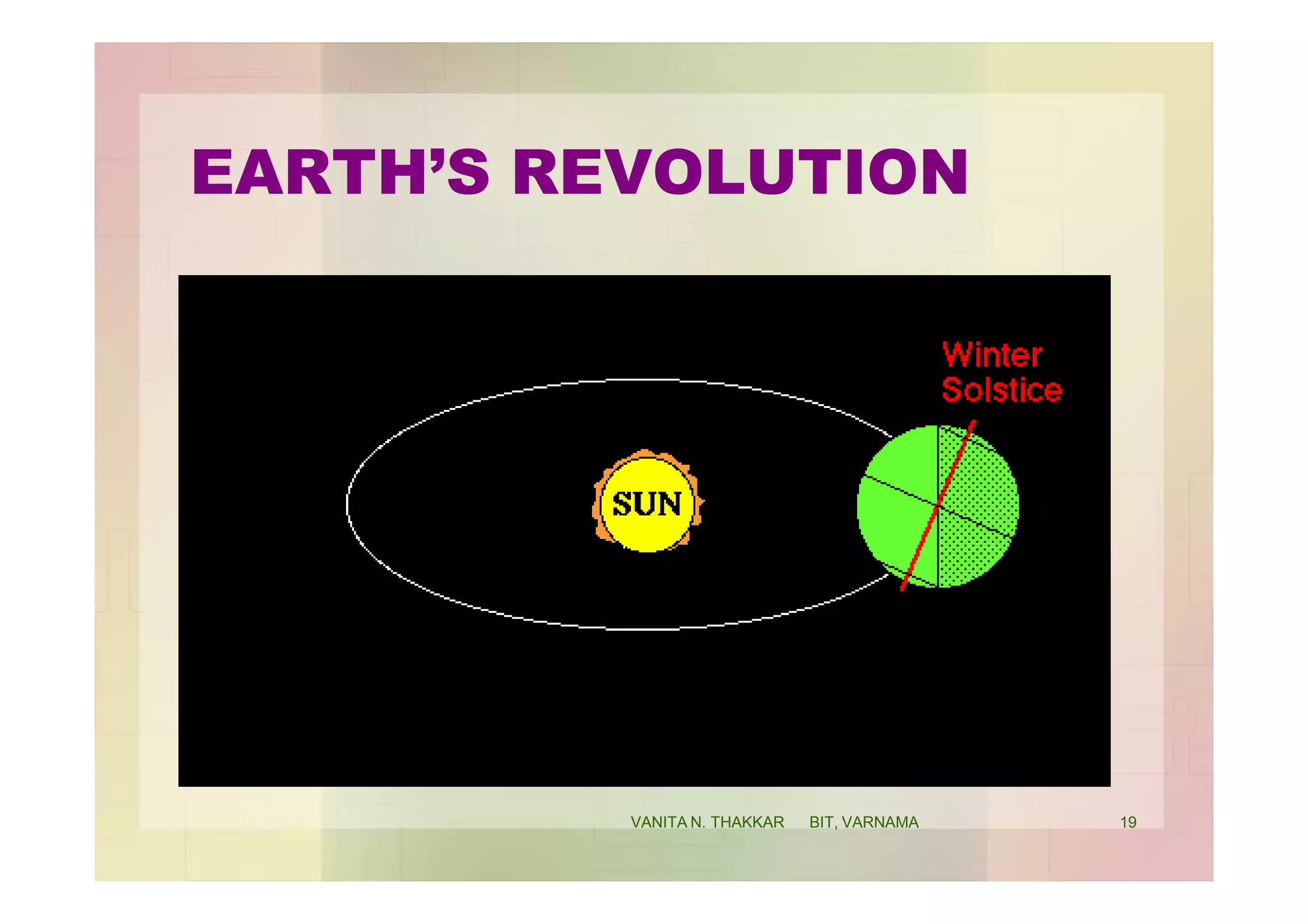
EARTH’S REVOLUTION
19VANITA N. THAKKAR BIT, VARNAMA
SPECTRAL DISTRIBUTION OF
SOLAR RADIATION
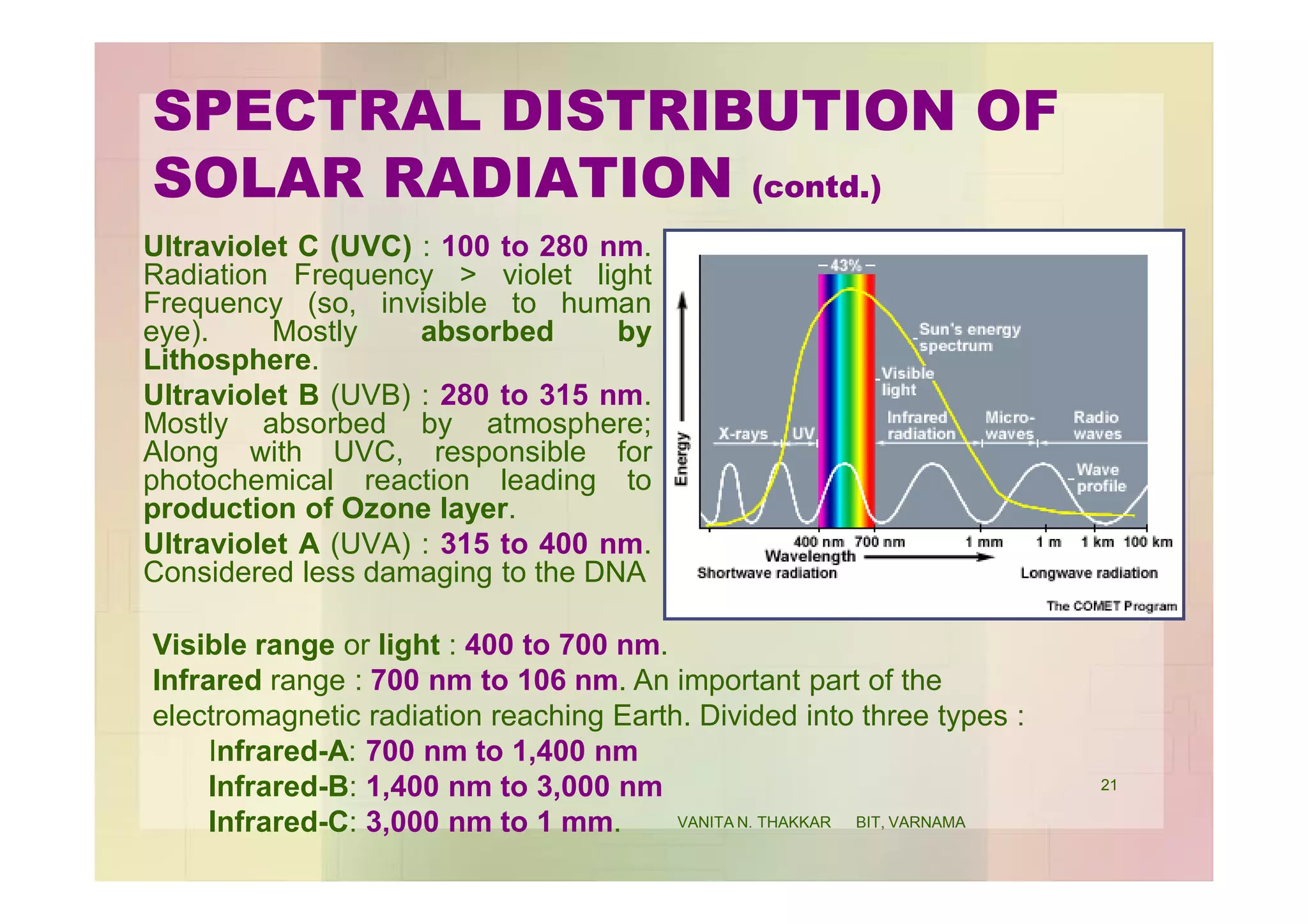
Solar Radiation spectrum is close to that
of a black body with a temperature of about
5,800 K.
About half that lies in the visible short-
wave part of and the other half mostly in
near-infrared part.
Some also lies in the ultraviolet part of the
spectrum.
Spectrum of electromagnetic radiation
striking Earth's atmosphere : 100 to 106 nm,
divided into five regions : 20
VANITA N. THAKKAR BIT, VARNAMA
SPECTRAL DISTRIBUTION OF
SOLAR RADIATION (contd.)
Ultraviolet C (UVC) : 100 to 280 nm.
Radiation Frequency > violet light
Frequency (so, invisible to human
eye). Mostly absorbed by
Lithosphere.
Ultraviolet B (UVB) : 280 to 315 nm.
Mostly absorbed by atmosphere;
Along with UVC, responsible for
photochemical reaction leading to
production of Ozone layer.
Ultraviolet A (UVA) : 315 to 400 nm.
Considered less damaging to the DNA
Visible range or light : 400 to 700 nm.
Infrared range : 700 nm to 106 nm. An important part of the
electromagnetic radiation reaching Earth. Divided into three types :
Infrared-A: 700 nm to 1,400 nm
Infrared-B: 1,400 nm to 3,000 nm
Infrared-C: 3,000 nm to 1 mm.
21
VANITA N. THAKKAR BIT, VARNAMA
SPECTRAL DISTRIBUTION OF
SOLAR RADIATION (contd.)
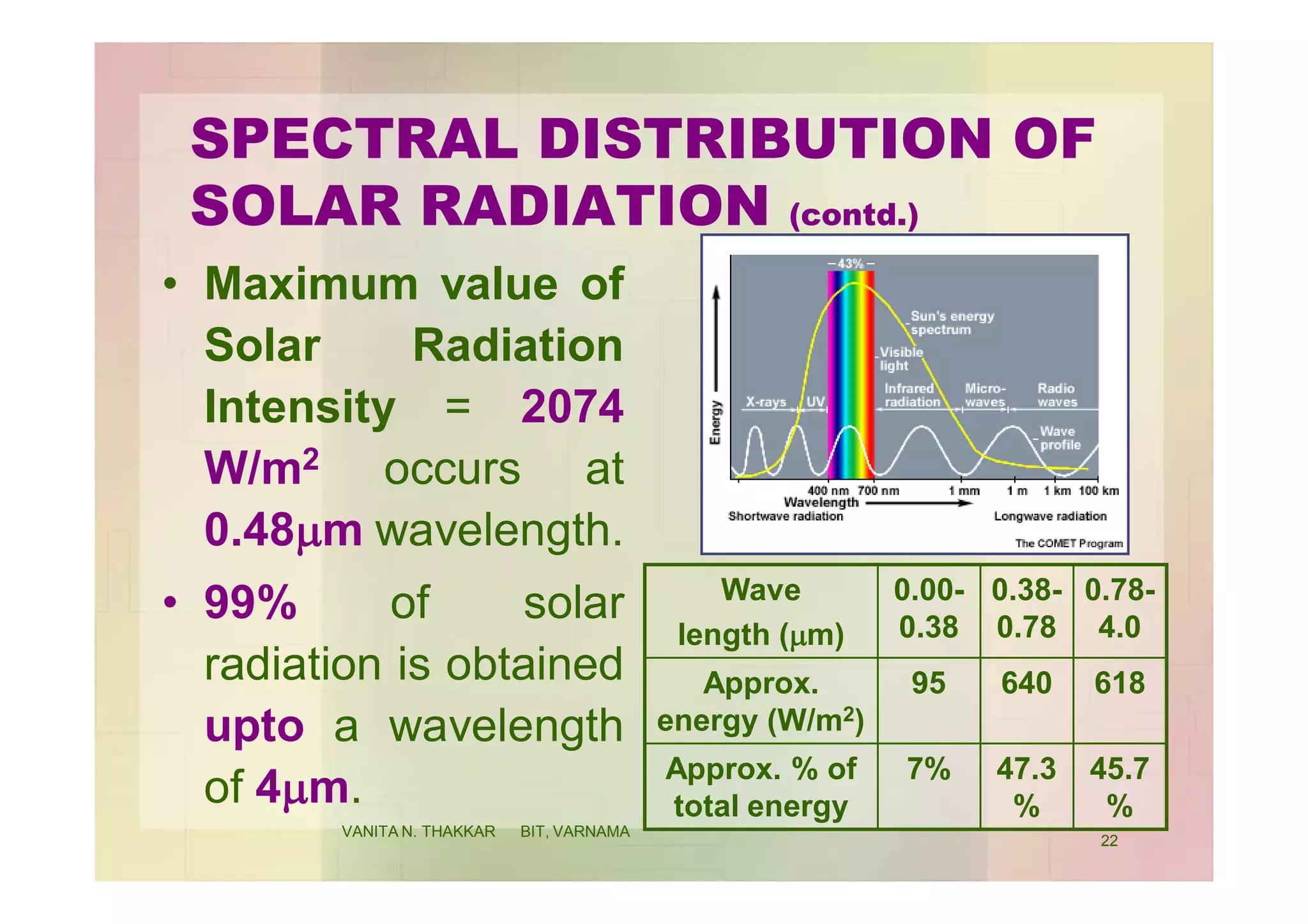
• Maximum value of
Solar Radiation
Intensity = 2074
W/m2 occurs at
0.48mm wavelength.
• 99% of solar
radiation is obtained
upto a wavelength
of 4mm.
Wave
length (mm)
0.00-
0.38
0.38-
0.78
0.78-
4.0
Approx.
energy (W/m2)
95 640 618
Approx. % of
total energy
7% 47.3
%
45.7
%
22
VANITA N. THAKKAR BIT, VARNAMA
SOLAR RADIATION ON
EARTH’S SURFACE
• Solar radiation reaching the Earth’s surface
differs in amount and character from
Extraterrestrial Radiation.
• Part of the radiation is reflected back, especially
by clouds.
• Some part of it is absorbed by molecules in air
such as –
– O2 and O3 (ozone) absorb nearly all UV radiations.
– Water vapour and CO2 absorb some energy in
infrared range.
• Some part of it is scattered by droplets in
clouds and dust particles. 23
VANITA N. THAKKAR BIT, VARNAMA
DIRECT AND DIFFUSE
RADIATION
Direct / Beam Radiation : Solar radiation
that does not get absorbed or scattered,
but reaches the ground directly from the
Sun. It produces shadow when
interrupted by an opaque object.
Diffuse Radiation : Solar radiation received
after its direction has been changed by
reflection and scattering in the
atmosphere. 24VANITA N. THAKKAR BIT, VARNAMA
ATTENUATION OF SOLAR
RADIATION
25VANITA N. THAKKAR BIT, VARNAMA
SOLAR RADIATION GEOMETRY
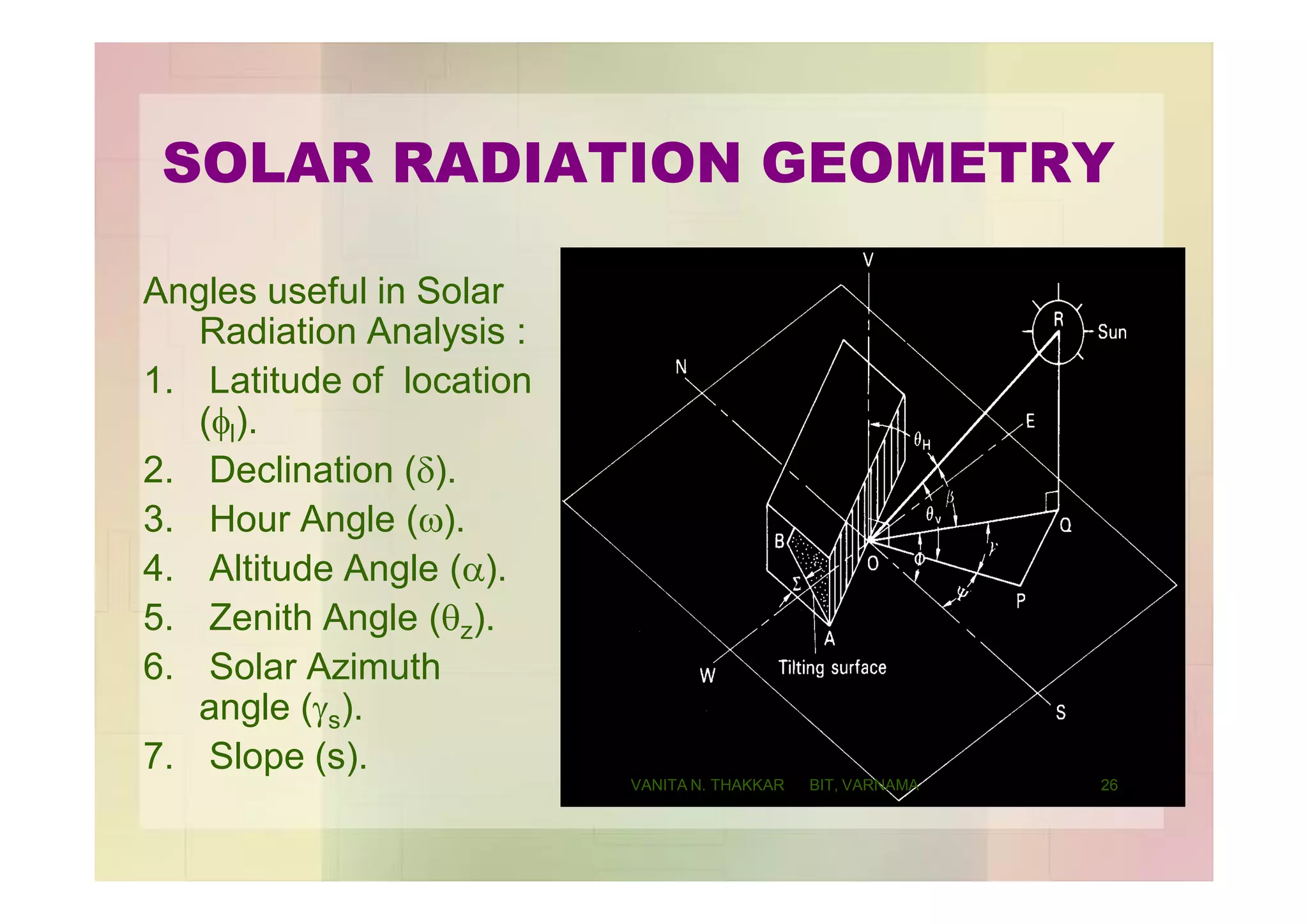
Angles useful in Solar
Radiation Analysis :
1. Latitude of location
(fl).
2. Declination (d).
3. Hour Angle (w).
4. Altitude Angle (a).
5. Zenith Angle (qz).
6. Solar Azimuth
angle (gs).
7. Slope (s).
26VANITA N. THAKKAR BIT, VARNAMA
LATITUDE ANGLE (fl)
Latitude (fl)
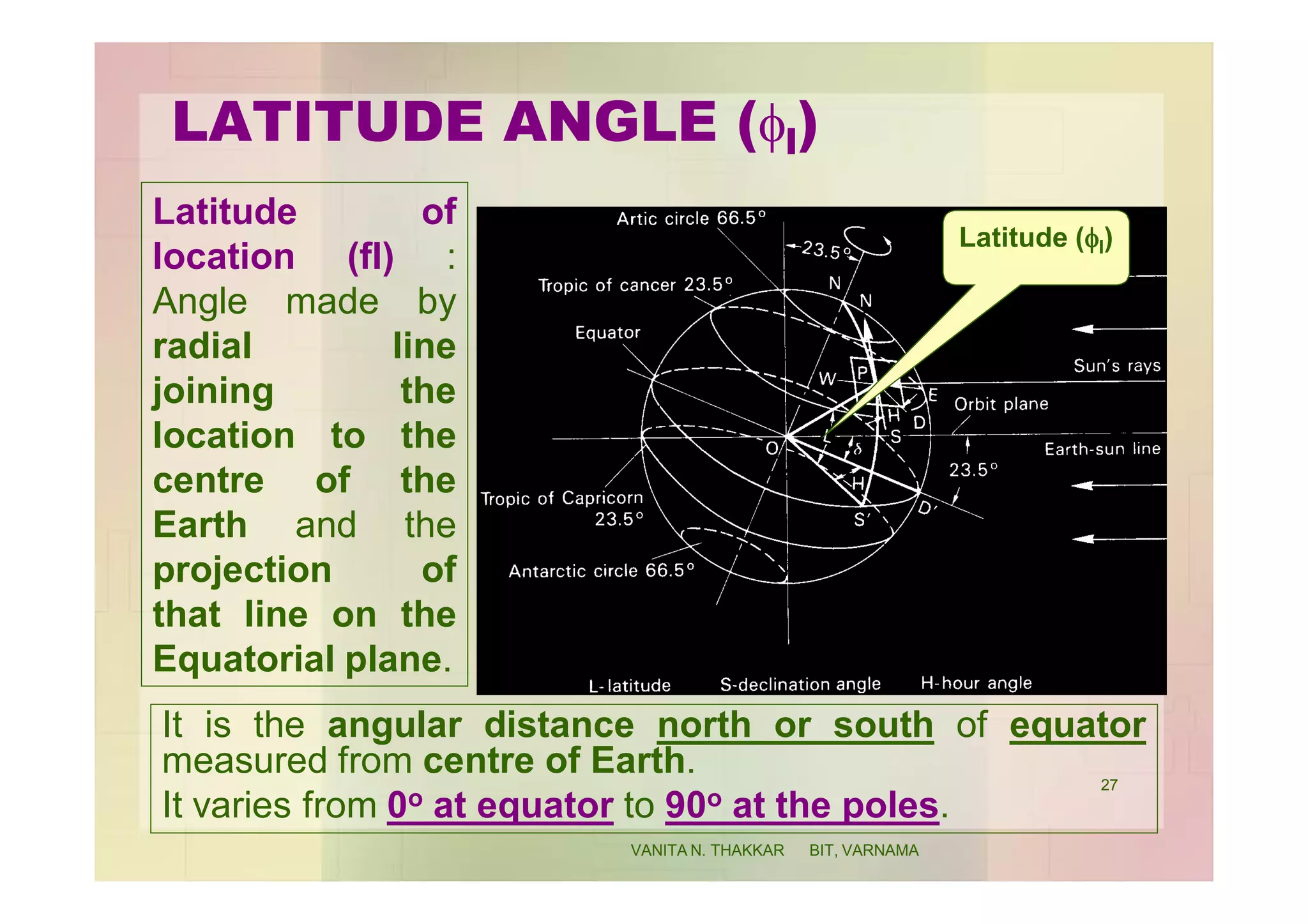
Latitude of
location (fl) :
Angle made by
radial line
joining the
location to the
centre of the
Earth and the
projection of
that line on the
Equatorial plane.
It is the angular distance north or south of equator
measured from centre of Earth.
It varies from 0o at equator to 90o at the poles.
27
VANITA N. THAKKAR BIT, VARNAMA
LATITUDE ANGLE (fl) (contd.)
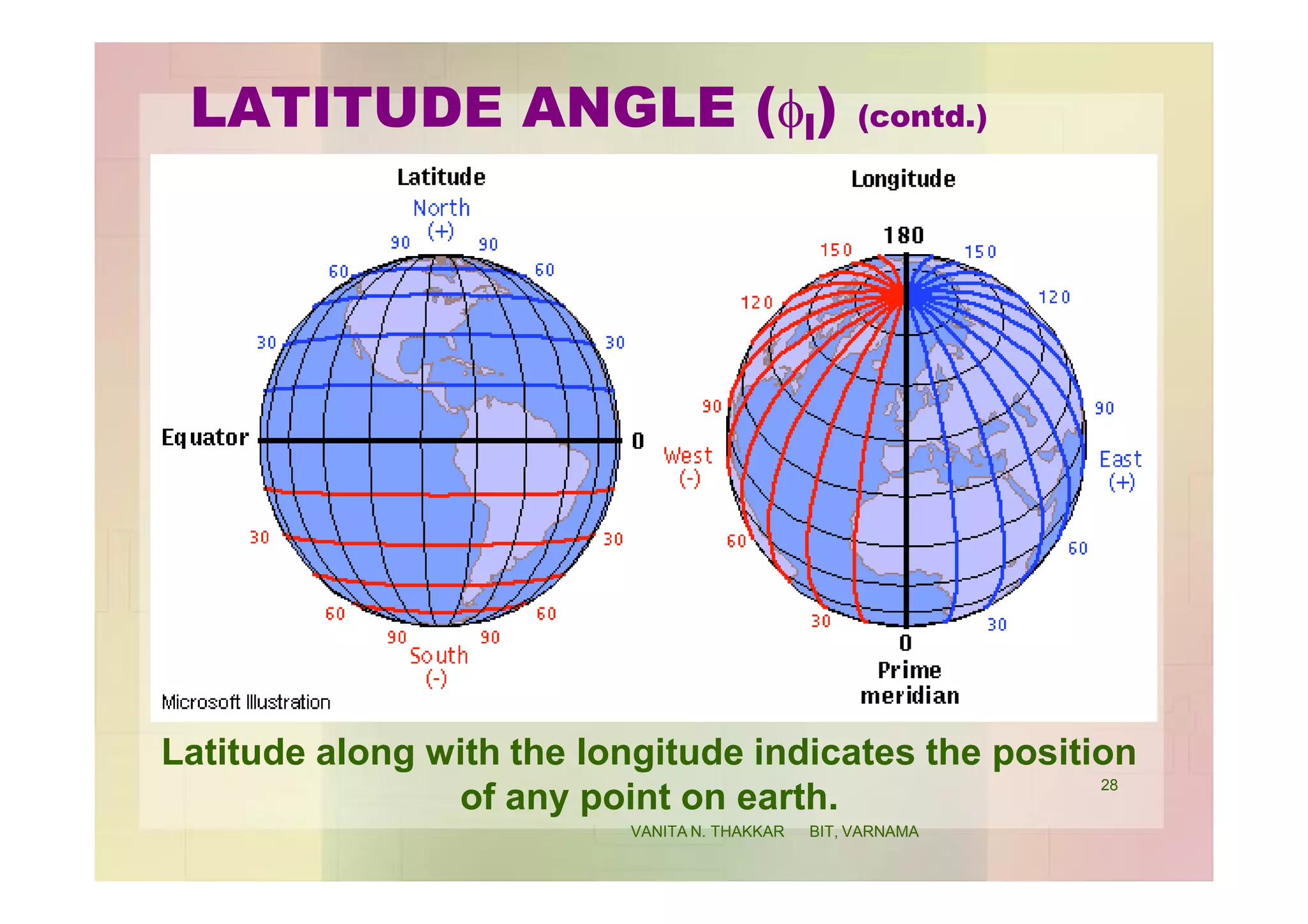
Latitude along with the longitude indicates the position
of any point on earth.
28
VANITA N. THAKKAR BIT, VARNAMA
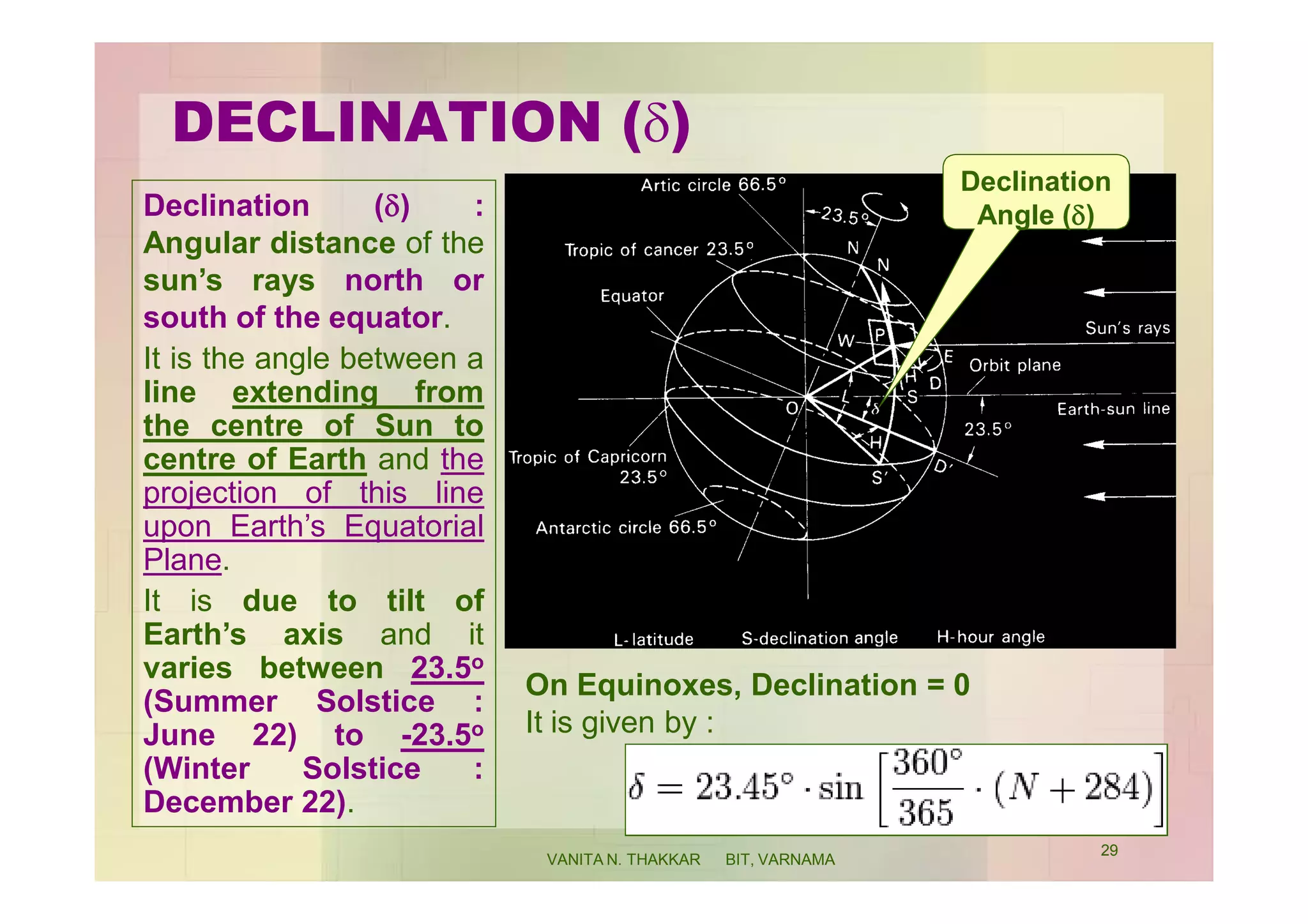
DECLINATION (d)
On Equinoxes, Declination = 0
It is given by :
Declination
Angle (d)Declination (d) :
Angular distance of the
sun’s rays north or
south of the equator.
It is the angle between a
line extending from
the centre of Sun to
centre of Earth and the
projection of this line
upon Earth’s Equatorial
Plane.
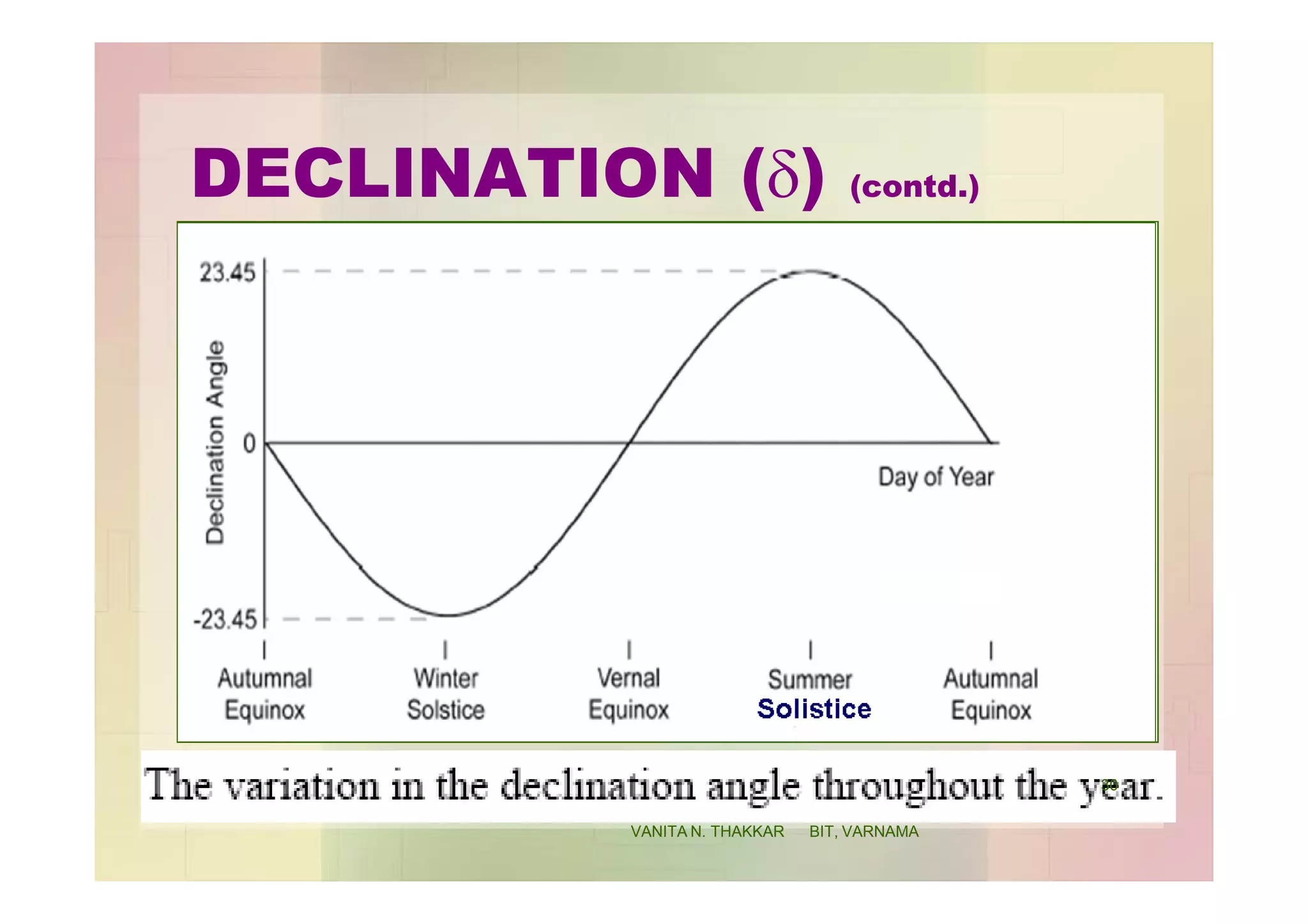
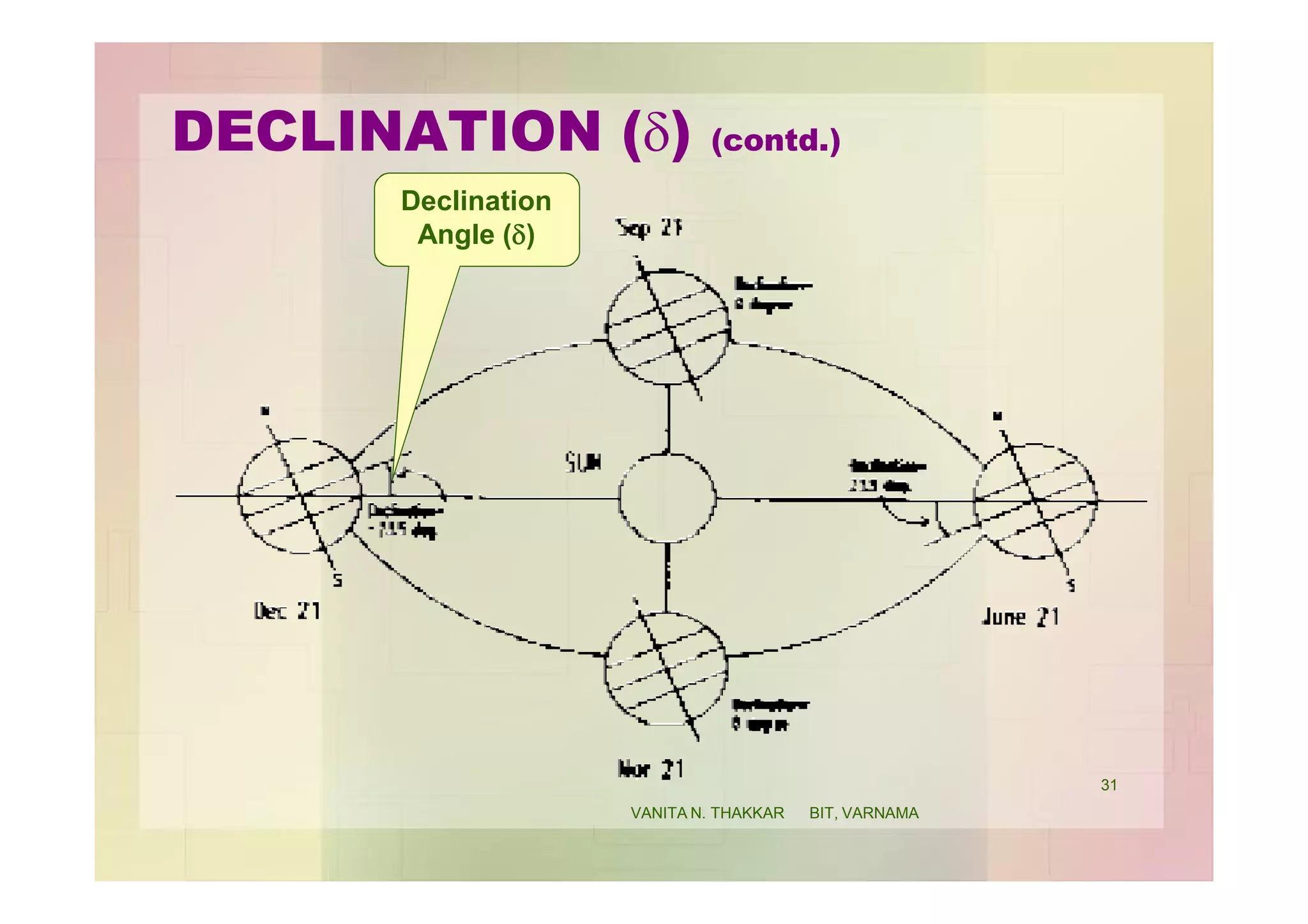
It is due to tilt of
Earth’s axis and it
varies between 23.5o
(Summer Solstice :
June 22) to -23.5o
(Winter Solstice :
December 22).
29
VANITA N. THAKKAR BIT, VARNAMA
DECLINATION (d) (contd.)
30
VANITA N. THAKKAR BIT, VARNAMA
DECLINATION (d) (contd.)
Declination
Angle (d)
31
VANITA N. THAKKAR BIT, VARNAMA
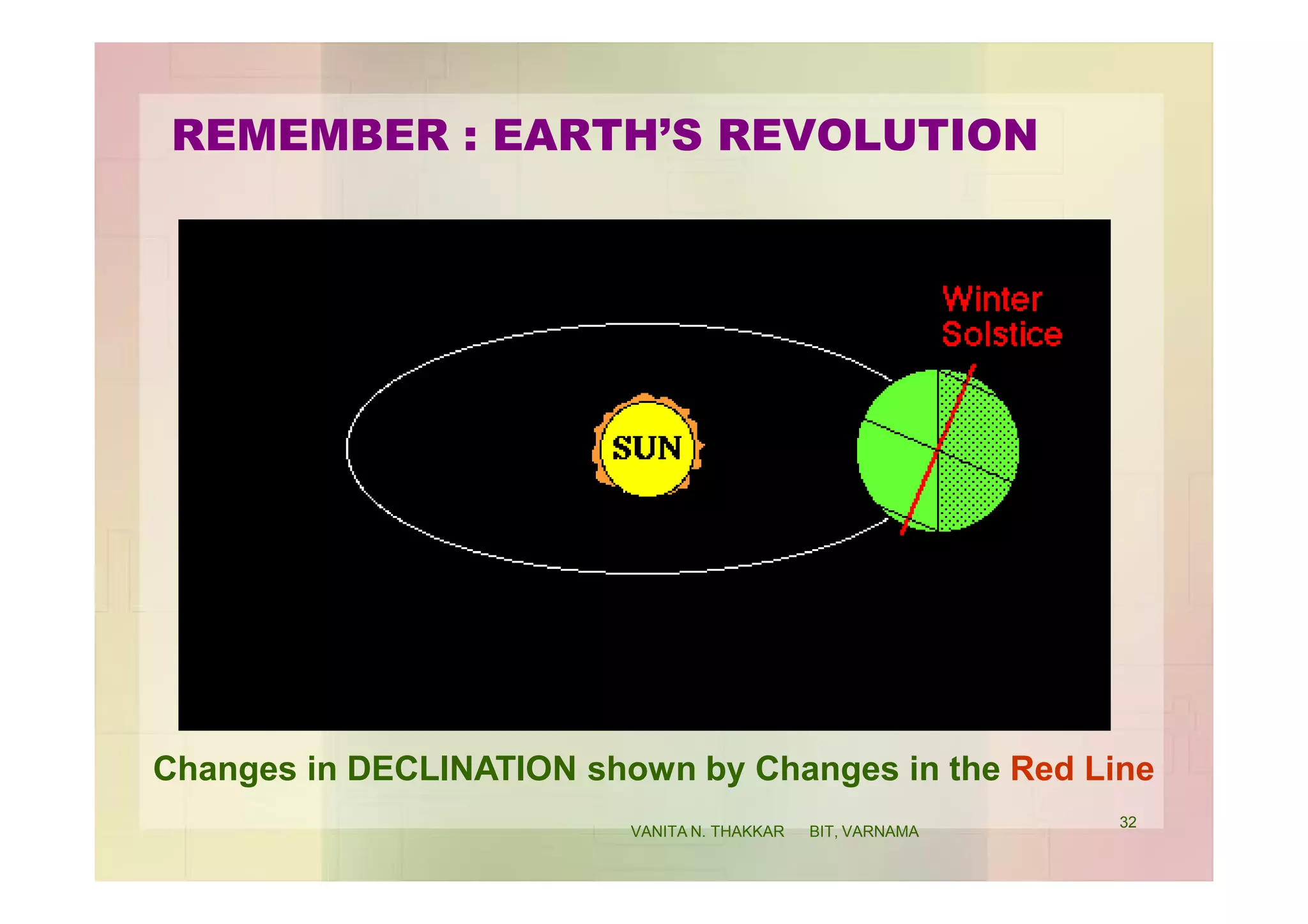
REMEMBER : EARTH’S REVOLUTION
Changes in DECLINATION shown by Changes in the Red Line
32
VANITA N. THAKKAR BIT, VARNAMA
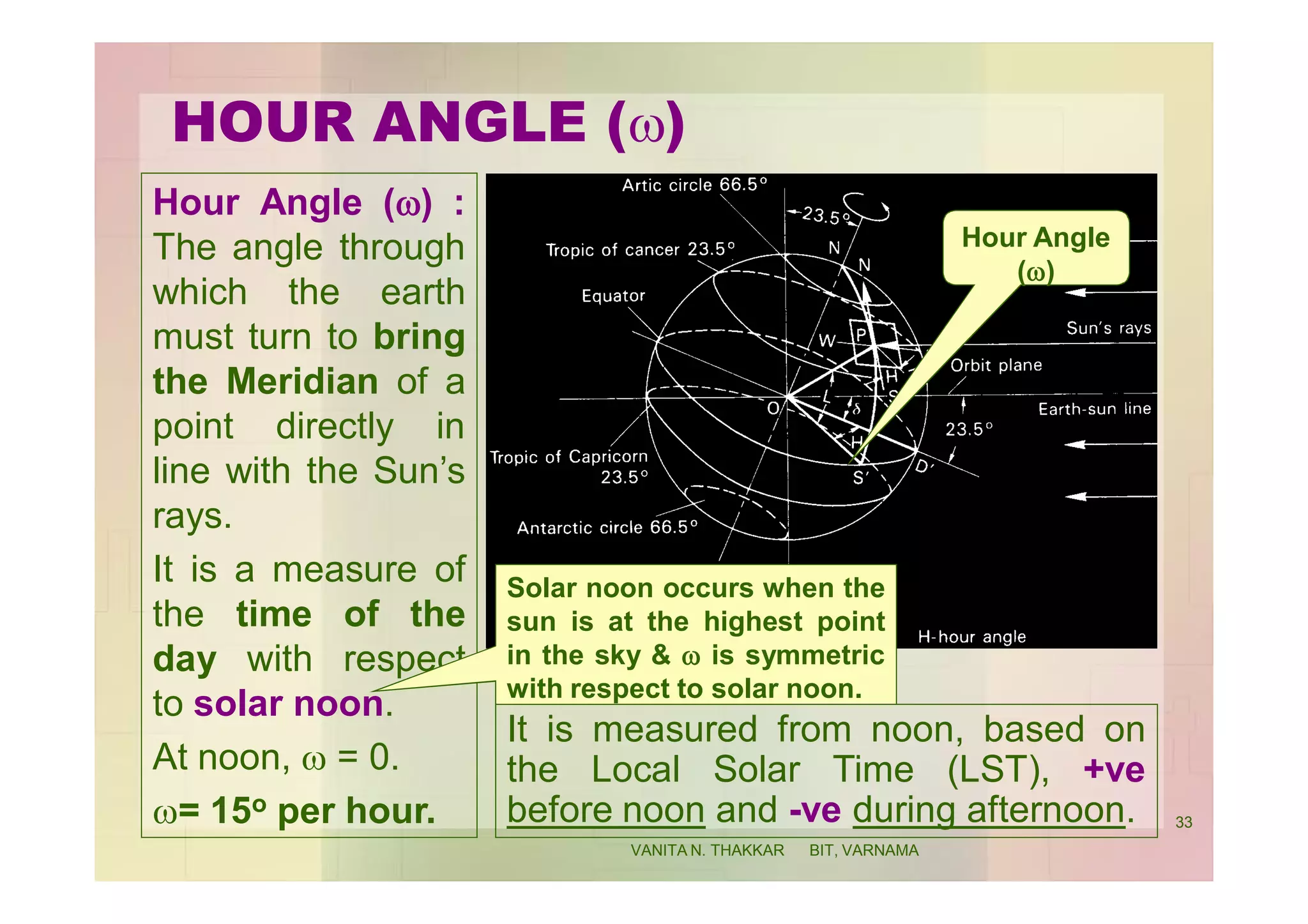
HOUR ANGLE (w)
Hour Angle
(w)
Hour Angle (w) :
The angle through
which the earth
must turn to bring
the Meridian of a
point directly in
line with the Sun’s
rays.
It is a measure of
the time of the
day with respect
to solar noon.
At noon, w = 0.
w= 15o per hour.
It is measured from noon, based on
the Local Solar Time (LST), +ve
before noon and -ve during afternoon.
Solar noon occurs when the
sun is at the highest point
in the sky & w is symmetric
with respect to solar noon.
33
VANITA N. THAKKAR BIT, VARNAMA
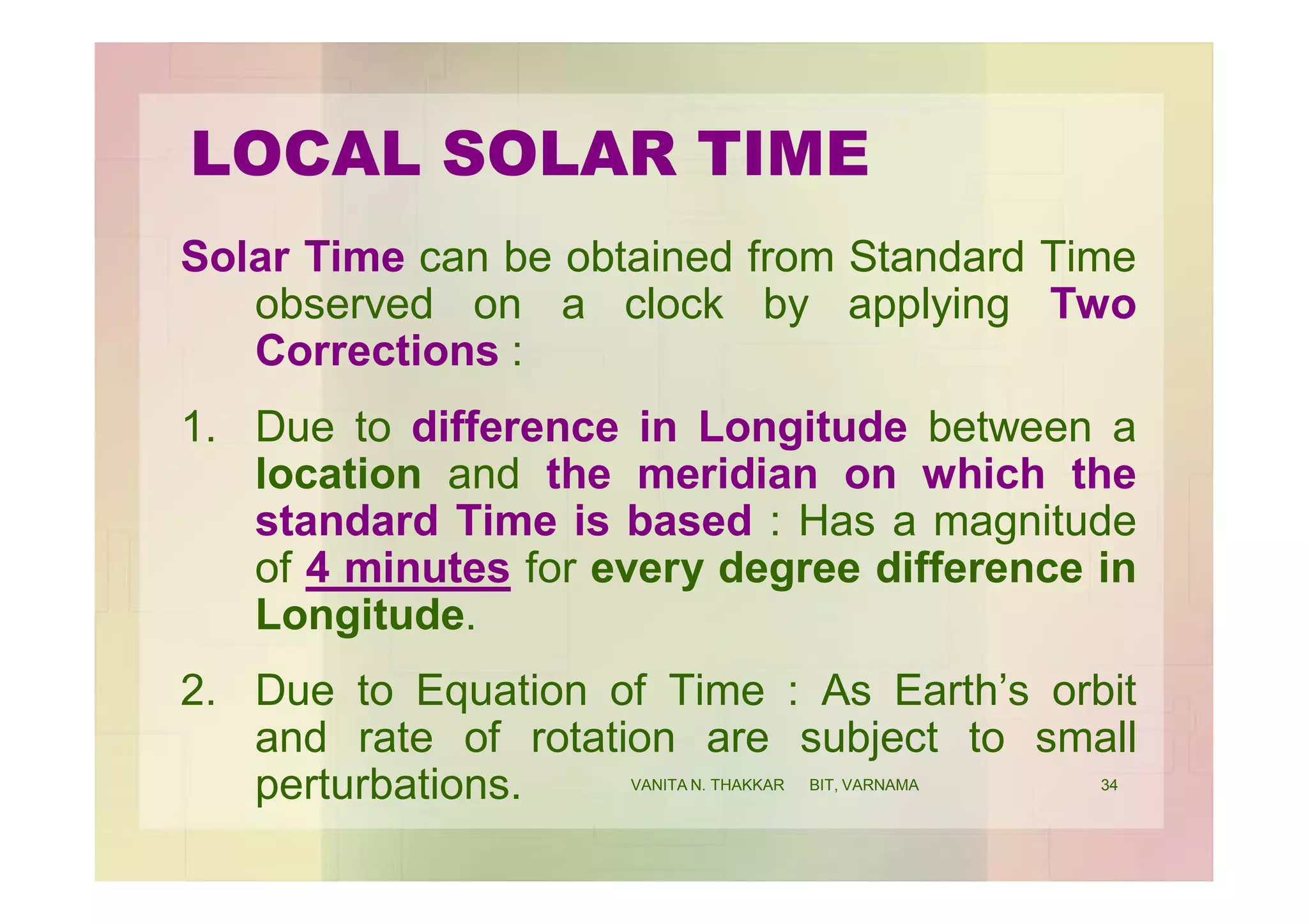
LOCAL SOLAR TIME
Solar Time can be obtained from Standard Time
observed on a clock by applying Two
Corrections :
1. Due to difference in Longitude between a
location and the meridian on which the
standard Time is based : Has a magnitude
of 4 minutes for every degree difference in
Longitude.
2. Due to Equation of Time : As Earth’s orbit
and rate of rotation are subject to small
perturbations. 34VANITA N. THAKKAR BIT, VARNAMA
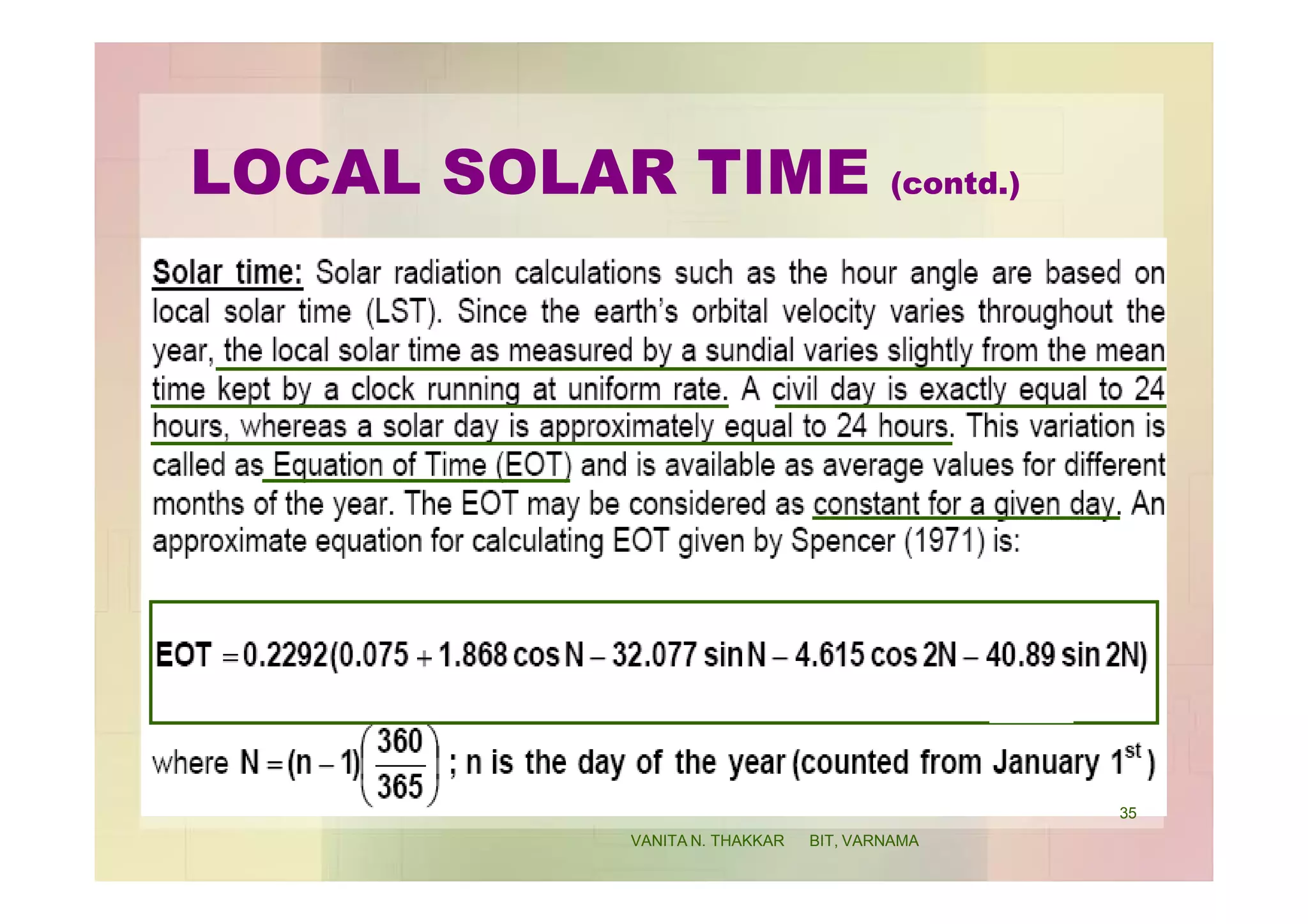
LOCAL SOLAR TIME (contd.)
35
VANITA N. THAKKAR BIT, VARNAMA
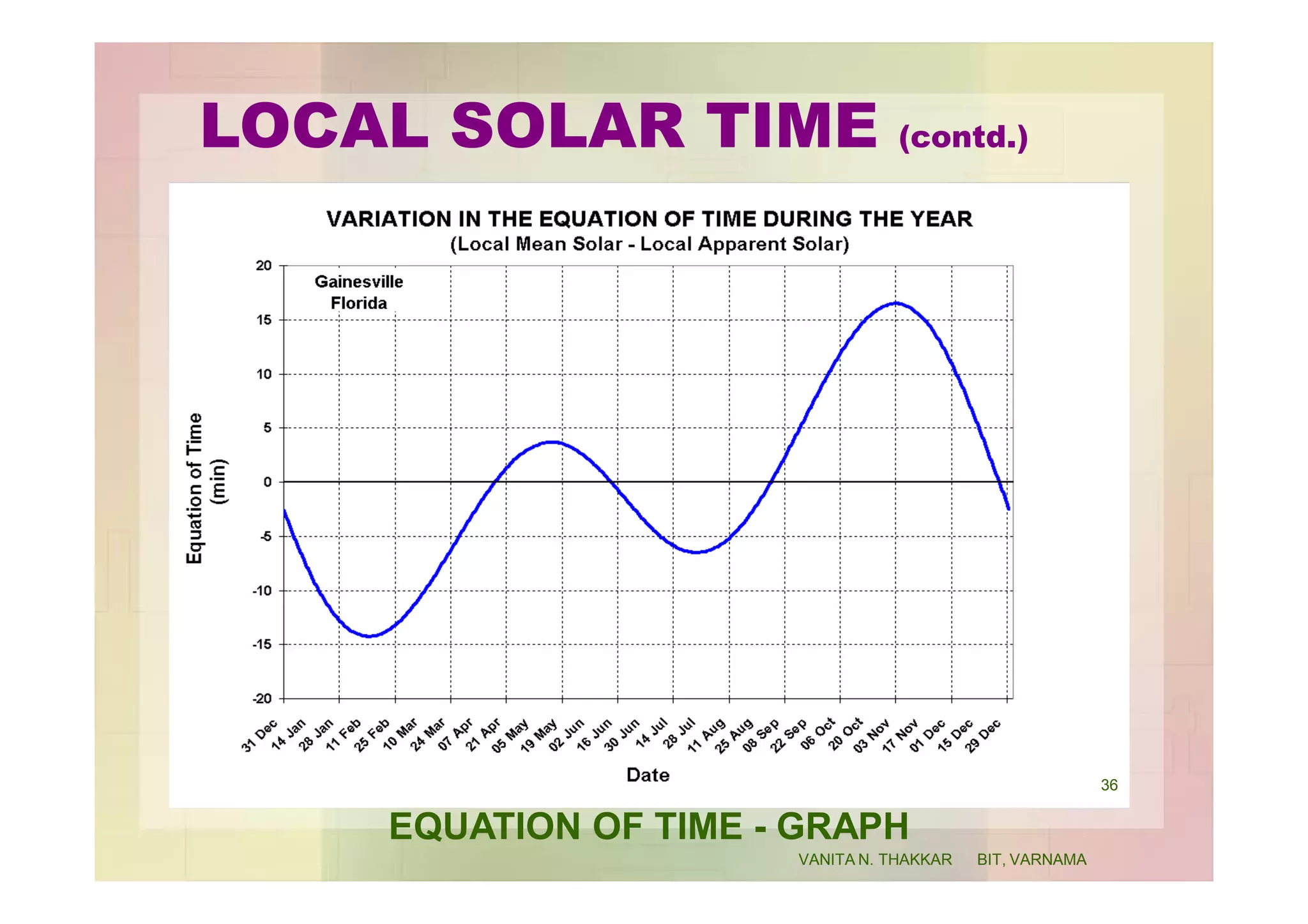
LOCAL SOLAR TIME (contd.)
EQUATION OF TIME - GRAPH
36
VANITA N. THAKKAR BIT, VARNAMA
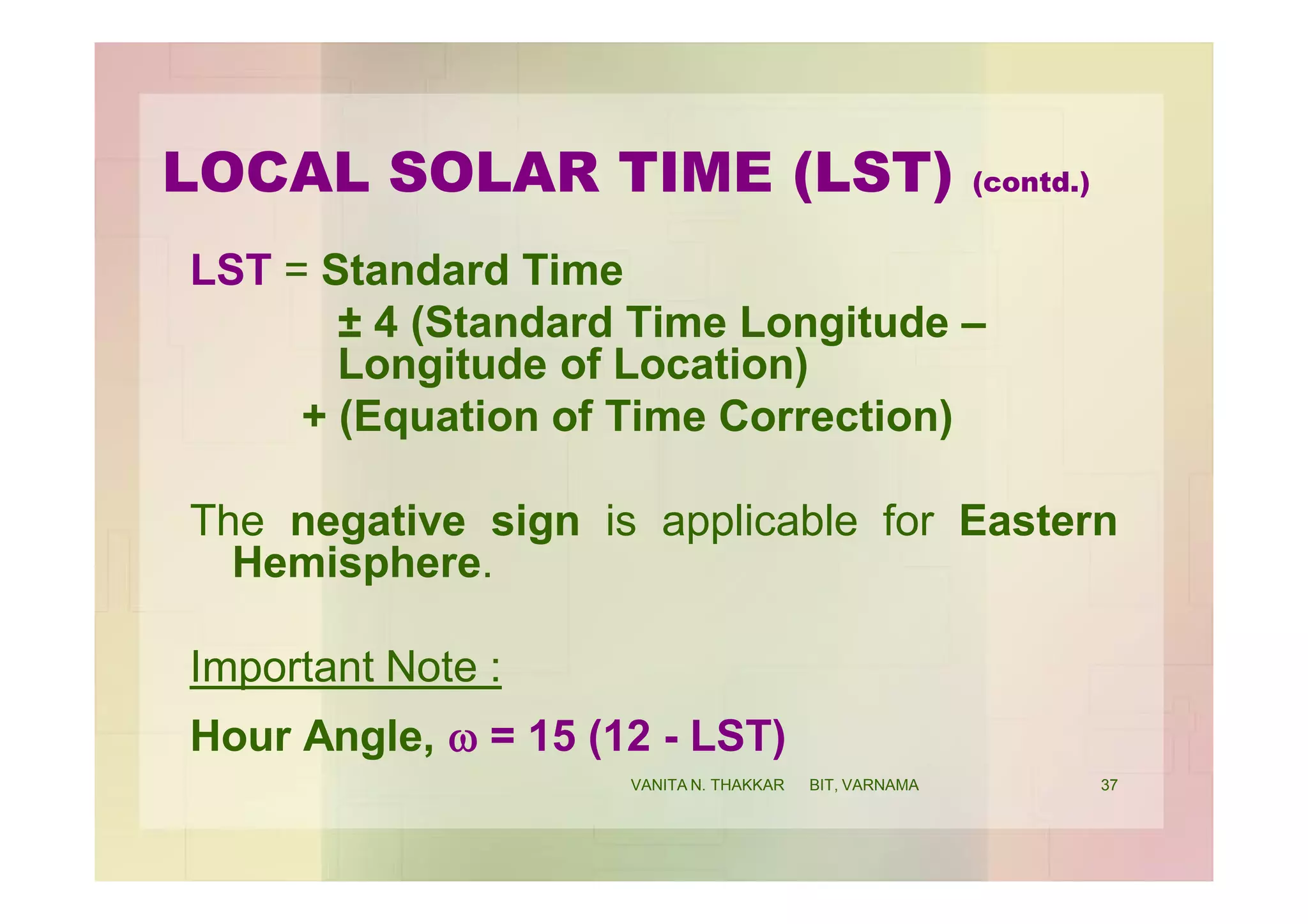
LST = Standard Time
± 4 (Standard Time Longitude –
Longitude of Location)
+ (Equation of Time Correction)
The negative sign is applicable for Eastern
Hemisphere.
Important Note :
Hour Angle, w = 15 (12 - LST)
LOCAL SOLAR TIME (LST) (contd.)
37VANITA N. THAKKAR BIT, VARNAMA
PROBLEM – 1 :
Determine Hour Angle for : 09:00 AM,
11:00 AM, 02:00 PM, 04:30 PM
SOLUTION :
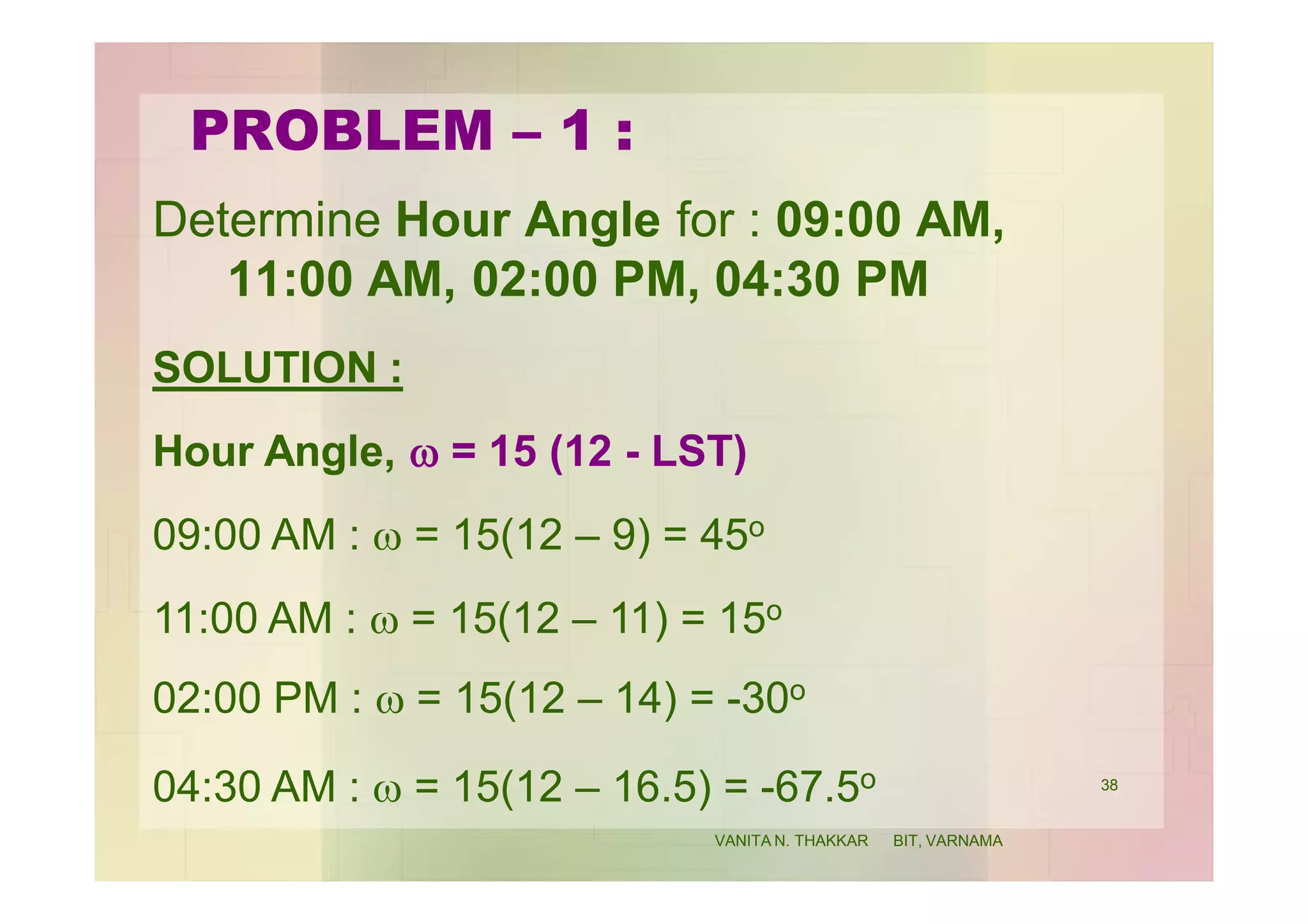
Hour Angle, w = 15 (12 - LST)
09:00 AM : w = 15(12 – 9) = 45o
11:00 AM : w = 15(12 – 11) = 15o
02:00 PM : w = 15(12 – 14) = -30o
04:30 AM : w = 15(12 – 16.5) = -67.5o 38
VANITA N. THAKKAR BIT, VARNAMA
PROBLEM – 2 :
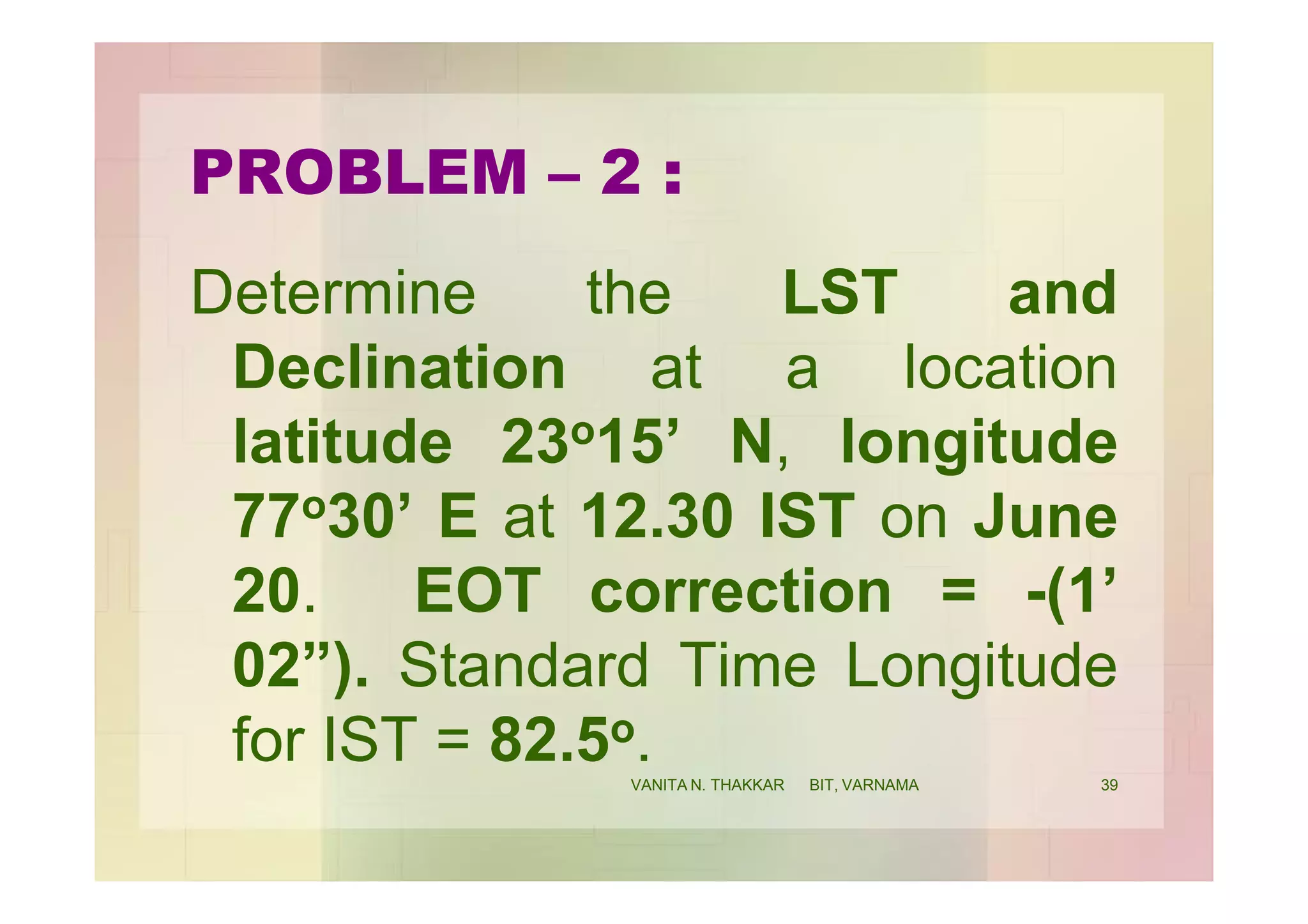
Determine the LST and
Declination at a location
latitude 23o15’ N, longitude
77o30’ E at 12.30 IST on June
20. EOT correction = -(1’
02”). Standard Time Longitude
for IST = 82.5o. 39VANITA N. THAKKAR BIT, VARNAMA
PROBLEM – 3 :
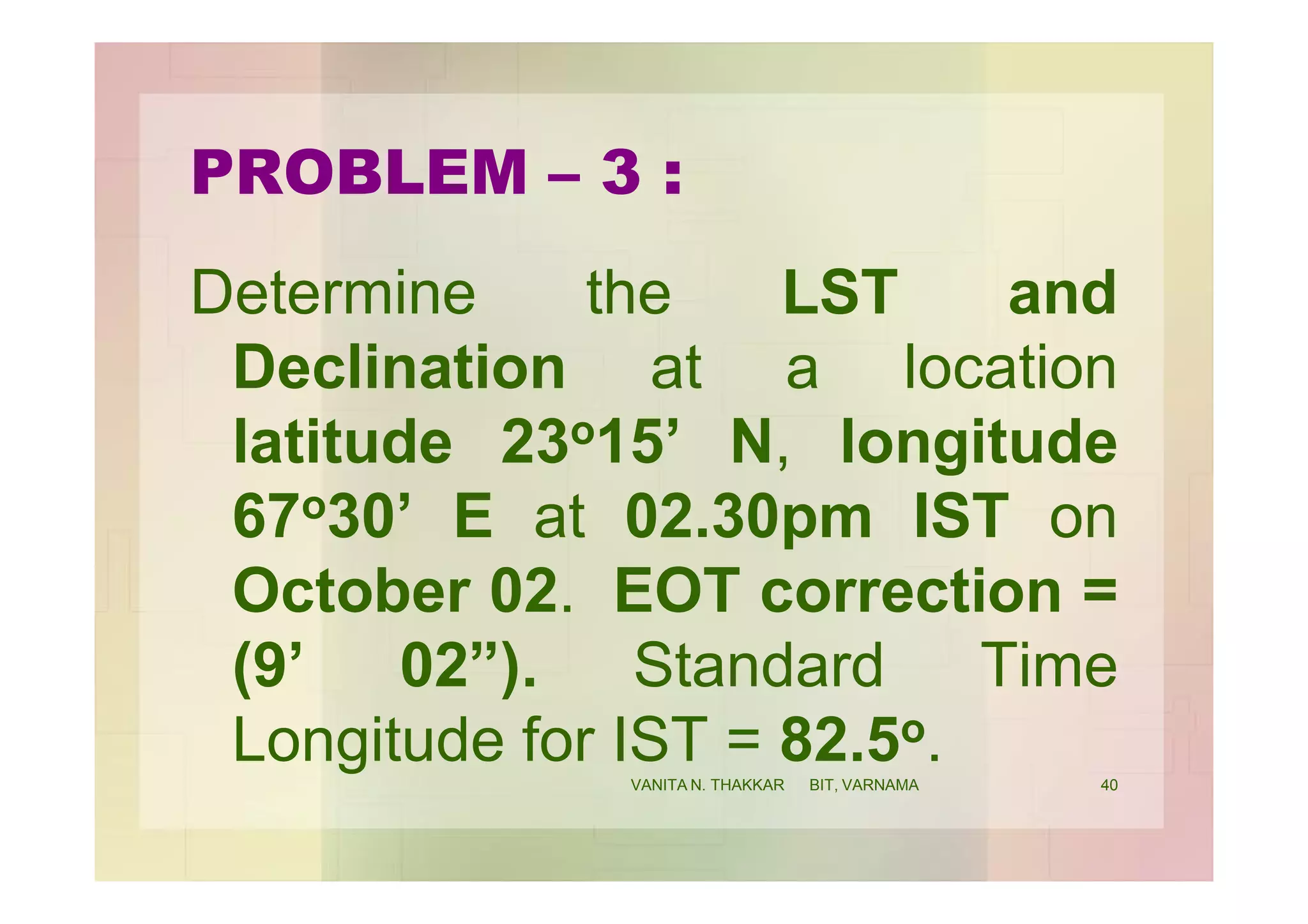
Determine the LST and
Declination at a location
latitude 23o15’ N, longitude
67o30’ E at 02.30pm IST on
October 02. EOT correction =
(9’ 02”). Standard Time
Longitude for IST = 82.5o. 40VANITA N. THAKKAR BIT, VARNAMA
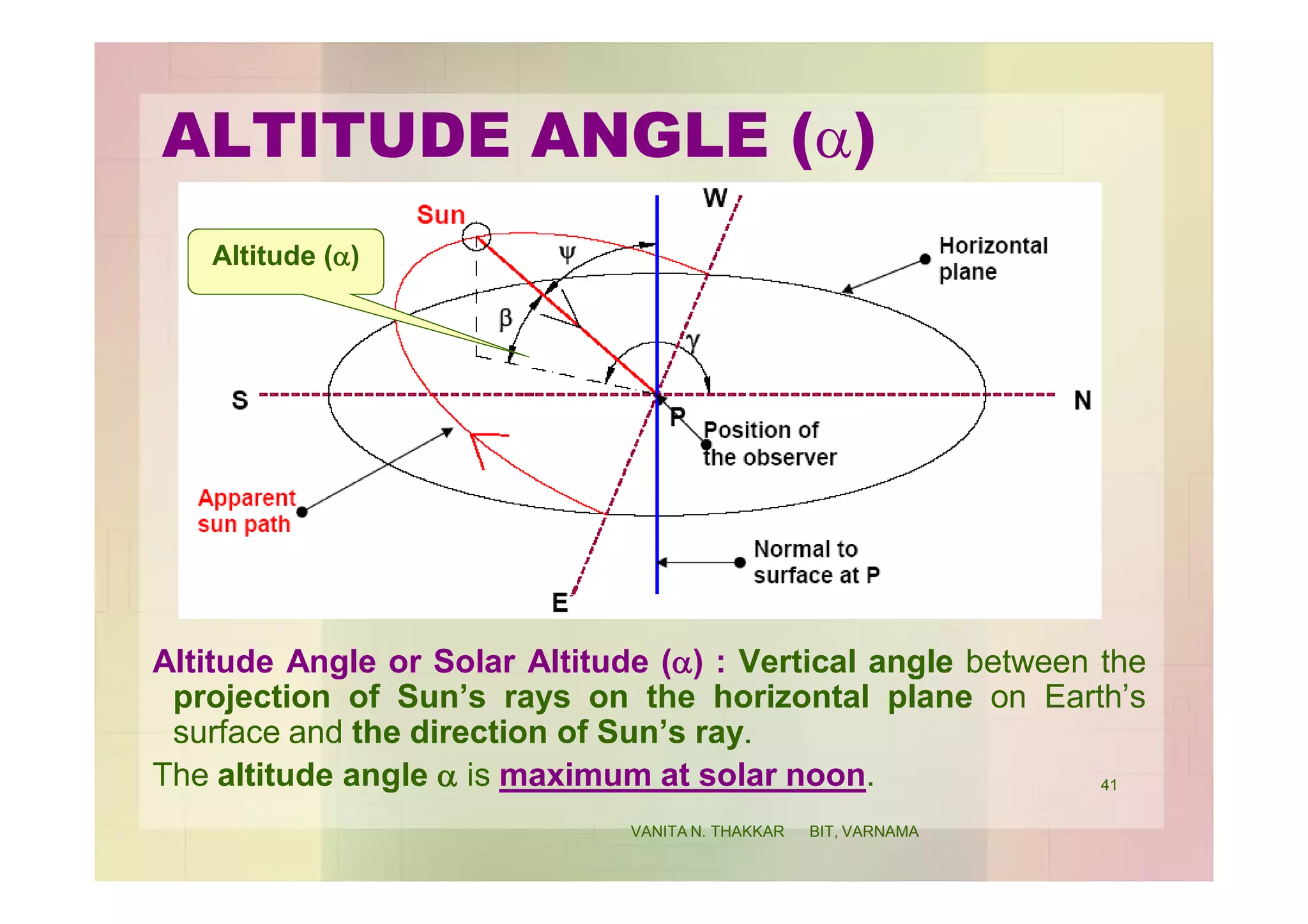
ALTITUDE ANGLE (a)
Altitude Angle or Solar Altitude (a) : Vertical angle between the
projection of Sun’s rays on the horizontal plane on Earth’s
surface and the direction of Sun’s ray.
The altitude angle a is maximum at solar noon.
Altitude (a)
41
VANITA N. THAKKAR BIT, VARNAMA
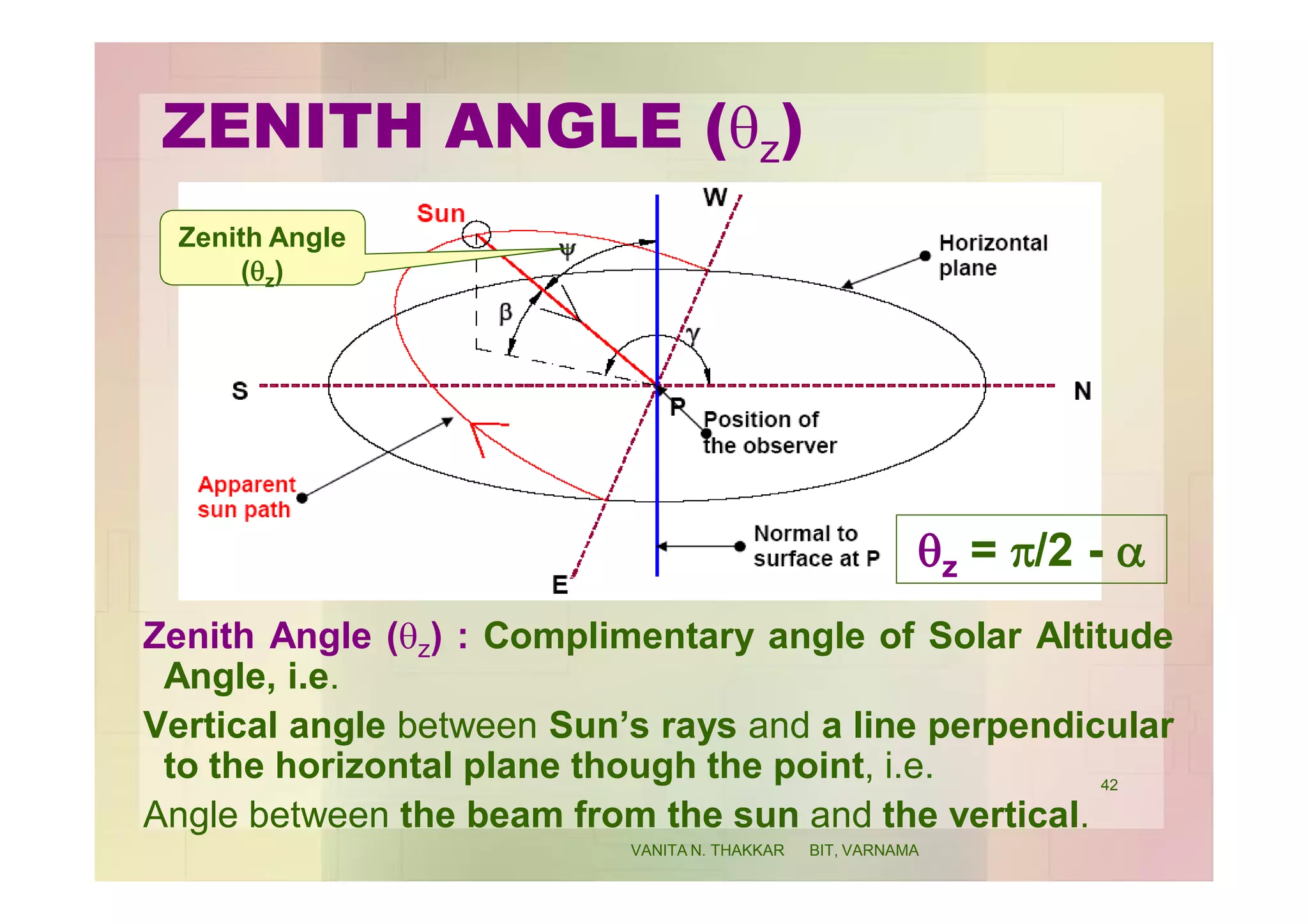
ZENITH ANGLE (qz)
Zenith Angle (qz) : Complimentary angle of Solar Altitude
Angle, i.e.
Vertical angle between Sun’s rays and a line perpendicular
to the horizontal plane though the point, i.e.
Angle between the beam from the sun and the vertical.
qz = p/2 - a
Zenith Angle
(qz)
42
VANITA N. THAKKAR BIT, VARNAMA
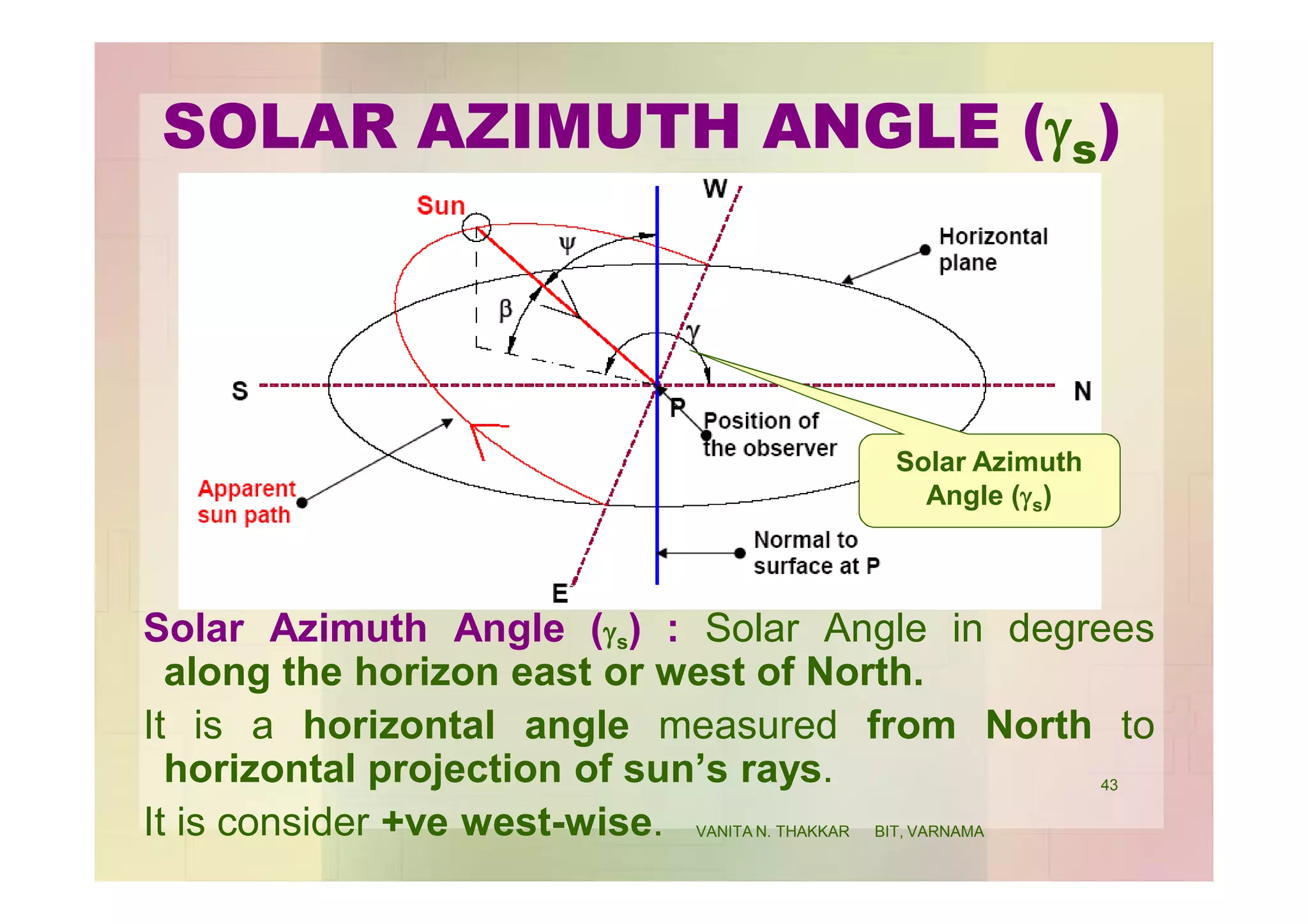
SOLAR AZIMUTH ANGLE (gs)
Solar Azimuth Angle (gs) : Solar Angle in degrees
along the horizon east or west of North.
It is a horizontal angle measured from North to
horizontal projection of sun’s rays.
It is consider +ve west-wise.
Solar Azimuth
Angle (gs)
43
VANITA N. THAKKAR BIT, VARNAMA
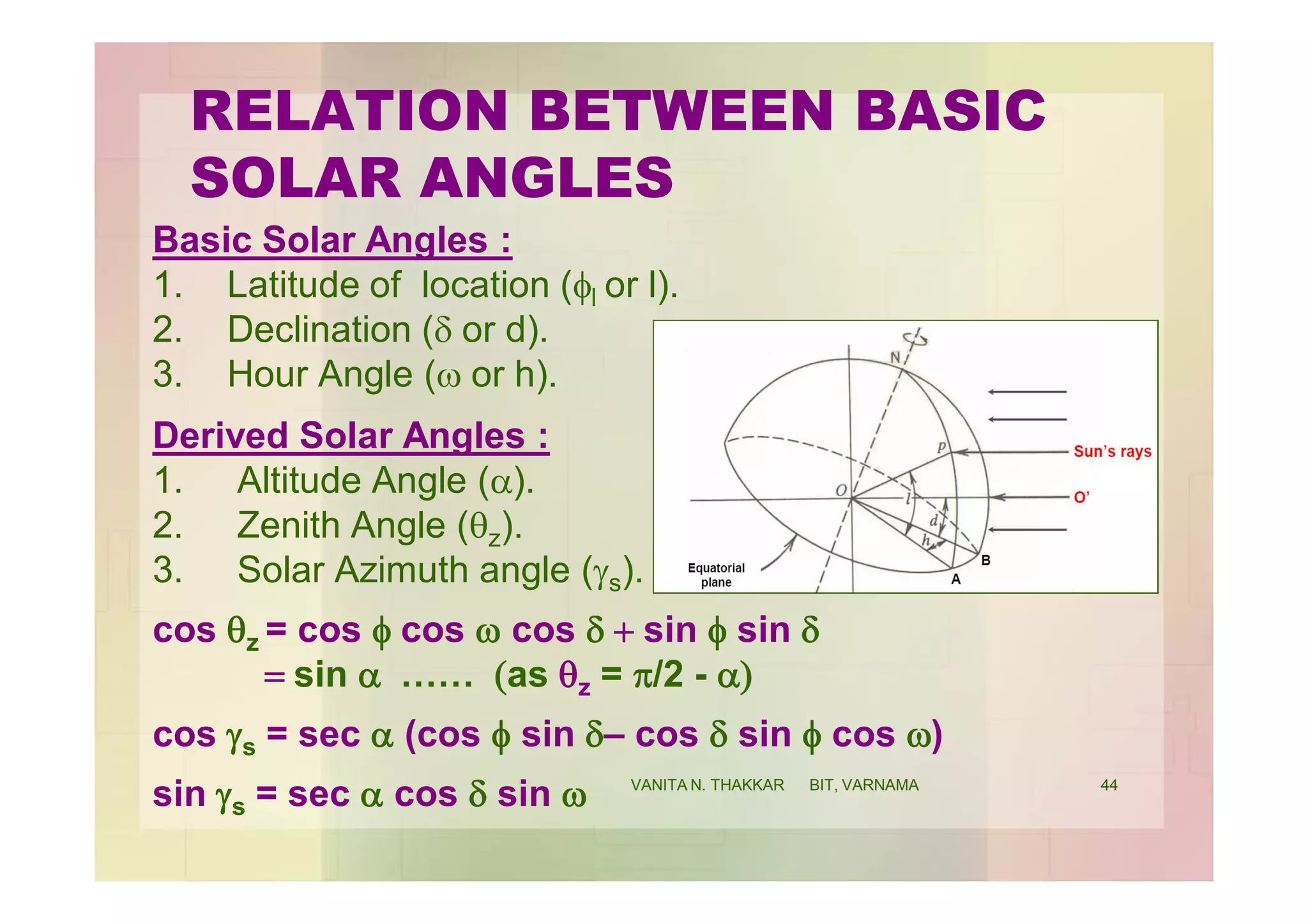
RELATION BETWEEN BASIC
SOLAR ANGLES
Basic Solar Angles :
1. Latitude of location (fl or l).
2. Declination (d or d).
3. Hour Angle (w or h).
Derived Solar Angles :
1. Altitude Angle (a).
2. Zenith Angle (qz).
3. Solar Azimuth angle (gs).
cos qz = cos f cos w cos d + sin f sin d
= sin a …… (as qz = p/2 - a)
cos gs = sec a (cos f sin d– cos d sin f cos w)
sin gs = sec a cos d sin w 44VANITA N. THAKKAR BIT, VARNAMA
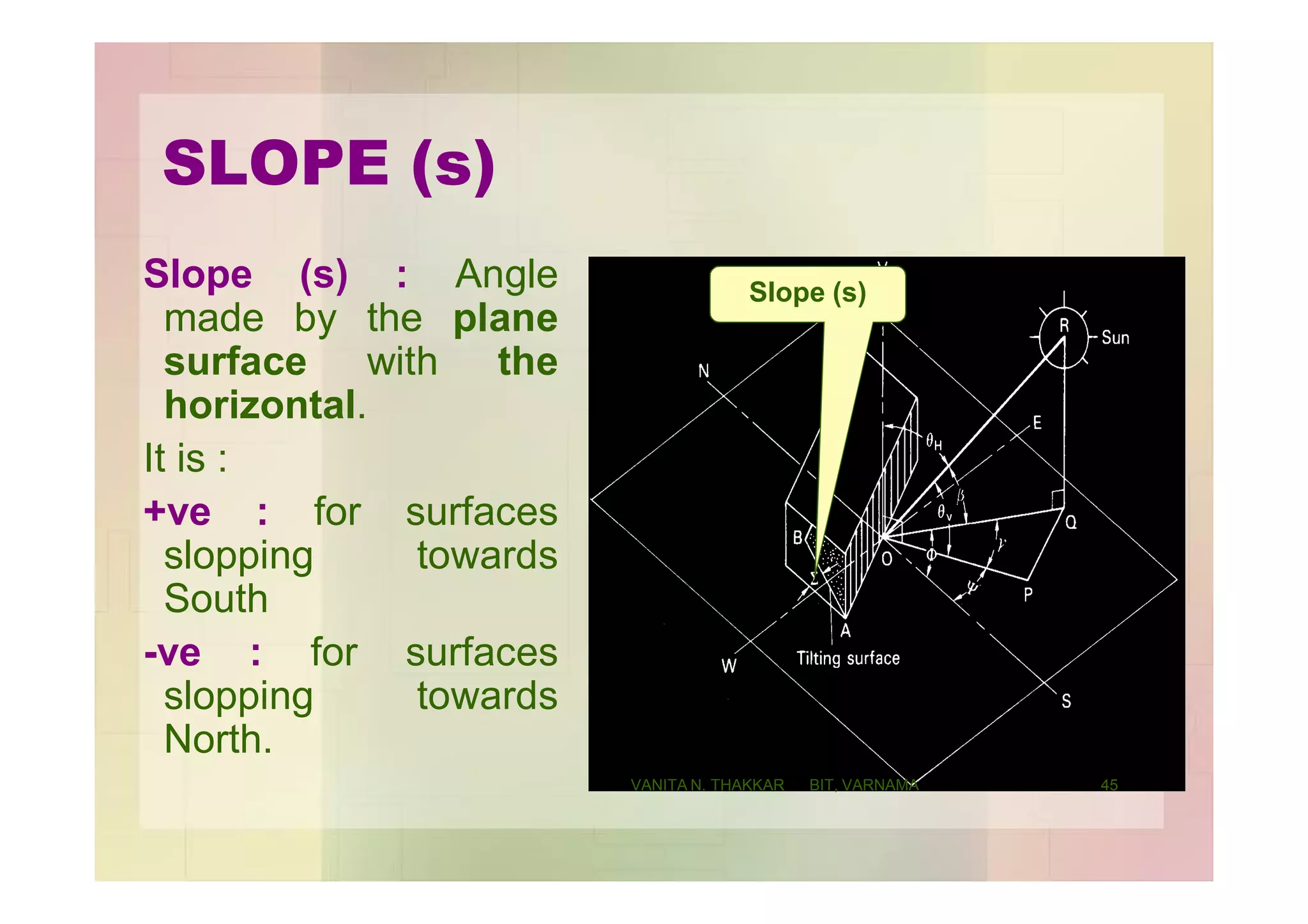
SLOPE (s)
Slope (s) : Angle
made by the plane
surface with the
horizontal.
It is :
+ve : for surfaces
slopping towards
South
-ve : for surfaces
slopping towards
North.
Slope (s)
45VANITA N. THAKKAR BIT, VARNAMA
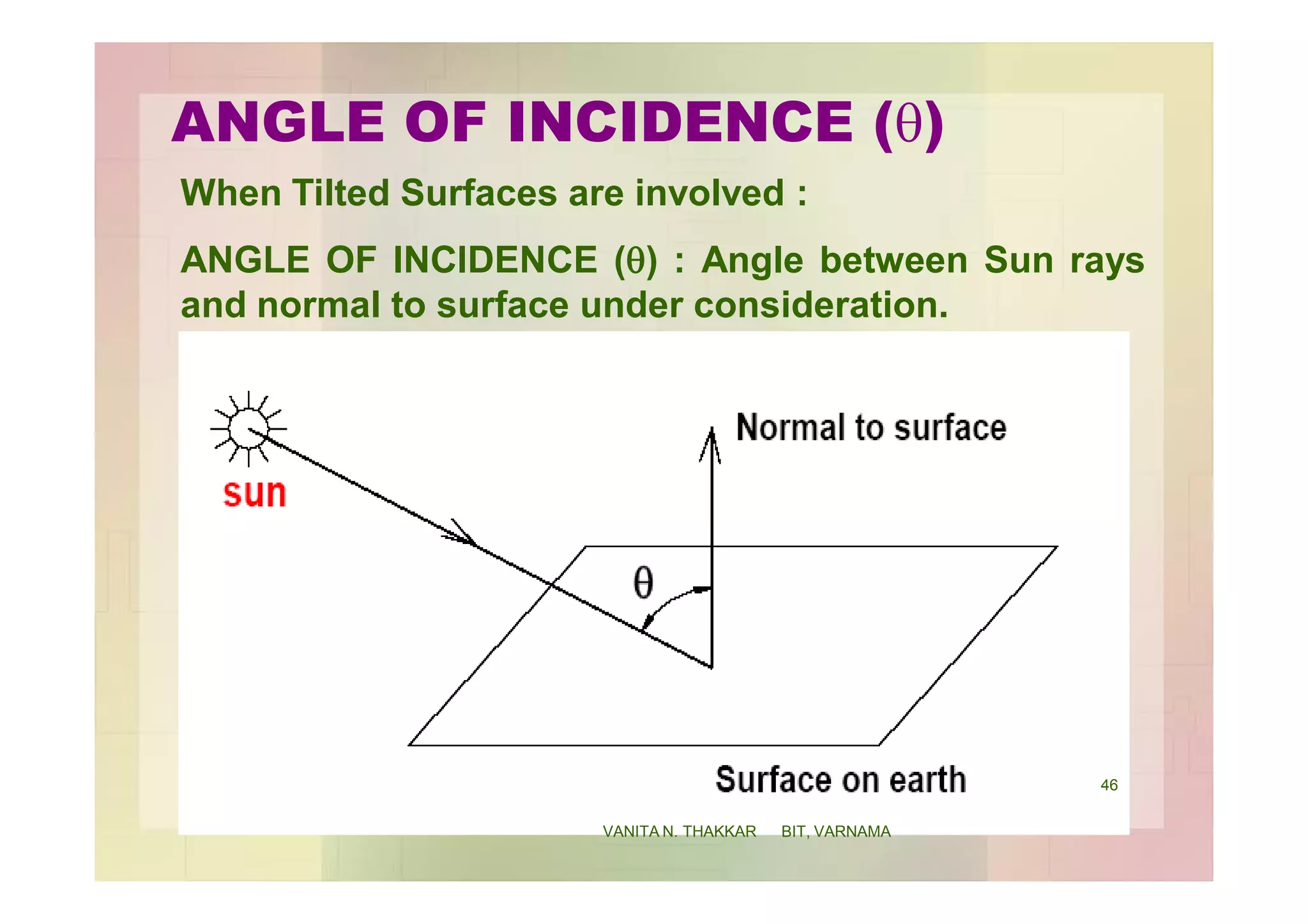
ANGLE OF INCIDENCE (q)
When Tilted Surfaces are involved :
ANGLE OF INCIDENCE (q) : Angle between Sun rays
and normal to surface under consideration.
46
VANITA N. THAKKAR BIT, VARNAMA
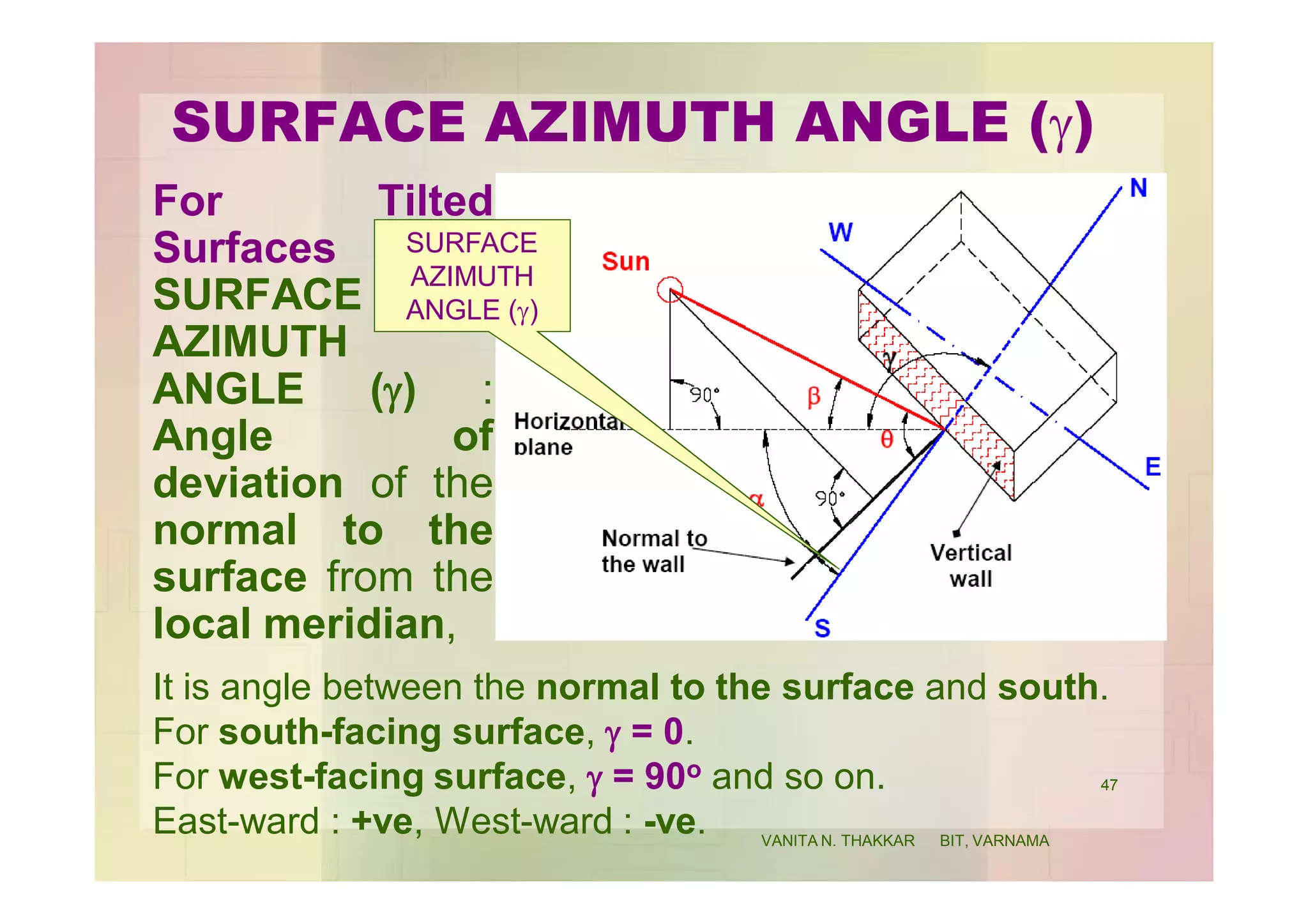
SURFACE AZIMUTH ANGLE (g)
For Tilted
Surfaces :
SURFACE
AZIMUTH
ANGLE (g) :
Angle of
deviation of the
normal to the
surface from the
local meridian,
It is angle between the normal to the surface and south.
For south-facing surface, g = 0.
For west-facing surface, g = 90o and so on.
East-ward : +ve, West-ward : -ve.
SURFACE
AZIMUTH
ANGLE (g)
47
VANITA N. THAKKAR BIT, VARNAMA
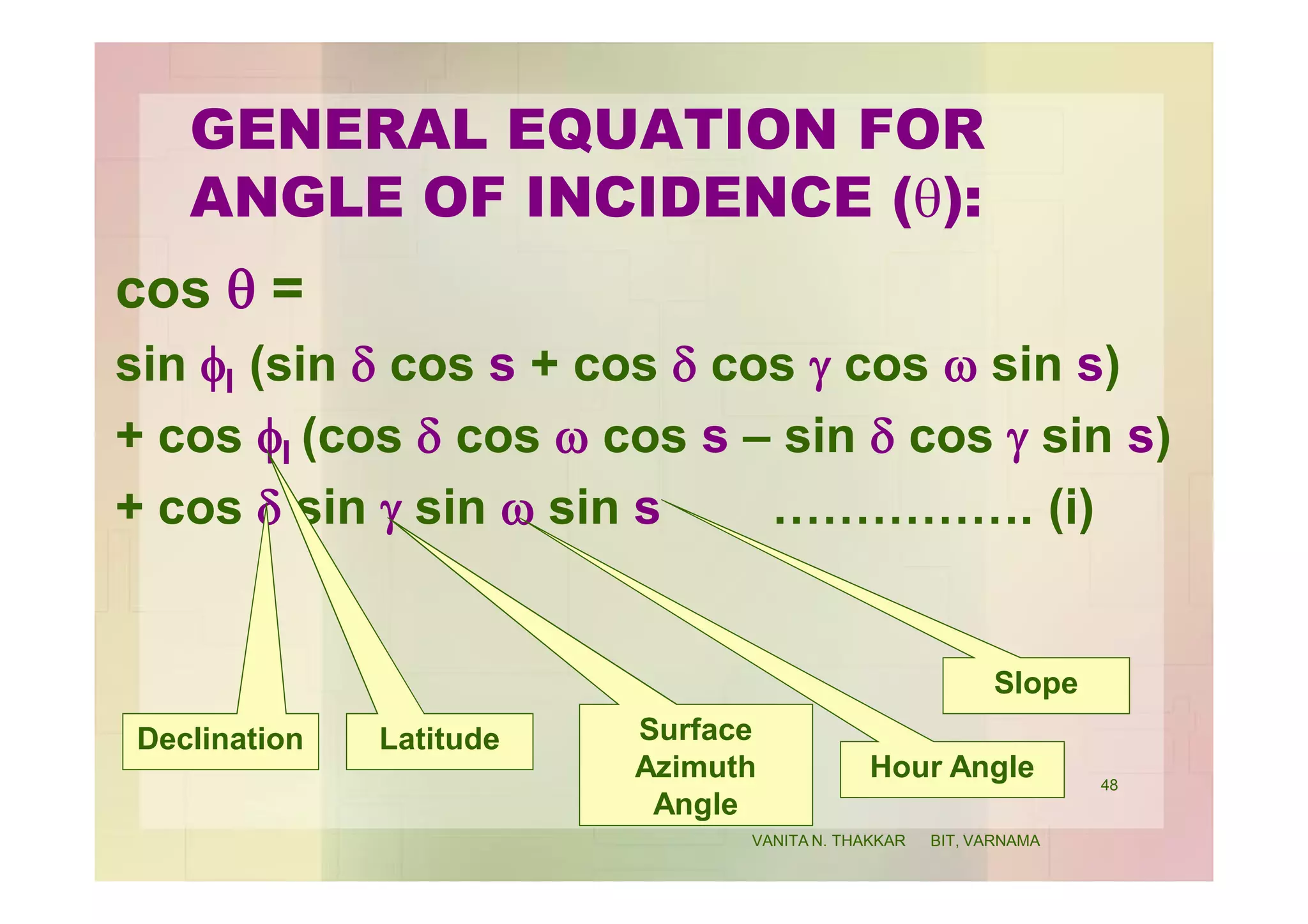
GENERAL EQUATION FOR
ANGLE OF INCIDENCE (q):
cos q =
sin fl (sin d cos s + cos d cos g cos w sin s)
+ cos fl (cos d cos w cos s – sin d cos g sin s)
+ cos d sin g sin w sin s ……………. (i)
LatitudeDeclination Surface
Azimuth
Angle
Hour Angle
Slope
48
VANITA N. THAKKAR BIT, VARNAMA
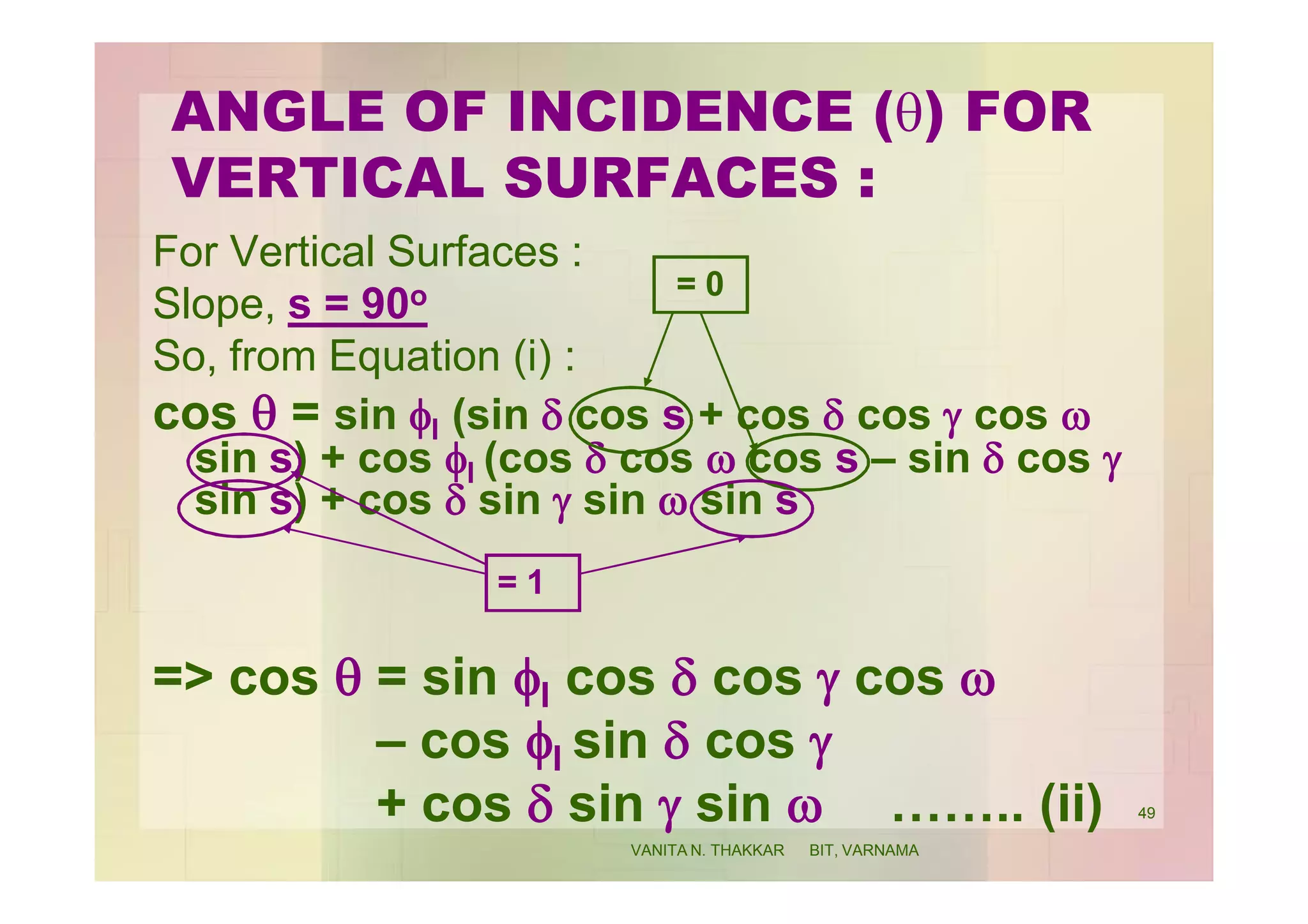
ANGLE OF INCIDENCE (q) FOR
VERTICAL SURFACES :
For Vertical Surfaces :
Slope, s = 90o
So, from Equation (i) :
cos q = sin fl (sin d cos s + cos d cos g cos w
sin s) + cos fl (cos d cos w cos s – sin d cos g
sin s) + cos d sin g sin w sin s
=> cos q = sin fl cos d cos g cos w
– cos fl sin d cos g
+ cos d sin g sin w …….. (ii)
= 0
= 1
49
VANITA N. THAKKAR BIT, VARNAMA
ANGLE OF INCIDENCE (q) FOR
HORIZONTAL SURFACES :
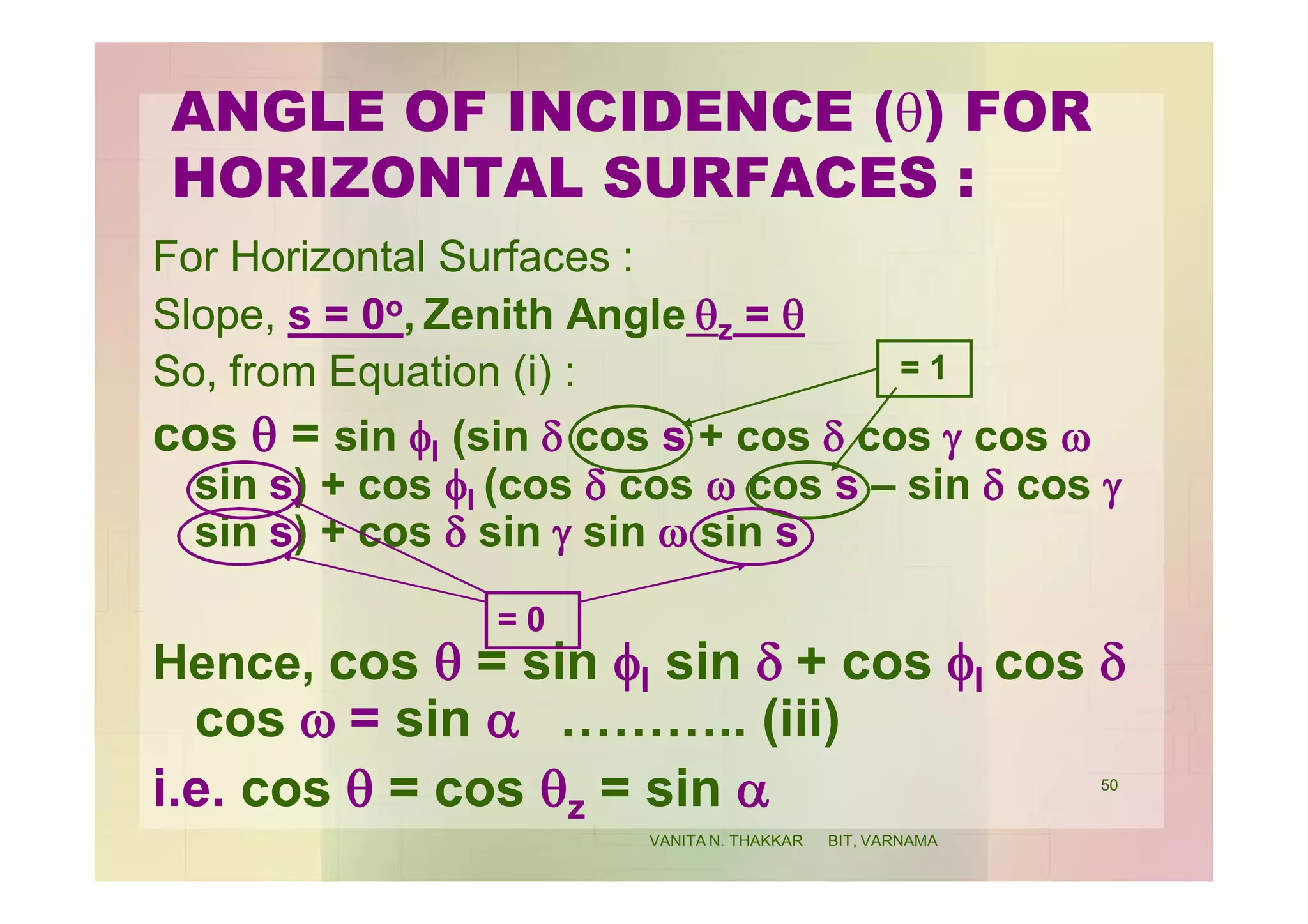
For Horizontal Surfaces :
Slope, s = 0o, Zenith Angle qz = q
So, from Equation (i) :
cos q = sin fl (sin d cos s + cos d cos g cos w
sin s) + cos fl (cos d cos w cos s – sin d cos g
sin s) + cos d sin g sin w sin s
Hence, cos q = sin fl sin d + cos fl cos d
cos w = sin a ……….. (iii)
i.e. cos q = cos qz = sin a
= 1
= 0
50
VANITA N. THAKKAR BIT, VARNAMA
ANGLE OF INCIDENCE (q) FOR
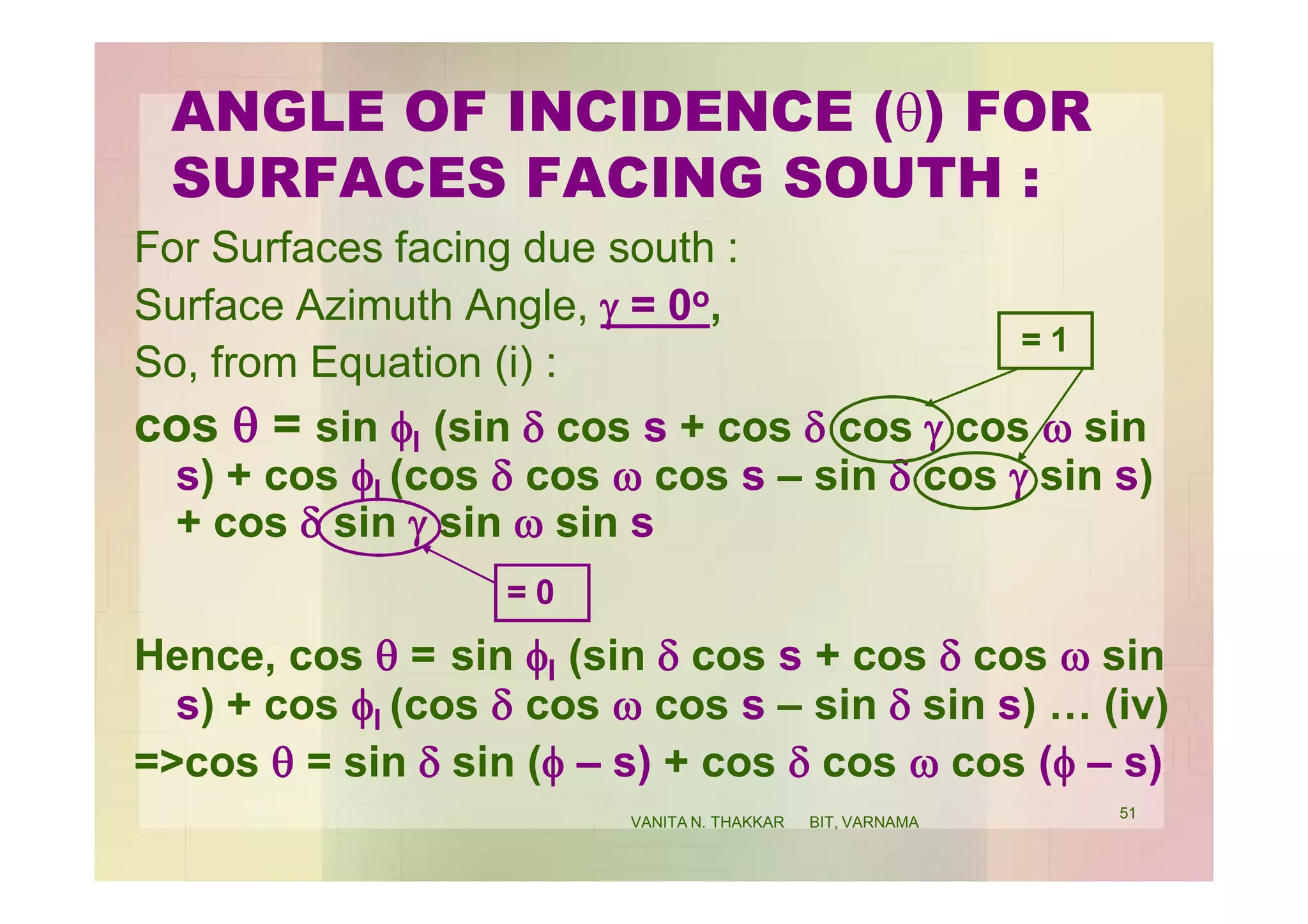
SURFACES FACING SOUTH :
For Surfaces facing due south :
Surface Azimuth Angle, g = 0o,
So, from Equation (i) :
cos q = sin fl (sin d cos s + cos d cos g cos w sin
s) + cos fl (cos d cos w cos s – sin d cos g sin s)
+ cos d sin g sin w sin s
Hence, cos q = sin fl (sin d cos s + cos d cos w sin
s) + cos fl (cos d cos w cos s – sin d sin s) … (iv)
=>cos q = sin d sin (f – s) + cos d cos w cos (f – s)
= 1
= 0
51
VANITA N. THAKKAR BIT, VARNAMA
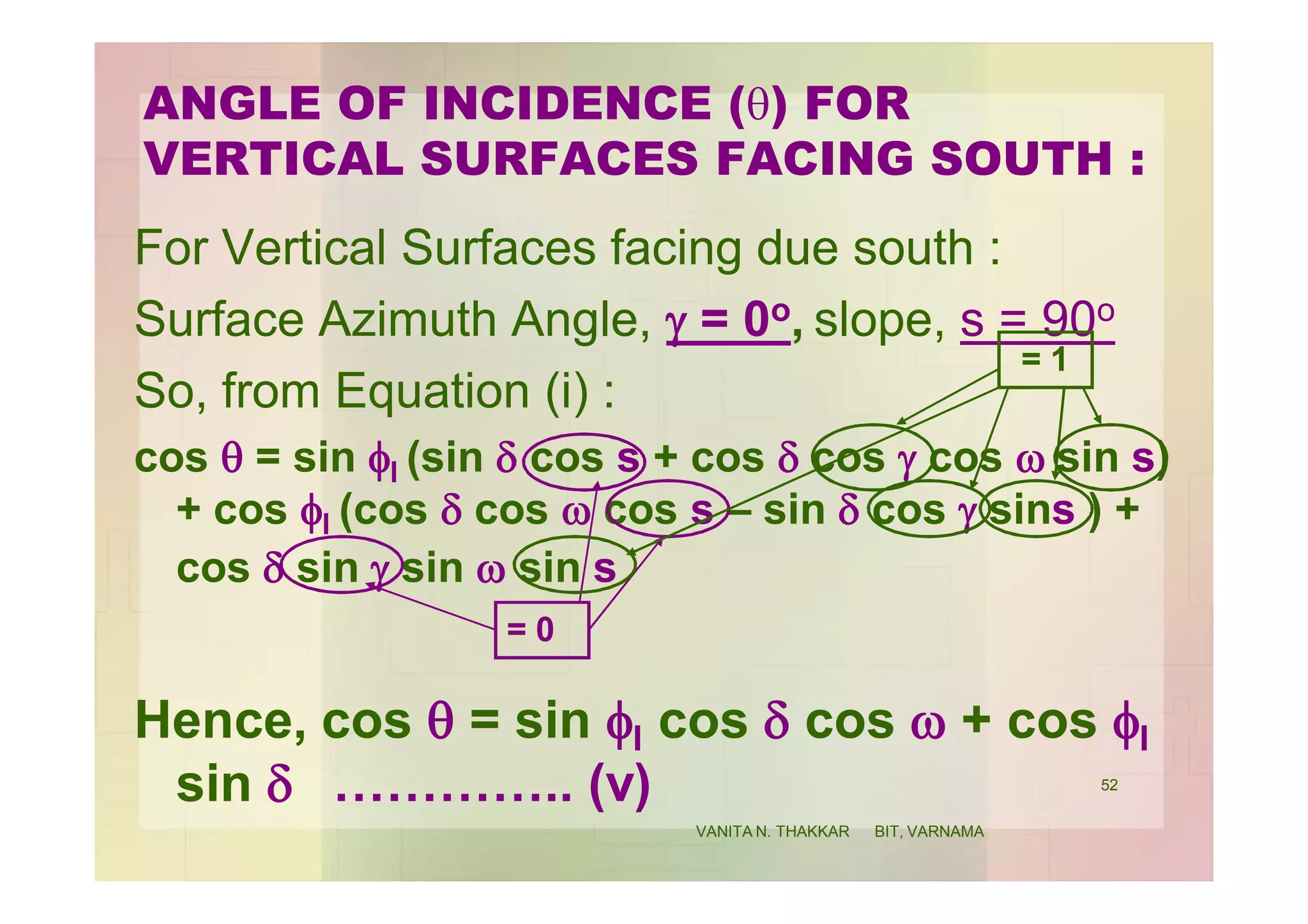
ANGLE OF INCIDENCE (q) FOR
VERTICAL SURFACES FACING SOUTH :
For Vertical Surfaces facing due south :
Surface Azimuth Angle, g = 0o, slope, s = 90o
So, from Equation (i) :
cos q = sin fl (sin d cos s + cos d cos g cos w sin s)
+ cos fl (cos d cos w cos s – sin d cos g sins ) +
cos d sin g sin w sin s
Hence, cos q = sin fl cos d cos w + cos fl
sin d ………….. (v)
= 1
= 0
52
VANITA N. THAKKAR BIT, VARNAMA
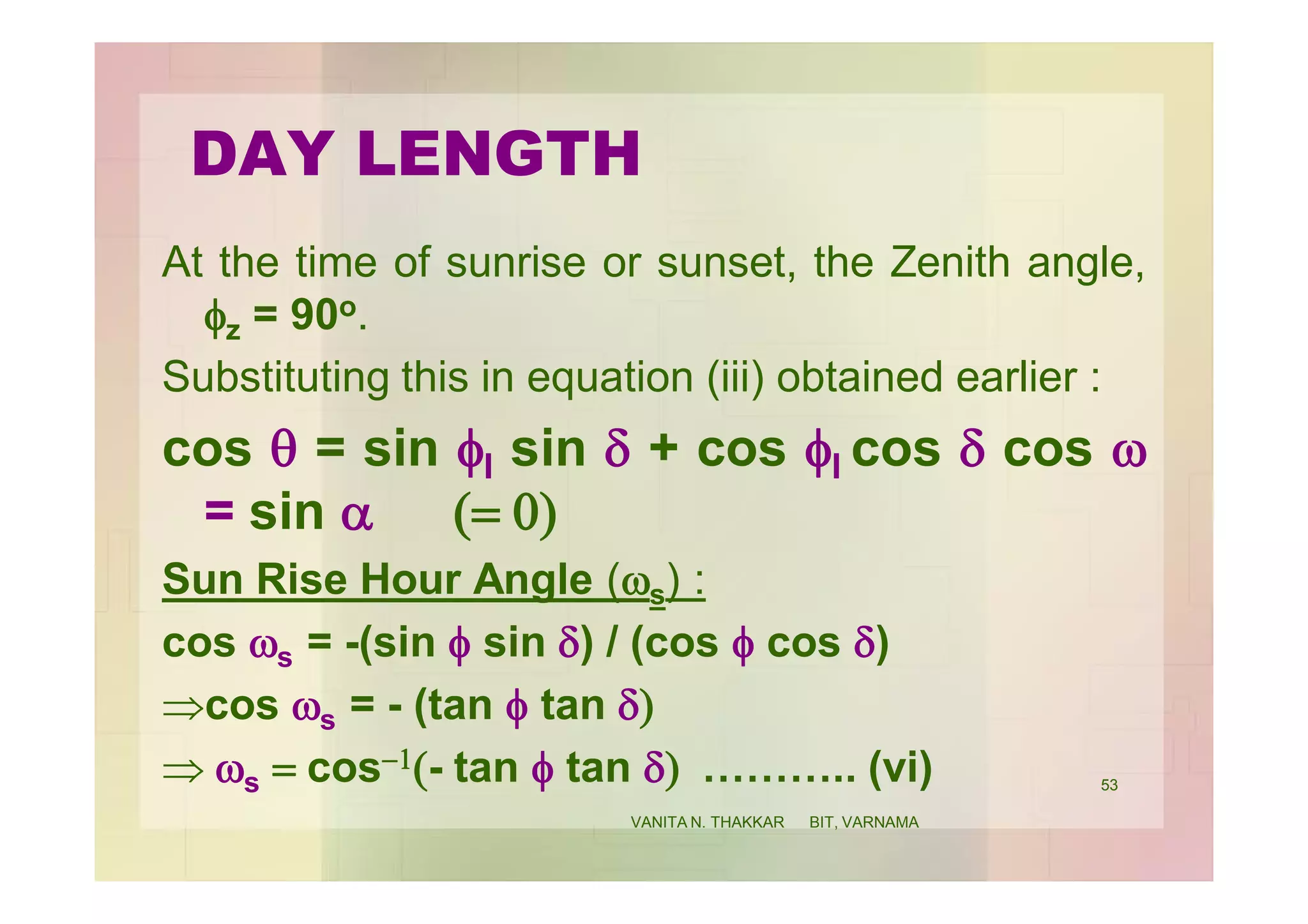
DAY LENGTH
At the time of sunrise or sunset, the Zenith angle,
fz = 90o.
Substituting this in equation (iii) obtained earlier :
cos q = sin fl sin d + cos fl cos d cos w
= sin a (= 0)
Sun Rise Hour Angle (ws) :
cos ws = -(sin f sin d) / (cos f cos d)
cos ws = - (tan f tan d)
 ws = cos-1(- tan f tan d) ……….. (vi) 53
VANITA N. THAKKAR BIT, VARNAMA
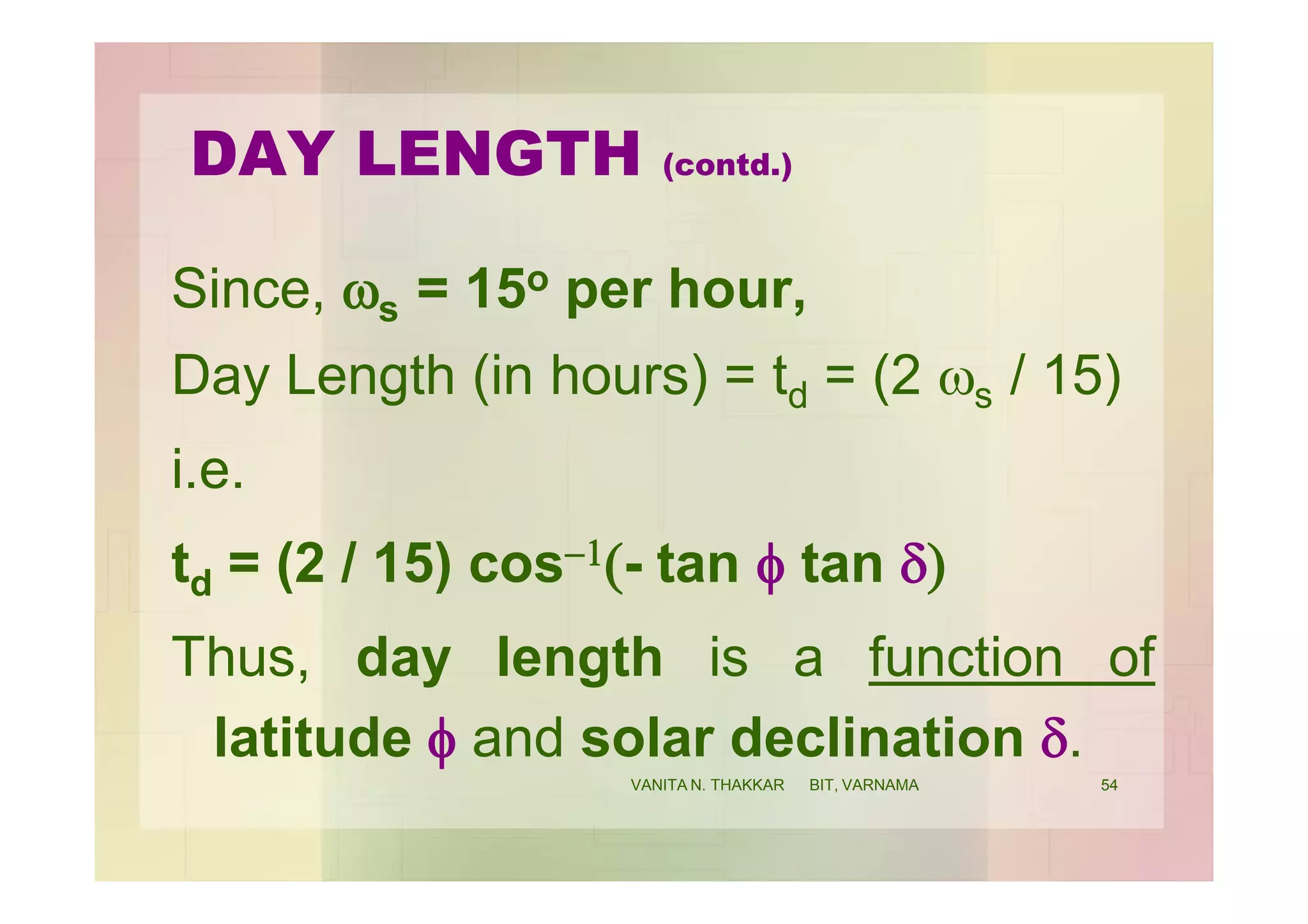
DAY LENGTH (contd.)
Since, ws = 15o per hour,
Day Length (in hours) = td = (2 ws / 15)
i.e.
td = (2 / 15) cos-1(- tan f tan d)
Thus, day length is a function of
latitude f and solar declination d.
54VANITA N. THAKKAR BIT, VARNAMA
THANKS !!
Contact : vanitaa.thakkar@gmail.com
55VANITA N. THAKKAR BIT, VARNAMA

Solar Radiation Geometry

  • 1.
    SOLAR RADIATION GEOMETRY -VANITA THAKKAR ASSOCIATEPROFESSOR, MECHANICAL ENGINEERING DEPARTMENT, BABARIA INSTITUTE OF TECHNOLOGY, VARNAMA, VADODARA.
  • 2.
    SOLAR ENERGY • Sunis the basic source of Energy for Earth. • Solar Energy is available in the form of Electromagnetic Radiations. • Sun is a large sphere of very hot gases, heat being generated by the various fusion reactions in it. • Diameter of Sun = 1.39 x 10⁶ km. • Diameter of Earth = 1.27 x 10⁴ km. • Sun subtends an angle of only 32’ at Earth’s surface (because of large distance between them.) 2 VANITA N. THAKKAR BIT, VARNAMA
  • 3.
    SOLAR ENERGY • Thedirect / beam radiation received from the Sun on the earth is almost parallel. • Brightness of the Sun varies from its centre to its edge, however, for engineering calculations, it is assumed to be uniform over the entire solar disc. 3 VANITA N. THAKKAR BIT, VARNAMA
  • 4.
    SOLAR ENERGY • Thesun generates an enormous amount of energy - approximately 1.1 x 10²⁰ kilowatt- hours every second. (A kilowatt-hour is the amount of energy needed to power a 100 watt light bulb for ten hours.) 4 VANITA N. THAKKAR BIT, VARNAMA
  • 5.
    SOLAR ENERGY ONEARTH • The earth’s outer atmosphere intercepts about one two-billionth of the energy generated by the sun, or about 1500 quadrillion (1.5 x 10¹⁸ ) kilowatt-hours per year. • Due to Reflection, Scattering, and Absorption by gases and aerosols in the atmosphere, however, only 47% of this, or approximately 700 quadrillion (7 x 10¹⁷ ) kilowatt-hours per year, reaches the surface of the earth. 5VANITA N. THAKKAR BIT, VARNAMA
  • 6.
    SOLAR ENERGY ONEARTH (contd.) • In the earth’s atmosphere, solar radiation is received : – directly (Direct Radiation) and – by diffusion in air, dust, water, etc., contained in the atmosphere (Diffuse Radiation). • Global radiation = Direct Radiation + Diffuse Radiation. • The amount of incident energy per unit area and day depends on a number of factors, e.g. : – Solar Radiation Geometry, which includes Solar Angles, Locational or Geographical factors and Season / Time of the year. – Local climate. – Inclination of the collecting surface in the direction of the sun. 6VANITA N. THAKKAR BIT, VARNAMA
  • 7.
    EARTH’S ROTATION • Theterm Earth’s rotation refers to the spinning of Earth on its axis. • Due to rotation, the Earth's surface moves at the equator at a speed of about 467 m per second or slightly over 1675 km per hour. • One rotation takes exactly twenty- four hours and is called a mean solar day. • The Earth’s rotation is responsible for the daily cycles of day and night – i.e. at any moment in time, one half of the Earth is in sunlight, while the other half is in darkness. • The edge dividing the daylight from night is called the circle of illumination. • The Earth’s rotation also creates the apparent movement of the Sun across the horizon. A line that bisects areas on the Earth receiving sunlight and those areas in darkness. Cuts the spherical Earth into lighted and dark halves. 7 VANITA N. THAKKAR BIT, VARNAMA
  • 8.
    EARTH’S ROTATION (contd.) •Looking down at the Earth's North Pole from space one would see that the direction of rotation is counter-clockwise. • Looking down at the Earth's South Pole from space one would see that the direction of rotation is clockwise. 8VANITA N. THAKKAR BIT, VARNAMA
  • 9.
    EARTH REVOLUTION • Theorbit of the Earth around the Sun is called an Earth revolution. • This celestial motion takes 365.26 days to complete one cycle. • Earth's orbit around the Sun is not circular, but oval or elliptical. • An elliptical orbit causes the Earth's distance from the Sun to vary over a year. Yet, this phenomenon is not responsible for the Earth’s seasons ! • This variation in the distance from the Sun causes the amount of solar radiation received by the Earth to annually vary by about 6%. 9VANITA N. THAKKAR BIT, VARNAMA
  • 10.
    POSITIONS IN EARTH’SREVOLUTION Positions in the Earth’s revolution : On January 3, Perihelion, Earth is closest to the Sun (147.3 million km). On July 4, Aphelion, Earth is farthest from the Sun (152.1 million km). Average distance of Earth from the Sun over one-year period is ~ 149.6 million km, i. e. 1.496 x 10⁸ km. 10 VANITA N. THAKKAR BIT, VARNAMA
  • 11.
    SOLAR CONSTANT • Measurementsindicate that the Energy Flux (rate of energy transfer through a unit area) received from Sun outside the Earth’s atmosphere is essentially constant : • SOLAR CONSTANT (ISC) : The rate at which Energy is received from the Sun on a unit area perpendicular to the rays of Sun, at a mean distance of the Earth from the Sun (~ 1.496 x 10⁸ km). ISC = 1367 W/m2 • The solar constant includes all types of solar radiation, not just the visible light. 11 VANITA N. THAKKAR BIT, VARNAMA
  • 12.
    VARIATION IN EXTRA-TERRESTRIAL FLUX •Due to variation in Earth-Sun distance throughout the year, the Extra- terrestrial Flux varies, which can be calculated from the equation : ISC’ = ISC [1 + 0.033 cos (360n/365)], Where, n = the number of day of the year. 12VANITA N. THAKKAR BIT, VARNAMA
  • 13.
    TILT OF EARTH’SAXIS • The ecliptic plane can be defined as a two-dimensional flat surface that geometrically intersects the Earth's orbital path around the Sun. • On this plane, the Earth's axis is not at right angles to this surface, but inclined at an angle of about 23.5° from the perpendicular. 13VANITA N. THAKKAR BIT, VARNAMA
  • 14.
    SOLISTICE AND EQUINOX Figureshows a side view of the Earth in its orbit about the Sun on four important dates: June solstice, September equinox, December solstice, and March equinox. Angle of the Earth's axis in relation to the Ecliptic Plane and the North Star on these four dates remains unchanged. 14 VANITA N. THAKKAR BIT, VARNAMA
  • 15.
    SOLISTICE AND EQUINOX(contd.) • Yet, the relative position of the Earth's axis to the Sun does change during this cycle. • This is responsible for the annual changes in the height of the Sun above the horizon. • It also causes the seasons, by controlling the intensity and duration of sunlight received by locations on the Earth. 15 VANITA N. THAKKAR BIT, VARNAMA
  • 16.
    SOLISTICE AND EQUINOX(contd.) • In an overhead view of the same phenomenon, one can see how the circle of illumination changes its position on the Earth’s surface. • During the two equinoxes, the circle of illumination cuts through North Pole and South Pole. • On the June solstice, the circle of illumination is tangent to the Arctic Circle (66.5° N) and the region above this latitude receives 24 hours of daylight. The Arctic Circle is in 24 hours of darkness during the December solstice. 16VANITA N. THAKKAR BIT, VARNAMA
  • 17.
    SOLISTICE • On June21 or 22 (also called the summer solstice in Northern Hemisphere) Earth is positioned in its orbit so that North Pole is leaning 23.5° toward the Sun : All locations north of the equator have day lengths greater than twelve hours, while all locations south of the equator have day lengths less than twelve hours. • On December 21 or 22 (also called the winter solstice in Northern Hemisphere), Earth is positioned so that South Pole is leaning 23.5 degrees toward the Sun : All locations north of the equator have day lengths less than twelve hours, while all locations south of the equator have day lengths exceeding twelve hours. 17VANITA N. THAKKAR BIT, VARNAMA
  • 18.
    EQUINOX • On September22 or 23, also called the autumnal equinox in the Northern Hemisphere, neither pole is tilted toward or away from the Sun. • In the Northern Hemisphere, March 20 or 21 marks the arrival of the vernal equinox or spring when once again the poles are not tilted toward or away from the Sun. • Day lengths on both of these days, regardless of latitude, are exactly 12 hours. 18 VANITA N. THAKKAR BIT, VARNAMA
  • 19.
  • 20.
    SPECTRAL DISTRIBUTION OF SOLARRADIATION Solar Radiation spectrum is close to that of a black body with a temperature of about 5,800 K. About half that lies in the visible short- wave part of and the other half mostly in near-infrared part. Some also lies in the ultraviolet part of the spectrum. Spectrum of electromagnetic radiation striking Earth's atmosphere : 100 to 106 nm, divided into five regions : 20 VANITA N. THAKKAR BIT, VARNAMA
  • 21.
    SPECTRAL DISTRIBUTION OF SOLARRADIATION (contd.) Ultraviolet C (UVC) : 100 to 280 nm. Radiation Frequency > violet light Frequency (so, invisible to human eye). Mostly absorbed by Lithosphere. Ultraviolet B (UVB) : 280 to 315 nm. Mostly absorbed by atmosphere; Along with UVC, responsible for photochemical reaction leading to production of Ozone layer. Ultraviolet A (UVA) : 315 to 400 nm. Considered less damaging to the DNA Visible range or light : 400 to 700 nm. Infrared range : 700 nm to 106 nm. An important part of the electromagnetic radiation reaching Earth. Divided into three types : Infrared-A: 700 nm to 1,400 nm Infrared-B: 1,400 nm to 3,000 nm Infrared-C: 3,000 nm to 1 mm. 21 VANITA N. THAKKAR BIT, VARNAMA
  • 22.
    SPECTRAL DISTRIBUTION OF SOLARRADIATION (contd.) • Maximum value of Solar Radiation Intensity = 2074 W/m2 occurs at 0.48mm wavelength. • 99% of solar radiation is obtained upto a wavelength of 4mm. Wave length (mm) 0.00- 0.38 0.38- 0.78 0.78- 4.0 Approx. energy (W/m2) 95 640 618 Approx. % of total energy 7% 47.3 % 45.7 % 22 VANITA N. THAKKAR BIT, VARNAMA
  • 23.
    SOLAR RADIATION ON EARTH’SSURFACE • Solar radiation reaching the Earth’s surface differs in amount and character from Extraterrestrial Radiation. • Part of the radiation is reflected back, especially by clouds. • Some part of it is absorbed by molecules in air such as – – O2 and O3 (ozone) absorb nearly all UV radiations. – Water vapour and CO2 absorb some energy in infrared range. • Some part of it is scattered by droplets in clouds and dust particles. 23 VANITA N. THAKKAR BIT, VARNAMA
  • 24.
    DIRECT AND DIFFUSE RADIATION Direct/ Beam Radiation : Solar radiation that does not get absorbed or scattered, but reaches the ground directly from the Sun. It produces shadow when interrupted by an opaque object. Diffuse Radiation : Solar radiation received after its direction has been changed by reflection and scattering in the atmosphere. 24VANITA N. THAKKAR BIT, VARNAMA
  • 25.
  • 26.
    SOLAR RADIATION GEOMETRY Anglesuseful in Solar Radiation Analysis : 1. Latitude of location (fl). 2. Declination (d). 3. Hour Angle (w). 4. Altitude Angle (a). 5. Zenith Angle (qz). 6. Solar Azimuth angle (gs). 7. Slope (s). 26VANITA N. THAKKAR BIT, VARNAMA
  • 27.
    LATITUDE ANGLE (fl) Latitude(fl) Latitude of location (fl) : Angle made by radial line joining the location to the centre of the Earth and the projection of that line on the Equatorial plane. It is the angular distance north or south of equator measured from centre of Earth. It varies from 0o at equator to 90o at the poles. 27 VANITA N. THAKKAR BIT, VARNAMA
  • 28.
    LATITUDE ANGLE (fl)(contd.) Latitude along with the longitude indicates the position of any point on earth. 28 VANITA N. THAKKAR BIT, VARNAMA
  • 29.
    DECLINATION (d) On Equinoxes,Declination = 0 It is given by : Declination Angle (d)Declination (d) : Angular distance of the sun’s rays north or south of the equator. It is the angle between a line extending from the centre of Sun to centre of Earth and the projection of this line upon Earth’s Equatorial Plane. It is due to tilt of Earth’s axis and it varies between 23.5o (Summer Solstice : June 22) to -23.5o (Winter Solstice : December 22). 29 VANITA N. THAKKAR BIT, VARNAMA
  • 30.
    DECLINATION (d) (contd.) 30 VANITAN. THAKKAR BIT, VARNAMA
  • 31.
    DECLINATION (d) (contd.) Declination Angle(d) 31 VANITA N. THAKKAR BIT, VARNAMA
  • 32.
    REMEMBER : EARTH’SREVOLUTION Changes in DECLINATION shown by Changes in the Red Line 32 VANITA N. THAKKAR BIT, VARNAMA
  • 33.
    HOUR ANGLE (w) HourAngle (w) Hour Angle (w) : The angle through which the earth must turn to bring the Meridian of a point directly in line with the Sun’s rays. It is a measure of the time of the day with respect to solar noon. At noon, w = 0. w= 15o per hour. It is measured from noon, based on the Local Solar Time (LST), +ve before noon and -ve during afternoon. Solar noon occurs when the sun is at the highest point in the sky & w is symmetric with respect to solar noon. 33 VANITA N. THAKKAR BIT, VARNAMA
  • 34.
    LOCAL SOLAR TIME SolarTime can be obtained from Standard Time observed on a clock by applying Two Corrections : 1. Due to difference in Longitude between a location and the meridian on which the standard Time is based : Has a magnitude of 4 minutes for every degree difference in Longitude. 2. Due to Equation of Time : As Earth’s orbit and rate of rotation are subject to small perturbations. 34VANITA N. THAKKAR BIT, VARNAMA
  • 35.
    LOCAL SOLAR TIME(contd.) 35 VANITA N. THAKKAR BIT, VARNAMA
  • 36.
    LOCAL SOLAR TIME(contd.) EQUATION OF TIME - GRAPH 36 VANITA N. THAKKAR BIT, VARNAMA
  • 37.
    LST = StandardTime ± 4 (Standard Time Longitude – Longitude of Location) + (Equation of Time Correction) The negative sign is applicable for Eastern Hemisphere. Important Note : Hour Angle, w = 15 (12 - LST) LOCAL SOLAR TIME (LST) (contd.) 37VANITA N. THAKKAR BIT, VARNAMA
  • 38.
    PROBLEM – 1: Determine Hour Angle for : 09:00 AM, 11:00 AM, 02:00 PM, 04:30 PM SOLUTION : Hour Angle, w = 15 (12 - LST) 09:00 AM : w = 15(12 – 9) = 45o 11:00 AM : w = 15(12 – 11) = 15o 02:00 PM : w = 15(12 – 14) = -30o 04:30 AM : w = 15(12 – 16.5) = -67.5o 38 VANITA N. THAKKAR BIT, VARNAMA
  • 39.
    PROBLEM – 2: Determine the LST and Declination at a location latitude 23o15’ N, longitude 77o30’ E at 12.30 IST on June 20. EOT correction = -(1’ 02”). Standard Time Longitude for IST = 82.5o. 39VANITA N. THAKKAR BIT, VARNAMA
  • 40.
    PROBLEM – 3: Determine the LST and Declination at a location latitude 23o15’ N, longitude 67o30’ E at 02.30pm IST on October 02. EOT correction = (9’ 02”). Standard Time Longitude for IST = 82.5o. 40VANITA N. THAKKAR BIT, VARNAMA
  • 41.
    ALTITUDE ANGLE (a) AltitudeAngle or Solar Altitude (a) : Vertical angle between the projection of Sun’s rays on the horizontal plane on Earth’s surface and the direction of Sun’s ray. The altitude angle a is maximum at solar noon. Altitude (a) 41 VANITA N. THAKKAR BIT, VARNAMA
  • 42.
    ZENITH ANGLE (qz) ZenithAngle (qz) : Complimentary angle of Solar Altitude Angle, i.e. Vertical angle between Sun’s rays and a line perpendicular to the horizontal plane though the point, i.e. Angle between the beam from the sun and the vertical. qz = p/2 - a Zenith Angle (qz) 42 VANITA N. THAKKAR BIT, VARNAMA
  • 43.
    SOLAR AZIMUTH ANGLE(gs) Solar Azimuth Angle (gs) : Solar Angle in degrees along the horizon east or west of North. It is a horizontal angle measured from North to horizontal projection of sun’s rays. It is consider +ve west-wise. Solar Azimuth Angle (gs) 43 VANITA N. THAKKAR BIT, VARNAMA
  • 44.
    RELATION BETWEEN BASIC SOLARANGLES Basic Solar Angles : 1. Latitude of location (fl or l). 2. Declination (d or d). 3. Hour Angle (w or h). Derived Solar Angles : 1. Altitude Angle (a). 2. Zenith Angle (qz). 3. Solar Azimuth angle (gs). cos qz = cos f cos w cos d + sin f sin d = sin a …… (as qz = p/2 - a) cos gs = sec a (cos f sin d– cos d sin f cos w) sin gs = sec a cos d sin w 44VANITA N. THAKKAR BIT, VARNAMA
  • 45.
    SLOPE (s) Slope (s): Angle made by the plane surface with the horizontal. It is : +ve : for surfaces slopping towards South -ve : for surfaces slopping towards North. Slope (s) 45VANITA N. THAKKAR BIT, VARNAMA
  • 46.
    ANGLE OF INCIDENCE(q) When Tilted Surfaces are involved : ANGLE OF INCIDENCE (q) : Angle between Sun rays and normal to surface under consideration. 46 VANITA N. THAKKAR BIT, VARNAMA
  • 47.
    SURFACE AZIMUTH ANGLE(g) For Tilted Surfaces : SURFACE AZIMUTH ANGLE (g) : Angle of deviation of the normal to the surface from the local meridian, It is angle between the normal to the surface and south. For south-facing surface, g = 0. For west-facing surface, g = 90o and so on. East-ward : +ve, West-ward : -ve. SURFACE AZIMUTH ANGLE (g) 47 VANITA N. THAKKAR BIT, VARNAMA
  • 48.
    GENERAL EQUATION FOR ANGLEOF INCIDENCE (q): cos q = sin fl (sin d cos s + cos d cos g cos w sin s) + cos fl (cos d cos w cos s – sin d cos g sin s) + cos d sin g sin w sin s ……………. (i) LatitudeDeclination Surface Azimuth Angle Hour Angle Slope 48 VANITA N. THAKKAR BIT, VARNAMA
  • 49.
    ANGLE OF INCIDENCE(q) FOR VERTICAL SURFACES : For Vertical Surfaces : Slope, s = 90o So, from Equation (i) : cos q = sin fl (sin d cos s + cos d cos g cos w sin s) + cos fl (cos d cos w cos s – sin d cos g sin s) + cos d sin g sin w sin s => cos q = sin fl cos d cos g cos w – cos fl sin d cos g + cos d sin g sin w …….. (ii) = 0 = 1 49 VANITA N. THAKKAR BIT, VARNAMA
  • 50.
    ANGLE OF INCIDENCE(q) FOR HORIZONTAL SURFACES : For Horizontal Surfaces : Slope, s = 0o, Zenith Angle qz = q So, from Equation (i) : cos q = sin fl (sin d cos s + cos d cos g cos w sin s) + cos fl (cos d cos w cos s – sin d cos g sin s) + cos d sin g sin w sin s Hence, cos q = sin fl sin d + cos fl cos d cos w = sin a ……….. (iii) i.e. cos q = cos qz = sin a = 1 = 0 50 VANITA N. THAKKAR BIT, VARNAMA
  • 51.
    ANGLE OF INCIDENCE(q) FOR SURFACES FACING SOUTH : For Surfaces facing due south : Surface Azimuth Angle, g = 0o, So, from Equation (i) : cos q = sin fl (sin d cos s + cos d cos g cos w sin s) + cos fl (cos d cos w cos s – sin d cos g sin s) + cos d sin g sin w sin s Hence, cos q = sin fl (sin d cos s + cos d cos w sin s) + cos fl (cos d cos w cos s – sin d sin s) … (iv) =>cos q = sin d sin (f – s) + cos d cos w cos (f – s) = 1 = 0 51 VANITA N. THAKKAR BIT, VARNAMA
  • 52.
    ANGLE OF INCIDENCE(q) FOR VERTICAL SURFACES FACING SOUTH : For Vertical Surfaces facing due south : Surface Azimuth Angle, g = 0o, slope, s = 90o So, from Equation (i) : cos q = sin fl (sin d cos s + cos d cos g cos w sin s) + cos fl (cos d cos w cos s – sin d cos g sins ) + cos d sin g sin w sin s Hence, cos q = sin fl cos d cos w + cos fl sin d ………….. (v) = 1 = 0 52 VANITA N. THAKKAR BIT, VARNAMA
  • 53.
    DAY LENGTH At thetime of sunrise or sunset, the Zenith angle, fz = 90o. Substituting this in equation (iii) obtained earlier : cos q = sin fl sin d + cos fl cos d cos w = sin a (= 0) Sun Rise Hour Angle (ws) : cos ws = -(sin f sin d) / (cos f cos d) cos ws = - (tan f tan d)  ws = cos-1(- tan f tan d) ……….. (vi) 53 VANITA N. THAKKAR BIT, VARNAMA
  • 54.
    DAY LENGTH (contd.) Since,ws = 15o per hour, Day Length (in hours) = td = (2 ws / 15) i.e. td = (2 / 15) cos-1(- tan f tan d) Thus, day length is a function of latitude f and solar declination d. 54VANITA N. THAKKAR BIT, VARNAMA
  • 55.
    THANKS !! Contact :vanitaa.thakkar@gmail.com 55VANITA N. THAKKAR BIT, VARNAMA