
RESIDENT ASSISTANT
RESOURCE GUIDE
2016—2017
GREETINGS!
Welcome to the Life of a Resident Assistant
Whether you are a new or continuing staff member we would like to welcome you and say
that we’re excited to have you on our team. The job of a Resident Assistant can be chal-
lenging and yet, extremely rewarding. This position provides a unique leadership opportuni-
ty to help you develop both personally and professionally. RAs play an integral role in our
department and in the campus community.
As you prepare for the start of the school year in this position we would like to remind you of
something. We believe in your ability to be successful, and we aim to do all that we can to
assist you. We believe you have what it takes to be a leader amongst your peers. We hope
through training and lots of practice you will feel ready and able to rise to the occasion.
Remember, you’re never on your own.
We hope that you will benefit from the use of this guide as “Cliff Notes” to the RA
Manual. It has helpful information that you can easily refer back to throughout the school
year. Thanks again for choosing to join us. We look forward to what this year has to offer,
and we have no doubt that with awesome folks like you we will be successful.
Go forth and prosper,
The Housing and Residence Life Pro Staff
TABLE OF CONTENTS
Important Dates - 4
Contact Information - 5
Departmental Mission - 6
The Life of an RA - 7
Building Community - 8
Programming - 11
Communication / Helping Skills - 13
Standard Operating Procedure - 16
Diversity / Social Justice Resources - 20
Ethical Decision Making - 22
***Clickable links will function in the PDF format of this guide.
IMPORTANT DATES
August 26
First Year / Transfer Students move in - 9:00am. Brunch is the
first meal that meal plans will be active.
August 28
Returning Students move in - 10:00am. Classes for all students
begin Monday, August 29th.
November 23-27
Thanksgiving break. Residents must sign up to stay. Dinner on
Tuesday (11/22) is the last meal prior to the break. Residence
Halls reopen at 1:00pm on the 27th for those who did not stay
for the break.
December 16
Winter Closing. Residence Halls close at 6:00pm. Lunch is the
last meal served for the semester on the meal plan.
December 17 -
January 13
Intercession housing available (Westside only) at an additional
cost to residents. Limited food services available.
January 16
Residence Halls reopen for all students at 10:00am. Dinner is the
first meal that meal plans will be active.
March 10-19
Spring Break. Residents must sign up to stay. Lunch on Friday
(3/10) is the last meal prior to the break. Limited food services
available. Residence Halls reopen at 1:00pm on the 19th for
those who did not stay for the break.
May 14
All residence halls close at 6:00 pm. Dinner on Friday (5/12)
is the last meal of the semester. Graduation Ceremony: TBD.
Ron Mason, Director of Housing &
Residence Life
203-837-8736
Maribeth Griffin, Director of
Programming & Staff
203-837-8532
Edward Mulvihill, Associate
Director of HRL for Operations
203-837-8538
Effie Masse, Secretary II
203-837-8533
Centennial Hall
Front Desk: 203-837-9240
RD: 203-837-8850
Fairfield Hall
Front Desk: 203-837-9236
RD: 203-837-8537
Grasso Hall
Front Desk: 203-837-9854
RD: 203-837-8548
Newbury Hall
Front Desk: 203-837-9237
RD: 203-837-8534
Pinney Hall
Front Desk: 203-837-8655
RD: 203-837-8535
CONTACT INFORMATION
Dr. Paul M. Simon, Director of
Campus and Student Centers &
Auxiliary Services
203-837-8494
Amy Shanks, Director of
Recreation, Intramurals, and
Club Sports
203-837-8609
Sharon Guck, Coordinator for
Substance Abuse & Prevention
Program - CHOICES
203-837-8899
Rayna Havelock, Campus
Advocate for the Women’s Center
203-837-3939
AccessAbility Services
203-837-8225
Career Services
203-837-8263
Center for Student Involvement
203-837-3954
Counseling Center
203-837-8690
Health Services
203-837-8593
Judicial Affairs
203-837-8770
University Police
203-837-9300
WestConnect
203-837-9311
_______________________
_______________________
_______________________
_______________________
_______________________
_______________________
_______________________
_______________________
_______________________
_______________________
_______________________
_______________________
_______________________
_______________________
_______________________
_______________________
_______________________
_______________________
HRL (Housing and Residence Life) MISSION
Our Residence Halls are crossroads where WE promote academic excellence, build
communities, and support student development.
The residence halls of Western Connecticut State University are a place where we
celebrate the uniqueness and dignity inherent in each one of us, no matter our race,
gender, religion, sexual orientation, class, ability, or age.
We will promote a community that is free from harassment, where independent opinions
are supported and respected and differences are celebrated. However, when these
opinions hurt and/or threaten others, we will act swiftly to ensure the safety and well-being
of the community.
Please join us in creating an environment at Western in which everyone can feel
comfortable and accepted.
ACADEMIC EXCELLENCE
COMMUNITY
STUDENT DEVELOPMENT
CELEBRATE DIFFERENCES
What is the job of an RA?
RAs at Western are trained in helping skills and interpersonal relations. They will get to know residents
individually throughout the course of the semester to assist them in their academic/ personal progress in
school. As always, RAs will be available to assist residents with maintenance issues, to act as sounding boards
during roommate issues, and to be a general resource to residents regarding the University community.
The links below are reflections written by RAs from different institutions. You can find more opinion pieces,
reflections, and resources for programming, community building, bulletin boards on the resource page.
Day-to-Day Experience
 Interacting with residents while at the desk, during duty, floor meetings, programs, etc.
 Designing bulletin boards and door decorations that you update each month.
 Checking your mailbox daily, updating advertisements in the community, and other
administrative tasks.
 Planning and hosting programs - after getting approval from RD and Hall Council.
 Communicating with your RD and fellow staff about what’s going on in the community.
 Attending and participating in staff meetings, 1 on 1 meetings with your RD, staff bonding,
and In-Service Training sessions.
 Helping to maintain a safe and healthy living environment by completing Health-Fire-Safety
Checks, being on duty, responding to and reporting incidents.
 Supporting various departmental and campus events (Chuck’s Cup, Homecoming, etc.).
 Putting it all together to build community.
THE LIFE OF AN RA
The Life of an RA
Reflections on the
RA Job
15 Things I Wish I Knew
Before I Became an
RA
BUILDING COMMUNITY
Why is it so Important?
Remember that signpost from 2 pages ago? Community is one of the core values of our Departmental
Mission. That means it is your job to get residents connected with one another, the residence life program,
and the greater campus ecosystem. Students who are connected to the campus community have a much
higher chance of persisting through graduation, so community building is important for our department and
the institution.
The Residence Life Experience
Each individual that moves into your residence hall will have their own experiences, backgrounds, and
feelings about living on campus. On top of that they face social rejection, a new social life, roommate
conflicts, homesickness, academic challenges, and other issues associated with living in a new environment.
Being aware of these issues will help you to better adapt to the needs of your residents.
How We Build Community
BUILDING COMMUNITY
Community Living Agreements
The Housing Guide and the Student Code of Conduct provide the departmental and institutional
expectations for students, but CLAs help to set boundaries and expectations of behavior specific to the
community within the building, floor, or section. CLAs are developed and implemented, with your facilitation,
by the residents of the community.
Topics such as laundry etiquette, “open door policies”, and celebrating birthdays and holidays can be
outlined. Facilitating the residents in developing standards helps them to feel ownership and accountability for
the living environment. Click here or navigate to Appendix VII for CLA resources.
Roommate Agreements
Your community and its members may benefit from a proactive approach to community living through the
use of roommate agreements. The agreement outlines standards for how the residents of a specific room,
suite, or apartment want to share their space. Roommate agreements cover the expectations for cleanliness,
sharing of personal items, having guests, noise levels, etc.
To help the process to be more successful consider facilitating your residents in communicating about
acceptable behavior during a floor meeting or program. With some snacks/food and the assistance of
another RA or your RD this process can help to lessen the amount of roommate issues that come up during
the school year. Click here or navigate to Appendix VII for Roommate Agreement resources.
Hints, Tips, and Tricks
 Be yourself
 Pursue academic excellence - lead by example
 Use your strengths to engage with the community
 Present fun & engaging programs
 Provide opportunities for residents to get involved
in the community
 Encourage healthy competition
(Chuck’s Cup / Intramurals)
 Be available
 Say hello when you see residents around campus
 Attend athletic and VPA events
 Be welcoming
 Interact with your residents outside of programs
and conduct-related incidents
 Initiatives: The FEW Program (first eight weeks),
Chuck's Cup, Western Day of Service, etc.
NOTES
Personally invite residents to
programs
Encourage residents to get involved
in the greater WCSU community
Ask your residents for their
perspective and ideas
Be accountable to the community
Celebrate culture and diversity
Traditional residence halls have
shared bathrooms on each floor
Newbury / Fairfield
Non-Traditional Halls have
suites or apartments
Centennial / Grasso / Pinney
Our traditional halls house the
majority of our first-year students.
Our non-traditional halls house
transfer and continuing students.
It takes time and effort for
communities to develop
HINTS, TIPS, TRICKS
PROGRAMMING
Keeping Things Fresh
We encourage you to use previous programming experience to guide your plans for the semester, but do not
repeat every program from last year. You can find past programming information in the Filemaker Database,
but keep in mind that your residents and their interests will change. Engaging them will help you to determine
what types of activities and programs to host. Slide an interest inventory sheet under each door, or reserve
part of your initial bulletin board for residents to write program ideas. Find ways to keep things fresh by utilizing
different resources (find links in Appendix VII).
Programming Needs
 First Year Students
 Campus Involvement; Campus Resources; Developing Relationships; Academic Resources;
Healthy Decision-Making; Campus Safety; Diversity & Social Justice
 Continuing Students
 Career Prep; Internship & Grad School Info; Studying Abroad; Diversity & Social Justice;
Managing Stress; Utilizing Campus Resources; Life Skills
 Transfer Students
 Campus Involvement; Campus Resources; Developing Relationships; Getting Acclimated;
Career Prep & Grad School Info; Studying Abroad; Diversity & Social Justice; Life Skills
Programming Topic Areas
You must present at least 7 programs each semester encompassing all the topics in the pie chart and either
Community Service or Greater Danbury. Program Proposals need to be submitted in Filemaker by the 15th of
each month and need to be approved by your RD. Failure to complete Program Requirements may result in
being placed on job probation. For more detail on each topic click the image or navigate to Appendix I at
the end of this guide.
Community Service Greater Danbury
NOTES
You must submit Program Proposals
and Evaluations via the Filemaker
application.
Check with your RD before co-
hosting programs with other staff.
You must allocate funds or food
service through Hall Council prior to
your program date.
Don’t forget to utilize Program
Sign-In sheets!
Make sure you’re submitting the
correct forms (Payment Vouchers,
Food Service, etc.).
SAVE YOUR RECEIPTS!
There are lots of program ideas in
the RA Manual, in Filemaker, and
online.
You will be required to complete 1
Community Service or Greater
Danbury program each semester.
Only 1/7 of your programs may be a
passive program, approved by your
RD.
Plan programs with faculty or staff
presenters from different
departments
Start planning and organizing early
for larger-scale programming
Look to clubs and organizations for
co-sponsorship opportunities
HINTS, TIPS, TRICKS
Who Owns the Problem?
As an RA you will encounter many types of issues in your communities. Some instances will require
confrontation while others you will have to choose whether or not to intervene. If you can determine
who “owns” the problem based on the impact and possible outcome you will be better suited to respond.
 Is this behavior acceptable (lawful; abiding by the housing policy)?
 Who will decide the outcome of the situation?
 Who will benefit from a change in the behavior or situation?
 Morally do I feel compelled to intervene?
COMMUNICATION / HELPING SKILLS
Helping Skills
A significant part of your job as a Housing and Residence Life staff member will be dedicated to listening to,
counseling, and referring people. Most of the situations and people with whom you will be working are
different and unique, requiring a range of styles and approaches. Remember, you are only facilitating the
adjustment of others; do not do for your advisees what they should learn to do for themselves. In the following
sections and in the margins you will find many helping and advising tips, but we encourage you to utilize the
RDs, Central Staff, and other campus resources to aid in your success.
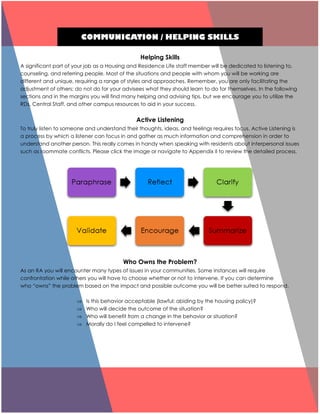
Active Listening
To truly listen to someone and understand their thoughts, ideas, and feelings requires focus. Active Listening is
a process by which a listener can focus in and gather as much information and comprehension in order to
understand another person. This really comes in handy when speaking with residents about interpersonal issues
such as roommate conflicts. Please click the image or navigate to Appendix II to review the detailed process.
COMMUNICATION / HELPING SKILLS
Generally, if there is little to no impact on the community or the outcome can be determined without the
intervention of staff that indicates a “Can” situation. If there is a substantial effect on the community or the
outcome will be determined by staff or other administrators that indicates a “Must” situation requiring your
intervention. Refer to the Standard Operating Procedures section of this guide and in the RA Manual for more
information on required intervention.
Can Strategy
Do you like to fix others’ problems? Do you give great advice? That might not be the best course of action in
the RA role. We want you to be a facilitator — able to help residents to resolve their own issues. If and when
you choose to get involved consider the guideline in the diagram to remain in a helping role. Since you do
not control the outcome it’s possible the resident will not want your assistance, and that’s okay as long as you
provide resource or referral information. Situations may include: issues with professors or grades, residents
feeling homesick, family problems, etc.
COMMUNICATION / HELPING SKILLS
Mediation
As an RA you will encounter conflict in the course of your job. Many of these conflicts will be small issues
between roommates or other residents, but at times things can get out of hand. If you become aware of
conflicts before they grow untenable encourage communication between the parties. Utilize roommate
agreements or referrals to the Counseling Center and keep your RD in the loop. Depending on the individuals
involved and the situation, mediation may be an appropriate avenue.
Mediation is a process meant to resolve conflicts between parties with you, an RD, or another staff member
acting as a neutral party. The neutral party assists the constituents in engaging one another and supports
them in finding a mutually agreed upon resolution. Successful mediation sets clear boundaries of acceptable
behavior and can help to repair the relationship between the parties. For mediation to be successful each
constituent has to be committed to the process. For a brief overview of the process click here or navigate to
Appendix III in the back of the guide. You can find more information on Conflict Resolution by clicking the
image below or by navigating to Appendices IV-V.
Appropriate Referral
The professional staff wants you to develop relationships in which you are aware of behavior changes with
your residents. We also want you to check-in when you notice something is off, but we understand that you
are not a Counselor. There are some instances that require outside consultation or referral, but you are
encouraged to consult with RDs and other referral sources often. The Campus Police, Counseling Center,
Women’s Center, Health Services, and AccessAbility Services all have capable professional staff members
that can provide help - utilize them.
Follow-up with residents can be just as important as initial interactions or peer counseling. It is a reminder to the
student that we care, and it gives us an opportunity to see if they are in need of further intervention. Make
sure to follow up with residents after responding to incidents, or anytime you provide peer counseling.
When you have
conflict with a resident
When a resident has a
conflict with you
NOTES
HINTS, TIPS, TRICKS
Be genuine in your approach to
communication
Talk frankly with residents.
Listen more than you talk.
Create a friendly atmosphere.
Talk with your residents as peers, not
as clients.
Avoid judgmental reactions such as
surprise, shock, or amusement.
Use self-disclosure of personal
experience where appropriate.
Be in touch with your own feelings
Follow up or make a referral where
needed.
Never promise a resident complete
confidentiality.
Be alert for abrupt or unexplained
changes in personal behavior .
Accept the limits of your
responsibility.
Ask open-ended questions.
Don’t rush to fill the silence during
conversations.
STANDARD OPERATING PROCEDURE
Information Desk
As an RA you are required to work 5 hours per week at the information desk in addition to duty responsibilities
in your residence hall. You will be responsible for being aware of people entering and exiting the building,
signing in guests, checking out equipment, and providing other assistance as necessary.
Duty
For duty you are required to be in the building from 6pm-8am on weekday duty nights (Sunday-Thursday).
For weekend duty (6pm Friday - 6pm Sunday) you are allotted 3 hours outside of the building. On duty nights
you (and possibly another RA) are responsible for desk coverage 6pm-10pm. More information regarding duty
expectations is in the RA Manual, and you are encouraged to consult with your RD. While on duty, you are the
go-to person for the residence hall including, but not limited to: lockouts, resident check-in or check-out,
responding to inappropriate behavior (policy violations), completing rounds of the building, etc.
A Night On Duty
 6:00pm
 You are in the building until duty is completed in the morning or for the weekend.
 5:50 - 7:50pm
 RA 1 at desk signing in guests, checking out equipment, doing bag checks, etc.
 RA 2 is available for lock-outs, check-in or check-out, and other resident needs.
 7:50 - 9:50pm
 RA 2 (or Desk Worker) at desk signing in guests, checking out equipment, doing bag
checks, etc.
 RA 1 is available for lock-outs, check-in or check-out, and other resident needs.
 10:00pm - Close of Desk
 Multiple rounds of the building
 Communicate with residents
 Document maintenance issues or PADs
 Write notes in Duty Log
 Check in with front desk
 Enforce quiet hours and other housing policies
Situational Awareness
By paying attention to sensory details and behaviors you will have a better idea of when incidents may occur.
Did you hear glass clinking in someone’s bag as they passed? Did you see a snapchat video of a party being
hosted in your building? These types of situations require your intervention or at least some investigation.
STANDARD OPERATING PROCEDURE
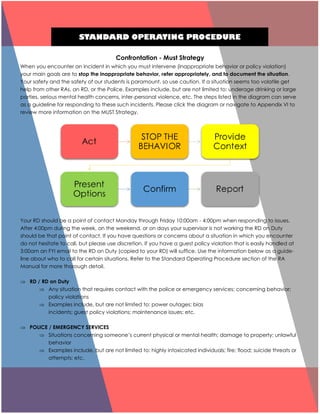
Confrontation - Must Strategy
When you encounter an incident in which you must intervene (inappropriate behavior or policy violation)
your main goals are to stop the inappropriate behavior, refer appropriately, and to document the situation.
Your safety and the safety of our students is paramount, so use caution. If a situation seems too volatile get
help from other RAs, an RD, or the Police. Examples include, but are not limited to: underage drinking or large
parties, serious mental health concerns, inter-personal violence, etc. The steps listed in the diagram can serve
as a guideline for responding to these such incidents. Please click the diagram or navigate to Appendix VI to
review more information on the MUST Strategy.
Your RD should be a point of contact Monday through Friday 10:00am - 4:00pm when responding to issues.
After 4:00pm during the week, on the weekend, or on days your supervisor is not working the RD on Duty
should be that point of contact. If you have questions or concerns about a situation in which you encounter
do not hesitate to call, but please use discretion. If you have a guest policy violation that is easily handled at
3:00am an FYI email to the RD on Duty (copied to your RD) will suffice. Use the information below as a guide-
line about who to call for certain situations. Refer to the Standard Operating Procedure section of the RA
Manual for more thorough detail.
 RD / RD on Duty
 Any situation that requires contact with the police or emergency services; concerning behavior;
policy violations
 Examples include, but are not limited to: power outages; bias
incidents; guest policy violations; maintenance issues; etc.
 POLICE / EMERGENCY SERVICES
 Situations concerning someone’s current physical or mental health; damage to property; unlawful
behavior
 Examples include, but are not limited to: highly intoxicated individuals; fire; flood; suicide threats or
attempts; etc.
Response Protocol (Partial)
Below you will find summarized response protocol information for a few specific incidents. Detailed information
about response protocol can be found in the Standard Operating Procedure section of the RA Manual.
***You need to know the protocol.***
Situation Protocol Referral Sources
Biased-related
Graffiti
Do not remove; notify RD and
PD; follow up with community;
document
RD On Duty
Police
Fire
EXIT THE BUILDING; notify RD and
PD; facilitate Fire Department;
direct students to designated areas;
retrieve info about cause;
document
RD On Duty
Police
Guests
Unescorted guests need to be
with host or escorted out of the
building; contact RD and PD if
people are uncooperative;
document
As necessary:
RD On Duty
Police
Missing Student
Ask residents, roommates, and
friends for whereabouts; notify RD;
refer calls to RD; document
RD On Duty
Police
Physical Assault
Notify RD (if incident is in
progress call PD); document; follow
up with those involved
RD On Duty
Police
Counseling Center
Serious Injury, Illness or
Accident (including
alcohol or drug related)
Do not touch resident or bodily
fluids; Do not transport; call PD or
9-1-1; notify RD; document; follow
up with student and community
Police / 911
RD On Duty
Counseling Center
Choices
STANDARD OPERATING PROCEDURE
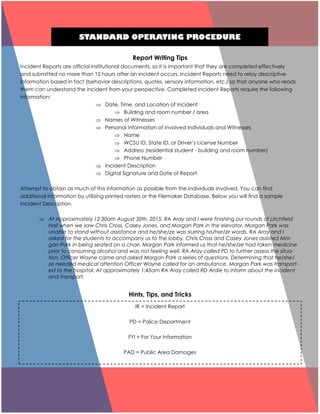
Report Writing Tips
Incident Reports are official institutional documents, so it is important that they are completed effectively
and submitted no more than 12 hours after an incident occurs. Incident Reports need to relay descriptive
information based in fact (behavior descriptions, quotes, sensory information, etc.) so that anyone who reads
them can understand the incident from your perspective. Completed Incident Reports require the following
information:
 Date, Time, and Location of Incident
 Building and room number / area
 Names of Witnesses
 Personal Information of involved Individuals and Witnesses
 Name
 WCSU ID, State ID, or Driver’s License Number
 Address (residential student - building and room number)
 Phone Number
 Incident Description
 Digital Signature and Date of Report
Attempt to obtain as much of this information as possible from the individuals involved. You can find
additional information by utilizing printed rosters or the Filemaker Database. Below you will find a sample
Incident Description.
 At Approximately 12:30am August 30th, 2015, RA Aray and I were finishing our rounds of Litchfield
Hall when we saw Chris Cross, Casey Jones, and Morgan Park in the elevator. Morgan Park was
unable to stand without assistance and he/she/ze was slurring his/her/zir words. RA Aray and I
asked for the students to accompany us to the lobby. Chris Cross and Casey Jones assisted Mor-
gan Park in being seated on a chair. Morgan Park informed us that he/she/ze had taken medicine
prior to consuming alcohol and was not feeling well. RA Aray called PD to further assess the situa-
tion. Officer Wayne came and asked Morgan Park a series of questions. Determining that he/she/
ze needed medical attention Officer Wayne called for an ambulance. Morgan Park was transport-
ed to the hospital. At approximately 1:45am RA Aray called RD Ardie to inform about the incident
and transport.
Hints, Tips, and Tricks
IR = Incident Report
PD = Police Department
FYI = For Your Information
PAD = Public Area Damages
NOTES
DIVERSITY / SOCIAL JUSTICE
Purpose
We aim to develop your understanding of self and others through training and facilitation. We hope through
exploration of these topics you will not only be well prepared to engage with your diverse communities, but
also have a richer understanding of how our diversity shapes our experiences. This type of development is
achieved through engagement, so we ask that you are open-minded, respectful, and participative in
activities and discussions. You are invited to share what is comfortable for you (we will not compel you to
OUT YOURSELF). These topics can precipitate strong emotions, but we hope through appropriate challenge,
support, and understanding we can all grow. Please communicate with the professional staff about any
concerns you might have.
Our Diversity Statement
The residence halls of Western Connecticut State University are a place where we celebrate the uniqueness
and dignity inherent in each one of us, no matter our race, gender, religion, sexual orientation, class, ability, or
age. We will promote a community that is free from harassment, where independent opinions are supported
and respected and differences are celebrated. However, when these opinions hurt and/or threaten others,
we will act swiftly to ensure the safety and well-being of the community. Please join us in creating an environ-
ment at Western in which everyone can feel comfortable and accepted.
Click the boxes below or navigate to the resource page for links to the information.
Identity
Often described as the filter through which people see and interact with the world, personal and cultural
identity is constructed of the multiple identities that define a person’s membership in a variety of groups,
including race, religion, gender, age, sexuality, language, nationality, ability, family, socioeconomic status
and ethnicity. An understanding of identity and an exploration of the ways people perceive different groups
promotes awareness and motivation to challenge stereotypes (2008 Anti-Defamation League). The link below
will lead you to a video of several people learning about and exploring a facet of their identities.
Rethink Your Role
University of
Arizona
Diversity and
Social Justice
Definitions
UMass - Lowell
The DNA Journey
Momondo
DIVERSITY / SOCIAL JUSTICE
Identity Molecule
Complete the activity by following the directions and using the image below.
1. Write your name in the center circle.
2. In the outer shapes, write the name of five groups
with which you identify (try to avoid hobbies and
personality traits).
3. Which of those five would you select as a primary
source of identification?
A. Reflect on a time when you felt proud to be
a member of that group.
B. Reflect on a painful experience resulting
from membership in that group.
4. Review the following list of categories and
consider how you or others might feel sharing the
reflections you made in the previous step.
A. Age - Ethnicity/Nationality - Gender -
Religion - Sexual Orientation - Profession -
Socioeconomic Class - Family - Language -
Mental / Physical Ability - Education
Practical Application
Learning about Diversity, Multiculturalism, and Social Justice is a process that includes the following steps.
1. Exploring your own identity and cultural background.
2. Addressing your identity development including values, beliefs, biases, and prejudices.
3. Examining how your beliefs , biases, and prejudices impact the relationships you have with others.
4. Understanding the issues that affect us a society (racism, sexism, homophobia, etc.
5. Making decisions on how you want to affect change in your relationships, communities, and in
society.
It is important to remember tat this is a learning process, and that it cannot be fully encompassed into our
student staff training experience. The information and training you receive is meant to raise your awareness
and to help prepare you for situations that may come up in the course of your work as an RA, but can extend
into your personal life as well. Let the following questions help guide your learning.
1. How have you and others been affected by discrimination and prejudice?
2. How would you respond to discriminatory activity?
3. What will you do to respect and celebrate diversity in your community?
NOTES
The Refugee Crisis / Immigration Reform
Black Lives Matter / Racial Profiling
Obamacare - Access to Healthcare
LGBT Adoption / Shared Benefits
Rape Culture on College Campuses
Poverty / Access to Resources
Equal Pay for Women
Access to Restrooms for Transgender People
Today’s Social Justice Issues
ETHICAL DECISION MAKING
RA Ethics
The RA role can be very rewarding, but also challenging in that it requires the management of your peers.
Your role requires that you hold yourself and others accountable to the policies of the department and institu-
tion. Activities that seem typical in peer relationships can bring about ethical dilemmas in terms of your role as
an RA. The consequences for inappropriate decisions can have a negative effect on your position, your resi-
dents, other student staff and the department. If you are faced with an ethical dilemma ask yourself the
following questions so that you are able to make the best decision with regard to all who could be affected.
 Is it safe?
 Will I be violating a civil law or institutional policy?
 Will my choice have a negative impact on others?
 Am I using excuses to justify my behavior?
 Will this stand the test of public scrutiny?
 If something terrible were to happen, could I defend my actions?
 Is it just, balanced, and fair?
 How will it make me feel about myself?
 Would I feel good if my parents/supervisors/someone I respect knew about my choice?
Examples of ethical dilemmas for an RA can include, but are not limited to:
 Using master keys to access rooms for personal reasons without the consent of the resident(s);
 Failure to enforce policy for your friends;
 Consuming alcohol as a minor, or with minors; etc.
Ultimately you have to take responsibility for what you do or don’t do. Please read through the departmental
and institutional policies regarding behavior. You should also familiarize yourself with the progressive process
and circumstances that would warrant such a response. Ask your supervisor or any of the administrators if you
have questions.
NOTES
APPENDIX I - PROGRAMMING
Current Event
An informative program involving any upcoming or recent occurrence on a local, national, or global
scale (elections, political movements, national disasters, etc.).
Cultural Awareness
Increase students’ appreciation or knowledge of diversity and/or cultural differences (not limited to
ethnicity or sexuality).
Social
Designed to bring the resident community together by interacting with one another in a fun, engaging,
and accepting atmosphere.
Supportive Plus
Taking students to support a scheduled campus event (for the duration), with a supplemental piece to
engage residents about the experience.
WCSU Success
Increase students’ awareness of and facilitate connection to resources and services available on campus
to aid in their success.
iMatter
Continuing holistic development by focusing on independence and life skills beyond campus life
(critical thinking and thoughtful decision making).
Community Service (by building)
An active program to help and support the WCSU and/or local community. No “piggy-backing” on any
previously scheduled events.
Greater Danbury (by building)
This program should be designed to increase students’ awareness of local services and events in Danbury
and the surrounding area.
Back to Programming
APPENDIX II - ACTIVE LISTENING
Paraphrase
 Restate in your own words what you think the speaker just said.
 “In other words…”
 “What I hear you saying is…”
Reflection
 Similar to Paraphrasing except you restate what the
speaker is feeling:
 “Sounds like you’re feeling ____________.”
Clarify
 You tell the other person what you thought you heard, learn whether you were right or wrong,
and then ask questions to gain a better understanding.
 “Paraphrase or Reflection. Am I on the right track?”
Summarize
 Recap the conversation
 Helps Listener and Speaker stay on track
 Helps to kick-start a stalled conversation
Encourage
 Open your posture to the person
 Maintain eye contact
 Non-verbal responses: Nodding and “Mhmm”
Validate
 Acknowledge the values and feelings of the Speaker
 Understand what and why
 One’s feelings cannot be wrong… and their Perception is reality.
Back to Communication / Helping Skills
APPENDIX III - MEDIATION
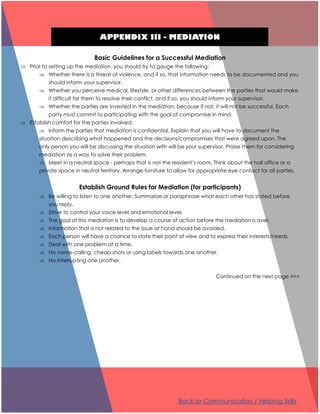
Basic Guidelines for a Successful Mediation
 Prior to setting up the mediation, you should try to gauge the following:
 Whether there is a threat of violence, and if so, that information needs to be documented and you
should inform your supervisor.
 Whether you perceive medical, lifestyle, or other differences between the parties that would make
it difficult for them to resolve their conflict, and if so, you should inform your supervisor.
 Whether the parties are invested in the mediation, because if not, it will not be successful. Each
party must commit to participating with the goal of compromise in mind.
 Establish comfort for the parties involved.
 Inform the parties that mediation is confidential. Explain that you will have to document the
situation describing what happened and the decisions/compromises that were agreed upon. The
only person you will be discussing the situation with will be your supervisor. Praise them for considering
mediation as a way to solve their problem.
 Meet in a neutral space - perhaps that is not the resident’s room. Think about the hall office or a
private space in neutral territory. Arrange furniture to allow for appropriate eye contact for all parties.
Establish Ground Rules for Mediation (for participants)
 Be willing to listen to one another. Summarize or paraphrase what each other has stated before
you reply.
 Strive to control your voice level and emotional level.
 The goal of this mediation is to develop a course of action before the mediation is over.
 Information that is not related to the issue at hand should be avoided.
 Each person will have a chance to state their point of view and to express their interests/needs.
 Deal with one problem at a time.
 No name-calling, cheap shots or using labels towards one another.
 No interrupting one another.
Continued on the next page >>>
Back to Communication / Helping Skills
APPENDIX III - MEDIATION
Steps in Mediation (for the RA to remember)
 Clarify the mediator’s role (your role). You DON’T SOLVE THE PROBLEM FOR THEM. You are neutral and are
there to help them reach their own solution. (note: if you aren’t able to be neutral, you should not be me-
diating the situation).
 Establish ground rules (above).
 The mediator chooses who gets to talk first and when it’s time for the other person to talk and respond.
 Each party has the opportunity to present his/her side without interruption by the other person.
 The mediator will have each participant paraphrase the other’s problem to ensure clarification.
 The mediator summarizes conversations (or parts of it, if it is needed).
 The parties will brainstorm ways to resolve the problems. The mediator can help by prompting them to
think about options (“what do you need to happen in order to be ok?” their solution needs to be realistic-
the other party needs to be able to accommodate the request- and clear-the other party needs to know
exactly what they need to change).
 The individuals involved will select a course of action.
 The mediator will help the parties record their course of action and what they will do if the course of action
is not followed and have both parties sign. Make sure all parties have a copy.
 All those involved will agree to meet on a set date in order to check on progress.
Back to Communication / Helping Skills
APPENDIX IV - CONFLICT  RESIDENT
Coaching Strategies
Identify and own your feelings
Initiate contact—don’t ask—tell
State concern using “I” messages
If resistant, use active listening
You decide on what action will be taken
Act
“I” Messages
“When you… (describe behavior)
“I feel… (identify your feelings)
“because… (describe how the behavior affects you)
“I need or I prefer… (describe what the person needs
to do to correct behavior)
***If discipline is involved you must
document the situation.
Conflict with Residents
As you strive to remain impartial and professional, occasionally you will disagree with the actions or behaviors
of your residents. Some of those actions or behaviors may have a negative effect on you or the community.
There are established policies and procedures for responding to certain situations, but outside of those
instances you may benefit from coaching strategies to change behavior. Examples include, but are not limited
to: a resident who marginalizes your time; a resident that has a negative attitude or uses hurtful language; etc.
ME RESIDENT
If Coaching fails
go to Discipline
Back to Communication / Helping Skills
Conflict Directed at You
Although it may be jarring to receive criticism from a resident it is important to remain calm. Their criticism may
have constructive use to help you improve. Utilizing Active Listening skills can be very helpful in understanding
the basis of the conflict to move towards resolution. Below you will find some tactics you can use to defuse
conflict directed towards you. You can excuse yourself or get help if a situation feels uncomfortable. Consult
with your RD about how to re-engage.
APPENDIX V - RESIDENT CONFLICT  YOU
Examples of Fogging Stems
That’s right or You’re right.
You’re probably right.
That’s probably true.
You could be right.
I guess you’re right.
Negative Inquiry Questions
Can you tell me more about…?
What else do I do that annoys you…?
What needs to happen to…?
Are there other factors that make this important to
you?
ME RESIDENT
Back to Communication / Helping Skills
APPENDIX VI - WHEN YOU MUST RESPOND
Must Strategy Foundations
To navigate through must situations requires a strong foundation of knowledge. Combining situational aware-
ness (mentioned here) with communication and helping skills will allow you to have a decent base, but there
are other things to consider for the various situations you will encounter. Professionalism is key in these interac-
tions, but it is just as important to respond with consideration (you don’t know the whole story). Prioritize early
on whether you want to be liked or respected. You should strive for a balance between the two without hav-
ing a negative impact on your ability to do your job. Use courage and restraint as you intervene—be confi-
dent in your training and your ability, but know your limits and resources. Be aware of your body language as it
can easily be misconstrued by the involved individuals. Lastly, rely on your training and remember YOU’RE NOT
ALONE in dealing with difficult situations.
Must Strategy
 ACT
 Step up to the situation (knock on the door or get help).
 STOP THE BEHAVIOR
 Excessive noise, drinking, fighting (the Police will intervene), etc. should be stopped to bet-
ter control the situation.
 PROVIDE CONTEXT
 Describe their behavior, how it affects you / the community, and how it makes you feel.
 “When you play your music so loud I have to knock on the door, and then I feel like the bad
guy.”
 PRESENT OPTIONS
 Describe what you would like them to do.
 “I need you to give me your personal information and
escort your guests out of the building, or I’ll have to call campus PD.”
 If possible, get them involved in the solution.
 “Can two of you assist in disposing of the alcohol?”
 CONFIRM
 Get agreement
 REPORT
 Update RD / RD on Duty if you haven’t done so already.
 Complete and process incident report.
Standard Operating Procedure
APPENDIX VII - HELPFUL RESOURCES
Links from Previous Sections
15 Things I Wish I Knew Before I Became an RA - http://goo.gl/H9F57z
The Life of an RA - http://goo.gl/G2X8nl
Reflections on the RA Job - http://goo.gl/nGc85f
UMass-Lowell, Diversity and Social Justice Definitions - https://goo.gl/jlWUbv
U of Arizona, Introduction to Social Justice Training - https://goo.gl/EOXJJM
Momondo, The DNA Journey - https://goo.gl/1vFZca
General Resources
www.pinterest.com
www.reslife.net
www.residentassistant.com
Tips for Being a Good Leader
L.E.A.D. Your Way to Success - http://goo.gl/eXE7p7
Programming
Partying with Programming - http://goo.gl/7y0IMO
Program Possibilities - http://goo.gl/uQk2xz
Community Building
Engaging Non-Traditional Residence Halls - https://goo.gl/HTfEVD
Student Interest Survey (downloadable word doc) - http://goo.gl/raCiC3
Community Living Agreements
Navigate to the X: Drive for more information
Roommate Agreements
University of Evansville - https://goo.gl/wpG6uE
The College of Wooster - https://goo.gl/DeT00W
Roommate Agreement Booklet - Navigate to the X: Drive for more information
Table of Contents
Housing and Residence Life 2016

RA Resource Guide 16-17

  • 1.
  • 2.
    GREETINGS! Welcome to theLife of a Resident Assistant Whether you are a new or continuing staff member we would like to welcome you and say that we’re excited to have you on our team. The job of a Resident Assistant can be chal- lenging and yet, extremely rewarding. This position provides a unique leadership opportuni- ty to help you develop both personally and professionally. RAs play an integral role in our department and in the campus community. As you prepare for the start of the school year in this position we would like to remind you of something. We believe in your ability to be successful, and we aim to do all that we can to assist you. We believe you have what it takes to be a leader amongst your peers. We hope through training and lots of practice you will feel ready and able to rise to the occasion. Remember, you’re never on your own. We hope that you will benefit from the use of this guide as “Cliff Notes” to the RA Manual. It has helpful information that you can easily refer back to throughout the school year. Thanks again for choosing to join us. We look forward to what this year has to offer, and we have no doubt that with awesome folks like you we will be successful. Go forth and prosper, The Housing and Residence Life Pro Staff
  • 3.
    TABLE OF CONTENTS ImportantDates - 4 Contact Information - 5 Departmental Mission - 6 The Life of an RA - 7 Building Community - 8 Programming - 11 Communication / Helping Skills - 13 Standard Operating Procedure - 16 Diversity / Social Justice Resources - 20 Ethical Decision Making - 22 ***Clickable links will function in the PDF format of this guide.
  • 4.
    IMPORTANT DATES August 26 FirstYear / Transfer Students move in - 9:00am. Brunch is the first meal that meal plans will be active. August 28 Returning Students move in - 10:00am. Classes for all students begin Monday, August 29th. November 23-27 Thanksgiving break. Residents must sign up to stay. Dinner on Tuesday (11/22) is the last meal prior to the break. Residence Halls reopen at 1:00pm on the 27th for those who did not stay for the break. December 16 Winter Closing. Residence Halls close at 6:00pm. Lunch is the last meal served for the semester on the meal plan. December 17 - January 13 Intercession housing available (Westside only) at an additional cost to residents. Limited food services available. January 16 Residence Halls reopen for all students at 10:00am. Dinner is the first meal that meal plans will be active. March 10-19 Spring Break. Residents must sign up to stay. Lunch on Friday (3/10) is the last meal prior to the break. Limited food services available. Residence Halls reopen at 1:00pm on the 19th for those who did not stay for the break. May 14 All residence halls close at 6:00 pm. Dinner on Friday (5/12) is the last meal of the semester. Graduation Ceremony: TBD.
  • 5.
    Ron Mason, Directorof Housing & Residence Life 203-837-8736 Maribeth Griffin, Director of Programming & Staff 203-837-8532 Edward Mulvihill, Associate Director of HRL for Operations 203-837-8538 Effie Masse, Secretary II 203-837-8533 Centennial Hall Front Desk: 203-837-9240 RD: 203-837-8850 Fairfield Hall Front Desk: 203-837-9236 RD: 203-837-8537 Grasso Hall Front Desk: 203-837-9854 RD: 203-837-8548 Newbury Hall Front Desk: 203-837-9237 RD: 203-837-8534 Pinney Hall Front Desk: 203-837-8655 RD: 203-837-8535 CONTACT INFORMATION Dr. Paul M. Simon, Director of Campus and Student Centers & Auxiliary Services 203-837-8494 Amy Shanks, Director of Recreation, Intramurals, and Club Sports 203-837-8609 Sharon Guck, Coordinator for Substance Abuse & Prevention Program - CHOICES 203-837-8899 Rayna Havelock, Campus Advocate for the Women’s Center 203-837-3939 AccessAbility Services 203-837-8225 Career Services 203-837-8263 Center for Student Involvement 203-837-3954 Counseling Center 203-837-8690 Health Services 203-837-8593 Judicial Affairs 203-837-8770 University Police 203-837-9300 WestConnect 203-837-9311 _______________________ _______________________ _______________________ _______________________ _______________________ _______________________ _______________________ _______________________ _______________________ _______________________ _______________________ _______________________ _______________________ _______________________ _______________________ _______________________ _______________________ _______________________
  • 6.
    HRL (Housing andResidence Life) MISSION Our Residence Halls are crossroads where WE promote academic excellence, build communities, and support student development. The residence halls of Western Connecticut State University are a place where we celebrate the uniqueness and dignity inherent in each one of us, no matter our race, gender, religion, sexual orientation, class, ability, or age. We will promote a community that is free from harassment, where independent opinions are supported and respected and differences are celebrated. However, when these opinions hurt and/or threaten others, we will act swiftly to ensure the safety and well-being of the community. Please join us in creating an environment at Western in which everyone can feel comfortable and accepted. ACADEMIC EXCELLENCE COMMUNITY STUDENT DEVELOPMENT CELEBRATE DIFFERENCES
  • 7.
    What is thejob of an RA? RAs at Western are trained in helping skills and interpersonal relations. They will get to know residents individually throughout the course of the semester to assist them in their academic/ personal progress in school. As always, RAs will be available to assist residents with maintenance issues, to act as sounding boards during roommate issues, and to be a general resource to residents regarding the University community. The links below are reflections written by RAs from different institutions. You can find more opinion pieces, reflections, and resources for programming, community building, bulletin boards on the resource page. Day-to-Day Experience  Interacting with residents while at the desk, during duty, floor meetings, programs, etc.  Designing bulletin boards and door decorations that you update each month.  Checking your mailbox daily, updating advertisements in the community, and other administrative tasks.  Planning and hosting programs - after getting approval from RD and Hall Council.  Communicating with your RD and fellow staff about what’s going on in the community.  Attending and participating in staff meetings, 1 on 1 meetings with your RD, staff bonding, and In-Service Training sessions.  Helping to maintain a safe and healthy living environment by completing Health-Fire-Safety Checks, being on duty, responding to and reporting incidents.  Supporting various departmental and campus events (Chuck’s Cup, Homecoming, etc.).  Putting it all together to build community. THE LIFE OF AN RA The Life of an RA Reflections on the RA Job 15 Things I Wish I Knew Before I Became an RA
  • 8.
    BUILDING COMMUNITY Why isit so Important? Remember that signpost from 2 pages ago? Community is one of the core values of our Departmental Mission. That means it is your job to get residents connected with one another, the residence life program, and the greater campus ecosystem. Students who are connected to the campus community have a much higher chance of persisting through graduation, so community building is important for our department and the institution. The Residence Life Experience Each individual that moves into your residence hall will have their own experiences, backgrounds, and feelings about living on campus. On top of that they face social rejection, a new social life, roommate conflicts, homesickness, academic challenges, and other issues associated with living in a new environment. Being aware of these issues will help you to better adapt to the needs of your residents. How We Build Community
  • 9.
    BUILDING COMMUNITY Community LivingAgreements The Housing Guide and the Student Code of Conduct provide the departmental and institutional expectations for students, but CLAs help to set boundaries and expectations of behavior specific to the community within the building, floor, or section. CLAs are developed and implemented, with your facilitation, by the residents of the community. Topics such as laundry etiquette, “open door policies”, and celebrating birthdays and holidays can be outlined. Facilitating the residents in developing standards helps them to feel ownership and accountability for the living environment. Click here or navigate to Appendix VII for CLA resources. Roommate Agreements Your community and its members may benefit from a proactive approach to community living through the use of roommate agreements. The agreement outlines standards for how the residents of a specific room, suite, or apartment want to share their space. Roommate agreements cover the expectations for cleanliness, sharing of personal items, having guests, noise levels, etc. To help the process to be more successful consider facilitating your residents in communicating about acceptable behavior during a floor meeting or program. With some snacks/food and the assistance of another RA or your RD this process can help to lessen the amount of roommate issues that come up during the school year. Click here or navigate to Appendix VII for Roommate Agreement resources. Hints, Tips, and Tricks  Be yourself  Pursue academic excellence - lead by example  Use your strengths to engage with the community  Present fun & engaging programs  Provide opportunities for residents to get involved in the community  Encourage healthy competition (Chuck’s Cup / Intramurals)  Be available  Say hello when you see residents around campus  Attend athletic and VPA events  Be welcoming  Interact with your residents outside of programs and conduct-related incidents  Initiatives: The FEW Program (first eight weeks), Chuck's Cup, Western Day of Service, etc.
  • 10.
    NOTES Personally invite residentsto programs Encourage residents to get involved in the greater WCSU community Ask your residents for their perspective and ideas Be accountable to the community Celebrate culture and diversity Traditional residence halls have shared bathrooms on each floor Newbury / Fairfield Non-Traditional Halls have suites or apartments Centennial / Grasso / Pinney Our traditional halls house the majority of our first-year students. Our non-traditional halls house transfer and continuing students. It takes time and effort for communities to develop HINTS, TIPS, TRICKS
  • 11.
    PROGRAMMING Keeping Things Fresh Weencourage you to use previous programming experience to guide your plans for the semester, but do not repeat every program from last year. You can find past programming information in the Filemaker Database, but keep in mind that your residents and their interests will change. Engaging them will help you to determine what types of activities and programs to host. Slide an interest inventory sheet under each door, or reserve part of your initial bulletin board for residents to write program ideas. Find ways to keep things fresh by utilizing different resources (find links in Appendix VII). Programming Needs  First Year Students  Campus Involvement; Campus Resources; Developing Relationships; Academic Resources; Healthy Decision-Making; Campus Safety; Diversity & Social Justice  Continuing Students  Career Prep; Internship & Grad School Info; Studying Abroad; Diversity & Social Justice; Managing Stress; Utilizing Campus Resources; Life Skills  Transfer Students  Campus Involvement; Campus Resources; Developing Relationships; Getting Acclimated; Career Prep & Grad School Info; Studying Abroad; Diversity & Social Justice; Life Skills Programming Topic Areas You must present at least 7 programs each semester encompassing all the topics in the pie chart and either Community Service or Greater Danbury. Program Proposals need to be submitted in Filemaker by the 15th of each month and need to be approved by your RD. Failure to complete Program Requirements may result in being placed on job probation. For more detail on each topic click the image or navigate to Appendix I at the end of this guide. Community Service Greater Danbury
  • 12.
    NOTES You must submitProgram Proposals and Evaluations via the Filemaker application. Check with your RD before co- hosting programs with other staff. You must allocate funds or food service through Hall Council prior to your program date. Don’t forget to utilize Program Sign-In sheets! Make sure you’re submitting the correct forms (Payment Vouchers, Food Service, etc.). SAVE YOUR RECEIPTS! There are lots of program ideas in the RA Manual, in Filemaker, and online. You will be required to complete 1 Community Service or Greater Danbury program each semester. Only 1/7 of your programs may be a passive program, approved by your RD. Plan programs with faculty or staff presenters from different departments Start planning and organizing early for larger-scale programming Look to clubs and organizations for co-sponsorship opportunities HINTS, TIPS, TRICKS
  • 13.
    Who Owns theProblem? As an RA you will encounter many types of issues in your communities. Some instances will require confrontation while others you will have to choose whether or not to intervene. If you can determine who “owns” the problem based on the impact and possible outcome you will be better suited to respond.  Is this behavior acceptable (lawful; abiding by the housing policy)?  Who will decide the outcome of the situation?  Who will benefit from a change in the behavior or situation?  Morally do I feel compelled to intervene? COMMUNICATION / HELPING SKILLS Helping Skills A significant part of your job as a Housing and Residence Life staff member will be dedicated to listening to, counseling, and referring people. Most of the situations and people with whom you will be working are different and unique, requiring a range of styles and approaches. Remember, you are only facilitating the adjustment of others; do not do for your advisees what they should learn to do for themselves. In the following sections and in the margins you will find many helping and advising tips, but we encourage you to utilize the RDs, Central Staff, and other campus resources to aid in your success. Active Listening To truly listen to someone and understand their thoughts, ideas, and feelings requires focus. Active Listening is a process by which a listener can focus in and gather as much information and comprehension in order to understand another person. This really comes in handy when speaking with residents about interpersonal issues such as roommate conflicts. Please click the image or navigate to Appendix II to review the detailed process.
  • 14.
    COMMUNICATION / HELPINGSKILLS Generally, if there is little to no impact on the community or the outcome can be determined without the intervention of staff that indicates a “Can” situation. If there is a substantial effect on the community or the outcome will be determined by staff or other administrators that indicates a “Must” situation requiring your intervention. Refer to the Standard Operating Procedures section of this guide and in the RA Manual for more information on required intervention. Can Strategy Do you like to fix others’ problems? Do you give great advice? That might not be the best course of action in the RA role. We want you to be a facilitator — able to help residents to resolve their own issues. If and when you choose to get involved consider the guideline in the diagram to remain in a helping role. Since you do not control the outcome it’s possible the resident will not want your assistance, and that’s okay as long as you provide resource or referral information. Situations may include: issues with professors or grades, residents feeling homesick, family problems, etc.
  • 15.
    COMMUNICATION / HELPINGSKILLS Mediation As an RA you will encounter conflict in the course of your job. Many of these conflicts will be small issues between roommates or other residents, but at times things can get out of hand. If you become aware of conflicts before they grow untenable encourage communication between the parties. Utilize roommate agreements or referrals to the Counseling Center and keep your RD in the loop. Depending on the individuals involved and the situation, mediation may be an appropriate avenue. Mediation is a process meant to resolve conflicts between parties with you, an RD, or another staff member acting as a neutral party. The neutral party assists the constituents in engaging one another and supports them in finding a mutually agreed upon resolution. Successful mediation sets clear boundaries of acceptable behavior and can help to repair the relationship between the parties. For mediation to be successful each constituent has to be committed to the process. For a brief overview of the process click here or navigate to Appendix III in the back of the guide. You can find more information on Conflict Resolution by clicking the image below or by navigating to Appendices IV-V. Appropriate Referral The professional staff wants you to develop relationships in which you are aware of behavior changes with your residents. We also want you to check-in when you notice something is off, but we understand that you are not a Counselor. There are some instances that require outside consultation or referral, but you are encouraged to consult with RDs and other referral sources often. The Campus Police, Counseling Center, Women’s Center, Health Services, and AccessAbility Services all have capable professional staff members that can provide help - utilize them. Follow-up with residents can be just as important as initial interactions or peer counseling. It is a reminder to the student that we care, and it gives us an opportunity to see if they are in need of further intervention. Make sure to follow up with residents after responding to incidents, or anytime you provide peer counseling. When you have conflict with a resident When a resident has a conflict with you
  • 16.
    NOTES HINTS, TIPS, TRICKS Begenuine in your approach to communication Talk frankly with residents. Listen more than you talk. Create a friendly atmosphere. Talk with your residents as peers, not as clients. Avoid judgmental reactions such as surprise, shock, or amusement. Use self-disclosure of personal experience where appropriate. Be in touch with your own feelings Follow up or make a referral where needed. Never promise a resident complete confidentiality. Be alert for abrupt or unexplained changes in personal behavior . Accept the limits of your responsibility. Ask open-ended questions. Don’t rush to fill the silence during conversations.
  • 17.
    STANDARD OPERATING PROCEDURE InformationDesk As an RA you are required to work 5 hours per week at the information desk in addition to duty responsibilities in your residence hall. You will be responsible for being aware of people entering and exiting the building, signing in guests, checking out equipment, and providing other assistance as necessary. Duty For duty you are required to be in the building from 6pm-8am on weekday duty nights (Sunday-Thursday). For weekend duty (6pm Friday - 6pm Sunday) you are allotted 3 hours outside of the building. On duty nights you (and possibly another RA) are responsible for desk coverage 6pm-10pm. More information regarding duty expectations is in the RA Manual, and you are encouraged to consult with your RD. While on duty, you are the go-to person for the residence hall including, but not limited to: lockouts, resident check-in or check-out, responding to inappropriate behavior (policy violations), completing rounds of the building, etc. A Night On Duty  6:00pm  You are in the building until duty is completed in the morning or for the weekend.  5:50 - 7:50pm  RA 1 at desk signing in guests, checking out equipment, doing bag checks, etc.  RA 2 is available for lock-outs, check-in or check-out, and other resident needs.  7:50 - 9:50pm  RA 2 (or Desk Worker) at desk signing in guests, checking out equipment, doing bag checks, etc.  RA 1 is available for lock-outs, check-in or check-out, and other resident needs.  10:00pm - Close of Desk  Multiple rounds of the building  Communicate with residents  Document maintenance issues or PADs  Write notes in Duty Log  Check in with front desk  Enforce quiet hours and other housing policies Situational Awareness By paying attention to sensory details and behaviors you will have a better idea of when incidents may occur. Did you hear glass clinking in someone’s bag as they passed? Did you see a snapchat video of a party being hosted in your building? These types of situations require your intervention or at least some investigation.
  • 18.
    STANDARD OPERATING PROCEDURE Confrontation- Must Strategy When you encounter an incident in which you must intervene (inappropriate behavior or policy violation) your main goals are to stop the inappropriate behavior, refer appropriately, and to document the situation. Your safety and the safety of our students is paramount, so use caution. If a situation seems too volatile get help from other RAs, an RD, or the Police. Examples include, but are not limited to: underage drinking or large parties, serious mental health concerns, inter-personal violence, etc. The steps listed in the diagram can serve as a guideline for responding to these such incidents. Please click the diagram or navigate to Appendix VI to review more information on the MUST Strategy. Your RD should be a point of contact Monday through Friday 10:00am - 4:00pm when responding to issues. After 4:00pm during the week, on the weekend, or on days your supervisor is not working the RD on Duty should be that point of contact. If you have questions or concerns about a situation in which you encounter do not hesitate to call, but please use discretion. If you have a guest policy violation that is easily handled at 3:00am an FYI email to the RD on Duty (copied to your RD) will suffice. Use the information below as a guide- line about who to call for certain situations. Refer to the Standard Operating Procedure section of the RA Manual for more thorough detail.  RD / RD on Duty  Any situation that requires contact with the police or emergency services; concerning behavior; policy violations  Examples include, but are not limited to: power outages; bias incidents; guest policy violations; maintenance issues; etc.  POLICE / EMERGENCY SERVICES  Situations concerning someone’s current physical or mental health; damage to property; unlawful behavior  Examples include, but are not limited to: highly intoxicated individuals; fire; flood; suicide threats or attempts; etc.
  • 19.
    Response Protocol (Partial) Belowyou will find summarized response protocol information for a few specific incidents. Detailed information about response protocol can be found in the Standard Operating Procedure section of the RA Manual. ***You need to know the protocol.*** Situation Protocol Referral Sources Biased-related Graffiti Do not remove; notify RD and PD; follow up with community; document RD On Duty Police Fire EXIT THE BUILDING; notify RD and PD; facilitate Fire Department; direct students to designated areas; retrieve info about cause; document RD On Duty Police Guests Unescorted guests need to be with host or escorted out of the building; contact RD and PD if people are uncooperative; document As necessary: RD On Duty Police Missing Student Ask residents, roommates, and friends for whereabouts; notify RD; refer calls to RD; document RD On Duty Police Physical Assault Notify RD (if incident is in progress call PD); document; follow up with those involved RD On Duty Police Counseling Center Serious Injury, Illness or Accident (including alcohol or drug related) Do not touch resident or bodily fluids; Do not transport; call PD or 9-1-1; notify RD; document; follow up with student and community Police / 911 RD On Duty Counseling Center Choices STANDARD OPERATING PROCEDURE
  • 20.
    STANDARD OPERATING PROCEDURE ReportWriting Tips Incident Reports are official institutional documents, so it is important that they are completed effectively and submitted no more than 12 hours after an incident occurs. Incident Reports need to relay descriptive information based in fact (behavior descriptions, quotes, sensory information, etc.) so that anyone who reads them can understand the incident from your perspective. Completed Incident Reports require the following information:  Date, Time, and Location of Incident  Building and room number / area  Names of Witnesses  Personal Information of involved Individuals and Witnesses  Name  WCSU ID, State ID, or Driver’s License Number  Address (residential student - building and room number)  Phone Number  Incident Description  Digital Signature and Date of Report Attempt to obtain as much of this information as possible from the individuals involved. You can find additional information by utilizing printed rosters or the Filemaker Database. Below you will find a sample Incident Description.  At Approximately 12:30am August 30th, 2015, RA Aray and I were finishing our rounds of Litchfield Hall when we saw Chris Cross, Casey Jones, and Morgan Park in the elevator. Morgan Park was unable to stand without assistance and he/she/ze was slurring his/her/zir words. RA Aray and I asked for the students to accompany us to the lobby. Chris Cross and Casey Jones assisted Mor- gan Park in being seated on a chair. Morgan Park informed us that he/she/ze had taken medicine prior to consuming alcohol and was not feeling well. RA Aray called PD to further assess the situa- tion. Officer Wayne came and asked Morgan Park a series of questions. Determining that he/she/ ze needed medical attention Officer Wayne called for an ambulance. Morgan Park was transport- ed to the hospital. At approximately 1:45am RA Aray called RD Ardie to inform about the incident and transport. Hints, Tips, and Tricks IR = Incident Report PD = Police Department FYI = For Your Information PAD = Public Area Damages
  • 21.
  • 22.
    DIVERSITY / SOCIALJUSTICE Purpose We aim to develop your understanding of self and others through training and facilitation. We hope through exploration of these topics you will not only be well prepared to engage with your diverse communities, but also have a richer understanding of how our diversity shapes our experiences. This type of development is achieved through engagement, so we ask that you are open-minded, respectful, and participative in activities and discussions. You are invited to share what is comfortable for you (we will not compel you to OUT YOURSELF). These topics can precipitate strong emotions, but we hope through appropriate challenge, support, and understanding we can all grow. Please communicate with the professional staff about any concerns you might have. Our Diversity Statement The residence halls of Western Connecticut State University are a place where we celebrate the uniqueness and dignity inherent in each one of us, no matter our race, gender, religion, sexual orientation, class, ability, or age. We will promote a community that is free from harassment, where independent opinions are supported and respected and differences are celebrated. However, when these opinions hurt and/or threaten others, we will act swiftly to ensure the safety and well-being of the community. Please join us in creating an environ- ment at Western in which everyone can feel comfortable and accepted. Click the boxes below or navigate to the resource page for links to the information. Identity Often described as the filter through which people see and interact with the world, personal and cultural identity is constructed of the multiple identities that define a person’s membership in a variety of groups, including race, religion, gender, age, sexuality, language, nationality, ability, family, socioeconomic status and ethnicity. An understanding of identity and an exploration of the ways people perceive different groups promotes awareness and motivation to challenge stereotypes (2008 Anti-Defamation League). The link below will lead you to a video of several people learning about and exploring a facet of their identities. Rethink Your Role University of Arizona Diversity and Social Justice Definitions UMass - Lowell The DNA Journey Momondo
  • 23.
    DIVERSITY / SOCIALJUSTICE Identity Molecule Complete the activity by following the directions and using the image below. 1. Write your name in the center circle. 2. In the outer shapes, write the name of five groups with which you identify (try to avoid hobbies and personality traits). 3. Which of those five would you select as a primary source of identification? A. Reflect on a time when you felt proud to be a member of that group. B. Reflect on a painful experience resulting from membership in that group. 4. Review the following list of categories and consider how you or others might feel sharing the reflections you made in the previous step. A. Age - Ethnicity/Nationality - Gender - Religion - Sexual Orientation - Profession - Socioeconomic Class - Family - Language - Mental / Physical Ability - Education Practical Application Learning about Diversity, Multiculturalism, and Social Justice is a process that includes the following steps. 1. Exploring your own identity and cultural background. 2. Addressing your identity development including values, beliefs, biases, and prejudices. 3. Examining how your beliefs , biases, and prejudices impact the relationships you have with others. 4. Understanding the issues that affect us a society (racism, sexism, homophobia, etc. 5. Making decisions on how you want to affect change in your relationships, communities, and in society. It is important to remember tat this is a learning process, and that it cannot be fully encompassed into our student staff training experience. The information and training you receive is meant to raise your awareness and to help prepare you for situations that may come up in the course of your work as an RA, but can extend into your personal life as well. Let the following questions help guide your learning. 1. How have you and others been affected by discrimination and prejudice? 2. How would you respond to discriminatory activity? 3. What will you do to respect and celebrate diversity in your community?
  • 24.
    NOTES The Refugee Crisis/ Immigration Reform Black Lives Matter / Racial Profiling Obamacare - Access to Healthcare LGBT Adoption / Shared Benefits Rape Culture on College Campuses Poverty / Access to Resources Equal Pay for Women Access to Restrooms for Transgender People Today’s Social Justice Issues
  • 25.
    ETHICAL DECISION MAKING RAEthics The RA role can be very rewarding, but also challenging in that it requires the management of your peers. Your role requires that you hold yourself and others accountable to the policies of the department and institu- tion. Activities that seem typical in peer relationships can bring about ethical dilemmas in terms of your role as an RA. The consequences for inappropriate decisions can have a negative effect on your position, your resi- dents, other student staff and the department. If you are faced with an ethical dilemma ask yourself the following questions so that you are able to make the best decision with regard to all who could be affected.  Is it safe?  Will I be violating a civil law or institutional policy?  Will my choice have a negative impact on others?  Am I using excuses to justify my behavior?  Will this stand the test of public scrutiny?  If something terrible were to happen, could I defend my actions?  Is it just, balanced, and fair?  How will it make me feel about myself?  Would I feel good if my parents/supervisors/someone I respect knew about my choice? Examples of ethical dilemmas for an RA can include, but are not limited to:  Using master keys to access rooms for personal reasons without the consent of the resident(s);  Failure to enforce policy for your friends;  Consuming alcohol as a minor, or with minors; etc. Ultimately you have to take responsibility for what you do or don’t do. Please read through the departmental and institutional policies regarding behavior. You should also familiarize yourself with the progressive process and circumstances that would warrant such a response. Ask your supervisor or any of the administrators if you have questions.
  • 26.
  • 27.
    APPENDIX I -PROGRAMMING Current Event An informative program involving any upcoming or recent occurrence on a local, national, or global scale (elections, political movements, national disasters, etc.). Cultural Awareness Increase students’ appreciation or knowledge of diversity and/or cultural differences (not limited to ethnicity or sexuality). Social Designed to bring the resident community together by interacting with one another in a fun, engaging, and accepting atmosphere. Supportive Plus Taking students to support a scheduled campus event (for the duration), with a supplemental piece to engage residents about the experience. WCSU Success Increase students’ awareness of and facilitate connection to resources and services available on campus to aid in their success. iMatter Continuing holistic development by focusing on independence and life skills beyond campus life (critical thinking and thoughtful decision making). Community Service (by building) An active program to help and support the WCSU and/or local community. No “piggy-backing” on any previously scheduled events. Greater Danbury (by building) This program should be designed to increase students’ awareness of local services and events in Danbury and the surrounding area. Back to Programming
  • 28.
    APPENDIX II -ACTIVE LISTENING Paraphrase  Restate in your own words what you think the speaker just said.  “In other words…”  “What I hear you saying is…” Reflection  Similar to Paraphrasing except you restate what the speaker is feeling:  “Sounds like you’re feeling ____________.” Clarify  You tell the other person what you thought you heard, learn whether you were right or wrong, and then ask questions to gain a better understanding.  “Paraphrase or Reflection. Am I on the right track?” Summarize  Recap the conversation  Helps Listener and Speaker stay on track  Helps to kick-start a stalled conversation Encourage  Open your posture to the person  Maintain eye contact  Non-verbal responses: Nodding and “Mhmm” Validate  Acknowledge the values and feelings of the Speaker  Understand what and why  One’s feelings cannot be wrong… and their Perception is reality. Back to Communication / Helping Skills
  • 29.
    APPENDIX III -MEDIATION Basic Guidelines for a Successful Mediation  Prior to setting up the mediation, you should try to gauge the following:  Whether there is a threat of violence, and if so, that information needs to be documented and you should inform your supervisor.  Whether you perceive medical, lifestyle, or other differences between the parties that would make it difficult for them to resolve their conflict, and if so, you should inform your supervisor.  Whether the parties are invested in the mediation, because if not, it will not be successful. Each party must commit to participating with the goal of compromise in mind.  Establish comfort for the parties involved.  Inform the parties that mediation is confidential. Explain that you will have to document the situation describing what happened and the decisions/compromises that were agreed upon. The only person you will be discussing the situation with will be your supervisor. Praise them for considering mediation as a way to solve their problem.  Meet in a neutral space - perhaps that is not the resident’s room. Think about the hall office or a private space in neutral territory. Arrange furniture to allow for appropriate eye contact for all parties. Establish Ground Rules for Mediation (for participants)  Be willing to listen to one another. Summarize or paraphrase what each other has stated before you reply.  Strive to control your voice level and emotional level.  The goal of this mediation is to develop a course of action before the mediation is over.  Information that is not related to the issue at hand should be avoided.  Each person will have a chance to state their point of view and to express their interests/needs.  Deal with one problem at a time.  No name-calling, cheap shots or using labels towards one another.  No interrupting one another. Continued on the next page >>> Back to Communication / Helping Skills
  • 30.
    APPENDIX III -MEDIATION Steps in Mediation (for the RA to remember)  Clarify the mediator’s role (your role). You DON’T SOLVE THE PROBLEM FOR THEM. You are neutral and are there to help them reach their own solution. (note: if you aren’t able to be neutral, you should not be me- diating the situation).  Establish ground rules (above).  The mediator chooses who gets to talk first and when it’s time for the other person to talk and respond.  Each party has the opportunity to present his/her side without interruption by the other person.  The mediator will have each participant paraphrase the other’s problem to ensure clarification.  The mediator summarizes conversations (or parts of it, if it is needed).  The parties will brainstorm ways to resolve the problems. The mediator can help by prompting them to think about options (“what do you need to happen in order to be ok?” their solution needs to be realistic- the other party needs to be able to accommodate the request- and clear-the other party needs to know exactly what they need to change).  The individuals involved will select a course of action.  The mediator will help the parties record their course of action and what they will do if the course of action is not followed and have both parties sign. Make sure all parties have a copy.  All those involved will agree to meet on a set date in order to check on progress. Back to Communication / Helping Skills
  • 31.
    APPENDIX IV -CONFLICT  RESIDENT Coaching Strategies Identify and own your feelings Initiate contact—don’t ask—tell State concern using “I” messages If resistant, use active listening You decide on what action will be taken Act “I” Messages “When you… (describe behavior) “I feel… (identify your feelings) “because… (describe how the behavior affects you) “I need or I prefer… (describe what the person needs to do to correct behavior) ***If discipline is involved you must document the situation. Conflict with Residents As you strive to remain impartial and professional, occasionally you will disagree with the actions or behaviors of your residents. Some of those actions or behaviors may have a negative effect on you or the community. There are established policies and procedures for responding to certain situations, but outside of those instances you may benefit from coaching strategies to change behavior. Examples include, but are not limited to: a resident who marginalizes your time; a resident that has a negative attitude or uses hurtful language; etc. ME RESIDENT If Coaching fails go to Discipline Back to Communication / Helping Skills
  • 32.
    Conflict Directed atYou Although it may be jarring to receive criticism from a resident it is important to remain calm. Their criticism may have constructive use to help you improve. Utilizing Active Listening skills can be very helpful in understanding the basis of the conflict to move towards resolution. Below you will find some tactics you can use to defuse conflict directed towards you. You can excuse yourself or get help if a situation feels uncomfortable. Consult with your RD about how to re-engage. APPENDIX V - RESIDENT CONFLICT  YOU Examples of Fogging Stems That’s right or You’re right. You’re probably right. That’s probably true. You could be right. I guess you’re right. Negative Inquiry Questions Can you tell me more about…? What else do I do that annoys you…? What needs to happen to…? Are there other factors that make this important to you? ME RESIDENT Back to Communication / Helping Skills
  • 33.
    APPENDIX VI -WHEN YOU MUST RESPOND Must Strategy Foundations To navigate through must situations requires a strong foundation of knowledge. Combining situational aware- ness (mentioned here) with communication and helping skills will allow you to have a decent base, but there are other things to consider for the various situations you will encounter. Professionalism is key in these interac- tions, but it is just as important to respond with consideration (you don’t know the whole story). Prioritize early on whether you want to be liked or respected. You should strive for a balance between the two without hav- ing a negative impact on your ability to do your job. Use courage and restraint as you intervene—be confi- dent in your training and your ability, but know your limits and resources. Be aware of your body language as it can easily be misconstrued by the involved individuals. Lastly, rely on your training and remember YOU’RE NOT ALONE in dealing with difficult situations. Must Strategy  ACT  Step up to the situation (knock on the door or get help).  STOP THE BEHAVIOR  Excessive noise, drinking, fighting (the Police will intervene), etc. should be stopped to bet- ter control the situation.  PROVIDE CONTEXT  Describe their behavior, how it affects you / the community, and how it makes you feel.  “When you play your music so loud I have to knock on the door, and then I feel like the bad guy.”  PRESENT OPTIONS  Describe what you would like them to do.  “I need you to give me your personal information and escort your guests out of the building, or I’ll have to call campus PD.”  If possible, get them involved in the solution.  “Can two of you assist in disposing of the alcohol?”  CONFIRM  Get agreement  REPORT  Update RD / RD on Duty if you haven’t done so already.  Complete and process incident report. Standard Operating Procedure
  • 34.
    APPENDIX VII -HELPFUL RESOURCES Links from Previous Sections 15 Things I Wish I Knew Before I Became an RA - http://goo.gl/H9F57z The Life of an RA - http://goo.gl/G2X8nl Reflections on the RA Job - http://goo.gl/nGc85f UMass-Lowell, Diversity and Social Justice Definitions - https://goo.gl/jlWUbv U of Arizona, Introduction to Social Justice Training - https://goo.gl/EOXJJM Momondo, The DNA Journey - https://goo.gl/1vFZca General Resources www.pinterest.com www.reslife.net www.residentassistant.com Tips for Being a Good Leader L.E.A.D. Your Way to Success - http://goo.gl/eXE7p7 Programming Partying with Programming - http://goo.gl/7y0IMO Program Possibilities - http://goo.gl/uQk2xz Community Building Engaging Non-Traditional Residence Halls - https://goo.gl/HTfEVD Student Interest Survey (downloadable word doc) - http://goo.gl/raCiC3 Community Living Agreements Navigate to the X: Drive for more information Roommate Agreements University of Evansville - https://goo.gl/wpG6uE The College of Wooster - https://goo.gl/DeT00W Roommate Agreement Booklet - Navigate to the X: Drive for more information Table of Contents
  • 35.