Quranic Studies Sources And Methods Of Scriptural Interpretation John Wansbrough
Quranic Studies Sources And Methods Of Scriptural Interpretation John Wansbrough
Quranic Studies Sources And Methods Of Scriptural Interpretation John Wansbrough
Quranic Studies Sources And Methods Of Scriptural Interpretation John Wansbrough
Quranic Studies Sources And Methods Of Scriptural Interpretation John Wansbrough
1.
Quranic Studies SourcesAnd Methods Of
Scriptural Interpretation John Wansbrough
download
https://ebookbell.com/product/quranic-studies-sources-and-
methods-of-scriptural-interpretation-john-wansbrough-2158340
Explore and download more ebooks at ebookbell.com
2.
Here are somerecommended products that we believe you will be
interested in. You can click the link to download.
A Comparative Lexical Study Of Quranic Arabic Handbook Of Oriental
Studies Handbuch Der Orientalistik Martin R Zammit
https://ebookbell.com/product/a-comparative-lexical-study-of-quranic-
arabic-handbook-of-oriental-studies-handbuch-der-orientalistik-martin-
r-zammit-2210942
Qurnic Studies Between History Theology And Exegesis Mehdi Azaiez
Editor Mokdad Arfamensia Editor
https://ebookbell.com/product/qurnic-studies-between-history-theology-
and-exegesis-mehdi-azaiez-editor-mokdad-arfamensia-editor-52104192
Qurnic Studies Today Angelika Neuwirth Michael A Sells
https://ebookbell.com/product/qurnic-studies-today-angelika-neuwirth-
michael-a-sells-5423040
New Trends In Qurnic Studies Text Context And Interpretation Munim
Sirry
https://ebookbell.com/product/new-trends-in-qurnic-studies-text-
context-and-interpretation-munim-sirry-10574684
3.
The Oxford HandbookOf Quranic Studies Mustafa Shah M A S Abdel Haleem
https://ebookbell.com/product/the-oxford-handbook-of-quranic-studies-
mustafa-shah-m-a-s-abdel-haleem-57322656
An Anthology Of Quranic Commentaries Volume 1 On The Nature Of The
Divine Quranic Studies Series 1st Edition Feras Hamza
https://ebookbell.com/product/an-anthology-of-quranic-commentaries-
volume-1-on-the-nature-of-the-divine-quranic-studies-series-1st-
edition-feras-hamza-42576118
The Oxford Handbook Of Quranic Studies Mustafa Shahm A S Abdel Haleem
M A S Abdel Haleem
https://ebookbell.com/product/the-oxford-handbook-of-quranic-studies-
mustafa-shahm-a-s-abdel-haleem-m-a-s-abdel-haleem-59416282
Application Of Modern Critical Theories To The Study Of The Quran With
A Particular Focus On Quranic Studies In Turkey Between 19802002 Phd
Diss Necmettin Gokkir
https://ebookbell.com/product/application-of-modern-critical-theories-
to-the-study-of-the-quran-with-a-particular-focus-on-quranic-studies-
in-turkey-between-19802002-phd-diss-necmettin-gokkir-4968772
The Qurnic Pagans And Related Matters Collected Studies In Three
Volumes Volume 1 Patricia Crone Hanna Siurua
https://ebookbell.com/product/the-qurnic-pagans-and-related-matters-
collected-studies-in-three-volumes-volume-1-patricia-crone-hanna-
siurua-10301192
5.
IJOHN WANSBROUGH I
O!IRANICSTUDIES
Sources and Methods of
Scriptural Interpretation
Foreword, Translations, and Expanded Notes by
ANDREW RIpPIN
@Prometheus Books
59 John Glenn Drive
Amherst, New York 14228,2197
CONTENTS
FOREWORD
Andrew Rippin
PREFACE
ABBREVIATIONS
BIBLIOGRAPHY
MANUSCRIPTS UTILIZEDIN QURANIC STUDIES
Andrew Rippin
I. REVELATION AND CANON
1. The document
2. Its composition
II. EMBLEMS OF PROPHETHOOD
III. ORIGINS OF CLASSICAL ARABIC
IV. PRINCIPLES OF EXEGESIS
1. Haggadic exegesis
2. Deutungsbediirftigkeit
3. Halakhic exegesis
4. Masor~tic exegesis
5. Rhetoric and allegory
INDEX
A. Names and subjects
B. Technical terms
C. Quranic references
ANNOTATIONS
Andrew Rippin
GLOSSARY
Andrew Rippin
pageix
XXI
xxv
XXVII
xxxix
33
53
8S
119
122
148
17°
202
227
247
247
249
252
257
FOREWORD
THE academic studyof the Qur'an, it has often been remarked, lags far
behind the study of the Bible while being, at the same time, closely
modelled after it. Not only are the resources available to scholars of the
Qur'an much more limited than those available to their biblical-scholar
counterparts, but the depth of methodological experimentation in
dealing with the scriptural text has been severely limited in compari-
son. This situation is illustrated by consideration of the sheer quantity
of scholarship that has been produced and the number of scholarly
landmarks that exist in the field. Modern biblical scholarship fills a
library many times the size of that devoted to the Qur'an. Each subdis-
cipline of biblical studies has its own set of "classics." By contrast, it is
still possible to point to individual works in the history of the study of
the Qur'an and declare them the pivotal texts that provide the founda-
tions for all later studies.
Two nineteenth-century authors set the tone, perspective, assump-
tions, and approach for much of modern scholarship on the QIr'an.
Abraham Geiger (d. 1874) is most famous as the founder and leader of
the German Jewish Reform movement. In 1832 Geiger submitted a
contest entry (written in Latin) to the University of Bonn that was
published the following year in German under the title Was hat Mo-
hammed aus dem Judenthume aufgenommen?1 Geiger's approach to
the Qur'an marks the beginning of the European scholarly quest for
the sources of Muslim scripture in Judaism and, to a lesser extent,
Christianity. No longer was the Qur'an being approached from the
medieval perspective of polemic grounded in the notion that
Muhammad was a religious impostor. Geiger's work set a new direc-
tion for scholarship because its working assumption was that
Muhammad was sincere in his religious mission. Geiger's study was
motivated by the underlying thrust of post-Enlightenment work gener-
ally, which promoted a sense of curiosity to which no particular value
was added over and above the desire to know the previously unknown.
Solid philological scholarship also serves as the foundation for in-
vestigation of the Qur'an, and the work of one of the greatest
1 Translated into English by F. M. Young under the title judaism and Islam (Madras,
1898; reprint, New York, 1970).
14.
x FOREWORD
philologists ofthe Semitic traditions, Theodor Noldeke (d. 1930),
provides the second major point of departure for scholarly studies of
the Qur'an. Noldeke's lasting monument to Qur'anic scholarship, his
Geschichte des Qoriins, has a history similar to that of Geiger's work.
Written originally in Latin, it was submitted in 1856 as a dissertation
and awarded the winning prize in a Parisian competition for a study of
the "critical history of the text of the Qpr'an." The work was first
published in an expanded German edition in 1860. A second edition
of the work appeared in three volumes, with volumes 1 and 2 edited
and rewritten by Friedrich Schwally (1909, 1919) and volume 3 writ-
ten by Gotthelf Bergstrasser and Otto Pretzl (1938). Noldeke's work
has set the agenda for subsequent generations of Qur'anic scholarship
by emphasizing concerns with chronology in the text and the text's
biblical background. As well, N oldeke's philological insights provide
much of the lasting value; his treatment of language, his stress upon
etymology, and his insights into grammar all provide the model for the
philological study of the Qur'an, and the material he provided contin-
ues to be a valued source of reference for later scholarship.
Such are the scholarly foundations of the field of study. However,
several works appeared in the 1970S and 1980s that deeply affected
scholarly approaches and attitudes toward the study of the Q!r)an in
the contemporary period. Each work, in its own way, opened up a new
range of approaches, a new inventory of questions to be asked, and a
new selection of paths to be followed by the following generation of
students of the Qur'an. One major development is seen in the work of
Toshihiko Izutsu, whose books have been praised by Muslim and non-
Muslim scholars alike. While a parallel methodological movement was
taking place at the time in biblical studies,
1
Izutsu's works, The Struc-
ture ofEthical Terms in the Koran (Tokyo, 1959) and God and Man
in the Koran (Tokyo, 1964)7 as well as the rewritten version of the
former work, Etbico-religious Concepts in the Qur>an (Montreal,
1966), appear uninfluenced by research in the biblical field (in either a
theoretical manner or in matters of detail)." The study of the Qur'an
was, with Izutsu, moved out of its biblical context and situated in an
explicit methodological framework of semantic analysis. Set out by
1 Represented most significantly in James Barr, Semantics ofBiblicalLanguage (Oxford,
1961).
2 The chronological development of the two fields at roughly the same time is perhaps
best understood in light of developments in the field of linguistics. See Stephen Ullmann, The
Principles ofSemantics, znd ed. (Oxford, 1957).
15.
FOREWORD Xl
Izutsu atthe beginning of his Ethico-religious Concepts in exemplary
form, the method is based upon one core idea: that the meaning of
words inheres in the context of their use, not in the individual words
themselves. Thus, on one level, this approach is in direct opposition to
the philological method, given the latter's stress on etymology in
determining meaning. While other assumptions about the Qur'an are
shared by the semantic approach with earlier approaches (continuing
the presuppositions of the Muslim tradition about the history of the
text, for example), the influence of the semantic method is apparent in
the many studies of individual words and word patterning that have
followed in the wake of Izutsu's work.
Still, there are major questions that linger in the study of the
Qur'an, especially related to why the text looks the way it does. Recent
works dealing with these problems have provided increasingly system-
atic attempts to devise a solution.'. Undoubtedly the most successful
and influential initiative is seen in the work of Angelika Neuwirth.
Neuwirth's book, Studien zur Komposition der mekkanischen Suren
(Berlin, 1981) argues for formulaic construction techniques structuring
the Qur'an that reflect a liturgical, oral background of "cola" as build-
ing blocks for the text." That observation leads to arguments in favor of
the Qur'an being seen as a carefully composed literary structure. Neu-
wirth's later work has expanded upon that insight in emphasizing the
liturgical and heavily symbolic nature of the language of the Qur'an.
A third work that has significantly affected the field of study is the
one being reprinted here, John Wansbrough's Quranic Studies: Sources
and Methods of Scriptural Interpretation. Secondary scholarly com-
mentary on this book is readily available.I and the following remarks
1 Earlier attempts may be noted: D. H. Muller, Die Propheten in ihrer urspriinglichen
Poesie(Vienna, 1896); R. Geyer, "Zur Strophik des Quran," WZKM 22 (1908): 265-86.
2 "Cola" are also discussed in A. H. Mathias Zahniser, "The Word of God and the Apos-
tleship of'lsa: A Narrative Analysis of AI 'Irnran (3):33-62," iSS 36 (1991): 77-112; "cola" are
defined as "breath units of speech, the number of syllables which can be encompassed in a
single breath" (p. 88).
3 A. Rippin, "Literary Analysis of Qur'an, Sira and Tslsir: The Methodologies of John
Wansbrough," in Approaches to Islam in Religious Studies, ed. R. C. Martin (Tucson, AZ,
1985), pp. 151-63,227-32 (reprint, Oxford, 2001); volume in honor of J. E. Wansbrough,
BSOAS 57, no. 1 (1994), including a full bibliography of Wansbrough's writings, pp. 4-13;
Herbert Berg, ed., "Islamic Origins Reconsidered: John Wansbrough and the Study of Early
Islam," special issue, Method and Theory in the Study ofReligion 9, no. 1 (1997); Herbert
Berg, "Competing Paradigms in the Study of Islamic Origins: Qur'an 15:89-91 and the Value
of isnsds,' in Method and Theory in the Study ofIslamic Origins, ed. H. Berg (Leiden, 2003),
pp.259-90.
16.
xii FOREWORD
highlight justa few of issues to help the reader appreciate the signifi-
cance and uniqueness of the work. Written between 1968 and 1972,1
this book has had an impact that has been felt throughout many differ-
ent areas in the scholarly study of Islam. It produced, in some people's
minds, a dichotomy in approaches among scholars, between the skepti-
cal revisionists and the trusting traditionalists, that has influenced the
entire field of Islamic studies. Such a bifurcation, though convenient
for polemical purposes.I hardly corresponds to the methodological
diversity and independence of those who work in the area. Fundamen-
tally, Wansbrough's work questions the basic assumptions of previous
scholarship in a way that had not been attempted before; working with
the heritage of Joseph Schacht3
and Ignaz Goldziher
4
before him,
whose work had focused on issues of Muslim law, Wansbrough ap-
proached the Qur'an in a manner that sees the Muslim tradition
surrounding the text as grounded in the dogmas of later centuries.
Freed from those constraints, new questions can, and must, be asked.
W ansbrough's work was also stimulated by advances in research in
manuscript studies, especially the publication of Fuat Sezgin's
Geschichte des arabischen Schriittums, vol. 1: Quranmssenschaft-
/:laeb.l-Geschichte-Fiqh-Dogmafjk-MysHk bis ca. 430 H (Lei-
den, 1967). Sezgin's approach to the early history of written
documents in Islam (as also illustrated in his own earlier work on
Bukhari) is reflected in his cataloging of the manuscript treasures that
had not previously been easily accessible to scholars; however, ascrip-
tion of works to early Muslim figures (such as Ibn (Abbas, d. 68
AH/687 CE) tends to be accepted by Sezgin and then used as evidence
of the written transmission of documents in the first few Islamic centu-
ries.
Wansbrough was the first person to subject to scholarly analysis an
entire body of literature attributed to the first four centuries of Islam
that stands as a witness to the rise of the Qur'an to the position of
absolute authority in the Muslim community. Although these exegeti-
1 This is according to a letter I received from Wansbrough, June 12, 1980; he also re-
ported that Sectarian Milieu was written between 1973 and 1977.
2 For example, see J. Koren and Y. D. Nevo, "Methodological Approaches to Islamic
Studies," Der Islam 68 (1991): 87-107. For an excellent overview of the methological debate,
see Herbert Berg, The Development ofExegesis in Early Islam: The Authenticity ofMuslim
Literature Irom the Formative Period(Richmond, UK, 2000).
3 EspeciallyJoseph Schacht, The Origins ofMuhammadan Jurisprudence (Oxford, 1953).
4 Especially Ignaz Goldziher, Muhammedanische Studien (Halle, 1889-90); translated as
Muslim Studies, 2 vols. (London, 1946, 1971).
17.
FOREWORD xiii
cal workswere known to exist, having faithfully been cataloged by
Sezgin, no scholar had actually read them and tried to make coherent
sense of the material. This is one of W ansbrough's main accomplish-
ments as reflected in this book, which lists seventeen manuscript
works. Notably, almost all of these books have now been edited and
published.
1
Although Wansbrough may have provided some of the
impetus toward this publishing industry, the general rise in the publi-
cation of works of Arab heritage is far greater and more a part of an
overall social tendency in the modern Muslim world than what can be
accounted for by his sheer influence on this particular matter.
Wansbrough's early scholarly career focussed on judaeo-Arabic and
Mediterranean trade history. His move into Qur'anic studies resulted
from his interest in literature in general and especially the literary traits
of documents from the medieval times. Given Wansbrough's path into
the study of the Qur'an through an emphasis on the cultural produc-
tion of literature, it should not come as a surprise to any of his readers
that he enjoyed the use of the English language and its rich classical
heritage as much as he did that of Arabic. His enjoyment of language is
likely the cause of one of the most frequently voiced complaints about
this work-that it is "difficult." In reflecting upon this matter, I must
intrude a personal anecdote. For reasons I no longer remember, I had
occasion, in my eagerness as a graduate student, to talk to Wansbrough
about Malcolm Lowry and Under the Volcano. Early on he may well
have recommended that I read it. For my own part, I was able to show
him some photographs that I had taken of the memorial to Lowry in
Dollarton in North Shore Vancouver, on the site at which Lowry wrote
the book. Our conversation turned to W ansbrough's own work, and I
remember mentioning to him that people found Quranic Studies
"difficult." He looked at me with an expression which suggested both
puzzlement and exasperation. "What's the problem with being diffi-
cult? Lowry is difficult, isn't he?" It is also worth remarking, to
emphasize the point further, that Wansbrough wrote fiction as well, at
least one piece of which was published, in 1980.2
1 See the section below, "Manuscripts Utilized in Quranic Studies," for details. Farra',
Ms'sn; 1-Qur'an, is listed in the bibliography in both its published and manuscript versions;
Wansbrough appears to have mainly used the printed edition.
2 John Wansbrough, "Let Not the Lord Speak," Encounter 54, no. 5 (1980): 3-7. In his
letter to me of June 18, 1980, Wansbrough also reports that he had written a novel entitled
"Palimpsest" in the period March-September 1979.
18.
xiv FOREWORD
There isno doubt that Quranic Studies needs serious, attentive
study, just like any other stimulating work of scholarship. It is not a
light read. It is also allusive in some of its master narrative statements
to the biblical and Arabian backgrounds, a fact that has captured many
people's attention. It is those points that have led to many exchanges
and debates among scholars and others, most of them unprofitable in
my view, regarding the most "outrageous" claim that the Qur'an was
written (down) in the third-century hijri. Indeed, some people seem to
have reacted to Quranic Studies solely on the basis of this matter, as
though Wansbrough wrote the book in order to prove that point but
that he buried it within the text in an obscure manner in order to
lessen the impact. To me, this is a misreading of the book: the subtitle
of the work, Sources and Methods ofScriptural Interpretation, summa-
rizes perfectly the aim of the work. That a reading of the
interpretational tradition suggests that the Qur'an emerged late is
simply a result of that investigation, but it is only one of many. Much
of the reaction to this suggestion of Wansbrough illustrates that some
scholars continue not to question their own scholarly assumptions.
However, the critical issue here that Wansbrough's work provokes in
me as a reader, at least, is, what do we mean by "the Qur'an" when we
speak of it in this way? A scripture has many different aspects to it
beyond its apparent written form, and even the written form takes time
to evolve and stabilize (as Muslim tradition has always maintained).
Drawing attention to this question is one of the major merits of Wans-
brough's work.
It is worth pondering this critical issue of the emergence of the
Qur'an at greater length.
1
Fundamentally, the question revolves around
what we mean by "the Qur'an" and what sort of evidence we have to
answer that question. There is a good deal of uncertainty as to what we
do mean here by "the Qur'an." Wansbrough is certainly talking about
something that has significance, not a theoretical construct. I would say
that when we speak of the Qur'an in this context, and if we are going
to have a meaningful discussion of the question, three elements must
come into play: one, there must be a fixed body of text that is, two,
written down, and, three, has some measure of acceptance among a
group of people as a source of authority.
1 I previously presented some of what follows at the symposium on "Who Wrote (Down)
the Qur'an?" at the University of Philadelphia, February 2003.
19.
FOREWORD xv
. L
Now,those processes of being fixed, of being written down, and of
becoming authoritative, work hand-in-hand. Significantly, it is precisely
these three notions-proliferating copies of the Qur'an, with a com-
monality of content, being promulgated as having symbolic and
practical authority-that are, of course, the central motifs of the com-
munity's own account related to the' collection of the Qur'an under
Abu Bakr, 'Umar, 'Uthman and 'Alr, Notably, those are precisely the
key elements that are central to the criteria of what we need to talk
about for a meaningful discussion of this text called the Qur'an, On the
level of characteristic motifs, then, I doubt that there is much dis-
agreement.
There are certainly tensions within the community's account of the
collection of the Qur'an when it is subjected to scholarly scrutiny,
especially in the matter of the speed at which this process of definition
of the limits of the text is conceived to have occurred. This is even
more so when one considers the significant social processes that must
have gone on behind each of the elements in this chain of events. For
example, the emergence of a fixed and explicit script for the Arabic
language suggests a considerably longer time frame than the commu-
nity's account, on its surface, seems to allow. But it is also worthy of
note that these internal community accounts of the collection of the
Qur'an do not, in fact, fully account for the establishment of the
Qur'an even within the community's own view. Elements such as the
fixing of the Arabic script, the establishment of written formats of
manuscripts, and the codification of the variant readings are all spoken
of in these accounts as subsequent to the initial collection stories by a
significant time period. Since each of these elements is important in
establishing the authoritative, fixed, widely distributed text of what we
know as the Qur'an, this is of substantial significance. The communal
process of text formation is a long one, and a notion of the Qur'an
"existing" under 'Uthman, for example, is quite anachronistic, if we
give full meaning to the notion of the "Qur'an."
Furthermore, it is also worthy of note that the evidence of the ex-
isting Qur'an manuscripts does not match the rationale provided by the
community's collection stories. The creation of a written text in order
to solve the problem of discrepancies in the reading of the text, as is
suggested as the rationale for the distribution of copies of the text
under 'Uthman, is clearly an anachronistic element. The form of the
Arabic script in early manuscripts is far too ambiguous to have accom-
plished the purpose of unifying the reading of the text.
20.
xvi FOREWORD
Now) itmay be thought that I have defined the question of what
the Qur'an is in an unreasonable way and that I am speaking) in fact,
of something that all agree is a later product. However, I think that is
not the case. Those who consider the Qur'an to have been written
down some thirty or fifty years after the death of Muhammad and who
thus speak of a Qur'an existing under 'Uthman frequently wish to
ascribe or presume both an unquestioned stability and an absolute
authority to the text at that point. Such stability and authority seem to
me to be unrealistic, in tension with other sources that provide us with
glimpses into the process by which the Qur'an came into being, and
substantially contradicted by the state of the text at that point of his-
tory. To speak, using Fred Donner's words, of the time "when the
whole Qur'an as a canonized closed text first crystallized"1 being so
early in the community)s existence does not fit with all of the evidence
that is available to us. It is this questioning of previously unchallenged
scholarly assumptions that is Wansbrough's major achievement.
Wansbrough pushes these questions further. He argues in Quranic
Studies that the commentarial literature provides us with material that
can help answer questions such as how a fixed text of the Qur'an was
made acceptable within the community and how it was defined in an
age that depended upon handwritten copies. These matters are posed
within the context of the process that we commonly call canonization.
Such a process differentiates between the composition of a text and its
recognition as scripture) with all the implications of that term. In fact,
the process is sometimes spoken of as having five stages: composition,
circulation, revision, collection, and recognition. Many factors play into
that final "recognition» factor, but the opinion of religious leaders and
the conviction of common people clearly play a major role. This stage
of recognition cannot be pinned down; it does not occur overnight as
the result of one person's actions or even the actions of a group of
people. Canon formation is a part of a process of knowledge dissemina-
tion and control within an institutional setting. In the Islamic case, the
actions of the scholarly elite-the jurists, the grammarians, the theolo-
gians-whose actions work to define the texts that are to be studied,
reflected upon, and promulgated are crucial, but, once again, canoniza-
tion is not a single process, nor is it a personalized one. One of the
marks of this canonization process, according to Wansbrough, is the
1 Fred M. Donner, Narratives ofIslamic Origins: The Beginnings ofIslamic Historical
Writing(Princeton, NJ, 1998), p. 37..'
21.
FOREWORD xvii
emergence ofcommentarial literature: the subjecting of a text to a
process of elaboration and definition within the understanding of the
community. It is this process that creates and confirms the authority of
the text.
This point is crucial. The fundamental argument is that we cannot
meaningfully talk about the Qur'an as we know it today until that
point of authority) acceptance) and stability has been achieved. That
does not mean) of course) that a proto-Qur'an did not exist) in some
form or another) prior to that point. Indeed) the text must have a
prehistory for such a process to take place) a prehistory that brings
strands of the earlier biblical and Arabian traditions together through
the person of Muhammad. However) to return to the central point
here) the evidence that these commentaries on the Qur'an provide is
one element in the overall puzzle of the emergence of the scripture.
The organization) solidification) and standardization of the text of the
Qjrr'an-s-crucial elements in creating what we know as the Q}.1r'an-
are accomplished) confirmed) and emphasized in this series of early
commentarial texts. Of course) such historical observations must still fit
within the context of all the other evidence that can be brought forth
to deal with the core question of the emergence of the Qur'an. Scholars
subsequent to Wansbrough have brought forth all sorts of further
evidence arguing the point on one side or the other. The simple exis-
tence of written portions of the Qur'an in manuscript form) for
example) does not tell us the full picture of the history of the text any
more than the traditional collection stories or the language and struc-
ture of the text itself do.
Fred Donner has written in his recent book that we must be able
«to say who was responsible for deciding what did, or did not, belong
to the Quranic canon." He continues, "To put the responsibility for
such a process simply on 'the community' or 'the scholars) is too
vague; we need to have some idea of what individuals) or at least what
groups, were involved in making decisions) and what interests they
represented.?" However, at this point in the history of the critical
scholarly study of the Qur'an, our knowledge does not really permit us
to move beyond these admittedly vague notions; the facts remain
suggestive of a multitude of ideas to us) just as they do in Wans-
brough's work. We do not know enough about the social) polemical,
and political processes taking place during the first centuries of Islamic
1 Ibid., Pl': 37-38.
22.
xviii FOREWORD
civilization; wehave only the vaguest information about the develop-
ment of professional classes, the religious scholars, and the social
power structures.
1
The current state of our knowledge simply does not
allow us to specify the who, when, or where. We need much more
investigation into the nature of early Islamic society before it will be
possible to say more. The failure to be able to answer those questions
cannot be taken as evidence against the relevance of the implications of
the various sets of evidence that can be brought forth as they are in
Wansbrough's work; rather, such a vague answer to the question
indicates by its very nature the amorphous and collective sense within
which all such canonizing processes take place.
With even such a tentative conclusion in place, however, we can
start asking subsidiary questions related to the Qur'an, ones that are
often confused with ideas related to the emergence of the authoritative
text. Clearly, such a picture of the process lying behind the emergence
of the crystallized, canonized text of the Qur'an puts us in a position to
ask questions about the compositional history of the Qur'an. Here, too,
Wansbrough makes us rethink the assumptions regarding this. Is the
Quean to be attached fully to Muhammad? Is there evidence that the
Qur'an was reformulated, added to, changed, or developed during that
process of canonization? The first parts of W ansbrough's book address
these points, but they, too, lead to the final crucial questions sketched
above: What was the process behind deciding the contents of the
Qur'an? How were the limits of the text established (such as to exclude
the l;adith qudsi, for example)? How were those processes confirmed
and conveyed? What was the process by which the meaning of the text
was defined within certain limits, especially as connected to the matter
of variant readings?
Some people have decried the publication of Wansbrough's
Quranic Studies, seeing it as a major impediment to fostering a trust of
nonconfessional scholarship among Muslims. Such an accusation made
less sense when the work was published than it does, in fact, today. A
book with a small print run, written in a language whose tone and
vocabulary was scholarly through and through, the audience for
Quranic Studies was small. Today, the Internet has changed that
substantially. Used as a source of authority and opinion on polemical
1 See the work of Norman Calder. Studies in Early Muslim jurisprudence (Oxford,
1993), esp. chapter 7. "Literary Form and Social Context," for an illustration of what a study
on this topic might entail.
23.
FOREWORD xix
sites byboth Muslims and Christians, Wansbrough's work has gained
a significant profile, even though likely languishing unread by those
citing the work. This is, to me, a most unfortunate fate for such a
stimulating work of scholarship, and I believe Wansbrough himself
would have bemoaned the fact. Given the situation, however, I also
believe that the best way to counter such polemic and nonscholarly
treatments of Wansbrough's ideas, extracted, as they are, from their
context and manipulated in various ways, is to have the book become
more widely available for consultation: hence this reprint. Honest
scholarship (of which I certainly believe Wansbrough's work to repre-
sent the highest level) has nothing to fear from open discussion and
debate among those who are informed.
Andrew Rippin
Victoria, British Columbia
December 2003
25.
PREFACE
DESPITE long reflection,many falsestarts, and unceasing efforts at clearer
formulation, these studies remainessays. Time and industry, together with
the mechanism of cross-reference, have served perhaps to make of them
one essay, but not to eliminate the basic etymological sense of that term.
This estimate, intended neither to disarm nor to discourage, is the conse-
quence as much of an experimental method as of an inordinate quantity of
literary material to be examined. To argue a casefor the Qur'an as scripture
mayseem gratuitous. As the record of Muslim revelation the book requires
no introduction. As a document susceptible of analysisby the instruments
and techniques of Biblical criticism it is virtually unknown. The doctrinal
obstacles that have traditionally impeded such investigation are, on the
other hand, very well known. Not merely dogmas such as those defining
scripture as the uncreated Word of God and acknowledgingits formal and
substantive inimitability, but also the entire corpus of Islamic historio-
graphy, by providing a more or less coherent and plausible report of the
circumstances of the Quranic revelation, have discouraged examination of
the document as representative of a traditional literary type. But historio-
graphy, like other kinds of literature, derives an important share of its
momentum from the rhetorical devices upon which it depends for ex-
pression, that is, upon techniques designed, developed, or borrowed to
enhance and to interpret its communication. Historical reports of the
Quranic revelation are no exception, and it seemed to me that a structural
analysis, not only of the text of scripture but also of the other evidence
associated with its genesis and with its interpretation, might produce some
useful comparisons with the traditional historiography.
I have thus proposed for the study of Islamic monotheism a threefold
division into its principal components: scriptural canon, prophetology, and
sacred language. Examination of these, in the first three chapters of this
book, will, I hope, provide an adequate introduction to my main concern,
which is the development of scriptural exegesis. There the treatment is
typological, though I have soughtto elicit an atleastprovisionalchronology.
Provisional too are my views on the elaboration of the canon, on its precise
relation to the much larger corpus of prophetical literature, and on the
environment which produced the final forms of both. Such problems as
attend a typological description of the traditional components of salvation
history of the decisive factors in community formation, the boun-
daries between orthodoxy and heterodoxy resulting from formulation of a
fixed identity and elaboration of a historical image, and the articulation
26.
xxii PREFACE
of adogmatic theology as final stage and permanent emblem of the reli-
gious establishment, await clarification and eventual (tentative) solutions.
These may be found, I suspect, in the Islamic literature of polemic, both
sectarian and interconfessional, and it is my intention to devote a second
volume to analysis of that literature. The interesting hypotheses of such
scholars as Schoeps and Rabin, following upon the theories of Harnack
and Schlatter, with regard to the sectarian catenations from which Islam
in the end emerged, or constituted the final expression, deserve notice.
There the essential difficulty lies in identifying the several shared theo-
logoumena as products of historical diffusion rather than of polygenesis.
All such efforts at historical reconstruction (wieeseigentlich gewesen) tend to
be reductive, and here one senses the spectre of that (possibly very real)
dichotomy in early Christian history: Jerusalem Urgemeinde opposed to
Hellenistic kerygma(Bultmann). The basic problems associated with that
opposition, whether social or doctrinal, seem in retrospect to reflect
disputes about eschatology, much as the development of Rabbinic Judaism
has been defined as reaction to or residue from extreme expressions of
eschatological belief/activity. Now, in the formation of the Muslim com-
munity an eschatological factor is hardly perceptible, though much has
been made of the presence in Muslim scripture of eschatological formulae
(Casanova and Andrae). In my viewit is unlikely to have been an eschato-
logical community which served either as model or as point of departure
for Islam, but rather one of or a combination of others of the traditional
types, e.g. ritualist, scripturalist, primitivist.
That argument does not, however, find a place in these essays. My aim
here is a systematic study of the formal properties of scriptural authority,
as merely one (though possibly the major one) factor contributing to the
emergence of an independent and self-conscious religious community.
The literary uses, and hence communal functions, of scripture might be
(roughly) isolated as four: polemic, liturgical, didactic, and juridical, in
descending order of importance and (approximate) chronological order of
appearance. I believe that this set of priorities can be demonstrated from
the Muslim exegeticalliterature, examination of which constitutes half the
bulk of my book. The material adduced is intended to represent a cross-
section of Quranic commentary prior to the monumental work of Tabari
(d. 923). Save for a kind of philosophical exegesis belonging to a later
period, the typology set out here includes the principal lines of inquiry
applied to the text of Muslim scripture: haggadic, halakhic, masoretic,
rhetorical, and allegorical. The manner in which the concept of authority
was progressively articulated by means of these exegetical types is the
formative principle and the purpose of my exposition, though it is of
course possible to interpret the evidence differently. It is, on the other
hand, quite impossible to mistake the chronology of the sources or to
27.
- - -- - - - - - - - - - - - - - - - - - - - - - - - - - - - - -....
PREFACE xxiii
J. w.
ignore the presence of N achdichtung in traditionist literary forms. Tra-
dition implies, and actively involves, historicization, and the growth of a
polemical motif into a historical fact is a process hardly requiring demon-
stration, e.g. the patriarchal narratives of the Old Testament. History, like
poetry, is mimetic and produces as many necessary truths as it contains
fortuitous facts (Lessing).
Pressed into the service of salvation history these two categories tend to
coalesce: everything becomes relevant, the most insignificant scraps of
information fall into place as components of the grand design. And it is
that design which scriptural exegesis is intended to illustrate, by recourse
to a range of standard hermeneutical techniques, all of ancient lineage and
indisputable merit. Islamic adaptation of these was a fairly uncomplicated
process of direct appropriation, and thus its analysis contains no surprises.
It can, on the other hand, be argued that the data of the theodicy (as set out
in Chapter I) limited from the outset its historical development: the
expression of communal purpose and authority could hardly have been
different from what it became (Weber). Sectarian forms of Islam reflect an
equally predictable pattern of divergence from what became the normative
(Sunni) expression. Again, the problem of diffusion and polygenesis. Some
aid towards a solution may be sought in the lexicon of exegesis, where
terminological calques could, and probably do, indicate a community of
scholarship. I have examined these, but am unable to identify one single
path of diffusion. The marginalia of judaeo-Christian history, what might
be called 'the 'sectarian milieu', await systematic exposition. That the wait
promises to be a long one is most persuasively illustrated in the quite
extraordinary literature generated by discovery of the Dead Sea Scrolls.
Comforted by speculative scholarship of such quality and quantity, I feel
no special compulsion to apologizefor the conjectural nature of my own
efforts to depict the origins of Islam.
The final draft of this work wascompleted in July 1972, and I have thus
not taken accountof studies published since that date (and quite possibly of
several published before that date). The sources employed in Chapter IV
are in part still in manuscript, and I am pleased to acknowledge the help-
fulness of the staffsof the several libraries in Istanbul listed in the Biblio-
graphy and of the British Museum. I should also like to express here my
gratitude to Simon Hopkins, who read and commented upon the final
version of these studies, having been for many years as my student exposed
to the cruder formulations of my earliest thoughts on the subject. I think
he is not satisfiedwith the result, but then, neither am I. Finally, I wish to
thank the Schoolof Oriental and Mrican Studies for granting me leave to
work in Istanbul, for including this book in the London Oriental Series,
and for meeting the expense of publication.
July I975
29.
AJSLL
AO
BO
BSOAS
BSS
eBB
EI
GAL
GAS
GdQ
GVG
BUCA
IC
IQ
JA
JAOS
JNES
JQR
JRAS
JSS
MSOS
MW
NBSS
OLZ
PAAJR
REI
REJ
RO
SALP
SI
VT
WI
WZKM
ZA
ZDMG
ZS
ABBREVIATIONS
AmericanJournal of SemiticLanguages and Literatures
Acta Orientalia
Bibliotheca Orientalis
Bulletin oj the School of Oriental and African Studies
T. Ndldeke, Beitriige zur Semitischen Sprachunssenschaft
CambridgeHistory of the Bible
Encyclopaedia oj Islam, second edition, Leiden 1960-
C. Brockelmann, Geschichteder Arabischen Literatur
F. Sezgin, Geschichte des Arabischen Schrifttums
T. Noldeke and F. Schwally, Geschichtedes Qorans i-ii, G. Bergstrasser
and O. Pretzl, Geschichtedes Qorans iii
C. Brockelmann, Grundriss der Vergleichenden Grammatik der Semiti-
schen Sprachen
Hebrew Union College Annual
Islamic Culture
Islamic Quarterly
Journal Asiatique
Journal of the American Oriental Society
Journal of Near Eastern Studies
Jewish Quarterly Review
Journal of the Royal Asiatic Society
Journal of Semitic Studies
Mitteilungen des Seminars fiir Orientalische Sprachen
Muslim World
T. Noldeke, Neue Beitriige zur Semitischen Sprachunssenschaft
Orientalistische Literaturzeitung
Proceedings oj the American Academy for Jewish Research
Revue desEtudes Islamiques
Revue des Etudes Juives
Rocznik Orientalistyczny
N. Abbott, Studies in Arabic Literary Papyri
Studia Islamica
Vetus Testamentum
Die Welt des Islams
Wiener Zeitschrijt fur die Kunde des Morgenlandes
Zeitschrift Jilr Assyriologie
Zeitschrift der Deutschen Morgenldndischen Gesellschajt
Zeitschrift jilT Semitistik
31.
BIBLIOGRAPHY
Abbott, N. SALPI: Historical Texts, Oriental Institute Publications lxxv, Univer-
sity of Chicago, 1957
- - SALP II: Qur'iinic Commentary and Tradition, Oriental Institute Publica-
tions lxxvi, University of Chicago, 1967. See Wansbrough, BSOAS xxxi (1968)
61 3- 16
'Abd al-Baqi, M. MUJam gharib al-Qur'iin, Cairo, 1950
'Abd al-jabbar. Tanzih al-Qur'iin, Beirut, n.d.
- - Tathbit dalii'il al-nubuunoa, MS. Shehid Ali Pasha 1575
Abu 'Ubayd. Kitiib al-niisikh ioal-mansiikh, MS. Ahmet III, 143
- - See A. Spitaler, 'Ein Kapitel aus den FaQa'il al-Qur'an von Abu 'Ubaid
al-Qasim ibn Sallam', in Documenta Islamica Inedita, Berlin, 1952, 1-24
Abu ·Ubayda. Majiiz al-Qur'iin, Cairo, 1954-62
Ahrens, K. 'Christliches im Qoran', ZDMG lxxxiv (1930) 15-68, 148~0
Allard, M. 'Une Methode nouvelle pour I'etude du Coran, SI xvi (1961) 5-21
- - Analyse conceptuelle du Coran sur cartes perforees, Paris, 1963
Altmann, A. 'Saadya's theory of revelation: its origin and background', in Saadya
Studies, Manchester, 1943, 4-25
Andrae, T. Die person Muhammeds in lehre und glaubenseiner gemeinde, Stockholm,
19 18
Ash'ari. Kitiib maqdldt al-islamiyyin, Bibliotheca Islamica I, Wiesbaden, 1963
Asin Palacios, M. La EscatologiaMusulmana en la Divina Comedia, Madrid, 1961.
Auerbach, E. Mimesis, Bern, 1967
Augapfel, J. 'Das Kitiib im Qur'an', WZKM xxix (19 15) 384-«)3
Bacher, W. 'Die Anfange der hebraischen Grammatik', ZDMG xlix (1895) 1-62,
335~2
- - Die exegetische Terminologie der judischen Traditionsliteratur i-ii, Leipzig,
1899-190 5
Baghdadi, 'Abd al-Qahir. Kitab al-nasikh wal-mansUkh, MS. Beyazit Umumi 445
Baljon, J. 'The "Amr of God" in the Qur'an', AO xxiii (1958) 7-18
Baqillanl. I'jiiz al-Qur'iin, Cairo, 1963
Barr, J. The Semantics of Biblical Language, Oxford, 1961
- - Comparative Philology and the Text of the Old Testament, Oxford, 1968
Barth, J. 'Studien zur Kritik und Exegese des Qorans', Der Islam vi (1915-16)
113-48
Bayc;lawi. Anwar al-tanzil, Bulaq, 1330
Beck, E. 'Die Kodizesvarianten der Arnsar', Orientalia xvi (1947) 353-76
- - 'Die Gestalt des Abraham am Wendepunkt der Entwicklung Muhammeds',
Le Museon lxv (1952) 73-«)4
32.
Becker, C. H.'Der Islam als Problem', Der Islam i (1910) 1-21 (Islamstudien I,
Leipzig, 1924, 1-23)
- - 'Christliche Polemik und Islamische Dogmenbildung", ZA xxvi (1911) 175-
95 (Islamstudien I, 432-49)
- - 'Ubi sunt qui ante nos in mundo fuere", in Festschrift E. Kuhn, Breslau, 1916
87-105 (Islamstudien I, 501-19)
- - 'Prinzipielles zu Lanunens Sirastudien', Der Islam iv (1913) 263-9 (Islam-
studien I, 520-'7: 'Grundsatzliches zur Leben-Muhammed-Forschung')
- - Beitriige zur Geschichte J1"gyptens unter dem Islam i-ii, Strassburg, 1902-3
Bell, R. Bell's Introduction to the Qur'iin, ed. W. M. Watt, Edinburgh, 1970
Ben-Zvi, I. 'Les Origines de l'etablissement des tribus d'Jsrael en Arabie', Le
Museon lxxiv (1961) 143-90
Bergstrasser, G. Einfiihrung in die semitischen Sprachen, Munchen, 1928
- - Hebriiische Grammatik i, Leipzig, 1918
- - 'Die Koranlesung des Hasan von Basra', Islamica ii (1926) II-57
- - 'Anfange und Charakter des juristischen Denkens im Islam', Der Islam xiv
(1925) 76-81
- - and Pretzl, O. Geschichte des Qorans III: Die Geschichte des Korantexts,
Leipzig, 1938
Bevan, A. 'Mohammed's Ascension', in Studien zur Semitischen Philologie und
Religionsgeschichte Julius Wellhausen ... gewidmet, Giessen, 1914, 49-61
Birkeland, H. Altarabische Pausalformen, Oslo, 1940
- - The Legend of the Opening of Muhammed's Breast, Oslo, 1955
- - Old Muslim Opposition against Interpretation of the Koran, Oslo, 1955
- - The Lord Guideth: Studies on Primitive Islam, Oslo, 1956
- - 'The interpretation of Surah 107', SI ix (1958) 13-29
Bjorkman, W. Beitriige zur Geschichte der Staatskanzlei im islamischen J1"gypten,
Hamburg, 1928
Blachere, R. Introduction au Coran, Paris, 1959
- - Histoire de la litterature arabe i-iii, Paris, 1952-66
Black, M. An Aramaic approach to the Gospels and Acts, Oxford, 1967
Blanc, H. Communal Dialects in Baghdad, Cambridge, Mass., 1964
Blau, J. A Grammar of Christian Arabic, based mainly on South Palestinian Texts
from the first Millennium, CSCO Subsidia 27-g, Louvain, 1966-']. See Wans-
brough, BSOAS xxxi (1968) 610-13
- - On Pseudo-corrections in some Semitic Languages, Jerusalem, 1970
- - The Emergence and Linguistic Background of Judaeo-Arabic, Oxford, 1965
- - 'The role of the bedouins as arbiters in linguistic questions and the Mas'ala
Az-Zuribiiriyya', JSS viii (1963) 42-51
- - 'Some problems of the formation of the old Semitic languages in the light
of Arabic dialects', in Proceedings of the International Conference on Semitic
Studies, Jerusalem, 1965
- - "L'Apparition du type linguistique neo-arabe', REI xxxvi (1969) 191-201
- - 'Judaeo-Arabic in its linguistic setting', PAAJR xxxvi (1968) 1-I2
- - 'On the problem of the synthetic character of Classical Arabic as against
Judaeo-Arabic (Middle Arabic)', JQR lxiii (1972) 2g-J8
xxviii BIBLIOGRAPHY
,
I
l
33.
BIBLIOGRAPHY xxix
Bloch, A.Vers und Sprache im Altarabischen, Acta Tropica Supplementum 5,
Basel, 1946
Bonebakker, S. Some Early Definitions of the Tq.wriya and $afadi's 'Faq,q, al-
Xitam 'an at-touiriya wa'l-istixdiim', The Hague-Paris, 1966
Bouman, J.Le Gonflit autour duCoran et la solutiond'al-Baqilldni, Amsterdam, 1959
- - 'The Doctrine of 'Abd al-Djabbar on the Qur'an as the created word of
Allah', in Verbum: Essays . . . Dedicated to Dr. H. W. Obbink, Utrecht, 1964,
67-86
Braunlich, E. 'Versuch einer literargeschichtlichen Betrachtungsweise altarabischer
Poesien', Der Islam xxiv (1937) 201-69
- - 'Zur Frage der Echtheit der altarabischen Poesie', OLZ (1926) 825-33
Bravmann, M. 'On the spiritual background of early Islam and the history of its
principal concepts', Le Museon lxiv (1951) 317-56
Brockelmann, C. Geschichte tierarabischen Literatur, Leiden, 1937-49
- - Grundrisstieroergleichenden Grammatik derSemitischen Sprachen I-II, Berlin,
1908-13
Buhl, F. 'Ober Vergleichungen und Gleichnisse im Qur'an', AO ii (I924W-II
- - 'Zur Kuranexegese', AO iii (1925) 97-108
- - 'Ein paar Beitrage zur Kritik der Geschichte Muhammed's', in Orientalische
Studien Theodor Nsldeke . . . gezoidmet, Giessen, 1906, i, 7-22
Bukharf. $abi/.z iii, Leiden, 1868
Burton, J. 'Those are the high-flying cranes', JSS xv (1970) 246-65
- - 'The collection of the Qur'an', Glasgow University Oriental Society, Trans-
actions xxiii, 1969-70 (1972) 42-60
Caetani, L. Annali dell'Islam I, Milan, 1905
Caskel, W. 'Aijam al-rArab: Studien zur altarabischen Epik', Islamica iii Suppl.
(193 1) 1-g9
- - 'Zur Beduinisierung Arabiens', ZDMG ciii (1953) ""28-36*
Cerulli, E. Il 'Libro della Scala' e la questionedellefonti arabo-spagnole della Divina
Commedia, Studi e Testi 150, Citta del Vaticano, 1949
Chapira, B. 'Legendes bibliques attribuees a Katb el-Ahbar', REJIxix (1919) 86-
107, lxx (1920) 37-43
Cohen, A. 'Arabisms in Rabbinic literature', JQR iii (1912-13) 221-33
Cohen, D. 'Koine, langues communes et dialectes arabes', Arabica ix (1962) 119-44
Corre, A. 'Phonemic problems in the Masora', in Essays Presented to Chief Rabbi
I~aeIBrodre,London, 1968,59-66
Corriente, F. 'On the functional yield of some synthetic devices in Arabic and
Semitic morphology', JQR lxii (1971) 20-50
Culley, R. Oral Formulaic Language in the Biblical Psalms, Toronto, 1967
Curtius, E. Europiiische Literatur und Lateinisches Mittelalter, Bern, 1948
Dani. Kitab al-taysir fi 'l-qira'at al-sab, Istanbul, 1930
Daube, D. 'Rabbinic methods of interpretation and Hellenistic rhetoric', RUGA
xxii (1949) 239-64
DeGoeje, M. 'Die Berufung Mohammed's', in Orientalische Studien Theodor
Noldeke ... gewidmet, Giessen, 1906, i, 1-5
34.
xxx BIBLIOGRAPHY
Derenbourg, J.'Quelques remarques sur la declinaison arabe', JA IV ( 1844 )
209-20
Derrett, J. Law in the New Testament, London, 1970
Dinawari. Tafsir al-wiitjifz, MS. Ayasofya 221-2
Dozy, R. Supplement aux Dictionnaires Arabes, Leiden, 1967
Eissfeldt, O. Einleitung in das Alte Testament, Tubingen, 1956
Elbogen, I. Der jiidische Gottesdienst in seiner geschichtlichen Entwicklung, Frank-
furt, 1931
Farra'. Mafiini 'l-Qur'iin, Cairo, 1955-, and MS. Nurosmaniye 459
Ferguson, C. 'The Arabic Koine', Language xxxv (1959) 616-30
Fischer, A. 'Arab. aysh', ZDMG lix (1905) 807-18
-- 'Usaijid, usw.', ZDMG lvi (1902) 581
-- 'Eine Qoran-Interpolation', in Orientalische Studien Theodor Noldeke ...
gewidmet, 1906, i, 33-55
-- 'Die Mas'ala Zunburija", in A Volume of Oriental Studies Presented to E. G.
Browne, Cambridge, 1922, 150-6
Fischer, W. 'Ein Srock vorklassischer, arabischer Kunstprosa in der Umm
Ma'bad-Legende', in Festschrift W. Eilers, Wiesbaden, 1967, 318-24
-- 'Silbenstruktur und Vokalismus im Arabischen', ZDMG cxvii (1967)
30-'77
Frye, N. Anatomy of Criticism, Princeton, 1957
Flick, J. "Arabiya; recherches sur l'histoire de la langue et du style arabe, tr, C.
Denizeau, Paris, 1955
Galliner, S. Saadia Al-fajjioni:« arabische Psalmenubersetzung und Commentar
(Psalm 73-89), Berlin, 1903
Garbell, I. 'Remarks on the historical phonology of an East Mediterranean Arabic
dialect', Word xiv (1958) 303-37
Geiger, A. Was hat Mohammed aus dem Judenthume aufgenommen?, Leipzig, 1902
Gerhardsson, B. Memory and Manuscript: Oral Tradition and Written Transmission
in Rabbinic Judaism and Early Christianity, Copenhagen, 1964
Gertner, M. 'The Masorah and the Levites: an essay in the history of a concept',
VT x (1960) 241-']2
-- 'Terms of scriptural interpretation: a study in Hebrew semantics', BSOAS
(1962) 1-27
-- 'The terms pharisaioi, gazarenoi, hupokritai: their semantic complexity and
conceptual correlation', BSOAS xxvi (1963) 245-58
-- 'On translating medieval Hebrew writing', JRAS (1963) 163-93
Goitein, S. 'Ramadan, the Muslim month of fasting', in Studies in Islamic History
and Institutions, Leiden, 1966, 90-110
-- 'A turning-point in the history of the Muslim state', Ie xxiii (1949) 120-35
(Studies 149-67)
-- 'The Birth-hour of Muslim law', MW 1 (1960) 23-9 (Studies 126-34)
Goldziher, I. Abhandlungen zur Arabischen Philologie i-ii, Leiden, 1896"-99
-- Die Richtungen der islamischen Koranauslegung, Leiden, 1920
-- Muhammedanische Studien i-ii, Halle, 1889"-90
35.
BIBLIOGRAPHY xxxi
- -Die ~ahiriten, Leipzig, 1884
- - Vorlesungen uber den Islam, Heidelberg, 1910
- - Gesammelte Schriften i-v, ed. J. DesomogyizHildesheim, 1967-70 (GS)
- 'Beitrage zur Geschichte der Sprachgelehrsamkeit bei den Arabern I-III',
SKAW lxvii (1871) 207-51, lxxii (1872) 587-631, lxxiii (1873) SII-S2 (GS i,
7-51, 91-135, 187-228)
- - 'Linguistisches aus der Literatur der muhammedanischen Mystik', ZDMG
xxvi (1872) 764-85 (GS i, 165-86)
- - 'Ober muhammedanische Polemik gegen Ahl al-kitab', ZDMG xxxii (1878)
341-87 (GS ii, 1-47)
- - 'Das Princip des Istishab in der muhammedanischen Gesetzwissenschaft',
WZKM i (1887) 228-36 (GS ii, 182-g0)
- 'Die Ginnen der Dichter', ZDMG xlv (1891) 68S-go (GS ii, 400-5)
- 'Der Chatib bei den alten Arabem', WZKMvi (1892) 97-102 (GS iii, 27-32)
- - 'Usages juifs d'apres la litterature religieuse des Musulmans', REJ xxviii
(1894) 75-94 (GS iii, 322-41)
- - 'Neue Materialien zur Litteratur des Oberlieferungswesens bei den Muham-
medanern', ZDMG 1 (1896) 46S-S06 (GS iv, 6g-1Io)
- - 'Melanges judeo-arabes', REJ xliii (1901) 1-14 (GS iv, 263-'76)
- - 'Neutestamentliche Elemente in der Traditionslitteratur des Islam', Oriem
Christianus (1902) 390-7 (GS iv, 315-22)
- - 'Die Bedeutung der Nachmittagszeit im Islam', Archiv far Religionswissen-
schaft ix (1906) 294-302 (GS v, 23-31)
- - 'Aus der Theologie des Fachr al-din al-Razi', Der Islam iii (1912) 213-47
(GS v, 237-'71)
- - 'Bemerkungen zur neuhebraischen Poesie', JQR xiv (1902) 719-36
- - 'Kampfe urn die Stellung des Hadit im Islam', ZDMG lxi (1907) 860-']2
(GS v, 86-g8)
Gotz, M. 'Matllridi und sein Kitab Ta'wilat al-Qur'an', Der Islam xli (196S)
27-7°
Grohmann, A. Einfiihrung und Chrestomathie zur arabischen Papyrushunde,
Prague, 1955
Grunebaum, G. von. A Tenth-century Document of Arabic Literary Theory and
Criticism, Chicago, 1950
- - Kritik und Dichtkunst: Studien zur arabischen Literaturgeschichte, Wiesbaden,
1955
GrUnbaum, M. Neue Beitriige zur semitischen Sagenkunde, Leipzig, 1893
Guidi, M. La lotta tra l'Islam e il Manicheismo, Rome, 1927
Hasan, A. 'The theory of naskh', Islamic Studies iv (1965) 181-200
Heinrichs, W. Arabische Dichtung und Griechische Poetik, Beirut, 1969. See Wans-
brough, BSOAS xxxiii (1970 ) 615-17
Heller, B. 'Recits et personnages bibliques dans la legende mahometane', REI
lxxxv (1928) 113-36 .
- - 'La Legende biblique dans I'Islam', REJxcviii (1934) 1-18
Hibatallah. Kitab al-ndsikh wal-manmkh, Cairo, 1960
36.
xxxii BIBLIOGRAPHY
Hirschberg, J.Jildischeund christliche Lehren im vor- und fruhislamischen Arabien,
Cracow, 1939
Hirschfeld, H. 'Historical and legendary controversies between Mohammed and
the Rabbis', JQR x (1897-8) 100-16
-- 'Mohammedan criticism of the Bible', JQR xiii (1900-1) 222-40
-- New Researches into the Composition and Exegesisof the Qoran, London, 1902
Horovitz, J. Koranische Untersuchungen, Berlin-Leipzig, 1926
-- 'Zur Muhammadlegende', Der Islam v (1915) 41-53
-- 'Muhammeds Himmelfahrt', Der Islam ix (1919) ISg-83
-- 'Biblische Nachwirkungen in der Sira', Der Islam xii (1922) 184'-9
Horst, H. 'Zur Uberlieferung im Korankommentar at-Tabarls', ZDMG ciii (1953)
290-3°7
Husayn, Talla. 'La Rhetorique arabe de Djahiz a'Abd al-Kahir', in Kudama b.
Dja'far: Nakd an-nathr, Cairo, 1933, 3-24
Hyman, A. 'Maimonides' "Thirteen Principles?', Jewish Medieval and Renaissance
Studies, Cambridge, Mass., 1967, 11g-44
Ibn 'Abbas. Kitiib bayiin lughiit al-Qur'iin, MS. Esad Efendi 91
-- Kitiib gharib al-Qur'iin, MS. Atif Efendi 2815
-- 'Masii'il Niifi' b. Azraq': see fAbd al-Baqt, Mu'jamgharib al-Qur'iin, 234-g2
Ibn 'Abd Rabbih. AI-'Iqd al-fartd, Bulaq, 1293
Ibn Abi 'l-Ililba'. Badi' al-Qur'iin, Cairo, 1957
Ibn Anbari. AI-In~iiJfi masii'il al-khila/, Cairo, 1961
Ibn 'Arabi. Alzkam aI-Qur'iin, Cairo, 1331
-- Shorb to Tirmidhi, $alzilz, Cairo, 1934
Ibn Athir. Kitiib al-kamil, Leiden, 1851-76
Ibn Hazm. Kitiib al-fisal wal-milal, Cairo, 1321
Ibn Hisham. See Ibn Ishaq
Ibn Hisham al-Anlil3ri. Mughni'I-labib, Cairo, 1969
Ibn Isl}.aq. AI-Sira al-nabazoiyya (Ibn Hisham), Cairo, 1955
Ibn Kalbi, Hisham. Kitab al-Amam, Cairo, 1924
Ibn Kammiina (Sa'd b. Mansur), Tanqib al-abhdth. lil-milal al-thaldth, Berkeley-
Los Angeles, 1967
Ibn Kathir. Tafsir, Beirut, 1966
Ibn Munayyir. 'Al-In~a£': sharlzto Zamakhshari, Al-Kashshdf, Beirut, 1967
Ibn Mu'tazs. Kitiib al-Badf', London, 1935
Ibn Muqaffa', 'RisaIat fil-Sahaba', in M. Kurd fAli, Rasa'il al-bulagha", Cairo,
1946, II7-34
Ibn Qutayba. Ta'wil Mushkil al-Qur'iin, Cairo, 1954
Ibn Safd. Tabaqat, Cairo, 1939
Ibn Wahb. AI-Burhiinfi wujiih al-baYiin, Baghdad, 1967
Ibn Abi Dawud. See Jeffery, Materials
Ililfahani, Raghib. Ifall mutashiibihiit al-Qur'iin, MS. Ragip Pasha 180
Izutsu, T. Ethico-religious conceptsin the Qur'an, Montreal, 1966
J~. 'Kitab I}.ujaj al-nubuwwa', in Rasa'il, Cairo, 1933, Il7-54
37.
BIBLIOGRAPHY xxxiii
-- Al-Bayanwal-tabyin i-iii, Cairo, 1947
- - 'Kitab al-tarbt' wal-tadwir', in Tria Opuscula, Leiden, 1903, 86-107
Ja'far al-Sadiq. Tafsir, MS. Nafiz Pasha 65
Ja~~a~. A/:zkam al-Qur'an, Istanbul, 1335-8
Jastrow, M. A Dictionary of the Targumim, New York, 1950
Jeffery, A. Materials for the history of the text of the Qur'an (inc. Ibn Abi Dawud,
Kitiib al-mQ§a/:zif), Leiden, 1937
- - 'The Qur'an as scripture', MW xl (1950) 41-55, 106-34, 185-206, 257~5
Jensen, P. 'Das Leben Muharnmeds und die David-Sage', Der Islam xii (1922)
84-iJ7
Johnson, A. 'Mashal', in Wisdom in Israel and in the ancient Near East, Suppl. VT
iii (1960) 162~
Jones, J. 'The chronology of the maghazi-a textual survey', BSOAS xix
(1957) 245-80
Jullandri, R. 'Qur'anic exegesis and classical tafsir', IQ xii (1968) 71-119
Jurjani. Asrar al-baliigha, Istanbul, 1954
- - Dala'il i}Qz al-Qur'an, Cairo, 1372
Kahle, P. 'The Arabic readers of the Koran', JNES viii (1949) 65~1
Kalbi, Muhammad. Tafsir, MS. Ayasofya u8, Hamidiye 40
Katsch, A. Judaism in Islam, New York, 1954
Khoury, A. Les Theologiens byzantins et l'Islam, Louvain-Paris, 1969. See Wans-
brough, BSOAS xxxiii (1970) 391-3
Khurasanl, 'Ata' (pseudo). Tofsir (ikhtilaj), MS. Ahmet 111,310
Kisa'I, Kittih Mushtabihdt al-Qur'an, MS. Beyazit Umurni 436
Kister, M. 'You shall only set out for three mosques': a study of an early tradition',
Le Museon lxxxii (1969) 173~6
- - 'A bag of meat: a study of an early badith', BSOAS xxxiii (1970) 267~5
- - 'Al-ta~annuth: an inquiry into the meaning of a term', BSOAS xxxi (1968)
223-36
- - 'Al-/:zira: some notes on its relations with Arabia', Arabica xv (1968) 143-69
Koch, K. The Growth of the Biblical Tradition, London, 1969
Kofler, H. 'Reste altarabischer Dialekte', WZKM xlvii (1940) 61-13°, 233-62,
xlviii (1941) 52-88, 247~4, xlix (1942) 15-30,234-56
Kluge, F. and Gotze, A. Etymologisches Wiirterbuch der deutschen Sprache, Berlin
1953
Kopf, L. 'Religious influences on medieval Arabic philology', SI v (195 6) 33-59
- - 'The treatment of foreign words in medieval Arabic lexicology', Scripta
Hierosolymitana ix (1961) 191-205
Krauss, S. "Talmudische Nachrichten liber Arabien', ZnMG lxx (1916) 321-53,
Ixxi (1917) 268-9
Ktmstlinger, D. ' "Kitab" und "ahlu l-kitabi" im Kuran', RO iv (1926) 238-47
- - ' "Islam", "Muslim", "AsI~a" im Kuran', RO xi (1935) 128-37
- - 'Die Namen der Gottes-Schriften im Quran', RO xiii (1937) 72-84
- - ,cUzair ist der Sohn Allah's', OLZ (1932) 381-3
- - 'Sablan min al-mathani', OLZ (1937) 596-8
38.
xxxiv BIBLIOGRAPHY
Lammens, H.L'Arabie occidentale avant l'hegire, Beirut, 1928
Lauterbach, J. Saadja Al-fajjumi's arabische Psalmenubersetxung, und Commentar
(Psalm I07-24), Berlin, 1903
Lausberg, H. Handbuch der literarischen Rhetorik, Munchen, 1960
Lehmann, E., and Pedersen, J. 'Der Beweis fur die Auferstehung im Koran, Der
Islam v (1914) 54-61
Lidzbarski, M. 'Salam und Islam', ZS i (1922) 85-<)6
Lindblom, J. 'Wisdom in the Old Testament prophets', in Wisdom in Israel and in
the ancient Near East, Suppl. VTiii (1960) 192-204
Loewe, R. 'The "Plain" meaning of scripture in early Jewish exegesis', in Papers
of the Institute of Jewish Studies, Jerusalem, 1965, 14cr85
- - 'The medieval history of the Latin Vulgate', CHB ii, Cambridge, 1969,
102-54
Ma'arrl. Ristilat al-ghufriin, Cairo, 1950
Anon. Kitiib al-Mabiini, Cairo, 1954 (Jeffery, Two Muqaddimas)
Malatl, Kitiib al-tanbih zoal-radd (aliiahl al-ahwii' ual-bida", Bibliotheca Islamica
IX, Istanbul, 1936
Maimonides. Dallilat al-fzii'£rin i-iii, Paris, 1856-66 (S. Munk)
-- Iggeret Ternan, New York, 1952(A. Halkin)
Malik b. Anas. Al-MUU1lltta',Cairo, 1951
Margoliouth, D. 'Omar's instructions to the kadi', JRAS (1910) 307-26
-- 'The origins of Arabic poetry',JRAS (1925) 417-49
Massignon, L. Recueilde textes inedits concernant l'histoire de la mystique en pays
d'Islam i, Paris, 1929
Masson, D. Le Corll1J et la revelation judio-chretienne: etudes comparees, Paris,
1958
Mann, J. The Jews in Egypt and in Palestine under the Fatimids i-ii, Oxford,
192cr2
Maturidi. Kitiib Ta'wiliit al-Qur'iin, MS. Medine 179, 180
Mehren, A. von. Die Rhetorik der Araber, Kopenhagen-Wien, 1853
Metzger, B. The Text of the New Testament, Oxford, 1968
Mirsky, A. 'Biblical variants in medieval Hebrew poetry', Textus iii (1963) 159-62
Mittwoch, E. 'Die Berliner arabische Handschrift Ahlwardt No. 683', in A Volume
of Oriental Studies Presented to E. G. Browne, Cambridge, 1922, 33g-44
Monroe, J. 'Oral composition in Pre-Islamic poetry', Journal of Arabic Literature
iii (1972) I-53
Moubarac, Y. Abraham dans Ie Coran, Paris, 1958
Moscati, S. (ed.). An Introduction to the Comparative Grammar of the Semitic Lan-
guages, Wiesbaden, 1964
-- (ed.). Linguistica Semitica; presente e futuro, Studi Semitici ~h Rome, 1961
Mowinckel, S. 'Psalm criticism between 1900 and 1935', VT v (1955) 13-33
Muilenburg, J. 'A study in Hebrew rhetoric: repetition and style', SuppI. VTi
(1953) 97-1II
Muller, F. Untersuchungensur Reimprosaim Koran, Bonn, 1969. See Wansbrough,
BSOAS xxxiii (1970) 38~1
39.
BIBLIOGRAPHY xxxv
Murtada, Sharif.Amiili, Cairo, 1954
Muqatil b. Sulayman, Tafsir, MS. Hasan Hiisnii 17
- - Kitdb tafsir al-khamsmi'at iiya min aJ-Qur-'an, MS. British Museum Or.
6333
- - Kitab al-Ashbiih uial-nasir fi tafsir al-Qur'iin, MS. Beyazit Umumi 561
Muslim. $abib viii, Cairo, 1332
Nahhas, Kitdb al-niisikhx'lf.f!-mansUkh, Cairo, 1938
Noldeke, T. Beitriige sur Kenntnis der Poesie der alten Araber, Hannover, 1864
- - Delectus Veterum Carminum Arabicorum, Berlin 1890
- - Zur Grammatik des classischen Arabiscb (ed. Spitaler), Darmstadt, 1963
- - Beitriige:mr semitischen Sprachunssenschaft, Strassburg, 1904
- - Neue BeitTiige:mr semitischen Sprachsdssenschaft; Strassburg, 1910
- - and Schwally, F. Geschichte des Qorans i-ii, Leipzig, 19°9-19. See Berg-
strasser-Pretsl
Norden, E. Die Antike Kunstprosa, Stuttgart, 1958
Norris, H. 'New evidence on the life of ~Abdullah B. Yasin and the origins of the
the Almoravid movement', Joumal of African History xii (1971) 255-68
Nyberg, H. 'Zum Kampf zwischen Islam und Manichaismus', OLZ xxxii (1929)
42S-~P
Obermann, J.'Political theology in early Islam: Hasan al-Basrfs treatise on qadar',
JAOS Iv (1935) 138-62
- - 'Koran and Agada: the events at Mount Sinai', AjSLL lvii (1941) 23-48
- - 'Islamic origins: a study in background and foundation', in The ArabHeritage,
Princeton, 1944, 58-120
Ory, S. 'Un Nouveau Type de mushaf: Inventaire des Corans en rouleaux de
provenance damascaine, conserves aIstanbul', REI xxxiii (1965) 87-149
O'Shaughnessy, T. The Koranic Concept of the Word of God, Rome, 1948
- - 'The seven names for Hell in the Qur'an', BSOAS xxiv (1961) 444-69
- - Muhammad's Thoughts on Death: a Thematic Study of the Qur'anic Data,
Leiden, 1969. See Wansbrough, BSOAS xxxiii (1970) 613-15
Paret, R. 'Der Koran als Geschichtsquelle', Der Islam xxxvii (1961) 26-42
- - Der Koran: Kommentar und Konkordans, Stuttgart, 1971
Pedersen, J.Israel i-iv, London-Copenhagen, 1926-40
- - 'The Islamic preacher: wa'~, mudhakkir, q~!}', in Goldziher Memoria
Volume i, Budapest, 1948, 226-5I
- - 'The criticism of the Islamic preacher', WI ii (1953) 215-31
- - See Lehmann, E.
Perlmann, M. 'Another Ka~b al-AQbar story', JQR xlv (1954) 48-58
Qartajanni. See Heinrichs, W., Arabische Dichtung
Qalqashandi. $ubb al-a~shii, Cairo, 1914-20
Qasim b. Ibrahim. Kitiib al-radd ~alii ~l-zindiq (see Guidi, M.)
Qazwini. ShurillJal-talkhi§ i-iv, Cairo, 1937
Qumml. Tafsir, Najaf, 1386
Qurtubi. AI-Jams ~li-abkiim al-Qur'iin, Cairo, 1967
40.
xxxvi BIBLIOGRAPHY
Rabin, C.Ancient West-Arabian, London, 1951
-- 'The beginnings of Classical Arabic', 81 iv (1955) 19-37
-- Qumran Studies, Oxford, 1957
-- 'The historical background of Qumran Hebrew', Scripta Hierosolymitana iv
(1958/1965) 144-61
Rad, G. von. Old Testament Theologyi-ii, Edinburgh, 1962-5
Reckendorf, H. Die Syntaktischen Verhdltnisse des Arabischen i-ii, Leiden,
1895- 8
-- Arabische Syntax, Heidelberg, 1921
Reuschel, W. 'Wa-kana llahu 'aliman rahiman', in Studia Orientalia in Memoriam
Caroli Brockelmann, Halle, 1968, 147-53
Richter, W. Exegese au Literaturwissenschaft, Gottingen, 1971
Ritter, H. 'Studien zur Geschichte der islamischen Frommigkeit I. Hasan al-
Basri, Der Islam xxi (1933) 1-83
Rosenthal, F. 'The influence of the Biblical tradition on Muslim historiography',
in Historians of the Middle East, London, 1962, 35-45
Saadya. Kitab al-Amanat wal-i(tiqadat, Leiden, 1880
-- See Galliner, S., and Lauterbach, J.
Sabbagh, T. La Mltaphore dans Ie Coran, Paris, 1943
Schacht, J. The Origins of Muhammadan Jurisprudence, Oxford, 1953
-- An Introduction to Islamic Law, Oxford, 1964
Schapiro, I. Die haggadischen Elemente im erziihlenden Teil des Korans i, Leipzig,
19°7
Schoeps, H. Theologie und GeschichtedesJudenchristentums, Tubingen, 1949
Schreiner, M. 'Zur Geschichte der Polemik zwischen Juden und Muhammeda-
nern", ZDMG xlii(1888) 591-675
Schrieke, B. 'Die Himmelsreise Muhammeds', Der Islam vi (1915-16) 1-30
Schwarz, M. 'The Letter of al-Hasan al-Basrt', Oriensxx (1967/9) 15-30
Schwarzbaum, H. 'The Jewish and Moslem versions of some theodicy legends',
Fabula iii (1959-60) 119-69
Seeligmann, I. 'Voraussetzungen der Midraschexegese', Suppl. VTi(1953) 150-81
Segal, M. A Grammar of Mishnaic Hebrew, Oxford, 1927
Sellheim, R. 'Prophet, Caliph und Geschichte: Die Muhammad-Biographie des
Ibn Ishaq', Oriensxviii-xix (1965-6/67) 33--91
Semaan, K. 'Al-Niisikh wal-mansiikh', IQ vi (1961) II-29
Serjeant.R. 'The "Constitution of Medina" " IQ viii (1964) 3-16
Sezgin, F. Geschichte des Arabischen Schrifttums i, Leiden, 1967
Shafi~i. AI-Risala, Cairo, 1940
-- Aflkam al-Qur'an (Bayhaqi), Cairo, 1951-2
Shahid, I. 'A contribution to Koranic exegesis', in Arabic and Islamic Studies in
Honor of Hamilton A. R. Gibb, Leiden, 1965,563-80
Shahrastani. Kitiib al-Milal zoal-nihal, Cairo, 1321
Sidersky, D. Les Originesdes legendes musulmanes dansle Coran, Paris, 1933
Sister, M. 'Metaphern und Vergleiche im Koran' MSOS xxxiv (1931) 104-54
'"
41.
BIBLIOGRAPHY xxxvii
Speyer, H.Die Biblischen Erzahlungen im Qoran, Hildesheim, 1961
Spitaler, A. Reviewof Flick, "Arabiya, in BO x(1953) 144-50
- - Review of Bloch, Vers und Sprache, in Oriens-!ii (1949) 317-22
- - 'Arabisch', in Linguistica Semitica, II5--38 (see Moscati, S.)
- - See Noldeke, ZUT Grammatik
Steinschneider, M. Polemische und apologetische Literatur in arabischer Sprache,
Leipzig, 1877
Stetter, E. Topoi und Schemata im l;adi;t, Tiibingen, 1965
Stieglecker, H. Die Glaubenslehren des Islam i-iv, Paderbom, 1959-62
Strack, H. Introduction to the Talmud and Midrash, Philadelphia, 1945
Subki. ShurUb al-talkhi~ i-iv (see Qazwini)
Sufyan Thawri. TafnT al-Qur'lin al-karim, Rampur, 1965
Suhayli. Al-RawtJ al-unuf, Cairo, 1332
SUyiiti. Al-Itqanfi 'ulilm al-Qur'an, Cairo, 1967
- - AI-Muzhirfi 'ulilm al-lugha, Cairo, 1958
- - and Maballl, Tafsir al-Jalalayn, Damascus, 1385
Tabari. Annales, Leiden, 1879-1901
- - Tafsir, Cairo, 1321-8
- - Kitiib Ikhtiliif al-fuqahii' O. Schacht), Leiden, 1933
Tahanawl. Kitab Kashshdf iftiliil;at al-funiin, Calcutta, 1862
Tirmidhi. $abil; xi-xii, Cairo, 1934
Torrey, C. TheJewish Foundation of Islam, New York, 1967
Tustari. Tafsir aI-Qur'an al-'a~im, Cairo, 1329
Tyan, E. 'Methodologie et sources du droit en Islam', S1 x (1959) 7g-109
Ullendorff, E. 'Is Biblical Hebrew a language ?', BSOAS xxxiv (1971) 241-55
Ullmann, M. Untersuchungen sur Ragazpoesie, Wiesbaden, 1966
Vajda, G. 'Juifs et Musulmans selon le l)adi!',JA ccxxix (1937) 57-127
Vermes, G. Scripture and Tradition in judaism, Leiden, 1961
- - 'The use of bar nash/bar nasha in Jewish Aramaic', in Black, An Aramaic
AppToach, 310-28
- - 'Bible and Midrash: early Old Testament exegesis', CHB i, Cambridge,
1970, 199-231
Vollers, K. 'Arabisch und Semitisch: Gedanken iiber eine Revision der semitischen
Lautgesetze', ZA ix (1894) 165-217
- - Review of Noldeke, Zur Grammatik, in ZA xii (1897) 125-39
- - Volkssprache und Schriftsprache im alten Arabien, Strassburg, 1906
Vossler, K. Einfilhrung ins Vulgiirlatein (H. Schmeck), Miinchen, 1954
Wal)idi. Kitiib Asbiib al-nuziU, Cairo, 1315
Wansbrough, J. 'A Note on Arabic rhetoric', in Lebende Antike: Symposion fur
Rudolf SiJhnel, Berlin, 1967, 55-63
- - 'Arabic rhetoric and Qur'anic exegesis', BSOAS xxxi (1968) 46g-85
- - 'Majaz al-qur'an ; periphrastic exegesis', BSOAS xxxiii (1970) 247-66
Waqidi. Kitiib al-Maghiizi(M. Jones), London, 1966. See Wansbrough, BSOAS
xxxi (1968) 14~
42.
xxxviii BIBLIOGRAPHY
Watt, W.'Early discussions about the Qur~an', MW xl (1950) 27-40, 96-105
-- 'The dating of the Qur'an: a review of Richard Bell's theories',JRAS (1957)
46-56
-- 'The Materials used by Ibn Ishaq', in Historians of the Middle East, London,
1962,23-34
Wehr, H. Review of Fiick, ' Arabiya, in ZDMG cii (1952) 179-"86
Weil, G. Die grammatischen Schulen von Kufa und Basra, Leiden, 1913
- - Grundriss und System der altarabischen Metren, Wiesbaden, 1958
Weinreich, U. Languages in contact, The Hague-Paris, 1968
Weisgerber, L. Deutsch als Volksname, Stuttgart, 1953
Weisweiler, M. "Abdalqahir al-Curcani's Werk iiber die Unnachahmlichkeit des
Korans und seine syntaktisch-stilistischen Lehren, Oriens xi (1958) 77-121
Wellhausen, J. Reste arabischen Heidentums, Berlin, 1927
- - Prolegomena zur iiltesten Geschichte des Islams, Skizzen und Vorarbeiten VI,
Berlin, 1899
-- Das arabische Reich und sein StUTZ, Berlin, 1902
Wensinck, A. 'Muhammed und die Propheten', AO ii (1924) 168~8
.-- A Handbook of Early Muhammadan Tradition, Leiden, 1927
- - The Muslim Creed, Cambridge, 1932
Westennann, C. Grundformen prophetischer Rede, Munchen, 1968
Wetzstein, I. 'Sprachliches aus den Zeltlagern der syrischen Wiiste', ZDMG xxii
1868) 69-"194
Widengren, G. Muhammad, the Apostle of God, and his Ascension, Uppsala-
Wiesbaden, 1955
-- 'Oral tradition and written literature among the Hebrews in the light of
Arabic evidence, with special regard to prose narratives', AO xxiii (1959) 201-62
Wieder, N. TheJudean Scrolls and Karaism, London, 1962
Wild, S. Das Kitiib al-' Ain und die arabische Lexikographie, Wiesbaden, 1965
Wiirthwein, E. The Text of the Old Testament, Oxford, 1957
Zabidi. Tdj al-'Arils, Cairo, 1306-']
Zajjaj. Kitab I'rab al-Qur'iin wa-ma'iinihi, MS. Ahmet III, 122-3, Nurosmaniye
IIS
Zamakhshari. Al-Kashshiif 'an l;zaqd'iq al-tanzil i-iv, Beirut, 1967
- - AI-MufaHal, Christiana, 1879
Zuhri. Kitdb Tanzi! al-Qur'dn, Beirut, 1963
Zunz, L. Die Gottesdienstlichen Vortriigeder juden, Frankfurt, 1892
43.
MANUSCRIPTS UTILIZED INQURANIC STUDIES
1. 'Abd al-jabbar, Tathbit dalaJlal-nubuwwa
An edition was published in 1966, edited by 'Abd al-Karim
'Uthman,
2. Abu 'Ubayd, Kitdb sl-ruisik]: wal-mansiikh
A facsimile edition of the manuscript Ahmet III 143 (209ff.)
was published by F. Sezgin, Frankfurt 1985. The manuscript was
edited with commentary by John Burton, Cambridge 1987; also
edited by Muhammad al-Mudayfir, Riyad 1990. See A. Rippin,
"Abu 'Ubaid's Kitsb sl-nasik]: wa'l-msnsiikh,' BSOAS 53 (1990):
319-20, for details on the manuscript fragment, Turk ve Islam
Eserli Miizesi 7892.
3. Abu 'Ubayd, Far;laJl al-Qur>an
Wansbrough employed an extract published by Spitaler. The
full text has been edited by Wahbi Sulayrnan Khawaji, Beirut 1991.
4. al-Baghdadi, 'Abd al-Qahir, Kitiib sl-ruisikh wel-msnsiikh
The text has been published, ed. Hilmi Kamil As'ad 'Abd al-
Hadi, <Amman 1987, based upon the manuscripts Berlin
Petermann S5S (a somewhat broken copy) and Beyazit 445. A
third significant manuscript exists, Manisa 178, written in the
eighth century, 101ff. For further details on this text, see A.
Rippin, "The Exegetical Literature of Abrogation: Form and
Content," in Studies in Islamic and Middle Eastern Texts and
Traditions in Memory of Norman Calder (Oxford, 2000), pp.
21 3- 31.
S. Dinawari, Tatsir al-waejil;
The text has been published under the title Tatsir ibn Wahb
mussmmii al-War;lil; fl tafsir al-Qur>an al-karim, ed. Ahmad Farid
(Beirut, 2003). However, the work ascribed to Kalbi-s-see number
9 below-and at the same time ascribed to Ibn <Abbas and
al-FlriizabadI and printed many times under the title Tanwir sl-
miqbes min I teisir Ibn ~bbas-is identical; see A. Rippin, "Tafsir
44.
xl MANUSCRIPTS UTILIZED
Ibn'Abbas and Criteria for Dating Early taisir Texts," Jerusalem
Studies in Arabic and Islam 18 (1994): 38-83 (= A. Rippin, The
Qur~n and Its Interpretative Tradition [Aldershot, UK, 2001],
chap. 15).
6. Ibn 'Abbas, Kitiib bayiinlughat al-Qur~n
Wansbrough indicates (p. 219) that the manuscript Esad
Efendi 91 with this title contains the text of Ibn 'Abbas, Gharib al-
Quran. For further clarification of the works under both these
titles, see A. Rippin, "Ibn 'Abbas's al-Lughat fI1-Qur>an," BSOAS
44 (1981): 15-2 5; and A. Rippin, "Ibn 'Abbas's Gbsrib sl-
Qur~n," BSOAS 46 (1983): 332-33 (= A. Rippin, The Qur~n
and Its Interpretative Tradition, chaps. 13 and 14). The work is
published (as indicated by Wansbrough butnot consulted by him)
as Kitab al-lughat fI1-Qur~n rawaya ibn Hssniin al-Muqri bi-
isruidihi11a Ibn 'Abbas, ed. Salah al-Din al-Munajjid (Cairo, 1946;
reprint, Beirut, 1972).
7. Ibn 'Abbas, Kitiib gharib al-Qur~n
The work is identical to Ibn 'Abbas, Kitab bayan lughat al-
Qur~n; see number 6 above.
8. Isfahani, Raghib, Hsll mutashsbihat al-Qur~n
No further work appears to have been done on this
manuscript.
9. Ja'far al-Sadiq, Tsisir
No further work appears to have been done on this
manuscript. Meir M. Bar-Asher, Scripture and Exegesis in Early
Imsmi Shiism (Leiden, 1999), comments that such texts are
"clearly ahistorically ascribed" to the early Imams (p. 7).
10. Kalbj, TafSIr
Published many times; see number 5 above.
11. Khurasani, (Ata' (Pseudo), Taisir (ikhtilal)
No further work appears to have been done on these folios.
45.
MANUSCRIPTS UTILIZED xli
12.Kisal, Kitiib mushtsbihiit al-Qur>an
Published under the title Kitiib mutashabih al-Qur>an, ed.
Sabih al-Tarnimi (Tarabulus, 1994).
13. al-Maturidl, Kitdb ta)wilat al-Quran
Only vol. 1 has been published under the title Ta)wI]at ahl sl-
sunna, ed. Ibrahim and al-Sayyid 'Awadayn (Cairo, 1971); also, ed.
Muhammad Mustahd al-Rahrnan (Baghdad, 1983).
14. Muqatil ibn Sulayman, Tslsir
Published in four volumes (plus a fifth volume as in index and
study), ed. 'Abd Allah Mahmud Shibata (Cairo, 1980-89); also
published in three volumes, ed. Ahmad Farid (Beirut, 2003).
IS. Muqatil ibn Sulayrnan, Kitiib tafsir al-khamsmi'at aya min sl-
Quran
Published, ed. Isaiah Goldfeld (Shfaram, 1980).
16. Muqatil ibn Sulayman, Kitab al-ashbah wa'l-nezs'ir fJ tafslr al-
Quran
Published under the title Kiteb al-ashbah wa'l-neze'ir Ii 1-
Quran, ed. 'Abd Allah Mahmud Shibata (Cairo, 1975).
17. Zajjaj, Kitsb i'rdb al-Quran we-mecanihi
Published in five volumes under the title Ma cani 1-Quran wa-
i'rsbuhu, ed. 'Abd al-jalil'Abduh Shalabi (Beirut, 1988).
47.
I
REVELATION AND CANON
I.THE DOCUMENT
ONCE separated from an extensive corpus of propheticallogia, the Islamic
revelation became scripture and in time, starting from the fact itself of
literary stabilization, wasseen to contain a logical structure of its own. By
the very achievement of canonicity the document of revelation was
assured a kind of independence, both of historical traditions commonly
adduced to explain its existence and of external criteria recruited to
facilitate its understanding. But the elaborate and imposing edifice of
classical Quranic scholarship is hardly monolithic, and discernible lines of
cleavage correspond to the number of options left open to the most
fundamental lines of inquiry. Both formally and conceptually, Muslim
scripture drew upon a traditional stock of monotheistic imagery, which
may be described as schemata of revelation. Analysis of the Quranic
application of these shows that they have been adapted to the essentially
paraenetic character of that document, and that, for example, originally
narrative material was reduced almost invariably to a series of discrete and
parabolic utterances. An illustration is Staat Yusuf, often cited as a single
instance of complete and sustained narrative in the Qur'jin. In fact,
without benefit of exegesis the Quranic story of Joseph is anything but
clear, a consequence in part of its elliptical presentation and in part of
occasional allusion to extra-Biblical tradition, e.g. verses 24, 67, 77.1 It
may, indeed, be supposed that the public for whom Muslim scripture was
intended could be expected to supply the missing detail. A distinctly
referential, as contrasted with expository, style characterizes Quranic
treatment of most of what I have alluded to as schemata of revelation,
exhibited there as components of earlier established literary types. The
technique by which a theme is repeatedly signalled but seldom developed
may be observed from an examination in their Quranic form of those
themes traditionally associated with literature of prophetical expression.
Not merely the principal themes, but also the rhetorical conventions by
which they are linked and in which they are clothed, the variant traditions
in which they have been preserved, as well as the incidence of exegetical
gloss and linguistic assimilation, comprise the areas of investigation under-
taken in the fir~t part of these studies.
I See below, IV pp. 136-7.
4SS9C76 B
48.
QURANIC STUDIES
Four characteristicexamples are found in the imagery appropriate to the
theodicy: retribution, sign, exile, and covenant. These themes, which
constitute by far the major part of the Quranic message, depend upon a
limited lexical range with correspondingly high ratios of frequency and
distribution. The result is not unexpected: a very repetitive style which
could indicate either a long period of oral transmission or an original
series of unco-ordinated pericopes, or both.' The imagery associated with
divine retribution turns principally upon four substantives: umma (nation),
aunoalun. (predecessors), qarn(generation), and qarya (abode), accompanied
by such finite verbs as khalii, madii, and halaka(signifying decease). Of the
many contexts containing these locutions those which are not anonymous
were analysed by Horovitz, described as Straflegenden, and ingeniously
related to the seven mathiini(Q. 15: 87, possibly 39: 23).2 Emphasis upon
the dramatis personae of those Straflegenden, which I should prefer to call
retribution pericopes, led Horovitz to postulate a number of Biblical
calques, in turn adduced as evidence of the Arabian prophet's increasing
knowledge of Hebrew scripture. This kind of argument was a corollary of
that scholar's acceptance of the Noldeke-Schwally chronologyofrevelation,
a feasible but hardly the only method of interpreting the Quranic data.J
,. f ,.
The phrases ~ J.i LI ~ (Q. 2: 134, 141) , J.:.. LI JS0 (Q. 7: 34,
10: 49), J""""J :c.f Js::J (Q. 10: 47, cf. 16: 36, with shahid 16: 89, with
nadhir 35: 24), ~-:i Lor r"""f JI L:LJf ..uJ (Q. 16: 63, cf. 29: 18,41: 25), etc.,
are to be understood as hortatory or admonishing, and of eschatological
rather than historical significance. Of similar application is imagery de-
veloped round the concept aunoaliin, as ~Y.J~I Jli L j.;::... Iyli ~ (Q. 23:
81), uJ.J-91 ~ ~ ~ (Q. 8: 38, cf. 3: 136), Lr--'.J-91 ~l...1 ~, ,~ ~!
(Q. 6,.: 25), uJ.J~1 ~ J ~ Lr l;l...)f J.AJ.J (Q. 15: 10, cf. 54: 51), ~.J
Lr--'.J~I ~ Q. 43: 8, cf. 13: 6), in which the implicit reference to history
is attenuated by the eschatological framework. The locution ~f ~
~.J &-' ~ Lr (Q. 6: 6, 19: 74, 98, etc.) is always anonymous, as are
almost all constructions based on the plural quriln (e.g. Q. 10: 13, 32: 26.
36: 31 , etc.). Similarly ~ l;S:,L,J ~j Lor ~.J' (Q. 7: 4), A:!} Lr ~f L.J
(Q. 15: 4), and with the plural LS.;JI ~ (Q. 6: 131, 28: 59).
It may seem useful to distinguish between these general thematic formu-
lations and those narrative conventions employed to introduce or to con-
clude actual accounts of divine retribution found in the Qur'an, such as
Jz- JJ L ,,~f t.:.r ~ ~ ~j.) (Q. 20: 99, cf. 7: 101, II: 100, etc.),
I See below, pp. 20, 46- 5 2 .
3 See below, pp. 38-43.
2 Untersuchungen, 10-32.
49.
REVELATION AND CANON3
or ;;~ ~ J 0l) .ill (Q. 12: III). The phrase <.Jl) ~ 1.J~li
Lhi Lr ~jJl ~~ is either of anonymous ~pplication (Q. 30: 42) or
specific (e.g. Moses, in Q. 40: 21), like several of the narrative formulae.'
Closely related to the imagery of retribution and containing an allusion to
what might be regarded as its Sitz im Leben isQ. 27: 34 I~I !Jy.W' 01 ~ u
0~ ~,lJ1("-, :u~r 19ki orf I~-, ~-,...wf ~.J ~~. In the context
of Solomon's letter to the queen of Saba' a threat of destruction is seen
to be of secular origin, but employing the 'abode' (qarya) image, the one
of most frequent occurrence among the Quranic formulae for divine
retribution. It is, on the other hand, hardly likely, in view of the basmala,
that we are here offered even the reminiscence of an authentic docu-
ment, and the expression 'when they enter a village they destroy it' is
probably to be interpreted as Nachdichtung derived from precisely that
formula.> It would anyway appear that the conventional designation of this
theme adopted by exegetes was umam khiiliya (the nations which have
perished), e.g.by Muqatil b. Sulayman ad Q. 18: 9 and 55 to gloss iiyiitina
(our signs) and sunnat al-awwalin (the way of the predecessors), respec-
tively.> Umam khiiliya may be thought to exhibit the motif: Ubi sunt qui
ante nos in mundo[uere characteristic of Wisdom literature, despite absence
in the Quranic text of an exact equivalent to Ubi sunt» Identification and
historicity of the umam khiiliya were problems posed and solved in the
literature of haggadic exegesis." In Muslim scripture itself they represent
merely perpetuation of a literary type.
The nations perished in many ways, each an expression of divine
vengeance. Here the Quranic vocabulary draws amply upon the lexicon of
literary Arabic. Based upon only a few finite verbs, of which the most
common are jaala, akhadha, arsala, and toaqda (all containing the conno-
tation: to set in motion), the primary concepts 'iiqiba (destiny) and 'udhiib
(retribution) are realized as a series of variations upon the theme of natural
disaster: e.g. rajfa (Q. 7: 78), lulan (29: 14),rijz (2: 59), malar (26: 173),
I;zii#b (17: 68),ril;z 'aqim (51: 41),qii#fmin al-Ti~(17: 69), I;zijiira minsijjil(II:
82), I;tijiira min [in (51: 33), sayl al-tarim (34: 16), ril;t sarsar(41: 16), fiira
'l-tannur (II: 40), mii' munhamir (54: II), [ariid zoa-qummal wa-tJ,afiidt
wa-dam (7: 133), sinin zoa-naqs min al-thamasiit (7: 130), ~aiqa (2: 55); but
occasionally alsoas more direct intervention: e.g.Ta'na (28: 42), sayha (II:
67), zajra(37: 19),~iikhkha(80: 33), used to convey the notion of curse, as
I See below, pp. 18-20.
~ Pace Horovitz, op. cit. 35.
3 Tafsir, MS H. Husnu 17, 167v, 170v; see also the references in Goldziher, Abhand-
ungen II, xvi-xviii: qubUriyyiit.
4 Becker, 'Ubi sunt', esp. 509; cf. Horovitz, op. cit. 16, 21,29; and for poetic treatment,
Hirschberg, Lehren, 53-7.
S See below, IV pp. 135-6.
50.
4 QURANIC STUDIES
wellas generic terms like lilif(68: 19), laghiya (69: 5), batsha (44: 16), or
karb (37: lIS). The significance of this imagery is typological and the
punishments exemplary, of the kind referred to in Q. 13· 6 0-" d:;.. J.i-,
o~I ~ and 34: 19 ~ s6.f ~ ~-,. Both frequency and distribution
of the selected lexica suggest originally distinct pericopes.
To be contrasted with the exempia afforded by the umam khiiIiya are the
concepts of trial and ordeal exhibited in the verbs balii andfatana with God
as subject, e.g. ~J ~ ,;.~ ~.; J.J (Q. 2: 49), 6~ It l~ ~W')' ltti
~) (Q. 89: IS), ~ ~ 0:!lJ l!:9 J.AJ.J (Q. 29: 3), and especially ~ J"
(jy.~;; ~-, 0 ~b ~4 ~
~.J ~.,.JI ~I'; (Q. 21: 35). Similar
constructions with adalla (cause to err) may also be adduced, e.g. ~.J.)
c.~ ~ JJJI ~ (Q. 74: 31) . Divine justice is here mitigated by what
seems clearly to be a reflex of the Biblical election tradition, evident in
passages where Abraham (Q. 2: 124)or David(38: 24) or Solomon (38: 34)
is object of the trial. Not unexpected is the occasional allusion in these
contexts to its corollary, the remnant tradition (baqiya, biiqiya, biiqiyiln):
general in Q. II: 116 ~ I}-,I Ai tJ4 ~-,}JI and specific in 26: 120 and
37: 77 (Noah), 43: 28 (Abraham), 2: 248 (Moses and Aaron), 69: 8 CAd),
and 53: 5I (Thamiid), the twolast negatively expressed and thus belonging
to the umam khiiIiya. The appearance in Muslim scripture of these two
Biblical motifs may, in my opinion, be interpreted as BildungserIebnis
imperfectly assimilated.
Of quite different character is treatment of the retribution theme
reflected in the locution ayyiim alliih (days/battles of God). In Quranic
usage yawm may be merely chronological and quantitative, as in Q. 2: 196,
41 : 9-10, etc., but the context is more often eschatological, e.g. 0 J.zi 0-"
o.lJl ~ .u 3..,... ':J r~ J ~ (Q. 30: 43, cf. 14: 44) and in phrases like ~
~~ ,;.W (Q. 32: 14) and j.J: ~~ ~ (34: 30). Its typical function as
complement to umma is evident in 4~1 j4~I (Q. 69: 24) and r4f J=..
~ ~ l.,k ~.:ul (10: 102). In Q. 45: 14 JJJI r4f ~J-=:'.):! ':J ~lH the
plural ayyiim is the equivalent of the eschatological singular in the
examples aboveand of the Biblicalinil" C'''. With one exception (Job 24: I)
Biblical usage favours the singular, which may of course refer to a
historical event, e.g. Isaiah 9: 3 rj~ C,", a synonym of il7Jn'7J (Judges 8:
13). But the days/battles of Israel are also those of God (Numbers 21: 14
;nil" n~n'7J) a concept very likelythe source of ayyiim not only in Q. 45: 14
(above), but ~so in 3: 140 U'"'l.:.H ~ lfJ-,~ r4~1 ~:;.J and 14: 5 ~I
o.lJl r44~.;S'~.J J~I JI oWlilI ~ cl..,.;, the latter addressed to Moses.
Now, the existence in Arab~c of a profane tradition (ayyiim al-farab) might
51.
REVELATION AND CANON5
be thought to provide an alternative sourcefor the Quranic locution, much
as it appears to have been the source of 'epic' motifs in classical Islamic
historiography.I The possibility of contamination may not be excluded,
and conceptual transfer within the Arabic lexicon from secular to divine
(battle) is scarcely difficult. Against the non-occurrence of malhama in
Muslim scripture may be set its primary use (in the plural: malii~im) as
designation of apocalyptica.> as well as the semantic equivalence of the
cognate roots felt by Saadya in his translation of Psalm 1°9: 3 and of
Exodus IS: 3.3 Like the remnant imagery contained in baqiyaiyeterlshe'ar,
the equivalence ayyiim: milhamot exhibits theological elaboration of a
Wisdom motif (Ubi sunt), of which a search for the origins might seem
superfluous. In prophetical language, as opposed to that of apocalyptic, the
imagery of retribution belongs to the oracular judgement (e.g, massa in
Isaiah and the later prophets), and it is that literary type which is per-
petuated in the Qur'an,
For expression of the 'sign' as manifestation of the deity and as creden-
tial of the prophet, the lexicalrange issomewhatwider than for the theme of
retribution. One may distinguish between Quranic terms for sign and
descriptions of them. The latter fall into four groups, of which the most
frequent is imagery drawn from the phenomena of divine creation, ex-
hibiting variations upon the motif of Q. 3: 190 d'J~l-, ul..,.-JI ~ ~ 31
~l:J~1 J-,~ ~4~ J~I-, ~i ~~I-,. In addition to the blessings and
disasters of nature events of an unusual character (khariq lil-fiida) are
introduced, e.g. splitting of the moon (Q. 54: I, cf. 55: 37, 84: I) and
crumbling of mountains (Q. 77: 10, cf. 59: 21, 7: 143). Different from but
related to those are instances of more personal intervention in the laws of
nature by its creator, e.g. nourishment (Q. 7: 32, cf. 2: 257), clothing
(7: 26), treasure (I I: 12, ef. 9: 34, 43: 33-5), hosts (36: 28, 48: 4, cf. 3: 12,
5: 52), sanctuaries (2: 158),but also the esempla of salvation history: Noah
and his people (25: 37), Joseph and his brothers (12: 7), Jesus and his
mother (23: 50), the men of the Cave (18: 9).
Rather more important to the elaboration of dogma are two other
categories of sign, which may be designated respectively guidance and
scripture. To the former belong ru~, amr, kalimalkalimiit, 1}ukm/~ikma,
shir'a, minhiij, mi~biiMnur, masdisa, wardJwafid, bariia, adhiin, but also
rasulJrisala, bashir, nadhir, nabijnubuunoa, and malak/malii'ika. To the
latter may be reckoned kitiibJkutub, qur'tiin, injil, tasoriit, jurqiin, zaburl
I See Caskel, 'Aijam aI-'Arab·. 1-99; and below, IV pp. 125.14°.
z cr. Dozy. Suppliment ii, 522, and kutub malJ:uzma with sefer milhamot, Numbers 21:
14; and Goldziher, Richtungen, 57, but also 66 n. 5, where. however. I should equate
mala1)im with the Quranic ayyam allah, not merely with 'Nachrichten apokalyptischer
Art'. I
3 Lauterbach. Saadja, vi. 25 n. 3; Rabin. Qumran, 118-19.
52.
6 QURANIC STUDIES
r
!
zubur,~ul;uf, sUra/suwar. It would be misleading to propose a rigorously
schematic distinction between the two sets of lexica, in which semantic
boundaries tend to be blurred by contextual similarity. References in
scripture to scripture pose a particular kind of problem, related to the role
of proof-texts in Islamic prophetology.I Collocation of sign as guidance
and sign as scripture is of comparatively high frequency in the Qur'an, e.g.
kalimiit with kitiib (Q. 18: 27), J;ikma with kitlib, tasoriit, and injil (3: 48,
5: I 10, etc.), J;ukm with kitliband nubuwwa(3: 79, 6: 89, etc.). Rill;and amr,
though not formally linked with 'scriptural' signs, appear in contexts
determined by finite verbs signifying revelation, e.g. awJ;ii (Q.42: 52) and
anzala (65: 5), as do general terms for 'guidance' like rushd, hudii, bayiin/
tibyiin, and even rahma (mercy). Rasut (messenger) is of course found in
combination with nearly all the words of both categories. From collocations
of this kind one might infer that the Quranic concept of theophany is
basically scriptural, an argument commonly referred to a tradition of
rhetorical accomplishment among speakers of Arabic.2
'Sign' is generally conveyed in Muslim scripture by iiya, which in Q.
38: 29 may be understood to signify'verse of the revealed book'c)l;J.;if yl.::..f"'
.A,jl:T I.j.)~~ .:JJ~ ~l. Elsewhere, however, iiya is merely 'exemplum'
and from analogous contexts attracts a number of synonyms, e.g. "aldmii:
(Q. 16: 6, curiously only once, though this is the most common equivalent
in exegetical literature), 'ibra itz: III), uswa(6o: 4), l;adith(45: 6), mathal
(43: 57), tadhkira (20: 3), dhikr (3: 58), dhikrii (S0: 37), bayyina (20: 133),
burhiin(4: 174), sultan (30: 35), nabii' (38: 67), sha
fa'ir(22:
36), ashriit (47:
18), iithiir (30: 50). In Q. 48: 29 sima and athar are not synonyms of
aya, but signify rather "imprint',« Save for Staat Rahman (verse 13 and
passim: ~4k; ~) 6:.~I lS~) it is ayajayiit which bears the burden of a
Quranic refrain: :i.:~ ~~ <..i O' (sing. Q. 2: 248, suras 16 and 26 passim;
plural 10: 67, sUra 30 passim; six occurrences with 'ibra, e.g. 3: 13). The
locution belongs to the imagery of prophetical expression, e.g. Isaiah 37": 30
mNil 1~ rm, and may announce a miracle: e.g. Isaiah 7: 14 ~il 'tliN In't l::l~
~'N C~~ and Q. 18: 9 l;,j~T Lr ~L) ~)I-, ~~I y~i ~I ~ ii
~.4
. ·It is precisely in contexts characterized by the equivalence sign: miracle,
demanded as credential of the prophet, that the lexical range is widest.
Introduced by such conjunctive particles as lawlii, lasomii, law anna, J;.attii,
I See below, II pp. 63-5.
Z See below, II pp. 79-81.
3 Pace Hirschfeld, Researches, 96-7 n. 75 where read sima or dya, but see also 45-6,
60-1; cf, 'unwtin al-sujUJ in Noldeke, Delectus, 77, line 14.
4 Cf. Westennann, Grundformen, 113-4; Quranic usage, it may be observed, partakes
of both Heilsankii:ndigung and Gerit;htsankundigung.
53.
REVELATION AND CANON7
matd, or by a simple imperative, the demands include gardens, springs,
fire, victory, angels, messengers, and (!) scripture (kitiib, suhuf, sura,
qur'an). The formulae range from a modest reproach, e.g. ~ J;f 'l.."J
~) l.r' ~T (Q. 10: 20, 13: 7, etc., cf. 20: 33) to the elaborate inventory of
Q. 17: 90-3:
We will not believe you until you cause a spring to erupt from the earth, or till
you have a garden with palms and grapes in which you can make rivers flow, or
till you causeheaven to collapse, as you claim,or bring us face to face with God
and the angels, or till you owna house of gold, or ascend into heaven, nor will
we believe your ascension until you send downto us a book that we can read.
The scripture: miracle imagery is of course that underlying the tahaddi
(challenge) verses.I Relation to the Quranic version of the Ubi sunt motif
was achieved by allusion to earlier scriptural (!) revelations, e.g. Q. 21: 5
~y-,'91 J-) ~ ~4 l;.j.tJ; .;&-~~ ~ olpl ~ i~f 6~r l.."Jli ~ and
37: 168 ~-,)'I Lr I..,.)~ li~ ~I y. In this context the not quite un-
expected disclaimer of miracles and refusal 'to grant a sign' (cf. John 6:
28-32, Matthew 16: 1-4, Luke II: 29-32), e.g. Q. 7: 203 ~t- rJ I~I.J
~I ').,J L,Jli ~ and 40: 78 ~l 0~~ ')1 ~-4 Jt:! 01 JrJ 0b L.J
is further evidence of conformity to scriptural archetype.
A third theme contributory to the Quranic theodicy is that of exile. A
primary source for the imagery is a description of Abraham's withdrawal in
search of God from the environment familiar to him ,y. ~iI ~I)i Jli
~?I.J J.. J~l-, ~)'} ~ ~ lfJ ~~I..r.1 l:! ~l
~I ~.J~ Lr 0y.JJ L.J (Q. 19: 46, 48). Use of i'tasala (withdrew) may be
compared with Q. 18: 16, where the flight of the men of the Cave from
persecution is so named. But it is the verb hajara, imperative here (leave
me f), which exemplifies the Quranic concept of displacement, whether
for the sake of worship, of redemption, or of bearing witness (martyrdom).
Employment of the imperative for that classical instance of exile (cf.
Genesis 12: 1 lekh lekha) becomes in Q. 73: 10 an expression of general
paraenesis ~ I~ ~~I.J ~.."Jy:! L ~ ~'.J (cf. lekhJhalokh,
Isaiah 6: 9, Jeremiah 2: I, Ezekiel 3: 4, Amos 7: 17, etc.). The active
participle of the first form appears in Q. 59: 9, but of most frequent
occurrence are the perfect, imperfect, and active participle of the verb's
third derived form, e.g. Q. 2: 218 1.J..a~.J '.J~lJb 0:!jJ1
.J ,~ 0:!jJl Z,l
..uJI J~ J and 4: 100 I~ W-ljA ~)~I J ~ J..Ul ~ J ~4:! Lr.J
I
I See below, II pp. 78-9.
54.
8 QURANIC STUDIES
oU.J-)-'.uJi JI ,~~ ~ If' ~ tr-' ~J' The parallelism of yuhajir
and yakhruj exhibited in Q. 4: 100 is attested elsewhere, e.g. 2: 74, 60: I,
and in 4: 66 with the imperative ukhruju. A fourth derived form with God
as subject appears in Q. 8: 5 ~4 AM..! ~ clJ) d=:--J~i lS". The latter
construction, accompanied by the participle muhiijir, is especially con-
spicuous in a context containing the only Quranic instance of jalalt
as exile
~..>JI J ~lJ c.~1 ~ .uJ1 ~ ~I ~y-, (Q. 59: 3, cf. verses 2,
8, 9, I I). There, the notion of exile, though an act of God, is not an
imperative addressed to a prophet, but belongs instead to the vocabulary
of prophetical threats (cf. golah, Nahum v: 10, Amos I: IS, etc.). Sara:
Barii'a containsa number of parallel constructions with kharaja and nafara
signifying movement towards, or at the behest of, God, e.g. the imperative
in Q. 9: 38 ~I ~ J I-,.;Ail ~ JJ I~I (cf. verses 39, 41-2, 46- 7, 81,
122). The imperative of farra in Q. 51: 50 ..uJ1 JI I-,~ is isolated. Of
Moses and Lot the verb asrii is used, often glossed 'in the night', e.g. Q.
44: 23 ~ (.)~~ r t9 (d. 20: 77,26: 52, and lekh lekha in Exodus 3: 10,
16,4: 12, etc.), and II: 81 J~I ~ ~ ~4 rt; (cf. IS: 65). It is that
locution which was employed for the isrii' verse (Q 17: I), a Mosaic
reference appropriated in exegetical literature to the biography of the
Arabian prophet.I The divine imperative may also express the notion of
movement combined with the imagery of retribution, as in Q. 3: 137
WdlS:oJl ~;:. ~Lf" ~ I-,)uti d)'91 J I-,~ (cf. 6: II, 16: 36, etc., and
in the imperfect: 12: 109,3°: 9, and passim), andespecially 34: 18,following
upon the devastation wrought by the deluge(verse 16: sayl al-~arim). The
verb sara occurs once (Q. 28: 29 Moses) in the perfect, and to indicate
movement at the command of God, a notion symbolized in exegetical
literature by the non-Quranic substantive hijra.2
The unilateral character of the imperative is reflected in the fourth
theme here proposed to illustrate the Quranic theodicy: the covenant. The
locus classicus is Q. 3: 81 Ct"H:II 13~ A.lJI kf ~I.J amplified in 33: 7 by
reference to Noah, Abraham, Moses, and Jesus, and employed in the
exegetical tradition to depict the origins of prophecy in Arabia.!The finite
verb form akhadha (took), with God as agent or one of His retributive
'signs' as source of action (e.g. Q. II: 102, 22: 48, and II: 57, 2: 55,
respectively), invariably expresses unilateral imposition, and is thus used
in the two passages cited above, as well as in most other locutionsbased on
mithiiq, when the latter refers to a covenant between God and man
I See below, II pp. 67-8.
3 Ibn Hisham, Sira i, 233-4.~
2 CE. Wensinck, 'Propheten', 18C)-9o.
dampness retarded Gladys'recovery, and she was fractious and
troublesome. Poor Helen was in despair, for Miss Stuart was
unreasonable enough to resent her spending so much time in the
nursery, and took small pains to conceal the fact that she was almost
bored to death.
By Friday Aunt Helen was seriously fretting over her niece, for Helen
was looking pale and tired and seemed quite incapable of coping
with the anxieties of housekeeping, Gladys, and the entertainment of
her difficult friend.
On the afternoon of this day the rain ceased and Nathalie, in despair
of any more interesting amusement, declared her intention to drive
to the station to see the express arrive.
"Not that anyone ever comes here," she said dolorously as she drew
on her driving gloves.
An hour later she burst into the drawing-room, her face radiant, her
eyes twinkling. Helen sat before the low tea-table serving tea, Miss
Stuart lounged in a huge armchair, while Jean was on her way
between the tea-table and Miss Stuart, with a dainty cup in her
hand. She paused, and looked expectantly at Nathalie.
"Well, cheer up, girls, for I have some news at last. Who do you
think arrived to-day?"
Even Miss Stuart leaned forward in her chair, and lost something of
her air of languor.
"Don't ask tiresome riddles, Nathalie," pleaded Jean, "but tell us."
"Mrs. Archer."
Miss Stuart looked blank; Helen laughed softly, and Jean handed
Miss Stuart her cup of tea with a disgusted expression on her bonny
face.
57.
"You must, indeed,be in the depths to call that good news," she said
scornfully.
"I didn't say good news. I said news," Nathalie retorted triumphantly,
"and in any case I think Mrs. Archer is a godsend after the monotony
of the last few days."
Miss Stuart smiled faintly for Nathalie, but echoed her sentiments.
"I think Cliff's mother is a charming woman," interposed Helen. "She
is somewhat overbearing and imposing, but I know she does not
mean to be disagreeable."
"I like her," maintained Nathalie. "She is so worldly, so thoroughly
magnificent."
Jean laughed and meekly took her cup of tea from Helen.
"I have not another word to say. I suppose the truth is that I am
mortally afraid of Mrs. Archer. She completely subdues me."
After a moment she spoke again, from the comfortable place she
had taken on the divan:
"Do you know, Nathalie, just for one moment I thought it might have
been Guy of whom you were speaking."
Helen set the teapot down suddenly, and there was a moment's
uncomfortable silence. Miss Stuart let her glance travel slowly from
Helen's flushed face to Jean's grave one.
"Are you speaking of Mr. Appleton?" she asked lazily.
"Yes," replied Jean, with perfect unconsciousness, "I suppose you
met him at the same time you did Helen. I wish it had been he
instead of Mrs. Archer."
Miss Stuart shrugged her shoulders, and answered with insolent
disregard of Jean's evident affection for Guy:
58.
"A nice enoughman in his way, but so deadly uninteresting, so
lacking in that knowledge of the world which alone makes a man
worth talking to."
Jean's eyes flashed, and her voice trembled with anger.
"Mr. Appleton is a very dear friend of ours, Miss Stuart, and to none
of us is it agreeable to hear him spoken ill of."
She looked impulsively across at Helen, feeling sure that her sister
would speak some word of vindication of Guy, but the girl's head was
bent and she seemed wholly occupied in pushing the tea-cups
aimlessly about on the polished surface of the mahogany tea-table.
For the first time in her life Jean felt a contempt for her sister, and
pressed her lips tightly together to keep down the bitter words that
rose to them. Nathalie, who hated a scene above all things, and yet
was too thoroughly in sympathy with Jean to feel equal to changing
the conversation, sat down at the piano and began to drum.
Miss Stuart looked from one to the other and laughed unpleasantly.
"Mr. Appleton should be proud of such an ardent champion."
Jean made no answer. She finished her tea in silence and then left
the room, followed by a sneering glance from Miss Stuart's eyes.
That evening Mrs. Andrews and her sister, Mrs. Archer, called at the
manor. The young people had taken advantage of the first clear
evening since Miss Stuart's arrival and had gone for a walk, so Mrs.
Dennis asked her guests up to her room. During the conversation
Mrs. Andrews said:
"How badly Helen is looking lately."
Aunt Helen agreed with her and related to Mrs. Archer the facts of
Gladys' accident, and dilated upon Helen's untiring devotion to her
little sister.
59.
"She is wornout," she sighed in conclusion, "and it is so hard for her
to have Miss Stuart here just at present."
"You don't mean Lillian Stuart, that beautiful girl about whom
everyone is raving?" exclaimed Mrs. Archer, roused to a degree of
interest she rarely felt when in Hetherford.
"I suppose it is the same. She is certainly very beautiful, but
somehow," and Aunt Helen's face grew puzzled, "she doesn't seem
at all the kind of girl my Helen should care for. However, they are
close friends, so I——"
"Oh, she is a great belle," Mrs. Archer interrupted brusquely. "Poor
girl! What in the world does she do with herself in this out-of-the-
way place?"
Mrs. Andrews replied with some heat:
"She must be very hard to please if she cannot find anything to
amuse or interest her here."
A gleam of amusement flashed into Aunt Helen's eyes, but was
instantly suppressed. Hetherford was the basis of an old feud
between the sisters, and had been the cause of more than one bitter
quarrel. Mrs. Archer was a fashionable woman to the tips of her
fingers, and for years she had striven to impress her easy-going
sister with the importance of society, and to persuade her at least to
spend her summers in some resort more frequented by the world of
society. Mrs. Andrews, however, stood out against her and stoutly
maintained that she and her children were perfectly happy where
they were, and Mrs. Archer had to content herself with an occasional
visit from her niece Mollie, who was eminently unsatisfactory as a
fashionable girl. To crown her displeasure, her only son Clifford,
instead of finding pleasure in his charming home at Newport,
insisted upon spending the summer at Hetherford Inn, and Mrs.
Archer bore a great grudge against this small place. She was a very
hospitable woman, and enjoyed keeping open house, but she found
it a great drawback to have no young person at home.
60.
As she roseto leave, it suddenly occurred to her that it would be
very delightful to take two of the girls back to Newport with her. Her
choice fell upon Helen, because in that way she could include Miss
Stuart in the invitation. Mrs. Dennis met the suggestion with
approval, for she knew it would do Helen good to get away from
home for a few days, and that so pleasant a change would please
Miss Stuart. In the midst of the discussion, the two girls walked into
the room.
Mrs. Archer's shrewd, worldly eyes took in every detail of Miss
Stuart's beautiful face and faultless gown, and she instantly dropped
the somewhat patronizing tone she had used toward Helen, and
urged their acceptance with great cordiality. Helen hesitated, for she
was loath to leave Gladys again, but Aunt Helen and Miss Stuart
overruled all her objections, and it was agreed that they should
accompany Mrs. Archer.
The quiet that settled down over the manor after their departure was
very grateful to Jean, who during the past week had been disturbed
and harassed. She knew that she was fast approaching the most
serious crisis of her life. All during these joyous summer days she
had drifted on so happily, evading self-questionings, living only for
the day. Now she realized that the drifting was at an end. On his
return Valentine Farr would speak to her, and although she had no
doubt as to the answer she would give him, yet she trembled a little
and would fain have been alone with her secret. And now, when she
would have had her whole mind dominated by this one thought, Miss
Stuart's unwelcome presence in the house thrust other and less
pleasant thoughts upon her. Up to the time of this last visit Jean's
dislike of Miss Stuart had been a vague, passing sentiment, which
had concerned her but little. She had distrusted her always, but even
that distrust was purely intuitive, for she had no idea of the part Miss
Stuart had played in the severing of Helen's engagement. In that
slight controversy about Guy, however, Jean had unwittingly pierced
beneath the surface of Miss Stuart's suave manner, and had caught a
glimpse of the girl's true nature. She could not understand why this
61.
should affect herso strongly. In vain she tried to account for it to
herself. Miss Stuart, although so dear a friend of Helen's, occupied a
comparatively unimportant position in their home life. In another
fortnight she would be gone from among them, and for months they
would know nothing of her, save what Helen might choose to
communicate from her oft received letters. So Jean argued with
herself, battling with a curious sense of apprehension that struggled
within her. She longed to talk it all over with Aunt Helen, whose
judgment was always to be trusted; but that seemed a kind of
disloyalty to Helen, so she smothered the vague doubts and fears
which threatened to overwhelm her usual good sense. Her thoughts
flew off to Farr, and poised over that strange talk they had had on
that last afternoon. She drew from her pocket a letter that had come
from him, and read it over slowly, lingering over every sentence. But
when she had finished and was folding it into its envelope again, she
sighed a little, for even that dear missive could not quite dispel the
vision which haunted her of Lillian Stuart's beautiful, cruel face.
62.
CHAPTER XII.
EDDYING CURRENTS.
Mondaydawned bright and clear. When Jean awoke the sunlight was
flooding the room, and through the open window came the sweet
voices of the birds as they merrily chirped and sang. As she sprang
out of bed she was filled with a sense of well-being and happiness.
She could even find it in her heart to laugh a little scornfully at the
fancies that had disturbed her, for they had vanished with the
vanishing clouds. She dressed hurriedly and ran down to the dining
room with a snatch of song upon her lips. By her plate on the
breakfast table lay an envelope addressed in a man's legible
handwriting. She flushed as she caught it up, and crossed to the
window to read it. Farr had written in great haste to say that the
Vortex would be in Hetherford Harbor by noon on Monday. When
Jean had reached that point in his note she read no further. She
stood very still, her hands holding the bit of paper closely, her breath
coming hurriedly through her slightly parted lips. For one moment
thus—then the maid entered bearing the coffee urn, Larry clattered
noisily into the room, and Jean turned back to the ordinary duties of
everyday life. But her face was still illumined, and in the depths of
her shining eyes lingered the reflection of her soul's great happiness.
63.
During the morninga telegram came from Helen saying that she and
Miss Stuart would arrive by the afternoon express. Jean had just
terminated a long interview with the cook, and was frowning
portentously over her unusual duties as housekeeper, when Nathalie
brought her the news. She made a grimace and then proceeded to
inform Nathalie of the approaching arrival of the Vortex, subduing as
best she could the tremor of excitement in her voice. Nathalie was
jubilant. At last the dull days were at an end, and they would start
on a new round of festivities. While she was chattering volubly it
suddenly occurred to Jean that it would be a pleasant welcome to
Helen and Miss Stuart to ask Mr. Dudley and Farr to dinner. She
made the suggestion timidly, for she feared that Nathalie would
divine the true motive which prompted her. Her mind was instantly
set at rest, for Nathalie, overjoyed at the break in the monotony,
gave her a friendly push toward the desk to hasten the writing of the
notes. Jean laughingly reminded her that the Vortex had not yet
arrived, and then they put their two heads together to concoct a
dinner which should quite equal one of Helen's ordering.
That afternoon, as they were about starting for the station, Barnes
brought back the answer from the Vortex. Farr's was of so grateful
and rejoicing a nature that Jean laughed light-heartedly as she read
it. It came to her suddenly, as they were bowling along the highroad,
that in her note to him she had not mentioned the fact that Miss
Stuart was with them, nor had she done so in the one letter she had
written him during his absence.
"It was just an oversight," she said to herself. "A mere chance."
A mere chance, and yet chance sometimes means fate.
Helen met them with so many questions about Gladys, the boys, and
Aunt Helen, that Jean had no opportunity to unfold her plan for
dinner until Miss Stuart had gone to her room, and she had followed
her sister into the nursery. Helen was tired and travel-worn, but she
was delighted by Jean's thoughtfulness for Lillian's pleasure, and
64.
listened interestedly whileher sister anxiously submitted the menu
for her approval.
"Everything is perfect, dear," she said, putting Gladys down from her
lap and making her way out into the hall, "but before I go to dress I
must tell Lillian that we are to have guests to dinner," and she turned
away without noting the shadow that crossed Jean's face at the
mention of Miss Stuart's name.
Miss Stuart stood before her dressing-table arranging the silver toilet
articles which she had just taken from her trunk. She had thoroughly
enjoyed her stay at Newport, and was feeling in a good humor with
all the world. She turned a bright glance of inquiry as the door
opened to admit Helen, and betrayed a ready interest in her friend's
announcement.
"Who are the men?"
"Two officers from the Coast Survey schooner that is anchored here,
Mr. Dudley and Mr. Farr; Valentine Farr."
The little vinaigrette Miss Stuart held in her hand dropped on the
dressing-table. Her face contracted sharply, and she made a quick
instinctive movement away from the light.
"Valentine Farr," she repeated slowly, keeping her voice well under
control. "It must be the same of course."
"Do you know him?" Helen asked the question absent-mindedly, for
she was looking about her critically, to assure herself that everything
in the room was as it should be.
"Oh, yes. I have known him for a long while." She had quite
recovered from her surprise, and spoke lightly, in her usual tone.
"What a small world it is after all."
"Dinner at seven, Lillian," Helen said to her as she closed the door;
and then she was alone.
65.
"So Val ishere," she murmured. "Val, of all people in the world." She
flung back her head with a reckless laugh, and began to pace up and
down the room.
A flood of recollections swept over her; recollections which stirred
her with a strange emotion. How long ago it seemed since sunny-
tempered strong-willed Val Farr had wooed her in so masterful a
way. What folly it had been, and yet a sweet folly withal! Miss Stuart
paused midway in the room. Her face softened, and her beautiful
mouth drooped tenderly. She had craved a splendid future which Val
could not give her, so she had thrust his love out of her heart, and
filled its place with the admiration and exactions of the gay world in
which she moved. Val's misfortunes, his poverty, and his
estrangement from his family gave her the opportunity which she
sought to jilt him. She frowned with vexation as she recalled the look
of scorn that he had cast at her when she had laid bare to him the
aims and ambitions to which she had sacrificed their love. And after
all, it had been a useless, needless exposure, for Val had come to
her to give her her freedom. She told herself that she had acted
wisely, she laughed to scorn the sentiment that was so hard to stifle
—but no other man had ever taken Val's place.
They had met from time to time in Washington, during the past few
years, and at each fresh meeting Farr had found himself more and
more disillusioned concerning the woman whom he had once loved.
Something of this Lillian Stuart divined, with a bitterness of spirit
which she could not quell. His indifference stung her to the quick,
and she could not renounce the hope that she might win him back, if
only circumstances would give her the opportunity. Miss Stuart's
thoughts brought her back to the present. She drew her brows
together and stared meditatively before her, with eyes that saw
nothing of the room around her:
"I wonder if Val is in love with one of these girls, and if so which
one."
66.
Jean Lawrence's faceflashed before her. She struck her hands
sharply together, and an angry light gleamed in her eyes.
"That would be a curious way of punishing me. I have always
detested that sister of Helen's."
She crossed to the mirror, and gazed critically at the picture
presented there. A smile, slow and cruel, touched her lips, and with
a satisfied air of triumph she turned away and began to dress for
dinner.
The hands of the little French clock on the mantel were close upon
seven, when a knock came at the door and Helen entered. She
started back with a faint gasp of admiration, as Miss Stuart turned
from the dressing-table and swept across the room to meet her.
"O Lillian," she cried, "how beautiful you look; but, my dear, you will
take away my guests' breath. You know we are thoroughly informal
at Hetherford."
Miss Stuart raised her hands to clasp a string of pearls about her
throat, with slow deliberation.
"I am very sorry," she said distantly, "that my gown does not meet
with your approval. I can easily change it."
"Why Lillian, I find your gown charming, and would not have you
change it for the world; I exclaimed simply because I did not expect
to see you en grande toilette."
"It did not occur to me that I was inappropriately dressed, but of
course I am not conversant with your customs here."
The covert sneer was not lost upon Helen, and she flushed painfully
at the sharp words. With her usual self-depreciation she felt
reproached for what she considered her lack of tact and courtesy.
"I don't know how to tell you how sorry I am, Lillian," she
murmured, with deep contrition, "for my inadvertent speech. I never
67.
knew you tolook lovelier. Won't you please believe me when I tell
you that?"
The naïveté of the compliment touched Miss Stuart, and she smiled
gayly into Helen's troubled eyes.
"I admit that I did not understand you at first. I thought that I was
guilty of a social error. However, it is all right now."
Helen put her hand on her shoulder, and turned her gently around.
"I want to really see your gown. It is exquisite. What perfect taste
you have, Lillian."
Miss Stuart's gown was of the palest shade of green velvet, made so
simply as to be almost severe in its lines. The low-cut bodice was
ornamented with some fine cut jet, and a little dagger of the same
was thrust through the soft coil of auburn hair which crowned her
small and shapely head. Her neck and arms shone dazzlingly fair,
and the contour of the firm white throat would have delighted the
eyes of an artist. The long straight lines of her gown accentuated her
height, which was somewhat above the average, and she carried
herself with regal grace.
Helen gazed at her a moment in silent admiration. She absolutely
worshiped beauty, and its power over her was very great. Had
anyone hinted to her that it was chiefly this in Miss Stuart which so
charmed her, she would have indignantly refuted the accusation, and
yet in a great measure it was true. Many and many a time she had
cause to puzzle over her friend—aye, almost to distrust and fear her;
but the power of the girl's great beauty blinded her and left her
helpless to condemn one who possessed such infinite attraction.
The silence lasted but a moment, yet Miss Stuart had read Helen's
verdict in her transparent face, and her pulses quickened with
triumphant hope.
"Well, well," she cried laughingly, at length, "are you spellbound, and
have you forgotten your guests?"
68.
Helen cast ahurried glance at the clock.
"Why, it is seven. I must run down at once. Follow me as soon as
you can, dear."
Down in the drawing-room, Jean was wandering restlessly about, too
excited to keep still for one moment. She wore the simplest of her
gowns, but one which Farr had once told her he liked. Jean was
almost without vanity, but to-night, as she passed the long mirror
over the mantel, she could not refrain from glancing therein. She
was counting the slow-footed moments, and at every turn her eyes
consulted the old Dutch clock in the corner. At last a carriage drove
up the graveled road, there were steps upon the veranda, and the
front door opened and closed again. She longed to run out into the
hall, but an overwhelming shyness deterred her; and even as she
halted, irresolute, the portières were pushed apart, and, as in a
dream, she saw Farr coming toward her. Her heart beat so she could
not trust her voice to speak him greeting.
He caught both her hands in his, and held them closely.
"Jean, do you know how glad I am to see you again?" he whispered.
Slowly she raised her eyes to meet his. The depth of her emotion
paled her cheek, and her young face wore a look of awe. Farr's heart
bounded with joy, and he would have spoken, but suddenly she
flushed crimson and, wrenching her hands from his, started forward
to meet Dudley, who stood in the doorway, uncertain whether to
advance or beat a retreat. Jean covered her embarrassment as best
she could; although Dudley tried valiantly to put her at her ease,
there was a merry twinkle in his blue eyes which she found very
disconcerting. At that moment Helen and Nathalie made their
entrance, and Jean moved a little apart from the others, struggling
to regain her self-possession.
Farr had turned to appeal to her for confirmation of some statement
when a sudden lull fell upon the buzz of conversation. Miss Stuart
stood in the doorway, her brilliant figure strikingly set against the
69.
dark background ofthe dimly lighted hall-way. She surveyed them
for a brief instant with apparent nonchalance, but that brief glance
told her that it was with Jean that Farr was talking. With slow grace
she crossed the room and gained Helen's side.
Farr's eyes followed Jean's, and as they reached Miss Stuart his
expression underwent a sudden change. She was looking directly at
him, and smiled faintly at the dismay in his face.
"Well, Mr. Farr, is it so great a surprise to you to see such an old
friend in Hetherford?"
Farr recovered himself, instantly, and met her challenging glance
with an impenetrable smile.
"It is, indeed, an unexpected pleasure, Miss Stuart," he said with
grave courtesy, and Miss Stuart was conscious of feeling curiously
baffled.
To Jean, watching them with dilating eyes, that apparently
meaningless incident seemed fraught with significance. All the
haunting doubts and fears, that not twelve hours ago she had
scorned as morbid fancies, returned upon her with redoubled force.
Love, which makes us strangely blind, makes us also strangely alert;
and Jean's eyes had seen the change in Farr's face, and as he spoke
those few conventional words, her quick ears had detected an
unnatural ring in his voice. Miss Stuart had called herself an old
friend, and yet Farr had never spoken of her. Jean searched her
memory to see if it were possible that she had never mentioned Miss
Stuart's name to him, and, as she thus pondered, a chance sentence
of Nathalie's reached her:
"You go through the shrubbery——"
She heard no more. In an instant the scene was clear before her—
the long stretch of lawn beyond the shrubbery, bright in the silver
moonlight, the sound of voices from the parsonage, breaking softly
upon the evening stillness, through which Farr and she walked slowly
70.
side by side.Then she had spoken of Miss Stuart, and he had
certainly disclaimed any acquaintance with her. Her heart grew cold
as her first doubt of her lover found lodgment there. As if in
consummation of her thoughts, she looked up to see Farr offer Miss
Stuart his arm. With a sense of foreboding she followed them slowly
into the dining room, smiling a little drearily as she remembered with
what eagerness she had anticipated this dinner.
Farr's place at table was between Miss Stuart and Jean, and as they
took their seats, he spoke to the latter in a carefully lowered tone:
"You can't imagine how delightful it is to be here again. I was
absolutely homesick for the manor while I was away."
"Indeed? How unhappy you must have been."
"I was," he replied gravely, observing for the first time the girl's air of
disdain, and wondering at the cause thereof, "and I shall have a new
cause for sorrow if you look at me as you are now doing."
Jean's levity was somewhat forced as she replied:
"I am very sorry you are not pleased. I do not find it easy to change
my expression."
"No?" He bent a very direct and earnest gaze upon her. "Why, Miss
Jean," he said softly, "I thought we were friends when I went away;
and only to-night you seemed glad at my return."
The last spark of resentment died out of Jean's heart. Her distrust of
him seemed suddenly both groundless and foolish. Ashamed and
contrite, she was about to speak, when Miss Stuart's suave voice
broke in upon them:
"Mr. Farr, have you heard anything of the Saunders since you left
Washington?"
Farr had no alternative but to reply to so direct a question, and Jean,
although annoyed at the unwelcome interruption, waited patiently,
71.
confident that hewould seize upon the first opportunity to resume
his conversation with her. As the moments passed, however, and his
undivided attention was still given to Miss Stuart, she was first hurt,
and then bitterly angry. A lump rose in her throat, and for one
miserable moment she thought she was going to cry; then her pride
came to her rescue, and under an almost reckless gayety of speech
and manner she hid her momentary weakness. It was unjust and
unreasonable to blame Farr, but Jean was in no frame of mind for
logical argument. He had turned away from her to speak to Miss
Stuart, and although she had given him ample time to take up the
broken thread of their discourse, he had failed to do so. As she
talked on excitedly with Dudley, her cheeks burning, her eyes dark
and restless, she was mentally comparing herself with Miss Stuart,
whom she had already almost unconsciously begun to regard as her
rival. She had always known that Helen's friend was beautiful, but
to-night her newly awakened jealousy caused her to lay great stress
on the brilliancy and fascination of their guest. She recalled, with
curious distinctness, the image of herself which the mirror had
shown her while she awaited Farr's coming, and her heart contracted
as she thought how colorless she must appear in contrast with Miss
Stuart's rich and vivid beauty.
When at length Farr was once more at liberty to address her, she
had worked herself up to such a pitch of miserable jealousy that she
would have none of him, and took an almost savage delight in
thwarting his every attempt at speech with her. He was too reserved
to let her see how deeply he was wounded by her flippancy and
incivility, and, in his apparent indifference, Jean found an added
proof of his disloyalty and of her own unpardonable folly. She had
almost come to the end of her courage, when Helen rose, giving the
signal to the ladies to withdraw.
Helen sat down before the open piano, and Nathalie picked up her
mandolin from the music stand and began to tune it. When she had
finished she spoke in a low tone to her sister:
"Let's play Guy's old favorite, will you, dear?"
72.
Helen complied, butnot before she had cast a half-guilty glance
across the room to where Miss Stuart was gracefully reclining in a
huge armchair, to satisfy herself that the mention of her lover's name
had escaped her friend's notice. The piano took up the
accompanying strains of a soft andante, the mandolin carrying the
air with its tremulous and strangely human wail.
Jean leaned her face on her hand as she nestled down among the
cushions on the divan. Her good angel was whispering to her in the
sweet harmony of the music, and gentler thoughts of her lover were
prevailing against the cruel doubts of him which her jealousy had
taught her. After all, had not Miss Stuart been chiefly at fault, and
had he not honestly striven to make amends?
"It is entirely the result of my morbid dislike of that girl," she said to
herself; and when the officers came out from the dining room, she
gave Farr a bright glance of welcome, and when he had joined her,
she talked to him until her persistent gentleness had completely
melted away the barrier of reserve which had crept between them.
Once or twice it was on the tip of her tongue to say, "Why did you
never tell me that you knew Miss Stuart?" but the words, held back
by a foolish sentiment of pride, never passed her lips.
Meanwhile Farr, although touched by the sweet friendliness, was
more disheartened than he quite cared to own. He had allowed his
hope to grow too quickly, founded on that one honest glance from
Jean's eyes, a glance so full of love and trust that he had felt he
could not be deceived. Scarcely had he told himself that his
happiness was assured when Jean's coldness had denied the love
which her eyes had bespoken. No suspicion of the truth had crossed
his mind, and as Jean had never been given to moods, he was left to
the discouraging conclusion that he had been too hasty and that she
was resenting it. She was willing now to treat him with her old-time
cordial frankness, for having once clearly defined their relative
positions, she was too courteous to continue a course of treatment
which she must have seen had greatly pained him. Never until he
had reached this unhappy decision had he realized how strong and
73.
deep-rooted was hislove for Jean. As his eyes rested on her, a
longing seized him to take her in his arms, and to bring back to her
face that look which had given him such promise of joy.
His unexpected meeting with Miss Stuart had brought back to his
memory the foolish impetuosity, the passionate unrest of his boyish
love for her, and he thanked God for the wholesome lesson he had
learned, and prayed earnestly for the love of this young girl, whose
truth and sincerity stirred all the dormant possibilities of his higher
nature. With these thoughts in his mind his eyes wandered across
the room to where Lillian Stuart sat talking with Dudley. He
acknowledged the force and charm of her rare exotic beauty, but it
moved him not at all. Her effective pose was studied and artificial.
Her face, so perfect in contour, was lacking in any suggestion of
tender womanliness, and her glorious eyes, now raised to Dudley's,
although full of the power of expression, revealed no depth of soul.
It was refreshing to him to turn once more to Jean, to meet the dear
laughter-loving eyes, to watch the fleeting changes of expression on
her bonny face, to mark the unconscious grace of every movement
of her lithe, slender figure. Yet, the secret of Jean's strong hold on
his heart lay not in these superficial attractions, nor in her frank
simplicity of manner, nor yet in her girlish freshness, which was her
greatest claim to beauty, but in the knowledge he had gained of her
true nature; a nature so honest, so unfailing in loyalty, so unselfish,
so charitable, so responsive in its sympathies, that both respect and
reverence were blended with his love for her. And yet he was not
wholly blind to her faults. He knew that she was impatient and hot-
tempered, and that, in anger, she was often sarcastic and cutting;
but he also saw that she made a brave effort to hold herself in
check, and that, however she might be worsted, she never ceased to
struggle for the mastery. His meditations had carried him far adrift of
the conversation, but although Jean had observed his abstraction,
she did not resent it. She was living in a day-dream herself, a dream
that was all the happier for that miserable hour at the dinner-table.
She rose with a regretful sigh when Helen asked her to go up with a
74.
message to AuntHelen. She looked up at Farr as he held back the
portière for her to pass, and impulsively put out her hand to him.
"We are friends again, are we not?" she asked scarcely above her
breath.
Farr gripped the little hand so tightly it almost hurt her.
"Only friends, Jean?" was all he said; but Jean was satisfied.
Aunt Helen detained her for some few moments with questions
about the dinner, and when at last she was free Mary called to her to
please step into the nursery, for Larry was wakeful and naughty and
would not be quiet. Quite a half-hour had passed before she re-
entered the drawing-room.
She paused on the threshold, attracted by Farr's voice. He was
seated just within the doorway. His back was turned toward her and
he faced Miss Stuart, who was leaning slightly forward in her chair.
"You are mistaken," he was saying. "I remember everything about
that evening, to the color of the gown you wore."
Before the conclusion of this sentence Miss Stuart had detected
Jean, half hidden by the heavy portière.
"Those were pleasant days in Washington, Val," she said,
accompanying the words with a faint sigh.
Jean, never dreaming that she had been seen, retreated precipitately
to a far corner of the hall, and when she once more entered the
room her face was pale, but she held her head well up, and with a
low "I beg your pardon," swept by the two, who still maintained their
positions.
That night Miss Stuart's light burned until a late hour, and in
response to Helen's gentle inquiry as to the cause thereof she gave
through the closed door, but a curt "Good-night."
75.
CHAPTER XIII.
AN INVITATION.
Wednesdaybrought the return of the Sylph from her cruise. The
men, tanned and burned by exposure to wind and sun, were in great
spirits, and declared themselves ready for any sport that might be
suggested. The girls rallied forces, and in solemn conclave bade
them extend their vacation one more week, that Miss Stuart might
be amused and entertained. They drew a pathetic picture of her first
week in Hetherford, and maintained that it would be rank disloyalty
to allow her to go away with such an impression of the beloved
place.
In the confusion of tongues two voices were silent. Emily and Jean
each had her own reason for wishing Miss Stuart a thousand miles
away, and both looked a little contemptuous at the excitement that
was being made over her. However, their lack of interest did not
dampen the enthusiasm of the others, and the day was carried. The
men did not need a great deal of urging, for they had already met
Miss Stuart, and were eloquent in their praises of her. Dick Andrews
succumbed at once to the tender passion, much to everybody's
amusement, for jolly Dick in the rôle of lovesick swain was a most
diverting spectacle.
76.
Andrews did nothave it all his own way, however, for Miss Stuart,
with an exception in Farr's favor, treated them quite impartially. It
was conceded that Farr, as an old friend, had a prior right, and no
one marveled that Miss Stuart's manner toward him was particularly
gracious and amiable. They were much in each other's society, and
so diplomatic was Miss Stuart, that no one discerned that their
frequent tête-à-têtes were invariably of her planning.
It must be said, however, that Farr made no resistance and appeared
eminently at ease with her. He was sorely wounded, and as angry
with Jean as it was possible for him to be; and in this dejected and
unenviable frame of mind, he took small heed of what he did with
his time. Monday night when, at Helen's request, Jean had left the
drawing-room, she had distinctly bade him hope. One hour later, she
had again veered round and had treated him with a contemptuous
indifference which he felt he had in no way deserved. Even then he
had tried to believe that his imagination was at fault, but when she
had purposely overlooked the hand which he had extended to her in
parting, he could no longer deceive himself. Unfortunately, Miss
Stuart had seen the slight which Jean had put upon him, and the
faint smile of amusement in her eyes when she had said, "good-
night" to him but deepened the sting. In a tempest of rage he flung
himself out of the house and strode furiously down the avenue,
leaving poor Dudley far behind, to wonder what on earth was the
matter.
It was not easy for Farr with his nature to forgive a repulse, and on
Tuesday he kept to the Vortex, nursing his wrongs, and vowing he
would take no step to make matters right between them until Jean
should show some sign of penitence. By Wednesday this
determination was less firm, and during the hours of his work and
leisure his heart was pleading for Jean. When evening came he gave
up the struggle, and at nine o'clock presented himself at the manor.
The light that streamed out through the open door and windows
revealed quite a number of people on the veranda, and he
remembered that he had observed the Sylph riding at anchor in the
77.
Welcome to ourwebsite – the perfect destination for book lovers and
knowledge seekers. We believe that every book holds a new world,
offering opportunities for learning, discovery, and personal growth.
That’s why we are dedicated to bringing you a diverse collection of
books, ranging from classic literature and specialized publications to
self-development guides and children's books.
More than just a book-buying platform, we strive to be a bridge
connecting you with timeless cultural and intellectual values. With an
elegant, user-friendly interface and a smart search system, you can
quickly find the books that best suit your interests. Additionally,
our special promotions and home delivery services help you save time
and fully enjoy the joy of reading.
Join us on a journey of knowledge exploration, passion nurturing, and
personal growth every day!
ebookbell.com

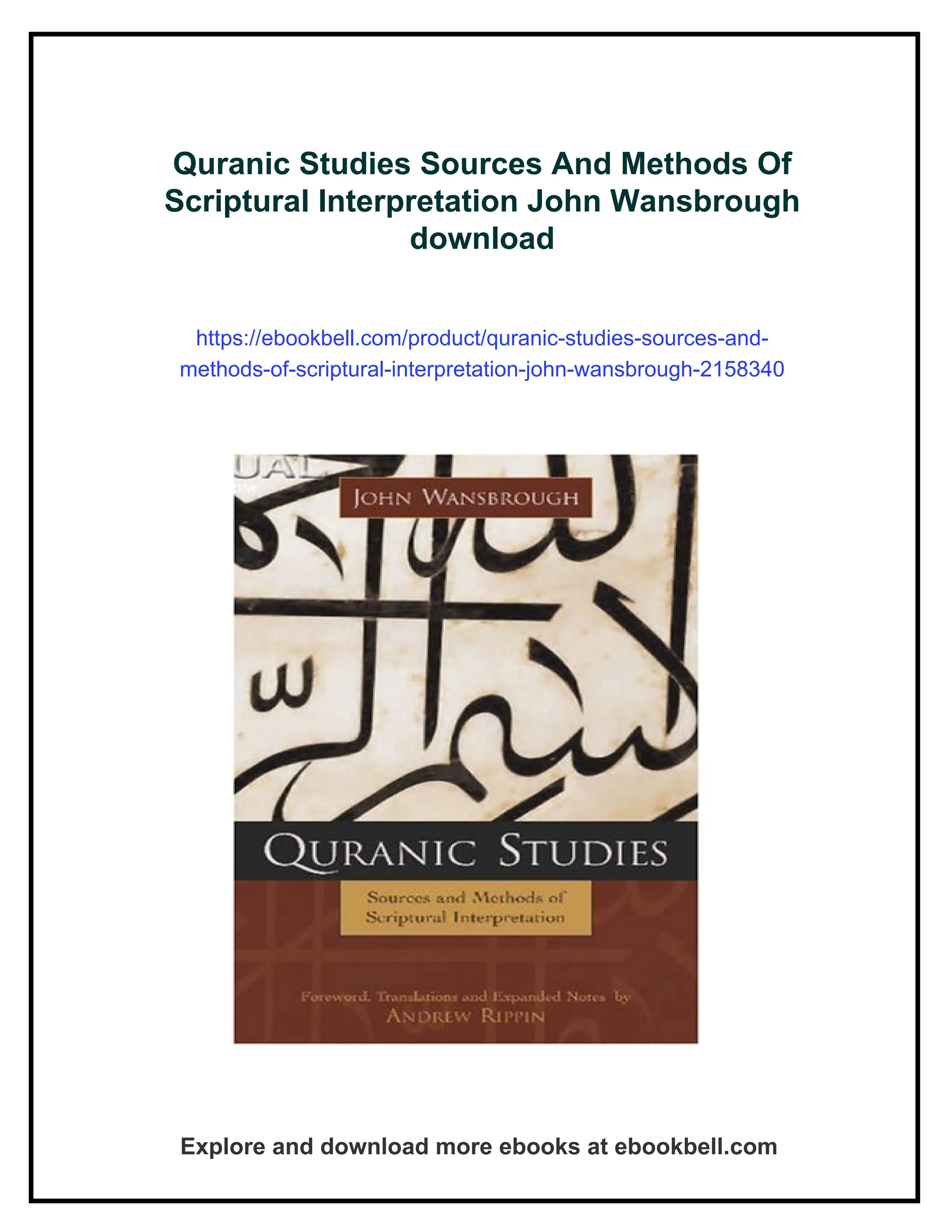

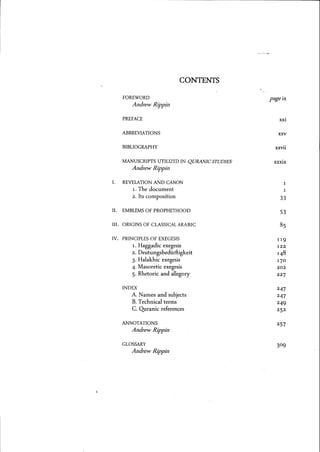





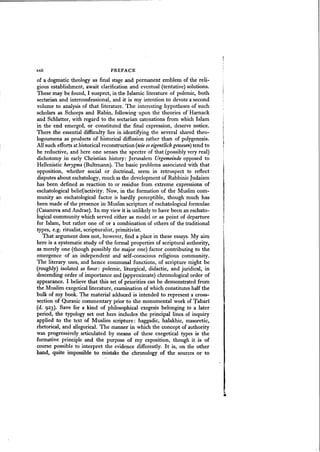
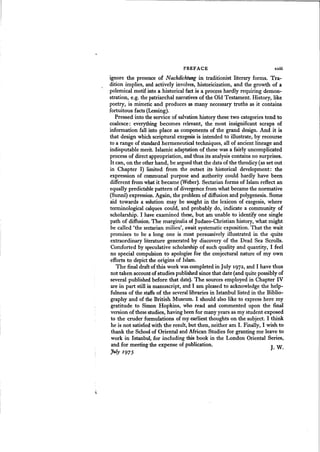

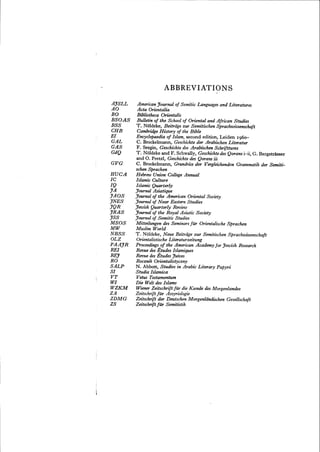

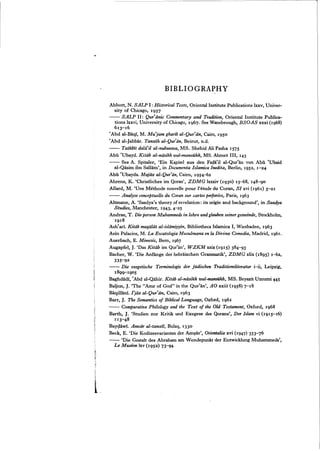
![Becker, C. H. 'Der Islam als Problem', Der Islam i (1910) 1-21 (Islamstudien I,
Leipzig, 1924, 1-23)
- - 'Christliche Polemik und Islamische Dogmenbildung", ZA xxvi (1911) 175-
95 (Islamstudien I, 432-49)
- - 'Ubi sunt qui ante nos in mundo fuere", in Festschrift E. Kuhn, Breslau, 1916
87-105 (Islamstudien I, 501-19)
- - 'Prinzipielles zu Lanunens Sirastudien', Der Islam iv (1913) 263-9 (Islam-
studien I, 520-'7: 'Grundsatzliches zur Leben-Muhammed-Forschung')
- - Beitriige zur Geschichte J1"gyptens unter dem Islam i-ii, Strassburg, 1902-3
Bell, R. Bell's Introduction to the Qur'iin, ed. W. M. Watt, Edinburgh, 1970
Ben-Zvi, I. 'Les Origines de l'etablissement des tribus d'Jsrael en Arabie', Le
Museon lxxiv (1961) 143-90
Bergstrasser, G. Einfiihrung in die semitischen Sprachen, Munchen, 1928
- - Hebriiische Grammatik i, Leipzig, 1918
- - 'Die Koranlesung des Hasan von Basra', Islamica ii (1926) II-57
- - 'Anfange und Charakter des juristischen Denkens im Islam', Der Islam xiv
(1925) 76-81
- - and Pretzl, O. Geschichte des Qorans III: Die Geschichte des Korantexts,
Leipzig, 1938
Bevan, A. 'Mohammed's Ascension', in Studien zur Semitischen Philologie und
Religionsgeschichte Julius Wellhausen ... gewidmet, Giessen, 1914, 49-61
Birkeland, H. Altarabische Pausalformen, Oslo, 1940
- - The Legend of the Opening of Muhammed's Breast, Oslo, 1955
- - Old Muslim Opposition against Interpretation of the Koran, Oslo, 1955
- - The Lord Guideth: Studies on Primitive Islam, Oslo, 1956
- - 'The interpretation of Surah 107', SI ix (1958) 13-29
Bjorkman, W. Beitriige zur Geschichte der Staatskanzlei im islamischen J1"gypten,
Hamburg, 1928
Blachere, R. Introduction au Coran, Paris, 1959
- - Histoire de la litterature arabe i-iii, Paris, 1952-66
Black, M. An Aramaic approach to the Gospels and Acts, Oxford, 1967
Blanc, H. Communal Dialects in Baghdad, Cambridge, Mass., 1964
Blau, J. A Grammar of Christian Arabic, based mainly on South Palestinian Texts
from the first Millennium, CSCO Subsidia 27-g, Louvain, 1966-']. See Wans-
brough, BSOAS xxxi (1968) 610-13
- - On Pseudo-corrections in some Semitic Languages, Jerusalem, 1970
- - The Emergence and Linguistic Background of Judaeo-Arabic, Oxford, 1965
- - 'The role of the bedouins as arbiters in linguistic questions and the Mas'ala
Az-Zuribiiriyya', JSS viii (1963) 42-51
- - 'Some problems of the formation of the old Semitic languages in the light
of Arabic dialects', in Proceedings of the International Conference on Semitic
Studies, Jerusalem, 1965
- - "L'Apparition du type linguistique neo-arabe', REI xxxvi (1969) 191-201
- - 'Judaeo-Arabic in its linguistic setting', PAAJR xxxvi (1968) 1-I2
- - 'On the problem of the synthetic character of Classical Arabic as against
Judaeo-Arabic (Middle Arabic)', JQR lxiii (1972) 2g-J8
xxviii BIBLIOGRAPHY
,
I
l](https://image.slidesharecdn.com/1079170-250605035900-be7a1cc8/85/Quranic-Studies-Sources-And-Methods-Of-Scriptural-Interpretation-John-Wansbrough-32-320.jpg)
![xxx BIBLIOGRAPHY
Derenbourg, J. 'Quelques remarques sur la declinaison arabe', JA IV ( 1844 )
209-20
Derrett, J. Law in the New Testament, London, 1970
Dinawari. Tafsir al-wiitjifz, MS. Ayasofya 221-2
Dozy, R. Supplement aux Dictionnaires Arabes, Leiden, 1967
Eissfeldt, O. Einleitung in das Alte Testament, Tubingen, 1956
Elbogen, I. Der jiidische Gottesdienst in seiner geschichtlichen Entwicklung, Frank-
furt, 1931
Farra'. Mafiini 'l-Qur'iin, Cairo, 1955-, and MS. Nurosmaniye 459
Ferguson, C. 'The Arabic Koine', Language xxxv (1959) 616-30
Fischer, A. 'Arab. aysh', ZDMG lix (1905) 807-18
-- 'Usaijid, usw.', ZDMG lvi (1902) 581
-- 'Eine Qoran-Interpolation', in Orientalische Studien Theodor Noldeke ...
gewidmet, 1906, i, 33-55
-- 'Die Mas'ala Zunburija", in A Volume of Oriental Studies Presented to E. G.
Browne, Cambridge, 1922, 150-6
Fischer, W. 'Ein Srock vorklassischer, arabischer Kunstprosa in der Umm
Ma'bad-Legende', in Festschrift W. Eilers, Wiesbaden, 1967, 318-24
-- 'Silbenstruktur und Vokalismus im Arabischen', ZDMG cxvii (1967)
30-'77
Frye, N. Anatomy of Criticism, Princeton, 1957
Flick, J. "Arabiya; recherches sur l'histoire de la langue et du style arabe, tr, C.
Denizeau, Paris, 1955
Galliner, S. Saadia Al-fajjioni:« arabische Psalmenubersetzung und Commentar
(Psalm 73-89), Berlin, 1903
Garbell, I. 'Remarks on the historical phonology of an East Mediterranean Arabic
dialect', Word xiv (1958) 303-37
Geiger, A. Was hat Mohammed aus dem Judenthume aufgenommen?, Leipzig, 1902
Gerhardsson, B. Memory and Manuscript: Oral Tradition and Written Transmission
in Rabbinic Judaism and Early Christianity, Copenhagen, 1964
Gertner, M. 'The Masorah and the Levites: an essay in the history of a concept',
VT x (1960) 241-']2
-- 'Terms of scriptural interpretation: a study in Hebrew semantics', BSOAS
(1962) 1-27
-- 'The terms pharisaioi, gazarenoi, hupokritai: their semantic complexity and
conceptual correlation', BSOAS xxvi (1963) 245-58
-- 'On translating medieval Hebrew writing', JRAS (1963) 163-93
Goitein, S. 'Ramadan, the Muslim month of fasting', in Studies in Islamic History
and Institutions, Leiden, 1966, 90-110
-- 'A turning-point in the history of the Muslim state', Ie xxiii (1949) 120-35
(Studies 149-67)
-- 'The Birth-hour of Muslim law', MW 1 (1960) 23-9 (Studies 126-34)
Goldziher, I. Abhandlungen zur Arabischen Philologie i-ii, Leiden, 1896"-99
-- Die Richtungen der islamischen Koranauslegung, Leiden, 1920
-- Muhammedanische Studien i-ii, Halle, 1889"-90](https://image.slidesharecdn.com/1079170-250605035900-be7a1cc8/85/Quranic-Studies-Sources-And-Methods-Of-Scriptural-Interpretation-John-Wansbrough-34-320.jpg)
![BIBLIOGRAPHY xxxi
- - Die ~ahiriten, Leipzig, 1884
- - Vorlesungen uber den Islam, Heidelberg, 1910
- - Gesammelte Schriften i-v, ed. J. DesomogyizHildesheim, 1967-70 (GS)
- 'Beitrage zur Geschichte der Sprachgelehrsamkeit bei den Arabern I-III',
SKAW lxvii (1871) 207-51, lxxii (1872) 587-631, lxxiii (1873) SII-S2 (GS i,
7-51, 91-135, 187-228)
- - 'Linguistisches aus der Literatur der muhammedanischen Mystik', ZDMG
xxvi (1872) 764-85 (GS i, 165-86)
- - 'Ober muhammedanische Polemik gegen Ahl al-kitab', ZDMG xxxii (1878)
341-87 (GS ii, 1-47)
- - 'Das Princip des Istishab in der muhammedanischen Gesetzwissenschaft',
WZKM i (1887) 228-36 (GS ii, 182-g0)
- 'Die Ginnen der Dichter', ZDMG xlv (1891) 68S-go (GS ii, 400-5)
- 'Der Chatib bei den alten Arabem', WZKMvi (1892) 97-102 (GS iii, 27-32)
- - 'Usages juifs d'apres la litterature religieuse des Musulmans', REJ xxviii
(1894) 75-94 (GS iii, 322-41)
- - 'Neue Materialien zur Litteratur des Oberlieferungswesens bei den Muham-
medanern', ZDMG 1 (1896) 46S-S06 (GS iv, 6g-1Io)
- - 'Melanges judeo-arabes', REJ xliii (1901) 1-14 (GS iv, 263-'76)
- - 'Neutestamentliche Elemente in der Traditionslitteratur des Islam', Oriem
Christianus (1902) 390-7 (GS iv, 315-22)
- - 'Die Bedeutung der Nachmittagszeit im Islam', Archiv far Religionswissen-
schaft ix (1906) 294-302 (GS v, 23-31)
- - 'Aus der Theologie des Fachr al-din al-Razi', Der Islam iii (1912) 213-47
(GS v, 237-'71)
- - 'Bemerkungen zur neuhebraischen Poesie', JQR xiv (1902) 719-36
- - 'Kampfe urn die Stellung des Hadit im Islam', ZDMG lxi (1907) 860-']2
(GS v, 86-g8)
Gotz, M. 'Matllridi und sein Kitab Ta'wilat al-Qur'an', Der Islam xli (196S)
27-7°
Grohmann, A. Einfiihrung und Chrestomathie zur arabischen Papyrushunde,
Prague, 1955
Grunebaum, G. von. A Tenth-century Document of Arabic Literary Theory and
Criticism, Chicago, 1950
- - Kritik und Dichtkunst: Studien zur arabischen Literaturgeschichte, Wiesbaden,
1955
GrUnbaum, M. Neue Beitriige zur semitischen Sagenkunde, Leipzig, 1893
Guidi, M. La lotta tra l'Islam e il Manicheismo, Rome, 1927
Hasan, A. 'The theory of naskh', Islamic Studies iv (1965) 181-200
Heinrichs, W. Arabische Dichtung und Griechische Poetik, Beirut, 1969. See Wans-
brough, BSOAS xxxiii (1970 ) 615-17
Heller, B. 'Recits et personnages bibliques dans la legende mahometane', REI
lxxxv (1928) 113-36 .
- - 'La Legende biblique dans I'Islam', REJxcviii (1934) 1-18
Hibatallah. Kitab al-ndsikh wal-manmkh, Cairo, 1960](https://image.slidesharecdn.com/1079170-250605035900-be7a1cc8/85/Quranic-Studies-Sources-And-Methods-Of-Scriptural-Interpretation-John-Wansbrough-35-320.jpg)
![xxxviii BIBLIOGRAPHY
Watt, W. 'Early discussions about the Qur~an', MW xl (1950) 27-40, 96-105
-- 'The dating of the Qur'an: a review of Richard Bell's theories',JRAS (1957)
46-56
-- 'The Materials used by Ibn Ishaq', in Historians of the Middle East, London,
1962,23-34
Wehr, H. Review of Fiick, ' Arabiya, in ZDMG cii (1952) 179-"86
Weil, G. Die grammatischen Schulen von Kufa und Basra, Leiden, 1913
- - Grundriss und System der altarabischen Metren, Wiesbaden, 1958
Weinreich, U. Languages in contact, The Hague-Paris, 1968
Weisgerber, L. Deutsch als Volksname, Stuttgart, 1953
Weisweiler, M. "Abdalqahir al-Curcani's Werk iiber die Unnachahmlichkeit des
Korans und seine syntaktisch-stilistischen Lehren, Oriens xi (1958) 77-121
Wellhausen, J. Reste arabischen Heidentums, Berlin, 1927
- - Prolegomena zur iiltesten Geschichte des Islams, Skizzen und Vorarbeiten VI,
Berlin, 1899
-- Das arabische Reich und sein StUTZ, Berlin, 1902
Wensinck, A. 'Muhammed und die Propheten', AO ii (1924) 168~8
.-- A Handbook of Early Muhammadan Tradition, Leiden, 1927
- - The Muslim Creed, Cambridge, 1932
Westennann, C. Grundformen prophetischer Rede, Munchen, 1968
Wetzstein, I. 'Sprachliches aus den Zeltlagern der syrischen Wiiste', ZDMG xxii
1868) 69-"194
Widengren, G. Muhammad, the Apostle of God, and his Ascension, Uppsala-
Wiesbaden, 1955
-- 'Oral tradition and written literature among the Hebrews in the light of
Arabic evidence, with special regard to prose narratives', AO xxiii (1959) 201-62
Wieder, N. TheJudean Scrolls and Karaism, London, 1962
Wild, S. Das Kitiib al-' Ain und die arabische Lexikographie, Wiesbaden, 1965
Wiirthwein, E. The Text of the Old Testament, Oxford, 1957
Zabidi. Tdj al-'Arils, Cairo, 1306-']
Zajjaj. Kitab I'rab al-Qur'iin wa-ma'iinihi, MS. Ahmet III, 122-3, Nurosmaniye
IIS
Zamakhshari. Al-Kashshiif 'an l;zaqd'iq al-tanzil i-iv, Beirut, 1967
- - AI-MufaHal, Christiana, 1879
Zuhri. Kitdb Tanzi! al-Qur'dn, Beirut, 1963
Zunz, L. Die Gottesdienstlichen Vortriigeder juden, Frankfurt, 1892](https://image.slidesharecdn.com/1079170-250605035900-be7a1cc8/85/Quranic-Studies-Sources-And-Methods-Of-Scriptural-Interpretation-John-Wansbrough-42-320.jpg)
![MANUSCRIPTS UTILIZED IN QURANIC STUDIES
1. 'Abd al-jabbar, Tathbit dalaJlal-nubuwwa
An edition was published in 1966, edited by 'Abd al-Karim
'Uthman,
2. Abu 'Ubayd, Kitdb sl-ruisik]: wal-mansiikh
A facsimile edition of the manuscript Ahmet III 143 (209ff.)
was published by F. Sezgin, Frankfurt 1985. The manuscript was
edited with commentary by John Burton, Cambridge 1987; also
edited by Muhammad al-Mudayfir, Riyad 1990. See A. Rippin,
"Abu 'Ubaid's Kitsb sl-nasik]: wa'l-msnsiikh,' BSOAS 53 (1990):
319-20, for details on the manuscript fragment, Turk ve Islam
Eserli Miizesi 7892.
3. Abu 'Ubayd, Far;laJl al-Qur>an
Wansbrough employed an extract published by Spitaler. The
full text has been edited by Wahbi Sulayrnan Khawaji, Beirut 1991.
4. al-Baghdadi, 'Abd al-Qahir, Kitiib sl-ruisikh wel-msnsiikh
The text has been published, ed. Hilmi Kamil As'ad 'Abd al-
Hadi, <Amman 1987, based upon the manuscripts Berlin
Petermann S5S (a somewhat broken copy) and Beyazit 445. A
third significant manuscript exists, Manisa 178, written in the
eighth century, 101ff. For further details on this text, see A.
Rippin, "The Exegetical Literature of Abrogation: Form and
Content," in Studies in Islamic and Middle Eastern Texts and
Traditions in Memory of Norman Calder (Oxford, 2000), pp.
21 3- 31.
S. Dinawari, Tatsir al-waejil;
The text has been published under the title Tatsir ibn Wahb
mussmmii al-War;lil; fl tafsir al-Qur>an al-karim, ed. Ahmad Farid
(Beirut, 2003). However, the work ascribed to Kalbi-s-see number
9 below-and at the same time ascribed to Ibn <Abbas and
al-FlriizabadI and printed many times under the title Tanwir sl-
miqbes min I teisir Ibn ~bbas-is identical; see A. Rippin, "Tafsir](https://image.slidesharecdn.com/1079170-250605035900-be7a1cc8/85/Quranic-Studies-Sources-And-Methods-Of-Scriptural-Interpretation-John-Wansbrough-43-320.jpg)
![xl MANUSCRIPTS UTILIZED
Ibn 'Abbas and Criteria for Dating Early taisir Texts," Jerusalem
Studies in Arabic and Islam 18 (1994): 38-83 (= A. Rippin, The
Qur~n and Its Interpretative Tradition [Aldershot, UK, 2001],
chap. 15).
6. Ibn 'Abbas, Kitiib bayiinlughat al-Qur~n
Wansbrough indicates (p. 219) that the manuscript Esad
Efendi 91 with this title contains the text of Ibn 'Abbas, Gharib al-
Quran. For further clarification of the works under both these
titles, see A. Rippin, "Ibn 'Abbas's al-Lughat fI1-Qur>an," BSOAS
44 (1981): 15-2 5; and A. Rippin, "Ibn 'Abbas's Gbsrib sl-
Qur~n," BSOAS 46 (1983): 332-33 (= A. Rippin, The Qur~n
and Its Interpretative Tradition, chaps. 13 and 14). The work is
published (as indicated by Wansbrough butnot consulted by him)
as Kitab al-lughat fI1-Qur~n rawaya ibn Hssniin al-Muqri bi-
isruidihi11a Ibn 'Abbas, ed. Salah al-Din al-Munajjid (Cairo, 1946;
reprint, Beirut, 1972).
7. Ibn 'Abbas, Kitiib gharib al-Qur~n
The work is identical to Ibn 'Abbas, Kitab bayan lughat al-
Qur~n; see number 6 above.
8. Isfahani, Raghib, Hsll mutashsbihat al-Qur~n
No further work appears to have been done on this
manuscript.
9. Ja'far al-Sadiq, Tsisir
No further work appears to have been done on this
manuscript. Meir M. Bar-Asher, Scripture and Exegesis in Early
Imsmi Shiism (Leiden, 1999), comments that such texts are
"clearly ahistorically ascribed" to the early Imams (p. 7).
10. Kalbj, TafSIr
Published many times; see number 5 above.
11. Khurasani, (Ata' (Pseudo), Taisir (ikhtilal)
No further work appears to have been done on these folios.](https://image.slidesharecdn.com/1079170-250605035900-be7a1cc8/85/Quranic-Studies-Sources-And-Methods-Of-Scriptural-Interpretation-John-Wansbrough-44-320.jpg)
![MANUSCRIPTS UTILIZED xli
12. Kisal, Kitiib mushtsbihiit al-Qur>an
Published under the title Kitiib mutashabih al-Qur>an, ed.
Sabih al-Tarnimi (Tarabulus, 1994).
13. al-Maturidl, Kitdb ta)wilat al-Quran
Only vol. 1 has been published under the title Ta)wI]at ahl sl-
sunna, ed. Ibrahim and al-Sayyid 'Awadayn (Cairo, 1971); also, ed.
Muhammad Mustahd al-Rahrnan (Baghdad, 1983).
14. Muqatil ibn Sulayman, Tslsir
Published in four volumes (plus a fifth volume as in index and
study), ed. 'Abd Allah Mahmud Shibata (Cairo, 1980-89); also
published in three volumes, ed. Ahmad Farid (Beirut, 2003).
IS. Muqatil ibn Sulayrnan, Kitiib tafsir al-khamsmi'at aya min sl-
Quran
Published, ed. Isaiah Goldfeld (Shfaram, 1980).
16. Muqatil ibn Sulayman, Kitab al-ashbah wa'l-nezs'ir fJ tafslr al-
Quran
Published under the title Kiteb al-ashbah wa'l-neze'ir Ii 1-
Quran, ed. 'Abd Allah Mahmud Shibata (Cairo, 1975).
17. Zajjaj, Kitsb i'rdb al-Quran we-mecanihi
Published in five volumes under the title Ma cani 1-Quran wa-
i'rsbuhu, ed. 'Abd al-jalil'Abduh Shalabi (Beirut, 1988).](https://image.slidesharecdn.com/1079170-250605035900-be7a1cc8/85/Quranic-Studies-Sources-And-Methods-Of-Scriptural-Interpretation-John-Wansbrough-45-320.jpg)