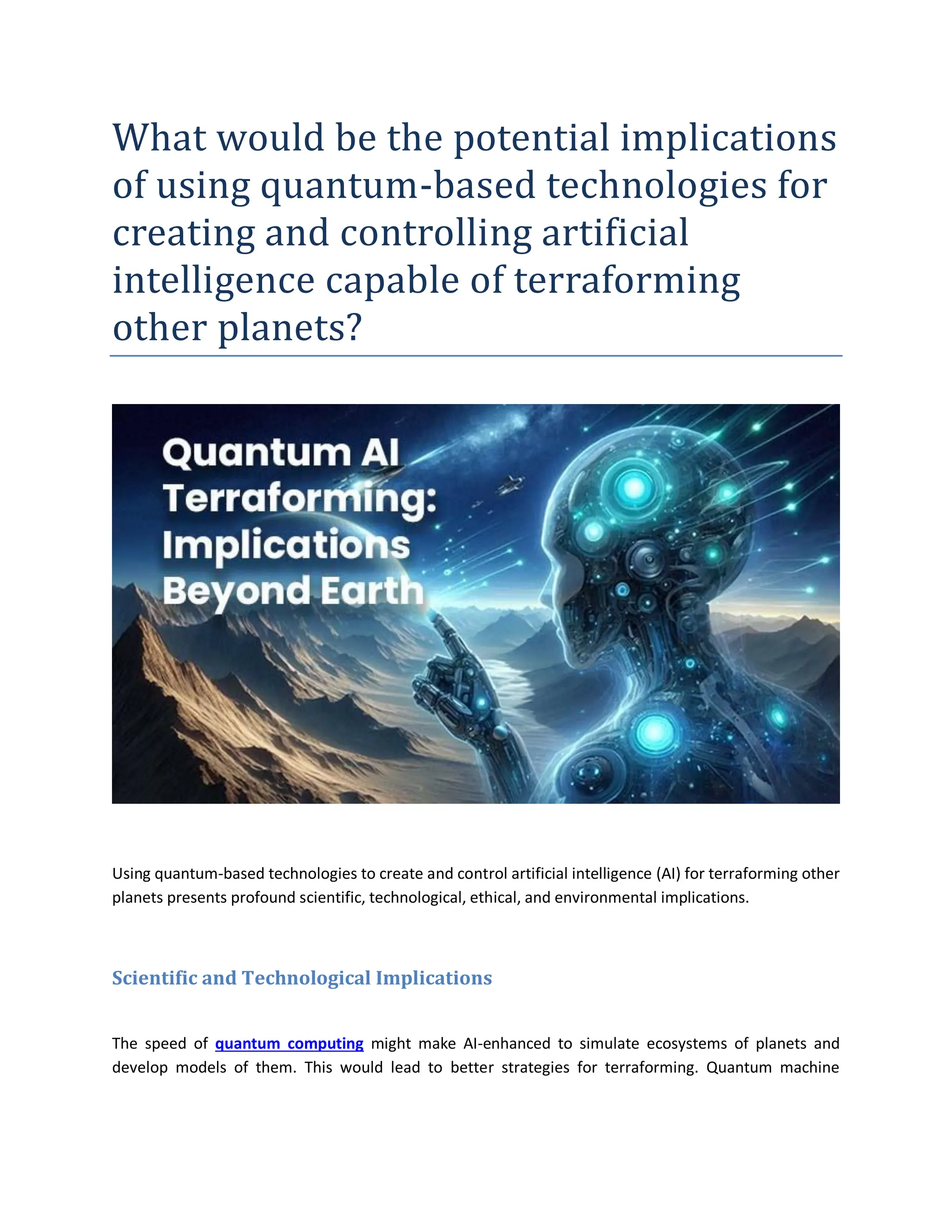
What would be the potential implications
of using quantum-based technologies for
creating and controlling artificial
intelligence capable of terraforming
other planets?
Using quantum-based technologies to create and control artificial intelligence (AI) for terraforming other
planets presents profound scientific, technological, ethical, and environmental implications.
Scientific and Technological Implications
The speed of quantum computing might make AI-enhanced to simulate ecosystems of planets and
develop models of them. This would lead to better strategies for terraforming. Quantum machine
learning algorithms could scale and analyze huge data more rapidly, making the environmental
alteration of AI-enhanced as well.
Self-improving autonomous robots could be another application that could stem from quantum
technologies; these technologies could also have implications in material science that could produce
materials for construction and other infrastructure.
Ethical and Societal Implications
The application of advanced AI in the process of terraforming raises ethical questions related to the
impact it has on another planet’s environment and species. They also can scale up power with the help
of quantum-based AI; thus, they require protection from attackers.
The availability of these technologies means that differences between nations can increase, polarizing
people and regions into powers and weak linkages, sowing seeds of conflicts and ethical questions
related to the distribution of opportunities and resources.
Environmental and Extraterrestrial Implications
It may be necessary to modify other planets’ conditions, for instance, human life forms may be
alternative life forms, or even geophysical processes, on those planets. Only eco-friendly techniques of
terraforming are possible through viable approaches based on quantum-related AIs like Alaya AI.
However, conservative and liberal changes on Earth and other planets have to be assessed and
sophisticated scientific and technological criteria are required for inter-planetary ecosystem
maintenance.
Conclusion
Technologies such as quantum-based AI-driven terraforming could potentially change the way by which
other planets could be made inhabitable for humans but at the same time, it comes with many serious
ethical, environmental, and social implications.
Consequently, deliberation and supervision are required to guarantee that these potent instruments are
applied equitably to mankind’s advantage.
Original Source

Quantum AI: Revolutionizing Technology Through Quantum Computing.

  • 1.
    What would bethe potential implications of using quantum-based technologies for creating and controlling artificial intelligence capable of terraforming other planets? Using quantum-based technologies to create and control artificial intelligence (AI) for terraforming other planets presents profound scientific, technological, ethical, and environmental implications. Scientific and Technological Implications The speed of quantum computing might make AI-enhanced to simulate ecosystems of planets and develop models of them. This would lead to better strategies for terraforming. Quantum machine
  • 2.
    learning algorithms couldscale and analyze huge data more rapidly, making the environmental alteration of AI-enhanced as well. Self-improving autonomous robots could be another application that could stem from quantum technologies; these technologies could also have implications in material science that could produce materials for construction and other infrastructure. Ethical and Societal Implications The application of advanced AI in the process of terraforming raises ethical questions related to the impact it has on another planet’s environment and species. They also can scale up power with the help of quantum-based AI; thus, they require protection from attackers. The availability of these technologies means that differences between nations can increase, polarizing people and regions into powers and weak linkages, sowing seeds of conflicts and ethical questions related to the distribution of opportunities and resources. Environmental and Extraterrestrial Implications It may be necessary to modify other planets’ conditions, for instance, human life forms may be alternative life forms, or even geophysical processes, on those planets. Only eco-friendly techniques of terraforming are possible through viable approaches based on quantum-related AIs like Alaya AI. However, conservative and liberal changes on Earth and other planets have to be assessed and sophisticated scientific and technological criteria are required for inter-planetary ecosystem maintenance. Conclusion Technologies such as quantum-based AI-driven terraforming could potentially change the way by which other planets could be made inhabitable for humans but at the same time, it comes with many serious ethical, environmental, and social implications. Consequently, deliberation and supervision are required to guarantee that these potent instruments are applied equitably to mankind’s advantage. Original Source