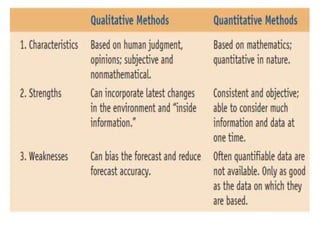
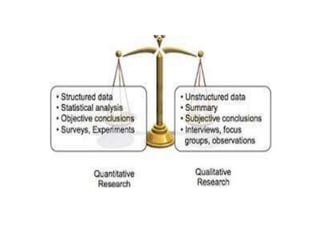
Qualitative forecasting is an estimation methodology that
uses expert judgment, rather than numerical analysis.
This type of forecasting relies upon the knowledge of
highly experienced employees and consultants to provide
insights into future outcomes. This approach is
substantially different from quantitative forecasting,
where historical data is compiled and analyzed to discern
future trends.
What is QUALITATIVE FORECASTING ?
What Are Four Primary Forecasting
Techniques?
• Delphi Technique
• The RAND Corporation developed the Delphi
Technique in the late 1960s. In the Delphi Technique, a
group of experts responds to a series of
questionnaires. The experts are kept apart and
unaware of each other. The results of the first
questionnaire are compiled, and a second
questionnaire based on the results of the first is
presented to the experts, who are asked to reevaluate
their responses to the first questionnaire. This
questioning, compilation and requestioning continues
until the researchers have a narrow range of opinions.
Scenario Writing
• In Scenario Writing, the forecaster generates
different outcomes based on different starting
criteria. The decision-maker then decides on
the most likely outcome from the numerous
scenarios presented. Scenario writing typically
yields best, worst and middle options.
Subjective Approach
• Subjective forecasting allows forecasters to
predict outcomes based on their subjective
thoughts and feelings. Subjective forecasting
uses brainstorming sessions to generate ideas
and to solve problems casually, free from
criticism and peer pressure. They are often
used when time constraints prohibit objective
forecasts. Subjective forecasts are subject to
biases and should be viewed skeptically by
decision-makers.
Time-Series Forecasting
• Time-series forecasting is a quantitative
forecasting technique. It measures data gathered
over time to identify trends. The data may be
taken over any interval: hourly; daily; weekly;
monthly; yearly; or longer. Trend, cyclical,
seasonal and irregular components make up the
time series. The trend component refers to the
data's gradual shifting over time. It is often
shown as an upward- or downward-sloping line
to represent increasing or decreasing trends,
respectively
Quantitative Forecasting tools :
• Trend Analysis:
A method for forecasting sales data when a definite upward or
downward pattern exists. Model includes double exponential smoothing, regression
& triple smoothing.
• Seasonal adjustment:
Seasonal models take into account the variation of demand from
season to season. Adjustments can be made to a baseline forecast to predict the
impact of a seasonal demand.
• Graphical method :
Plotting information in a graphical form. It is relatively easy to convert
a spreadsheet into a graph that conveys the information in a visual manner. Trends
& patterns are easier to spot & extrapolation of previous demand can be used to
predict future demands.
Qualitative Forecasting tools :
• Market Research:
Conducted thru surveys.
• Focus Groups:
Consists of panels of customers who are asked to provide their opinions
about a product or service.
• Panel Consensus:
A group of people provides opinion about the future & a facilitator
brings the group to a consensus. The groups as whole would make better decisions
than would each member individually.
Importance of forecasting :
• Supply Chain Efficiency
• Supplier and Customer Satisfaction
• Successful Long-Term Planning
• Human Limitations
• Limitations of Economic Predictions

Quantitative and qualitative forecasting techniques om

  • 3.
    Qualitative forecasting isan estimation methodology that uses expert judgment, rather than numerical analysis. This type of forecasting relies upon the knowledge of highly experienced employees and consultants to provide insights into future outcomes. This approach is substantially different from quantitative forecasting, where historical data is compiled and analyzed to discern future trends. What is QUALITATIVE FORECASTING ?
  • 6.
    What Are FourPrimary Forecasting Techniques? • Delphi Technique • The RAND Corporation developed the Delphi Technique in the late 1960s. In the Delphi Technique, a group of experts responds to a series of questionnaires. The experts are kept apart and unaware of each other. The results of the first questionnaire are compiled, and a second questionnaire based on the results of the first is presented to the experts, who are asked to reevaluate their responses to the first questionnaire. This questioning, compilation and requestioning continues until the researchers have a narrow range of opinions.
  • 7.
    Scenario Writing • InScenario Writing, the forecaster generates different outcomes based on different starting criteria. The decision-maker then decides on the most likely outcome from the numerous scenarios presented. Scenario writing typically yields best, worst and middle options.
  • 8.
    Subjective Approach • Subjectiveforecasting allows forecasters to predict outcomes based on their subjective thoughts and feelings. Subjective forecasting uses brainstorming sessions to generate ideas and to solve problems casually, free from criticism and peer pressure. They are often used when time constraints prohibit objective forecasts. Subjective forecasts are subject to biases and should be viewed skeptically by decision-makers.
  • 9.
    Time-Series Forecasting • Time-seriesforecasting is a quantitative forecasting technique. It measures data gathered over time to identify trends. The data may be taken over any interval: hourly; daily; weekly; monthly; yearly; or longer. Trend, cyclical, seasonal and irregular components make up the time series. The trend component refers to the data's gradual shifting over time. It is often shown as an upward- or downward-sloping line to represent increasing or decreasing trends, respectively
  • 10.
    Quantitative Forecasting tools: • Trend Analysis: A method for forecasting sales data when a definite upward or downward pattern exists. Model includes double exponential smoothing, regression & triple smoothing. • Seasonal adjustment: Seasonal models take into account the variation of demand from season to season. Adjustments can be made to a baseline forecast to predict the impact of a seasonal demand. • Graphical method : Plotting information in a graphical form. It is relatively easy to convert a spreadsheet into a graph that conveys the information in a visual manner. Trends & patterns are easier to spot & extrapolation of previous demand can be used to predict future demands.
  • 11.
    Qualitative Forecasting tools: • Market Research: Conducted thru surveys. • Focus Groups: Consists of panels of customers who are asked to provide their opinions about a product or service. • Panel Consensus: A group of people provides opinion about the future & a facilitator brings the group to a consensus. The groups as whole would make better decisions than would each member individually.
  • 12.
    Importance of forecasting: • Supply Chain Efficiency • Supplier and Customer Satisfaction • Successful Long-Term Planning • Human Limitations • Limitations of Economic Predictions