Quality in Testing
QUALITY PRINCIPLES

       Quality - the most important factor affecting an
                 organization’s long-term performance.

       Quality - the way to achieve improved
                 productivity and competitiveness in
                 any organization.

       Quality - saves. It does not cost.

       Quality - is the solution to the problem, not a
                  problem.

360Logica
Cost of Quality

       Prevention Cost
          Amount spent before the product is actually
          built. Cost incurred on establishing methods
          and procedures, training workers, acquiring
          tools and planning for quality.

       Appraisal cost
         Amount spent after the product is built but
         before it is shipped to the user. Cost of
         inspection, testing, and reviews.

360Logica
Failure Cost
       Amount spent to repair failures.
       Cost associated with defective products
       that have been delivered to the user or
       moved into production, costs involve
       repairing products to make them fit as per
       requirement.


360Logica
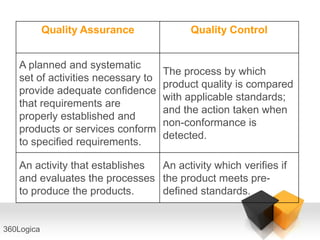
Quality Assurance            Quality Control


   A planned and systematic
                                    The process by which
   set of activities necessary to
                                    product quality is compared
   provide adequate confidence
                                    with applicable standards;
   that requirements are
                                    and the action taken when
   properly established and
                                    non-conformance is
   products or services conform
                                    detected.
   to specified requirements.

   An activity that establishes An activity which verifies if
   and evaluates the processes the product meets pre-
   to produce the products.     defined standards.


360Logica
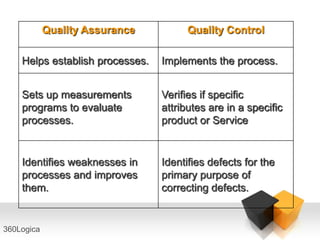
Quality Assurance         Quality Control

    Helps establish processes.   Implements the process.


    Sets up measurements         Verifies if specific
    programs to evaluate         attributes are in a specific
    processes.                   product or Service


    Identifies weaknesses in     Identifies defects for the
    processes and improves       primary purpose of
    them.                        correcting defects.


360Logica
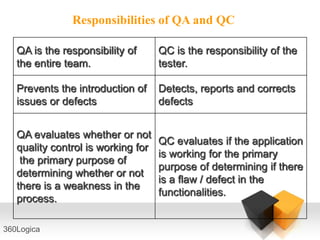
Responsibilities of QA and QC

   QA is the responsibility of      QC is the responsibility of the
   the entire team.                 tester.

   Prevents the introduction of     Detects, reports and corrects
   issues or defects                defects


   QA evaluates whether or not
                                    QC evaluates if the application
   quality control is working for
                                    is working for the primary
    the primary purpose of
                                    purpose of determining if there
   determining whether or not
                                    is a flaw / defect in the
   there is a weakness in the
                                    functionalities.
   process.

360Logica
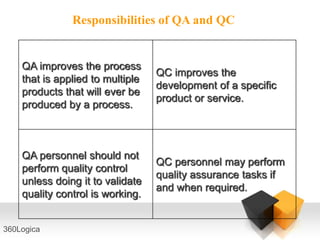
Responsibilities of QA and QC


    QA improves the process
                                  QC improves the
    that is applied to multiple
                                  development of a specific
    products that will ever be
                                  product or service.
    produced by a process.


    QA personnel should not
                                  QC personnel may perform
    perform quality control
                                  quality assurance tasks if
    unless doing it to validate
                                  and when required.
    quality control is working.


360Logica
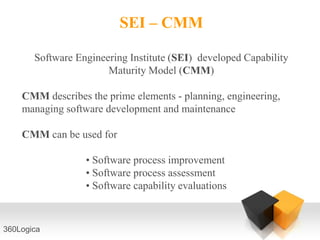
SEI – CMM

       Software Engineering Institute (SEI) developed Capability
                       Maturity Model (CMM)

    CMM describes the prime elements - planning, engineering,
    managing software development and maintenance

    CMM can be used for

                  • Software process improvement
                  • Software process assessment
                  • Software capability evaluations


360Logica
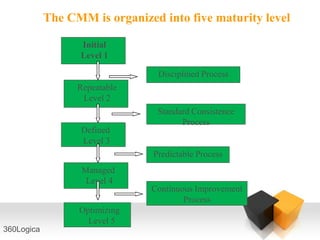
The CMM is organized into five maturity level

                  Initial
                  Level 1

                                 Disciplined Process
                  Repeatable
                   Level 2
                                 Standard Consistence
                                       Process
                  Defined
                  Level 3
                                Predictable Process
                   Managed
                    Level 4
                               Continuous Improvement
                                       Process
                  Optimizing
                    Level 5
360Logica
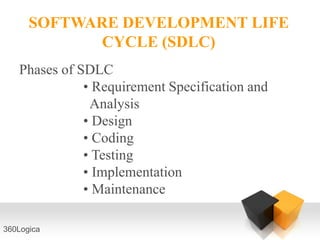
SOFTWARE DEVELOPMENT LIFE
             CYCLE (SDLC)
   Phases of SDLC
              • Requirement Specification and
               Analysis
              • Design
              • Coding
              • Testing
              • Implementation
              • Maintenance

360Logica
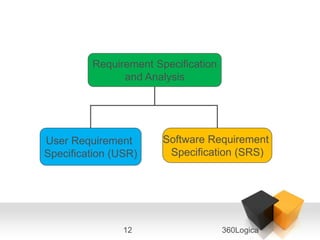
Requirement Specification
               and Analysis


User Requirement       Software Requirement
Specification (USR)     Specification (SRS)


                12                   360Logica
Design

   The output of SRS is the input of design phase.

   Two types of design -

              High Level Design (HLD)
              Low Level Design (LLD)


360Logica
High Level Design (HLD)

  List of modules and a brief description of each
   module.
  Brief functionality of each module.
  Interface relationship among modules.
  Dependencies between modules (if A exists, B
   exists etc).
  Database tables identified along with key
   elements.
  Overall architecture diagrams along with
   technology details.
360Logica
Low Level Design (LLD)

      Detailed functional logic of the module, in
       pseudo code.
      Database tables, with all elements,
       including their type and size.
      All interface details.
      All dependency issues
      Error message listings
      Complete input and outputs for a module.
360Logica
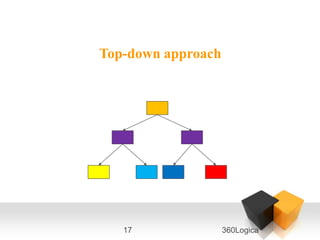
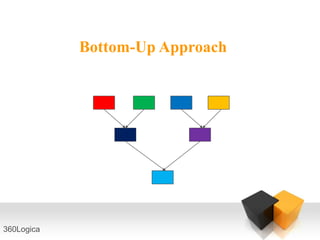
The Design process

    Breaking down the product into independent
    modules to arrive at micro levels.

    2 different approaches followed in designing –

               Top Down Approach
               Bottom Up Approach


360Logica
Top-down approach


   17               360Logica
Bottom-Up Approach


360Logica
Coding
            Developers use the LLD document and write the code in
            the programming language specified.

 Testing
            The testing process involves development of a test plan,
            executing the plan and documenting the test results.

 Implementation
       Installation of the product in its operational environment.


360Logica
Maintenance
        After the software is released and the client starts using the
    software, maintenance phase is started.

    3 things happen - Bug fixing, Upgrade, Enhancement

    Bug fixing – bugs arrived due to some untested scenarios.

    Upgrade – Upgrading the application to the newer versions of
    the software.

    Enhancement - Adding some new features into the existing
    software.


360Logica
SOFTWARE LIFE CYCLE MODELS

            WATERFALL MODEL

            V-PROCESS MODEL

            SPIRAL MODEL

            PROTOTYPE MODEL

            INCREMENTAL MODEL

            EVOLUTIONARY DEVELOPMENT MODEL


360Logica

Quality in Software Testing

  • 1.
  • 2.
    QUALITY PRINCIPLES Quality - the most important factor affecting an organization’s long-term performance. Quality - the way to achieve improved productivity and competitiveness in any organization. Quality - saves. It does not cost. Quality - is the solution to the problem, not a problem. 360Logica
  • 3.
    Cost of Quality Prevention Cost Amount spent before the product is actually built. Cost incurred on establishing methods and procedures, training workers, acquiring tools and planning for quality. Appraisal cost Amount spent after the product is built but before it is shipped to the user. Cost of inspection, testing, and reviews. 360Logica
  • 4.
    Failure Cost Amount spent to repair failures. Cost associated with defective products that have been delivered to the user or moved into production, costs involve repairing products to make them fit as per requirement. 360Logica
  • 5.
    Quality Assurance Quality Control A planned and systematic The process by which set of activities necessary to product quality is compared provide adequate confidence with applicable standards; that requirements are and the action taken when properly established and non-conformance is products or services conform detected. to specified requirements. An activity that establishes An activity which verifies if and evaluates the processes the product meets pre- to produce the products. defined standards. 360Logica
  • 6.
    Quality Assurance Quality Control Helps establish processes. Implements the process. Sets up measurements Verifies if specific programs to evaluate attributes are in a specific processes. product or Service Identifies weaknesses in Identifies defects for the processes and improves primary purpose of them. correcting defects. 360Logica
  • 7.
    Responsibilities of QAand QC QA is the responsibility of QC is the responsibility of the the entire team. tester. Prevents the introduction of Detects, reports and corrects issues or defects defects QA evaluates whether or not QC evaluates if the application quality control is working for is working for the primary the primary purpose of purpose of determining if there determining whether or not is a flaw / defect in the there is a weakness in the functionalities. process. 360Logica
  • 8.
    Responsibilities of QAand QC QA improves the process QC improves the that is applied to multiple development of a specific products that will ever be product or service. produced by a process. QA personnel should not QC personnel may perform perform quality control quality assurance tasks if unless doing it to validate and when required. quality control is working. 360Logica
  • 9.
    SEI – CMM Software Engineering Institute (SEI) developed Capability Maturity Model (CMM) CMM describes the prime elements - planning, engineering, managing software development and maintenance CMM can be used for • Software process improvement • Software process assessment • Software capability evaluations 360Logica
  • 10.
    The CMM isorganized into five maturity level Initial Level 1 Disciplined Process Repeatable Level 2 Standard Consistence Process Defined Level 3 Predictable Process Managed Level 4 Continuous Improvement Process Optimizing Level 5 360Logica
  • 11.
    SOFTWARE DEVELOPMENT LIFE CYCLE (SDLC) Phases of SDLC • Requirement Specification and Analysis • Design • Coding • Testing • Implementation • Maintenance 360Logica
  • 12.
    Requirement Specification and Analysis User Requirement Software Requirement Specification (USR) Specification (SRS) 12 360Logica
  • 13.
    Design The output of SRS is the input of design phase. Two types of design - High Level Design (HLD) Low Level Design (LLD) 360Logica
  • 14.
    High Level Design(HLD)  List of modules and a brief description of each module.  Brief functionality of each module.  Interface relationship among modules.  Dependencies between modules (if A exists, B exists etc).  Database tables identified along with key elements.  Overall architecture diagrams along with technology details. 360Logica
  • 15.
    Low Level Design(LLD)  Detailed functional logic of the module, in pseudo code.  Database tables, with all elements, including their type and size.  All interface details.  All dependency issues  Error message listings  Complete input and outputs for a module. 360Logica
  • 16.
    The Design process Breaking down the product into independent modules to arrive at micro levels. 2 different approaches followed in designing – Top Down Approach Bottom Up Approach 360Logica
  • 17.
    Top-down approach 17 360Logica
  • 18.
  • 19.
    Coding Developers use the LLD document and write the code in the programming language specified. Testing The testing process involves development of a test plan, executing the plan and documenting the test results. Implementation Installation of the product in its operational environment. 360Logica
  • 20.
    Maintenance After the software is released and the client starts using the software, maintenance phase is started. 3 things happen - Bug fixing, Upgrade, Enhancement Bug fixing – bugs arrived due to some untested scenarios. Upgrade – Upgrading the application to the newer versions of the software. Enhancement - Adding some new features into the existing software. 360Logica
  • 21.
    SOFTWARE LIFE CYCLEMODELS WATERFALL MODEL V-PROCESS MODEL SPIRAL MODEL PROTOTYPE MODEL INCREMENTAL MODEL EVOLUTIONARY DEVELOPMENT MODEL 360Logica